When I try to take photographs of a butterfly, I usually have multiple objectives. First, of course, I’d like to be able to capture some images that are more or less in focus. Ideally, I like to get an interesting wing position, which often means that I try to catch the butterfly with its wings open. Finally, I love to catch the butterfly in a visually attractive habitat or doing something interesting, though these variables are the ones over which I have the least amount of control.
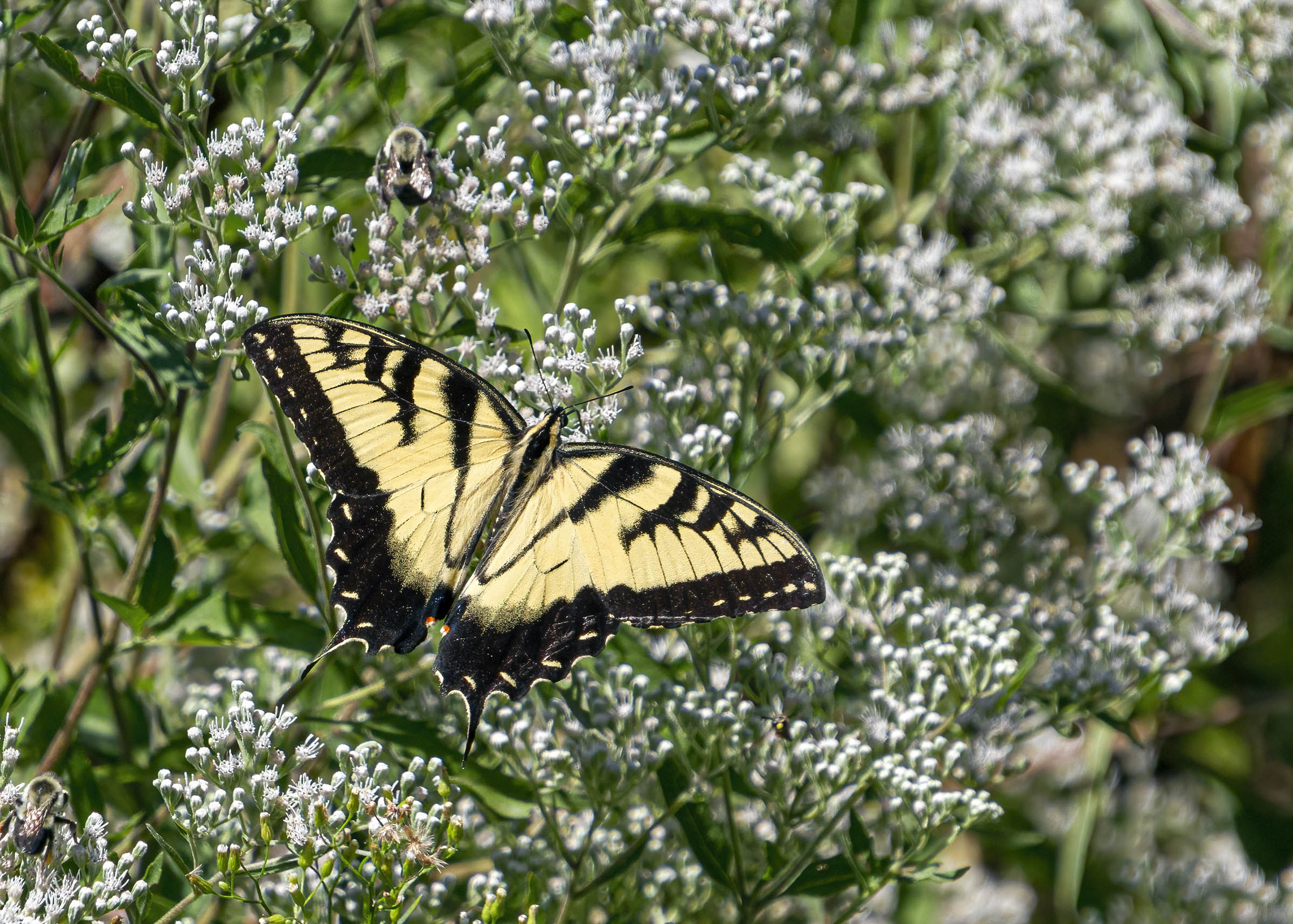
On Monday I chased after this Eastern Tiger Swallowtail butterfly (Papilio glaucus) when I spotted it in flight and tracked it when it landed in some nearby vegetation. There did not seem to be any flowers there, so I was a little surprised that the butterfly had chosen to perch at that spot. I carefully chose my shooting angle and was pretty pleased that I was able to capture a lot of the habitat. Although there is still a lot of greenery, the dried-up leaves help to give the image an interesting autumn vibe.
I was thrilled to spot this pristine Eastern Tiger Swallowtail butterfly (Papilio glaucus) last week at Occoquan Bay National Wildlife Refuge. Many of the butterflies that I see this late in the season are tattered and damaged, but this one appeared to be in a perfect condition as it hungrily fed on some blooming wildflowers.
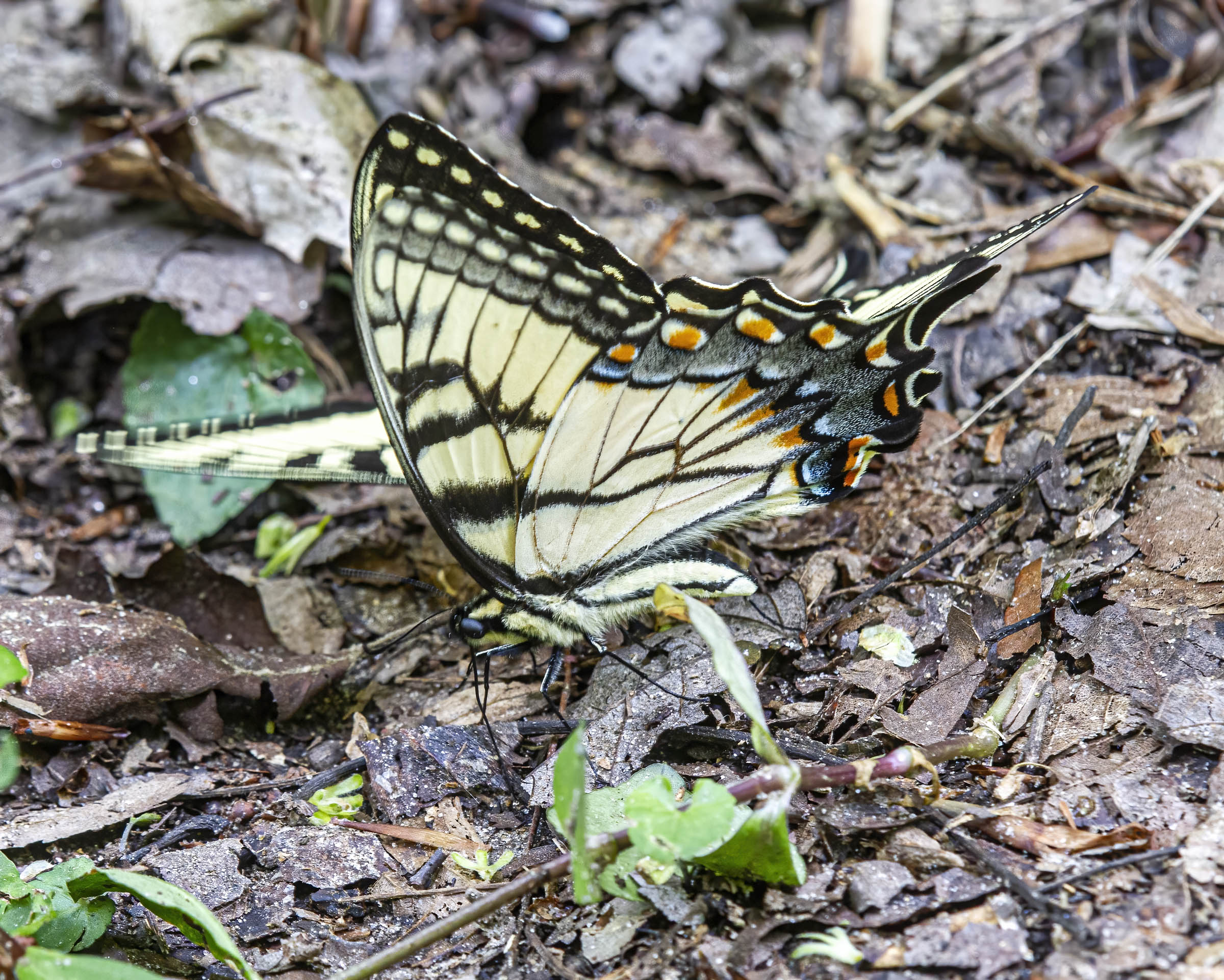
This Eastern Tiger Swallowtail butterfly (Papilio glaucus) was sipping from a wet area at the edge of a forest creek (and maybe ingesting other nutrients) when I photographed it on 23 April at Prince William Forest Park in Triangle,Virginia. I used to associate this species of butterfly with gardens, because that is where I tended to spot them in the past. However, over the last few years, I have spent a lot of time in the spring in forested areas and have spotted Eastern Tiger Swallowtails regularly there, both individually and in small groups.
Check out my 2021 posting called “A Kaleidoscope of butterflies” to see a photograph of Eastern Tiger Swallowtails “puddling,” i.e. congregating together on wet sand and mud to drink water and extract minerals from puddles.
We are definitely in a period of time when butterflies are everywhere, especially in the patches of thistles that are blooming now. Earlier in the week I spotted this beautiful male Eastern Tiger Swallowtail (Papilio glaucus) at Occoquan Bay National Wildlife Refuge as he was feeding on a thistle. I was delighted to capture a shot when the butterfly had his wings fuly extended, showing off all the details of the wings.
In case you are curious, you can tell that the butterfly is a male because he lacks the band of blue spots along the hindwings that are found on the females of the species.
I’ve noted several times recently the tattered butterflies that I tend to encounter at this time of the year. However, not all of the ones that I see have suffered wing damage. Some of them appear to have recently emerged and are in perfect condition, like these Eastern Tiger Swallowtail butterflies (Papilio glaucus) that I spotted during a recent visit to Occoquan Bay National Wildlife Refuge.
There must be something irresistible about thistle flowers, because on Tuesday I encountered multiple clusters of thistles with butterflies feeding on them during a short visit to Huntley Meadows Park. Sometimes the butterflies seemed to be socially distancing themselves, but at other times they were feeding side by side with other butterflies, including those of different species.
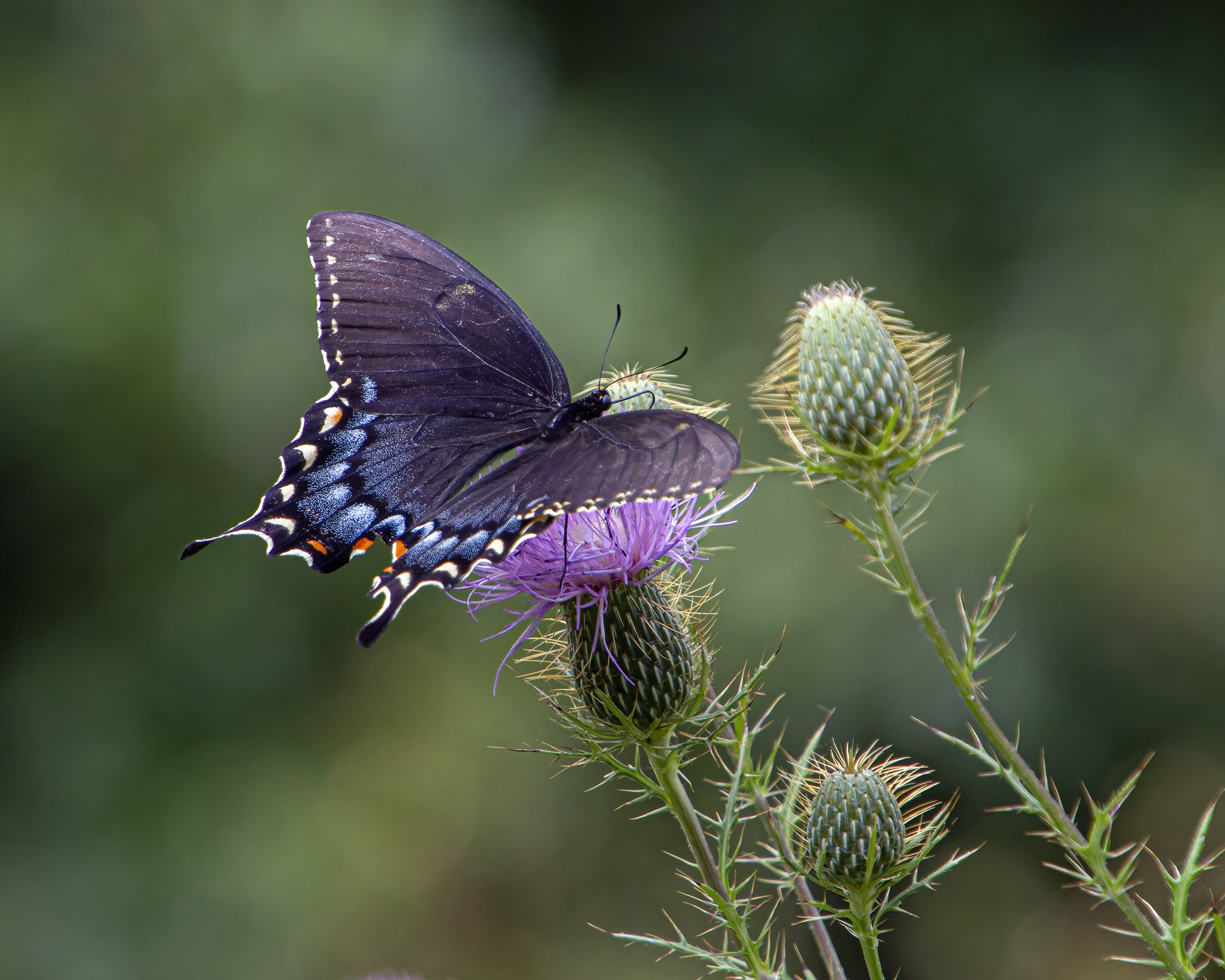
Of course, butterflies do not remain still while feeding—they move about constantly as they change their positions and flap their wings, complicating my efforts to capture images of them. The first photo below is one of my favorites. It shows a dark morph female Eastern Tiger Swallowtail (Papilio glaucus) sharing a thistle flower with two Great Spangled Fritillary butterflies (Speyeria cybele). I love the contrast between the colors of these two species that together provide a foretaste of the autumn season that is almost upon us.
The second photo provides a closer view of the dark morph Eastern Tiger Swallowtail. The final photo is a shot of what I believe is another female Eastern Tiger Swallowtail that has a yellow coloration similar to that of a male, but has an additional band of blue spots along the hindwings. I think it is really cool that there are two different color variants of females—in many insect and bird species, the males have more color and variation and the females are drab by comparison.
I went on a pretty long hike yesterday in Prince William Forest Park—just over 18,000 steps (7.1 miles or 11 km) according to my iPhone—and was delighted to spot this beautiful Eastern Tiger Swallowtail butterfly (Papilio glaucus), my first of the season.
When I first spotted the butterfly, it appeared to be sucking moisture and minerals from the wet soil, as you can see in the first photo. The butterfly flew to a nearby location and resumed its efforts and I was able to maneuver around to get the second image that shows the markings of the butterfly a bit better.
Personally I prefer the first photo that is more dynamic and gives a better sense of the activity of the butterfly. From a purely scientific perspective, the second one might be preferable because it shows more of the butterfly’s identification features. I am more of an artist than a scientist, though, so capturing all of the details with clinical precision is not as important to me.
I was excited to spot this beautiful Eastern Tiger Swallowtail butterfly (Papilio glaucus) on Monday at Occoquan Bay National Wildlife Refuge. Most years I spot lots of these butterflies, but for some reason I have not seen one in quite some time this summer.
I love the beautiful coloration of this Eastern Tiger Swallowtail and believe that it is a female. Males of this species are almost exclusively yellow and black, while females are more vividly colored, with strongly pronounced cells of orange and a greater degree of iridescent blue on the lower wings.
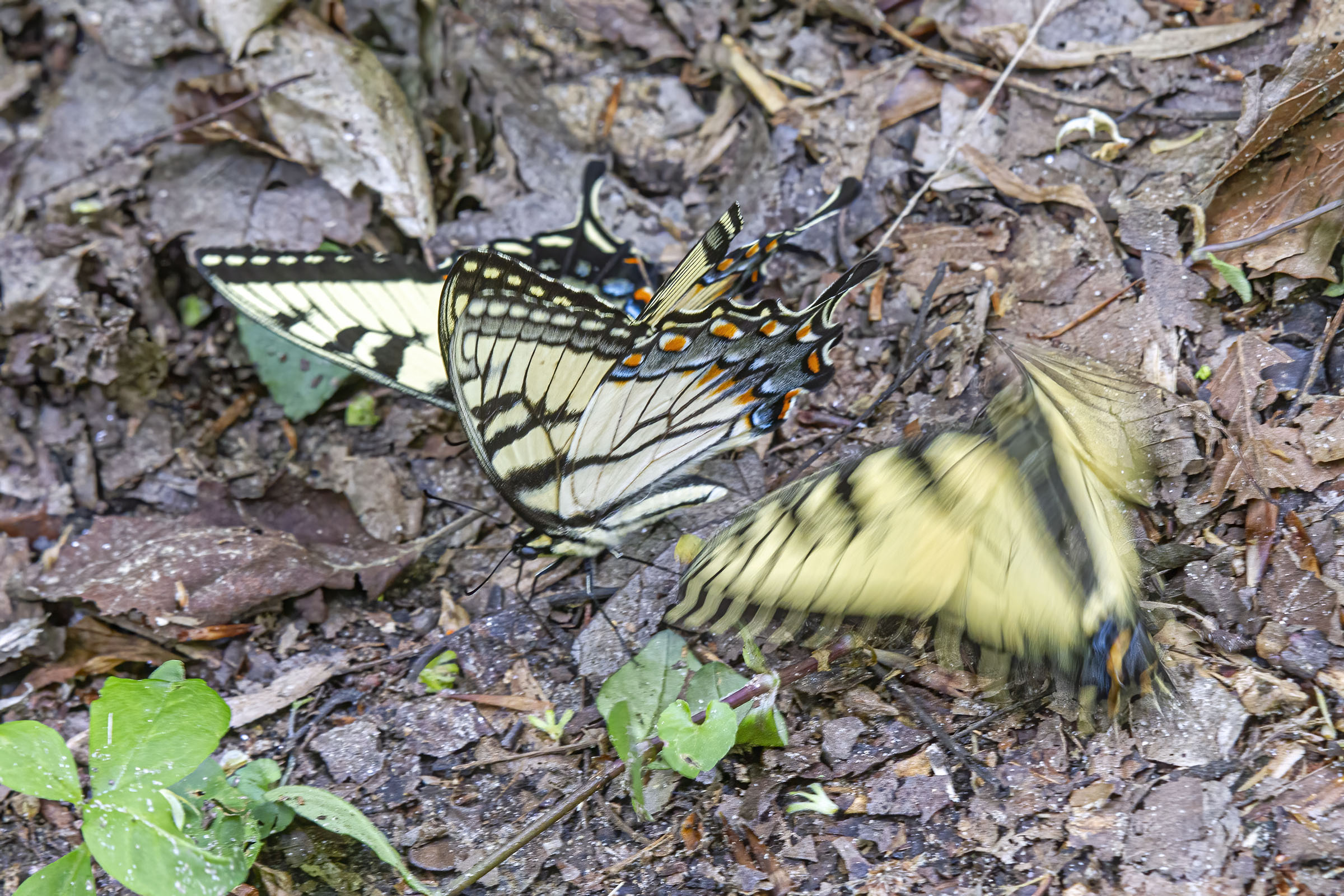
I usually think of butterflies drinking nectar from colorful flowers. Sometimes, though, newly emerged Eastern Tiger Swallowtails (Papilio polyxenes) will gather around mud puddles or other damp spots—a behavior often referred to as “puddling”—to suck minerals and other substances out of the damp ground, like these butterflies that I spotted in early May alongside a creek in Prince William County, Virginia.
Butterflies were constantly moving in and out of a small group that seemed to be concentrated at one particular spot. As I was taking this shot, a new arrival “photobombed” me. I really like the motion blur of the arriving butterfly, which gives the image a dynamic feel and also a bit of whimsy. The second shot is a close-up view of one of the butterflies as it extracted nutrients from the moist area.
“Puddling” behavior is mostly associated with male butterflies. According to an article at the Thoughtco website, “Nectar lacks some important nutrients the butterflies need for reproduction. For those, butterflies visit puddles. By sipping moisture from mud puddles, butterflies take in salts and minerals from the soil. This behavior is called puddling, and is mostly seen in male butterflies. That’s because males incorporate those extra salts and minerals into their sperm.”
Throughout most of the summer I have seen very few large butterflies. Recently, though, I have been seeing them in greater numbers. I do not know if this is somehow linked to the blooming of the thistle plants, but I have spotted numerous butterflies in patches of this plant during recent visits to Occoquan Bay National Wildlife Refuge.
Last week I spotted this beautiful Eastern Tiger Swallowtail butterfly (Papilio glaucus) high atop a plant and I captured the first image with the sky in the background. The second image is linked to a short video I captured yesterday of a Monarch butterfly (Danaus plexippus). Most of the time I tend to associate Monarchs with milkweed, but this one sure seemed to be enjoying the thistle flower. Before long, it should begin its migration and perhaps this was part of the fueling process.
I am still experimenting with taking short videos with my iPhone and once again posted the video to YouTube. I have started a little channel on YouTube and have already posted a number of short clips, primarily of butterflies, bison, and butterflies, some of them with music tracks as accompaniment—I inserted some copyright free piano music, for example, in the Monarch video below. I have also experimented with some slightly longer compilations of clips with voiceover narration. Check out my channel Mike Powell if you are at all curious to see and hear what I have done so far.
I am still learning to take videos with my iPhone 11. During my recent road trip, I convinced myself that it could be used with large subjects like bison and wild horses. I wasn’t sure, however, if it could be used effectively with the small subjects that I enjoy photographing.
Yesterday I visited Occoquan Bay National Wildlife Refuge, my favorite local wildlife photography spot, and kept my iPhone in my front pants pocket—normally I keep it in my backpack, which it is much less accessible. I was still using my Canon 7D with the Tamron 18-400mm zoom lens most of the time, but I made a conscious effort to look for subjects that I could also film with my iPhone.
I was astonished when I encountered a relatively cooperative Zebra Swallowtail butterfly (Eurytides marcellus). Normally these butterflies are extremely skittish and it is a challenge to get a photo of one, even with a long telephoto lens. How could I make a video of one when I would have to be really close to it?
The first video, which is hosted in YouTube, is a short clip I was able to capture of a Zebra Swallowtail. I added a piano track as accompaniment to enhance the experience.
The second video features an Eastern Tiger Swallowtail butterfly (Papilio glaucus) feeding on a colorful thistle plant. This video was a bit easier to capture, because the butterfly was perched much higher and was really preoccupied. I was therefore able to frame the video much better. Once again I added piano music to the video, using the copyright free music available in the YouTube Studio.
As I mentioned in a previous posting, I have chosen to embed YouTube links to the videos rather than place them directly in my blog, where they would count against the blog’s data limits. In order to have an image appear for this posting in the Reader section of WordPress, I have reprised an image of a Zebra Swallowtail that was in a May 2022 posting.
I am having fun playing with videos and think they give a slightly different perspective to my normal blog postings. What do you think? Do you enjoy these kinds of short video clips?
Recently I did a posting that featured Eastern Tiger Swallowtail butterflies (Papilio glaucus)—see Swallowtails in the forest. None of those butterflies seemed to be involved in searching for nectar and seemed content to take in minerals and water.
Last Friday I returned to that same location in Prince William County, Virginia and discovered that the butterflies were taking advantage of the few small flowers that were blooming. In the first photo, an Eastern Tiger Swallowtail was nectaring on the small bluets (Houstonia caerulea) that are sometimes referred to as Quaker Ladies. The butterfly was so low to the ground that it looked like it was dragging its “tails.”
The butterfly in the second image is a dark morph Eastern Tiger Swallowtail female. Females of this species are dimorphic—there is a yellow variant that looks like the one in the first photo and a dark variant that looks like the one in the second image. The dark morph female was almost flat on the ground as she gathered nectar from a very short dandelion.
As more flowers begin to bloom, I am sure these butterflies will have a better selection of sources of nourishment, but the early arrivers have to make do with a really limited menu of choices.
On Monday I saw a surprisingly large number of Eastern Tiger Swallowtail butterflies (Papilio glaucus) as I explored a stream in Prince William County, Virginia. I used to associate these butterflies with gardens, because that is where I had previously seen them most of the time. Over the past years, though, as I have searched for early spring dragonflies, I have gotten used to seeing these colorful butterflies alongside the streams, often congregating in groups to drink and extract minerals from puddles (see my blog post from last year called A kaleidoscope of butterflies for more information and a photo of this phenomenon).
These swallowtails seemed content to fly about continuously, searching and exploring, but rarely perching. When they did come to the ground, they often landed in patches of fallen leaves, as you can see in the second and third images. I was happy when one of the butterflies opted to perch on a fern, which made it a little easier for me to photograph it.
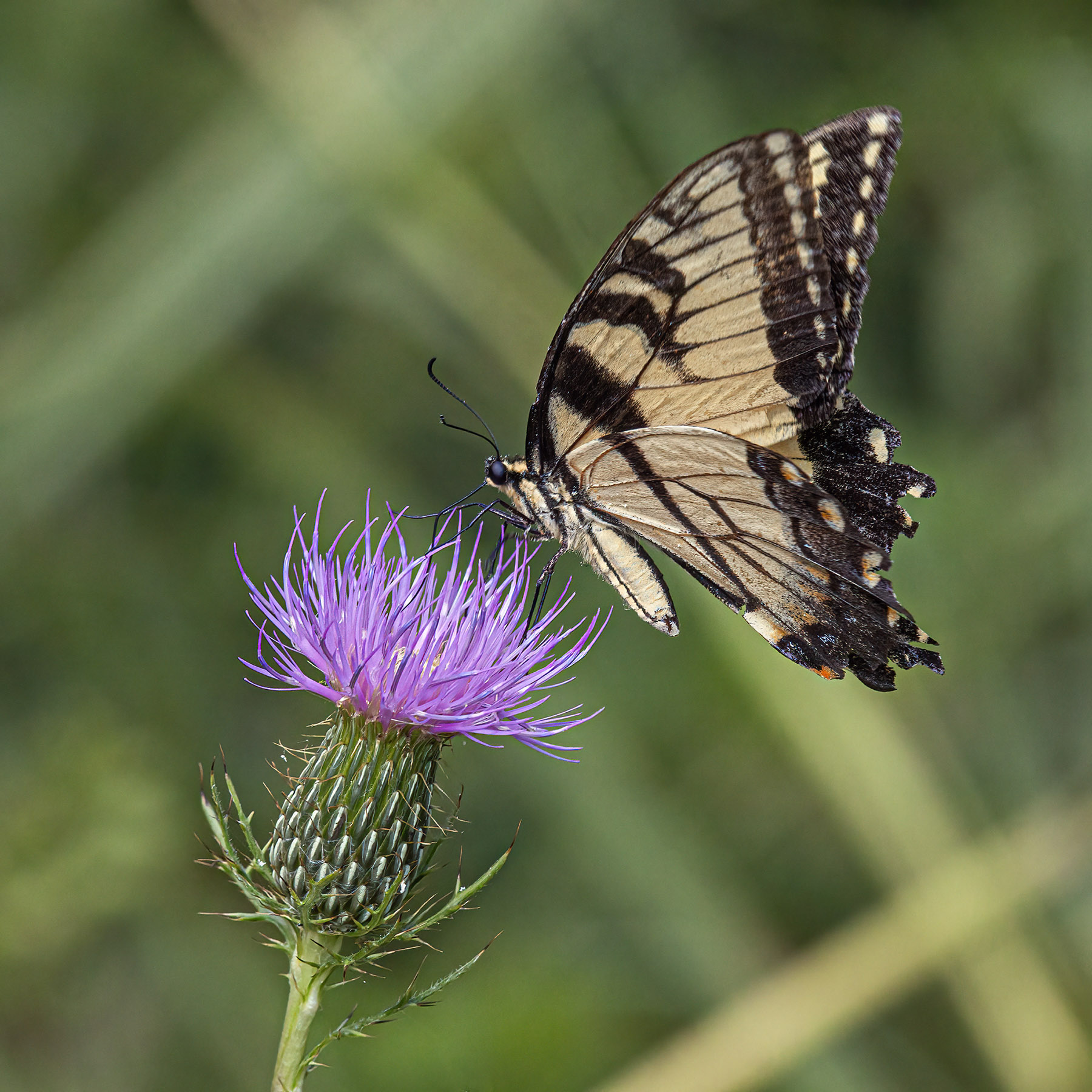
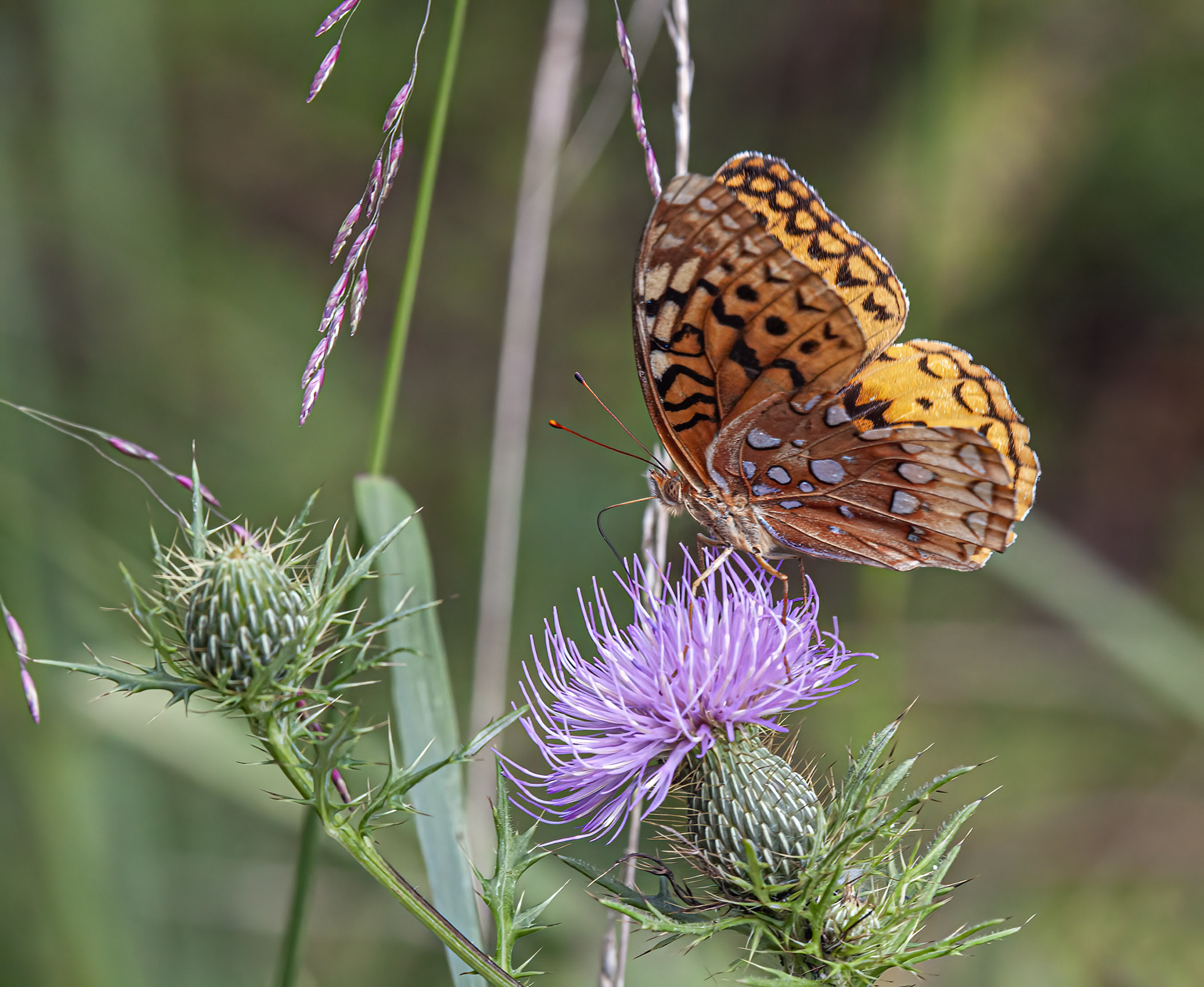
The thistles in bloom must have been absolutely irresistible to butterflies on Saturday at Occoquan Bay National Wildlife Refuge. I was delighted to spot an Eastern Tiger Swallowtail butterfly (Papilio glaucus) and a Great Spangled Fritillary butterfly (Speyeria cybele) feeding almost side-by-side at a small patch of thistle plants.
I love the color combinations in these shots that contrast the warmer tones of the butterflies with the cooler colors of the flowers and the background. I also really like the texture of the thistles that appear to be hard and thorny, but are actually quite soft to the touch.
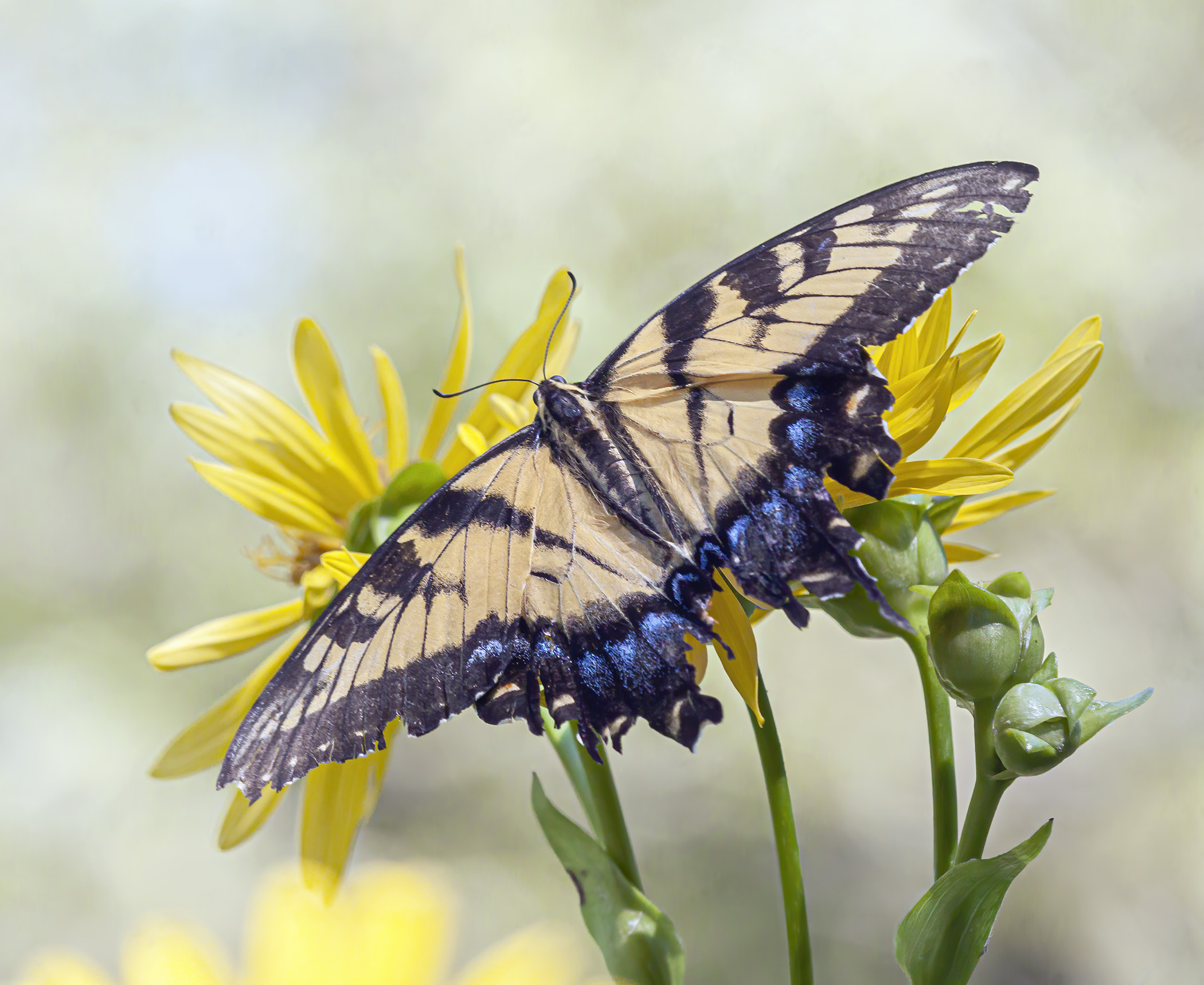
Some days I am guilty of overanalyzing my images, trying to figure out why I like or do not like them. Today, I decided to simply present this shot of a pretty Eastern Tiger Swallowtail butterfly (Papilio glaucus) that I spotted yesterday at Occoquan Bay National Wildlife Refuge as it fed on what looked to be some kind of sunflower.
I remember so well the words of the old Shaker song, “Simple Gifts” that I sang as part of a high school chorus:
‘Tis the gift to be simple, ’tis the gift to be free,
‘Tis the gift to come down where we ought to be;
And when we find ourselves in the place just right,
‘Twill be in the valley of love and delight.
When true simplicity is gained,
To bow and to bend we shan’t be ashamed;
to turn, turn, will be our delight.
Till by turning, turning we come round right.
It was definitely exciting to see my first Monarch butterflies of the season last Friday at Green Spring Gardens, but I was equally delighted to see some other beautiful butterflies that day. The one in the first photo is an Eastern Tiger Swallowtail (Papilio glaucus) on a flower that I later learned is a Mexican sunflower. I am pretty sure that the butterfly in the second image is a Spicebush Swallowtail (Papilio troilus), although the angle of this shot keeps me from being absolutely certain. I am not sure what kind of flower it is feeding on, but it sure was pretty.
Although I spend a lot of time in streams, fields, and marshes, I enjoy visiting gardens from time to time. It is stimulating to all of the senses to see all of the bright colors and smell the fragrant flowers. There were plenty of bees too and occasional forays into the flowers by goldfinches and hummingbirds. It was a good day.
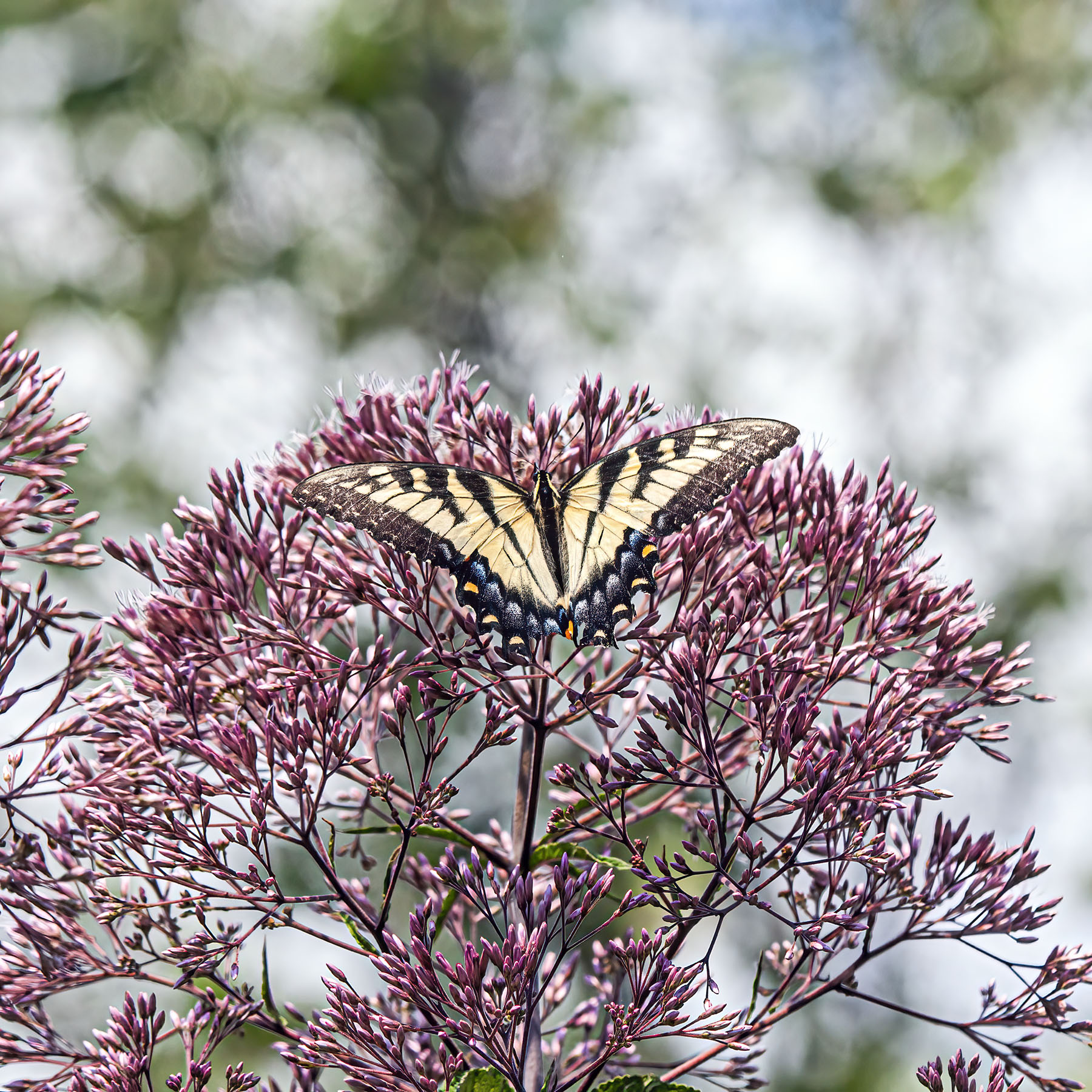
The Joe Pye Weed (Eutrochium purpureum) at Jackson Miles Abbott Wetland Refuge grows so high that I have to point my camera almost straight up to get a shot of the butterflies that seem to really enjoy this flowering plant. Although it is a somewhat uncomfortable shooting angle, it allows me to include the sky in some of my shots, as was the case with this Eastern Tiger Swallowtail (Papilio glaucus) on Monday.
I seem to be in an artistic mood recently. I noted this morning that this is the third consecutive posting in which the colors and shapes of my subjects have been of equal or greater importance as the subjects themselves. There is something about the first image especially that just seems so beautiful to me. I really like the way that the different elements in the image work together to create a harmonious whole.
In the second image, I deliberately violated one of the “rules” of photography and placed my primary subject in the center of the frame. Why? I wanted to emphasize the symmetry of the butterfly when it spread its wings. I think the photo works pretty well, though perhaps not quite as well as the first image, which has a slightly more dynamic feel to it.
I was delighted on Monday to see that Swamp Milkweed (Asclepias incarnata) is now flowering at Huntley Meadows Park, a local marshland refuge. Butterflies really seem to like all varieties of milkweed and I was thrilled to photograph several different species that were feeding on these fabulous flowers, including a Spicebush Swallowtail(Papilio troilus) in the first image; an Eastern Tiger Swallowtail (Papilio glaucus) in the second image; and in the final image, a Silver-spotted Skipper (Epargyreus clarus), a smaller skipper that I cannot identify, and a bee.
What do you call a group of butterflies? There are apparently many collective nouns for butterflies in English, but my absolute favorite is “kaleidoscope.” The word combination “kaleidoscope of butterflies” captures well for me the magical and fanciful nature of these colorful creatures.
I was excited yesterday when I spotted an Eastern Tiger Swallowtail butterfly (Papilio glaucus) fluttering about near a stream at Prince William Forest Park—it was my first “big” butterfly of the spring season. I was even more thrilled later in the day when a spotted this kaleidoscope of Eastern Tiger Swallowtails clustered together on a rocky ledge at water’s edge, engaged in what is often referred to as “puddling.” Many species of butterflies congregate on wet sand and mud to partake in “puddling”, drinking water and extracting minerals from damp puddles or even from animal droppings.
According to a posting by Westborough Land Trust, “When tiger swallowtails emerge from their chrysalises, one of the first things they do – especially if they’re male – is to head for a mud puddle. There they fill up on water and get minerals needed for reproduction. They suck water and dissolved minerals up through their long “tongue” or proboscis, which they also use to drink nectar.”
It is really early in the season and all of the butterflies were in perfect condition, with fully intact wings and vibrant colors. I am always energized to see the emergence of new life in the spring in plants and in all of the small and large creatures that I love to photograph.
Is today the first day of a new season? It depends. If you use the meteorological calendar, today is the first day of autumn (or spring if you live in the Southern Hemisphere). If you use the astronomical calendar, however, you have to wait until the equinox on 22 September for summer (or winter) to end.
No matter how you calculate the seasons, we are already starting to see signs of transition. The weather is marginally cooler and some vegetation is dying off. It won’t be long before the leaves on the trees begin to change colors or, as is often the case, simply fall from the trees.
Many of the dragonflies and butterflies that I see are showing signs of wear and tear, with scratches on their bodies and tattered wings. While exploring Occoquan Bay National Wildlife Refuge last week, I spotted several butterflies with somewhat unusual damage to their wings. The wings of the Eastern Tiger Swallowtail (Papilio glaucus) in the first photo seem to be in almost pristine condition, except for the fact that one of the tails and a portion of the wing is gone. What could have caused that kind of damage?
The Common Wood Nymph (Cercyonis pegala) in the second image had similar damage, but it appears that the damage affected both of its wings. I can’t help but notice the straight lines and almost right angles of the edges of the missing wing sections of both of these butterflies. Could a bird have caused that damage? It is a bit of a mystery to me and I would welcome any insights that you might have about the cause of the injuries to these butterflies, which nonetheless seemed flying capable of flying.
Happy change of seasons—fall or spring, as applicable—if you live a place that uses the meteorological calendar.
I love butterflies and am thrilled that I am finally beginning to see them more regularly after a slow start to this season. I spotted this beautiful female Eastern Tiger Swallowtail (Papilio glaucus) last week at Jackson Miles Abbott Wetland Refuge perched high in a patch of what looks like Joe Pye weed (Eutrochium purpureum).
Most folks who live in the Eastern part of the United States can probably identify an Eastern Tiger Swallowtail butterfly (Papilio glaucus) when they see one. Eastern Tiger Swallowtails are large and have a distinctive pattern of bright yellow and black on their wings. However, not all Eastern Tiger Swallowtail butterflies are yellow—females come in two distinctly different variants, black and yellow.
The yellow morph looks a lot like a male, but with a conspicuous band of blue spots along the hindwings that the males do not have. The dark morph female has similar markings, but most of its body color is black, like the one below that I spotted last week at Green Spring Gardens. The perfect condition of its wings this late in the season suggests to me that this is a newly emerged butterfly.
So why do the females come in two colors? I read an interesting on-line article about this subject entitled “Why are you that color? The strange case of the dark phase tiger swallowtail.” The author speculates that the dark morph is an evolutionary attempt to mimic a similar-looking Pipevine Swallowtail butterfly that predators know is toxic, a practice known as Batesian mimicry. So, in theory the dark morph would have a better chance of survival. For unknown reasons, however, the males do not seem to be as attracted to the dark morph females, “These guys are apparently traditionalists and prefer the good ol’ yellow and black that their species is known for.” So the genes that might benefit species survival are not always passed on.
Many butterflies are looking a little tattered this late in the season, like this Eastern Tiger Swallowtail (Papilio glaucus) that I spotted on Tuesday at Green Spring Gardens, but I still find their beauty to be breathtaking. True beauty, I would argue, is often to be found in imperfection, not in some superficial notion of perfection.
It seems like I have seen fewer butterflies this year than in previous years, so I was especially thrilled to spot this Eastern Tiger Swallowtail butterfly (Papilio glaucus) last week during a trip to Green Spring Gardens with my photography mentor Cindy Dyer. Normally by this time of the year I have seen lots of Monarchs and Eastern Tiger Swallowtails, but I have not seen a single Monarch yet and only a few swallowtails. This butterfly was the only large butterfly that I saw that day—all of the others that I spotted were the much smaller skipper butterflies.
Generally I prefer to have a natural background when photographing wild subjects, but that was not possible in this case. The blurred background is part of the welcome center of the gardens. The bands of color at the bottom of the image add some visual interest without being distracting, so I am not all that dissatisfied with the way the shot turned out.
What do you call a group of butterflies? I have always been fascinated by the collective nouns that we use in English for groups of creatures. I was delighted to learn that one of the collective nouns used for butterflies is a kaleidoscope.
“A kaleidoscope of butterflies” seems to be the perfect descriptor for this group of beautiful Eastern Tiger Swallowtail butterflies (Papilio glaucus) that I spotted yesterday. They appeared to be engaged in a behavior known as “puddling,” during which the butterflies, most often the males, gather minerals and other nutrients from the soil or other organic material.
I was looking into the bright sun when I spotted this Eastern Tiger Swallowtail butterfly (Papilio glaucus) feeding on a nearby flower. Normally that is not an ideal situation for photography and often renders the subject as a silhouette. However, I adjusted my camera settings and was able to capture the translucency of the butterfly’s wings and the shape and color of the vegetation showing through from behind the wings.
Eastern Tiger Swallowtails (Papilio glaucus) were definitely enjoying this patch of Joe Pye Weed (Eutrochium purpureum) when I spotted them last Saturday at Riverbend Park. The butterfly in the foreground is a dark morph female and I believe the one in the background is a male. One of the cool things about Eastern Tiger Swallowtails is that females come in two varieties, one with coloration close to that of the male and one with the dark colors that you see in the image below.
This image is a a pretty straightforward presentation of a fairly common subject, but there is something about the composition that I really like. Maybe it’s the contrasting colors or the overlapping shapes. Who knows? So often I like what I like without being able to articulate the precise reasons why.
This seems to be the prime season for butterflies and I have been seeing lots of them this past week. I spotted this spectacular Eastern Tiger Swallowtail (Papilio glaucus) as I was exploring Occoquan Regional Park last Thursday. It was attracted to a pink flowering plant that I think is some kind of milkweed—I am a whole lot more confident in identifying butterflies than plants.
I am happy with both shots, but must that I particularly like the background in the first image.
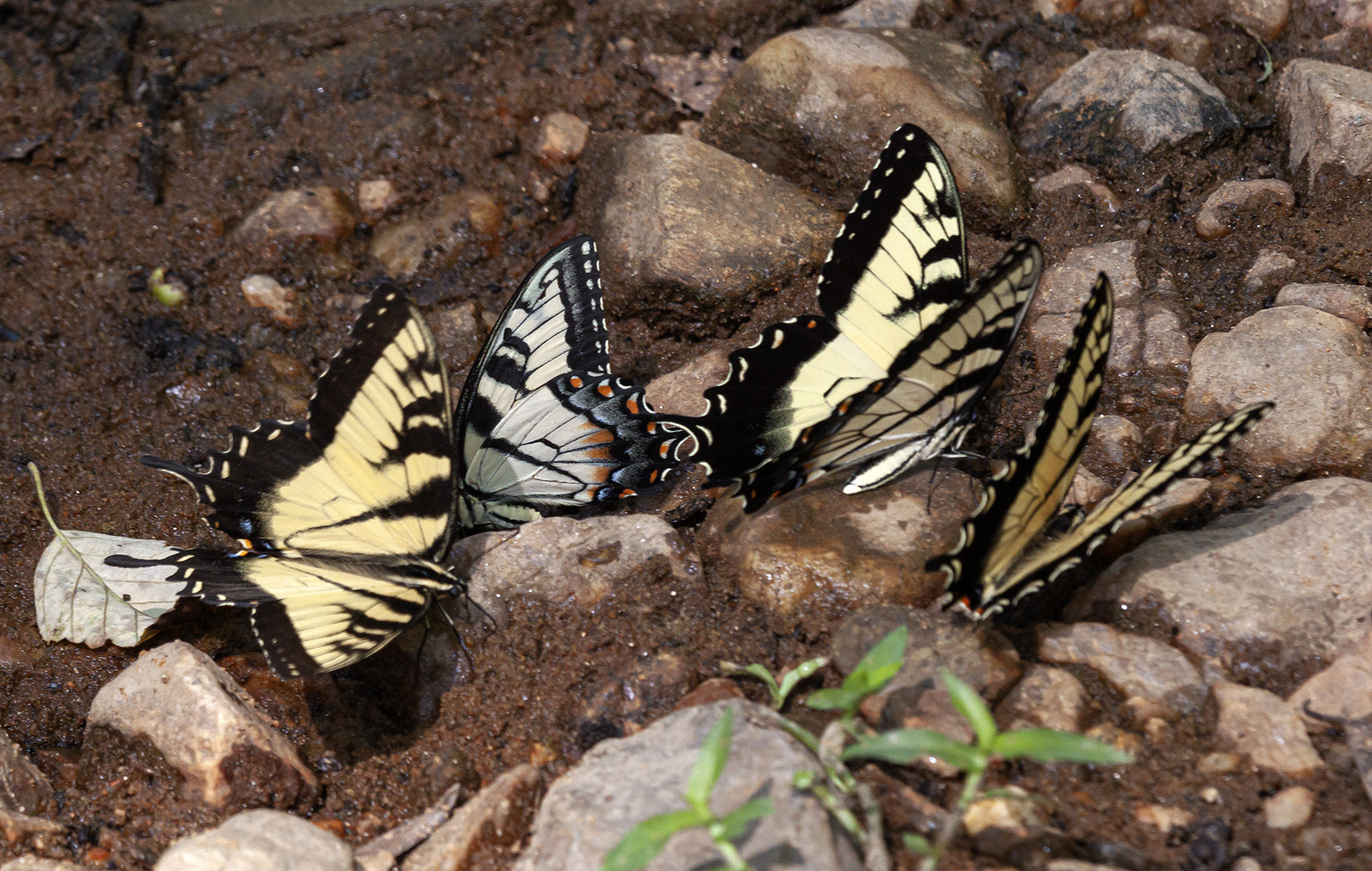
Most of us associate butterflies with flowers, but they sometimes can be found on the sandy banks of creeks, like this cluster of male Eastern Tiger Swallowtails (Papilio glaucus) that I spotted earlier this month in Prince William County, Virginia.
I went looking for information about this behavior and learned the following on the thoughtco.com website:
“Butterflies get most of their nutrition from flower nectar. Though rich in sugar, nectar lacks some important nutrients the butterflies need for reproduction. For those, butterflies visit puddles. By sipping moisture from mud puddles, butterflies take in salts and minerals from the soil. This behavior is called puddling, and is mostly seen in male butterflies. That’s because males incorporate those extra salts and minerals into their sperm. When butterflies mate, the nutrients are transferred to the female through the spermatophore. These extra salts and minerals improve the viability of the female’s eggs, increasing the couple’s chances of passing on their genes to another generation.”
Is the best image of a butterfly only one in which its wings are fully open so that you can see all of the beautiful colors and patterns? Generally that is the angle that most of us seek to shoot. This past Wednesday I was observing an Eastern Tiger Swallowtail (Papilio glaucus) at Jackson Miles Abbott Wetland Refuge when it struck me that the butterfly was “attacking” the flower from all kinds of different angles, even hanging upside down. Why shouldn’t I take the same approach with the butterfly (minus the hanging upside down part)?
I like the way in which the three shots below capture some of the activity of the butterfly and not merely its beauty. At times it seems like beauty and function are at odds with each other, that beauty is best captured in controlled settings like in a studio, where portraits are often taken.
I fully accept that the natural world in which I like to work is chaotic and out of my control, but in the midst of it I still find incredible beauty, a beauty that may be imperfect by some standards. I encourage you to look at your world from a different angle at least from time to time and you may be amazed by the way that a change of perspective can cause you to see things in a totally different way.
When presented with a downward-facing flower, this Eastern Tiger Swallowtail butterfly (Papilio glaucus) was forced to choose an unusual angle of attack. Seeming defying gravity, this acrobatic butterfly hung upside down as it probed upwards earlier this week at Prince William Forest Park in Triangle, Virginia.
If this were an Olympic competition, I would give him a 10 for both his technical skills and overall artistic impression.
















 Mike Powell