Feeds:
Posts
Comments

Posts Tagged ‘Eastern Forktail damselfly’

It has taken a little while, but I am starting to see damselflies during my searches for dragonflies. As many of you know, damselflies and dragonflies are “cousins” in the sense that they are both members of the order Odonata. Generally speaking, dragonflies have thicker, shorter bodies and hold their wings out to the sides when resting, while damselflies are slender with wings often folded together. The eyes of dragonflies often touch each other, while those of damselflies tend to be more widely separated.

The first photo below shows a Fragile Forktail damselfly (Ischnura posita), a very common species where I live. The interrupted shoulder stripes look like exclamation marks, which makes them pretty easy to identify.  The second photo shows what I am pretty certain is a female Eastern Forktail damselfly (Ischnura verticalis). Female damselflies of a number of species are similar in appearance, so I am a bit less confident that I have correctly identified this individual.

More damselflies will continue to appear as I shift my attention almost exclusively from birds to insects. As a result of recent rains, the trees in my area are now covered with leaves, which means that I am increasingly having trouble seeing the birds that I can hear singing.

Fragile Forktail

Eastern Forktail

© Michael Q. Powell. All rights reserved.

Read Full Post »

Odonata is an order of flying insects that includes dragonflies and damselflies. During the warmer months of the year I spend a lot of time hunting for dragonflies, the larger members of this group of magical creatures, but I also enjoy searching for damselflies, their smaller and more fragile “cousins.”

Damselflies, like dragonflies, come in a variety of colors and shapes. Here is a sampling of images of damselflies that I captured this past Thursday during visits to Jackson Miles Abbott Wetland Refuge and Occoquan Regional Park, both of which are located within 15 miles (24 km) of my house.

The first photo shows a Orange Bluet (Enallagma signatum). I am always amused by the name of this species, because it seems incongruous to have an orange-colored member of a genus called American Bluets. Most male bluets are, in fact, blue, but others are orange, scarlet, and burgundy and there is even a “Rainbow Bluet.”

The second image shows a male Azure Bluet (Enallagma aspersum), whose colors are closer to my mental image of a bluet. Most bluets are some combination of blue and black and it can be tricky trying to determine specific species by examining the color patterns on the body and in the eyes.

The third shot is of a male Fragile Forktail (Ischnura posita), one of the first damselflies to emerge each spring. Fragile Forktails are really tiny (about an inch (25 mm) in length, but are relatively easy to identify by their broken shoulder stripe that looks like an exclamation point.

In the final photo I was eye-to-eye with the damselfly so his abdomen is almost completely out of focus. Nonetheless enough details are visible for me to say this is almost certainly a male Eastern Forktail damselfly (Ischnura verticalis).

I like to try to vary my approach to capturing images of most subjects, including damselflies, as you can see in this little collection of photos. Sometimes, as in the first shot, I will try to isolate the subject from its background in order to focus the viewer’s complete attention on the subject. Recently, though, I have developed a preference for including more of the habitat in my shots, as in the second image, in order to give the viewer a sense of the environment in which I took the shot. When possible, I like to attempt to capture some “artsy” shots, like the final image, by using selective focus and choosing carefully my angle of view.

No matter what approach I choose with damselflies, I have to be careful not to fall into the water, where most of these dragonflies were perching. I am not always successful in keeping my feet dry.

Orange Bluet

Azure Bluet

Fragile Forktail

Eastern Forktail

© Michael Q. Powell. All rights reserved.

Read Full Post »

Yesterday I went exploring in Accotink Bay Wildlife Refuge, a nature preserve on the grounds of Fort Belvoir, a nearby US Army installation. I did not see many dragonflies, but was happy to spot some Eastern Forktail (Ischnura verticalis) damselflies. These damselflies are quite small—about an inch (25 mm) in length—and have distinctive blue markings near the tips of their abdomens.

Many damselflies have combinations of black and blue on their bodies, so identification can often be difficult. Usually I start by looking at the body and deciding if it is primarily black, as was the case here, primarily blue, or somewhere in the middle. After that, I examine the shape of the markings at the tip of the abdomens and compare them with the pictures in my damselfly identification guide.

Somehow, though, I always have more problems with damselfly identification that I do with dragonfly identification. Fortunately I am part of several Facebook groups that have experts who can weigh in when I need help in identifying a particular damselfly.

Eastern Forktail

Eastern Forktail

Eastern Forktail

© Michael Q. Powell. All rights reserved.

Read Full Post »

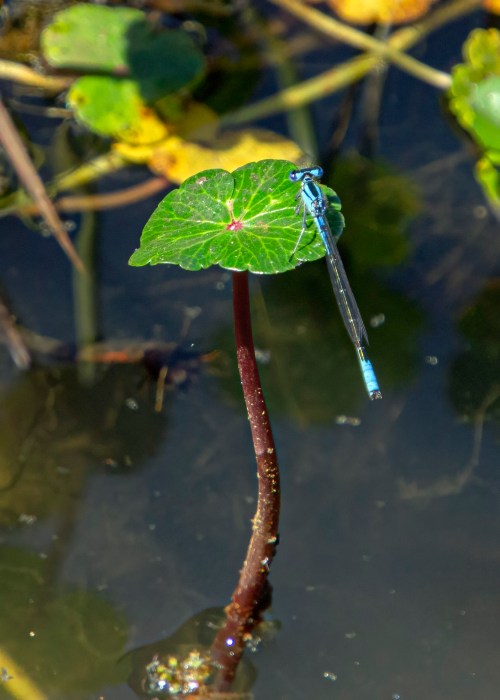
As I was visiting a small pond at Green Spring Gardens last week, checking to see if the lotus flowers and water lilies were in bloom, I detected some movement at the edge of the water. It took me a moment to spot some tiny Eastern Forktail damselflies (Ischnura verticalis) that were buzzing around the vegetation sticking out of the water. Eastern Forktails are quite small, about 0.8-1.3 inches (20-33 mm) in length.

I got down as low as I could and captured several images of a beautiful female Eastern Forktail. In the first shot, she perched and posed for me, so I had the luxury of carefully composing my shot. Click on the photo to see the wonderful details of this damselfly, including her stunning two-toned eyes. Eastern Forktails are quite small, about 0.8-1.3 inches (20-33 mm) in length.)

In the second shot, she was perching on the edge of a lily pad with the tip of her abdomen in the water. She was in the process of depositing eggs into the bottom of the lily pad or possibly into the stem of the plant.

As it turned out, it is still too early for the lotus flowers to bloom, though the plants were producing lots of leaves. There was one white water lily that was blooming, so the scene at the pond does not yet remind me of a Monet painting.

Eastern Forktail

Eastern Forktail

© Michael Q. Powell. All rights reserved.


Read Full Post »

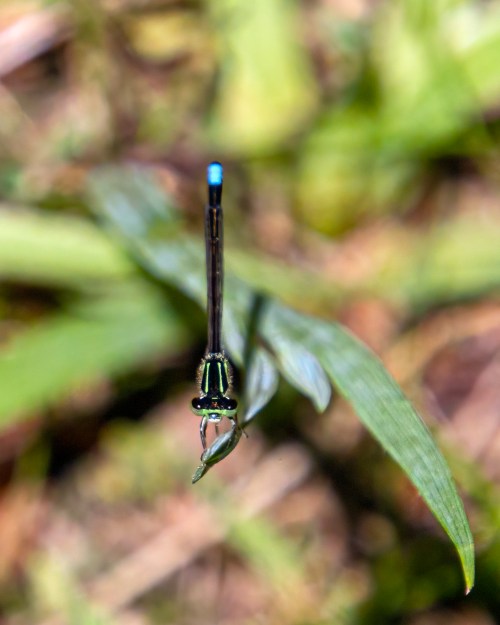
I was excited on Friday to capture this image of a colorful male Eastern Forktail damselfly (Ischnura verticalis) as I was wandering about at Occoquan Regional Park in Lorton, Virginia. I love the color combination of the light green thorax and the turquoise accents near the tip of the abdomen.

Generally when I see these little damselflies they are perched flat on the ground or on vegetation close to the ground—this slightly elevated perch made it a bit easier for me to get a good shot of its entire body. In case you are curious about the size of this damselfly, Eastern Forktails are only 0.8-1.3 inches (20-33 mm) in length, so you have to look really carefully to spot one.

Eastern Forktail

© Michael Q. Powell. All rights reserved.


Read Full Post »

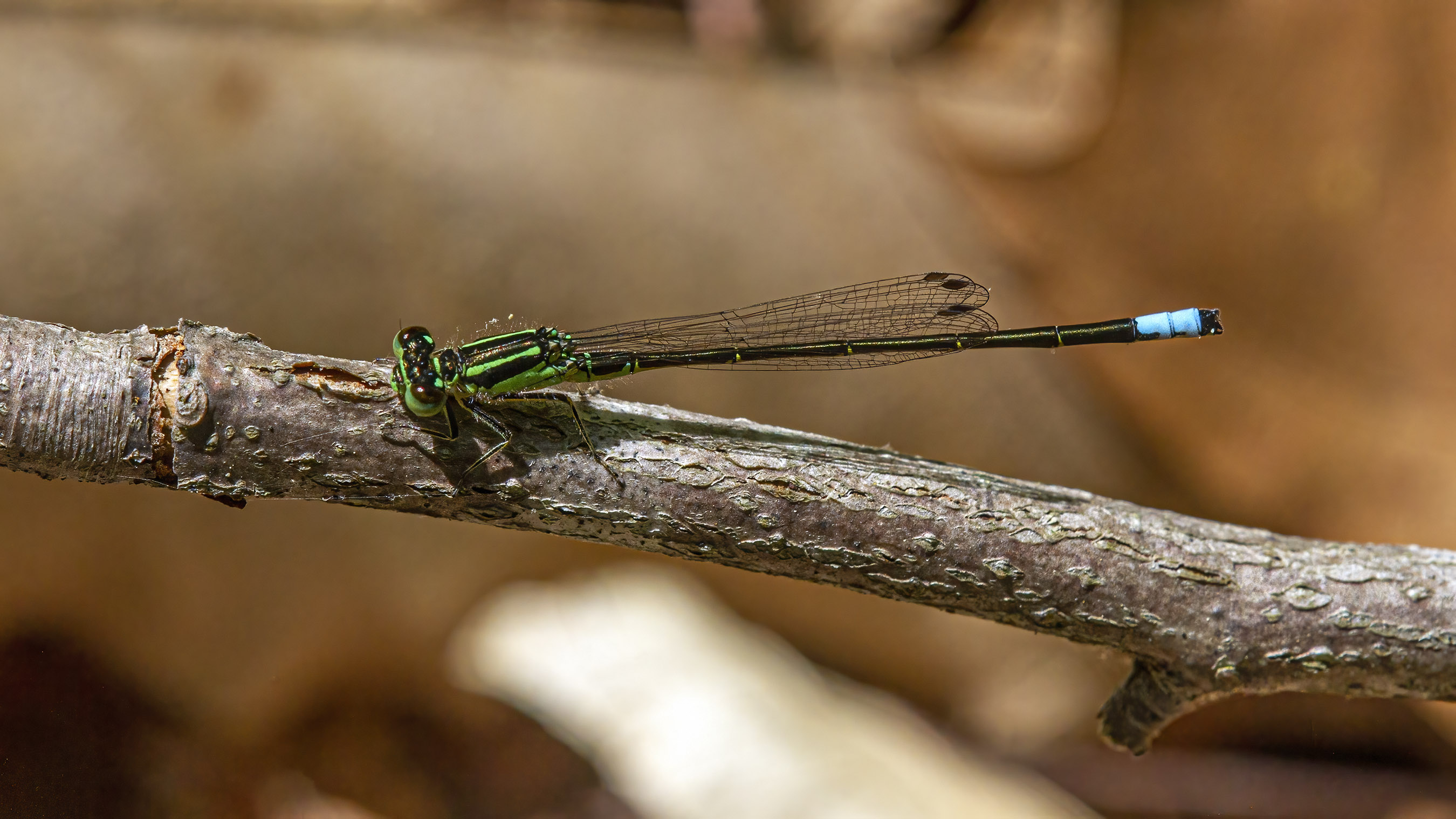
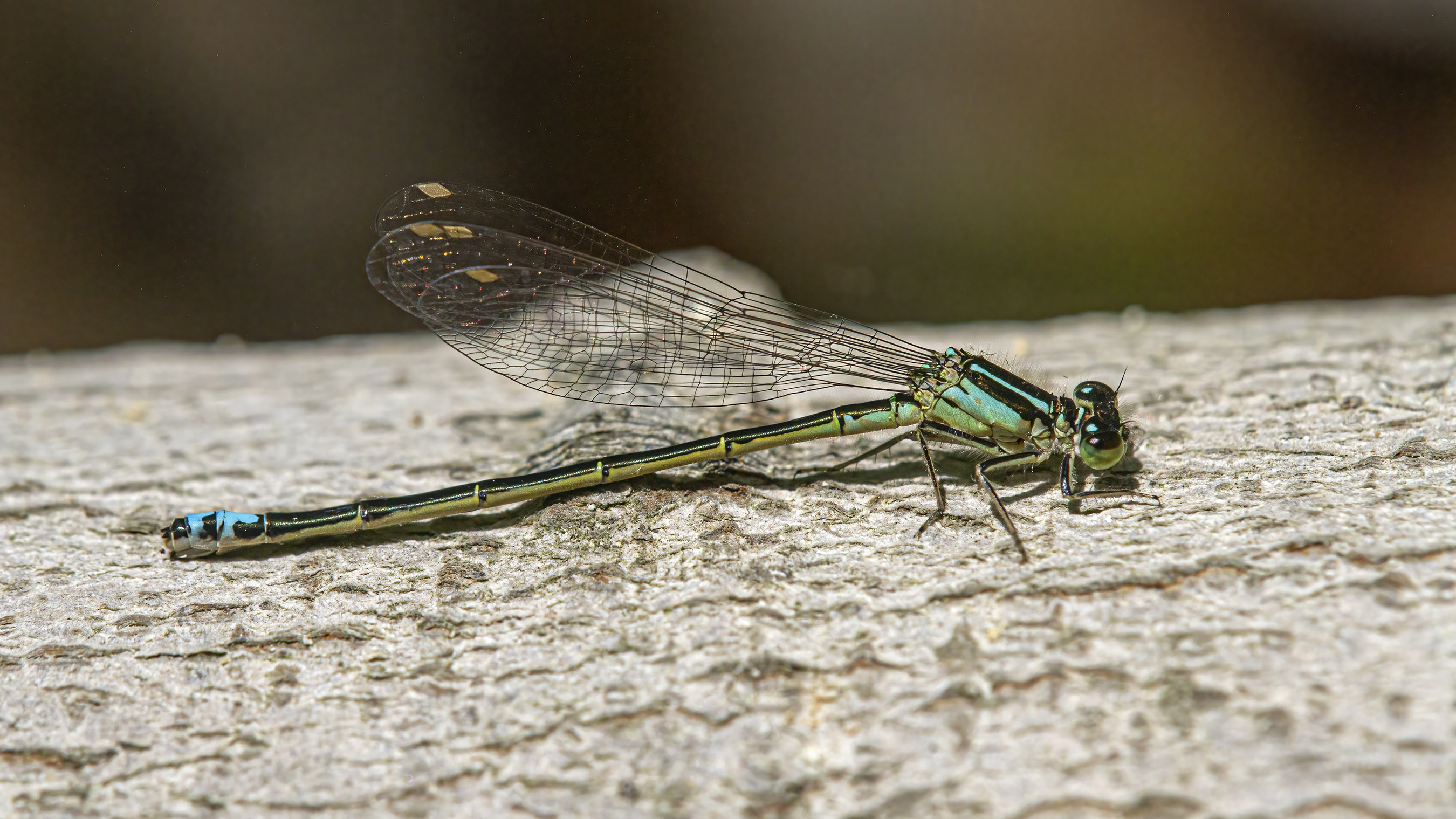
I finally photographed my first damselflies of the spring on Wednesday during during a brief visit to Jackson Miles Abbott Wetland Refuge. I spotted the female Eastern Forktail damselfly (Ischnura verticalis) in the first image as she perched on a log in a mini-wetland area adjacent to a small pond. In addition to capturing the damselfly itself, I am really happy with the way that the texture of the bark and the interplay of the light and shadows turned out in the shot.

The second shot shows a male Fragile Forktail damselfly (Ischnura posita), one of the few damselflies that I am able to identify with a relatively high degree of confidence. On males of this species (and most females too), the shoulder stripe is interrupted and looks like an exclamation point. I like the way that the muted colors of the dried-out vegetation on which this damselfly was perched  help to make its colors stand out and draw a viewer’s eyes to the main subject.

I will almost certainly get more and better shots of damselflies in the upcoming months, but there is something special about stopping for a moment to celebrate images of my first damselflies each year.

Eastern Forktail

Fragile Forktail

© Michael Q. Powell. All rights reserved.

Read Full Post »

During a brief trip to Massachusetts last weekend, I photographed this beautiful damselfly, which I believe is an immature female Eastern Forktail damselfly (Ischnura verticalis), while exploring Horn Pond in Woburn.

When I looked at the range map for this species, it looked like it is not present in my home area of Northern Virginia. However, when I did a search of my blog postings, I was surprised to discover that I had previously photographed an orange Eastern Forktail at one of my favorite local spots. Obviously I am not someone who keeps a “life list” of all the species that I have seen and photographed. 🙂

Eastern Forktail

© Michael Q. Powell. All rights reserved.


Read Full Post »

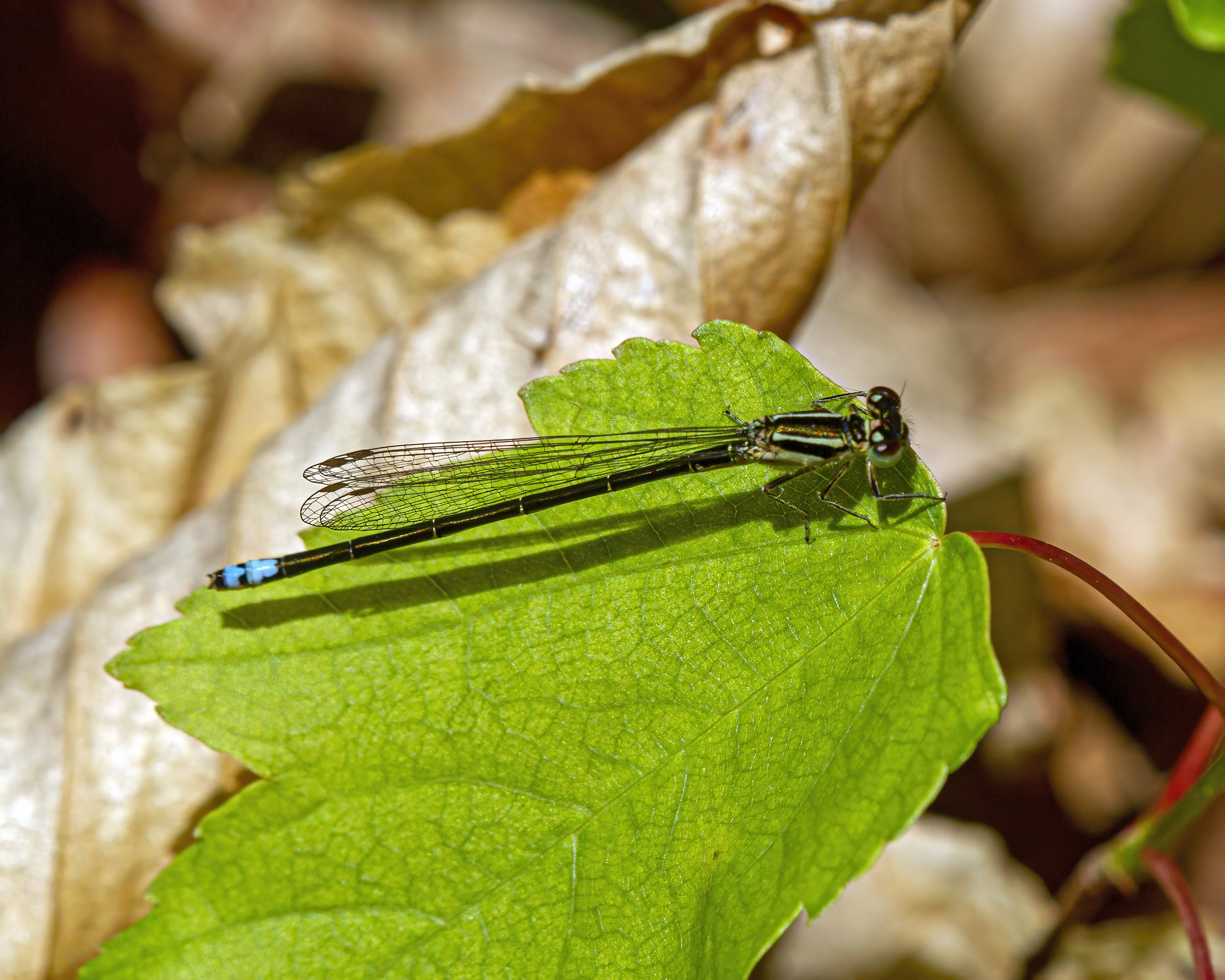
Orange is one of the colors that I tend to associate with autumn. Some leaves are already turning orange and pumpkin decorations and displays have started to appear on my neighbors’ doorsteps.

As I was exploring Occoquan Bay National Wildlife Refuge yesterday morning, my eyes detected some motion in the nearby grass. I leaned forward and was delighted to see this tiny damselfly decked out in the colors of Halloween—orange and black. I had no idea what species it was, but fortunately I have a really good guide for damselflies and was able to identify it as an immature female Eastern Forktail damselfly (Ischnura verticalis).

Although there are already lots of symbols for autumn, I think this tiny damselfly could be added to the list.

Eastern Forktail

© Michael Q. Powell. All rights reserved.

Read Full Post »
To crop, or not to crop—that is the question. At a certain point in time when we are processing our images, we are all come face to face with this question. To some photographers, composing perfectly in the camera is the ultimate virtue, and they take pride in the fact that they do not crop (and object when their images are cropped).

Moose Peterson is one prominent photographer who does not crop and he explained his views in a fascinating blog posting in 2012 entitled, “The Crop Revisited.” I am still pondering one of his conclusions, “When you don’t give yourself the option to “fix it in post,” photographers push themselves. This always make a better click and the story telling, the subject, that passion of that click becomes clearer and clearer.”

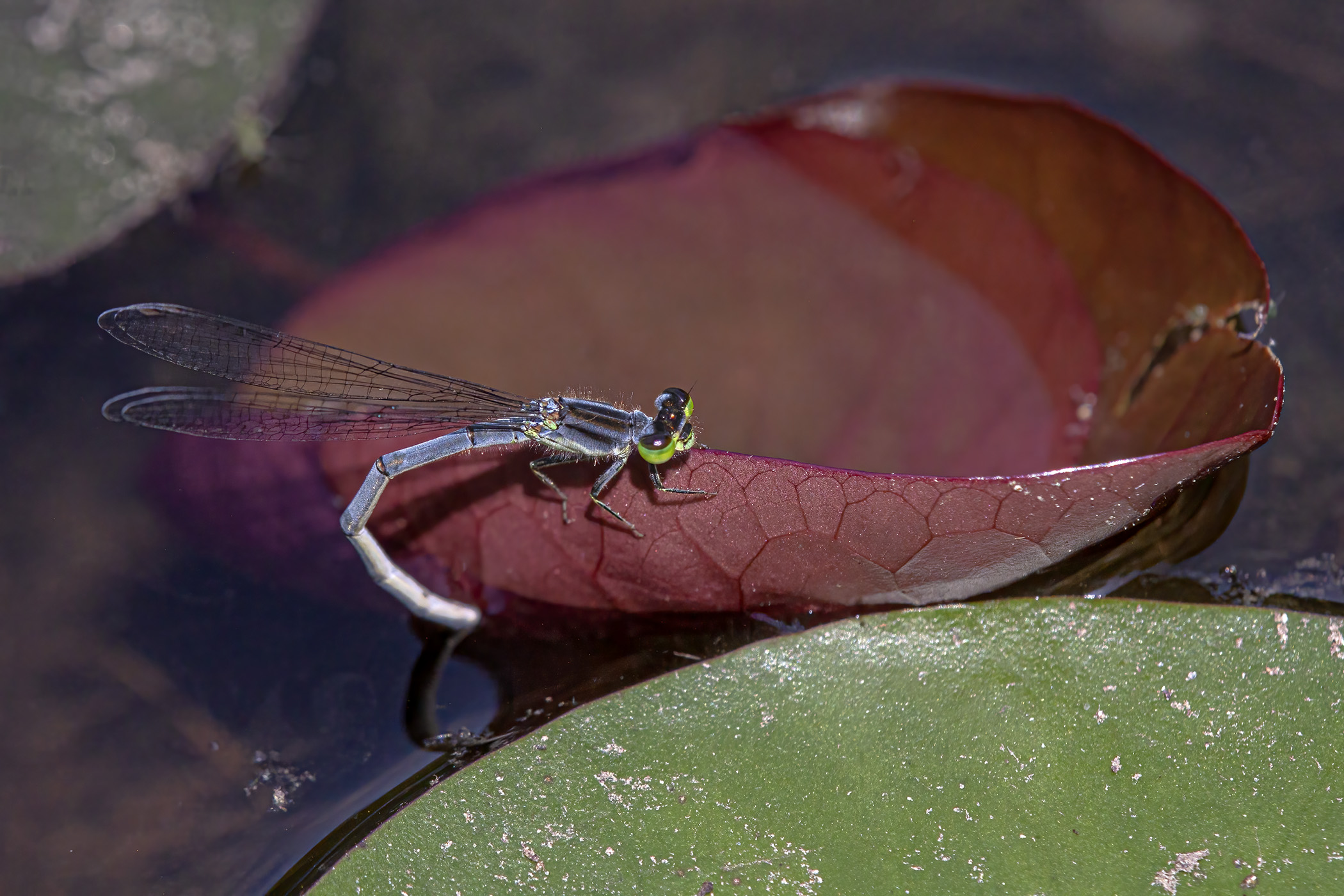
Most of us could not live with such a high standard and for various reasons we choose to crop. I am so used to cropping my images that even when I compose an image just the way that I want it, I am tempted to move in closer with my crop. That was my dilemma with this image of a damselfly on the edge of a lily pad, as it was framed when it came out of the camera.

damsel_pad_blogI really like the long sinuous curve on the left and the large expanse of green on the right. I worry, however, that the damselfly is taking up too little space of the image and is not prominent enough. So I cropped a bit and produced a second version.

damsel_pad_crop_blog

That’s not a very extreme crop, but somehow the image feels different to me. Does it make any difference to you? Do you prefer one of the two over the other?

UPDATE: Fellow blogger and local dragonfly expert, Walter Sanford, has identified this for me as an Eastern Forktail damselfly (Ischnura verticalis). Thanks, Walter.

© Michael Q. Powell. All rights reserved.


Read Full Post »
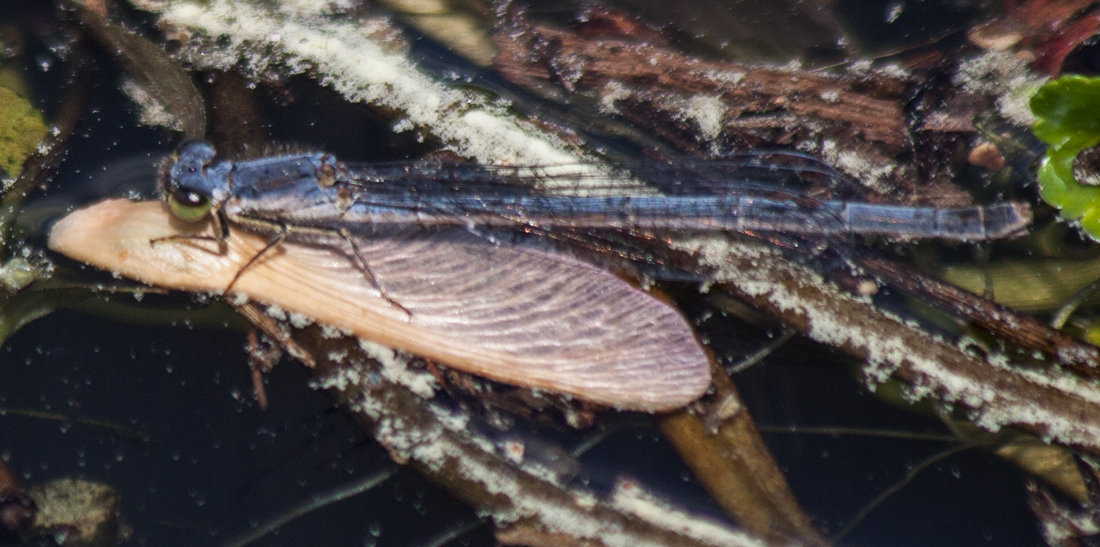
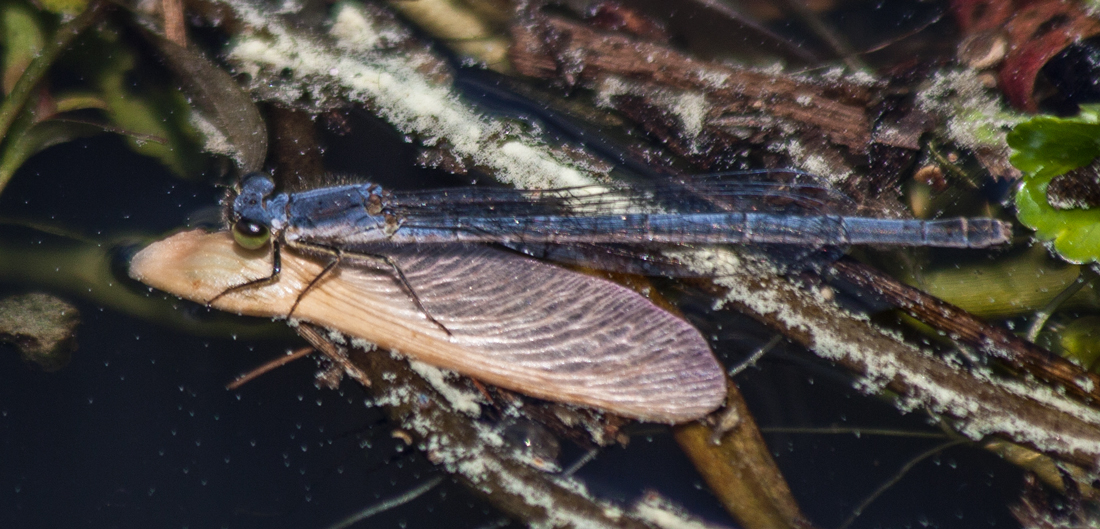
Most folks are familiar with dragonflies, but damselflies, the smaller members of the Odonata family, are equally impressive. I spotted this little beauty yesterday in the pond debris at Huntley Meadows Park, the local marshland area where I take many of my nature photographs.

I don’t know damselfly behavior very well, but noted that the very end of the damselfly’s tail is in different positions in this series of photos. In the first image, the tip is curved upward and then gradually returns to a more straight position in the final shot. Sometimes movements like this indicate that the damselfly could be laying eggs, but I haven’t been able to determine yet the gender or species of the damselfly. There seem to be a lot of different species of damselflies that are blue. (If I had to guess, I’d say that it looks like a female Eastern Forktail (Ischnura verticalis), because of the color, the forked end of the tail, and the two-tone eyes).

Although this looks like a macro shot (and the subject was really small), this is another case in which I was able to use my telephoto zoom lens to get macro-like results. Click on any of the photos to get a higher-resolution view of the damselfly and you may be surprised to see how many of the details the telephoto lens was able to capture.

damselfly1_may_blogdamselfly2_may_blogdamselfly3_may_blog

© Michael Q. Powell. All rights reserved

Read Full Post »