Feeds:
Posts
Comments

Posts Tagged ‘Canon SX50’

During a visit yesterday to Meadowlark Botanical Gardens in Vienna, Virginia, I was reminded of my favorite artist—Claude Monet. During the last thirty years of his life, water lilies (Nymphéas in French) were the main focus of his artistic production. One of the museums that I most love visiting is the Musée de l’Orangerie in Paris, because it houses eight massive water lily murals by Monet in two specially-built oval rooms. It is incredibly peaceful to just sit in one of those rooms, surrounded by those amazing paintings.

I was delighted and a little surprised yesterday to see that some water lilies were already in bloom. There was a lot of vegetation surrounding the pond in which the beautiful flowers were floating, so there were some limits to my ability to compose my shots. Still, I am pretty happy with the images that I was able to capture.

Perhaps you will find yourself as captivated by the water lilies as I was.

Water lily

Water lily

water lily

© Michael Q. Powell. All rights reserved.


Read Full Post »

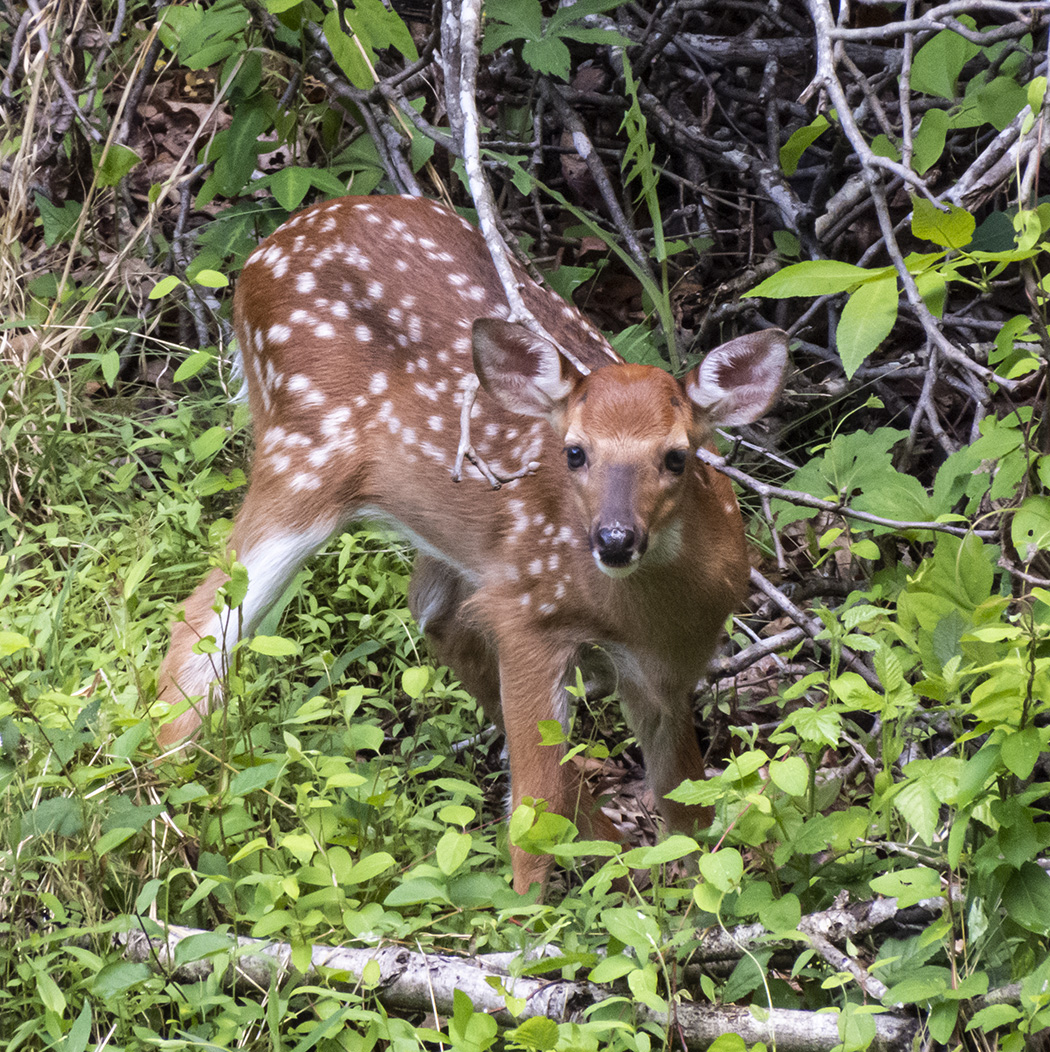
Whenever folks of my generation catch sight of a spotted fawn, we invariably think of the animated Disney movie Bambi, a movie that is an integral part of  our collective memory of childhood. Perhaps we remember the friendship of Bambi, Thumper,  and Flower or the love of Bambi and Faline  or the shocking death of Bambi’s mother. Our memories of the movie may vary, but I think we all feel a soft spot in our hearts if we are lucky enough to catch sight of a fawn.

I spotted this little deer on Tuesday at Prince William Forest Park in Triangle, Virginia. It was down in a small valley at the edge of some heavy vegetation. I watched from a distance from my higher vantage point as the fawn poked about in the vegetation. At some point, the fawn became aware of my presence and looked straight at me through its soft brown eyes. The deer held its gaze for what seemed like a long time and it faded into the underbrush and the spell was broken.

Thanks, Bambi, for sharing those magical moments with me.

Bambi

© Michael Q. Powell. All rights reserved.

Read Full Post »

It was quite startling to see the bright orange color on the head of this Broad-headed Skink (Plestiodon laticeps) yesterday at Prince William Forest Park in Triangle, Virginia. We do not have many lizards in our area and they all tend to blend in much better with their surroundings than this one did.

According to information from the Virginia Herpetological Society, adult males of this species are uniformly brown most of the year. However, during mating season in the spring the head of the males becomes enlarged and turns bright orange. The color of their heads gradually fade and the head is reduced in size the rest of the year.

Broad-headed Skink

© Michael Q. Powell. All rights reserved.

Read Full Post »

During my church retreat in Orkney Springs, Virginia this past weekend, I played hide-and-seek with a Common Green Darner dragonfly (Anax junius). It repeatedly flew teasingly close to me, trying to entice me to chase it.  I took the bait and pursued the big dragonfly for quite some time as it flew in and out of the reeds.

It tried to hide by hanging from some vegetation by the tips of its tiny toes—the second photo shows my initial view of the hidden dragonfly. By moving to the side and crouching low, I was able to peer through the vegetation and eventually spot the dragonfly. Realizing that it was found, the dragonfly tilted its head toward me and smiled, as you can see in the first image shown below.

Common Green Darner

Common Green Darner

© Michael Q. Powell. All rights reserved.


Read Full Post »

Shorebirds are always tough for me to identify—so many of them are similar in appearance. When I spotted this little bird on Wednesday at Occoquan Regional Park, I noticed that it was all alone. Half-jokingly, I thought to myself that maybe it is a Solitary Sandpiper (Tringa solitaria). When I later checked my bird identification guide I was shocked to discover that it actually is a Solitary Sandpiper.

According to the Cornell Lab of Ornithology, however, the name of the Solitary Sandpiper is not completely accurate—”While not truly solitary, it does not migrate in large flocks the way other shorebirds do.” On the same website I also learned the interesting fact of the world’s 85 sandpiper species, only the Solitary Sandpiper and the Green Sandpiper of Eurasia routinely lay eggs in tree nests instead of on the ground.

Solitary Sandpiper

Solitary Sandpiper

© Michael Q. Powell. All rights reserved.

Read Full Post »

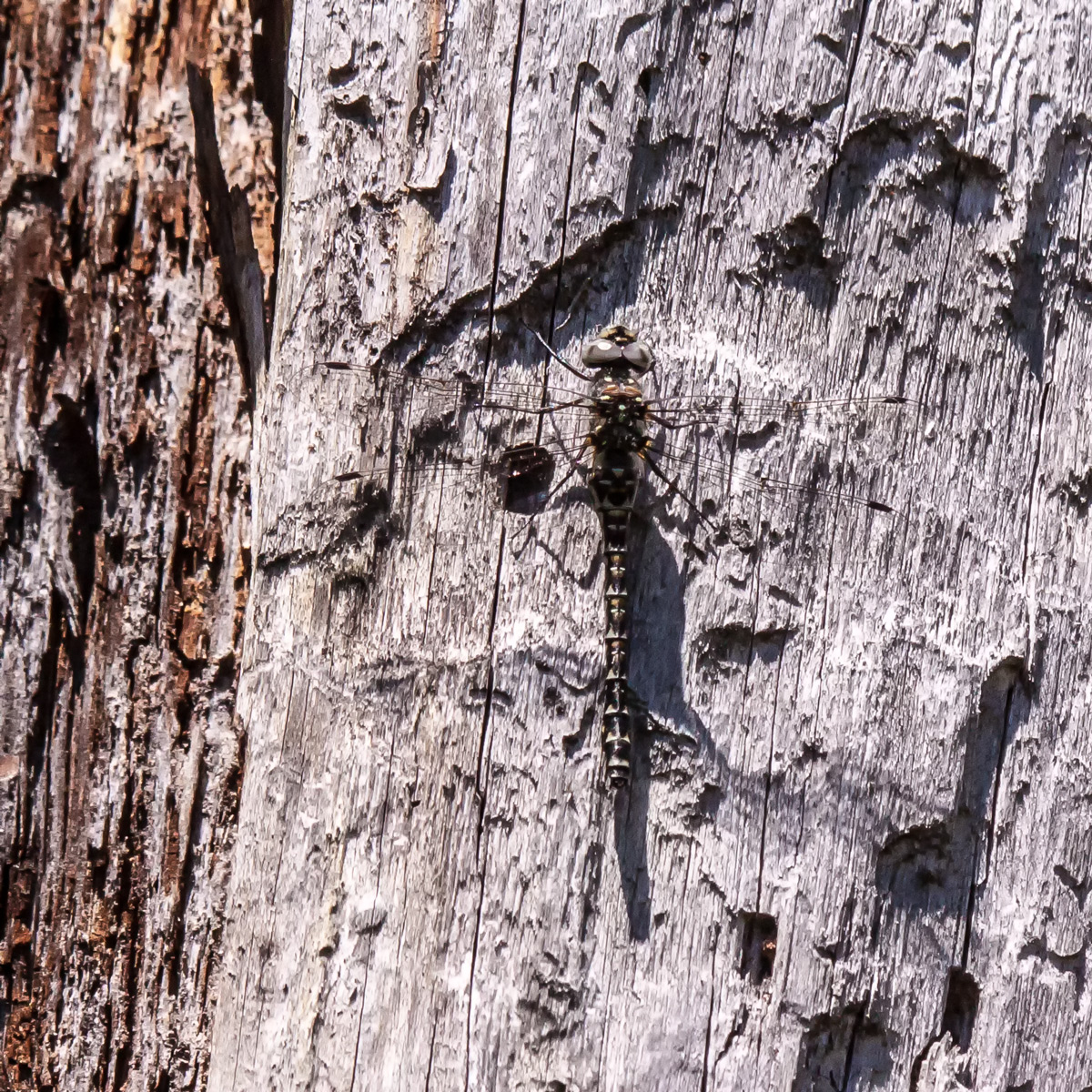
Natural camouflage in the coloration of birds and insects enhances their survivability, but it really makes them hard to find and photograph. Last week I made trips on two consecutive days to Patuxent Research Refuge in Laurel, Maryland to search for dragonflies. I have already posted photos of a Common Green Darner and a Swamp Darner that I saw during those trips—both of those dragonflies are large and colorful and relatively easy to spot.

One of the main purposes of the trip, though, was to look for a Harlequin Darner (Gomphaeschna furcillata), a species that is rare in our area and hard to spot in the field. Why? The Harlequin Darner is small for a darner, about 2.2 inches (56 mm) in length, and is in a sub-group know as pygmy darners. Its subdued coloration of gray and brown provide excellent camouflage, particularly because it often perches on tree trunks. The Harlequin Darner requires a specific type of habitat and has a flight season of only a few weeks in early spring.

On my first trip, I traveled with fellow dragonfly enthusiast and blogger Walter Sanford. We searched in vain for several hours, sometimes side-by-side and sometimes separated. As luck would have it, Walter located a Harlequin Darner at a moment when I was pretty far away. Alas, the dragonfly flew away shortly after I arrived at his location. Fortunately, Walter captured some excellent shots which you can see (along with some additional information) on his blog posting from last week. As it turned out, that was the only Harlequin Darner that either of us saw all day.

The following day I decided to return alone, hoping that I too might spot a Harlequin Darner. I saw a good number of dragonflies, including the Common Baskettail that I captured in flight, but as the day progressed, I began to wonder if I would ever find a Harlequin Darner. I kept searching and finally I saw a dragonfly perch vertically on the trunk of a tree. The lighting was harsh and the shadows distorted the proportions of the dragonfly, so I wasn’t sure what kind it was. At this point, though, I was focused on getting a shot and would worry later about identifying the dragonfly. The dragonfly remained in place for about 30 seconds and then flew away.

Well, it turns out this is a female Harlequin Darner. Every time that I see a new species for the first time, I am thrilled to get any kind of recognizable images. In the future I will try to get better shots, but for now I am content that once again my persistence paid off.

It’s great to celebrate small victories.

Harlequin Darner

Harlequin Darner

© Michael Q. Powell. All rights reserved.


Read Full Post »

It is a little unusual for me to post photos of the same species twice within a few days, but I could not help myself when I captured this image of a female Swamp Darner (Epiaeschna heros) that provides such a wonderful view of her remarkable eyes.

Dragonfly eyes are always amazing, with their multiple lens that give the dragonfly almost 360 degree vision and the ability to see parts of the color spectrum that are invisible to the human eye. What is particularly striking about this Swamp Darner’s eyes are its varied colors and patterns. Wow!

The second image shows the same female Swamp Darner as she rested in a tree prior to beginning the task of depositing her eggs, which is what you see her doing in the first shot. I captured these images this past Tuesday during a visit to Patuxent Research Refuge in Laurel, Maryland.


Swamp Darner

Swamp Darner

© Michael Q. Powell. All rights reserved.


Read Full Post »

On Monday I traveled to Patuxent Research Refuge in Laurel, Maryland with fellow dragonfly enthusiast and blogger Walter Sanford to search for dragonflies. One of the highlights of the visit for me was spotting this female Swamp Darner dragonfly (Epiaeschna heros) as she was laying her eggs. As you can see from these two photos Swamp Darners lay their eggs directly into wet wood with their blade-like ovipositor, unlike many other dragonflies that lay their eggs onto the water.

Swamp Darners are among the largest dragonflies in our area, about 3.4 inches in length (86 mm) and it was impressive to watch this one flying about over a swampy area of the refuge.

Swamp Darner

Swamp Darner

© Michael Q. Powell. All rights reserved.

Read Full Post »

Yesterday while I was exploring a stream in Northern Virginia looking for dragonflies, I came across an interesting little bird perched in a tree at the edge of the stream. I could not identify it on the spot and when I returned home and looked at my identification guide, I was still uncertain. Some experienced birders in a Facebook forum identified it as a Louisiana Waterthrush (Parkesia motacilla).

I think I bypassed that entry in my guide, assuming incorrectly that I was in the wrong geographic area. Strangely enough, the Louisiana Waterthrush is not even in the thrush section of the guide, where you find birds like American Robins—it is a warbler.

Louisiana Waterthrush

Louisiana Waterthrush

© Michael Q. Powell. All rights reserved.


Read Full Post »
One of the hazards of exploring creeks and streams at this time of the year is that snakes may be sunning themselves at water’s edge. Last week I was startled when I suddenly realized that there was a snake right in front of me, precisely in the direction in which I had been moving.

I managed to get a shot of the sunning snake, which I believe to be a Northern Water Snake (Nerodia sipedon), just before it set off swimming down the creek. Although the first shot may make it look like I was really close to the snake, I was actually a good distance away—generally I prefer to use long telephoto lenses with snakes.

Northern Water Snake

Northern Water Snake

© Michael Q. Powell. All rights reserved.

Read Full Post »

Do you associate certain colors with certain seasons? For me, yellow is definitely a springtime color. After months of winter weather dominated by shades of gray and a palette of faded colors, spring explodes with bright colors, with yellow daffodils popping up all over the place. Usually I have to wait a bit longer for yellow to pop up in the birds and insects that I enjoy photographing.

As I was exploring with my camera this week, I ran across bright yellow subjects in two very different locations. One, a Pine Warbler (Setophaga pinus) was quite appropriately perched high in a pine tree. The second was an Eastern Tiger Swallowtail butterfly (Papilio glaucus) that appeared to be probing the sand on the bank of a forest creek. I suspect that the butterfly needed the minerals and salts, although I confess to initially thinking that butterflies needed only nectar from flowers for sustenance (and there were definitely no flower in the area of that creek).

Pine Warbler

Eastern Tiger Swallowtail

© Michael Q. Powell. All rights reserved.


Read Full Post »

When you truly love someone, you love them warts and all (and as the second image shows, American Toads (Anaxyrus americanus) have lots of warts). I spotted these amorous amphibians earlier this week at Prince William Forest Park in Triangle, Virginia.

American Toads

American Toad

© Michael Q. Powell. All rights reserved.

Read Full Post »

As I was exploring Accotink Bay Wildlife Refuge earlier this week, I spotted an unusual shape in a small tree. I moved a little closer and zoomed in with my camera and discovered that it was a fairly large animal. It was bigger than a squirrel, so my initial thought was that it was a raccoon or an opossum, but as I studied my viewfinder, I quickly rejected those possibilities.

What was the animal? When I uploaded the images to my computer, the facial features reminded me of a beaver, but the visible portions of the animal’s tail look to be hairy, so I eliminated both the beaver and the muskrat. Grasping at straws, I started looking at photos of porcupines, but they didn’t match at all what I was seeing in the photo. Finally I came across some photos of a Groundhog (Marmota monax) and I realized that I had finally found a match.

I guess that the name “groundhog” threw me off, because I expected a groundhog to be on the “ground,” not in a tree and I can’t imagine a “hog” climbing a tree. According to Wikipedia, groundhogs, also known as woodchucks, “occasionally climb trees when escaping predators or when they want to survey their surroundings.”

groundhog

© Michael Q. Powell. All rights reserved.

Read Full Post »

I was a little surprised and quite happy this past weekend to spot a Pileated Woodpecker (Dryocopus pileatus) poking about on the ground at Occoquan Regional Park. Most of the time I have to settle for high-angle shots when I am lucky enough to spot one of these giant woodpeckers. I have been told that these woodpeckers regularly probe fallen trees, but this was a first for me.

After I inadvertently spooked the woodpecker, it flew to a nearby tree. The light was coming from the side and the front when I took the second shot and it made the woodpecker red crest look like it was on fire. Somehow it seemed appropriate, given that most redheads I have known have tended to be quite fiery.

Pileated Woodpecker

Pileated Woodpecker

© Michael Q. Powell. All rights reserved.

Read Full Post »

Can you actually see a sound? Yesterday while I was exploring Prince William Forest Park, I heard a whole lot of croaking. Eventually I spotted one really loud male toad with an inflated vocal sac, which was pretty cool. What were even cooler were the concentric ripples in the water generated by the toad’s croaking.

The second image shows the toad resting in between performances, whose main purpose is to attract mates. His song did not appear to have had any immediate benefits, although I was certainly impressed.

UPDATE: I initially identified this as a frog, but fellow blogger and wildlife enthusiast Walter Sanford pointed out to me that this is probably an American Toad (Anaxyrus americanus).

frog

frog

© Michael Q. Powell. All rights reserved.


Read Full Post »
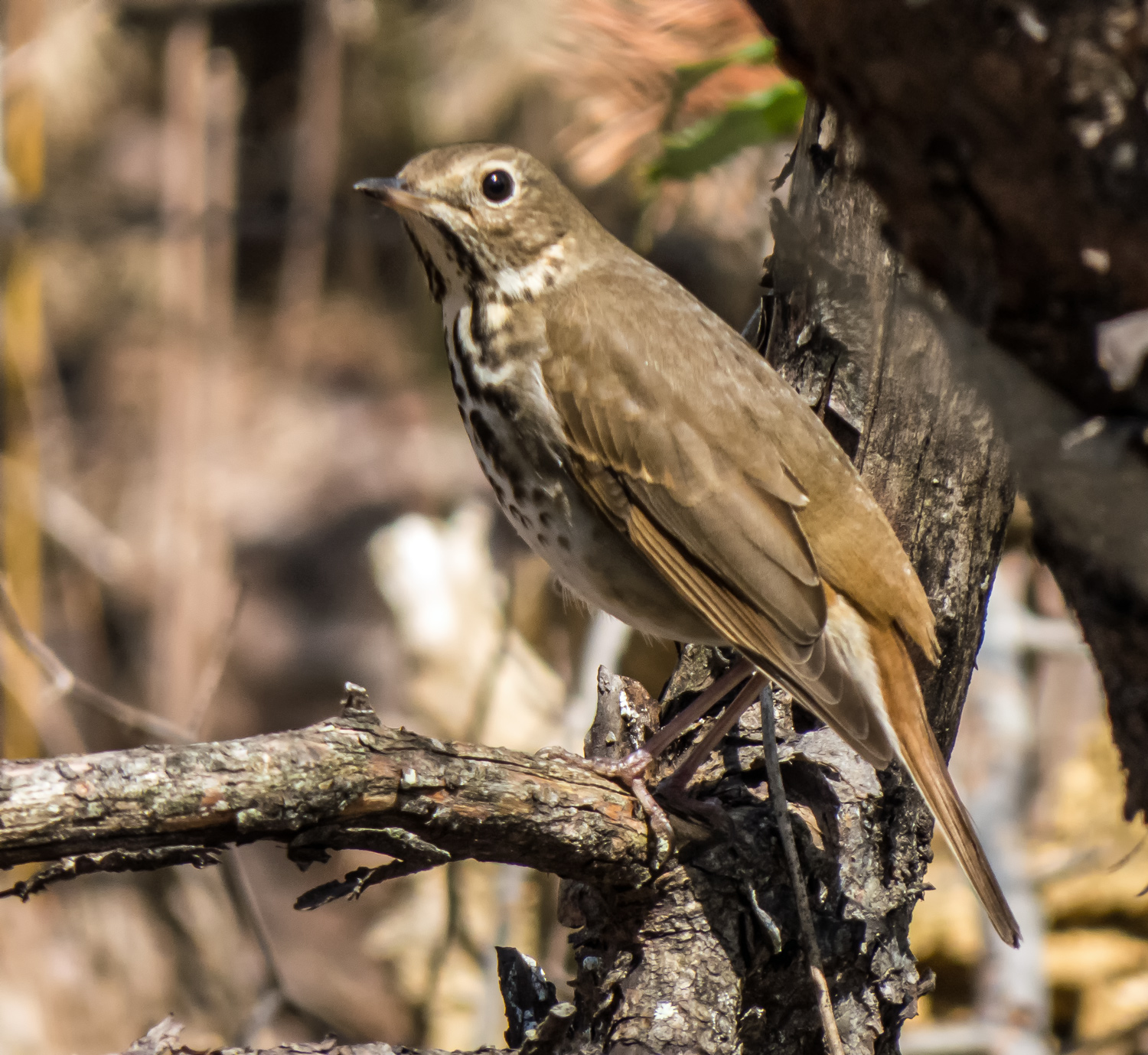
Last week I took a break from exploring Occoquan Bay National Wildlife Refuge and hiked about in Prince William Forest Park in Triangle, Virginia. According to Wikipedia, this park is the largest protected natural area in the Washington D.C. metropolitan region at over 16,000 acres.  I went lighter than usual with my camera gear, carrying only my Canon SX50 superzoom camera, because I knew that I would be doing a lot of walking on hilly forest trails, which fortunately were well-marked with signs and colored blazes on the trees.

I did not see much wildlife, but was quite happy to capture these shots of a Hermit Thrush (Catharus guttatus) that was poking about in the underbrush. The shape of the Hermit Thrush reminds me of that of the American Robin, another bird in the greater thrush family, though, of course, the breast of the Hermit Thrush lacks the distinctive reddish-orange color of the robin.

Hermit Thrush

Hermit Thrush

© Michael Q. Powell. All rights reserved.

Read Full Post »

I’ve noticed that recently I have been really sensitive to lighting and moods and not just to specific subjects. It’s problematic for me, because it is so difficult to figure out how to capture a feeling.

That is part of what was going through my head when I took this photo early in the morning this past Wednesday at Occoquan Bay National Wildlife Refuge. The sun had already risen, but it was still low in the sky. I loved the way that shafts of light were visible coming through the trees. It was a cold morning and mist was hanging over the still water of a small pond. Could I possiblycapture the details that took my breath away?

So what do you think, or more importantly, what do you feel?

sunrise

© Michael Q. Powell. All rights reserved.

Read Full Post »

I love the feeling of the early morning, when the sun is just beginning to rise. Some mornings begin with fog hanging over the fields, giving the scene an eerie feeling. On other mornings, the sun adds color to the sky and produces beautiful reflected light in the clouds. I never know what the sunrise will bring when I set out in the dark, but I love to start the way watching darkness give way to light.

I captured these images on separate mornings during this past week at Occoquan Bay National Wildlife Refuge.


early morning

sunrise

© Michael Q. Powell. All rights reserved.

Read Full Post »

Insects are becoming more active now as the weather warms up a bit, like this tiny Spring Azure butterfly (Celastrina ladon) that I spotted yesterday at Occoquan Bay National Wildlife Refuge.

There is something about chasing after a butterfly that makes me feel like a child again. I am sure that I would have looked ridiculous to an outside observer, who would have wondered what it the world I was doing.

Try it yourself. Chase a butterfly today or, if you can’t find one, let go of your inhibitions and do something equally childlike, like coloring with crayons. I think that most of us take ourselves too seriously too often.

Spring Azure

© Michael Q. Powell. All rights reserved.


Read Full Post »

I love the early morning hours and enjoy watching the darkness give way to the light. This morning I was pleased to be able to capture the predawn colors and then the actual sunrise at Occoquan Bay National Wildlife Refuge.

It was a wonderful way to start the new day.

dawn's early light

sunrise at Occoquan Bay

© Michael Q. Powell. All rights reserved.


Read Full Post »

How do you capture the beauty of a landscape in a single shot? I shoot landscape shots so infrequently that I feel somewhat helpless when trying to do so. Normally they are kind of an afterthought, a second option when there is no wildlife around.

Last week in Germany, however, I was surrounded by mountains. I knew I had to get some shots of the mountains and I took a lot of them. As I reviewed them, though, not very many stood out. I decided to play around a bit and eventually came up with a couple of images that I really like. Both of them were taken from the destination point of the little cable car that I featured in an early posting.

The first image is one that I converted to black and white using an old version of Nik Silver Efex Pro software.  The second shot is a panorama image that was stitched together from three separate handheld images using PhotoMerge in Photoshop Elements. The third image is the color version of the first image prior to using the conversion software.

It was a challenge for me to step out of my comfort zone and try a different kind of photography. In my experience, feeling uncomfortable is part of the learning process. This year I am going to consciously look for more opportunities to take landscape photos and see where that takes me.

mountains in Germany

mountains in Germany

mountains in Germany

© Michael Q. Powell. All rights reserved.

Read Full Post »

I am glad that I have neither a fear of heights (acrophobia) nor of closed-in spaces (claustrophobia) or I might not have enjoyed my ride last week on the Laben Bergbahn, a small cable car in Oberammergau, Germany.  The little  gondola cars (I think that is what they are called) took us up a steep slope that rose from 900m to 1684 meters (2952 feet to 5525 ft). A plaque in the car says it holds 11 people, but they would have to be really little people for that to be true.

Halfway up the mountain, there was a stop, leaving the car swinging a little in the breeze. The sign in the second image below was of only minor comfort as we waited and waited to start moving again—it seemed like we were hanging there for a really long time.

Laben Bergbahn

Laben Bergbahn

© Michael Q. Powell. All rights reserved.


Read Full Post »

There were several groves of trees near the Munich airport hotel that I stayed in prior to my return flight to the United States. I figured there might be some birds to photograph and was happy when I spotted birds flitting about. They reminded me of chickadees, but were much more colorful.

I did a little research on-line and think that the bird in the first photo is a Eurasian Blue Tit (Cyanistes caeruleus) and the one in the second image looks to be a Great Tit (Parus major).  Apparently they are both pretty common, but they seem rare and exotic to me because they are not to be found in the area in which I live.

Eurasian Blue Tit

Great Tit

© Michael Q. Powell. All rights reserved.

Read Full Post »

I spotted this bird on Friday as I explored the area around my hotel near the airport in Munich, Germany. I am not sure of the exact name of the town, but it is one of many airport hotels that are in a relatively rural area adjacent to the airport.

I spotted the bird, which I was sure was some kind of a raptor, from a distance and was able to move a little closer to the mound on which it was perched. My initial thought was that it was some kind of hawk or falcon, but it was different from any of the ones that I have seen in my home area of Northern Virginia.

Thanks to the experts on a Facebook birding forum, I learned that this is a Eurasian Kestrel (Falco tinnunculus). It is somewhat similar to the American Kestrel, the smallest falcon that we have in North America, a species that I have seen a few times.

Eurasian Kestrel

© Michael Q. Powell. All rights reserved.

Read Full Post »

Yesterday I bought a round trip ticket on the Laben Bergbahn, a small mountain cable car in Oberammergau, Germany that took us quickly from 900m to 1684 meters. Some folks, however, bought a one-way ticket up the mountain and used an alternative mode of transportation to come down.

I am not sure if I am courageous or crazy enough to jump off a mountain like that and paraglide to the bottom.

parasailing

paragliding

paragliding

© Michael Q. Powell. All rights reserved.

Read Full Post »

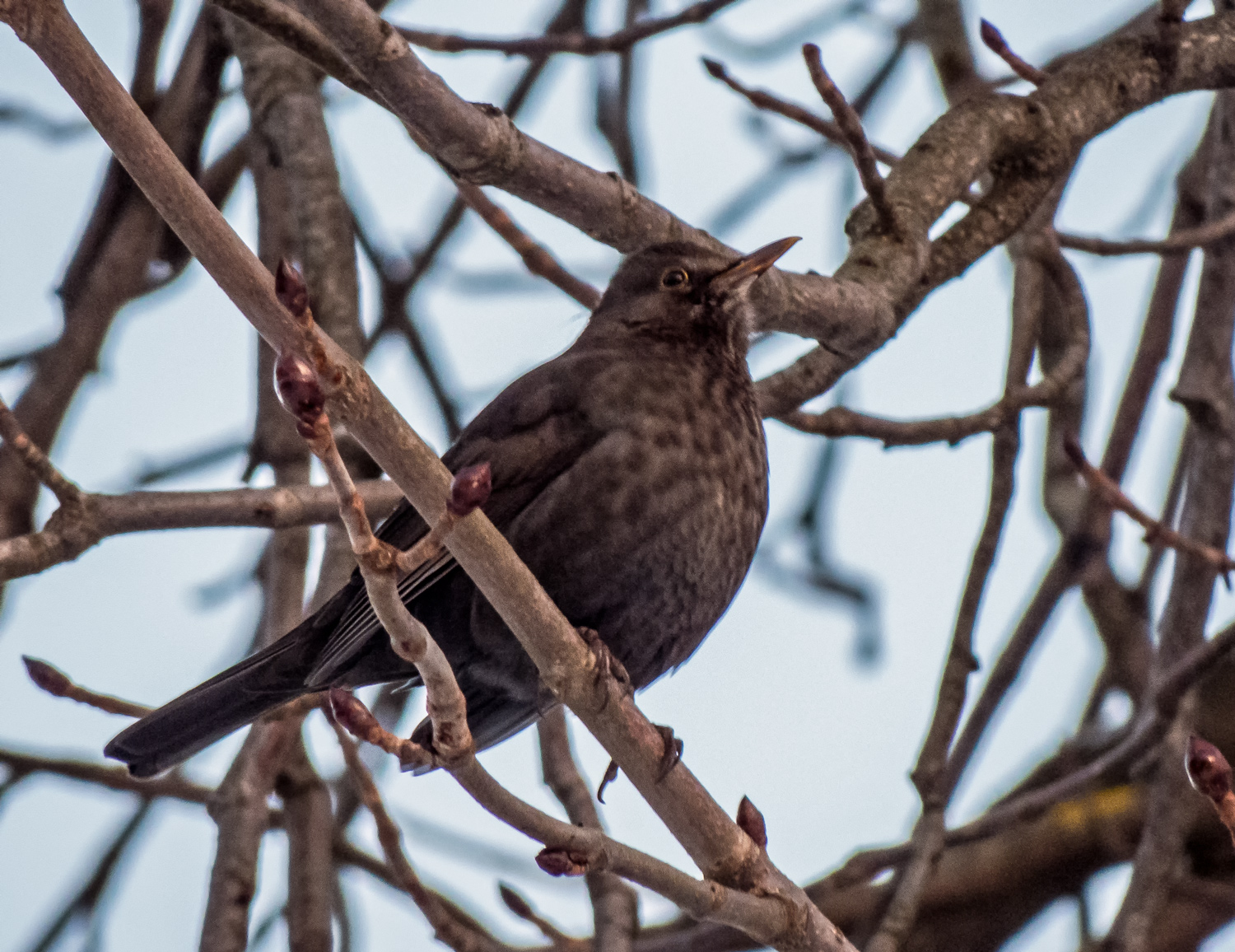
Blackbirds in Germany are more closely related to American Robins (Turdus migratorius)—both belong to the thrush family—than to Red-winged Blackbirds (Agelaius phoeniceus), which belong to an entirely different bird family.

Here is a shot that I took earlier this week of a female Eurasian Blackbird (Turdus merula) in Oberammergau, Germany. In many places this bird species is known as the Common Blackbird or simply as a blackbird. When I first spotted this bird, I was struck by two things. First, the shape of the body and bill reminded me immediately of a robin, even though the red-breast was not present. Secondly, the song that the bird was singing was melodious, unlike the sometimes grating calls of Red-winged Blackbirds.

Eurasian Blackbird

© Michael Q. Powell. All rights reserved.

Read Full Post »

I couldn’t see the sun actually setting on Wednesday in Oberammergau, Germany, but there was a glow in the sky and behind the mountains that was particularly beautiful.

As I rushed around in the fading light, trying to get some shots, I decided to include the Parish Church St. Peter and Paul, one of the most prominent buildings in this small Bavarian village. A few hours later, I captured the second image with a long exposure made by leaning my camera on a parked car. I love the architectural style of the church and included a third image to give you a better sense of the entire church structure.

Parish Church Oberammergau

Parish Church Oberammergau

Parish Church Oberammergau

© Michael Q. Powell. All rights reserved.

Read Full Post »

During most of my travel overseas, I stay at hotels operated by US chains, generally the Marriott. The accommodations are predictable, albeit a bit generic, no matter where I am in the world.

This week in Oberammergau, Germany, I am staying in the Alte Post Hotel, which is almost the antithesis of a hotel chain.  It is old, unique, and charming.

According to information in the hotel, it was initially known as the Lion Inn and was first mentioned in chronicles in 1612. Merchants frequently stopped in as early as the 17th century. In 1851, the first postal station was opened at the inn. In 1864 the inn, minus the postal station was purchased and the new owner renamed it as the Alte Post  (Old Post).

The hotel is a little quirky, but friendly, with lots of wood paneling, as seems to be the style in the region. The first photo below shows the front of the hotel. The second photo shows the view from my room that looks out onto the spectacular mountains.

Alte Post

Alte Post

© Michael Q. Powell. All rights reserved.

Read Full Post »

As I was exploring the Ammer River on Sunday afternoon, the day of my arrival in Germany, I spotted these two Common Merganser ducks (Mergus merganser). Initially they were sleeping with their heads tucked under their wings, but eventually they woke up and swam around a little and I was able to get some shots.

I am on a brief trip to Germany for work and am staying in the small Bavarian town on Oberammergau, in southern Germany. It is located in the mountains and at the moment has lots of snow. I did manage to get a few shots of the town and of the mountains on Sunday that I hope to feature later this week. Our work schedule looks to be pretty busy and I am not sure I will have the chance to get out again with my camera before I depart on Saturday.

Common Merganser

Common Merganser

Common Merganser

© Michael Q. Powell. All rights reserved.

Read Full Post »

Normally I plan my photo expeditions so that I arrive after the sun has already risen. After all, if I want to photograph wildlife subjects, I need to have enough light to be able to see them. Recently, however, I have been trying to get there before sunrise in order to capture images of the color in the sky. This is becoming a problem for me, because the gates of the wildlife refuge where I like to explore do not open until 7:00 in the morning and we have almost reached the point in the year where the sun rises even earlier than that.

On Tuesday, I arrived at Occoquan Bay Wildlife Refuge at about 7:05 and the color in the sky was amazing, a beautiful red color tinged the clouds. My view of the most colorful parts of the sky was blocked by trees, so I did my best to frame the sky with those trees. My the time I reached the water, the most saturated colors had disappeared, but in some directions I could still see some glorious pastel colors and I captured the second image. I love the abstract quality of that image, a depiction of nature at its simplest, a series of wonderful shapes and colors.

colorful dawn

colorful dawn

© Michael Q. Powell. All rights reserved.

Read Full Post »

The sun had risen before I reached the water at Occoquan Bay National Wildlife Refuge this past Saturday morning, but there still was some color in the sky that was reflected by the ice along the shoreline, imparting blue and orange tinges to the ice.

In the second shot, I used the wide-angle capabilities of my Canon SX50 superzoom camera to give you an overall feel for the moment. As you can see, the sun was not yet very high in the sky and the clouds helped to direct the sun’s rays directly down onto the distant water, giving it a kind of shimmer. I am now accustomed to carrying both my DSLR and the SX50 to give me greater flexibility in capturing different situations.

winter sunrise

winter sunrise

© Michael Q. Powell. All rights reserved.

Read Full Post »

« Newer Posts - Older Posts »