Feeds:
Posts
Comments

Posts Tagged ‘Canon 55-250mm zoom lens’

This morning as I was walking along the boardwalk that runs through the marsh in Huntley Meadows Park, I happened to glance down into the muddy water and was surprised to see something that looked like a cross between a starfish and a spider. I always though that spiders lived in trees and on other types of vegetation, but today I learned that there are also spiders that hunt for their prey in the water.

This spider is from the Dolomedes family, probably a six-spotted fishing spider (Dolomedes triton). According to the Wikipedia article, they are often seen with their legs sprawled out by the water while they are waiting for prey (which is what this one seems to be doing). They eat other invertebrates, tadpoles and occasionally small fish (and the female may also eat male fishing spiders if she has already mated). According to fcps.edu, these spiders can walk on the surface water and can stay underwater for 30 minutes. Not surprisingly, they don’t make webs.

This has been quite the day for unusual insects, beginning with a neon-colored grasshopper and ending with a fishing spider. I can’t wait to see what’s next.

Fishing Spider Waiting for Prey (click for higher resolution)

© Michael Q. Powell. All rights reserved.

Read Full Post »

The water level in the marsh at Huntley Meadow Gardens here in Alexandria, VA has been getting lower and lower as the summer has progressed. I suspect that the situation had made it more difficult for some of the inhabitants to find food and may have increased competition for the available food.

Previously I posted photos of a Great Blue Heron catching a fish in the remaining water of the pond of the marsh. Last week I had the chance to watch a series of confrontations between a Great Blue Heron and a snapping turtle. It seemed to start when the  heron grabbed a fish out of the water just as the turtle was approaching him. I had the impression that the turtle might have been pursuing that same fish. The snapping turtle made a series of aggressive runs at the heron, getting really close to the heron’s legs. I have seen pictures on-line of a snapping turtle pulling down a Great Blue Heron, so I waited with fear and anticipation to see what would happen. The heron left the water this time without any bodily injury. (I have some photos of this initial confrontation that I might post later, but their quality is not as good as those of the second round of confrontations.)

The heron eventually went back into the water and it wasn’t long before the snapping turtle came at him again. (I could almost hear the music of the movie “Jaws” in my head as the turtle made a run at the heron.) Like a matador side-stepping a charging bull, the heron awkwardly avoided the turtle who was approaching him faster than I’ve ever seen a turtle move. The heron then turned his back on the turtle and started walking away, perhaps feeling the hot breath of the turtle who continued to pursue him. Finally, the heron took to the air, deciding that he had had enough of the persistent turtle.

I managed to capture the highlights of the confrontation with my camera. I continue to marvel at the wonders of nature as I observe new creatures and see familiar ones act and interact in new ways.

Snapping turtle approaches Great Blue Heron

Great Blue Heron steps to the side as snapping turtle gets aggressive

Great Blue Heron walks away with snapping turtle in pursuit

Great Blue Heron decides to leave his problems behind

© Michael Q. Powell. All rights reserved.

Read Full Post »

I just got back from shooting and couldn’t wait to post a photo of one of the coolest looking insects that I have ever seen. It appears to be be part of the grasshopper family, but its bright colors and blue eyes really made it stand out as I was walking through the marsh at Huntley Meadows Park this morning. I’m sure I’ll be able to identify him eventually, but want to share him now. Sometimes folks need a little extra pick-me-up on Fridays.

UPDATE: I am pretty sure he is a Handsome Meadow Katydid (Orchelimum pulchellum). I found a photo in BugGuide that looks quite a bit like this one.

© Michael Q. Powell. All rights reserved.

Read Full Post »

I was going through my recent dragonfly photos and this one really caught my eye. Somehow the combination of the dragonfly’s position and the long branch with the slight curve together made me think of a pole vaulter just before he clears the bar. It’s a little unusual that I photograph a dragonfly from below with the sky as a backdrop, but that’s what happened that day.

Maybe he’s preparing for the Dragonfly Olympics! What other events do you think they would have? I’m pretty sure they’d have gymnastics, given the frequency with which I see dragonflies do handstands.

Pole-vaulting dragonfly

© Michael Q. Powell. All rights reserved.

Read Full Post »

I love to shoot in the rain. This past weekend the weather was threatening, but I went to Huntley Meadows Park anyway and was happy to see both a Great Blue heron and a green heron. It was already sprinkling a little when I started to take some photos of this little green heron and I had my umbrella out. I like the effect of the raindrops on the surface of the water. The light was interesting too and the heron cast a reddish, blurry reflection in the water.

Green heron in the rain

The weather started to worsen as I headed toward the location where I previously had seen a Great Blue heron. That area has a two-tiered observation area and I knew the lower level is partially sheltered from the rain. I arrived just in time as the rain started to come down really hard. The first photo of the Great Blue heron shows him standing in the water as the rain pours down. It didn’t seem to bother him at all. The quality of the photo is not that great (the light was bad and I upped the ISO), but I like the effect. The second photo shows the same area as the downpour is ending and the water appears as a very vivid green and looks almost tropical.

Great Blue heron in the driving rain

Great Blue heron as the rain tapers off

The rain may not be the time to take perfect photos, but I personally like the look that it gives to some of the photos that I shoot.

© Michael Q. Powell. All rights reserved.

Read Full Post »

A few days ago I posted a photo of a Yellow Garden Orbweaver (Argiope aurantia) that I photographed at Huntley Meadows Park in Alexandria, VA. I was strangely attracted to those spiders and returned the next day to see if I could get a few more shots.

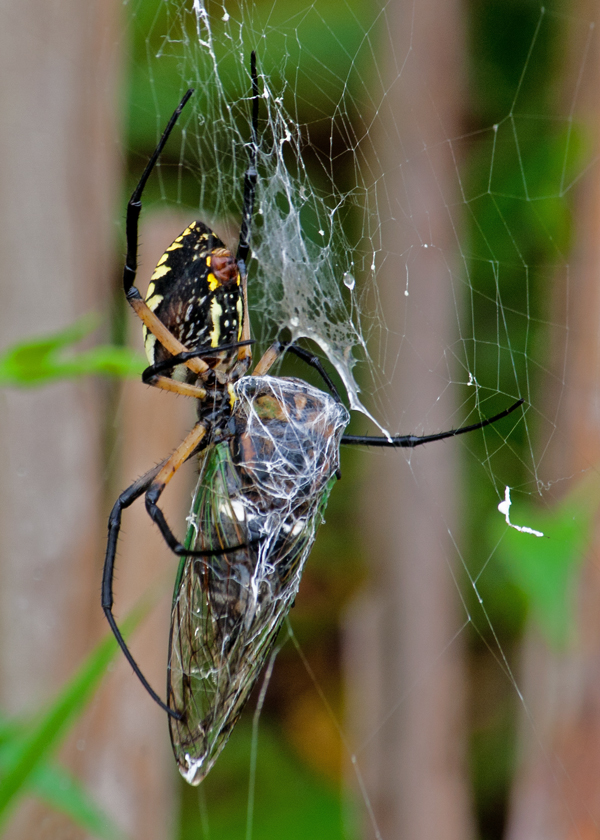
Here is one of my favorite shots from that day. The spider looks to be gnawing on the leg of a grasshopper that has been wrapped up and seems to be a little dried out. The grasshopper actually looks like he has been battered and deep-fried, but that seems to be a bit over the top, even for a Southern spider. You can also see a little of the zigzag pattern of the web at the bottom of the photo that is typical of the webs of this kind of orbweaver.

Yellow Garden Orbweaver Spider and Grasshopper (click on the photo to see more details)

© Michael Q. Powell. All rights reserved.

Read Full Post »

Usually when I try to photograph this kind of flower I end up focusing on the petals and the stigmata (I think that’s what those five purplish things at the end of the stalk are called) are out of focus. This time I made a concerted effort to have the stigmata in focus and let the rest of the flower—which I am pretty sure is some kind of hibiscus—take care of itself.

It seems to have worked out pretty well and as an added bonus the light caused the inside of the flower to glow a little, giving some depth and texture to the petal.

Glowing hibiscus flower

© Michael Q. Powell. All rights reserved.

Read Full Post »

This past weekend when I was out taking photos I was startled when I heard the very loud “singing” of a cicada really close to me. I glanced down and could see the cicada right in front of me, clutching a plant and visibly vibrating. I managed to get this shot of the cicada.

Cicada singing

I decided to do a little research on the cicada because I really don’t know much about them, except for the panic we had a few years ago when the 17-year cicadas were here. In the Wikipedia article, I learned about the different types of cicadas and how they produce the noise that is associated with them that can go up to 120 decibels, among the loudest of all insect-produced sounds.

One of the most interesting statements for me in the article was that, “The cicada has represented insouciance since classical antiquity” and referred to a fable by Jean de La Fontaine. Why was this interesting to me? I love words and it’s fun to read words like “insouciance,” a word with which many people probably are not familiar. It comes from the French word for “care”or “concern” (souci) and “insouciance” usually refers to a carefree, light-hearted, nonchalant attitude.

Did I mention that I was a French literature major in college more than 35 years ago? In college I really liked the French classical literature of the 17th century and Jean de La Fontaine was a very well-known poet and fabulist of that period. (Now tell me, how often do you get to use the word “fabulist” (someone who writes fables)? “Fabulist”—it sounds like it should be something that you’d find in People magazine to know how a celebrity rates in being fabulous.)

I went looking for de La Fontaine’s fable about the cicada to learn more of its reputation for being insouciant. There are a lot of different translations from French into English of the short fable, but I decided to do my own translation to avoid copyright issues and to exercise my French skills.

Here is my translation of La Fontaine’s fable called the “La Cigale et la Fourmi” (“The Cicada and the Ant”).

“The cicada, having sung the entire summer,
Found herself strongly in need when the north wind blew,
Possessing not a single morsel of fly or worm.
She went to her neighbor, Madame Ant, to tell of her need,
Asking her to lend some grain so she could survive until the new season.
“I will pay you interest and principal before the harvest, animal’s oath,” she said to her.

Madame Ant, however, is not a lender, which is the least of her faults.
“What were you doing during the hot weather?” she asked the borrower.
—Night and day I sang to all those coming by, whether that pleases you or not.
—You were singing? I am so glad.
Well, dance now.”

We could have a fascinating intellectual discussion about the meaning of the fable, but I’ll leave that for another time. While I was doing research about the fable, I came across a really cool video of the fable on YouTube that was produced by Studio YBM. It’s a cartoon and is in French, but if you’ve read the fable it’s easy to follow. I don’t want to spoil the video for you, but I encourage everyone to watch it to see insects in snowsuits and hear the cicada performing as a hip-hop singer.

So, where do you see yourself in the fable? Are you more like the ants or the cicada? Are you insouciant or are you more like Madame Ant?

© Michael Q. Powell. All rights reserved.

Read Full Post »

This weekend a fellow photographer (Christy T.) pointed out some really interesting looking spiders while we were at Huntley Meadows Park in Alexandria, VA. They were very colorful and big (at least they seemed really big, especially when looking through a telephoto lens). I had walked by the area where they were located (and there were probably at least ten of them), but had not noticed them until she prompted me to look more closely.

The spider (Argiope aurantia) goes by many different names including Black and Yellow Argiope, Yellow Garden Orbweaver, Writing Spider, and Yellow Garden Spider, according to BugGuide. These spiders had large webs with a very distinctive zigzag pattern in the center, which I learned from Wikipedia is called a stabilimentum. (I’m still going through my shots from yesterday when I returned to visit the spiders and may post a shot showing the zigzag pattern in a later post). Nobody seems to know for sure why they make that zigzag pattern, perhaps for camouflage or to attract prey.

One of the other really cool things about this spider is that it oscillates the web really vigorously when it feels threatened. My fellow photographer demonstrated this when she touched a web with a tripod’s leg (she did not want to get any closer). It was amazing to see the elasticity of the web as the spider moved—it reminded me of a slingshot being pulled back.

These spiders seem to catch some pretty big prey. There were grasshoppers in some of the webs and in the photo below the spider has captured a cicada. The Wikipedia article notes that the spider kills the prey by injecting its venom and then wraps it in a cocoon of silk for later consumption (typically 1–4 hours later). I think the spider in the photo may be in the process of wrapping up the cicada.

I continue to be amazed by the fascinating things that are in front of me that I have never seen before. It’s clear to me that my photographic journey is causing me to see the world differently, more attentively. That’s a good thing.

© Michael Q. Powell. All rights reserved.

Read Full Post »

I love to shoot photos after the rain (and sometimes even during the rain). The rain somehow transforms the world, adding drops of water to some surfaces when the water beads up and darkening others when the water is absorbed. Sometimes the weight of the accumulated water even causes shapes to change. That seems to have been the case with this lotus flower. The petals now hang down to the side, revealing the beautiful green seed pod. The glistening raindrops add to the distinctive look as does the yellow fringe hanging from the center.

I like the new-look lotus flower—it’s almost like it has had an extreme make-over, flower-style.

Lotus flower after the rain

© Michael Q. Powell. All rights reserved.

Read Full Post »

I love the graphic black-and-white pattern on this caterpillar that I photographed yesterday at Huntley Meadows Park in Alexandria, VA. The monochromatic pattern is wonderfully accented by the orange tufts with long white bristles. In this case, I am not too concerned about identifying this caterpillar—I am simply enjoying its colors, textures, and patterns.

© Michael Q. Powell. All rights reserved.

Read Full Post »

Rain was gently falling as I observed a Great Blue Heron at Huntley Meadows Park, a marshland in Alexandria, VA. I was surprised to see how the open water area had shrunk to just a small pool over the past couple of months, presumably because of the lack of rain.

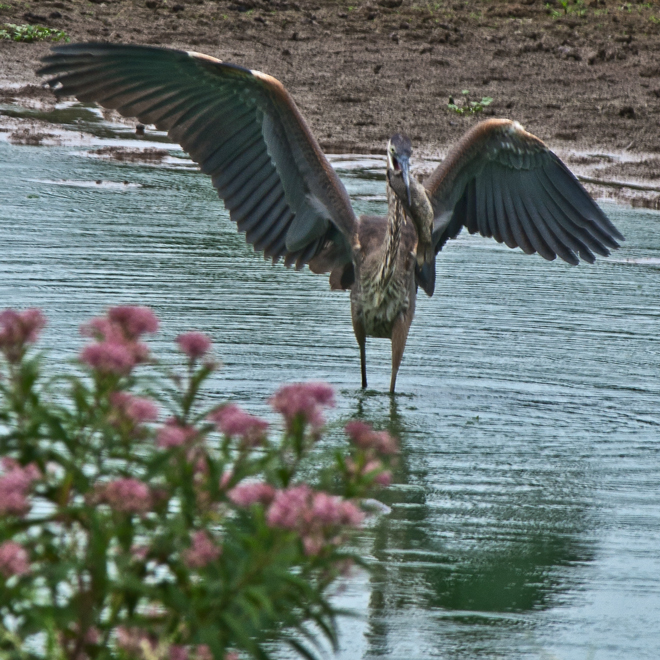
Nonetheless, there was a heron in the middle of that pool, seemingly intent on catching a fish. I was not at all convinced that there were any fish in such a small body of water, but the heron soon proved me wrong. He extended his neck and made a strike into the water and came up with a fish. As he brought the fish out of the water, he opened his wings widely (as the second photo shows), perhaps to counterbalance the weight of the fish. The heron’s wingspan was definitely impressive. He kept his wings partially extended as he moved the fish around in his mouth (as you can see in the first photo) and then swallowed the fish whole.

My photos are not technically great, but they did capture the moment pretty well.  I am thankful that I once again had the privilege to watch such a beautiful creature in action.

Great Blue Heron positions fish prior to swallowing it

Great Blue Heron opens his wings as he pulls a fish out of the water

© Michael Q. Powell. All rights reserved.

Read Full Post »

I remember my excitement the first time I saw a really cool dragonfly a few months ago that turned out to be a Halloween Pennant dragonfly (Celithemis eponina). He had a very distinctive look with brown spots and stripes on his wings and orange veins. That first time I was happy to get any shot of the dragonfly.

Today I think that I encountered a Halloween Pennant for a second time. I was still very much taken by his looks but I had the presence of mind to circle about a bit, trying to get a good angle for the shot. The shot below is the one that I like the best of those that I took.

As I think about it, I go through this cycle a lot. I’m so in awe and wonder when I encounter something new that photography is not my first priority. Instead I am living the experience. Maybe my photos the first time are not the best, but that’s ok for me, because living my life is more important than merely recording it in my photos. That may be why I like to go back to places a second time and then focus a bit more on getting good shots.

Halloween Pennant dragonfly (Click for higher resolution view)

© Michael Q. Powell. All rights reserved.

Read Full Post »

Have you ever gone through your photos so quickly that you missed your best shot?

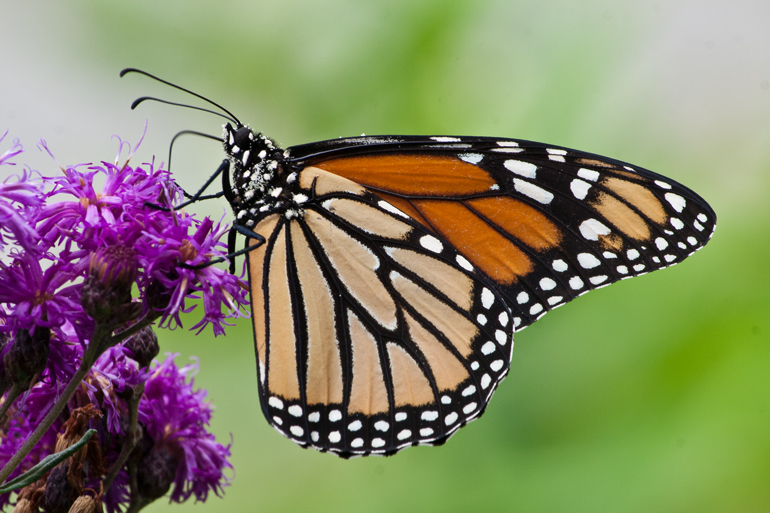
Earlier this week I was really excited because I had finally gotten some shots of Monarch butterflies and I posted a number of photos of them. As I looked over my photos from Monday again this evening, I saw a shot that surprised me. It surprised me because it was really good and it surprised me because I missed it the first time.

Other than using unsharp mask, this is the image that came out of my camera without any cropping at all. (Naturally I downsized the resolution for the blog.) I like the composition, I like the focus, and I like the background.

It doesn’t take much to make me happy.

Monarch butterfly (click for higher resolution)

© Michael Q. Powell. All rights reserved.

Read Full Post »

Here’s a shot from this past Monday of a Clouded Sulphur butterfly (Colias philodice) at Green Spring Gardens in Alexandria, VA.

Clouded Sulphur butterfly

© Michael Q. Powell. All rights reserved.

Read Full Post »

This past weekend I managed to get this shot of a green heron wading in a shallow stream. At that moment I don’t think he was yet aware of my presence.  I had an unobstructed view and the light was cooperative enough to make a nice reflection in the water. If you click on the image you can see some additional details of the green heron.

Wading green heron

© Michael Q. Powell. All rights reserved.

Read Full Post »

I finally managed to get a shot of a Blue Dasher dragonfly (Pachydiplax longipennis) on a lotus flower bud this past weekend. Previously I had photographed Blue Dashers on various plants and stalks and other things, but I have always thought that it would be especially cool to get on perched on the tip of a lotus bud.

It’s nice sometimes to have your wishes fulfilled and, yes, I think the photo met my expectations.

Blue Dasher dragonfly on lotus bud

© Michael Q. Powell. All rights reserved.

Read Full Post »
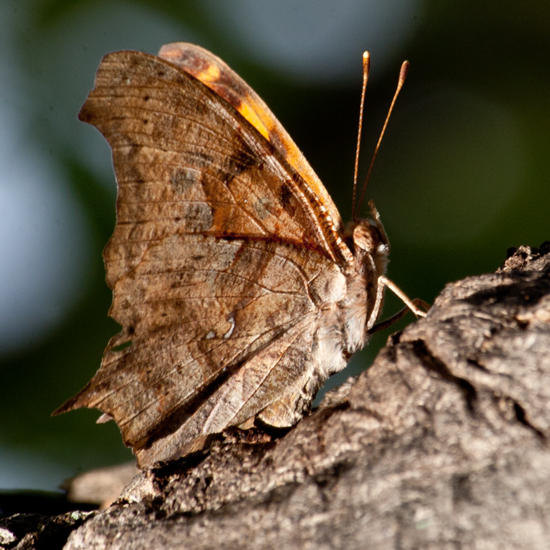
Back and forth I went as I tried to answer a simple question, “Comma or question mark?” You’re probably imagining that I was caught in some kind of punctuation dilemma, but that was not the case. No, I was not stuck in some special hell reserved for grammarians and editors, nor was I sweating out a standardized English test. Instead, I was trying to make a decision on the identity of this unusual looking butterfly that I encountered this past weekend.

Comma or Question Mark?

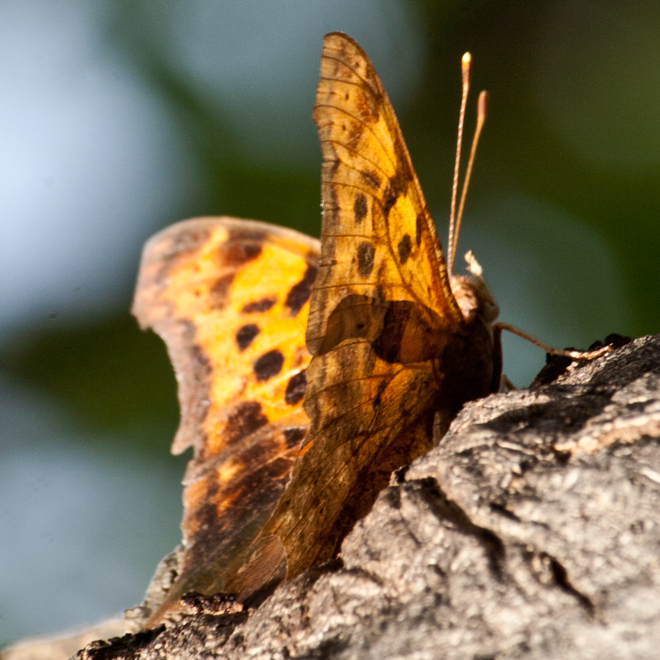
The colors of this butterfly almost perfectly matched the tree on which he was perched, facing downward in a way that almost perfectly camouflaged him. I rotated the image for the ease of viewers, hoping they will avoid the sore neck that I got as I turned my head trying to make out the details of the butterfly. In addition to the unusual color, the shape of this butterfly was pretty distinctive. What kind was he? As I was pondering that question, the butterfly—who had flown away and returned—opened his wings a little and I got a glimpse of the brilliant orange concealed inside his drab exterior.

A glimpse of orange

As he slowly opened his wings, more of more of the inside of his wings was revealed. The light shining through his wings made the colors glow like those of a back-lit stained glass window.

Back-lit wings

The butterfly flew away again, but amazingly returned once more and treated me to a full view of his open wings—his breathtaking beauty was revealed in full.

Beauty revealed

He sure was beautiful, but I wanted to know his name. Previously I had read about a butterfly called the Eastern Comma butterfly (Polygonia comma) and I had a vague recollection that he looked like this one. Wikipedia’s article on the Eastern Comma also helped explain why he was on a tree rather than some beautiful flower, like most of the butterflies that I have encountered. “This butterfly seldom visits flowers, but rather feeds on sap, rotting fruit, salts and minerals from puddling, and dung.”

I was still not sure of his identity, so I continued to search for clues. It turns out that there are two butterflies with similar shapes and colors. One is the Eastern Comma and the other is the Question Mark (Polygonia interrogationis), really. I feel like I am in some kind of Abbott and Costello style routine akin to their famous “Who’s on first?” routine. (Here’s a You Tube link to the classic routine if you are not familiar with it. It is definitely worth watching.)

The key to distinguishing the two is the shape of the little white markings on the wings and whether the markings are in two parts or one. If you think back to punctuation, you can probably guess that the one in two parts is the question mark and the unitary one is the comma. The website Gardens With Wings has an article with side by side photos of the two butterflies in case I have confused you.

So, which one did I photograph? I think I saw at least two different butterflies, but the one in the initial two photos and the one below all seem to have the white marking in two parts, which make them Question Mark butterflies (Polygonia interrogationis).

Question Mark butterfly

To be honest, though, the marking looks more like a semicolon than a question mark. Why isn’t there a Semicolon Butterfly?

© Michael Q. Powell. All rights reserved.

Read Full Post »

The cone flowers have lost their petals and have dried up in the summer heat, but the loss to my eyes seems to be a definite gain for the birds. The seeds in the cone flowers appeared to be the favorite food of an American Goldfinch (Carduelis tristis) that I spotted today at Green Spring Gardens.

Normally I see the goldfinches only as a flash of bright yellow zooming past my eyes. In the past when I tried to photograph them they seemed to startle very easily at the slightest movement. Today I was able to creep up closer and got some relatively unobstructed shots of a goldfinch.

I may post some more photos later, but here is one of my initial favorites.

American goldfinch on a cone flower (click to see the photo at a higher resolution)

© Michael Q. Powell. All rights reserved.

Read Full Post »

All this summer I have been waiting and hoping that I would have a chance to see lots of Monarch butterflies (Danaus plexippus). There is something so classically beautiful about the Monarch, from the white-dotted body to the gorgeous orange and black. So far this summer I had seen only an occasional Monarch.

Today, however, my wishes finally came true and I saw quite a few Monarch butterflies at Green Spring Gardens in Alexandria, VA. That does not necessarily mean that I had an easy time getting good shots of the Monarch, because the Monarchs today did not seem to like to linger very long on a flower. Consequently, more of my shots were rushed than I would have preferred.

Here is an assortment of my shots from today. None of them is spectacular, but I nonetheless am pleased I was able to capture some of the majesty of the Monarch in my images.

© Michael Q. Powell. All rights reserved.

Read Full Post »

I am never sure if it’s appropriate to post photos of mating insects, but decided to overlook my inhibitions and post this unusual photo of a pair of mating Eastern Amberwing dragonflies (Perithemis tenera).

Normally I have trouble getting good shots of these dragonflies because of their small size. According to BugGuide, their total length typically is 21-24 mm long (about 3/4-1 inch). In addition, they always seem to land on plants that away from the shoreline (unlike the Blue Dasher dragonflies that seem to like the plants at the very edge of the water).

This past Friday I was photographing dragonflies with Cindy Dyer at a local garden (Green Spring Gardens in Alexandria, VA) when this pair dropped from the sky and landed on a lily pad right in front of me. I happened to be shooting with a telephoto zoom so I had to back up a little to try to get a picture in focus. For those who are technically-minded, the exposure was shot at f11, 1/50 second, ISO 400, at 179mm of a 55-250mm zoom lens.

The photo is not perfectly sharp, but it gives an interesting view into the mating habits of Eastern Amberwing dragonflies. I don’t know my dragonfly anatomy very well, so it took some research to figure out who is who in this photo. The female is the one with the brown spots on her wings and she is holding on to the male’s tail. I think I’ll stop my description there and leave the rest to your imagination.

One thing that this photo taught me is that dragonflies are a whole lot more flexible and gymnastic than I realized!

Mating Eastern Amberwing dragonflies (click for a higher resolution view)

© Michael Q. Powell. All rights reserved.

Read Full Post »

I took this shot of a Red Admiral butterfly (Vanessa atalanta) at Green Spring Gardens in Alexandria, VA on 17 August 2012. It was a little surprising to me that the butterfly chose such a shriveled up, dead leaf as the place to stop, rather than a flower or bush. In a lot of ways, though, I like the simpler setting. It allows me to focus on the beauty of the butterfly without any competing attention from a colorful flower.

The colors and patterns of the Red Admiral butterfly would look good on a necktie. The colors are bright, but not gaudy, and the abstract patterns convey a sense of sophistication.

Red Admiral butterfly (Vanessa atalanta)

© Michael Q. Powell. All rights reserved.

Read Full Post »
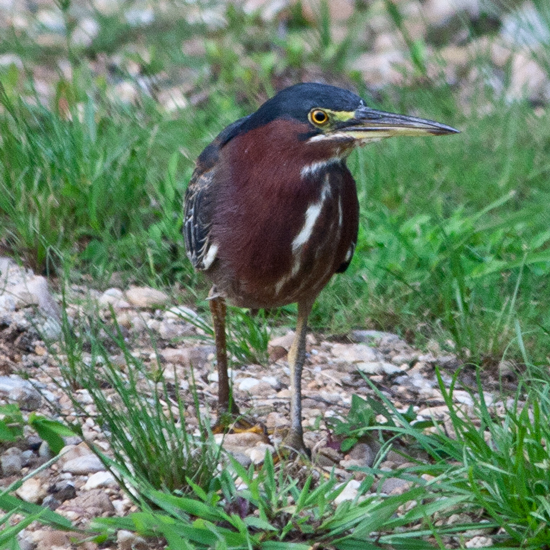
This is a shot of a green heron in the third different location where I have seen a green heron within the past month or so, all within a five mile radius of where I live in suburban Northern Virginia, outside of Washington DC. I came upon this little guy while I was walking down a stream bed and he flew into a tree when he became aware of my presence. Luckily he was still very visible in the foliage and, in fact, the green leaves serve as a nice backdrop to highlight the beauty of this green heron.

Green Heron in a tree

© Michael Q. Powell. All rights reserved.

Read Full Post »

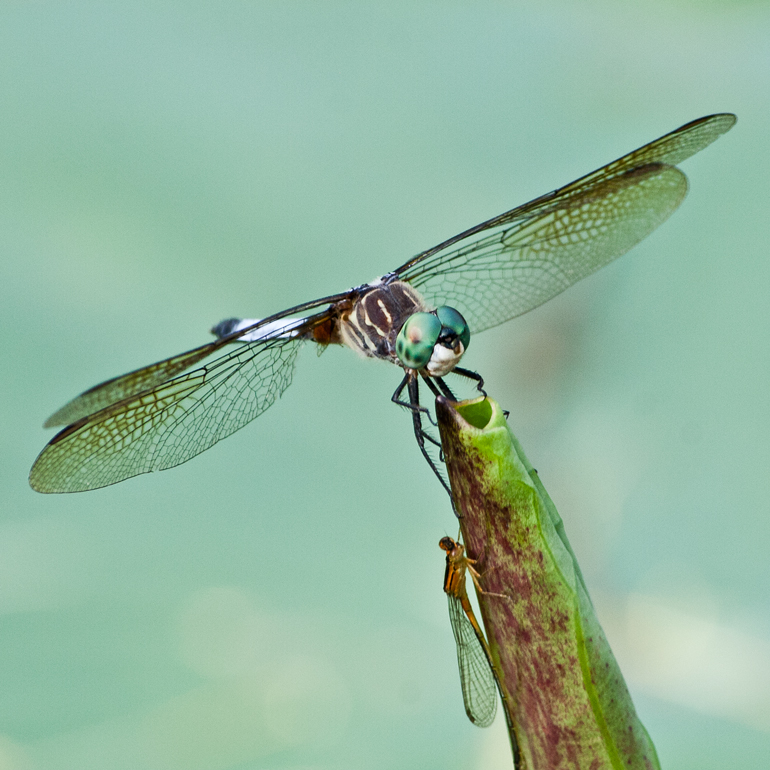
Sometimes when I open my images on my computer I am pleasantly surprised. I was going through my images from yesterday afternoon and came upon this one.

Click on the image for greater resolution and details

I had been focusing on shooting dragonflies that had stopped to pose on various objects. In this case I am certain that I was looking at the Blue Dasher dragonfly (Pachydiplax longipennis) perched on the rolled-up leaf of a lotus plant and never noticed the damselfly in the photo. The damselfly appears to be scaling the leaf, ready to do battle with the dragonfly. The dragonfly seems to be looking down with a little concern, wondering who is trying to challenge his position. When I compare the relative sizes of the two insects, I can’t help but think of the Biblical story of the boy David taking on the giant Goliath. In this case it would essentially be a family feud, since both dragonflies and damselflies are part of the Odonata family.

It’s a lesson to me to check my images carefully when I process them—there may be all kinds of hidden treasures waiting to be discovered.

© Michael Q. Powell. All rights reserved.

Read Full Post »

Yesterday I was at a nearby pond photographing mostly dragonflies. After shooting them I decided to make a quick walk around the pond (it’s only a small man-made pond) to see what other subjects I could find. I managed to find a colorful butterfly, a small green heron, and some lotus flowers that I will post later, assuming the photos came out ok.

The subject that really caught my attention, though, was a frog. Really? Yes, really.

I was leaning over the green-colored pond water, gazing at a distant dragonfly when I happened to glance down to my right. There, almost camouflaged in what my friends say is duckweed, was a semi-submerged frog. I was able to get my camera’s lens down pretty low and got in close and captured an image I really like. The frog’s gold-ringed eyes shine out clearly amidst all of the individual particles of duckweed that cover much of his expressionless face.

There are a couple of blades of grass that were partially blocking my view to the frog but they blurred out and are not really much of a problem.  After I took some shots, though, I decided to try to carefully remove one of those offending blades. As I made the effort,  the frog, who had remained motionless up to then, literally leaped into action. He sprung powerfully into the air and skipped across the surface of the water, like a rock throw by a dad showing his son how to skip rocks.

I was so startled by his sudden motion that I almost fell over into the water. Later in the day I did end up getting wet when I belatedly noticed that one foot was planted in the water while I was intently focusing on composing a shot. I guess that’s the price of being a photographer.

Hiding frog

© Michael Q. Powell. All rights reserved.

Read Full Post »

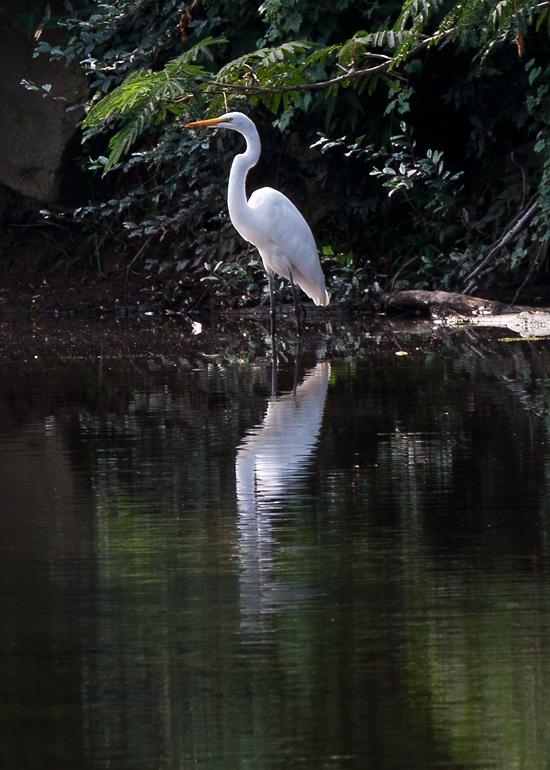
This morning I went shooting at Cameron Run, a tributary stream of the Potomac River in Alexandria, VA. I frequently commute along a road that parallels this stream and have often seen large white wading birds as I drove by. Today I decided to investigate and see if I could get some photos and determine if they were herons or egrets or some other kind of bird.

I did manage to get some shots of the birds in the water and even in the trees, but learned how difficult it is to get a proper exposure with a pure white bird. I’m pretty confident that the birds are Great Egrets (Ardea alba), which are also known as Great White Egrets. A passerby with binoculars (who seemed to know what he was talking about) told me that the orange beak is one of the characteristics that distinguishes the egret from the heron. If you want to know more, there is lots of interesting information about the Great Egret in an article on the website of the Cornell Lab of Ornithology.

The Great Egret is a really impressive looking bird, so much so that it is the symbol of the National Audubon Society, according to Wikipedia.  The Cornell Lab article points out that Great Egrets were hunted nearly to extinction for their plumes in the late nineteenth century, sparking conservation movements and some of the first laws to protect birds.

I was struck by the fact that the Great Egret roosts in the trees and seems to enjoy doing so with other egrets. In one cluster of trees I saw three egrets that appeared to be grooming themselves—they definitely did not seem territorial. I was impressed too by the wingspan that I got to see when I startled one of them and he flew up to a nearby tree.

Now that I know what kind of birds these are and where they hang out, I’m sure I’ll be back to watch them and, hopefully, to photograph them.

Great Egret in a tree

Great Egret in the shade

Great Egret fishing in the stream

Reflections of a Great Egret

© Michael Q. Powell. All rights reserved.

Read Full Post »
After I got home from work today I rushed to a nearby garden to get in a few shots before the light disappeared totally. I was happy to spot a green heron (I’ve photographed them before at the pond area of this garden) and managed to take a photo of him that I really like. The green heron is standing the edge of a rocky cliff and appears to be keeping watch.  (In reality it’s more like a rock wall).

Green Heron Sentinel

I decided to add one other photo of the green heron that I managed to take before he flew across the little pond to the rock wall. It is a little more of an unposed shot than the first one, which almost looks staged, and captures him in his more natural environment.

Candid shot of a green heron

© Michael Q. Powell. All rights reserved.

Read Full Post »

Almost everywhere that I have seen flowers the last few weeks I have seen skippers. One of the few varieties that I can identify is the Silver-spotted Skipper butterfly (Epargyreus clarus) which I feature in my first photo.

Silver-spotted Skipper

Many of the other skippers, however, look almost the same to me. Wikipedia says that there are more 3500 recognized species of skippers, so I don’t feel too bad about my identification difficulties. Here’s a photo of one of the 3499 non-Silver-spotted Skippers on a sunflower.

Unidentified skipper on a sunflower

This must be the season for the Eastern Tiger Swallowtail (Papilio glaucus), because I see them almost everywhere too. I’ve posted lots of photos of swallowtails recently, but I figure that the bright color of the swallowtails will complement the more muted tones of the skippers. Besides, the different lighting and angles of the shots makes them very different photos for me, even when the subject is the same.

Male Eastern Tiger Swallowtail against the sky

Looking downward at a female Eastern Tiger Swallowtail

© Michael Q. Powell. All rights reserved.

Read Full Post »
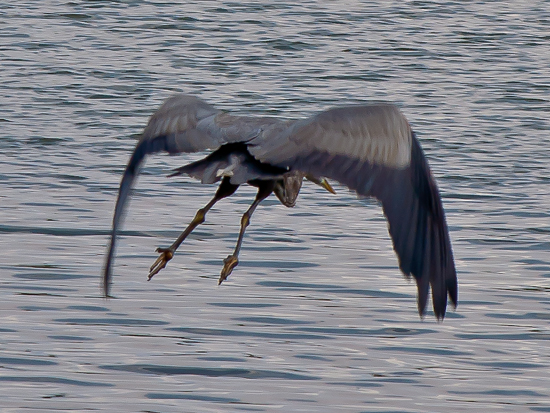
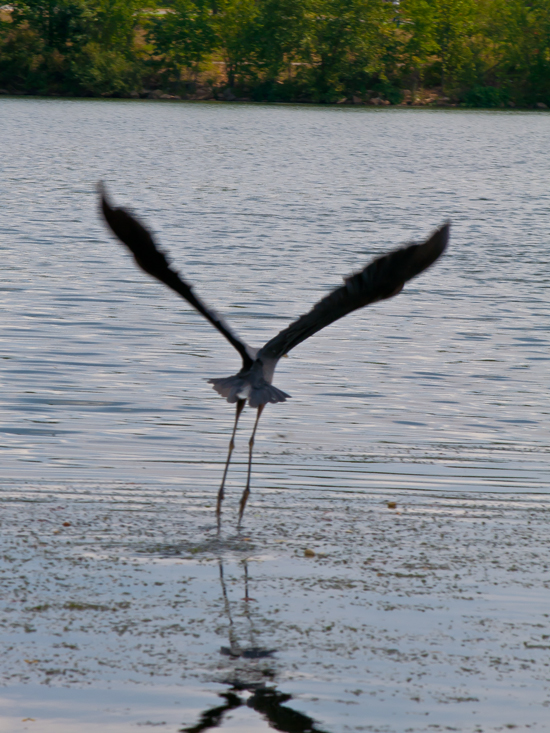
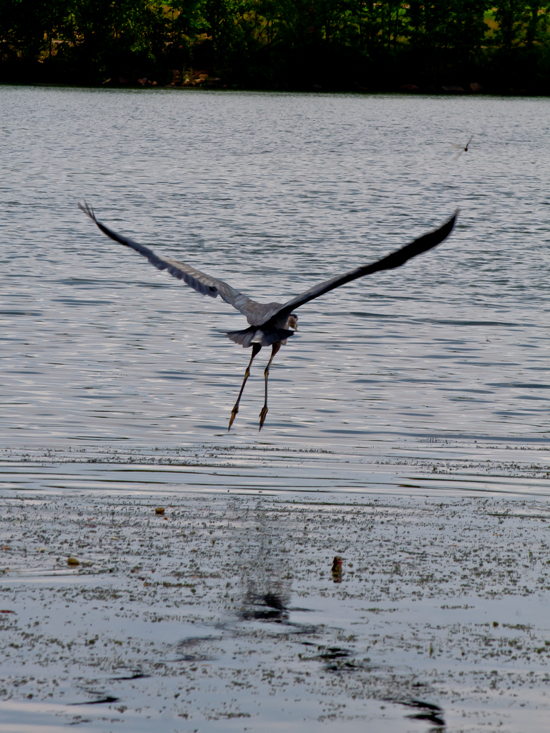
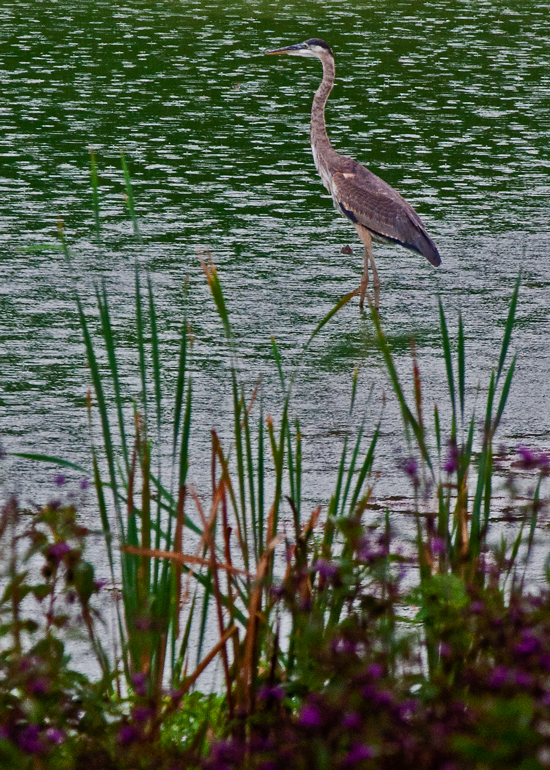
I haven never really paid attention to how birds take off. This past weekend I was photographing a Great Blue heron wading in the water of a nearby pond.  Without any prior indications, he suddenly took to the air. I happened to be in a good position to get a few shots of the different positions his wings assumed as he lifted off from the water. As you can see, I was almost directly behind the heron.

The first photo is my favorite because of the way in which the wings frame the extended legs and the barely visible head. Out of the three photos I have posted here, this was the second one shot.

The photo below shows the heron just as he was taking off from the water. The wings are blurry and are almost like a silhouette. It seems like he had to flap them really hard to lift out of the water. I like the fact that I was able to capture part of his reflection in the water.

Lifting off from the water

This final shot shows his wings in what I consider to be a normal flying position. I haven’t observed herons enough to know if they eventually pull in their legs tighter when they fly higher, but I assume that to be the case. In this photo I managed to get more of a complete reflection in the water than in the previous one.

Spreading his wings

I learned a few things when shooting these photos. First, and perhaps most importantly, I learned how important it is to be ready at all times, because a static situation can become very dynamic very quickly. Secondly, I now understand better why serious wildlife photographers have really big (and expensive) telephoto lens—it’s tough to get in close enough. Finally, I appreciate much more the abilities of those who are able to capture moving subjects like this heron with perfect focus and sharpness. My photos are not very sharp and clear, but I still found them interesting enough to want to share them.

© Michael Q. Powell. All rights reserved.

Read Full Post »

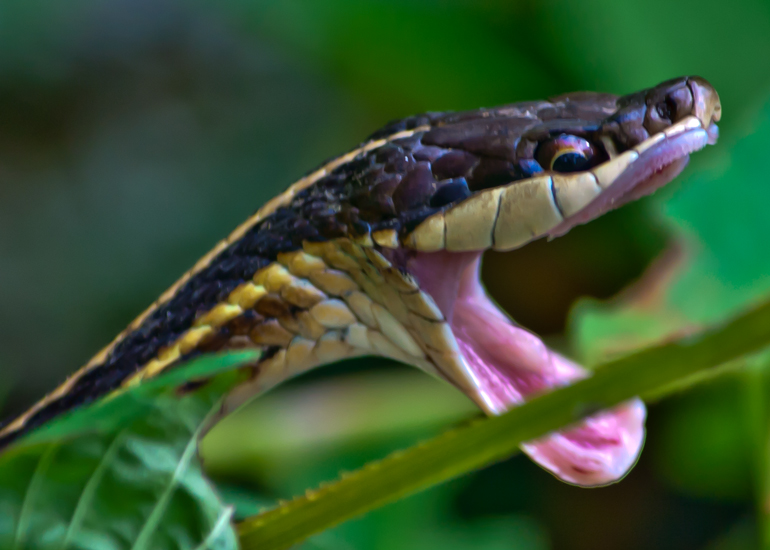
Some days it seems like anything that catches my eye is a potentially viable subject. This was the case last Friday when I was walking in a marsh in a local park and came upon this snake. Much of his body was concealed, but the upper body was exposed enough for me to attempt a head-and-shoulders portrait. Oh, wait a minute, I guess a snake does not really have shoulders, so I guess I was attempting a head-and-neck portrait.

The snake was beautiful in his own way, with wonderfully textured skin and stunning gold accents around his eyes. I thought he was probably a garter snake, but after a bit of research I am now convinced he is an Eastern Ribbon snake (Thamnophis sauritus), not a Common Garter snake (Thamnophis sirtalis). If you are at all interested in the differences, there is a wonderful article entitled “Telling Garter Snakes and Ribbon Snakes Apart” at http://www.gartersnake.info (yes, that’s the actual web address).

As I was admiring his beauty, he may have decided to remind me that he is a predator as suddenly he opened his mouth wide, really wide. I was looking through the lens at him and the effect was magnified because his head filled a good portion of the frame of the viewfinder. My first thought was that he was sizing me up as a potential snack. I had the presence of mind to snap a picture before his mouth snapped shut. A vine covers part of his mouth in the photo, but I decided to include it to show you how wide his mouth really is.

Now I understand how he is able to do things like swallow frogs whole. I’m glad I’m a lot bigger than a frog.

Eastern Ribbon Snake Posing for Portrait

Eastern Ribbon Snake Sizing Me Up

© Michael Q. Powell. All rights reserved.

Read Full Post »

Prior to this past weekend I had never seen an American Painted Lady butterfly (Vanessa virginiensis) and now it seems like they are everywhere, if you define “everywhere” as two separate locations within a few days.

Previously I posted a photo of the American Painted Lady butterfly in beautiful soft light in a shot taken from the side. On Sunday, just as I was getting ready to leave Meadowlark Botanical Gardens in Vienna, Virginia, I saw a flash of color and realized that it was a beautiful butterfly. Upon closer examination I recognized the now familiar coloration of the American Painted Lady.

She settled onto a plant and seemed to pose for me, as though she could put aside the normal activities of feeding for a moment. The late afternoon light was behind her and was still bright, causing some of the highlights to be blown out. However, the light also gave her a glow, partially illuminated her wings, and highlighted her reddish hair. The angle of he shot provides an unusual, but pleasing, view of this butterfly.

The shot may not be perfect, but you can’t help but admire the beauty of this American Painted Lady.

The lady is a redhead

© Michael Q. Powell. All rights reserved.

Read Full Post »

« Newer Posts - Older Posts »