Feeds:
Posts
Comments

Posts Tagged ‘Canon 55-250mm zoom lens’

After two days that were heavily overcast, we finally had some sunshine yesterday, although the day started out below freezing.A light sheet of ice covered then pond where I have been photographing ducks and geese, and they had all disappeared.

Eastern Gray Squirrels (Sciurus carolinensis) were very active, though, taking advantage of the weather to scamper about and gather food. It was fun to watch them run around, sometimes chasing each other like little kids playing a game of tag. I came upon this squirrel on a broken off limb, enjoying a snack. He was high enough up in the tree that he did not seemed to feel threatened by my presence.

There was some beautiful lighting from the side and the back that illuminated his underside when he turned in certain directions. My first few shots were really overexposed. If this had been a human subject, I might have tried using some flash to add some light, but that did not seem to be the right thing to do for a squirrel out on a limb. So I intentionally underexposed the image, blowing out the background (which was mostly sky, so it wasn’t a problem). I recaptured a little of the sky’s color in post-processing and played with the settings to try to bring out the texture and color of the squirrel’s fur. I guess that I never realized before that the fur is not a solid gray, but is a mixture of lighter and darker hairs.

I especially like how the light hits the upper portion of one of his ears and the tip of his bushy tail. The reddish brown tones of the wood also help to bring out the colors of his face.  It was nice to have a cooperative, photogenic subject.

Out on a limb

© Michael Q. Powell. All rights reserved.

Read Full Post »

I am getting better at bird identification, but there are so many little brown birds that it seems virtually impossible to distinguish one species from another. That doesn’t hinder me from attempting to take photos of them, generally with little success, because the little brown birds seem to like to stay in the middle of bushes.

Today, however, I was able to take a clear shot of one of the little birds (perhaps some kind of sparrow) when it perched on the top of a blue metal fence. I got close enough to capture a lot of the texture of the feathers (you should click on the photo to see it in higher resolution) and I found an angle to shoot from that left a uncluttered background streaked with light blue and brown. Even the fence itself is a pleasing element of the photo, providing a touch of color and geometry.

I don’t know why, but a number of my recent photos have been graphic and simple in their approach. My eye seems to be framing my photos that way and I am pretty pleased with the results.

Little brown bird on a fence

© Michael Q. Powell. All rights reserved.

Read Full Post »

One frosty morning this past weekend as I was was walking on a bike path, searching for a subject to photograph, I spotted a Mourning Dove (Zenaida macroura) sitting on a bush. The bird’s small head and long tail made it pretty easy for me to identify. I snapped off a couple of shots before the dove flew away. Following the bird in its flight, I watched as it gently took a spot on some powerlines, where several small, noisy birds already were perched.

I like the contrasts in the photo I took at that moment. The two small birds are shadowy and full of sharp edges, suggesting a kind of nervous, frenetic energy. The dove is larger, softer, and brighter and radiates a sense of gentleness and peace, undisturbed by the outside world. The parallel lines of the wires provide a man-made geometric structure for the natural elements and the sky provides a gradient-like backdrop to the entire scene.

Morning Mourning Dove

© Michael Q. Powell. All rights reserved.

Read Full Post »

The late afternoon sun was still illuminating the top of trees today in my neighborhood as the moon began to rise. According to The Old Farmer’s Almanac, the full moon will be on Wednesday the 28th of November.  November’s full Moon (also called the Full Frost Moon) traditionally was called the Beaver Moon because it was the time to set beaver traps, before the waters of the swamps froze over.

November moonrise

© Michael Q. Powell. All rights reserved.

Read Full Post »

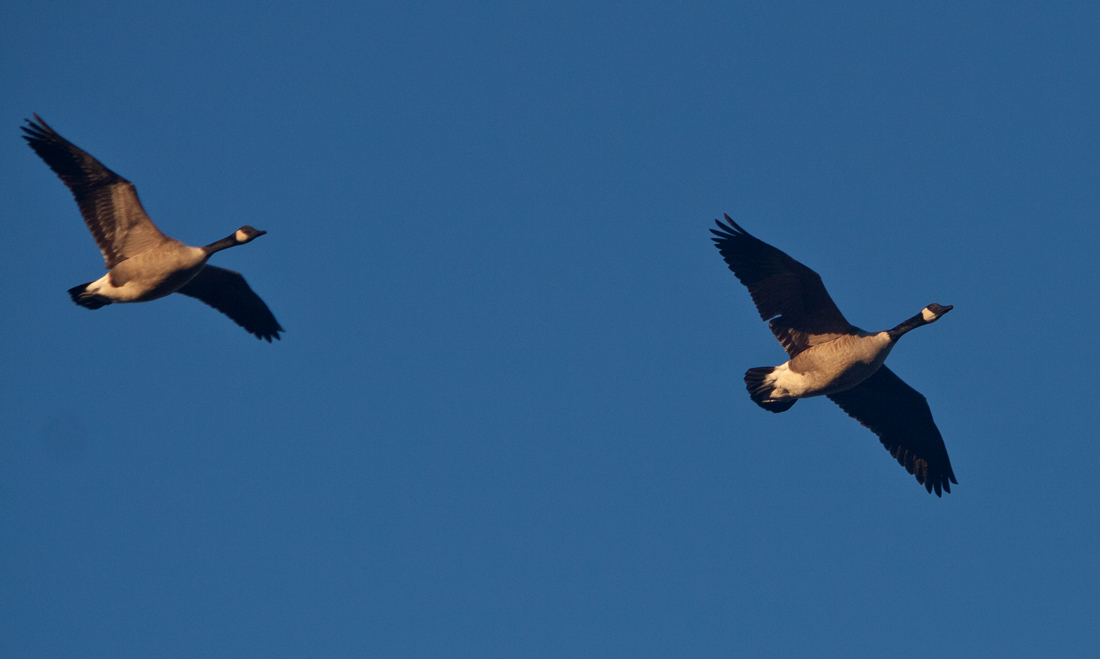
I continue my quest to capture birds in flight and geese continue to be a favorite subject. They are loud and big and fly slowly enough for me to have a fighting chance of capturing a decent image. That is not to say, however, that it’s been easy to photograph geese in flight. There are so many variables that I can’t control, particularly the direction of the geese in relation to the sun. Ideally the sun would illuminate the underside of the geese, rather than hiding parts of the body in dark shadows.

One morning earlier this weekend, conditions were relatively favorable and I was able to photograph these Canada Geese (Branta canadensis) as they flew by me. I like the different positions of the wings on each goose at the moment of the photo—it looks to me almost like a multiple exposure image, intended to show the flight of a single goose in stop=action.

Canada Geese in flight

© Michael Q. Powell. All rights reserved.
Read Full Post »

Today was cloudy, windy, and overcast—definitely not an ideal day for taking photos. Sure, I like to have some clouds to cut down on harsh shadows, but you need sunlight to have shadows, and we sure did not have much of that today.

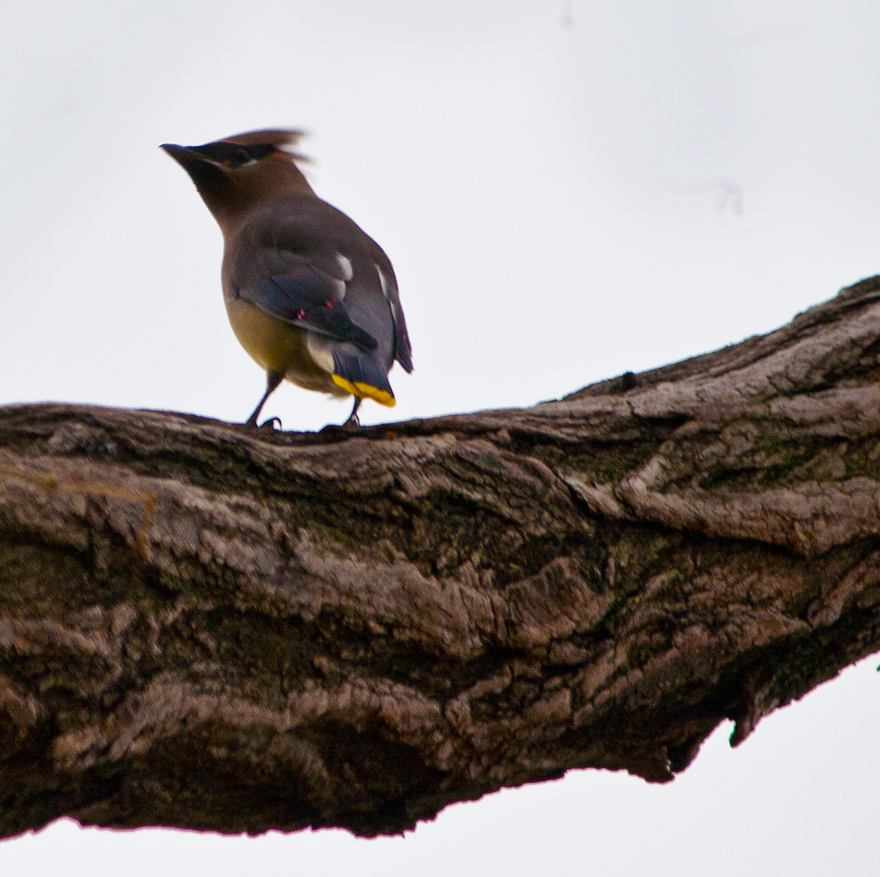
This afternoon I was walking on a path along a creek when small flock of birds flew into some nearby trees. They were pretty noisy and that attracted my attention. Looking though my telephoto zoom lens, I saw that they had an interesting silhouette, so I took some shots. They sky was already really light, but when I tweaked the exposure a little it went totally white and a really cool-looking bird emerged from the shadows. Usually I am pretty bad at identifying birds, but my initial Google search on the very distinctive yellow wing tips was successful in identifying this bird as a Cedar Waxwing (Bombycilla cedrorum).

Cedar Waxwing on a branch

According to the Cornell Lab of Ornithology, Cedar Waxwings feed on mostly fruit year-round, one of the few North American birds that specialize in eating fruit. One of the consequences of doing so, however, is that they sometimes get intoxicated from eating fermenting berries. The range map for this species suggests that they may be present year-round in this area (we are close to the northern boundary), but this is the first time that I have seen one.

This photo is more “artsy” than realistic, but I like its graphic character. It looks a bit to me like an illustration, in part, I guess, because of the white background.

© Michael Q. Powell. All rights reserved.

Read Full Post »

The Canada Geese (Branta canadensis) continue to make migratory stops at Huntley Meadows Park, the local marshland in which I have been taking a lot of photos recently and I have been able to observe them closely. I am always struck by their beautifully expressive eyes, which seem to reflect an inner gentleness.

The old proverb says that the eyes of the mirror of the soul. I have been told from the outset that I should always strive to have the eyes in focus when I am photographing people and animals. As far as I can tell, that’s one of the few rules of photography that is almost never broken.

How often do you make eye contact with other people? I am amazed at how infrequently people acknowledge the presence of others by looking into their eyes. It was one of the biggest adjustments I had to make when I left military service, in which you saluted and greeted everyone in uniform that you passed. So often people pass each other without any visual signal that they recognize the presence of other sentient being. Needless to say, I am not a fan of wearing headphones in public.

People may think that you are a little strange, but I encourage you to look others in the eye and smile and greet them—it’s amazing how their attitude and expressions change.

Profile of a Canada Goose

© Michael Q. Powell. All rights reserved.
Read Full Post »

Some birds seem to enjoy relaxing and posing and showing off their beauty, embodying a carefree approach to life. Woodpeckers, on the other hand, seem to be serious and focused, with a look of sheer determination in their eyes. It’s the same look that I see in so many of the people here in the Washington D.C. area, so driven in their professional lives that they are in danger of losing their identities apart from work.

Today, I photographed this Downy Woodpecker (Picoides pubescens) as he was preparing himself for work. Look deeply into his eye and what to you see? (Click on the photo to see more details.) The dead tree seems huge in comparison to this tiny bird. Yet he seems determined, determined to beat his head repeatedly against that wood, determined to find the food that he hopes and believes may be hidden inside.

Determined Downy Woodpecker


Do you ever feel like this woodpecker?

© Michael Q. Powell. All rights reserved.

Read Full Post »

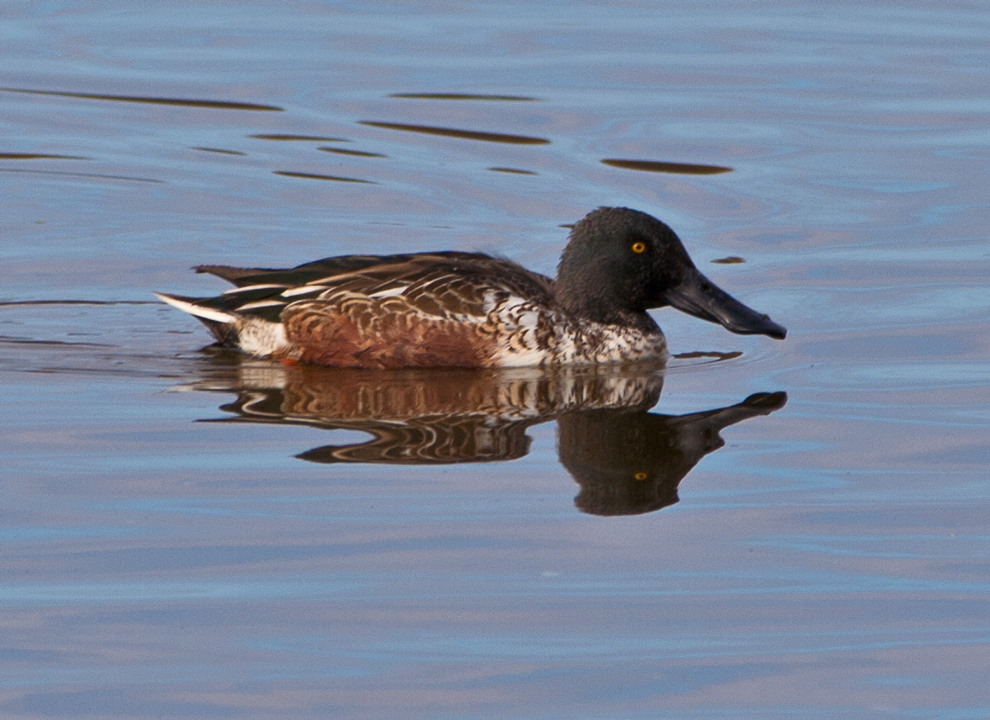
When I first saw this duck and his mate this week, I thought it was just another mallard couple. As I studied the male, though, I couldn’t help but notice his elongated black bill—it’s as plain as the nose on its face (wait a minute, duck don’t have noses). The female’s bill was similar in shape, but was orange in color. Not only are they long, their bills also seemed wider at the tip than at their bases, causing the ducks to look almost cartoonish.

Northern Shoveler

Using the duck’s distinctive bill as a search term, it was easy for me to discover that this duck is called a Northern Shoveler (Anas clypeata). Sometimes I am baffled by the names of species, but this time the reasoning behind the name was pretty obvious. Like the mallard, the Northern Shoveler is considered to be a “babbling duck.” It forages by swimming along with its bill lowered into the water, straining out small crustaceans and other invertebrates, and generally does not tip its head and upper body forward into the water, according to the Cornell Lab of Ornithology.

Foraging Northern Shoveler

The Cornell Lab also notes that Northern Shoveler couple are monogamous and “remain together longer than pairs of other dabbling duck species.” Longer than other dabbling duck species? It makes me wonder about the divorce rate among dabbling ducks. Does “dabbling” refer to their mating habits as well as to their feeding habits? Do they stay together for the sake of the ducklings?

Northern Shoveler Couple

Speaking of ducklings, the Cornell Lab, which I highly recommend as a source of information about birds, includes the following bizarre and disgusting, yet strangely interesting factoid about this duck species, “When flushed off the nest, a female Northern Shoveler often defecates on its eggs, apparently to deter predators.” What a strange reaction.  With humans, flushing almost occurs after defecation, not before.

© Michael Q. Powell. All rights reserved.

Read Full Post »

One early morning recently I was walking through the marsh, lamenting that spectacular spider webs of the summer and early fall had disappeared. Suddenly I noticed that some of the plants were covered in a silky, web-like material. It was almost abstract in its construction and I wondered (and still wonder) about its purpose. This photo captures pretty well—in a minimalist set of colors and tone—the mysterious moodiness of that morning moment.

Natural abstract

© Michael Q. Powell. All rights reserved.

Read Full Post »

When migrating geese land at my local marsh, most of them spend their time foraging for food, storing up energy for the next leg of their trip. This Canada Goose, however, seemed to have decided to rest a bit to regain his strength and secluded himself from the feverish activity of the other geese. His position is not that unusual, but his surroundings make this photo stand out for me. The colors contrast nicely with the black of his head and I really like the reflections. Click on the photo if you would like to see it in higher resolution.

Canada Goose at rest

© Michael Q. Powell. All rights reserved.

Read Full Post »

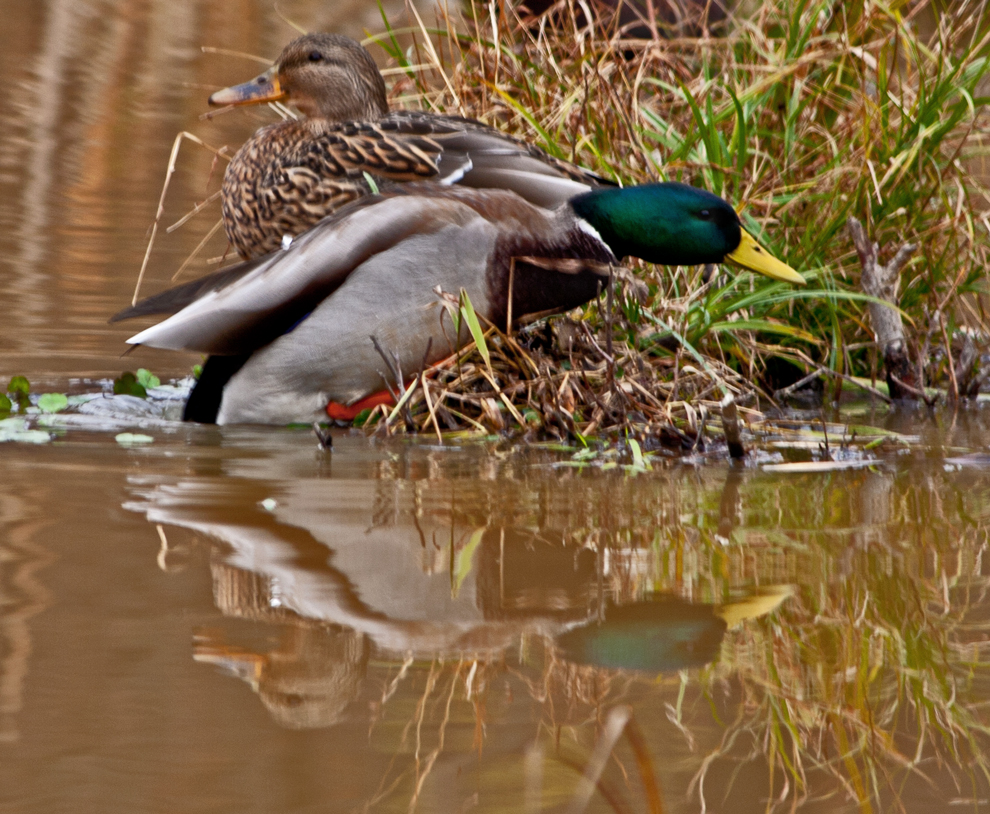
I have been watching migratory birds recently and observed that mallard ducks feed mainly by tipping forward and placing their fringed-edged bills in the water, straining out plants, seeds, and other material. The Cornell Lab of Ornithology categorizes mallards as “dabbling ducks” versus  “diving ducks” that go deep underwater to forage for food.

One mallard, though, used a different technique. Instead of dipping his head forward, he flattened himself out and placed his bill almost parallel to the water. He then slowly and systematically paddled back and forth with his beak in the water or just above it, continuously straining and restraining the surface of the water. (Did he require a restraining order?) As the photo shows, there was a lot of plant material available for him to gather. His female partner used the same technique, though I was not able to get a clear shot of her doing so.

Straining mallard

I observed another mallard straining in a different way. Along with his female companion, he was perched on a tiny piece of land. I must have startled him a little when I walked by, because he slipped into the water. Realizing he had nothing to fear from me, he tried to regain his spot. It required several vigorous attempts for him to climb out of the water and I managed to capture him straining to do so. I love the contrast between the determined look on his face and the impassive expression on the female’s face.

Mallard straining to regain his spot

Strain or strain? It’s so amazing that words can have so many different meanings—it strains the imagination.

© Michael Q. Powell. All rights reserved.

Read Full Post »

Usually when I see a deer, it turns and runs away, sometimes stopping to gaze back at be from a distance just beyond the range of the lens that I have on my camera at that moment. Recently, however, I encountered a deer that seemed content to look at me as I looked at him. It sounds like a nature photographer’s dream come true.

The biggest challenge was that he was in the middle of a mostly dried-up marshy field full of cattails and other tall growth that made it impossible to get a clear view of the young buck, a white-tailed deer, I believe. It became pretty clear to me that auto-focus was not a viable option—the camera seemed to really want to focus on some arbitrary branch rather than on the deer—so I relied on manual focusing. It was also in the middle of the day, so shadows were pretty harsh. During the protracted period of time that the deer stayed in the same little area, I shot a lot of photos and these are two of my favorites. You’ll note that the deer blends in pretty well with the background. If he had remained absolutely still, I may very well have walked on by without seeing him.

Deer in the cattails

White-tailed buck in a field of cattails

© Michael Q. Powell. All rights reserved.
Read Full Post »

Geese and ducks continue to arrive and depart with such frequency in my local marsh that I feel like I am in a major bird airport. Fortunately, there are no long lines or security checks for them to endure. We must have a special arrangement with our northern neighbors, for the Canada Geese are not subject to any special customs scrutiny.

I continue to try to take photos of the geese while they are in flight, usually when the are coming in to land or taking off. Often the geese will circle around and honk loudly to announce their arrival (a kind of bird intercom system). Perhaps the birds on the ground can interpret the honks to mean something like, “Now arriving on pond number one, Canada Geese flight number one from Toronto.” My first photo is one of a Canada Goose banking. No, he is not at an ATM machine, withdrawing cash. He is making a sharp turn as he prepares to land.

Banking goose

The second photo shows a goose in flight. If you click on the photo, you will notice that the goose has a zen-like look of contentment on is his face. Scientists have been working on implanting a tiny device into geese that will provide them an in-flight entertainment package (and autopilot features too) and this goose may be one of the early test subjects.

Goose in flight

Some geese hate to fly alone and prefer companionship during the long flight. A new business has sprung up that provides escort service for the lonely goose, a fledgling matchmaking company that is just getting off of the ground. The company’s contracts are full of fine print about additional charges, but some geese continue to be surprised with the bill they are presented at their final destination.

Lonely goose escort service

© Michael Q. Powell. All rights reserved.

Read Full Post »

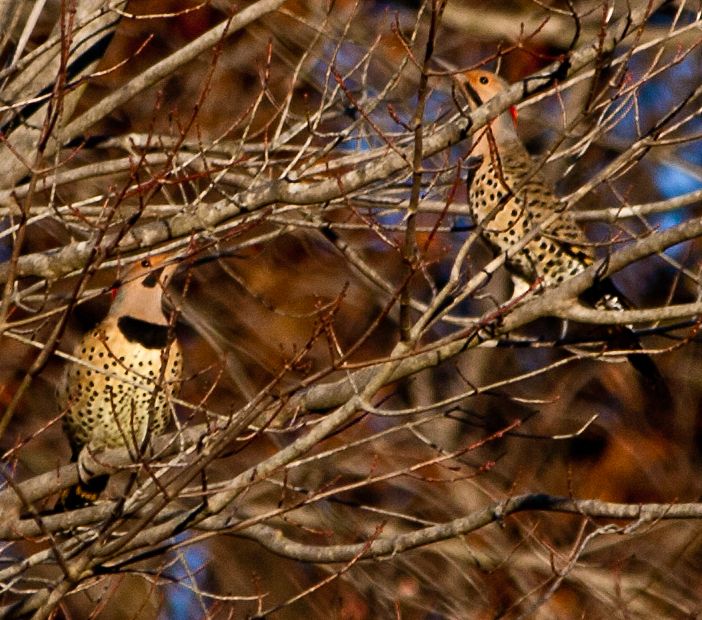
As I was walking this weekend past the beaver lodge at my local marshland park, a flash of brilliant yellow in the trees across the little pond caught my eye. Through my telephoto lens I could see that there were a couple of birds in the trees, but I couldn’t see them clearly because of tree branches nor could I identify them. Still, I kept shooting, aiming at the spot where I could see the movement and the flashes of color. Here is an example of what I was seeing (though this image is significantly cropped).

Northern Flicker couple

After returning home and doing a little research, I found out that I had photographed a pair of Northern Flickers (Colaptes auratus), a type of woodpecker that I had never seen before. I love their speckles and their black and red markings. These two birds were interacting in peculiar ways, with both of them flashing their feathers at the other, revealing the bright yellow colors that I had seen earlier.

Is this mating behavior? Were they putting on a performance for my benefit? I have not idea what was the cause for all of that behavior, but it certainly was intriguing.

None of my photos of these birds are that great, but I am always excited to share my photos when I see something for the first time. Perhaps the next time I will be better placed to get clearer shots.

“Maybe some sweet words will make an impression?”

“How do you like me now?”

“Two can play at that game.”

© Michael Q. Powell. All rights reserved.

Read Full Post »

This bumblebee seems to be cleaning or adjusting one of his antennae and it caused me to wonder why. What are the antennae used for? Bumblebee.org had the answer—the antennae are used for smelling and touching. Taste and smell are conveyed to the bee through tiny hairs on the antennae.

Amazingly, bumblebees have a built-in antenna cleaner on each front leg, a notch between the metatarsus and the tibia. As bumblebee.org describes it, “The antenna is inserted into the notch then the metatarsus is bent enclosing the antenna. The antenna is then pulled through the notch and any debris or pollen is caught on the comb fringing the notch.” That site has lots more great information on the bumblebee, including electron microscope photos of the bee and a diagram of the antenna cleaner.

Bumblebee grooming an antenna

© Michael Q. Powell. All rights reserved.
Read Full Post »

Late this afternoon, I was at a nearby suburban pond and noticed a Great Blue Heron (Ardea herodias) on the opposite bank. He was in a shaded area, where the water was calm and the reflections were beautiful. I was a bit too far away for a close-up shot, but couldn’t get any closer because of the bushes and underbrush that kept me from the water’s edge. Nevertheless, I was able to get some images that I like, including this one. I decided not to crop too closely to the heron in order to retain some of the bushes and their reflections that add a lot to the photo.

Heron in the shade (click for higher resolution)

© Michael Q. Powell. All rights reserved.
Read Full Post »

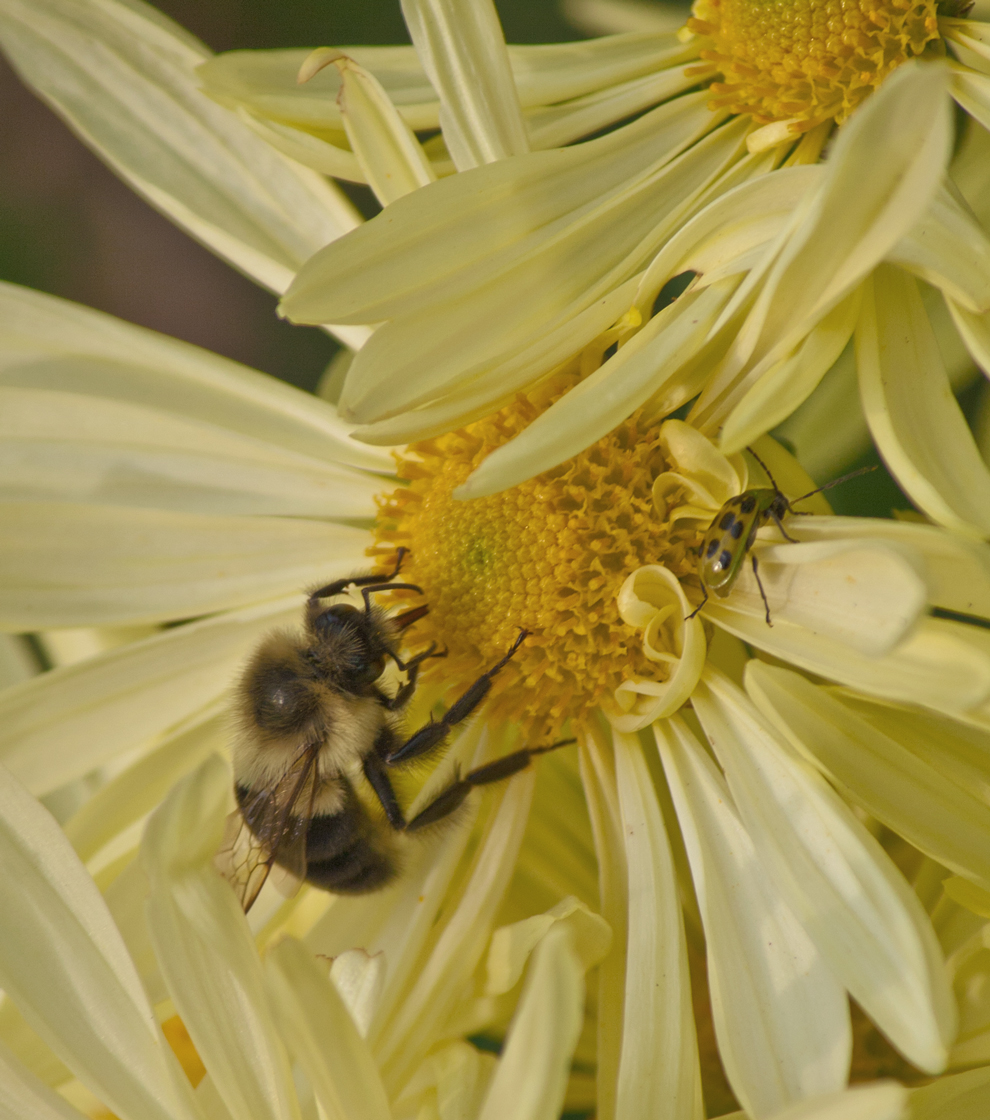
Yesterday I did a posting on a couple of interactions between birds of two species, a heron and a goose. Continuing on the same theme, here is a photo from last weekend of an interaction between insects of two species, a bumblebee and a Spotted Cucumber beetle (Diabrotica undecimpunctata). The beetle was already on the flower when the bumblebee arrived. Looking at the size of the invader, the beetle seems to have decided that a strategic retreat was the best course of action.

Interesting insect interaction

© Michael Q. Powell. All rights reserved.
Read Full Post »

Last weekend was warm and sunny and the bees were very active again after a period of cold weather and little activity. In a short period of time I was able to see (and photograph) several different varieties of bees. In addition to the familiar honeybees and bumblebees, I encountered what I thought was a new kind of bee.

Well, actually, it looked more like a hover fly (or flower fly), but the coloration was different. (Check out one of my earlier postings to see a photo of a hover fly.)  The unknown insect, featured in the third photograph below, acted a lot like a bee, buzzing from flower to flower feeding on nectar or pollen. I am still not completely certain about its identification, but it looks like it might be a Yellowjacket Hover Fly (Milesia virginiensis), a mimic for the Southern Yellowjacket (Vespula squamosa), according to information at Bugguide.

The weather has turned cold again and I may not see these insects again until spring, but it was nice to have an encore performance before the show is closed for the season.

Honeybee in November

Bumblebee in November

Yellowjacket Hover Fly in November

© Michael Q. Powell. All rights reserved.
Read Full Post »

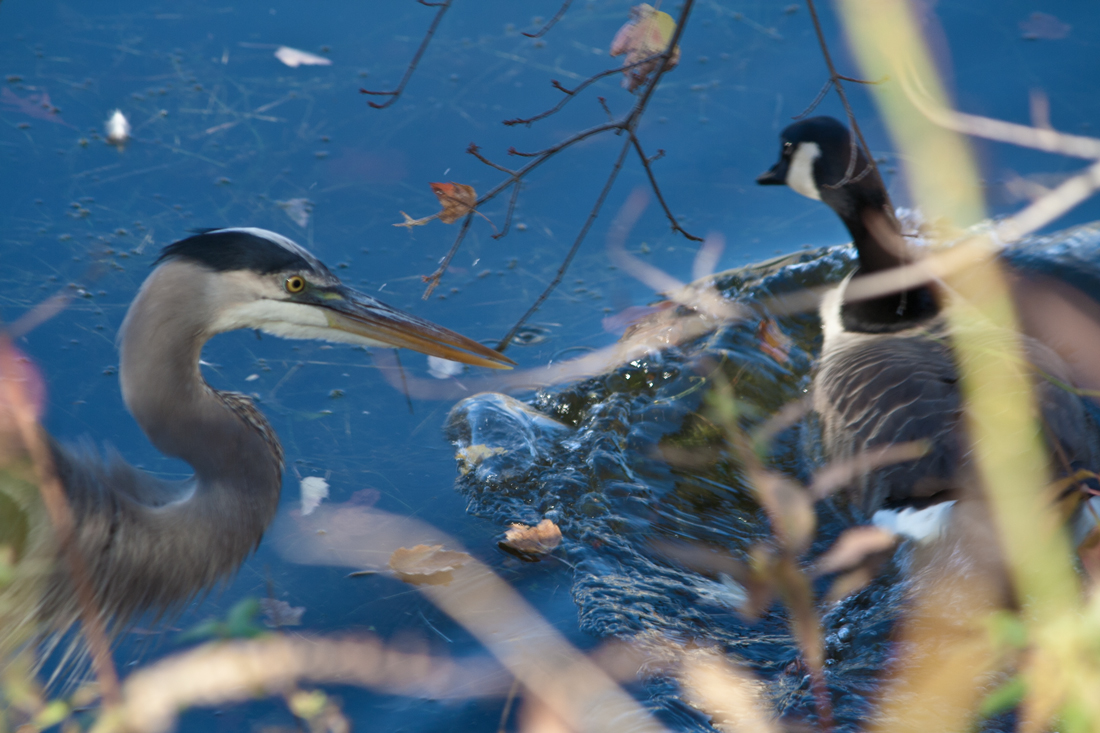
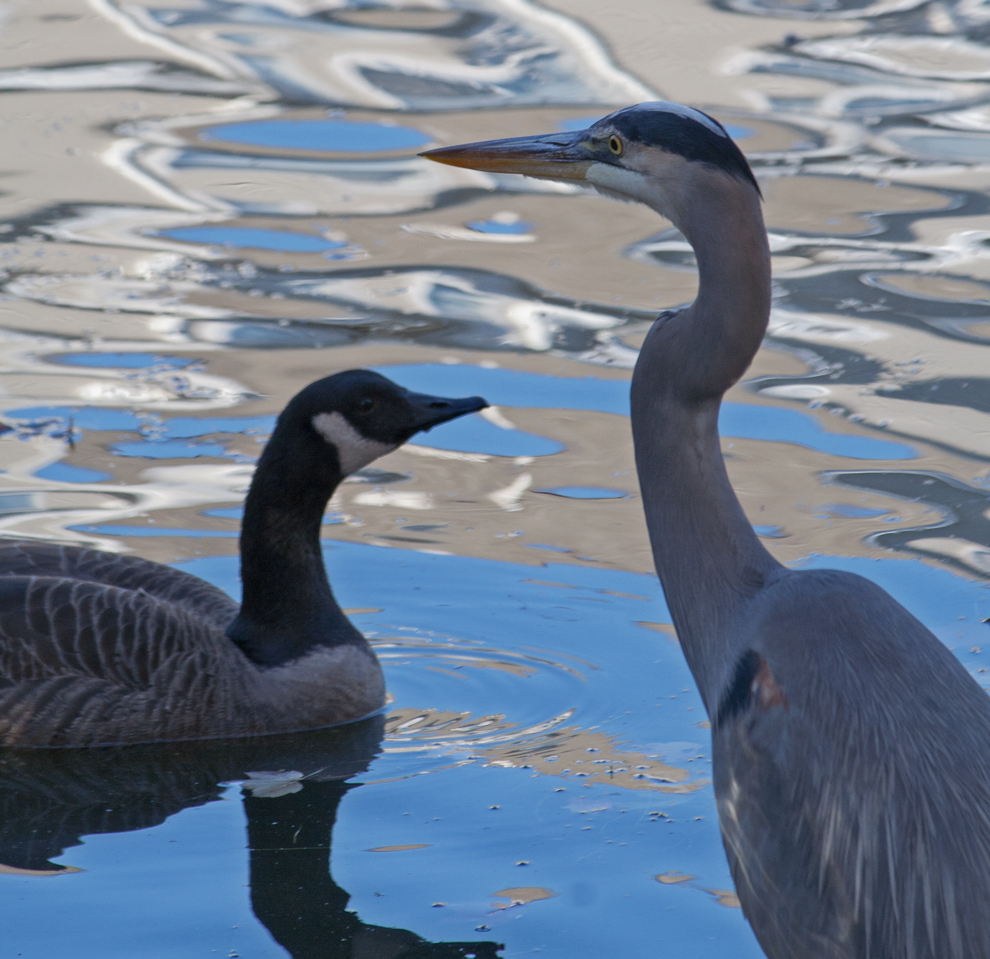
It is always interesting for me to see two species interact—you never quite know what will happen. Last Sunday, I was in the bushes in a local suburban pond area, pretty close to a Great Blue Heron (Ardea herodias). He seemed to be willing to tolerate my presence, though there were a lot of bushes that kept me from getting a clear shot. I photographed several encounters between the heron and Canada Geese (Branta canadensis) that live semi-permanently at the pond.

I took the first photo just after the heron made a threatening gesture with his beak at a goose that must have invade his personal space. The goose appears to have gotten the message and looks to be exiting the area. At the time of the shot, the sun was bright and was reflecting off the water, somehow turning it almost turquoise in color. The branches of the bush get in the way a little, but don’t detract too much from the charm of the photo. The whole effect is to make the image look almost as much like an illustration as a photograph.

“I need my personal space.”

The second photo is much less action oriented and is a study in contrasts. The goose seems to be looking at the heron with wonderment and curiosity, while the heron seems to be cool and disinterested. The background reminds me a little of a psychedelic image from the 1960’s.

“How did you grow to be so tall?”

© Michael Q. Powell. All rights reserved.

Read Full Post »

What strikes you first when you look at a photo? Is it the color, the composition, the lighting, or some other aspect? When I first looked at this close-up photo of a Canada Goose foraging as it took a break from its migratory flying, it was the contrast in textures that grabbed my eyes. When I see these geese from a distance, I tend to see them in solid blocks of color, such as a black and white face. A closer examination reveals details like the shininess of the eyes and the beak, the burlap-like texture of the white portion of the face, and the multicolored beauty of the feathers.

What other details do I miss each day, because I fail to look closely enough?

Goose textures

© Michael Q. Powell. All rights reserved.

Read Full Post »

The light was sinking lower in the sky late this afternoon when I took this photo of two Canada geese (Branta canadensis) in the still waters of a little pond. The light was beautiful, as are the reflection of various parts of the scene in the water. If you click on the photo, you can see a higher resolution view of the scene. To use the term of a fellow blogger, Steve Schwartzman, I consider this photo to be a “semi-landscape.”

Geese in late afternoon light

© Michael Q. Powell. All rights reserved.

Read Full Post »

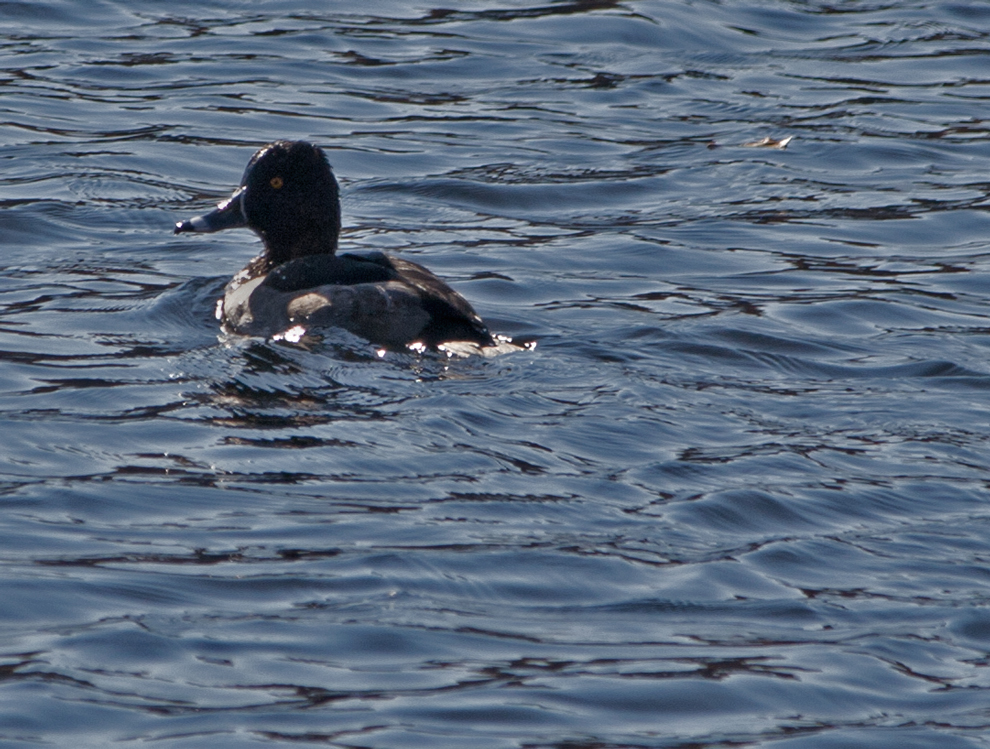
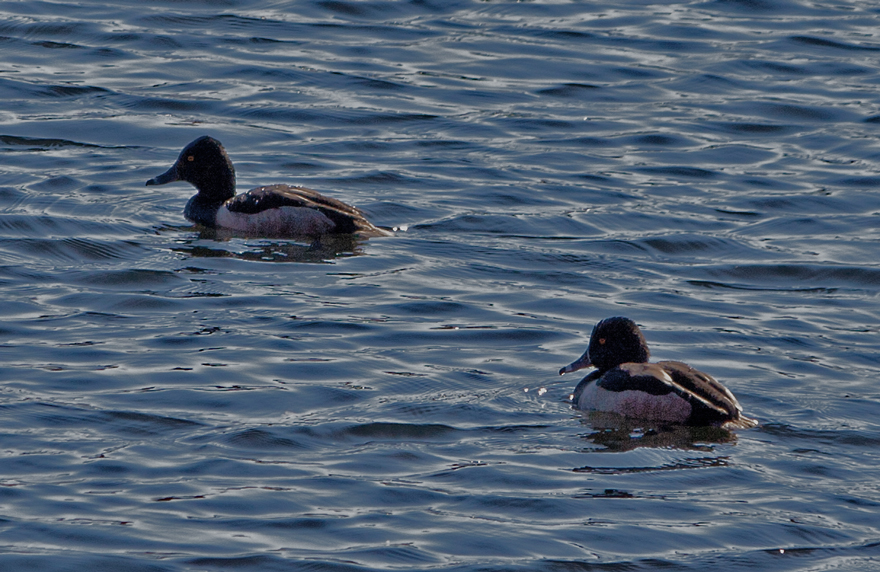
I photographed a lot of ducks last weekend and have already posted photos of Mallard and Hooded Merganser. As I was going over my photos, I realized that I had a third kind of duck, though I was not immediately sure about its identity. Fortunately they have very distinctively colored bills and yellow eyes, so I was able to identify them as Ring-necked ducks (Aythya collaris). As I watched them, I noticed too that they are diving ducks, rather than the dabbling ducks that I am more used to seeing. I don’t know how long they can hold their breath, but it seemed like they stayed underwater a long time.

The light was a bit harsh when I took these photos, but hopefully they are clear enough for you to see and appreciate the beauty of this duck, a type that I had never before encountered.

Ring-necked duck

Ring-necked ducks in early November

© Michael Q. Powell. All rights reserved.

Read Full Post »

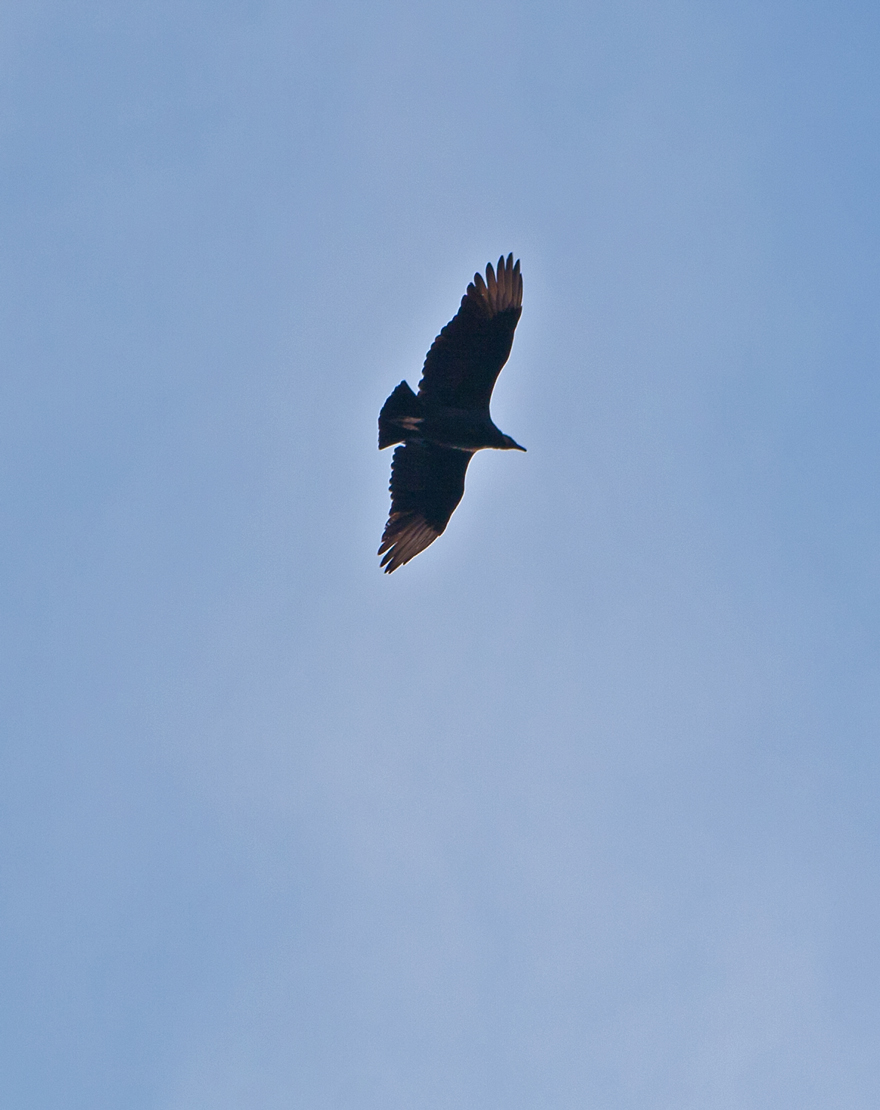
As the cool morning air was warmed by the sun last Monday, I caught sight of a group of seven large birds soaring together through the air. I could tell that they were different from the turkey vultures that I had previously photographed, but I wasn’t sure what they were. A friendly birder identified them for me as Black Vultures (Coragyps atratus).

The Cornell Lab of Ornithology website, one of my favorite places to go to learn more about birds, notes that the Black Vulture have a less developed sense of smell than Turkey Vultures, and have to rely on their sight, which is why they may soar at greater heights than the Turkey Vultures. More social than the Turkey Vultures, Black Vultures often travel in flocks and may share a common roost before they go off to forage. (I saw a whole group of them in a single tree earlier in the morning that I took these shots).

I am still in awe of these large birds with impressive wing spans. At the marshland park where I do a lot of my photography, there are a number of species of hawks, and I hope to be able to get some photos of them eventually.

© Michael Q. Powell. All rights reserved.

Read Full Post »

This duck tale has a happy ending, as two Hooded Merganser duck couples paddle gently down the stream, but a potential crisis had been averted only moments before.

It began like this. Five Mallard ducks (Anas platyrhynchos), three males and two females, were swimming upstream. Two of the males were in the lead, while the other male seemed to be carrying on a conversation with one of the females. Their course had them in the partial shade, not far from one of the banks.

At the same time, four Hooded Merganser ducks (Lophodytes cucullatus), two males and two females, were headed downstream in perfect formation on a collision course with the Mallard ducks.

What would happen when the groups met? Would there be a confrontation? Would they exchange information about the attractions of the places they had just passed through? Who has the right-of-way in situations like this?

The signals were a bit ambiguous at the first encounter, as one of the male Mallards tried to have a conversation with one of the male Hooded Mergansers, who had turned away. All eyes were turned on the two representatives. Would they be able to negotiate an agreement? If a fight broke out, it was clear that the Mallards had an advantage in both size and numbers.

Who know what was said, but it appears that an agreement was reached and a possible confrontation was avoided. The ducks peacefully passed each other and continued on their separate ways.

The first photo showed the Hooded Merganser ducks after the encounter with the Mallards, so sequentially it should go here. Did you notice that the duck formation had changed and that the males were now in the lead? Was this a protective, chivalrous gesture on their part?

Of course, I may have completely misread this situation. Perhaps the male duck ego is less fragile than the human one and the two male ducks were simply asking each other for directions when they met in the middle of the stream.

© Michael Q. Powell. All rights reserved.
Read Full Post »

I was attempting to get a photo of a bird in the cattails, when suddenly I noticed that a deer had entered into the frame. Deer are pretty common and I have even seen them in my suburban neighborhood, but I have rarely seen them at a moment when I had my camera in my hand, so I was excited.

The lighting was a little uneven and harsh and it was difficult to get a completely unobstructed shot, but the deer cooperated and paused a few times, allowing me take a few relatively clear shots. I grew up in the suburbs of Massachusetts and even though my deer identification skills are not strong, I am pretty confident that this is a buck, probably a white-tailed deer (Odocoileus virginianus).

I am not a politician, but I am glad to affirm with great conviction,  “The buck stops here.”

© Michael Q. Powell. All rights reserved.

Read Full Post »

I arrived early in the marsh on a cold fall morning when the dew and a touch of frost seemed to have combined to coat objects with a kind of frozen mist. I was hoping to find some large, beautiful spiders shining in the early morning light, as I had found repeatedly during the summer and early fall mornings. My initial scan found no spider webs at all, but suddenly I spotted one in the cattails. It was not large, but its rarity made it extra special. The structure is not very complex or symmetrical and the silk threads seem to be heavy-duty, rather than delicate. I wondered what kind of spider made such a web, but did not spot the maker of the web. Perhaps she’ll continue her handiwork for a little while longer—I’ll be checking each time I return to the marsh.

Last web standing in the fall

© Michael Q. Powell. All rights reserved.

Read Full Post »

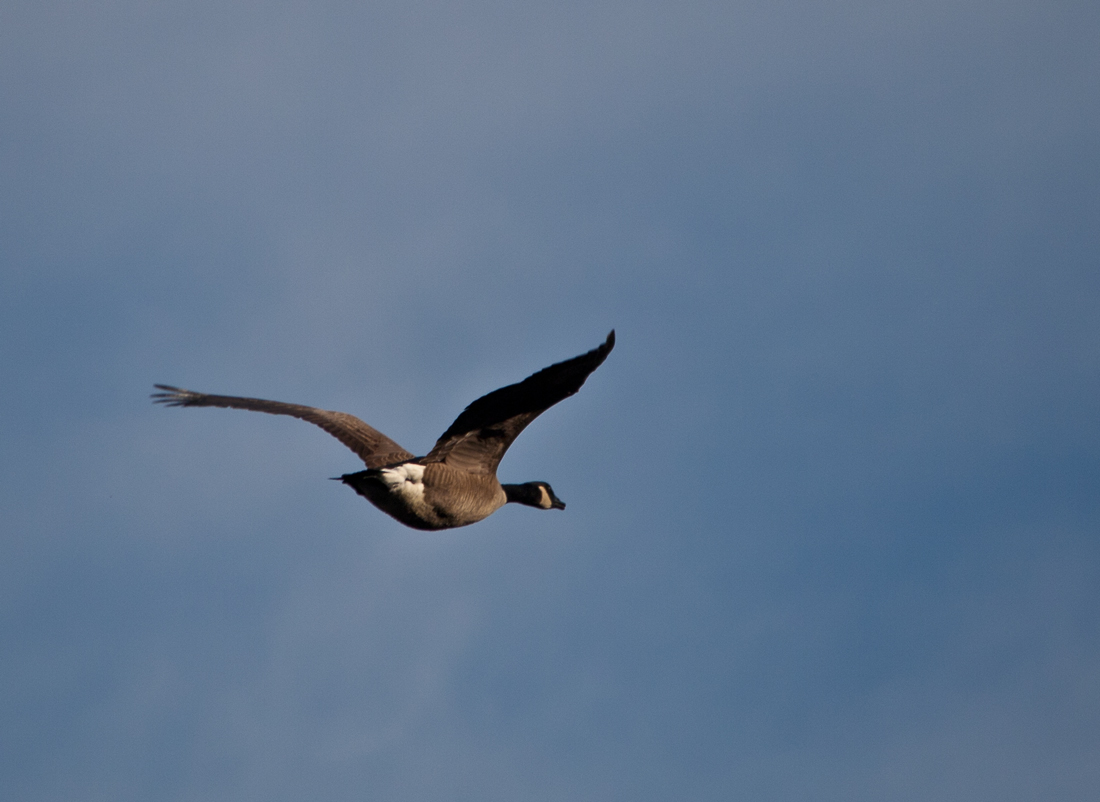
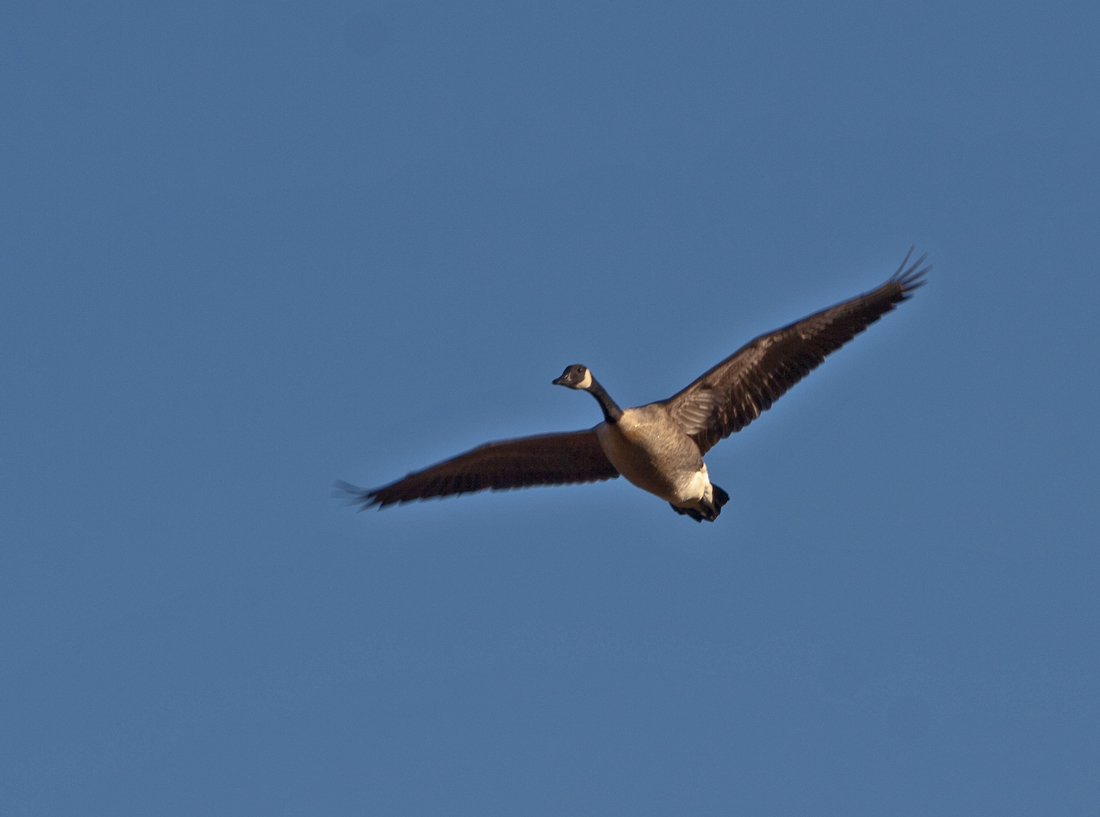
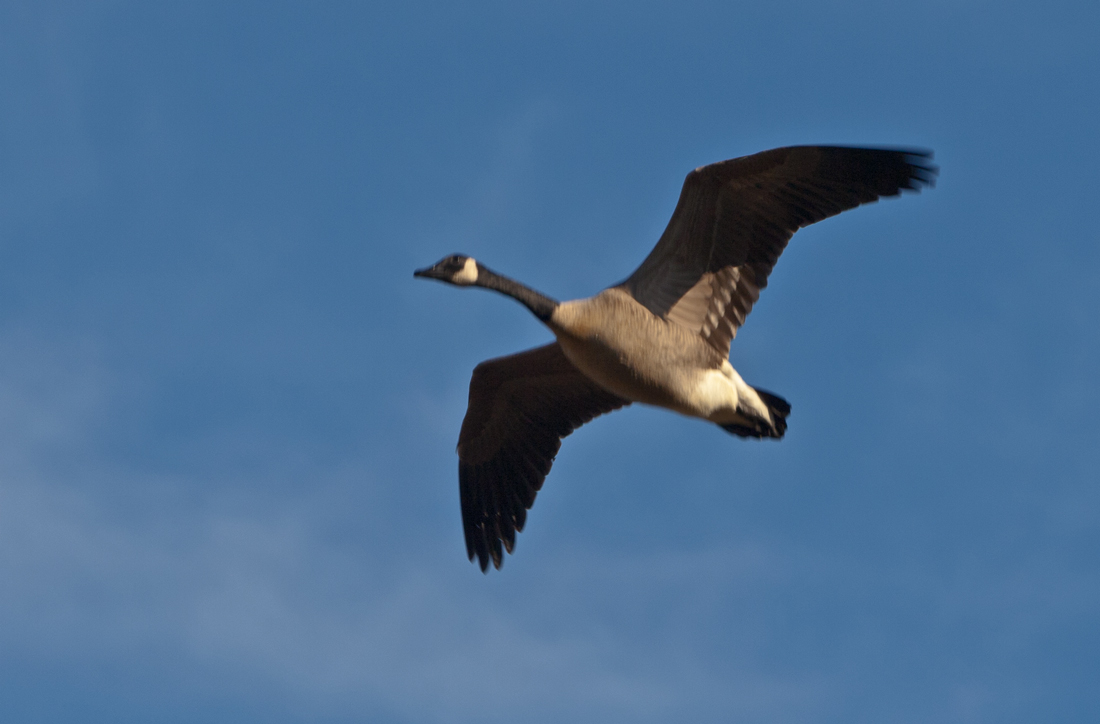
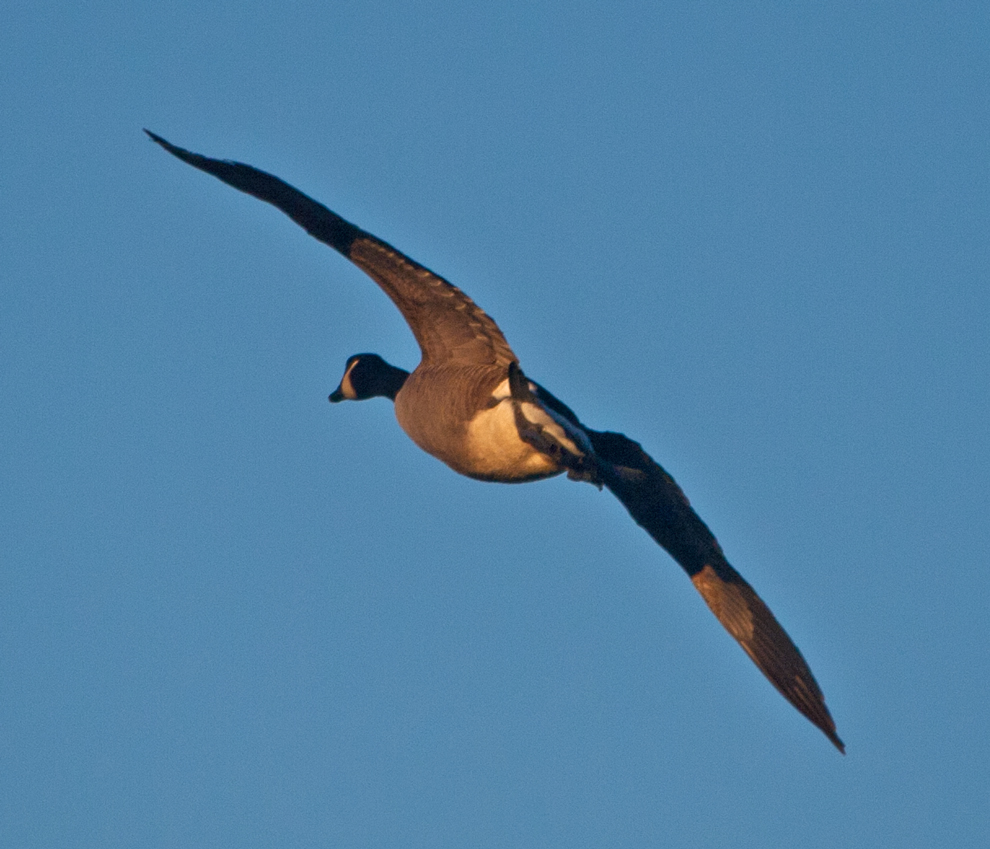
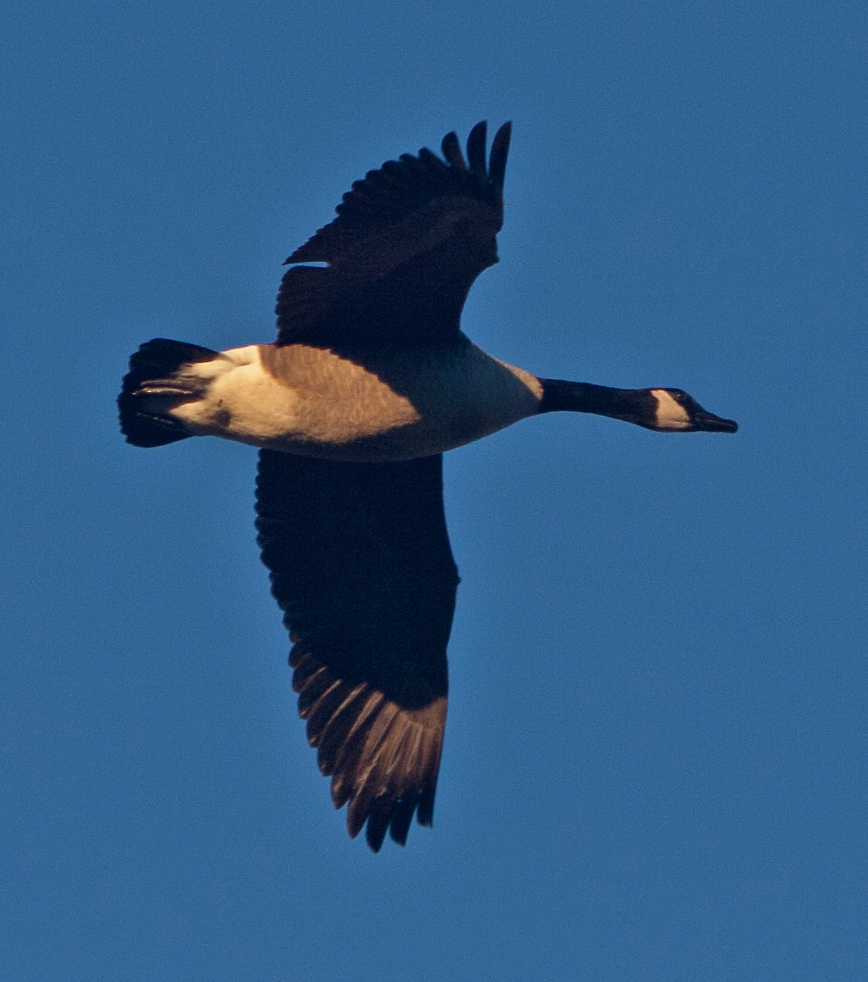
Canada Geese (Branta canadensis) continue to stop in at my local marshland (Huntley Meadows Park) as they migrate to unknown destinations. Sometimes they come in large groups, though most often I have seen them come in small groups of two to  six geese. I watched them for quite some time during this sunny weekend, and it seems that they spend most of their time on the ground foraging for food or simply relaxing and grooming themselves.

I’ve tried to take photos of the geese when they are flying and have found that this is much more challenging than I had anticipated. Lighting is perhaps the biggest issue, but the speed and direction of the geese is an almost equal problem—profile shots are great, but their relative speed seems fastest when they are moving perpendicular to the camera direction. Camera settings are sometimes hard to choose and adjust, especially when the geese decide at the spur of the moment that it’s a good time to take off. As I’ve found out repeatedly, the settings appropriate for taking photos of the geese in the water are not appropriate for geese in the air.

Here are some of my photos of geese in flight from this past weekend. As you can see, the weather was sunny and the skies were blue.  I am still working on my techniques, but I like the results so far (though I wouldn’t dare reveal how many shots I attempted in my quest to capture the geese in flight). If you click on the photos, you can see a few more details in a higher resolution view.

Migrating Canada Goose

Soaring Canada Goose

Climbing Canada Goose

© Michael Q. Powell. All rights reserved.

Read Full Post »

It was a beautiful weekend and I did a lot of walking. I came across an assortment of ducks, including some Hooded Merganser ducks (Lophodytes cucullatus). Most of my photos of them were from a good distance away, so I may need to work on them before I post them. This image was in such a beautiful setting that I thought I’d post it first. (It looks better if you click on it and see it in greater resolution.) I took this photo from a little bridge looking down on the ducks, which is why the heads do not have the distinctive look associated with Hooded Merganser ducks. I’m making the call on the identification on basis of the color and markings, but would welcome a correction if I am mistaken.

Hooded Merganser ducks in a stream

© Michael Q. Powell. All rights reserved.
Read Full Post »

Yesterday afternoon, I took some photos of a Great Blue Heron (Ardea herodias) in the little pond in my suburban neighborhood. He seemed amazing mellow and content to relax in the shade. Consequently, he was pretty tolerant of my presence and that of the nearby Canada Geese. Here’s a sneak preview of the shoot, an image that captures the heron with the reflections of the remaining fall foliage.

Fall reflection of a Great Blue Heron

© Michael Q. Powell. All rights reserved.
Read Full Post »

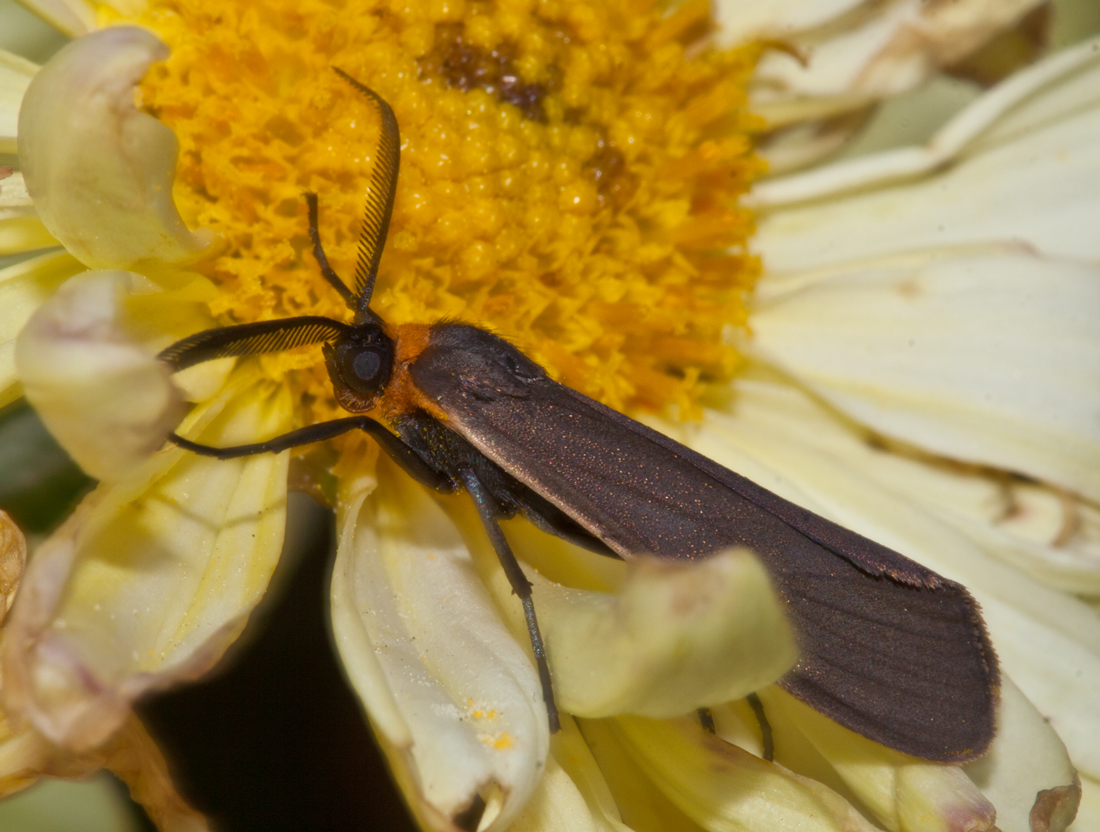
The light was starting to fade when I spotted a large insect on a flower. I already had my macro lens on my camera and my tripod  was with me, so I thought I’d try to get some shots of the specimen.

To give myself a chance at a decent depth of field, I set the camera at f/18 and then dropped the ISO to 100 for the best possible quality. Finally, I decided to use my pop-up flash (at its lowest setting) to add a little light. I was in aperture priority mode, so I let the camera choose the shutter speed. I figured the shutter speed would be pretty slow, so I used the self-timer to minimize movement. The camera chose an exposure of 30 seconds.

Do you know how long 30 seconds feels as you check the insect to see if he is moving and hope that the wind will not blow? I took a couple of shots and got some pretty good results.  Before I show you the entire insect, I’ll show you a close-up of the face. The antennae are amazing and the eyes are pretty cool looking too.

Close-up shot of really cool insect

So, what kind of an insect is this? It is a Yellow-collared Scape Moth (Cisseps fulvicollis). Yes, for those of you interested in collar ID, I realize that it is more orange than yellow, but even Bugguide acknowledges that it would be more appropriate to call it “orange-collared.” You can’t help but notice the amazing antennae with teeth like a comb—the technical term for antennae like this is “pectinate.”

Here is a photo of the entire insect. Sharp-eyes readers will  notice that the first photo is merely a blow-up of a portion of this image. You can see the light shadow from the flash, but it seems to have helped reveal an amazing amount of detail. Surprisingly, it looks like neither the insect or the plant moved during the exposure.

Yellow-collared Scape Moth

I have a lot to learn about using a flash for extra illumination for macro shots, but this image convinced me that it can be beneficial, though I probably need to diffuse the light and use off-camera flash.

© Michael Q. Powell. All rights reserved.

Read Full Post »

« Newer Posts - Older Posts »