Feeds:
Posts
Comments

Posts Tagged ‘Canon 50D’

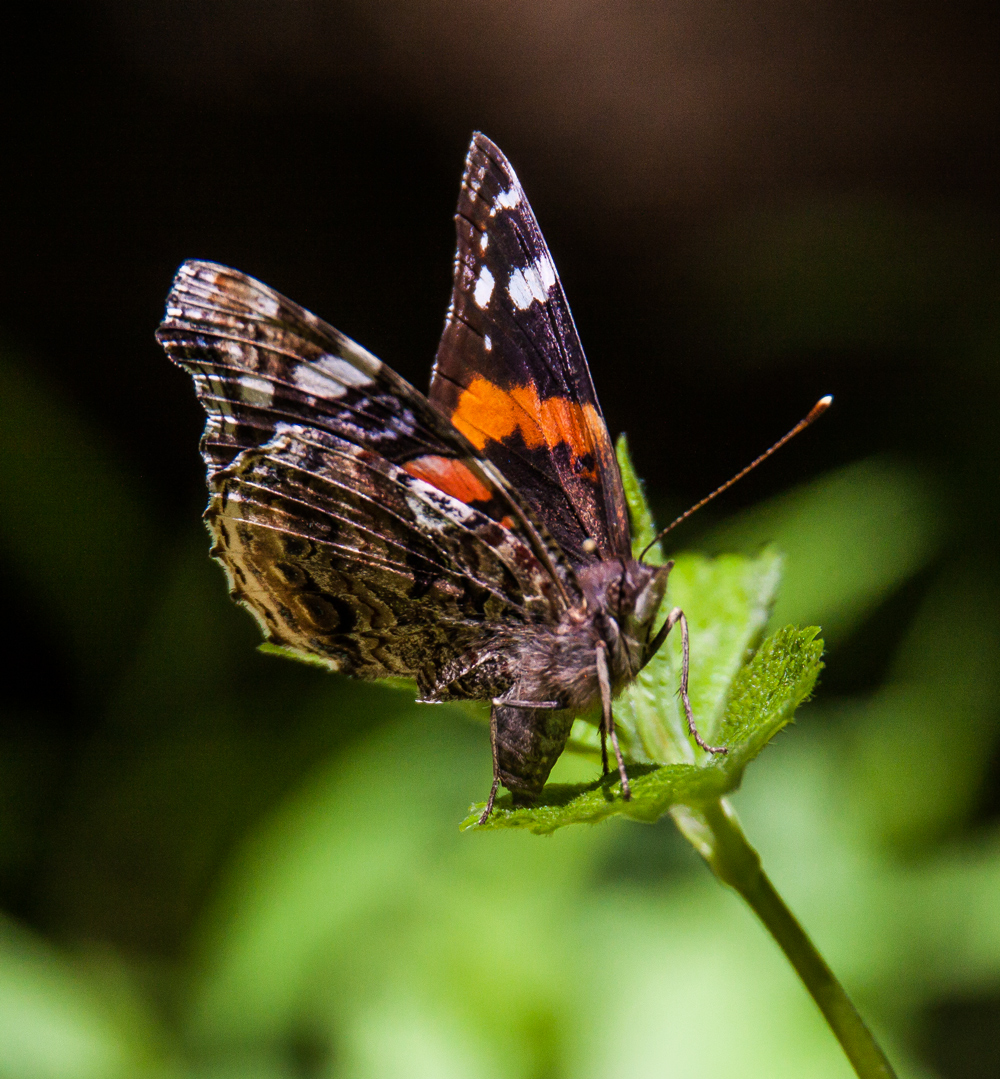
With the return of the sun, butterflies have started to reappear, like this handsome Red Admiral (Vanessa atalanta) that I spotted yesterday afternoon at Huntley Meadows Park.

It’s been gloomy and rainy for most of the past few weeks, so it was a particular joy when the sun was shining brightly yesterday. As I wandered through the woods and fields of my favorite park, butterflies flitted by a number of times, including several Red Admirals. Most of them kept moving and I was unable to capture them with my camera, but one of them perched a few times and gave me a chance to get some shots.

I’ve posted two of my favorite shots. The first is a little unconventional—the butterfly is upside down on a fallen log and I love the way it looks a bit like a heart. The second shot is a little more conventional, but it has a dynamic quality in the half-open wings and overall pose and I love the background blur.

Red Admiral

Red Admiral

© Michael Q. Powell. All rights reserved.

Read Full Post »

Tree Swallows (Tachycineta bicolor) are fast and erratic fliers as they chase after insects in mid-air. It’s tough to track them in my camera’s viewfinder and even more difficult to get shots that are in focus.

Last Friday, however, I managed to capture some images of a Tree Swallow at Huntley Meadows Park as it swooped so low above the surface of the water that it cast a reflection. It was an overcast day in which the sky and the water seemed to have the same gray color,, making it hard to tell where the sky ended and the water began.

Tree Swallow

Tree Swallow

© Michael Q. Powell. All rights reserved.

Read Full Post »

Simple birds often seem to defy my limited identification skills. I caught sight of this little bird in the early morning Friday at Huntley Meadows Park. Its overall shape reminded me a bit of an American Robin, but the colors were all wrong.

One of the helpful birders at a Facebook  group called Birding Virginia came to my rescue when I posted this photo. She identified it as a probable Swainson’s Thrush (Catharus ustulatus), a migratory species that is almost certainly just passing through our area. If you want to learn more about this bird, check out this page on the website of Cornell Lab of Ornithology, one of my favorite resources for information about birds.Swainson's Thrush

© Michael Q. Powell. All rights reserved.


Read Full Post »

Late yesterday afternoon an excited fellow photographer told me that that she had spotted a pair of Little Blue Herons (Egretta caerulea) at Huntley Meadows Park. I had no idea if her identification was accurate, but I knew that sightings of Little Blue Herons are pretty unusual in our area.

I rushed to the place she had described and eventually I was able to spot the two herons in the back area of a beaver pond. As I observed them from a distance, I couldn’t help but notice the mottled colors of the feathers of the one on the left. Last year a couple of juvenile Little Blue Herons, which were entirely white, spent some time at the park, but this one, which I assume is an adolescent, seemed to be transitioning to a darker plumage. The colors of the adult, which I was seeing for the first time, were equally amazing, with beautiful shades of maroon and dark blue.

After some grooming, the light-colored heron flew to another tree and shortly thereafter they both took off into the air. I was happy that I was able to get a few in-flight shots of these beautiful birds. I’ll be looking for them on my next visits to the park, but suspect they were merely making a rest stop on a longer journey.

Little Blue Heron

Little Blue Heron

Little Blue Heron

© Michael Q. Powell. All rights reserved.


Read Full Post »

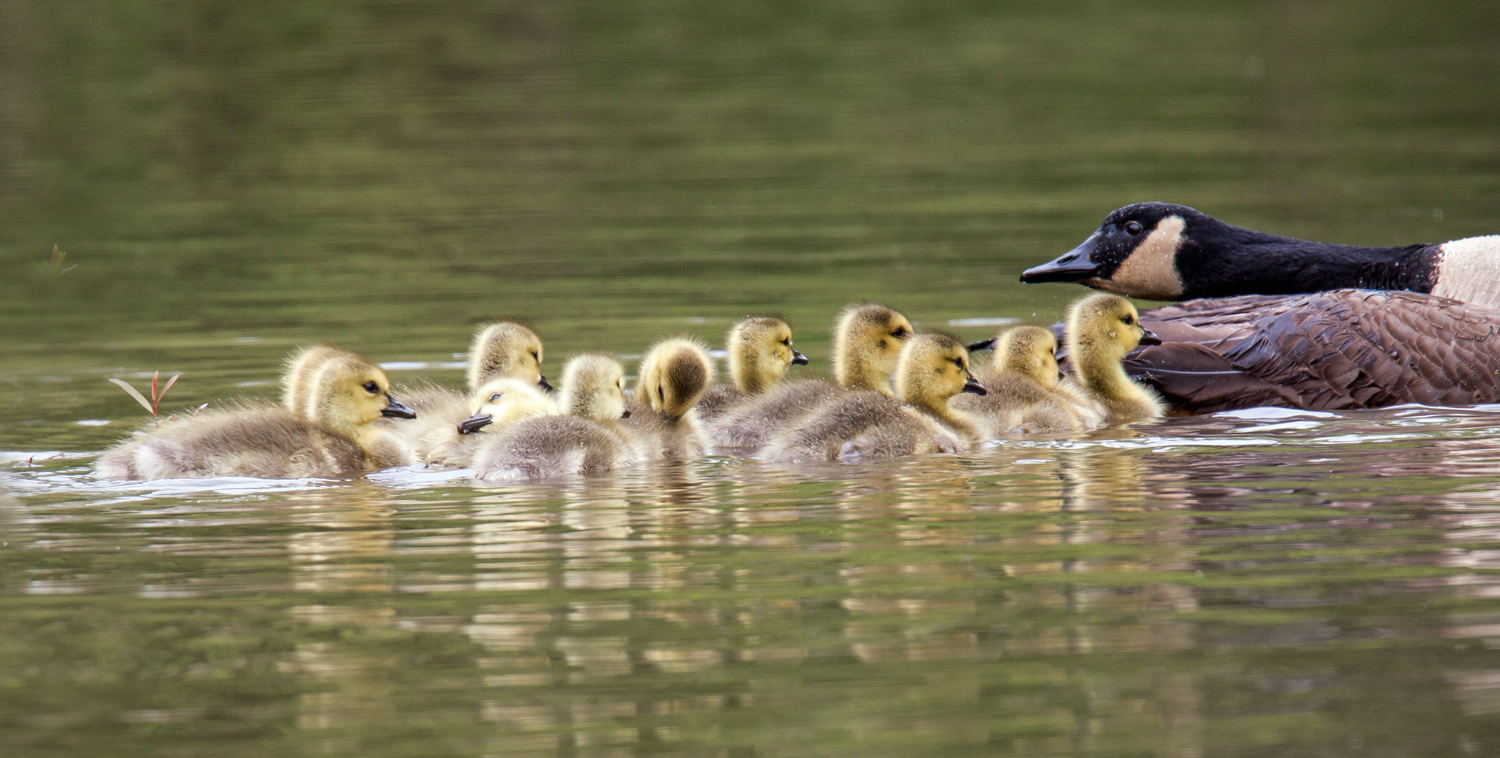
When you have as many little ones as this Canada Goose family (Branta canadensis), you have to take roll call almost all of the time to make sure that everyone stays safely together.

I was trying to focus on the group of goslings that were following the adult when the adult abruptly stopped and turned around. The little ones drifted forward and I ended up with this shot. I love the way that the attentive parent is almost at eye level with the cute little babies and has its neck almost fully extended.

Canada Goose

© Michael Q. Powell. All rights reserved.

Read Full Post »

While I was trying to get some more shots of the baby Barred Owl (Strix varia) at Huntley Meadows Park this past weekend, I managed to get some shots of one of the parents. I returned to the park the day after I got some shots of the owlet in the rain and word had gotten out about the baby owl. There were quite a few photographers present, including several with long lenses and heavy tripods. It was a far cry from the more intimate one-on-one session I had the previous day with the owl.

Fortunately there was somewhat better light than the day before and one of the parents was hanging around, keeping an eye on the baby, and was not hard to spot. Here are a couple of shots of that parent. It’s fascinating for me to note how the owl’s shape changes when it is hunched over versus sitting tall.

Barred Owl

Barred Owl

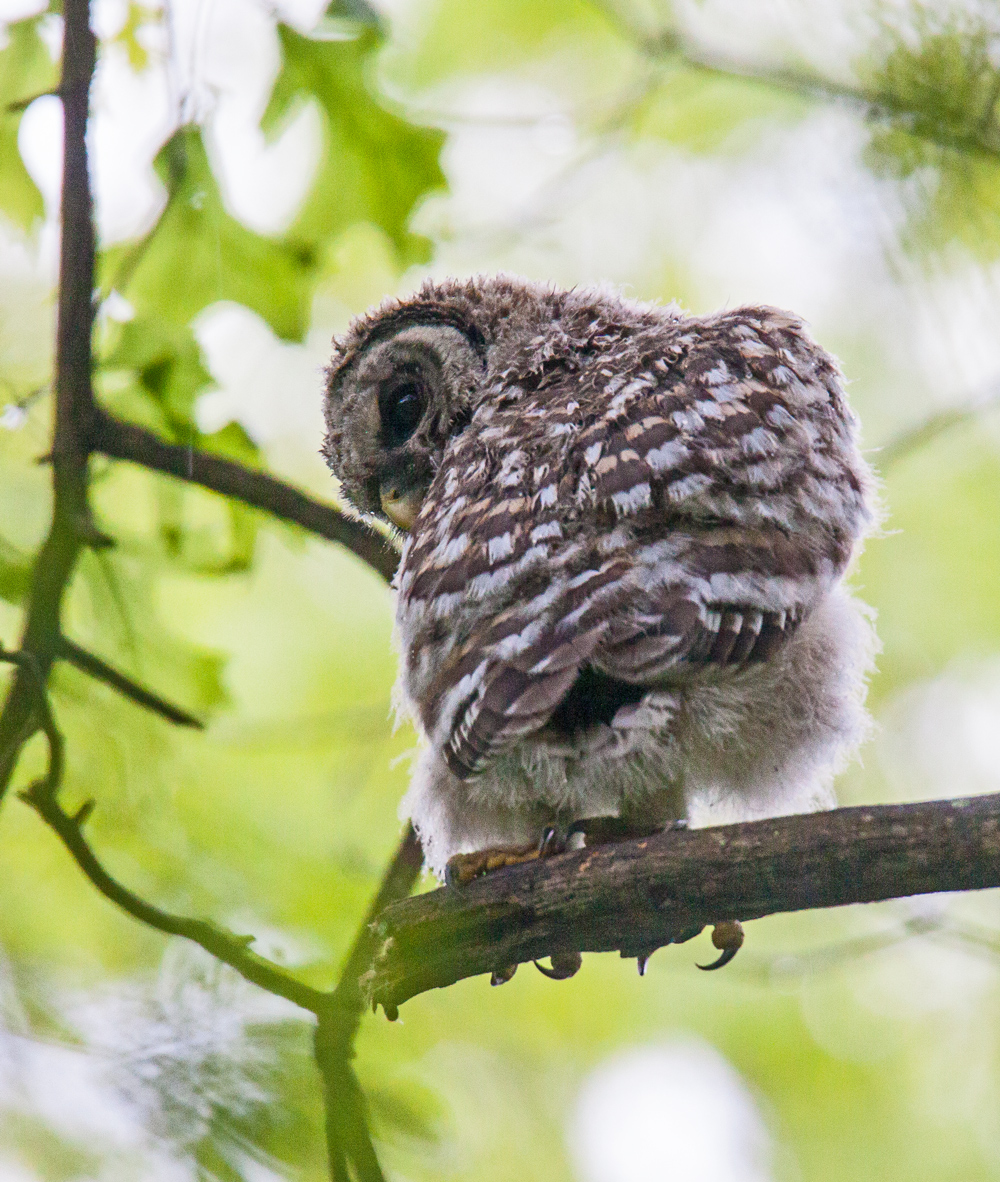
I never got a really clear look at the baby owl that day. Most of the time it sat on a distant tree with its back to me. Occasionally it would glance slightly over its shoulder and I got this shot during one of those occasions. It gives you a general ideal of the owlet’s body shape compared to the more elongated body of the parents.

Barred Owl

I thought I’d finish off this post with a couple more shots of the baby owl from my first encounter. The owl was closer to me, but I was shooting upward in a rather steep angle. The perspective is a little distorted, but you certainly get a good view of its fuzzy bottom.

Barred Owl

Barred Owl

© Michael Q. Powell. All rights reserved.


Read Full Post »

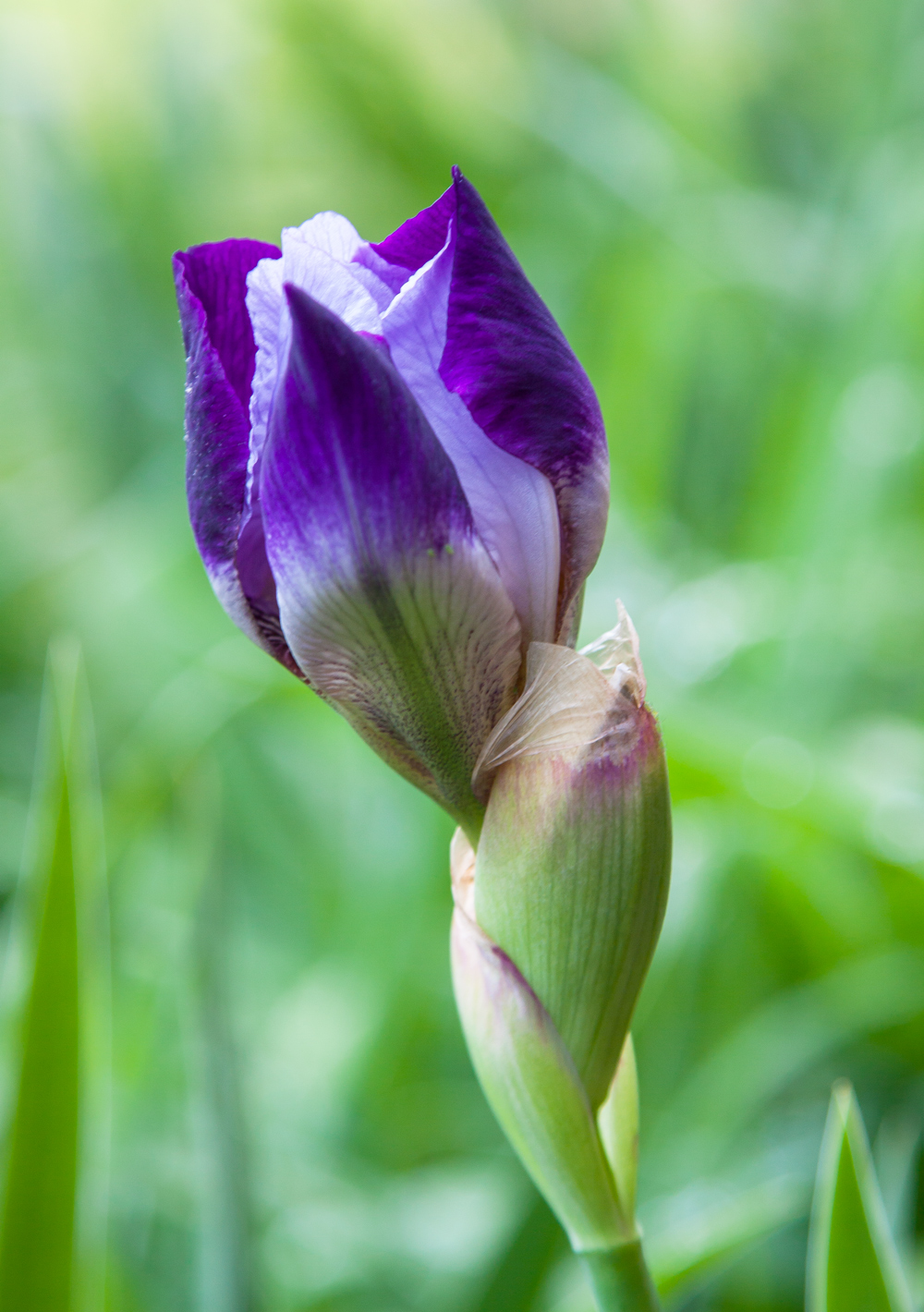
The past two weeks have been filled with intermittent rain and constant clouds, so I have not been able to chase dragonflies as I like to do at this time of year. The rain has been good for the flowers, however, and the garden of my photography mentor and neighbor Cindy Dyer is now full of beautiful bearded irises. Yesterday I attempted to capture some of the beauty of the purple ones in different stages of development. I particularly like the way the first image turned out, where the blurry image in the background gives a foretaste of the beauty that is to come when the bud opens up.

Speaking of Cindy Dyer, I was thrilled recently when I learned that another of her images will appear as a United States Postal Service (USPS) stamp. Her image of Sacred Lotuses at Kenilworth Aquatic Gardens will be part of a 16-stamp series celebrating the centennial of the National Park Service. The series will be officially unveiled in New York City on June 2. Check out this announcement from the USPS for more information and to see her beautiful image.

purple iris

purple iris

purple iris

purple iris

© Michael Q. Powell. All rights reserved.

Read Full Post »

I was a bit surprised recently to spot an Eastern Garter Snake (Thamnophis sirtalis) with blue eyes at Huntley Meadows Park. Normally, a garter snake’s eyes are clear and bright and if I can get close enough, I can sometimes see my own reflection.

As I moved closer, I could see that the bluish covering over the eyes was somewhere between translucent and opaque, looking a little like cataracts. The snake was aware of my presence and flicked its tongue when I got too close, but did not try to slither away. A search on the internet revealed that the eyes turn this blue color when the snake is getting ready to shed its skin, a process that generally takes about a week.

When my macro lens is on my camera I feel drawn to move closer and closer to my subject, as you can see in the first image. This shot gives a good view of the blue eye, but doesn’t give you much a sense of the snake’s environment. When I pulled back to include the snake’s entire body, you get a look at the sinuous curves of the body, but the eye is almost lost. The final image here was a mid-range shot that was a kind of compromise—some of the body shows, but the eye has greater prominence than in the second image.

Which image do I like the most? It’s hard for me to decide, but I think it was a good idea to photograph the snake at different distances to give myself some options. I’m going to have to try that approach more often.

garter snake

garter snake

garter snake

© Michael Q. Powell. All rights reserved.

Read Full Post »

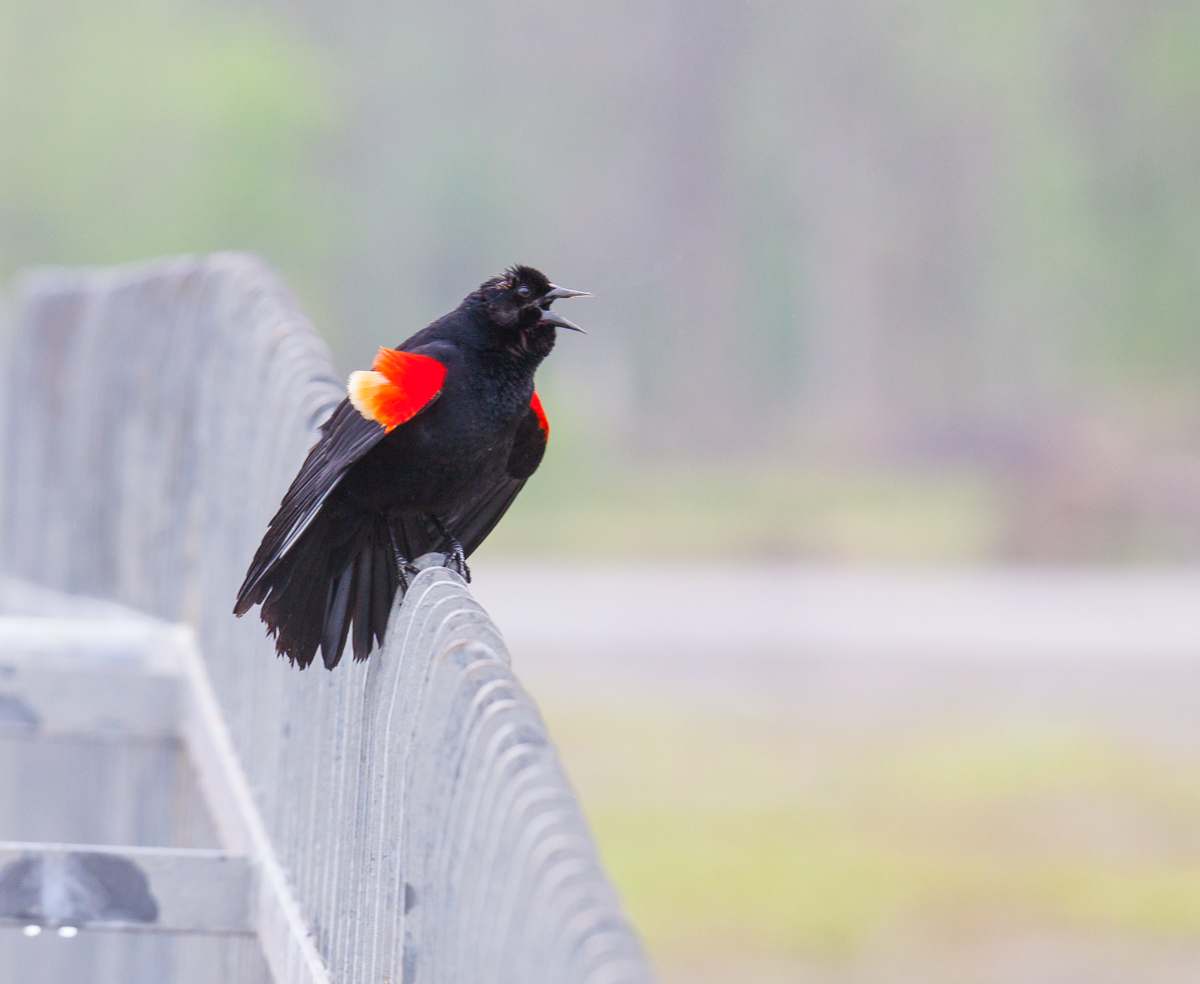
I love the feeling of the early morning, when the world is awash in pale colors and the birds are just starting to wake up. It’s a magical feeling for me sometimes, and the mist in the air last Monday only enhanced that effect.

How do you capture a moment like that? I don’t shoot a lot of landscape photos, but I can understand how some photographers are driven to find the right mix of compositional elements to pass on to others the emotional impact of a particular scene.

As I was walking along the boardwalk at my favorite marshland park, I was drawn to this male Red-winged Blackbird (Agelaius phoeniceus) perched on a railing leading to an observation platform. Normally I try not to include man-made elements in my wildlife shots, but in this case the railing faded out into an almost indistinct set of lines and shapes. Far in the distance, there is a suggestion of the trees and the water. With its bright shoulder patches, dark color, and sharper details, the blackbird provides an element of contrast with the rest of the scene.

Sometimes it’s fun to chase after more exotic subjects, like the owlet that I saw recently, but at other times I am content to try to capture the feeling of a moment, like this blackbird on a misty morning.

Red-winged Blackbird

© Michael Q. Powell. All rights reserved.

Read Full Post »

Early yesterday morning I didn’t expect to see much wildlife or even other people. I was a little surprised when through the falling rain two individuals came walking toward me. One of them asked me if I was interested in seeing an owlet. Without a second’s hesitation I replied affirmatively—I’ve seen an owl in the wild only a handful of times and had never seen an owlet.

We walked together for a short while and then he pointed to a dark lump on a broken-off branch high in a tree. There was a quite bit of foliage, but eventually I found a visual tunnel to the subject and zoomed in. At first, it was hard to tell what I was looking at, but gradually as I began to make out the mottled feathers, I realized that the little Barred Owl (Strix varia) was facing away from me.

I didn’t have much choice of a shooting position, because the leaves and branches of nearby trees obscured the owl from view when I moved to the right or to the left or tried to get a shot from the direction in which the owl was facing. So with my umbrella in one hand and my camera in the other, I watched and waited. I tried to be as stealthy as I could, but the owlet seemed to be aware of my presence and every now and then curiosity would prompt it to sneak a peek in my direction.

I am still going through my photos and may do another posting later, but wanted to share an initial image of one of the owlet’s glances in my direction.

Barred Owl owlet

© Michael Q. Powell. All rights reserved.

Read Full Post »

A Spotted Sandpiper (Actitis macularius) at Huntley Meadows Park seemed overwhelmed with curiosity as a female Hooded Merganser (Lophodytes cucullatus) swam closer and closer. What were they thinking as they checked out each other?

I love to capture multiple species in a single image, particularly when they seem to be interacting with each other. In this case, the differences in size, shape, coloration, and body position make for some fascinating contrasts.

encounter1_2May_blog

© Michael Q. Powell. All rights reserved.

Read Full Post »

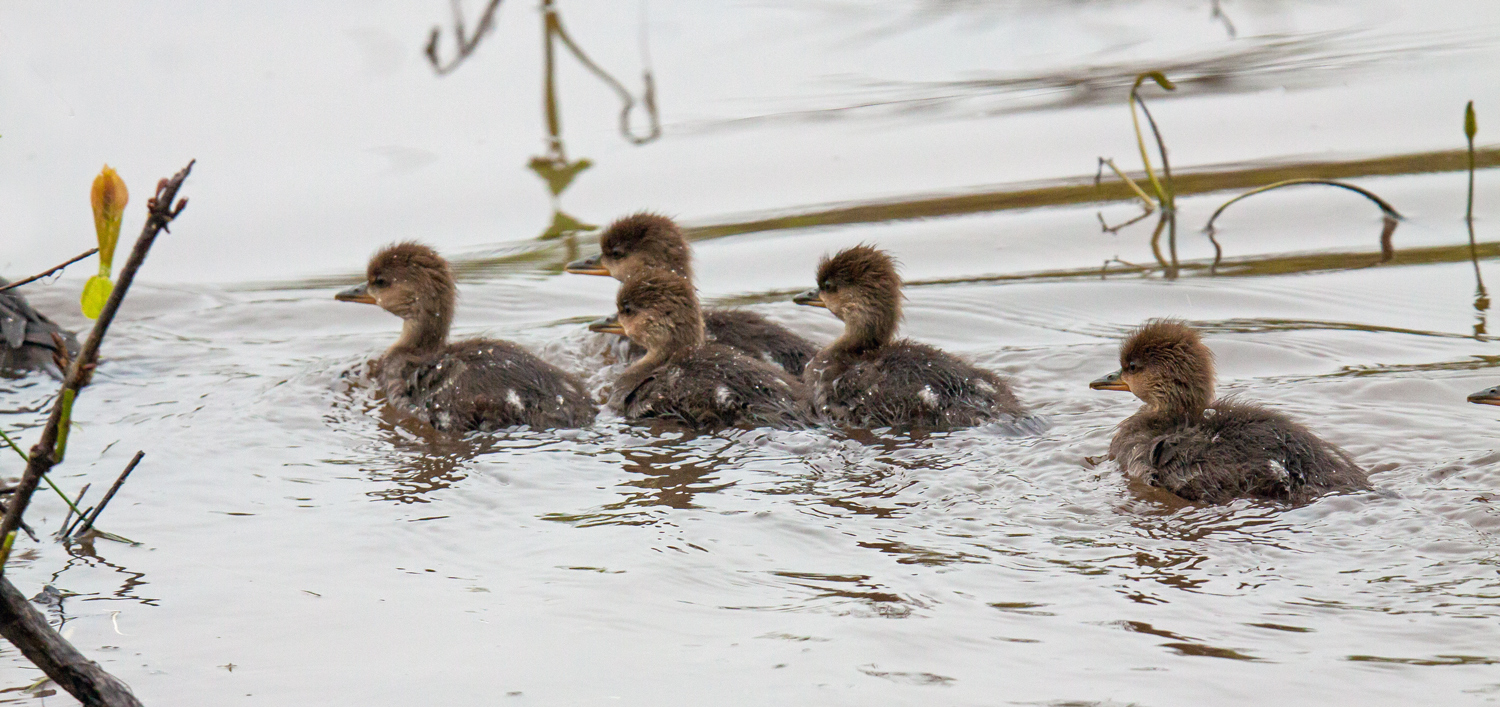
Like so many others at Huntley Meadows Park, I have fallen in love with this Hooded Merganser family (Lophodytes cucullatus), with its hyper-vigilant Mom and nine growing babies. Occasionally I will see them all huddled together on a fallen log, but only rarely do I a clear look at them. The ducklings are be full of energy, ready to wander in multiple directions, and the Mom seems to be more than fully occupied watching out for predators and keeping the group together.

Hooded Merganser family

hooded merganser ducklings

Hooded Merganser ducklings

© Michael Q. Powell. All rights reserved.

Read Full Post »

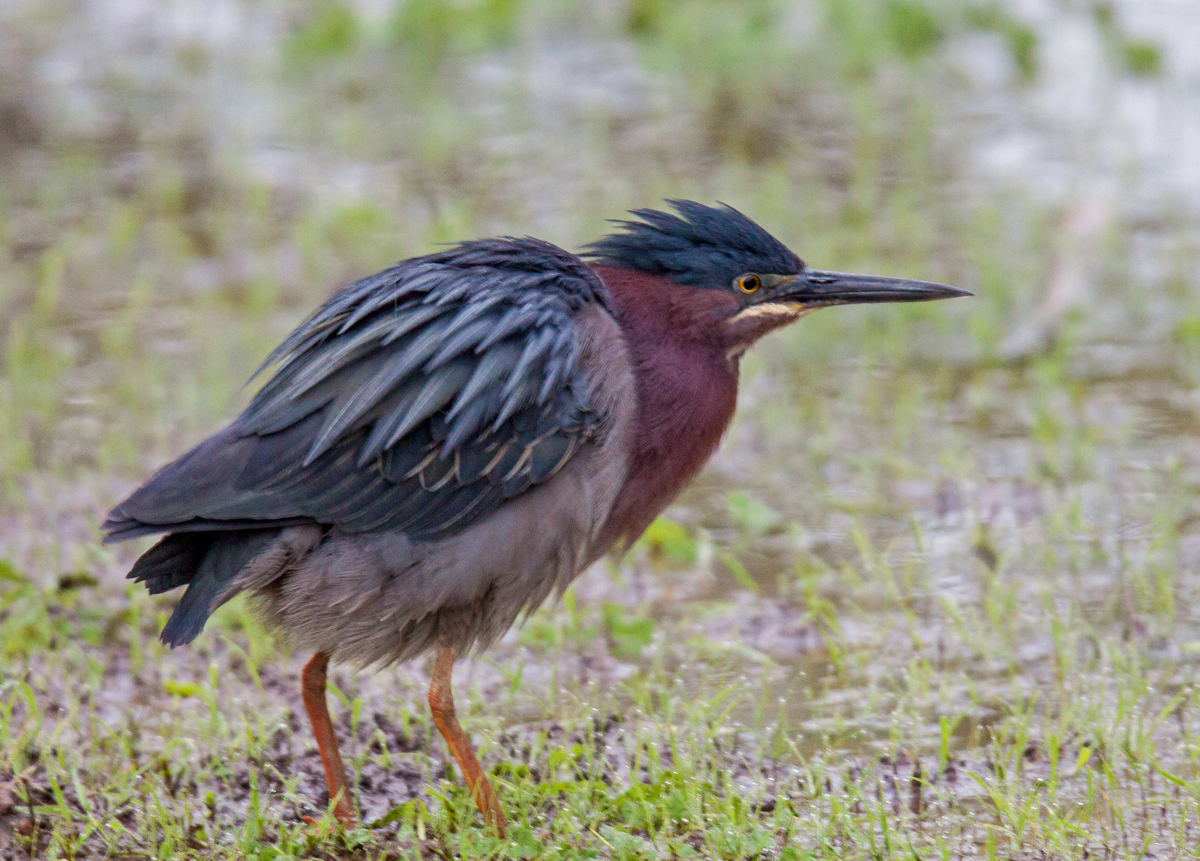
Against the wind, this Green Heron (Butorides virescens) looked like it was facing into a strong headwind and running against the wind early Monday morning at Huntley Meadows Park. In fact, the air was calm and the wind-blown, tousled look was merely a grooming choice by the heron as it prepared for the new day.

Green Heron

© Michael Q. Powell. All rights reserved.

Read Full Post »

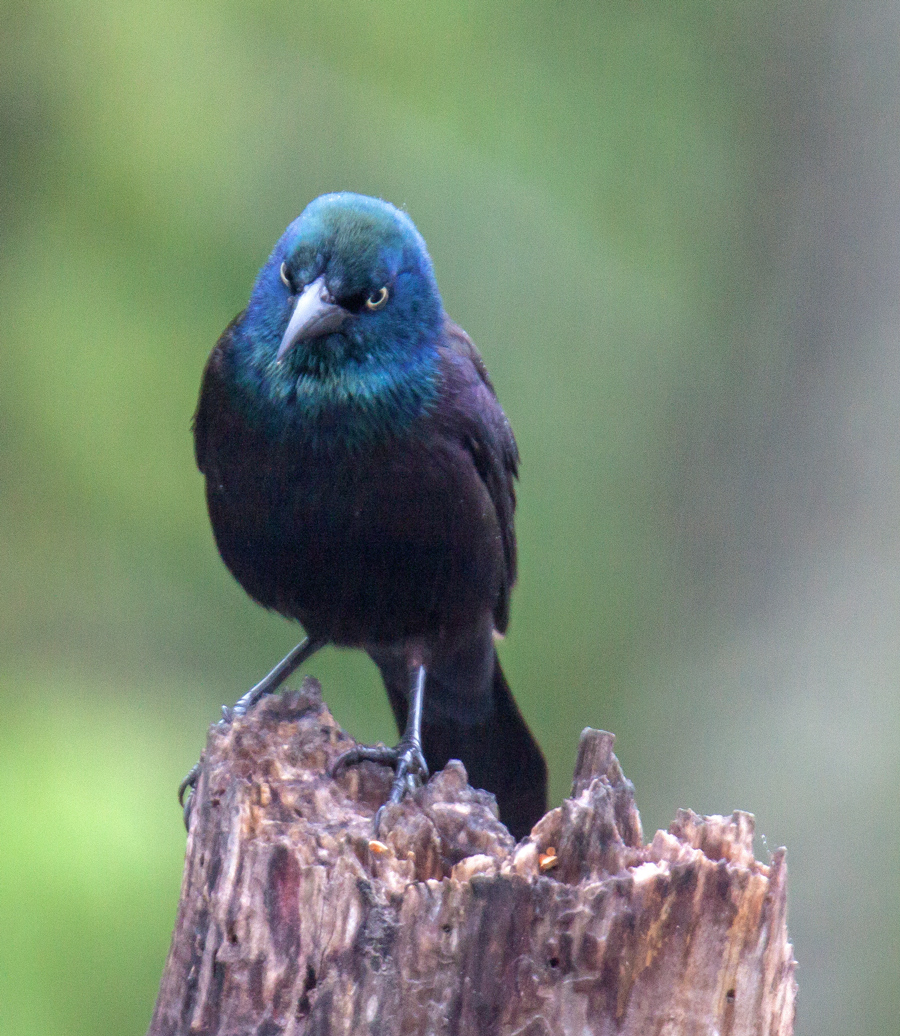
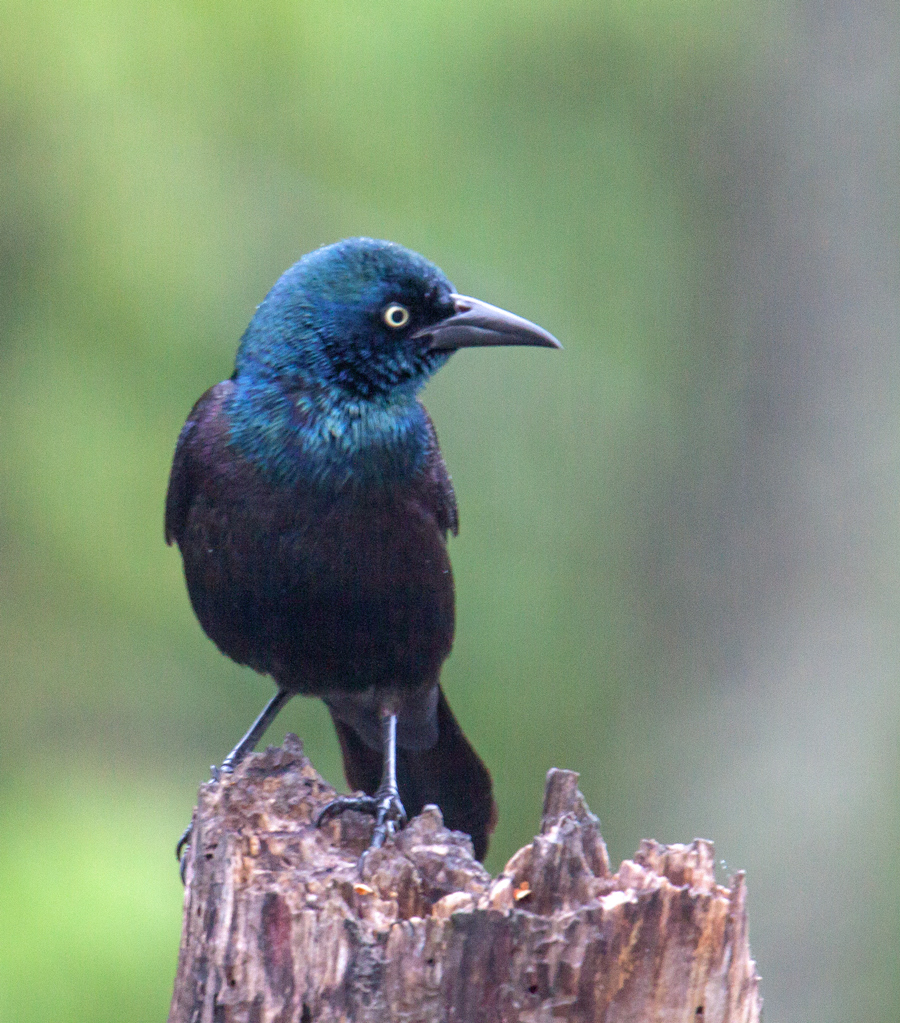
Early yesterday morning at Huntley Meadows Park this Common Grackle (Quiscalus quiscula) seemed to be sending me a definite “Don’t mess with me” message. Fortunately the grackle eventually loosened up a bit and I was able to capture some additional images in a mini portrait session.

I captured these images around 6:30 on a misty, overcast morning. There was some light, but not a whole lot, so I was forced to set my ISO relatively high at ISO 1600. I was shooting in aperture priority mode and I didn’t realize until later that the shutter speeds for these shots was between 1/15 and 1/30 of a second. Considering that I was shooting with my lens zoomed out to 600mm, it’s surprising that these shots are not completely blurry (though they are a bit grainy). I am convinced that the built-in image stabilization of the lens really helps in situations like this.

Common Grackle

Common Grackle

Common Grackle

Common Grackle

© Michael Q. Powell. All rights reserved.


Read Full Post »

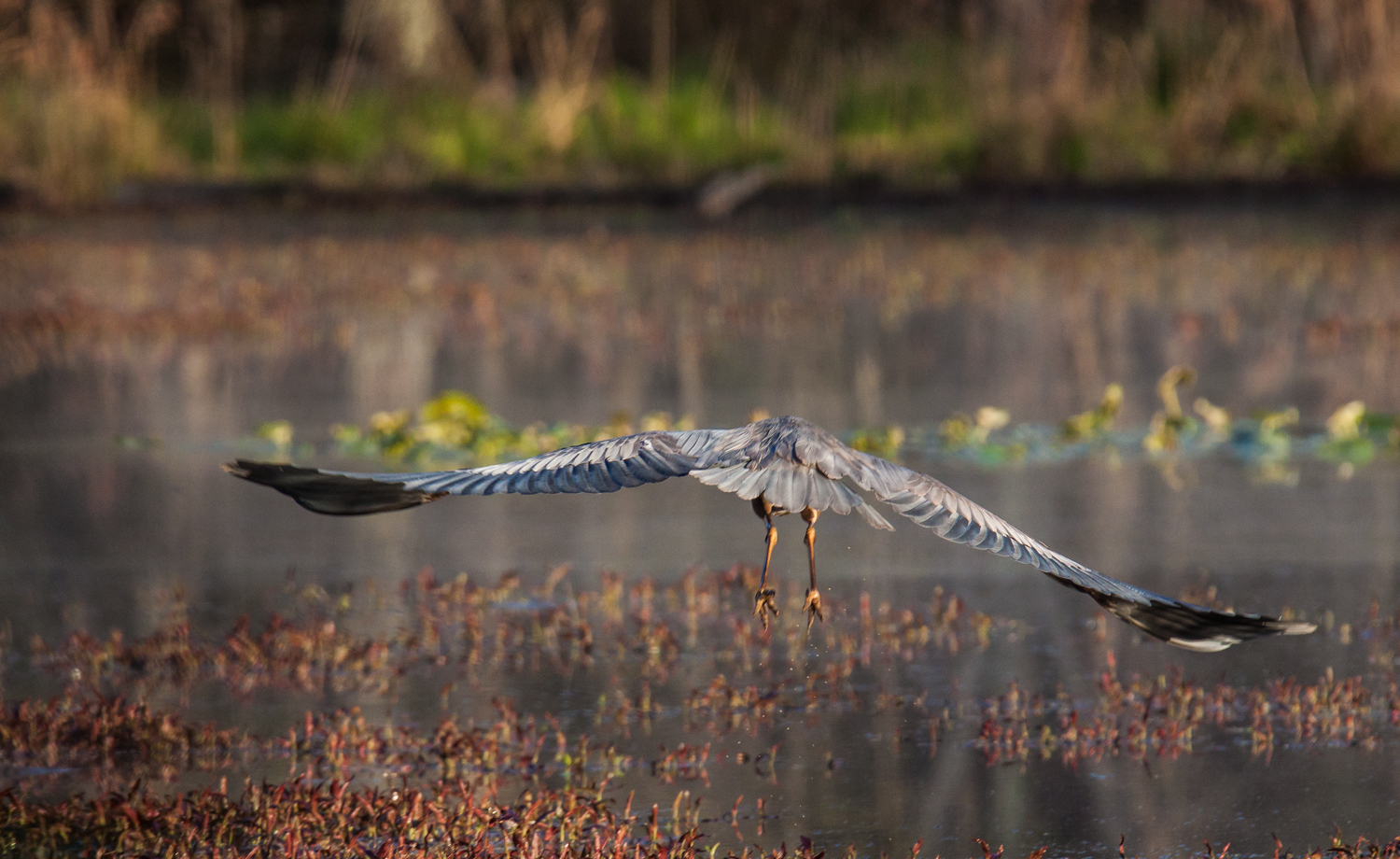
I’ve probably photographed a Great Blue Heron (Ardea herodias) taking off dozens of times, but this is the first time when I captured the bird flying directly away from me. This perspective makes the wingspan of the heron even more impressive  than usual.

I’ve managed to violate one of the main rules of bird photography by not ensuring that the eye was in focus (or even visible in this case), but I think that it helps to focus the viewers attention on the movement and shapes of the wings of the heron in this sequence of images.

Great Blue Heron

Great Blue Heron

Great Blue Heron

Great Blue Heron

© Michael Q. Powell. All rights reserved.


Read Full Post »

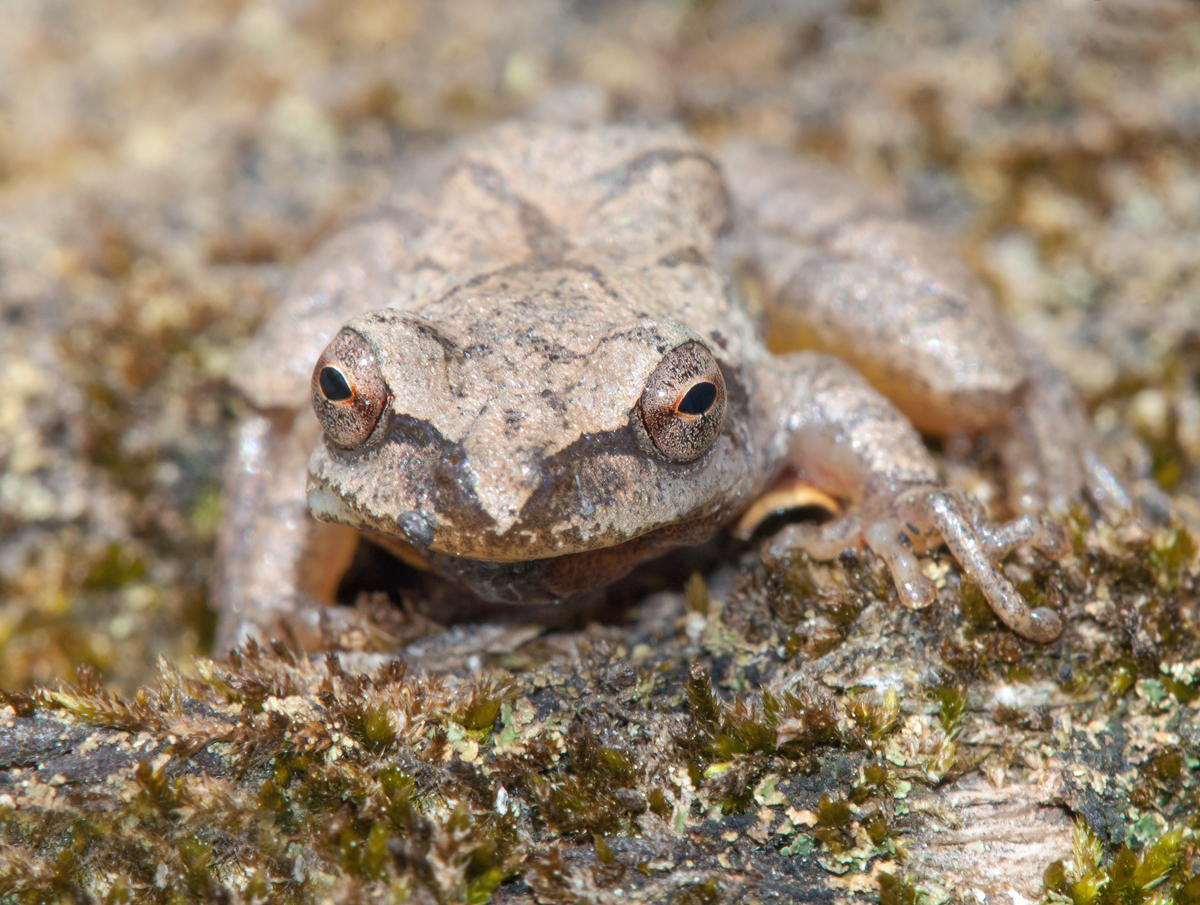
The high-pitched calls of the Spring Peeper frog (Pseudacris crucifer) are one of the harbingers of spring for many of us, but have you ever actually seen one of these diminutive songsters? Even when there was a loud chorus of Spring Peepers, these tiny frogs seemed to be invisible.

Last Friday, while hunting for dragonflies at Huntley Meadows Park with my friend and fellow photographer Walter Sanford, we almost literally stumbled upon a Spring Peeper near the edge of the water. As we were photographing one peeper, another jumped into view. The thing that struck me most about the spring peepers was how small they are, a bit over one inch and certainly less than two inches in length (about 3-5 cm). The other thing that I noticed was how low they were to the ground—it was tough getting a good viewing angle even when my elbows and knees were submerged in the marshy soil.

Here are three of my favorite shots of the Spring Peepers in a couple of different settings. You can’t help but notice how well the frog blends in with its surroundings, which helps explain why I had never been able to spot one previously. My one regret is that we never heard a peep from the frogs. Perhaps next time I will be able to get a shot of a Spring Peeper with its vocal sac inflated.

Spring Peeper

Spring Peeper

Spring Peeper

© Michael Q. Powell. All rights reserved.


Read Full Post »

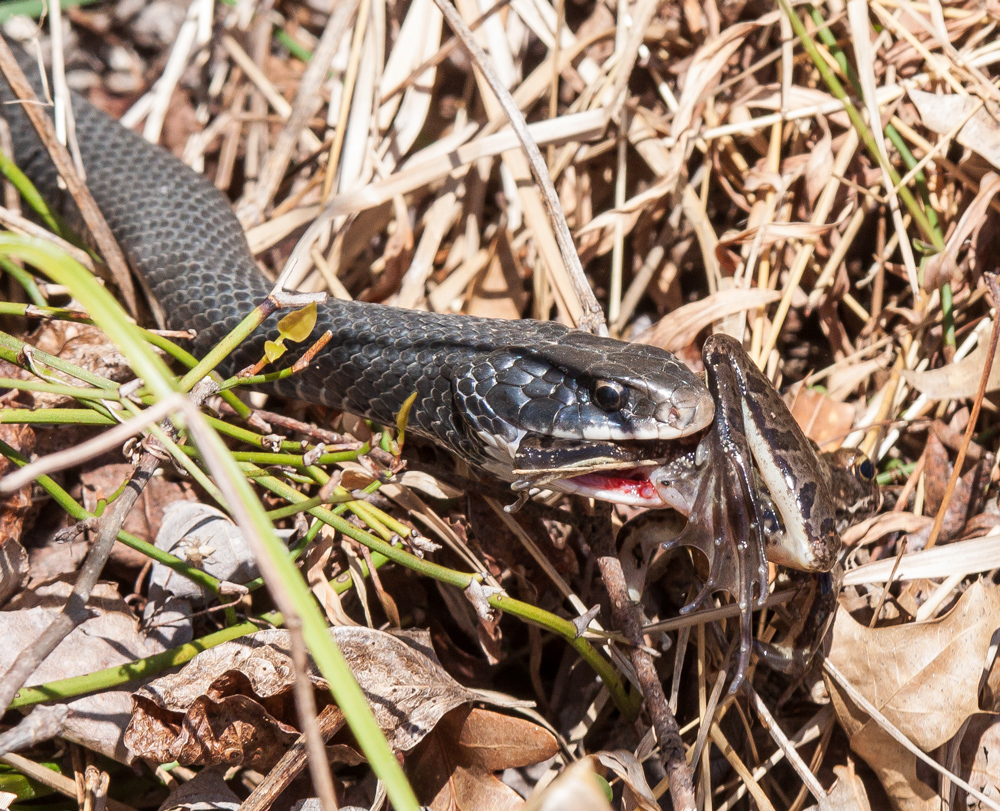
With a mixture of horror and fascination, I watched as a large black snake slowly ingested a Southern Leopard Frog (Lithobates sphenocephalus) that it had caught on Friday at Huntley Meadows Park. The frog was struggling and crying out loudly and then suddenly it was free. The lucky frog hopped away and the snake could only tell its friends about the one that got away.

When I first spotted the snake, it was holding the frog in the air. It appeared to have grabbed the frog by one of its back legs and was trying to adjust the frog so that it could swallow it. Unlike a Great Blue Heron that swallows its prey in a single gulp, the snake has to pull its prey in slowly. Little by little the snake seemed to get more of the frog’s leg in its mouth.

The frog continued to struggle, seeking to get some leverage so that it could pull its way out of the snake’s death grip. I didn’t see exactly how it happened, but all of the sudden the frog was free. It almost looked like that snake had released the frog, though that just seems so unlikely to have happened. Whatever the case, the frog was extremely fortunate—all of the previous encounters that I have observed between snakes and frogs have ended with the frog inside of the snake.

I was shooting with my macro lens, so I couldn’t zoom in closer, but I did manage to capture a sequence of shots that show some of the action.

release2_15Apr_blog

release3_15Apr_blog

release1_15Apr_blog

release5_blog_blog

© Michael Q. Powell. All rights reserved.

Read Full Post »

Do you find yourself shooting the same subjects with the same lens all of the time? Sometimes it’s fun to try to try to photograph a subject with the “wrong” lens.

Conventional wisdom tells me to use a telephoto lens to photo birds, a macro lens to photograph insects, and a wide-angle lens to photograph landscapes. Following that wisdom, I had my macro lens on my camera this past weekend when I traveled with some friends to Meadowlark Botanical Gardens in Vienna, Virginia, where I anticipated that I would be shooting flowers and insects.

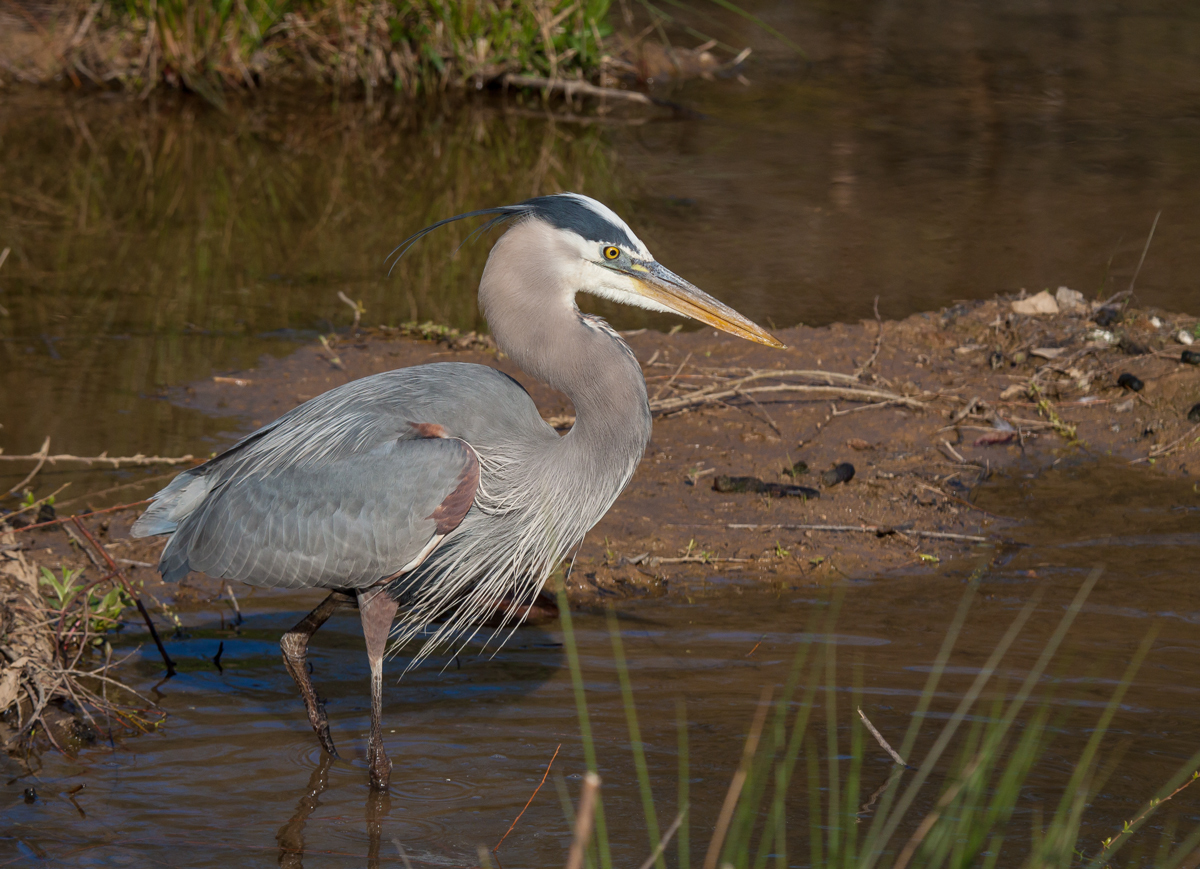
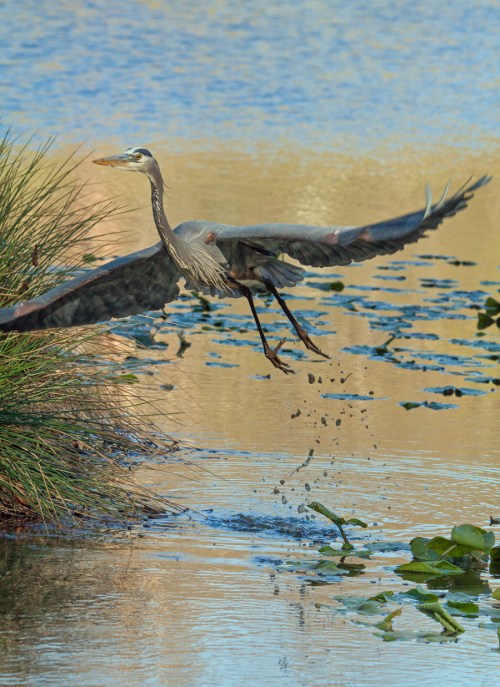
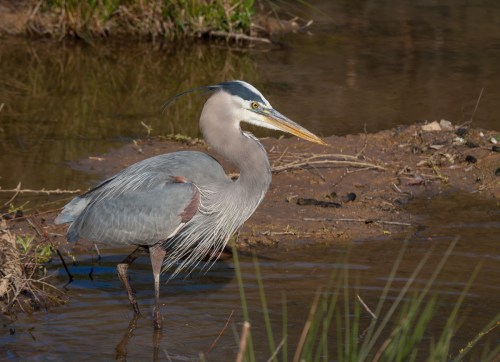
As I was walking around a small pond, hoping in vain to spot some dragonflies, I suddenly came upon a Great Blue Heron (Ardea herodias). From a distance, vegetation at the water’s edge had blocked the heron from view. With the heron right in front of me, I had two choices—I could try to change to the 70-300mm lens that I had in my camera bag to gain some additional reach or I could make do with my macro lens. I chose the latter option.

My macro lens is a 180mm Tamron lens. It is slow and noisy when focusing at close distances, but when I pay attention to my technique, I have taken some pretty good macro shots with it. How would it do with a bird? I have gotten used to photographing birds with a 150-600mm Tamron lens that has a built-in image stabilization system and, obviously, lets me zoom in and out. My macro lens lacks both of these capabilities, so I really did not know how well it would fare, particularly when I tried to capture some in-flight shots of the heron—I was pretty sure the heron would be spooked by my presence and I proved to be right.

Well, I ended up following the heron around for quite a while and captured images of it at several locations, including in the air. It worked out remarkably well. In some ways, it was even more enjoyable shooting with a prime lens than with a zoom lens, because I could concentrate better on tracking and framing the subject—my decision process was simplified when I had to zoom with my feet.

I particularly like the first photo below. The lighting at that moment was very unusual and the colors are so vivid that a friend asked me if I had used some kind of art filter. With the exception of a few minor tweaks in post-processing, however, the image looks like it did when I first looked at it on the back of my camera.

So what did I learn? I have a greater appreciation of the capabilities of my macro lens and realize that I can use it for more than just macro shots. I think that I also appreciate better the experience of shooting with a prime lens—I think my zoom lenses sometimes make me a bit lazy and sloppy.

I look forward to trying to shoot some more little experiments like this of thinking outside of the box and shooting more subjects with the “wrong” lens.
Great Blue Heron

Great Blue Heron

Great Blue Heron

Great Blue Heron

© Michael Q. Powell. All rights reserved.

Read Full Post »

Unlike many species with “common” in their names, Common Whitetail dragonflies (Plathemis lydia) actually are abundant and frequently seen during their peak season of June through September. In mid-April, however, they are much more rare and I was thrilled to spot this newly-emerged female this past Saturday at Huntley Meadows Park.

Members of this dragonfly species often perch on the ground, making them a bit difficult to photograph when they are in in area of heavy vegetation. This individual made it a easier for me to get some shots by perching almost vertically. My 180mm macro lens let me get some close-up shots without having to move too close.  I really enjoy trying to get somewhat “artsy” macro shots of dragonflies.

Mature female Common Whitetail dragonflies have distinctive dark patches on their wings. This dragonfly’s wings are mostly clear, which is why I judge that she is a teneral, i.e. she only recently underwent the transformation from living in the water as a nymph and emerged as an air-breathing acrobatic dragonfly. For comparison purposes I have included a photo from May 2014 of a fully-developed female Common Whitetail in which you can see the wing patches.

Common Whitetails are one of the first dragonflies to appear in the spring and they are around until late in the fall. I find them to be beautiful, especially this early in the season when they do not have to share the stage with very many other dragonflies.

Common Whitetail dragonfly

Common Whitetail dragonfly

Common Whitetail dragonfly

Common Whitetail dragonfly May 2014

© Michael Q. Powell. All rights reserved.


Read Full Post »
Yesterday when a Great Blue Heron at Meadowlark Botanical Gardens in Vienna, Virginia turned and intently stared at me, its look conveyed a definite sense of stern disapproval.
I went to the gardens with some friends with the intent of photographing flowers, but my attention was hijacked by this very photogenic Great Blue Heron (Ardea herodias). Despite the fact that I was shooting with my macro lens, I managed to get some wonderful shots of the heron, including some in-flight shots, that I will post later. I loved the look in the heron’s eyes and its pose so much that I decided to post this image immediately.
Great Blue Heron

© Michael Q. Powell. All rights reserved.


Read Full Post »

I have captured images of many beautiful dragonflies in the past, but I am not sure that any of them can quite match the spectacular colors and pattern of this female Springtime Darner dragonfly (Basiaeschna janata) that I photographed this past Friday at Huntley Meadows Park in Alexandria, Virginia.

Springtime Darners appear to be be pretty uncommon at our park—they are few in number and are active for only a very limited period of time early in the spring. Last year, fellow photographer Walter Sanford and I spotted the first known Springtime Darner at Huntley Meadows Park, but it was only a brief encounter and we never again spotted one.

Walter and I were determined that we would do better this year. Already this spring, he and I have separately explored likely locations for hours on end without success. On Friday, we decided to work together as a team. Our experience has shown that having an extra set of eyes really helps in spotting and tracking our elusive flying subjects.

After several hours of searching, we finally caught sight of a dragonfly in flight. It flew about a bit and then it finally perched—our moment had arrived for indeed it was a Springtime Darner. Springtime Darners will generally perch vertically on vegetation low to the ground. My view of the dragonfly was obscured, but fortunately Walter could see it and began to compose some shots.

I stood still for what seemed like an eternity, fearful of spooking the dragonfly, but finally was able to move forward to a spot with a somewhat clearer view of the dragonfly. The only problem was that I couldn’t pick out the dragonfly amidst all of the vegetation. I was shooting with my 180mm macro lens, which meant that I couldn’t simply zoom in to get a better view. Walter patiently described for me the specific location and I took some initial shots without actually seeing the dragonfly.

Eventually I was able to see what I thought was the dragonfly and captured a few shots before it flew away, though I never had a really clear view of it. Although we searched and searched, we were not able to relocate the dragonfly, nor did we see another Springtime Darner.

I was not very hopeful when I downloaded my images from my memory card to my computer and was surprised when I saw that somehow I had captured some of the beautiful colors and patterns of the Springtime Darner. Normally I like to try to isolate my subjects from the background and the background in these two images was unavoidably really cluttered, but I’m really happy with them.

I am happy with the images, but not quite satisfied—I’ll be out again soon to search for more Springtime Darners, hopefully including a male, as well as other dragonflies and damselflies. My dragonfly season has only just begun.

Springtime Darner

Springtime Darner

© Michael Q. Powell. All rights reserved.


Read Full Post »

I was thrilled on Friday morning to spot this Wood Duck mother (Aix sponsa) with thirteen little ducklings (if I counted right) at my favorite marshland park, Huntley Meadows Park. A few days ago, one of my fellow photographers was able to capture some shots of the moment when some newly fledged wood duck babies were called out of the nesting box by their mother and dropped into the water below. I suspect this is the same family, although I have been told that there are plenty of eggs in some of the other nesting boxes, so there may a lot more baby ducks soon.

I hope that all of the cute little ducklings can remain safe, but I remember with a tinge of sadness the experience of past years when I watched the number of babies decrease over time. The environment is hostile for these vulnerable little ones, with water snakes and snapping turtles as well as hawks and other birds of prey.  It has to be tough on the mother duck to try to keep them together and out of danger and it seems like she has to raise them on her own—the father duck does not seem to participate in the process.

Wood Duck babies

Wood Duck babies

© Michael Q. Powell. All rights reserved.

Read Full Post »

This past Monday as I was exploring Huntley Meadows Park with fellow photographer Walter Sanford, he spotted an Eastern Garter Snake (Thamnophis sirtalis sirtalis). We both like to photograph snakes, so we sprung into action. Following my normal instincts, I moved in close to the snake. How close did I get? At a certain point in time I actually had to back up a little to make sure I included the snake’s entire head in the image.

Some readers of this blog may recall that Walter and I use different camera systems and approach our shots in different ways, partly because he is using a zoom lens and I am often using a macro lens with a fixed focal length. If you shoot side by side with another photographer, you’ll often get the same shots, but that’s usually not the case for Walter and me. We normally choose different angles of view and frame our shots differently—I am usually the one sprawled on the ground.

Walter and I have shot together often enough that he knows the “tricks” that I employ when shooting. From my earliest days, my photography mentor Cindy Dyer emphasized to me the importance of using a tripod. Frequently I carry a tripod with me, but for low-angle shots, I prefer to use my camera bag as a kind of improvised tripod to help steady my camera. In the past month I have used this techniques with varying subjects including a jumping spider and a beaver. Special thanks to Walter for allowing me to use one of the photos he shot of me in action with my improvised tripod.

The snake was amazingly tolerant of our presence. Unbelievably it stayed in place when I moved a stalk of grass next to its head that was getting in the way of a clear shot. The first shot below was shot with my improvised tripod and was not cropped at all. The other two shots, I believe, were handheld and cropped slightly, because the snake had changed positions and I did not have the luxury of stabilizing my camera. In all cases I tried to focus on the snake’s eye and I really like the way that I managed to capture a reflection in the eye.

Walter will soon be posting a companion post that I will reblog, so that you can contrast the images that we captured when shooting the same subject together.

Eastern Garter Snake

alternative tripod

Using my camera bag as an improvised tripod (Photo by Walter Sanford)


Eastern Garter Snake

He’s got lips like Jagger

Eastern Garter Snake

Environmental portrait of a garter snake

© Michael Q. Powell. All rights reserved.


Read Full Post »

In the early morning, I am particularly sensitive to shapes and sounds. I saw and heard this bird calling from atop a dead tree on Monday at Huntley Meadows Park and assumed I would capture only its silhouette. It was a nice bonus that its light-colored eye was shining brightly despite the limited light.

What kind of bird is it? Perhaps it’s a Rusty Blackbird, judging from the color of the eye, though there are really not enough details to make a good call. Identification seems less important to me than normally, because this image is mostly about mood and composition for me. The wonderful texture of the weathered wood and the sense of joy that radiates for the bird prompted me to post this image after initially rejecting it.

Some days I am drawn to my simple graphic images, and I guess that today is one of those days.

shining eye

© Michael Q. Powell. All rights reserved.

Read Full Post »

Is it a bee? Is it a fly? It’s a Blotch-winged Bee Fly (Bombylius pulchellus). What?

I spotted this bee fly Monday afternoon at Huntley Meadows Park in Alexandria, Virginia and I have to say that it is one of the strangest insects that I have ever seen—it looks like Doctor Frankenstein pieced together an insect from the parts of other insects.

Its fuzzy body looks a bit like that of a bee and it has a similar proboscis, though the bee fly’s proboscis is outrageously long and looks a lot like it could be a stinger. Its long, spindly legs, however, are not bee-like and remind me of certain types of flies. The patterned wings and the way that it hovers are reminiscent of a hummingbird moth, though the bee fly is considerably smaller.

The helpful folks on bugguide.net were able to identify this insect for me and you can see shots by others of this type of bee fly at this link. I can’t find much information about this particular species, but the Bombyliidae apparently is a whole family of flies that feed on nectar and pollen.

Blotch-winged Bee Fly

© Michael Q. Powell. All rights reserved.

Read Full Post »

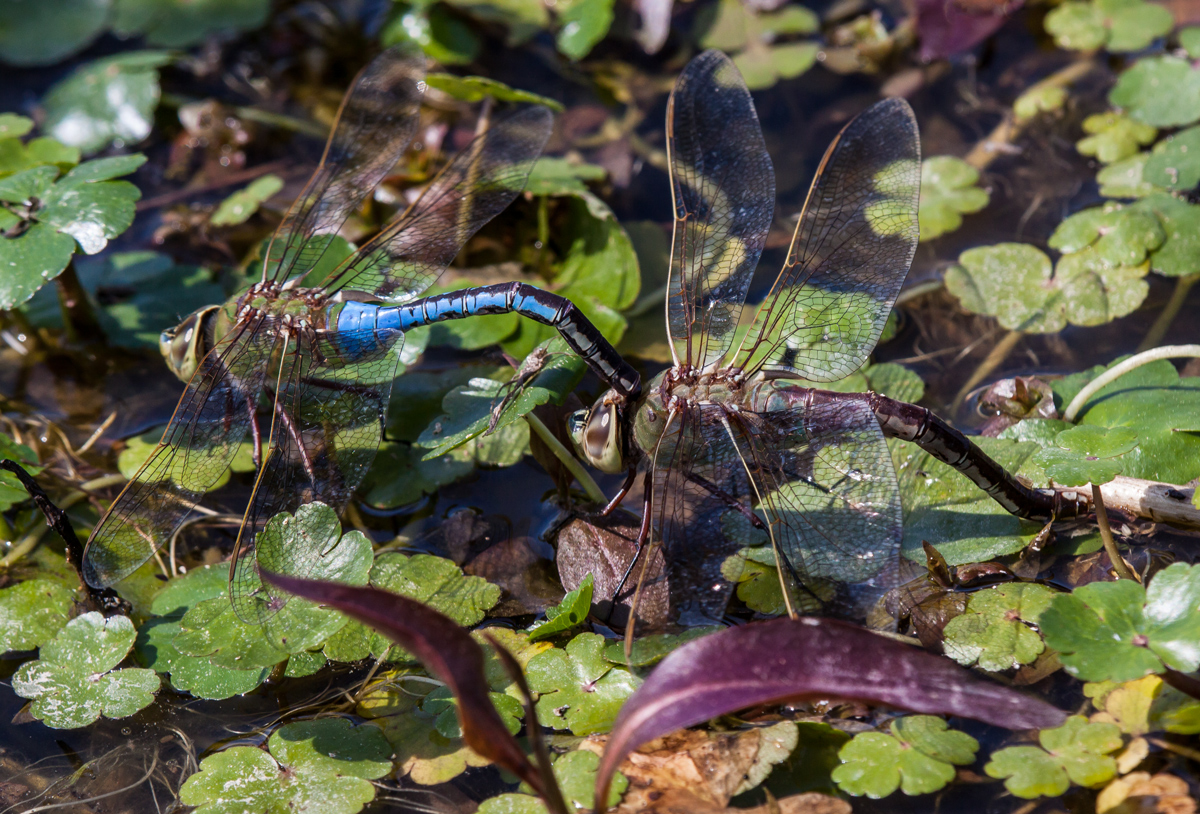
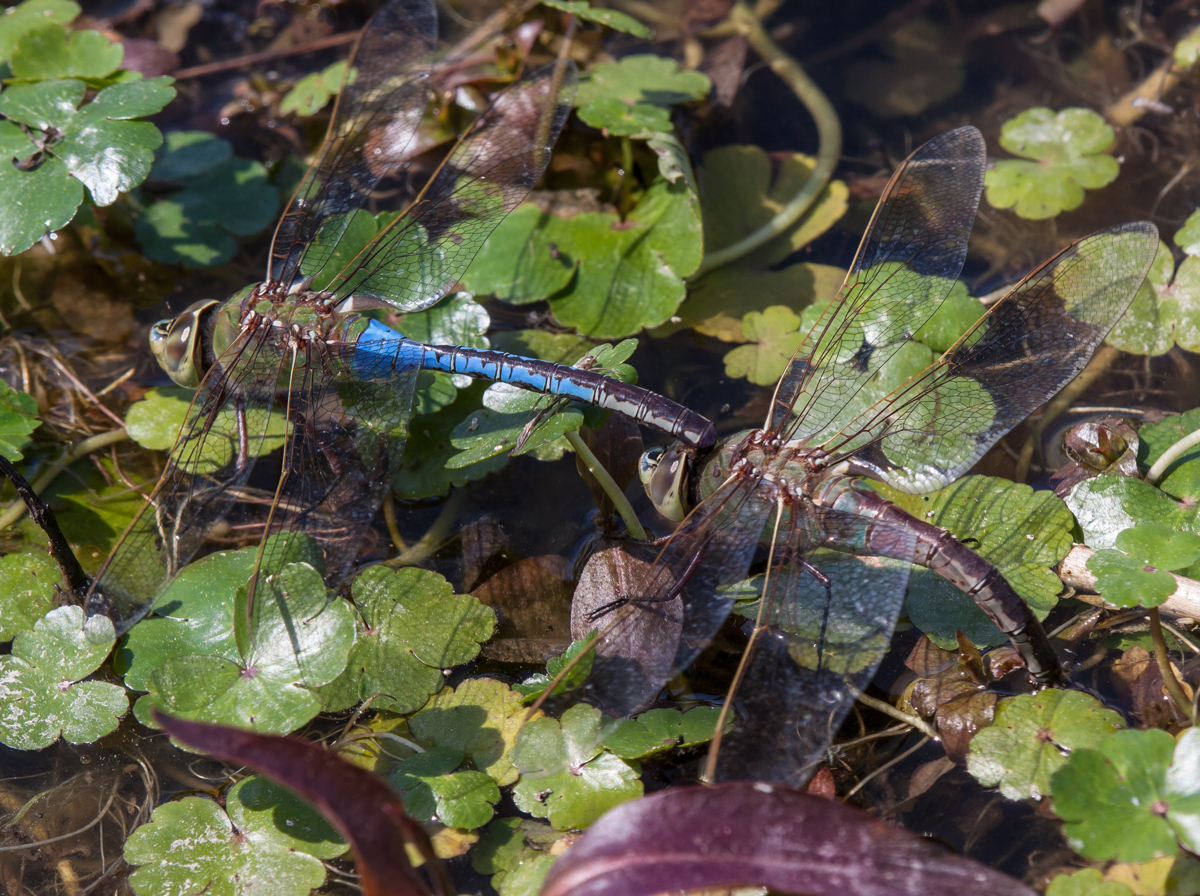
Now that the weather is warming up, I am searching in earnest for dragonflies, one of my favorite subjects to photograph. I am still having difficulties locating native-born species, but fortunately there are some migratory species in the area. Yesterday I spotted this Common Green Darner (Anax junius) dragonfly couple in tandem, with the male holding on as the female deposited her eggs in the floating vegetation.

In some dragonfly species the male will hover above the female as she oviposits, but in others, like the Common Green Darner, the male remains attached. I suspect that this method is one way of ensuring that the eggs that the male has fertilized are deposited before the female hooks up with another male.

Common Green Darner

Common Green Darner

© Michael Q. Powell. All rights reserved.

Read Full Post »
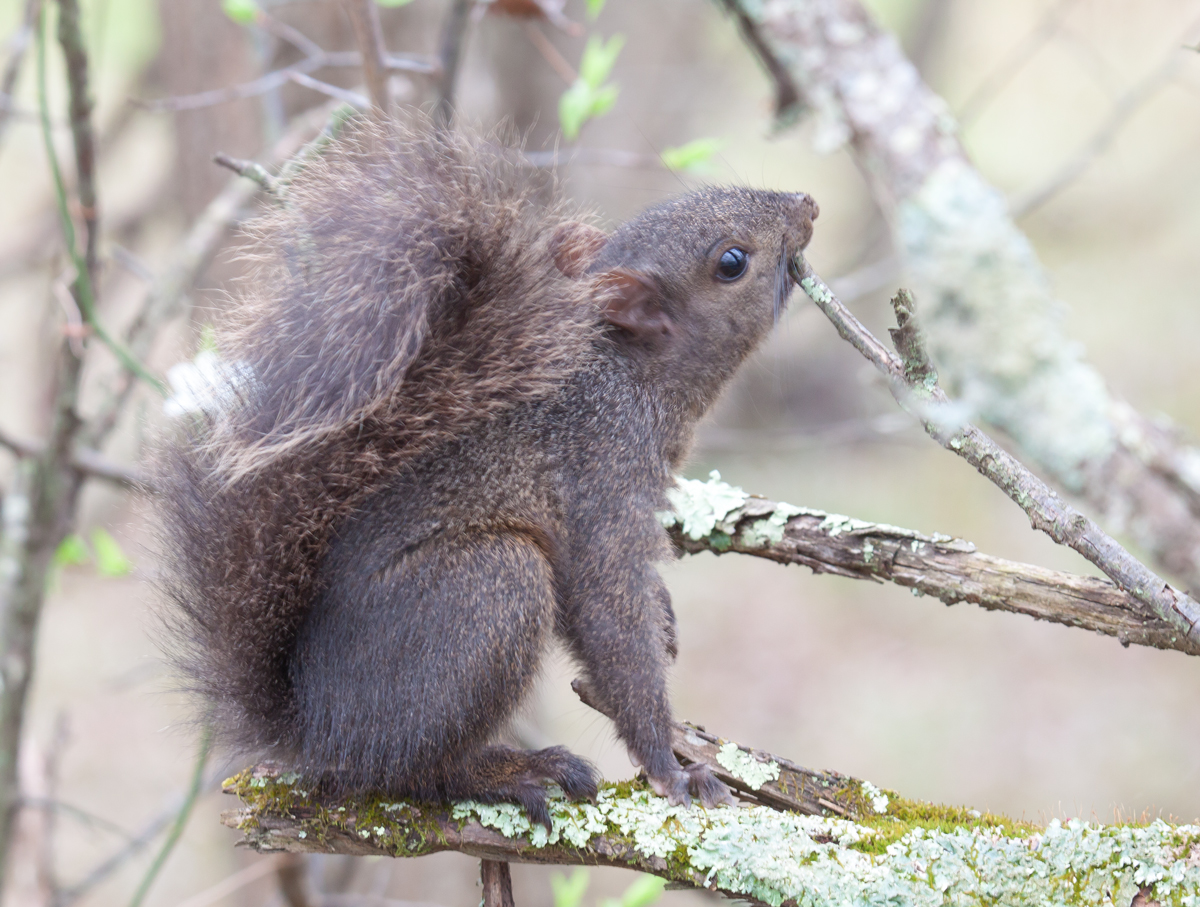
Would you stop to watch a squirrel as it nibbled on a branch or would you move on in search of more exciting wildlife? I love trying to capture the beauty in the ordinary and spent quite some time recently observing and photographing this Eastern Gray Squirrel (Sciurus carolinensis) at Huntley Meadows Park.

Although the tree looks kind of dead, I think that the squirrel spotted a fresh bud on the end of the branch and decided to chew on it for a little while. Normally a squirrel has its head down when feeding and it was nice to be able to get this shot with its neck extended. The little reflection in its eye was a bonus.

Eastern Gray Squirrel

© Michael Q. Powell. All rights reserved.

Read Full Post »

This weekend I have been hosting the odd couple. Katie, a young female German Shepherd, has been visiting me and Prime Rib (aka PR), my little gray male rabbit. It is an understatement to say that Katie is utterly fascinated by PR—she just can’t take her eyes off of him.

Sometimes she will put her nose right up against the cage and sometimes she will watch him from a short distance away, but she is always watching him. She particularly seems to like to follow him as he moves about in the cage.

PR pretty much ignores Katie and doesn’t seem to be bothered at all by her presence, even when she is only inches away from him. I have tried to keep an eye on the two of them to see if Katie displays any aggression or if PR shows an signs of fear or anxiety, but so far things seem to be working out ok—I think I am the only one showing signs of being a little anxious.

katiePR1_blog

katiePR2_blog

katiePR3_blog

© Michael Q. Powell. All rights reserved.


Read Full Post »

I love the distinctive look of the male Hooded Merganser duck (Lophodytes cucullatus) and it was a real treat to watch this one last weekend as he foraged in the vegetation at Huntley Meadows Park. Normally these small ducks are so skittish they fly away as soon as they sense my presence.

Hooded Merganser

© Michael Q. Powell. All rights reserved.


Read Full Post »

On Monday, I finally captured my first dragonfly shots of the season at Huntley Meadows Park, a recently emerged Common Basketttail dragonfly (Epitheca cynosura). For a couple of weeks I’ve been periodically seeing migrating Common Green Darners, but this is the first “native-born” dragonfly I have spotted.

The dragonfly is in a juvenile stage known as “teneral,” which initially confused me when I was trying to identify it. I looked through a lot of photos on the internet and they didn’t quite match up with some of the markings of “my” dragonfly.

Fortunately an expert came to the rescue when I posted the photos on the Northeast Odonata Facebook page and asked for help. Ed Lam, who literally wrote the book on odonata in the Northeast, replied that, “It’s a Common. It’s teneral so the stigmas and the hind wing patch will darken as it matures.” You can check out Ed’s book, Damselflies of the Northeast: A Guide to the Species of Eastern Canada and the Northeastern United States, on Amazon.

From my perspective, the dragonfly season has now officially opened. It is still really challenging, however, to find them this early, given that most species won’t emerge until much later in the spring and in early summer.

Common Baskettail dragonfly

Common Baskettail dragonfly

Common Baskettail dragonfly

© Michael Q. Powell. All rights reserved.


Read Full Post »

I spotted this Hooded Merganser couple (Lophodytes cucullatus) last Friday at Huntley Meadows Park enjoying a few quiet moments together.

The male duck has a wide-eyed goofy look on his face that makes me think of a teenager who has fallen in love. He worked up the courage to ask the cute girl on a date and she actually said yes. She’s playing it cool, but he can hardly contain his excitement.

It’s springtime and love is in the air.

Hooded Merganser

© Michael Q. Powell. All rights reserved.

Read Full Post »

« Newer Posts - Older Posts »