Feeds:
Posts
Comments

Posts Tagged ‘Canon 100mm macro lens’

As the weather has cooled off, there have been fewer and fewer dragonflies buzzing around in the marsh area. Occasionally I see a Common Whitetail dragonfly, but that has been pretty much it. This past weekend, however, I encountered some new, colorful dragonflies that I am pretty sure are Autumn Meadowhawk dragonflies (Sympetrum vicinum).

It was relatively early in the morning when some fellow photographers pointed out an orange-colored dragonfly perched on some leaves. According to their information, the dragonfly was unlikely to move until the temperature rose to about 70 degrees. I wasn’t so sure about their calculations and so I hastened to take some shots with my 55-250mm zoom lens. Here is an overall shot to give you an idea what an Autumn Meadhawk looks like (the sun was a bright and I couldn’t shield it so there are some unfortunate hot spots).

Autumn Meadowhawk dragonfly

Once I had a record shot, I became a bit bolder and decided to try my 100mm macro lens. The major problem I had was that the dragonfly was about a foot below me and about two feet away from me (I was on a raised boardwalk), so holding the lens steady was a problem. I did get a couple of close-up shots, like this one. I am always amazed when you can see the little hairs on a dragonfly’s “face.”

Close-up shot of Autumn Meadowhawk dragonfly

There were still some harsh shadows and hotspots, so I decided to use my collapsible diffuser to soften the light. Unfortunately, the dragonfly must have thought I was a predator, because it flew away as soon as I cast a shadow on it with the diffuser. Later that day, however, I encountered the Autumn Meadowhawks several times, but they refused to perch on plants, preferring to land on the boardwalk. Feeling a little frustrated, I took some shots of them on the boardwalk and ended up with the following image that I like, even if it’s not exactly a “natural” environment.

Autumn Meadowhawk dragonfly on the boardwalk

I am not sure how long these dragonflies will hang around, but it is nice seeing some new species as the seasons change, an unexpected bonus for me this past weekend.

© Michael Q. Powell. All rights reserved.

.

Read Full Post »

As I was reaching down one recent morning to pick up my newspaper from the small concrete stoop of my townhouse, I happened to look up and saw a beautiful spider web reflected in the early morning sun. In the center of the web was a small, fuzzy brown spider with what appeared to be short legs.

The spider was positioned in such a way that I could use my macro lens to get some close-up shots, but he was too high in the air for me to use a tripod or to brace my arms for optimal steadiness.  I also did not have a choice of too many angles, because the spider was suspended over a large bush that impeded my access. I took a lot of photos, many of which came out really out of focus.

Here are my favorite shots, two of which show the underside of the spider and two show a side view. I really like the markings and texture of this little spider, though I am not at all sure what kind he is. The unidentified spider is living proof, however, that the most interesting things are sometimes literally just outside our front door—all we have to do is open our eyes as we open the door.

© Michael Q. Powell. All rights reserved.

Read Full Post »

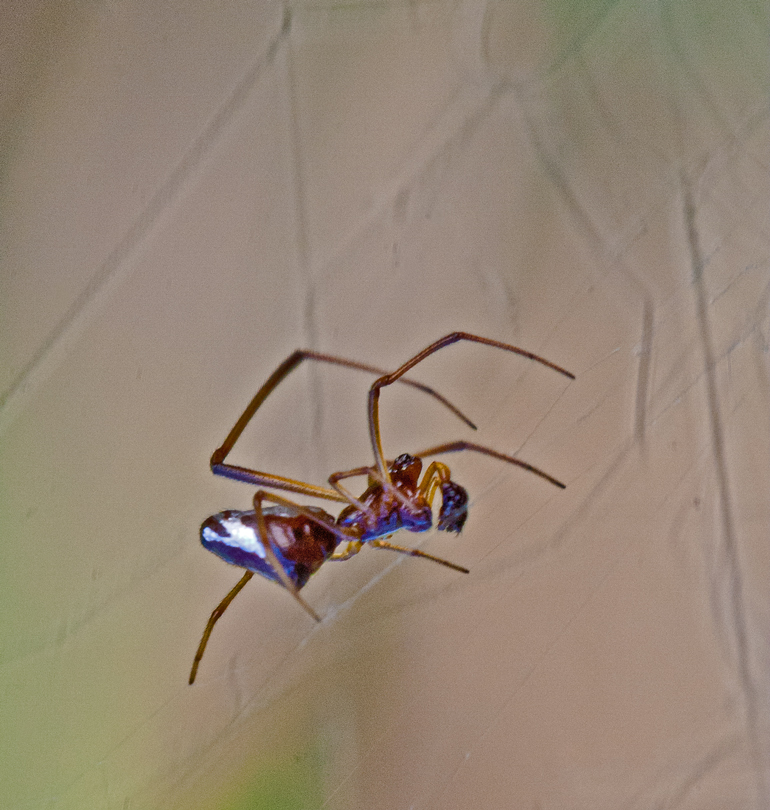
Last week I did a posting entitled “Kleptoparasitic Spider that talked of the little spiders that hang around a larger spider’s web and steal or feed on the prey captured by the other spider. Today I managed to take a much clearer shot of one such spider. I am pretty sure the little spider below is of the genus Argyrodes, which are also known as dewdrop spiders.

The spider was positioned in such a way that I was able to get close enough to use my 100mm macro lens, although there was not really enough room for me to shoot with a tripod. I was able to close down only to F10 because I was shooting handheld and wanted to have a shutter speed of 1/200 sec, so depth of field suffered a little. I have found that depth of field is a problem with spiders most of the time because of the length and positioning of their legs.

This spider was really tiny and I am happy that I was able to get this good a photo of it. The portions of the web that are visible help to add an interesting geometric pattern to the background, which I think enhances the image.

Dewdrop spider (genus Agyrodes)

© Michael Q. Powell. All rights reserved.

Read Full Post »

I have repeatedly observed a small spider or two hanging around the periphery of the web of the large Yellow Garden Orbweaver spiders (Argiope aurantia) that I have been photographing recently. Initially I thought it might be the male of the species, which is considerably smaller than the female, but when I finally took a clear enough photo of one of these small spiders, I realized it was a different species.

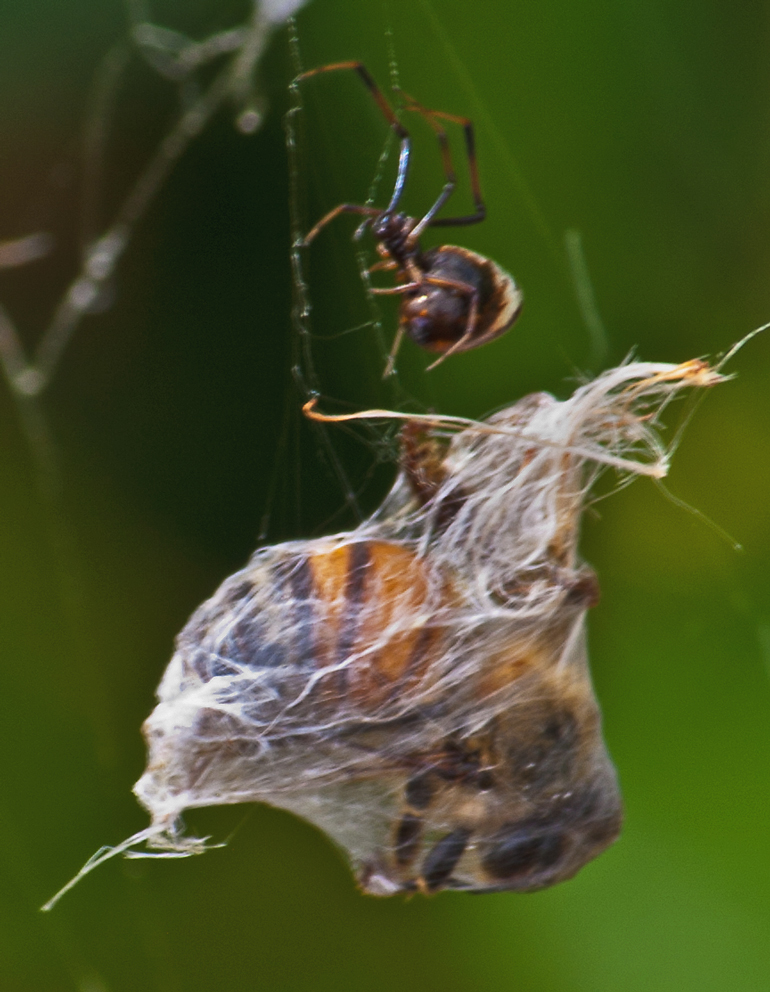
My research suggests that this is a kleptoparasitic spider. Let me explain. It may sound like I’m trying to sound like a scientist, but “kleptoparasitism” is a single word that captures the idea that this spider steals or feed on the prey captured by another spider. According to Wikipedia, kleptoparasitic spiders occur in five different families and I am pretty sure the little spider below is of the genus Argyrodes, which are also called dewdrop spiders.

Kleptoparastic spider eyes another spider’s catch

Let me set the scene for you. The much larger Yellow Garden Orbweaver spider caught what looks like a bee and returned to the center of the web, leaving the wrapped bee on the periphery. The little spider moved in and appears to be checking out this potential new food source. Compare the relative size of the spider and the bee—the spider is tiny. That made it tougher to get a clear shot of both the spider and the captured bee. My shot is far from perfect, but it does allow you to see some of the details (and you can get a higher resolution view if you click on the image).

It seems to me that the little spider plays a risky game, living with (and maybe stealing food from) a larger, more dangerous spider. Maybe he’s a thrill-seeker, an adrenaline junkie who enjoys living in a state of constant danger.

© Michael Q. Powell. All rights reserved.

Read Full Post »

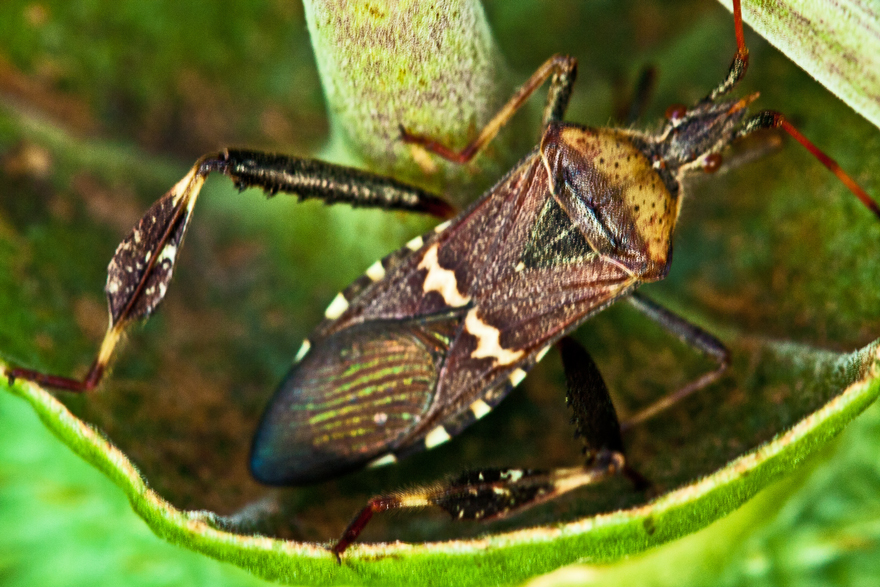
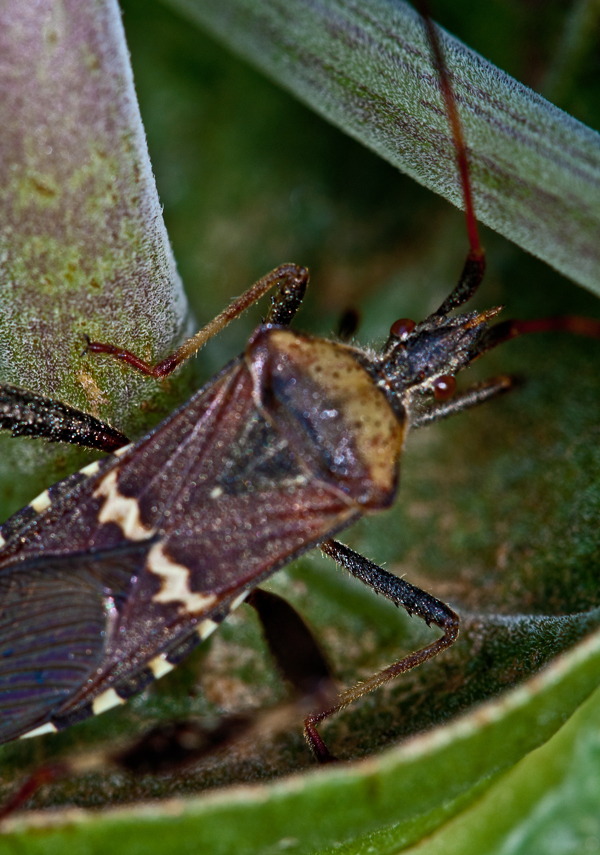
I was getting ready to wrap up my brief photo shoot at a local garden this afternoon when I happened to spot this interesting looking insect. Fortunately I had my macro lens on my camera and I had my tripod as well. I maneuvered as well as I could to frame the first shot and this is how I composed the image in the camera. I did a few tweaks in Photoshop Elements but did not crop at all. I cropped the second image slightly as I tried to move in a little closer. The eyes are in better focus, but I lost the sharper focus on the body.

I hope to figure out eventually what kind of insect he is, but for the moment I like the way the photos turned out.

UPDATE: Thanks to Jeremy Sell’s identification skills, I am pretty confident this is a Western Leaf-Footed Bug (Leptoglossus clypealis). Check out his blog at thelifeofyourtime.wordpress.com.

© Michael Q. Powell. All rights reserved.

Read Full Post »

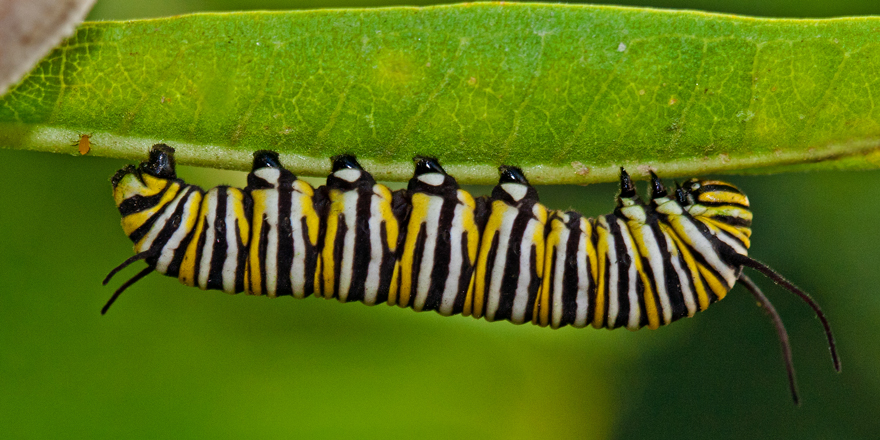
The day before I left for my recent trip I managed to get some photos of Monarch caterpillars with my macro lens. It was the first time that I had seen them live. Not surprisingly they were on milkweed plants and seemed to be chomping away with great appetite. I noted too that some of the milkweed plants were full of aphids (and some of them had lots of ladybugs too). I checked a number of sources on-line and they all suggest that the aphids are not directly harmful to the Monarch caterpillars during the two-week stage when they are caterpillars. I looked around today to see if I could see any chrysalis, the next stage of development, or more caterpillars, but found neither. I’ll keep looking!

Monarch caterpillar (click to see more details)

© Michael Q. Powell. All rights reserved.

Read Full Post »

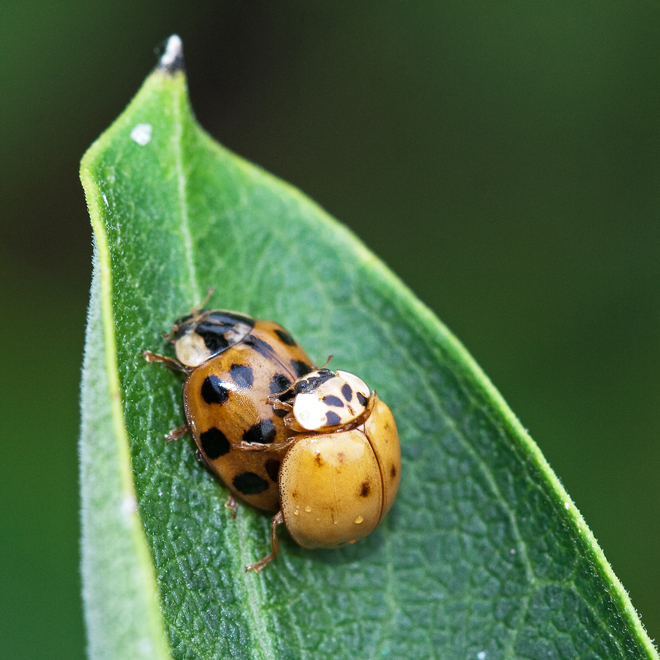
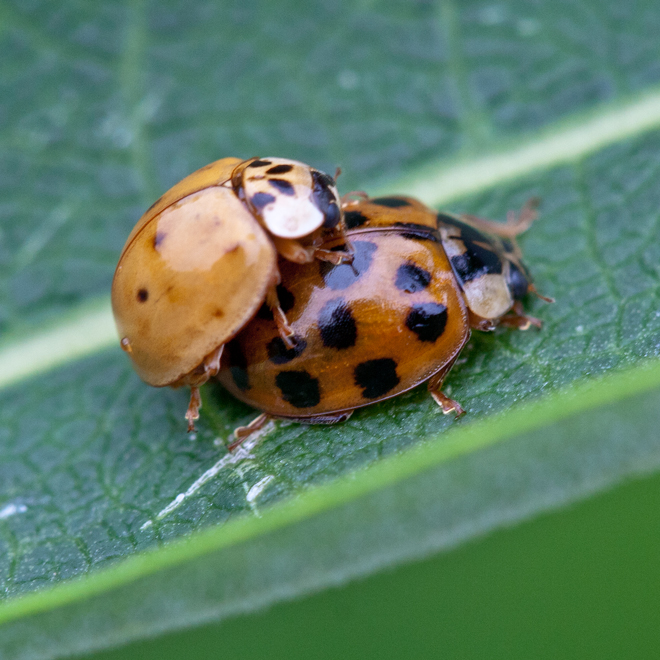
Last week when I was at a local garden I came across several pairs of ladybugs mating and several things really stood out to me.

First, the male ladybug is a lot smaller than the female. An article at ladybuglady.com (a great name for a website) points out that females are “usually” larger than males, but essentially it’s almost impossible for the average person to tell them apart until they are mating. If you really want to know how to tell male ladybugs from females the referenced article has photos from an electron microscope with detailed explanations.

The other thing that was obvious was the difference in color and spots between the two. The male is a medium orange with a few small light black spots and the female is a deeper shade of red with larger, darker spots. Wikipedia notes that there are more than 5,000 species of ladybugs (which technically are beetles and not bugs), with more than 450 native to North America. According to that article, the number, shape, and size of the spots is dependent on the species of ladybug. Does that mean these two ladybugs are different species?

Bugguide has some interesting factoids about names used elsewhere in the world for the ladybug. For example, “Ladybird” was first used in medieval England, perhaps because these beneficial predators of agricultural pests were believed to be a gift from the Virgin Mary—the “Lady.” Other European names have similar associations, such as the German Marienkäfer, “Marybeetle.” (Thanks to Gary for pointing out the correct spelling in German—I inserted the Umlaut to make it correct.)

So I am left wondering, will the little ladybugs that result from this coupling look more like mom or like dad?

© Michael Q. Powell. All rights reserved.

Read Full Post »

Who knew that the spots on a ladybug’s shell were water-soluble? That seems to be the case with this ladybug, who has only one remaining spot and a few drops of water, perhaps where other spots used to be.

Spotless ladybug–well almost spotless

© Michael Q. Powell. All rights reserved.

Read Full Post »

This unidentified little purple flower attracted my eye when I was shooting at a local garden with some friends. I had my macro lens on my camera and I had my tripod with me, so I carefully set up the shot the way my mentor, Cindy Dyer, has taught me to do. I tried to isolate my subject and keep a relatively unobstructed background. I shot at f16 to have a decent depth of field.

The final image is simple, modest, and pleasant, like the flower itself.

© Michael Q. Powell. All rights reserved.

Read Full Post »

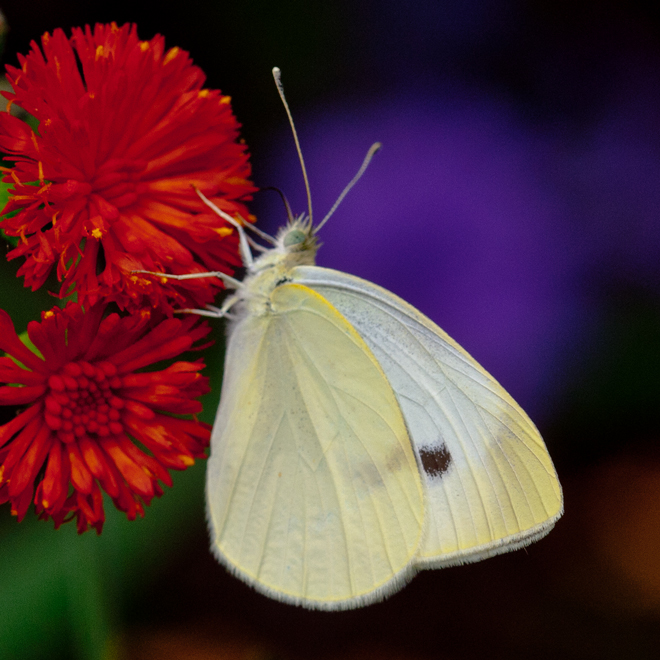
Cabbage White butterfly (Pieris rapae) on unidentified flower today at Green Spring Gardens, Alexandria, VA. Cabbage White butterflies are very common, but I find them to possess a delicate beauty in their elegant simplicity.

Cabbage White butterfly on a red flower

© Michael Q. Powell. All rights reserved.

Read Full Post »

All this summer I have been waiting and hoping that I would have a chance to see lots of Monarch butterflies (Danaus plexippus). There is something so classically beautiful about the Monarch, from the white-dotted body to the gorgeous orange and black. So far this summer I had seen only an occasional Monarch.

Today, however, my wishes finally came true and I saw quite a few Monarch butterflies at Green Spring Gardens in Alexandria, VA. That does not necessarily mean that I had an easy time getting good shots of the Monarch, because the Monarchs today did not seem to like to linger very long on a flower. Consequently, more of my shots were rushed than I would have preferred.

Here is an assortment of my shots from today. None of them is spectacular, but I nonetheless am pleased I was able to capture some of the majesty of the Monarch in my images.

© Michael Q. Powell. All rights reserved.

Read Full Post »

Almost everywhere that I have seen flowers the last few weeks I have seen skippers. One of the few varieties that I can identify is the Silver-spotted Skipper butterfly (Epargyreus clarus) which I feature in my first photo.

Silver-spotted Skipper

Many of the other skippers, however, look almost the same to me. Wikipedia says that there are more 3500 recognized species of skippers, so I don’t feel too bad about my identification difficulties. Here’s a photo of one of the 3499 non-Silver-spotted Skippers on a sunflower.

Unidentified skipper on a sunflower

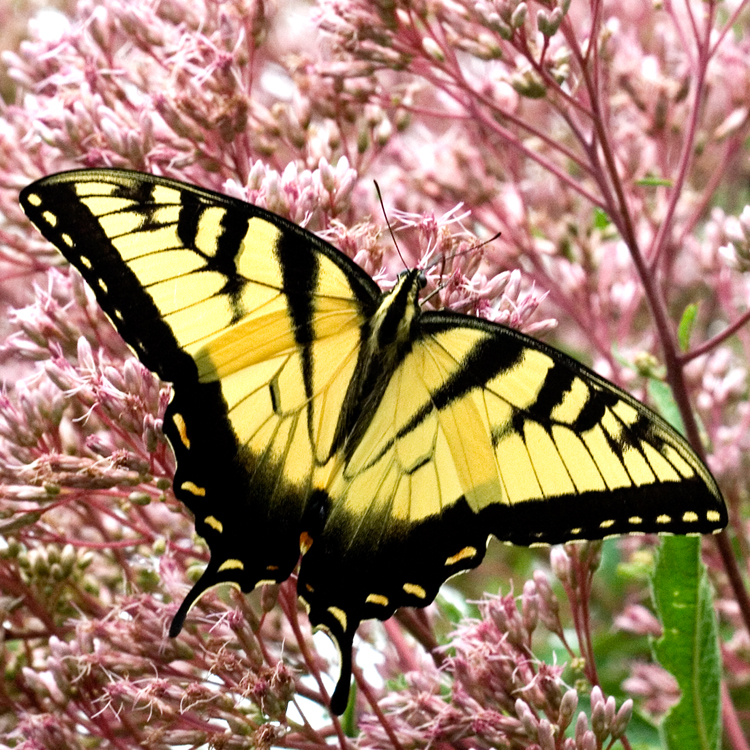
This must be the season for the Eastern Tiger Swallowtail (Papilio glaucus), because I see them almost everywhere too. I’ve posted lots of photos of swallowtails recently, but I figure that the bright color of the swallowtails will complement the more muted tones of the skippers. Besides, the different lighting and angles of the shots makes them very different photos for me, even when the subject is the same.

Male Eastern Tiger Swallowtail against the sky

Looking downward at a female Eastern Tiger Swallowtail

© Michael Q. Powell. All rights reserved.

Read Full Post »

I have to admit that I am really challenged when it comes to identifying flowers. I just don’t know where to start in researching them. So I apologize in advance for not knowing the name of this flower.

I spotted this distinctive small flower when I was shooting with some friends at a local botanical garden. The outside of the flower was not really that unusual, but I was immediately attracted to the inside of the flower. The shape and unusual pattern on the inside reminded me of a pleated curtain installed by a designer who was color-challenged. The color and pattern of the inside did not seem to  go well with the outside (or maybe I just watch too much Home and Garden TV).

I like that I was able to isolate and photograph this unusual flower which for now remains nameless for me.

© Michael Q. Powell. All rights reserved.

Read Full Post »

I came across this colorful specimen while on a nature walk at a local marsh. He was close enough to the edge of the path that I was able to set up my tripod and shoot with my macro lens, so I was able to get a reasonable depth of field.

I don’t have the slightest idea what kind of a caterpillar this is, but I really like his colors and all of the hairy, spiny things sticking out of his body (even if they made focusing a bit of a challenge).

© Michael Q. Powell. All rights reserved.

Read Full Post »

When I came upon this scene this afternoon I couldn’t help but think of some blog posts that I had read recently. Steven Schwartzman had a beautiful artistic image of a damselfly caught in a spider’s web entitled “Three Orbs, Three Colors.”  Daniel Proud had a wonderfully informative Four part series on Harvestmen (Daddy Longlegs) in late July that included colorful images of different harvestmen. Both of those bloggers caused me to be much more attentive today as I took in my surroundings during a nature walk at a local marsh.

I managed to capture an image of the spider moving in on his captured prey, a daddy longlegs, that had become stuck in the spider’s web.  Some may find the photo to be a little disturbing, but to me it is a simple fact of natural life.

Shortly after taking this photo, I moved in a little closer and must have disturbed the web. The spider quickly climbed up the web and took refuge inside the curled-up leaf. I waited for quite some time but the spider did not reappear.

I think the daddylongs was still alive when I left him, but his prospects do not appear to be good.

Caught in the web

© Michael Q. Powell. All rights reserved.

Read Full Post »

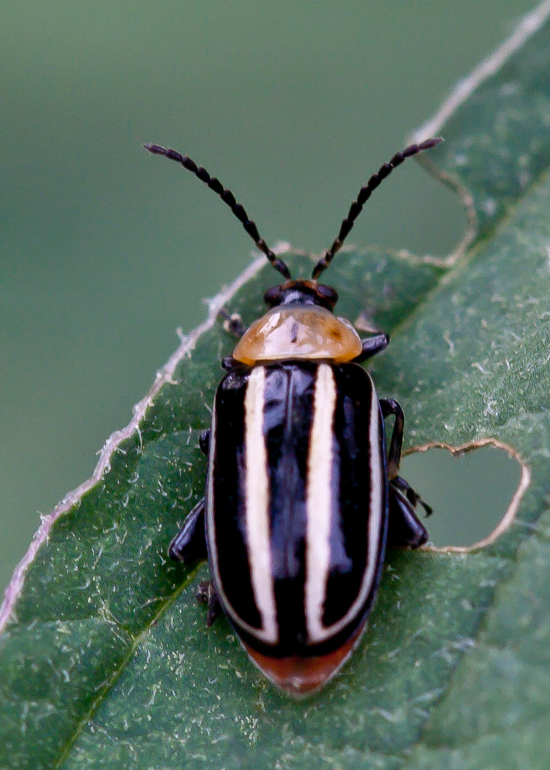
Last month I first encountered the Striped Cucumber Beetle (Acalymma vittata) in a neighbor’s garden. I was immediately taken by his cool, sophisticated, man-about-town look. The black and light yellow stripes down his back make him look like he is dressed formally. The translucent orange high collar, though, adds a splash of color to his ensemble and causes him to really stand out in a crowd. This well-dressed dandy, however, has a deep dark secret. Beneath the surface of this Dr. Jekyll lurks a Mr. Hyde.

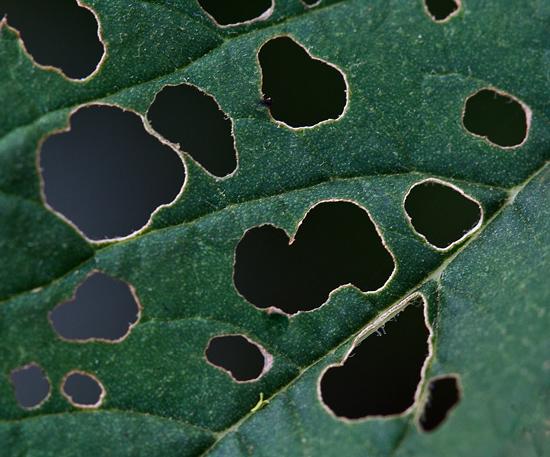
I ran into him today in my friend’s garden. Previously, the garden had been green and flowering. Now the garden looked like a war zone, with signs of devastation everywhere. The leaves of the plants had all been ravaged and looked like the image below.

So I confronted the striped cucumber beetle about what had happened to the leaves. I asked him to swear an oath to tell the hole truth, and nothing but the truth. Initially he resisted and then he admitted to a hole in one. Finally he confessed and named the other beetles who had participated. The judge, however,  may be lenient with him because he took personal responsibility for his actions and acknowledged that the hole thing had been his idea.

© Michael Q. Powell. All rights reserved.

Read Full Post »

A few minutes ago I was vacuuming when I suddenly noticed that there was an insect on the screen of my sliding glass patio door.  Of course, I immediately stopped working and grabbed my camera (with macro lens) and tripod.

I decided to try some face-to-face shots, which was a little tricky for the insect (which I think is a katydid) was less that two feet above ground level. I am glad that nobody could see me as I contorted my body with considerably less grace than the Olympic gymnasts I watched earlier this week.

When I looked at my closeup shots of the eyes, I realized they were a little creepy. No, they were more than a little creepy. So, of course, I am sharing them with you. Hopefully this image does not cause anyone to lose sleep or have nightmares and I certainly would not advise blowing this up and hanging it on your wall. (And yes, I know my macro technique still needs work, but I am still just learning.)

Now I can return to my chores, unless some other photo opportunity literally falls at my door step.

© Michael Q. Powell. All rights reserved.

Read Full Post »

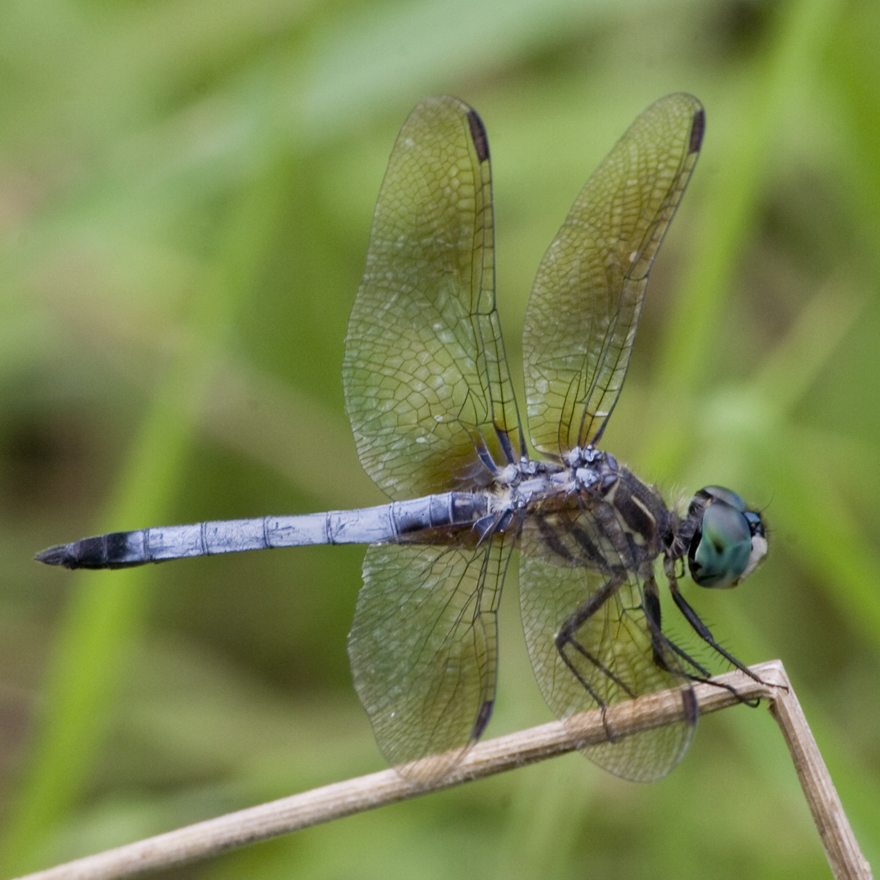
Perhaps I am going through a blue period for my favorite members of the Odonata family this weekend (one damselfly and two dragonflies) all turned out to be different shades of blue. I photographed the dragonflies in a marshy area where I expected to find them. I didn’t at all expect to see the damselfly in a garden setting but was able to get a shot when my friend Cindy Dyer pointed her out to me. (I’m calling the damselfly a “her” because it seems strange for me to refer to anything with “damsel” in its name as a “him.”)

It’s easy for me to identify the dragonfly in the middle as a Blue Dasher but I have not yet been able to identify the other two insects by name.

For now they will have to remain strangers, nameless but beautiful.

© Michael Q. Powell. All rights reserved.

Read Full Post »

What do you want to emphasize in a photograph that you display to others? It is a creative choice that each of us faces every time we take a photo or manipulate an image.

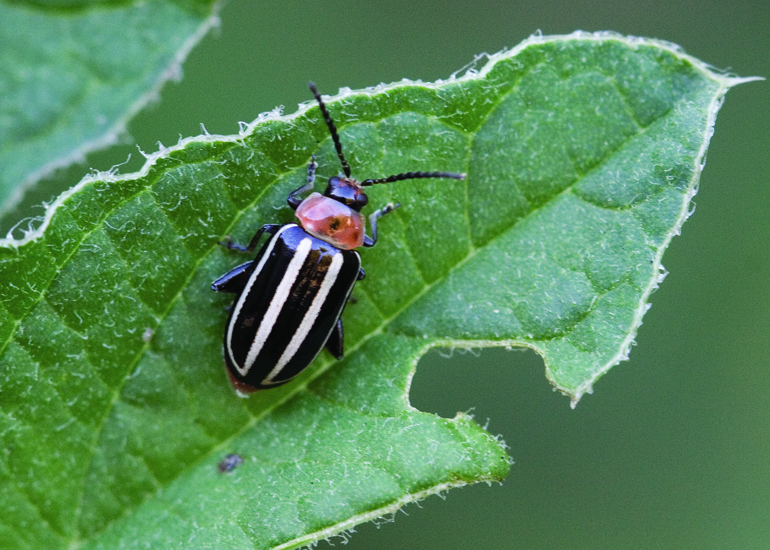
I enjoy shooting subjects with friends and comparing our results. Earlier in the week I was with Cindy Dyer, my photography mentor, and spotted an interesting looking little beetle on a plant in her garden. I did not have my macro lens on my camera and suggested that she photograph the little striped beetle, a type she had never previously encountered. She later identified the beetle as a Striped Cucumber beetle (Acalymma vittata).

Cindy took a wonderful photo of the beetle staring over the edge of a leaf and entitled her posting “The Abyss.” Her photo is graphic and colorful and full of a sense of mystery and contemplation. I took some photos this evening of what is possibly the same beetle. I tried to convey the same impression that Cindy did in my second photo below, but that was not really what I wanted to stress. This first photo shows my “take” on the subject.

I decided that I wanted to contrast the beauty of the beetle with its destructiveness and chose to include the damaged leaf in the initial photo that is most prominently featured on the blog. The rest of the photos are variations of the themes of beauty and destruction, sometimes depicting only one of the two themes or juxtaposing them both in a single frame.

Our choices influence how our viewers are likely to react to our photos.  It is liberating to have that kind of creative freedom. It is who we are and what we do.

© Michael Q. Powell. All rights reserved.

Read Full Post »

Let me begin with a disclaimer—no actual stabbing of bugs took place in the making of this posting. Believe it or not, this bug really is called the Twice-stabbed Stink Bug (Cosmopepla lintneriana). Why? The namer of bugs (whoever that is) decided the two red spots on the bug’s back look like stab wounds.

Yesterday I spotted this little bug while photographing with my friend and photo mentor Cindy Dyer. Cindy has a wonderful posting with a sharper photo of this specific bug and some fun information about him, including the fact that he is also known as the Wee Harlequin Bug. For additional information on the bug, check out his page at Bugguide.

I like the overall effect of this photo, acknowledging that it is far from perfect technically. I’m looking forward to improving my skills as I practice and learn new techniques.

© Michael Q. Powell. All rights reserved.

Read Full Post »

I haven’t seen too many butterflies yet this season so I was happy yesterday to encounter several Eastern Tiger Swallowtail (Papilio glaucus) butterflies at a local garden. The few that I have seen during the past few weeks have been pretty damaged but the male I photographed was in great condition. The female had some damage to one of her “tails” but otherwise was almost perfect.

Eastern Tiger Swallowtail male in perfect condition

Eastern Tiger Swallowtail female with damaged tail

© Michael Q. Powell. All rights reserved.

Read Full Post »

What do bees do when it’s raining? I never really gave the question much thought until this morning when I saw a really cool photo by the unUrban Studio showing a bee seeking shelter in an orchid in an early morning rain. In an earlier post today I showed a bee clinging to the underside of a leaf for protection from the rain.

During a walk in the light rain this afternoon I was pleased to also discover the bee shown below, sheltered inside of a red hibiscus flower. He appeared to be completely protected and may have been napping. As you can probably tell, I had to lighten the image a little to reveal the bee more clearly. This caused the sky, which was light already, to go totally white and produced an effect that I really like.

I enjoy walking in the rain and sometimes carry my camera under an umbrella if it is not raining too hard. From now on I’ll make a point of peeking into flowers and under leaves to discover more secret hiding places of the bees.

© Michael Q. Powell. All rights reserved.

Read Full Post »

What do bees do when it’s raining? I never really gave the question much thought until this morning when I saw a really cool photo by the unUrban Studio showing a bee seeking shelter in an orchid in an early morning rain.

When I took a walk in the light rain earlier this afternoon I decided to look carefully to see if I too could find bees hiding from the rain. Much to my surprise I found the bee shown below, clinging to the underside of a leaf. Apparently it protects him pretty well, though you can see a couple of drops of water on his lower body. The moisture also seems to have caused his hair to frizz a little.

I remember when I too had hair that frizzed when it was humid but those days, alas, are long gone (as is my hair).

© Michael Q. Powell. All rights reserved.

Read Full Post »

One of my earlier post identified my obsession with the red milkweed beetle (Tetraopes tetrophthalmus). As I hang around the milkweed plants, it’s hard not to notice another really colorful creature, especially because this seems to be its prime mating season. After a little research I’ve started to become better acquainted with the large milkweed bug (Oncopeltus fasciatus). Wikipedia provided me with some good information to start and BugGuide added some additional details. I am still getting used to shooting with my macro lens so I apologize in advance that not all of the photos are super sharp. I think they help, though, in explaining some of the traits of these fascinating bugs.

It has been relatively easy to get shots of the mating milkweed bugs and my research identified why. Milkweed bugs while mating can remain connected for up to 10 hours, according to Wikipedia. Yikes! I guess those television commercials about seeing your doctor after four hours don’t apply to these bugs.

What happens after mating? An article from the Life Sciences Depart at the University of Illinois at Urbana noted that a female lays about 30 eggs a day and 2,000 during her lifetime. Egg-laying begins 1 to 15 days after mating and peaks at about 20 days.

A few days ago I came across this group of milkweed bugs. The photo is technically lacking (it was hard to get the needed depth of field) but it gives you an idea of what the large milkweed bug looks like in various stages of development. As a “true” bug, milkweed bugs undergo incomplete metamorphosis. They go through a series of nymph stages, known as instars. For the large milkweed bug there are five instars. Buzzle has an article that explains the bug’s life cycle.

At each stage the bug is covered by an inflexible exoskeleton that constrains its growth. Periodically he bursts out of the exoskeleton and can grow to twice his size in minutes as the new exoskeleton develops and hardens, according to the Buzzle article. Here’s a shot of a bug in one of the earlier nymph stages.

As the milkweed bugs get older the wing pads increase in size in each molt. In the next three photos the wing pads are visible but not yet really prominent.

The wings on this nymph are much more prominent, leading me to think he might almost be an adult. The Buzzle article noted that the entire process of metamorphosis, from egg to adult takes 4-8 weeks, depending on the temperature of the habitat.

Once the large milkweed bug has become and adult (as shown in the last couple of photos) mating begins 5 to 12 days after the last molt for females and two to three days for males, according to the University of Illinois article. And the circle of life continues.

© Michael Q. Powell. All rights reserved.

Read Full Post »

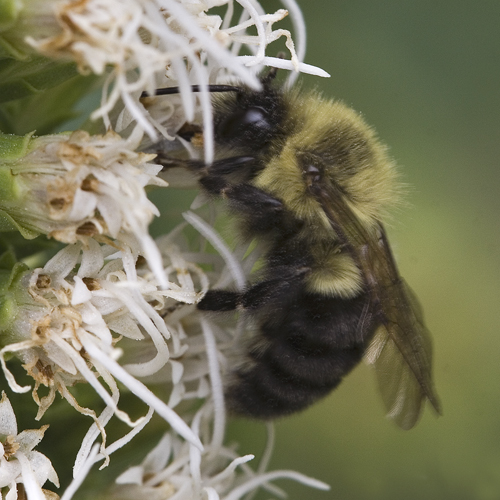
Bees were the very first insects that I tried to photograph close up when I got interested in macro photography a few month ago. (You might say I followed the advice of Julie Andrews as Maria in The Sound of Music when she said, “Let’s start at the very bee-ginning, it’s a very good place to start.”) It was a challenge without a macro lens but I managed to get some pretty good results by shooting at the extreme end of the focusing capability of my digital SLR.

Since that time I have “graduated” to a macro lens and to more exotic insects, but from time to time I am drawn back to the bees. Today, for example, as I was reviewing  images from a session that included colorful butterflies and dragonflies, I realized there were also a few images of bees that I wanted to share.

Most of the time I try to feature a single photo in my postings, but tonight I couldn’t make up my mind. Like Shakespeare’s Hamlet I was caught up in an internal struggle, “Two bees or not two bees, that is the question.”  I’m including them both—I don’t want to decide which is better.

As I end this post, the words of an old Carly Simon song come to mind, “Nobody does it better…bee-bee you’re the best.”

© Michael Q. Powell. All rights reserved

Read Full Post »

Focus on the eyes! That’s one of the first tips that I was given to improve my shots and I tried to follow that advice when photographing this red milkweed beetle. (One of my earlier blogs chronicled my obsession with these little creatures.)

I like the way the antennae turned out in this photo. They remind me of a Texas longhorn steer’s horns which, according to Wikipedia, can extend to 7 feet (2.1 meters) tip to tip.

Can you imagine a red milkweed beetle with an equivalent antenna span?

© Michael Q. Powell. All rights reserved

Read Full Post »

What’s a harvestman?

a. A man who harvests. like a farmer or a migrant worker;

b. A pocket electronic device made by International Harvester (like a Walkman or Discman);

c. An insect related to a spider; or

d. Spiderman’s adversary in the new Spiderman movie

Until earlier this week I might have responded with selection  “a” if  I had been posed this question—it is the most obvious answer. I would have been wrong. The correct answer is “c.”

As I was finishing up a photo shoot in a local garden one of my friends excitedly pointed to a bush and exclaimed, “There’s your first harvestman.” I did not have a clue what she was talking about. All I could really see in the bush was a bunch of long legs connected to a body. (My friend Cindy D. has some photos of the entire body of a harvestman in one of her blog postings in case you are not familiar with this insect.)

I shot some photos anyways and when I looked at them on my computer I was shocked. There appeared to be two eyes on a stalk in the middle of the insect’s back, with the eyes looking sidewards in completely opposite directions. Could they really be eyes?

Here is one of my photos of the harvestman. It is not a technically perfect photo but it gives you a pretty clear view of the unusual eyes of this strange insect.  If you want to learn more, check out this page, which is full of fascination factoids and photos.

© Michael Q. Powell. All rights reserved

Read Full Post »

The heat wave in the Washington DC area has finally broken. Many of us last night were awakened by the loud, cannon-like sound of thunder and the softer, more gentle sound of falling rain. This morning the skies were overcast and the ground was still wet, a likely source of frustration for commuters but a blessing for photographers.

I set off in the morning with a couple of friends for Green Spring Gardens, a county-run historic park in Alexandria, Virginia. The colors of the flowers today seemed to be extraordinarily vivid and saturated. There also were beads of water on many of the plants and flowers, creating wonderful reflections and adding additional interest.

I do not know for sure what kind of flower I captured in this photo, perhaps a hibiscus. Its color and texture caught my eye today. I probably would have passed by it yesterday without stopping. Today, however, its beauty was enhanced, enhanced by the effects of the storm.

© Michael Q. Powell. All rights reserved

Read Full Post »

« Newer Posts