Feeds:
Posts
Comments

Posts Tagged ‘Canon 100mm macro lens’

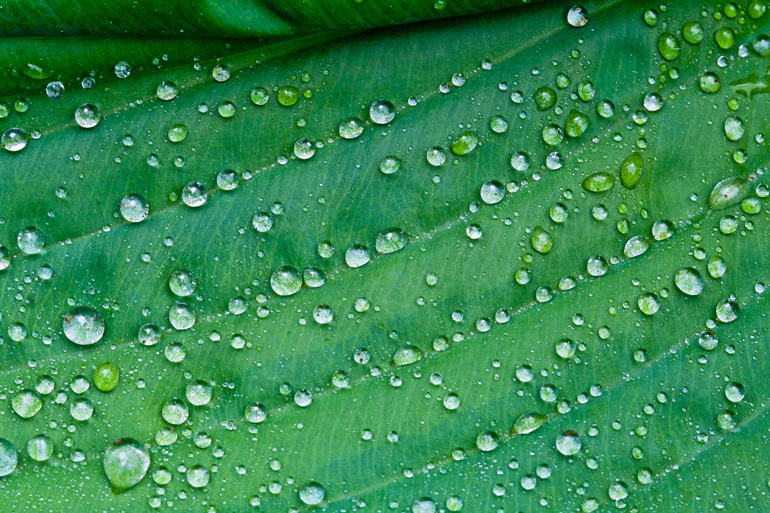
I love to photograph raindrops, normally focusing on a single drop, but I was really attracted this weekend to the rows of water drops on a single leaf of this Hosta plant. Many of them formed perfect little spheres of water, like tiny jewels or little water pearls.

Sometimes it’s easiest to find real beauty in simplicity, with no need for bright colors or ornate details.

drops1_blog

Michael Q. Powell. All rights reserved

Read Full Post »

Love-in-a-mist (Nigella damascena) is a flower that looks like it came from outer space, with wild tendrils shooting out of its middle and green spikes surrounding it.

I was surprised this past weekend to see some of the plants putting out blossoms this early at a local garden that I like to visit. I had never seen Love-in-a-mist (I love saying the flower’s name) in its early stage of growth and really like the look of the bud in the last photo, surrounded by the soft green spikes, as the flower is at all stages of growth.

Before long, entire patches of this garden will be covered with this remarkable flower—we can always use more Love, whether it is in a mist or not.

love1a_bloglove3_bloglove2_blog

Michael Q. Powell. All rights reserved

Read Full Post »

Columbines come in a variety of colors and they have sharp angles as well as soft curves—these are a few of the reasons that columbines are among my favorite spring flowers.

purple_columbine_blogdown_blog

Michael Q. Powell. All rights reserved

Read Full Post »

One of my favorite spring flowers is the columbine (genus Aquilegia) and I especially like its distinctive shape. Yesterday I took this photo at Green Spring Gardens, a county-run historical garden, one of my favorite spots for photographing flowers.

The flower was growing at an unusual angle and I tried hard to capture the details of the flower, as well as the beautiful colors in the background. I’m pretty happy with the result.

pink_columbine_blog

Michael Q. Powell. All rights reserved

Read Full Post »

In my neighbors’ garden facing the street, a beautiful purple bearded iris has a position of prominence, but unseen by most, a more modest, but equally beautiful purple flower grows amidst the vines in a corner of the back yard.

This iris is a showy flower, with deep, rich colors, frilly petals, and the colorful accent of the beard. How can you not like such a flower? It is the first iris to bloom and doesn’t have to share its glory.

Yet I am just as attracted to the geometric simplicity of the little purple flower in the back yard. The owner, Cindy Dyer, who posts amazing flower photos on her blog, told me the name of the flower (or perhaps it is considered a weed), but it didn’t stick in my memory.

Spring offers such a bounty of flowers, that there are bound to be some that appeal to your tastes and moods and sensitivities—it is definitely worth slowing down to smell the roses (and taking in the beauty of the other flowers too).

Iris_blogpurple_blog

Michael Q. Powell. All rights reserved

Read Full Post »

Ladybugs are often considered symbols of good luck and many people look at them as cute. Consequently, you have probably never considered them as menacing (assuming that you are not an aphid), but that is the descriptor that came to mind when I first looked at this head-on image of a ladybug that I photographed yesterday.

Perhaps I am just not used to looking eye to eye with a ladybug, but this one seems to have a deadly serious look on its face, like it was not happy that I was disturbing it.

I took the shot in my neighbor’s garden, using a macro lens and a hand-held diffuser to cut down on the intensity of the sunlight. Although I stopped down the lens to get some additional depth of field, the back portion of the ladybug, including its rear legs, are out of focus, which helps to draw attention to the face.

The change in seasons means that I will probably be featuring fewer birds in my blog than during the winter, and a whole lot more insects and flowers.

ladybug1a_blog

Michael Q. Powell. All rights reserved

Read Full Post »

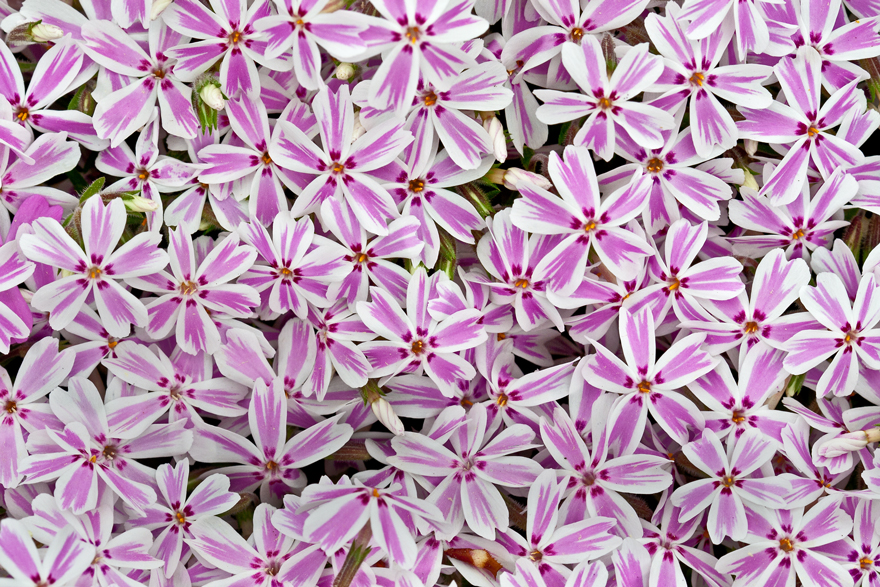
Here is a shot of the beautiful Creeping Phlox (Phlox stolonifera) that covered one whole area of the rock garden at one of the local gardens that I like to visit.

phlox_blog

Michael Q. Powell. All rights reserved

Read Full Post »

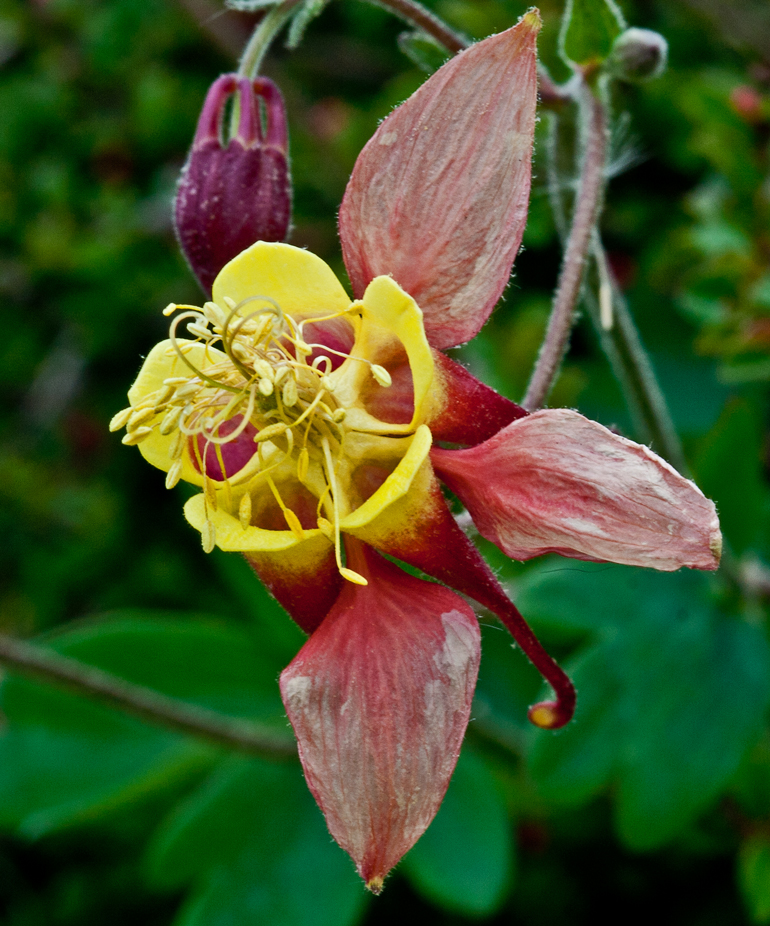
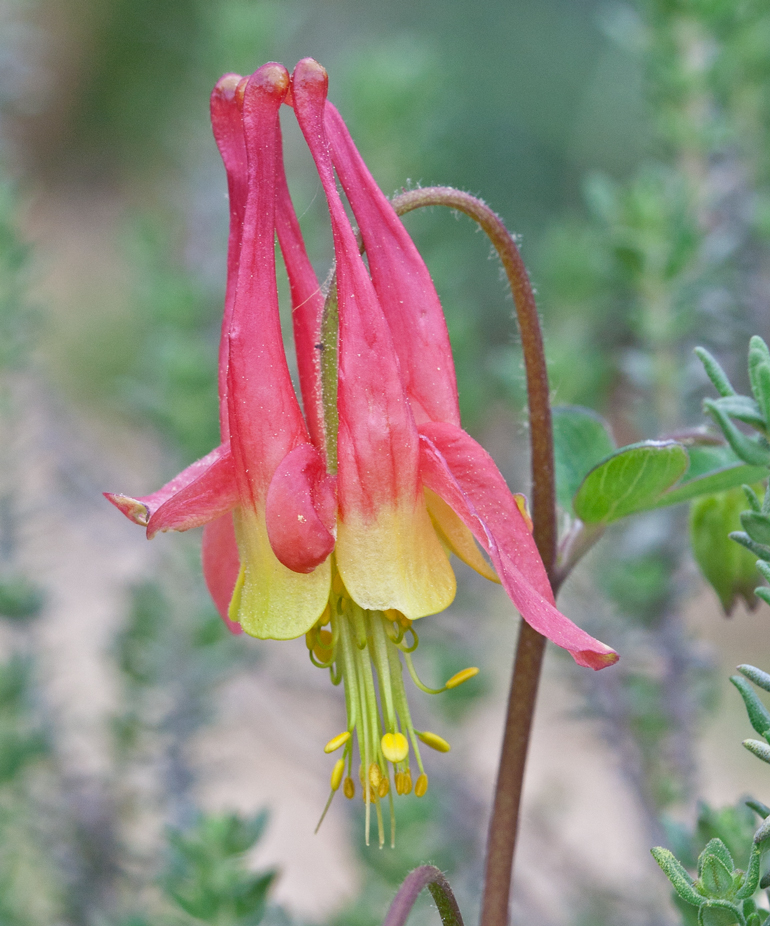
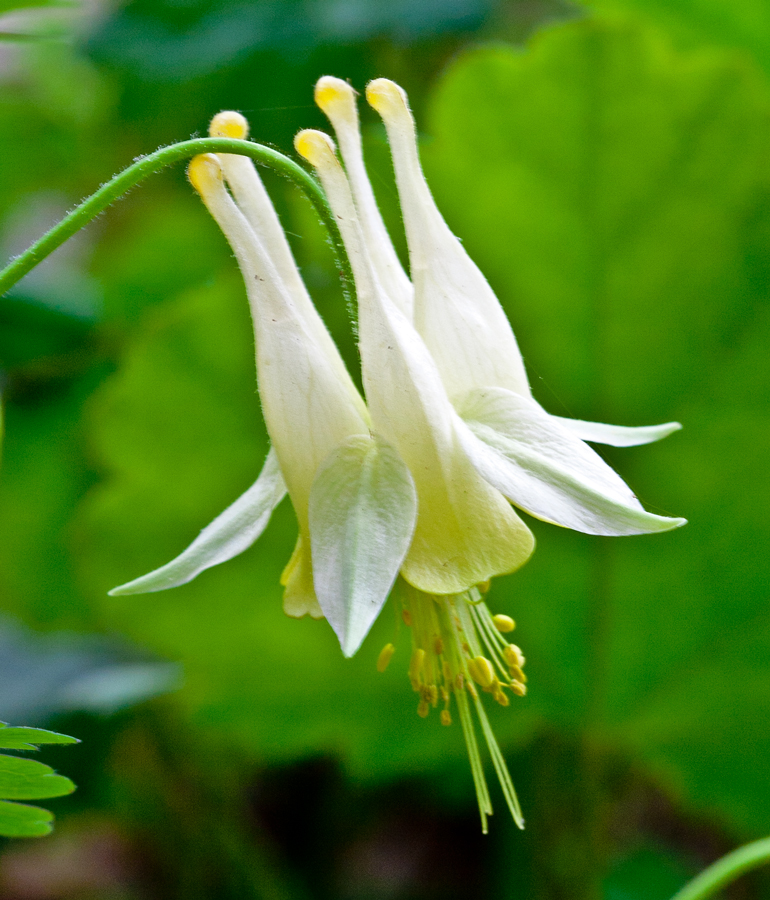
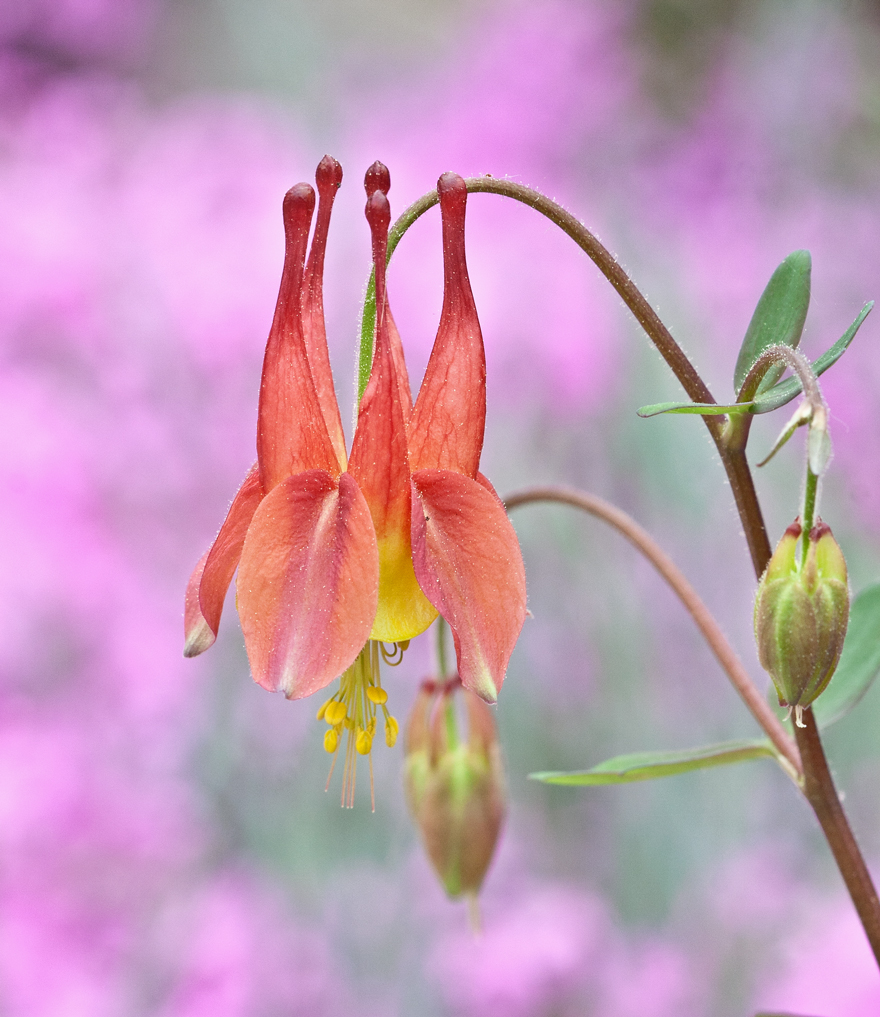
After first getting introduced to these pretty little flowers last spring, the Columbine (genus Aquilegia) rapidly became one of my favorites. They come in a lot of different colors, although the only ones blooming in the county-run garden that I visited this weekend were red-and-yellow ones and white ones.

Normally it’s not that difficult to get decent shots of these flowers, but the day was windy and that made it tough to control the depth of field (which normally requires a slower shutter speed) and stop the movement caused by the wind.

The pretty pink in the background of the final photo came from a patch of phlox that blanked a large area of a rock garden. I think I got some pretty good  photos of the phlox, so you may see them in another posting later.

columbine2_blogcolumbine1_blogcolumbine3_blog

Michael Q. Powell. All rights reserved

Read Full Post »

I like backlighting a lot, especially when the light shines through and illuminates beautiful colors, like those of this tulip in a neighbor’s garden.

backlit_tulip1_blog

Michael Q. Powell. All rights reserved

Read Full Post »

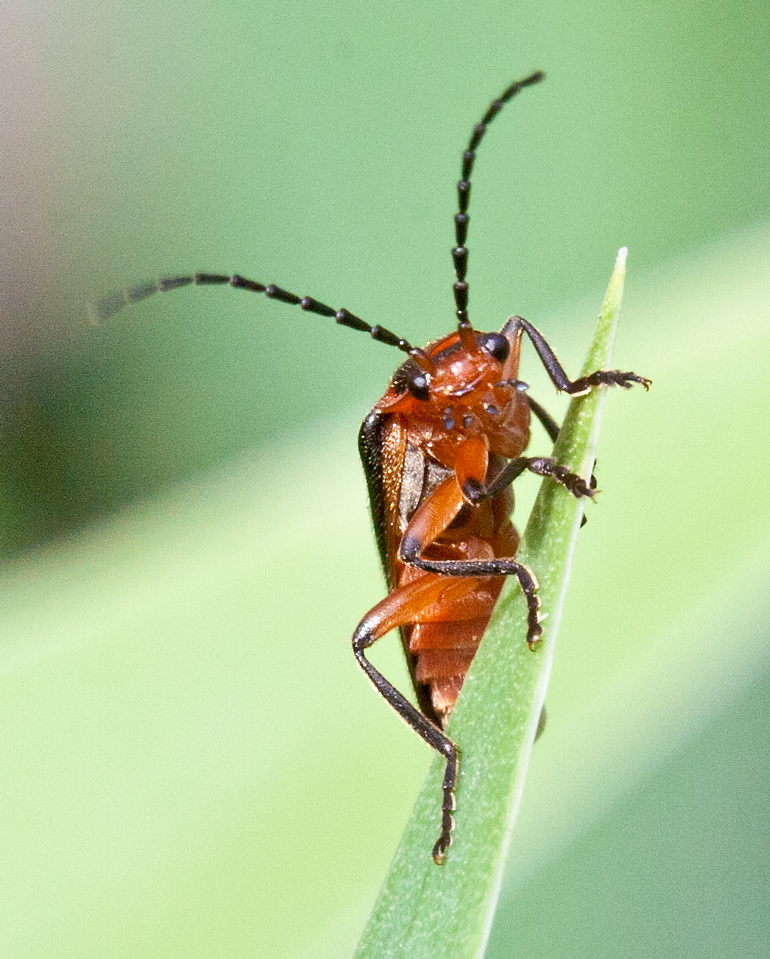
An insect on the edge of a leaf is a perfect candidate for a macro shot and when I saw this one from a distance in my neighbor’s garden, I got to work without a clue about its identity.

When I looked at the photos initially, I thought I had captured images of a Red Milkweed Beetle (Tetraopes tetrophthalmus), because of its bright red body and curved, segmented antennae. (I have a self-identified obsession with this insect that I discussed in a blog posting last year.) However, there were a few problems with that identification. This beetle seemed smaller; it was on a plant that was definitely not a milkweed plant; and it seemed too early to be seeing a milkweed beetle. My identification was further complicated by the fact that I never did see the back of the beetle.

So what insect did I photograph? I have been going over photos at bugguide.net, one of my favorite sources and wonder if this might be a Lily Leaf Beetle (Lilioceris lilii). Tentatively, though I like the name that I invented for this post, Red Spring Beetle.

I may not be sure about the identification of this insect, but I know that I like the photos that I managed to get, especially the first one. I captured a pretty good amount of detail and I like the way that he posed, looking directly at me.

red_bug3_blogred_bug2_edited-1

Michael Q. Powell. All rights reserved

Read Full Post »

I almost always take photos of nature and wildlife, but every now and then a man-made object will catch my eye, like this rusty, industrial-looking clamp.

I was visiting a friend as she was cleaning up her back yard, preparing for the flowers that will soon be blooming there, when I caught sight of  clamp. It was sitting on a rough-sawn stump and, as she told me, is used to attach a plant stand to another object.

The shape reminds me of a question mark, an industrial question mark. I really like the solidness of the piece, a solidness from which the rust detracts little. The light casts an interesting shadow and the scattered red buds are a nice complement to the rusty tones.

This was a case of shooting what caught my eye, without too much thought at the moment. I simply knew that I liked what I saw.

clamp_blog

Michael Q. Powell. All rights reserved

Read Full Post »

As I was admiring the beautiful tulips in my neighbors’ garden, I noticed this fly perched on the edge of one of them. In a different setting he might have gone unnoticed, but here the details of the fly provide a nice contrast with the wonderful primary colors of the tulips in the background.

With spring here in full force, I am reacquainting myself with my macro lens, causing me to look more closely at details like the red compound eyes of this fly and his hairy back legs.  It’s fun too to note the details of his tiny little feet.

I am now remembering how much I have to pay attention to lighting, depth of field, and shutter speed when shooting macro shots, particularly because my macro lens is not image stabilized. Very minor problems can really be magnified when I try to get in this close, especially with an animate subject.

fly_tulip_blog

Michael Q. Powell. All rights reserved

Read Full Post »

It doesn’t get much simpler than this—light shining through this leaf from behind created a graphic image that stands out from its blurry background. The color palette is mostly just shades of green. The suggestions of lines in the background help to add some visual interest.

The image is both striking and soothing to me, an interesting combination of reactions.

leaf2_blog

Michael Q. Powell. All rights reserved

Read Full Post »

We’ll have more ladybugs in our neighborhood even sooner than I expected.

My neighbor and photography mentor, Cindy Dyer, has ladybug larvae in her garden as I showed in a recent posting. Some of them have already entered the pupa stage, the final stage before adulthood. Once metamorphosis is complete, the shell splits open and a full-grown ladybug emerges. Initially, the shell is soft, but pretty rapidly the exoskeleton hardens and takes on the look that we associate with ladybugs.

Here’s a photo from today of a ladybug pupa. I think that it is probably from a Harlequin Ladybug (Harmonia axyridis), a type that is also known as the Multicolored Asian Lady Beetle. If you want to know more about the life cycle of a ladybug, check out the posting that I did last fall entitled Baby Ladybugs.

larva2_web

Michael Q. Powell. All rights reserved

Read Full Post »

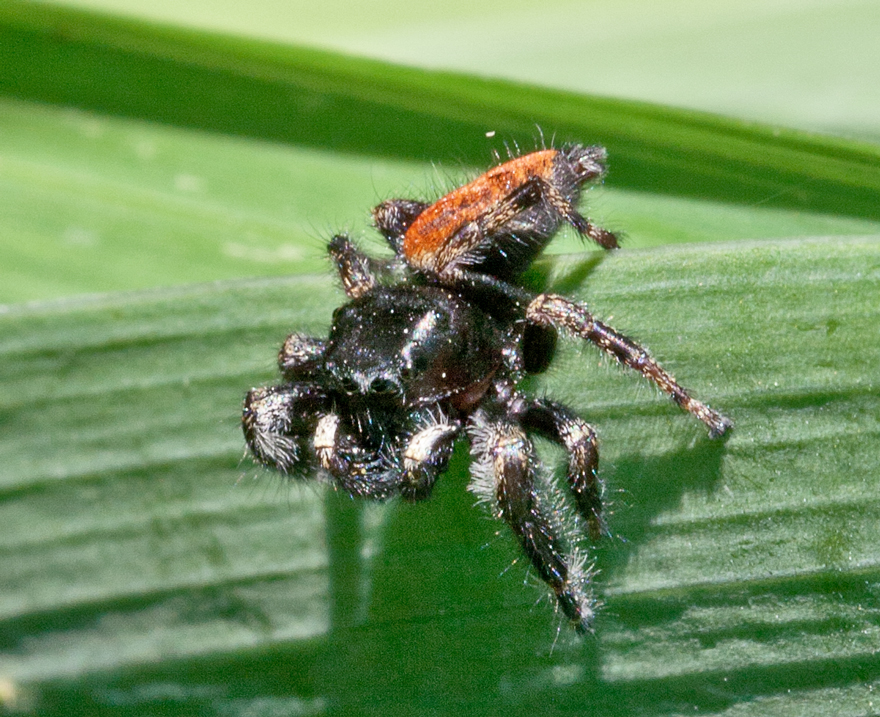
I was checking out the plants yesterday in my neighbor’s garden when I came upon this cool-looking spider, a type that I had never before encountered. From an initial check on-line, it looks like this might be a kind of jumping spider, though I really am out on a limb with the guess. In any case, I really like the combination of red and black on his body and the multiple eyes that are just visible.

With the arrival of spring, I am starting to see some familiar insects from last year and some new “friends.” It’s an exciting time for me.

spider_blog

Michael Q. Powell. All rights reserved

Read Full Post »

I am going to have to brush up on my insect identification skills, but I think that this cool-looking insect is a larval form of a ladybug.

I don’t have a garden of my own, but one of my neighbors, fellow blogger and photographer Cindy Dyer, has a wonderful garden that is always full of colorful flowers and insects. I photographed this insect in her garden this afternoon.

The sunlight was a little too direct and the shadows are too harsh. I am happy, though, that I was able to pick up many of the insect’s details with my macro lens. In case you are curious, the bright red in the background is a group of tulips that are in full bloom.

As always, I welcome corrections or clarifications about my identification of my subject—there are lots of folks on-line with greater knowledge and experience in all of the subject areas in which I shoot.

insect_blog

Michael Q. Powell. All rights reserved

Read Full Post »

Progress toward spring seems to have slowed down and frost has reappeared in the morning, though we have been spared the heavy snows that have fallen in other parts of the country.

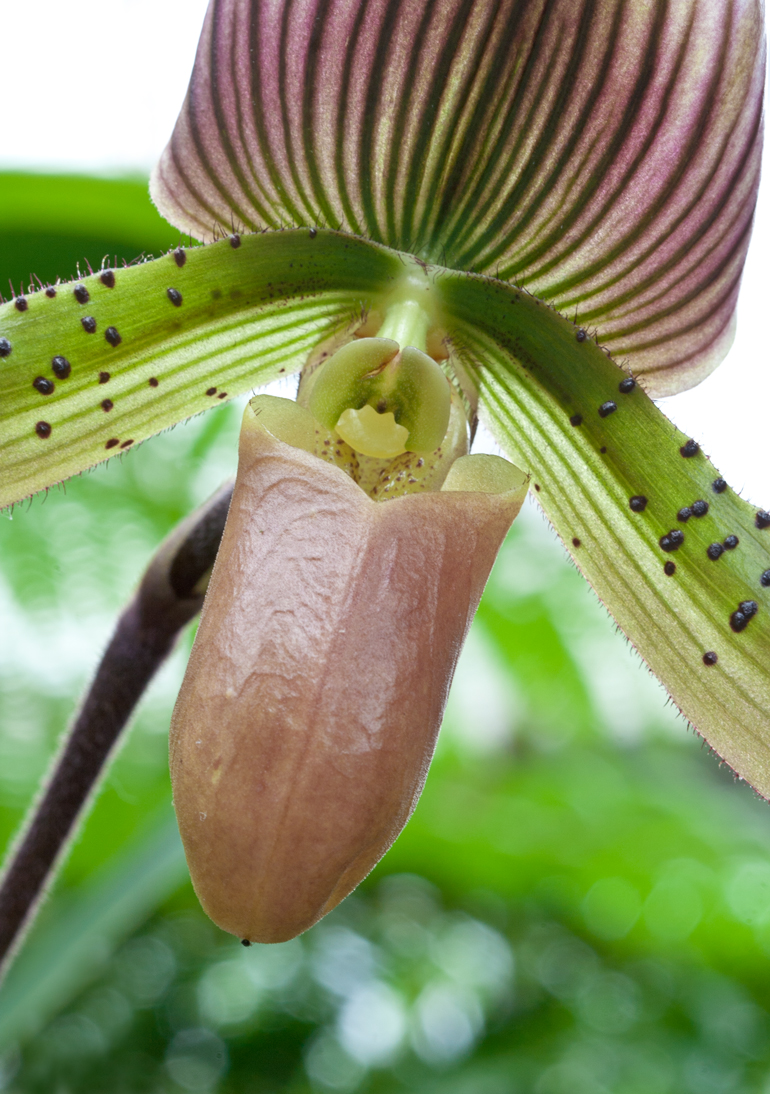
As a reminder of the colorful growth that is to come, I decided to share a few images of one of my favorite orchids—a Lady’s Slipper orchid—from the orchid exhibition that I visited at Lewis Ginter Botanical Gardens in Richmond, VA earlier this month. I was really intrigued by the “pouch” portion of the flower and tried to highlight it in close-up photos, which I took with my camera on a tripod and settings of ISO 100, f16, and .6 seconds.

As I think about spring, I feel like a little kid on a trip, who keeps asking his parents, “Are we there yet?” Despite what the calendar may indicate, we are not there yet, and the answer to the question “When?” is likely to be the indefinite “Soon” that parents are wont to use in a response to the child.

Slipper1_blogslipper2_blog

Michael Q. Powell. All rights reserved

Read Full Post »

This past weekend, I made another trip to the orchid exhibit at Lewis Ginter Botanical Gardens in Richmond, VA, in part to hone my macro-shooting skills that have atrophied during the winter months.

I have grown accustomed to photographing birds and small mammals at the far end of my telephoto range in situations in which I don’t have much time for decision-making. If I am lucky, I am able to quickly check the direction of the light and adjust my camera’s settings, but sometimes there is insufficient time for even those rudimentary checks.

When I am shooting with my macro lens, my camera is usually attached to my tripod and, if I remember to do so, I have time to think about the exposure, the settings, and the angle before the shot. More importantly, I can look at the results and take a second shot. Birds and animals rarely give me a second chance.

Here are shots of a couple of the orchids that at the exhibition. I don’t know the names of the orchids, but one of my Facebook friends told me that the red one is from the Cymbidium genus. As I was working on the images, I noticed that I photographed both of them from almost the same angle. Perhaps I liked that angle, but most likely I was desperately trying to get an uncluttered background and this view allowed me to minimize distractions.

I can tell I need to retrain my eyes a bit to look at the tiny details as I prepare for the insect and flower season. Baseball is not the only activity that requires spring training.

orchid_red_blog

yellow_orchid_blog

© Michael Q. Powell. All rights reserved

Read Full Post »

I’m finally finishing up with the shots from my trip last weekend to see the orchid exhibition and thought I’d post a couple of abstract images.

The first shot is a close-up of an elephant ear plant. I like the way its veins pop out, like a bodybuilder with a heavy weight. The image is somewhat symmetrical, but the two sides are not mirror images.

The second shot is a close-up of an orchid. Is it just me, or does it look like the flower contains a pink Darth Vader helmet?

ElephantEarCloseupDarthVadarPinkHelmet

© Michael Q. Powell. All rights reserved

Read Full Post »

My challenge this weekend was to capture the delicate beauty of a wide variety of orchids and I decided that the best way to do so was to look at them closely, very closely and to use my macro lens.

I took these photos at an orchid exhibition at Lewis Ginter Botanical Gardens in Richmond, VA, about 90 minutes from where I live. The orchids were displayed in a glassed-in conservatory at varying heights in many different ways at varying heights—sometimes as single plants and sometimes in groups. It would have been amusing to make a video of my body’s contorted positions as I struggled to frame the photos and to look through the viewfinder of my camera, which was on a tripod most of the time.

In some of these images, like the first one, I tried to increase the depth of field to show more details and in other cases, like the last image, I intentionally limited the depth of field to capture one element. In some photos, I was most interested in the lines and colors.

If forced to choose a favorite, I’d probably select the first image, because of the interesting shapes, which are set off by the white petals. Do you have a preference?

White Orchid closeupPinkWhiteYellow OrchidAbstract Pink Orchid

SpecklePurpleOrchidGreen

© Michael Q. Powell. All rights reserved

Read Full Post »

Here is a splash of color to start the work week—a close-up shot of the inside of a deep purple tulip called Negrita.  I photographed this flower while visiting an orchid exhibit at the Lewis Ginter Botanical Gardens in Richmond, Virginia this past weekend.

Tulip Negrita

© Michael Q. Powell. All rights reserved

Read Full Post »

In an effort to chase away the dullness of another gray winter day, I traveled yesterday with some friends to Lewis Ginter Botanical Gardens in Richmond, VA to see a spectacular display of orchids.

There was an amazing variety of orchids of all sizes and color, displayed in several areas of a large indoor glass conservatory. I know very little about orchids, but my eyes were especially drawn to a variety called Lady’s Slippers that are in the sub-family Cypripedioideae. According to Wikipedia, orchids of this type are characterized by slipper-shaped pouches that traps insects so they are forced to climb up past the staminode, behind which they collect or deposit pollen, thus fertilizing the flower.

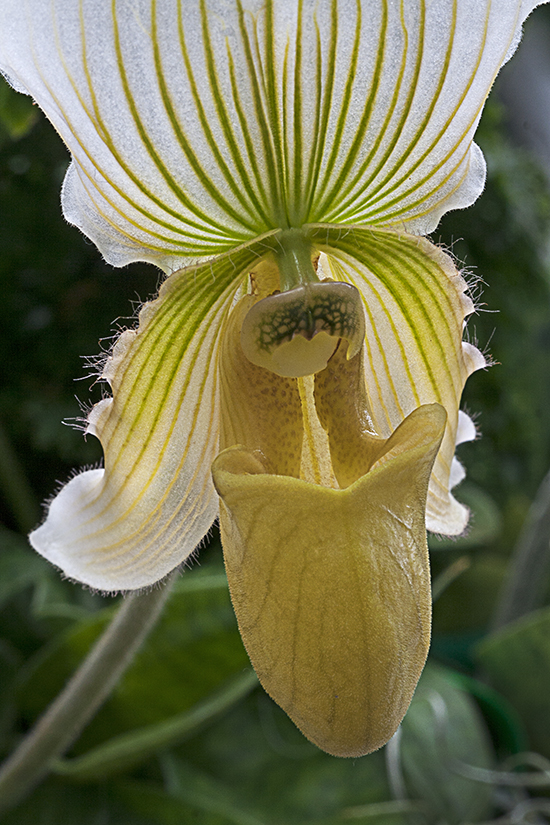
Here is a front view of a green-and-yellow Lady’s Slipper. Although the orchids were amazingly beautiful, it was often difficult to get good backgrounds for images of the flowers, because of visual clutter. I dealt with the issue by using my macro lens and concentrating on small elements of individual flowers.

My friend and photography mentor, Cindy Dyer, however, was better prepared for this by carrying along a piece of white cardboard to help isolate the flowers and simplify the background. (You should check out her blog for beautiful photos of orchids and other flowers and insects).

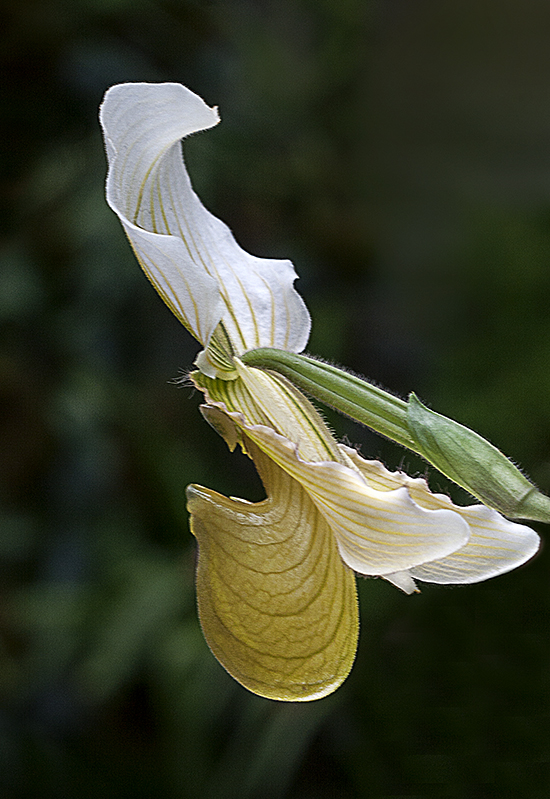
The second and third images, which provide a side view of the Lady’s Slipper, were taken with a few seconds of each other, one with the existing background and one using Cindy’s white cardboard. In many ways, I like the look of the white background—it reminds me a little of a botanical print, but it is definitely unnatural.

Which version of the side view do you prefer?

GreenYellowSlipperFront

Slipper Side ViewYellowGreenSlipperOrchid

© Michael Q. Powell. All rights reserved

Read Full Post »

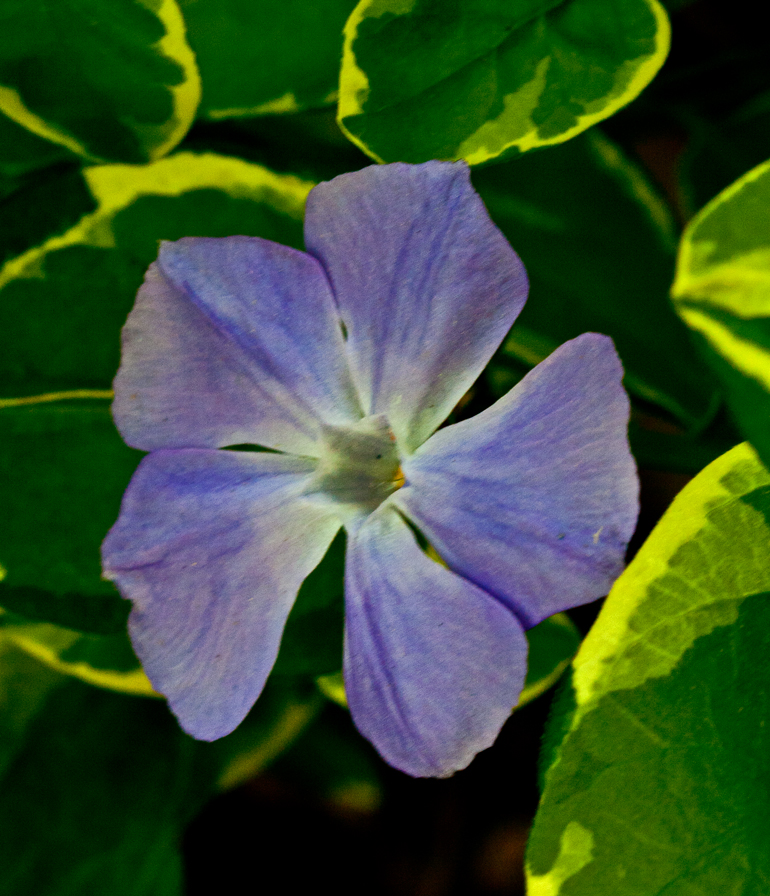
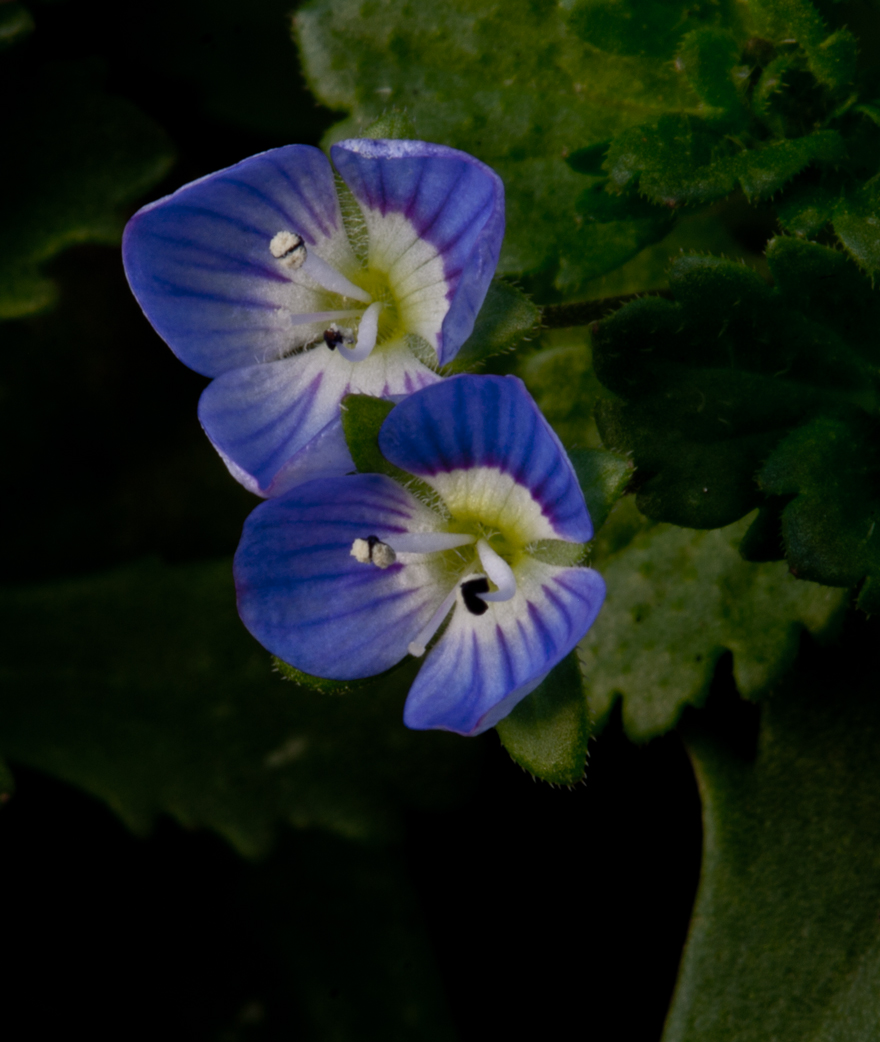
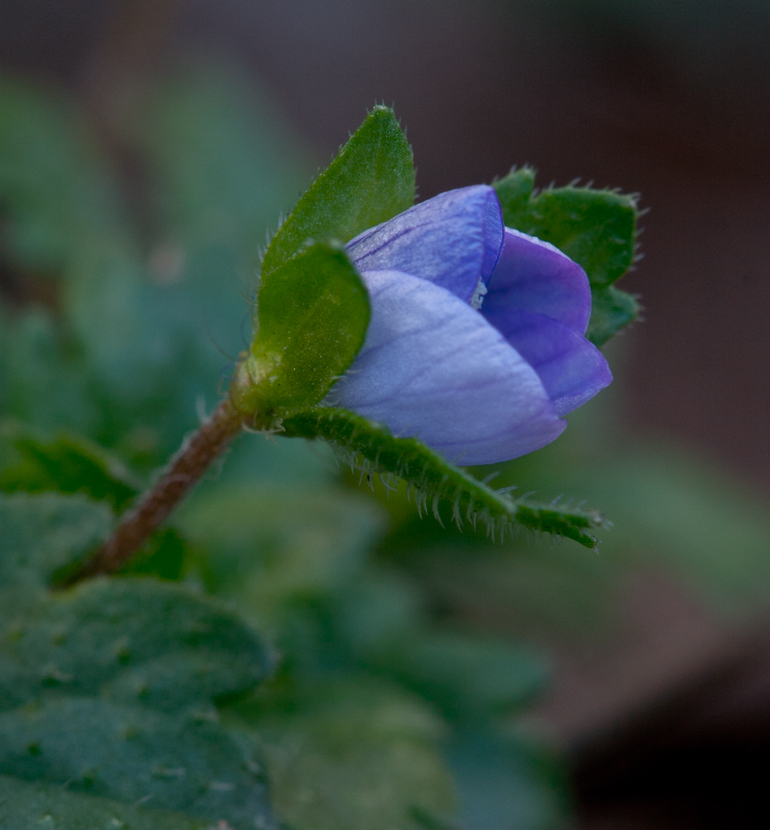
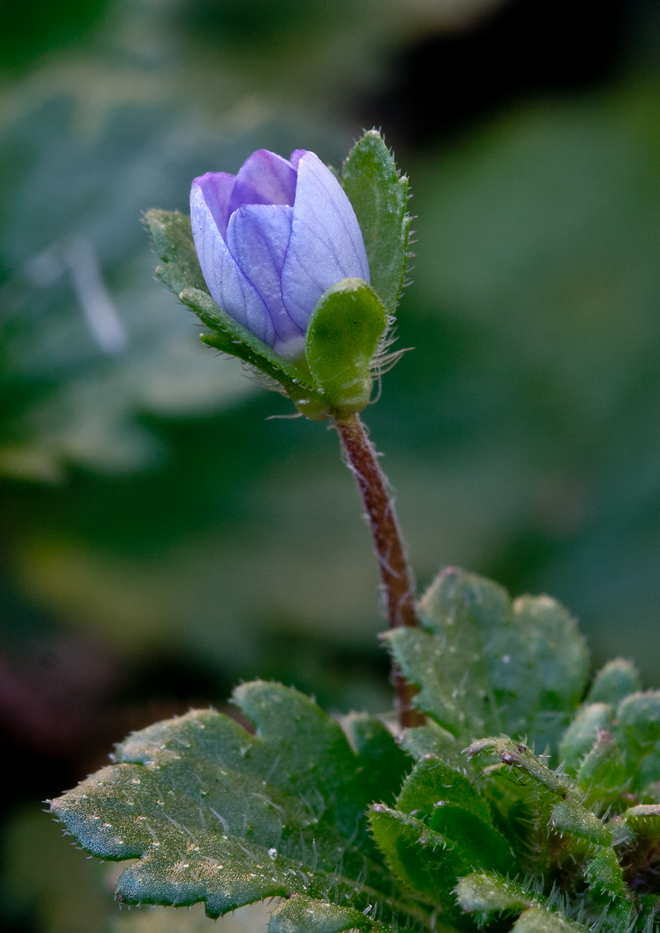
We have had a strange winter here in Northern Virginia, with some unseasonably warm days. Today, for example, it was over 50 degrees (10 degrees Celsius). As a result, some flowers may be starting to bloom earlier than normal. My neighbor and photography mentor Cindy Dyer has a wonderful garden and I noticed today that she has a whole lot of little blue flowers that are in the process of blooming.

I can’t identify what kind of flowers they are, but they are really pretty. I put my macro lens on my camera, put the camera on a tripod, and attempted to use the techniques that Cindy taught me for photographing flowers. I shot the first photo with an aperture setting of f20 in an attempt to capture the details of the flowers. The second and third images were shot at about f9, which let me blur the background a little. I like the way in which the buds look like little roses.

Temperatures are supposed to drop way below freezing during this coming week and I hope these little flowers are hardy enough to endure the cold.

flowers1_blogflowers2_blogflowers3_blog

© Michael Q. Powell. All rights reserved

Read Full Post »

Last weekend was warm and sunny and the bees were very active again after a period of cold weather and little activity. In a short period of time I was able to see (and photograph) several different varieties of bees. In addition to the familiar honeybees and bumblebees, I encountered what I thought was a new kind of bee.

Well, actually, it looked more like a hover fly (or flower fly), but the coloration was different. (Check out one of my earlier postings to see a photo of a hover fly.)  The unknown insect, featured in the third photograph below, acted a lot like a bee, buzzing from flower to flower feeding on nectar or pollen. I am still not completely certain about its identification, but it looks like it might be a Yellowjacket Hover Fly (Milesia virginiensis), a mimic for the Southern Yellowjacket (Vespula squamosa), according to information at Bugguide.

The weather has turned cold again and I may not see these insects again until spring, but it was nice to have an encore performance before the show is closed for the season.

Honeybee in November

Bumblebee in November

Yellowjacket Hover Fly in November

© Michael Q. Powell. All rights reserved.

Read Full Post »

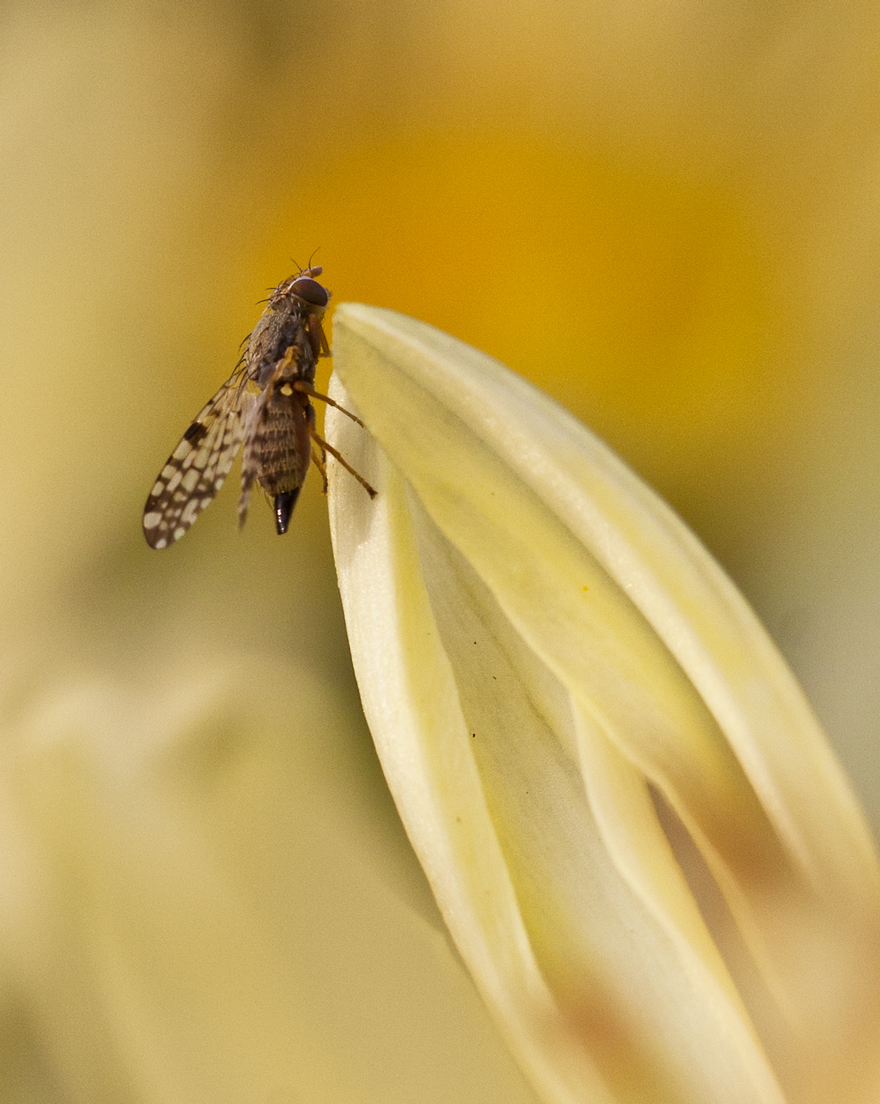
We had a few warm days this past weekend and there were a lot more insects around the still-flowering plants than there had been the week before. I focused a lot of my attention on some white flowers, where bees were active (I may post some bee photos later), but my eyes were especially drawn to a tiny fly with red eyes, clear and black patterned wings and a shaggy-looking body. Despite his diminutive stature, I managed to get a pretty clear shot of him. If you click on the photo, you can even see the hairs on his head. I searched the internet and couldn’t seem to find and identification of my little fly. His wings look a little like a scorpion fly, but the tail is all wrong.

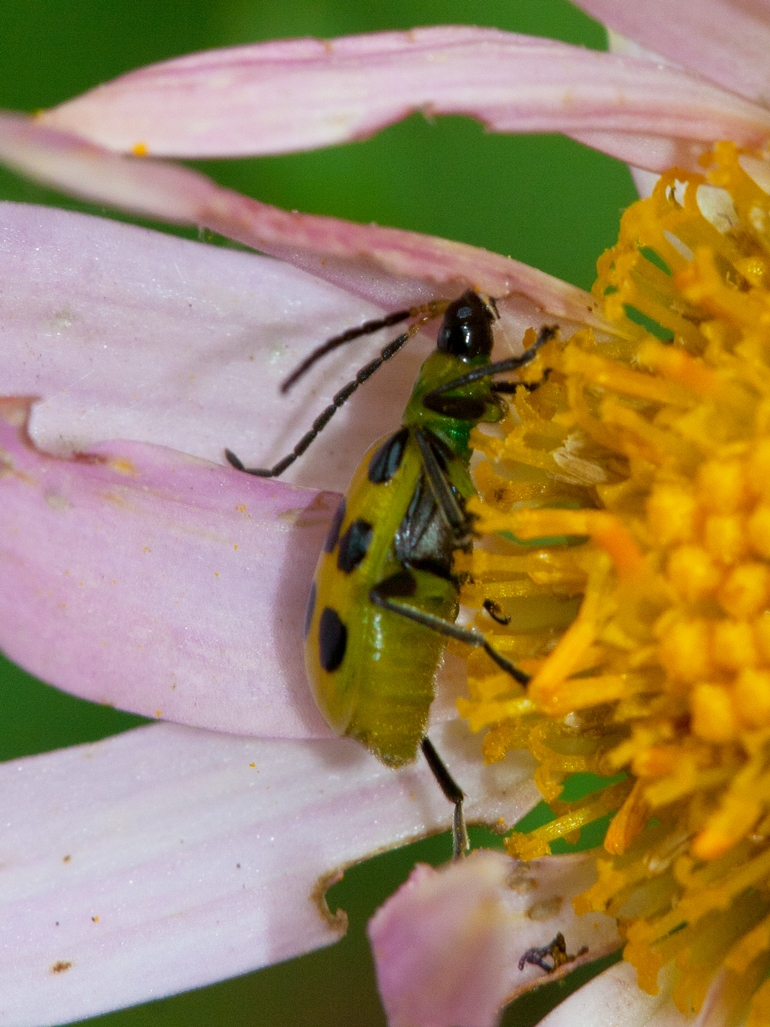
The other photo is a spotted cucumber beetle (Diabrotica undecimpunctata), a photogenic insect whose photo I’ve posted several times already. I especially like the pose of the beetle as he is climbing up the flower. The photo also gives you an idea of the size differential between this beetle and the tiny fly.

Tiny fly on a white flower

Ain’t no mountain high enough…

© Michael Q. Powell. All rights reserved.

Read Full Post »

After a frosty start, today was the warmest it’s been in a while, partly sunny with highs above 60 degrees F (about 16 degrees C). As the sun was starting to set, I decided to be a little creative and see if I could highlight a single leaf with the colorful sky in the background. I found a suitable tree without too much problem, but finding a leaf at the right height with an unobstructed background was a little tricky. I happened to have my 100mm macro lens on the camera and decided to go with that. I knew that I would need to use a little flash on the leaf to keep it from getting lost in the shadows. I used settings of ISO 100, F32, and 8/10 sec to get the effect and tweaked the image slightly in Photoshop Elements, though I chose not to crop at all. Here’s a couple of shots of my experiment. (In case you are curious, the leaf is still attached to the tree, even though it looks like I am merely holding it in from of the lens.)

© Michael Q. Powell. All rights reserved.

Read Full Post »

Last weekend, I took some shots of Multicolored Asian Lady Beetles (Harmonia axyridia) in the larval and pupal stage and discussed the phases of ladybug development in a post called Baby Ladybugs. Yesterday, I returned  to see if I could find any fully developed ladybugs that had been in pupae the last time I encountered them. (Yes, I realize I would not be able to recognize them individually, but it’s nice to imagine that we’re gradually getting to know each other.)

So, what happened? I left the shoot thinking that I had not seen any adult ladybugs, but when I looked at some of the photos on my computer of different pupae, I was uncertain. Right outside of an empty pupa shell in one of the photos is something that looks like an adult ladybug, if I squint my eyes, tilt my head, and use a little imagination. What do you think?
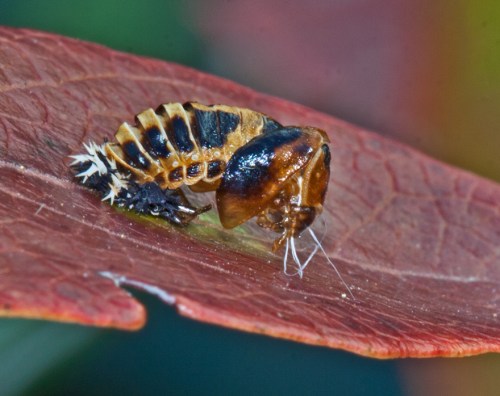
Newly emerged ladybug?

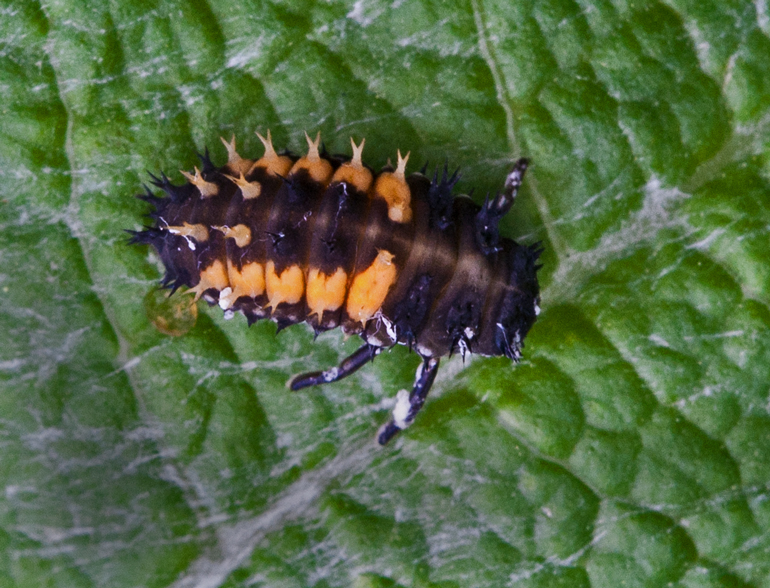
If you haven’t been following this story, let me catch you up with a couple of photos. (I feel like I’m doing an intro for a new television series, Lifestyles of the Ladybug.Ladybugs start out as eggs and them become larvae. As they grow, they molt several times and each time they develop a new exoskeleton. Yesterday, I saw quite a few discarded skins that, at first glance, looked a lot like the larvae themselves. Here is what a ladybug larva looks like in a later phase of development. (I took some new shots of the larvae and pupae yesterday.) They are not as cute in this stage as they will become as adult ladybugs.

Ladybug larva

Once they are fully grown, the larvae enter into a pupal stage, somewhat akin to the cocoons into which caterpillars develop into butterflies. The pupae look a little bit like ladybugs themselves and are attached to leaves. While they are in this phase, the metamorphosis takes place in which they turn into ladybugs. Here is my favorite shots of a ladybug pupa.
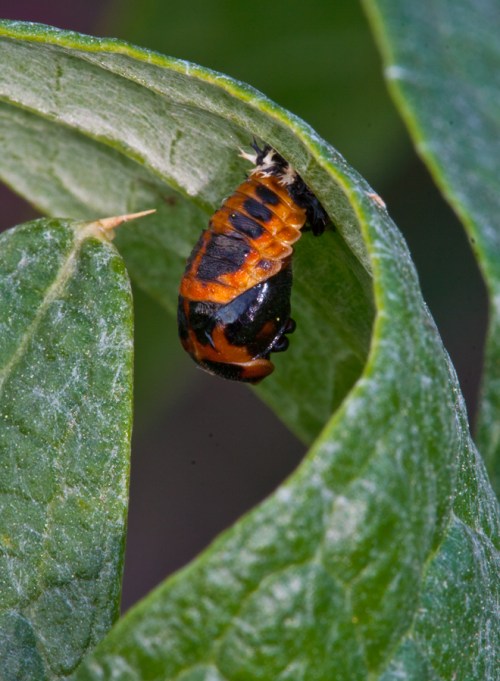
Ladybug pupa

After about five days, a ladybug emerges from the pupa. According to ladybug-life-cycle.com, “When the metamorphosis is complete, the skin of the larvae will split open and the full grown ladybug will emerge, but it still won’t look like the ladybug that you know so well. It will look soft and pink or very pale for a couple of hours until its shell becomes hard.”

Was I really lucky enough to catch the ladybug just after it had emerged from the pupa? My response is a firm, “Maybe,” but others with more experience may be able to respond more definitively. Here is one last photo of the possible new ladybug, from a slightly different angle than the first photo, to help your deliberations.
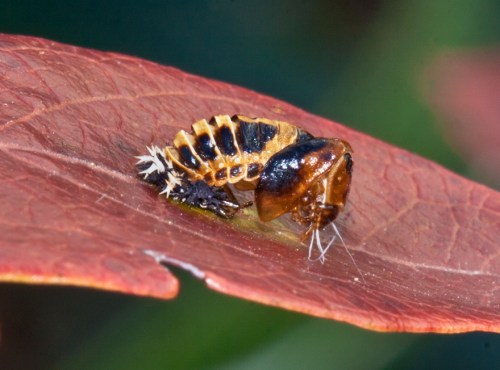
Welcome to this world

© Michael Q. Powell. All rights reserved.

Read Full Post »
Sometimes my eye is drawn to the shapes and colors and textures of objects more than to the objects themselves. The result can be a somewhat abstract looking photo, which is very different from what I usually shot. Here are couple of photos of that ilk from a trip last week to a local garden.

The first was taken looking through a ground-level weathered weathervane and the framing of the shot is just as it came out of the camera. I like the contrast between the light and the shadows and between the rust and the blurry natural colors in the background.

The second is a shot of a feathery looking yellow plant in which I narrowed the depth of field to isolated a few of the yellow needles and the reddish branch. I like the variations of color in the photo and the blurry repetitions of the foreground shapes and colors that can be found in the background.

Weathered weathervane

Abstract yellow

© Michael Q. Powell. All rights reserved.

Read Full Post »

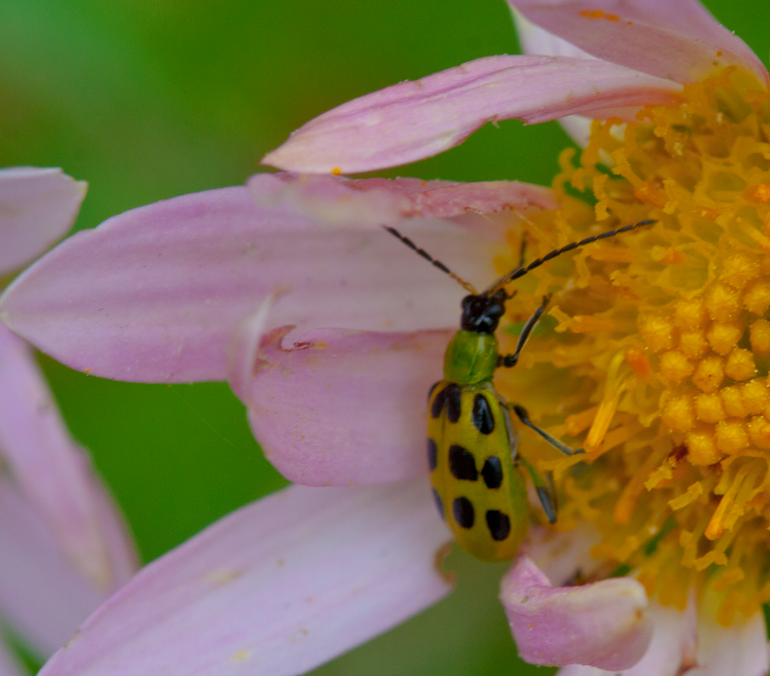
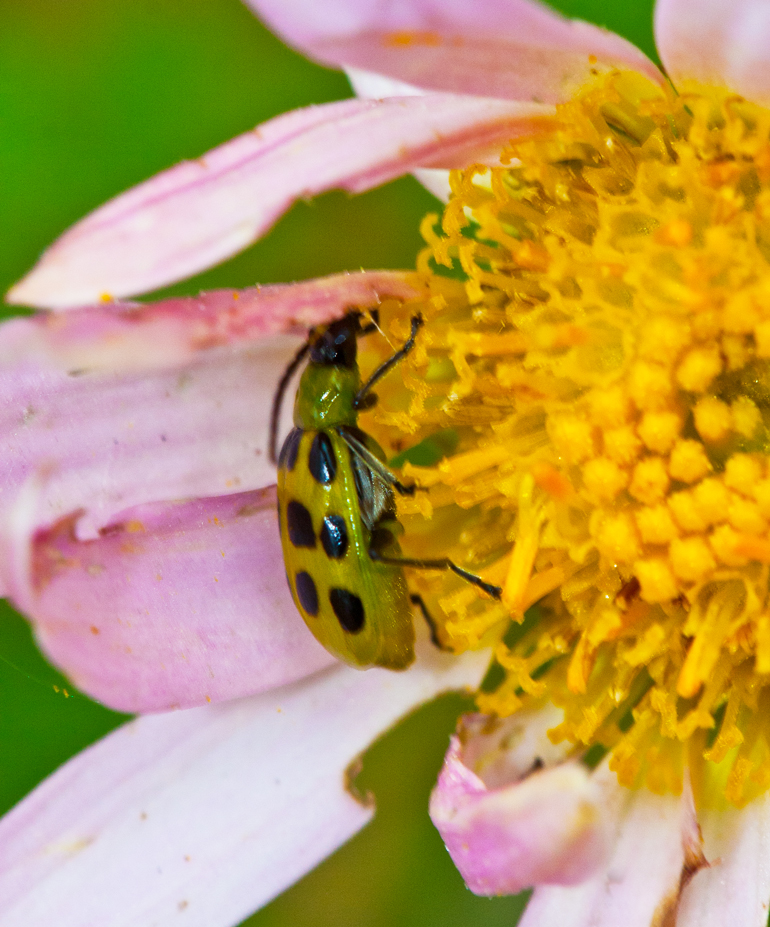
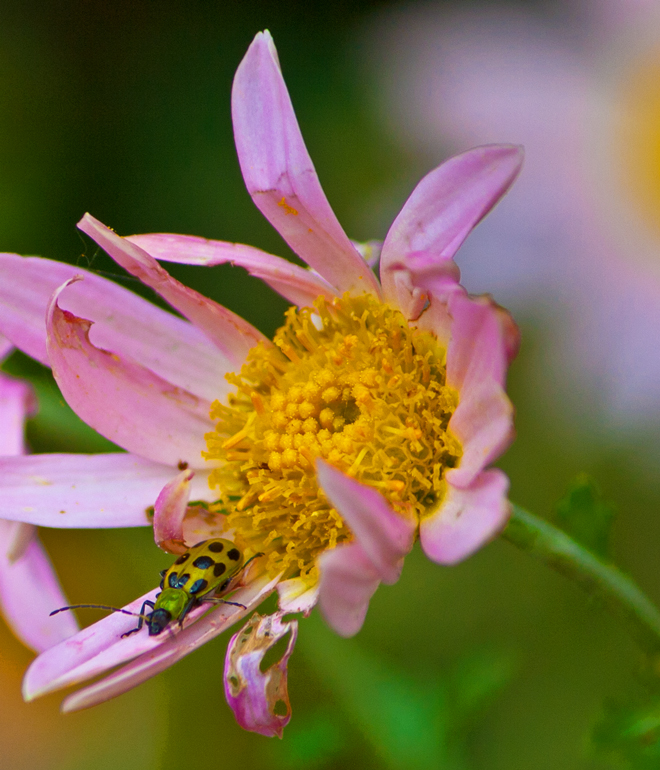
It seems that as long as plants are blooming, some insects, especially those considered to be pests, will continue to be active. This past weekend as I was looking at flowers at a local garden, I spotted a familiar insect, the Spotted Cucumber beetle (Diabrotica undecimpunctata). I consider this beetle to be attractive, with his different shades of green and multiple black spots, but recognize that it causes a lot of destruction (and you can see some of the petals of the flower that it has chewed through).

Several cucumber beetles were on the flowers and I was able to get some pretty good shots with my 100mm macro lens, a lens that has fallen into disuse as I have focused more of my attention on birds. The photos show the beetles in several different “poses”—I especially like the first one that seems to have caught the beetle as he is chewing on the flower. You may want to click on the photos to see higher resolution views.

© Michael Q. Powell. All rights reserved.

Read Full Post »

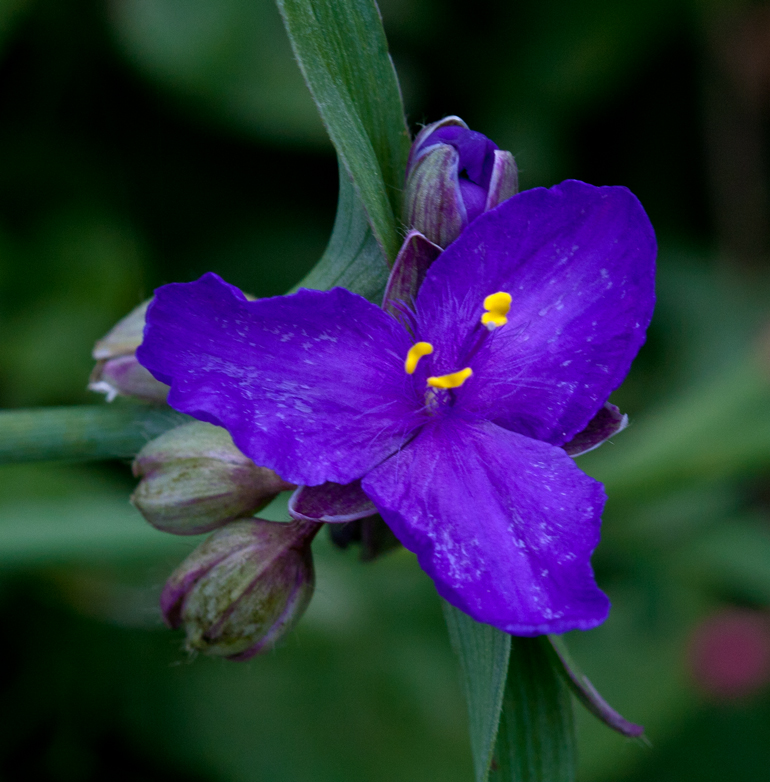
During a walk this past weekend through a local garden, I was surprised at how many flowers were still blooming (or were newly blooming). Here is a somewhat random assortment of photos of those flowers, some of which I can identify such as a zinnia and a pansy, but others are nameless beauties to me.

© Michael Q. Powell. All rights reserved.

Read Full Post »

I know that ladybugs don’t really have babies, but, seriously, how many people will read a posting with words like “larva” and “pupa” in the title? A more accurate title would be something like “Larva and Pupa of the Multicolored Asian Lady Beetle (Harmonia axyridis).”

This past weekend I was wandering through a local garden when I spotted a strange-looking little yellow and black insect. Upon closer investigation, I discovered several more of them on the plant, along with some orange and black objects that I thought might be insects too, but they were not moving. This was a good excuse to take out my macro lens and to follow the old adage about shooting first and asking questions later.

After a bit of research, I realized that I had captured two different phases in the life cycles of a ladybug. Lady-bugs.org and ladybug-life-cycle.com offer additional details on the stages of development of a ladybug, but allow me to summarize for folks like me who don’t follow insects for a living. The ladybug’s life cycle is about four to six weeks long, with four stages (egg, larva, pupa, and adult). During the larval stage, the ladybug larvae shed their exoskeletons three times before the pupation stage begins. It is during the pupa stage that the metamorphosis takes place that is almost as magical as it is for butterflies and the insect that I photographed turns into a full grown ladybug.

Thanks to bugguide, I was able to identify my bug as the Multicolored Asian Lady Beetle (Harmonia axyridis). The article notes that the larvae look like tiny alligators and grow to be larger in size than the eventual ladybug. It describes the pupa as “an elongated dome shape, usually found attached to a leaf, with the spiky remains of the last larval skin usually clinging to one end. The branched spines of this skin are usually visible.”

It was fascinating to discover the details of what I had photographed—metamorphosis never ceases to amaze me. Here are a couple of my favorite shots of the ladybug larvae and several of different pupa. Be sure to click on them to see more details.

© Michael Q. Powell. All rights reserved.

Read Full Post »

« Newer Posts - Older Posts »