Feeds:
Posts
Comments

Posts Tagged ‘Canon 100mm macro lens’

As I was checking out the cattails that are growing like crazy at my local marsh, I spotted this little beetle chewing on the soft insides of a broken cattail.  I immediately recognized him as a Spotted Cucumber beetle (Diabrotica undecimpunctata), a species that I encountered numerous times last summer when photographing flowers.

I really like the texture of the immature cattail, both on the outside as well as on the inside, and the bold design of the beetle.  I think that those elements and the varied shades of green make for a cool, graphic image.

cucumber1_blog

Michael Q. Powell. All rights reserved

Read Full Post »

One of the first rules of photography that I learned was the importance of keeping a subject’s eye in focus and I managed to accomplish that with this bee that I photographed yesterday. However, the depth of field turned out to be so shallow that only a few other parts of the bee are as precisely focused as the eye.

I was hand-holding my macro lens, which is not image-stabilized, and the sky was overcast, so I had to open up the aperture and keep the shutter speed fairly high to get a decent shot (f/6.3, 1/100 sec, ISO400). The bee was moving all around a patch of lavender in a neighbor’s garden, gathering nectar with its tongue, which is visible in the photo.

I stalked the bee for quite a while and a lot of my shots turned out to be blurry, but I ended up with a few that were ok. This is my favorite of the bunch and I think that the shallow depth of field, which is a shortcoming in many situations, is the primary reason that I like it.

lavender1_blog

Michael Q. Powell. All rights reserved

Read Full Post »

Looking for spiders to photograph, I came across this one, which I think may be a Lattice Orbweaver spider (Araneus thaddeus). I tried a number of different techniques to get a shot of this little spider and think that this may be one of the ones on which I used my pop-up flash.

I especially like the way in which part of the web is visible against the dark background and the way the light seems to be shining through the jelly-like front part of the spider’s body.

spider_drops_blog

Michael Q. Powell. All rights reserved

Read Full Post »

As we move through spring, I am finally starting to see more hover flies and bees, busily at work collecting food and pollinating the flowers.

The insect in the first photo is, I believe, an American Hover Fly (Eupeodes americanus). A year ago, I would almost certainly have called it a bee, but I have learned a lot about insects since then, thanks to my photography.

The second photo feature a beautiful variegated flower and what looks to be a honey bee, though it’s a little difficult to make a positive identification, because of the angle.

It’s early in the season, so I am having to recall some lessons from last year, like the need to pay attention to my distance. In my desire to get closer, I have already managed a few times to bump the flower and scare off the bee, forgetting that the lens hood on my macro lens is pretty big.

hover1_blogbee1_blog

Michael Q. Powell. All rights reserved

Read Full Post »

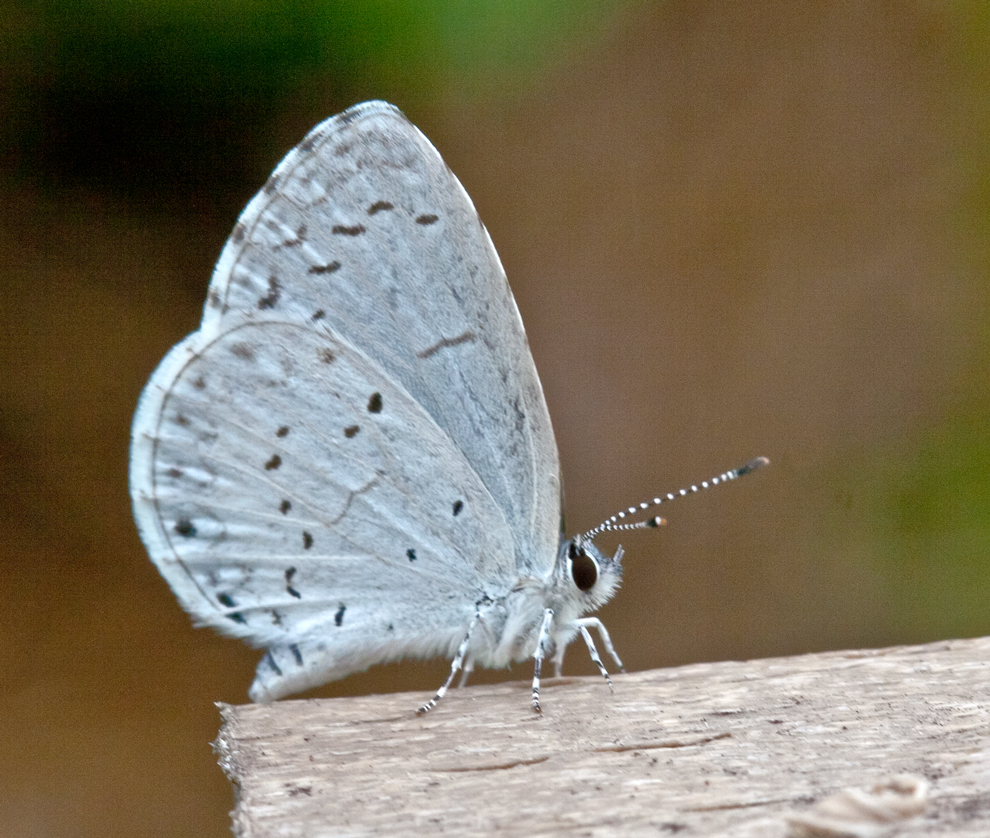
This past weekend I chased around this little butterfly—which I think may be a Summer Azure butterfly (Celastrina neglecta)—for quite some time until it finally landed.

This butterfly was really tiny, with a wing span of only about an inch (2.5 cm), so it was hard to get close enough to get a decent shot without spooking it. It took flight a couple of times, but landed nearby so I could continue the hunt.

It is always fun to photography the larger, more colorful butterflies like the Eastern Swallowtail or the Monarch, but I find that these little butterflies have a simple beautiful of their own.

little_white1_blog

Michael Q. Powell. All rights reserved

Read Full Post »

As I was going over my images from the last few weeks, I came across this image of a daddy longlegs (also known as a harvestman) that I really like, in part because of the way that the photo shows its eyes.

Previously I posted  what I had characterized as an artistic shot of this arachnid that showed mostly its bottom side. In this shot, the harvestman had turned toward the camera and the eyes, which grow on a stalk in the middle of its back are visible.

They are a huge contrast with the eyes of a jumping spider that I featured recently in a posting, which had multiple sets of large eyes.  

daddy2_blog

Michael Q. Powell. All rights reserved

Read Full Post »

As I was searching for dragonflies and butterflies in the vegetation overlooking a small pond this past weekend, I spotted this little patch of yellow on the leaf of a small tree, which turned out to be a tiny tree frog.

The frog appears to still be in a developmental stage, with indistinct feature and a substantial amount of the tail that it had as a tadpole. The frog was yellowish in color and it is a little tough for me to figure out what kind of a frog it is.

I should note that this it the first tree frog that I have ever seen and I was amazed at how small it was. It is not much bigger than some of the insects that I have been photographing, but it is definitely a whole lot cuter.

little_frog1_bloglittle_frog2_blog

Michael Q. Powell. All rights reserved

Read Full Post »

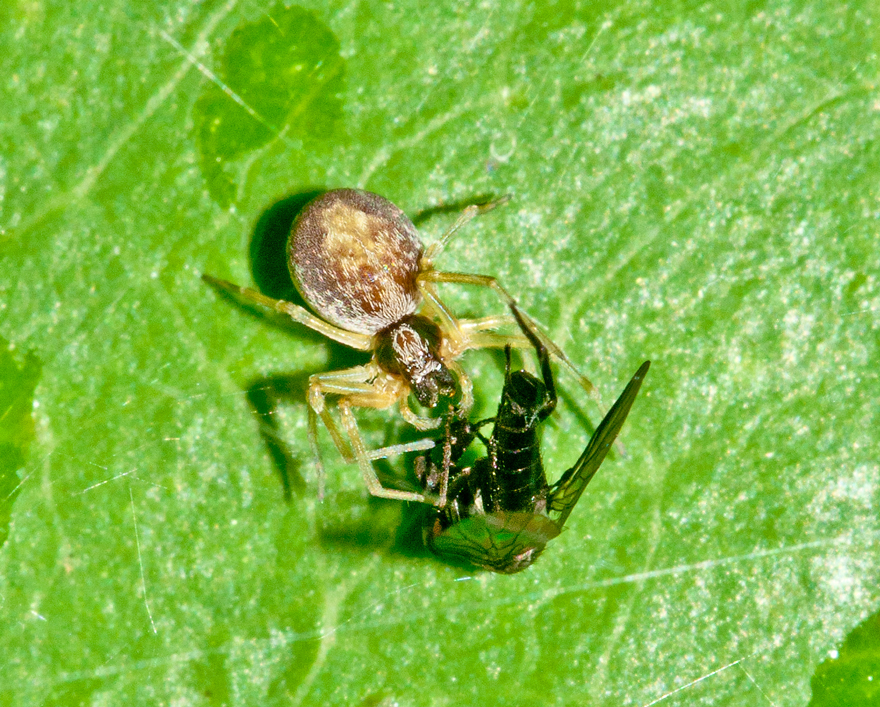
This past weekend I was off in search of spiders again and came across this little spider perched on a leaf, munching on a flying insect.

The lighting was poor, so I used the pop-up flash on my camera to provide a little extra light. Generally I don’t like it if the flash causes a shadow, but in this case it seems to add a somewhat more menacing and sinister look to the spider.

I am still trying to identify the spider and would welcome assistance. The patterns on its body, and especially the front section, are particularly cool and should assist me in finally being able to identify it.

spider_fly_blog

Michael Q. Powell. All rights reserved

Read Full Post »

One of my neighbors, fellow blogger Cindy Dyer, now has lavender blooming in her garden. It smells wonderful and this Cabbage White butterfly (Pieris rapae) seemed to be really enjoying it earlier this afternoon.

cabbage1_blog

Michael Q. Powell. All rights reserved

Read Full Post »

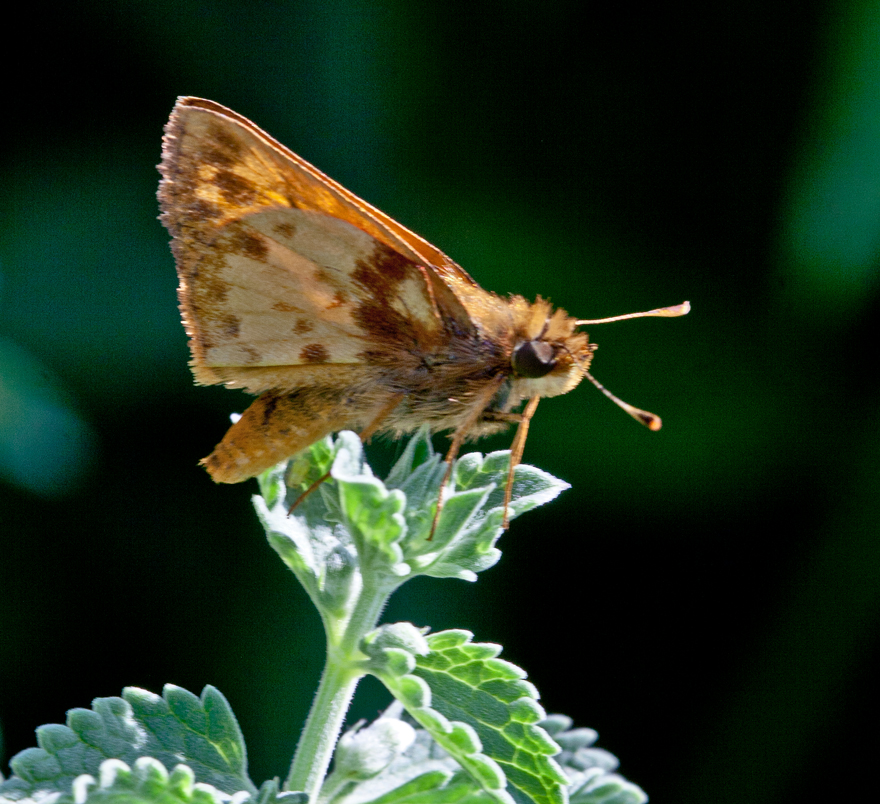
I have trouble identifying a lot of my photographic subjects, but skipper butterflies are among the toughest. Wikipedia says that are more than 3500 recognized species of skippers worldwide, so I don’t feel too bad about my difficulties.

As I perused photos on the internet, I came across a few shot of butterflies that looked at lot like the one that I photographed, and on that basis I am going to tentatively identify it as a Fiery Skipper (Hylephila phyleus).

I like the way in which the skipper was lit and he stayed perched long enough to permit to use my macro lens.

skipper_blog

Michael Q. Powell. All rights reserved

Read Full Post »

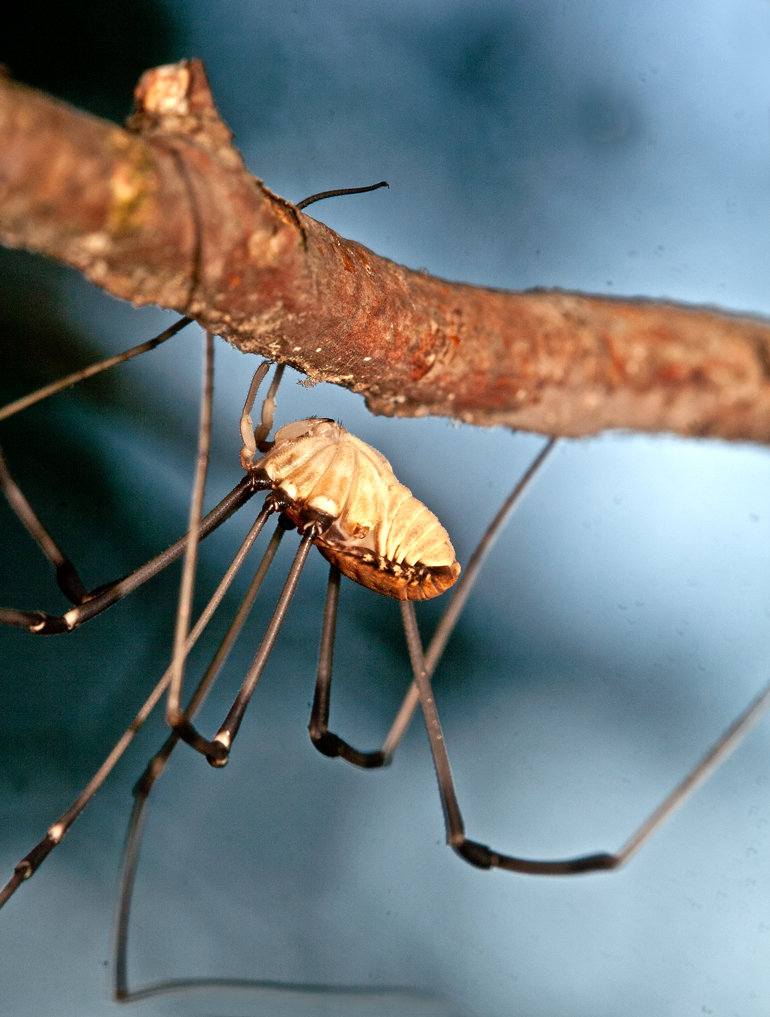
Can a photo of a daddy longlegs (also known as a harvestman) be artistic?

Ordinarily, I would emphatically respond in the negative, but somehow this macro shot that I took of a daddy longlegs, suspended upside down from a branch, came out with a cool, creative vibe to it. I like the way the legs are placed, the way the light is hitting its body, and the way the branch is in focus only in the center area.

I ran across this daddy longlegs as I was walking through the woods and I took the time to set up my tripod and use my 100mm macro lens to get this shot. The daddy longlegs was amazingly tolerant of my efforts and remained in place the whole time, even when I experimented with the use of my pop-up flash.

daddy1a_blog

Michael Q. Powell. All rights reserved

Read Full Post »

With thousands of gorgeous flowers blooming at Brookside Gardens in Wheaton, Maryland today, this beautiful butterfly, which I think is a Variegated Fritillary (Euptoieta claudia), chose to land on a lowly dandelion growing at the edge of a walkway. Why did it make that choice?

I had been chasing this butterfly around though several sections of the garden, hoping desperately that it would land somewhere within range of my 100mm macro lens. When it did finally land, I approached it cautiously and got a few shots handheld that came out pretty well. I am also including a shot that gives you an idea of the setting—there was a landscape timber to the left and a series of stone tiles that made up the walkway, and the dandelion was growing low to the ground at the edge of the walkway. The lighting was less than optimal, but sometimes you have to work with what you have, especially when the subject is likely to fly away at any moment.

I deliberated for quite some time over the identification of the butterfly. At first, I was sure that it was a Pearl Crescent (Phyciodes tharos), which is orange and has brown spots. As I looked at more photos, though, I changed my mind and now think that it may be a Variegated Fritillary.

As always, I welcome assistance on the identification of my subjects.

pearl2_blogpearl1_blogpearl3_blogMichael Q. Powell. All rights reserved

Read Full Post »

Temperatures were forecast to soar yesterday, so I arrived early at the marsh—about 6 o’clock— and was treated to many stunning examples of spider art. The early morning light and the dew made it possible to get these shots.

I had thought that it was a bit early in the season for spiders to be active, but I was thrilled to be proven wrong. I never fail to be impressed by the handiwork of the different kinds of spiders and how they are able to adapt their webs to the environment.

I shot some webs with my macro lens and others with a telephoto zoom. In virtually all cases, I focused manually and used my tripod.

Only a few of the webs had visible spiders and I chose to highlight one of those in the first image, which is a close-up of the web shown in the final shot. The webs themselves are not perfect and have gaps and breaks in some places, an appropriate metaphor for the lives that most of us live.

web3_blogweb1_blogweb4_blogweb2_blog

Michael Q. Powell. All rights reserved

Read Full Post »

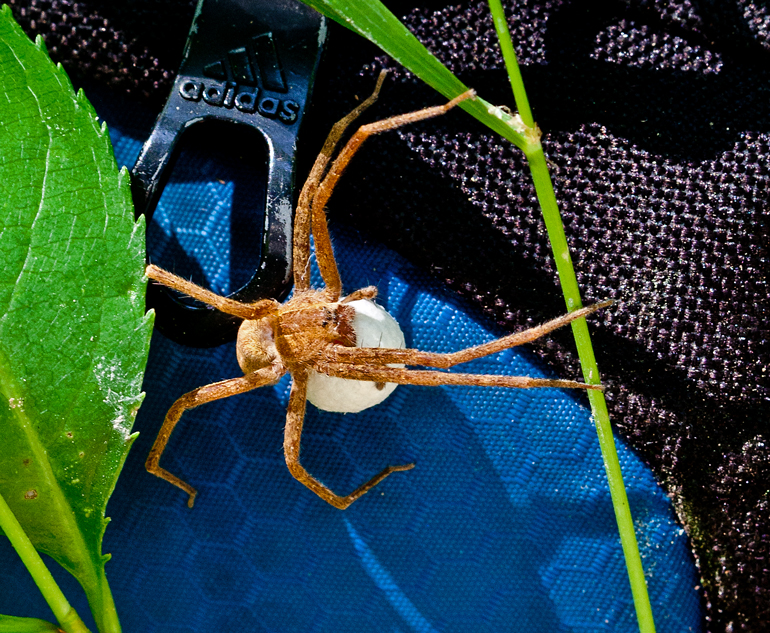
As I was reaching for my camera bag after taking a photo of a spider, I was surprised to see an unexpected visitor—a much larger spider with what looks like an egg sack.

I was in a wooded area and had placed my bag on the ground while I set up my tripod to take a photo of a small spider (shown in the second photo).  After getting the shots, I returned to my bag. I bent down to open the zipper of the bag and suddenly was eye-to-eye with the spider. The spider seemed really large at that moment, although retrospectively it does not seem that big when I compare it with the Adidas logo on the zipper pull. When I tried to adjust the bag’s position, the spider moved away, but fortunately I had the foresight to take some photos before attempting to improve the lighting situation.

I am not sure of the identification of either of these spiders, but find them both to be pretty cool in their own ways. I’d welcome some more information from more knowledgeable readers about the white ball and, in particular, if it is an egg sack.

UPDATE: I have done a little research and think that the spider in the first shot may be a Nursery Web Spider (Psaurina mira), a spider that is known for carrying its egg sack with its fangs. Some other spiders attach the egg sack to their spinnerets.

egg1_blogspider2_green_blog

Michael Q. Powell. All rights reserved

Read Full Post »

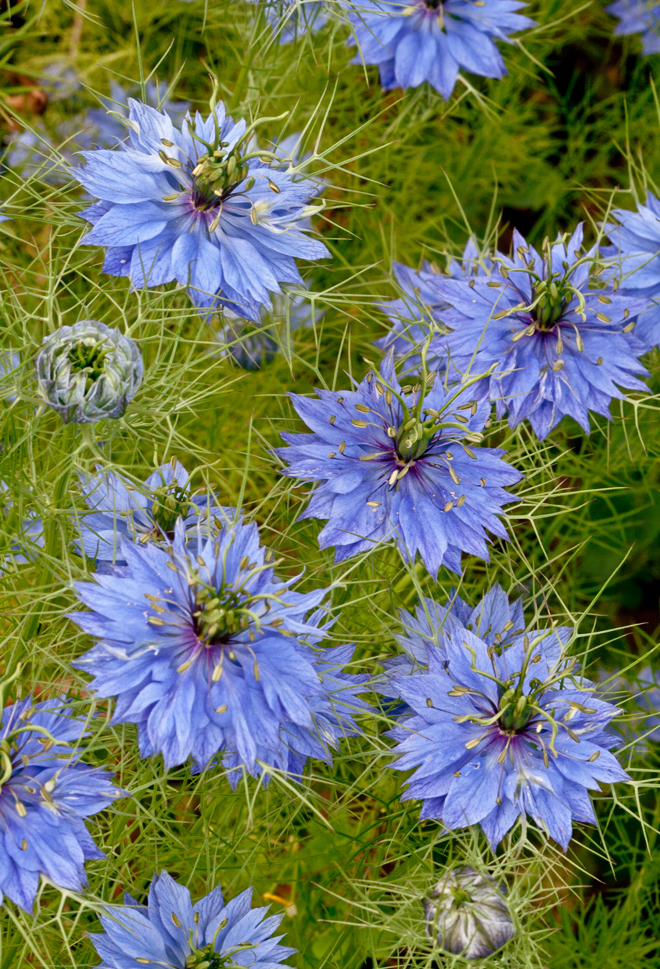
This cluster of Love-in-a-mist (Nigella damascena), one of my favorite flowers, was so striking that I decided to try to capture the grouping, even though usually when I take photos of flowers, I focus on a single blossom.

Framing the shot was a challenge, as I struggled to find a plane and camera settings that would keep most of the flowers in focus. I’m pretty happy with the result and I did only a slight amount of cropping to get this final image.

I grew up in the era of what is known now as classic rock-and-roll and it seemed natural to borrow the title of a Led Zeppelin song for this posting. I can’t say that I remember too many of the lyrics, excepted the chorus of repeated “Wanna whole lotta love,” but some of the guitar playing was really memorable.

lofoflove_blog

Click on the photo for a higher resolution view.

Michael Q. Powell. All rights reserved

Read Full Post »

Like Paul Revere’s call in 1775, the cry went out in early May, “The cicadas are coming, the cicadas are coming.” After 17 years in the ground, the cicadas of Brood II  (Magicicada septendecim) were coming back in force. The Washington Post ran a story with the sensationalist headline of Bug-phobic dread the looming swarm of Brood II cicadas” and hysteric anticipation gripped the metro D.C. area.

Like most of the snowstorms forecast in this area, the invasion of the cicadas has been underwhelming. I had not seen a single cicada until I traveled to Manssas, VA for a cookout and the got to see and hear a large number of these scarey-looking insects. Apparently we are past the peak moments, but the noise in some places was just short of deafening and there were some bushes that were covered with the giant insects.

I was struck by the contrast between the fierce look of this cicada and the delicate beauty of the purple iris on which he was perched.

beast1_blog

Michael Q. Powell. All rights reserved

Read Full Post »

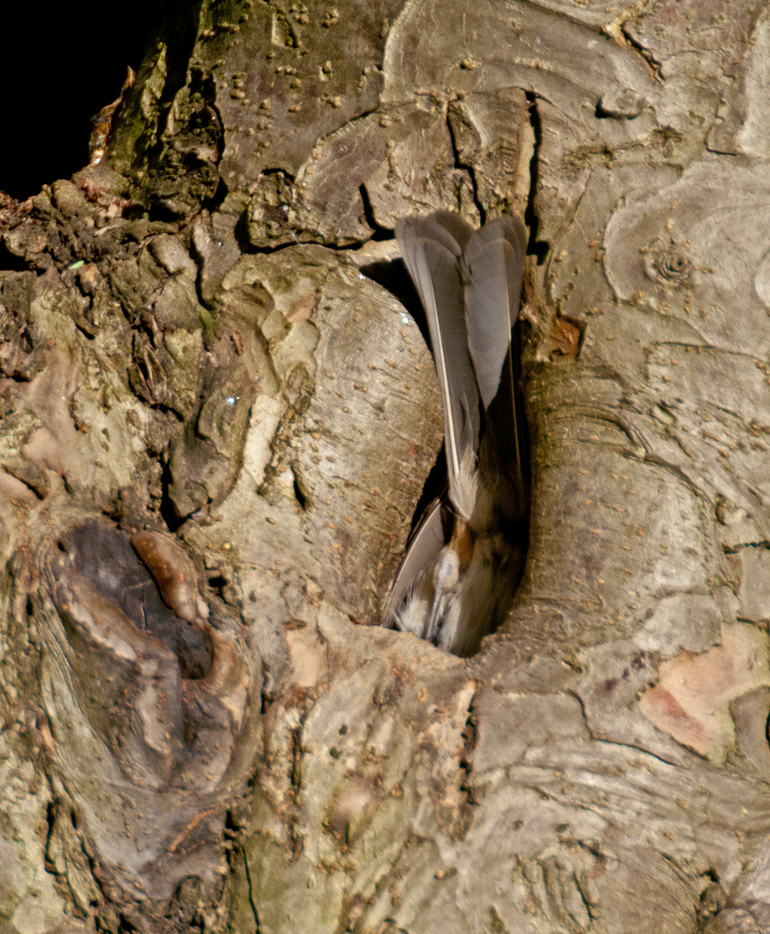
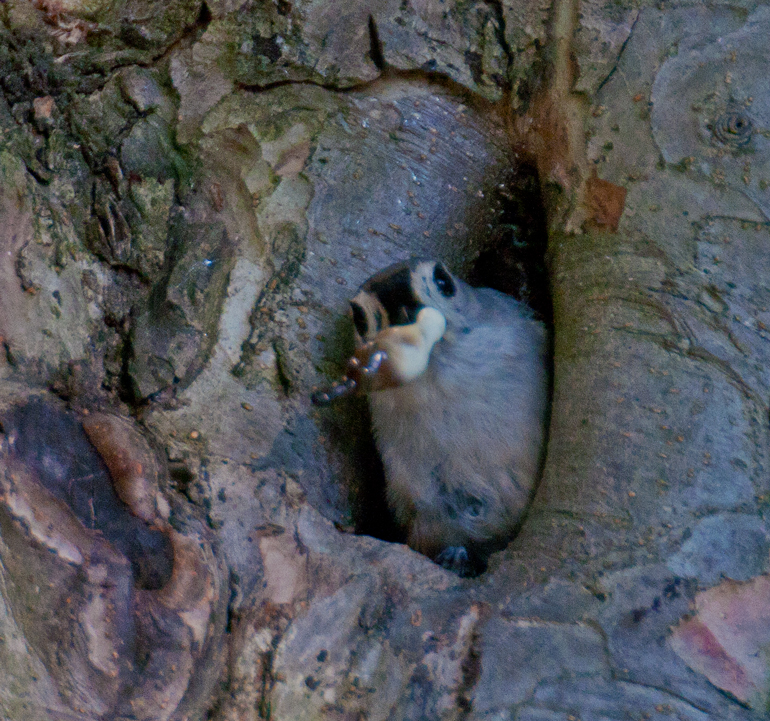
As I stalked the nest of the rescued baby bird featured in a posting last week, hoping to catch sight of its parents, I took this shot. Can you identify the bird from this photo of it entering the nesting cavity?

mom7_blog

Let me back off a little and explain. The nest in question is inside of a crabapple tree in the front yard of a neighbor’s house, about a yard or so (one meter) above the ground. There are two openings and you can sometimes see the baby birds’ heads pop up through the lower opening, which serves as a window. I learned that the upper opening serves as an entry door for the parents. This is one of my initial shots with my 100mm macro lens of the tree, with one of the parents entering the “door.”

mom9_blog

I came back at a later time with my 135-400mm lens and set up my tripod on the sidewalk and waited. It was mid-afternoon and the sun was shining almost directly into the opening, which complicated the exposure, but my patience was rewarded when the parents made multiple trips into the nest. This is another shot of one of them entering the nest, which you can see is a pretty tight squeeze.

mom5_blog

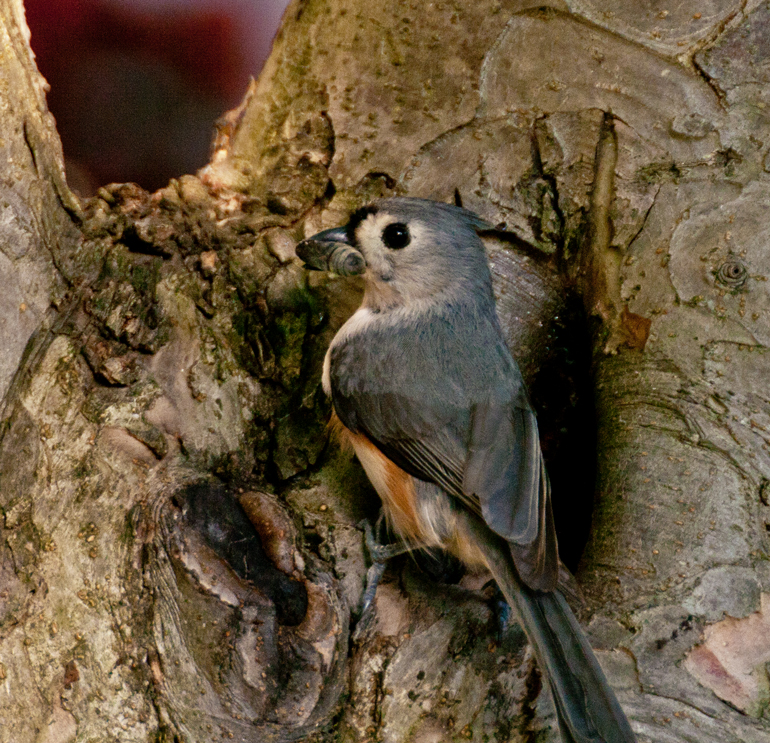
I am not that great at making bird identifications from the rear, so my job was greatly facilitated when one of the birds paused and turned to the side prior to entering the nest. The mystery birds are Tufted Titmice (Baeolophus bicolor). I can’t quite figure out what the little bird has in its bill, but assume that it is something edible. Can anyone else tell what it is?

mom1-BLOG

Timing was tricky as I tried to maintain my focus and the sidewalk was not all that comfortable. (I should bring a cushion next time.) Sometimes the parents would signal their imminent arrival with a call, but sometimes they would fly in out of nowhere. I attempted to capture the birds flying in and then flying out of the nest. Here is one of the few shots I was able to get of one of the parents preparing to leave the nesting cavity.

mom2_blog

Sometimes when processing my photos, I come across one that I really like, even though it has all kinds of technical problems. I decided to end this posting with such a photo. The bird has already flown out of focus, but is clearly visible and is casting a cool shadow just below the entry into the nest.

mom6_blog

Michael Q. Powell. All rights reserved

Read Full Post »

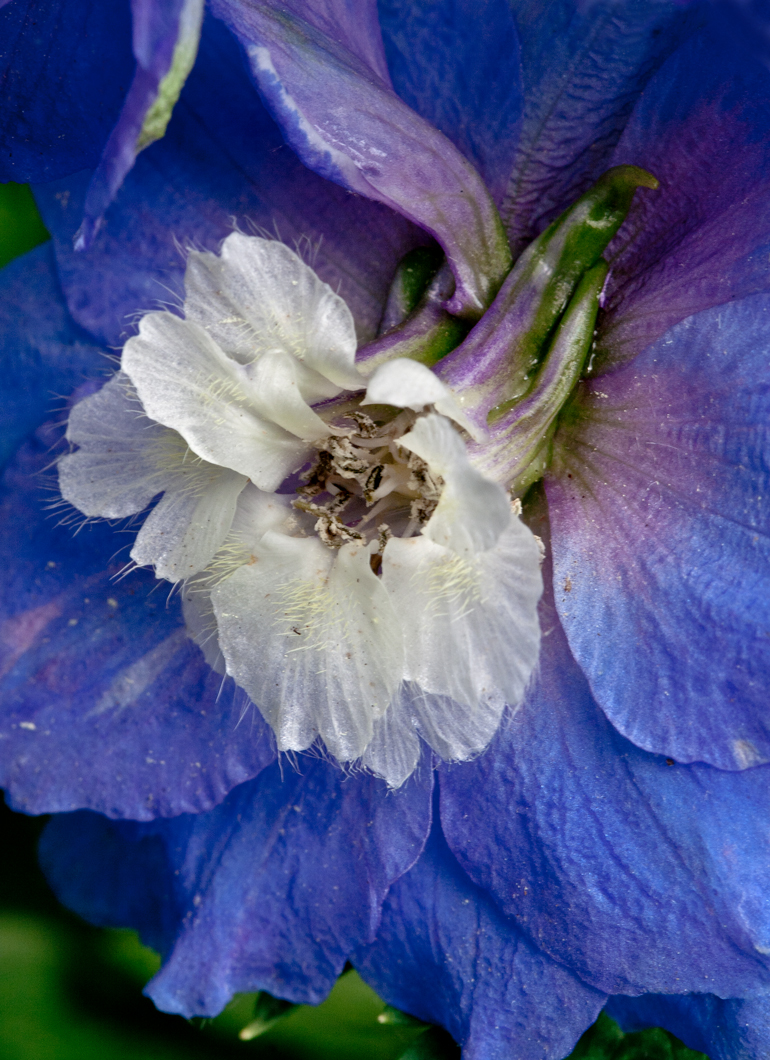
Whenever my neighbor has new flowers popping up in her garden, she invariably invites me to come and photograph them, and this close-up shot of a blue delphinium is my newest capture.

The neighbor in question is Cindy Dyer, a noted flower photographer and fellow blogger, and I thinks she almost always chooses photogenic flower species to plant. Check out her blog to see some gorgeous shots of all kinds of flowers. (She also is the one who got me started shooting regularly and has been an endless source of inspiration and encouragement for my photography.)

I love the beautiful color of this flower, which is pretty small, and the different textures that you can see in this shot.

delphinium_closeup_blog

Michael Q. Powell. All rights reserved

Read Full Post »

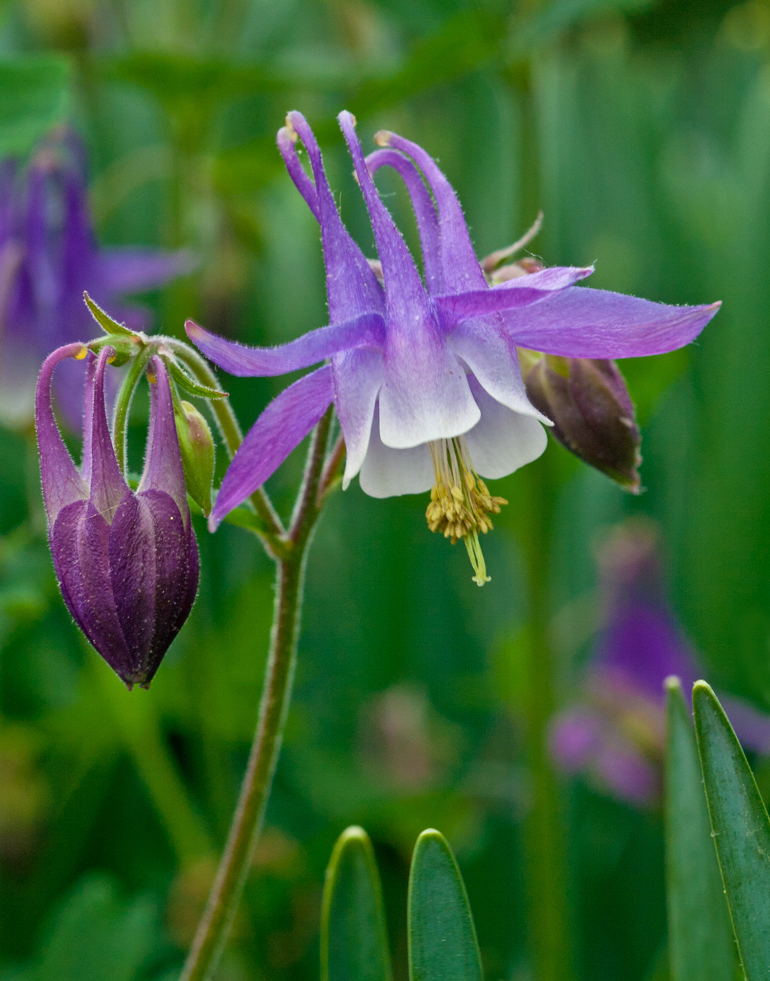
There are a lot of columbines blooming now at a local garden and I can’t keep from photographing them every time that I am there.

I especially like this shot because it shows blooms at various stages of development on the same stem. It’s fascinating for me to be able to see how the shape and color of the flower change as the blooms mature.

purple_blog

Michael Q. Powell. All rights reserved

Read Full Post »

What do you do when you find a baby bird on the ground? That was the dilemma I faced a couple of nights ago, when I found this tiny baby bird on the lawn of a neighbor’s townhouse.

Earlier in the week another neighbor had alerted me that there were baby birds in a tree a few doors down from my townhouse. I live in a suburban townhouse community and each of us has a postage-stamp size front lawn and a mandatory tree, mostly small crab apple trees. The baby birds were in a cavity of one such tree, a mere two feet (60 cm) above the ground and there seemed to be three or four babies.

When I returned home from work, I checked on the babies and suddenly heard a squawk. I looked down at my feet and saw one of the babies in the grass. There are all kinds of views about the advisability of putting baby birds back in a nest, but I was genuinely concerned that this tiny bird was in an incredibly vulnerable spot (among other things, we have some cats in the neighborhood).

A little fearful of doing it myself, I called my friend (and fellow blogger) Cindy Dyer, who was both willing and able to place the small bird back with its siblings in the cavity of the tree. Yesterday evening, I made a quick check of them and they seem to be ok.

I was mostly focused on dealing with the situation, but did manage to get a few quick shots of the little bird, which I can’t yet identify.

baby_bird1_blogbaby_bird3_blogbaby_bird2_blog

Michael Q. Powell. All rights reserved

Read Full Post »

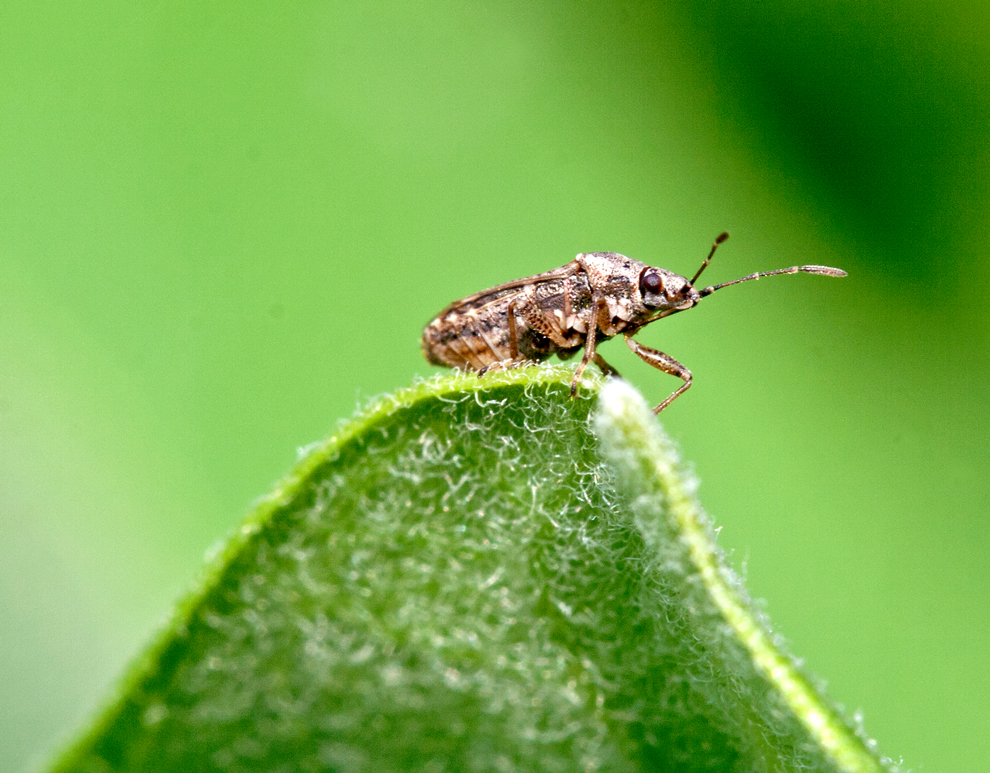
It took some time for this tiny insect to ascend to the top of this leaf, which may have looked like a mountain to him, and once there he seemed relax and pose for me, as though he was really proud of his accomplishment.

I don’t have any idea what kind of insect he is and would welcome any additional information (or even guesses) from fellow bloggers. To aid you in identification, I have loaded a higher resolution view that you can access by clicking on the photo.

littleinsect_1a_blog

Michael Q. Powell. All rights reserved

Read Full Post »

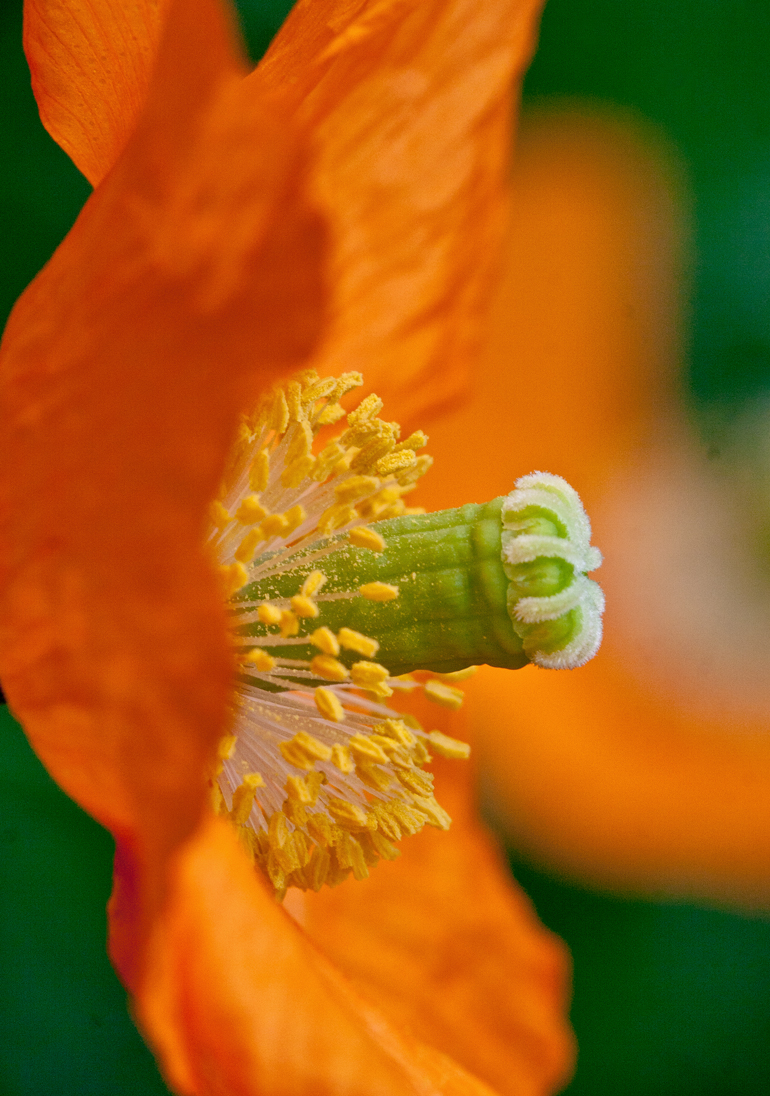
Vibrant colors surrounded me this past weekend, when I visited a local garden, and this morning I felt like highlighting the beautiful pink and yellow of a pair of peonies and the contrasting orange and green in a close-up shot of an orange poppy.

peonies_blog

orange_poppy_blog

Michael Q. Powell. All rights reserved

Read Full Post »

I don’t know much about the Clematis flower, but I found these purple ones to be amazingly beautiful this past weekend at Green Spring Gardens, a county-run horticultural center. I can’t decide if I like them better in a group, as in the first photo, or individually, as in the second photo.

clematis2_blogclematis1_blog

Michael Q. Powell. All rights reserved

Read Full Post »

This weekend I learned how difficult it is to get good shots of a tiny spider when it is in the middle of a cluster of plants and is surrounded by an untidy mess of web material, rather than a nice web.  Auto-focus was utterly useless and the camera refused to focus on the spider—it wanted to focus either on the plants in the background or on the web material. Manual focusing was required and it was tough to tell which parts of the spider were in focus at any given moment.

I used my tripod, which helped a little, and even used the pop-up flash to give me little extra light (you can see the shadows it caused in the second photo). I especially like the way that the colors in the images turned out, giving the photos kind of an out-of-this-world, sci-fi look.

The second shot is an action shot in which the spider has captured some kind of flying insect, which I can’t really identify. I didn’t have a great angle, but find the shot to be interesting.

As I shoot more insects and spiders, I am experimenting and finding out what works for me (and admiring even more the photographers who are able to get the amazing shots that I see on other blogs and elsewhere on the internet).

spider1_blog

spider2_blog

Michael Q. Powell. All rights reserved

Read Full Post »

Six-spotted Fishing Spiders (Dolomedes triton) are a particularly fascinating kind of spiders and I was really excited to see one yesterday at my local marsh.

Fishing spiders don’t build a web, but use the surface of the water in the same way that other spiders use a web. They extend some of their legs onto the surface of the water and when they feel the vibrations of a prey, they run across the surface of the water to snatch it. According to Wikipedia, the very sensitive hairs on their legs and feet help them to interpret the vibrations they sense and determine distance and direction. Their eyes play a secondary role in hunting, particularly because they do much of their hunting at night.

This spider was a couple of feet below the level of the boardwalk and several feet away and I was able to use my tripod to help steady the shot. In fact, the spider was cooperative enough that I made attempts with my 135-400mm zoom, my 55-250mm zoom, and my 100mm macro lens. Of the images that I am posting, the first image was shot with the longer zoom and the second with the macro lens. The macro lens let me hang over the edge of the boardwalk a little, which let me get a little closer, but made it tough to brace myself.

If you want to see a few more images of these interesting spiders, check out my previous postings Fishing spider waiting for prey and Fishing in the swamp.

fishing_spider1_blogfishing_spider2_blog

Michael Q. Powell. All rights reserved

Read Full Post »

As I was looking in my neighbors’ garden for flowers to photograph, I came across this cool-looking little spider, which I have not yet been able to identify.

The spider was really small, maybe a half-inch (a little over 1 cm) in size and didn’t sit still too much, so it was quite a challenge to photograph him. I really like his eyes and his hairy legs, which look almost like they are transparent.

One of the things that I especially like about spring is that insects reappear and give me photo opportunities like this one.

spider2_blogspider3_blog

Michael Q. Powell. All rights reserved

Read Full Post »

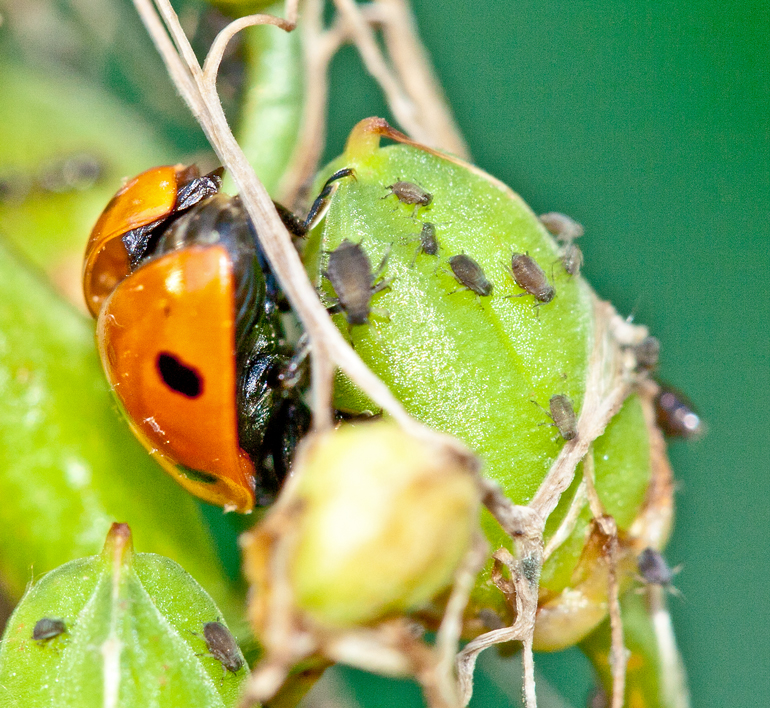
This ladybug was not in a very good position for me to get a shot, but I usually try to photograph every ladybug that I see, so I took the shot, totally oblivious to the fact that she was not the only bug in the frame.

Occasionally, when I am photographing a flower or an insect, there is an additional insect in the photo that I notice only when reviewing the  images, what my friend Cindy Dyer calls a “bonus bug.” How did I miss almost a dozen bugs in my viewfinder?

Can anyone identify the little bugs?

bugs_blog

Michael Q. Powell. All rights reserved

Read Full Post »

Looking at this plant from the side, all you notice are the tall, straw-like spikes that radiate from the center, but from above, it’s like looking into a kaleidoscope. I love the repetition of the colors and patterns in a wide circle around the center blossom.

I don’t have any idea what kind of flower this is, so I’ll make up my own name for it and call it the Kaleidoscope flower.

circle_blog

Michael Q. Powell. All rights reserved

Read Full Post »

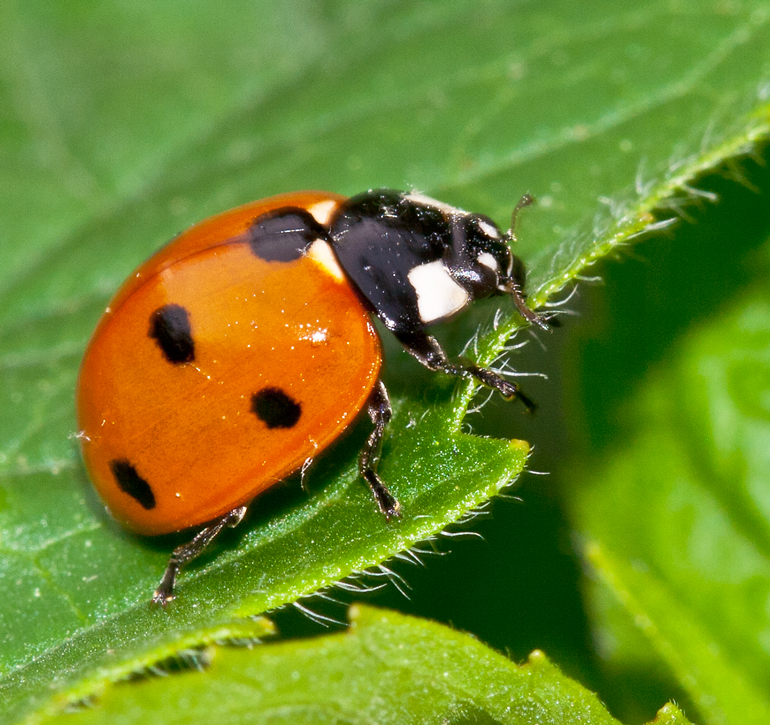
I really enjoy the challenge of trying to photograph insects and this ladybug was a relatively cooperative subject. She sat still for quite a while, which allowed me to experiment a little with techniques. The first show was taken after she started to move a little.

The light was fading a little, so I decided to see what would happen if I used my pop-up flash. It’s obvious to me that I risk having a hot spot, which is most visible in the second shot, but it seems that the additional light helped to bring out some additional details. I have seen the fancy setups advertised that use dual external flashes, but don’t think that I am ready to make that kind of financial commitment. Perhaps I will experiment with a cheaper, LED light or possibly a ring light and see how well they work.

ladybug2_blogladybug1_blog

Michael Q. Powell. All rights reserved

Read Full Post »

Do you prefer to take photos alone or with others?

Normally I prefer to shoot alone, to move at my own pace and shoot whatever catches my eye at a given moment. However, there are advantages to working side-by-side with another photographer. The other person can serve as a spotter and point out opportunities and subject that you might have otherwise missed. It’s also interesting and instructive after a shoot is done to compare images and see the same scene through another set of eyes.

Friday late in the afternoon, I noticed that my neighbor, friend, and photography mentor, Cindy Dyer, was out in her garden taking photos of her beautiful flowers. Cindy, a noted photographer, has been a constant influence on my photography this past year, encouraging me and inspiring me. She loves this time of the year, when nature explodes with color, and her blog is full of beautiful images of flowers of all varieties (and lots of other cool photos too).

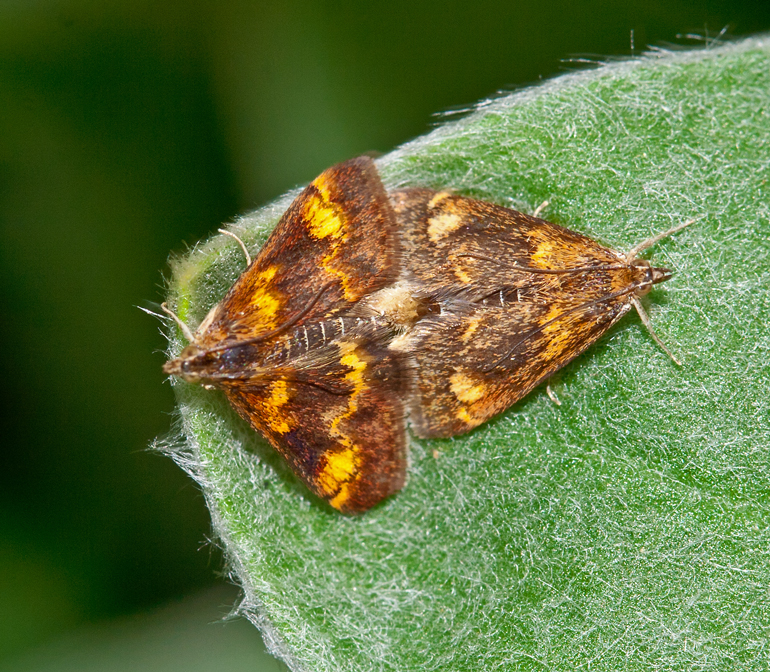
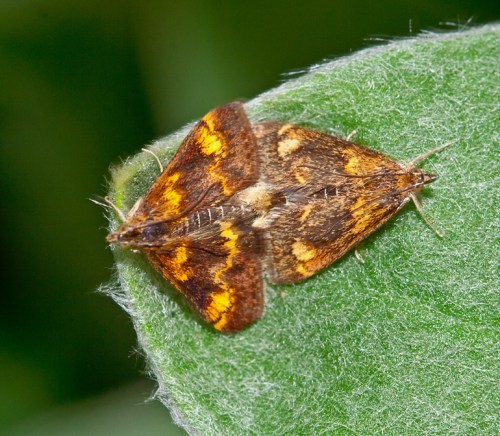
When I started shooting with Cindy, I was shooting a lot of flowers and a few insects, but gradually moved to shooting more insects than flowers. Somehow my eyes are attracted to insects. Shortly after joining Cindy in her garden with my camera and tripod, I spotted what I thought was an interesting looking insect. Upon closer examination, it turned out to be a pair of mating moths, that together were about one inch long (2.5 centimeters). They were positioned in such a way that the only way to capture them was to shoot from directly overhead. I had real problems with depth of field as I got my macro lens as close as it would let me get.

I challenged Cindy (in a friendly way) to photograph this couple and she took up the challenge and posted an image in her blog. It was an interesting challenge pitting Nikon against Canon and teacher against student as we explored the limits of our macro lenses and photography skills.

This little incident helped to remind me of the benefits of shooting with someone else, especially someone who gently pushes me forward. It usually works best for me when we travel somewhere and shoot side-by-side part of the time and wander on our own the rest of the time—the best of both worlds.
moths_mating_blog

Michael Q. Powell. All rights reserved

Read Full Post »

I have been taking photos of a lot of flowers in a lot of different places and thought I would post a few of my favorites.

The first one is of a plant called Lily of the Valley that was growing in the back yard of one of my neighbors. It was pretty small and close to the ground, so I have to create a makeshift bean bag to support my camera, using cushions for lawn furniture

I really don’t know what the second flower is called, but I really liked the shape of its petals and the slight pinkish-purple tinge of color .

The final shot is a small plant that was growing in the rock garden of a county-run historical garden that I love to visit. From a distance, the flower looked like it was in the shape of a cube.

lily_blogflake_blogsquare_blog

Michael Q. Powell. All rights reserved

Read Full Post »

« Newer Posts - Older Posts »