Feeds:
Posts
Comments

Posts Tagged ‘birds in flight’

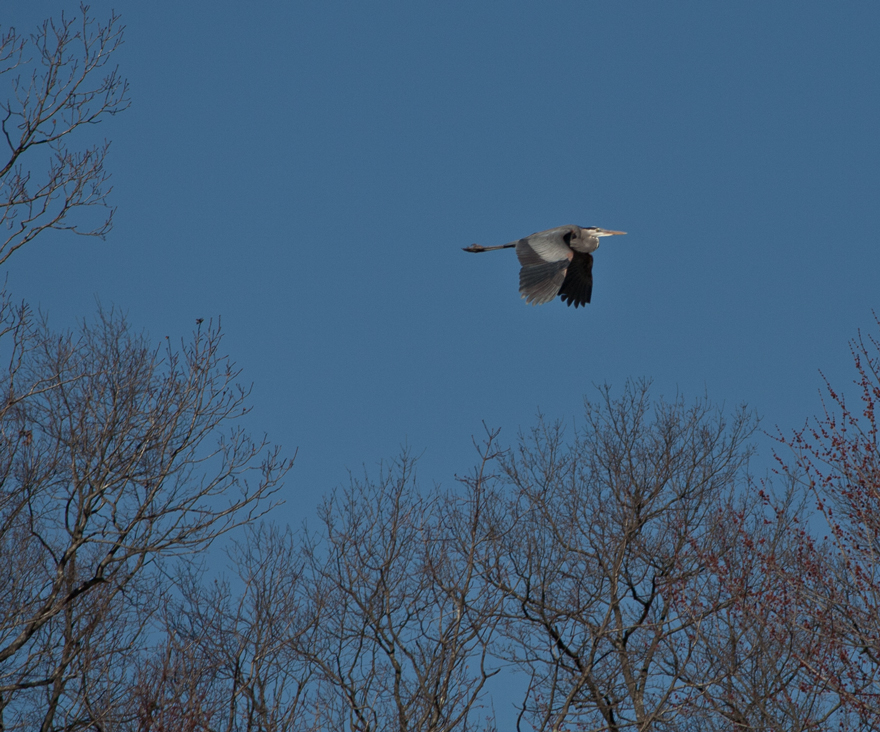
I was staring intently at some ducks in a secluded area of the marsh, when suddenly my eyes caught sight of movement in one of the trees overlooking the pond. The next think I knew a Great Blue Heron (Ardea herodias), who had apparently been perched on the tree,  was flying through the air.

This is the best of the shots that I was able to take. Most of the times that I have attempted a similar shot in the past, the white in the face has been totally blown out. I still need to work on getting a better exposure, but feel like I am making progress. Now if I can just find a cooperative heron.

heron_blog

© Michael Q. Powell. All rights reserved

Read Full Post »

After endless gray winter days, the beauty of a sunny day seemed magnified and the vivid colors of this mallard duck looked even brighter. I love the shade of blue of the feathers that show through when the ducks are in flight, especially when they are taking off and landing.

mallard_blog

© Michael Q. Powell. All rights reserved

Read Full Post »

Capturing images of ducks in flight has been a lot more difficult for me that photographing geese. Geese are larger, fly more slowly, and are more predictable than their skittish duck counterparts.

My camera also seems to have a problem grabbing the focus of these smaller birds when they are moving. Nonetheless, I still spring into action whenever ducks take to the air and occasionally I manage to get shots that are pretty much in focus. Here are a few such images of mallard ducks from this past Friday.

ducks1_blogducks2_blogducks3_blog

© Michael Q. Powell. All rights reserved

Read Full Post »

Lately I have been playing around with the auto-focus settings on my camera, trying to figure out how they work and deciding when it is appropriate to use each of the modes.

After doing some reading and watching some videos on the internet, I decided to remap one of the buttons on my camera. As a result, I no longer engage the autofocus by pushing down halfway on the shutter release—I engage it by pushing on the * button with my thumb. If you are interested in the reasoning behind this process, you can Google “back-button autofocus.”

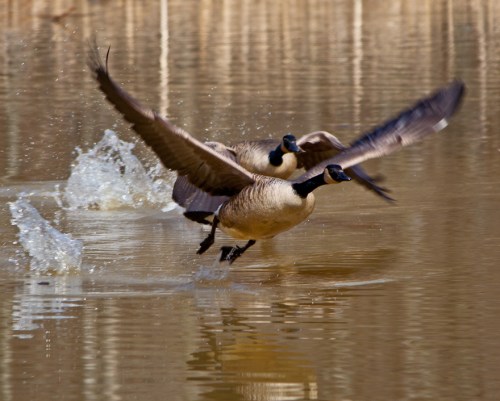
Next I decided to experiment with AI Servo mode, which is supposed to be the best mode for moving subjects. Previously, I had been shooting in One Shot mode or AI Focus (which is a hybrid mode). Most of the time, that meant I had to achieve focus separately for each image. I am still having some difficulties with the Servo mode, in part because it’s hard to know for sure if the focus has locked on the subject, since, unlike the other modes, the camera will shoot even if nothing is in focus.

The way that it is supposed to work is that you focus on the subject with the center focus point for 1-2 seconds and then the camera will follow that subject as it moves. In the situation below, I focused on the front goose that looked like he was about to take off. When he took off, I took a sequence of six photos, only two of which were in focus. They were the second and fifth in the sequence and they came out pretty sharp.

I may be overtaxing my ancient Canon Rebel XT by shooting in RAW, shooting bursts, and having the autofocus engaged continuously. Still, it’s fascinating to experiment with the different settings and see what works best for me.
flight1_blogflight2_blog

© Michael Q. Powell. All rights reserved

Read Full Post »
I love the dreamy look of the morning mist that provided such a beautiful backdrop for the flight of these two Canada Geese this past weekend.

geese_mist

© Michael Q. Powell. All rights reserved

Read Full Post »

As I was focusing on some ducks yesterday on a misty, gray morning, one of them suddenly decided to take to the air and I managed to capture him just as he was starting to come out of the water.

The ducks were a little closer to the shore of a little pond at my local marshland park than is usually the case and I was squinting through the viewfinder trying to identify their types. The bright white neck of one of them made me pretty sure that it was a Northern Pintail (Anas acuta), but I wasn’t quite so sure about the pair of ducks that sort of looked like mallards, but turned out to be Northern Shovelers (Anas clypeata).

I was trying to be as quiet as I could as I took some photos, when the male Northern Shoveler somehow detected me and took off. I managed to snap a photo at a really interesting moment as the male is just starting to flap his wings. The female and the pintail aren’t  paying much attention to the male’s actions and eventually just swam away.

liftoff_blog

I tried to follow the male Northern Shoveler in flight as he headed off into the distance. Most of my shots were pretty blurry, but I got a couple that I really like. The first one is just after take off and I like the splash and the fact that his reflection is still visible. In the second one,the background is a soft blur, providing a nice backdrop for the vivid colors of the shoveler. He is in a photogenic position as he flies away and I like the fact that a portion of his head and one of his yellow eyes are still visible.

flight3_blog

flight_blogI’ll probably post some separate photos of the Northern Shoveler and the Northern Pintail a bit later, but wanted to share my good fortune in capturing this moment.

© Michael Q. Powell. All rights reserved

Read Full Post »

This week I have been posting a lot of photos of soaring birds that I photographed last weekend. This last batch, which includes some of my favorites, features a young hawk soaring in a number of different positions. I was fortunate that he flew almost directly overhead and the light was reasonably good.

The strength and beauty of a bird like this is hard to capture in photos, but it was really impressive to watch him effortlessly soaring on the winds.

flight3_blogflight1_blogflight2_blogflight4_blog

© Michael Q. Powell. All rights reserved

Read Full Post »

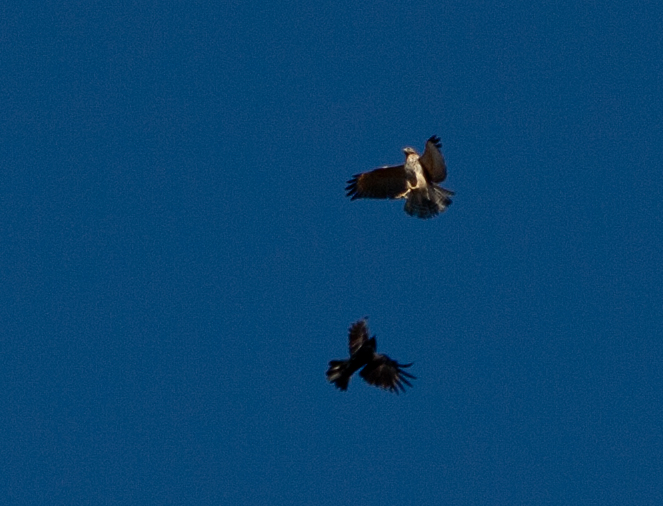
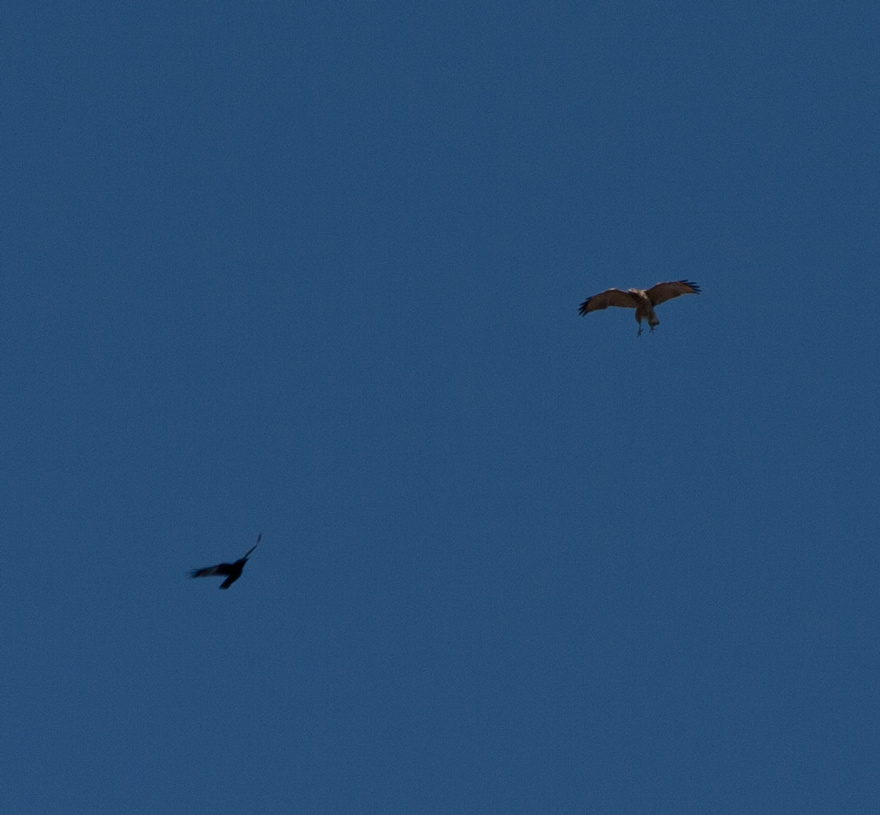
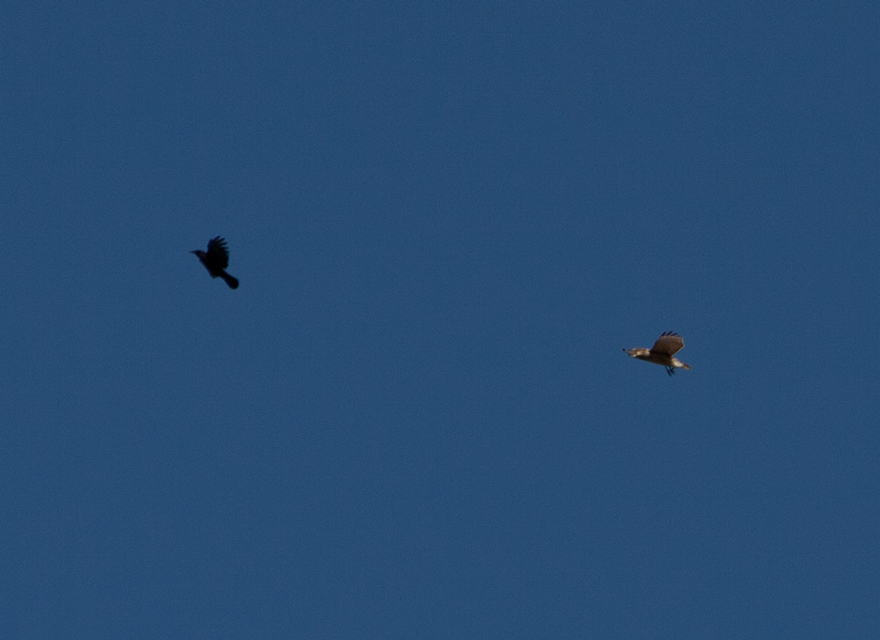
I was looking up in the sky watching a hawk soaring through the air this past weekend when I noticed that there was another bird there too, a black bird that I eventually identified as a crow. The two of them seemed to be soaring on the same updrafts, each virtually mirroring the movements of the other. My first thought was that they must be having a lot of fun, gliding along together. When I looked at my photos, though, I realized that a more serious drama probably had been taking place at high altitude.

chase5_blog

Now, I have never had a hawk come rushing at me with talons flashing, but the crow seems to have decided that it was probably not a good idea to wait around and see what the hawk’s intentions are. The hawk began to chase the crow, it appears, and the crow took immediate evasive action. As far as I can tell, the crow got away. Here are some shots that I took of the chase. They are not very high resolution, but they help illustrate a fascinating encounter.

chase4_blogchase1_blogchase2_blog

chase3_blog

Since last weekend when I took these shots, I’ve done some research on the internet and learned that crows and hawks don’t get along very well and each has been known to pester the other. I’ll keep my eyes open now for any additional encounters between the two species.

© Michael Q. Powell. All rights reserved

Read Full Post »
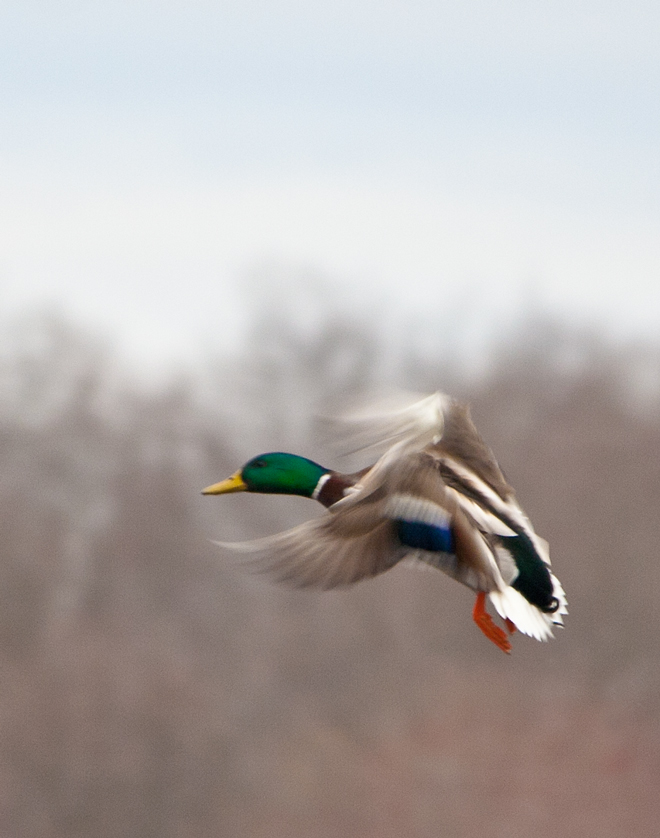
This past weekend I spent some more time watching migrating geese and and attempting to photograph them in flight. Often the geese flew in large formations, though sometimes they would arrive and depart in pairs. As I looked overt my photos, though, my favorite photos of the day feature geese trios.

I love shots like these in which it’s fun to compare the positions of the different birds, and the degree to which they are synchronizing or varying their body positions and wing movements. Each of these photos seems to form a mini-progression within itself, as though they were made up of multiple exposures of a single bird.

goose triogoose trio 2

© Michael Q. Powell. All rights reserved

Read Full Post »

The skies turned dark and gray this morning and rain gradually turned into snow, a wet snow with large flakes that quickly covered the ground. It snowed hard for an hour or so, but the snow clouds eventually blew away and sunshine arrived to destroy all of evidence of the snowfall.

As the snow was falling, however, I went walking through the neighborhood with an umbrella in one hand and my camera in the other. Wondering if I would see any birds (I had visions of brightly-colored cardinals on pine branches against a backdrop of snow), I heard the unmistakable sound of a crow. It wasn’t hard to locate him and as I was focusing on him he took off. Mainly on instinct, I snapped a photo and got an interesting photo.

It’s a moody, dark photo that is perhaps a little ominous.  The crow seems to be a perfect match for the rest of the elements of the scene.

I’ll have to wait for another time for photos of beautiful birds in the sunshine with glistening snow.

Crow in the snow

Crow in the snow

© Michael Q. Powell. All rights reserved

Read Full Post »
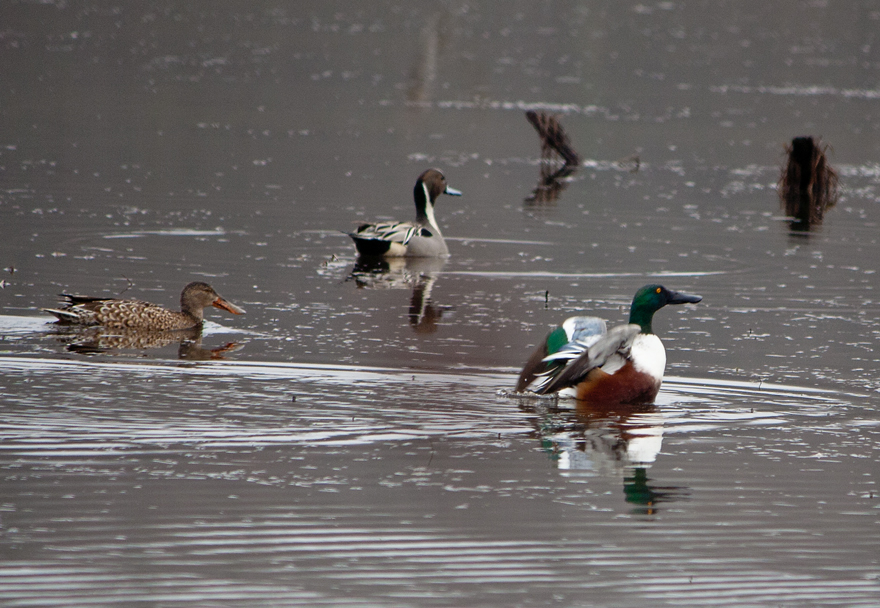
This morning I am in the mood for simplicity, so I am posting a single photo of a male Mallard Duck (Anas platyrhynchos) in flight. I like the geometric shapes in the image and how the light illuminates one wing, while keeping the other in the shadows. There is some color, but it doesn’t overwhelm the eyes. The photo is a simple one of a common subject—sometimes I need to slow down and see the beauty in simple things.

duck1_blog

© Michael Q. Powell. All rights reserved.

Read Full Post »
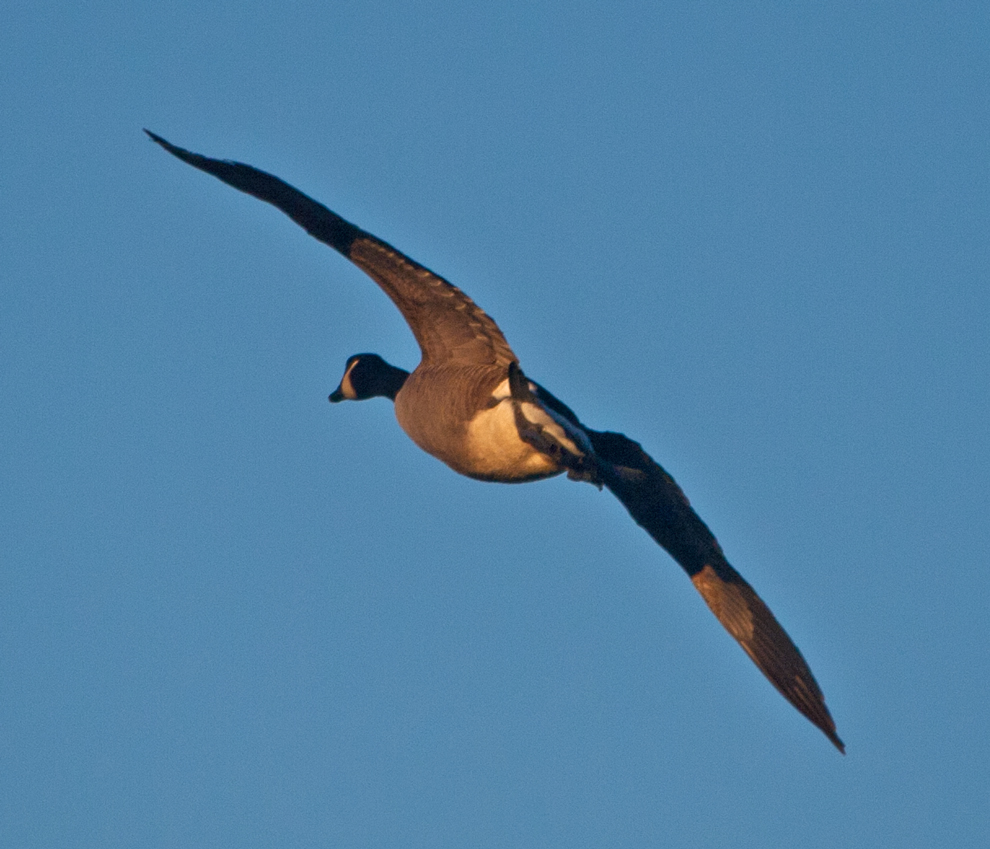
Geese and ducks continue to arrive and depart with such frequency in my local marsh that I feel like I am in a major bird airport. Fortunately, there are no long lines or security checks for them to endure. We must have a special arrangement with our northern neighbors, for the Canada Geese are not subject to any special customs scrutiny.

I continue to try to take photos of the geese while they are in flight, usually when the are coming in to land or taking off. Often the geese will circle around and honk loudly to announce their arrival (a kind of bird intercom system). Perhaps the birds on the ground can interpret the honks to mean something like, “Now arriving on pond number one, Canada Geese flight number one from Toronto.” My first photo is one of a Canada Goose banking. No, he is not at an ATM machine, withdrawing cash. He is making a sharp turn as he prepares to land.

Banking goose

The second photo shows a goose in flight. If you click on the photo, you will notice that the goose has a zen-like look of contentment on is his face. Scientists have been working on implanting a tiny device into geese that will provide them an in-flight entertainment package (and autopilot features too) and this goose may be one of the early test subjects.

Goose in flight

Some geese hate to fly alone and prefer companionship during the long flight. A new business has sprung up that provides escort service for the lonely goose, a fledgling matchmaking company that is just getting off of the ground. The company’s contracts are full of fine print about additional charges, but some geese continue to be surprised with the bill they are presented at their final destination.

Lonely goose escort service

© Michael Q. Powell. All rights reserved.

Read Full Post »
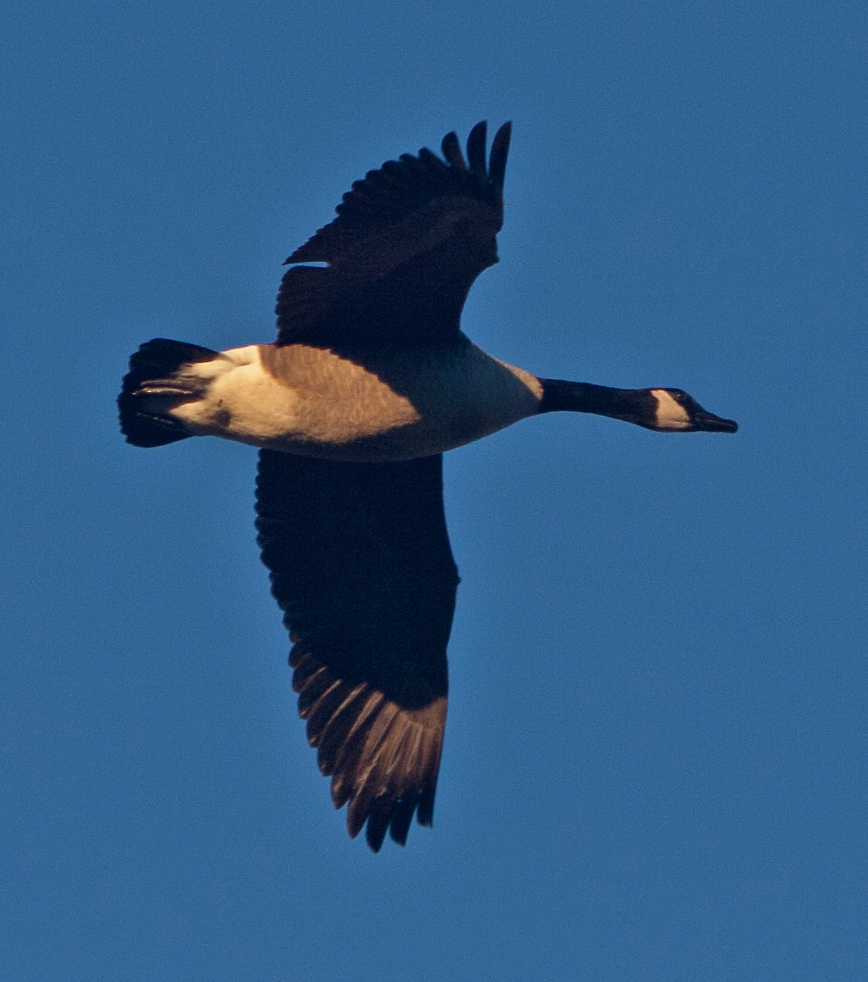
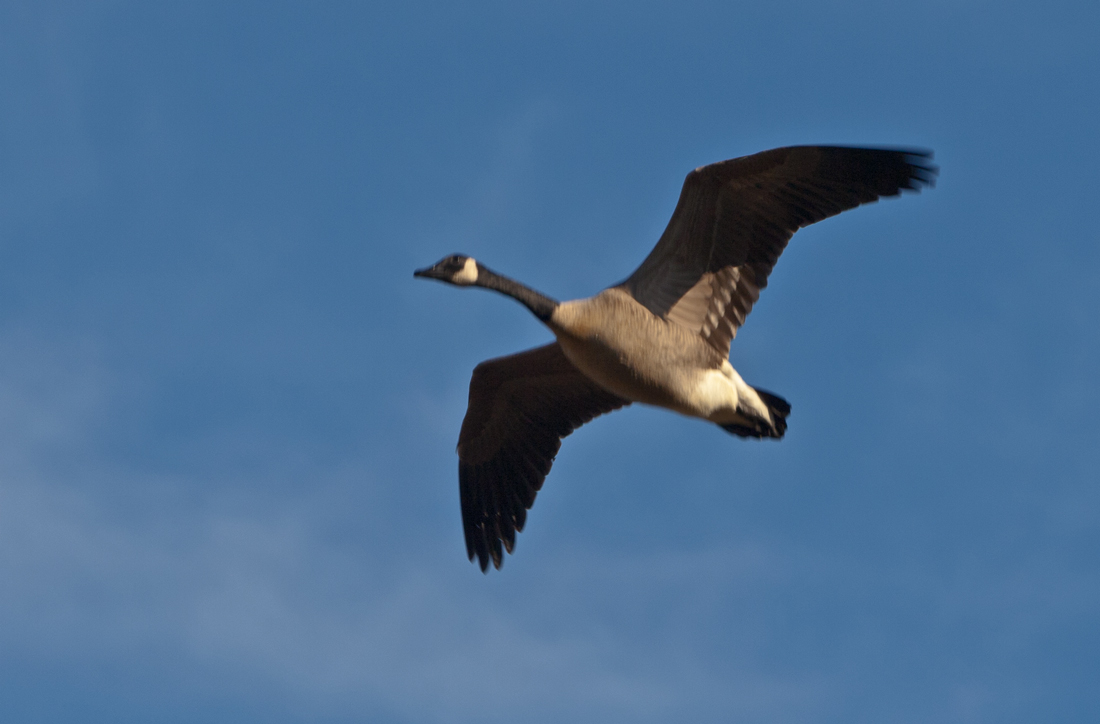
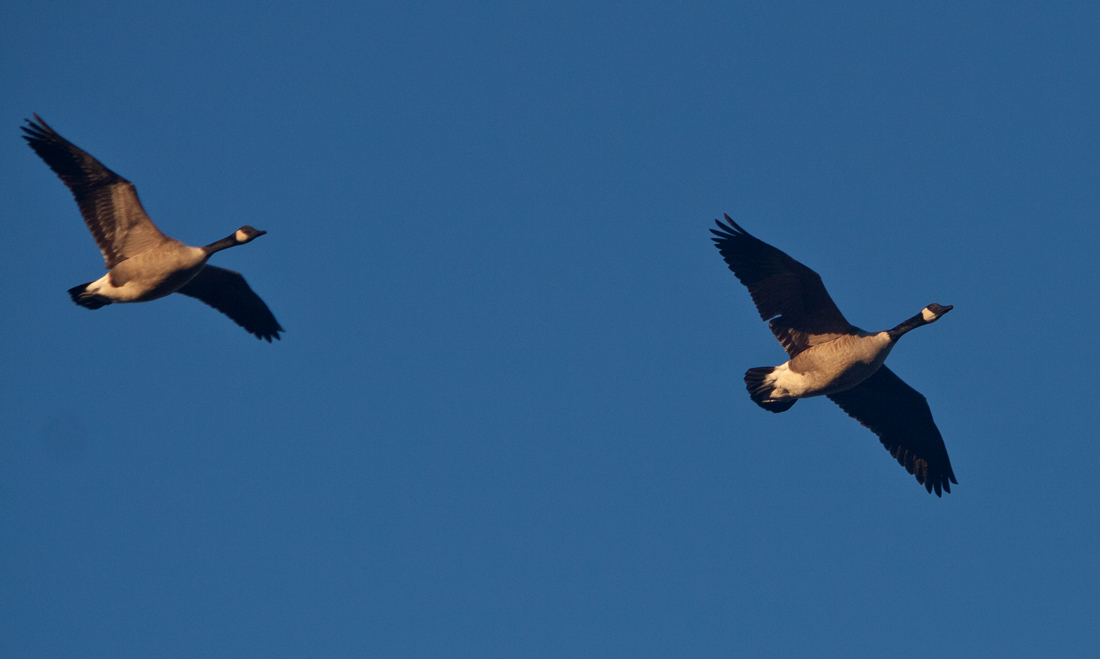
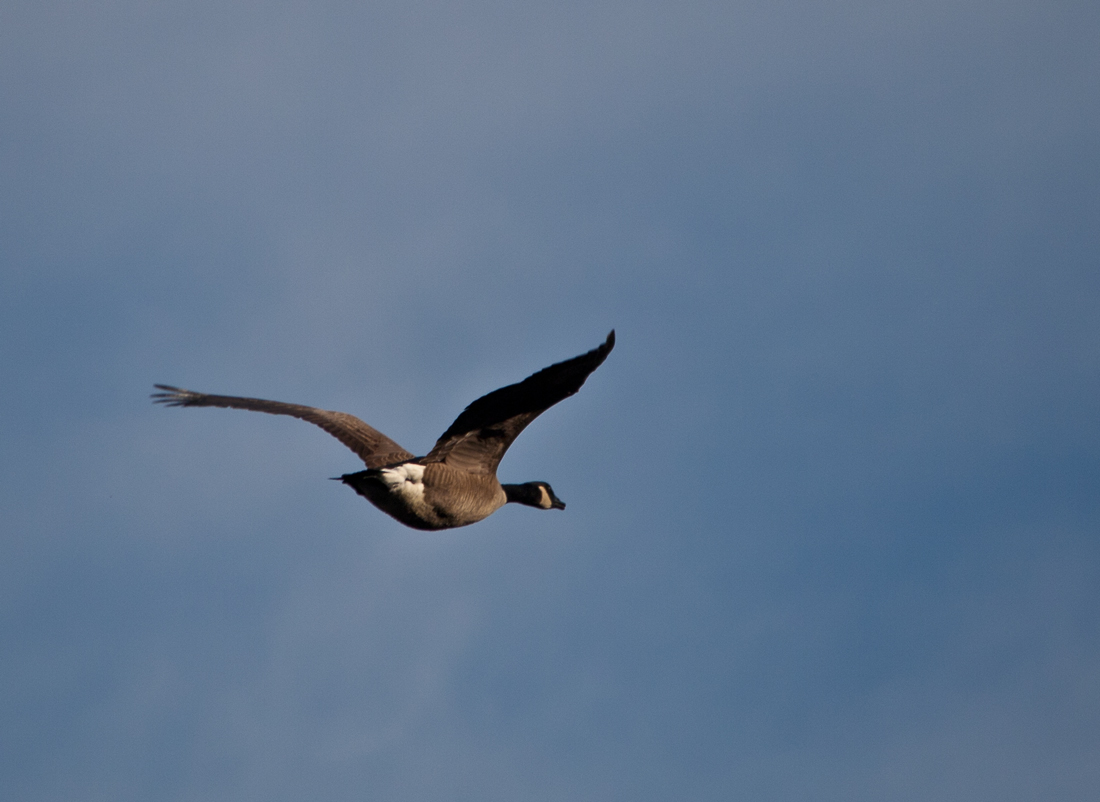
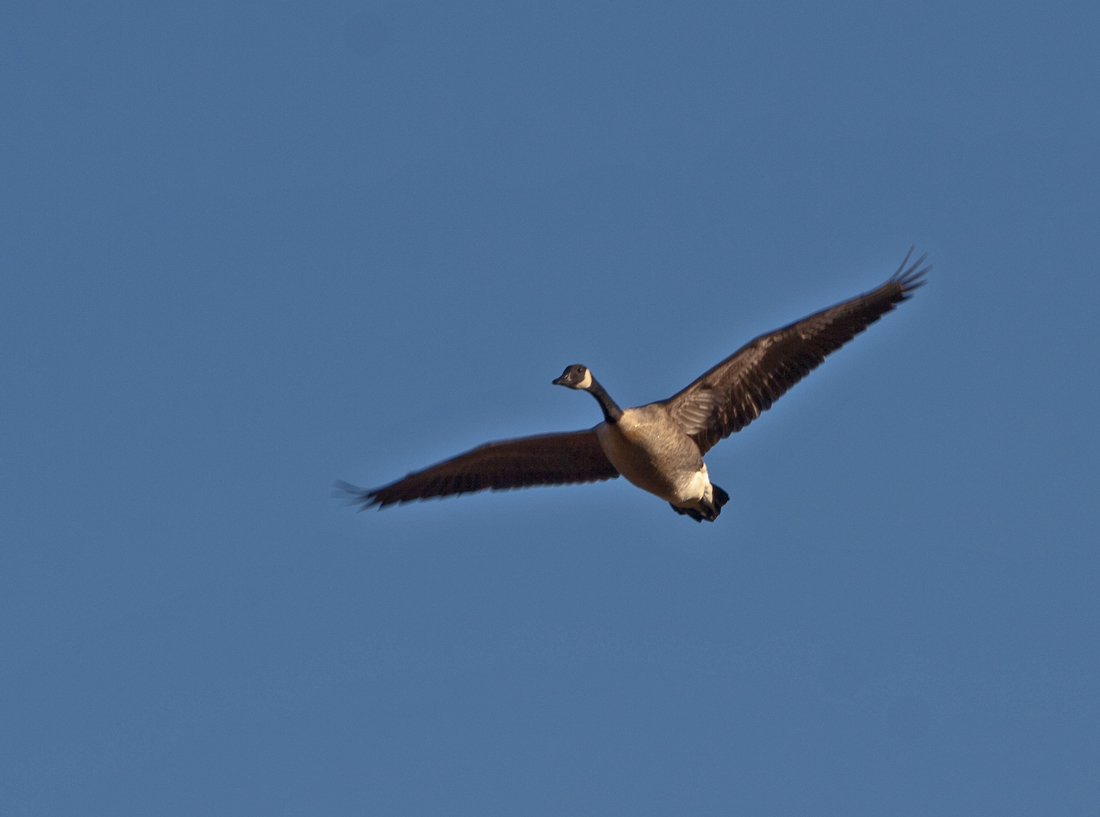
Canada Geese (Branta canadensis) continue to stop in at my local marshland (Huntley Meadows Park) as they migrate to unknown destinations. Sometimes they come in large groups, though most often I have seen them come in small groups of two to  six geese. I watched them for quite some time during this sunny weekend, and it seems that they spend most of their time on the ground foraging for food or simply relaxing and grooming themselves.

I’ve tried to take photos of the geese when they are flying and have found that this is much more challenging than I had anticipated. Lighting is perhaps the biggest issue, but the speed and direction of the geese is an almost equal problem—profile shots are great, but their relative speed seems fastest when they are moving perpendicular to the camera direction. Camera settings are sometimes hard to choose and adjust, especially when the geese decide at the spur of the moment that it’s a good time to take off. As I’ve found out repeatedly, the settings appropriate for taking photos of the geese in the water are not appropriate for geese in the air.

Here are some of my photos of geese in flight from this past weekend. As you can see, the weather was sunny and the skies were blue.  I am still working on my techniques, but I like the results so far (though I wouldn’t dare reveal how many shots I attempted in my quest to capture the geese in flight). If you click on the photos, you can see a few more details in a higher resolution view.

Migrating Canada Goose

Soaring Canada Goose

Climbing Canada Goose

© Michael Q. Powell. All rights reserved.

Read Full Post »
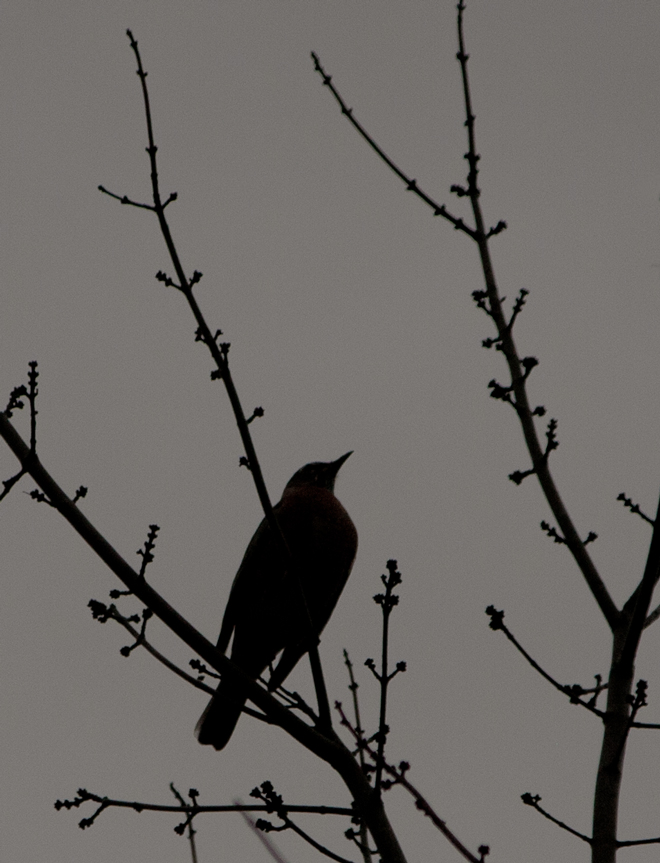
The skies were dark and overcast early this afternoon as we awaited the hurricane that was likely to bring rains and winds, though we are probably not directly in its path. The birds in my neighborhood were unusually active, so I decided to try to take some photographs of them. With few exceptions, my photos turned out to be silhouettes, because the existing light was too weak to illuminate the birds against the backdrop of the sky. I like the effect, however, and decided to post some of these silhouettes. The first one, my favorite, was a shot in which the bird started to take off just as I pressed the shutter and I like the result better than if I had captured him on the branch. Some of the other images show birds in flight or in action. Somehow they seems appropriate for a stormy day (and I can hear the wind and the rain outside as I write this entry).

© Michael Q. Powell. All rights reserved.

Read Full Post »
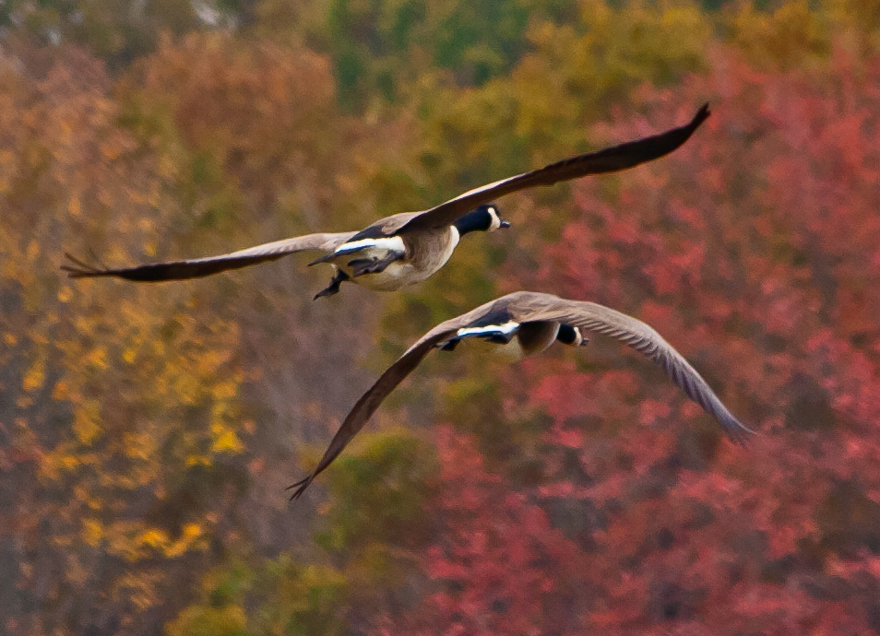
A trio of Canada Geese (Branta canadensis) paid a short visit today to my local marsh at Huntley Meadows Park. I suspect they are migrating, though I am not sure about that. They announced their arrival loudly and circled around before landing, so I had time to attempt some shots. I don’t have much experience in photographing birds in flight, but had limited success, as you can see in these shots. I could not get all three of them close enough to each other in the frame, so you only see two at a time. In case you wonder, the day was extremely overcast and there was not much sunlight—that is why the sky looks white in some of the photos.

This is the kind of photo that I want to be able to take, so today was good practice for me. I can tell I still need a lot of practice in tracking birds in the air.

Geese in flight at Huntley Meadows Park

Geese circling for a landing

Geese in flight during the fall

© Michael Q. Powell. All rights reserved.

Read Full Post »
« Newer Posts