Feeds:
Posts
Comments

Posts Tagged ‘Belted Kingfisher’

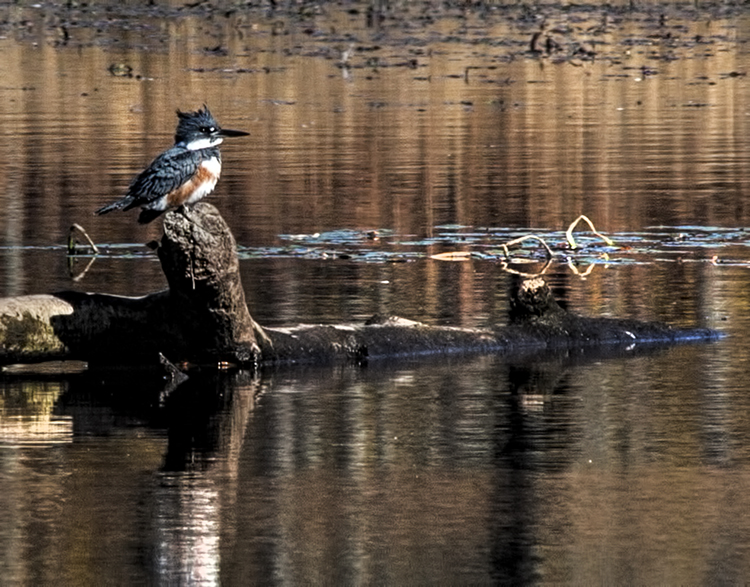
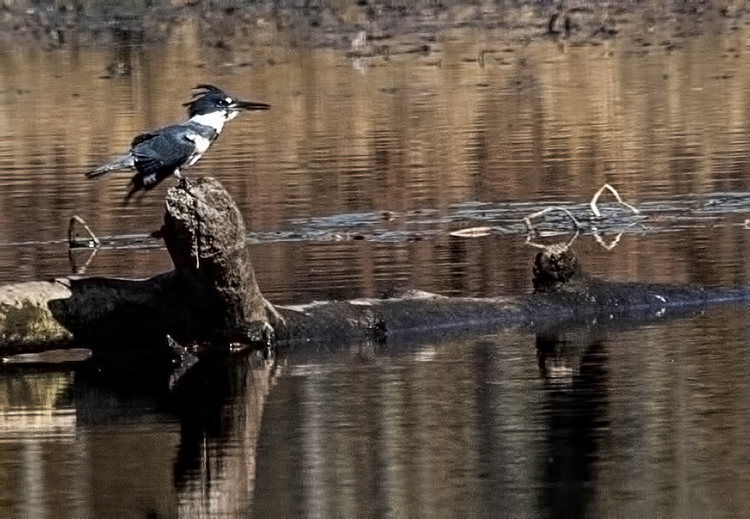
Instinctively I try to get as close to a subject as possible, often ignoring the “big picture.” One recently early morning, however, there was a substantial amount of water between me and the Belted Kingfisher (Megaceryle alcyon) that I spotted on a fallen tree and there was no way I was getting closer.

I concentrated on focusing, thinking I would probably have to crop a lot, and on composition. Almost despite myself, I ended up with an image that I really like, an image in which the kingfisher is only one element of an early morning landscape.

There is definitely a benefit sometimes in not getting closer to the subject.

Belted Kingfisher

Michael Q. Powell. All rights reserved.

Read Full Post »

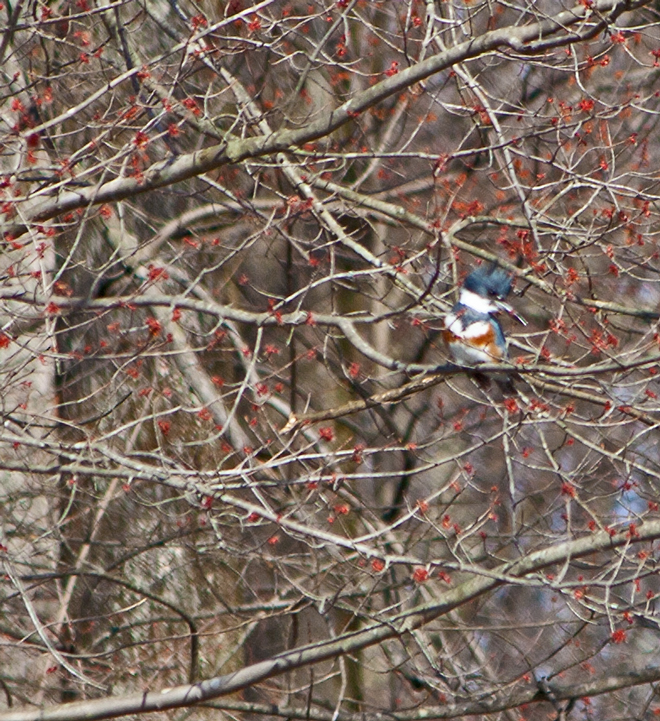
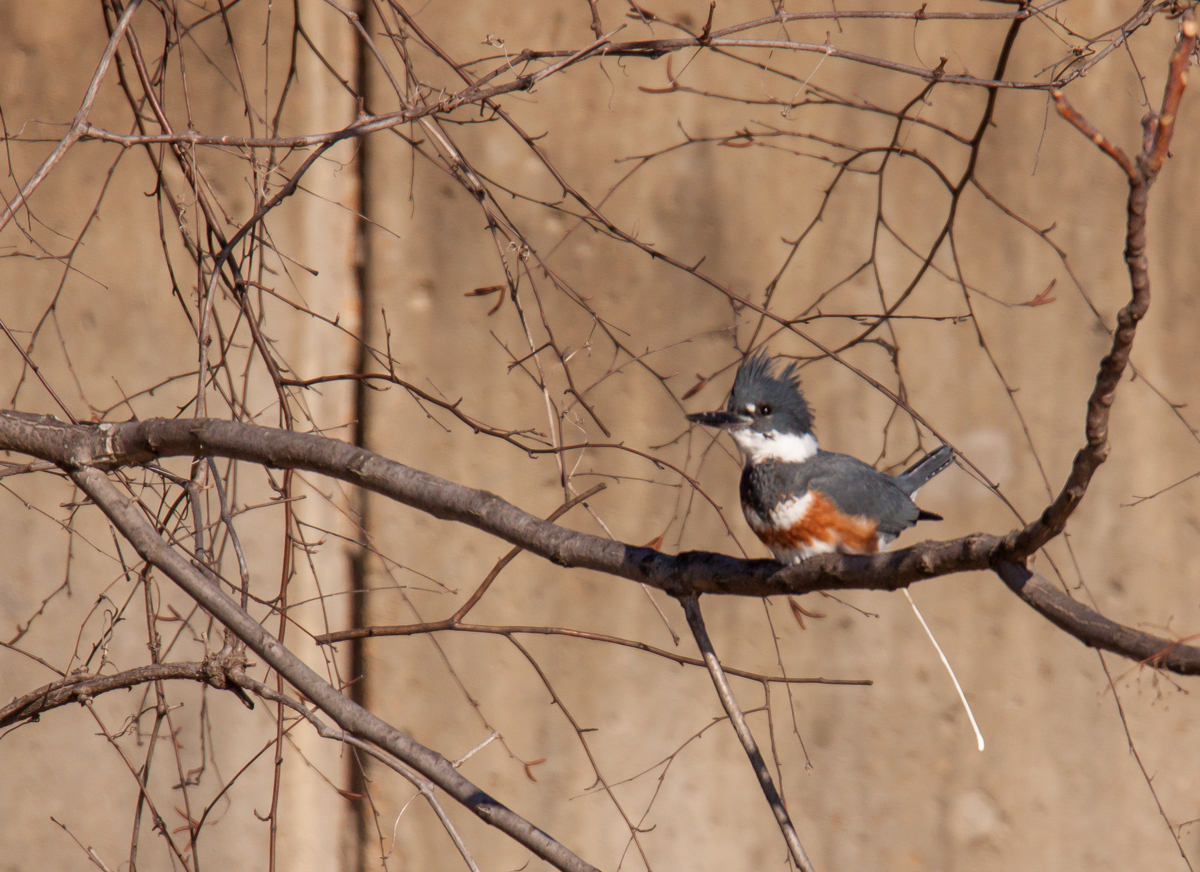
Yesterday, the last day of January, I set out for a small pond, hoping to see a female Belted Kingfisher who hangs out there. I didn’t have high hopes that I would see her and thought the pond probably would be frozen. I was happy to discover that the pond was only partially frozen over and thrilled when I hear the unmistakable call of a Belted Kingfisher (Megaceryle alcyon).

Before I could get in range, the kingfisher flew into a tree that was a good distance away, adjacent to the wall of an elevated section of railroad tracks. The tan color in the first photo is that wall. After I had observed her for a few moments (and she seemed to be observing me), she flew a little higher in the trees and I took the second shot. The colorful design was painted on a railroad tanker car.

I am still hoping that I will be able to get some closer shots of this kingfisher, but I was quite pleased to be able to capture these images of one of my favorite birds.

Belted Kingfisher

Belted Kingfisher

© Michael Q. Powell. All rights reserved.


Read Full Post »

A female Belted Kingfisher (Megaceryle alcyon) lives at a small lake not far from where I live and periodically I try to photograph, but she continues to remain elusive.

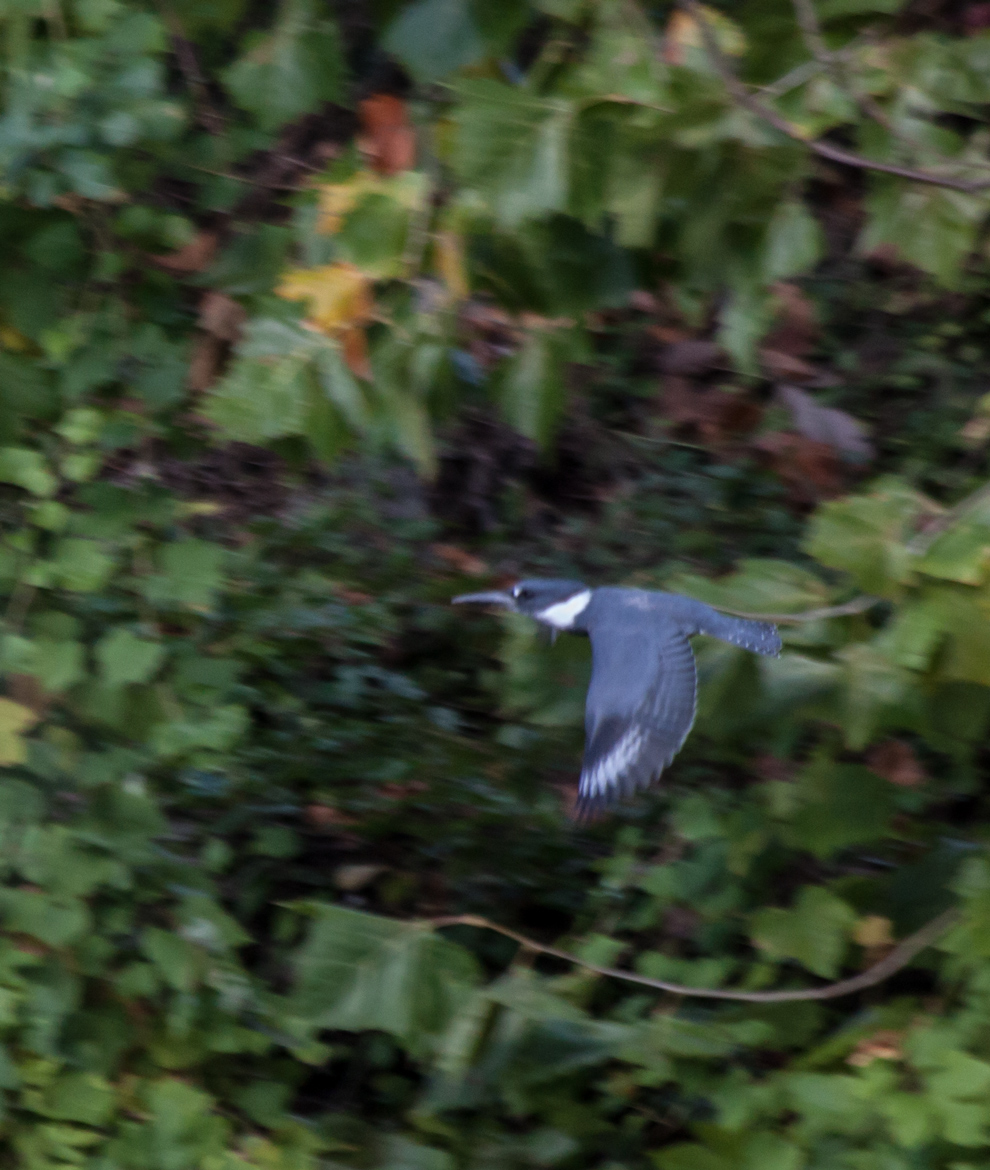
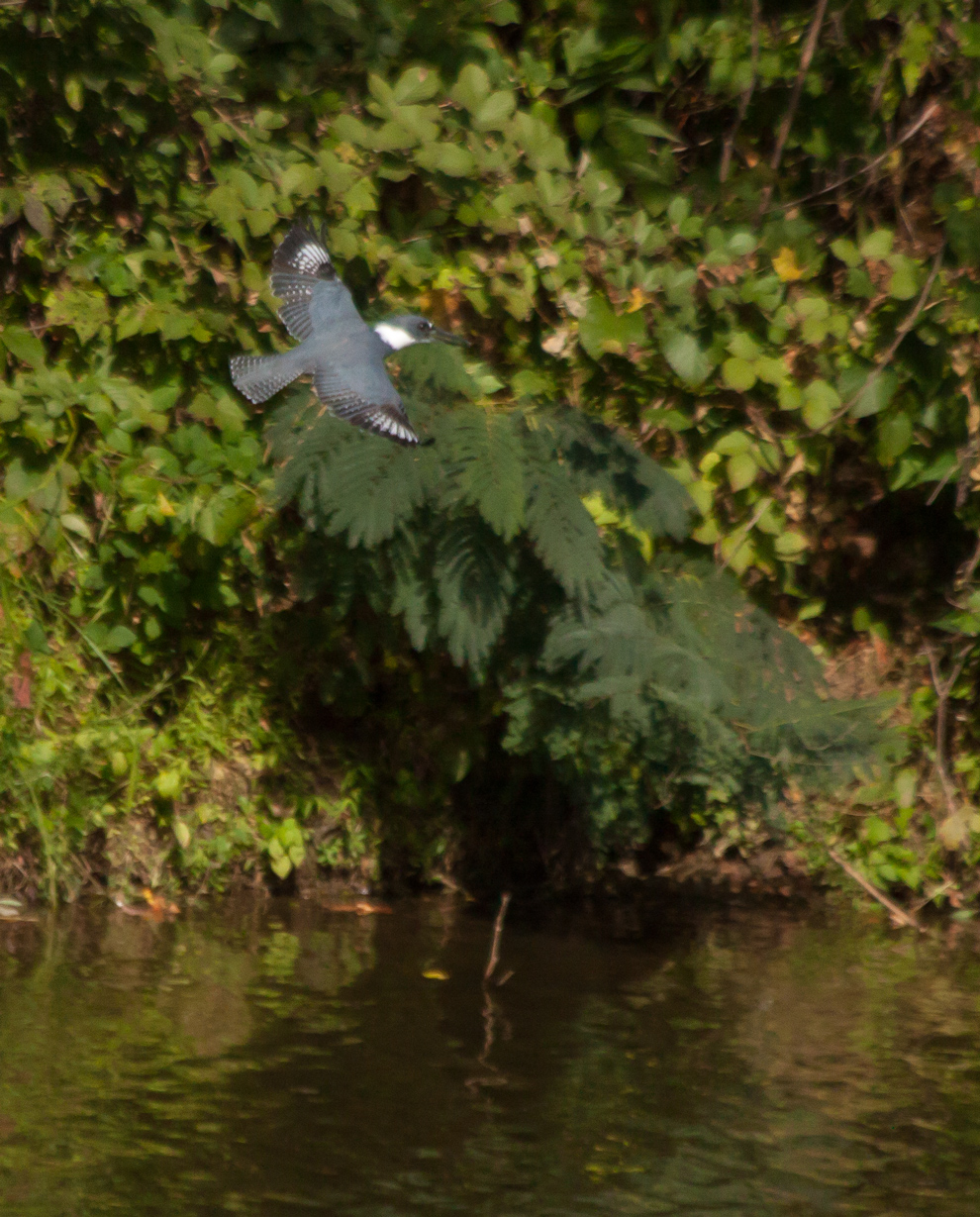
Generally I try to photograph the kingfisher at one of her normal perches in a grove of trees across a narrow portion of the lake from where I am standing. It’s tough to isolate her against the backdrop of the trees, especially at this time of the year when the leaves are still on the trees, and often I only catch sight of her when she starts to fly.

Most of the shots in this posting are my attempts to capture her in flight. I am getting better at tracking the bird in the air and keeping her in focus, but it’s not easy to do as she flies in and out of the shadows and against varying backgrounds and she is somewhat hidden in these shots.

This past weekend, I decided to try to approach the grove of trees from the other side of the lake, where there is often a group of fishermen. I was fortunate that I was alone and I was able to make it relatively close to the grove of trees.  I was surprised to see that the kingfisher was on a low perch rather than high in the trees where I usually find her and I managed to squeeze off a few shots before she flew away. The first shot in this posting was from this new shooting position.

I plan to try this new approach again in the future and with a bit of luck, I may finally be able to get the kind of shot of this bird that I have been visualizing in my mind.


Belted Kingfisher

Belted KingfisherBelted KingfisherBelted Kingfisher

© Michael Q. Powell. All rights reserved.

Read Full Post »

It’s autumn now and my thoughts (and my camera) are starting to focus more on birds than insects. This past weekend, I returned to a location where I had previous seen a female Belted Kingfisher (Megaceryle alcyon).  The kingfisher would perch on the limbs of some trees overlooking a small trout-stocked pond called Lake Cook, which is really more like a small pond, and periodically make a foray across the surface of the water and grab a fish.

I realized this time that I had a problem—there are so many leaves still on the trees that I couldn’t spot the kingfisher when I heard its very distinctive, rattling call. I could get a general idea of its location, but couldn’t see the kingfisher until it was already in flight, which mean I had to react really quickly to acquire and track it, hoping that I would be able to focus on it.

As it turns out, hope is not really an effective photographic technique and not surprisingly I ended up with a lot of blurry, improperly exposed images, in part because the kingfisher was flying in an out of the shadows. I was pleased, though, that I was able to capture a few decent images of the kingfisher in flight. I was shooting from across the pond from where the kingfisher was perched, so the shots are not close-ups of the bird, but are more like environmental action shots. Maybe I need a longer lens!

Belted KingfisherBelted KiingfisherBelted KingfisherBelted Kingfisher

© Michael Q. Powell. All rights reserved.

Read Full Post »

Early yesterday morning, I was so focused on a Great Blue Heron that I spotted high in a tree that I didn’t even notice that there was a Bald Eagle in an adjacent tree until it took off almost right in front of me. Nearby, a female Belted Kingfisher loudly announced her presence with her unmistakable rattling call.

The sky was covered with heavy clouds and the forecast called for thunderstorms, which meant that lighting conditions were less than optimal for taking photos in a wooded area. Still, it felt great to be outdoors on the trails after a week of constrained activity thanks to our recent snowstorm.

I hadn’t seen a live Great Blue Heron (Ardea herodias) at my local marsh in quite some time, so I was excited when I caught sight of the heron, perched on broken-off tree at the edge of one of the marshy fields. The heron was almost a silhouette against the sky, but its shape is very easy to recognize when you see it in profile.

heron_early_blog

As I was creeping forward to get a clearer shot, I was startled when a large bird flew right across my field of view—I knew almost immediately that it was a Bald Eagle (Haliaeetus leucocephalus), although it too was mostly a shadowy silhouette as I viewed it through the branches of the trees. I was able to react quickly enough to get off a few shots before the eagle flew out of sight.

eagle_early_blog

A short distance away, a female Belted Kingfisher (Megaceryle alcyon) was perched on the trunk of a rotted tree, intently staring down at the shallow water of the marsh, looking for prey. That water prevented me from getting closer to her, but I did manage to capture her distinctive pose through the branches.

kingfisher_early_blog

I am an early bird by habit and it was great to be outdoors in the “wilds” of my suburban marsh to see what other early birds I could find.

© Michael Q. Powell. All rights reserved

Read Full Post »

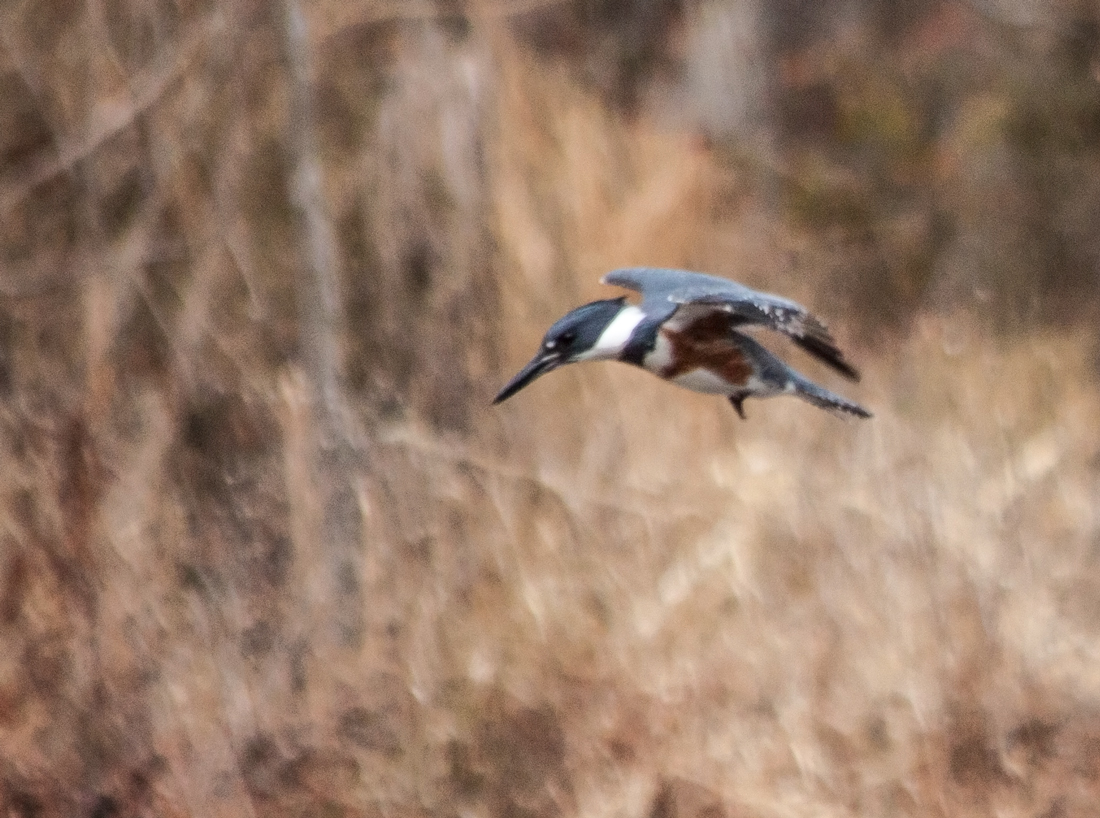
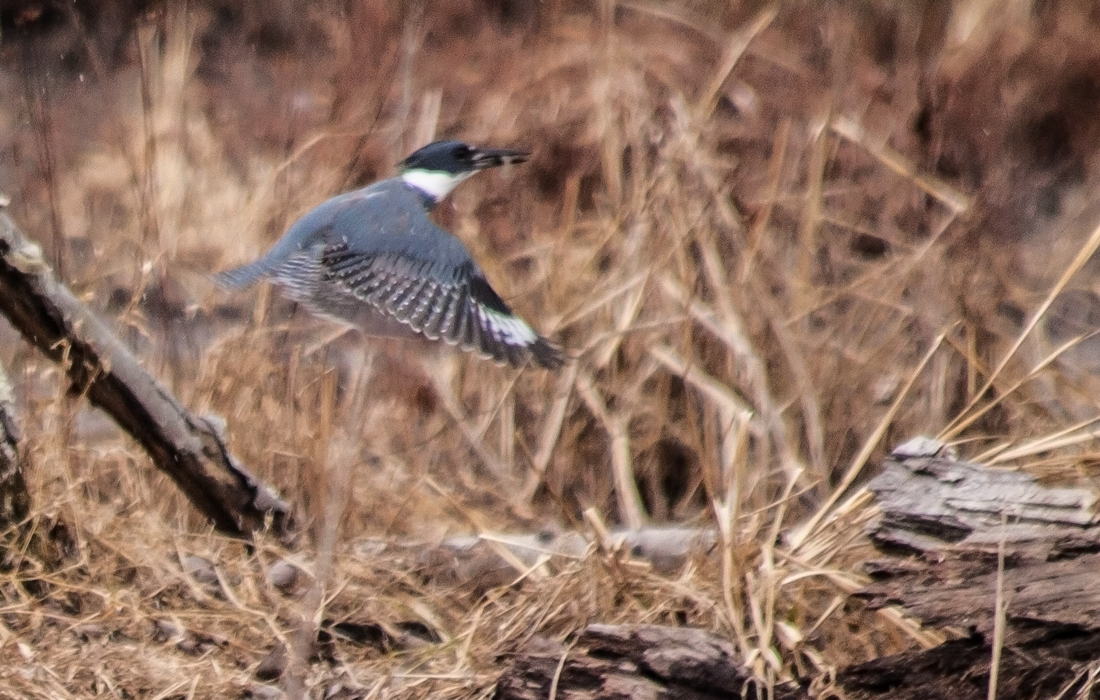
This past week I have observed female Belted Kingfishers (Megaceryle alcyon) at a couple of different locations at my marshland park and tried to capture them in flight as they dove into the water from their perches in the trees. It was challenging, because the kingfishers were pretty far away, but I did get a couple of decent shots (with a fair amount of cropping).

kingfisher4_dec_blogkingfisher1_dec_blogkingfisher2_dec_blogkingfisher3_dec_blog

© Michael Q. Powell. All rights reserved

Read Full Post »

I was looking across the water of a small pond at my local marsh, enjoying the beautiful early morning reflections, when a bright white flash zoomed across my field of view and stopped in the middle of the water.

Initially I had no clue about what it might be, but when I looked through my telephoto lens, I could see that it was a female Belted Kingfisher (Megaceryle alcyon). I had never before seen a kingfisher perched so low to the water and it was pretty obvious that she was not fishing. As I watched from a distance, she went through what I assume is her morning routine, as she twisted and turned and fluffed up her feathers.

Before long, the kingfisher flew off to a higher perch in a more distant tree, where I suspect she busied herself with the task of catching some fish for her breakfast.

IMG_2587 crop webIMG_2519 Cropped web

© Michael Q. Powell. All rights reserved.

Read Full Post »

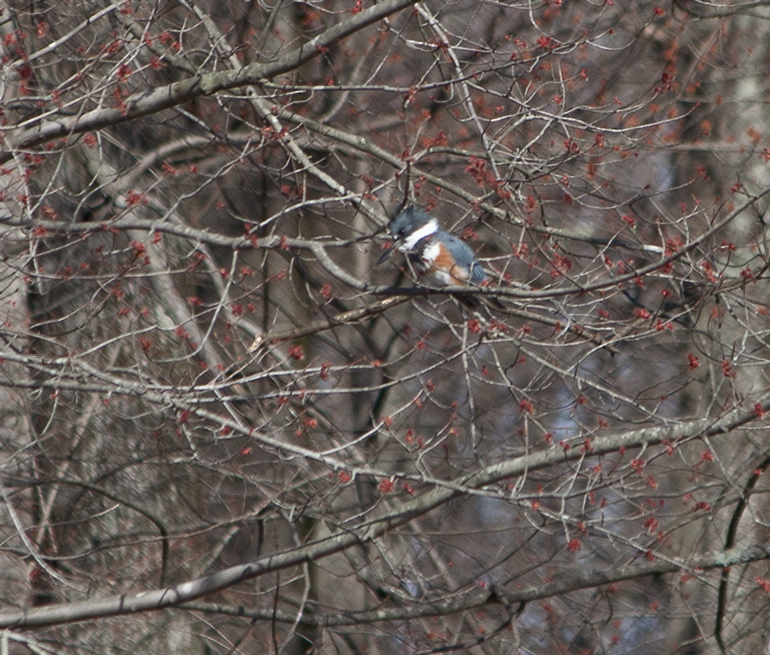
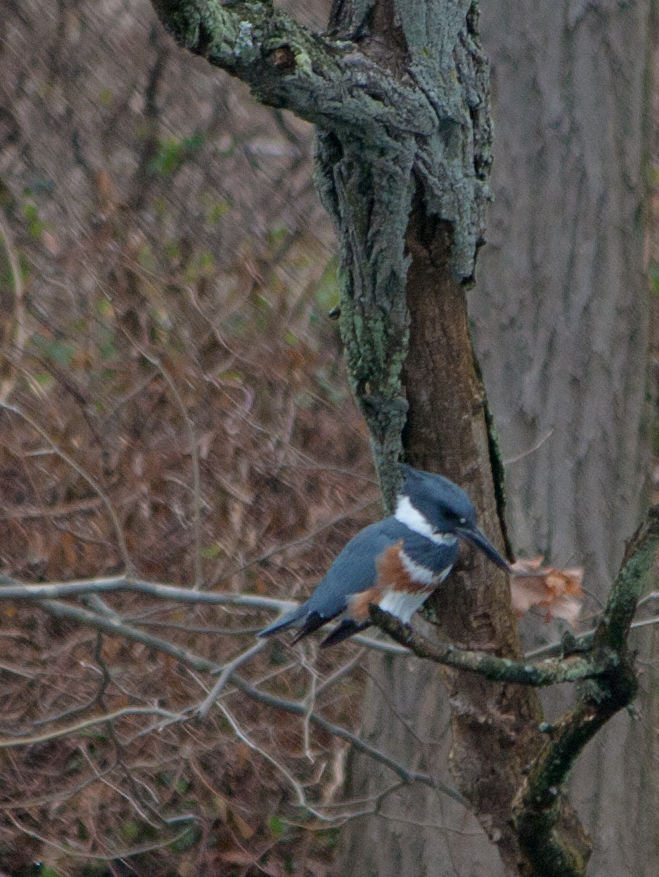
This past weekend I went back to locations where I have seen Belted Kingfishers (Megaceryle alcyon) in the past and encountered this male kingfisher (you may recall that the female has a chestnut stripe on her chest).

Initially he was on a wire above the stream, as shown in the second photo, but eventually he moved to a tree, where his pose looks more natural. He was pretty high in the tree and seemed to be surveying the entire area.

This was the first time that I was able to photograph the kingfisher with a longer lens and I had hoped to get some close-up shots. However, the kingfisher was not very cooperative this time and stayed close to the limit of the range of the lens. I was able to get pretty good detail in the first photo, however, despite a large amount of cropping, probably because I shot from a tripod.

As I said in a previous post, I enjoy stalking kingfishers—there is something about their look that I really like. I will continue to chase after them in search of better shots and hope they cooperate by staying in their current locations.

kingfisher1_blogkingfisher2_blog

Michael Q. Powell. All rights reserved

Read Full Post »

As I was standing next to the beaver lodge at my local marsh, I heard the unmistakable call of a Belted Kingfisher (Megaceryle alcyon), a sound I had never heard before at that location. After you have heard its sound, described by the Cornell Lab of Ornithology as a “strident, mechanical rattle,” you can’t help but remember it.

I was a bit surprised to see a kingfisher at that location, because kingfishers usually prefer clear waters, so they can see their prey. The water in the beaver pond is somewhat muddy, but perhaps it is teeming with new life.

I watched  for a while as the female Belted Kingfisher (females have orange chest stripe and males don’t) changed positions several times in the tree, perhaps hoping to get a better view of the water. Eventually she dove into the water, but I was unable to tell if she was successful in catching something before she flew away.

The kingfisher was across the pond from me, so the photos are not perfectly sharp, but they do show some of the different positions of this fascinating bird as she gazed intently at the water.

  kingfisher3_blog

kingfisher1_blog

kingfisher2_blog

© Michael Q. Powell. All rights reserved

Read Full Post »

Although I was excited to discover a male Belted Kingfisher (Megaceryle alcyon) in an industrial setting, later that day I returned to my first love, a female kingfisher in a more natural environment.

Previously I posted photos of the male kingfisher and female kingfisher as I continue in my quest to get some really good photos of these amazing birds. If you compare the male and the female, you can see that the chestnut stripe really makes the female stand out (and the Belted Kingfisher is one of the few birds in which the female is more colorful than the male).

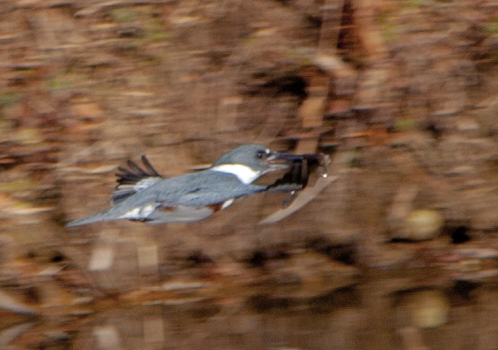
I continue to get interesting photos (and I am posting some new ones here), but I still am trying to get some better ones (these are grainy and a bit soft). By the way, can anyone figure out what she has in her bill in the last photo?

kingfisher_F2_blogkingfisher-F1_blogkingfisher_F3_blog

© Michael Q. Powell. All rights reserved

Read Full Post »

Walking alongside a stream yesterday, I heard the unmistakable call of a Belted Kingfisher, a call that is usually described as a “piercing rattle.” Here is a link to the Cornell Lab of Ornithology, which has sound clips that you might find interesting if you have never heard a Kingfisher’s call in person.

A previous post chronicled my quest for an elusive female Belted Kingfisher (Megaceryle alcyon) at a little suburban lake that is stocked with trout. I made multiple attempts on different days to photograph that Kingfisher as she perched on tree branches overlooking the water.

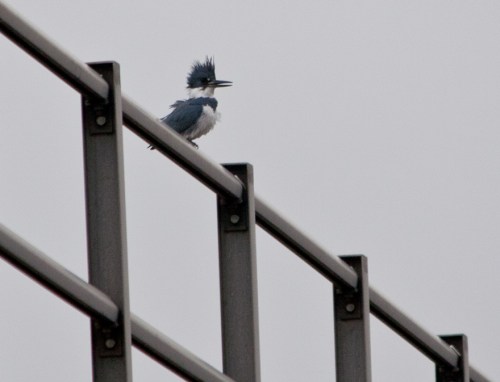
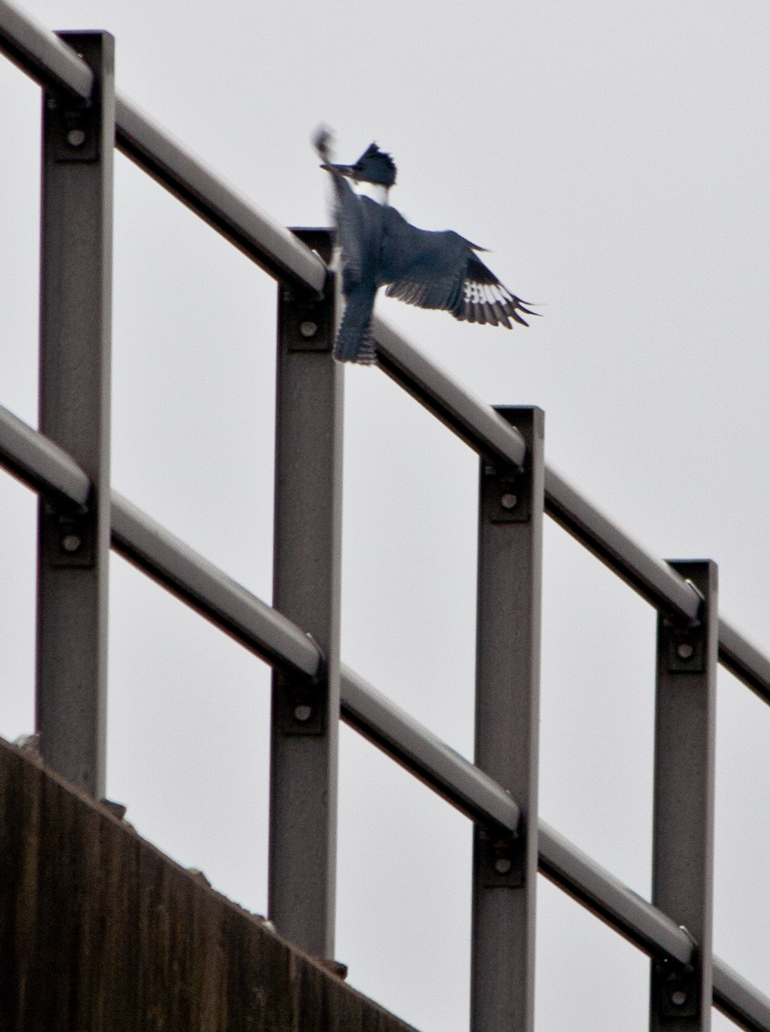
Although the stream along which I was walking yesterday is only a half mile or so from the female Kingfisher’s fishing spot, I was surprised to hear a Kingfisher’s call, because there are no trees on the banks of the stream at that location. When I heard its call again, I turned my head in the direction of the sound and was surprised to see a male Kingfisher perched on a power line above the stream. (It’s really easy to distinguish a male Belted Kingfisher from a female, because the male has only a blue stripe on is chest and a female has blue and chestnut stripes.)

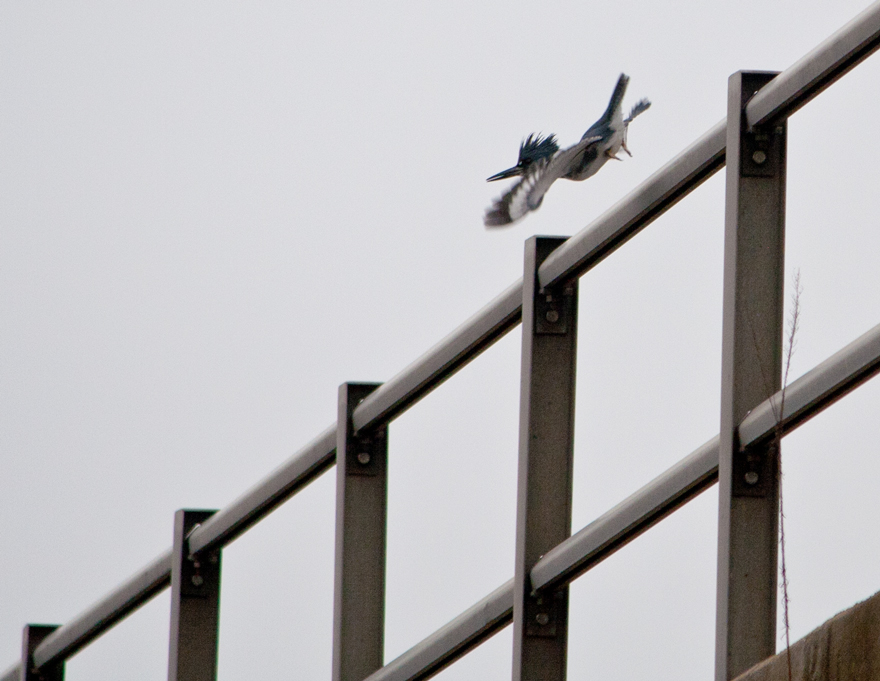
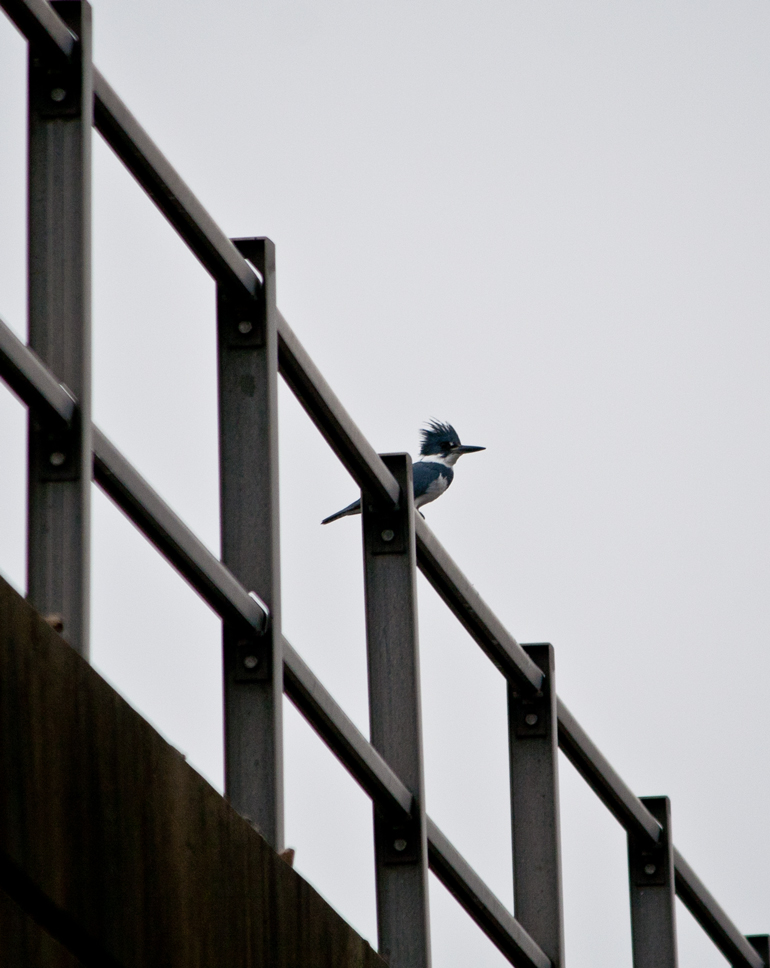
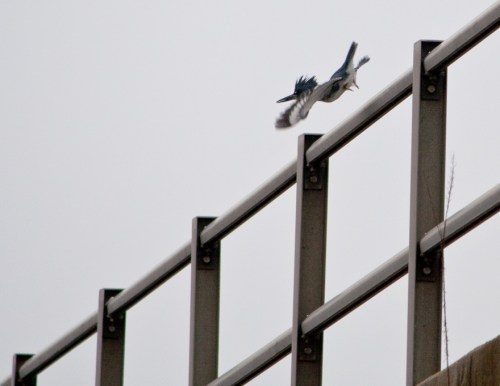
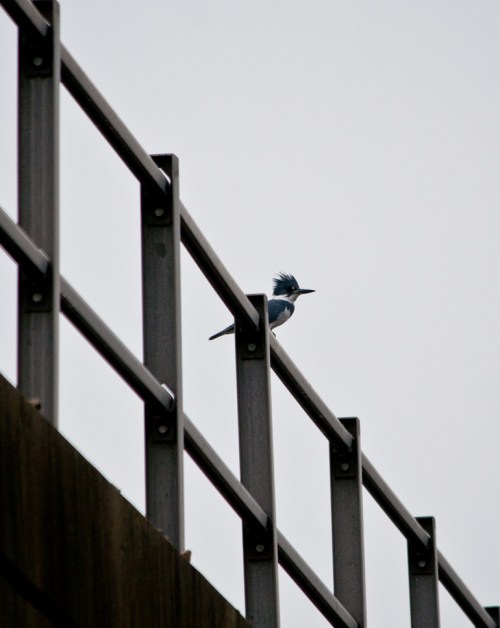
When I moved a little closer to him, he flew a short distance downstream and I located him again, this time perched on the railing of a railroad bridge over the stream. Over the course of an hour or so, he and I played  a little game in which he would pose for a few minutes on the railing and then fly downstream. A short while later he would be back on the suspended power line. I would walk slowly in the direction of the power line and once I arrived there, the Kingfisher would return to the railroad bridge.

Although I was not able to get really close to the Kingfisher, I managed to get some pretty cool pictures, including several in-flight shots. I really like the industrial-looking setting of the railroad bridge, with its simple geometric structure and beautiful angular lines. In many ways, the bridge is a much a subject in the photos as the bird.

I confessed in a previous post that I was a stalker of Kingfishers, but maybe it’s time to elevate my status—perhaps from now on I will refer to myself as a member of the Kingfisher paparazzi.
kingfisher_M3_blogkingfisher_M1_blogkingfisher_M2_blogkingfisher_M5_blogkingfisher_M6_blogkingfisher_M4_blog

© Michael Q. Powell. All rights reserved

Read Full Post »

I spent several hours on Sunday and Monday stalking a female Belted Kingfisher (Megaceryle alcyon). Does that make me a bad person?

I first encountered this beautiful bird a couple of weeks ago and was immediately smitten. Like a paparazzi photographer, I started snapping photos frantically when I saw her. I included some of those photos in a previous posting that I creatively entitled “Belted Kingfisher.”

Now I have started to hang out what I think are some of her favorite places, hoping desperately to catch a glimpse of her. She is still quite standoffish and won’t let me get close, but perhaps she will get used to having me around. Maybe she has commitment issues.

Here are a few shots from my recent encounters, including two in which I captured her as she was flying away.

For now, it is a classic case of unrequited love.

kingfisher1_blogkingfisher2_blogkingfisher3_blogkingfisher4_blog

© Michael Q. Powell. All rights reserved

Read Full Post »
This past weekend I decided to return to a little lake (it’s actually more like a pond) where I had previously seen some Hooded Merganser Ducks. This lake is part of a regional park and, according to posted signs, is stocked with trout.

As I was looking down at the water, I was surprised when a powder blue bird flew across my field of view. It was a pretty good size bird, but I didn’t have a clue what it was. It perched on a tree across the small lake and I was able to get a couple of shots to help me identify it. I came back later in the weekend and found the bird again and was able to take some additional photos. None of the photos yet is very good, but I thought I would share some of them, because I find the bird to be exceptionally cool.

What is the bird that has me so excited? It is a female Belted Kingfisher (Megaceryle alcyon). According to the Cornell Lab of Ornithology article, the Belted Kingfisher is one of the few bird species in which the female is more colorful than the male.  In a couple of my photos you can see the blue and chestnut bands across the breast of the female kingfisher (the male has only the blue band).

The Belted Kingfishers eat mostly fish and you can see a fish in the mouth of the bird in a couple of my photos. I suspected that the kingfisher swallows the fish whole, but I was too far away to see it happen. The same Cornell Lab article states that the kingfisher often dives from a perch, catches a fish and returns to the perch. It then pounds the prey against the perch before swallowing it head first.

As I mentioned, these photos were heavily cropped and are not that great in quality, but I hope to be able to take some better ones in the future. In addition to the shots of the bird in the tree, I am including one in which I attempted to photograph the bird in flight.

kingfisher5_blogkingfisher3_blog kingfisher1_blogkingfisher2

© Michael Q. Powell. All rights reserved

Read Full Post »

« Newer Posts