Feeds:
Posts
Comments

Posts Tagged ‘bee’

This bee might argue that it’s just the camera angle, but my initial impression of this bee was that he looked chubby—I don’t think that I have ever encountered a bee with such a round face. He reminds me of a sumo wrestler at the start of a match.

The bee pretty much ignored me, though, and seemed to really get into his work, literally, gathering pollen from some kind of milkweed plant, perhaps swamp milkweed (Asclepias incarnata).

chubby_blog

© Michael Q. Powell. All rights reserved

Read Full Post »

I was attracted initially by the bright red color of a cardinal flower (Lobelia cardinalis), but then I noticed a small amount of movement. When I looked more closely, I realized there was a tiny bee—the smallest that I have ever seen—busily gathering pollen. Rather than gathering pollen in little sacs, as I had seen other bees do, this bee seemed to be collecting it on his abdomen.

I don’t know much about plant anatomy, but as I searched on the internet, I learned some fascinating things about the cardinal flower, especially from a blog posting by Eye on Nature dealing with the way in which hummingbirds pollinate cardinal flowers. That posting contains some detailed images of the cardinal flower as well as some fantastic shots of a hummingbird.

I shot these images handheld with my 180mm macro lens. Ideally I should have used my tripod to get clearer shots, but the bee was so active that I feared that it would be gone if I had taken the time to set up the tripod.

It’s hard to appreciate the small size of the “bearded” section of the cardinal flower, so I enclosed an overall look at the flower as a final photo.

tiny_bee_blogtiny_bee2_blogtiny_bee-3_blogcardinal_flower_blog

© Michael Q. Powell. All rights reserved

Read Full Post »

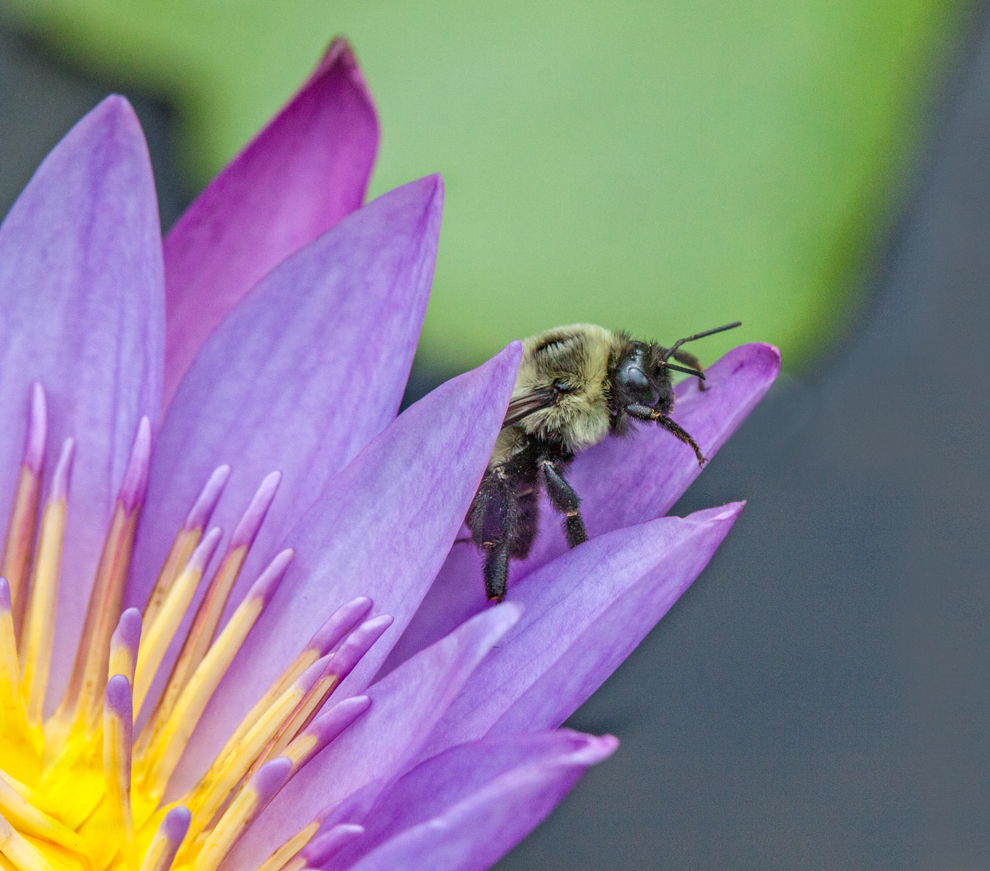
A bee landed on a petal of this purple water lily and, rather than heading for the center of the flower, the obvious source for pollen, decided to crawl down in between the petals.

I followed his movements and, after a short time, those movements ceased—I think he was stuck. Eventually the plant began to move again, this time more violently. Slowly the bee reemerged, crawling slowly up the petal, and I took this shot.

I find the tones of this image to be very soothing and purple is one of my favorite colors. If you too like purple, check out today’s postings called Violetta at Calee Photography, one of my favorite blogs.

crawling_out_blog

© Michael Q. Powell. All rights reserved

Read Full Post »

Have you noticed that I really like purple water lilies? I was so struck by their beauty the first time that I saw one last year that a purple water lily appears at the top of my blog most of the time.

Earlier this week, as I was visiting Brookside Gardens in Wheaton, Maryland,  I came across an area in which two types of purple, tropical water lilies were growing. My photography mentor, Cindy Dyer, always recommends photographing the little signs that identify flowers and other plants and these water lilies were called “Panama Pacific” and “Blue Beauty.”

As I was photographing one of the waterlilies—I think it was a Panama Pacific—a bee dove headfirst into the center of the flower. Even before the bee arrived, I had noticed that the center of the water lily seemed to be glowing and that was what I was trying to capture by underexposing the shot. If you click on the photo, you can see a higher resolution view of the image, which shows an almost three-dimensional view of the flower’s center.

diving_blog© Michael Q. Powell. All rights reserved

Read Full Post »

It was bound to happen. No more than I few days ago I lamented that I had never seen a dragonfly eating, in responding to a wonderful posting by Sue of Backyard Biology about dragonflies as super predators—you should check out her posting, unless you are squeamish about things like headless dragonflies.

Sure enough, this past weekend I was able to get some photos of a female Eastern Pondhawk dragonfly (Erythemis simplicicollis) with a bee that she had captured. Initially, I was just trying to get a photo of the beautiful emerald-colored dragonfly on the plant in the second photo. I didn’t even realize that she was cuddling a bee in her front legs, almost like a little baby.

Eventually she flew down from the plant to the edge of the boardwalk to enjoy her meal and I got the first shot. I had to lean over the edge of the boardwalk to get the photo and just barely avoided falling into the bushes below.

My usual experience is that I am so excited about photographing a subject the first time that I not very concerned about the quality of the images. I will keep my eyes open and hope to capture some more images of dragonflies feeding.

dragonfly_bee1_blogdragon_bee2_blog

© Michael Q. Powell. All rights reserved

Read Full Post »

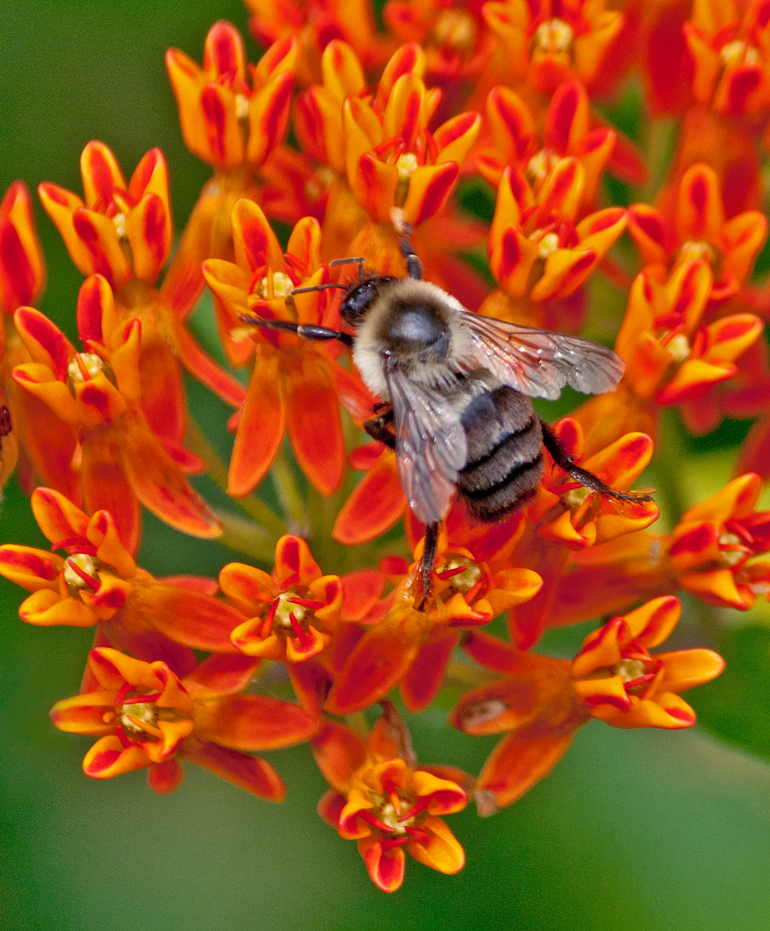
How do you approach each day? Do you embrace it with all of your energy, like this bumblebee seems to be doing as it leaps into a patch of Butterfly Weed (Asclepias tuberosa)? Most mornings, my body needs the stimulation of coffee and bright colors like those in this photo have the same effect in awakening my other senses.

I had never seen Butterfly Weed until a few days ago, when I encountered it at a local garden, and I was immediately captivated by its vibrant color. According to Wikipedia, it is a species of milkweed native to North America that attracts butterflies and hummingbirds (and obviously bees too).

I love the unusual position of this bee. It looks like he is skydiving, gliding through the air.

orange_bee_blog

© Michael Q. Powell. All rights reserved

Read Full Post »

It doesn’t get much more simple or more beautiful than this—a fuzzy bumblebee on a Purple Cone Flower (Echinacea purpurea).

I got as close as I could with my macro lens, eye-to-eye with the bee, and managed to capture some of the incredible details and colors of both the flower and the bee. Except for a minor amount of cropping and tweaking, this is pretty much what the image looked like when I first pulled it up on my computer.

It’s enjoyable to chase after more exotic creatures and environments to photograph, but it is reassuring to know that beauty is never far away—it is present in the ordinary.

big_bee_blog

© Michael Q. Powell. All rights reserved

Read Full Post »

One of my favorite plants in my neighbors’ garden is the Globe Thistle (Echinops ritro), a magical plant that has fantastic balls of tiny flowers tinged with blue, purple, and pink and has the additional benefit of attracting bees.

The plant’s spherical shape makes it a little tough to photograph and creates real issues with depth of field, but I managed to get a few shots that highlight both the shape and texture of the plants and the activity of the bees that were gathering pollen from them.

thistle2_blogthistle_blog

© Michael Q. Powell. All rights reserved

Read Full Post »

The response was so positive to my recently posted photos of a bee on a lavender plant that I decided to post a couple more of my favorite images from that session. Unlike my previous shots that attempted to capture a bee in flight, these ones were taken while the bee was busily working. The light was starting to fade, so both of these were shot with my pop-up flash and I am happy that the flash did not totally blow out the highlights.

Using flash is an area that I have not paid much attention to, but it looks like it’s worth spending some time learning more about it and experimenting with different ways of adding additional light to my photos.

top_blogmist_blog

© Michael Q. Powell. All rights reserved

Read Full Post »

Have you ever tried to take photos of a bee in flight? In the past, I have managed to get a few such shots accidentally, when a bee took off as I was shooting.

However, a few days ago when the light was fading in the early evening, I decided to try to photograph a bee in flight using my pop-up flash. I knew that timing would be critical, because the time required for the flash to recycle meant that I would get only one shot each attempt, and not a burst. It was a fun little challenge, even though most of my shots were out of focus.

I especially like the first image, in which the bee appears to be attempting to hover in mid-air. The second shot makes it look like the bee was free-falling, waiting for the optimal moment to deploy his tiny parachute.

It’s easy to get ultra-serious about photography and get bogged down thinking of settings and exposures and composition—it’s nice sometimes to just have fun and then share the results of the fun time.

hover_bee_blogjump_blog

© Michael Q. Powell. All rights reserved

Read Full Post »

When I get the urge to take some photos and don’t have much time, I like to walk over to a neighbor’s house and take photos of the bees that are usually buzzing around the lavender plants there.

A little over a week ago, I did a posting that had a super close-up shot of a bee. Today’s shot was taken from farther away and has the blurry background that I really like, with the bee still in pretty sharp focus in the foreground.  I like the way that the image shows the way the lavender droops a little from the weight of the bee and I also like the the second stalk of lavender standing tall in the mid-range area of the shot.

It’s a pretty simple composition, but the result is a pleasing image of a bee happily at work.

double_blog

© Michael Q. Powell. All rights reserved

Read Full Post »

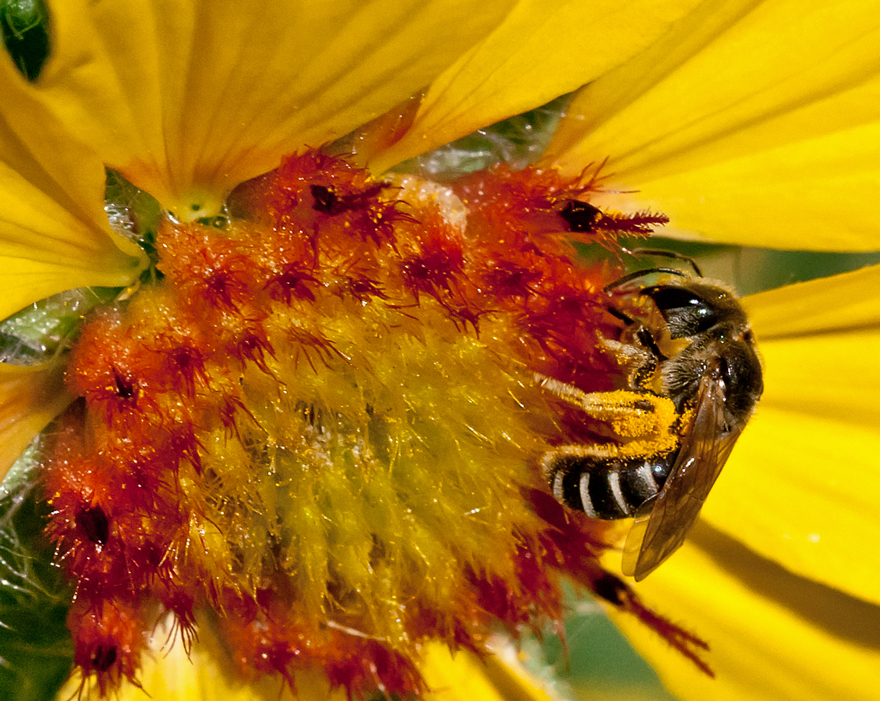
Some bees seem to be really tidy when they are gathering pollen, but this bee was a total mess, with pollen sticking all over its legs and underside. The bee looks to be some kind of honey bee, although the striped markings on its lower body seem a little unusual.

Often when I am shooting a macro shot, I am so worried about the technical aspects of the shot that I forget that photography is also an art. This image helps remind me that photography remains a creative pursuit, a fusion of art and science.

pollen_1a_blog

© Michael Q. Powell. All rights reserved

Read Full Post »

Before going out to the marsh park to shoot this morning, I decided to check out my neighbor’s garden and came across this bumblebee, hanging from the side of a a beautiful Small Globe Thistle (Echinops ritro).

I took some initial shots and then began to wonder if the bee was still alive, because it was not moving at all. When I blew gently on its face, however, it moved a little, so I figure that it was probably just sleeping. I carefully set up my tripod and got as close as my lens would let me get, which caused the bee to fill a substantial part of the frame.

I managed to capture some details that normally I do not see, like the little lines on the antennae and the hairs on the bee’s face. The bee was still sleeping when I departed—I didn’t want to risk the possibility that bees get angry if you wake them up prematurely.

close-up_bee1_blog

Michael Q. Powell. All rights reserved

Read Full Post »

One of the first rules of photography that I learned was the importance of keeping a subject’s eye in focus and I managed to accomplish that with this bee that I photographed yesterday. However, the depth of field turned out to be so shallow that only a few other parts of the bee are as precisely focused as the eye.

I was hand-holding my macro lens, which is not image-stabilized, and the sky was overcast, so I had to open up the aperture and keep the shutter speed fairly high to get a decent shot (f/6.3, 1/100 sec, ISO400). The bee was moving all around a patch of lavender in a neighbor’s garden, gathering nectar with its tongue, which is visible in the photo.

I stalked the bee for quite a while and a lot of my shots turned out to be blurry, but I ended up with a few that were ok. This is my favorite of the bunch and I think that the shallow depth of field, which is a shortcoming in many situations, is the primary reason that I like it.

lavender1_blog

Michael Q. Powell. All rights reserved

Read Full Post »

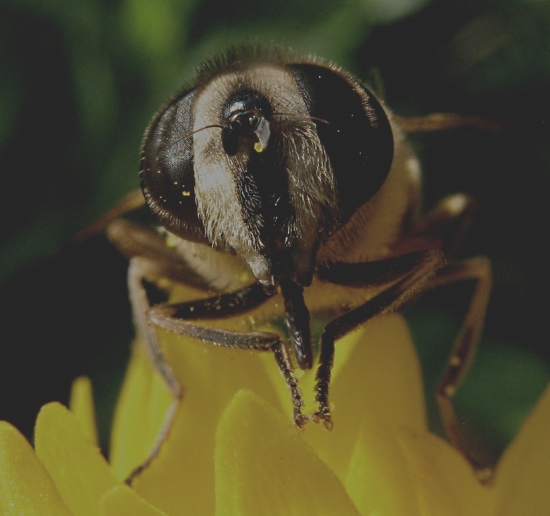
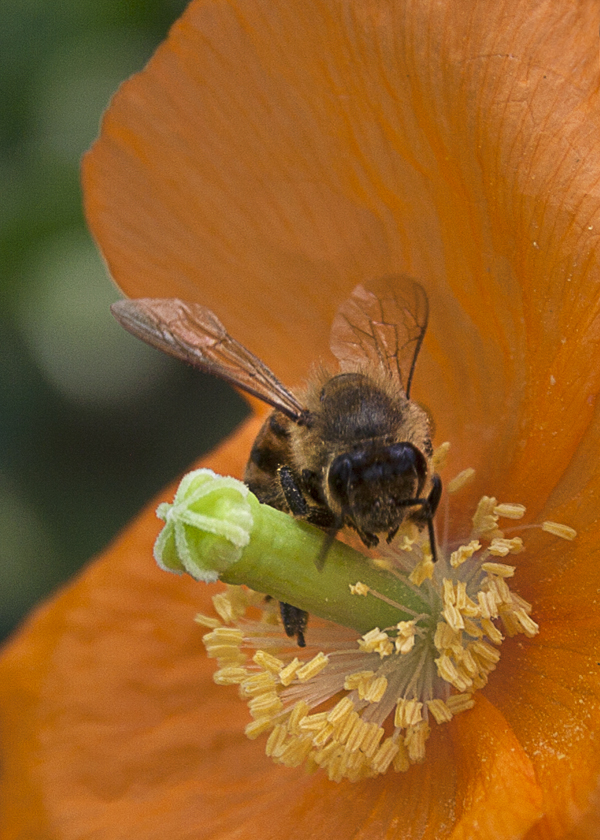
As we move through spring, I am finally starting to see more hover flies and bees, busily at work collecting food and pollinating the flowers.

The insect in the first photo is, I believe, an American Hover Fly (Eupeodes americanus). A year ago, I would almost certainly have called it a bee, but I have learned a lot about insects since then, thanks to my photography.

The second photo feature a beautiful variegated flower and what looks to be a honey bee, though it’s a little difficult to make a positive identification, because of the angle.

It’s early in the season, so I am having to recall some lessons from last year, like the need to pay attention to my distance. In my desire to get closer, I have already managed a few times to bump the flower and scare off the bee, forgetting that the lens hood on my macro lens is pretty big.

hover1_blogbee1_blog

Michael Q. Powell. All rights reserved

Read Full Post »

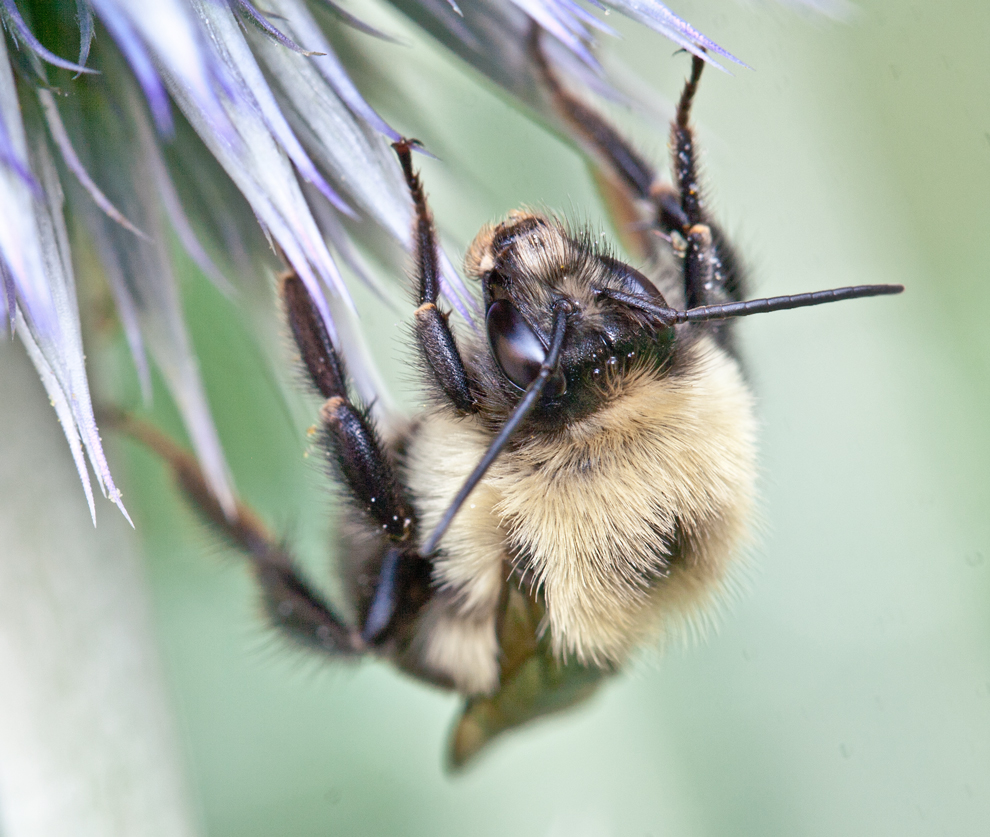
This bumblebee seems to be cleaning or adjusting one of his antennae and it caused me to wonder why. What are the antennae used for? Bumblebee.org had the answer—the antennae are used for smelling and touching. Taste and smell are conveyed to the bee through tiny hairs on the antennae.

Amazingly, bumblebees have a built-in antenna cleaner on each front leg, a notch between the metatarsus and the tibia. As bumblebee.org describes it, “The antenna is inserted into the notch then the metatarsus is bent enclosing the antenna. The antenna is then pulled through the notch and any debris or pollen is caught on the comb fringing the notch.” That site has lots more great information on the bumblebee, including electron microscope photos of the bee and a diagram of the antenna cleaner.

Bumblebee grooming an antenna

© Michael Q. Powell. All rights reserved.

Read Full Post »

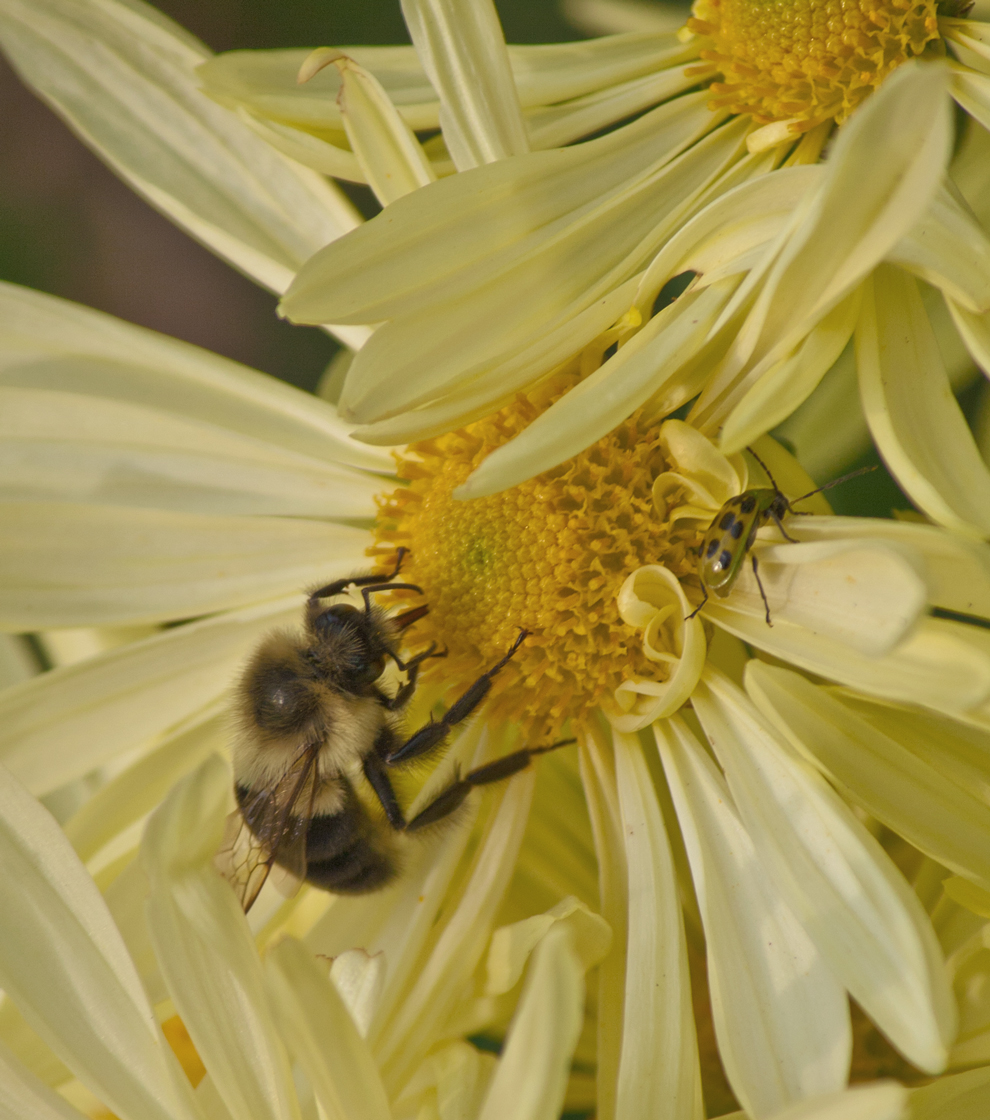
Yesterday I did a posting on a couple of interactions between birds of two species, a heron and a goose. Continuing on the same theme, here is a photo from last weekend of an interaction between insects of two species, a bumblebee and a Spotted Cucumber beetle (Diabrotica undecimpunctata). The beetle was already on the flower when the bumblebee arrived. Looking at the size of the invader, the beetle seems to have decided that a strategic retreat was the best course of action.

Interesting insect interaction

© Michael Q. Powell. All rights reserved.

Read Full Post »

Yesterday I returned to my photographic roots at Green Spring Gardens, a county-run historic park, to shoot flowers and bugs, the subjects I started with six months ago when Cindy Dyer, my mentor and muse, helped me get serious about my photography. It was cloudy and cool (about 47 degrees F (8.3 degrees C) and I didn’t expect to see many insects active. There was quite a variety of flowers blooming, including many that have been present all summer. Perhaps when we have a hard freeze, some of them will die off, but for now they provide a blast of bright color that contrasts with the now fading fall foliage.

Bee in early November

I was surprised when I encountered this bee, the only one that I saw all day. It seemed to be moving slowly in the colder weather, but was industriously working on this purple flower. Judging from its relatively hairless abdomen, I think that this might be a carpenter bee rather than a bumblebee, though I am not completely sure about the identification.

I have always mentally associated bees with spring, but now, as I look more closely at nature, I realize that I have to question all of my previous assumptions. That’s probably a good thing for me to do regularly, and not just in my photography.

Bee working in the cold

© Michael Q. Powell. All rights reserved.

Read Full Post »

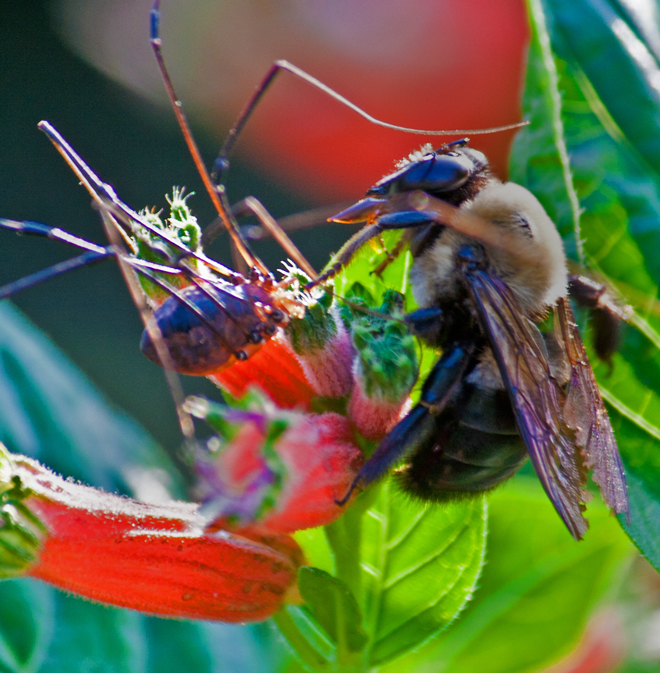
I am always fascinated whenever I happen to capture two different insects in a single image, especially when they appear to be interacting. A bee flew onto a flowering plant and appears to be having a conversation with a daddy longlegs (aka harvestman) that was already there. Does one of them look at the other as a potential prey? Are they sharing information? Is one asking the other out on a date?

Can you hear me now?

Insect interaction

© Michael Q. Powell. All rights reserved.

Read Full Post »

It was a dark and cloudy afternoon and the rain was threatening to start at any moment (and eventually did). Even my usual grasshoppers and spiders seemed to have disappeared from sight. I was losing hope that I would find anything interesting to photograph when I stumbled upon a large bee on a bright yellow plant.

It looked like a carpenter bee, but the eyes were unusually light in color. I am pretty sure that it is an Eastern Carpenter bee (Xylocopa virginica) and the white patch on the face indicates that it is a male. There are other photos on-line of carpenter bees with green eyes, but I am not sure how common it is to find one like this. I don’t recall ever seeing one like it before.

Male Eastern Carpenter bee

© Michael Q. Powell. All rights reserved.

Read Full Post »

The weather is getting cooler and it’s getting darker earlier, but it’s nice to see that there are still lots of insects around to photograph. Here’s a recent shot of a bee, still busily at work in mid-September.

Bee in mid-September

© Michael Q. Powell. All rights reserved.

Read Full Post »

I’m amazed at the size and intricacy of the webs of the Yellow Garden Orbweaver spiders (Argiope aurantia) whenever I see them at Huntley Meadows Park here in Alexandria, VA. This past weekend I had a chance to see how effective these webs are when a bee flew into the web of a spider that I was observing.

Previously I posted some photos of these spider with prey (a grasshopper and a cicada) that had been captured earlier and wrapped up in silk, but I didn’t really understand how the spider accomplished this. In this case, as soon as the bee touched the web, the spider moved quickly from the center of the web and in a few seconds had wrapped up its newest victim. I was so fascinated by what was happening in front of my eyes that my reaction time was delayed and I missed photographing those initial actions. However, I stayed and observed (and photographed) the spider’s subsequent actions.

The first photo below shows the spider as she is wrapping up the wrapping up of the bee. It’s a little hard to believe that the long package is just a bee, but I’m pretty sure that’s all that there is inside. (With all three photos, you can click on them and get a somewhat higher resolution view.) After the bee had finished, she left the package at the periphery of the web and returned to the center of the web, where she usually resides, probably hoping for another victim.

After several minutes wait, she returned to the bee and and began to transport it to the center of the web. In the photo below, you can see how she held the wrapped-up bee with some of her legs as she crawled along the strands of the web. The zigzag portion of the web is part of the path that leads to the center.

Once she was back in the center, it looks like she was preparing to eat her newly captured meal. I really like the varied positions of her legs in this photo as she holds on to her prey.

You may have noticed the blurry contours of another, smaller spider in the upper portion of the final photo. There were two small spiders hanging around the web and they seemed to be fighting with one another. I tried to capture that dynamic and will post a photo if I find one that is clear enough. I suspect that one of them may have been the mate of the female spider. Bugguide notes that the male of this species is considerably smaller than the female. Not counting legs, the male is usually 5-6 mm in size and the female is 14-25mm. I am not sure who the “other guy” was. Maybe he’s another male competing for the affections of this “lovely” lady. Any ideas?

© Michael Q. Powell. All rights reserved.

Read Full Post »

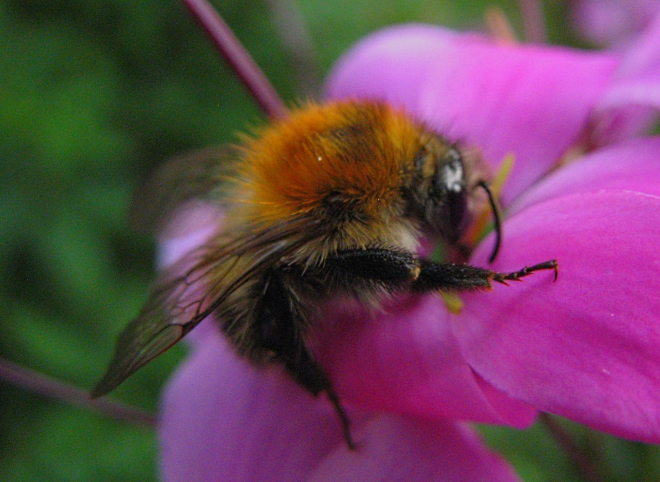
This bee is not as perfectly sharp as some that I have shot, but the softness of the image and the pink flower give this photo more of a romantic mood (if that is at all possible with a bee as the primary subject). I also like the beautiful colors in the bee’s fuzzy hair. Sometimes I feel like I would be content to photograph different kinds of bees every day, focusing at times on their hard work, at other times on their beauty, and at other times on their ferocity. It would take a long time for my fascination with bees to wear off.

Bee on a pink flower

© Michael Q. Powell. All rights reserved.

Read Full Post »

I am out of town at the moment and took along my Canon PowerShot A620, a somewhat glorified point-and-shoot camera. I had used this before for travel photos, but had never tried out the macro features of the camera. The manual claims that in macro mode you can get as close as 1 cm (.4 inches).

I decided to play around with macro on this camera by taking some shots of bees, one of my favorite subjects. The first photo is one of a bee taken straight on and I am surprised that I got the detail that I did. The other shots are pretty good as well. I would note that I had to get really close to the bees to get these shots. I also am feeling a little hamstrung, because I am producing these images on a netbook computer with somewhat limited capabilities and I am using Paint.Net to manipulate the images rather than PhotoShop or PhotoShop Elements.

Eye-to-eye with a bee

© Michael Q. Powell. All rights reserved.

Read Full Post »

Whenever I am shooting flowers of any sort I am inevitably drawn to bees. I love watching them flying and hovering, back and forth and in and out of the flowers.  Sometimes a bee seems to be systematically covering a group of flowers and other times he seems to be choosing randomly where to touch down before moving on, relentlessly in motion.

Here are a couple of recent shots of carpenter bees on a plant that I have been told is called salvia. I love its deep purple color and simple flowers. The first shot is a closeup of a bee. The second one gives you a better idea of the shape of the flower. Note that in both cases the bee is getting the nectar from the side of the flower and is therefore not pollinating it.

© Michael Q. Powell. All rights reserved.

Read Full Post »

The subject is simple and familiar, a bee and a flower. My eye was drawn, however, to the way this bee had latched on to the entire center of this flower in a full-bodied bee hug. The X-shape of the splayed legs and the radiating petals combine to produce a graphic effect that goes beyond the literal subject matter.

© Michael Q. Powell. All rights reserved.

Read Full Post »

Some bees are hairy and some bees are really hairy.

Seriously, this bee looks like he could use a beauty makeover. At a minimum he needs a trip to a barber or hair stylist to trim away some of that excess hair. Look at his legs, his forehead, and his neckline. Yikes! The worst area may be the swirly hair on his back. I haven’t seen anything that bad since the days when the comb-over was a popular hair style.

Maybe he is wearing his hair long to conceal the fact that he is going thin on his back. If that’s the case, I have news for you, Mr. Bee. “You’re not fooling anyone.”  It’s time to get with modern styles, perhaps, and shave it all off.

What would a bald bee look like?

Fuzzy Wuzzy was a bee…

© Michael Q. Powell. All rights reserved.

Read Full Post »
Does a bee ever get stuck when he flies (or climbs) into a flower with a narrow opening?

This question arose this afternoon when I watched a bee enter a flower so deeply that only his legs were visible. He remained in that position for some time and then he somehow was able to get back out of the flower. I am still not sure if he was stuck or how he was able to extricate himself. From my perspective, it was a feat worthy of an insect Houdini.

I shot a series of photos that illustrate the whole process. In this case the old adage is true about a picture being worth a thousand words. You will notice that I changed my vantage point part way through the shoot. (I had plenty of time while the bee was inside the flower.) I would also draw your special attention to the details of the last photo in which the bee has to act like a contortionist to get his legs out of the tight spot.

Who knew that bees were so flexible?

© Michael Q. Powell. All rights reserved.

Read Full Post »

You might think that I am going to talk philosophically about a bee, but my title is meant to be taken literally. If you click on the photo, you can actually see reflections of the sky and bushes on the shiny surface of the abdomen end of this bee.

I am pretty sure that this is a carpenter bee for two main reasons. First, the abdomen area is shiny and hairless, unlike a bumblebee who is more hairy. Secondly, the bee is sucking nectar out of the side of the flower rather than going in from the front, a process sometimes referred to as “nectar robbing.” Carpenter bees are notorious for circumventing pollination in certain plants by slitting open the side of the flower.

Perhaps others can see more reflections on the bee. It’s like looking at clouds and trying to see shapes—it’s a lot of fun and everyone sees something different. Life is like that sometimes.

Click the photo to see more details

© Michael Q. Powell. All rights reserved.

Read Full Post »

Do you ever get in the mood for a single color? This evening I am in an orange mood. (As a disclaimer I should mention that I drive an orange car, so orange plays a larger role in my daily life than it probably does for most others.) To scratch that itch, I decided to post some photos from late May of an orange poppy and some of the insects that visited it.

May was the month when I first started getting more serious about photography and these photos were an early indication to me that I was improving. I still enjoy looking at them, remembering some of the early twists and turns of the photography journey on which I have embarked.

As I think back, I feel like I was just learning to walk. Now I can walk with much greater confidence. I look forward to being able to run.

Visiting bee

Visiting hoverfly (flower fly)

Visiting ant

© Michael Q. Powell. All rights reserved.

Read Full Post »

What do bees do when it’s raining? I never really gave the question much thought until this morning when I saw a really cool photo by the unUrban Studio showing a bee seeking shelter in an orchid in an early morning rain. In an earlier post today I showed a bee clinging to the underside of a leaf for protection from the rain.

During a walk in the light rain this afternoon I was pleased to also discover the bee shown below, sheltered inside of a red hibiscus flower. He appeared to be completely protected and may have been napping. As you can probably tell, I had to lighten the image a little to reveal the bee more clearly. This caused the sky, which was light already, to go totally white and produced an effect that I really like.

I enjoy walking in the rain and sometimes carry my camera under an umbrella if it is not raining too hard. From now on I’ll make a point of peeking into flowers and under leaves to discover more secret hiding places of the bees.

© Michael Q. Powell. All rights reserved.

Read Full Post »
« Newer Posts - Older Posts »