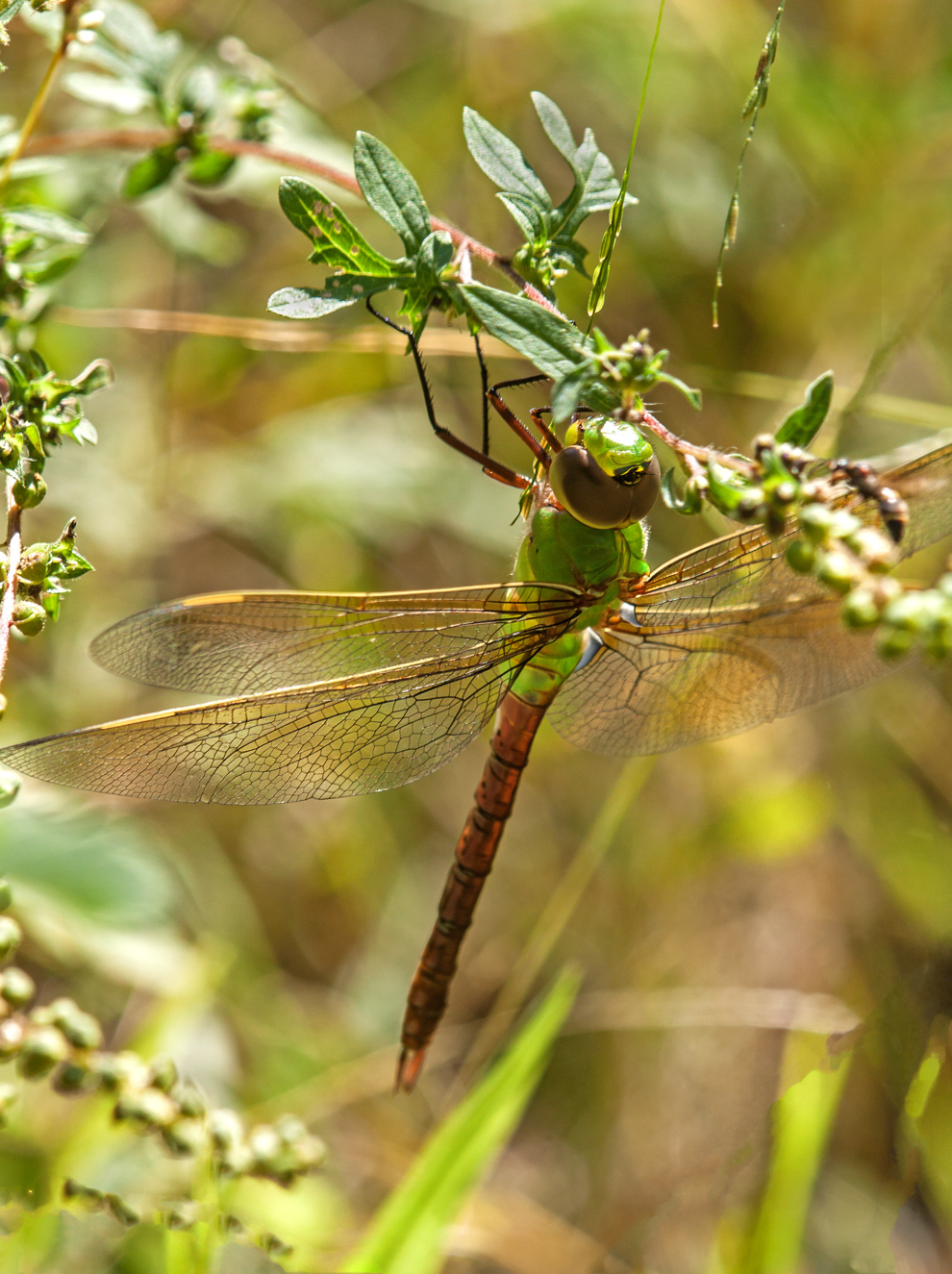
Feeds:
Posts
Comments

Posts Tagged ‘Anax junius’

I have been seeing dragonflies at my local marshland park for a couple of weeks now and yesterday I finally got my first dragonfly shots of the spring. It’s still a little early for the emergence of the local dragonflies, so I was not at all surprised that the dragonflies that I captured were Common Green Darners (Anax junius), a migratory species.

Green Darners spend most of their time flying, rather than perching, so it is pretty tough to take photos of them. In this case, I captured the pair in tandem, as the female was ovipositing in the vegetation of a shallow vernal pool.

As luck would have it, after a day of walking around with my telephoto zoom lens on my camera, I had switched to a macro lens not long before I encountered these dragonflies. My macro lens is 180mm in focal length, but that really didn’t get me close enough to the dragonflies. I tried unsuccessfully to be stealthy in moving closer, but the Green Darners flew away as I drew nearer.
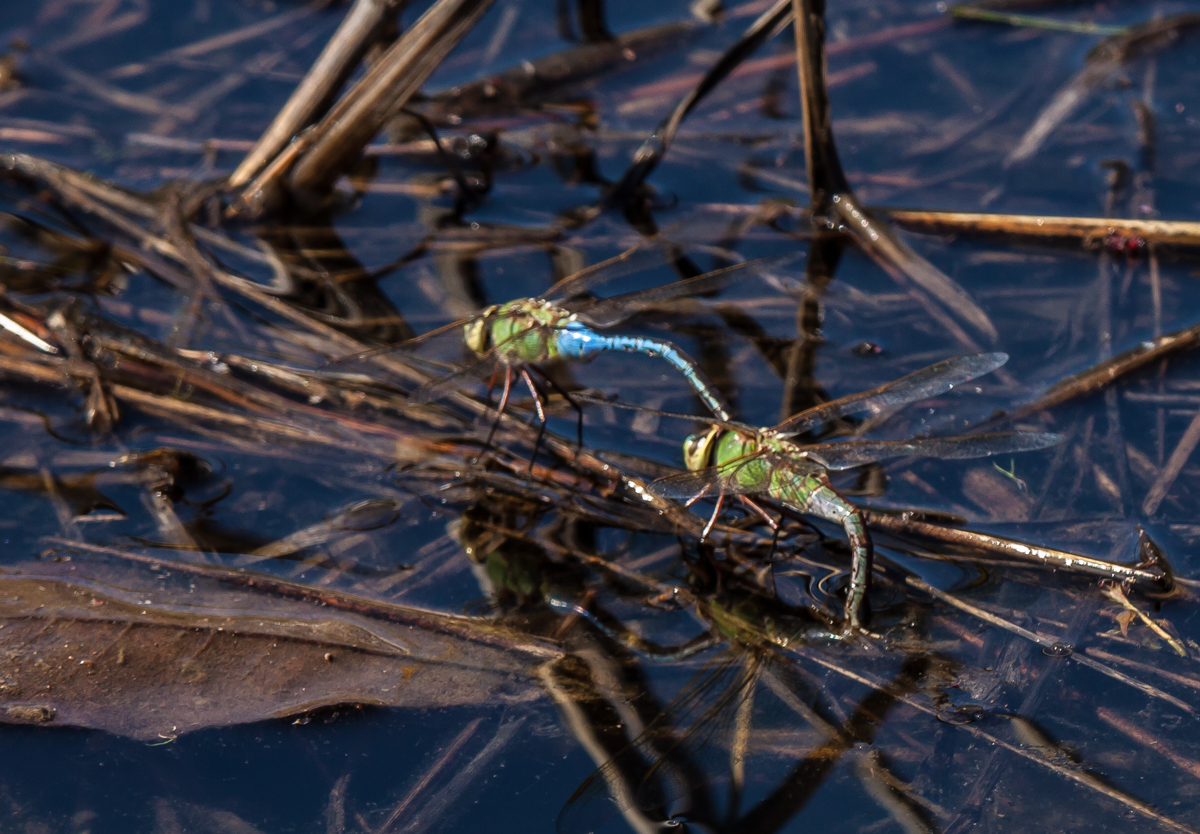
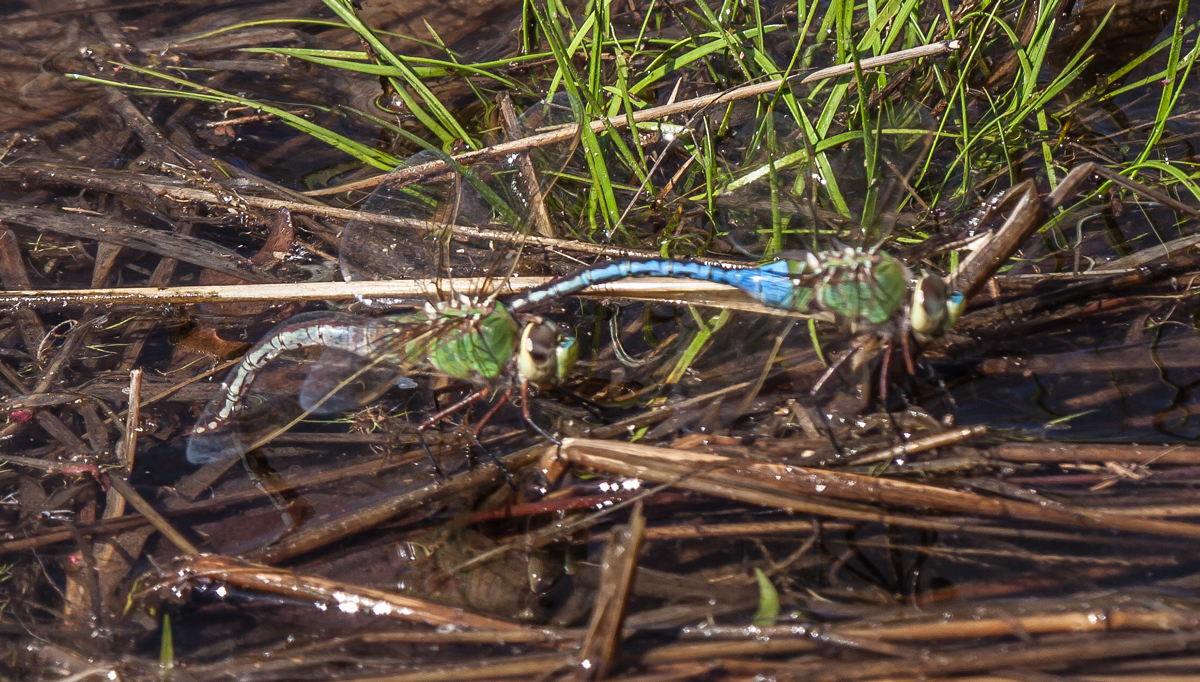
Common Green DarnerCommon Green Darner

© Michael Q. Powell. All rights reserved.

Read Full Post »

It’s migration time for Common Green Darner dragonflies (Anax junius) and last week one of my fellow photographers, Walter Sanford, reported a small swarm of Green Darners at my local marshland park.

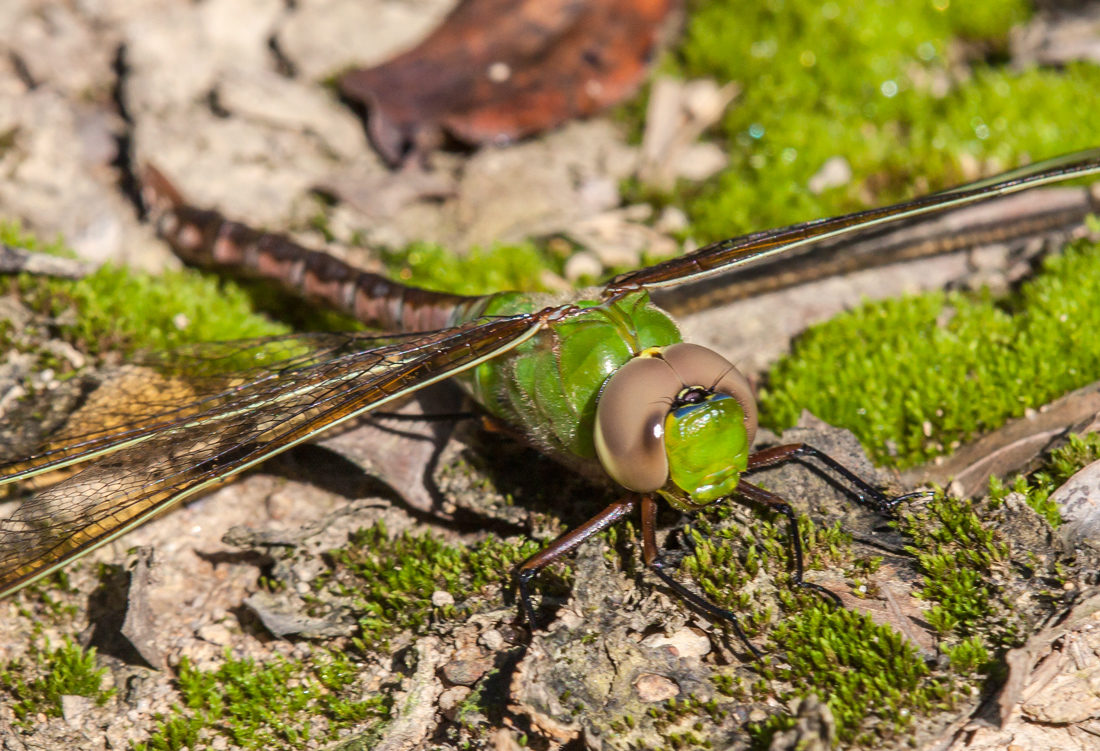
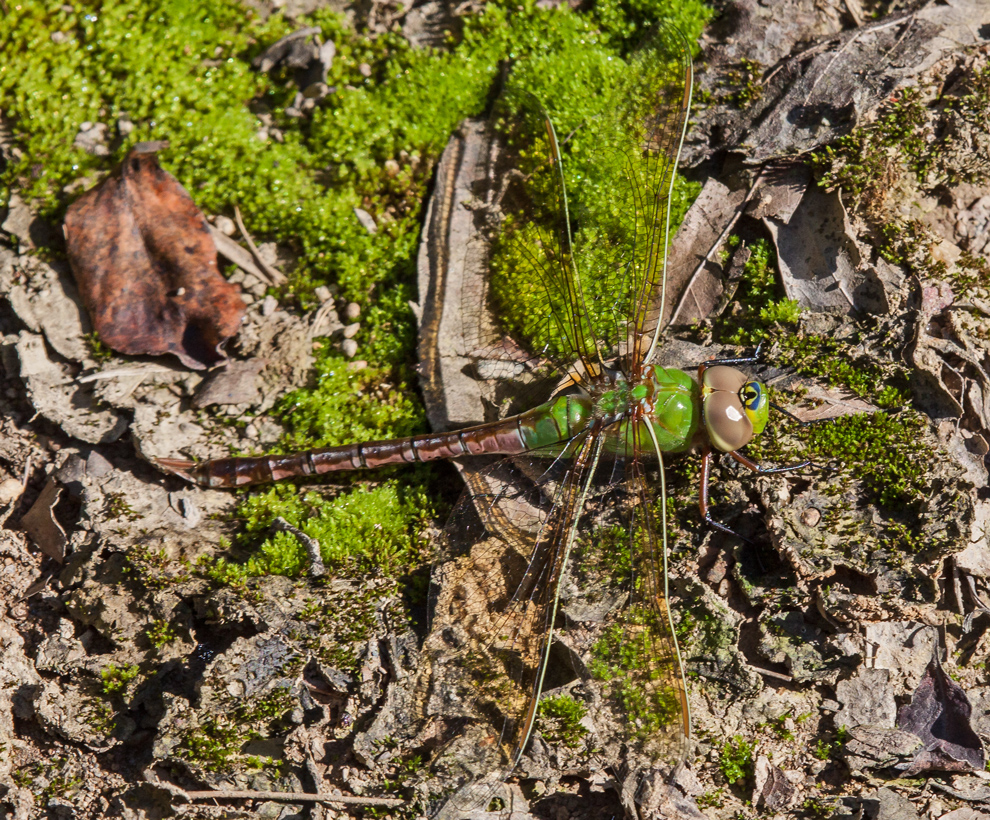
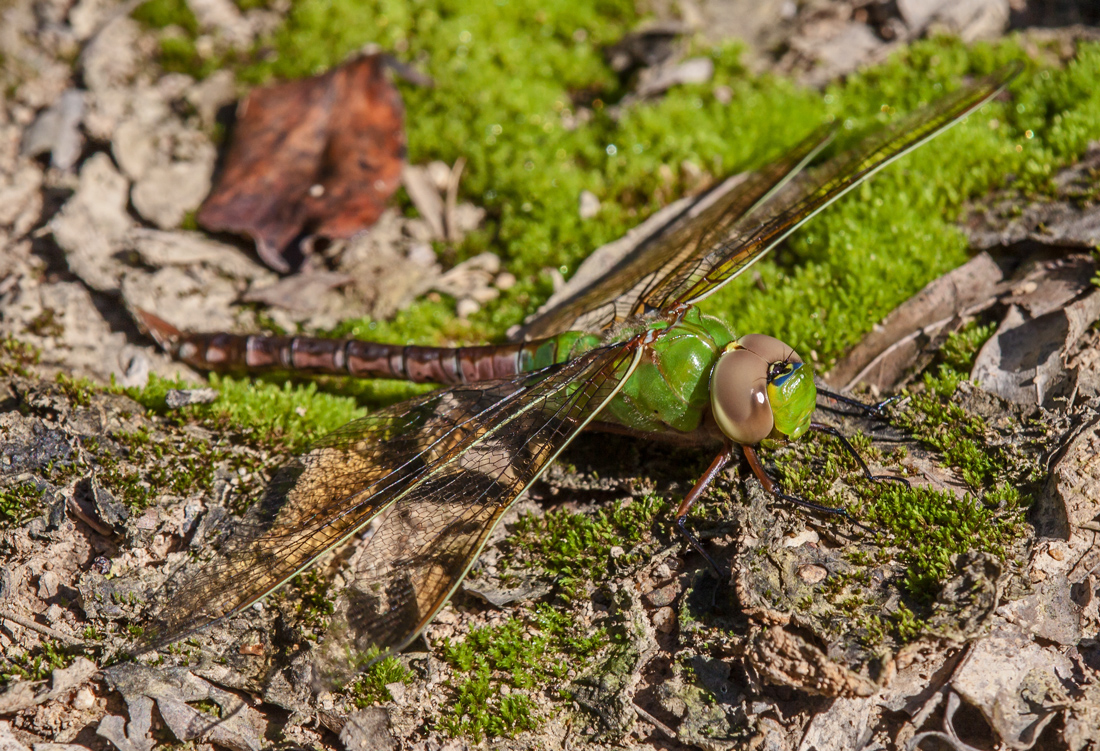
I was walking in an entirely different area of the park from Walter and was surprised to see Green Darners, which are easily recognized thanks to their coloration and distinctive bullseye on their heads, flying up from the ground as I approached them. Rather than fly off into the distance, which is most often the case when I happen to disturb a dragonfly, these dragonflies moved only a short distance and came to rest again on the ground.

I don’t yet have the ability to interpret the movements of dragonflies, but it seemed to me that these Green Darners were conserving energy, as though they were resting in the midst of a long journey. I tried to be as quiet and stealthy as I could and moved closer and closer to one Green Darner perched near some green moss that was almost a perfect match for the color of the forward portion of her body. Judging from her overall coloration, I think this is probably a female.

My subject was amazingly cooperative and I was able to get shots of this beautiful dragonfly from a number of different angles. Although I normally try to have backgrounds that are must less cluttered than those in these images, I don’t find them to be too distracting here and they do help to show how well this colorful dragonfly blended in with her environment.

Common Green DarnerCommon Green DarnerCommon Green DarnerCommon Green Darner

© Michael Q. Powell. All rights reserved.
Read Full Post »

As I was walking through a meadow at my local marsh this past Monday, dragonflies would take off from the high grass and low vegetation as I approached. Most of them appeared to be Common Whitetail dragonflies (Plathemis lydia), a species that seems to like to perch on the ground.

One of the dragonflies, however, really caught my eye, because it was larger than the rest and was a pastel green in color. At first, I thought it might be a female Eastern Pondhawk (Erythemis simplicicollis), one of the few green dragonflies that I have encountered. The green dragonfly flew weakly away and came to rest on some low vegetation a short distance away. As I drew closer, I noted that the dragonfly was hanging from the vegetation and was not perching on it, so I knew it was not an Eastern Pondhawk, which perches horizontally.

When I got a clear look at the dragonfly’s body, I could see that it was shaped like a darner, and I concluded the beautifully-colored dragonfly was probably a young Common Green Darner (Anax junius), judging from its shape and pale coloration. I hadn’t really considered the possibility that this might be a Green Darner, because dragonflies of this species are really strong fliers and I had never seen one behave like this.

I’m going out shooting later today, searching for more beautiful butterflies and dragonflies, enjoying the good news that they are still here with us.

Common Green DarnerCommon Green Darner

© Michael Q. Powell. All rights reserved.
Read Full Post »

Spring is here and I am once again chasing dragonflies, on a quest to capture images of these beautiful insects. Common Green Darners (Anax junius) rarely seem to perch, so I was forced to try to photograph them in flight.

This early in the spring, there aren’t yet a lot of dragonflies, so my patience was tested as I waited for one to fly by. I tried a lot of different approaches and the one that worked best on this day was to focus manually, which is a bit of a challenge at 300mm when the subject is moving pretty fast.

I hope I’ll get some better shots later this season—this is my best one so far.

dragonfly_flight_blog

© Michael Q. Powell. All rights reserved

Read Full Post »

The weather has gotten warmer, but I was still a bit surprised when I saw my first dragonfly of the year yesterday at Huntley Meadows Park, my local marsh. I think that it is a female Common Green Darner dragonfly (Anax junius), one of the species that migrates north after spending the winter in warmer places. This is the only dragonfly that I saw yesterday and I was able to squeeze off a couple of shots before it disappeared. I’m hoping that it won’t be long before I see more dragonflies and butterflies, some of my favorite photographic subjects.

dragonfly_april_blog

© Michael Q. Powell. All rights reserved

Read Full Post »

Yesterday at my local marsh, I noticed some large dragonflies flying over the cattails and realized that it was migrating season for Green Darner dragonflies (Anax junius). I don’t usually think of dragonflies as migratory creatures, but I recall from early spring that Green Darner dragonflies spend their winters in the south and migrate north in the spring (or at least their offspring fly north).

Green Darners are pretty big dragonflies, with bodies up to 3 inches (75mm), so I decided to try to photograph one in mid-flight. Another photographer and I spent almost an hour trying to track and photograph the dragonflies. Unlike other times, when I photographed dragonflies when they were hovering, I was attempting to capture these dragonflies as they were flying at a normal speed, which greatly complicated the task.

I knew that there was no way that I could isolate a flying dragonfly against the green plants of the marsh, so I concentrated on the dragonflies in areas in which I would have the sky as a backdrop. I used my 180mm macro lens and would try to follow a dragonfly in the viewfinder and track it, hoping it would fly close enough for me to attempt a shot. As I was tracking the dragonfly, I would focus manually. Needless to say, my success rate was really low, but I am happy that I managed to get the shot below of what I believe to be a female Green Darner. My fellow photographer, who was using a 70-200 telephoto zoom lens used a different approach and pre-focused on an area and took a shot when a dragonfly entered that capture zone.

It was a beautiful, sunny fall day and I enjoyed this challenge, which gave me a greater appreciation for the aerial skills of dragonflies—they are really tough to track. This practice, though, should help me later in the fall when I start to take more photographs of birds.

flying_dragonfly_blog

© Michael Q. Powell. All rights reserved.
Read Full Post »

Today I saw my first dragonflies of the spring, which I am pretty sure were Common Green Darners (Anax junius). They buzzed by me several times, but never stopped to perch.

I had reconciled myself to the likelihood that I would not get a single shot.  Suddenly a dragonfly that I was chasing stopped and hovered over the water. I have never had any success before in capturing an in-flight image of a dragonfly, but somehow I was able to grab focus and got several pretty good shots. The beautiful, two-toned colors of this dragonfly are amazing.

I look forward to a new season of chasing dragonflies, but suspect that I will have to work hard to top this first dragonfly of the spring.

dragonfly_blog

Michael Q. Powell. All rights reserved

Read Full Post »

« Newer Posts