Feeds:
Posts
Comments

Posts Tagged ‘Anax junius’

It is getting to be that time of the year when certain dragonfly species, like the Common Green Darner (Anax junius), begin to migrate southward. Most people are aware of the migration of Monarch butterflies, but are surprised to learn that some dragonflies also migrate.

The Science News website described this amazing migration in an on-line article, “At least three generations make up the annual migration of Common Green Darner dragonflies. The first generation emerges in the southern United States, Mexico and the Caribbean starting around February and flies north. There, those insects lay eggs and die, giving rise to second generation that migrates south until late October. (Some in that second generation don’t fly south until the next year, after overwintering as nymphs.) A third generation, hatched in the south, overwinters there before laying eggs that will start the entire process over again.”

Last week I spotted a formation of helicopters flying in formation overhead as I was searching for dragonflies at Occoquan Bay National Wildlife Refuge. For a moment the helicopters, which look to be UH-60 Black Hawk helicopters, reminded me of migratory dragonflies. Before long their loud engines disturbed my reverie and I realized that they were probably flying to Fort Belvoir, a nearby military base.

The image I captured of the helicopters may look like it was turned into black-and-white after the fact, but that was actually the way that it came out of the camera. I really like the stark,  monochromatic feel of image that works well with the subject.

helicopters

© Michael Q. Powell. All rights reserved.

Read Full Post »

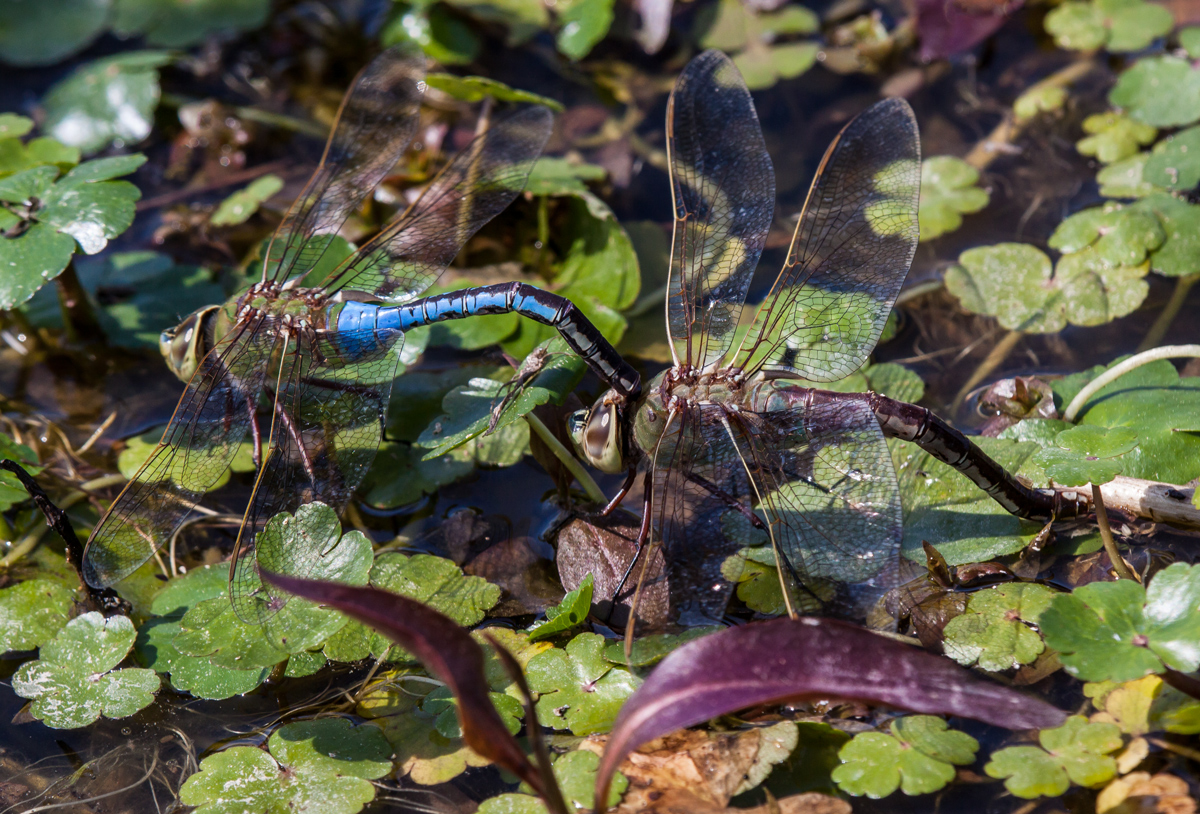
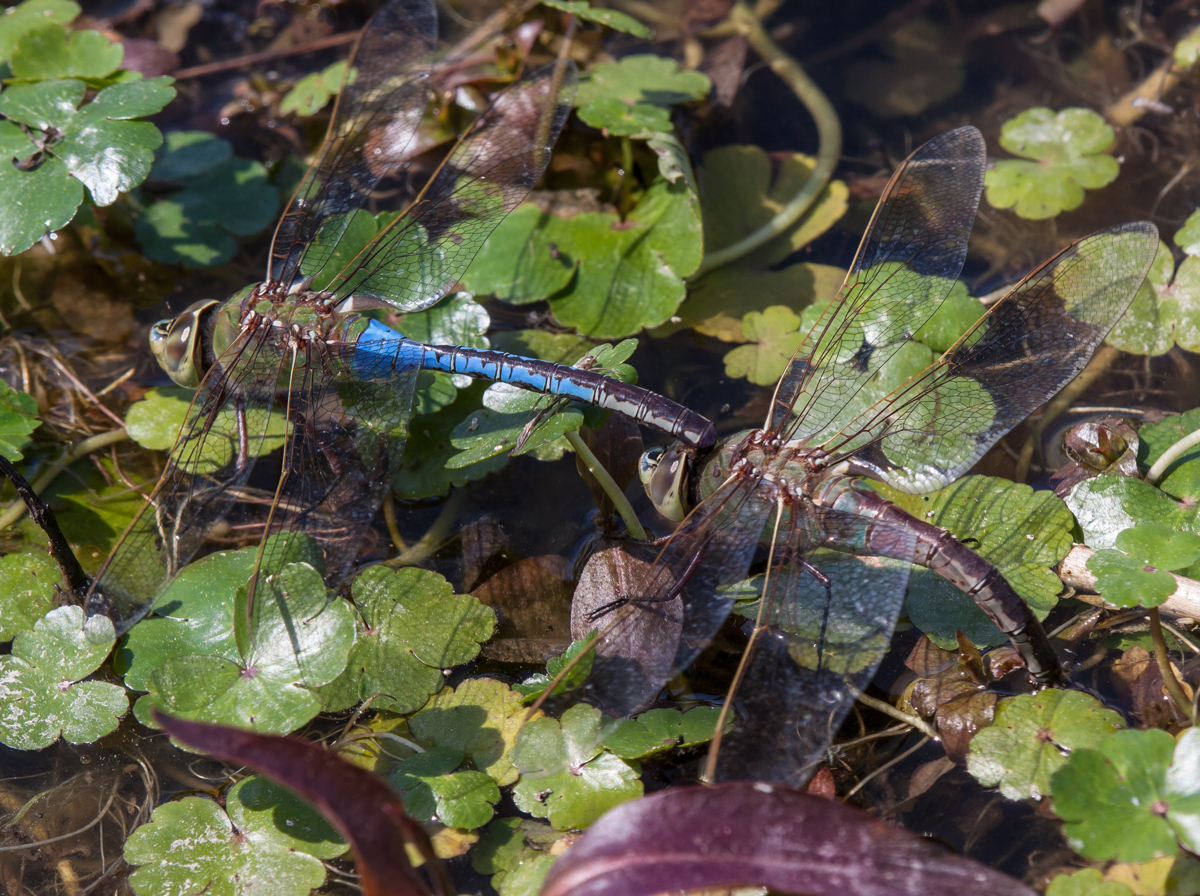
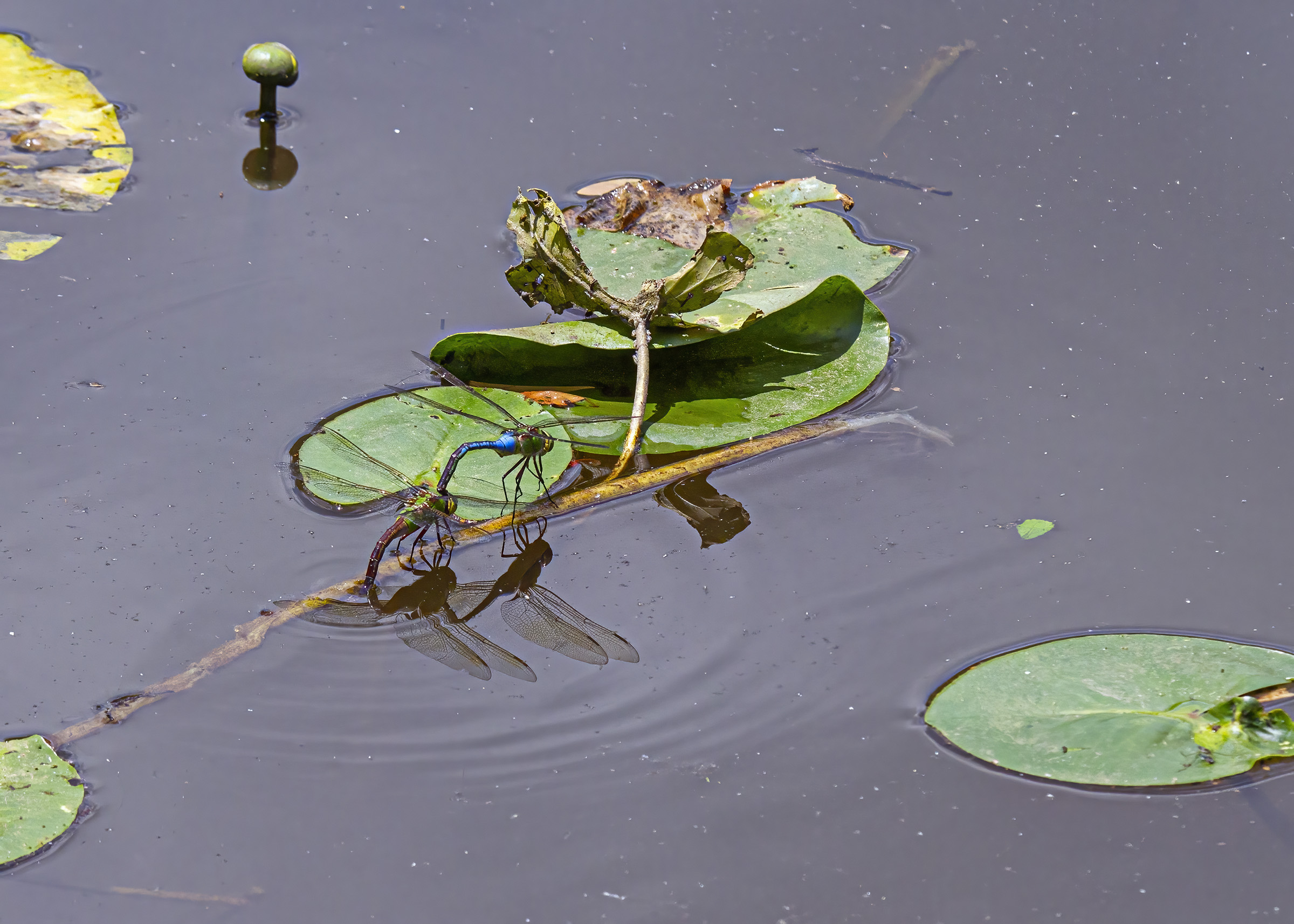
A small group of Common Green Darner dragonflies (Anax junius) was active on Monday at Occoquan Regional Park, including a couple that, after mating, was depositing eggs in the floating vegetation. The male (the one with the blue abdomen) holds onto the female while she does the actual work and then they fly off together still attached in the “tandem” position to another patch of vegetation.

Common Green Darners are a migratory species and I suspect that these particular dragonflies were part of that migration. Most people are aware of the migratory pattern of Monarch butterflies, but are unaware of the fact that Common Green Darners follow a similar pattern. The Science News website provides a good overview of that migration.

“At least three generations make up the annual migration of common green darner dragonflies. The first generation emerges in the southern United States, Mexico and the Caribbean starting around February and flies north. There, those insects lay eggs and die, giving rise to a second generation that migrates south until late October. (Some in that second generation don’t fly south until the next year, after overwintering as nymphs.) A third generation, hatched in the south, overwinters there before laying eggs that will start the entire process over again.”

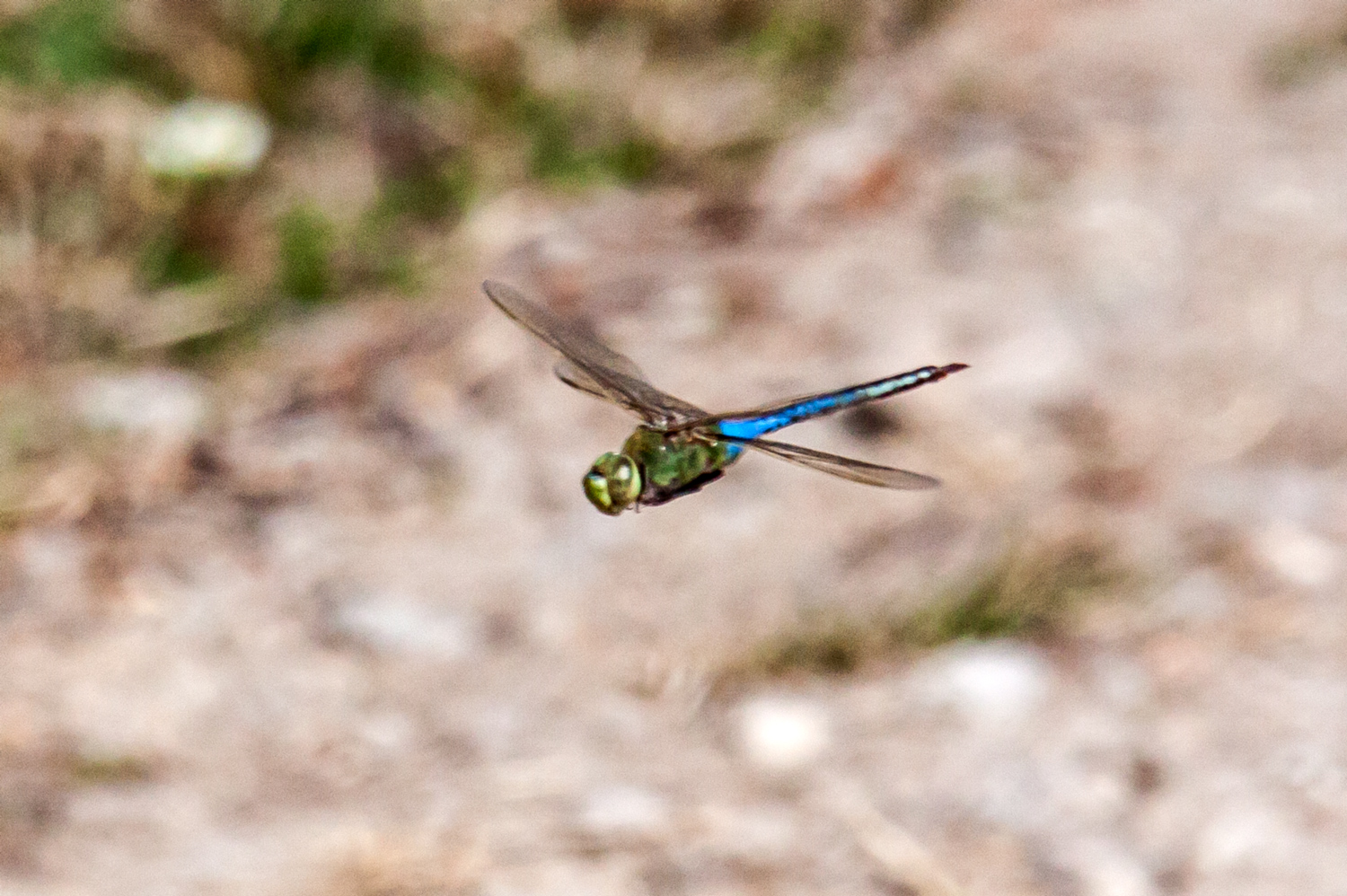
I was quite fortunate that the patches of vegetation where the dragonflies were depositing the eggs were relatively close to the edge of the pond, so I was able to capture the shots of the dragonflies in action. The second shot was one that I snapped as the couple zoomed by—long-time readers of my blog know that I love to try to capture images of dragonflies while they are flying.

The final image shows one a male Common Green Darner that was flying all around the small pond, searching for food or a mate (or maybe both). It is a fun challenge to try to track and photograph a dragonfly in flight and I felt a little rusty after spending the winter photographing birds. I was therefore quite thrilled when this shot turned out so well. Some newer mirrorless cameras have tracking systems that lock focus on moving subjects, but my trusty Canon 7D DSLR has 2009 technology, so it is a little trickier for me to get shots in—it is definitely a “hands-on” process.

Common Green Darner

Common Green Darner

Common Green Darner

Common Green Darner

© Michael Q. Powell. All rights reserved.

Read Full Post »

There were several Common Green Darner dragonflies (Anax junius) flying overhead on 10 October at Occoquan Bay National Wildlife Refuge. One of them landed and perched momentarily low in the vegetation and I was able to capture this image.

I have been seeing fewer and fewer dragonflies on the ground as we move deeper and deeper into October, but in the air I have been seeing quite a few Common Green Darners, Black Saddlebags, and Wandering Gliders, the dragonfly species that migrate through our area. Many of the members of the surviving summer species appear to be faded and tattered, but the migrants appear to be bright and pristine.

The tangled grasses and vegetation where the dragonfly was perched were dried out and mostly void of color, which helps the green of the dragonfly’s thorax to really stand out in the photo. I also like the way that I was able to capture the transparency and details of the dragonfly’s wings.

Common Green Darner

© Michael Q. Powell. All rights reserved.

Read Full Post »

Dragonflies were flying overhead at several locations at Occoquan Bay National Wildlife Refuge on Thursday, including a Common Green Darner (Anax junius), multiple Black Saddlebags (Tramea lacerata), and at least one Wandering Glider (Pantala flavescens). The Wandering Glider, alas, was elusive and I could not get an in-flight shot of it, but I did manage to get a shot of a Common Green Darner (1st photo) and a Black Saddlebags (2nd photo).

All three of these dragonfly species are migratory species. Migrating dragonflies will often fly in mixed swarms that are large enough that they are sometimes picked up by weather radars. For more details about this phenomenon, check out this September 2019 article in the Washington Post entitled “Weather radar is picking up swarms of dragonflies from the Midwest to the Mid-Atlantic.”

Common Green Darner

Black Saddlebags

© Michael Q. Powell. All rights reserved.

Read Full Post »

This handsome Common Green Darner dragonfly (Anax junius) does not have all of the colors of the rainbow, but it does have many of them and I love its mix of vibrant colors. The dragonfly was perched vertically really low in the vegetation when I spotted it during a recent to Occoquan Regional Park. I ended up sprawled almost flat on the ground to get this shot—my position would have made for an amusing photo, but fortunately no one else was around to capture that moment.

Mature male Common Green Darners have bright blue abdomens. The reddish pink color of this dragonfly’s abdomen suggest to me that it is an immature male. Early and late in the season, the abdomens of male Common Green Darners may appear purple. Common Green Darners have dark-colored platelets in their blood that rise to the surface when it is cold, darkening their abdomen color and attracting more sun. On bright, hot days, those dark platelets sink, and the abdomen turns bright blue again, now reflecting light.

Common Green Darner

© Michael Q. Powell. All rights reserved.

Read Full Post »

I spotted a female Common Green Darner dragonfly (Anax junius) as she was ovipositing while her male partner held onto her last Saturday at the edge of the small pond at Jackson Miles Abbott Wetland Refuge. Common Green Darners are large dragonflies—about 3 inches (76 mm) in length—so it was relatively easy to track the pair as they moved about placing eggs in various patches of vegetation in the water.

After mating takes place, the males of some species of dragonflies disappear.  In other species, the male stays nearby, guarding the female and fending off other males that might remove the initial suitor’s sperm and replace it with their own.  Some species, like this Common Green Darner, remain attached to the female in a position known as “tandem.” while egg-laying takes place.  The female Common Green Darner submerges her abdomen and lays her eggs in or on the aquatic vegetation, as you can see in these images. If you look really closely at the first image, you can see what I believe is the dragonfly’s curved ovipositor that she uses to make a little slit into the vegetation in which to place the eggs.

According to an article on Animal Diversity Web, there are two different lifecycles for Common Green Darners, one for the dragonflies that have migrated northward and one for the resident population. “Migratory adults mate and oviposit in June. Unlike resident populations, nymphal development for migrant offspring takes only 3 to 5 months, and they do not overwinter. They emerge as tenerals typically around late-August and September. They often begin their migration as tenerals, feeding along the way and developing into adults.” The timing of the activity that I observed suggests that these could be migrant Common Green Darners.

“For residents in the north, the adults mate and oviposit in late July to August. The resulting offspring hatch and develop to mid-instars and then overwinter when temperatures drop. Total nymphal development time can take 11 to 12 months for residents, as the nymphs finish development when temperatures warm in the spring and then emerge as adults in the following June and July.”

I highly recommend the article that I referenced, which has lots more fascinating information about this colorful dragonfly species.

Common Green Darner

Common Green Darner

Common Green Darner

Common Green Darner

© Michael Q. Powell. All rights reserved


Read Full Post »

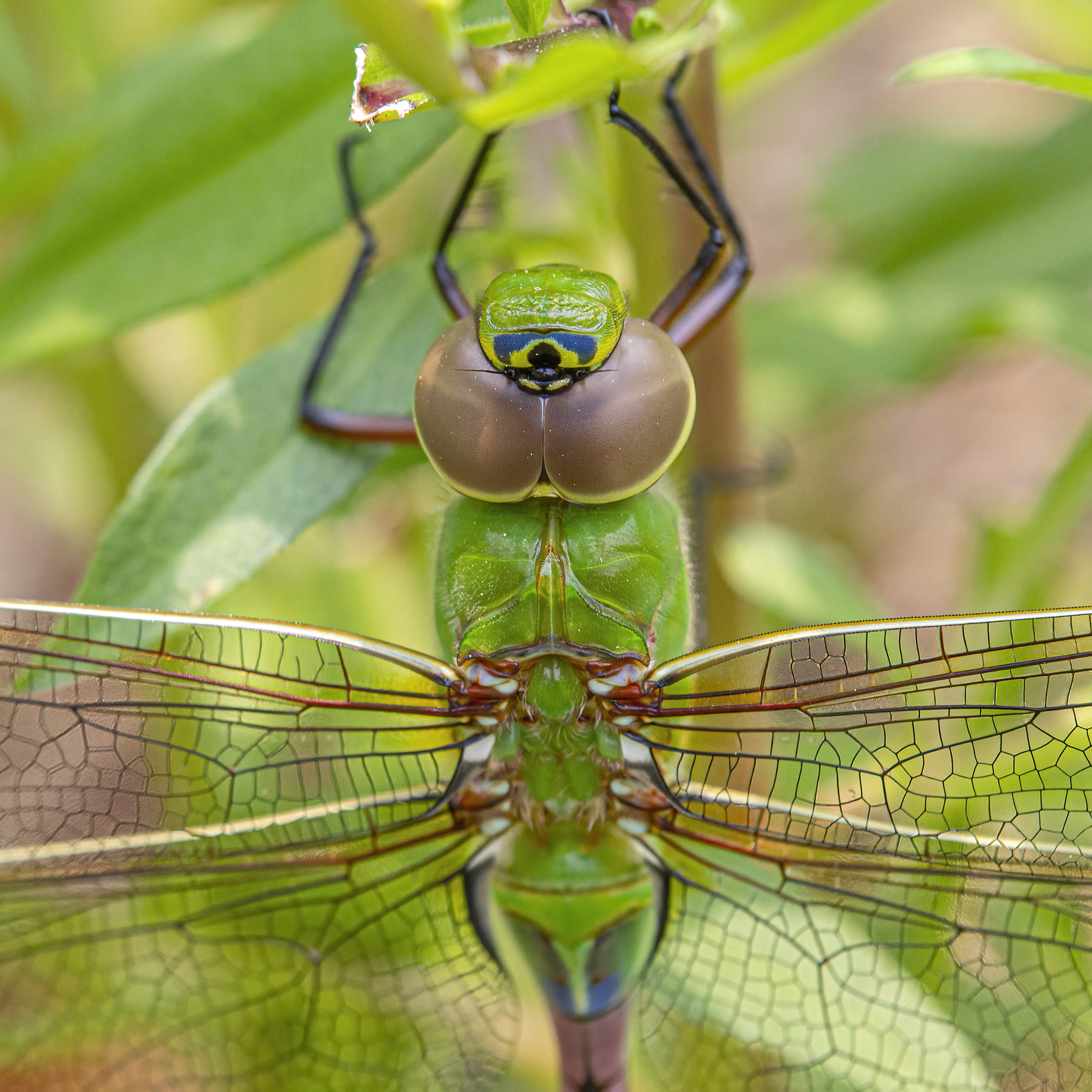
I am used to seeing Common Green Darner (Anax junius) dragonflies flying overhead, but on Tuesday I had the relatively rare chance to see one up close at Occoquan Regional Park. The Common Green Darner is a large, colorful dragonfly that is known for its long distance migratory flights. According to Wikipedia, “By attaching micro-radio transmitters to Common Green Darners, researchers have found them to be capable of migrating up to 140 kilometers in a day, though they typically cover less distance per day. ” Wow!

I spotted this dragonfly when I saw it fly to a perch in the vegetation just inches above the ground. I slowly made my way towards the vertically-perched Common Green Darner and surprisingly it did not move. I am not certain, but I had the impression that the dragonfly had newly emerged and was resting as its body parts dried out.

My 180mm macro lens gives you the impression that I was right on top of the dragonfly, but I was actually quite a bit farther away than it seems. After I took a few shots and moved away, the Common Green Darner remained in place. In fact, when I passed by the same area about twenty minutes later, it was still perched there.

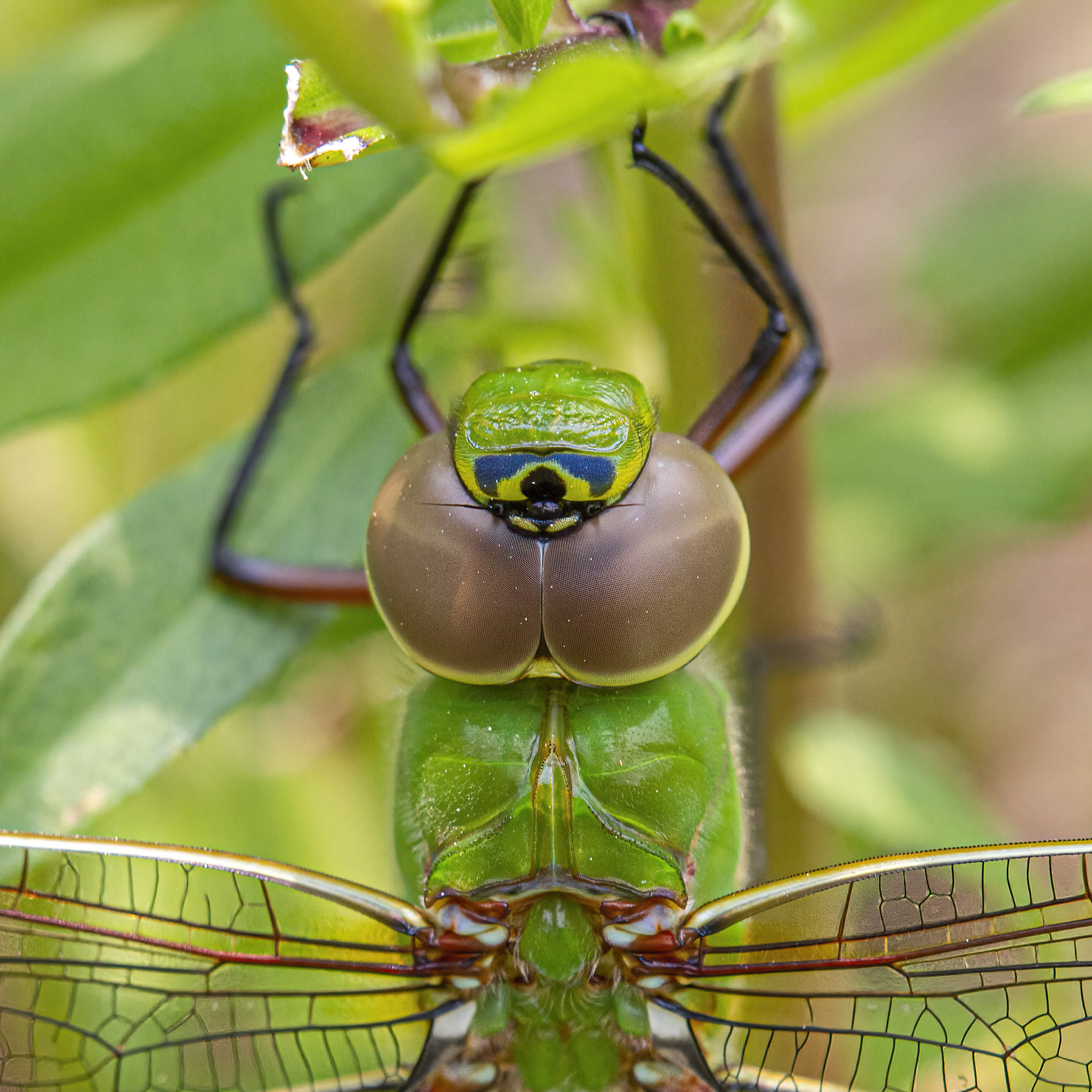
I was thrilled by the amount of detail that I was able to capture. You can easily see the distinctive “bullseye” marking, for example, on the “face” of the dragonfly. The second image is a closer crop of the first image and it helps you to see some of the ommatidia, the thousands of faceted optical units that make up the dragonfly’s amazing compound eyes. You may want to click on the image to make it larger on your screen.

According to an on-line article called Dragonfly’s Eyes, “Dragonflies have very large eyes and have very good vision. Vision dominates their behaviour, including predation and looking for mates. The compound eye is made up of ommatidia which is a visual unit consisting of a lens system and a group of light sensitive cells. A large dragonfly may have up to 30,000 ommatidia in each compound eye. Each ommatidium collects one visual information, together form a mosaic image in the dragonfly’s brain. It is believed that the insects’ compound eyes are not as high resolution as vertebrate eyes. However, the dragonfly’s visual system is extremely sensitive to movement and it points in almost all direction and gives the 360 degree visual field.”

Common Green Darner

Common Green Darner

© Michael Q. Powell. All rights reserved.

Read Full Post »

On Tuesday I spotted this female Common Green Darner (Anax junius) dragonfly at Occoquan Bay National Wildlife Refuge, the first darner that I have been able to photograph this season. Like most darners, Common Green Darners are relatively large dragonflies—about 3 inches (76 mm) in length—that spend a lot of time patrolling in the air. In fact, Common Green Darners are one of a handful of dragonflies that migrate, so that the earliest ones that we see in spring are likely to have migrated from more southern locations before local Common Green Darners have emerged.

When I first spotted this dragonfly, she was patrolling over a field of tall vegetation. I watched her fly back and forth for quite a while. When she decided to take a break, I was lucky to see where she landed.

As you can see in the photo, Common Green Darners normally hang vertically. In this case the dragonfly perched relatively close to the ground, so it was a bit of a challenge to frame the shot, particularly because I was shooting with my long telephoto zoom lens. I am quite pleased, though, with the resulting image that shows off a lot of the details of this species, including the distinctive black and blue “bullseye” in from of the dragonfly’s large compound eyes.

Common Green Darner

© Michael Q. Powell. All rights reserved.

Read Full Post »

I have been a bit befuddled by the dragonflies that I have seen here in Bastrop, Texas and have misidentified about half of them. I was therefore delighted on Wednesday when I managed to get a few shots of a familiar species—a Common Green Darner.

The Common Green Darner dragonfly (Anax junius) had been patrolling overhead and I managed to track it when it came down to earth and perched low in the vegetation. I only had a little latitude in trying to frame my shot, because I know from experience that Common Green Darners can be very skittish. I varied my angle a little between shots by moving slightly, but most of the shots ended up looking pretty similar.

Common Green Darners are a migratory species and are one of the most common and abundant dragonfly species in North America. I love the beautiful colors of this species and am happy when I can get a shot, like the first one, in which you can see the bullseye marking on the “nose” of the dragonfly.

Common Green Darner

Common Green Darner

© Michael Q. Powell. All rights reserved.

Read Full Post »

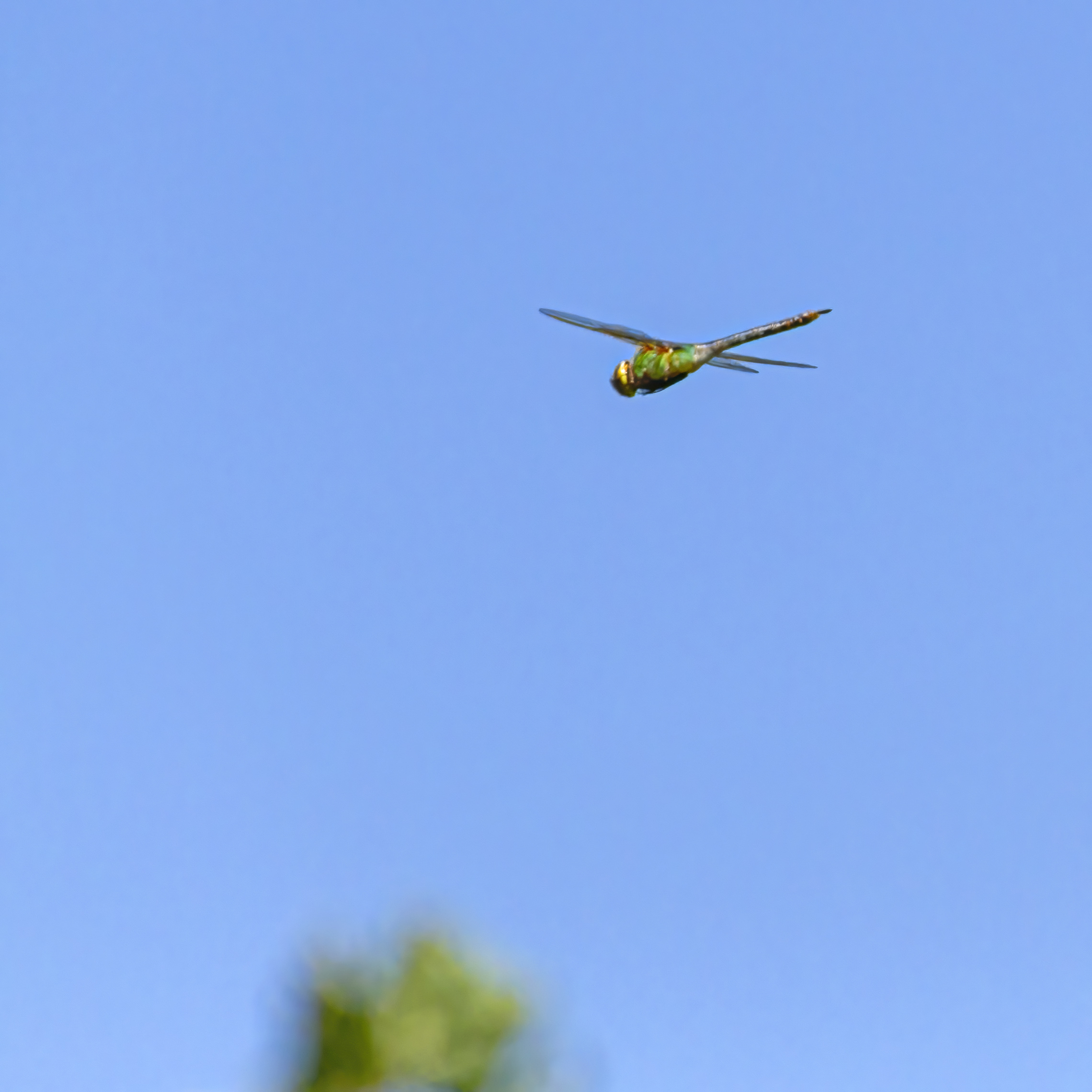
On Wednesday I spotted a small group of a half-dozen of so Common Green Darner dragonflies (Anax junius) patrolling over a large field at Occoquan Bay National Wildlife Refuge. Common Green Darners are one of few species of dragonflies that migrate. Perhaps the ones that I saw are preparing to migrate from the local area or are just stopping off on their journey southward.

It is a fun challenge to point your camera toward the sky and to try and capture photos of these colorful dragonflies as they zoom overhead. The first image is the sharpest image that I was able to capture and it provides a good look at the dragonfly. In many ways, though, I am even happier with the second and third image that include some vegetation and help to provide some context to the shots.

The migration cycle of the Common Green Darner involves three generations. I highly recommend a research article entitled “Tracking dragons: stable isotopes reveal the annual cycle of a long-distance migratory insect” that was published in 2018 in the journal Biology Letters that explains the migration cycle and has some fascinating maps and diagrams. Despite the geeky-sounding title, it is actually quite easy to read and understand.

Here is an extract from the abstract for the article, in case you do not want to read the entire article:

“Using stable-hydrogen isotope analysis of 852 wing samples from eight countries spanning 140 years, combined with 21 years of citizen science data, we determined the full annual cycle of a large migratory dragonfly, the common green darner (Anax junius). We demonstrate that darners undertake complex long-distance annual migrations governed largely by temperature that involve at least three generations. In spring, the first generation makes a long-distance northbound movement (further than 650 km) from southern to northern range limits, lays eggs and dies. A second generation emerges and returns south (further than 680 km), where they lay eggs and die. Finally, a third resident generation emerges, reproducing locally and giving rise to the cohort that migrates north the following spring. Since migration timing and nymph development are highly dependent on temperature, continued climate change could lead to fundamental changes in the biology for this and similar migratory insects.”

Wow!

Common Green Darner

Common Green Darner

Common Green Darner

© Michael Q. Powell. All rights reserved.

Read Full Post »

I was thrilled on Saturday when one of my fellow dragonfly enthusiasts spotted this colorful male Common Green Darner dragonfly (Anax junius) at Jackson Miles Abbott Wetland Refuge and pointed it out to me. Common Green Darners are relatively common, but most of the time when I see them they are patrolling overhead, so it was quite a treat to find one perched.

Common Green Darners are one of the few dragonfly species that migrate. According to Kevin Munroe, creator of the wonderful Dragonflies of Northern Virginia website, “Common Greens seen in our area in early spring are in fact migrants from points south. They emerge in the Southeast and fly north, arriving here late March thru May. After their long flight, they mate, lay eggs and die. Their young emerge in July and August. Congregating in large swarms, this second generation begins flying south in September. They lay eggs that fall, after arriving in their southern destinations, and die. When their young hatch in March, they fly back to Northern Virginia and it starts again—a two generation migration.” Wow!

This dragonfly was hanging on the same evergreen tree where I recently photographed a Russet-tipped Clubtail—see my blog posting entitled “Russet-tipped Clubtail dragonfly.” I guess that I will be checking that tree from now on to see if lightning will strike again. When I am hunting for dragonflies, I tend to return first to places where I have seen them previously and then widen my search. Sometime it pays off, though, as is the case for all wildlife photography, there are certainly no guarantees of success.

Common Green Darner

© Michael Q. Powell. All rights reserved.

Read Full Post »

I was hoping on Tuesday that this male Common Green Darner dragonfly (Anax junius) at Occoquan Bay National Wildlife Refuge would land, but his stamina was impressive and I had to content myself with a couple of shots as he zoomed by overhead.

I missed focus on most of my shot attempts, but the first shot below turned out pretty well—I encourage you to click on the image to see some of the beautiful colors and details of this dragonfly.

Tracking the dragonfly visually and keeping it in the viewfinder is a real challenge. I was intrigued to see that my camera more or less held onto focus in the second shot, despite the fact that the dragonfly had flown closer to the foliage.

Common Green Darner

Common Green Darner

© Michael Q. Powell. All rights reserved.

Read Full Post »

I spotted this Common Green Darner dragonfly (Anax junius) during a recent trip to Occoquan Bay National Wildlife Refuge. It was patrolling overhead within a fairly confined area and I was able to track it visually until it finally landed. The photo makes it look like the dragonfly was climbing its way out of a deep pit. In reality, however, it was hanging from some roots sticking out from a big pile of dirt.

I was a little surprised that I was able to capture as much detail as I did, given that I was shooting with my Tamron 150-600mm lens fully extended to 600mm. Supposedly the lens is soft at 600mm, but good stabilization techniques (including using a monopod) and a little tweaking with software produce images that are acceptably sharp to my eyes.

I love the multi-colored bodies of Common Green Darners, one of the largest dragonflies in our area with a body length of about 3 inches (76 mm). I think that this is a male. Mature males normally have bright blue abdomens, but they may turn purple when temperatures are low, which seemed to be the case when I took this photo. Females, by contrast, have abdomens that tend to be a mixture of tan and gray-green. For both genders, the thorax (the “chest” area) is bright green.

If you click on the image, you can get a better look at the dragonfly’s “bullseye” marking, the black and blue dot that is found on the “nose” of both male and female Common Green Darners. I am always thrilled when I manage to get a shot that captures the bullseye so well.

We are in the midst of a spell of cool, rainy weather so I have not seen any dragonflies in over a week. The weather is forecasted to warm up a bit, so I am hoping that I will have better success in the upcoming week.

Common Green Darner

© Michael Q. Powell. All rights reserved.
 

Read Full Post »

I was tracking a Common Green Darner dragonfly (Anax junius) in my viewfinder yesterday at Occoquan Regional Park, when suddenly another dragonfly flew into the frame. The two dragonflies appeared to hook up in mid-air and I assumed that they were mating. When they landed in some nearby vegetation, however, I discovered that it was hunger and not lust that had brought them together. The Common Green Darner was having lunch with a Common Whitetail dragonfly (Plathemis lydia), and it was the main course.

Dragonflies feed on other live insects and they aren’t picky eaters—they will eat any insect they can catch, including other dragonflies. Midges and mosquitoes make up the bulk of their diet, but dragonflies also prey on flies, bees, beetles, moths, butterflies, and other flying insects. The larger the dragonfly, the larger the prey insect it can consume.

As you can see from the photo, Common Green Darners are quite large, with an overall length of approximately three inches (76 mm), while Common Whitetails are considerably smaller, with an overall length of approximately 1.7 inches (43 mm).

Common Green Darners are really powerful fliers too and are one of only a handful of dragonfly species that migrate. The adult Common Green Darners that I see this early in the season are likely to be migrants from locations further south. Kevin Munroe described their migration really well on the wonderful Dragonflies of Northern Virginia website:

“They emerge in the Southeast and fly north, arriving here late March thru May. After their long flight, they mate, lay eggs and die. Their young emerge in July and August. Congregating in large swarms, this second generation begins flying south in September. They lay eggs that fall, after arriving in their southern destinations, and die. When their young hatch in March, they fly back to N. VA and it starts again – a two generation migration.”

The Common Whitetail in the photo probably emerged only recently and may have been particularly vulnerable. Some may find this photo to be a little disturbing or a bit too graphic, but I think it shows the “circle of life” in nature. Yesterday the Common Green Darner was the predator, but tomorrow it could become the prey of a bird or some other creature higher up on the food chain—all creatures have to eat.


Common Green Darner

© Michael Q. Powell. All rights reserved.
Read Full Post »

I can’t help myself—whenever I see a dragonfly moving through the air, I feel compelled to try to capture an image of the dragonfly in flight. It is an almost impossible challenge and success is often dependent as much on luck as it is on skill. Last Thursday as I was exploring in Prince William County, I was feeling particularly patient and repeatedly spotted dragonflies flying.

Early in the day at a small pond, I spotted a Carolina Saddlebags dragonfly (Tramea carolina) and a Common Green Darner (Anax junius) that were patrolling over the water. In situations like this when the dragonflies are flying at a constant height, it is marginally easier to get shots, because there is one fewer variable than when the dragonfly is moving up and down.The Carolina Saddlebags was flying a little closer to the shore, but I had to contend with all of the vegetation that wanted to grab my camera’s focus, so I focused manually (first photo). The Common Green Darner was flying over the open water that presented a less obstructed background, but it filled such a small part of the frame that again I was forced to focus manually—my camera’s auto-focus had trouble focusing quickly on the moving dragonfly (second photo).

My greatest challenge, however, came later in the day. If I were to assign a degree of difficulty to my photos, the final photo would be near the top of the list. When I moved to a new location and got out of my car, I immediately spotted a group of large dragonflies frenetically flying through the air, feasting on insects as they flew. The dragonflies were moving in unpredictable ways, constantly changing their flight altitude and speed. Unlike some dragonflies that hover a bit when patrolling, these dragonflies were in constant high-speed motion.

I did my best to track the dragonflies visually, but it was tough to even get one in my viewfinder. I was ecstatic when I finally managed to capture a more or less in-focus image of one of the Swamp Darners (Epiaeschna heros) as it zoomed past me relatively low to the ground, as you can see in the final photo.

When it comes to wildlife photography, some shots are easy and straightforward—I see something and take the shot and that is it. At other times, I have to work really hard and take a lot of shots before I can get a potentially good one. Last Thursday definitely fell in the latter category more than in the former one. Was all that effort worth it? I think so, but I must confess that at times I felt like Don Quixote tilting at windmills.

If you want to get a more detailed look at the details of the three flying dragonflies, be sure to click on the images.


Carolina Saddlebags


Common Green Darner

Swamp Darner

© Michael Q. Powell. All rights reserved.
Read Full Post »

I spent a lot of time tracking this Common Green Darner (Anax junius) as it patrolled over a field of vegetation yesterday in Prince William County and was thrilled when it finally perched for a moment. Like most darners, this one was hanging vertically and as I got closer, I was immediately struck by the muted color of its abdomen.

I could tell from its terminal appendages that it was a female and I suddenly realized that most of the Common Green Darners I have photographed in the past have been males that often have bright blue abdomens. It had never really struck me that female Common Green Darners have tan-colored abdomens. It is not that surprising, though, because, as is the case in much of the animal kingdom, female dragonflies generally tend to have more subdued colors than their more ostentatious male counterparts.

Common Green Darner

© Michael Q. Powell. All rights reserved.

Read Full Post »

I have been seeing Common Green Darner dragonflies (Anax junius) in the air for several weeks now, but only this past Monday did I finally catch one taking a break from patrolling while I was tracking it at Occoquan Regional Park. It is quite common to see Common Green Darners patrolling high overhead in a wide variety of habitats, darting to and fro, feeding on the fly.

These large colorful dragonflies—about three inches (75 mm) in length—are among the first to be spotted in the early spring and among the last to disappear late in the autumn. How is such a long flight season possible? The simple answer is that Common Green Darners are a migratory dragonfly species. Kevin Munroe described the migratory cycle on his wonderful Dragonflies of Northern Virginia website in these words:

“Common Greens seen in our area in early spring are in fact migrants from points south. They emerge in the Southeast and fly north, arriving here late March thru May. After their long flight, they mate, lay eggs and die. Their young emerge in July and August. Congregating in large swarms, this second generation begins flying south in September. They lay eggs that fall, after arriving in their southern destinations, and die. When their young hatch in March, they fly back to Northern Virginia and it starts again— a two generation migration.”

I love the bright and cheery colors of the Common Green Darner, colors that reminded one of my Facebook viewers of a tropical parrot. I also really like the bullseye pattern on the dragonfly’s “nose,” just below its large compound eyes. Be sure to click on the image if you want to see these details better.

Common Green Darner

© Michael Q. Powell. All rights reserved.


Read Full Post »

The beautiful colors on this dragonfly that I spotted yesterday at Huntley Meadows Park are so amazing that it it hard for me to call it “common,” even though I know that it is a Common Green Darner dragonfly (Anax junius). I initially spotted this dragonfly when it was patrolling over a field and was thrilled when I saw it land nearby.

Although my telephoto lens zooms out to 600mm, I needed to extend it to only 450mm, because Common Green Darners are so large, about 3 inches (75 mm) in length. As a result, the images were sharper and I was able to capture a lot of detail. I encourage you to double-click on the images to see those details, like the bullseye pattern on the top of the “nose” and the spectacular rainbow colors of this dragonfly.

Common Green Darners are a migratory species that flies in swarms so big that they can be picked up on weather radar. This dragonfly seemed to be alone, so it could be a migratory straggler or simply a part of the local population.

Common Green Darner

Common Green Darner


© Michael Q. Powell. All rights reserved.

Read Full Post »

When they are mating, many dragonflies adopt a very conspicuous heart-shaped “wheel” position, like this pair of Common Green Darner dragonflies (Anax junius) that I spotted last week at Occoquan Bay National Wildlife Refuge. The process begins when the male, in this case the dragonfly with the blue abdomen, grabs a female by the back of her neck with claspers at the end of his abdomen that fit into species-specific grooves in the female. The two dragonflies are then hooked together, often for extended periods of time.

I couldn’t help but notice the sharp thorns on the branch that these dragonflies had selected for their encounter. Yikes—that is living life on the edge. After I took some photos, feeling a little like a voyeur, I decided to give the couple some privacy. When I circled back a short time time later, the dragonflies were gone, presumably having done their part to perpetuate the species.

common green darner

© Michael Q. Powell. All rights reserved.


Read Full Post »

Last Friday I photographed my first dragonflies of the spring, a male Common Green Darner (Anax junius) and a female Ashy Clubtail (Phanogomphus lividus). The Common Green Darner is probably a migratory dragonfly that is just passing through as it heads north—we do have local-born members of this species, but it is too early for them to have emerged.

The Ashy Clubtail, which was actually the first dragonfly that I photographed, almost certainly emerged locally. When a dragonfly emerges, its wings are really shiny and the wings of this Ashy Clubtail were definitely sparkling in the sunlight. According to the local flight calendar, the Ashy Clubtail is one of the earliest dragonflies in our area to emerge, but I have never seen one this early before.

As you can see, I captured the images of both of these dragonflies when they were perched flat on the ground. There were dry leaves all around, which made a stealthy approach almost impossible and focusing on the dragonfly was a bit of a challenge.

Common Green Darner

Ashy Clubtail

© Michael Q. Powell. All rights reserved.

Read Full Post »

Last week I spotted this male Common Green Darner dragonfly (Anax junius) while exploring with fellow photographer and dragonfly enthusiast Walter Sanford . This beauty was part of a swarm of dragonflies we observed that was probably preparing for migration.

As I processed these images I was struck by the wonderful range of colors on this dragonfly’s body. As its name suggests, a Common Green Darner has lots of green, but this one also has beautiful shades of blue and violet. I have included two images that may look very similar, but in fact were taken with two different cameras from the same spot.

In the first shot, I zoomed in close with my SX50 super zoom camera to try to capture as much detail as I could. I took the second shot with a fixed-focus lens. The heavy vegetation did not permit me to get any closer, so I tried to compose the image to include more of the environment.

Personally I like the second shot a bit more than the first—I prefer the additional “breathing space” around the subject and I think the second shot is a little sharper. Do you prefer one of them over the other?

Common Green Darner

Common Green Darner

© Michael Q. Powell. All rights reserved.
Read Full Post »

On Monday I spotted this freshly emerged female Common Green Darner dragonfly (Anax junius) at Occoquan Bay National Wildlife Refuge.  It won’t be long before it will be time for her to migrate southward. Yes, some dragonflies actually migrate.

When I first started getting into dragonflies, it never struck me that dragonflies could travel long distances. I figured that they lived and died in a relatively confined geographic area. Although that may be true for some dragonfly species, that is not the case for the Common Green Darner. One of my favorite websites, Dragonflies of Northern Virginia, describes the amazing saga of this species in these words:

“They emerge in the Southeast and fly north, arriving here late March thru May. After their long flight, they mate, lay eggs and die. Their young emerge in July and August. Congregating in large swarms, this 2nd generation begins flying south in September. They lay eggs that fall, after arriving in their southern destinations, and die. When their young hatch in March, they fly back to Northern Virginia and it starts again – a two generation migration.”

Many of us have gotten used to using Global Positioning System (GPS) devices to help us navigate or use Google Maps. How do these dragonflies know where to go? How do they find a destination that they have never visited before? It boggles my mind and fills me with awe and wonder when I contemplate questions like these.

Common Green Darner

Common Green Darner

© Michael Q. Powell. All rights reserved.


Read Full Post »

During my church retreat in Orkney Springs, Virginia this past weekend, I played hide-and-seek with a Common Green Darner dragonfly (Anax junius). It repeatedly flew teasingly close to me, trying to entice me to chase it.  I took the bait and pursued the big dragonfly for quite some time as it flew in and out of the reeds.

It tried to hide by hanging from some vegetation by the tips of its tiny toes—the second photo shows my initial view of the hidden dragonfly. By moving to the side and crouching low, I was able to peer through the vegetation and eventually spot the dragonfly. Realizing that it was found, the dragonfly tilted its head toward me and smiled, as you can see in the first image shown below.

Common Green Darner

Common Green Darner

© Michael Q. Powell. All rights reserved.


Read Full Post »

Sometimes I can identify a dragonfly by the way that it perches. Some dragonflies like to perch high on the tip of vegetation and some perch low to the ground or even on the ground itself. Some will hang vertically or perch horizontally or at an angle somewhere in between.

On the rare occasions in the past when I have seen a Common Green Darner (Anax junius) perch (usually I see them in the air), it has usually been in vegetation relatively low to the ground. I was therefore surprised to see one spreadeagled on the side of a tree on Monday at Patuxent Research Refuge in Laurel, Maryland. Of course, the bright green color and the bull’s-eye pattern on the face made it easy to identify this dragonfly, despite her unconventional perching pattern.

I have learned from experience that the wildlife subjects that I love to photograph often do not look or act the way in the ways described in books. They are may also be found in different habitats or at different times than the range maps indicate. That is what makes this type of photography so challenging and so rewarding and it means I have to be constantly alert and vigilant when out in the field.

Common Green Darner

Common Green Darner

© Michael Q. Powell. All rights reserved.

Read Full Post »

Normally when I see a Common Green Darner dragonfly (Anax junius) it is patrolling in the air and it is mostly a greenish blur. This past Friday, however, I was fortunate enough to spot one on the ground, nestled low in the vegetation at Occoquan Bay National Wildlife Refuge. At this closer distance I was able to marvel at all of the wonderful colors of this beautiful dragonfly.

Be sure to click on the images to see the details of this dragonfly at higher resolution.  Did you notice the blue color near the tip of its “nose?”

Common Green Darner

Common Green Darner

© Michael Q. Powell. All rights reserved.


Read Full Post »

Are you patient and persistent? If so, you have the right temperament to try to photograph dragonflies in flight. Every dragonfly season I spent endless hours in mostly fruitless attempts to capture in-flight images of dragonflies. One of my friends on Facebook described this as “a near impossible task” and, of course, she is right.

My first somewhat successful effort this year was a shot of a Common Green Darner (Anax junius) patrolling above one of the paths at Occoquan Bay National Wildlife Refuge last Friday. As you might suspect, getting the moving dragonfly in focus is one of the biggest challenges, because the subject is too small for the camera’s autofocus to engage. Sometimes I will focus manually as I track the dragonfly and sometimes I will use a zone focusing technique in which I preset the focusing distance and wait (and hope) for the dragonfly to fly into the zone.

A near impossible task? It certainly is, but I enjoy the challenge the way that its pursuit confounds observers—one such observer watched me closely for several minutes on Friday and couldn’t figure out what I was trying to photograph.

Common Green Darner

© Michael Q. Powell. All rights reserved.


Read Full Post »

Dragonflies are one of my favorite subjects to photograph and each spring I eagerly await their reappearance. Yesterday I captured my first image of one this season, a beautiful Common Green Darner (Anax junius) that I spotted at Occoquan Bay National Wildlife Refuge.

Common Green Darners are a migratory species and the ones that we see in early spring, like the one in the photograph, probably flew here from somewhere further south. Once they arrive, they have a series of tasks to accomplish—they mate, lay eggs, and die. The next generation of Green Darners will emerge in a few months and fly south in the autumn. That generation will die in the south and the following generation will fly north in the spring.

What an amazing life cycle!

Common Green Darner

© Michael Q. Powell. All rights reserved.

Read Full Post »

On Monday at Occoquan Bay National Wildlife Refuge I was thrilled to spend some time hanging out with this Common Green Darner dragonfly (Anax junius). The range of colors on its body is so remarkable that I almost couldn’t believe my eyes when I zoomed in on it. An expert in a dragonfly forum on Facebook noted to me that the dragonfly is a teneral one, which means that it has only newly emerged. That would account for its relatively pale, almost pastel coloration and the perfect condition of its wings. If you click on the image, you can see even better some of the remarkable details of this dragonfly, like the colorful pattern on its “nose.”

The beautiful dragonfly was hanging vertically only a few inches above the ground, in a pretty safe location. I kept my distance as I took some photos and departed quietly, conscious of the fact that a dragonfly is fragile and vulnerable at this early stage of development. It remained in place as I slowly slipped away.

Green Darner

© Michael Q. Powell. All rights reserved.

Read Full Post »

Now that the weather is warming up, I am searching in earnest for dragonflies, one of my favorite subjects to photograph. I am still having difficulties locating native-born species, but fortunately there are some migratory species in the area. Yesterday I spotted this Common Green Darner (Anax junius) dragonfly couple in tandem, with the male holding on as the female deposited her eggs in the floating vegetation.

In some dragonfly species the male will hover above the female as she oviposits, but in others, like the Common Green Darner, the male remains attached. I suspect that this method is one way of ensuring that the eggs that the male has fertilized are deposited before the female hooks up with another male.

Common Green Darner

Common Green Darner

© Michael Q. Powell. All rights reserved.

Read Full Post »

As I was preparing to leave work yesterday, one of my co-workers reminded me to wear something green today to celebrate St. Patrick’s Day. Some people go a little crazy on this day, drinking green beer and consuming food that has been dyed to an unnaturally bright shade of green.

To celebrate the day, I thought I’d reprise a few photos of some of my favorite green creatures, including the Common Green Darner (Anax junius), the Green Heron (Butorides virescens), a green metallic bee, and little green frogs. If you are viewing the images in the blog itself (and not the Reader), click on any one of the photos to see a larger image in slide-show mode.

For those of you also celebrating St. Patrick’s Day, be safe and have fun.

© Michael Q. Powell. All rights reserved.

Read Full Post »

I have been seeing Common Green Darner dragonflies (Anax junius) hunting high over the fields the last couple of weeks as they prepare for migration, but have not been able to get any shots of them. In theory, they are easier to photograph when they land, but these dragonflies like to hang vertically low to the ground, often in areas with heavy vegetation. I have been repeated frustrated by spotting them only after they have taken to the air as I got close to them.

This past Friday, though, I saw one land nearby when I was already in a field of waist-high vegetation. Judging from the blue abdomen, it’s a male Common Green Darner. I was struck by the relatively dark color of much of the abdomen of this particular individual. When doing a little research at my favorite website for local dragonflies, dragonfliesnva.com, I learned that Common Green Darners deal with the problem of cool weather “by having dark-colored platelets in their blood that rise to the surface when it’s cold, darkening their abdomen color, therefore attracting more sun. On bright, hot days, those dark platelets sink, and the abdomen turns bright bluagain, now reflecting light.”

The dragonfly was surrounded by dried vegetation and there was no way that I could get an uncluttered background for my shots. Fortunately, however, the the colors of the vegetation are so muted that the gorgeous blue and green of the dragonfly really stand out. In the first shot, I zoomed all the way to try to capture the maximum amount of detail, while in the second shot I pulled back a little on the zoom to capture the dragonfly’s entire wingspan.

Common Green Darner

Common Green Darner

© Michael Q. Powell. All rights reserved.

Read Full Post »

Older Posts »