Cabbage White butterflies (Pieris rapae) may look very ordinary at first glance, but when you look more closely, you find that they have amazingly beautiful, green speckled eyes.

© Michael Q. Powell. All rights reserved
Posted in Butterflies, Flowers, Gardening, Insects, Macro Photography, Nature, Photography, tagged Alexandria VA, butterfly, Cabbage White, Cabbage White butterfly, Canon 100mm macro lens, Canon Rebel XT, lavender, Pieris rapae on June 30, 2013| 9 Comments »
Cabbage White butterflies (Pieris rapae) may look very ordinary at first glance, but when you look more closely, you find that they have amazingly beautiful, green speckled eyes.
© Michael Q. Powell. All rights reserved
Posted in Dragonflies, Insects, Macro Photography, Nature, Photography, wildlife, tagged Alexandria VA, Canon 100mm macro lens, Canon Rebel XT, damselflies, green spring gardens, mating damselflies on June 30, 2013| 4 Comments »
Damselflies have such narrow bodies that it’s often hard for me to get my camera to focus on them, but I love to chase after them, hoping to capture some of their beautiful colors. I was happy that I managed to get this shot of mating damselflies with enough detail to see some of the differences in coloration between the male and the female. I don’t dare try to explain the physiology of the mating process—I don’t really understand it and will leave that to the experts.
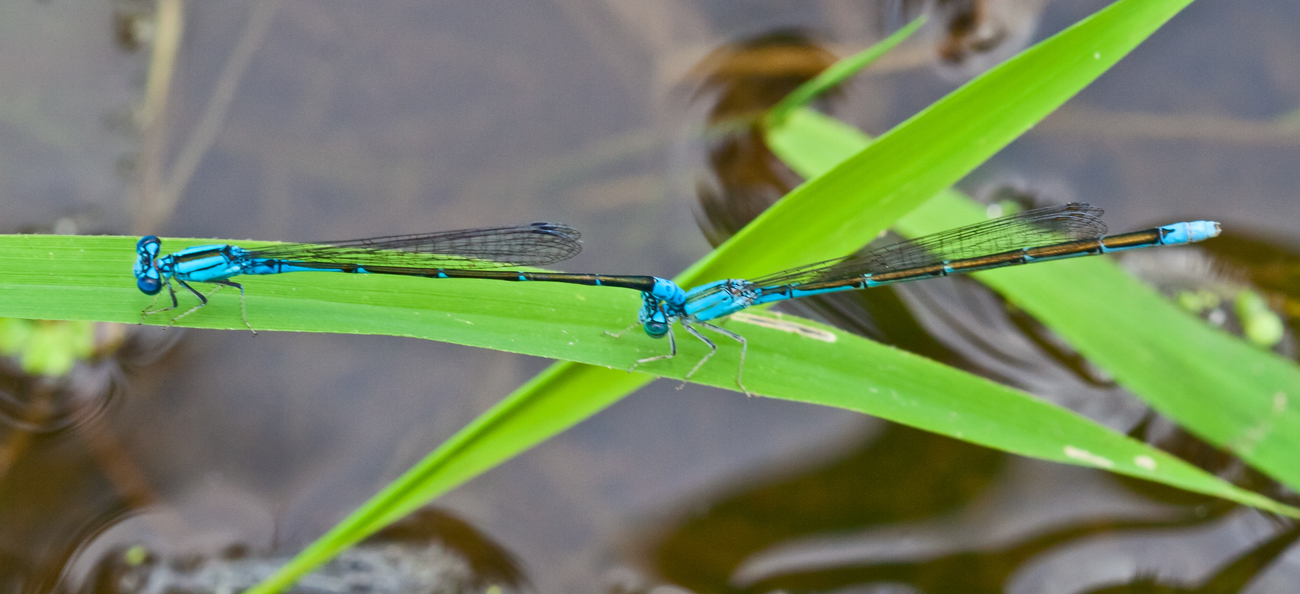
Click on the photo to see a higher resolution view of it.
© Michael Q. Powell. All rights reserved
Posted in Art, Dragonflies, Flowers, Gardening, Macro Photography, Nature, Photography, tagged Alexandria VA, Canon 100mm macro lens, Canon Rebel XT, damselfly, green spring gardens, Monet, water lilies on June 29, 2013| 7 Comments »
The water lilies at one of my local gardens seem to be blooming a little late this year, but two of them finally were in bloom yesterday. Here’s a shot one of them and if you look closely you’ll notice a damselfly perched on the water lily. The image is not in his style, but water lilies always remind me of Monet, one of my favorite painters.

© Michael Q. Powell. All rights reserved
Posted in Flowers, Gardening, Insects, Macro Photography, Nature, Photography, tagged Alexandria VA, bee, bumblebee, Canon 100mm macro lens, Canon Rebel XT, lavender on June 29, 2013| 8 Comments »
The response was so positive to my recently posted photos of a bee on a lavender plant that I decided to post a couple more of my favorite images from that session. Unlike my previous shots that attempted to capture a bee in flight, these ones were taken while the bee was busily working. The light was starting to fade, so both of these were shot with my pop-up flash and I am happy that the flash did not totally blow out the highlights.
Using flash is an area that I have not paid much attention to, but it looks like it’s worth spending some time learning more about it and experimenting with different ways of adding additional light to my photos.


© Michael Q. Powell. All rights reserved
Posted in Flowers, Gardening, Insects, Macro Photography, Nature, Photography, tagged Alexandria VA, Canon 100mm macro lens, Canon Rebel XT, family Syrphidae, flower fly, hover fly on June 28, 2013| 4 Comments »
Today there seemed to be a lot of small hover flies buzzing around the flowers, so I decided to try to get a shot of one of them. As their name suggests, these flies spend much of their time hovering, but fortunately they land sometimes, which gave me a chance to get an image of a hover fly.
Hover flies, which are also known as flower flies and syrphid flies, are part of the insect family Syrphidae. There are quite a few different species of hover flies and I find it difficult to tell them apart, so I’ll merely identify this one as a hover fly.

© Michael Q. Powell. All rights reserved
Posted in Flowers, Gardening, Humor, Insects, Macro Photography, Nature, Photography, tagged Alexandria VA, bee, bee in flight, bumblebee, Canon 100mm macro lens, Canon Rebel XT, lavender on June 27, 2013| 16 Comments »
Have you ever tried to take photos of a bee in flight? In the past, I have managed to get a few such shots accidentally, when a bee took off as I was shooting.
However, a few days ago when the light was fading in the early evening, I decided to try to photograph a bee in flight using my pop-up flash. I knew that timing would be critical, because the time required for the flash to recycle meant that I would get only one shot each attempt, and not a burst. It was a fun little challenge, even though most of my shots were out of focus.
I especially like the first image, in which the bee appears to be attempting to hover in mid-air. The second shot makes it look like the bee was free-falling, waiting for the optimal moment to deploy his tiny parachute.
It’s easy to get ultra-serious about photography and get bogged down thinking of settings and exposures and composition—it’s nice sometimes to just have fun and then share the results of the fun time.


© Michael Q. Powell. All rights reserved
Posted in Flowers, Gardening, Insects, Macro Photography, Music, Nature, tagged Alexandria VA, bee, bumblebee, Canon 100mm macro lens, Canon Rebel XT, lavender on June 26, 2013| 4 Comments »
When I get the urge to take some photos and don’t have much time, I like to walk over to a neighbor’s house and take photos of the bees that are usually buzzing around the lavender plants there.
A little over a week ago, I did a posting that had a super close-up shot of a bee. Today’s shot was taken from farther away and has the blurry background that I really like, with the bee still in pretty sharp focus in the foreground. I like the way that the image shows the way the lavender droops a little from the weight of the bee and I also like the the second stalk of lavender standing tall in the mid-range area of the shot.
It’s a pretty simple composition, but the result is a pleasing image of a bee happily at work.

© Michael Q. Powell. All rights reserved
Posted in Arachnids, Macro Photography, Nature, Photography, wildlife, tagged Alexandria VA, Araneus cavaticus, barn spider, Canon 100mm macro lens, Canon Rebel XT, flash, spider on June 25, 2013| 5 Comments »
The last time I posed a question about using flash to photograph a spider, the majority of readers said that the spider looked much better in natural light, but the case is not so clear for this Barn Spider (Araneus cavaticus) that I spotted in the garden yesterday.
The spider was in a web that stretched across the path in the garden, about chest-high, and was in subdued light. I really wanted to shoot at an angle to give the spider some dimensionality, but it was tough to do so, because of the web, and depth of field was an issue. To make matters worse, a breeze would kick up periodically, making slow shutter speeds a bit problematic.
There was no question about whether to use a tripod or not—it was obvious that I needed it. Initially, I shot at f/10 in aperture priority, with a shutter speed of 1/13 of a second, resulting in the second image. Although parts of the spider are blurry, the head and eyes are pretty sharp. I then raised the shutter speed to 1/200 and used my pop-up flash and got the first image. The background turned almost totally black, but I was happy that it did not blow out the details in lighter areas of the spider and the eyes remain pretty sharp.
I like the image with the black background better this time and like the look of the background. Which one do you prefer? (Clink on this link to see the posting from March when I initially posed a similar question.)


© Michael Q. Powell. All rights reserved
Posted in Bugs, Humor, Insects, Macro Photography, Nature, Photography, tagged Alexandria VA, Canon 100mm macro lens, Canon Rebel XT, green spring gardens, red milkweed beetle, Tetraopes tetrophthalmus on June 25, 2013| 6 Comments »
Last summer I confessed to being obsessed with Red Milkweed Beetles (Tetraopes tetrophthalmus) in one of my postings and initial signs this summer suggest that the fascination remains strong.
This past weekend, I spotted several of my little red friends when visiting Green Spring Gardens, a local county-run historical garden, and I stalked them like a paparazzo, trying to get a good shot. I particularly like this image, in which the beetle is staring down at me from a partially eaten leaf. (I don’t know if it was the one that chewed up the leaf.)
The colors of the photo may suggest Christmas, but I am not sure that there would be much of a market for this as a Christmas card image.

© Michael Q. Powell. All rights reserved
Posted in Dragonflies, Insects, Macro Photography, Nature, Photography, wildlife, tagged Alexandria VA, Canon Rebel XT, dragonfly, Libellula luctuosa, Sigma 135-400mm telephoto zoom lens, Widow Skimmer, Widow Skimmer dragonfly on June 24, 2013| 5 Comments »
It was exciting for me to spot a new dragonfly this weekend, a male Widow Skimmer dragonfly (Libellula luctuosa).
I really like the brown and white pattern on the wings, which was distinctive enough that it also helped me in identifying it. According to Bugguide, the species name means sorrowful or mournful, perhaps because the wings of both male and female seem to be draped in mourning crepe.
The weather has turned hot and humid, which is typical for the Washington D.C. area, which seems to be great for the dragonflies, so I’ll be out as often as I can tolerate the heat, searching for new dragonflies to photograph.


© Michael Q. Powell. All rights reserved
Posted in Bugs, Flowers, Gardening, Insects, Macro Photography, Nature, Photography, tagged Alexandria VA, bee, Canon 100mm macro lens, Canon Rebel XT, honey bee, pollen on June 23, 2013| 6 Comments »
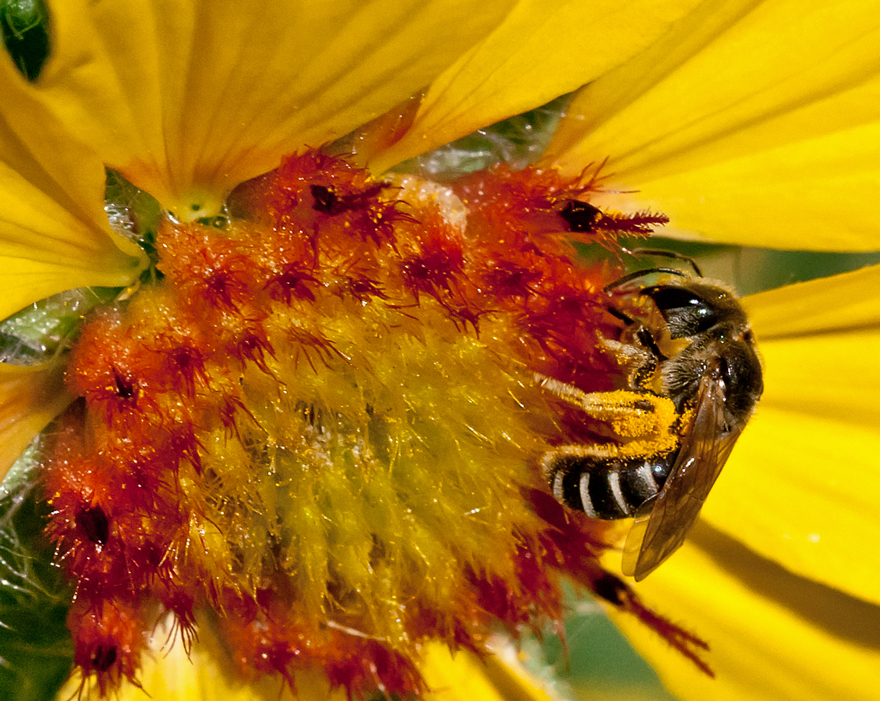
Some bees seem to be really tidy when they are gathering pollen, but this bee was a total mess, with pollen sticking all over its legs and underside. The bee looks to be some kind of honey bee, although the striped markings on its lower body seem a little unusual.
Often when I am shooting a macro shot, I am so worried about the technical aspects of the shot that I forget that photography is also an art. This image helps remind me that photography remains a creative pursuit, a fusion of art and science.
© Michael Q. Powell. All rights reserved
Posted in Flowers, Gardening, Humor, Insects, Macro Photography, Nature, Photography, tagged Alexandria VA, bee, Canon 100mm macro lens, Canon Rebel XT, Echinops ritro, globe thistle on June 21, 2013| 6 Comments »
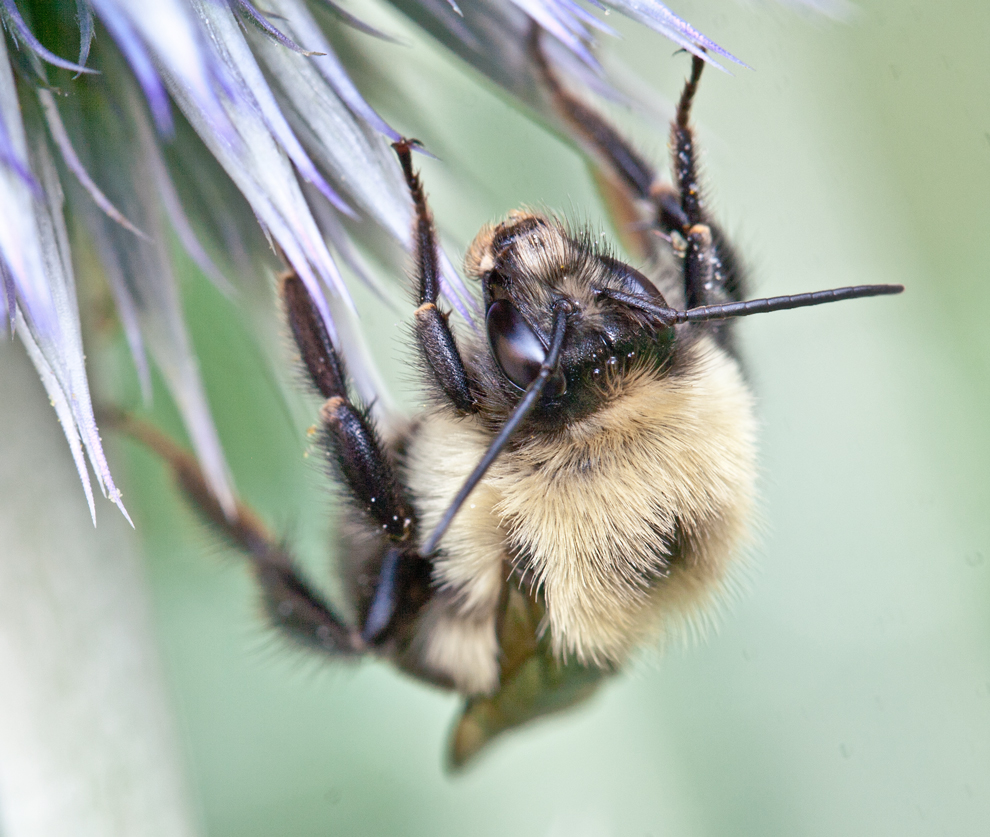
Before going out to the marsh park to shoot this morning, I decided to check out my neighbor’s garden and came across this bumblebee, hanging from the side of a a beautiful Small Globe Thistle (Echinops ritro).
I took some initial shots and then began to wonder if the bee was still alive, because it was not moving at all. When I blew gently on its face, however, it moved a little, so I figure that it was probably just sleeping. I carefully set up my tripod and got as close as my lens would let me get, which caused the bee to fill a substantial part of the frame.
I managed to capture some details that normally I do not see, like the little lines on the antennae and the hairs on the bee’s face. The bee was still sleeping when I departed—I didn’t want to risk the possibility that bees get angry if you wake them up prematurely.
Michael Q. Powell. All rights reserved
Posted in Butterflies, Flowers, Gardening, Macro Photography, Nature, Photography, tagged Alexandria VA, butterfly, canon 100mm, Canon Rebel XT, skipper on June 19, 2013| 4 Comments »
The little skipper butterfly found a dandelion to be particularly appealing and I like this simple image that captured their brief encounter.

Michael Q. Powell. All rights reserved
Posted in Flowers, Gardening, Insects, Macro Photography, Nature, Photography, tagged Alexandria VA, bee, Canon 100mm macro lens, Canon Rebel XT, lavender on June 18, 2013| 11 Comments »
One of the first rules of photography that I learned was the importance of keeping a subject’s eye in focus and I managed to accomplish that with this bee that I photographed yesterday. However, the depth of field turned out to be so shallow that only a few other parts of the bee are as precisely focused as the eye.
I was hand-holding my macro lens, which is not image-stabilized, and the sky was overcast, so I had to open up the aperture and keep the shutter speed fairly high to get a decent shot (f/6.3, 1/100 sec, ISO400). The bee was moving all around a patch of lavender in a neighbor’s garden, gathering nectar with its tongue, which is visible in the photo.
I stalked the bee for quite a while and a lot of my shots turned out to be blurry, but I ended up with a few that were ok. This is my favorite of the bunch and I think that the shallow depth of field, which is a shortcoming in many situations, is the primary reason that I like it.

Michael Q. Powell. All rights reserved
Posted in Flowers, Gardening, Insects, Macro Photography, Nature, Photography, tagged Alexandria VA, American Hover Fly, Apis, bee, brookside gardens, Canon 100mm macro lens, Canon Rebel XT, Eupeodes americanus, honey bee, hover fly on June 15, 2013| 9 Comments »
As we move through spring, I am finally starting to see more hover flies and bees, busily at work collecting food and pollinating the flowers.
The insect in the first photo is, I believe, an American Hover Fly (Eupeodes americanus). A year ago, I would almost certainly have called it a bee, but I have learned a lot about insects since then, thanks to my photography.
The second photo feature a beautiful variegated flower and what looks to be a honey bee, though it’s a little difficult to make a positive identification, because of the angle.
It’s early in the season, so I am having to recall some lessons from last year, like the need to pay attention to my distance. In my desire to get closer, I have already managed a few times to bump the flower and scare off the bee, forgetting that the lens hood on my macro lens is pretty big.


Michael Q. Powell. All rights reserved
Posted in Arachnids, Flowers, Gardening, Macro Photography, Nature, Photography, Portraits, wildlife, tagged Alexandria VA, canon 100mm, Canon Rebel XT, fuzzy spider, jumping spider, spider on June 9, 2013| 15 Comments »
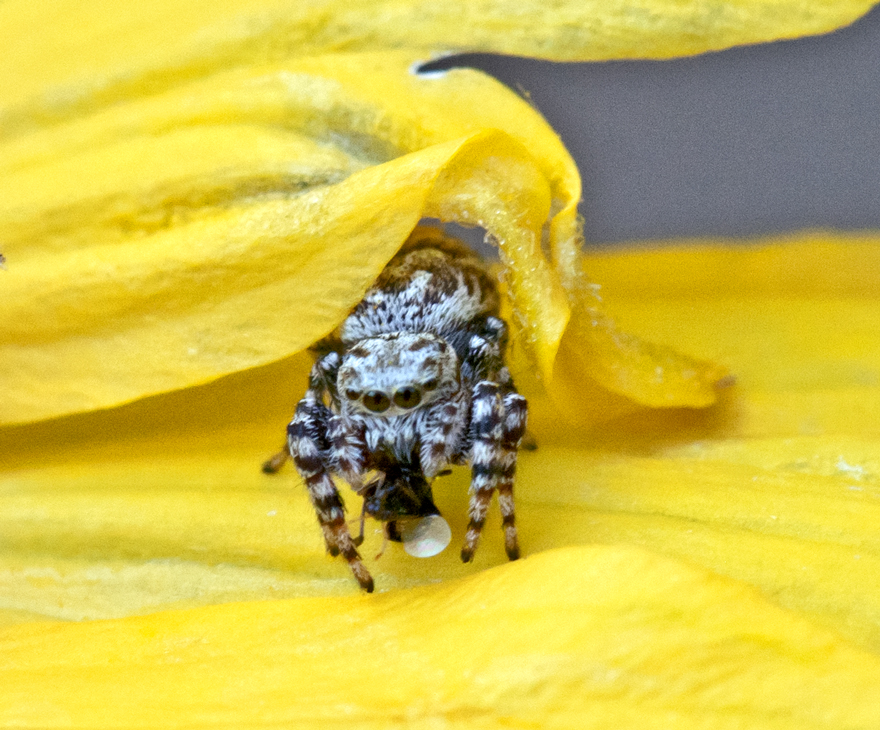
As I was checking out the flowers in my neighbors’ garden yesterday afternoon, I came across this little spider, sitting on top of a flower. There was no web anywhere in the vicinity, so I suspected that I might have a jumping spider.
Last month, I encountered a tiny, fuzzy spider that turned out to me a jumping spider, so I am a little more attuned to looking for them now. This one is definitely not the same kind, though, with completely different colors and markings. You can compare the two by checking out the photos in my previous posting.you
When I first saw the spider, it had just captured some kind of insect as you can see in the second photo. It then moved under the shade of a petal of the flower to enjoy its freshly caught dinner. I showed this moment in the first and third shots. The first one was taken a little closer and shows a lot of detail, but I really like the context that the third one provides and it is probably my favorite one. The final shot gives you an overall view of the spider.
I love the color and pattern of the spider and was happy that I was able to capture some of the details. The spider was not very big and I had trouble placing my tripod on the uneven ground to get a sharp shot. I am really happy with the results, however, and will definitely keep looking for these spiders with eyes that I find to be simply irresistible.


Michael Q. Powell. All rights reserved
Posted in Butterflies, Flowers, Gardening, Insects, Macro Photography, Nature, Photography, tagged Alexandria VA, butterfly, Cabbage White, Cabbage White butterfly, Canon 100mm macro lens, Canon Rebel XT, lavender, Pieris rapae on June 8, 2013| 8 Comments »
One of my neighbors, fellow blogger Cindy Dyer, now has lavender blooming in her garden. It smells wonderful and this Cabbage White butterfly (Pieris rapae) seemed to be really enjoying it earlier this afternoon.

Michael Q. Powell. All rights reserved
Posted in Flowers, Gardening, Macro Photography, Nature, Photography, tagged Alexandria VA, Canon 100mm macro lens, Canon Rebel XT, green spring gardens, Led Zeppelin, Love-in-a-mist, Nigella damascena on May 30, 2013| 6 Comments »
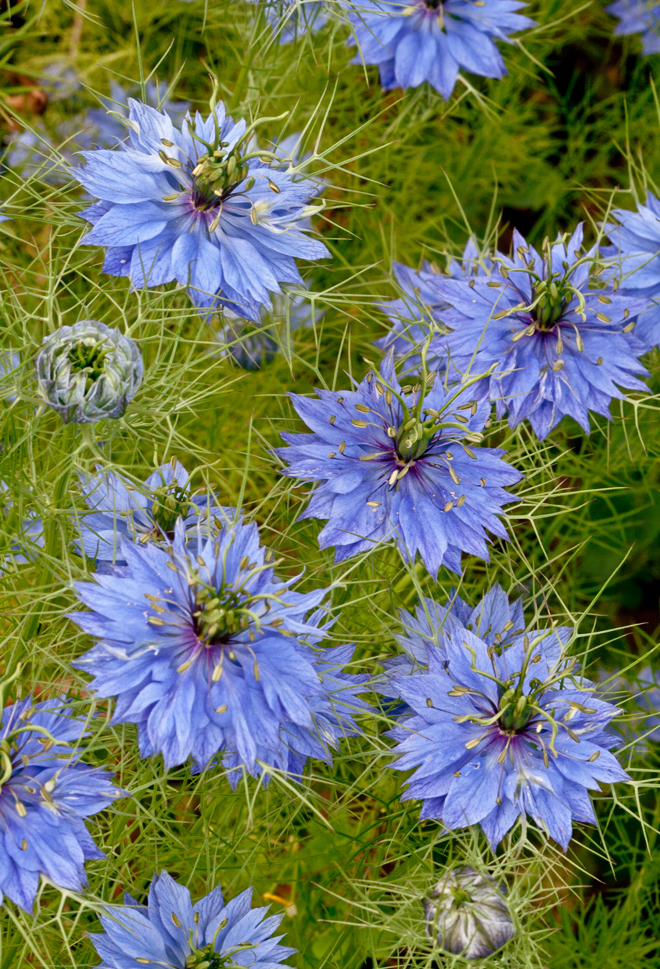
This cluster of Love-in-a-mist (Nigella damascena), one of my favorite flowers, was so striking that I decided to try to capture the grouping, even though usually when I take photos of flowers, I focus on a single blossom.
Framing the shot was a challenge, as I struggled to find a plane and camera settings that would keep most of the flowers in focus. I’m pretty happy with the result and I did only a slight amount of cropping to get this final image.
I grew up in the era of what is known now as classic rock-and-roll and it seemed natural to borrow the title of a Led Zeppelin song for this posting. I can’t say that I remember too many of the lyrics, excepted the chorus of repeated “Wanna whole lotta love,” but some of the guitar playing was really memorable.
Click on the photo for a higher resolution view.
Michael Q. Powell. All rights reserved
Posted in Birds, Nature, Photography, wildlife, tagged Alexandria VA, baby bird, Baeolophus bicolor, Canon 100mm macro lens, Canon Rebel XT, cavity nesting, Sigma 135-400mm telephoto zoom lens, Tufted Titmouse on May 27, 2013| 4 Comments »
As I stalked the nest of the rescued baby bird featured in a posting last week, hoping to catch sight of its parents, I took this shot. Can you identify the bird from this photo of it entering the nesting cavity?
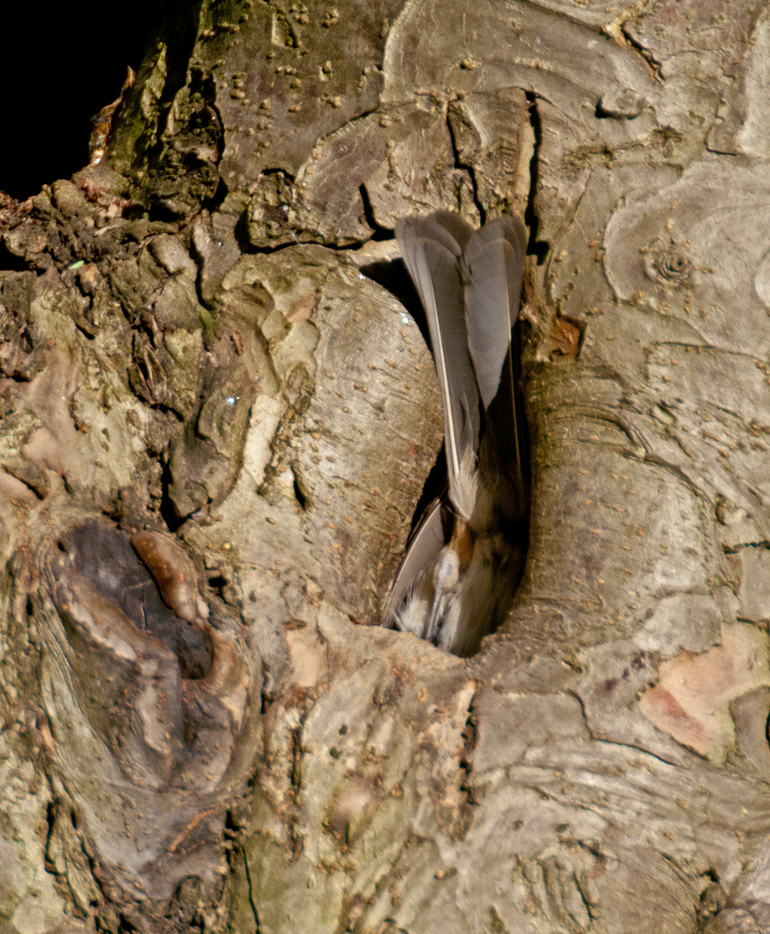
Let me back off a little and explain. The nest in question is inside of a crabapple tree in the front yard of a neighbor’s house, about a yard or so (one meter) above the ground. There are two openings and you can sometimes see the baby birds’ heads pop up through the lower opening, which serves as a window. I learned that the upper opening serves as an entry door for the parents. This is one of my initial shots with my 100mm macro lens of the tree, with one of the parents entering the “door.”

I came back at a later time with my 135-400mm lens and set up my tripod on the sidewalk and waited. It was mid-afternoon and the sun was shining almost directly into the opening, which complicated the exposure, but my patience was rewarded when the parents made multiple trips into the nest. This is another shot of one of them entering the nest, which you can see is a pretty tight squeeze.

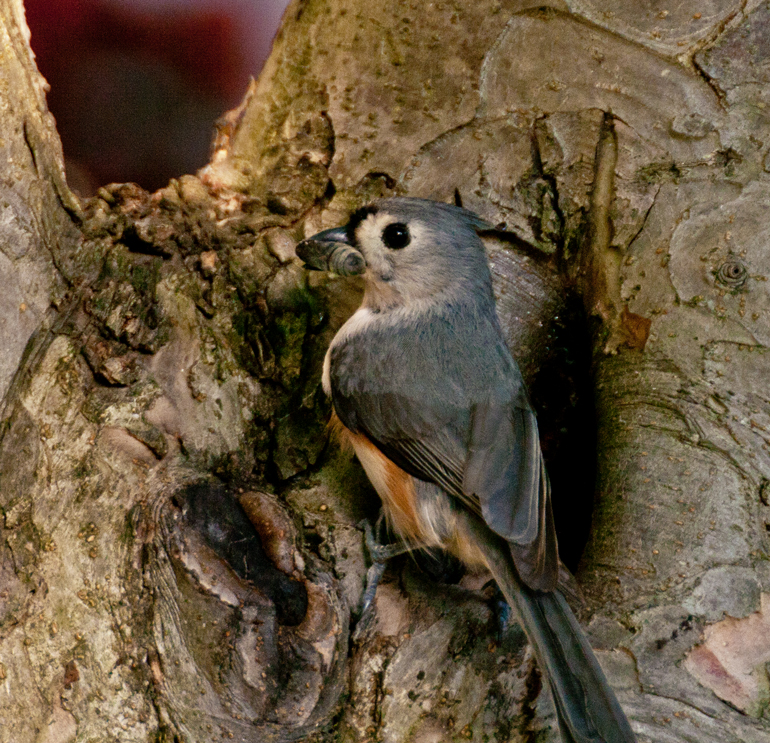
I am not that great at making bird identifications from the rear, so my job was greatly facilitated when one of the birds paused and turned to the side prior to entering the nest. The mystery birds are Tufted Titmice (Baeolophus bicolor). I can’t quite figure out what the little bird has in its bill, but assume that it is something edible. Can anyone else tell what it is?
Timing was tricky as I tried to maintain my focus and the sidewalk was not all that comfortable. (I should bring a cushion next time.) Sometimes the parents would signal their imminent arrival with a call, but sometimes they would fly in out of nowhere. I attempted to capture the birds flying in and then flying out of the nest. Here is one of the few shots I was able to get of one of the parents preparing to leave the nesting cavity.
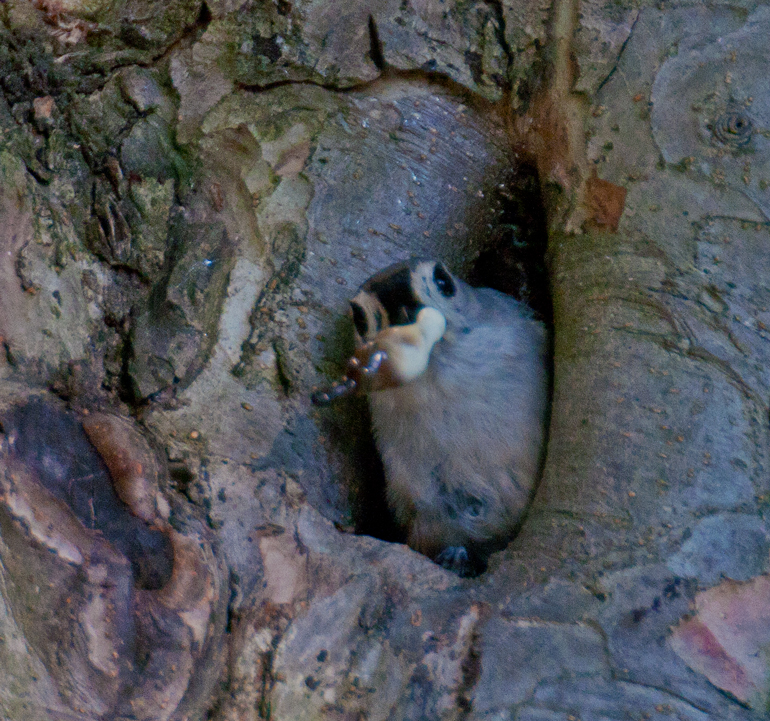
Sometimes when processing my photos, I come across one that I really like, even though it has all kinds of technical problems. I decided to end this posting with such a photo. The bird has already flown out of focus, but is clearly visible and is casting a cool shadow just below the entry into the nest.

Michael Q. Powell. All rights reserved
Posted in Flowers, Gardening, Macro Photography, Nature, Photography, tagged Alexandria VA, blue delphinium, Canon 100mm macro lens, Canon Rebel XT, delphinium on May 26, 2013| 5 Comments »
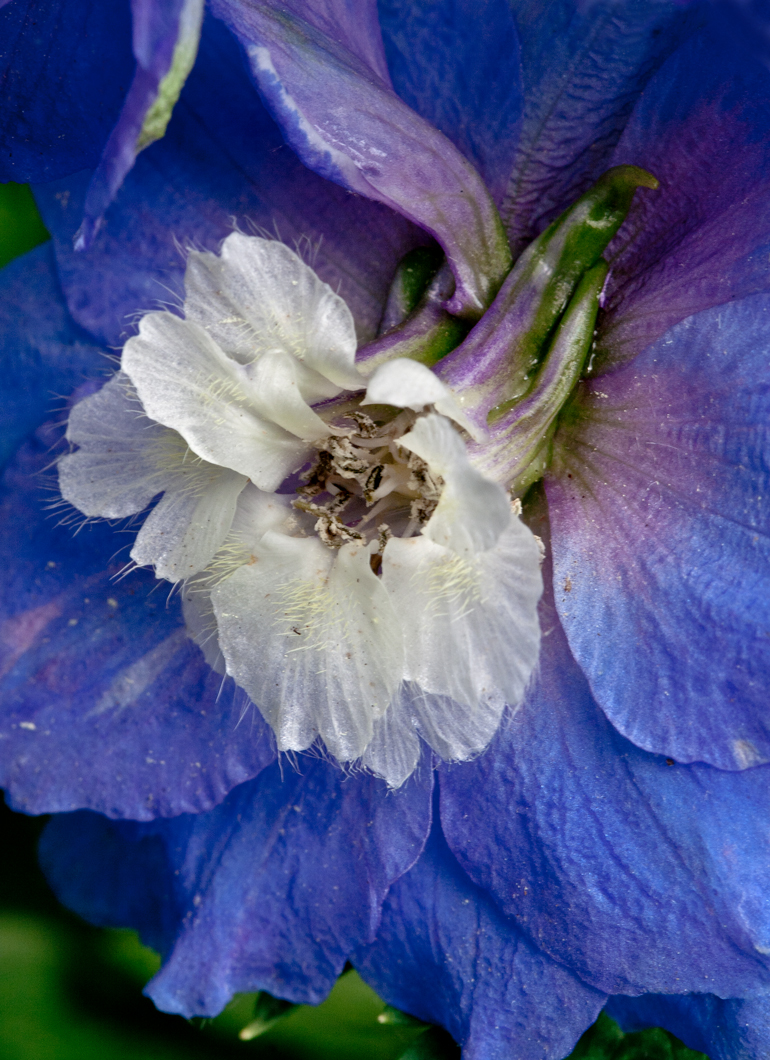
Whenever my neighbor has new flowers popping up in her garden, she invariably invites me to come and photograph them, and this close-up shot of a blue delphinium is my newest capture.
The neighbor in question is Cindy Dyer, a noted flower photographer and fellow blogger, and I thinks she almost always chooses photogenic flower species to plant. Check out her blog to see some gorgeous shots of all kinds of flowers. (She also is the one who got me started shooting regularly and has been an endless source of inspiration and encouragement for my photography.)
I love the beautiful color of this flower, which is pretty small, and the different textures that you can see in this shot.
Michael Q. Powell. All rights reserved
Posted in Flowers, Gardening, Nature, Photography, tagged Alexandria VA, Canon 100mm macro lens, Canon Rebel XT, columbines, green spring gardens, purple on May 25, 2013| 1 Comment »
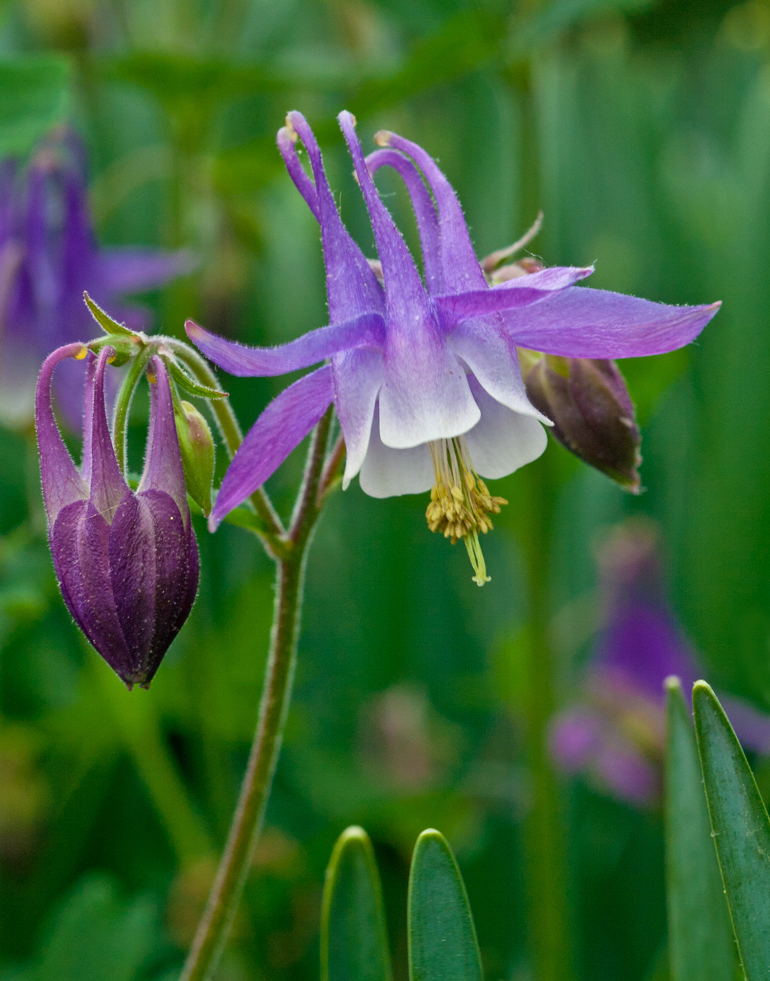
There are a lot of columbines blooming now at a local garden and I can’t keep from photographing them every time that I am there.
I especially like this shot because it shows blooms at various stages of development on the same stem. It’s fascinating for me to be able to see how the shape and color of the flower change as the blooms mature.
Michael Q. Powell. All rights reserved
Posted in Arachnids, Macro Photography, Nature, Photography, tagged Alexandria VA, Canon 100mm macro lens, Canon Rebel XT, green spring gardens, macro photography, spider on May 22, 2013| 8 Comments »
This weekend I learned how difficult it is to get good shots of a tiny spider when it is in the middle of a cluster of plants and is surrounded by an untidy mess of web material, rather than a nice web. Auto-focus was utterly useless and the camera refused to focus on the spider—it wanted to focus either on the plants in the background or on the web material. Manual focusing was required and it was tough to tell which parts of the spider were in focus at any given moment.
I used my tripod, which helped a little, and even used the pop-up flash to give me little extra light (you can see the shadows it caused in the second photo). I especially like the way that the colors in the images turned out, giving the photos kind of an out-of-this-world, sci-fi look.
The second shot is an action shot in which the spider has captured some kind of flying insect, which I can’t really identify. I didn’t have a great angle, but find the shot to be interesting.
As I shoot more insects and spiders, I am experimenting and finding out what works for me (and admiring even more the photographers who are able to get the amazing shots that I see on other blogs and elsewhere on the internet).


Michael Q. Powell. All rights reserved
Posted in Arachnids, Macro Photography, Nature, Photography, wildlife, tagged Alexandria VA, Canon 55-250mm zoom lens, Canon Rebel XT, daddy longlegs, green spring gardens, harvestman, opiliones on May 19, 2013| 10 Comments »
It was raining a little yesterday when I encountered my first harvestman (order Opiliones) of the spring, which explains the drops of water that you may notice on some on its legs.
Growing up, I was accustomed to calling them daddy longlegs and thought they were a kind of spider. Last year, I learned that harvestman in fact are not spiders, even though they do belong to the class of arachnids—harvestmen are in the order Opiliones and spiders are in the order Araneae.
I shot this image with my 55-250mm telephoto zoom, which meant that I couldn’t get in super close to the harvestman. However, I did manage to get at least part of all of his legs in the shot, which was not the case last year when I photographed one with my macro lens—there is an unavoidable tendency to want to get close whenever I put the macro lens on my camera.

Michael Q. Powell. All rights reserved
Posted in Birds, Nature, Photography, Winter, tagged Alexandria VA, Canon 55-250mm zoom lens, Canon Rebel XT, Colaptes auratus, green spring gardens, Northern Flicker, woodpecker on May 19, 2013| 6 Comments »
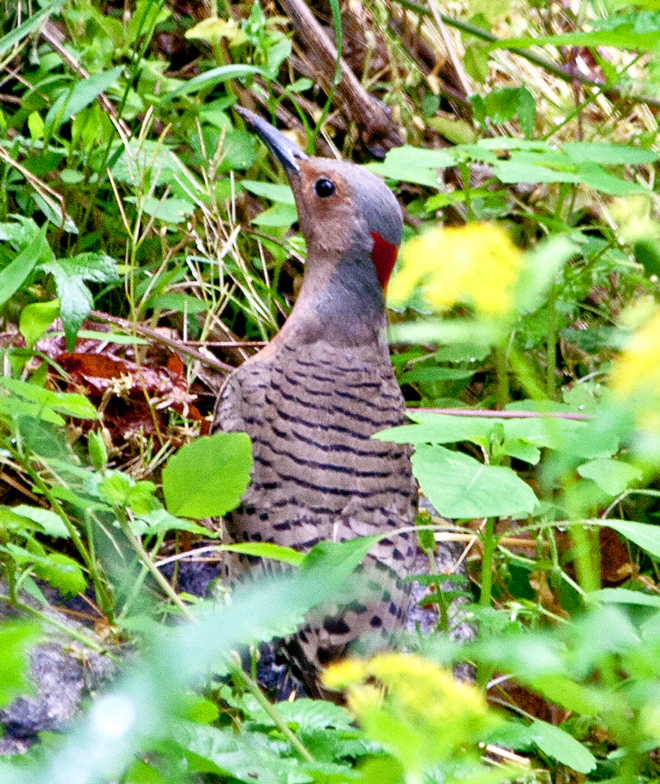
I observed this female Northern Flicker (Colaptes auratus) for quite some time yesterday, but had a difficult time getting a clear shot as she dug about in the undergrowth.
The Cornell Laboratory of Ornithology notes that this type of woodpecker is unusual in that it spends a lot of its time on the ground, digging in the dirt for ants and beetles. I love the coloration of the Northern Flicker and you can tell that this one is a female, because she is lacking the mustache stripe under her eye.
I didn’t manage to capture her entire body in the shot, but I like the way that she seems to emerge from the colorful underbrush.
Michael Q. Powell. All rights reserved
Posted in Arachnids, Bugs, Macro Photography, Nature, Photography, Portraits, tagged Alexandria VA, Canon 100mm macro lens, Canon Rebel XT, eyes, fuzzy legs, spider on May 17, 2013| 22 Comments »
As I was looking in my neighbors’ garden for flowers to photograph, I came across this cool-looking little spider, which I have not yet been able to identify.
The spider was really small, maybe a half-inch (a little over 1 cm) in size and didn’t sit still too much, so it was quite a challenge to photograph him. I really like his eyes and his hairy legs, which look almost like they are transparent.
One of the things that I especially like about spring is that insects reappear and give me photo opportunities like this one.


Michael Q. Powell. All rights reserved
Posted in Bugs, Insects, Macro Photography, Nature, Photography, tagged Alexandria VA, bugs, Canon 100mm macro lens, Canon Rebel XT, ladybug, macro on May 14, 2013| 7 Comments »
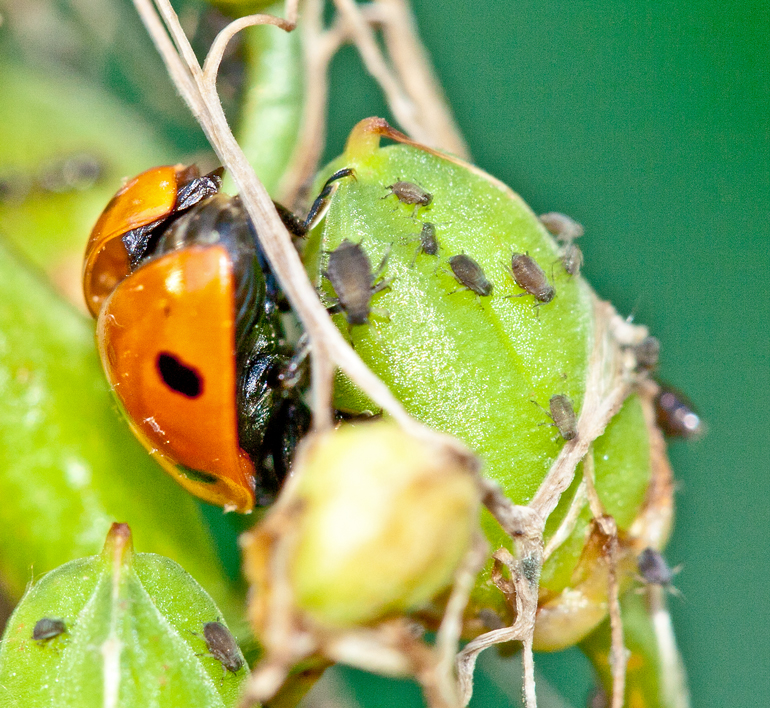
This ladybug was not in a very good position for me to get a shot, but I usually try to photograph every ladybug that I see, so I took the shot, totally oblivious to the fact that she was not the only bug in the frame.
Occasionally, when I am photographing a flower or an insect, there is an additional insect in the photo that I notice only when reviewing the images, what my friend Cindy Dyer calls a “bonus bug.” How did I miss almost a dozen bugs in my viewfinder?
Can anyone identify the little bugs?
Michael Q. Powell. All rights reserved
Posted in Art, Flowers, Gardening, Macro Photography, Photography, tagged Alexandria VA, Canon 100mm macro lens, Canon Rebel XT, flower, kaleidoscope on May 14, 2013| 1 Comment »
Looking at this plant from the side, all you notice are the tall, straw-like spikes that radiate from the center, but from above, it’s like looking into a kaleidoscope. I love the repetition of the colors and patterns in a wide circle around the center blossom.
I don’t have any idea what kind of flower this is, so I’ll make up my own name for it and call it the Kaleidoscope flower.

Michael Q. Powell. All rights reserved
Posted in Bugs, Insects, Macro Photography, Nature, Photography, tagged Alexandria VA, Canon 100mm macro lens, Canon Rebel XT, ladybug, macro on May 12, 2013| 6 Comments »
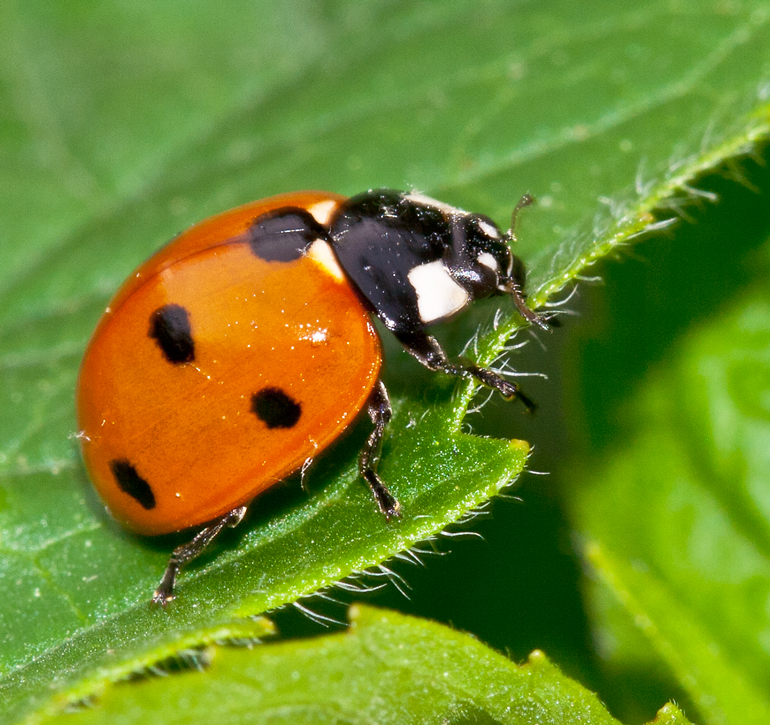
I really enjoy the challenge of trying to photograph insects and this ladybug was a relatively cooperative subject. She sat still for quite a while, which allowed me to experiment a little with techniques. The first show was taken after she started to move a little.
The light was fading a little, so I decided to see what would happen if I used my pop-up flash. It’s obvious to me that I risk having a hot spot, which is most visible in the second shot, but it seems that the additional light helped to bring out some additional details. I have seen the fancy setups advertised that use dual external flashes, but don’t think that I am ready to make that kind of financial commitment. Perhaps I will experiment with a cheaper, LED light or possibly a ring light and see how well they work.

Michael Q. Powell. All rights reserved
Posted in Bugs, Insects, Macro Photography, Nature, wildlife, tagged Alexandria VA, Canon 100mm macro lens, Canon Rebel XT, mating insects, mating moths, moths, Orange Mint moths, Pyrausta orphisalis on May 12, 2013| 9 Comments »
Do you prefer to take photos alone or with others?
Normally I prefer to shoot alone, to move at my own pace and shoot whatever catches my eye at a given moment. However, there are advantages to working side-by-side with another photographer. The other person can serve as a spotter and point out opportunities and subject that you might have otherwise missed. It’s also interesting and instructive after a shoot is done to compare images and see the same scene through another set of eyes.
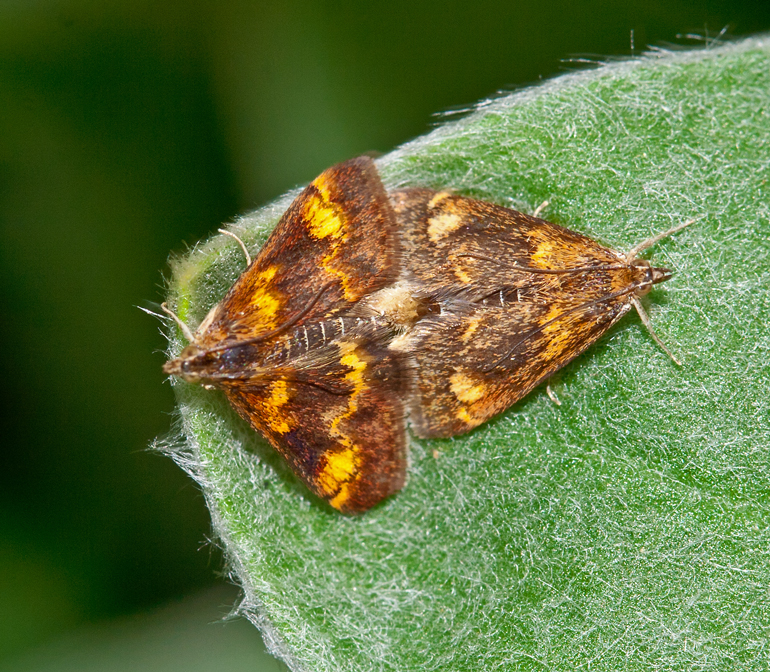
Friday late in the afternoon, I noticed that my neighbor, friend, and photography mentor, Cindy Dyer, was out in her garden taking photos of her beautiful flowers. Cindy, a noted photographer, has been a constant influence on my photography this past year, encouraging me and inspiring me. She loves this time of the year, when nature explodes with color, and her blog is full of beautiful images of flowers of all varieties (and lots of other cool photos too).
When I started shooting with Cindy, I was shooting a lot of flowers and a few insects, but gradually moved to shooting more insects than flowers. Somehow my eyes are attracted to insects. Shortly after joining Cindy in her garden with my camera and tripod, I spotted what I thought was an interesting looking insect. Upon closer examination, it turned out to be a pair of mating moths, that together were about one inch long (2.5 centimeters). They were positioned in such a way that the only way to capture them was to shoot from directly overhead. I had real problems with depth of field as I got my macro lens as close as it would let me get.
I challenged Cindy (in a friendly way) to photograph this couple and she took up the challenge and posted an image in her blog. It was an interesting challenge pitting Nikon against Canon and teacher against student as we explored the limits of our macro lenses and photography skills.
This little incident helped to remind me of the benefits of shooting with someone else, especially someone who gently pushes me forward. It usually works best for me when we travel somewhere and shoot side-by-side part of the time and wander on our own the rest of the time—the best of both worlds.
Michael Q. Powell. All rights reserved
Posted in Flowers, Gardening, Macro Photography, Nature, Photography, tagged Alexandria VA, Canon 100mm macro lens, Canon Rebel XT, green spring gardens, lily of the valley on May 11, 2013| 8 Comments »
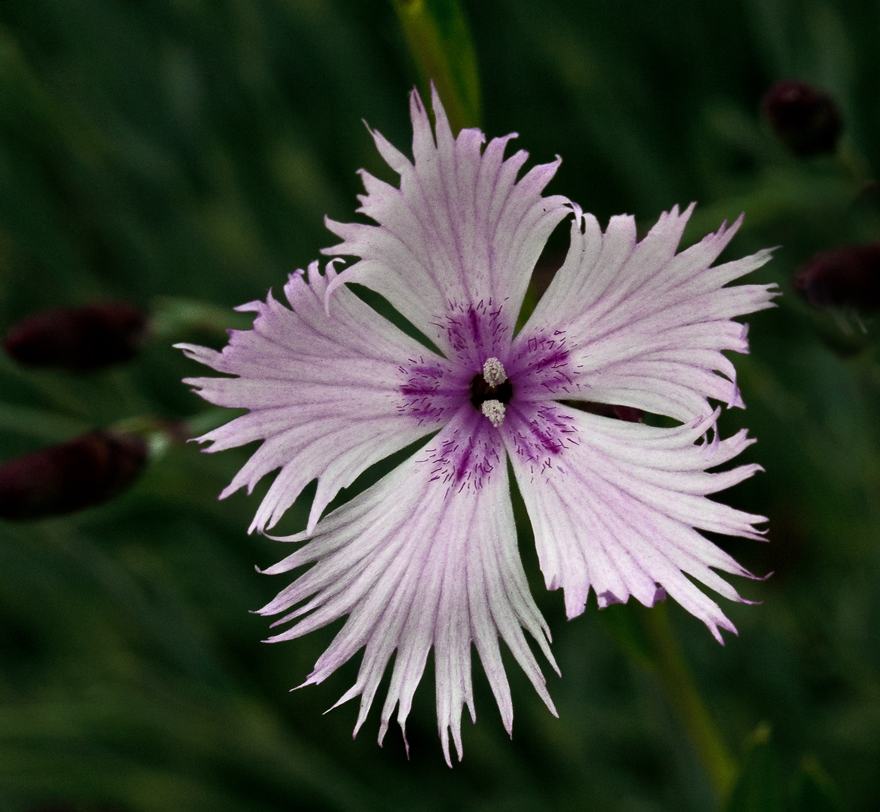
I have been taking photos of a lot of flowers in a lot of different places and thought I would post a few of my favorites.
The first one is of a plant called Lily of the Valley that was growing in the back yard of one of my neighbors. It was pretty small and close to the ground, so I have to create a makeshift bean bag to support my camera, using cushions for lawn furniture
I really don’t know what the second flower is called, but I really liked the shape of its petals and the slight pinkish-purple tinge of color .
The final shot is a small plant that was growing in the rock garden of a county-run historical garden that I love to visit. From a distance, the flower looked like it was in the shape of a cube.


Michael Q. Powell. All rights reserved
 Mike Powell
Baby bird
Posted in Birds, commentary, Nature, Photography, wildlife, tagged Alexandria VA, baby bird, Canon 100mm macro lens, Canon Rebel XT on May 24, 2013| 4 Comments »
What do you do when you find a baby bird on the ground? That was the dilemma I faced a couple of nights ago, when I found this tiny baby bird on the lawn of a neighbor’s townhouse.
Earlier in the week another neighbor had alerted me that there were baby birds in a tree a few doors down from my townhouse. I live in a suburban townhouse community and each of us has a postage-stamp size front lawn and a mandatory tree, mostly small crab apple trees. The baby birds were in a cavity of one such tree, a mere two feet (60 cm) above the ground and there seemed to be three or four babies.
When I returned home from work, I checked on the babies and suddenly heard a squawk. I looked down at my feet and saw one of the babies in the grass. There are all kinds of views about the advisability of putting baby birds back in a nest, but I was genuinely concerned that this tiny bird was in an incredibly vulnerable spot (among other things, we have some cats in the neighborhood).
A little fearful of doing it myself, I called my friend (and fellow blogger) Cindy Dyer, who was both willing and able to place the small bird back with its siblings in the cavity of the tree. Yesterday evening, I made a quick check of them and they seem to be ok.
I was mostly focused on dealing with the situation, but did manage to get a few quick shots of the little bird, which I can’t yet identify.
Michael Q. Powell. All rights reserved
Share this:
Read Full Post »