April 11, 2025 by Mike Powell
I was surprised and delighted to spot this Cabbage White butterfly (Pieris rapae) as it was feeding on a newly sprouted dandelion on Tuesday at Occoquan Bay National Wildlife Refuge. I love chasing these elusive little butterflies that I used to think were moths.
Gardeners consider Cabbage Whites to be pests, because their caterpillars can do significant damage to plants, including cabbage, broccoli, cauliflower, and collard greens, but I find them to be beautiful. In that respect I guess I am a kind of dreamer who prefers to focus more on form than on function.

© Michael Q. Powell. All rights reserved.
Posted in Butterflies, Insects, Nature, Photography, spring, wildlife | Tagged Cabbage White, Cabbage White butterfly, Canon 7D, Occoquan Bay National Wildlife Refuge, Pieris rapae, Tamron 150-600mm, Woodbridge VA | 8 Comments »
April 10, 2025 by Mike Powell
Long telephoto lenses tend to distort your depth perception. On Tuesday I watched this North American Snapping Turtle (Chelydra serpentina) swimming about in a pond at Occoquan Bay National Wildlife Refuge. I was a bit creepy as the turtle got bigger and bigger in my viewfinder when it began to swim directly towards me. One part of my brain objectively knew that the turtle was still a long way off, but it was nonetheless a bit disconcerting when the snapping turtle’s dinosaur-like eyes appeared to be staring right at me.
Spring is here, though the weather has been cool recently and there were some local frost warnings last night, and all kinds of creatures are waking up. I’m still looking for my first dragonfly of the year and will probably continue my quest later today.

© Michael Q. Powell. All rights reserved.
Posted in Nature, Photography, Reptiles, spring, turtle, wildlife | Tagged Canon 7D, Chelydra serpentina, common snapping turtle, North American Snapping Turtle, Occoquan Bay National Wildlife Refuge, Tamron 150-600mm, Woodbridge VA | 6 Comments »
April 7, 2025 by Mike Powell
I have been hearing a lot of Red-winged Blackbirds (Agelaius phoeniceus) during recent visits to Occoquan Bay National Wildlife Refuge and was delighted to finally capture a shot of one last week that shows the distinctive yellow and red shoulder patch of the males of his species.
I was hoping that the blackbird would fly to some lower branches, but he seemed content to perch high above me in a tree. I was pleased, though, to be able to capture this fun little portrait—it is tough to convince birds to pose for me.

© Michael Q. Powell. All rights reserved.
Posted in Birds, Nature, Photography, spring, wildlife | Tagged Agelaius phoeniceus, blackbird, Canon 7D, Occoquan Bay National Wildlife Refuge, Red-wing Blackbird, Tamron 150-600mm, Woodbridge VA | 1 Comment »
April 4, 2025 by Mike Powell
Most of the time when I am out in nature, I am focused on wildlife and often neglect to take landscape photos. Last week, though, was a notable exception when I went for a hike in Prince William Forest Park, an installation administered by the National Park Service located about 25 miles from where I live.
Most of the park is forested and hilly and there was not much wildlife to observe, so I enjoyed the natural beauty that surrounded me. My iPhone tracks the number of steps that I take and it shows that I walked about 12 thousand steps that day. That may not sound like a lot of steps, but the statistics also indicated that I climbed the equivalent of 37 flights of stairs.
One of the highlights of my hike was walking along Quantico Creek that runs through a portion of the park—I love the sound of rushing water. At several places along the creek there are dams, as you can see in several photos below, that tend to slow the flow of the water.
It was a wonderful way to spend the day and I left the park physically tired, but mentally refreshed and rejuvenated.

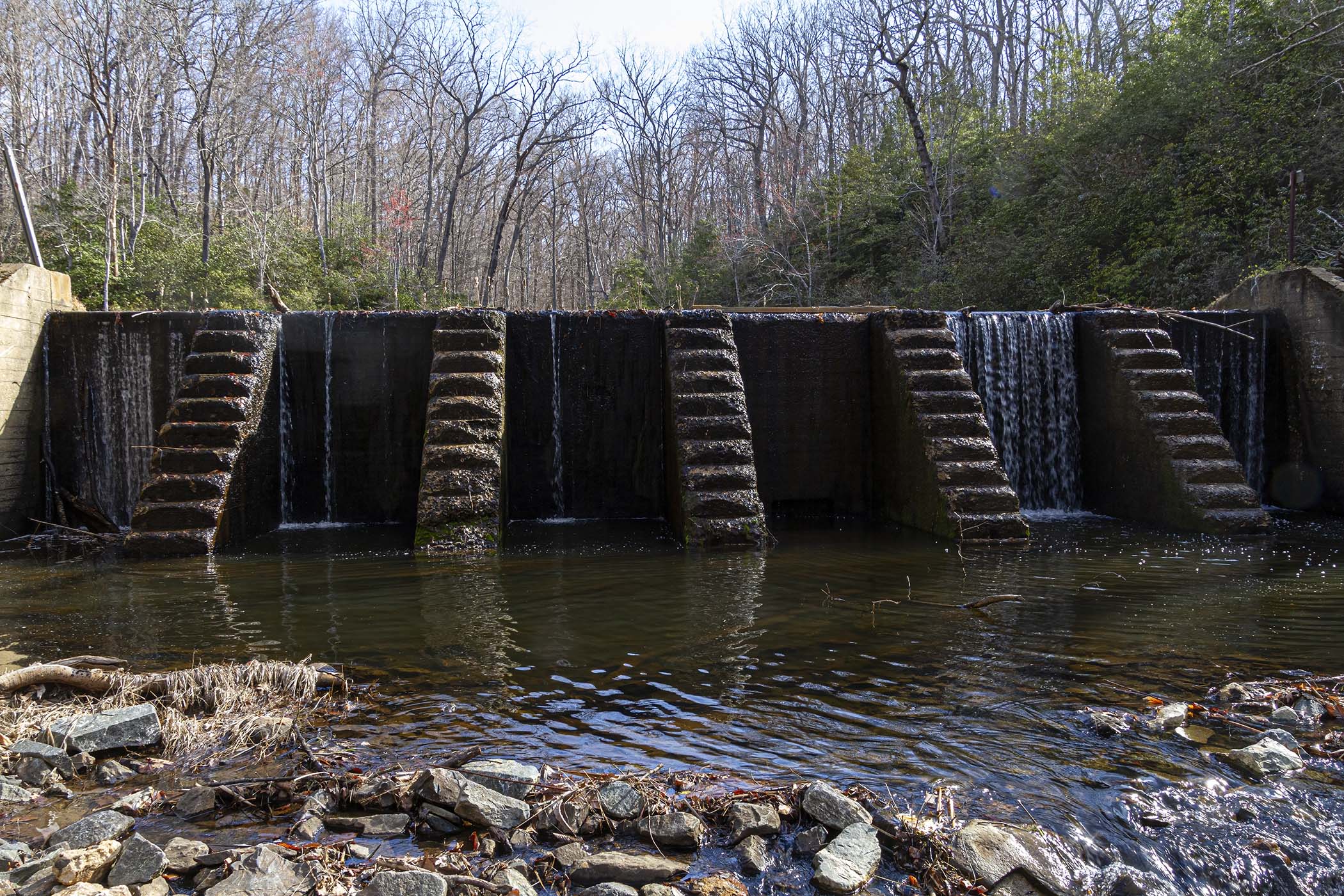

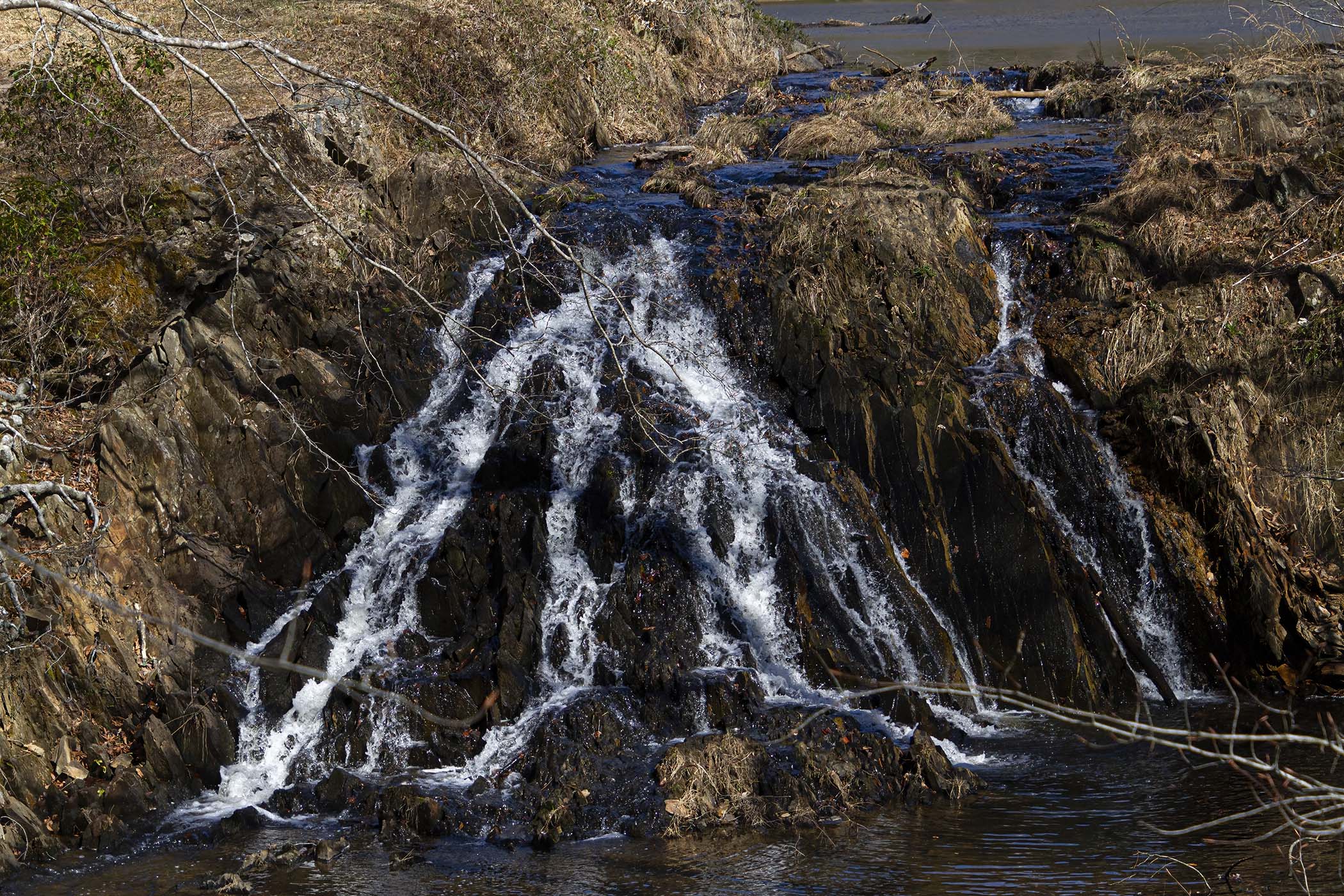
© Michael Q. Powell. All rights reserved.
Posted in Landscape, Nature, Photography, spring | Tagged Canon 7D, Prince William Forest Park, Quantico Creek, Tamron 18-400mm, Triangle VA | 5 Comments »
April 3, 2025 by Mike Powell
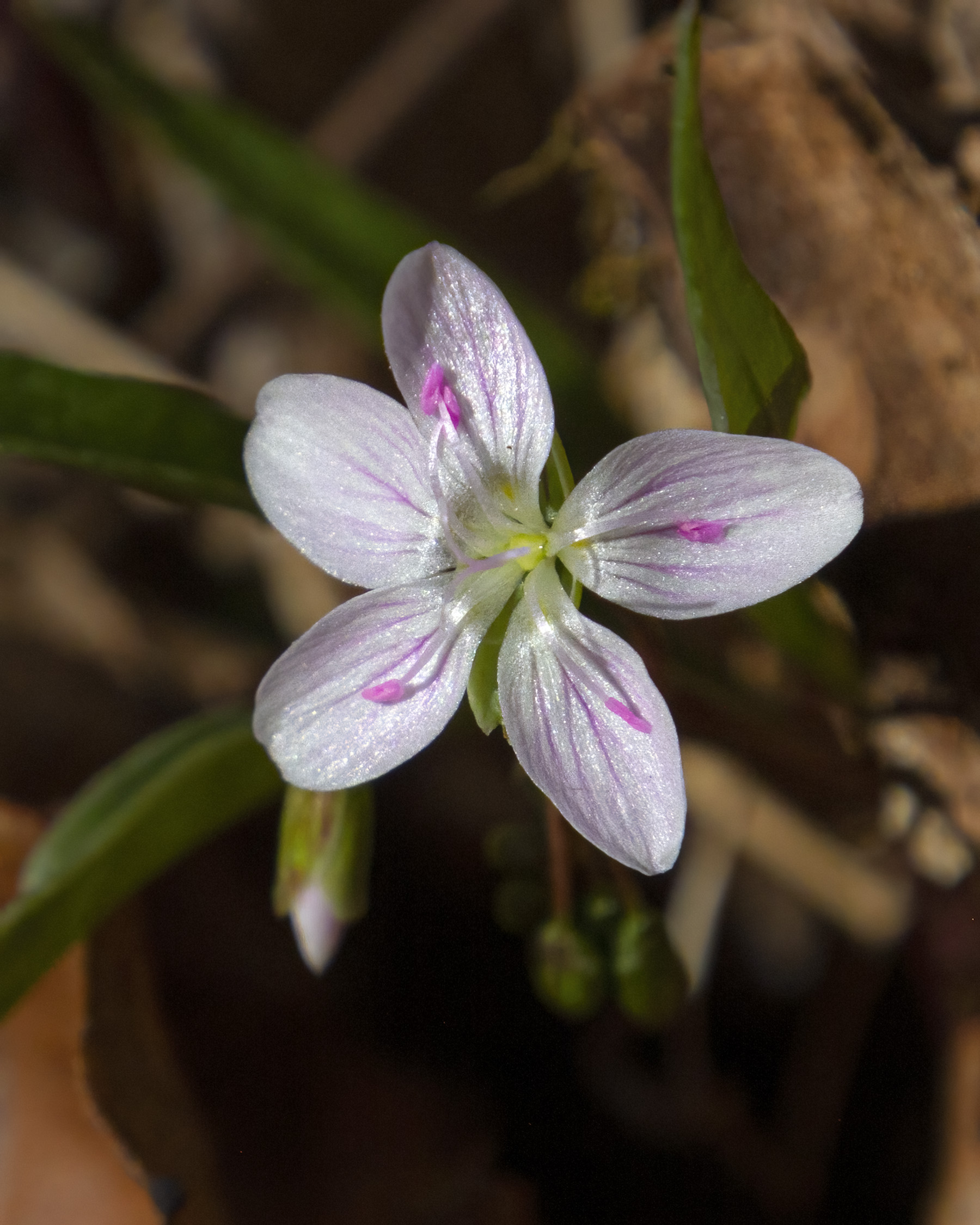
Spring is definitely here. I spotted my first Spring Beauty wildflower (Claytonia virginica) on 26 March during a hike at Prince William Forest Park in Triangle, Virginia. Before long I am sure that I will see large numbers of them in the forest, though they tend to be ephemeral and don’t bloom for very long.
The Spring Beauty plants have tiny underground tubers that Native Americans reportedly prepared and ate like potatoes, though I suspect that you would have to collect a lot of them to make a meal.
© Michael Q. Powell. All rights reserved.
Posted in Flowers, Nature, Photography, spring | Tagged Canon 7D, Claytonia virginica, Prince William Forest Park, Spring Beauty, Tamron 18-400mm, Triangle VA, Virginia Spring Beauty | 4 Comments »
April 1, 2025 by Mike Powell
Last Wednesday I went on a hike in Prince William Forest Park, a National Park Service site in nearby Triangle, Virginia. Unlike the coastal plains and marshes where I spent a lot of my time in nature, Prince William Forest Park, as its name suggests, is a forested area that is full of hills and valleys with numerous creeks.
One of the highlights of my hike was seeing my first Eastern Cricket Frogs (Acris crepitans crepitans) of the season. Cricket frogs of the genus Acris are quite small (about one inch (25 mm) in length) and I often spot them at the edge of the creeks in the park. On this occasion I spotted the frog when it hopped right in front of me, though most often I hear the frogs before I see them. Cricket frogs have a distinctive call that sounds like two pebbles being clicked against each other—some scientist thought it sounded like a cricket, which accounts for the common name for the species .

© Michael Q. Powell. All rights reserved.
Posted in Amphibians, Macro Photography, Nature, Photography, wildlife | Tagged Acris crepitans, acris crepitans crepitans, Canon 7D, cricket frog, Eastern Cricket Frog, Prince William Forest Park, Tamron 18-400mm, Triangle VA | 3 Comments »
March 31, 2025 by Mike Powell
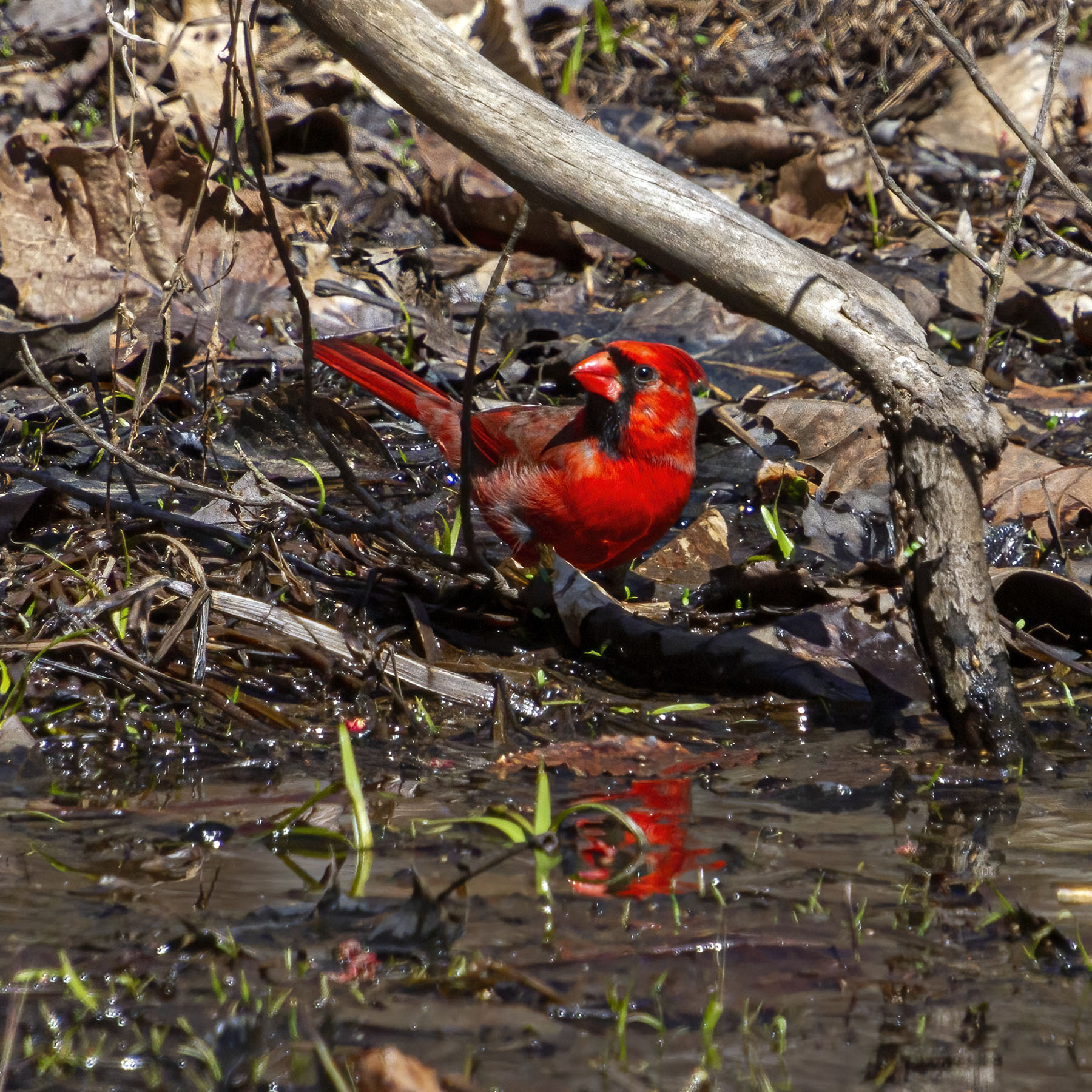
I spotted this male Northern Cardinal (Cardinalis cardinalis) as he was hopping around on the ground near a stream last week in Prince William County, Virginia. I was delighted when the cardinal bent over and drank briefly from the shallow water. In the first photo, I captured the moment when the cardinal lifted his head and dribbled a few drops of water from his mouth.
It seemed like the cardinal suddenly became aware of my presence and realized that my previous photo might not have been very flattering, which is usually the case when you snap a shot of someone eating or drinking. He then struck a profile pose for me to show his better side. Note the slight tilt of the head that helps to present a slimmer neck—clearly this cardinal had some previous experience as a model.

© Michael Q. Powell. All rights reserved.
Posted in Birds, Nature, Photography, Portraits, wildlife | Tagged Canon 7D, Cardinalis cardinalis, male Northern Cardinal, Northern cardinal, Prince William County VA, Tamron 18-400mm | 9 Comments »
March 28, 2025 by Mike Powell
Springtime has definitely arrived in Northern Virginia. All kinds of trees are starting to put out buds and leaves and Washington D.C.’s famous cherry trees are now in full bloom.
On Wednesday I explored a creek in Prince William County, hoping to find some early dragonflies. I was not successful in my quest, but I was quite happy to capture this image of a female Northern Cardinal (Cardinalis cardinalis) with some of the bright spring colors that have recently emerged. The subdued coloration of the female Cardinal does not stand out quite as much as that of her male counterpart, but I find it her more refined colors to be even more beautiful than those of the male.

© Michael Q. Powell. All rights reserved.
Posted in Birds, Nature, Photography, spring, wildlife | Tagged Canon 7D, Cardinalis cardinalis, female Northern Cardinal, Northern cardinal, Prince William County VA, Tamron 18-400mm | 4 Comments »
March 27, 2025 by Mike Powell
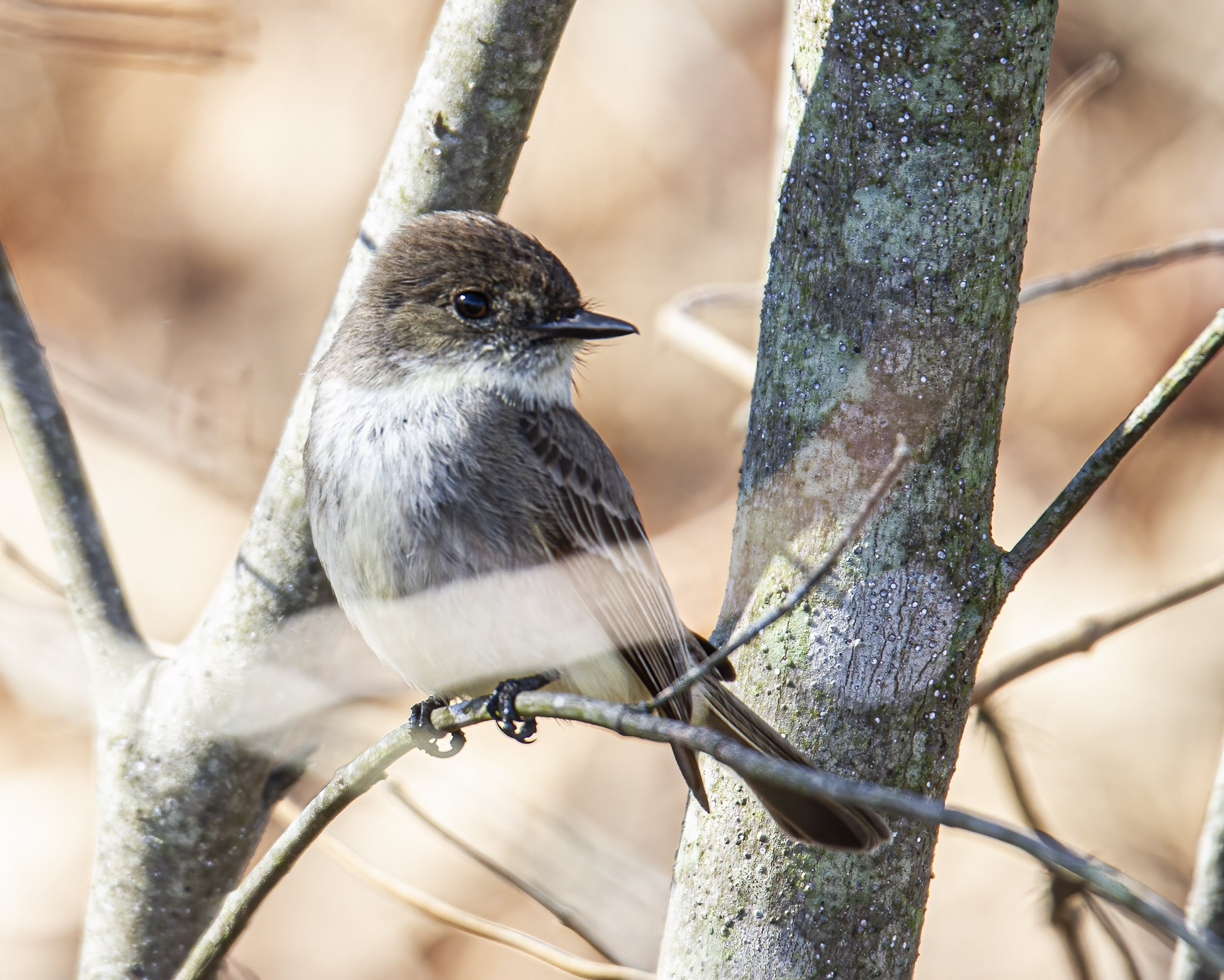
In some locations the reappearance of Eastern Phoebes (Sayornis phoebe) is one of the first indications that spring is returning. I am not sure if Eastern Phoebes are with us year round in Northern Virginia, but I know that it as been quite a few months since I last saw one.
On Tuesday I spotted this phoebe in a tree at Occoquan Bay National Wildlife Refuge. Branches were partially blocking my view of the bird, but I managed to find get a clear view of its face (and most importantly of its eye) by making small adjustments to my shooting position.
© Michael Q. Powell. All rights reserved.
Posted in Birds, Nature, Photography, spring, wildlife | Tagged Canon 7D, Eastern Phoebe, Occoquan Bay National Wildlife Refuge, phoebe, Sayornis phoebe, Tamron 150-600mm, Woodbridge VA | 1 Comment »
March 26, 2025 by Mike Powell
I was delighted to spot this Brown Thrasher (Toxostoma rufum) last week at Occoquan Bay National Wildlife Refuge. I had to move around a lot to get a clear view of its head, though I was pretty sure it was a thrasher when I caught a glimpse of its bright yellow eye and long tail. The Cornell Lab of Ornithology did a great job in describing the challenges of spotting this species, “It can be tricky to glimpse a Brown Thrasher in a tangled mass of shrubbery, and once you do you may wonder how such a boldly patterned, gangly bird could stay so hidden.”
Brown Thrashers are present year round in the southern portions of Virginia, but I think they move north into my area of Northern Virginia during the breeding season. Before long we should have lot of other birds, including warblers, migrating through our area and, of course, dragonflies and other insects will soon reappear. Yesterday i noted a posting in Facebook with photos of dragonflies that were recently taken in central Virginia. I will probably venture out later today to see if I can spot any dragonflies myself.

© Michael Q. Powell. All rights reserved.
Posted in Birds, Nature, Photography, spring, wildlife | Tagged brown thrasher, Canon 7D, Occoquan Bay National Wildlife Refuge, Tamron 150-600mm, thrasher, Toxostoma rufum, Woodbridge VA | Leave a Comment »
March 24, 2025 by Mike Powell
Osprey (Pandion haliaetus) are very opportunistic birds—they will make a nest almost anywhere there is a bit of space. Last week I spotted an osprey perched on the roof of a duck blind in the water and captured this cool little image.
These little shack-like structures on stilts have been built in the waters off of Occoquan Bay National Wildlife Refuge and are used a few weeks a year during duck hunting season. It is a little disconcerting during that time to hear shotguns being fired only a short distance away, but the money collected for hunting licenses is used for waterfowl habitat improvement and restoration in Virginia.

© Michael Q. Powell. All rights reserved.
Posted in Birds, Nature, Photography, spring, wildlife | Tagged Canon 7D, Occoquan Bay National Wildlife Refuge, Osprey, osprey nest, Pandion haliaetus, Tamron 150-600mm, Woodbridge VA | 2 Comments »
March 22, 2025 by Mike Powell
Buds are beginning to grow on many of the trees in my area as we welcome the beginning of spring. However, it looks like this little Carolina Chickadee (Poecile carolinensis) that I spotted on Tuesday at Occoquan Bay National Wildlife Refuge was impatient and chose to nibble on a tender young bud that had barely started to develop.
The lighting conditions were not optimal, but I like the way that I was able to capture the way that the chickadee used its tiny bill to poke into the underdeveloped bud. It may not seem like much, but I suspect that the chickadee welcomed the taste of the tender spring bud after a long winter of gnawing on hard, wizened seeds.

© Michael Q. Powell. All rights reserved.
Posted in Birds, Nature, Photography, spring, wildlife | Tagged Canon 7D, Carolina Chickadee, Occoquan Bay National Wildlife Refuge, Poecile carolinensis, Tamron 150-600mm, Woodbridge VA | Leave a Comment »
March 21, 2025 by Mike Powell
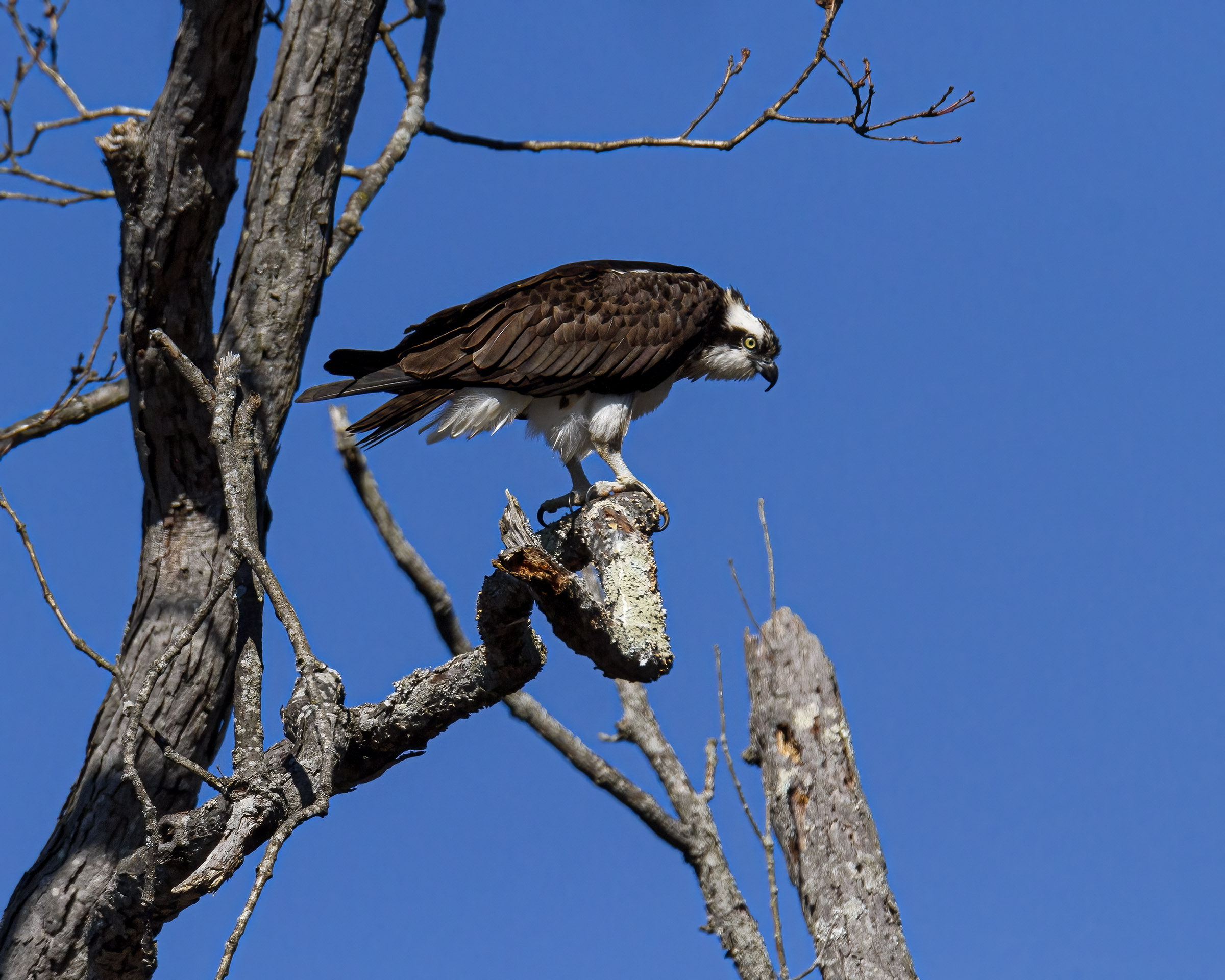
Something attracted the attention of this Osprey (Pandion haliaetus) on Tuesday at Occoquan Bay National Wildlife Refuge and it kept looking down at the ground. At first I thought that the osprey had caught a fish that it was trying to protect from competitors, but when I zoomed in, I did not see any fish.
Perhaps the osprey was looking for its mate or was merely curious to observe all the things that were going on. I don’t think that the osprey had spotted me when I took these shots, but that is also a possibility.

© Michael Q. Powell. All rights reserved.
Posted in Birds, Nature, Photography, spring, wildlife, Winter | Tagged Canon 7D, inquisitive osprey, Occoquan Bay National Wildlife Refuge, Osprey, Pandion haliaetus, Tamron 150-600mm, Woodbridge VA | 2 Comments »
March 18, 2025 by Mike Powell
When Great Blue Herons (Ardea herodias) take off from the water, they really stretch out and usually I cut off part of their bodies when trying to photograph them in action. Last week, though, my timing was good and I captured this little sequence of images as a heron took to the air, flew for a short distance, and “stuck” its landing in the water.
I was really happy with the way that I was able to capture so many details, from the arc of the water droplets as the heron rose out of the water to the bird’s different-colored feathers. In the final photo, the spread wings, wind-blown “hair,” and the wonderful reflection combine to create a really cool mood in the image.


© Michael Q. Powell. All rights reserved.
Posted in Birds, Nature, Photography, spring, wildlife, Winter | Tagged Ardea herodias, Canon 7D, Great Blue Heron, heron, Occoquan Bay National Wildlife Refuge, Tamron 150-600mm, Woodbridge VA | 9 Comments »
March 17, 2025 by Mike Powell
I don’t know if thegroup of Painted Turtles (Chrysemys picta)) was a family unit or merely good friends, but they seemed to be cooperating to maximize their exposure to the warmth of the sun last week at Occoquan Bay National Wildlife Refuge. At some of the other wildlife parks in my area there are large logs on which the turtles will space themselves out as they bask in the sun, but flat dry land is limited at this refuge, so the turtles are willing to share the space with others.
As I was taking the first photo, several more turtles emerged from the pond, as you can see in the second photo below. Their wet shells are much darker than those of the first three turtles that have had a chance to dry out a bit.


© Michael Q. Powell. All rights reserved.
Posted in Nature, Photography, Reptiles, turtle, wildlife, Winter | Tagged Canon 7D, Chrysemys picta, Eastern Painted Turtle, Occoquan Bay National Wildlife Refuge, painted turtle, Tamron 150-600mm, Woodbridge VA | 11 Comments »
March 14, 2025 by Mike Powell
When in the shadows, Common Grackles (Quiscalus quiscula) appear to be all black, but in the bright sunlight their iridescent feathers shine in an array of colors. I photographed this uncommonly beautiful Grackle as it perched in a dead tree on Tuesday at Occoquan Bay National Wildlife Refuge.
Beauty is everywhere.
© Michael Q. Powell. All rights reserved.
Posted in Birds, Nature, Photography, wildlife, Winter | Tagged beauty is everywhere, Canon 7D, Common Grackle, grackle, Occoquan Bay National Wildlife Refuge, Quiscalus quiscula, Tamron 150-600mm, uncommonly beautiful, Woodbridge VA | 5 Comments »
March 13, 2025 by Mike Powell
When does spring begin? If you use the meteorological calendar, spring begins on the first of March in the Northern Hemisphere. Most folks here in the United States, though, consider that spring begins with the vernal equinox that falls on 20 March this year.
I look for other signs that mark the beginning of the new season. Yesterday, for example, I saw a few blooming daffodils and crocuses, some of the first spring flowers to appear, and I also spotted some buds starting to open on trees.
On Tuesday, I spotted my first Ospreys (Pandion haliaetus) of the season at Occoquan Bay National Wildlife Refuge, a sure sign that spring will soon be here.The osprey in the photo was vigorously tearing into the flesh of the fish, stopping periodically to call out to another osprey. I wasn’t sure whether the other unseen osprey was a competitor or a mate, but suspect that it was the latter. A short time later, the osprey flew away to an elevated nesting platform, where I spotted three ospreys that appeared to be sharing the freshly-caught fish, as you can see in the second image below.


© Michael Q. Powell. All rights reserved.
Posted in Birds, Nature, Photography, wildlife, Winter | Tagged Canon 7D, first osprey, Occoquan Bay National Wildlife Refuge, Osprey, Pandion haliaetus, Tamron 150-600mm, Woodbridge VA | 7 Comments »
March 11, 2025 by Mike Powell
I do not pay too much attention to the statistics that WordPress provides about my blog, but I could not help but notice this morning that, according to the “official” statistics, I have now had over a half million views since July 2012 of 5,33p posts. Wow! It’s a bit of a mystery to me how exactly WordPress counts those views, so I am not sure if the stats are fully accurate, but those numbers indicate a lot of effort on my time.
More than that, though, those statistics reflect an incredible amount of support and encouragement from so many of you. Thanks to all of you, whether you have followed my photographic wanderings for a day for for years. The second image below is a screen shot of the overall statistics for the blog this morning.
As you may have noticed, I have slowed my pace of posting a bit over the last six months as more of my free time has been increasingly devoted to other interests and activities. I’ll be keeping up with the photography blog, though, at least a few times a week and quite possibly more frequently than that as the weather warms up.
During a recent visit to Occoquan Bay National Wildlife Refuge, I captured this shot of a Great Blue Heron (Ardea herodias) in action. Most of the time these herons thrust their bills violently in the water in attempting to catch fish, but this one was doing so much more gently that normally. The water level was low because it was lot tide and the heron may have been trying to pluck a small fish out of the water. On this attempt, though, he was not successful, but the heron’s open bill made for a nice photo.
I thought about posting one of my “best” images for today’s blog entry, but decided instead to continue my habit of posting recent images that appeal to me. As many of you know, I am generally content to post photos of everyday creatures to highlight the beauty that surrounds us all of the time if we slow down and take the time to observe it. Beauty is everywhere.


© Michael Q. Powell. All rights reserved.
Posted in Birds, Nature, Photography, wildlife, Winter | Tagged Ardea herodias, Canon 7D, Great Blue Heron, Great Blue Heron fishing, Occoquan Bay National Wildlife Refuge, Tamron 150-600mm, Woodbridge VA | 20 Comments »
March 10, 2025 by Mike Powell
During a recent visit to Occoquan Bay National Wildlife Refuge I caught a glimpse of bright red deep in the vegetation. I was pretty sure that it was some kind of woodpecker, but I wasn’t absolutely sure. I maneuvered around a bit and managed to determine that it was a Red-bellied Woodpecker (Melanerpes carolinus).
I was happy to capture this image that shows the head of the woodpecker clearly, even though most of its body is partially hidden. This gives you an idea of the kind of view I often get when I am out with my camera. Some photographers might not even try to get a shot of the subject under these circumstances, but I will give it a shot most of the time. Often my shots are blurry, but sometimes I get a decent shot that I like, like the one in this blog post.

© Michael Q. Powell. All rights reserved.
Posted in Birds, Nature, Photography, wildlife, Winter | Tagged Canon 7D, Melanerpes carolinus, Occoquan Bay National Wildlife Refuge, Red-bellied Woodpecker, Tamron 150-600mm, Woodbridge VA, woodpecker | 1 Comment »
March 7, 2025 by Mike Powell
As the weather has warmed up and the sun has started to shine a bit more brightly, Painted Turtles (Chrysemys picta) have emerged from the mud at the bottom of the ponds at Occoquan Bay National Wildlife Refuge. These turtles used whatever objects they could find to pull themselves out of the water and bask in the sunlight. Sometimes their shells are washed clean of mud, but, as you can see in the final photo, some of the turtles were still covered in mud when I photographed them last week.


© Michael Q. Powell. All rights reserved.
Posted in Nature, Photography, Reptiles, turtle, wildlife, Winter | Tagged Canon 7D, Chrysemys picta, Eastern Painted Turtle, Occoquan Bay National Wildlife Refuge, painted turtle, Tamron 150-600mm, Woodbridge VA | 5 Comments »
March 6, 2025 by Mike Powell
It is still a bit early for trees to be budding with new growth, so birds like this little Carolina Chickadee (Poecile carolinensis) have to be content to forage for seeds among the dried up vegetation from the previous growing season. Last week at Occoquan Bay National Wildlife Refuge I spotted this chickadee that seemed to have struck the jackpot—there was an abundance of dried seeds on the tree on which the bird was perched.
The chickadee had to bend and stretch a bit to reach the seeds, but, as you can see in the second photo below, it had some success in finding food. Before long, spring will arrive and lots of fresher food should appear for the birds, including insects. Chickadees are omnivorous, but like most birds that stay with us during the winter, their diet is mostly a vegetarian one when the weather gets cold and most of the insects disappear.


© Michael Q. Powell. All rights reserved.
Posted in Birds, Nature, Photography, wildlife, Winter | Tagged Canon 7D, Carolina Chickadee, chickadee, Occoquan Bay National Wildlife Refuge, Poecile carolinensis, Tamron 150-600mm, Woodbridge VA | Leave a Comment »
March 5, 2025 by Mike Powell
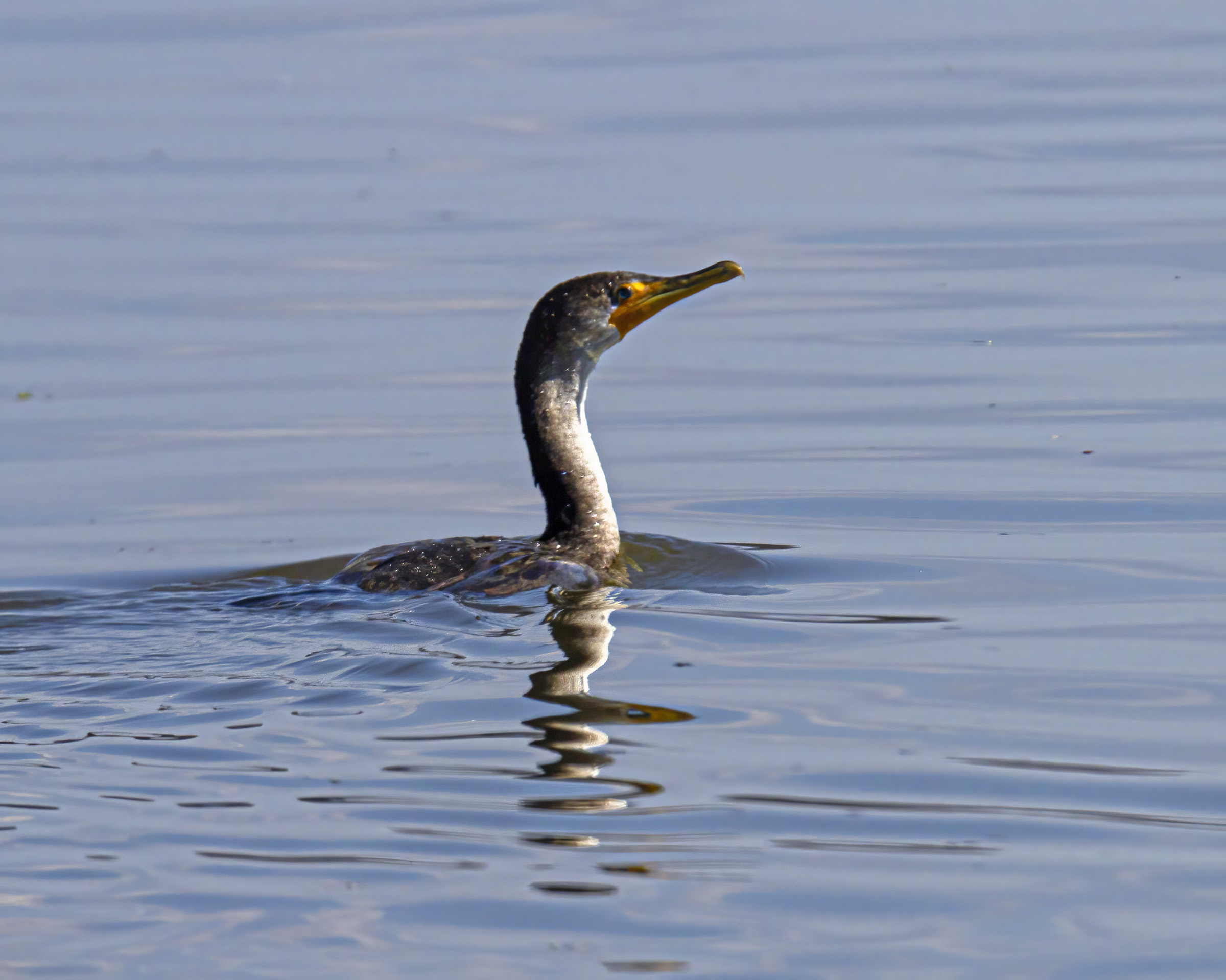
Most of my recent photos of Double-crested Cormorants (Nannopterum auritum) has show the birds taking off. Indeed, cormorants tend to be quite skittish and react quickly when they detect my presence. Last Wednesday, I spotted a cormorant in the waters off of Occoquan Bay National Wildlife Refuge that was so focused on repeatedly diving under that the did not notice me.
I was really happy with the photo that I captured of the cormorant, especially the way that it shows the bird’s beautiful rippled reflection. You may note that the cormorant is really low in the water, with most of its body submerged. As I noted in a recent post, cormorants’ feathers are not completely waterproof and can become waterlogged. For that reason, cormorants need to periodically come out of the water and stretch out their wings to dry them.
© Michael Q. Powell. All rights reserved.
Posted in Birds, Nature, Photography, wildlife, Winter | Tagged cormorant, cormorant reflection, Double-crested Cormorant, Nannopterum auritum, Occoquan Bay National Wildlife Refuge, Woodbridge VA | 1 Comment »
March 3, 2025 by Mike Powell
I see Great Blue Herons (Ardea herodias) quite often at Occoquan Bay National Wildlife Refuge, but generally they are far away from me. Last week, however, I was lucky to get close enough to a heron to be able to capture a portrait-like image of the big bird. How did I do it?
The heron was standing in the waters off of the shore of the refuge and was mostly hidden from view by the vegetation. I was walking along a trail parallel to the water and discovered a little break in vegetation that gave me a clear view of most of the heron. I twisted and turned my body, trying to make sure that no branches were blocking my view and zoomed in with my telephoto lens. I had to wait a little while and eventually the heron lifted its head and turned to the side, giving me a perfect profile pose.
Some wildlife photographers are always searching for new species to photograph, but most of the time I am content to photograph the same species over and over, capturing the changing seasons and environments in which I find these beautiful creatures.

© Michael Q. Powell. All rights reserved.
Posted in Birds, Nature, Photography, Portraits, wildlife, Winter | Tagged Ardea herodias, Canon 7D, Great Blue Heron, heron, Occoquan Bay National Wildlife Refuge, portrait, Tamron 150-600mm, Woodbridge VA | 9 Comments »
March 2, 2025 by Mike Powell
This past Monday I spotted some Double-crested Cormorants (Nannopterum auritum) in the waters off of Occoquan Bay National Wildlife Refuge and once again they took off immediately, even though I was quite a distance away from them. Fortunately I anticipated that this would happen and was able to react quickly enough to capture the action. The second photo below shows the way that cormorants bounce across the water, leaving a trail of small splashes, to gain the speed needed to lift off from the water.
The first photo, my favorite of the two, depicts the cormorant on its last bounce, making final preparations for takeoff with its feet just barely in the water. I really like the position of the extended wings in this image and if you zoom in and look at the face, you will get a look at the brilliant turquoise eyes of the cormorant.


© Michael Q. Powell. All rights reserved.
Posted in Birds, Nature, Photography, wildlife, Winter | Tagged Canon 7D, cormorant, Double-crested Cormorant, Nannopterum auritum, Occoquan Bay National Wildlife Refuge, Tamron 150-600mm, Woodbridge VA | 2 Comments »
February 28, 2025 by Mike Powell
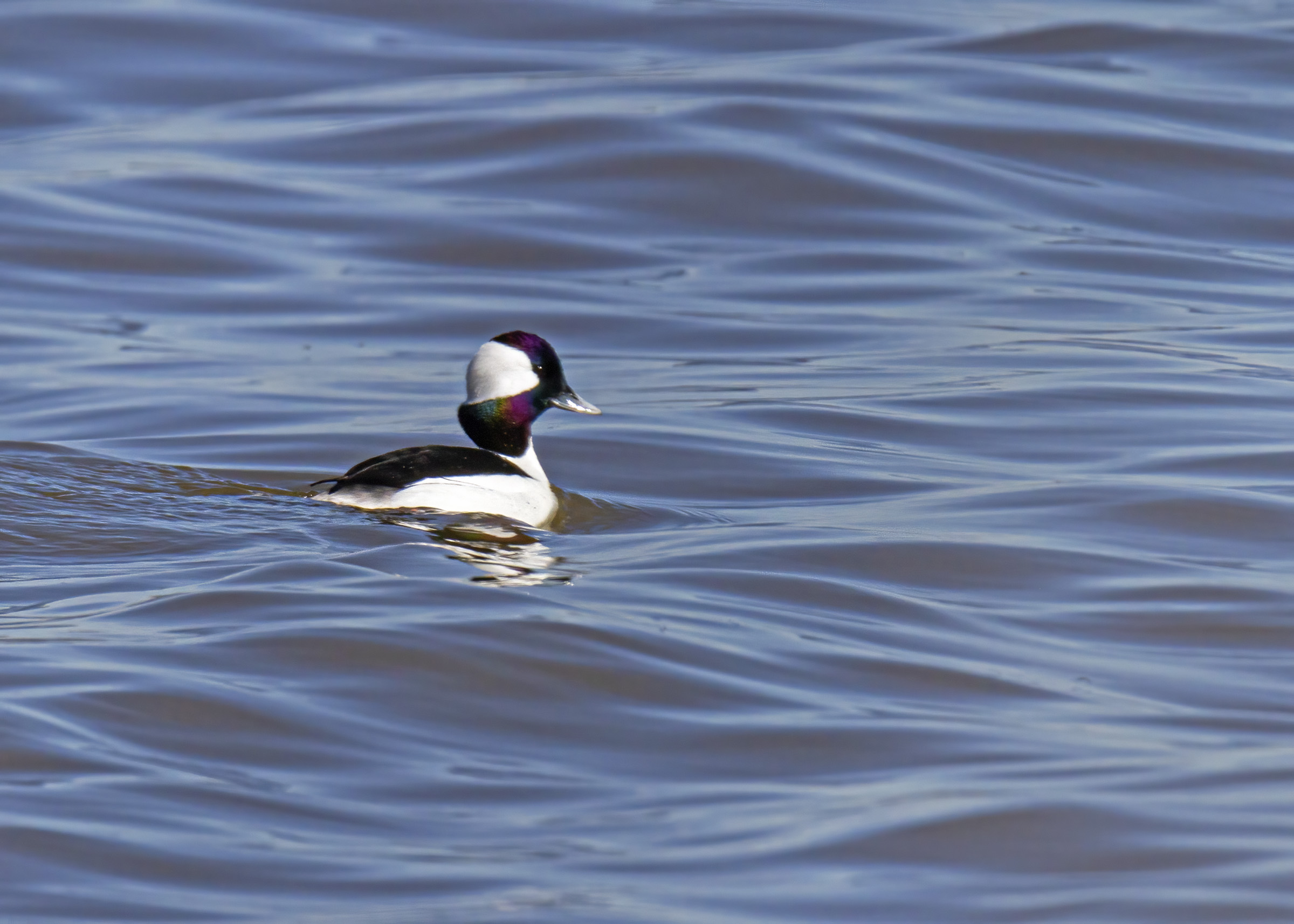
I was delighted on Monday to photograph this male Bufflehead (Bucephala albeola) duck in good light, which allowed me to see the beautiful purple-green iridescence on its head. Male Buffleheads have a large white patch that wraps around the back of their heads that makes them easy to identify from a distance. It is rare, though, for me to be close enough and in the right light to see the beautiful head coloration.
Buffleheads are small, large-headed ducks that migrate to my area of Northern Virginia during the winter and I often see some of them during my visits to Occoquan Bay National Wildlife Refuge. During the summer, Buffleheads breed near ponds and lakes in boreal forest and aspen parkland of Canada and Alaska, according to the Cornell Lab of Ornithology.
© Michael Q. Powell. All rights reserved.
Posted in Birds, Nature, Photography, wildlife, Winter | Tagged Bucephala albeola, bufflehead, bufflehead duck, Canon 7D, Occoquan Bay National Wildlife Refuge, Tamron 150-600mm, Woodbridge VA | 7 Comments »
February 27, 2025 by Mike Powell
Every year in the late winter and early spring I try to keep an eye on the nests of Bald Eagles (Haliaeetus leucocephalus) at Occoquan Bay National Wildlife Refuge. Several of the locations with nests that were used last year apparently are not being this year, but I have repeatedly observed eagle activity at one very large nest at the refuge.
On Monday, I spotted one eagle perched on the edge of that nest and another eagle in a nearby tree keeping watch over the nest. Does that mean that some eggs have hatched? Who knows? The nest is so deep that it is impossible to see what is going on inside of the nest. I watched the nest for quite a while, hoping I might see a tiny head pop up over the edge of the nest, but a baby eagle never appeared
I will continue to monitor this nest and a couple of other potential nesting sites and, with a little luck, may catch a glimpse of some eaglets in the upcoming weeks.

© Michael Q. Powell. All rights reserved.
Posted in Birds, Nature, Photography, wildlife, Winter | Tagged Bald Eagle, Canon 7D, eagle, eagle nest, Haliaeetus leucocephalus, Occoquan Bay National Wildlife Refuge, Tamron 150-600mm, Woodbridge VA | 2 Comments »
February 26, 2025 by Mike Powell
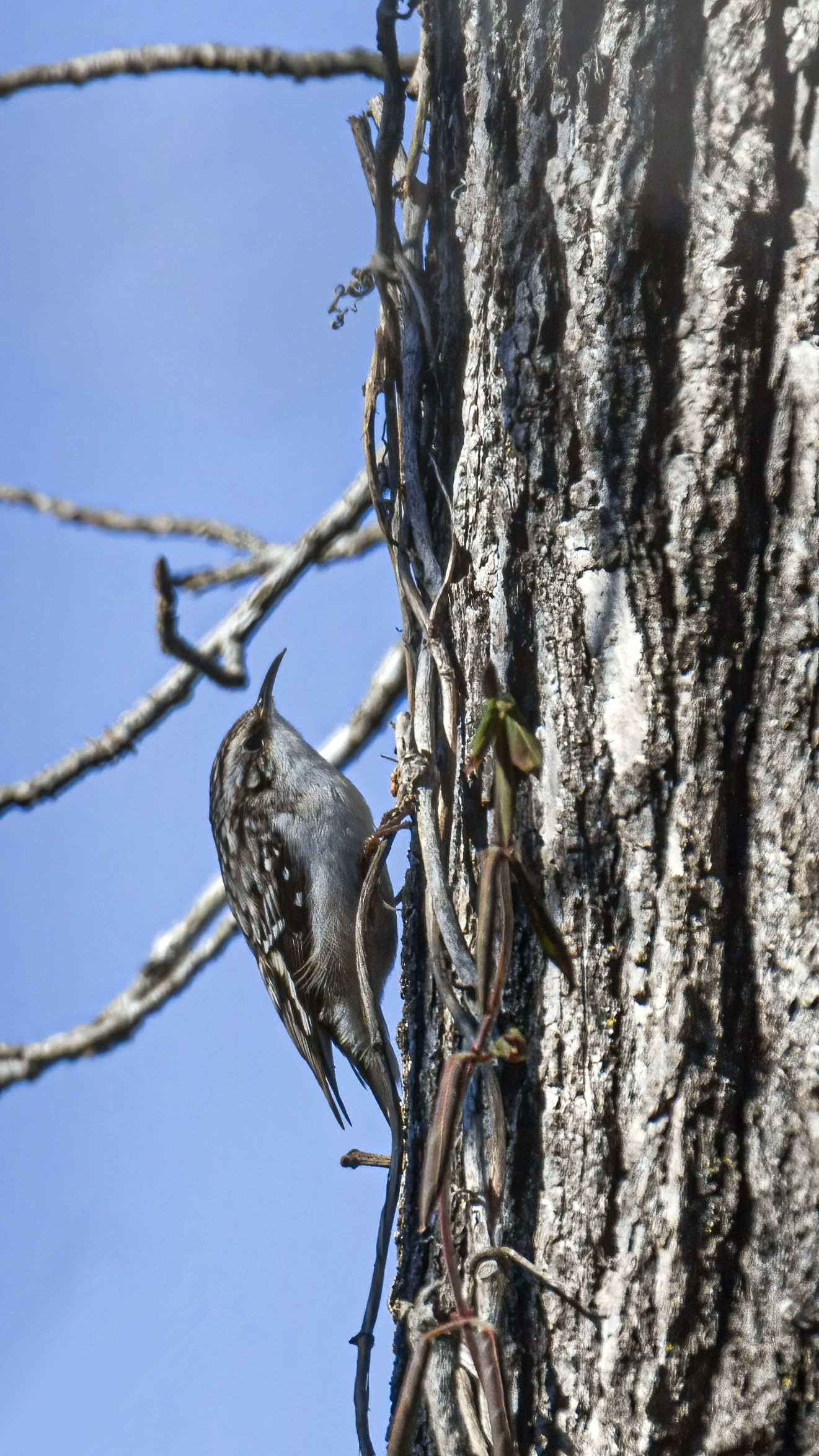
On Monday I spotted this tiny Brown Creeper (Certhia americana) as it spiraled its way up several trees alongside a trail at Occoquan Bay National Wildlife Refuge. This little bird was somewhat frenetic in its movements, often disappearing behind the trunk of the tree, but somehow I managed to track it. As you can see from the photo, the creeper blends in well with the tree bark, so movement is key to detecting the bird.
I was happy to capture an image that shows off the creeper’s distinctive bill so well. Brown Creepers use their slender, downcurved bills to probe into crevices and pick at loose bark in search of insects. From what I have observed, creepers almost always move upwards in a tree, while nuthatches seem move only downwards.
© Michael Q. Powell. All rights reserved.
Posted in Birds, Nature, Photography, wildlife, Winter | Tagged brown creeper, Canon 7D, Certhia americana, creeper, Occoquan Bay National Wildlife Refuge, Tamron 150-600mm, Woodbridge VA | 1 Comment »
February 25, 2025 by Mike Powell
The warmer weather yesterday was a welcome respite from our winter cold—temperatures rose above 50 degrees F (10 degrees C) and it is supposed to be even warmer today. During a lengthy walk at Occoquan Bay National Wildlife Refuge, I was delighted to spot this tiny Golden-crowned Kinglet (Regulus satrapa) on a tree with some visible buds.
Such signs are starting to appear—I can’t wait for spring to arrive with new growth, new colors, and new life.

© Michael Q. Powell. All rights reserved.
Posted in Birds, Nature, Photography, wildlife, Winter | Tagged Canon 7D, Golden-crowned Kinglet, kinglet, Occoquan Bay National Wildlife Refuge, Regulus satrapa, Tamron 150-600mm, Woodbridge VA | 1 Comment »
February 22, 2025 by Mike Powell
The weather this past week has been cold and windy, so I have not been able to get outdoors very much this past week. According to the weather forecasts, things should warm up next week, so hopefully I will be a bit more active.
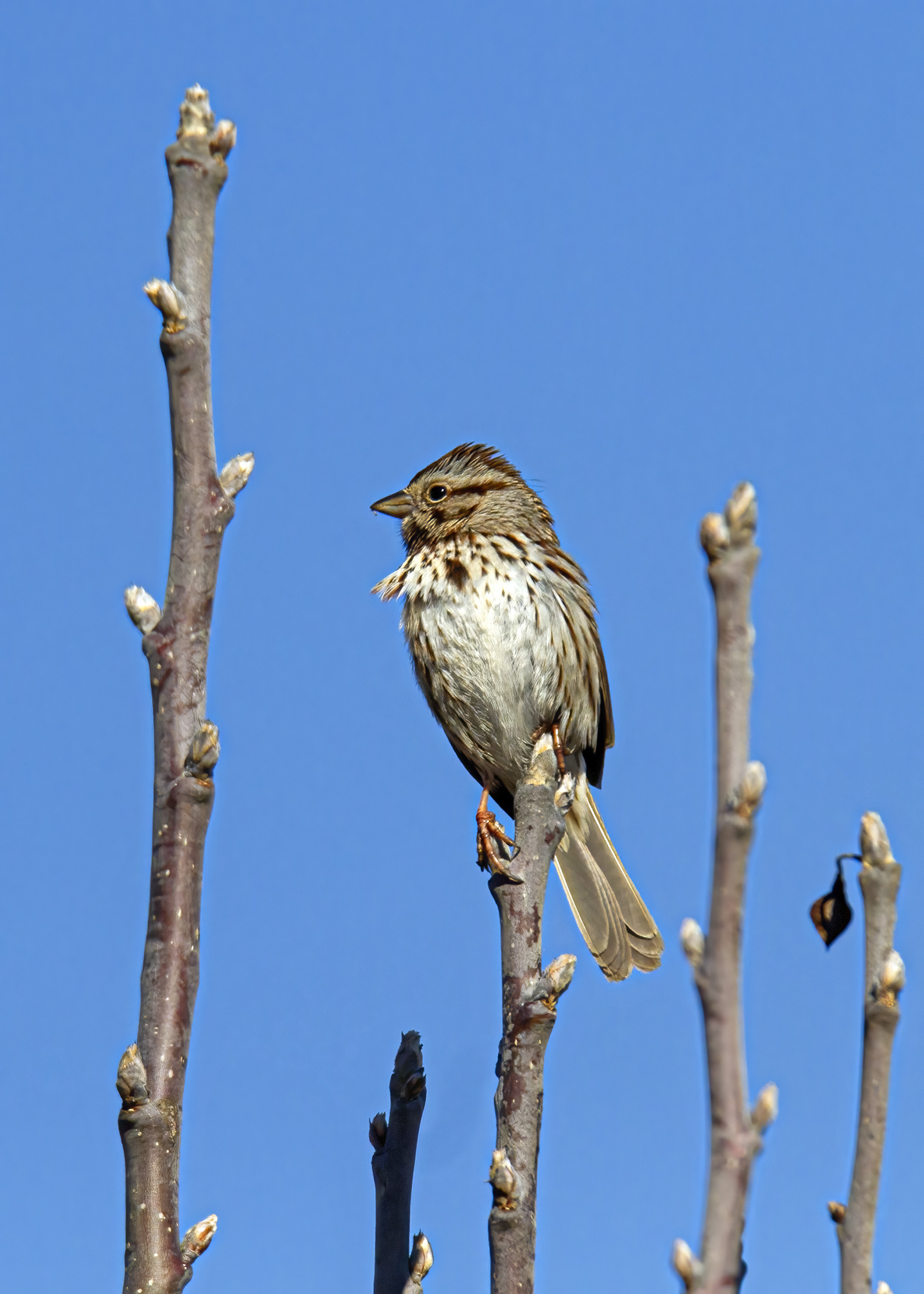
When I last visited Occoquan Bay National Wildlife Refuge a week or so ago, I captured this image of what I believe is a Song Sparrow (Melospiza melodia). The little bird was perched on the bare stalks of some unidentified vegetation, which permitted me to capture an uncluttered shot—most of the time I see sparrows foraging on in ground in the cluttered underbrush.
© Michael Q. Powell. All rights reserved.
Posted in Birds, Nature, Photography, wildlife, Winter | Tagged Canon 7D, Melospiza melodia, Occoquan Bay National Wildlife Refuge, song sparrow, Tamron 150-600mm, Woodbridge VA | 1 Comment »
February 19, 2025 by Mike Powell
This past Friday I photographed this Great Blue Heron (Ardea herodias) at Occoquan Bay National Wildlife Refuge in stealth mode as it attempted to sneak up on some potential prey. At other times, the heron walked through the water with its head held high. It was a fun little photo session for me, though I suspect that the heron wished it were more successful in catching some fish.


© Michael Q. Powell. All rights reserved.
Posted in Birds, Nature, Photography, wildlife, Winter | Tagged Ardea herodias, Canon 7D, Great Blue Heron, Great Blue Heron fishing, Occoquan Bay National Wildlife Refuge, stealthy heron, Tamron 150-600mm, Woodbridge VA | 2 Comments »
February 15, 2025 by Mike Powell
I never get tired of photographing Bald Eagles (Haliaeetus leucocephalus), like this one that soared by me last week at Occoquan Bay National Wildlife Refuge. The eagle made minor adjustments to its wings and tail to maintain its speed and direction, but it mostly seemed to be enjoying itself without exerting much effort. I couldn’t help but think of the Steve Miller Band and its well-known song “Fly Like an Eagle” from the 1970’s.
“I want to fly like an eagle
To the sea
Fly like an eagle
Let my spirit carry me
I want to fly like an eagle
‘Til I’m free
Oh, Lord, through the revolution…”


© Michael Q. Powell. All rights reserved.
Posted in Birds, Nature, Photography, wildlife, Winter | Tagged Bald Eagle, birds in flight, Canon 7D, eagle, Fly Like An Eagle, Haliaeetus leucocephalus, Occoquan Bay National Wildlife Refuge, Steve Miller Band, Tamron 150-600mm, Woodbridge VA | 8 Comments »
« Newer Posts - Older Posts »

