May 31, 2025 by Mike Powell
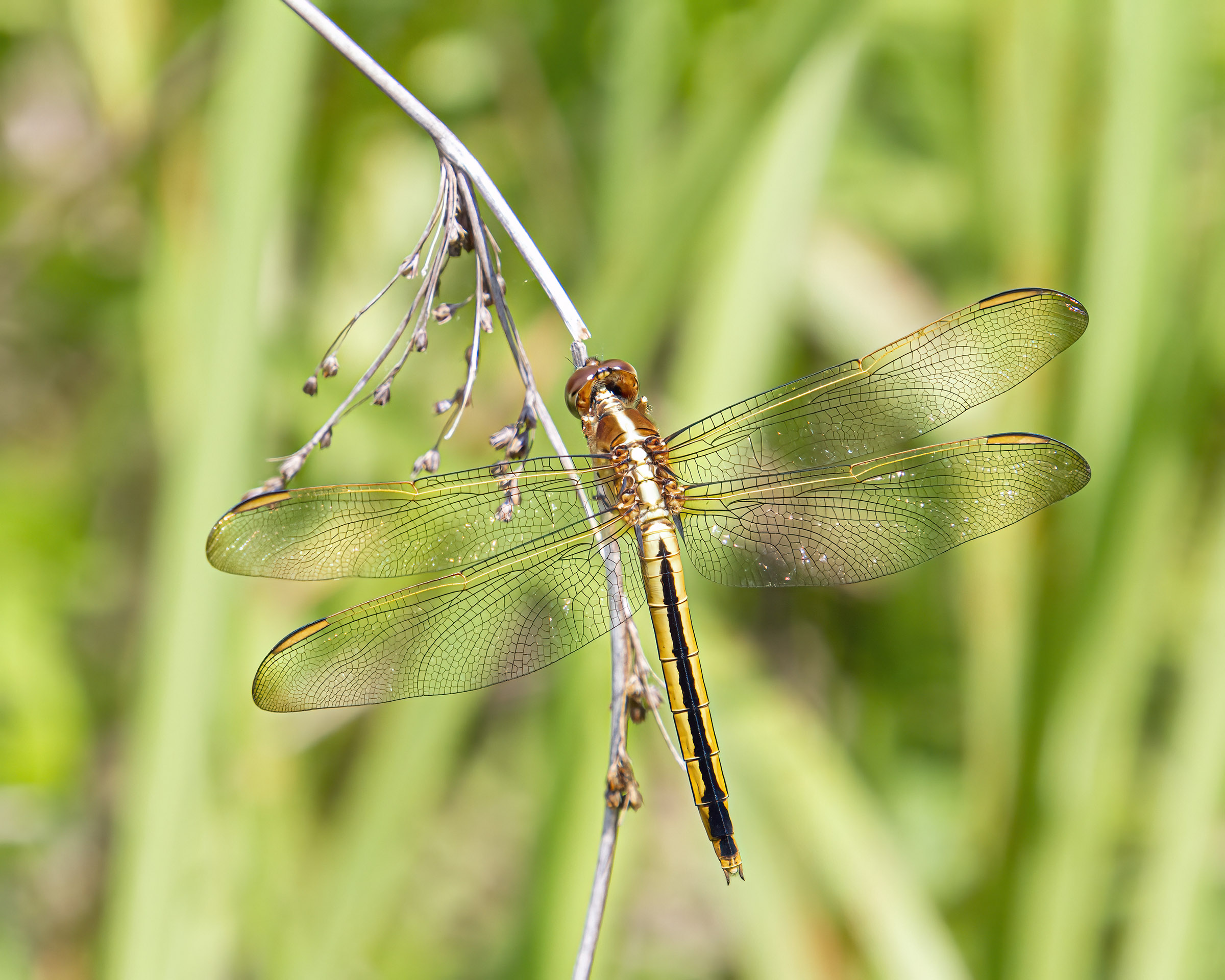
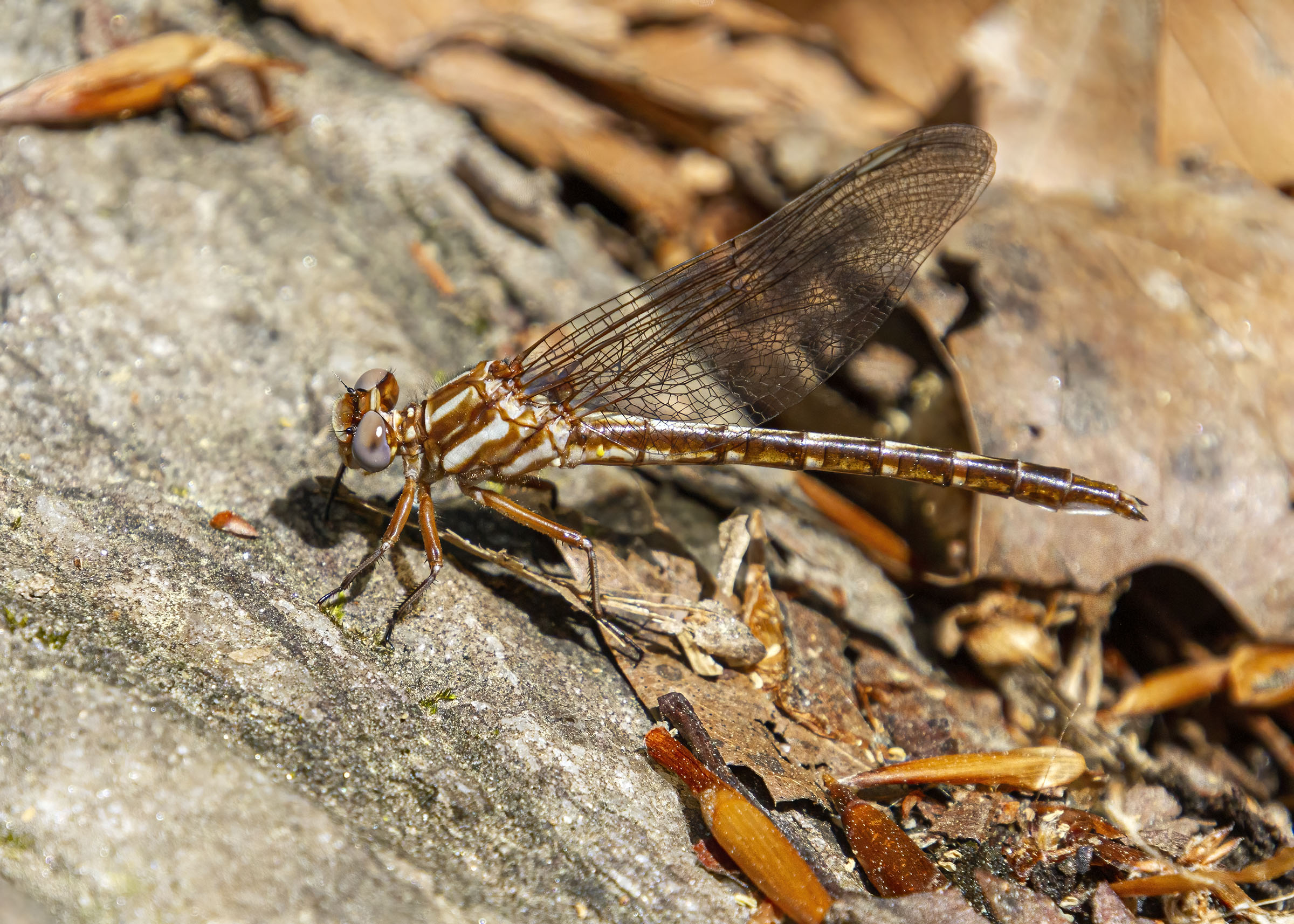
I was delighted yesterday during a visit to Occoquan Bay National Wildlife Refuge to spot this beautiful female Needham’s Skimmer dragonfly (Libellula needhami), my first of the year. Later in the year, Needham’s Skimmers will become the most frequent dragonfly that I will encounter at this location but the dragonfly in the photo below was the only one that I saw yesterday.
Needham’s Skimmers are quite distinctive in appearance. Mature males are reddish-orange in color and stand out from the males of other species. Females and immature males have a body coloration that is shared with some other species, but the golden yellow veins at the leading edges of their wings distinguishes them from the others.
© Michael Q. Powell. All rights reserved.
Posted in Dragonflies, dragonfly, Insects, Nature, Photography, spring, wildlife | Tagged Canon 7D, female Needham's Skimmer, Libellula needhami, Needham's Skimmer, Occoquan Bay National Wildlife Refuge, Tamron 18-400mm, Woodbridge VA | 4 Comments »
May 27, 2025 by Mike Powell
Blue Corporals (Ladona deplanata) are an early-season dragonfly—they appear in April and are usually gone by the beginning of June. I was therefore happy to spot some Blue Corporals in mid-May during a visit to Occoquan Bay National Wildlife Refuge. Blue Corporals perches frequently on low flat surfaces, often on the ground, so they are sometimes hard to see when the ground is cluttered, as it often is at this time of the year.
The dragonfly’s “corporal” stripes on his thorax are really visible in the first photos, so I could immediately identify his species. A short time later I was surprised when I saw a Blue Corporal land on a rusty bit of metal sticking out of the water at the edge of a small pond—I haven’t seen Blue Corporals flying over the water very often. I think this might have been a fence post or some kind of marker, because it appeared to be attached to some concrete.
I was absolutely delighted to be able to captures the texture of the rusty metal and the orange-blue complementary colors make this image particularly eye-catching.


© Michael Q. Powell. All rights reserved.
Posted in Dragonflies, dragonfly, Insects, Nature, Photography, spring, wildlife | Tagged Blue Corporal, Blue Corporal dragonfly, Canon 7D, Ladona deplanata, male Blue Corporal, Occoquan Bay National Wildlife Refuge, Tamron 18-400mm, Woodbridge VA | 4 Comments »
May 26, 2025 by Mike Powell
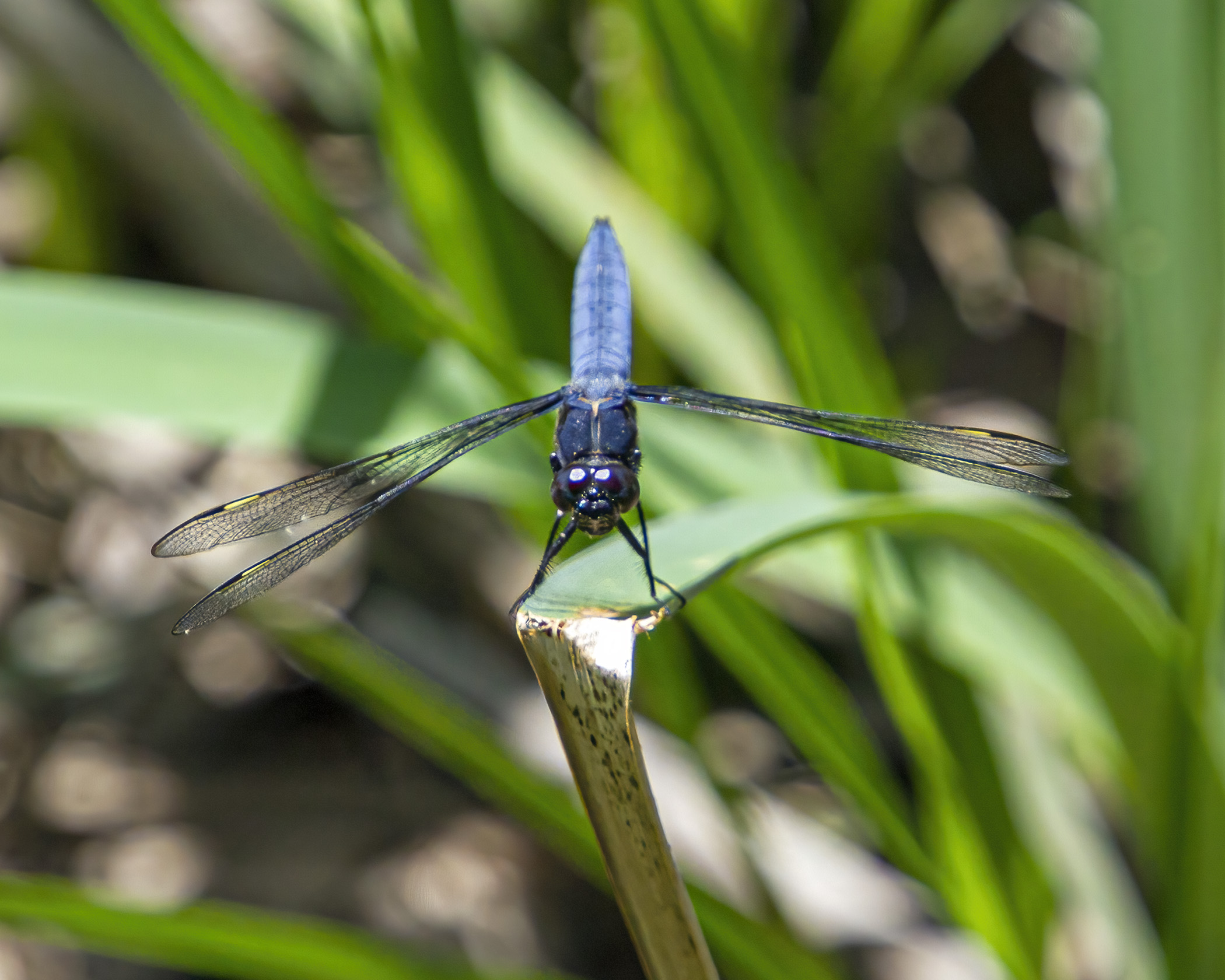
There are quite a few blue dragonflies where I live, so I can’t always rely on color to tell them apart. Fortunately, it is relatively easy to identify a male Spangled Skimmer (Libellula cyanea), because it has a lighter-colored spot beside a black spot on the outer leading edge of each wing—as far as I know, no other dragonfly in our area has multi-colored stigmata, the technical name for those spots.
The stigmata are not there for decoration, but reportedly serve an important role in the flight of dragonflies. I do not really understand the physics of flight, but have read that the stigmata are heavier than the adjoining cells and help to stabilize the vibrations of the wings.
I spotted this male Spangled Skimmer as he was perched in the vegetation at the edge of a small pond at Shrine Mont, an Episcopal Church retreat center, in Orkney Springs, Virginia. Most often I try to get side views of dragonflies in order to get most of the body in focus, but in this case I deliberately tried to focus on the dragonfly’s large, compound eyes, knowing that much of the body would fall out of focus. This allows the viewer’s attention to be drawn immediately to those eyes.
I encourage you to click on the image to get a closer look at the dragonfly’s amazing eyes.
© Michael Q. Powell. All rights reserved.
Posted in Dragonflies, dragonfly, Insects, Nature, Photography, spring, wildlife | Tagged Canon 7D, Libellula cyanea, male Spangled Skimmer, Orkney Springs VA, Shrine Mont, Spangled Skimmer, Spangled Skimmer dragonfly, Tamron 18-400 | 2 Comments »
May 24, 2025 by Mike Powell
I was away in the mountains last weekend at a church retreat at Shrine Mont, and Episcopal retreat center in Orkney Springs, Virginia. We had a wonderful time of rest, relaxation, and rejuvenation in a really beautiful setting.
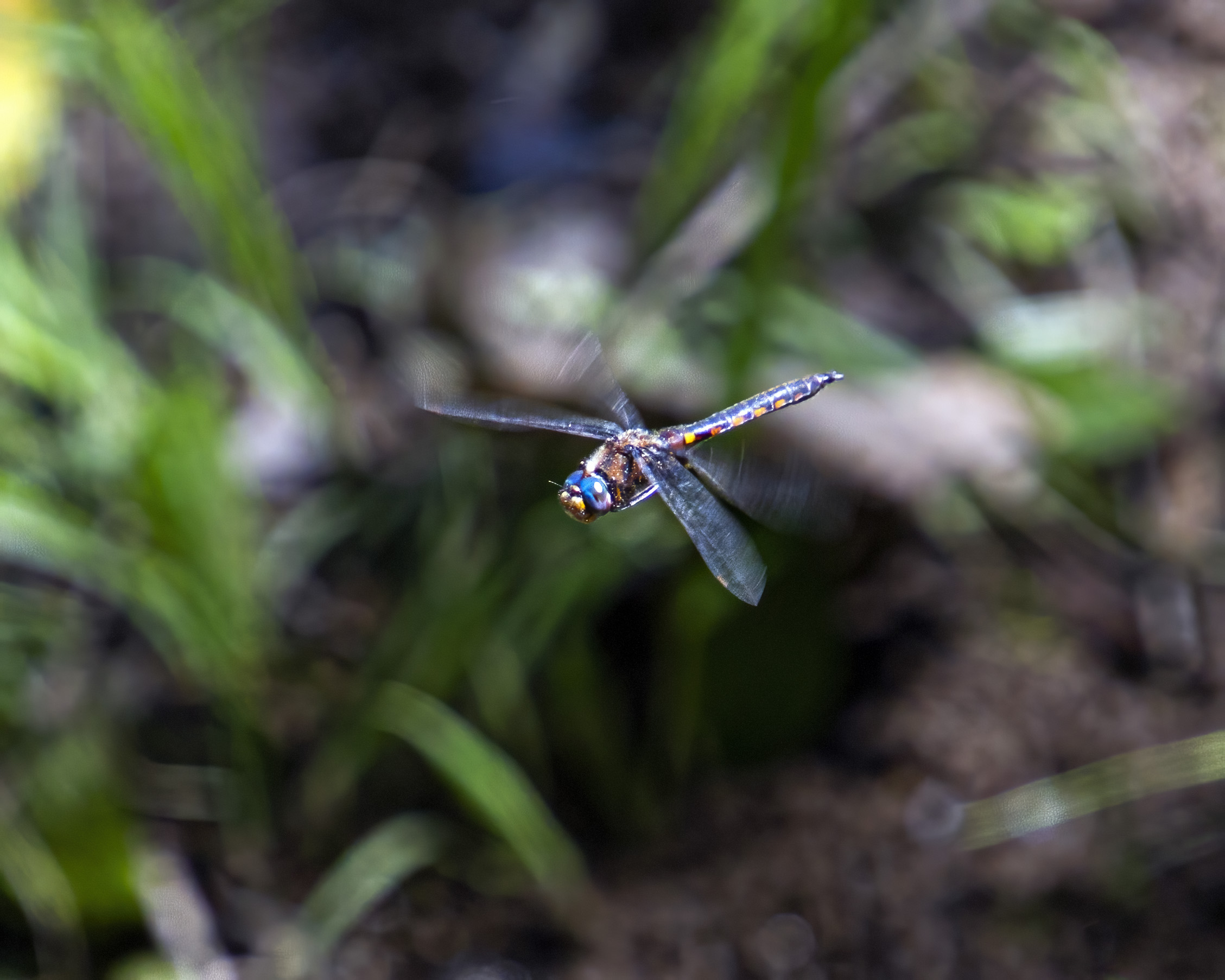
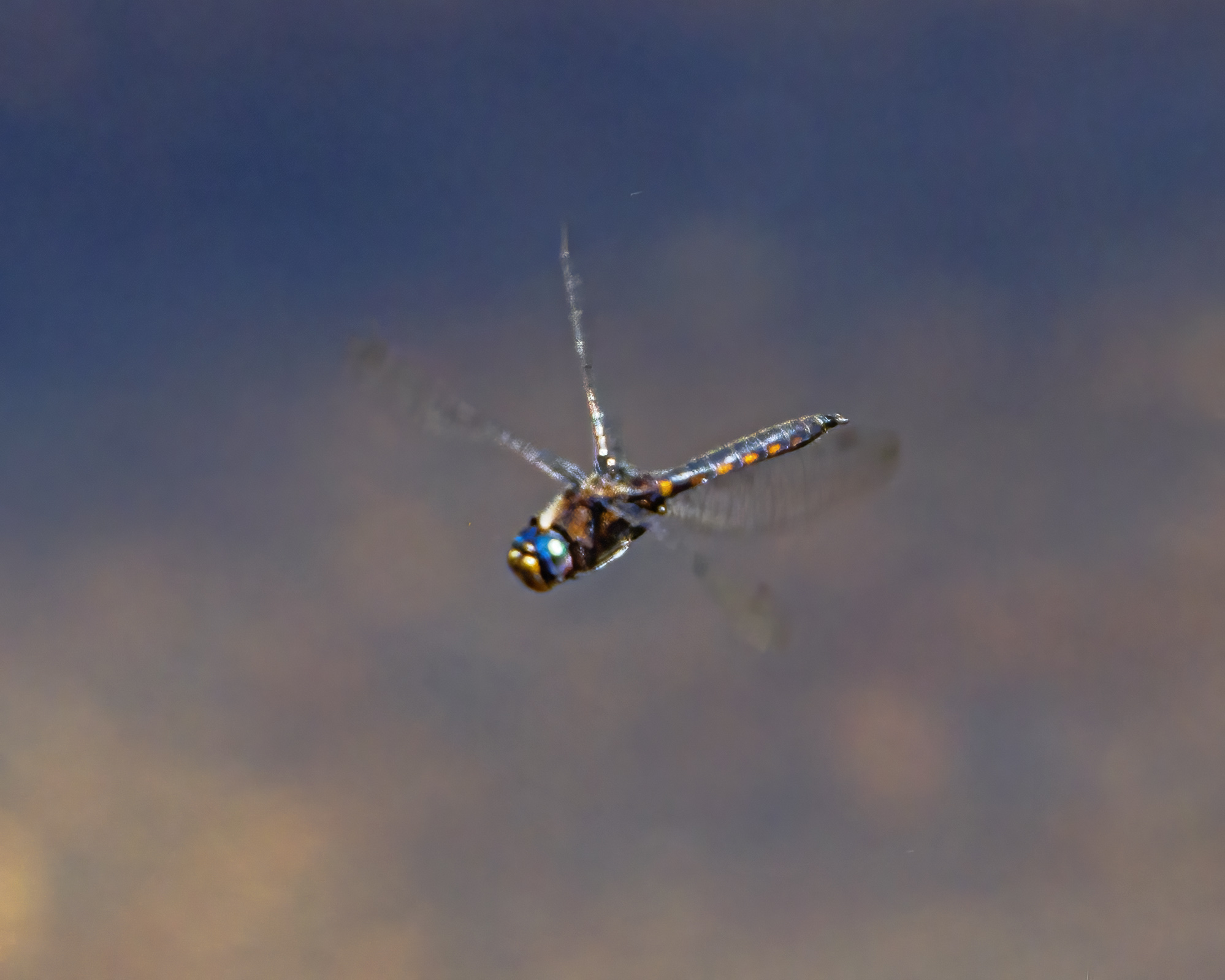
There was a small pond at the site where I spotted a number of dragonflies, including some Common Baskettails (Epitheca cynosura) that were patrolling back and forth over the surface of the water. I felt compelled to try to capture images of these dragonflies and had a modest amount of success, as you can see in the photos below. I ended up focusing manually most of the time, because the backgrounds were often cluttered and the focus system had trouble acquiring the dragonflies.
I really like the way that this little series shows the varied backgrounds at the pond. I was also quite happy to focus well enough on the dragonflies that the backgrounds were blurred and non-distracting. In case you are curious, these Common Baskettails were relatively cooperative, hovering a bit over the water and allowing me time to focus on them.

© Michael Q. Powell. All rights reserved.
Posted in Dragonflies, dragonfly, Insects, Nature, Photography, spring, wildlife | Tagged Canon 7D, Common Baskettail, Common Baskettail dragonfly, Epitheca cynosura, Orkney Springs VA, Shrine Mont, Tamron 18-400mm | 4 Comments »
May 22, 2025 by Mike Powell
When I first spotted two Ospreys (Pandion haliaetus) sitting in a large eagle nest last week at Occoquan Bay National Wildlife Refuge, I assumed that one of them was sitting on eggs. I was therefore a bit surprised when one of the ospreys mounted the other in what I assume was an act of mating. That suggests that there are not yet any eggs in the nest.
After a brief period of activity, the one that is probably the male flew away from the nest and I managed to capture a couple of photos of his departure. Both of the ospreys are in the frame in the second and third photos below and I really like the way that I captured the wing span of the departing osprey and his spread tail feathers. I encourage you to click on these two images to get a closer look at the ospreys, particularly the male.


© Michael Q. Powell. All rights reserved.
Posted in Birds, Nature, Photography, spring, wildlife | Tagged Canon 7D, Occoquan Bay National Wildlife Refuge, Osprey, osprey mating, osprey nest, Pandion haliaetus, Tamron 18-400mm, Woodbridge VA | Leave a Comment »
May 21, 2025 by Mike Powell
I usually try to get close-up shots of dragonflies, but sometimes that is not possible. In those cases, I try to be creative and frame and/or isolate the subject with elements of the environment, as I did with this Blue Dasher dragonfly (Pachydiplax longipennis) that I spotted last Monday at Occoquan Bay National Wildlife Refuge, the first one that I have spotted this year.
I really like this composition, despite the fact that the dragonfly is very small in the photo, thanks largely to the undulating green waves of the leaves and the out-of-focus branches in the background. What do you think? Should I have cropped the photo a bit more?

© Michael Q. Powell. All rights reserved.
Posted in Dragonflies, dragonfly, Nature, Photography, spring, wildlife | Tagged Blue Dasher, Blue Dasher dragonfly, Canon 7D, Occoquan Bay National Wildlife Refuge, Pachydiplax longipennis, Tamron 18-400mm, Woodbridge VA | 5 Comments »
May 20, 2025 by Mike Powell
As I have noted in several recent posts, I have real troubles spotting birds when the trees are fully leafed out. In other seasons, when the trees are bare, birds tend to fly to new perches when they detect my presence and I can often track them when they are in flight and follow them visually to their new perches. Now, however, the birds seem to remain in place and sing loudly, but remain invisible to my eyes.
Last week I managed to capture an image of an American Goldfinch (Spinus tristis) when he popped into view momentarily outside of the tree canopy at Occoquan Bay National Wildlife Refuge. The little goldfinch was visible for only a short period of time, but fortunately I was looking in the right direction at that moment.
Later in the day I spotted another goldfinch perched in a distant tree. For some reason, the tree had no leaves, so it was easy for me to see the bird. I grabbed a shot and tried to move a little closer, but the bird could see my movement and immediately flew away. I hesitated to post the second photo below, because the bird is so small in the frame, but decided that I really liked the contrast between the bright yellow of the bird and the starkness of the branches and the white sky, a nice counterpoint to the lushness of the vegetation in the first photo.


© Michael Q. Powell. All rights reserved.
Posted in Birds, Nature, Photography, spring, wildlife | Tagged American Goldfinch, Canon 7D, goldfinch, Occoquan Bay National Wildlife Refuge, Spinus tristis, Tamron 18-400mm, Woodbridge VA | 9 Comments »
May 19, 2025 by Mike Powell
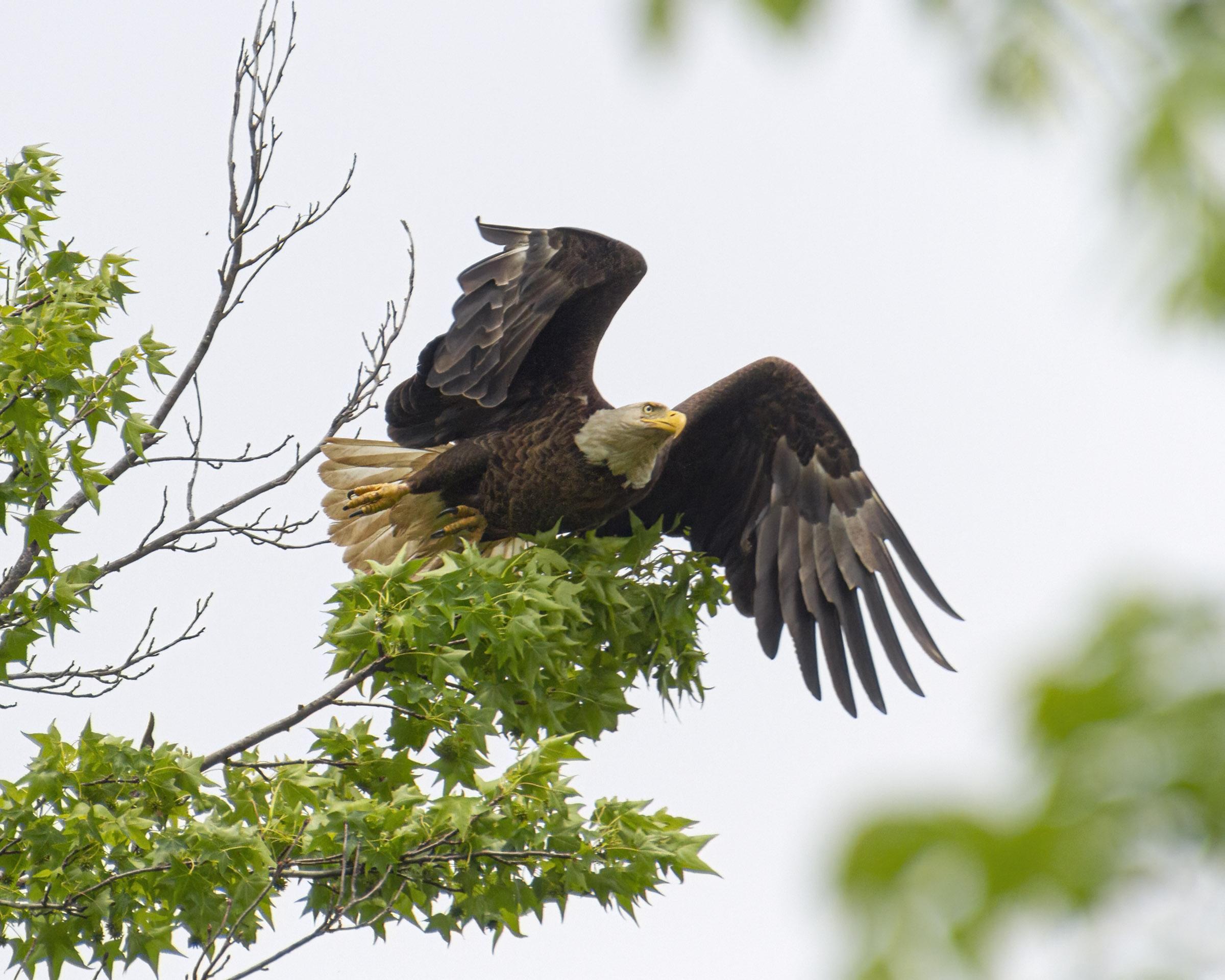
As I rounded a bend in a trail last Monday at Occoquan Bay National Wildlife Refuge, I spotted a Bald Eagle (Haliaeetus leucocephalus) in the foliage of a tree right in front of me. The eagle and I both reacted instantly, but its reflexes were faster than mine and the eagle took the air. I managed to capture a few shots of the departing eagle, a testament to both my luck and a quick reaction in bringing my camera up to my eye.


© Michael Q. Powell. All rights reserved.
Posted in Birds, Nature, Photography, spring, wildlife | Tagged Bald Eagle, bald eagle takeoff, Canon 7D, eagle, Haliaeetus leucocephalus, Occoquan Bay National Wildlife Refuge, Tamron 18-400mm, Woodbridge VA | 12 Comments »
May 16, 2025 by Mike Powell
The colors of the False Indigo Bushes (Amorpha fruticosa) were spectacular on Monday at Occoquan Bay National Wildlife Refuge, attracting my attention as well as that of an energetic honey bee (g. Apis) whose pollen sacs were already filled to bulging. I was initially paying so much attention to focusing on the moving bee that I did not realize that my shutter speed had dropped to 1/400—I was in aperture priority mode. The first photo was a “happy accident: in which the bee’s face was in focus, but its rapidly-moving wings were a blur.
In the second shot, the bee had landed and was crawling all around the stalks of the false indigo bush. I am really happy with my snapshot of that action that captured the color and movement of my brief encounter with the honey bee.


© Michael Q. Powell. All rights reserved.
Posted in Bees, Insects, Macro Photography, Nature, Photography, spring, wildlife | Tagged Amorpha fruticosa, bee, Canon 7D, false indigo bush, g. Apis, honey bee, Occoquan Bay National Wildlife Refuge, Tamron 18-400mm, Woodbridge VA | 2 Comments »
May 15, 2025 by Mike Powell
Later in the season I can rely on coloration to distinguish between male and female Calico Pennant dragonflies (Celithemis elisa)—the bodies of males are red and those of females are yellow. When they first emerge, however, immature males are yellow, so you have to look really closely at a given individual to determine its gender.
The terminal appendages of the dragonfly in the second photo indicate to me that it is a male, despite the fact that its body is yellow. The one in the first photo is also an immature male Calico Pennant dragonfly that is just beginning to change from yellow to red. I love the way that he is perched on the very tip of the flimsy vegetation stalk, holding tightly to it with all of his little legs.
I spotted these two dragonflies on 12 May at Occoquan Bay National Wildlife Refuge, my first sightings of this colorful dragonfly species of the year. There is something really special about the patterned wings of both genders of Calico Pennants and when viewed from the right angle, as in the second photo, the pattern on their bodies look like a series of hearts.


© Michael Q. Powell. All rights reserved.
Posted in Dragonflies, dragonfly, Insects, Nature, Photography, spring, wildlife | Tagged Calico Pennant, Calico Pennant dragonfly, Canon 7D, Celithemis elisa, male Calico Pennant, Occoquan Bay National Wildlife Refuge, Tamron 18-400mm, Woodbridge VA | 4 Comments »
May 14, 2025 by Mike Powell
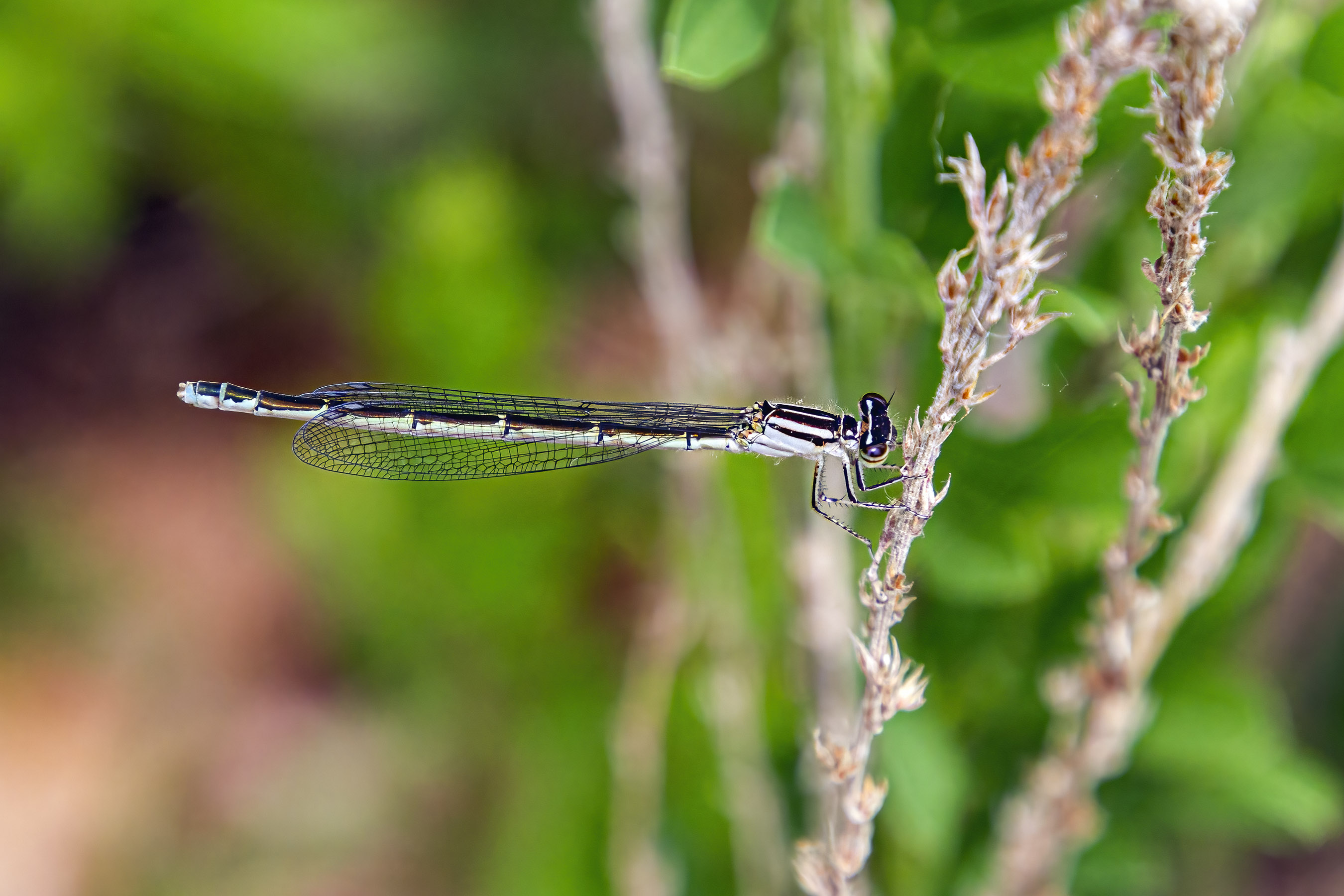
During a visit on Monday to Occoquan Bay National Wildlife Refuge, I noted that many of the summer dragonfly and damselflies are starting to appear. I was particularly delighted to spot several Big Bluet damselflies (Enallagma durum). As their name suggests, Big Bluets are relatively large damselflies, with an overall length of about 1.7 inches (43 mm).
Big Bluets tend to active and a bit skittish, so it’s a bit tough to get a decent shot of one, especially when I am shooting with a zoom lens. The auto-focus of my Tamron 18-400mm zoom often has trouble focusing on a damselfly, because their bodies are so thin and they clasp their wings together over their bodies. Consequently, I frequently end up focusing manually and it is an advantage with this lens that the minimum focusing distance is 17.7 inches (45 cm), so I can get pretty close to my subject.
I was delighted to be able to capture this beautiful image of a female Big Bluet. My focusing was spot on and the background blurred out nicely. If you look closely, you may notice that the depth of field, i.e. what was in focus, was so shallow that much of the stalk of vegetation on which the damselfly was perched was out of focus. In case you are curious, I tried to position myself so that I was on a parallel plane with the damselfly’s body to get as much of it in sharp focus as possible.
One interesting factual tidbits about Female Big Bluets is that, like several other damselfly species, they come in two different color variants. This one is the blue form and there is also an olive form. What that means is that I cannot rely exclusively on the color of the damselfly to determine its species and must also look at other features like the shapes of the eyespots and markings on the terminal appendages.
© Michael Q. Powell. All rights reserved.
Posted in damselfly, Insects, Macro Photography, Nature, Photography, spring, wildlife | Tagged Big Bluet, Big Bluet damselfly, Canon 7D, Enallagma durum, female big bluet, Occoquan Bay National Wildlife Refuge, Tamron 18-400mm, Woodbridge VA | Leave a Comment »
May 13, 2025 by Mike Powell
The feathers of Double-crested Cormorants (Nannopterum auritum) are not completely waterproof, so periodically they have to dry out their wings. I often see cormorants completely out of the water, perched on rocks or logs with extended wings. This cormorant last week at Occoquan Bay National Wildlife Refuge apparently decided, however, that a perch was not necessary—it simply spread its wings in the air and held them in that position.
A bit earlier I captured the second image below. Usually I see cormorants in the deep waters of the bay, but this cormorant was in a small pond at the wildlife refuge. The pond is mostly surrounded by trees that are now in bloom and I was happy to capture some of the colors of the trees in their reflections on the surface of the water.


© Michael Q. Powell. All rights reserved.
Posted in Birds, Nature, Photography, spring, wildlife | Tagged Canon 7D, cormorant, Double-crested Cormorant, Nannopterum auritum, Occoquan Bay National Wildlife Refuge, Tamron 18-400mm, Woodbridge VA | 1 Comment »
May 12, 2025 by Mike Powell
Common Five-lined Skinks (Plestiodon fasciatus) are indeed quite common, but they are so skittish that they are tough to photograph. As soon as they see me (or sense my presence), they will usually scamper away to the underside of the logs on which they like to perch. On a recent visit to Jackson Miles Abbott Wetland Refuge, I spotted this skink sunning itself on a log and was able to get this shot because I approached him from behind—this technique does not work as well for dragonflies, which have massive compound eyes that provide them with a field of view of almost 360 degrees.
It is always fun to encounter juvenile skinks that have bright blue tails, but this one appeared to be an adult. I noted too that its tail was intact. Like many lizards, skinks possess the unique defense mechanism of being able to drop their tail to escape predators. The dropped tail continues to wiggle, distracting the predator, while the skink flees. Skinks can regenerate their lost tail, though the new tail may differ in structure and coloration from the original.
As many of you know, I love bad “Dad” jokes and this skink reminded me of one of them. “Where do skinks go to find a replacement for a lost tail? A retail outlet.” Sorry!

© Michael Q. Powell. All rights reserved.
Posted in Nature, Photography, Reptiles, spring, wildlife | Tagged Canon 7D, Common Five-Lined Skink, Five-lined Skink, Fort Belvoir VA, Jackson Miles Abbott Wetland Refuge, Plestiodon fasciatus, skink, Tamron 18-400mm | Leave a Comment »
May 10, 2025 by Mike Powell
The trees are now covered with leaves, providing hiding places for the tiny songbirds that I can hear but cannot see. Fortunately, some birds are so big that it is hard to miss them, like this Wild Turkey (Meleagris gallopavo) that I spotted this past Wednesday at Occoquan Bay National Wildlife Refuge.
This turkey was slowly walking away from me and I captured this shot when he was in motion. I don’t think that a Wild Turkeys can balance themselves on a single leg when stationary, though perhaps there is a special kind of turkey yoga that enhances their balancing abilities.

© Michael Q. Powell. All rights reserved.
Posted in Birds, Nature, Photography, spring, wildlife | Tagged Canon 7D, Meleagris gallopavo, Occoquan Bay National Wildlife Refuge, Tamron 18-400mm, Wild Turkey, Woodbridge VA | Leave a Comment »
May 9, 2025 by Mike Powell
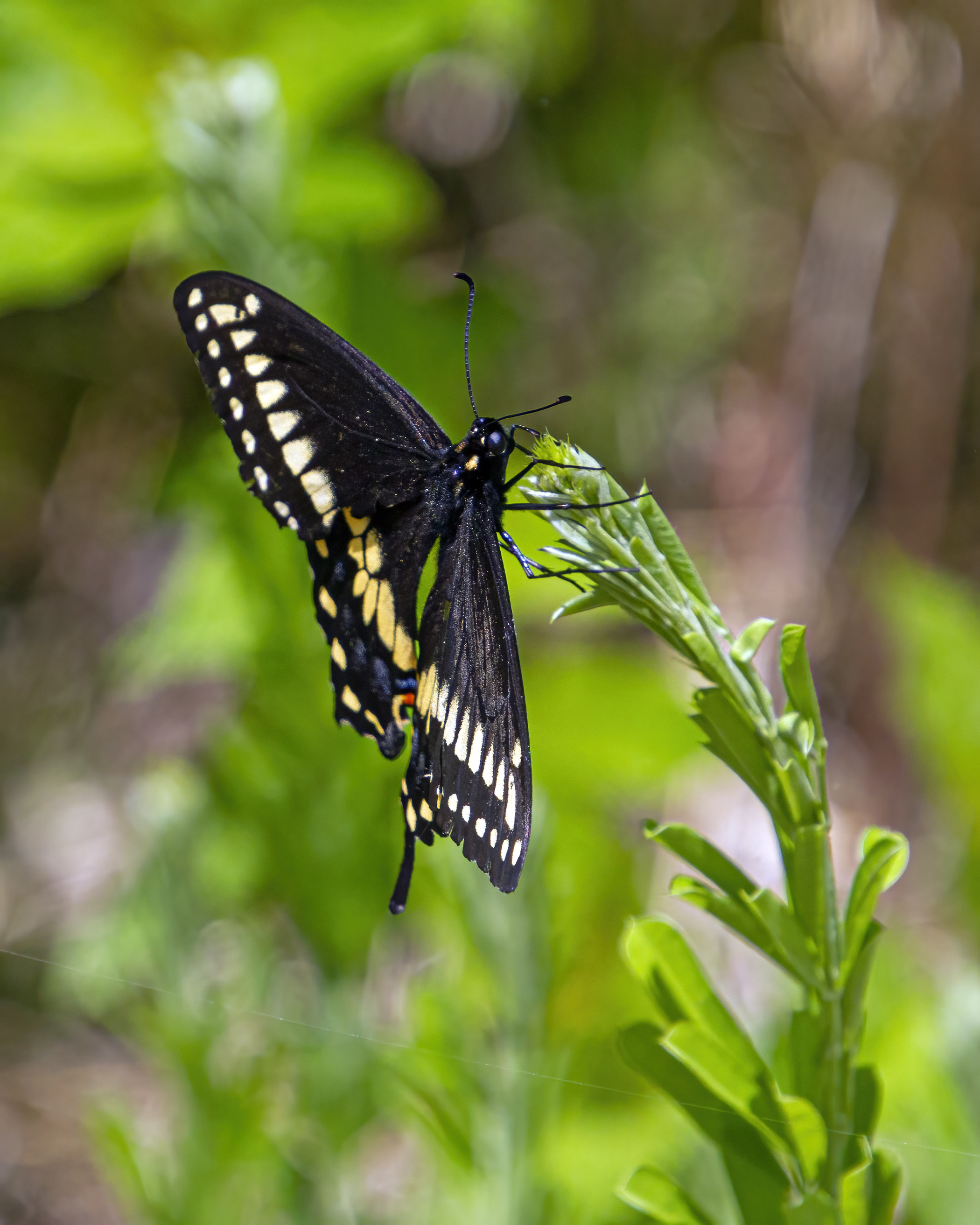
Although it is relatively early in the butterfly season, this beautiful Black Swallowtail (Papilio polyxenes) that I spotted on Wednesday at Occoquan Bay National Wildlife Refuge was already beginning to show signs of the wear and tear of everyday life, with damage to its wings and body and one missing “tail.” I don’t know what caused the damage to the butterfly’s wings, but suspect that it might have been attacks by predators or collisions with thorns or other sharp vegetation.

© Michael Q. Powell. All rights reserved.
Posted in Butterflies, Insects, Nature, Photography, spring, wildlife | Tagged black swallowtail, black swallowtail butterfly, Canon 7D, Occoquan Bay National Wildlife Refuge, Papilio polyxenes, Tamron 18-400mm, Woodbridge VA | 2 Comments »
May 8, 2025 by Mike Powell
It has taken a little while, but I am starting to see damselflies during my searches for dragonflies. As many of you know, damselflies and dragonflies are “cousins” in the sense that they are both members of the order Odonata. Generally speaking, dragonflies have thicker, shorter bodies and hold their wings out to the sides when resting, while damselflies are slender with wings often folded together. The eyes of dragonflies often touch each other, while those of damselflies tend to be more widely separated.
The first photo below shows a Fragile Forktail damselfly (Ischnura posita), a very common species where I live. The interrupted shoulder stripes look like exclamation marks, which makes them pretty easy to identify. The second photo shows what I am pretty certain is a female Eastern Forktail damselfly (Ischnura verticalis). Female damselflies of a number of species are similar in appearance, so I am a bit less confident that I have correctly identified this individual.
More damselflies will continue to appear as I shift my attention almost exclusively from birds to insects. As a result of recent rains, the trees in my area are now covered with leaves, which means that I am increasingly having trouble seeing the birds that I can hear singing.


© Michael Q. Powell. All rights reserved.
Posted in damselfly, Insects, Nature, Photography, spring, wildlife | Tagged Canon 7D, Eastern Forktail, Eastern Forktail damselfly, Fragile Forktail, Fragile Forktail damselfly, Ischnura posita, Ischnura verticalis, Lorton VA, Occoquan Regional Park, Prince William Forest Park, Tamron 18-400mm, Triangle VA | 3 Comments »
May 7, 2025 by Mike Powell
Most flowers have blooms at the end of their stems or at least in places above their leaves. Each spring, however, I encounter Mayapples (Podophyllum peltatum), a strange plant that seems to work in a totally different way. Mayapple plants grow in colonies from a single root and stems put out large umbrella-shaped leaves, with usually only a single large leaf per stem. These stems do not produce any flower or fruit.
A few stems, though, produce a pair or more leaves and a single white blossom appears at the juncture point where the stem branches off. If you don’t know that the blooms are there, it is easy to miss them, because the large leaves hide them from view.
Last week during a trip to Accotink Bay Wildlife Refuge I checked out several large patches of Mayapples that I had seen in previous years. I think I might have been a little late in the season, but eventually I found a Mayapple plant with a flower that was clearly past its prime. As you can see in the first photo, a harvestman, known colloquially as a daddy longlegs, was camped out on the flower, waiting perhaps for potential prey. For the second photo, I zoomed out a bit to show the unusual location of the flower on the Mayapple plant and the habitat in which these plants grow.
As many of you know, I focus mostly on wildlife creatures in my photography, but my almost insatiable sense of curiosity draws me to anything weird and wonderful that catches my eyes, like Mayapples in bloom.


© Michael Q. Powell. All rights reserved.
Posted in Flowers, Nature, Photography, spring | Tagged Accotink Bay Wildlife Refuge, Canon 7D, daddy longlegs, Fort Belvoir VA, Mayapple, mayapple flower, opiliones, Podophyllum peltatum, Tamron 18-400mm | 2 Comments »
May 6, 2025 by Mike Powell
How do you capture a shot of a dragonfly perched at an angle on a fallen branch? That was my dilemma last week at Accotink Bay Wildlife Refuge when I caught a view of a flying dragonfly out of the corner of my eye and saw it land.
My first reaction was to stop and then to slowly bring my camera up to my eye to capture a shot before the dragonfly flew away. I was still a good distance away from the dragonfly but thanks to my telephoto lens I could see that it was a Stream Cruiser dragonfly (Didymops transversa). The final photo shows my initial view of the dragonfly. It is a little hard to tell, but the fallen branch was not very far off of the ground.
Stream Cruisers are long and skinny and a little tough to fit into a photo taken in landscape mode. I moved closer to the dragonfly, knelt down, and circled around a bit to capture the middle image. By getting closer to my subject and altering my shooting angle, I was able to blur out the background better. I still was not quite satisfied with the photo, though, because it conveyed the mistaken impression that the cruiser was perching horizontally.
I circled around some more and decided to take some shots in portrait mode. I held my camera at an angle, trying to match the angle at which the dragonfly was perched, in order to have its entire body in focus. This first shot below, one of the last ones I took, was my favorite. The background is blurred and almost all of the details on the cruiser are pretty sharp.
I realize that the image makes it look like the cruiser was hanging perfectly vertically, which was not exactly true, but the image looks pretty natural to me. Wildlife photographers make a whole series of creative choices that help them to create images that reflect their personal vision of “reality” in front of their cameras, a kind of subjective reality.
One of my favorite quotations about photography comes from noted photographer Dorothea Lange, who said, “The camera is an instrument that teaches people how to see without a camera.” My photos provide some insight into the way that I view the world. Welcome to my world!


© Michael Q. Powell. All rights reserved.
Posted in Dragonflies, dragonfly, Insects, Nature, Photography, spring, wildlife | Tagged Accotink Bay Wildlife Refuge, Canon 7D, Didymops transversa, Fort Belvoir VA, Stream Cruiser, Stream Cruiser dragonfly, Tamron 18-400mm | Leave a Comment »
May 5, 2025 by Mike Powell
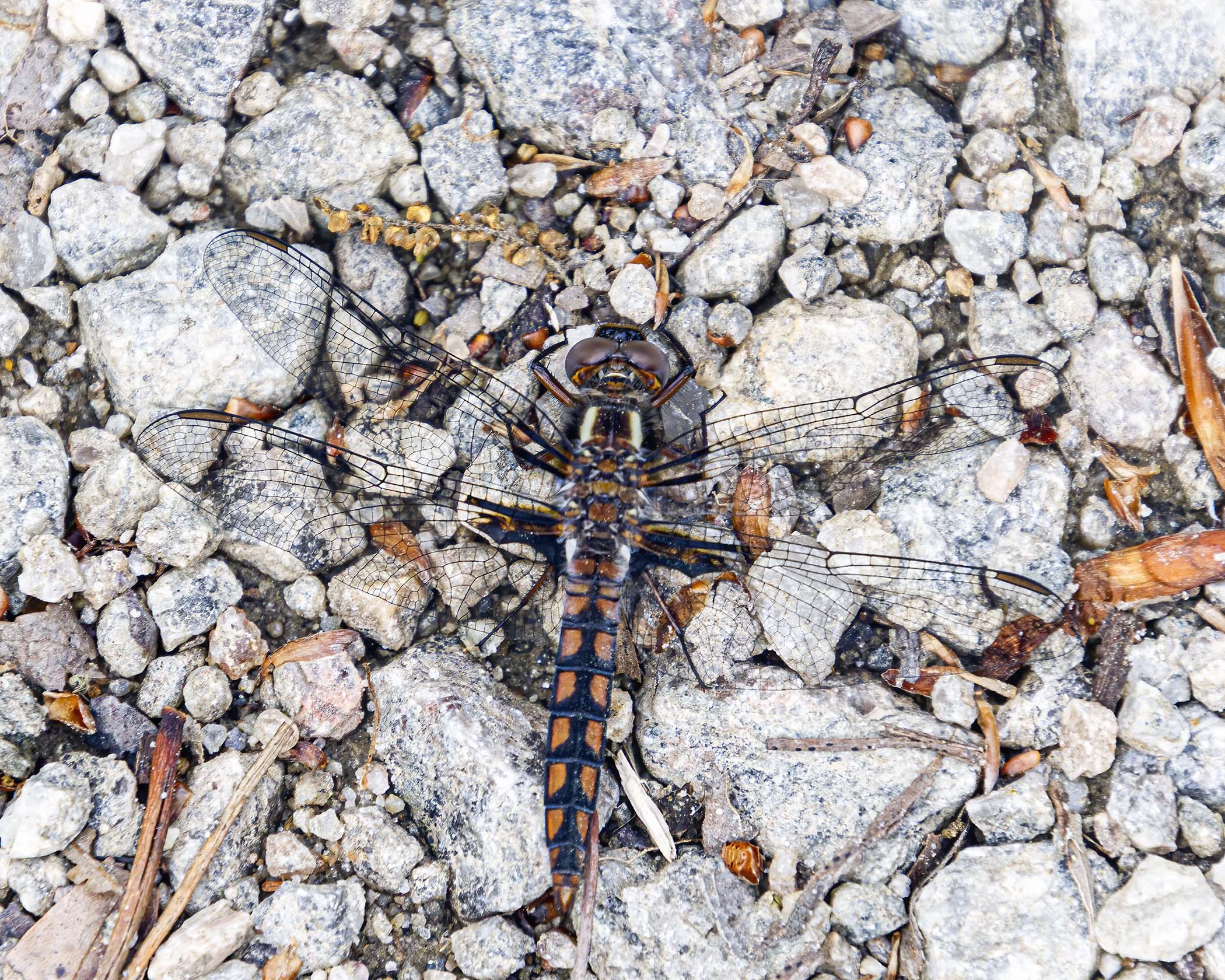
I am finally starting to see some male Blue Corporal dragonflies (Ladona deplanata) that are blue in color. In mid-April I started seeing Blue Corporals, but the males that I spotted at that time were all immature, like the one in the second photo below, and shared the coloration of females of the species.
The dragonfly in the first photo is a mature male. I spotted it during a recent hike along a creek in Prince William County. When you compare its feature to those of the immature male, you can see that the adult coloration is definitely bluer and the “shoulder” stripes on its thorax are a bit faded.
I really like the head-on angle that I used to photograph the Blue Corporal in the first photo. Technically only a small portion of the dragonfly is in sharp focus when you shoot from this angle, the eye-to-eye direct contact works well and draws in the viewer. As you can probably tell, I took this from a low angle, which helped to draw attention to the dragonfly’s interesting pose and to separate the subject from the somewhat cluttered background.

© Michael Q. Powell. All rights reserved.
Posted in Dragonflies, dragonfly, Insects, Nature, Photography, spring, wildlife | Tagged Blue Corporal, Blue Corporal dragonfly, Canon 7D, Ladona deplanata, male Blue Corporal, Prince William County VA, Tamron 18-400mm | Leave a Comment »
May 4, 2025 by Mike Powell
Common Whitetails (Plathemis lydia) can be found almost everywhere and are among the first dragonflies to appear in the spring and the last to survive in the fall. I nonetheless enjoy trying to capture creative images of them, like these two that I spotted this past week.
How do wildlife photographers choose their subjects? Some of them are attracted almost exclusively to rare and/or exotic species and are always looking for something new to photograph. Their mentality is close to those of many birders, who keep “life lists” of all the birds they have seen and are always lookin got add another one to the “list.”
Other photographers, like me, are content to photograph a more limited selection of subjects over and over again, hoping to capture something new and different, finding the extraordinary in the ordinary. The first photo is one such example—I love the prominent specular highlights in the image and the unusual pose of this female Common Whitetail with one of her legs extended.
At other times, I am simply trying to compose an image creatively, as in the second photo below. There is nothing super special about this shot of a male Common Whitetail, but I tried to add some visual interest by including some of the vegetation at the base of its perch and a portion of the lily pads in the distance. It is not a prize-winner by any standards, but I like the overall “feel” of the pleasant little image.


© Michael Q. Powell. All rights reserved.
Posted in Dragonflies, dragonfly, Insects, Nature, Photography, spring, wildlife | Tagged Canon 7D, Common Whitetail, Common Whitetail dragonfly, female Common Whitetail, Fort Belvoir VA, Jackson Miles Abbott Wetland Refuge, Lorton VA, male Common Whitetail, Occoquan Regional Park, Plathemis lydia, Tamron 18-400mm | 2 Comments »
May 2, 2025 by Mike Powell
I was a bit surprised to spot this North American Beaver (Castor canadensis) swimming in Accotink Creek yesterday afternoon and managed to capture this image before it sensed my presence and disappeared under the water. Beavers are primarily nocturnal, so most of my beaver sightings in the past have been at dusk or dawn. I am not sure why this beaver was active in the early afternoon on a bright sunny day. Perhaps it was looking for food to feed a newborn beaver baby. Who knows?
Accotink Creek is part of the Accotink Bay Wildlife Refuge, a nature preserve mostly on the grounds of the U.S. Army installation Fort Belvoir in Fairfax County, Virginia, where I live. However, parts of the refuge, including the areas that I visited yesterday, are open to the public and do not require entry onto the military installation.
I am including a photo of a suspension bridge across Accotink Creek that is currently closed. The stairs from the two banks of the creek to the bridge are gone and I do not know if they were removed intentionally or were washed away in a flood. The photo gives you the relative sense of the size of the creek and the overall habitat in which I spotted the swimming beaver.


© Michael Q. Powell. All rights reserved.
Posted in animals, beaver, Nature, Photography, spring, wildlife | Tagged Accotink Bay Wildlife Refuge, Accotink Creek, beaver, Canon 7D, Castor canadensis, North American Beaver, swimming beaver, Tamron 18-400mm | 2 Comments »
May 1, 2025 by Mike Powell
What is the most difficult subject that you try to photograph? Quite often my biggest concern is the composition of a photograph, i.e. can I capture a shot that will be visually pleasing. Sometimes that means waiting for a particular expression or wing position or moment of action, but if I am patient enough, I have a pretty good chance of getting some decent shots.
Each year, though, I try try to challenge myself to capture some “impossible shots” of dragonflies in flight. Of course, such shots are not actually impossible, but they are really difficult to pull off. Some really high-end modern mirrorless cameras have focusing systems that are so good that they can lock focus on a moving dragonfly, but I mostly use cameras with technology that is over a decade old. Usually I will try to track a dragonfly through the viewfinder of my camera and focus on it manually. It’s a little easier when the dragonfly is flying a somewhat predictable path over the water and ideally hovering a bit.
This past Monday I had my first experience this season with in-flight photography when I spotted several Common Baskettail dragonflies (Epitheca cynosura) patrolling over the water of a small pond at Occoquan Regional Park. I managed to get a decent number of shots in frame, but most of them were out of focus—clearly I am a little rusty and need more practice to regain the necessary hand-to-eye coordination. The first shot below is cropped quite a bit, but is one of my best shots from my little session.
Common Baskettail dragonflies, which are only about 1.6 inches (41 mm) in length, spend a lot of their time in the air, but on that day I was fortunate when one of them decided to take a break and perched for a few moments low in the nearby vegetation. The second and third shots below provide a good side view of this beautiful little dragonfly, including its distinctive terminal appendages (the tip of its “tail”).
It’s a fun challenge for my patience and skills as a photographer to attempt to capture shots of dragonflies in flight and luck certainly plays a big part in achieving any success whatsoever. I can just about guarantee that I will be featuring a few more in-flight dragonfly photos in the upcoming months as the insects and I become more active outdoors.


© Michael Q. Powell. All rights reserved.
Posted in Dragonflies, dragonfly, Insects, Nature, Photography, spring, wildlife | Tagged Canon 7D, Common Baskettail, Common Baskettail dragonfly, dragonfly in flight, Epitheca cynosura, Lorton VA, Occoquan Regional Park, Tamron 18-400mm | 3 Comments »
April 29, 2025 by Mike Powell
Yesterday I decided to visit Occoquan Regional Park in nearby Lorton, Virginia to search for some dragonflies. Some of you know that the place that I visit most frequently is Occoquan Bay National Wildlife Refuge, so you may be a little confused, because they both have “Occoquan” in their names. The Wildlife Refuge is run by the U.S. Fish and Wildlife Service, whereas the Regional Park is run by Fairfax County.
The locations are only a few miles apart, but their habitats are different enough that I tend to see some different dragonfly species at each spot. I was hoping to see some Spiketail dragonflies, but came up empty-handed. As I was nearing the end of my adventure, however, a large dragonfly flew overhead. I did not get a very good look at it, but its size, shape, and flight profile suggested to me that it was from the Darner family.
A short while later, I spotted another large dragonfly (possibly the same one) flying around some vegetation and was thrilled when it landed. At the precise moment that it landed, my vision was partially blocked by some branches, but I had a good idea of where I hoped the dragonfly was perched. I moved a few steps slowly and silent to get an unobstructed view of the dragonfly.
I held my breath when I saw that it was a Swamp Darner (Epiaeschna heros), the largest dragonfly in my area at about 3.5 inches (89 mm) in length. Wow! Judging from its terminal appendages (the tip of the “tail”), I am pretty sure that this is a female. I took the second photo below initially, afraid to move closer for fear of spooking the dragonfly.
I then stepped a little closer and moved up and down as I tried to get a better shot. My options were limited, because the dragonfly was perched about 10 feet up (about 3 meters) and was surrounded by intertwined vines and branches. I think that the first shot below is a marginal improvement on my first shot and encourage you to click on it to get a better look at the Swamp Darners beautiful markings, including its spectacular eyes.
I suspect that this park will be in my regular rotation of places to visit as additional dragonfly species continue to emerge.


© Michael Q. Powell. All rights reserved.
Posted in Dragonflies, dragonfly, Insects, Nature, Photography, spring, wildlife | Tagged Canon 7D, Epiaeschna heros, female Swamp Darner, Lorton VA, Occoquan Regional Park, Swamp Darner, Swamp Darner dragonfly, Tamron 18-400mm | 3 Comments »
April 28, 2025 by Mike Powell
Last week I spotted this Northern Water Snake (Nerodia sipedon) alongside a creek during a hike in Prince William Forest Park in Triangle, Virginia. Water Snakes are not venomous, but I remember reading that their saliva contains an anti-coagulant, so I am reluctant to get so close to one that I risk getting bitten.
Most of the Northern Water Snakes that I have previously seen have been a uniform dark color, but this snake has a beautiful striped pattern on its underside that is visible in this photo. This snake seemed to be simply sunning itself, absorbing the warmth of the spring sunshine.

© Michael Q. Powell. All rights reserved.
Posted in Nature, Photography, Reptiles, snake, spring, wildlife | Tagged Canon 7D, Nerodia sipedon, Northern Water Snake, Prince William Forest Park, sunning snake, Tamron 18-400mm, Triangle VA | 5 Comments »
April 27, 2025 by Mike Powell
This Eastern Tiger Swallowtail butterfly (Papilio glaucus) was sipping from a wet area at the edge of a forest creek (and maybe ingesting other nutrients) when I photographed it on 23 April at Prince William Forest Park in Triangle,Virginia. I used to associate this species of butterfly with gardens, because that is where I tended to spot them in the past. However, over the last few years, I have spent a lot of time in the spring in forested areas and have spotted Eastern Tiger Swallowtails regularly there, both individually and in small groups.
Check out my 2021 posting called “
A Kaleidoscope of butterflies” to see a photograph of Eastern Tiger Swallowtails “puddling,” i.e. congregating together on wet sand and mud to drink water and extract minerals from puddles.
© Michael Q. Powell. All rights reserved.
Posted in Butterflies, Insects, Nature, Photography, spring, wildlife | Tagged Canon 7D, Eastern Tiger Swallowtail, Eastern Tiger Swallowtail butterfly, Papilio glaucus, Prince William Forest Park, Tamron 18-400mm, Triangle VA | 4 Comments »
April 26, 2025 by Mike Powell
I am not sure that I can say that dragonfly activity is at a peak yet, but I did see a whole lot more dragonflies this past Wednesday in Prince William County than in previous trips there earlier in April. I was particularly delighted to spot some Common Baskettail dragonflies (Epitheca cynosura) that were perched—quite often I have seen them in the past only when they were flying.
The Common Baskettail in the first photo seems to be a mature male. I love the way that I was able to capture an image that shows the way that it hangs when perching and the distinctive terminal appendages that always remind me of the handles of some pliers that are wrapped in plastic.
The dragonfly in the second photo looks to be a recently emerged Common Baskettail. Its eyes are still pale and its wings are very clear and are probably not fully hardened yet.
I got a late start this year in finding spring dragonflies, but feel that I have more or less caught up as we near the end of April, though there are still some spring species that I have not yet seen.


© Michael Q. Powell. All rights reserved.
Posted in Dragonflies, dragonfly, Insects, Nature, Photography, wildlife | Tagged Canon 7D, Common Baskettail, Common Baskettail dragonfly, Epitheca cynosura, Prince William County VA, Tamron 18-400mm | 3 Comments »
April 25, 2025 by Mike Powell
Dragonfly season has definitely begun. I spotted several Stream Cruiser dragonflies (Didymops transversa) on Wednesday this week while I was exploring several creeks in Prince William Park here in Virginia. Stream Cruisers are pretty easy to identify, with a single stripe on their thoraxes, pale-colored tips of their abdomens, and long, thin legs. They tend to perch at an angle or to hang vertically.
Stream Cruisers are one of the earliest dragonfly species to appear each spring and it was exciting to spot them. They tend to be habitat specialists and are generally found near forest streams with good flow and rocks.


© Michael Q. Powell. All rights reserved.
Posted in Dragonflies, dragonfly, Insects, Nature, Photography, spring, wildlife | Tagged Canon 7D, Didymops transversa, Prince William County VA, Stream Cruiser, Stream Cruiser dragonfly, Tamron 18-400mm | 1 Comment »
April 24, 2025 by Mike Powell
The weather has warmed up considerably and I have started to see many of the spring dragonflies and even some of those that will remain with us through the summer. Last Friday I spotted numerous Ashy Clubtail dragonflies (Phanogomphus lividus), many of which appeared to have emerged recently, judging from their very shiny wings and pale coloration, as you can see in the first photo. Getting shots of them was tough, because they perch on the ground in the vegetation, are only about 2 inches in length (50 mm), and are often very skittish.
Kevin Munroe described well the challenges of finding early spring dragonflies in his wonderful Dragonflies of Northern Virginia website, “Searching for dragonflies in spring is a wholly different endeavor than finding them in July and August. Most summer dragonflies spend their time at sunny ponds or open fields, and engage in showy displays and aerial battles – they are, in a word, visible. The majority belong to the showy and successful skimmer family, along with a few darners and emeralds. The spring dragonfly community is more diverse, and has a very different M.O. They are for the most part, habitat specialists, with low population numbers, secretive habits, and denizens of woodland streams, not sunny ponds. Spiketails, Petaltails, Clubtails, Darners and Emeralds are all out and about in spring. To find these species in April and May, one must spend many hours searching forest edges, woodland clearings, and the banks of springs, streams and creeks.”
In fact, I photographed these Ashy Clubtails in the vegetation near a creek in Prince William County and I can testify to the fact that I walked about for hours searching for them. I am pretty happy with the photos that I was able to take. I especially like the second photo that has some really cool shadows that seem to magnify the number of legs and wings of the dragonfly.
The final two photos were taken only a few seconds apart and show the wings in very different positions. The penultimate photo shows the wings in a typical outstretched pose, while the final photo shows the wings clasped together over the dragonfly’s body, similar to the way that damselflies hold their wings when perched. In my experience recently emerged dragonflies sometimes flex their wings this way as fluid is pumped into the wings and the wings are hardening.


© Michael Q. Powell. All rights reserved.
Posted in Dragonflies, dragonfly, Insects, Nature, Photography, spring, wildlife | Tagged Ashy Clubtail, Ashy Clubtail dragonfly, Canon 7D, Phanogomphus lividus, Prince William County VA, Tamron 18-400mm | Leave a Comment »
April 22, 2025 by Mike Powell
When this little butterfly flew by me last Friday at Prince William Forest Park, it looked like a nondescript brown moth. Fortunately it landed on some nearby vegetation and I was able to zoom in on it. Wow—what an amazing variety of colors, textures, and markings on this tiny butterfly. I was able to determine that it was a Henry’s Elfin butterfly (Callophrys henrici).
I was pretty sure that I had never seen a butterfly like this until I searched my blog and discovered that I had seen one last spring on almost the same date. I don’t think that I’m losing my memory yet, but I keep filling my head with so much information that it is almost inevitable that I will forget some things.
There is something so whimsical about the word “elfin” that I can’t help but smile whenever I use it. I love the idea of magical creatures like elves and nymphs, drawn from the works of Shakespeare or perhaps from Tolkien’s Lord of the Rings. These creatures blend in so well with their surroundings that you have to look carefully to spot them and I should warn you that you may become blissfully enchanted by them.

© Michael Q. Powell. All rights reserved.
Posted in Butterflies, Insects, Nature, Photography, spring, wildlife | Tagged Callophrys henrici, Canon 7D, Henry's Elfin, Henry's Elfin butterfly, Prince William Forest Park, Tamron 18-400mm, Triangle VA | Leave a Comment »
April 21, 2025 by Mike Powell
I was delighted to finally spot my first Uhler’s Sundragon (Helocordulia uhleri) of the year on 18 April near a small pond in Prince William County, Virginia. I went searching for these dragonflies, which are usually the first ones I see in the spring, on several occasions in late March and early April, but came up empty-handed. Uhler’s Sundragons are usually around for only about a month, soI was fearful that I might miss them this season.
I have a pretty good idea of the type of habitat that this early season dragonfly prefers and tend to begin my searches by returning to spots where I have photographed them in the past and then begin to widen my search. Quite often this means that I spend a lot of time walking and watching, trying to remain alert to any movement in the air or on the ground.
As you can see in the first photo, Uhler’s Sundragons often hang from a perch, rather than perch horizontally, which makes it a little easier to get a detailed shot. When the dragonfly perches low to the ground, as in the second photo when it hung from the stem of a fallen leaf, I end up doing some improvised acrobatics to capture an image.


© Michael Q. Powell. All rights reserved.
Posted in Dragonflies, dragonfly, Insects, Nature, Photography, spring, wildlife | Tagged Canon 7D, Helocordulia uhleri, Prince William County VA, Tamron 18-400mm, Uhler's Sundragon, Uhler's Sundragon dragonfly | 4 Comments »
April 20, 2025 by Mike Powell
Happy Easter to friends and family who are celebrating today. This past week has been a whirlwind of activity and services for me at my church as we have commemorated Christ’s last days, beginning with his entry into Jerusalem on Palm Sunday, through his last supper, and finally his crucifixion and burial. Today we celebrate Jesus’s triumph over death with a joyous Easter service.
I photographed this beautiful little Pearl Crescent butterfly (Phyciodes tharos) during a recent visit to Occoquan Bay National Wildlife Refuge. Butterflies have always been special for me as symbols of the amazing transformations that can take place in this world, even when the situation seems hopeless and sad.
I offer my prayers for all of you, believers and non-believers alike, that your lives will be full of joy, hope, and peace.
Christ is risen!

© Michael Q. Powell. All rights reserved.
Posted in Butterflies, Easter, Insects, Nature, Photography, wildlife | Tagged Canon 7D, Easter, Easter 2025, Occoquan Bay National Wildlife Refuge, Pearl Crescent, pearl crescent butterfly, Phyciodes tharos, Tamron 150-600mm, Woodbridge VA | 13 Comments »
« Newer Posts - Older Posts »

 Mike Powell