May 7, 2024 by Mike Powell
A month ago it was easy to spot the early-emerging insects, because very few of them were flying. Now, though, the air is so full of bees, flies, and other aerial creatures that it is a little harder to detect the dragonflies and damselflies that are my primary targets.
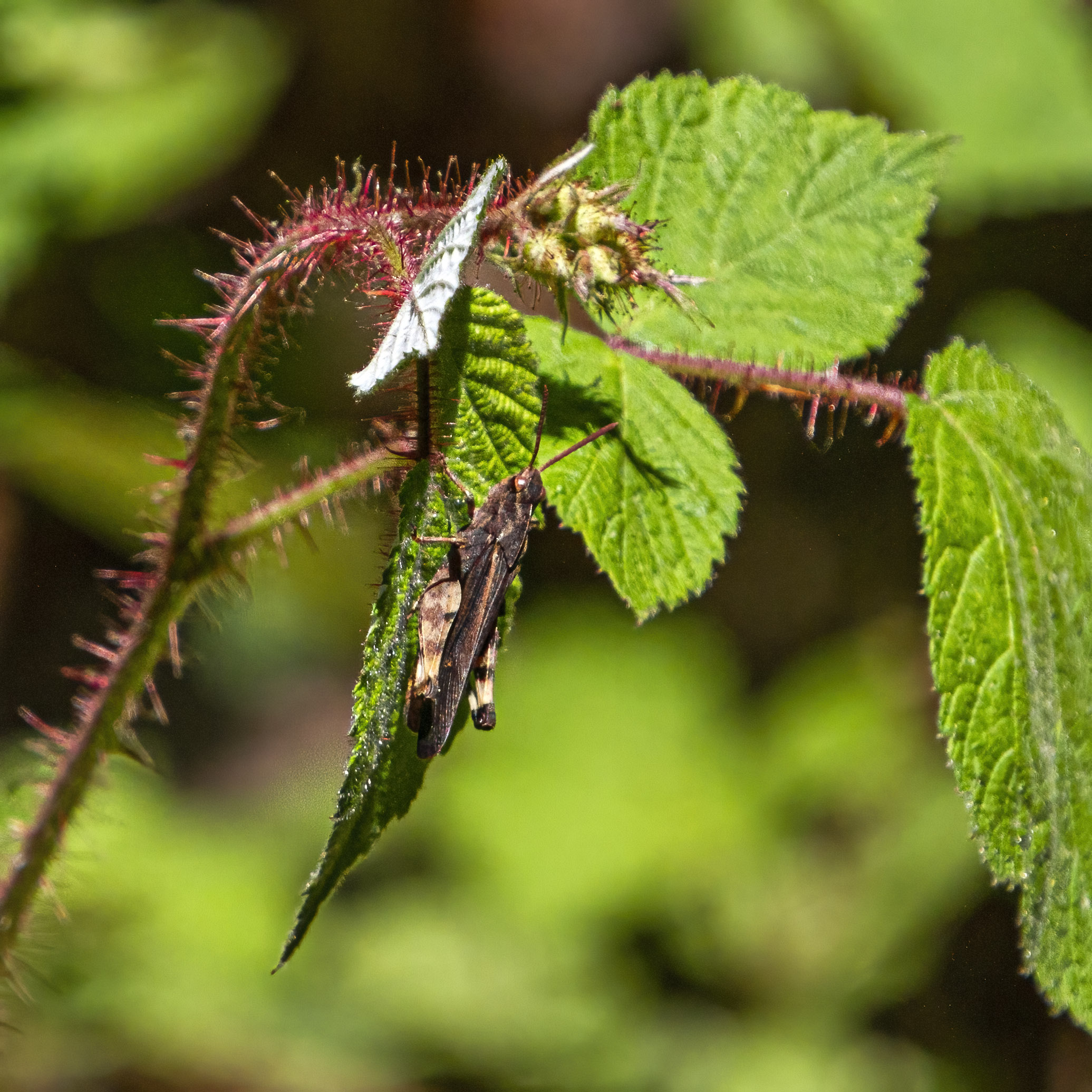
As I walk along grassy paths now, little clouds of grasshoppers burst into the air in front of me. Most of the grasshoppers jump out of sight, but occasionally one will perch on some nearby vegetation and remain immobile, hoping perhaps that I will not see him. Last week at Occoquan Regional Park I captured a shot of one such grasshopper.
I am definitely not an expert on grasshoppers, so I had to pore over page after page of entries on the internet before I finally concluded that this might be a Green-striped Grasshopper (Chortophaga viridifasciata). Still unsure of the identification, I posted a request for help on the BugGuide website and an expert there confirmed my identification of this grasshopper.
From an aesthetic perspective, I loved the curve of the spiky stem of the plant and my initial instinct was to go for a looser crop of the image, as you can see below in the second photo. However, I realized that viewers could not see the details of the grasshopper, so I made the more zoomed-in version that you can see as the first photo below.
The two images, which are actually just different versions of the same shot, complement each other and serve different functions. The first one focuses more on the grasshopper as the primary subject, while the second one makes the environment a co-star. I like both versions.


© Michael Q. Powell. All rights reserved.
Posted in Insects, Macro Photography, Nature, Photography, spring, wildlife | Tagged Canon 7D, Chortophaga viridifasciata, grasshopper, green-striped grasshopper, Lorton VA, Occoquan Regional Park, Tamron 18-400mm | 5 Comments »
May 6, 2024 by Mike Powell
I spotted this beautiful female Red-winged Blackbird (Agelaius phoeniceus) poking about in the marshland vegetation last Thursday at Jackson Miles Abbott Wetland Refuge. As is the case with many birds, the name of the species matches the coloration and/or features of the male, but not those of the female, e.g. this Red-winged Blackbird is not black nor does it have red wings.
I had my first encounter with a female Red-winged Blackbird in June 2012, a few months before I started this blog. I remember well my initial difficulties in trying to identify the bird and my shock in learning that it was a blackbird—I assumed it was a sparrow of some sort. In September 2012, I posted some photos of that bird in a blog entry entitled “Intense bird.” I encourage you to click on that link and make your own judgment about the degree to which my photography “style” has remained consistent over the years.
In 2012 I was just starting to get serious about photography and my dear friend and photography mentor Cindy Dyer had lent me a Nikon D300 and a Tamron 180mm macro lens that day. I fell in love with that lens and quickly purchased one for my Canon, the brand that I mostly use. The Tamron 180mm macro lens remains one of my favorite lenses.
It was quite enjoyable to watch this blackbird last week exploring the vegetation protruding from the water. She would perch on some rather small stems, appearing to flare her tail to maintain her balance, as you can see in these photos, occasionally calling out to a male blackbird that I could hear, but did not see.


© Michael Q. Powell. All rights reserved.
Posted in Birds, Nature, Photography, spring, wildlife | Tagged Agelaius phoeniceus, Canon 7D, female Red-winged Blackbird, Fort Belvoir VA, Jackson Miles Abbott Wetland Refuge, red-winged blackbird, Tamron 18-400mm | Leave a Comment »
May 5, 2024 by Mike Powell
Odonata is an order of flying insects that includes dragonflies and damselflies. During the warmer months of the year I spend a lot of time hunting for dragonflies, the larger members of this group of magical creatures, but I also enjoy searching for damselflies, their smaller and more fragile “cousins.”
Damselflies, like dragonflies, come in a variety of colors and shapes. Here is a sampling of images of damselflies that I captured this past Thursday during visits to Jackson Miles Abbott Wetland Refuge and Occoquan Regional Park, both of which are located within 15 miles (24 km) of my house.
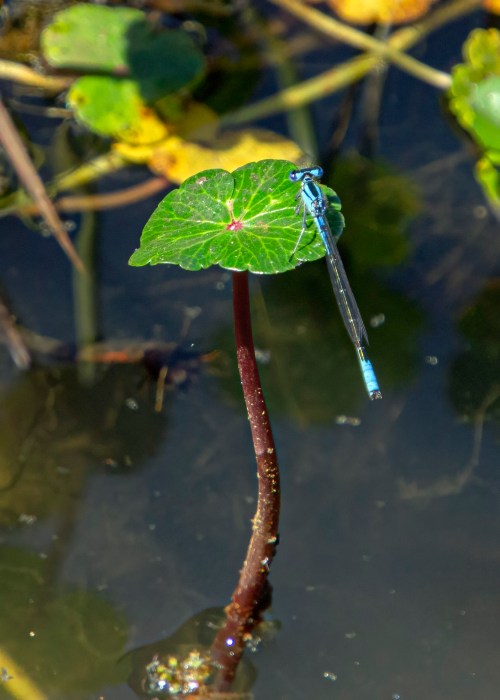
The first photo shows a Orange Bluet (Enallagma signatum). I am always amused by the name of this species, because it seems incongruous to have an orange-colored member of a genus called American Bluets. Most male bluets are, in fact, blue, but others are orange, scarlet, and burgundy and there is even a “Rainbow Bluet.”
The second image shows a male Azure Bluet (Enallagma aspersum), whose colors are closer to my mental image of a bluet. Most bluets are some combination of blue and black and it can be tricky trying to determine specific species by examining the color patterns on the body and in the eyes.
The third shot is of a male Fragile Forktail (Ischnura posita), one of the first damselflies to emerge each spring. Fragile Forktails are really tiny (about an inch (25 mm) in length, but are relatively easy to identify by their broken shoulder stripe that looks like an exclamation point.
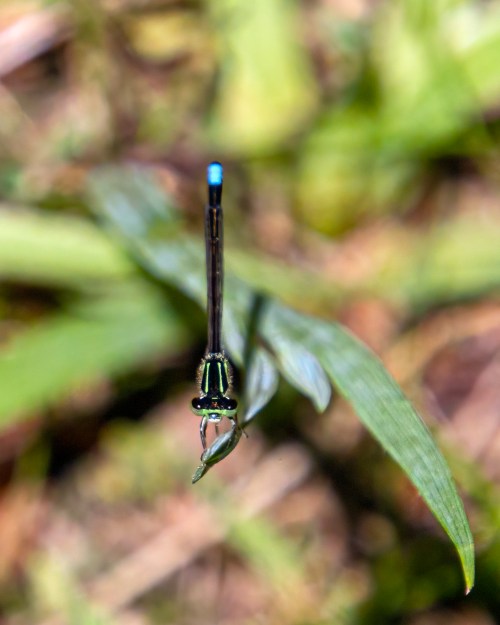
In the final photo I was eye-to-eye with the damselfly so his abdomen is almost completely out of focus. Nonetheless enough details are visible for me to say this is almost certainly a male Eastern Forktail damselfly (Ischnura verticalis).
I like to try to vary my approach to capturing images of most subjects, including damselflies, as you can see in this little collection of photos. Sometimes, as in the first shot, I will try to isolate the subject from its background in order to focus the viewer’s complete attention on the subject. Recently, though, I have developed a preference for including more of the habitat in my shots, as in the second image, in order to give the viewer a sense of the environment in which I took the shot. When possible, I like to attempt to capture some “artsy” shots, like the final image, by using selective focus and choosing carefully my angle of view.
No matter what approach I choose with damselflies, I have to be careful not to fall into the water, where most of these dragonflies were perching. I am not always successful in keeping my feet dry.


© Michael Q. Powell. All rights reserved.
Posted in damselfly, Insects, Macro Photography, Nature, Photography, spring, wildlife | Tagged Azure Bluet, Azure Bluet damselfly, Canon 7D, Eastern Forktail, Eastern Forktail damselfly, Enallagma aspersum, Fort Belvoir VA, Fragile Forktail, Ischnura posita, Jackson Miles Abbott Wetland Refuge, Lorton VA, Occoquan Regional Park, Orange Bluet, Orange Bluet damselfly, Tamron 18-400mm | 2 Comments »
May 4, 2024 by Mike Powell
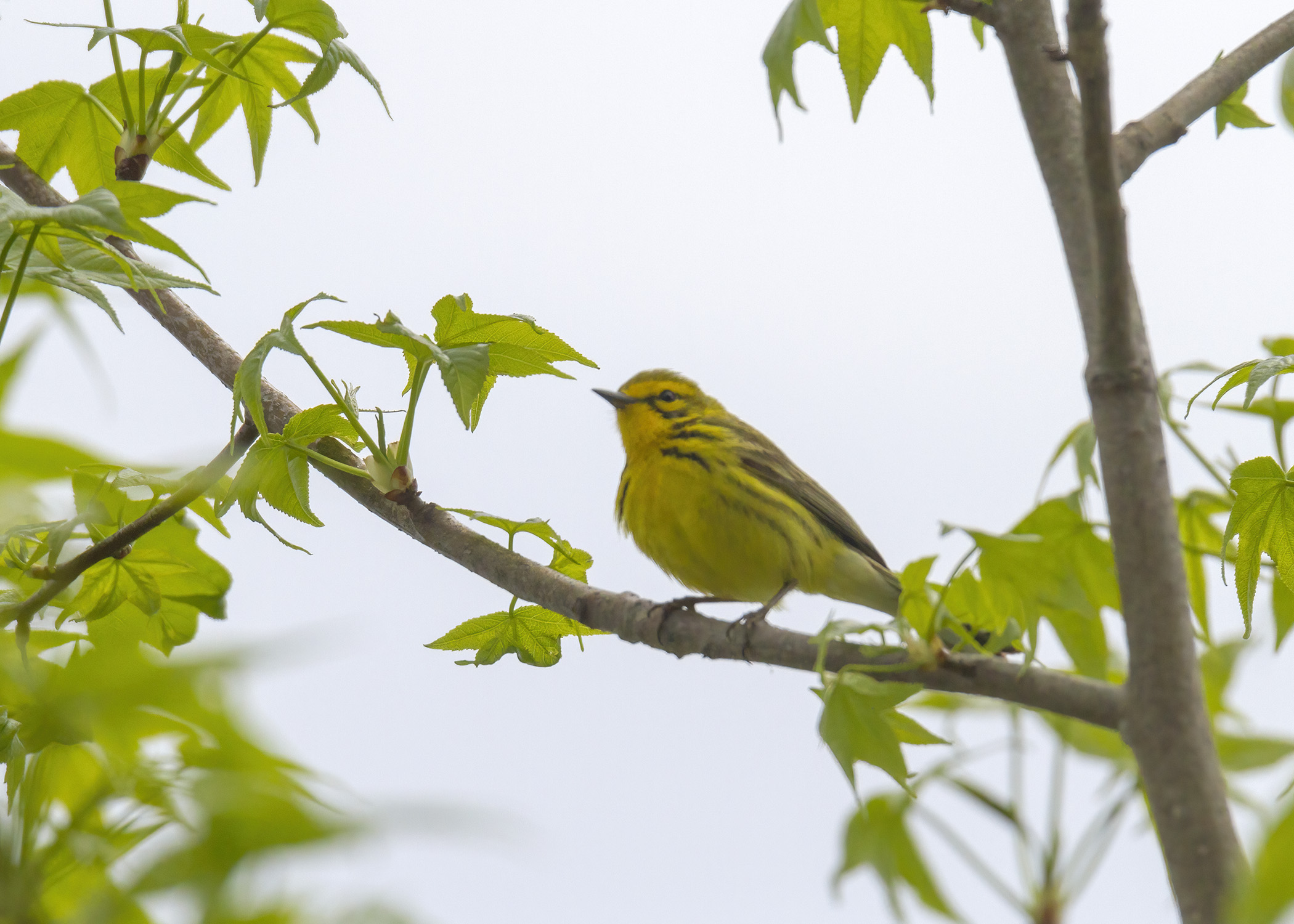
I don’t know how much longer the migrating warblers will be in my area, but this past few weeks I have been trying to get outside with my camera as often as I can, hoping to be able to photograph these colorful little birds. On Tuesday I spotted a Prairie Warbler (Setophaga discolor) in the patient and patiently tracked it as it moved about.
The first photo was a bit of an anomaly, because the warbler momentarily gave me an unobstructed view when it jumped to a high branch. The second photo gives you a much better idea of the typical challenge I face, with the warbler barely showing itself from behind the wall of foliage. Fortunately, I reacted quick and got a shot that is one of my favorites of this warbler season, which has been my most successful one to date.


© Michael Q. Powell. All rights reserved.
Posted in Birds, Nature, Photography, spring, warbler, wildlife | Tagged Canon 7D, Occoquan Bay National Wildlife Refuge, Prairie Warbler, Setophaga discolor, Tamron 18-400mm, warbler, Woodbridge VA | 7 Comments »
May 3, 2024 by Mike Powell
On Wednesday I spotted a skink with a shockingly orange head while I was exploring Occoquan Bay National Wildlife Refuge. Why was the skink’s head so orange? During mating season, adult male skinks get swollen heads that turn bright orange-red in color. I am not sure what biological purpose the color change serves, but it sure is impressive.
I think that this is probably a Common Five-lined Skink (Plestiodon fasciatus), the most common skink species in my area. However, the Broad-headed Skink (Plestiodon laticeps) is similar in appearance and I am not very good at telling them apart. Whatever the case, the males in both species have orange heads during mating season.

© Michael Q. Powell. All rights reserved.
Posted in Nature, Photography, Reptiles, spring | Tagged Broad-headed Skink, Canon 7D, Common Five-Lined Skink, Occoquan Bay National Wildlife Refuge, Plestiodon fasciatus, Plestiodon laticeps, skink, Tamron 18-400mm, Woodbridge VA | 4 Comments »
May 2, 2024 by Mike Powell
This female Eastern Pondhawk dragonfly (Erythemis simplicicollis) blended in so well with the vegetation that I almost missed seeing her yesterday at Occoquan Bay National Wildlife Refuge. Eastern Pondhawks are one of the most commonly seen dragonflies in my area during the summer, but this is the first one that I have seen so far this year.
I love the beautiful emerald color of female Eastern Pondhawks (as well as immature males of the species). They are not particularly large as dragonflies go, but they are very fierce predators. Several times each season I stumble upon Eastern Pondhawks gnawing on damselflies or other dragonflies that they have caught. Yikes!

© Michael Q. Powell. All rights reserved.
Posted in Dragonflies, dragonfly, Insects, Nature, Photography, spring, wildlife | Tagged Canon 7D, Eastern Pondhawk, Eastern Pondhawk dragonfly, Erythemis simplicicollis, female eastern pondhawk, Occoquan Bay National Wildlife Refuge, Tamron 18-400mm, Woodbridge VA | 1 Comment »
May 2, 2024 by Mike Powell
Prothonotary Warblers (Protonotaria citrea) are probably my favorite warblers. I just love their brilliant yellow plumage that seems to glow. Many warblers have touches of bright yellow, especially during the spring breeding season, but the Prothonotary Warbler outdoes them all and is almost completely covered in yellow.
I spotted this little beauty yesterday (1 May) at Occoquan Bay National Wildlife Refuge. I initially caught sight of the warbler as it was flitting about in the foliage. I would see flashes of yellow as it foraged, but could not get a clear look at it. All of the sudden the warbler flew across the trail and landed in a bush, momentarily give me a clear shot.
Quite often I strain my neck when trying to photograph warblers, a phenomenon that is colloquially called “warbler neck.” It is so common that the Audubon website has an article entitled, “A Birder’s Workout Guide for Preventing Warbler Neck.” I was very fortunate in this case, though, that the bird was perched below eye level, so I was able to capture a lot of detail without harming my neck, detail that is often hidden when I am shooting upwards at a sharp angle.

© Michael Q. Powell. All rights reserved.
Posted in Birds, Nature, Photography, Portraits, spring, warbler, wildlife | Tagged Canon 7D, Occoquan Bay National Wildlife Refuge, Prothonotary Warbler, Protonotaria citrea, Tamron 18-400mm, warbler, Woodbridge VA | 6 Comments »
May 1, 2024 by Mike Powell
I spotted this spectacular Yellow-throated Warbler (Setophaga dominica) on Monday at Occoquan Bay National Wildlife Refuge as it perched amidst the hanging seed pods of what I believe is a sycamore tree. I love the round shape and texture of the seed pods and the warbler was much more in the open than he was when he was hidden amidst the foliage.

© Michael Q. Powell. All rights reserved.
Posted in Birds, Nature, Photography, spring, warbler, wildlife | Tagged Canon 7D, Occoquan Bay National Wildlife Refuge, Setophaga dominica, sycamore, sycamore seed pods, Tamron 150-600mm, warbler, Woodbridge VA, Yellow-throated Warbler | 4 Comments »
May 1, 2024 by Mike Powell
Yesterday I spotted several Indigo Buntings (Passerina cyanea) at Occoquan Bay National Wildlife Refuge. It is probably more accurate to note that I heard the buntings before I actually saw them. Unlike recent warblers that I have photographed that seem to hide behind the leaves while they sing their songs, Indigo Buntings like to fly to the top of the trees in order to be seen and heard.
I really like the basic description of this species on the Cornell Lab of Ornithology website:
“The all-blue male Indigo Bunting sings with cheerful gusto and looks like a scrap of sky with wings. Sometimes nicknamed “blue canaries,” these brilliantly colored yet common and widespread birds whistle their bouncy songs through the late spring and summer all over eastern North America. Look for Indigo Buntings in weedy fields and shrubby areas near trees, singing from dawn to dusk atop the tallest perch in sight or foraging for seeds and insects in low vegetation.”
The bird in the third photo has mottled feathers and may be in the process of molting, but I think that it is another Indigo Bunting. The only other species in our area at this time of year with equally brilliant blue feathers is the Blue Grosbeak. It is a little hard to tell, but it seems to me that the bill on the bird in this photo is too small for it to be a “grosbeak.” UPDATE: Some more experience birders in a Facebook group say that this Indigo Bunting is immature and/or in the process of molting, while others say this is a Blue Grosbeak.


© Michael Q. Powell. All rights reserved.
Posted in Birds, Nature, Photography, spring, wildlife | Tagged Canon 7D, Indigo Bunting, Occoquan Bay National Wildlife Refuge, Passerina cyanea, Tamron 18-400mm, Woodbridge VA | 4 Comments »
April 30, 2024 by Mike Powell
I don’t know if this Yellow-rumped Warbler (Setophaga coronata) that I spotted last week at Occoquan Bay National Wildlife Refuge was in a transitional plumage stage, but it looked awfully scraggly to me. The colors on the warbler’s face and body were mottled, but the yellow patches on its chest helped me to identify it as a Yellow-rumped Warbler.
I feel very fortunate when I am able to get any shots of a warbler. The trees are now covered in leaves and I can’t help but feel a bit of frustration when I can hear all kinds of birds singing, but can’t spot them. That’s the reality for a wildlife photographer—sometimes all I can do is watch, listen, and wait patiently, hoping that a subject will come into view.


© Michael Q. Powell. All rights reserved.
Posted in Birds, Nature, Photography, spring, warbler, wildlife | Tagged Canon 7D, Occoquan Bay National Wildlife Refuge, Setophaga coronata, Tamron 150-600mm, warbler, Woodbridge VA, Yellow-rumped Warbler | 5 Comments »
April 29, 2024 by Mike Powell
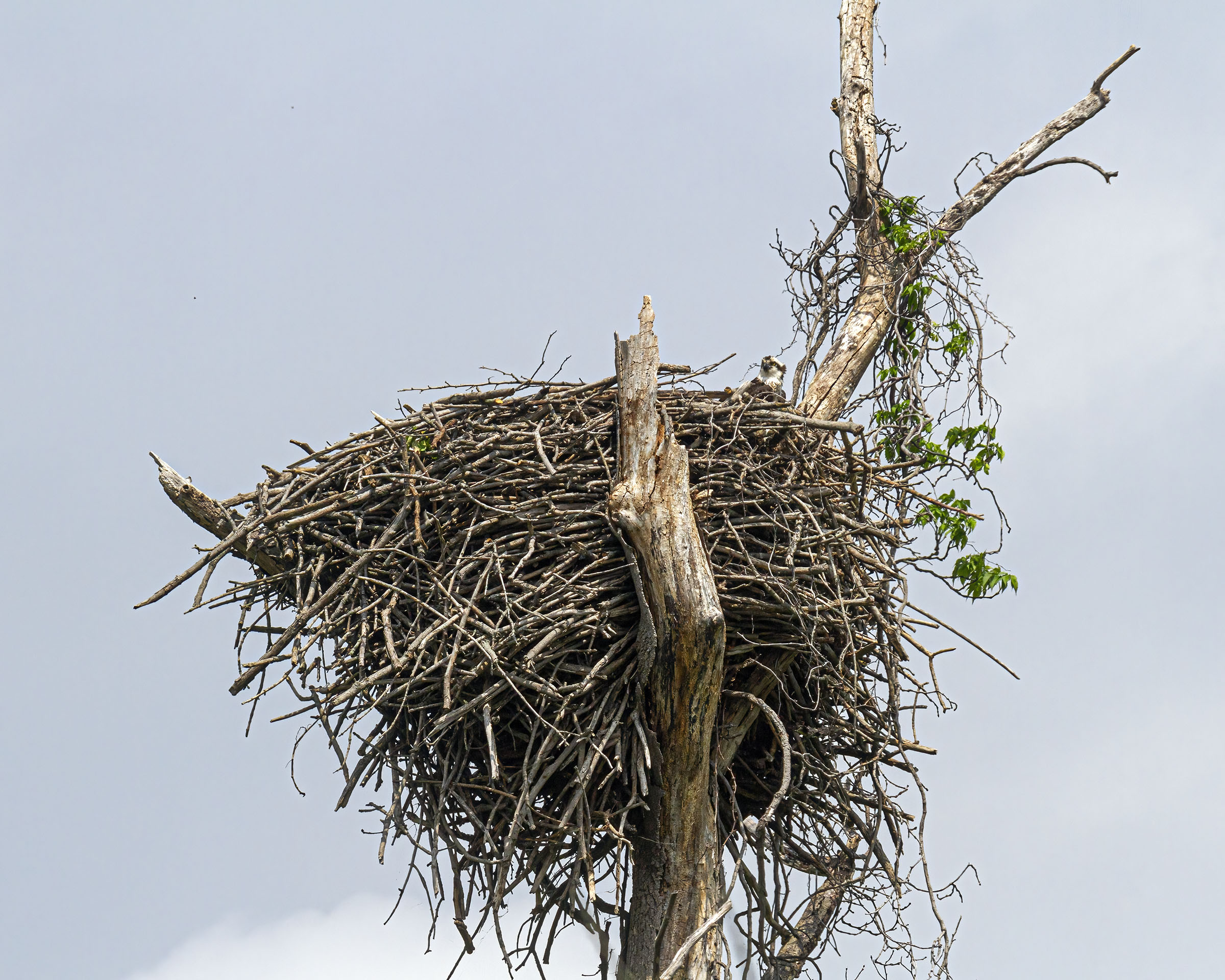
There is one extremely large eagle nest (plus one or two smaller ones) that I monitor each year at Occoquan Bay National Wildlife Refuge. Earlier this year I spotted a lot of eagle activity around that nest and I assumed that the eagles would be nesting in it.
However, recently both members of an eagle couple were spotted on the outside of the nest and ospreys began to display a lot of interest in the nest. I assume that means that the eagles were not successful in incubating eggs, but I do not know for sure what happened.
Last week I photographed an osprey in the nest and captured a few shots of it. The osprey looks absolutely tiny in the nest and the nest is far larger than the typical ones that osprey use.
I will continue to keep an eye on the nest and see if I eventually see some baby ospreys there. The big challenge is that the nest is so large and deep that osprey (or eagles) are not visible when they are sitting on eggs.


© Michael Q. Powell. All rights reserved.
Posted in Birds, Nature, Photography, spring, wildlife | Tagged Canon 7D, eagle nest, Occoquan Bay National Wildlife Refuge, Osprey, Pandion haliaetus, Tamron 150-600mm, Woodbridge VA | 1 Comment »
April 28, 2024 by Mike Powell
This male Prairie Warbler (Setophaga discolor) was signing loudly and proudly when I captured this image on Thursday at Occoquan Bay National Wildlife Refuge. I just love the way the little bird tilts back his head and sings with all of his might, seemingly putting his entire body into the effort.


© Michael Q. Powell. All rights reserved.
Posted in Birds, Nature, Photography, spring, warbler, wildlife | Tagged Canon 7D, Occoquan Bay National Wildlife Refuge, Prairie Warbler, Setophaga discolor, Tamron 18-400mm, warbler, Woodbridge VA | 3 Comments »
April 27, 2024 by Mike Powell
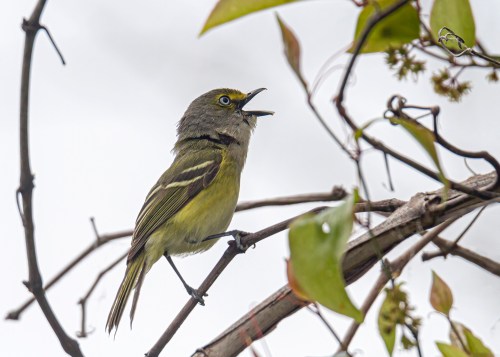
I was absolutely thrilled to capture some shots of this White-eyed Vireo (Vireo griseus) on Thursday at Occoquan Bay National Wildlife Refuge. It was a cloudy, overcast day and it seemed like the vireo was mostly in the shadows, which caused the first and last images to look a bit drab. Fortunately, though, I was able to catch the bird mid-song in the first shot, which definitely added some visual interest.
In many ways the second shot is my favorite of this set, even though the body of the vireo is partially blocked by the foliage. Somehow the colors in this image seem brighter and more true to life. In all of the shots, I really like the way that the light eyes of the subject pop, giving the vireo a very distinctive look.


© Michael Q. Powell. All rights reserved.
Posted in Birds, Nature, Photography, spring, wildlife | Tagged Canon 7D, Occoquan Bay National Wildlife Refuge, singing vireo, Tamron 150-600mm, vireo, Vireo griseus, White-eyed Vireo, Woodbridge | 3 Comments »
April 26, 2024 by Mike Powell
During the summer it seems like dragonflies are everywhere, perching prominently in plain sight in all kinds of environments, but this early in the season there are a whole lot fewer of them and the ones that are around are relatively hard to find. Last week, though, I was blessed to encounter quite a few Ashy Clubtail dragonflies (Phanogomphus lividus) while I was exploring a creek in Prince William County, Virginia.
The Dragonflies of Northern Virginia website, one of my favorite on-line dragonfly resources, described well the environment in which to find this species. “To find Ashies, look for clean, stable, rocky forest streams and then search out the closest sunny clearing, stream-side meadow or sunlit path. Like Common Whitetails and Blue Corporals, Ashy Clubtails prefer to perch flat on bare-soil, fallen logs, rocks or leaf litter.”
Most of the Ashy Clubtails that I spotted were in fact perched in the middle of the trails that I was following, like the one in the final photo. Although the dragonflies are sometimes skittish, it is relatively easy to get a photo of one, albeit with a fairly uninteresting background. The Ashy Clubtail in the first photo has a somewhat more interesting pose, with a nice shadow to add some visual interest.
My favorite photo of this little group, however, has to be the middle one. I really like the confrontational pose of the female Ashy Clubtail as she perched on a leaf and looked right at me. In case you are curious, the dragonflies in the first and second photos are females and the one in the final photo is the male. If you look carefully at the tips of their abdomens (their “tails”), you can see that only the males have terminal appendages that look like a sidewards-facing parenthesis and are quite distinctive.


© Michael Q. Powell. All rights reserved.
Posted in Dragonflies, dragonfly, Insects, Nature, Photography, spring, wildlife | Tagged Ashy Clubtail, Ashy Clubtail dragonfly, Canon 7D, Phanogomphus lividus, Prince William County VA, Tamron 18-400mm | Leave a Comment »
April 25, 2024 by Mike Powell
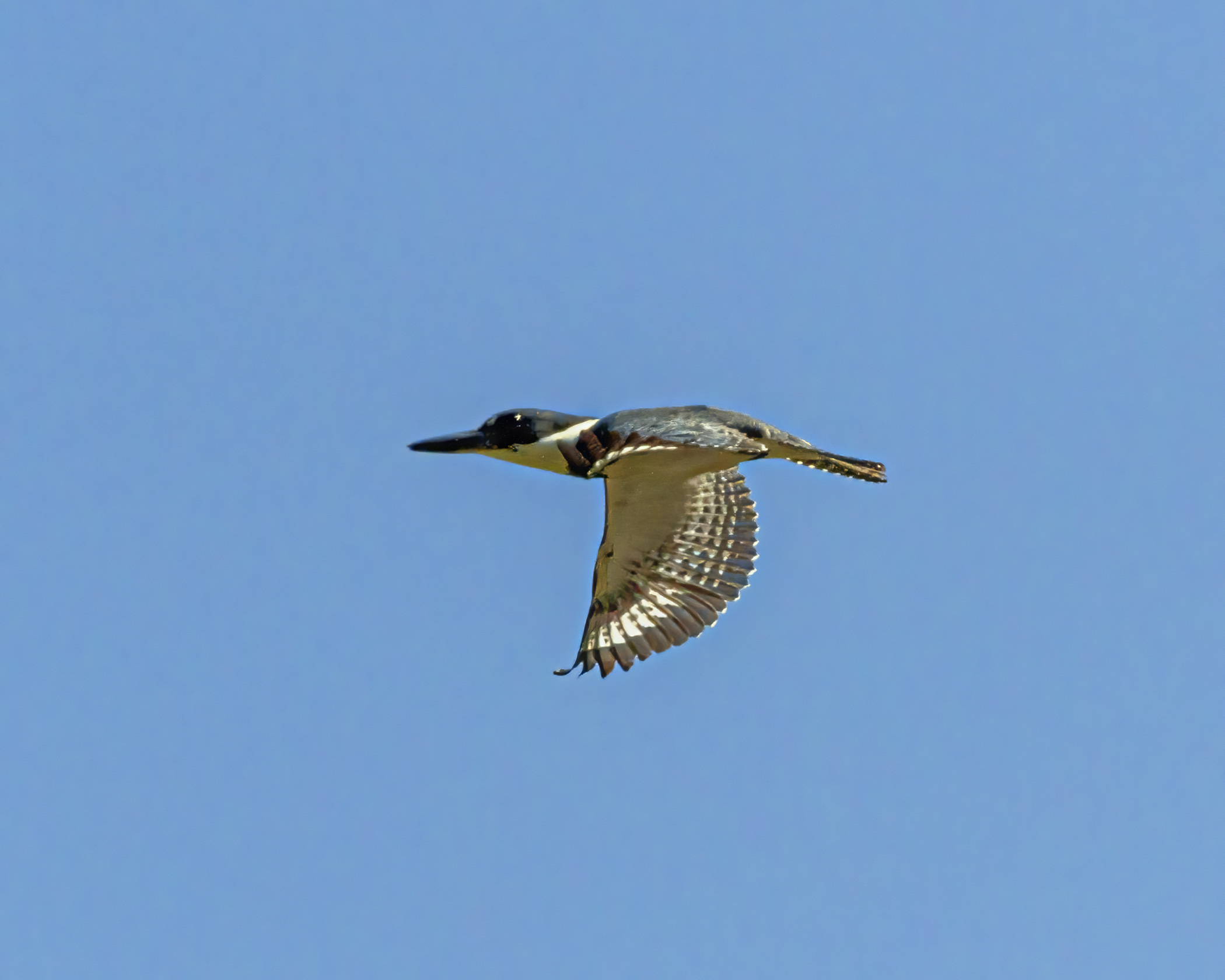
On Monday at Occoquan Regional Park, I was thrilled to capture some shots of this male Belted Kingfisher (Megaceryle alcyon) as he flew by me overhead. Kingfishers are really skittish and quite often I am aware of their presence of these speedy little birds when I hear their rattling call as they fly away from me. This kingfisher, however, flew across my field of view, which allowed me to track it and focus on it as it passed.
How do I know this is a male kingfisher? Normally male birds are more colorful than their female counterparts, but that is not true for Belted Kingfishers—females have a chestnut-colored band across their chests that the males do not have.

© Michael Q. Powell. All rights reserved.
Posted in Birds, Nature, Photography, spring, wildlife | Tagged Belted Kingfisher, birds in flight, Canon 7D, kingfisher, kingfisher in flight, Lorton VA, male Belted Kingfisher, Megaceryle alcyon, Occoquan Regional Park, Tamron 18-400mm | 9 Comments »
April 24, 2024 by Mike Powell
What is your first reaction when you see a snake? If you are like many people, you turn and run away as fast as you can. My reaction is generally the opposite one—I move closer to the snake, either physically or with a zoom lens, in order to get a more detailed look at it. Most of the snakes in our area are non-poisonous, but I still remain very cautious, because some of them will strike and/or bite.
On Monday I spotted a large black snake in the vegetation at Occoquan Regional Park. As I started to get a little closer, it began to vibrate its entire body and the dried leaves helped to create a rattling kind of sound. Yikes! I decided that I was close enough to get a few shots. Usually the black snakes that I encounter are ratsnakes, but this one turned out to be a Northern Black Racer (Coluber constrictor constrictor). The two species of snakes are somewhat similar in appearance, but the scales of the black racer are smoother and more shiny in appearance.
I decided to check out the website of the Virginia Herpetological Society for more information on the black racer and was surprised to learn that “Coluber constrictor does not constrict, as the scientific name implies, but pins its prey with body loops and swallows it alive.”
The website also noted that “Coluber constrictor has a catholic diet,” which caused me to do a double take. I grew up in a predominantly Roman Catholic neighborhood and tend to associate the word “catholic” with that church, so I immediately wondered how the snake determined the religious preferences of its victims. When a sense of reality returned to me, I remembered that “catholic” with a small initial letter simply means “universal,” so that statement probably just means that the black racer has a wide-ranging diet.
Ever curious, I wondered why this species is called a “racer.” Do they compete in competitions? The herpetological society provided the following information about the snake’s hunting habits:
“Northern Black Racers are active, diurnal predators that use vision to search for prey. Coluber constrictor actively forages with the forepart of the body raised off the ground and the head held horizontally searching for prey. They will seek escape by swiftly moving to thick grass cover or into a burrow entrance…Because they are active snakes that widely search for prey, they have large home ranges. Movements of up to 1.6 km have been recorded.”
My apologies to those readers who are creeped out by photos of snakes. I find then to be as fascinating as the more traditionally “beautiful” creatures that I often feature.


© Michael Q. Powell. All rights reserved.
Posted in Nature, Photography, Reptiles, snake, spring, wildlife | Tagged Canon 7D, Coluber constrictor, Coluber constrictor constrictor, Lorton VA, Northern Black Racer, Northern Black Racer snake, Occoquan Regional Park, racer, Tamron 18-400mm | 9 Comments »
April 23, 2024 by Mike Powell
I spotted these cool-looking ducks last week in the waters off of Occoquan Bay National Wildlife Refuge. Some research and help for on-line experts helped me determine that these are Red-breasted Mergansers (Mergus serrator), a duck species that I do not see very often. I really like the spiky hairdos and long bills of these ducks that give them a distinctive punk vibe. I kept hoping that they would swim closer to shore, but, alas, they drifted farther and farther away, so I could not capture any close-up images.


© Michael Q. Powell. All rights reserved.
Posted in Birds, Nature, Photography, spring, wildlife | Tagged Canon 7D, Mergus serrator, Occoquan Bay National Wildlife Refuge, Red-breasted Merganser, Tamron 18-400mm, Woodbridge VA | 1 Comment »
April 22, 2024 by Mike Powell
Mayapples (Podophyllum peltatum) are woodland plants with large umbrella-shaped leaves. Instead of having flowers above the leaves, like most plants, mayapple plants have flowers that grow on the stems below the leaves, like this one that I photographed last week at Accotink Bay Wildlife Refuge.
Mayapples typically grow in colonies that originate from a single root. Most of the mayapple plants that I see have only a single stem and are infertile. The fertile ones, which are fairly uncommon, have a pair of leaves on a branched stem and a single flower grows at the junction spot where the branching occurs.

© Michael Q. Powell. All rights reserved.
Posted in Flowers, Nature, Photography, plants, spring | Tagged Accotink Bay Wildlife Refuge, Canon 7D, Fort Belvoir VA, Mayapple, mayapple flower, Podophyllum peltatum, Tamron 18-400mm | 1 Comment »
April 22, 2024 by Mike Powell
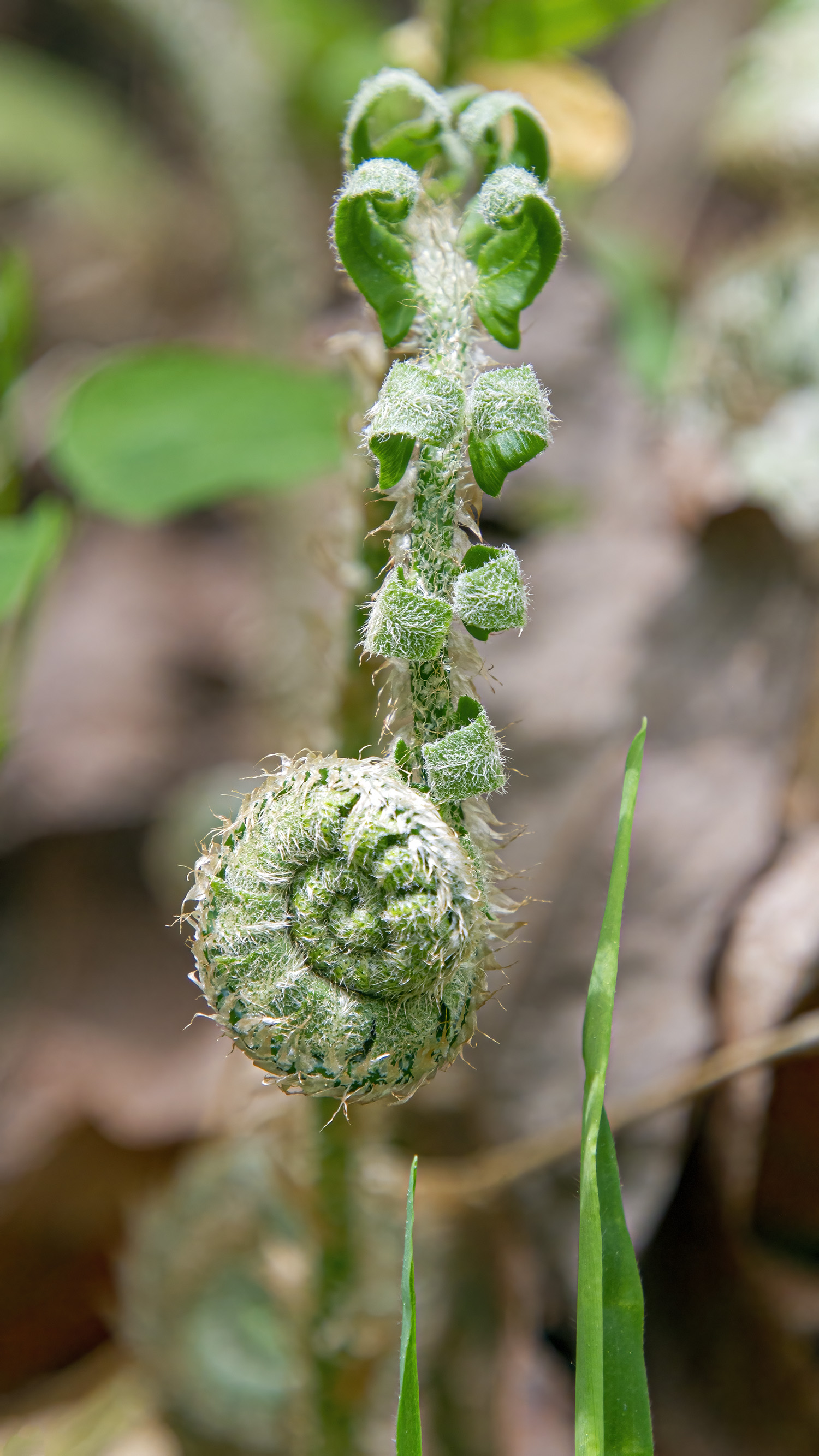
I love the spiral shape of fiddleheads, the furled fronds of fledging ferns, like these ones that I spotted last week at Prince William Forest Park. I have been told that fiddleheads are quite tasty when sautéed with garlic, olive oil, and lemon, but I have not yet tasted a fiddlehead.


© Michael Q. Powell. All rights reserved.
Posted in Macro Photography, Nature, Photography, plants, spring | Tagged Canon 7D, ferns, fiddlehead, fiddlehead ferns, Prince William Forest Park, Tamron 18-400mm, Triangle VA | 2 Comments »
April 21, 2024 by Mike Powell
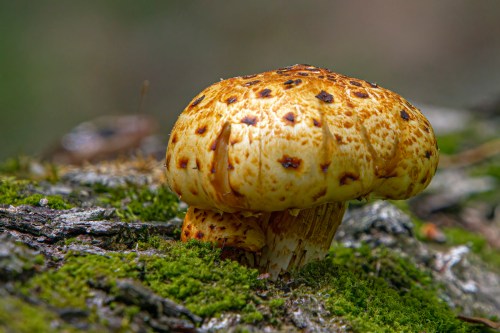
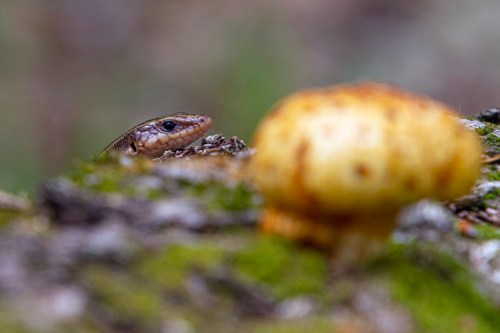
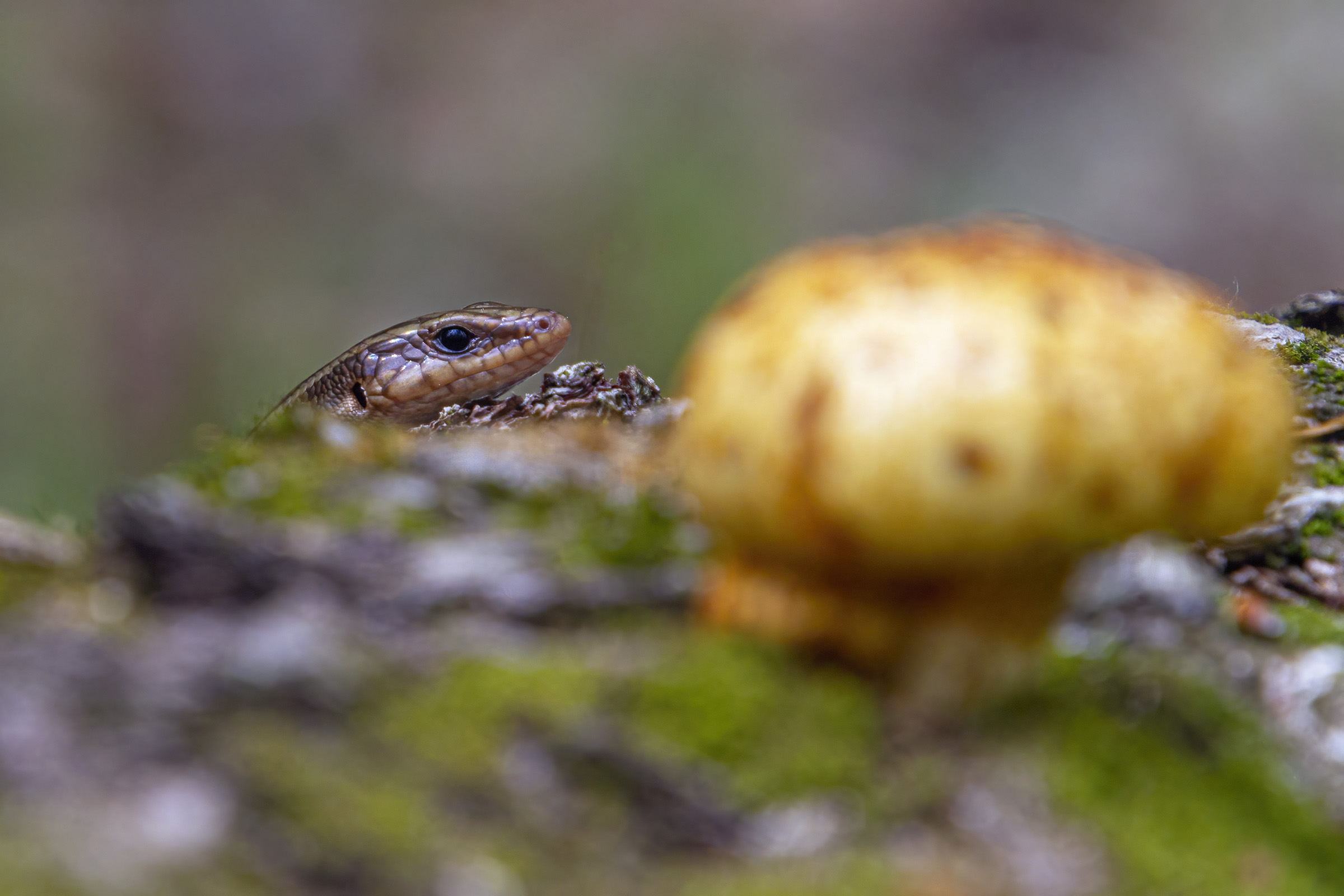
As I was hiking last Thursday in Prince William Forest Park, I spotted a cool-looking mushroom on a moss-covered fallen tree. I crouched low to the ground so that I could capture an eye-level shot of the mushroom. While I was carefully composing a few shots in the camera’s viewfinder, my eyes detected some movement in the corner of the frame and I was a bit shocked to see the head of a Five-lined Skink (Plestiodon fasciatus), one of the few lizard species in Virginia.
Skinks are generally very skittish, so I froze in place and slowly changed the focus point from the mushroom (first photo) to the skink (second photo). Once I knew that I had captured those shots, I moved slightly to the side to see if I could get a better angle on the skink.
I never could not see the skink’s entire body, but really like the final shot that shows a lot of the details of the skink. I am not sure what the skink was doing, but it seemed to be focusing intently on something. Perhaps it was so focused on a potential prey that it was less aware of me than it might otherwise have been.
A small change in focus made a big difference in the final results. Maybe that’s true in other aspects of our lives.

© Michael Q. Powell. All rights reserved.
Posted in Nature, Photography, Reptiles, spring, wildlife | Tagged Canon 7D, Common Five-Lined Skink, Five-lined Skink, mushroom, Plestiodon fasciatus, Prince William Forest Park, switching focus, Tamron 18-400mm, Triangle VA | 5 Comments »
April 20, 2024 by Mike Powell
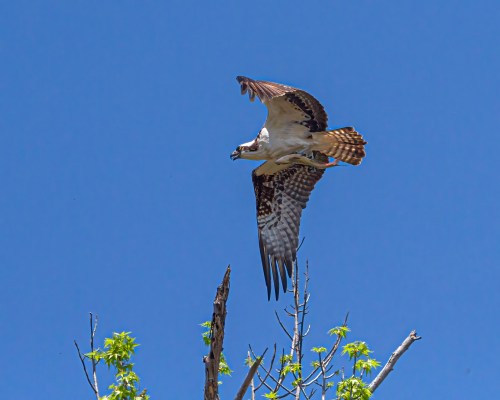
An Osprey (Pandion haliaetus) raised a wing as it flew by me on Monday at Occoquan Bay National Wildlife Refuge, displaying the fish that it had just caught. There are quite a few osprey at the refuge at this time of the year and it is not uncommon for me to see one clutching an osprey in its talons. However, it is rare that I am able to get a good look at the prey, because it is often hidden by the osprey’s wing movements.
Normally I attempt to capture shots of birds in flight with my longest lens, a Tamron 150-600mm. At this time of the year, though, I am just as likely to want to photograph butterflies and dragonflies as birds, so most of the time I keep my Tamron 18-400mm lens on my camera that lets me focus on a much closer subject. I sacrifice a bit of reach by using this lens, but, as you can see in the image of the osprey captured with this lens, it can produce good results even when fully extended. I encourage you to click on the image to see the feather details of the osprey and the details of the hapless fish too.
© Michael Q. Powell. All rights reserved.
Posted in Birds, Nature, Photography, spring, wildlife | Tagged birds in flight, Canon 7D, Occoquan Bay National Wildlife Refuge, Osprey, osprey fishing, Pandion haliaetus, Tamron 18-400mm, Woodbridge VA | 4 Comments »
April 20, 2024 by Mike Powell
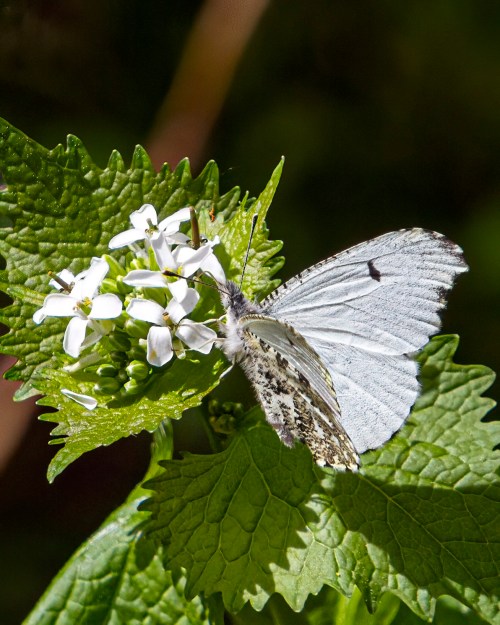
On Monday I spotted this cool little butterfly at Occoquan Regional Park in nearby Lorton, Virginia. I was a little surprised to learn that it is a Falcate Orangetip butterfly ( (Anthocharis midea), given that the butterfly has not a single visible spot of orange. Apparently only the males have the orange tips for which the species is named and this one is a female.
When I first spotted this tiny butterfly flying about, I assumed that it was a Cabbage White. However, I quickly noticed the colored pattern on the outside of the wings and realized that my initial impression were wrong—Cabbage Whites are all white except for some black spots. When I looked even closer I noticed the butterfly’s gray eyes and scallop-edged wings, unlike the Cabbage Whites that have green eyes and more even-edged wings.
© Michael Q. Powell. All rights reserved.
Posted in Butterflies, Insects, Nature, Photography, spring, wildlife | Tagged Anthocharis midea, Canon 7D, Falcate Orangetip, Falcate Orangetip butterfly, female Falcate Orangetip, Lorton VA, Occoquan Regional Park, Tamron 18-400mm | 5 Comments »
April 19, 2024 by Mike Powell
One of the earliest dragonflies to appear in the spring in my area is the Blue Corporal (Ladona deplanata). Blue Corporals are relatively easy to identify because they have two stripes of their shoulders—two stripes is the traditional marking for the rank of corporal in the armed forces. When they first emerge, males and females have similar colorations, but the males turn blue as they mature.
The dragonfly in the first photo is an immature male Blue Corporal and was the first member of this species that I photographed on 10 April at Occoquan Bay National Wildlife Refuge. The shiny wings and pale markings suggest that this dragonfly was newly emerged. I believe that the dragonfly in the second photo is a female Blue Corporal, judging from her terminal appendages.
I usually try to get close-up shots of dragonflies, but when I can’t get near them, I am content to capture more “artsy” shots, like the final image below that shows a male Blue Corporal perched on some vegetation poking out of the shallow water of a pond.


© Michael Q. Powell. All rights reserved.
Posted in Dragonflies, dragonfly, Macro Photography, Nature, Photography, spring, wildlife | Tagged Blue Corporal, Blue Corporal dragonfly, Canon 7D, Ladona deplanata, Occoquan Bay National Wildlife Refuge, Tamron 18-400mm, Woodbridge VA | 3 Comments »
April 18, 2024 by Mike Powell
As many of you know, I keep an eye on several eagle nests at Occoquan Bay National Wildlife Refuge at this time of the year, waiting with hopeful expectation for the birth of new eaglets. In one nest that is relatively small, the adult Bald Eagle (Haliaeetus leucocephalus) is now sitting upright, rather than hunkering down over the eggs to keep them warm. I suspect that there is at least one eagle baby, but I have not yet seen any tiny eagle heads pop up over the edge of the nest.
I am not sure what’s happening with the much larger eagle nest. I had assumed that the eagles were sitting on eggs. However, on Tuesday I watched as an osprey perched on one of the trees supporting the nest and buzzed a nearby perched eagle. Several other photographers have reported seeing osprey actually sitting in the eagle nest.
As I observed the nesting area on Tuesday afternoon, two eagles in a tree overlooking the nest briefly engaged in what looked like mating behavior. Was an earlier nesting attempt unsuccessful? Are the eagles going to make another attempt to have babies this season?
It is a bit late in the year for the eagles to begin nesting, but I think there is still time for them to do so. Normally this process begins earlier in the year before the ospreys have returned, so there is no competition for the nest. Although there appears to be competition now, I would put my money on the eagles, which I believe are larger and stronger than the osprey.
I will continue to monitor the nesting situation. There may be more drama there this spring than in previous years.

© Michael Q. Powell. All rights reserved.
Posted in Birds, Nature, Photography, spring, wildlife | Tagged Bald Eagle, Bald Eagle couple, bald eagle nest, Canon 7D, Haliaeetus leucocephalus, mating bald eagles, Occoquan Bay National Wildlife Refuge, Tamron 18-400mm, Woodbridge VA | Leave a Comment »
April 17, 2024 by Mike Powell
When this little butterfly flew by me last week at Prince William Forest Park, it looked a bit like a nondescript brown moth. However, when it landed on the ground and I was able to zoom in on it, I was amazed by its variety of colors, textures, and markings. I was pretty sure that I had never seen one like this. When I returned home, I did some searching on the internet and concluded that this is a Henry’s Elfin butterfly (Callophrys henrici).
Every time I use the butterfly’s name, I smile, because there is just something whimsical about the word “elfin.” I love the idea of magical woodland creatures that blend in so well with their surroundings that you have to look carefully to spot them.
I encourage you to click on the image to see all of this creature’s wonderful markings, including the little white stripes on its antennae and legs and the beautiful scalloped edges of its wings.
Keep your eyes open today and you too may spot some magically whimsical creatures.

© Michael Q. Powell. All rights reserved.
Posted in Butterflies, Insects, Macro Photography, Nature, Photography, spring, wildlife | Tagged Callophrys henrici, Canon 7D, Henry's Elfin, Henry's Elfin butterfly, Prince William Forest Park, Tamron 18-400mm, Triangle VA | 4 Comments »
April 17, 2024 by Mike Powell
A small group of Common Green Darner dragonflies (Anax junius) was active on Monday at Occoquan Regional Park, including a couple that, after mating, was depositing eggs in the floating vegetation. The male (the one with the blue abdomen) holds onto the female while she does the actual work and then they fly off together still attached in the “tandem” position to another patch of vegetation.
Common Green Darners are a migratory species and I suspect that these particular dragonflies were part of that migration. Most people are aware of the migratory pattern of Monarch butterflies, but are unaware of the fact that Common Green Darners follow a similar pattern. The Science News website provides a good overview of that migration.
“At least three generations make up the annual migration of common green darner dragonflies. The first generation emerges in the southern United States, Mexico and the Caribbean starting around February and flies north. There, those insects lay eggs and die, giving rise to a second generation that migrates south until late October. (Some in that second generation don’t fly south until the next year, after overwintering as nymphs.) A third generation, hatched in the south, overwinters there before laying eggs that will start the entire process over again.”
I was quite fortunate that the patches of vegetation where the dragonflies were depositing the eggs were relatively close to the edge of the pond, so I was able to capture the shots of the dragonflies in action. The second shot was one that I snapped as the couple zoomed by—long-time readers of my blog know that I love to try to capture images of dragonflies while they are flying.
The final image shows one a male Common Green Darner that was flying all around the small pond, searching for food or a mate (or maybe both). It is a fun challenge to try to track and photograph a dragonfly in flight and I felt a little rusty after spending the winter photographing birds. I was therefore quite thrilled when this shot turned out so well. Some newer mirrorless cameras have tracking systems that lock focus on moving subjects, but my trusty Canon 7D DSLR has 2009 technology, so it is a little trickier for me to get shots in—it is definitely a “hands-on” process.


© Michael Q. Powell. All rights reserved.
Posted in Dragonflies, dragonfly, Insects, Nature, Photography, spring, wildlife | Tagged Anax junius, Canon 7D, Common Green Darner, Common Green Darner dragonfly, common green darner ovipositing, dragonflies in flight, Lorton VA, Occoquan Regional Park, Tamron 18-400mm | 6 Comments »
April 16, 2024 by Mike Powell
Each spring a lot of colorful warblers pass through our area on their northward migration. Most of them stay for only a short time, so it is a hit-or-miss proposition for me to find them. This is also the time of the year when the trees are budding, flowering and pushing out new leaves. All of this new growth is beautiful, but it makes it even harder for me to spot the little birds as they flit about, often at the tops of the trees.
Yesterday I was thrilled to spot this Yellow-throated Warbler (Setophaga dominica) high in a distant tree at Occoquan Bay National Wildlife Refuge. Initially my view of the colorful little bird was blocked by the vegetation, but I bent, twisted, stretched, and leaned in all directions and was eventually was able to get a clear view of the warbler.
My eyes are really active during the spring as I look up to try to find birds and look down to search for dragonflies. I manage to observe lots of cool things, but suspect that there is so much more going on that I do not see or notice.

© Michael Q. Powell. All rights reserved.
Posted in Birds, Nature, Photography, spring, warbler, wildlife | Tagged Canon 7D, Occoquan Bay National Wildlife Refuge, Setophaga dominica, Tamron 18-400mm, warbler, Woodbridge VA, Yellow-throated Warbler | 8 Comments »
April 15, 2024 by Mike Powell
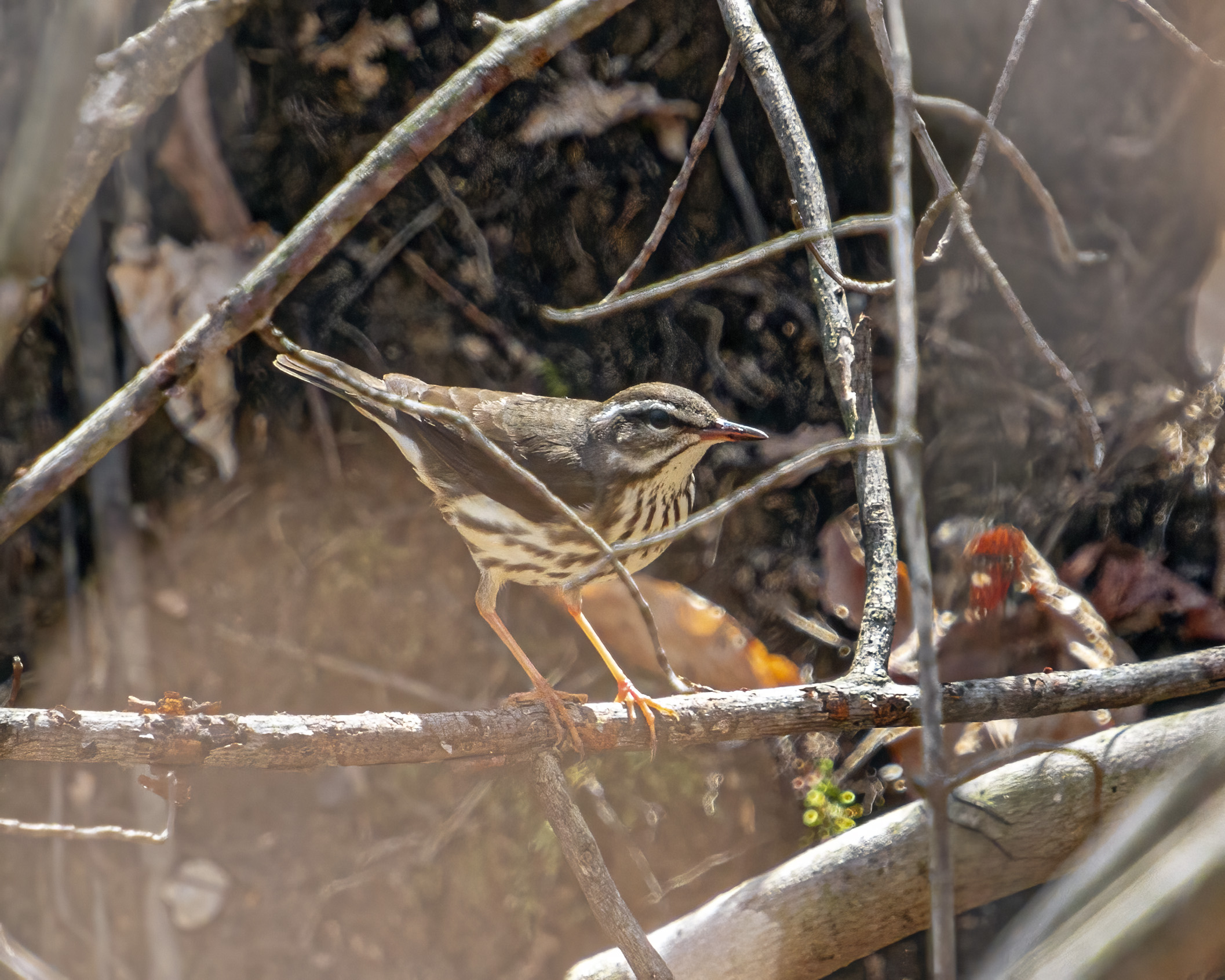
Last week I spotted this bird hopping about in a small creek in Prince William Forest Park. The bird was in constant motion and I could not get close to it, so I was was not able to get a really good shot of it. I vaguely remembered seeing a similar bird a few years ago in the same location, so I checked my old blog entries and determined that it might be a Louisiana Waterthrush (Parkesia motacilla). Several more experienced birders confirmed my tentative identification in a Facebook group for birding forum.
Despite its name, a Louisiana Waterthrush is actually a warbler, not a thrush. The Cornell Lab of Ornithology website provides the following overall description of the species:
“The ringing song of the Louisiana Waterthrush, in cadence so like the rushing streams that are its home, is one of the first signs of spring in eastern North America. Its brown plumage and bold streaking help explain why this member of the warbler family has the word “thrush” in its name. At all seasons, this species stays close to moving water—especially forested streams and creeks—and bobs its rear end almost constantly. In both spring and fall, Louisiana Waterthrushes are among the earliest migrant warblers.”
Several local photographers have started posting photos of more colorful warblers, so I will be keeping my eyes open for them. Leaves are starting to cover the trees, so I will probably have my usual problem of not being able to spot the little birds even when I can hear them singing.


© Michael Q. Powell. All rights reserved.
Posted in Birds, Nature, Photography, spring, warbler, wildlife | Tagged Canon 7D, Louisiana Waterthrush, Parkesia motacilla, Prince William Forest Park, Tamron 18-400mm, Triangle VA, warbler | 1 Comment »
April 13, 2024 by Mike Powell
Most of the insects that I have observed feeding on Virginia Spring Beauty wildflowers (Claytonia virginica) have been equally small in size. I was a bit shocked, therefore, earlier this week to spot a large Eastern Carpenter Bee (Xylocopa virginica) gathering nectar and/or pollen from a small patch of Spring Beauties at Prince William Forest Park. The bee looked to be at least twice as large as each tiny flower. Wow!
The lighting was quite good and the bee was a bit distracted, so I was able to zoom in close and capture a lot of the details of the bee. I particularly like the speckled green eyes that look like they were carved out of a semiprecious stone. You can also see the bee’s tiny feet as it grasped the edges of the flower. I encourage you to click on the photos, especially the first one, to get a better look at the bee.


© Michael Q. Powell. All rights reserved.
Posted in Bees, Flowers, Insects, Macro Photography, Nature, Photography, spring, wildlife | Tagged Canon 7D, carpenter bee, Claytonia virginica, Eastern Carpenter Bee, green-eyed bee, Prince William Forest Park, Spring Beauty, Tamron 18-400mm, Triangle VA, Virginia Spring Beauty, Xylocopa virginica | 5 Comments »
April 12, 2024 by Mike Powell
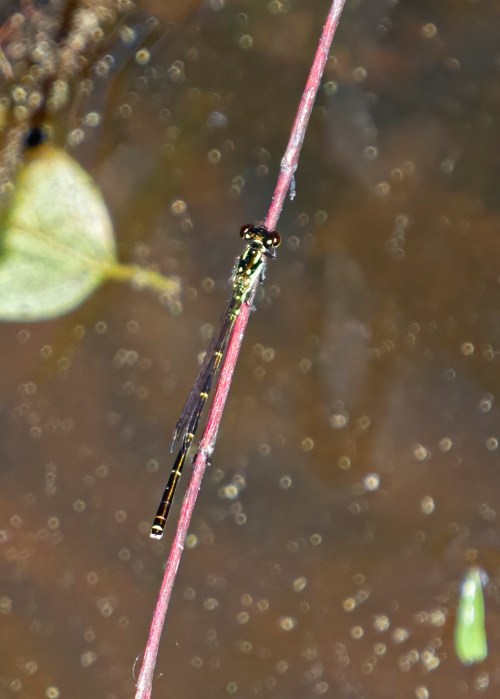
I almost fell into the pond on Wednesday at Jackson Miles Abbott Wetland Refuge when I leaned over the edge of a steep bank after detecting some movement. Fortunately I did not lose my balance and managed to get a shot of this male Fragile Forktail (Ischnura posita), my first damselfly of this season.
Fragile Forktails are almost always the first damselflies in my area to emerge and are surprisingly easy to identify—they have broken shoulder stripes that look like exclamation points. Although they are easy to identify, you have to find them first and their diminutive size (0.83 to 1.14 inches (21 to 29mm) in length) makes them quite difficult to spot.
Damselflies and dragonflies belong to the Odonata order of flying insects. Damselflies generally are more slender, have eyes placed apart, and perch with their wings folded together along their bodies when at rest. Dragonflies tend to be bulkier, have large compound eyes that touch each other, and usually perch with their wings extended when at rest.
© Michael Q. Powell. All rights reserved.
Posted in damselfly, Insects, Macro Photography, Nature, Photography, wildlife | Tagged Canon 7D, Fort Belvoir VA, Fragile Forktail, Fragile Forktail damselfly, Ischnura posita, Jackson Miles Abbott Wetland Refuge, Tamron 18-400mm | 2 Comments »
April 11, 2024 by Mike Powell
I was excited yesterday to spot this cool-looking Horned Grebe (Podiceps auritus) in breeding plumage in the waters off of Occoquan Bay National Wildlife Refuge. In addition to the golden tufts that sometimes look like horns, this grebe has striking red eyes.
There were not very many birds on the water yesterday, only a few geese, cormorants, and scaups, so I was quite shocked when I saw the head of this Horned Grebe emerge from the water after a short dive. I hoped that the grebe would come a bit closer with each dive, but instead it seemed to get farther and farther away from me.
I suspect that the Horned Grebe was stopping over on a migration flight northward. Although I read that migrating grebes usually form small flocks when migrating, this one appeared to be by itself. I too like to travel alone.

© Michael Q. Powell. All rights reserved.
Posted in Birds, Nature, Photography, spring, wildlife | Tagged breeding plumage, Canon 7D, Horned Grebe, Occoquan Bay National Wildlife Refuge, Podiceps auritus, Tamron 18-400mm, Woodbridge VA | 3 Comments »
« Newer Posts - Older Posts »












 Mike Powell