August 6, 2024 by Mike Powell
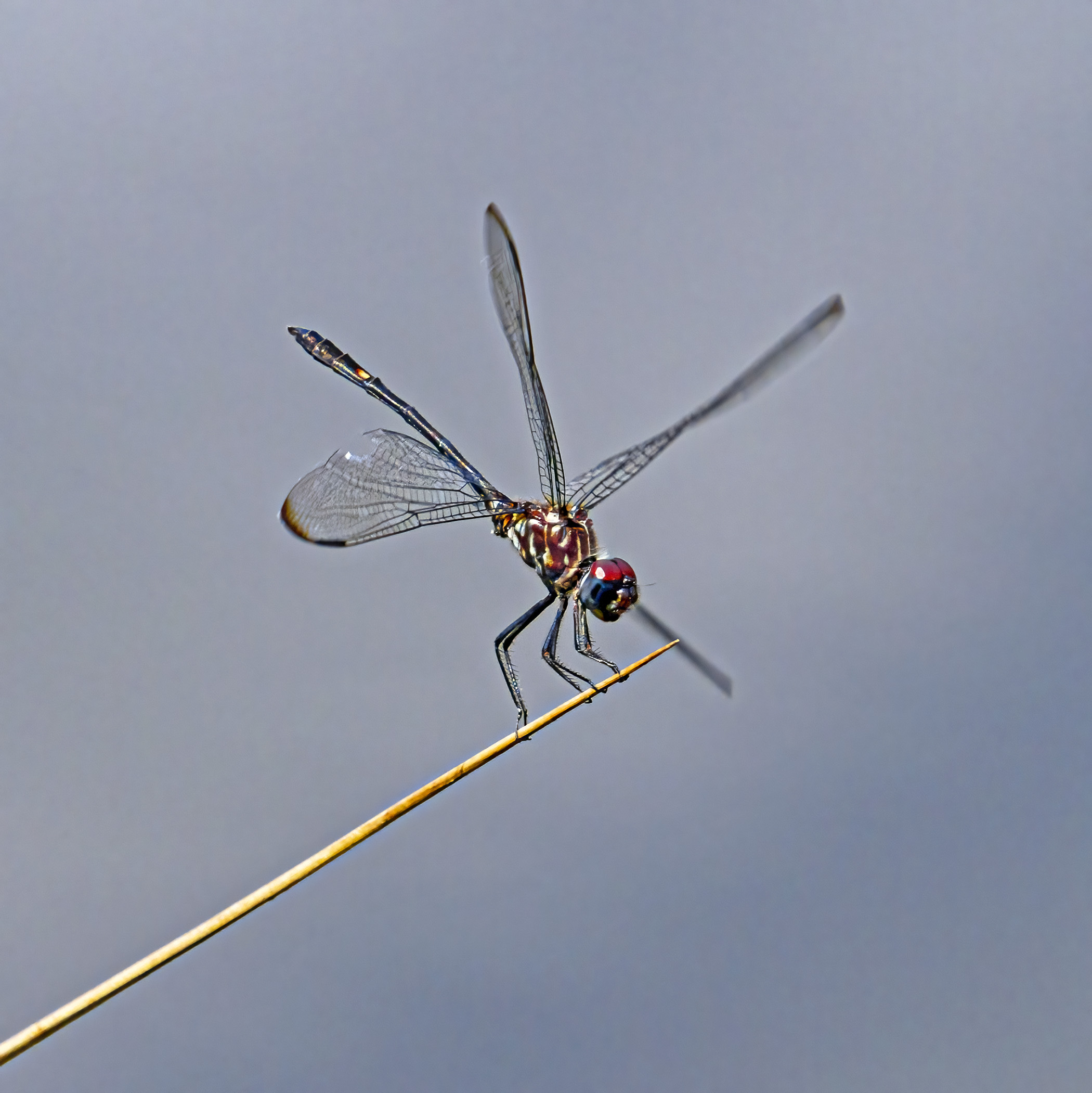
During several recent visits to Jackson Miles Abbott Wetland Refuge, I did not see any Swift Setwing dragonflies (Dythemis velox), so I feared that they might be gone for the season. I was therefore delighted last Thursday to spot several of them at the small pond at this refuge.
Swift Setwings like to perch at the very tip of vegetation that hangs over the water, which makes getting a profile shot of one a challenge without getting wet. These little dragonflies often perch in a distinctive pose with their wings pulled forward, which reminded some scientist of the “ready-set-go” position of a sprinter and is reportedly the reason for the name of the species.
On this day, a breeze was blowing periodically and it seemed like the Swift Setwings had to repeatedly readjust their wing positions to maintain their balance, which you can see particularly well in the second photo below.

© Michael Q. Powell. All rights reserved.
Posted in Dragonflies, dragonfly, Insects, Nature, Photography, Summer, wildlife | Tagged Canon 7D, Dythemis velox, Fort Belvoir VA, Jackson Miles Abbot Wetland Refuge, Swift Setwing, Swift Setwing dragonfly, Tamron 18-400mm | Leave a Comment »
August 5, 2024 by Mike Powell
As I watched television coverage of the Olympic Games in Paris, I could not help but notice the numerous handstands in almost all of the gymnastic events for the men. There were handstands on the floor, on the rings, on the parallel bars, the high bar, and even on the pommel horse.
When I spotted this male Blue Dasher dragonfly (Pachydiplax longipennis) doing a handstand last Thursday at Jackson Miles Abbott Wetland Refuge, I immediately thought of those Olympic gymnasts.
This position is sometimes referred to as the “obelisk” pose for dragonflies. Many scientists believe that it is used as a form of thermoregulation to keep the body cooler by reducing the amount of surface exposure to direct sunlight. Several other dragonfly species use this pose, but I observe it most often with the male Blue Dasher dragonflies.

© Michael Q. Powell. All rights reserved.
Posted in Dragonflies, dragonfly, Insects, Nature, Photography, Summer, wildlife | Tagged Blue Dasher, Blue Dasher dragonfly, Canon 7D, Fort Belvoir VA, Jackson Miles Abbott Wetland Refuge, obelisk, obelisk pose, obelisk posture, Pachydiplax longipennis, Tamron 18-400mm | 6 Comments »
August 3, 2024 by Mike Powell
I was delighted to spot this handsome male Blue-fronted Dancer damselfly (Argia apicalis) on Thursday during a quick visit to Jackson Miles Abbott Wetland Refuge. This species is not rare, but I do not see it very often at my favorite locations for dragonflies and damselflies. It is pretty easy to identify a Blue-fronted Dancer because, as its name suggests, its thorax is almost completely blue, with only a few hairline shoulder stripes.
According to Wikipedia, the damselflies in the genus Argia, are commonly known as “dancers” because of the distinctive jerky form of flight they use, which contrasts with the straightforward direct flight of bluets, forktails, and other pond damselflies.
Blue-fronted Dancers are quite small, about 1.5 inches (38 mm) in length, so it was quite a challenge to get this one in focus as he perched on some vegetation close to the ground. I am pretty sure that I switched to manual focus for this shot, because the autofocus of my camera has trouble staying on such a narrow subject and kept trying to focus on the ground.

© Michael Q. Powell. All rights reserved.
Posted in damselfly, Insects, Nature, Photography, Summer, wildlife | Tagged Argia apicalis, Blue-fronted Dancer, Blue-fronted Dancer damselfly, Canon 7D, Fort Belvoir VA, Jackson Miles Abbott Wetland Refuge, Tamron 18-400mm | 6 Comments »
August 2, 2024 by Mike Powell
Some dragonflies are openly curious and will look at me straight in the eye and even perch on me sometimes. Others will immediately fly away when they sense my presence.
This male Great Blue Skimmer dragonfly (Libellula vibrans) that I spotted during a recent visit to Occoquan Bay National Wildlife Refuge seemed to be a bit shy. He tolerated my presence well as I moved about to frame the shot, but gave me a sidewards glance instead of looking right at me. Was it shyness or maybe a little impatience that I was not taking the photo more quickly?
Whatever the case, I was happy to be able to capture his beautiful speckled blue eyes so well.

© Michael Q. Powell. All rights reserved.
Posted in Dragonflies, dragonfly, Insects, Nature, Photography, Summer, wildlife | Tagged Canon 7D, Great Blue Skimmer, Great Blue Skimmer dragonfly, Libellula vibrans, Occoquan Bay National Wildlife Refuge, Tamron 18-400mm, Woodbridge VA | 5 Comments »
August 1, 2024 by Mike Powell
I am always looking for cool perches when I spot dragonflies. Sometimes I will try to communicate telepathically with the dragonflies to prompt them to move to photogenic perches, but, alas, I am rarely successful—I guess that my telepathic powers are weak.
I was delighted on Monday at Occoquan Regional Park when this dark male Slaty Skimmer (Libellula incesta) voluntarily perched on the flowering stalk of a beautiful dark red plant. I have no idea what kind of plant it is, but I really like the color combination of this dragonfly and the the vegetation. The twisting pattern of the flowers on the stalk were a nice bonus and add a bit of additional visual interest to the image.

© Michael Q. Powell. All rights reserved.
Posted in Dragonflies, dragonfly, Insects, Nature, Photography, Summer, wildlife | Tagged Canon 7D, Libellula incesta, Lorton VA, male Slaty Skimmer, Occoquan Regional Park, Slaty Skimmer, Slaty Skimmer dragonfly, Tamron 18-400mm | 1 Comment »
July 31, 2024 by Mike Powell
Most of the time I see butterflies in the air or perched on vegetation, but some species, like this Red-spotted Purple butterfly (Limenitis arthemis astyanax) are low-fliers and spend a lot of time perching on the ground. I spotted this beauty on Monday during a short visit to Occoquan Regional Park in nearby Lorton, Virginia.
It was hot and humid and it seemed like most of the insects and birds were taking afternoon naps, so I cut my trip short and joined them in their siestas.

© Michael Q. Powell. All rights reserved.
Posted in Butterflies, Insects, Nature, Photography, Summer, wildlife | Tagged Canon 7D, Limenitis arthemis astyanax, Lorton VA, Occoquan Regional Park, Red-spotted Purple, Red-spotted Purple butterfly, Tamron 18-400mm | 5 Comments »
July 30, 2024 by Mike Powell
Inspired perhaps by the Summer Olympics in Paris, this female Halloween Pennant dragonfly (Celithemis eponina) was practicing her acrobatic moves last week at Occoquan Bay National Wildlife Refuge.
Yesterday I watched coverage of some of the men’s gymnastics competition and I was in awe of the ease with which the athletes were able to do handstands in the air on rings, on parallel bars, and on the ground. I have always been in awe of the combination of strength and balance of both human and insect gymnasts.
I’d give this dragonfly a perfect 10.0 as a score.

© Michael Q. Powell. All rights reserved.
Posted in Dragonflies, dragonfly, Insects, Nature, Olympics, Photography, Summer, wildlife | Tagged Canon 7D, Celithemis eponina, female Halloween Pennant, halloween pennant, Halloween Pennant dragonfly, Occoquan Bay National Wildlife Refuge, Tamron 18-400mm, Woodbridge VA | 1 Comment »
July 29, 2024 by Mike Powell
There was a lot of activity at one of the Osprey (Pandion haliaetus) nests last Tuesday at Occoquan Bay National Wildlife Refuge. When I first noticed the nest, there were a several Osprey sitting in the nest—initially I thought there were only two in the nest, but when I looked more carefully, I could see that there were at least three osprey there.
As I watched, another osprey flew into the nest as you can see in the first photo below. The nest does not appear to very large, so the the birds had to rearrange themselves a bit to accommodate the new arrival. In the second photo, one of the osprey seemed to be expressing its displeasure with the need to move a bit.
I think this may be a family unit, though I can’t be absolutely sure of that. When I look closely at the eyes of the osprey, some of them appear to be orangish in color, unlike the paler eyes of adults.
I especially love the body language in the second photo. It’s fun to imagine the conversation that is taking place. Perhaps, for example, the osprey with the flapping wings is complaining that the newly arrived osprey did not have a fish in its talons to share with the rest of the family. What do you think?


© Michael Q. Powell. All rights reserved.
Posted in Birds, Nature, Photography, Summer, wildlife | Tagged Canon 7D, Occoquan Bay National Wildlife Refuge, Osprey, osprey nest, Pandion haliaetus, Tamron 18-400mm, Woodbridge VA | 3 Comments »
July 27, 2024 by Mike Powell
Halloween Pennant dragonflies (Celithemis eponina) perch so high in the vegetation that it sometimes seems like they are perching amidst the clouds, like this one that I spotted a week ago at Occoquan Bay National Wildlife Refuge. One of the advantages of this species’ perching preference is that it is often easy to get an uncluttered background. In addition, I frequently can get a shot like this one in which the light shines through the cells of the wings, illuminating them like a stained glass window.

© Michael Q. Powell. All rights reserved.
Posted in Dragonflies, dragonfly, Insects, Nature, Photography, Summer, wildlife | Tagged Canon 7D, Celithemis eponina, halloween pennant, Halloween Pennant dragonfly, Occoquan Bay National Wildlife Refuge, Tamron 18-400mm, Woodbridge VA | Leave a Comment »
July 26, 2024 by Mike Powell
This Black Vulture (Coragyps atratus) took a long look at me last week at Occoquan Bay National Wildlife Refuge before deciding that I was not dead, though I was moving quite slowly because of the heat and the humidity. Most of the vultures that I see in my area are Turkey Vultures, which have red, featherless heads, but, as you can in the photo, we also have Black Vultures.
I readily acknowledge that vultures play an important role in our ecosystems by eating dead animal carcasses and preventing the spread of diseases that could affect local food webs and human health. However, I admit that I, like most people, find these amazing birds a little creepy. Perhaps it is the result of watching countless Westerns on television as a child, movies in which circling vultures were always seen as a foreboding sign of death.
I like the way that this stark, naked tree enhances the spookiness of the vulture. One of my Facebook friends suggested that this would make a good Halloween image. For now, the image serves to remind us that life is ephemeral, tomorrow is not guaranteed.

© Michael Q. Powell. All rights reserved.
Posted in Birds, Nature, Photography, Summer, wildlife | Tagged Black Vulture, Canon 7D, Coragyps atratus, Occoquan Bay National Wildlife Refuge, Tamron 18-400mm, vulture, Woodbridge VA | 5 Comments »
July 25, 2024 by Mike Powell
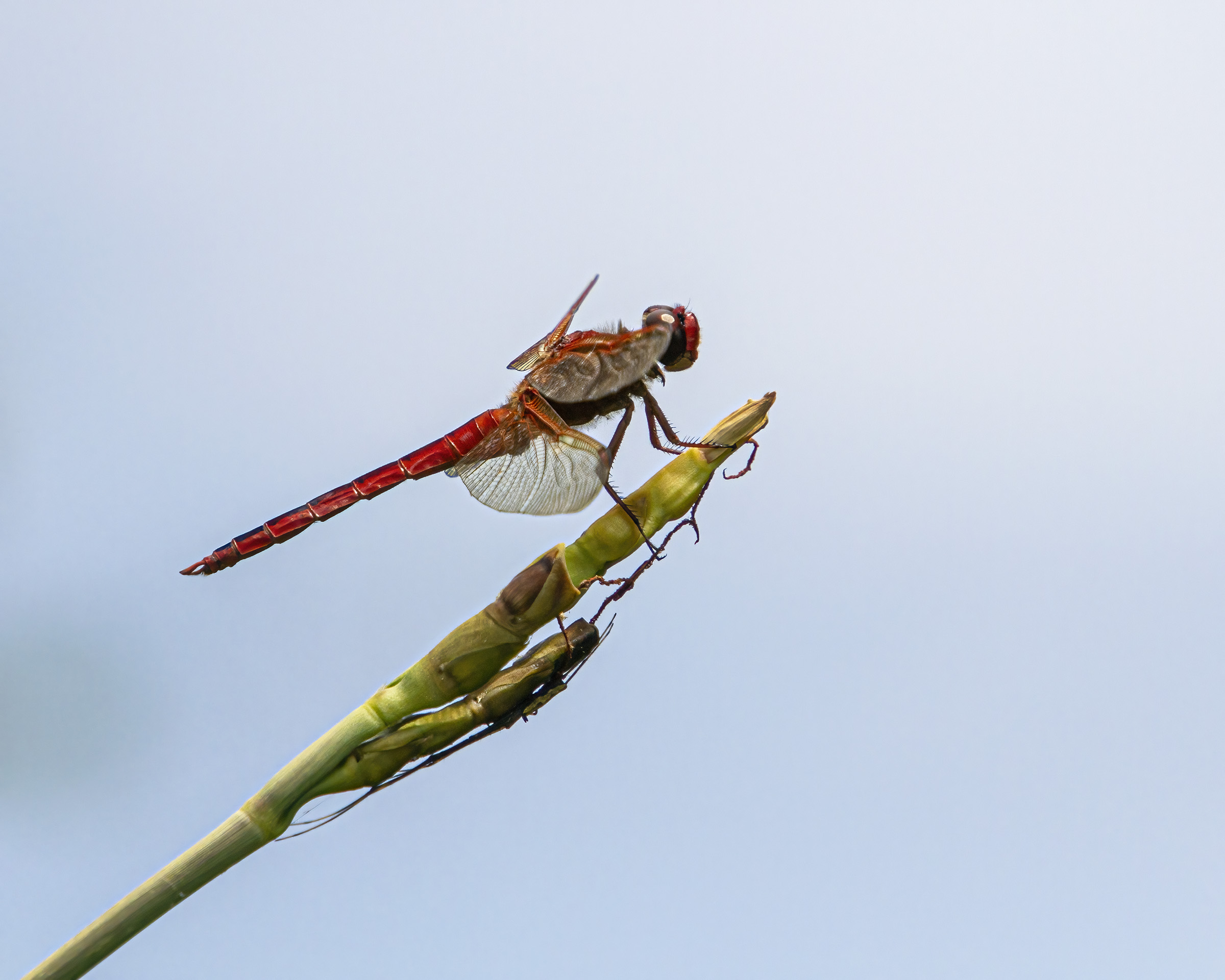
Immature male Needham’s Skimmer (Libellula needhami) dragonflies are yellow and black in color, like the females of the species, but gradually turn into a wonderful shade of reddish-orange as the season progresses. I was delighted to spot this mature male Needham’s Skimmer last Thursday at Occoquan Bay National Wildlife Refuge and captured this image as he perched on a stalk of what appears to be Eastern Gamagrass.
© Michael Q. Powell. All rights reserved.
Posted in Dragonflies, dragonfly, Insects, Nature, Photography, Portraits, Summer, wildlife | Tagged Canon 7D, Eastern gamagrass, Libellula needhami, male Needham's Skimmer, Needham's Skimmer, Needham's Skimmer dragonfly, Occoquan Bay National Wildlife Refuge, Tamron 18-400mm, Woodbridge VA | Leave a Comment »
July 24, 2024 by Mike Powell
The entrance to a partially-open flower on a trumpet vine was so narrow that a bumblebee really struggled to gain access to the sweet goodness inside last Thursday at Occoquan Bay National Wildlife Refuge. Eventually the bee was able to wiggle its way inside and add to the pollen baskets on its hind legs.
I could not help but recall how much easier it is for Ruby-throated Hummingbirds (Archilochus colubris) to access the nectar in trumpet vine flowers using their long, slender bills. I have not yet been able to photograph any hummingbirds this season, but thought that I would reprise a photo from an August 2015 blog posting entitled “Hummingbird and trumpet vine.” Click on the link to see some additional photos of hummingbirds feeding on trumpet vines and learn more about my encounter that day.


© Michael Q. Powell. All rights reserved.
Posted in Bees, Birds, Flowers, Insects, Photography, Summer | Tagged bumble bee, bumblebee, Canon 7D, Occoquan Bay National Wildlife Refuge, Ruby-throated Hummingbird, Tamron 18-400mm, trumpet vine, trumpet vine flower, Woodbridge VA | 2 Comments »
July 23, 2024 by Mike Powell
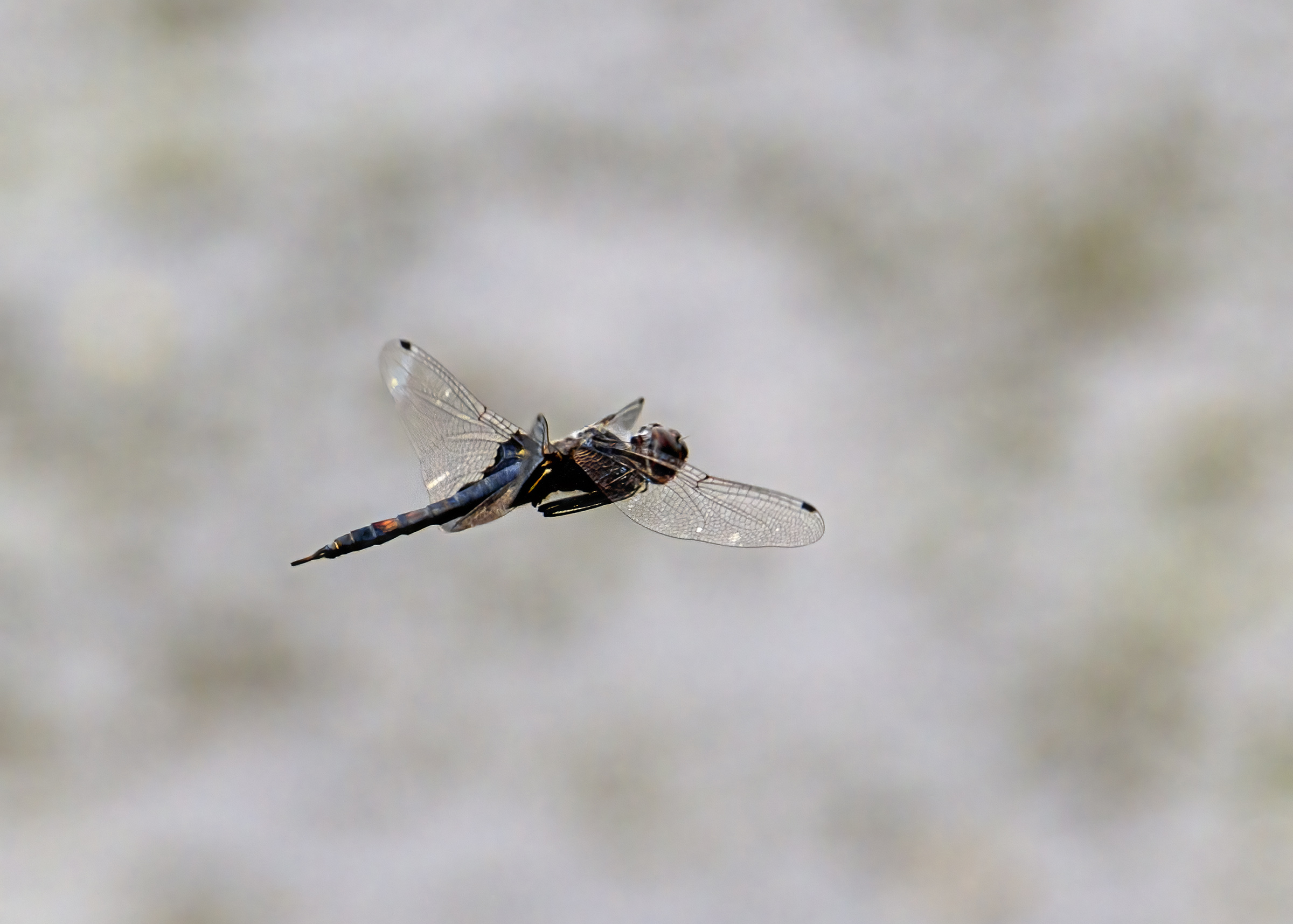
I do not tilt at windmills, but often find myself engaged in my personal quixotic quest of trying to photograph dragonflies in flight. It is such a challenging task that I titled a video that I posted on YouTube, “Impossible Shots? Dragonflies in flight.” Despite the almost overwhelming odds of getting a good shot of one of these aerial acrobats in flight, I feel irresistibly drawn to trying over and over again whenever I see a dragonfly in the air.
I spotted this Black Saddlebags dragonfly (Tramea lacerata) patrolling over the waters off of Occoquan Bay National Wildlife Refuge last Thursday and was thrilled to capture this shot of the dragonfly as it flew past me.Black Saddlebags dragonfly (Tramea lacerata). I love the way that you can see how the dragonfly had enhanced its aerodynamic profile by folding up its legs under its thorax, a bit like the way aircraft retract their landing gear after taking off.
In case you are curious, Black Saddlebags are only about 2 inches (52 mm) in length, so I have to be paying attention in order to even spot one. After years of pursuing my quest, though, my eyes are now calibrated to recognize the shape of a dragonfly pretty quickly and my hand-to-eye coordination has improved with practice, so that I am able to track these a lot better than when I started.
© Michael Q. Powell. All rights reserved.
Posted in Dragonflies, dragonfly, Insects, Nature, Photography, Summer, wildlife | Tagged Black Saddlebags, Black Saddlebags dragonfly, Canon 7D, dragonfly in flight, Occoquan Bay National Wildlife Refuge, quest, quixotic quest, Tamron 18-400mm, Woodbridge VA | 2 Comments »
July 22, 2024 by Mike Powell
I love to look closely at dragonfly wings. I have a mental picture of the cells of a dragonfly wing as being made up of regularly-shaped squares, like those on a page of graph paper. When I examine them in real life, though, I am always delighted to see all of the different shapes and sizes of these tiny cells in intricate patterns that rival those of massive stained-glass windows.
I photographed this male Widow Skimmer dragonfly (Libellula luctuosa) last Thursday at Occoquan Bay National Wildlife Refuge. I love to see dragonflies with patterned wings and the males of this species have the added bonus of having both brown and white patterns on each wing.
This dragonfly was relatively cooperative and did not fly away as I moved slowly into a position that gave me a good view of the wings. I had to bend and crouch a little to get this shot that emphasizes the impressive wingspan of this handsome little dragonfly.

© Michael Q. Powell. All rights reserved.
Posted in Dragonflies, dragonfly, Insects, Nature, Photography, Summer, wildlife | Tagged Canon 7D, Libellula luctuosa, male Widow Skimmer, Occoquan Bay National Wildlife Refuge, Tamron 18-400mm, Widow Skimmer, Widow Skimmer dragonfly, Woodbridge VA | 2 Comments »
July 20, 2024 by Mike Powell
The main subject of one of my photos is usually pretty clear—I try to fill as much of the frame as possible with the insect or bird on which I am focusing at that moment with a telephoto or macro lens. Of course, it is often impossible to “fill the frame,” because my wildlife subjects frequently are skittish and are likely to depart if I move too suddenly or get too close to them.
As I was reviewing my photos from a visit to Occoquan Bay National Wildlife Refuge last week, I came across this shot of a Carolina Wren (Thryothorus ludovicianus). The wren was pretty far away and had its back to me. The only thing that saved this from being another “butt shot” was the slight turn of the wren’s head that provided me with a chance to get a profile shot.
The shot of the wren is ok, but it was the amazing background that took my breath away. I dabble with watercolor painting and I would be absolutely thrilled to be able to paint a background like this, with all of those different shades of green and the deliciously soft “bokeh ball.” Wow!
I decided that the main subject of the photo that I wanted to show you all was actually the background, not the Carolina Wren. Consequently I did not crop very tightly and left it to the viewers to focus their attention on the linear structure of the branches and on the wonderful background. I am not sure that a thumbnail view of the image will grab folks’ attention, but I am ok with that—the photos in my blog are intended to provide an interesting view of some aspect of the beauty of nature and not serve as click-bait to maximize the number of views.

© Michael Q. Powell. All rights reserved.
Posted in Birds, Nature, Photography, Summer, wildlife | Tagged Canon 7D, Carolina Wren, Occoquan Bay National Wildlife Refuge, Tamron 18-400mm, Thryothorus ludovicianus, Woodbridge VA | 5 Comments »
July 19, 2024 by Mike Powell
Earlier in the season, when the trees were bare, it was very easy to spot Ospreys (Pandion haliaetus) when they returned to our area from their wintering grounds. Now, though, the trees are covered in leaves and Ospreys are increasingly hard to see as they perch among the leaves, especially if they remain silent.
I was delighted to spot this vigilant osprey last week at Occoquan Bay National Wildlife Refuge. He was alert and focused—he seemed to be paying attention to something, though I am not sure of the subject of his surveillance.
The winds were kicking up periodically, causing a cowlick of feathers to stand up in the back of the osprey’s head. When I was a child, I had a similar problem and had to use a bit of Brylcreem to keep the unruly hair in place. (My Mom used to be able to accomplish the same thing with my hair using only a bit of her saliva and her fingers.)

© Michael Q. Powell. All rights reserved.
Posted in Birds, Nature, Photography, Summer, wildlife | Tagged Canon 7D, Occoquan Bay National Wildlife Refuge, Osprey, osprey in a tree, Pandion haliaetus, Tamron 18-400mm, Woodbridge VA | 2 Comments »
July 18, 2024 by Mike Powell
On occasion I have noticed a dragonfly that seemed to be smiling a little at me. Last week, though, I encountered a female Widow Skimmer (Libellula luctuosa) at Occoquan Bay National Wildlife Refuge that seemed to have an exceptionally toothy grin—she seemed delighted to pose for me. I love the way that the background blurred out, allowing viewers to focus on the details of this smiling dragonfly and hopefully producing smiles on their faces in response.

© Michael Q. Powell. All rights reserved.
Posted in Dragonflies, dragonfly, Insects, Nature, Photography, Portraits, Summer, wildlife | Tagged Canon 7D, female Widow Skimmer, Libellula luctuosa, Occoquan Bay National Wildlife Refuge, Tamron 18-400mm, toothy grin, Widow Skimmer, Widow Skimmer dragonfly, Woodbridge VA | 2 Comments »
July 17, 2024 by Mike Powell
When dragonflies mate, they usually assume a “wheel” position, in which the male grasps the female by the back of her head and she bends her abdomen towards his thorax. The position appears to be both awkward and acrobatic, but amazingly the dragonflies are able to fly while in this position.
I was searching for dragonflies last week at Occoquan Bay National Wildlife Refuge when a pair of mating Calico Pennant dragonflies (Celithemis elisa) flew by me and landed in some nearby vegetation. Calico Pennants are some of the most spectacular dragonflies in our area, with bright colors and distinctive patches on their wings.
Feeling a bit like a voyeur, I moved a little closer to them and slowly crouched a bit to get a better angle for my shot. In the image below, you can see how the female grasps the abdomen of the male during this process.
I was happy to be able to get most of the two dragonflies in focus, which is always a challenge in situations like this.

© Michael Q. Powell. All rights reserved.
Posted in Dragonflies, dragonfly, Insects, Nature, Photography, Summer, wildlife | Tagged Calico Pennant, Calico Pennant dragonfly, Canon 7D, Celithemis elisa, mating calico pennant dragonflies, Occoquan Bay National Wildlife Refuge, Tamron 18-400mm, Woodbridge VA | 1 Comment »
July 16, 2024 by Mike Powell
The entire East Coast of the United States is in the midst of a heat wave. Yesterday here in the Washington D.C. area we had a record high temperature for 15 July of 102 degrees (39 degrees C) with the heat index even higher. Yikes.
Following recommendations of doctors and weather forecasters, I stayed indoors for most of the day and worked on a few images that I captured last week at Occoquan Bay National Wildlife Refuge, including this shot of a Halloween Pennant dragonfly (Celithemis eponina).
Many dragonflies perch with their wings held stationary, but Halloween Pennants seem to move their wings about quite a bit to maintain their balance as they perch precariously on the very tips of tall stalks of vegetation. It is very easy to isolate the dragonfly from the background, because they are perched above all of the ground clutter, but it is a bit of a challenge to focus on the dragonfly as it is buffeted to and fro by even the slightest of breezes.

© Michael Q. Powell. All rights reserved.
Posted in Dragonflies, dragonfly, Insects, Nature, Photography, Summer, wildlife | Tagged Canon 7D, Celithemis eponina, halloween pennant, Halloween Pennant dragonfly, Occoquan Bay National Wildlife Refuge, Tamron 18-400mm, Woodbridge VA | 2 Comments »
July 15, 2024 by Mike Powell
I was delighted to see some Red-winged Blackbirds (Agelaius phoeniceus) last week at Occoquan Bay National Wildlife Refuge. In the first photo, a male Red-winged Blackbird seemed to be showing off for me as he balanced himself on a single leg, glanced in my direction, and seemed to smile. Eventually he climbed to the tip of the small branch and appeared to be complaining about something that he observed.
A short distance away I captured the final image of a female Red-winged Blackbird. As you can she, she is not black nor does she have any red on her wings, so it feels a little strange to call her a Red-winged Blackbird. Although I was not able to get very close to her, I really like the overall composition of the image and the moment of action that I was able to capture as she called out.


© Michael Q. Powell. All rights reserved.
Posted in Birds, Nature, Photography, Summer, wildlife | Tagged Agelaius phoeniceus, Canon 7D, female Red-winged Blackbird, Occoquan Bay National Wildlife Refuge, red-winged blackbird, Tamron 18-400mm, Woodbridge VA | 5 Comments »
July 14, 2024 by Mike Powell
What do you do to cope with the heat at this time of the year? I stay indoors a bit more in my air conditioned house and decided this week to work on a cool little cross stitch pattern. Yesterday I finished the pattern, which is available as a free download from Silver Creek Samplers. (
https://www.silvercreeksamplers.com/dog-days)
Although my ears are not quite as long as those of the dog in this image, I confess that I have been spending a lot of time in front of a fan as we cope with a heat wave that has enveloped much of the United States this past week.
As I noted in a blog posting earlier this month, I returned this year to cross stitching, which I did a lot during the 1980s and 1990s, after a break of about 20 years. I am working on a bigger project, but sometimes it is fun to knock out little projects like this one that make me smile.
© Michael Q. Powell. All rights reserved.
Posted in cross stitch, Photography, Summer | Tagged counted cross stitch, cross stitch, dog days of summer, Silver Creek Samplers | 6 Comments »
July 13, 2024 by Mike Powell
We have a number of different dark swallowtail butterfly species in our area and sometimes I have trouble telling them apart. Recently I have seen Black Swallowtails fairly frequently and occasionally I will see a Pipevine Swallowtail. I know that there is also a dark morph version of the Eastern Tiger Swallowtail and a Red-spotted Purple butterfly sometimes looks almost like a swallowtail.
Are you confused yet? When I spotted this cool-looking butterfly on Wednesday at Occoquan Bay National Wildlife Refuge, I was not sure what it was. Rather than endlessly speculating while in the field, I follow what I call the “Law of the Wild West”—shoot first and ask questions later—and wait to identify my subjects until after I have loaded my images onto my computer.
I have grown accustomed to using a blog posting by the Louisiana Naturalist to help identify dark swallowtails—it provides side-by-side photos of four different species. On the basis of that posting and some other research, I have concluded that “my” butterfly is probably a Spicebush Swallowtail (Papilio troilus) butterfly, a species that I don’t recall seeing the past few years.
The background of the photo is not particularly interesting, but I was patient enough to wait for the butterfly to open its wings, so you get a good look at the wonderful markings of this Spicebush Swallowtail butterfly.

© Michael Q. Powell. All rights reserved.
Posted in Butterflies, Insects, Nature, Photography, Summer, wildlife | Tagged Canon 7D, Occoquan Bay National Wildlife Refuge, Papilio troilus, Spicebush Swallowtail, Spicebush Swallowtail butterfly, Tamron 18-400mm, Woodbridge VA | 1 Comment »
July 12, 2024 by Mike Powell
On Wednesday I watched as a Bald Eagle (Haliaeetus leucocephalus) chased an Osprey (Pandion haliaetus) high in the sky above the waters off of Occoquan Bay National Wildlife Refuge in a vain attempt to steal its freshly caught fish. I captured the second shot when the eagle flew past me after giving up on its chase.
It has been several months since I last photographed a Bald Eagle, so I was thrilled to capture these images. As most of you know, I concentrate most of my photographic attention on dragonflies and other insects during the warmer months. However, I am always alert to the possibility of photographing birds when I manage to spot them.
During the winter months I generally use a 150-600mm telephoto zoom lens that gives me a long reach, but in the summer I tend to rely on a 180mm macro lens or the 18-400mm zoom lens that I used for these shots. This lens gives me a good deal of versatility, allowing me to capture my close-in tiny subjects and some longer distance ones like these raptors in flight.
© Michael Q. Powell. All rights reserved.
Posted in Birds, Nature, Photography, Summer, wildlife | Tagged Bald Eagle, birds in flight, Canon 7D, Haliaeetus leucocephalus, Occoquan Bay National Wildlife Refuge, Osprey, Pandion haliaetus, Tamron 18-400mm, Woodbridge VA | 5 Comments »
July 11, 2024 by Mike Powell
I was a little shocked yesterday to see a Green Heron (Butorides virescens) while I was searching for dragonflies at a small pond at Occoquan Bay National Wildlife Refuge. In the past I have seen Green Herons at other locations at the refuge, but never before at this pond. Green Herons are smaller and squatter than the Great Blue Herons that I am more accustomed to seeing.
When I initially spooked the Green Heron, it flew to a mucky, shallow end of the pond, where I was able to capture the first two images. I am always amazed at the length of the neck of a Green Heron when it extends it fully—it looks so much taller and slimmer in the second shot. I also really like the floppy head feathers that sometime look like a Mohawk hairstyle.
The Green Heron eventually sensed my presence and flew to a nearby tree. The heron was partially hidden by the abundant foliage, but eventually I was able to capture the final image of it among the leaves.
It was hot and humid yesterday, so I limited my trekking to a couple of hours and drank plenty of water. Still, it was nice to get out in the wild with my camera after a week of spending most of my time indoors.


© Michael Q. Powell. All rights reserved.
Posted in Birds, Nature, Photography, Summer, wildlife | Tagged Butorides virescens, Canon 7D, green heron, Occoquan Bay National Wildlife Refuge, Tamron 18-400mm, Woodbridge VA | 7 Comments »
July 10, 2024 by Mike Powell
When it comes to color theory, red and green are viewed as complementary colors, i.e. they are on the opposite sides of a color wheel. When used together, complementary colors provide a high contrast and high impact color combination—together, these colors will appear brighter and more prominent.
A week ago I was delighted to post a photo of a perched Carolina Saddlebags (Tramea carolina) dragonfly, a species that is almost always in flight when I am fortunate to spot one. A few days later, I managed to get some even better photos of a perched Carolina Saddlebags during a visit to Occoquan Bay Regional Park.
The lighting was good and the background was far enough away that it became blurry. The complementary colors of the dragonfly and the background really make these images “pop.” The interesting poses of the dragonfly draw in the viewer as well—a breeze was blowing and the dragonfly struggled a bit to maintain its hold on the tip of the vegetation on which it was perched.
It is really cool when the elements of a photograph come together like this and I am able to capture the scene in a way that is both technically and artistically pleasing. It was a good day.


© Michael Q. Powell. All rights reserved.
Posted in Art, Dragonflies, dragonfly, Insects, Nature, Photography, Summer, wildlife | Tagged Canon 7D, Carolina Saddlebags, Carolina Saddlebags dragonfly, color theory, color wheel, complementary colors, Lorton VA, Occoquan Regional Park, Tamron 18-400mm, Tramea carolina | 6 Comments »
July 9, 2024 by Mike Powell
Like many guys, I am not very good at remembering my own anniversary. In this case, though, I am not in trouble with a partner, because it is “only” the anniversary of my blog. Word Press informed me a couple of days ago that it has been 12 years since I started my blog. According to the Word Press stats, I have had 459,601 views and a total of 5,183 posts. Wow!
I am pretty sure that I never intended for the blog to become a part of my daily life for such a long period of time. Initially I thought that the blog would be merely a vehicle for showcasing the wildlife photos that I was increasingly taking. It quickly became clear, however, that I enjoyed expressing myself in my words as well as in my photos. Over the years, I have gotten accustomed to the routine of sitting down in front of the keyboard most days, picking a recent photo or a small group of them, and saying something about the images.
I have really appreciated the support and encouragement that I have received from so many readers over these last 12 years. My life has changed quite a bit over that time, but your support for the blog has been a steadying force for me. Thanks.
A special thanks goes to Cindy Dyer, my dear friend and photography mentor, who sat me down 12 years ago and walked me through the steps of starting this blog—she remains a muse for my photography and other artistic endeavors.
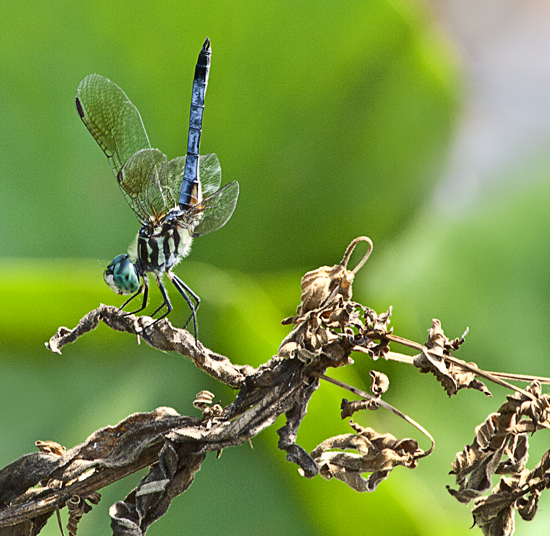
In case you are curious, I am attaching a copy of the photo of a Blue Dasher dragonfly that was featured in my very first blog posting on 7 July 2012. As you can see, I was already “hooked” on dragonflies back then.
As I get older—I will turn 70 in a few weeks—I have become increasingly aware that nothing in life is guaranteed. My hope, though, is that I will continue this blog indefinitely, sharing my photos and musings in almost daily posts. Enjoy the journey with me, dear friends.

© Michael Q. Powell. All rights reserved.
Posted in Inspiration, Nature, Photography, wildlife | Tagged anniversary, blog, Blog statistics | 34 Comments »
July 8, 2024 by Mike Powell
Sometimes my photos convey the mistaken impression that dragonflies are large and are easy to find and photograph. Using telephoto and macro lenses and a stealthy approach, I try to isolate the dragonflies, so that viewers can focus on the beautiful details of these amazing aerial acrobats.
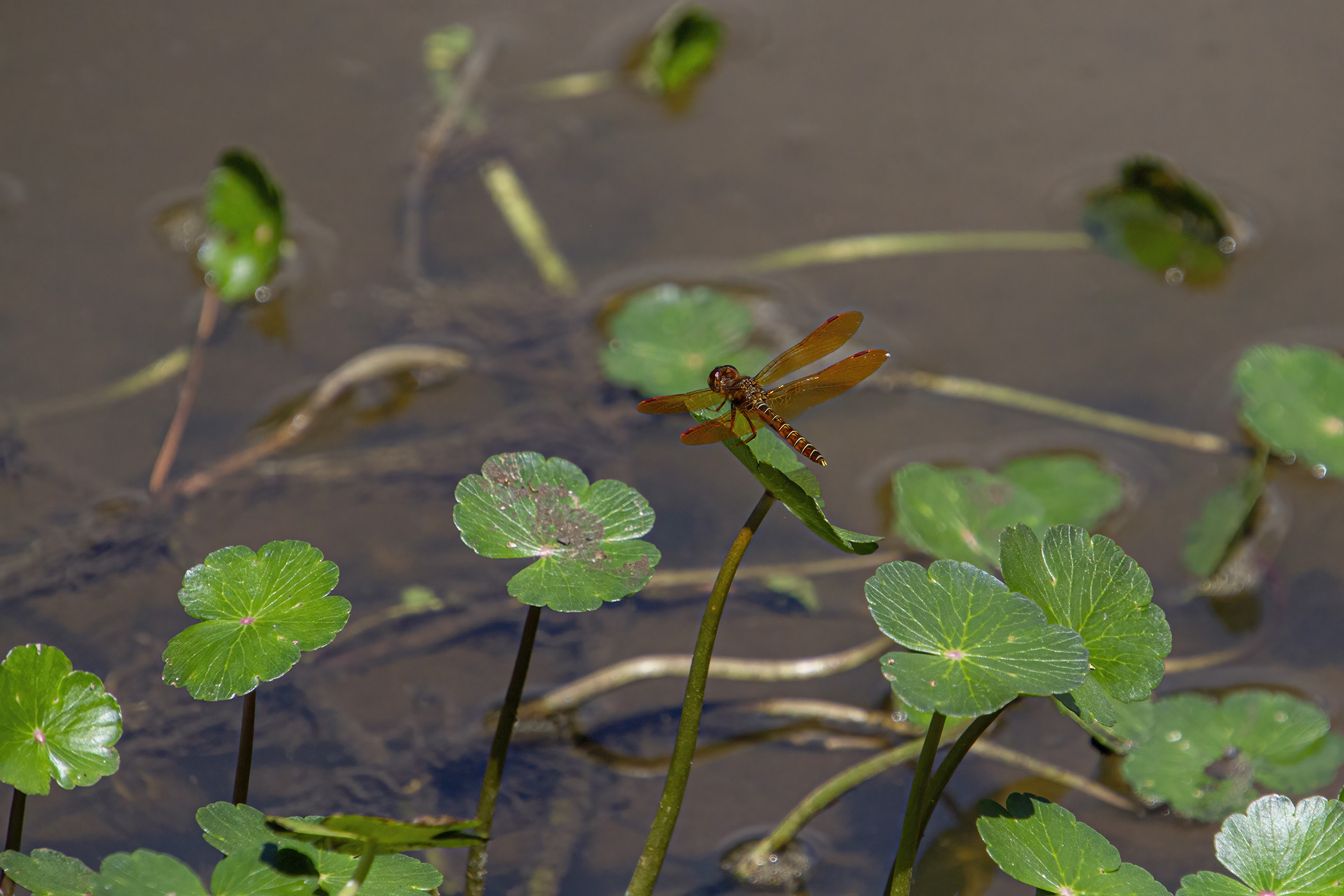
The reality though, is that most dragonflies are quite small—this male Eastern Amberwing dragonfly (Perithemis tenera) is only about one inch (25 mm) in length—and they often fly about amidst vegetation that conceals their movements.
This image gives you a sense of the vastness of the environment and some of the challenges in spotting the dragonflies. Of course, the second challenge is getting close enough to the subject without scaring it away, though in this case I was content to capture a wide-angle shot that shows this dragonfly in its preferred environment.
© Michael Q. Powell. All rights reserved.
Posted in Dragonflies, dragonfly, Nature, Photography, Summer, wildlife | Tagged Canon 7D, Eastern Amberwing, Eastern Amberwing dragonfly, Lorton VA, Occoquan Regional Park, Perithemis tenera, Tamron 18-400mm | 5 Comments »
July 7, 2024 by Mike Powell
Simple photographic compositions are often the most effective ones, like this image of a male Needham’s Skimmer (Libellula needhami) dragonfly that I captured last week at Occoquan Regional Park in Lorton, Virginia. All that is present in the frame is the dragonfly, the stem of the vegetation on which he is perched, and a blurred background—there is nothing extraneous or distracting. The limited color palette and the angled pose help to make the subject “pop.”
Sometimes photography can seem so complicated, but at other times it seems natural and intuitive and I am able to capture the beauty of nature without having to think consciously about what I am doing.

© Michael Q. Powell. All rights reserved.
Posted in Dragonflies, dragonfly, Insects, Nature, Photography, Summer, wildlife | Tagged Canon 7D, Libellula needhami, Lorton VA, male Needham's Skimmer, Needham's Skimmer, Needham's Skimmer dragonfly, Occoquan Regional Park, Tamron 18-400mm | Leave a Comment »
July 6, 2024 by Mike Powell
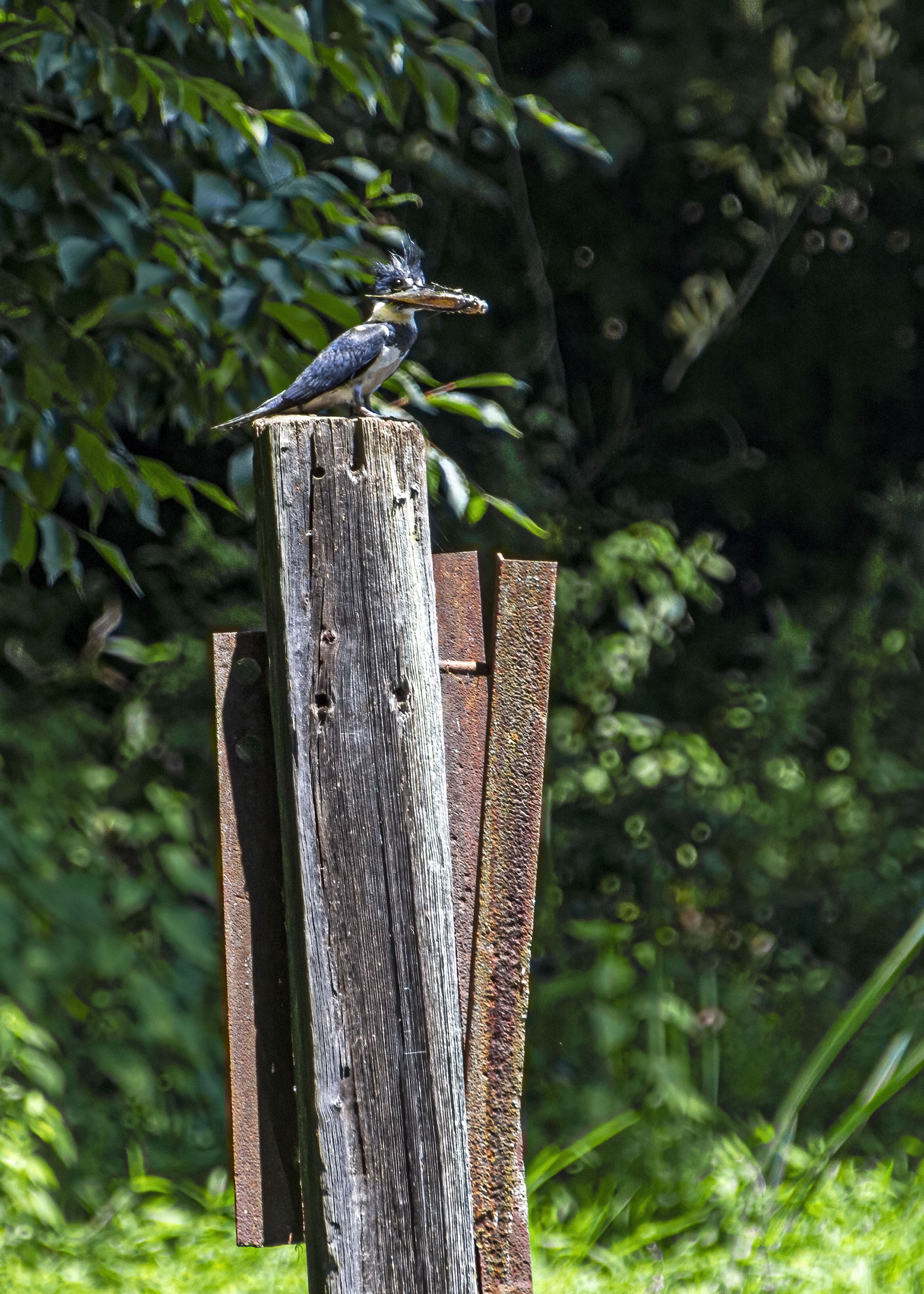
As I was searching the edge of a pond for dragonflies earlier this week I suddenly heard the unmistakable call of a Belted Kingfisher (Megaceryle alcyon). As I lifted my head, the kingfisher flew across my field of view and perched on a wooden post sticking out of the water. Even though the kingfisher was quite far away, I could see that it had a relatively large fish in its bill.
Normally a kingfisher will beat its catch against a branch to subdue it before swallowing it head-first. I was hoping to be able to see if the kingfisher would be successful in swallowing this prey—it looked too big for it to swallow in one gulp, but I have been surprised in the past when herons and cormorant have swallowed large fish.
Alas, the kingfisher flew away before I could see if it would be successful in swallowing its prey.
© Michael Q. Powell. All rights reserved.
Posted in Birds, Nature, Photography, Summer, wildlife | Tagged Belted Kingfisher, Canon 7D, kingfisher and fish, Lorton VA, male Belted Kingfisher, Megaceryle alcyon, Occoquan Regional Park, Tamron 18-400mm | 5 Comments »
July 5, 2024 by Mike Powell
I photographed this male Widow Skimmer (Libellula luctuosa) on Tuesday at Occoquan Regional Park. As I was working on the image, I noted that the dragonfly had an infestation of what look to be red water mites on at least two of its wings. You may need to click on the images to zoom in and you should be able to see some small red spherical objects that I am pretty sure are water mites.
According to Wikipedia, these water mites, likely from the genus Arrenurus, “establish an association for the purpose of transportation and nutrients, and attach to the host during the host’s transition from larva to adult.” Although these mites do not kill the dragonfly hosts, studies “show that parasitism by the mites affect the host’s longevity and fecundity by draining its tissue fluids, hampering copulation and interfering with sperm transfer.” Yikes!


© Michael Q. Powell. All rights reserved.
Posted in Dragonflies, dragonfly, Insects, Nature, Photography, Summer, wildlife | Tagged Arrenurus, Canon 7D, Libellula luctuosa, Lorton VA, male Widow Skimmer, mites, Occoquan Regional Park, Tamron 18-400mm, Widow Skimmer, Widow Skimmer dragonfly | 5 Comments »
July 4, 2024 by Mike Powell
This year I have rediscovered the joy of cross stitching. In the 1980s and 1990s I completed a considerable amount of cross stitch projects and have many of them hanging on my walls. I was originally introduced to the craft in about 1983 by a young lady friend who was always working on some stitching. I expressed a slight interest in what she was doing and the next thing I know she gifted me with some fabric, floss, patterns, and material. I quickly became hooked.
Over time, though, my life became busy and for almost two decades I stopped stitching. Two ladies at my church work at a wonderful local needlework shop called In Stitches Needlework that I first visited during the pandemic at their invitation. I bought a few new patterns, but did not really start getting back to stitching until earlier this year when I began to attend a twice monthly stitching session at the store. Stitchers of all skill levels sit around and work on individual projects and talk about a wide variety of topics—it is a wonderful community of people who provide me with lots of inspiration and encouragement.
The first photo shows my progress on my current big project, a pattern by Ink Circles called Reflections of Paris. This monochromatic piece includes a number of familiar Paris landmarks. I am about a third of the way through it right now (and already gone through two entire skeins of DMC floss). As you can probably tell, the motifs are repeated four times from the center, which is the square shown near the bottom of the image. As you look down the right and left edges, for example, you can start to see emerging portions of the same shapes that are visible along the top edge. I will be working on this patterns, which calls for 6944 stitches, for quite a while, but I find it to be really relaxing, so I look forward to doing a little stitching each day, if possible.
The second image shows a piece called Country Welcome that I stitched this spring. It was a pattern from the August 1990 issue of Leisure Arts, The Magazine. I used to subscribe to a number of different cross stitch magazines and have held on to the old issues. I tend to like cross stitch patterns that have a minimal color palette.
The final image shows another project that I completed this spring called “Do Everything in Love.” It was a free, but copyrighted, pattern by Silver Creek Samplers that I picked up at my local cross stitch store while checking out one day.
I realize that this posting is quite a change from my normal wildlife photos, but I thought it would be fun to share this other side of me with you all. On some of the days this summer when the weather and humidity make it tough to venture out with my camera, I know I can curl and stitch away in the comfort of my air-conditioned house.


© Michael Q. Powell. All rights reserved.
Posted in Art, cross stitch | Tagged cross stitch, In Stitches, Ink Circles, Leisure Arts, Paris, Silver Creek Samplers | 12 Comments »
« Newer Posts - Older Posts »


 Mike Powell