Feeds:
Posts
Comments

Archive for the ‘Winter’ Category

Yesterday I had the desire to photograph something different. For the past few months, my long 150-600mm telephoto zoom lens has remained on my camera and I have focused mostly on birds. I decided to switch back to my 180mm macro lens, the lens that I use most of the time during warmer months, and set off for Green Spring Gardens, a historic county-run park only a few miles from where I live.

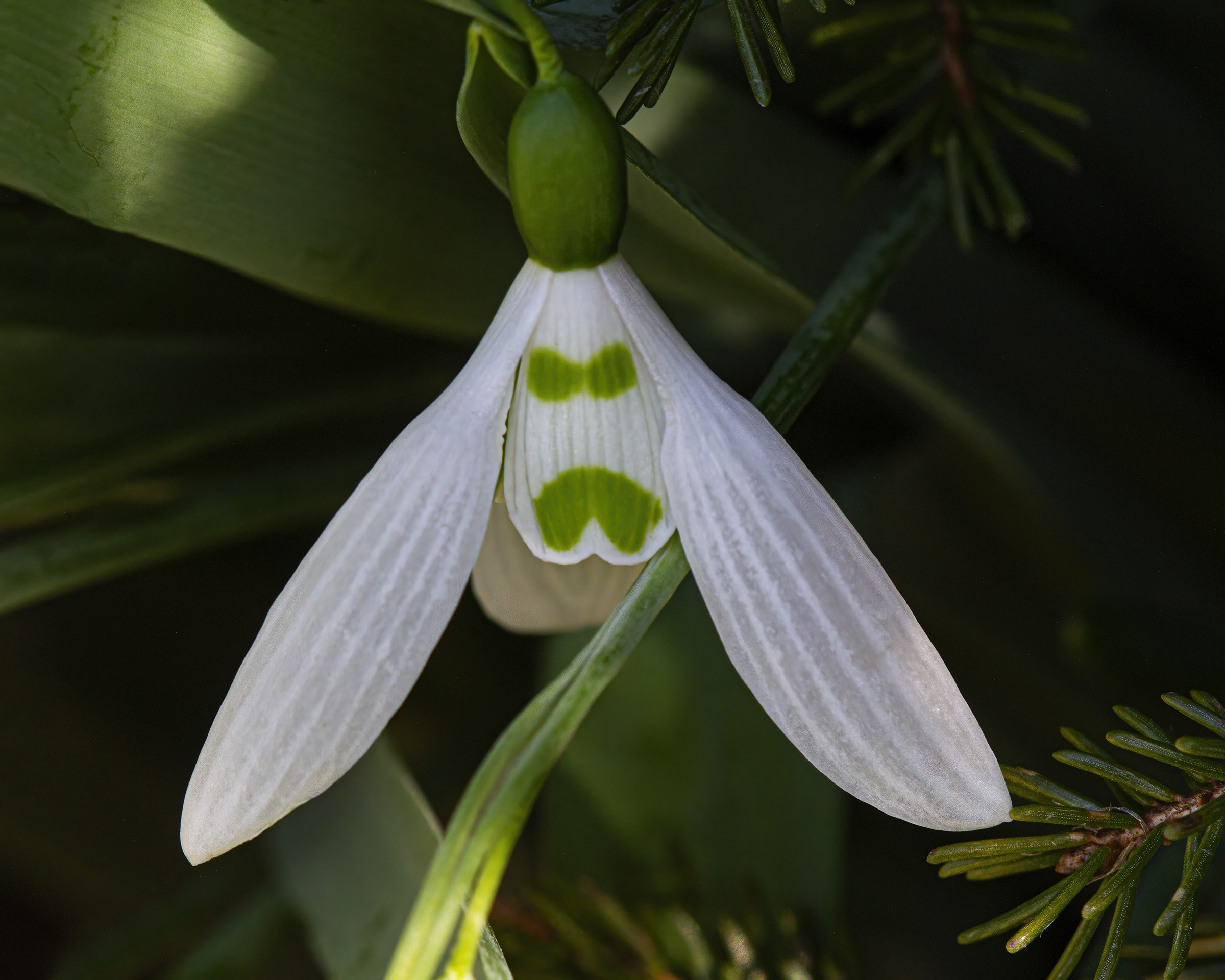
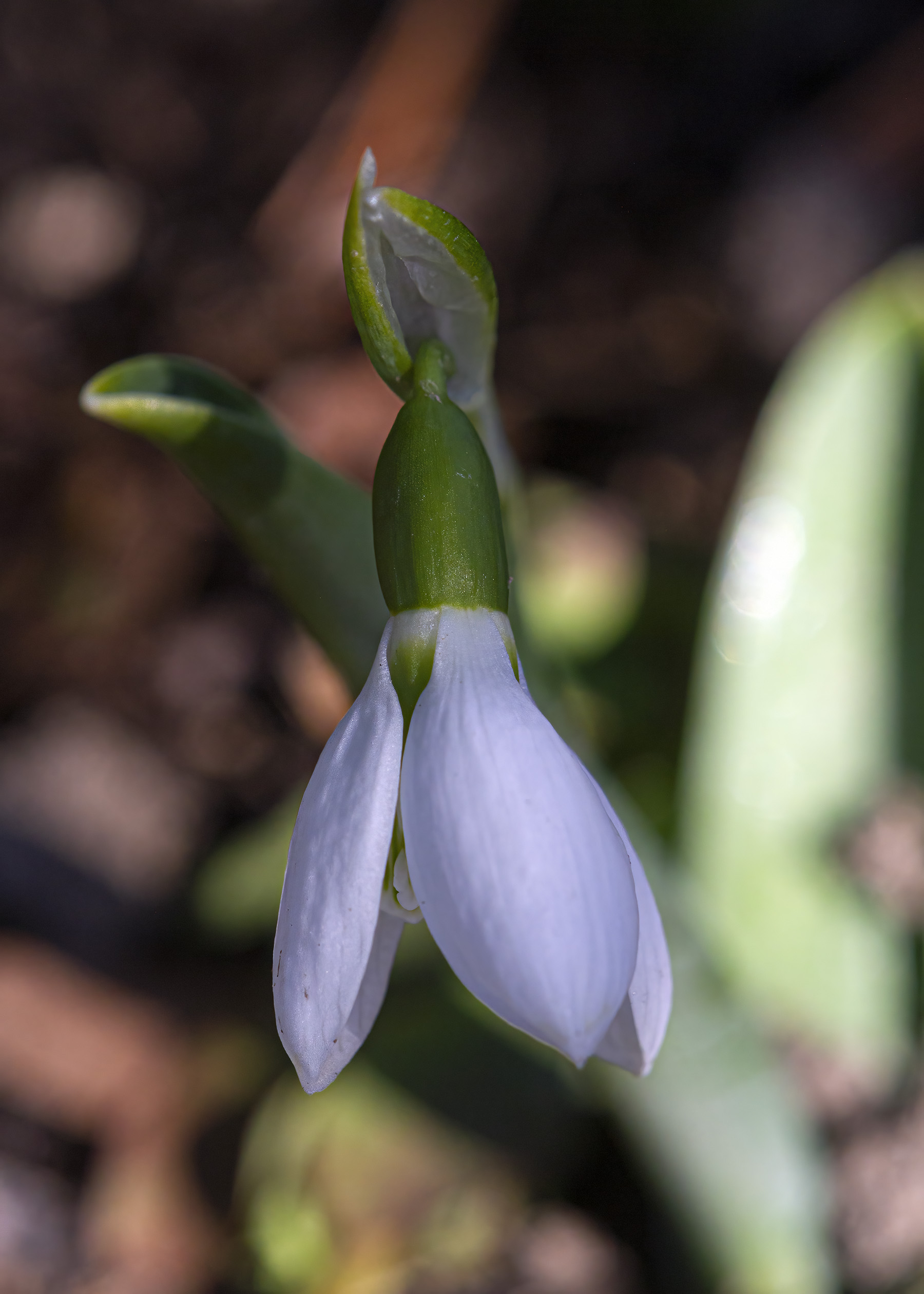
Not surprisingly, I did not spot any insects, but I was thrilled to find several patches of Snowdrop flowers (g. Galanthus) in bloom. I had a fun time trying to compose some  shots of these beautiful little flowers, though I did end up a bit muddy, because it had rained a lot the previous day.

At this time of the year the flower beds are mostly dirt and/or mulch, so it is impossible to get the smooth green backgrounds that I often strive for during the spring and summer months. However, I was able to blur the background some by carefully choosing my shooting angle and adjusting my camera settings.

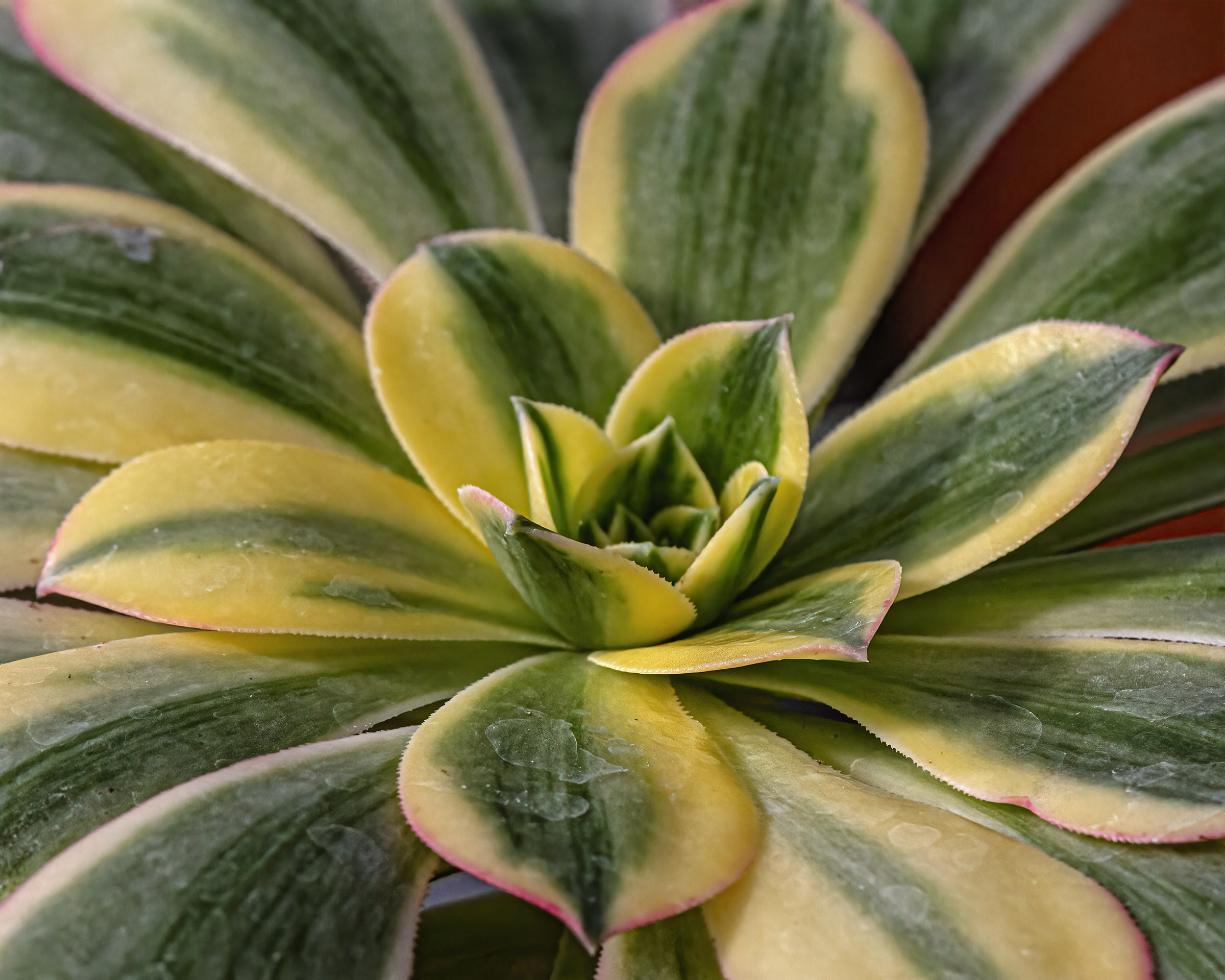
During my time at the park, I also visited the “glasshouse,” a small greenhouse that houses tropical flowers, succulents, and bromeliads. It felt great to soak up the warmth of the sun in this enclosed environment and I managed to take a few photos there that I will share in a future blog posting.

Snowdrop

Snowdrop

Snowdrop

© Michael Q. Powell. All rights reserved.

Read Full Post »

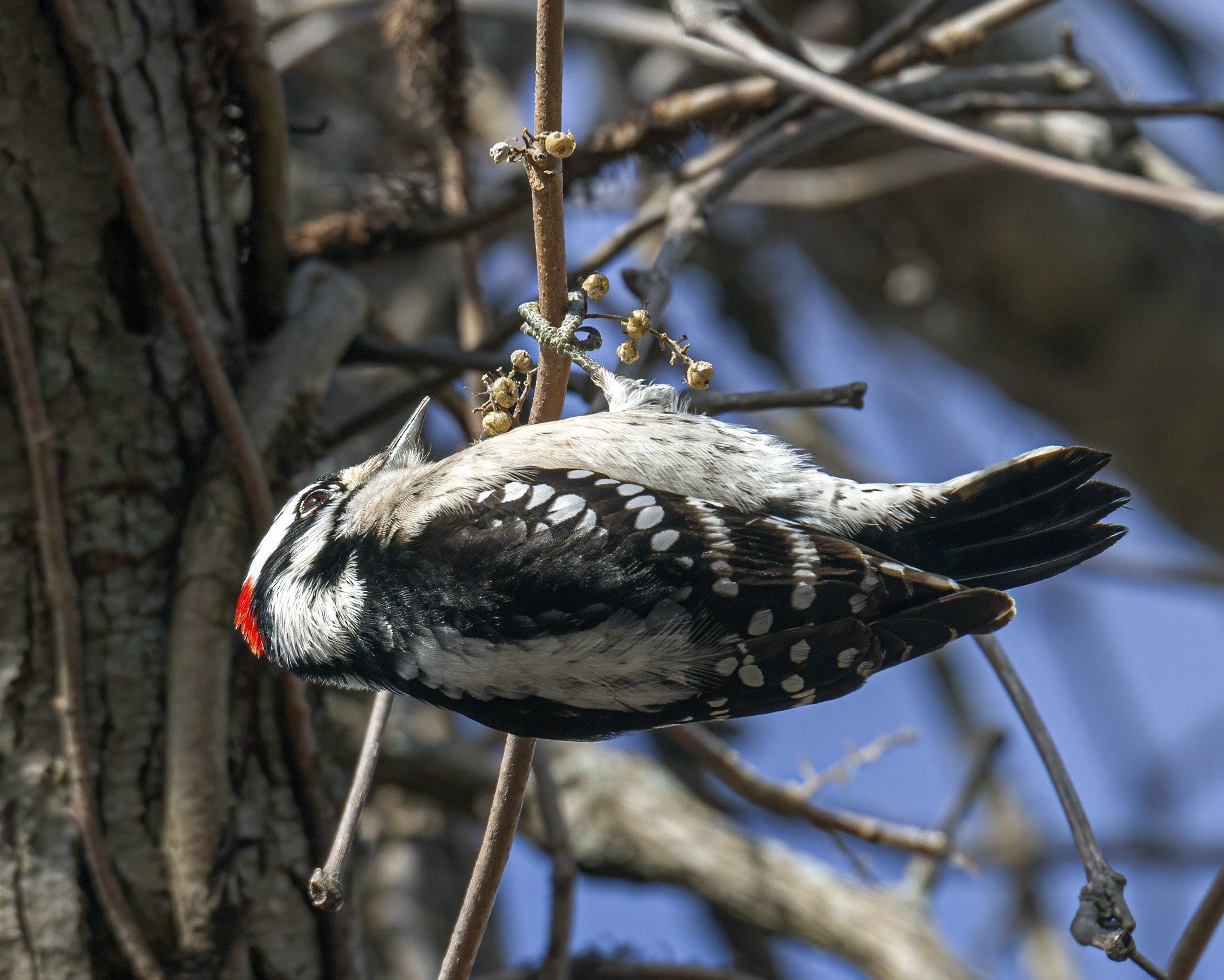
I love the beautiful markings of this male Downy Woodpecker that was acrobatically snagging some poison ivy berries when I spotted him on Monday at Occoquan Bay National Wildlife Refuge. Downy Woodpeckers, the smallest woodpeckers in North America, feed primarily on insects, although they supplement their diet with seeds and berries, especially during winter months, when insects are much harder to find.

I can’t help but admire the intense focus of these little dynamos that are in constant motion as they forage for food. I usually see them pecking away at the bark of trees, but have always seem them on bushes and cattails.

In case you are curious, it is easy to distinguish a male Downy Woodpecker from a female, because only the males have the small red patch on the back of their heads, a feature that is visible in both of these photos.

Downy Woodpecker

Downy Woodpecker

© Michael Q. Powell. All rights reserved.

Read Full Post »

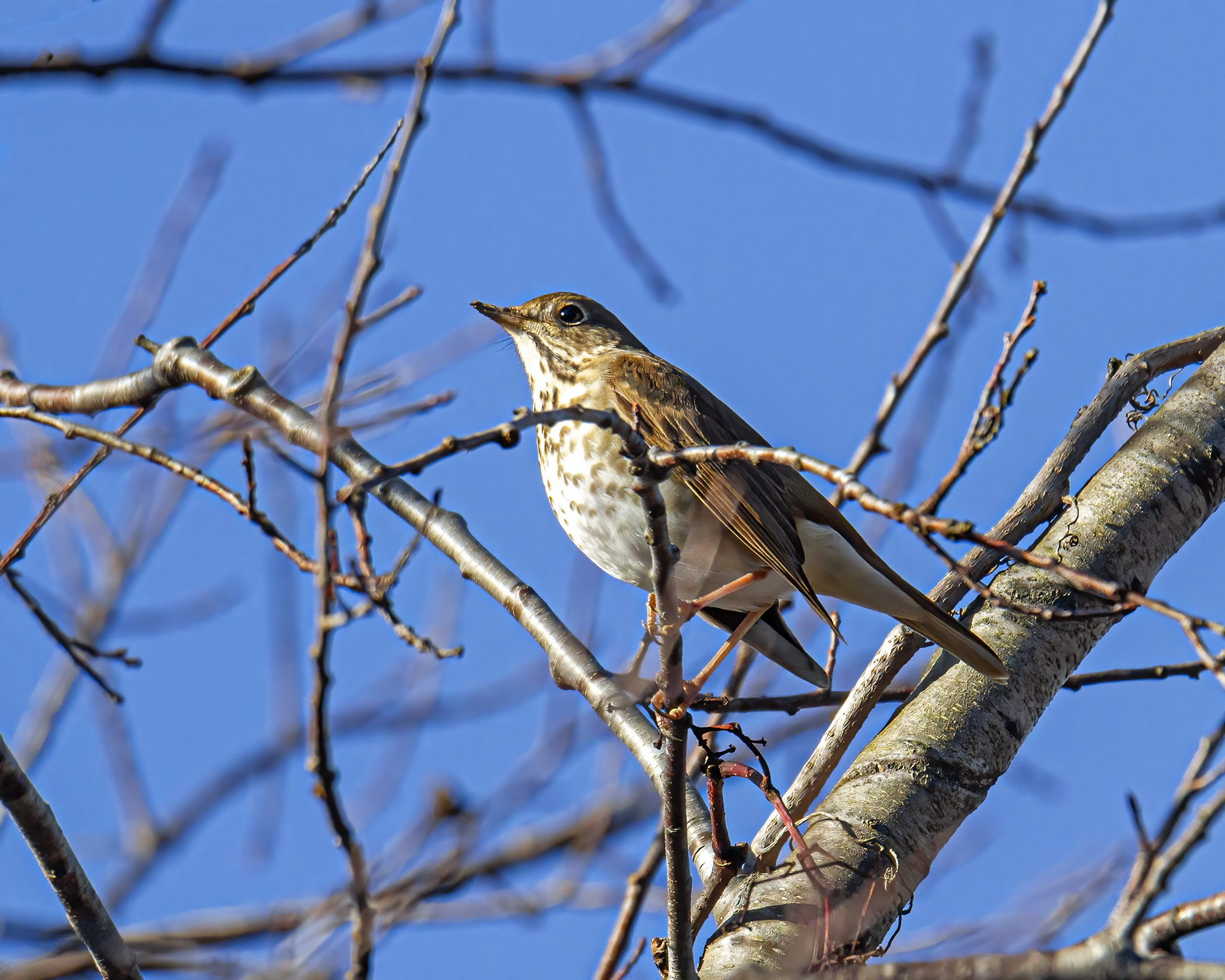
When I first spotted this little bird on Monday as it perched high in a tree at Occoquan Bay National Wildlife Refuge, its shape caused me to think that it was an American Robin. As I got a little closer, though, I could see that the bird’s breast was spotted and did not have the distinctive orange color of “our” robin.

I remembered that the American Robin is a member of the thrush family, so I assumed that this bird was another kind of thrush. (The European Robin, by contrast, belongs to the chat subfamily of the Old World Flycatcher family—check out this November 2019 blog posting to see a photo of a European Robin that I photographed in Paris.) When I returned home and checked by bird identification guide, I was able to determine that this is probably a Hermit Thrush (Catharus guttatus), a species that I have encountered only a few times.

As I was looking up information on the Hermit Thrush, I discovered that this bird played a an important role in “When Lilacs Last In The Dooryard Bloom’d,” an elegy on the death of Abraham Lincoln by noted American poet Walt Whitman. The thrush, along with lilacs and a star, is one of the recurring elements in the poem and seems to represent a kind of reconciliation with death and its song is described as “Death’s outlet song of life.” I am providing a link to the entire poem in case you are interested in reading the beautiful poem in its entirety. As a foretaste, I will leave you with one small section of the poem in which Whitman first introduced his readers to the Hermit Thrush:

“In the swamp in secluded recesses,

A shy and hidden bird is warbling a song.
Solitary the thrush,
The hermit withdrawn to himself, avoiding the settlements,
Sings by himself a song.
Song of the bleeding throat,
Death’s outlet song of life, (for well dear brother I know,
If thou wast not granted to sing thou would’st surely die.)”

Hermit Thrush

© Michael Q. Powell. All rights reserved.

Read Full Post »

Something caught the attention of this Great Blue Heron (Ardea herodias) yesterday at Occoquan Bay National Wildlife Refuge and caused it to momentarily look up towards the sky. The upward tilt of the heron’s head helped it to be better illuminated, allowing me to capture this little environmental portrait of one of the year-round inhabitants of the refuge.

Great Blue Heron

© Michael Q. Powell. All rights reserved.

Read Full Post »

Hooded Mergansers (Lophodytes cucullatus) are strange-looking ducks—no other ducks that I see regularly look like them. The shape and proportions of their heads and bills are so unusual and cartoonish that they look like they were created at Disney Studios.

Most of the time when I see Hooded Mergansers, they are in small groups, but last week I spotted only a solitary male during a short visit to a suburban pond not far from where I live. The “Hoodie” seemed to be content to swim around alone, not interacting with the other ducks on the pond and not spending any noticeable time fishing—Hooded Mergansers dive for fish, crayfish, and other food, seizing it in their thin, serrated bills.

The weather was cold, gray, and windy on the day I captured these images, conditions that are quite typical during the winter here. Weather forecasters predict that today will be mostly sunny, so I hope to have a chance to get out in nature with my camera and exercise both my body and my soul. As Vincent Van Gogh once wrote in a letter to his brother Theo, ““Always continue walking a lot and loving nature, for that’s the real way to learn to understand art better and better.”


Hooded Merganser

Hooded Merganser

© Michael Q. Powell. All rights reserved.

Read Full Post »

There is something really elegant about male Northern Pintail ducks (Anas acuta). Some other ducks are more flashy and colorful, but the beautiful combination of grays, browns, and white give the Northern Pintails a more refined beauty that is emphasized by their long white neck stripe and very long, pointed tails.

I don’t see Northern Pintails very often, because they prefer the kind of shallow wetland that is not common at my usual stomping grounds. Recently, however, I spotted a solitary male Northern Pintail amidst a group of Mallard couples a the edge of a reed-filled creek at Occoquan Bay National Wildlife Refuge. The pintail mostly stayed in the shadows, but occasionally swam into the light, allowing me to capture a couple of images.

I really like the minimal palette of earth-tone colors in these two images. The texture in the background and in the ripples in the water help to add some additional visual interest without distracting a viewer’s eyes.

Northern Pintail

Northern Pintail

© Michael Q. Powell. All rights reserved.

Read Full Post »

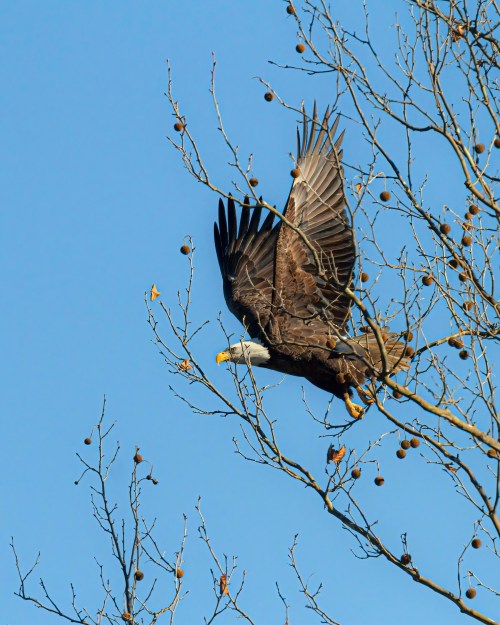
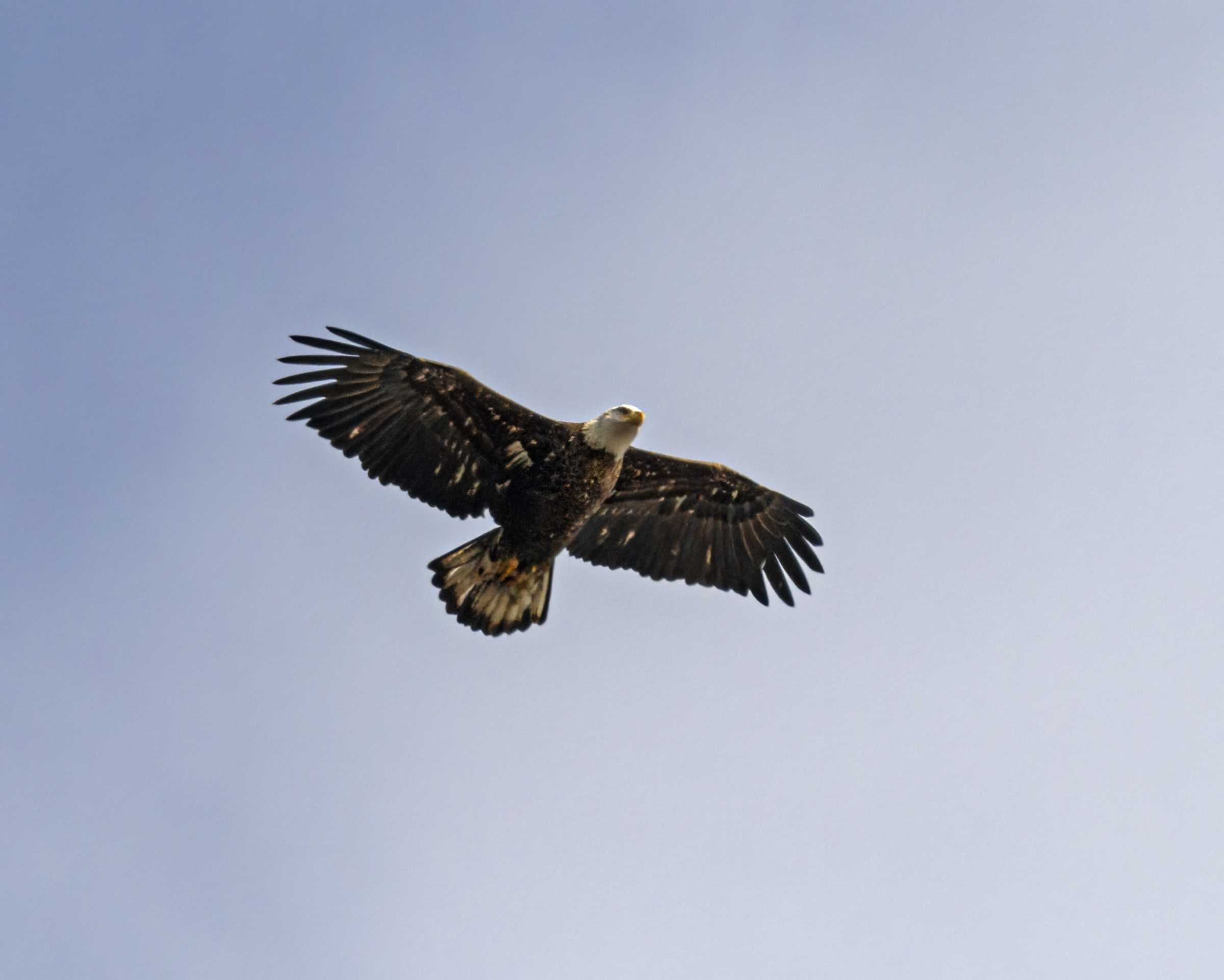
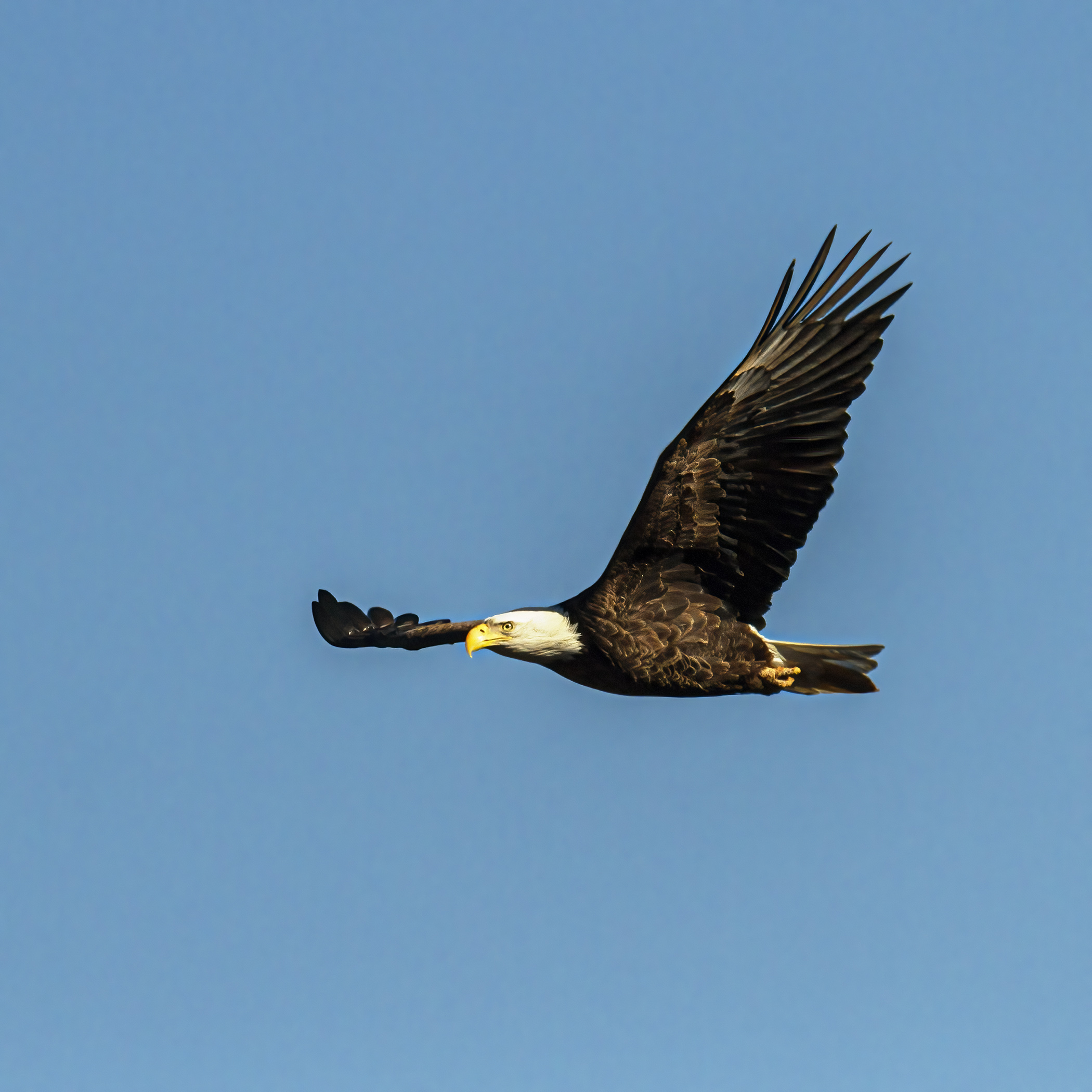
Quite often when I review my photos a second time I find photos that I missed during my initial look, like this photo of a Bald Eagle (Haliaeetus leucocephalus) that was just starting its liftoff from a tree last Saturday morning at Occoquan Bay National Wildlife Refuge.

When I spotted this pair of eagles in a distant tree, I watched and waited, hoping that they both would turn in my direction. However, the eagle in the back kept looking in the opposite direction and branches were also blocking my view. Suddenly the eagle in the front raised its wings to take off and I was able to react quickly enough to capture the moment when it was just starting to push off from the branch.

As you can probably tell from the lighting in the photo, this was another early morning encounter with bald eagles. I was very fortunately to have multiple encounters that morning. It will soon be nesting season for the eagles and I hope to able to capture some images as the eagles work on preparing the nests for another season—there are three nesting locations at the wildlife refuge, although one of the nests looks like it may have disappeared, possibly because one of the main supporting branches collapsed.

Bald Eagle

© Michael Q. Powell. All rights reserved.

Read Full Post »

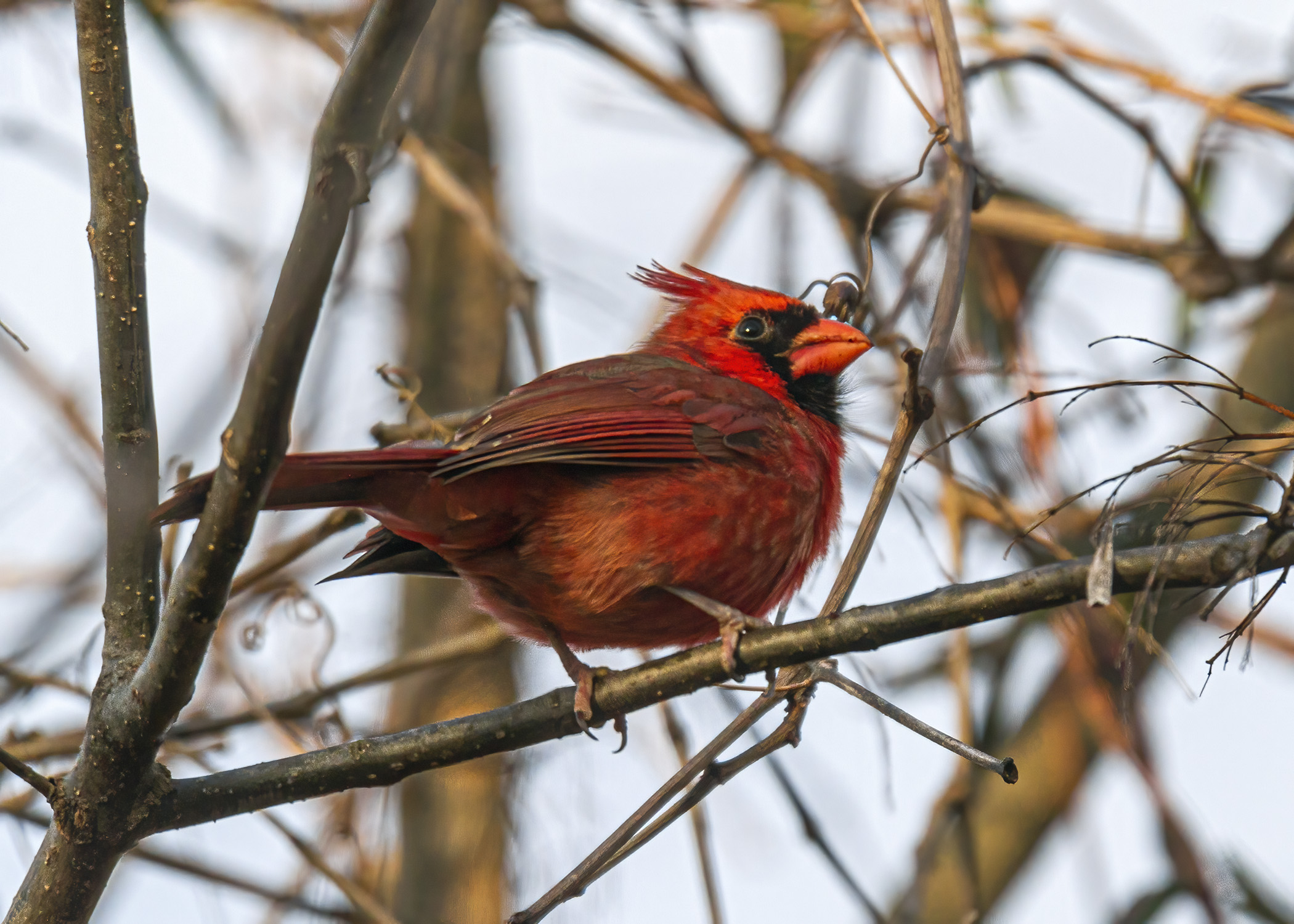
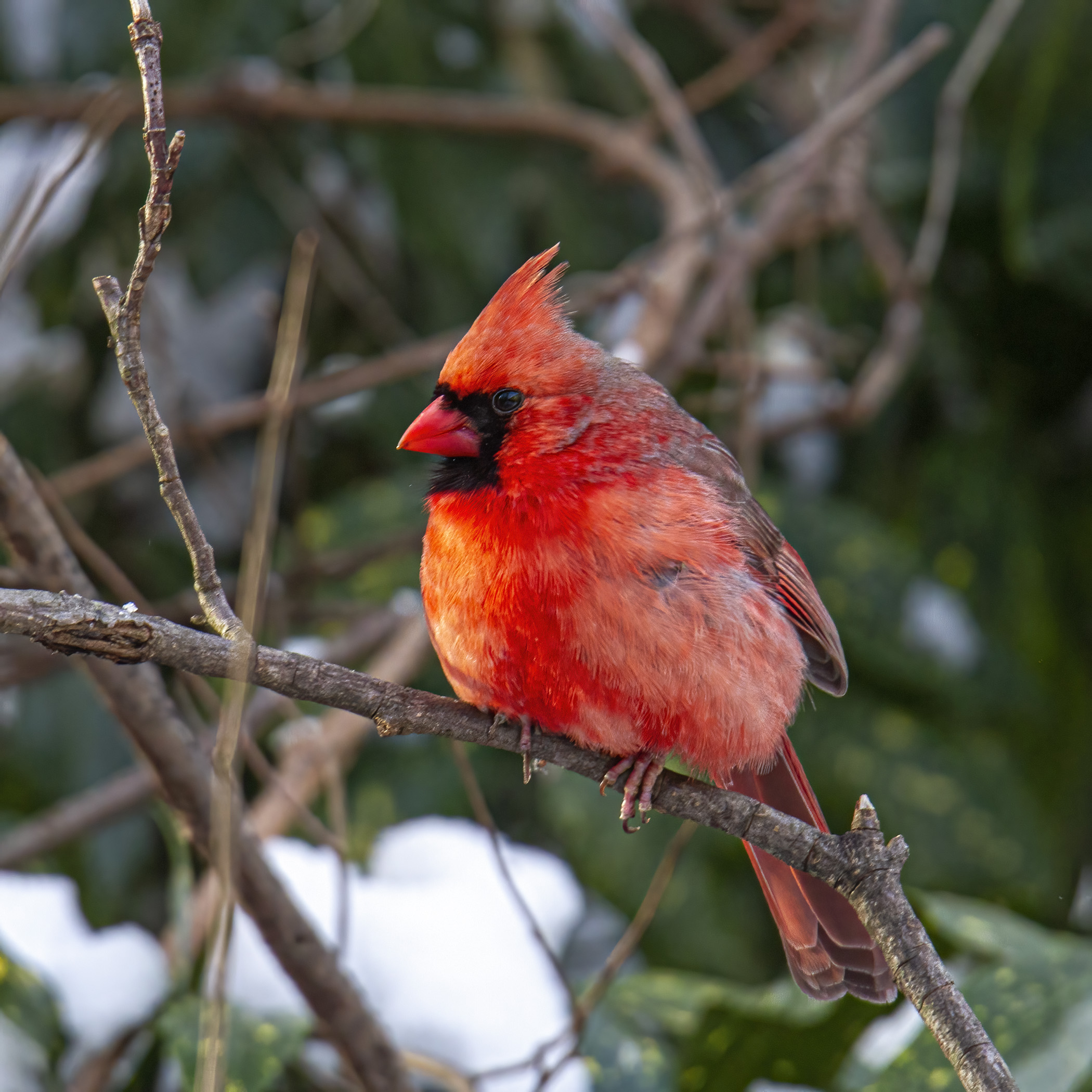
An industrious male Northern Cardinal (Cardinalis cardinalis) was foraging for food last Saturday at Occoquan Bay National Wildlife Refuge and gave me a quick sidewards glance to determine if I was a potential threat. Deciding that I posed no danger, the cardinal resumed its search for food.

Cardinals are one of my favorite birds, especially during the winter season where the world turns mostly monochromatic. My spirits are always lifted when I see the bright red plumage of a male cardinal.

Northern Cardinal

© Michael Q. Powell. All rights reserved.

Read Full Post »

Last Saturday morning I spotted a Bald Eagle (Haliaeetus leucocephalus) perched in the middle of a tangle of small trees at Occoquan Bay National Wildlife Refuge. My view was partially obscured by a large number of branches, but I still managed to focus on the eagle.

I captured this sequence of shots when the eagle unexpectedly took off. The eagle had to maneuver its wings carefully until it was away from the branches and in the final photo the eagle was finally able to display its impressive wingspan.

Bald Eagle

Bald Eagle

Bald Eagle

© Michael Q. Powell. All rights reserved.

Read Full Post »

I consider myself to be primarily a wildlife photographer, but sometimes I enjoy taking photos that do not include an animate subject. That was certainly the case last Saturday, when I travelled to Occoquan Bay National Wildlife Refuge just before sunrise. I have already posted a few photos of the sunrise that I took with my iPhone, but decided it was worthwhile sharing a few images captured with my DSLT.

When the sun first appears its light is so intense that it is difficult to capture a shot when staring right at it. As you can see in the first image, I had to underexpose the image to get a decent shot of the sun. For that reason, I like to take photos of portions of the early morning sky in which the sun is not in the frame, like the second image below that shows the pale orange color of the sky and some of the details of the distant trees.

The moon was almost full that morning and I managed to capture a detailed shot of it by once again underexposing the shot. If I had let the camera choose the exposure, I would have ended with with a bright while circle with no details. The moon was present throughout most of the morning, as shown in the final photo that I took later in the day. The daytime shot of the moon does not show as much contrast and detail as the shot in the dark, but I like the way that I was able to capture the blue sky and the clouds.

I am sure that I will be back to featuring wildlife subjects soon, but it was fun to play around with some different subjects and approaches for a change.

sunrise

sunrise

moon

moon

© Michael Q. Powell. All rights reserved.

Read Full Post »

Two Bald Eagles (Haliaeetus leucocephalus) were perched together in a distant tree early in the morning last Saturday at Occoquan Bay National Wildlife Refuge. One of them suddenly decided to take off and I captured this fun shot. I encourage you to click on the image to get a closer views of the details, including the expression on the eagle that was in mid-air.

Somehow the eagle’s pose reminded me of the winged monkeys in the Wizard of Oz. I guess it has something to do with the dangling legs that look like they could easily snatch up Toto.

The early morning light gave this image a glow that I really like. Photographers sometimes refer to this time of the day as the “golden hour,” though it often lasts for a much shorter period of time.

Bald Eagle

© Michael Q. Powell. All rights reserved.

Read Full Post »

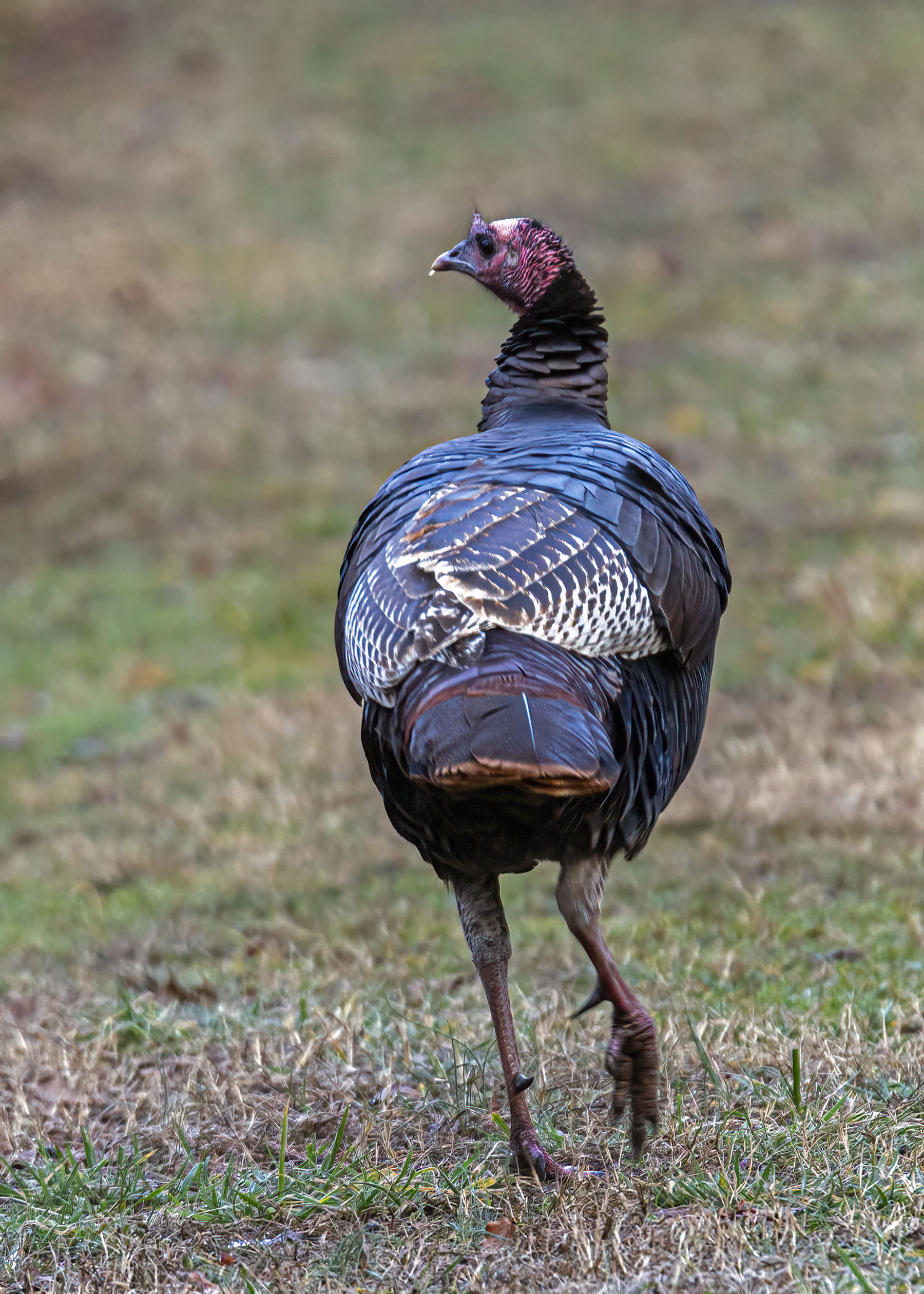
Most of the time when I see Wild Turkeys (Meleagris gallopavo) at Occoquan Bay National Wildlife Refuge, they are in small groups, but when I spotted this one last Friday it was alone. Initially the turkey was slowly strolling down the trail ahead of me on which I was walking. Somehow, though, it sensed my presence and picked up its pace until it seemed to be trotting.

I captured this image mid-stride, as the turkey seemed to be looking over its shoulder to see if I was still there. The photo is relatively sharp, though if you look at the turkey’s right foot, you can see a bit of motion blur, which enhances the sense of movement.

Wild Turkey

© Michael Q. Powell. All rights reserved.

Read Full Post »

WordPress is great at keeping statistics. Although it provides lots of data about my blog, I don’t really pay much attention to the numbers. For me, this blog has been primarily a vehicle for expressing myself creatively through my words and my photos. That was my original goal in July 2012, when I wrote my first posting, and I have remained pretty faithful to that approach.

As we begin a new year, though, it is interesting to review some of the statistics for 2023. During the year I published 359 posts with a total of 69,520 words. The blog had 43,575 views that included many views of postings from previous years—out of the 20 most-viewed postings of 2023, only one was published that year.

To give you a sense of context, since 2012 my blog has had a total of 4,995 postings with 427,759 views. The totals may seem impressive, but they actually are quite modest. I have never really aspired to attract a huge audience and am quite pleased with the success that I have achieved. Thanks so much to so many of you who have supported and encouraged me over the years.

I will probably be continuing my “normal” approach during this new year, but hope to venture a bit more into recording videos. I have a small YouTube channel that has languished a bit that I hope to reinvigorate this year.

Many of you know that I love long shadows. I captured the image below early in the morning on 30 December 2023 at Occoquan Bay National Wildlife Refuge. The image is a symbolic representation of my view of this new year that is full of promise and possibilities. Happy New Year!

long shadow

© Michael Q. Powell. All rights reserved.


Read Full Post »

A new year begins, full of promise and possibilities. Perhaps for you it starts with fireworks and loud noise, but for me, it is more quiet and introspective, like this tender little Song Sparrow (Melospiza melodia) that I spotted on Saturday at Occoquan Bay National Wildlife Refuge. Normally Song Sparrows are quite frenetic, but this one paused for an extended period of time with its feathers puffed up to stay warm, seemingly lost in its thoughts.

Happy New Year! Best wishes for a happy and healthy 2024.

Song Sparrow

© Michael Q. Powell. All rights reserved.

Read Full Post »

I could sense that this Bald Eagle (Haliaeetus leucocephalus) was preparing to take off and captured this image last Friday at Occoquan Bay National Wildlife Refuge right after it had taken a leap from the tree. I was hoping that the eagle would fly upwards and give me a chance at getting some more in-flight shots, but the eagle flew downwards and away from me.

Bald Eagle

© Michael Q. Powell. All rights reserved.

Read Full Post »

I think this Bald Eagle (Haliaeetus leucocephalus) may have been trying to snag a duck last Friday at Occoquan Bay National Wildlife Refuge. It repeatedly would swoop down over the water without success–the approach seemed quite different from the one that I would normally see when an eagle was fishing. In the bottom right of the first image, you can see some droplets of water that may have been caused by a duck diving under the water.

In the second photo, the eagle is not is as sharp focus as in the first shot, but you have a better look at the splash of the duck (?) diving to avoid the oncoming eagle. Perhaps it was just a fish, but I just don’t know enough about eagle behavior and the behavior of their potential prey to know for sure.

As you can probably tell, the lighting was less than optimal when I was taking these photos. The limited lighting made my camera’s focusing system struggle a bit and maintaining focus on the eagle in flight was a bit of a challenge. Still, I am pretty happy that I was able to capture some of the action, even if I am not 100 percent sure what was going on.

Bald Eagle

Bald Eagle

© Michael Q. Powell. All rights reserved.


Read Full Post »

It is almost nesting time for the Bald Eagles (Haliaeetus leucocephalus) at Occoquan Bay National Wildlife Refuge. Last Friday I spotted two eagles perched in the trees adjacent to the very large nest that has hosted numerous eagle couples over the years.

Later that same day I passed by the nest again and an eagle was sitting in the nest. I captured the second image when the eagle unexpectedly took off from the nest. I like the way that I captured the action,although I would have preferred not to have clipped the eagle’s wing as it extended it upwards to generate lift for its takeoff.

Bald Eagle

bald eagle

© Michael Q. Powell. All rights reserved.

Read Full Post »

The late afternoon sun was shining low in the sky and softly illuminated the side of a Bald Eagle (Haliaeetus leucocephalus) perched in a tulip tree last Friday at Occoquan Bay National Wildlife Refuge. A short time later, I spotted a Bald Eagle in a sweetgum tree with the sun shining a bit more intensely—it kept going in and out of the clouds as it dropped lower on the horizon—which made the second image feel “warmer” than the first one.

The final image shows a Bald Eagle as it was flying over the water. The sunlight was coming from almost directly behind the eagle and provided some beautiful backlighting of the eagle’s white tail feathers as well as a bit of rim lighting around the edges of its body

Bald Eagle

Bald Eagle

Bald Eagle

© Michael Q. Powell. All rights reserved.


Read Full Post »

What could possibly be better than getting a photo of a Belted Kingfisher (Megaceryle alcyon)? Capturing a shot of two of them together.

Last Friday I watched and listened as two kingfishers loudly chased each other across the sky and through the trees at Occoquan Bay National Wildlife Refuge. I thought they might be a couple, but when they landed briefly in a tree, I discovered that there were two females (females have a chestnut chest stripe that the males do not have).

The two kingfishers looked at each other and continued chattering—kingfishers have a loud, rattling call that is unique and distinctive. If you have never heard the call of a Belted Kingfisher, I encourage you to click on this link to a selection of sounds of this bird on the Cornell Lab of Ornithology website, one of my favorite resources for information about birds.

Belted Kingfishers

© Michael Q. Powell. All rights reserved.


Read Full Post »

When a Great Blue Heron (Ardea herodias) looked skyward on Friday at Occoquan Bay National Wildlife Refuge, it helped me create an unusual portrait of one of my most frequently photographed subjects.

This past Saturday I helped to decorate my church in preparation for the Christmas Eve candlelight service. One of the items that was set up was a manger scene that included the three wise men. They did not arrive at the stable at the moment of the birth of Jesus, but a bit later—we celebrate the visit of the Magi on 6 January.

According to the second chapter of Matthew, the wise men travelled from the East with their eyes turned skyward, like those of this heron, following a star in order to find and worship Jesus. It has become a bit of a cliché, but I firmly support the idea that “wise men still seek Him.”

Merry Christmas to all who are celebrating today and I pray that we all can join in the message of the angels in Luke 2:14, “Glory to God in the highest heaven, and on earth peace to those on whom his favor rests,” a peace that has seemed so elusive during 2023.

Great Blue Heron

© Michael Q. Powell. All rights reserved.

Read Full Post »

Belted Kingfishers (Megaceryle alcyon) have a distinctive chattering call and I hear these skittish little birds more often than I see them. Often my first indication of their presence is their call as they fly away from me.

Normally I see a single kingfisher at a time, but Friday at Occoquan Bay National Wildlife Refuge I watched and listened as two kingfishers loudly chased each other around through the trees and over the water. I did not get a really good look at them, because they never flew or perched close to me, but it appeared to me that they were both females. Female Belted Kingfishers have a chestnut-colored strip across their chests that males do not have, one of the few bird species that I know of in which the females are more colorful than the males.

These kingfishers are small and fast, but I managed to capture a few in-flight shots. I particularly like the first image, in which the sunlight helped to illuminate the underside of the kingfisher as she extended her wings fully as she flew through what I believe is a tulip tree. In the second photo there was more of a shadow on the bird, but I like the angle of view that I had as I pointed my camera upwards as the kingfisher zoomed by me.

Belted Kingfisher

Belted Kingfisher

© Michael Q. Powell. All rights reserved.

Read Full Post »

A female Red-winged Blackbird (Agelaius phoeniceus) lifted her head as I approached her last week at Occoquan Bay National Wildlife Refuge, but then went back to work extracting seeds from the spiky sweetgum balls. The seedpods were so numerous that they reminded me of a well-decorated Christmas tree festooned with hanging ornaments.

Red-winged Blackbird

© Michael Q. Powell. All rights reserved.

Read Full Post »

I am always thrilled when I get a look at the “crown” of a Golden-crowned Kinglet (Regulus satrapa), one of the smallest birds in our area. I photographed this cute little kinglet last Friday at Occoquan Bay National Wildlife Refuge. Golden-crowned Kinglets are frenetically active, so it can be tough to get a decent shot of one.

Surprisingly, the kinglets overwinter with us. According to the Cornell Lab of Ornithology, “The tiny Golden-crowned Kinglet is hardier than it looks, routinely wintering in areas where nighttime temperatures can fall below –40° Fahrenheit (-40 degrees C).”

Golden-crowned Kinglet

Golden-crowned Kinglet

© Michael Q. Powell. All rights reserved.

Read Full Post »

As I walking along one of the trails last Friday at Occoquan Bay National Wildlife Refuge, I spotted a Bald Eagle (Haliaeetus leucocephalus) perched in a distant tree. I had a pretty clear view of the eagle across an open, marshy area, but I couldn’t get closer without totally blocking my area. I decided to stop and to observe the eagle, hoping that the eagle would fly across the open area if it decided to take off.

In my experience, eagles generally fly away from me or behind trees, so many of my shots of flying eagles show their tail feathers or a blurry silhouette of the eagle with branches in focus. Getting a proper exposure can be a little tricky, especially when the light is bright, and it is easy to blow out the highlights in the white head or lose feather details in the shadow areas.

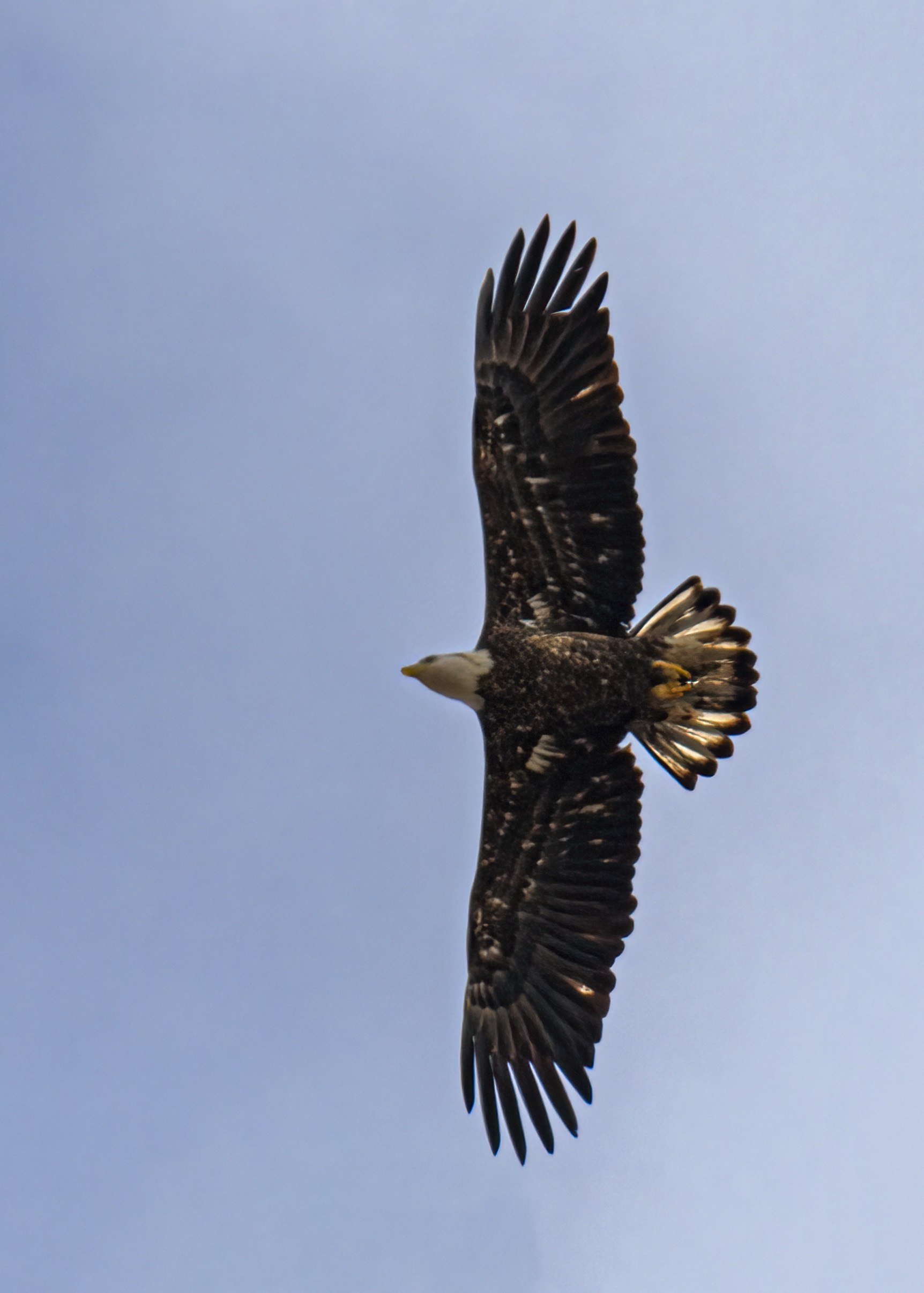
I watched and waited and was prepared when the eagle took off in my desired direction, flying across my field of view. Although the eagle initially flew behind some trees, I managed to keep my focus on the bird, as you can see in the last photo—amazingly the eye of the eagle is in focus. (As you can probably tell, the photos are presented in reverse chronological order.)

I continued to track the eagle as it flew into the open sky. In a number of my shots, the eagle’s wings blocked its head or hid it in the shadows—wing positions really matter, so I took a lot of shots. The second shot does a nice job of showing the interplay of light and shadows, which can be a particular problem in the middle of the day, when shadows are harsh, compared with the softer light near dawn and dusk.

This is one of the best sequence of images that I have managed to capture of an eagle in flight, but I will try to do even better in the upcoming months. In YouTube video reviews of some of the new high-end mirrorless cameras, I have seen pro photographers demonstrate amazing focus systems that allow them to lock and hold focus on the eyes of moving birds and animals.

I personally find it hard to justify spending that amount of money on a camera system—the combined cost of a top-end camera and long telephoto lens is about as much as I paid for my car—and am content for now to use a hands-on approach with my more “primitive” DSLR set-up. It’s a challenge, but a fun challenge, to try to photograph birds in flight and it is such a thrill when everything comes together and I am successful.

Bald Eagle

Bald Eagle

Bald Eagle

Bald Eagle

© Michael Q. Powell. All rights reserved.


Read Full Post »

It is always a joy and a challenge to photograph tiny birds, like this cute little Carolina Chickadee (Poecile carolinensis) that I spotted last Friday at Occoquan Bay National Wildlife Refuge.

Even when they are perched, these chickadees are a bundle of energy and seem to be constantly changing head and body positions. As you can see from these two shots, the chickadee was surrounded by branches, so I had to bend and stretch a lot to get a clear shot. Lighting was also an issue, because the little bird often had its head pointed down and was covered with shadows.

I especially like the chickadee’s pose in the first photo, in which he was looking upward and the light was illuminating his face.

Carolina Chickadee

Carolina Chickadee

© Michael Q. Powell. All rights reserved.


Read Full Post »

I was delighted to spot this stunning male Redhead duck (Aythya americana) on Friday in the waters off of Occoquan Bay National Wildlife Refuge. I have seen this species only a few times, so I initially was not able to identify it. However, as I was capturing these shots, I was pretty sure that the duck’s stunning brown head, black-tipped bill, and  distinctive yellow eyes would make it easy to find in my bird identification guide—I was right.

According to the Cornell Lab of Ornithology, Redheads are exceptionally gregarious and gather in large flocks in the winter, especially in the Gulf of Mexico. On this occasion, however, this Redhead appeared to be by himself.

The Redhead was quite far away, so I had limited options for composing my shots as I walked along the water’s edge. I managed to incorporated some of the environmental elements to come up with a couple of images that I really like—although it may appear that the duck is perched on rocks, I think that they may be portions of a waterlogged tree trunk or stump.

Redhead duck

Redhead duck

© Michael Q. Powell. All rights reserved.

Read Full Post »

The coloration of female Northern Cardinals (Cardinalis cardinalis) is not as bold and flashy as their male counterparts, but I think they are equally beautiful, like this one that I photographed recently at Occoquan Bay National Wildlife Refuge.

I do love bright colors—I drive an Ignition Orange KIA Soul—but I think there is something more refined and sophisticated when those colors are used in moderation as accents. That is why I really like the way a female cardinal has reddish streaks in her crown and on the outer portions of her wings.

Northern Cardinal

© Michael Q. Powell. All rights reserved.


Read Full Post »

Birds have to work really hard to find food during the cold season. This female Red-wing Blackbird (Agelaius phoeniceus) decided that it was worth her effort to try to extract some seeds from the spiky seed pods of a sweetgum tree earlier this month at Occoquan Bay National Wildlife Refuge.

Some of you may be wondering how this can possibly be a Red-winged Blackbird. After all, this bird is not at all black and her wings are not red. When I first started getting serious about my photography more than 11 years ago, I would often go out shooting with my mentor Cindy Dyer, who loved to photograph flowers and sometimes insects. She rarely photographed birds and I had no experience identifying them.

During one such outing I photographed a bird on a rebar trellis at one a botanical garden. I assumed that it was one of the many types of sparrows that I lumped together as “little brown birds.” When I posted the shots in a Facebook birding forum, I was shocked to learn that it was a female Red-winged Blackbird. (Check out my 27 September 2012 blog posting called “Intense bird” for more details on that adventure, including my first ever shots of a female Red-winged Blackbird. I also remember that 2012 encounter well because I was shooting with a Nikon D300 that Cindy had lent me along with a Tamron 180mm macro lens. I did not switch from Canon to Nikon, but immediately orders the Canon version of the lens, which continues to be one of my favorite lenses.)

I am a lot more knowledgeable about birds now and have reconciled myself to the reality that many species derive their names from the males, who tend to be more colorful in appearance. As most of you know, I love to photograph insects, particularly dragonflies, but they have now completely (or maybe almost completely) disappeared from the scene, so I will be focusing my camera and my attention mostly on birds in the upcoming cold months.

Red-winged Blackbird

© Michael Q. Powell. All rights reserved.

Read Full Post »

White-throated Sparrows (Zonotrichia albicollis) always remind me of Santa Claus. They show up in the winter, have white beards, and are often chubby. I spotted this White-throated Sparrow last Friday at Occoquan Bay National Wildlife Refuge.

I thought that perhaps it was the angle at which I photographed this bird that made it look rotund, but the sparrow looked just as spherical when it changed its pose, as you can see in the second photo.

The bird reminds me of the time when the priest at my church remarked that he used to worry about getting into shape until he realized that round is in fact a shape. More recently I saw a meme that stated that Thanksgiving is the time of the year when many men decide to get in shape—in shape to play Santa Claus.

Have a wonderful day!

White-throated Sparrow

White-throated Sparrow

© Michael Q. Powell. All rights reserved.


Read Full Post »
One of the most distinctive ducks that migrates into my area for the winter is the Hooded Merganser (Lophodytes cucullatus). The male has a curious-looking head that is black and the white and the female has an orange-brown hairstyle that literally sticks out.

Sometimes Hooded Mergansers arrive in groups and I have seen some recent photos by local photographers of males competing for the attention of the females. In this case, cover, I spotted only one couple at the small suburban pond not far from where I live. The ducks dozed a bit and occasionally preened their feathers, so there was not a whole lot of action to capture. I was content to capture a few “record” images and hope I will have some more chances to see these little diving ducks in the upcoming months.

Hooded Merganser

Hooded Merganser

Hooded Merganser

© Michael Q. Powell. All rights reserved.

Read Full Post »

There are almost always a few Great Blue Herons (Ardea herodias) at Occoquan Bay National Wildlife Refuge. Most often I see them patiently fishing in the water, but sometimes I have to scan the tangled vegetation surrounding the ponds to find them, as was the case last Friday. Some herons are very skittish and fly away as soon as they sense my presence, but this heron remained in place while I carefully composed this image and continued silently along the trail.

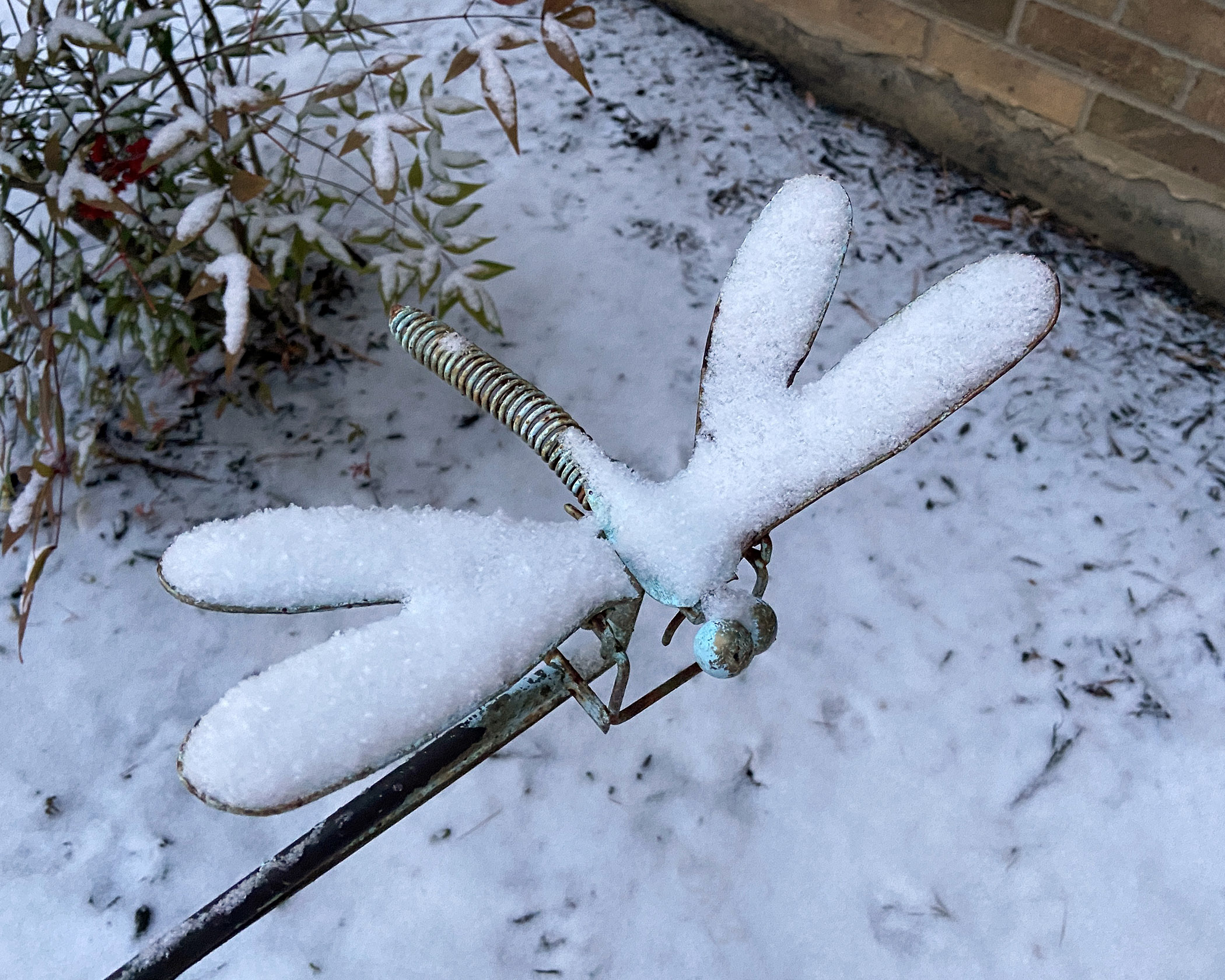
Unlike the Great Egrets, Green Herons, and Ospreys that leave our area in the winter, Great Blue Herons are with us year round. Now that the weather is getting colder and we have already had our first snowfall (it was less than a half-inch (1 cm) or so), I suspect that it is getting harder for herons to find food. I am sure, though, that I will continue to see herons foraging for food, including in the frigid waters of the ponds and the bay—even when the surface of the water freezes, there is enough movement in the water that there are some open areas.

Great Blue Heron

© Michael Q. Powell. All rights reserved.


Read Full Post »

« Newer Posts - Older Posts »