Feeds:
Posts
Comments

Archive for the ‘Winter’ Category

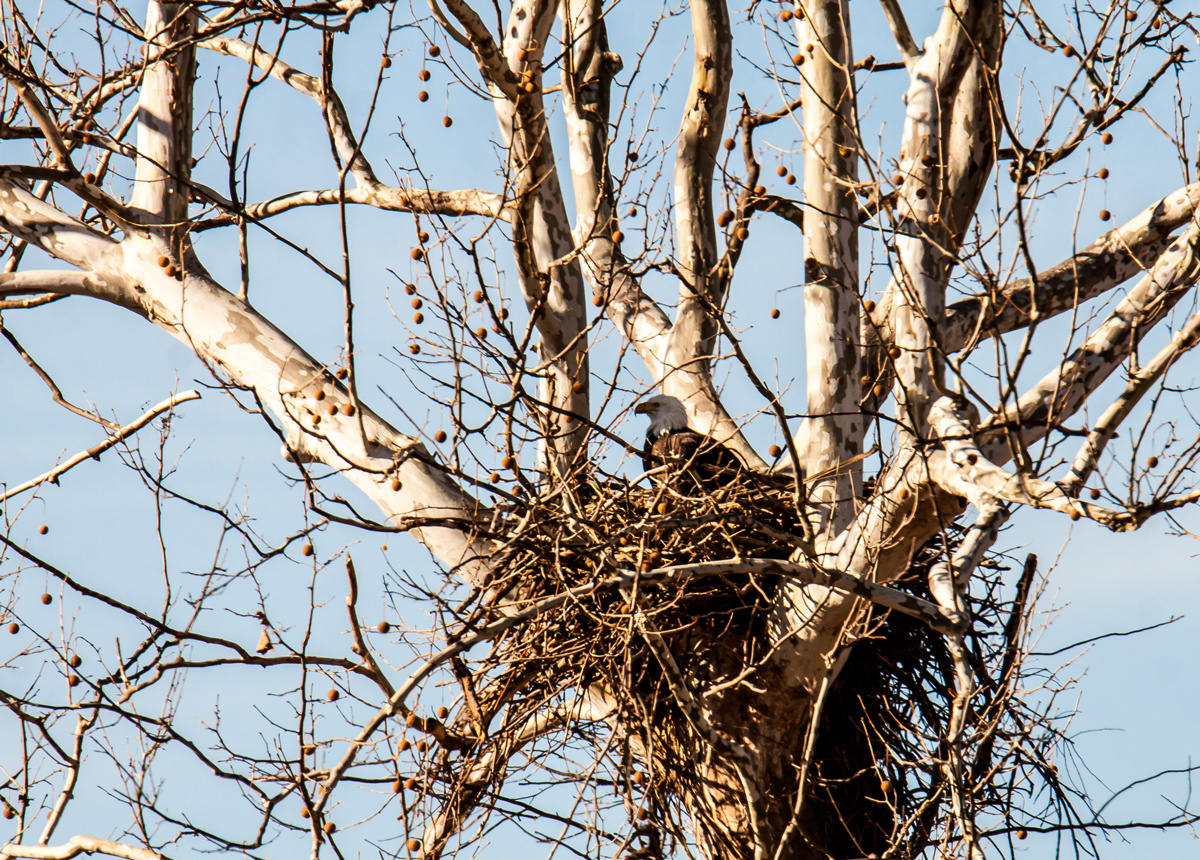
From a distance I was able to catch a glimpse of a nesting Bald Eagle (Haliaeetus leucocephalus) last week at Occoquan Bay National Wildlife Refuge. I love the way that this shot shows the awesome structure of the tree in which the eagles built their nest.

As I mentioned in an earlier posting, officials at the wildlife refuge have blocked of roads near this nest to keep the eagles from being  unnecessarily disturbed by human activity. I captured this image from behind the barriers. As nesting activity continues, I suspect that the barriers will be pushed even further back, so I decided to get this shot while I was still able to do so.

Once I was aware of the presence of the eagle in the nest I attempted to be as stealthy as I could in approaching the barrier, which is a little tough to do when you are standing in the middle of a wide trail with fields on both sides. I stayed low and left after I had taken a few shots.

Bald Eagle

© Michael Q. Powell. All rights reserved.


Read Full Post »

Is this love or anger or a bit of both? Relationships of any sort are complicated and I don’t know enough about eagle behavior to interpret the interaction between these two Bald Eagles (Haliaeetus leucocephalus) that I observed one morning last week at Occoquan Bay National Wildlife Refuge.

Sharp-eyed reader viewers may have noted that these two eagles are perched on the same branch where I previously photographed an eagle couple. The branch is part of a tree in which there is a nest that I am now relatively certain is an eagle nest. It is a pretty good distance off of the path and partially hidden, so I am hoping that the wildlife will judge that passing humans won’t unduly disturb what may become nesting eagles and will leave the path open.

As for the behavior, I must admit that I am a bit romantic and couldn’t help but note how the space between their beaks forms a heart. I’m voting therefore for love.

Bald Eagle

© Michael Q. Powell. All rights reserved.


Read Full Post »

Bluebirds never fail to make me feel happy—there is just something really positive about their attitude and their colors.

These Eastern Bluebirds (Sialia sialis) made it a little easier for me to capture their images by perching on the tip of  branches this past Saturday at Occoquan Bay National Wildlife Refuge.

Eastern Bluebird

Eastern Bluebird

© Michael Q. Powell. All rights reserved.

Read Full Post »

Birds can be very expressive, though it can sometimes be hard to interpret their expressions. It was pretty clear, however, that this Northern Mockingbird (Mimus polyglottos) was not happy about something last Friday at Occoquan Bay National Wildlife Refuge.

Was it me?

In addition to the priceless expression on the bird’s face, I really love the limited color palette in this image. It also has a kind of sparse minimalist feel that appeals to me.

Northern Mockingbird

© Michael Q. Powell. All rights reserved.


Read Full Post »

I  love the small birds that are always around us, but they rarely perch long enough in the open for me to photograph them. I spotted this energetic little Carolina Chickadee (Poecile carolinensis) last Friday moving about in the vegetation at Occoquan Bay National Wildlife Refuge and was happy when it paused for a second to pose for me.

The tiny bird was still for only a moment and then hopped off the branch and disappeared in the vegetation. I was thrilled when I looked at the image to see that I had captured a pretty clear view of the eye and that there was even a nice little catchlight—almost all of us who do portraits of any sorts are sort of obsessive about the eyes of our subjects.

Carolina Chickadee

© Michael Q. Powell. All rights reserved.

Read Full Post »

Great Blue Herons (Ardea herodias) at Occoquan Bay National Wildlife Refuge were really busy yesterday now that much of the ice has broken up and is melting. This heron caught a fish so big that it really seemed to be struggling to gain altitude as it flew away.

Temperatures in our area have been below freezing for almost a month and I was starting to get worried that the Great Blue Herons would starve. Somehow, though, they manage to survive. I did not actually see this heron catch the large fish. I first caught sight of the heron when it flew with the fish to a section of floating ice in the distance and tried to manipulate the fish into position.

Eventually it seemed to have decided to head for solid ground and I captured this shot just after the heron had taken off from the ice. I tracked it in the air as it flew to a little island in the middle of the bay, where I hope it was able to finally swallow the fish.

Great Blue Heron

© Michael Q. Powell. All rights reserved.

Read Full Post »

I never cease to be amazed by the balance and flexibility of birds, like this female Northern Cardinal (Cardinalis cardinalis) that managed to reach down and grab some poison ivy berries this past Monday at Occoquan Bay National Wildlife Refuge. I am probably going to return to that refuge today, because I am not sure if it will be open in the upcoming days if there is a shutdown of the federal government.

Northern Cardinal

© Michael Q. Powell. All rights reserved.


Read Full Post »

One of my fellow bloggers, Jodi of The Creative Life In Between, saw a recent photo I took of a Yellow-rumped Warbler and asked if I minded if she used it for inspiration for a painting. Check out the wonderful watercolor she painted and the other cool postings on her blog.  Thanks, Jodi.

Jodi's avatarthe creative life in between

Yellow (rumped) Warbler in Winter Watercolor 11×14 140 lb cold press

A Winter Warbler Watercolor

I was looking at some beautiful photos on Mike Powell’s Photography Blog the other day of a fluffy little yellow-rumped warbler he spotted eating berries in the frigid winter weather at the Occoquan Bay National Wildlife Reserve in Virginia this month.

He was so cute, I asked Mike if I could paint one of his photos.  He kindly obliged.  My watercolor doesn’t do justice to the beauty of the bird or the magnificent shot Mike caught, but it was fun to do.  It’s been a while since I painted a bird.  And this little guy had his fluffiest coat on in the frigid temperatures we’ve been experiencing in the Northeast part of the United States lately, which made him just too irresistible for me to resist.

Thanks for giving me a shot at him Mike…

View original post 74 more words

Read Full Post »

As this male Northern Cardinal (Cardinalis cardinalis) stared at me Monday from within a bush, I couldn’t help but wonder if he thought he was camouflaged. It is hard to hide that bright red color.

Northern Cardinal

© Michael Q. Powell. All rights reserved.

Read Full Post »

No matter how much you love someone, minor squabbles are virtually inevitable and sometimes they can get quite heated. I am not sure what was being discussed, but the members of this Bald Eagle (Haliaeetus leucocephalus) couple seemed to have differing views that they defended loudly and emphatically on Monday at Occoquan Bay National Wildlife Refuge.

In many ways this photo embodies what I most love to capture when I go out with my camera. Although it is wonderful to capture a static subject, it is even more wonderful to capture some action or even better some interaction. I think viewers are drawn into the drama and emotion of the moment and creatively try to imagine what was going on in the photo. Are these angry birds? Is this how eagles express love? We, of course, can’t know the true explanation for the behavior that I document, but that sense of mystery and incertitude can sometimes further stimulate our imagination.

I didn’t see this couple kiss and make up, but a short time later they took off together, apparently having resolved whatever problem had prompted their little squabble.

Bald Eagle

© Michael Q. Powell. All rights reserved.

Read Full Post »

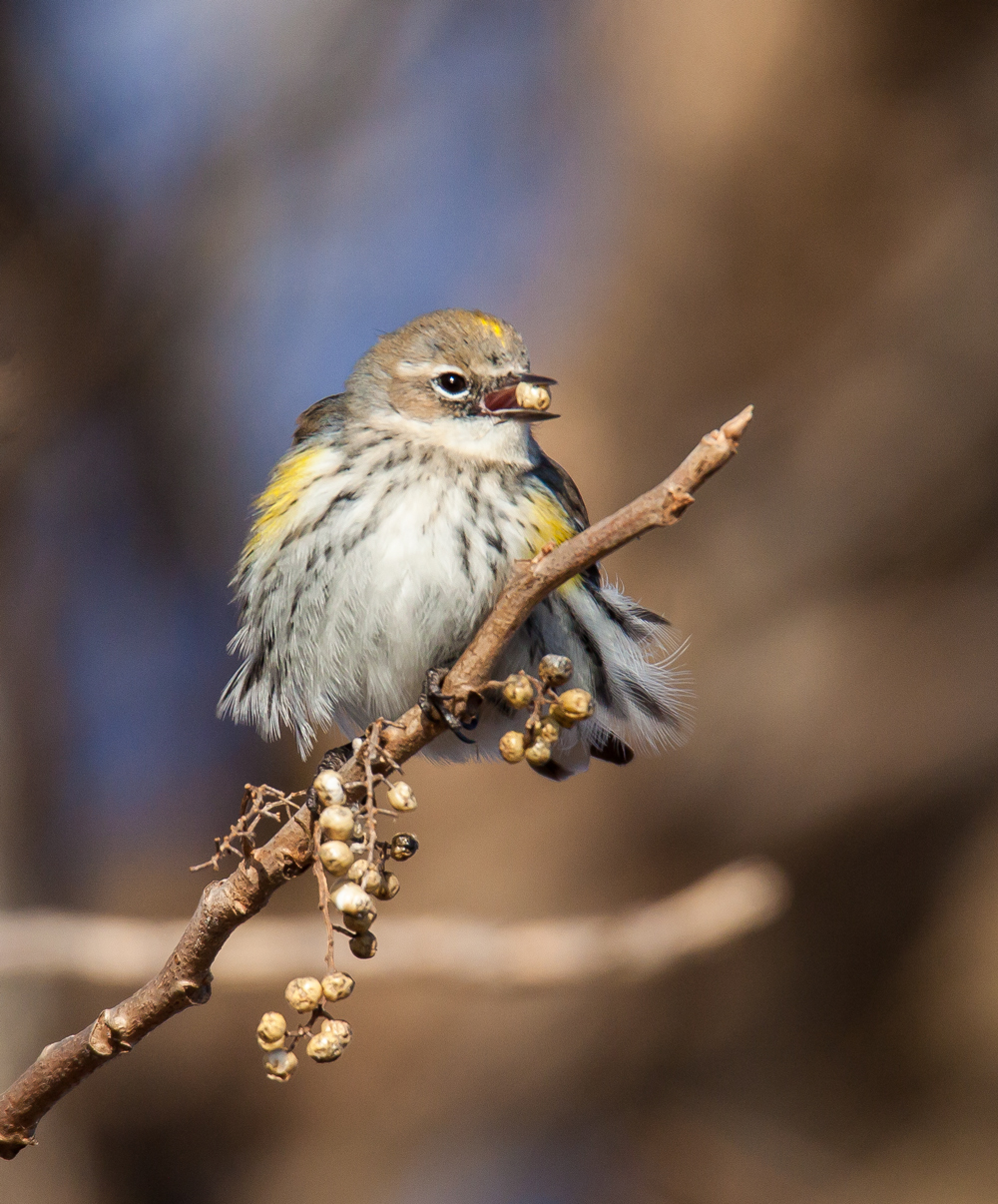
A Yellow-rumped Warbler (Setophaga coronata) really seemed to be enjoying the poison ivy berries that it managed to find on a frigid morning earlier this month at Occoquan Bay National Wildlife Refuge.

This little bird was so focused on finding food that it was not disturbed by my presence, which allowed me to capture a series of images.

Yellow-rumped Warbler

Yellow-rumped Warbler

Yellow-rumped Warbler

© Michael Q. Powell. All rights reserved.


Read Full Post »

The berries looked dried up and unappetizing to me, but to the male Northern Cardinal (Cardinalis cardinalis) that I spotted last Friday at Occoquan Bay National Wildlife Refuge, they provided much needed nourishment on a frigid winter day.

Northern Cardinal

© Michael Q. Powell. All rights reserved.

Read Full Post »

On the day of my arrival in Brussels, Belgium for a short business trip, I went for a short walk in the botanical garden, one of my favorite spots to visit in this city. It is within walking distance of my hotel and is one of the few places where I know I can find a taste of nature in the crowed inner city area of Brussels.

Initially I noted only a few mallard ducks and moorhens in the small pond at the botanical garden, but when I looked more closely, I spotted a couple of spectacularly-colored ducks sleeping in a remote corner. I wasn’t sure what they were, but that did not deter me from taking some photos of them. When I went searching on the internet for the species of ducks in Brussels, none of them seemed to match the ones that I had seen. So I switched to searching using more descriptive terms and discovered that the birds were not ducks, but were in fact geese—Egyptian Geese.

As their name suggests, Egyptian Geese (Alopochen aegyptiaca) are native to the Nile River area and sub-Saharan Africa. There are now established breeding populations in parts of Europe and even in the United States.

I took this photo with my Canon SX50, a superzoom point-and-shoot camera that I usually take with me when I travel. As you can see from this image, the camera is capable of capturing a pretty good amount of detail and color.

Egyptian Goose

© Michael Q. Powell. All rights reserved.

Read Full Post »

Some birds may seek shelter when the weather is inhospitable, but sparrows seem to be active and busy all of the time, like this White-throated Sparrow (Zonotrichia albicollis) that I spotted in the snow this past Friday at Occoquan Bay National Wildlife Refuge.

It is a bit of a challenge to get a proper exposure when so much of the frame is filled with white snow. As I understand it, the camera would like to render everything to a neutral gray, so it is necessary to overexpose the image or adjust it in post-processing.  In my initial RAW image, the sparrow was very much in the shadows and the snow had a grayish-blue tinge to it. I cranked up the exposure to the point that most of the snow turned almost pure white and I was left with soft bluish shadows that I really like. I am also pretty pleased with the sparrow’s pose as it paused for a moment to survey the landscape.

White-throated Sparrow

© Michael Q. Powell. All rights reserved.

Read Full Post »

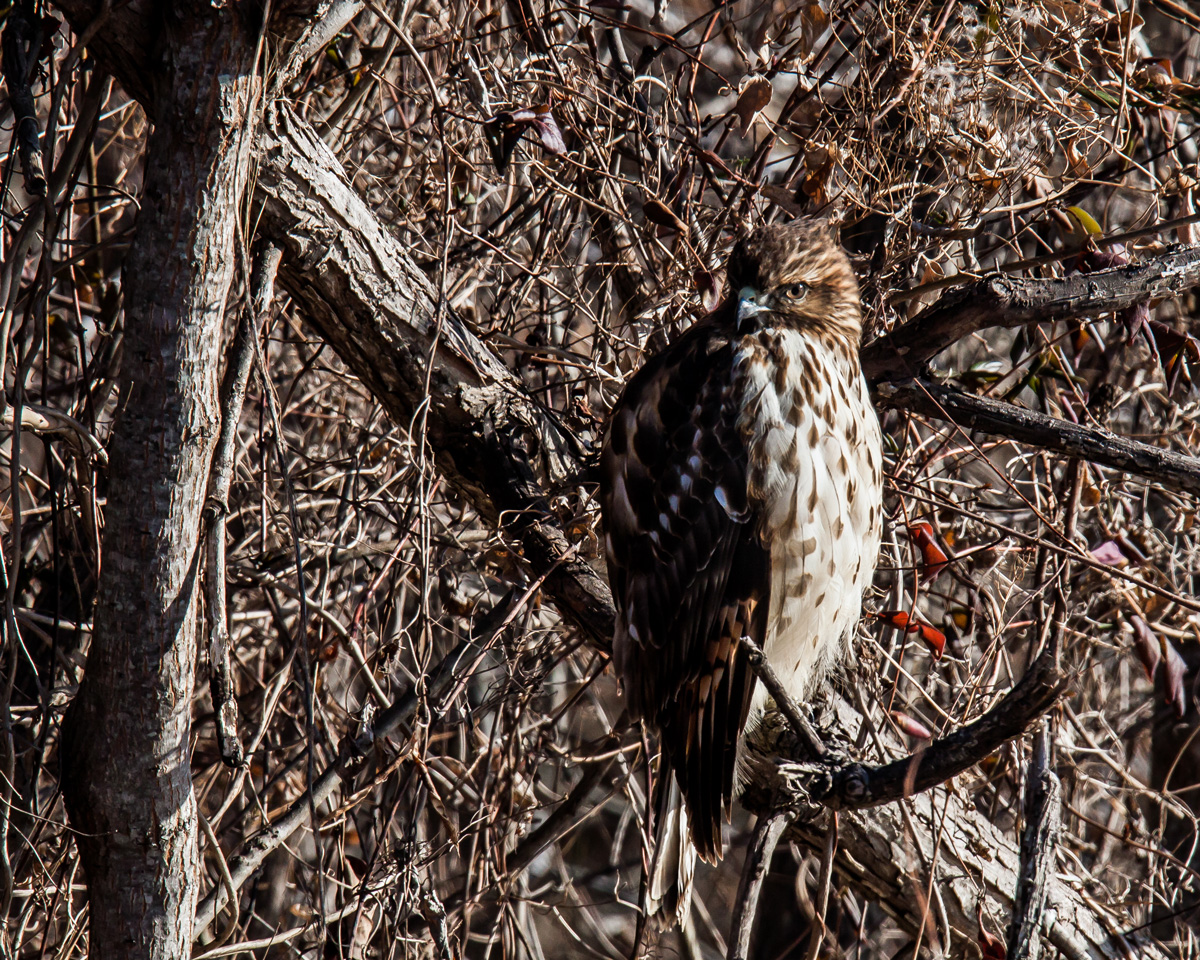
One of the basic rules of portrait photography is that you should try to be at eye level with your subject. That’s a bit tough to do with raptors, but this past Friday at Occoquan Bay National Wildlife Refuge I encountered a juvenile Red-shouldered Hawk (Buteo lineatus) that was perched very low on a tree and I managed to capture a number of shots of it. The wind was blowing strongly at the time and my guess is that the hawk was trying to shelter itself from the wind by perching low and from the cold by fluffing up its feathers (as you can see in the the second image).

Red-shouldered Hawk

Red-shouldered Hawk

© Michael Q. Powell. All rights reserved.


Read Full Post »

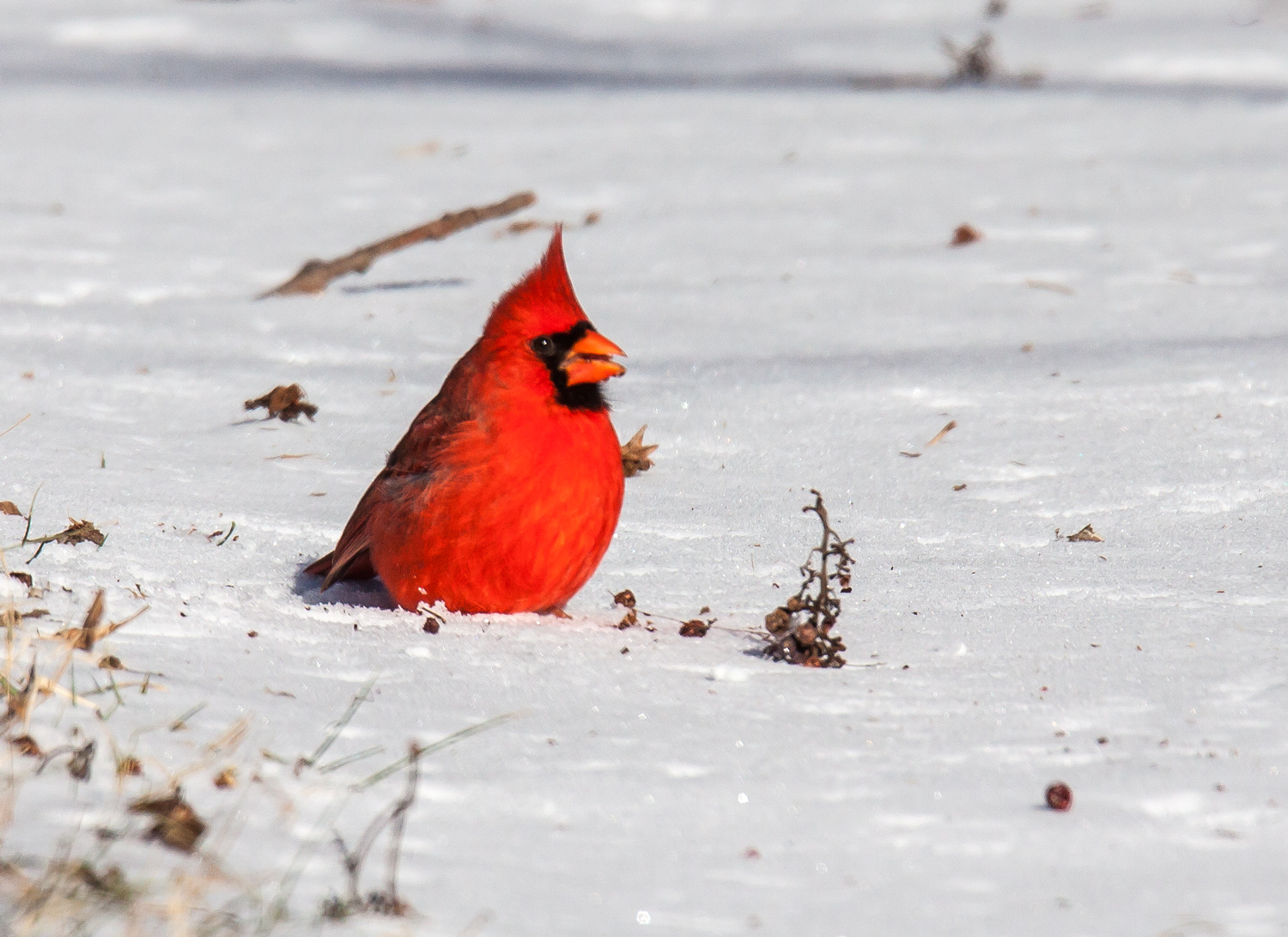
It is always a joy to see the bright red color of a male Northern Cardinal (Cardinalis cardinalis), especially during the winter, when the world seems almost monochromatic. I spotted this one yesterday at Occoquan Bay National Wildlife Refuge as he pecked about in the drifted snow. We have had only a small amount of snow, but the weather has remained steadfastly below freezing, so it has stayed with us for an extended period of time.

Northern Cardinal

© Michael Q. Powell. All rights reserved.

Read Full Post »

Sometimes when a bird fluffs up its feathers, its appearance changes enough that identification becomes more difficult than usual. That was certainly the case with this little Carolina Wren (Thryothorus ludovicianus) that I spotted on New Year’s Day at Occoquan Bay National Wildlife Refuge. The head and the tail looked normal for a Carolina Wren, but I had never before seen spots on the back of one.

Once again, experts in a Facebook forum came to my rescue and reassured me that this was normal behavior for a Carolina Wren. When they fluff up their feathers to roost at night, the spots are visible too, although in this case I suspect that the wren was merely trying to retain body heat in the bitter cold weather that we have been experiencing the last couple of weeks.

Carolina Wren

© Michael Q. Powell. All rights reserved.

Read Full Post »

I spotted this fluffy Hermit Thrush (Catharus guttatus)on New Year’s Day at Occoquan Bay National Wildlife Refuge. In this frigid weather, all of the birds seem unusually round as they try to retain their body heat.

I don’t recall ever seeing a Hermit Thrush before, but when I did a search in my blog, I was surprised to discover that I had photographed one in December 2016 eating berries—here is a link to that posting. At that time I could not identify the species and asked for assistance. I guess I did not internalize the identification very well, for I ended up asking for help in a Facebook forum again.

It is funny how we associate certain words with memories from out childhoods. When I hear the word “Thrush,” I immediately think of the “enemy” organization in the television series “The Man From U.N.C.L.E.” According to a page on the IMDb website, “In the series, the organization was merely called Thrush. Ace paperbacks, which published a series of paperback novels based on the show, had one installment in which Thrush stood for The Technological Hierarchy for the Removal of Undesirables and the Subjugation of Humanity.”

This winter I am spending more time outdoors and it is exciting to discover how many birds and other little creatures are active, even in the most inclement, inhospitable weather. The challenge for me is to stay motivated and dressed warmly enough to be able to spot and photograph these little beauties, like this Hermit Thrush, that may have traveled south to winter with us.

Hermit Thrush

© Michael Q. Powell. All rights reserved.

Read Full Post »

On Monday, I was having a nice little portrait session with a male Ruby-crowned Kinglet (Regulus calendula) at Occoquan Bay National Wildlife Refuge, but I wanted more than just a glimpse of his “ruby crown.” Amazingly, he bowed in my direction to make my wish come true.

For those of you who may not be familiar with kinglets, they are tiny birds that are even smaller than chickadees. During this past fall, I became aware that they spend their winters in my area and I have been hunting them ever since. Both the Ruby-crowned Kinglet and the Golden-crowned Kinglet are energetic and elusive and rarely sit still long enough for me to get a shot. When it comes to the “ruby crown,” only the male has it and it is only occasionally visible. That is why I was ecstatic to be able to get such a clear shot of the ruby crown of this kinglet.

Wishes do come true—maybe a ruby crown is better than ruby slippers.

Ruby-crowned Kinglet

Ruby-crowned Kinglet

Ruby-crowned Kinglet

© Michael Q. Powell. All rights reserved.

Read Full Post »

How did you spend your New Year’s Day? When I arrived yesterday at Occoquan Bay National Wildlife Refuge, the sun had just risen. I was a bit shocked to see four other cars in the parking lot, given that it was only 7:30 in the morning. I trudged about the refuge all day (and have a bunch of photos to sort through) and as I departed at 6:00 pm, the full moon was rising.

It was a long, tiring day, but I can’t think of anything I would rather have been doing to start off the new year.  Just for fun, I’m also including the view from inside my car as I got ready to step out into the crisp morning air. I am not sure it was actually 5 degrees outside ( minus 15 degrees C), but that was what my car showed as the outside temperature. Eventually it “warmed up” to about 24 degrees (minus 5 C) during the day, though the occasional gusts of wind made it feel colder.

sunrise

moonrise

cold

© Michael Q. Powell. All rights reserved.

Read Full Post »

So how are you feeling about the new year that has just begun? Are you feeling more like the Eastern Bluebird (Sialia sialis) on the left, agitated and out front, or more like the one on the right, mellow and content to remain in the background? (Photographed this past Friday at Occoquan Bay National Wildlife Refuge.)

I would never have thought of a bluebird when I thought of an “angry bird,” but it sure looked irritated or even angry about something. Perhaps it was a territoriality issue or a fellow bluebird had just cut him off in traffic without even signalling. Whatever the case, I love the intensity of the pose that I managed to capture.

I hope that this first day of the new year finds you at peace and optimistic. Best wishes to all of you for a blessed new year. 

Eastern Bluebirds

© Michael Q. Powell. All rights reserved.

Read Full Post »

The moon rose in mid-afternoon on Fridat at Occoquan Bay National Wildlife Refuge and it looked like this Bald Eagle (Haliaeetus leucocephalus) was howling at the moon. In reality, I think it might have been calling out to its mate.

As you can probably notice, I was shooting almost straight up when I took this shot. I had spotted the eagle from a distance through the branches of a tree and was able to creep relatively close to it before I had to move to an exposed position. I don’t think that the eagle had seen me yet when I took this shot, so I probably was not the cause of the eagle crying out.

The image is a bit more cluttered with branches than I would have preferred, but I really like the pose that I was able to capture, particularly the details of the beak and the eye.

Bald Eagle

© Michael Q. Powell. All rights reserved.


Read Full Post »

This male Eastern Bluebird (Sialia sialis) seemed to be pretty happy to have found a batch of little red berries on which to munch on Friday at Occoquan Bay National Wildlife Refuge. I am not sure what those berries are, but they undoubtedly were a welcome source of energy for the little bird on a frigid morning.

I am in somewhat of a contemplative mood this morning on the final day of 2017. Five or so years ago, before I started to get more serious about photography, I might have looked at this image and wondered how it would be possible to capture a shot like this. How could I get close to such a small bird? How could I compose a pleasing image? What would I need to do to separate the subject from the cluttered background?

At the start, I needed to think consciously about all of these factors and it was somewhat overwhelming. Now, thankfully, I have had so much practice that most of these factors are second nature to me and I know how to produce an image like this. There is, of course, still lots of room for improvement, for sharpening my eye and my skills, but objectively speaking I have can see a gradual progression in my photography.

What does 2018 hold for me? I have no formalized plans, no set goals. I often describe myself as an “opportunistic shooter”—I like to walk around and photograph whatever I happen to spot. Location, though, does really matter and I anticipate visiting a few new places this coming year. I am starting to realize that I enjoy my wildlife photography most when I am more or less on my own. Popular locations often have too many other people for my personal sense of comfort. When faced with the choice of going to a place with more wildlife (and more people) or one with less varied wildlife, I increasingly find myself opting for the more isolated area.

Best wishes to all of you for a blessed 2018. Happy New Year.

Eastern Bluebird

© Michael Q. Powell. All rights reserved.

Read Full Post »

As I was tracking a pair of Bald Eagles (Haliaeetus leucocephalus) yesterday in the sky over Occoquan Bay National Wildlife Refuge, I was surprised when they landed in the distance on the ice. I have no idea why they did so, but they stood there on the ice for a long time.

Were they just chilling? Did they want to try ice skating? Could they see a fish through the ice? I have lots of questions and few answers, but it was definitely a cool sighting.

Bald Eagles

© Michael Q. Powell. All rights reserved.

Read Full Post »
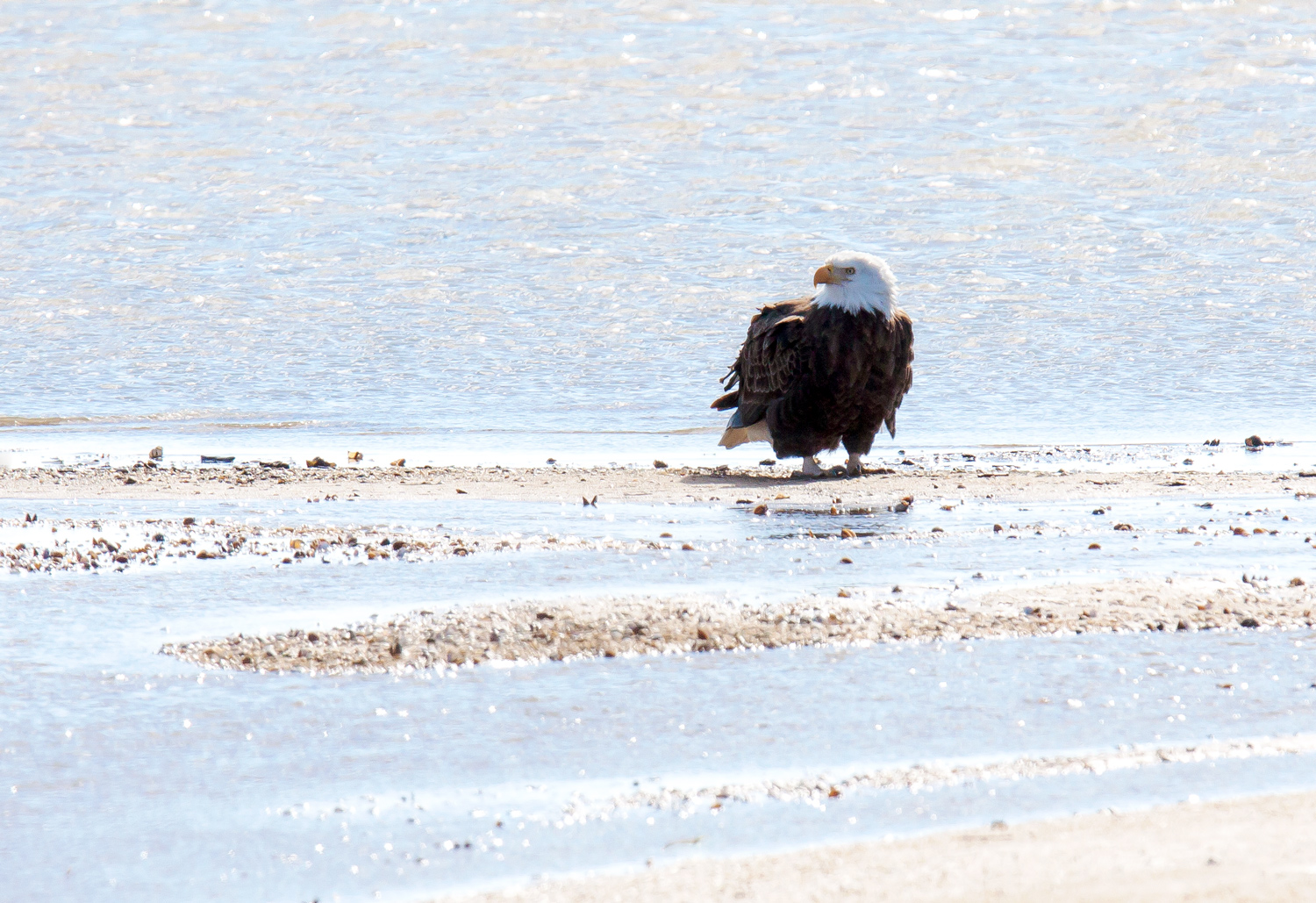
Folks with more experience can tell the age of this immature Bald Eagle (Haliaeetus leucocephalus) from its colors and the pattern of its plumage. As for me, I was thrilled to get a shot of it when it flew over me yesterday at Occoquan Bay National Wildlife Refuge.

I found a helpful posting on-line, A Guide To Aging Bald Eagles by Ron Dudley, that provides helpful tips and photographs for determining the age of an immature Bald Eagle. I am not completely certain, but it looks like this eagle may be in its second or third year, though I would welcome a correction or clarification from someone who has more experience with birds than I do.

immature Bald Eagle

© Michael Q. Powell. All rights reserved.


Read Full Post »

A Bald Eagle (Haliaeetus leucocephalus) perched on the top of a post this morning at Occoquan Bay National Wildlife Refuge looked for a moment like it was going to pounce on another eagle that had just landed on a platform attached to the post. Apparently the larger eagle, almost certainly, decided she had something to say to her mate and was merely hopping down to his level and she landed really close to him.

The female eagle seemed unhappy with him and made several loud cries in his direction. He just stood there and took it and in the third shot has the look of a henpecked husband. Apparently she also told him that he needed to perch on the upper post. Perhaps this is the eagle equivalent of sleeping on the couch.

Bald Eagles

Bald Eagles

Bald  Eagles

Bald Eagles

© Michael Q. Powell. All rights reserved.

Read Full Post »

The wind was blowing hard on Christmas Day at Occoquan Bay National Wildlife Refuge and one of the Bald Eagles (Haliaeetus leucocephalus) took to the sky, spread its impressive wings, and effortlessly soared above me for a short while.

I really enjoyed the Christmas show.

Bald Eagle

Bald Eagle

Bald Eagle

© Michael Q. Powell. All rights reserved.


Read Full Post »

I am not sure why this Great Blue Heron (Ardea herodias) was sticking out his tongue at me on Monday at Occoquan Bay National Wildlife Refuge—maybe this is how herons wish each other Merry Christmas.

I have gotten glimpses of a heron’s tongue before, but there is the first detailed look that I have had. I am amazed at the way that herons are able to swallow their prey whole and imagine that the tongue has to be tucked away somewhere within its mouth when doing so.

When I look at this image, it looks like the heron is singing, perhaps bringing tidings of comfort and joy and wishes for peace on the earth.

Great Blue Heron

© Michael Q. Powell. All rights reserved.

Read Full Post »

It was cold and windy on Christmas morning, but I nonetheless spent some time trekking about at Occoquan Bay National Wildlife Refuge and captured this shot of a beautiful little Yellow-rumped Warbler (Setophaga coronata). One of my Facebook viewers has posited that the berries the warbler is eating are poison ivy, though I cannot confirm that identification.

In my church, Christmas day marks the beginning of the twelve days of Christmas (many of you may be familiar with the song), so I am continuing to think about Christmas. I am saddened each year when I see Christmas trees confined to the curb the day after Christmas—I am not ready to move on.

Merry Christmas to all and best wishes for a blessed new year.

Yellow-rumped Warbler

© Michael Q. Powell. All rights reserved.


Read Full Post »
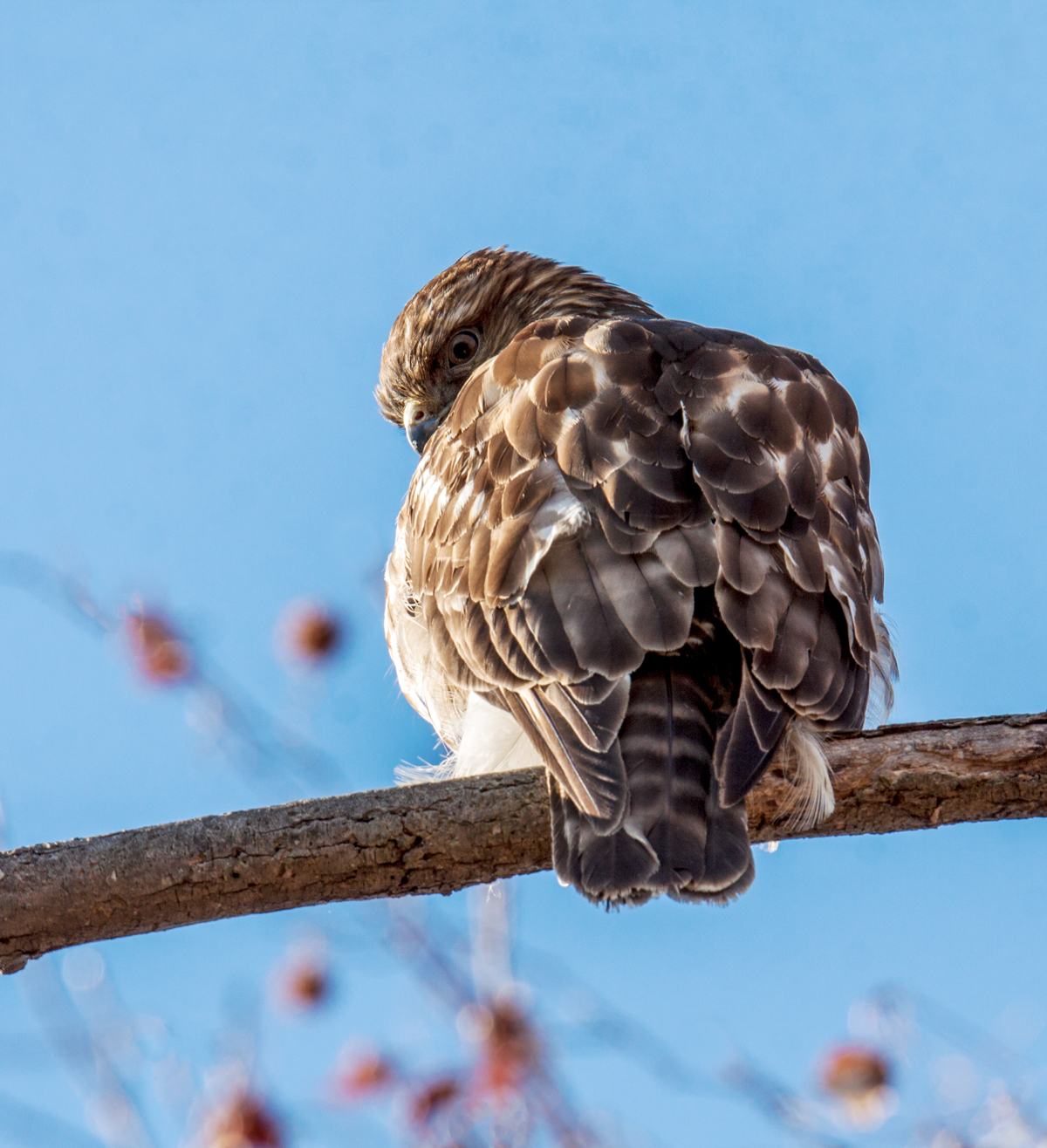
By this time of the year, the Great Egrets (Ardea alba) in our area have generally flown south for the winter, but one of them was still hanging around on Monday at Occoquan Bay National Wildlife Refuge. Its pose reminds me of that of the angels that we had in a manger set when I was growing up, looking like it was keeping watch in the early morning hours.

Great Egret

© Michael Q. Powell. All rights reserved.

Read Full Post »

At this time of the year, many of the birds look chubby, like this Northern Mockingbird (Mimus polyglottos) that I spotted on Monday at Occoquan Bay National Wildlife Refuge. I suspect that the mockingbird’s appearance is caused by feathers that have been fluffed up for better insulation.

I wish that I could use that excuse.

Northern Mockingbird

© Michael Q. Powell. All rights reserved.

Read Full Post »

« Newer Posts - Older Posts »