Feeds:
Posts
Comments

Archive for the ‘wildlife’ Category

As I was exploring Occoquan Bay National Wildlife Refuge last week, I spotted a Bald Eagle (Haliaeetus leucocephalus) perched high in a sweetgum tree. The eagle seemed to be surveying the entire area, like a king keeping watch over his kingdom. I am pretty sure that he spotted me, but may have judged correctly that I was not a threat, and therefore the eagle remained in place as I passed on by.

bald eagle

© Michael Q. Powell. All rights reserved.


Read Full Post »

Do turtles show affection? If so, how do they overcome the obstacle posed by their hard shells?

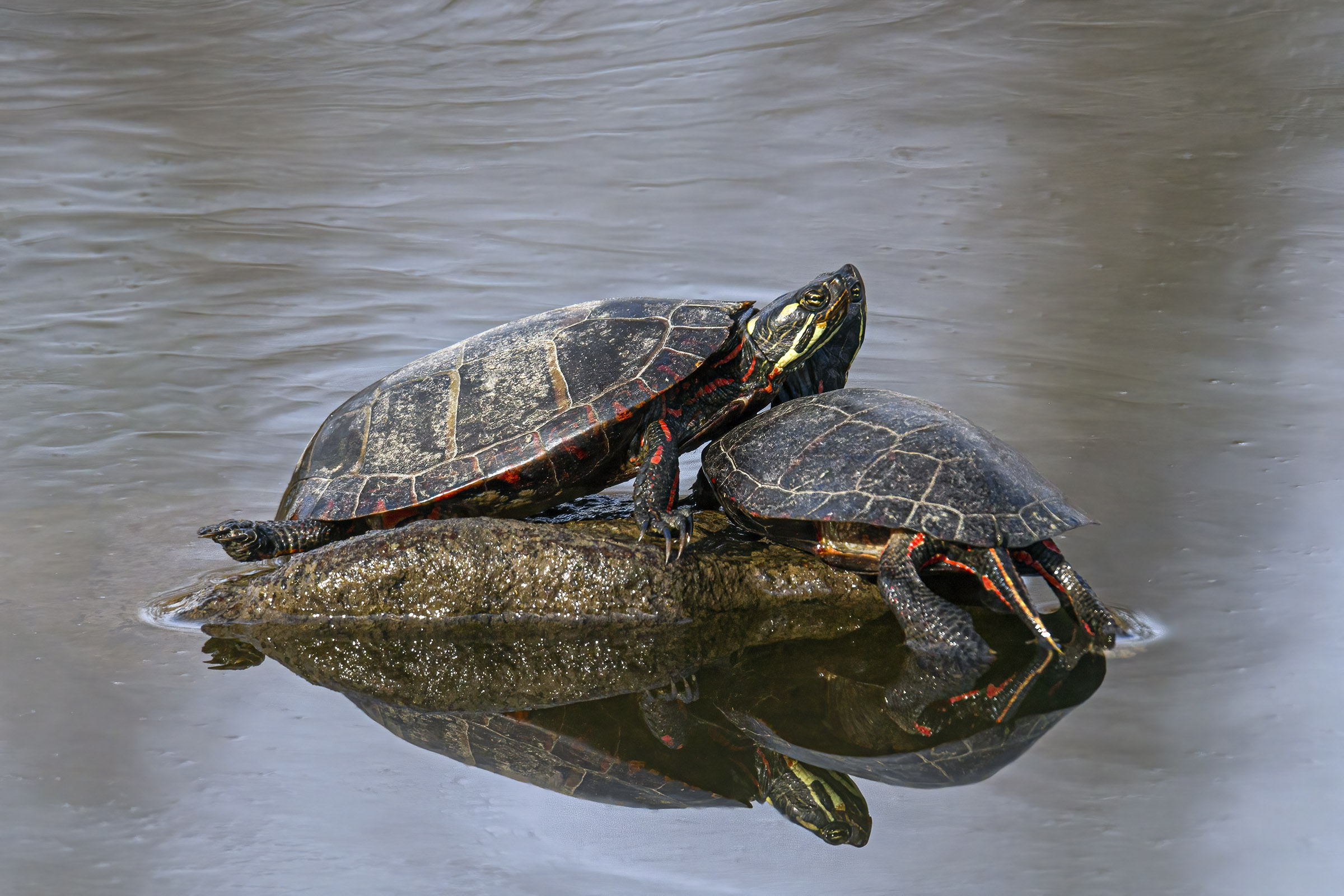
Last week on an unusually warm December day, I spotted two Eastern Painted Turtles (Chrysemys picta) sitting on a log in a small swampy pond at Occoquan Bay National Wildlife Refuge. They were sitting pretty close to each other, which was not unusual given the small size of the log. What really struck me, though, was the way that they appeared to be rubbing the sides of their faces against each other.

Was this a sign of affection? It certainly seemed that way to me.

I’ve met people who appear to have as tough an exterior as these turtles. How do you reach people like that? Persistent small act of unrequited kindness may help to penetrate those barriers. For me, that is what Christmas is all about, an attitude towards others that lasts a whole lot long that a single-day celebration.

A belated Merry Christmas to all of you who celebrated yesterday and best wishes for a happy and healthy 2025 to you all.

Painted Turtles

© Michael Q. Powell. All rights reserved.

Read Full Post »

Last week I spotted a Bald Eagle (Haliaeetus leucocephalus) couple perched near each other in a tree at Occoquan Bay National Wildlife Refuge. Although it is not quite nesting season here in Northern Virginia, the eagles were within eye sight of the large nest that you can see in the second photo below. It is hard to get a sense of the massive size of the nest from the photo, but it is so large that the eagles disappear from sight when they are sitting on eggs in that nest.

I suspect that the eagles will soon occupy that nest and, with a little luck, I hope to see some baby eagles in the next few months.

Bald Eagle

eagle nest

© Michael Q. Powell. All rights reserved.


Read Full Post »

The last time that I recall seeing an American Goldfinch (Spinus tristis) was during breeding season, when the goldfinch was bright yellow in color. That breeding season is long gone and the plumage of goldfinches is a lot drabber in color. I spotted this goldfinch on Tuesday at Occoquan Bay National Wildlife Refuge and captured this moment when the little bird was sticking out its tongue.

I am not sure if the bird was singing at the time or was merely clearing its throat. Whatever the case, it definitely was cool to be able to see the tiny tongue of the little goldfinch.

American Goldfinch

© Michael Q. Powell. All rights reserved.


Read Full Post »

This last week or so, I have had several opportunities to capture “artistic” shots of Great Blue Herons (Ardea herodias) at Occoquan Bay National Wildlife Refuge. In these cases the heron was not actively engaged in fishing and was standing in the vegetation a bit removed from the water.

In the first two photos, I was struck by the beautiful light that was falling on the heron. I particularly like the heron’s pose in the first image in which the heron has his neck stretched out, giving him a very slim profile. In the final photo, the heron was partially hidden by the reeds and is much more hunched over in an effort, perhaps, to retain his body heat.

Great Blue Heron

Great Blue Heron

Great Blue Heron

© Michael Q. Powell. All rights reserved.

Read Full Post »

Are you a messy eater? Do you feel a need to constantly wipe your face with a napkin? Do you wonder if you have visible food stuck between your teeth? If you are like most people, you are very self-conscious about your appearance.

Birds, on the other hand, don’t seem to mind it when the remains of their last snack remain on their faces. Of course, the absence of mirrors and selfie cameras on cell phones probably makes them less aware of how they look or they simply don’t care.

Last week I spotted this White-throated Sparrow (Zonotrichia albicollis) at Occoquan Bay National Wildlife Refuge with some berry residue on its upper bill. Perhaps I merely caught the sparrow taking a momentary break from the feeding that seems to occupy the sparrows for most of their waking hours during the winter.

I felt an impulse to pull out a napkin to wipe this little sparrow’s face, but resisted that impulse and continued on my way, happy in the knowledge that the sparrow had been successful in finding something to eat.

White-throated Sparrow

© Michael Q. Powell. All rights reserved.

Read Full Post »

I confess that I know almost nothing about boats, so I was not sure what I was looking at when I spotted this enormous floating object in the Potomac River off of Occoquan Bay National Wildlife Refuge last week. Eventually I figured out that it was a boat pushing some kind of barge up the river. It looked a bit like a tugboat, but instead of “tugging” the boat, it seemed to be pushing from behind.

I have seen the difficulties that some folks have in towing a trailer, so I can’t imagine how difficult it must be to steer something like this. Fortunately the tugboat seemed to be taller than the barge, so presumably the captain was able to see where he was going, and it appeared that he was able to stay on course pretty well.

barge

© Michael Q. Powell. All rights reserved.

Read Full Post »

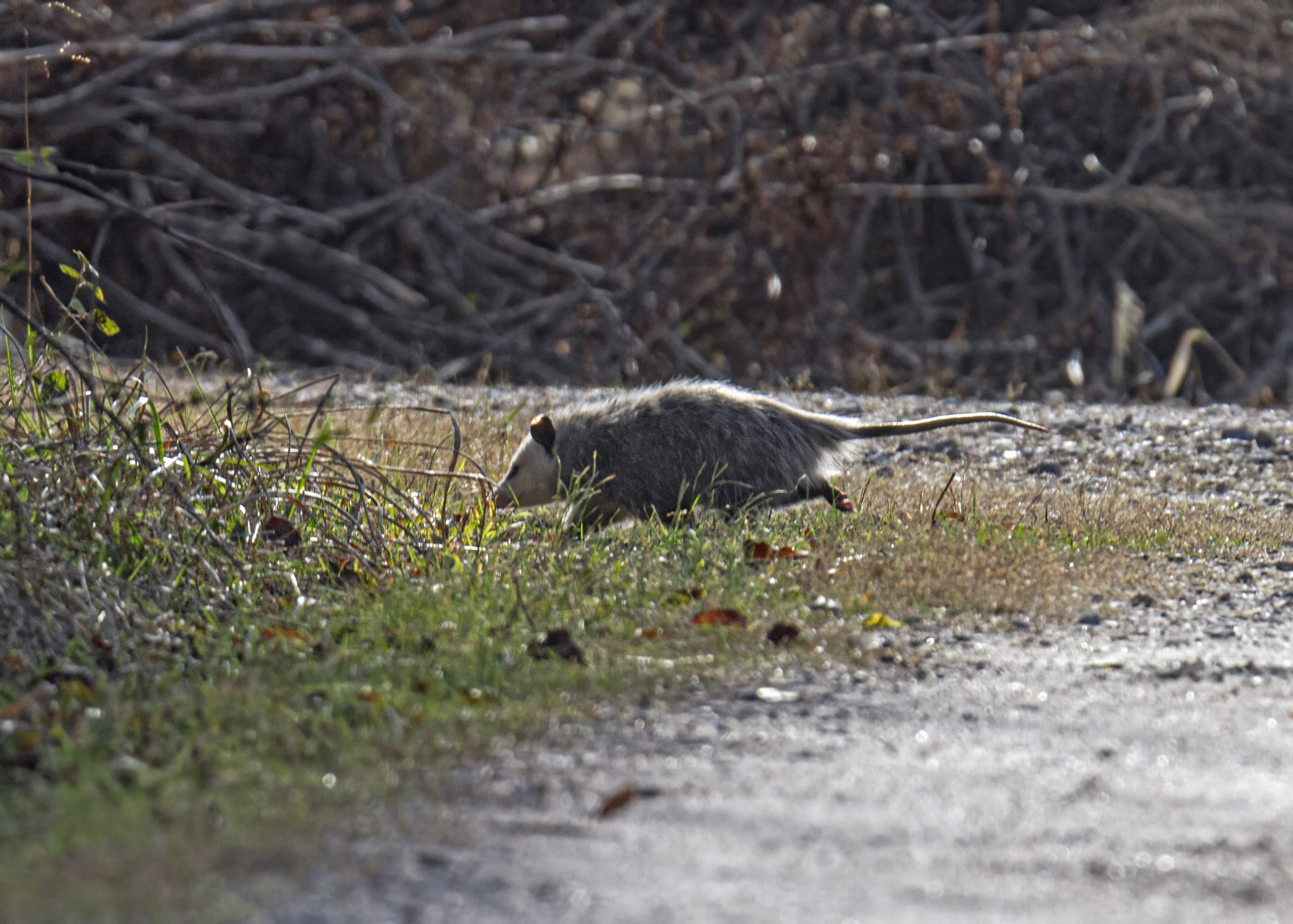
My mind was busy trying to identify the animal crossing the trail ahead of me on Thursday at Occoquan Bay National Wildlife Refuge, but my reflexes took over and I was able to capture these shots of what turned out to be an opossum (Didelphis virginiana), an animal that I rarely see. When I was doing a little research I learned that Virginia Opossums, also known as North American Opossums, are the only marsupial in the United States—most marsupials, including kangaroos, wallabies, and koalas, are found in Australia and New Guinea.

opossum

opossum

© Michael Q. Powell. All rights reserved.

Read Full Post »

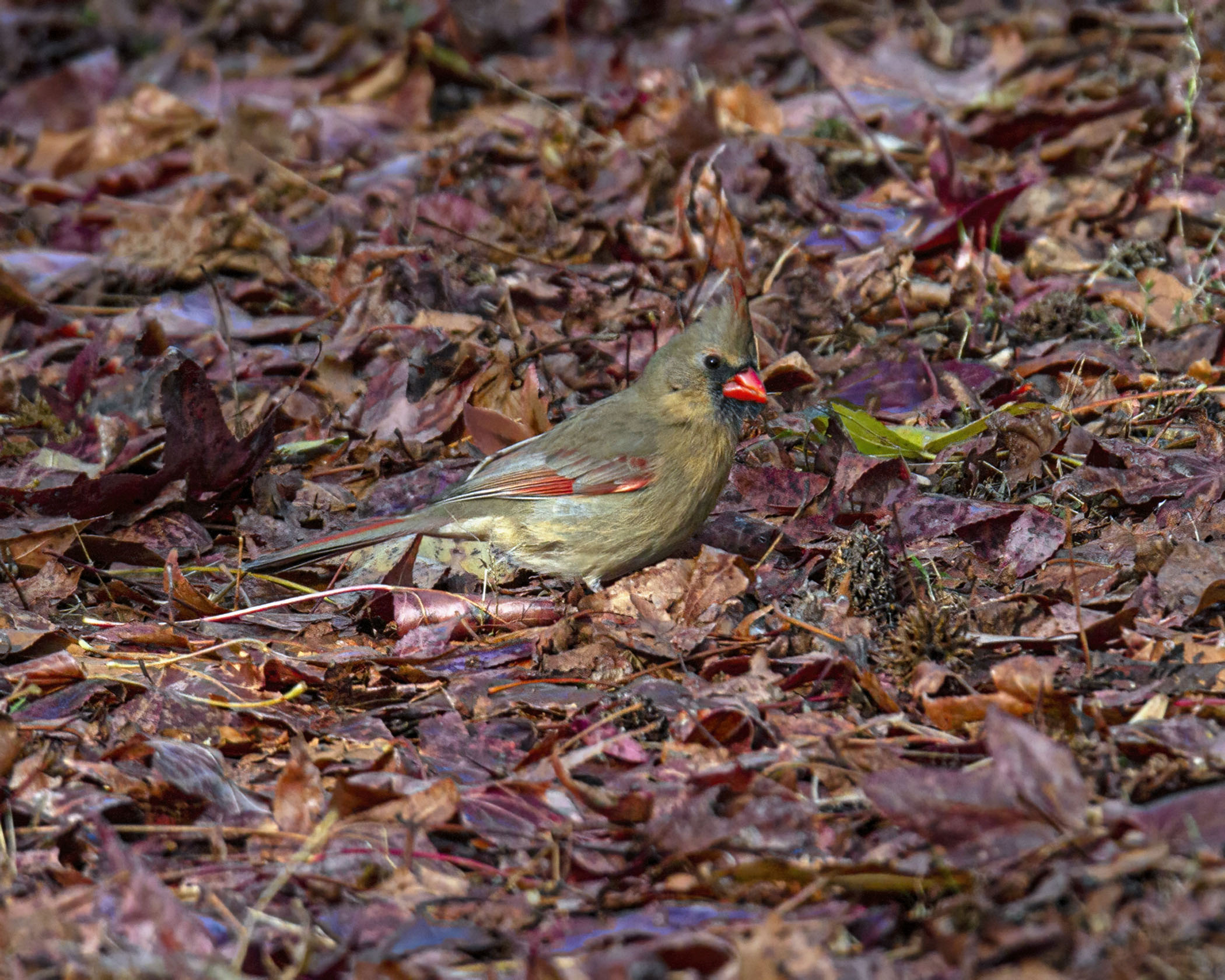
Most of the leaves have fallen from the trees by mid-December and the remaining birds have to work a lot harder to find food than in the warmer months. During a visit on Thursday to Occoquan Bay National Wildlife Refuge, I spotted a small group of Northern Cardinals (Cardinalis cardinalis) foraging among the colorful fallen leaves.

Unlike many other colorful birds that migrate out of our area, cardinals remain with us throughout the year, providing a pop of color in an often monochromatic winter landscape. Although the males, like the one in the final photo, are easier to spot, I often prefer the more subdued beauty of the females, like the one in the first photo.

female Northern Cardinal

Northern Cardinal

© Michael Q. Powell. All rights reserved.

Read Full Post »

Yesterday I watched a Great Blue Heron (Ardea herodias) fishing at Occoquan Bay National Wildlife Refuge. After an extended period of cold and cloudy days, it was a treat for both of us to be out in the somewhat warmer weather. Although the the heron was really focused on its task, its results were modest—the fish that it caught may well be the tiniest fish that I have ever seen a heron catch.

I am hoping that the heron was eventually more successful later in the day—it would take a lot of those tiny fish to satisfy its appetite.

Great Blue Heron

© Michael Q. Powell. All rights reserved.

Read Full Post »

At this time of the year I often see large groups of ducks, often referred to as “rafts” because the ducks gather so closely together, in the waters off of Occoquan Bay National Wildlife Refuge. Frequently there are different species of ducks intermixed, though in my experience there is usually a dominant species.

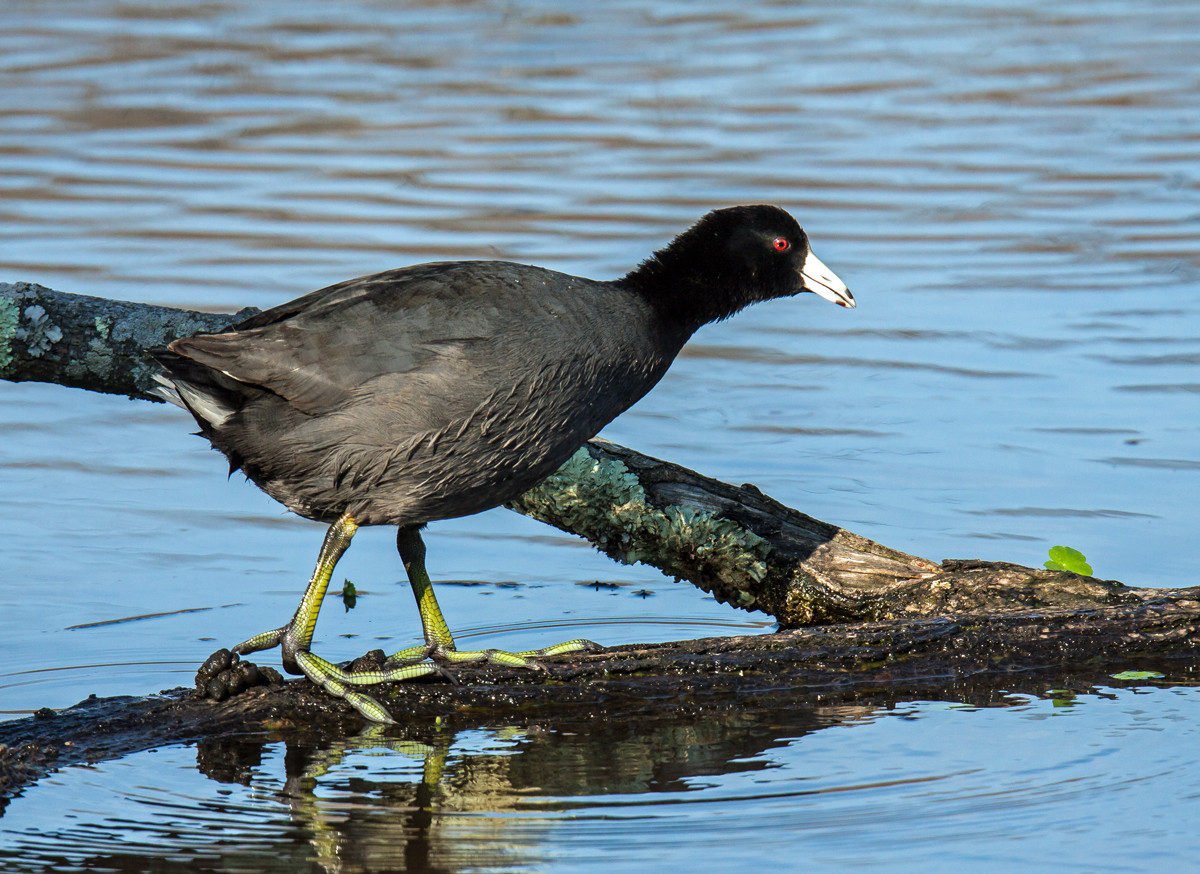
In later November, I spotted a large group of American Coots (Fulica americana) during a visit to the refuge, as you can see in the first photo below. Coots are pretty easy to identify because of the shape and color of their bills. In addition to the coots, a number of Ruddy Ducks (Oxyura jamaicensis) were part of the raft. I encourage you to click on the image to get a better look at the individual birds.

Technically, coots are not ducks, though, because they have lobed rather than webbed feet. The coots that day were too far away for me to get a shot of their feet, so I am instead including a photo I took in April 2017 that shows those lobed feet and the coot’s distinctive red eyes.

American Coots

American Coot

© Michael Q. Powell. All rights reserved.


Read Full Post »

Some birds, like the ospreys and Great Egrets, leave our area and migrate to warmer climates as winter approaches. Others, like Great Blue Herons (Ardea herodias), remain with us and have to work harder to find food.

Last week I spotted a heron standing in the shallow water of one of the tidal ponds at Occoquan Bay National Wildlife Refuge. In the past I have often seen herons wait patiently for extended periods of time to catch large fish, but this heron was content to strike often and pluck small fish from the water—every few minutes he would catch another fish, swallow it in a single gulp, and return to fishing.

I encourage you to click on the image to get a better look at the small fish in the heron’s bill and the visible spray of water droplets. I also really like the dynamism of the  heron’s pose that suggests both the energy and the focus of the heron.

Great Blue Heron

© Michael Q. Powell. All rights reserved.

Read Full Post »

It is still a little early for the Bald Eagles (Haliaeetus leucocephalus) to begin nesting at Occoquan Bay National Wildlife Refuge, but both members of an eagle couple were perched in a tree near a large nest last week when I visited the reserve. One of the eagles was partially blocked from view by the tree’s branches, but I was able to capture this image of the other one as it kept watch over the nesting site.

Bald Eagle

© Michael Q. Powell. All rights reserved.

Read Full Post »

During the winter I often see rafts of ducks in the waters off of Occoquan Bay National Wildlife Refuge. Usually they are gathered in the deep water, far from the shore and out of camera range for close-up shots, but I can usually identify them with my long telephoto lens.

On Wednesday during a visit to Occoquan Bay National Wildlife Refuge, I spotted a large group of mostly American Coots and Ruddy Ducks. When I examined the group really carefully, however, I noticed a pair of Ring-necked ducks (Aythya collaris) that were resting on a semi-submerged log. I have seen this species of diving ducks at other locations, primarily in ponds, but don’t recall seeing them in the open water like this.

I’m pretty sure that the duck in the first photo is a male Ring-necked Duck, thanks to his striped bill and distinctive yellow eye. I am a little less certain about the duck in the second photo, but I think it is probably a female Ring-necked duck because of the white eye ring. I am a little rusty with my bird identifications after a summer spent chasing mostly insects and mammals, but suspect that I will better as we move into winter.

Male Ring-necked Duck

Female Ring-necked Duck

© Michael Q. Powell. All rights reserved.


Read Full Post »

This past Tuesday I heard a lot of rustling in the underbrush as I walked about in Occoquan Bay National Wildlife Refuge. Sometimes the noise was caused by squirrels, but often it was the result of energetic White-throated Sparrows (Zonotrichia albicollis) foraging for food amidst the fallen leaves.

White-throated Sparrows overwinter in my area of Northern Virginia and seem to have arrived recently. I love the distinctive markings of these little birds, with their white “beards” and bright yellow lores, i.e. the region between the eye and the bill.

White-throated Sparrow

© Michael Q. Powell. All rights reserved.

Read Full Post »
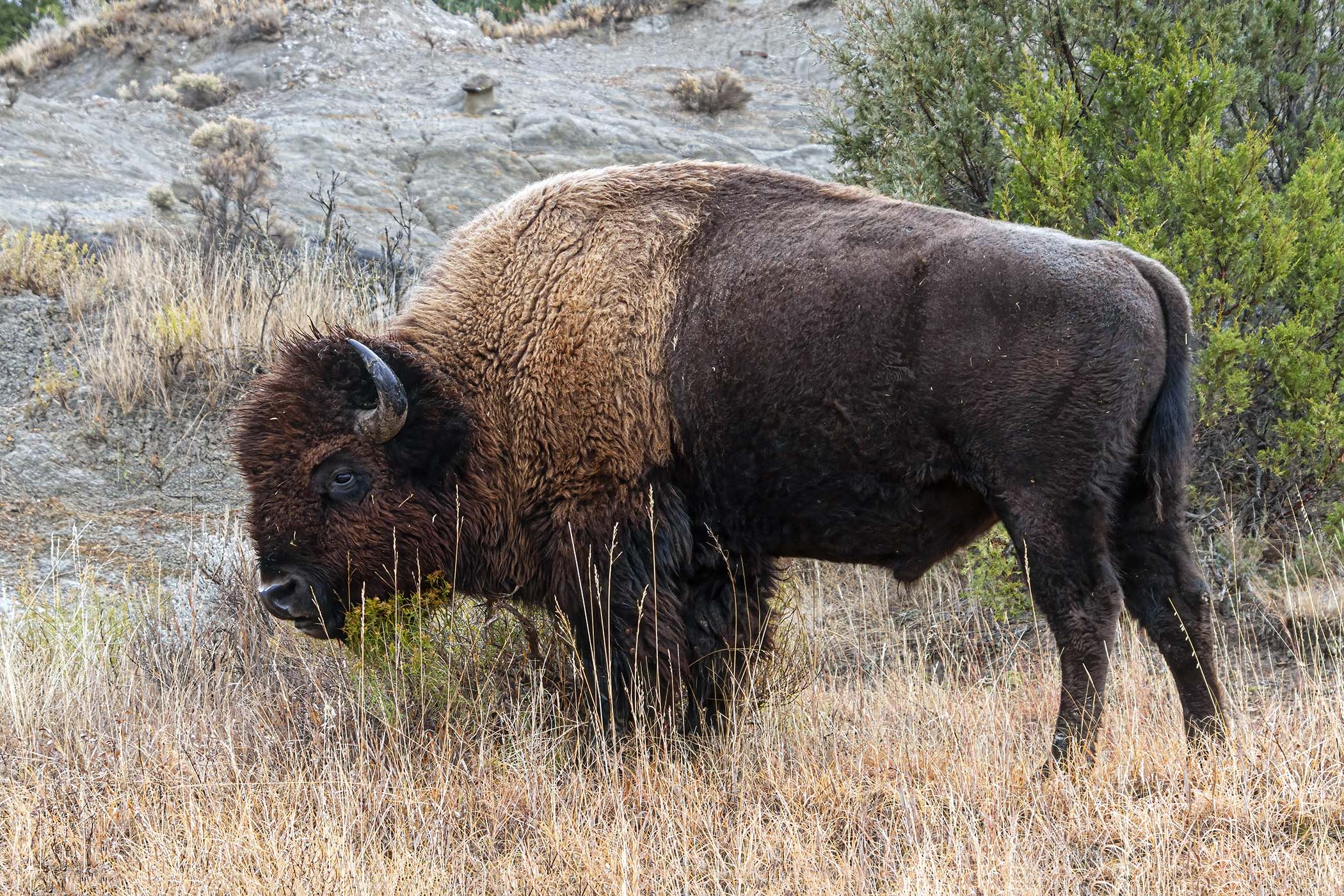
I am finally nearing the end of my photos from my brief stay in Theodore Roosevelt National Park in North Dakota at the beginning of November. I captured quite a few images of wild horses, bison, and prairie dogs at the national park and it has been a real joy reviewing the photos on my computer and relive the memories after my return home. Normally I try to post images on my blog that are a week old or less, but I figure that you will forgive me for posting images that are three weeks old.

Here are a few selected images of American Bison (Bison bison) that I spotted at the park in early November. Most often the were simply grazing, so frequently I would try to capture some interesting background, as in the first photo below. I was quite excited to spot the young bison in the second photo. It was quite a bit smaller than the adults, but already seemed to be growing horns.

The bison in the final photo lifted its head momentarily, allowing me to capture this informal portrait. It may look like I was really close to the bison, but I was using a telephoto zoom lens on my camera and I am pretty sure that I took the shot from inside my car. However, the bison was close enough that I had to zoom out a little to 322mm (on an 18-400mm lens) to fit the bison’s enormous head in the frame.

American Bison

American bison

American Bison

© Michael Q. Powell. All rights reserved.


Read Full Post »

Although I returned from my road trip out West several weeks ago, I am still going through some of the images that I captured. One of the real highlights of the trip was staying for a few nights in Theodore Roosevelt National Park in North Dakota. Unlike some other national parks in that part of the USA, like Yosemite and Glacier National Parks, this park is uncrowded and I was able to drive slowly on its roads and observe a variety of wildlife species.

One of my favorites was the bands of wild horses that live in the national park. It’s estimated that there are about 200 wild horses in the park, though it is hard to know for sure. Most of the time I spotted some of the horses at a distance, out of the range of my telephoto lens, but I did have a few closer encounters and was able to capture some decent images of them.

It was interesting to note that the horse in the final photo is wearing what looks to be some kind of tracking collar. I am not sure if this is a normal practice at the national park or if the horse is part of some special study.

I grew up watching lots of Western show on television, like The Rifleman, Bonanza, and Gunsmoke. As a result, I have a special fondness for cowboys and find it really cool to see wild horses and bison herds.

wild horses

wild horse

wild horse

© Michael Q. Powell. All rights reserved.

Read Full Post »

When I was a child, I recall hearing and singing an old American folk song called “Home on the Range.” Its lyrics speak of a home where buffalo roam and “the deer and the antelope play.” Those words kept coming back to me earlier this month during my brief stay at Theodore Roosevelt National Park in North Dakota.

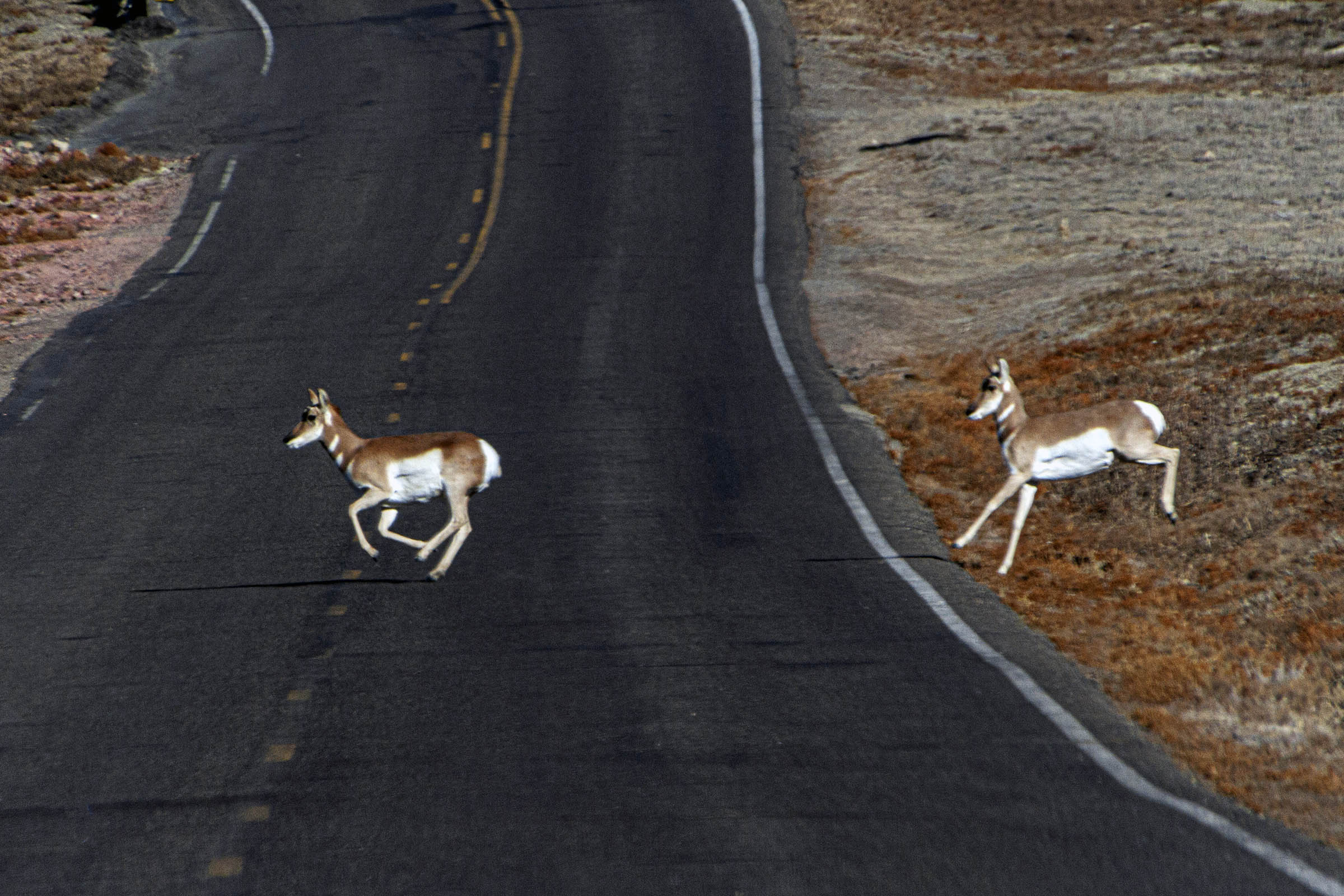
Over the years I have learned that the song is technically inaccurate, because there are no antelopes in North America. However, the Pronghorn (Antilocapra americana) closely resembles the antelopes of the Old World and are known colloquially as “American antelope.” The closest living relatives of pronghorn, though, are the giraffe and the okapi, an animal often referred to as the “forest giraffe” found in the Democratic Republic of the Congo. Of note, the pronghorn is the fastest land mammal in the Americas, capable or reaching speeds of up to 55 miles per hour (88 km/h).

When I first spotted these pronghorns, they were coming down the side of a hill and preparing to cross the road on which I was traveling. There were two young pronghorns and one an adult, that I presumed was their mother. I focused primarily on the young ones, as you can see in the first two photos, and finally got a shot of the adult as the the pronghorns were climbing a hill on the other side of the road. If I remember correctly, I took the first two photos through the windshield of my car.


pronghorn

pronghorn

Pronghorn

© Michael Q. Powell. All rights reserved.

Read Full Post »

I was delighted on Monday to spot multiple Autumn Meadowhawk dragonflies (Sympetrum vicinum) at Occoquan Bay National Wildlife Refuge. During the past couple of weeks I saw a few female Autumn Meadowhawks, but until this week I had not photographed a single male—I think that all of the dragonflies that I spotted that day were males. Females are mostly brown with touches of red, while the bodies of males are mostly red, as you can see in the photo below.

Autumn Meadowhawks are only about 1.2 inches (30 mm) in length, so they are difficult to spot, despite their bright coloration. At this time of the year when fallen leaves litter the ground, they tend to blend in pretty well with their surroundings.

I was using my Tamron 150-600mm lens with a monopod, my preferred combination for photographing birds, so it was a challenge to focus on such tiny subjects as dragonflies. I was persistent, however, and was successful in capturing some pretty detailed shots of them.

Autumn Meadowhawk

© Michael Q. Powell. All rights reserved.

Read Full Post »

Monday was a wonderfully sunny autumn day, so I headed out with my camera to Occoquan Bay National Wildlife Refuge. Suspecting that the insects were almost completely gone, I decided that I would primarily be searching for birds and switched to my longest telephoto lens, my Tamron 150-600mm zoom lens. This is a really versatile lens, but it has a minimum focusing distance of almost 9 feet (2700 mm), which makes focusing on small subjects problematic.

There were ducks on the bay, but they were too far away to photograph. I also spotted a few Bald Eagles as they flew away from me. Fortunately I had better luck with a Carolina Wren (Thryothorus ludovicianus) that I initially heard singing. I located the small bird and waited until it turned its head to the side and captured this wonderful little shot of the wren with its mouth wide open and its tail lifted up.

Carolina Wren

© Michael Q. Powell. All rights reserved.

Read Full Post »

Early in the morning on 5 November, I encountered some mule deer (Odocoileus hemionus) at Theodore Roosevelt National Park in Medora, North Dakota. Initially the deer were lapping up water that had accumulated alongside the road after a rainstorm.

I remained in my car as I captured a few shots of the deer, who looked at me with what appeared to be curiosity rather than fear. I was happy to be able to capture views of the tails and the ears of the mule deer, two of their most distinctive features, before they slowly moved into the underbrush.

mule deer

mule deer

mule deer

© Michael Q. Powell. All rights reserved.

Read Full Post »

The number of butterflies continues to dwindle, so I was thrilled to spot this pretty little Variegated Fritillary butterfly (Euptoieta claudia) last Tuesday at Occoquan Bay National Wildlife Refuge. The weather has gotten cooler and it won’t be long before below freezing temperatures arrive, so I will be out chasing these last summer survivors until none remain.

Variegated Fritillary

© Michael Q. Powell. All rights reserved.

Read Full Post »

Earlier this month I spotted a coyote (Canis latrans) at Theodore Roosevelt National Park in North Dakota. The coyote was hanging around a prairie dog town (you can see a prairie dog in the background) and magpies accompanied it, hoping to scavenge some tasty remnants.

I took these photos from inside my car with the windows open, hoping that no other cars would come by and disturb the coyote. Fortunately it was early in the morning and I was able to watch the coyote without interruptions. The coyote was unsuccessful in its hunt while I was there and eventually moved on.

Although we have coyotes at the wildlife refuge where I do a lot of my photography in Northern Virginia, this was my first time seeing and photographing one.

coyote

coyote

coyote

© Michael Q. Powell. All rights reserved.

Read Full Post »

As the weather cools off and the insects disappear, my attention has gradually been shifting to birds. This was a real challenge for me a month ago when the leaves were still covering the trees and hid the birds from my view. Now, however, most of the leaves have fallen and I feel like I have a fighting chance of spotting a bird when I see or hear one.

On Tuesday I visited Occoquan Bay National Wildlife Refuge and managed to capture shots of some of the resident birds. The bird in the first photo is a Downy Woodpecker (Picoides pubescens), the smallest woodpecker in our area. You can see a touch of red on the back of his head, indicating that he is a male.

Carolina Chickadees (Poecile carolinensis), like the one in the second photo, are quite common, but they are small and elusive and therefore difficult to photograph. During most of the time that I was observing this bird, its head was hidden by branches, but I watched and waited and finally was able to get an unobstructed shot of it.

I am not certain of the identification of the bird in the final photo. On the basis of its markings and color, I think that it may be a Hermit Thrush (Catharus guttatus), but that is really not much more than an educated guess. I would welcome a confirmation or correction from a more experienced birder.

Downy Woodpecker

Carolina Chickadee

Hermit Thrush

© Michael Q. Powell. All rights reserved.

Read Full Post »

By mid-November most butterflies have disappeared in my area as the weather has cooled off. One notable exception, however, has been the Common Buckeye (Junonia coenia). I was delighted to spot numerous Common Buckeyes last week at Occoquan Bay National Wildlife Refuge.

The markings on these little butterflies are incredibly beautiful and I was happy to be able to capture some of that beauty in the photo below.

Common Buckeye

© Michael Q. Powell. All rights reserved.

Read Full Post »
I can usually count on spotting at least one Great Blue Heron (Ardea herodias) during my visits to Occoquan Bay National Wildlife Refuge. Sometimes, when the tides are right, I will see them in the waters of the bay, but most often they are in the small ponds throughout the refuge.

Last Friday I caught sight of this heron in the shallow waters of one such pond. The heron was intently focused on the water and eventually plunged its head into the water. When the water is deep, the heron will thrust violently into the water, but in this case the movement was much smaller.

I watched and waited as the heron slowly lifted its head to see if it had been successful in catching a fish. As you can see in the final photo, the results were not clear. Obviously the “catch” included a lot of vegetation, but I can’t tell for sure if there was also a small fish. A few seconds later the heron seemed to swallow, dipped its bill into the water to rinse it, and resumed its fishing.

Great Blue Heron

Great Blue Heron

© Michael Q. Powell. All rights reserved.

Read Full Post »
After a month away on a car road trip, I finally returned home last week. On Friday I ventured out to Occoquan Bay National Wildlife Refuge to see if I could find any dragonflies. It is pretty late in the season for most dragonfly species, but I was optimistic that I might be able to find some Autumn Meadowhawks (Sympetrum vicinum) that are almost always the final dragonflies to disappear in late autumn.

Happily I was able to spot a half-dozen or so Autumn Meadowhawk dragonflies, although I was able to capture images of only a few of them. The female in the first photo was quite cooperative and landed on a colorful fallen leaf. The dragonfly in the second photo is also a female and I am pretty sure that it too is an Autumn Meadowhawk—there is a slight chance that it could be a Blue-faced Meadowhawk (Sympetrum ambiguum), though it would be unusual to see that species so late in the season.

The final image is a long distance shot of another female Autumn Meadowhawk that is almost perfectly camouflaged. You will need to look very carefully at the upper edge of the leaf in order to spot the little dragonfly. I watched it land at that spot, but actually could not see the dragonfly when I took this shot. I will probably be out again with my camera later this week diligently searching for more dragonflies, the final survivors of the 2024 dragonfly season.

Happy Veterans Day to all those who have served or are continuing to serve in the Armed Forces of the United States. As someone who served for 20 years in the U.S. Army, this day is a special one for me. It seems a bit trite to say “Thank you for your service,” but those words reflect my heartfelt thanks to those men and women who voluntarily defend our freedoms.

In other parts of the world this day is celebrated as Armistice Day (or Remembrance Day) and I remember well being in Paris, France on this day several times and observing the impressive ceremonies on the Champs-Élysées to commemorate the armistice that ended World War I. Some thought at the time that it would be the “war to end all wars,” but, alas, those hopes proved to be unfounded.

Autumn Meadowhawk

Autumn Meadowhawk

Autumn Meadowhawk

© Michael Q. Powell. All rights reserved.

Read Full Post »

It is always a challenge to shoot directly into the sun. You never quite know what kind of sun flares will make their way into you photo or how much your subject will become a silhouette. Still I can’t help but attempt to capture a photo whenever the opportunity presents itself.

My gamble paid off last week when I captured this cool image of an American Bison (Bison bison) last week at Theodore Roosevelt National Park in Medora, North Dakota. It was just after sunrise and the sun was still quite low on the horizon, creating a distorted, elongated shadow of the bison. You can see only a few details of this magnificent animal, but the shape of the profile of the bison makes it easy to identify the primary subject.

Luck plays often plays a significant role when it comes to wildlife photography, but I can’t help but think of the old adage, usually attributed to Wayne Gretzky, “You miss 100 % of the shots that you don’t take.” While I am not a fan of the “spray and pray” approach to photography, I do think it is worthwhile to take a shot whenever something catches your eye—sometimes you will be pleasantly surprised by the results.

© Michael Q. Powell. All rights reserved.

Read Full Post »

During my recent visit to Theodore Roosevelt National Park in North Dakota I encountered several colonies of Prairie Dogs (Cynomys ludovicianus). It was a lot of fun observing these active little creatures scurrying in and out of their interconnected holes.

Some of them seemed to be foraging for food, but many of them seemed to be playing and/or interacting with each other. I had the impression that some of them were youngsters, but they never stood still long enough for me to get an impression of their relative sizes.

prairie dog

prairie dog

prairie dog

© Michael Q. Powell. All rights reserved.

Read Full Post »

One of the highlights of my recent visit to Theodore Roosevelt National Park in Medora, North Dakota was having the chance to see quite a few American Bison (Bison bison). Unlike during a previous visit there two years ago, the bison were not blocking the road, but some of them were alongside the edges of the road.

These mammoth creatures seemed to be almost as large as my KIA Soul, so I often stayed inside my car when taking photographs of them. I ventured outside of the relatively friendly confines of my little car only when the bison were a good distance away from me.

bison

bison

bison

© Michael Q. Powell. All rights reserved.

Read Full Post »
On several of my drives through Theodore Roosevelt National Park in North Dakota I spotted Mule deer (Odocoileus hemionus) with fawns. I was always struck by the proportionally large ears on the youngsters—apparently they grow into them as they age.


deer and fawn

deer and fawn

© Michael Q. Powell. All rights reserved.

Read Full Post »

« Newer Posts - Older Posts »