Feeds:
Posts
Comments

Archive for the ‘wildlife’ Category

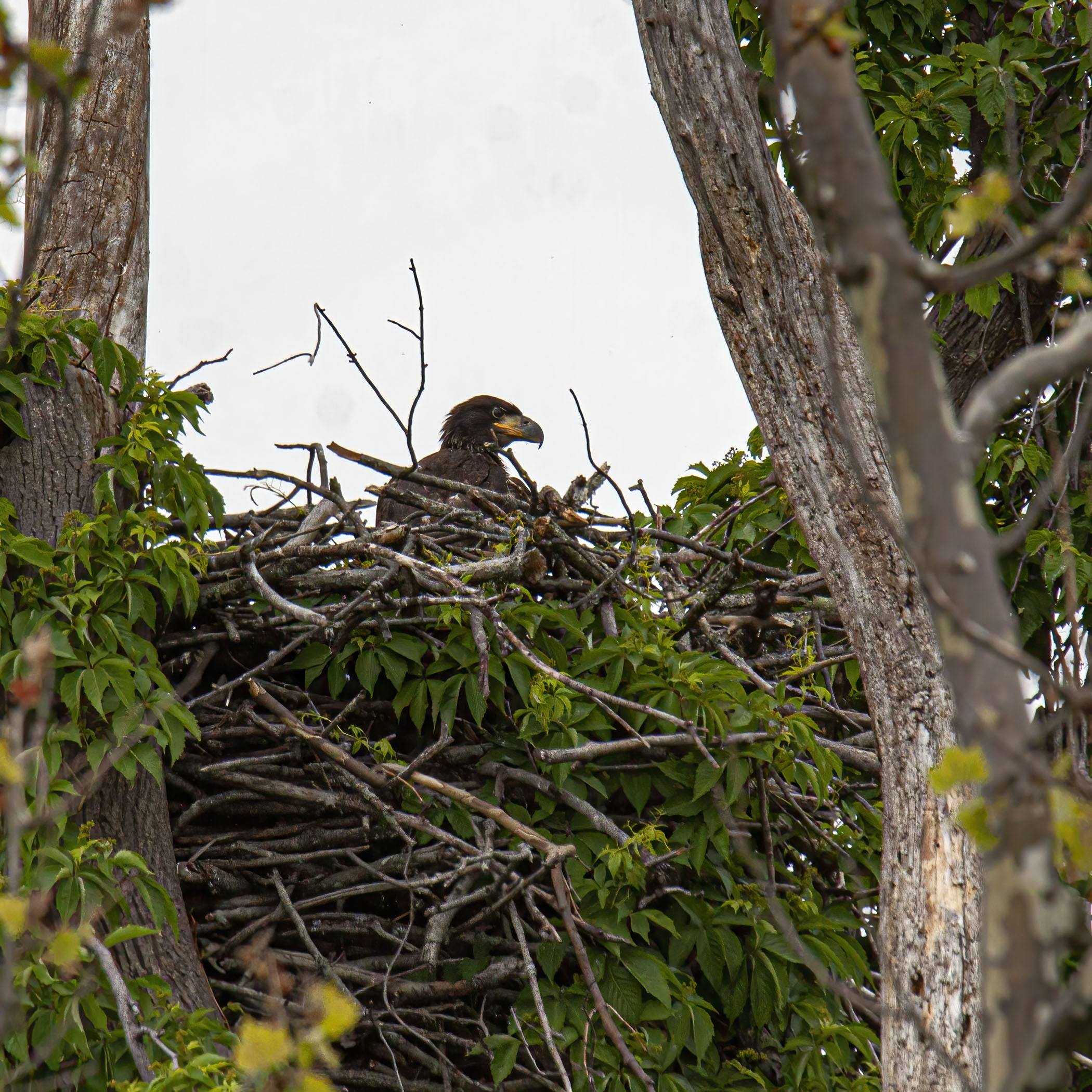
It was really cool on Tuesday to be able to capture these images of a young Bald Eagle (Haliaeetus leucocephalus) looking out from the large eagle nest at Occoquan Bay National Wildlife Refuge. The growing eaglet appeared to be quite alert and was sitting up quite high near the edge of the nest. I love how you can see the mottled plumage, dark eyes, and multi-colored beak of this eaglet in these photos.

The nest is high in the trees and there is now a lot of vegetation growing, so it was quite a challenge to get a clear angle of view. I am pretty happy with the results that I was able to achieve. The eaglet looks to be big enough to be flying, but I am not sure if that is the case. One of its parents was perched on some branches just above the nest, so I am pretty sure that it is not yet ready to go out on its own—eagles normally take about 12 weeks to fledge and then may hang around with their parents for another month or two.

Bald Eagle

Bald Eagle

© Michael Q. Powell. All rights reserved.

Read Full Post »

One of the cool things about traveling is having the chance to see species that are not present in my home area. This past weekend I drove north about 600 miles (965 km) to Gill, Massachusetts, the home of Northfield Mt Hermon School, where I celebrated my 50th graduation from high school. There was plenty of wild life at the reunion, with loud music, firepits, and adult beverages, but I also managed to squeeze in a few quieter moments with wildlife.

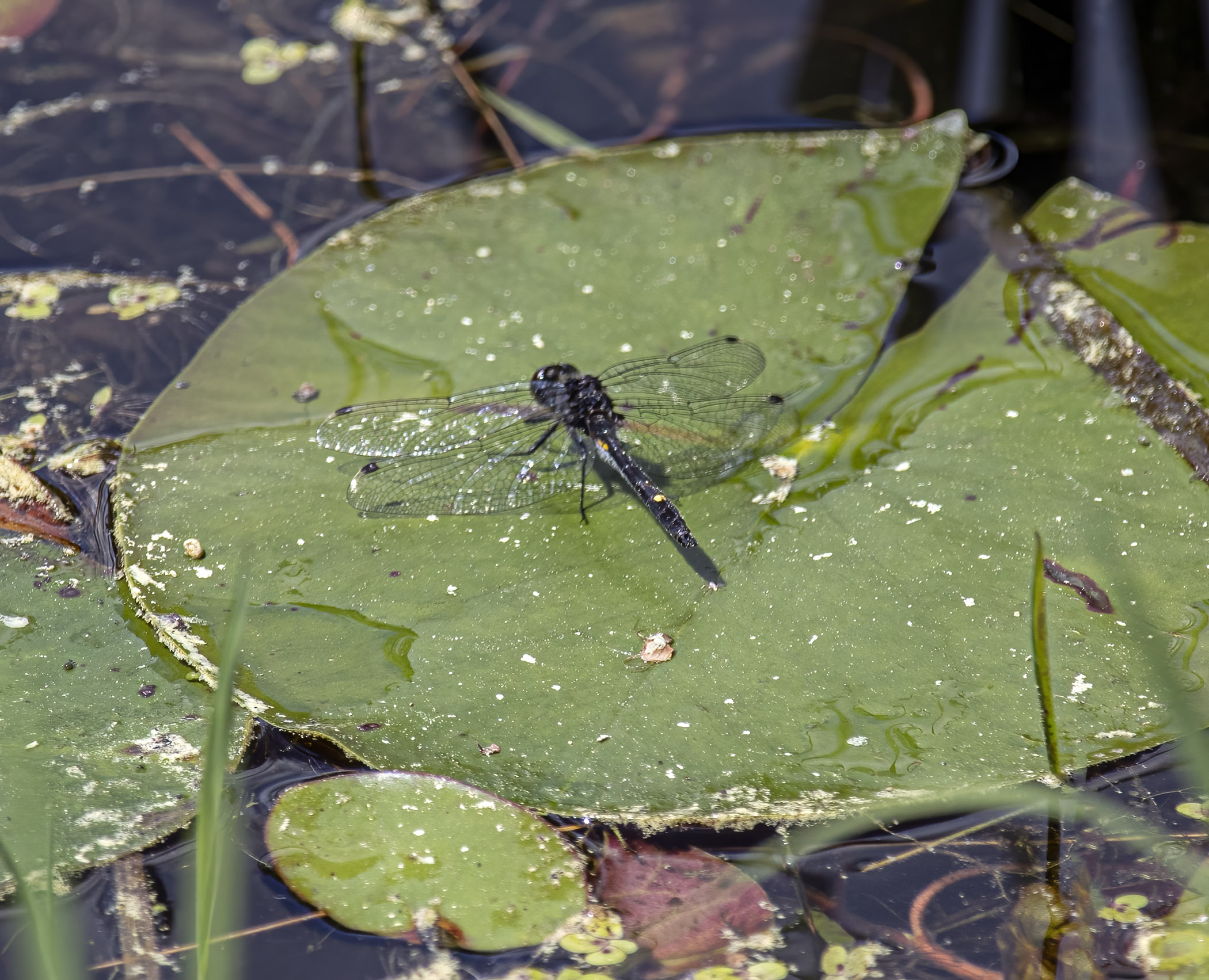
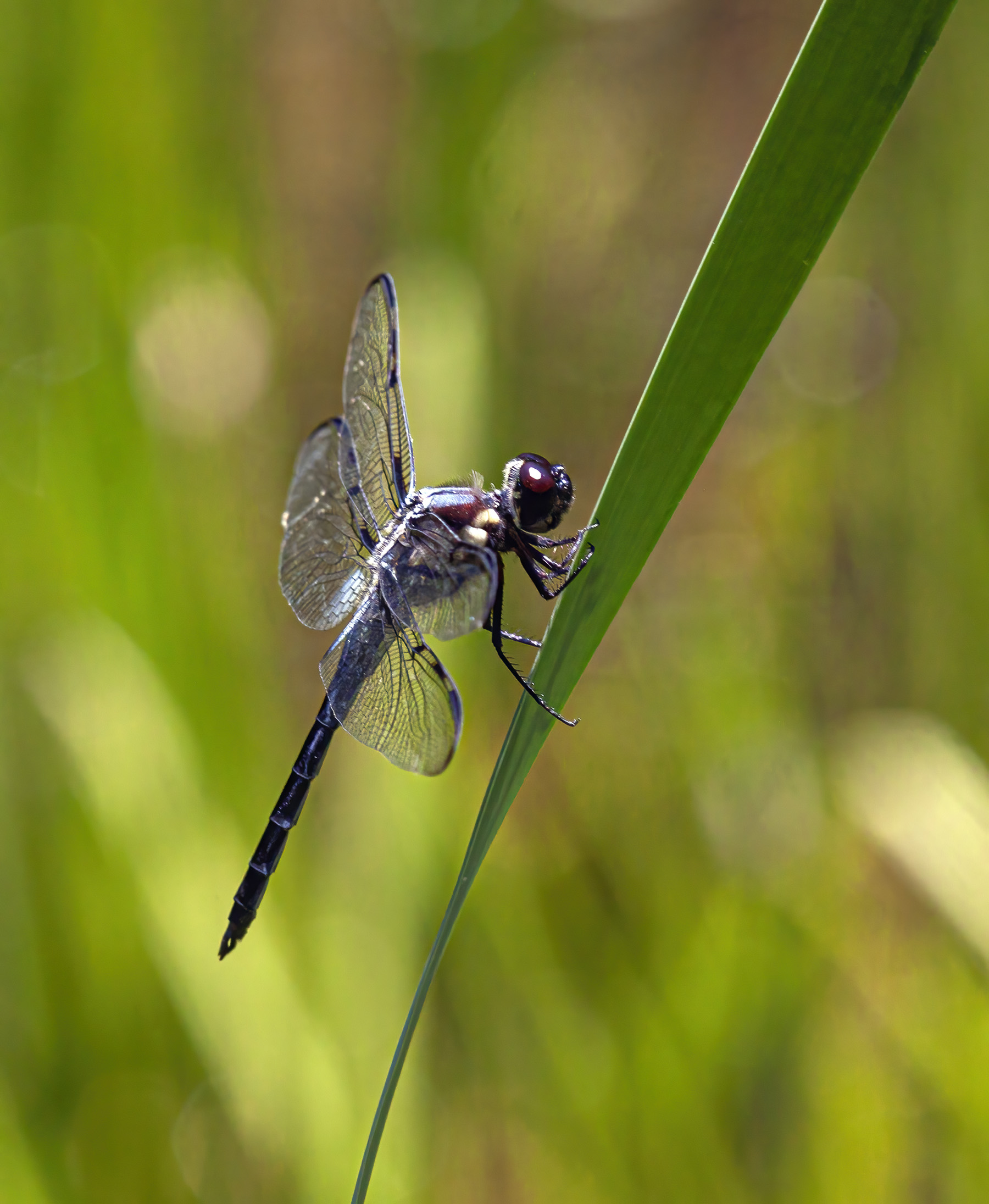
While I was walking along the edge of Shadow Lake, a small marshy lake on campus, I spotted some unfamiliar dragonflies on the floating lily pads. As I examined the dragonflies through my 55-250mm telephoto lens, the longest lens that I had with me, I was struck by the bright white faces of the dragonflies and the prominent dots on the top of their abdomens. I was a little shocked to learn later that the dragonflies that I photographed are Dot-tailed Whiteface dragonflies (Leucorrhinia intacta)—rarely has the name of a species fit so well.

The range map for Dot-tailed Whitefaces shows that it is primarily a northern species that does not exist in Virginia. I get the impression that this is a fairly common species, so locals would probably not be very excited to spot one. For me, though, it was a rare and exotic species that I was seeing for the very first time and I was thrilled. It is amazing how our reactions in so many areas of our lives are influenced as much by our perspectives as by the “objective” facts of a situation.

Dot-tailed Whiteface

Dot-tailed Whiteface

Dot-tailed Whiteface

© Michael Q. Powell. All rights reserved.

Read Full Post »

Last Tuesday I spotted several beautiful Bar-winged Skimmer dragonflies (Libellula axilena) while I was exploring a small pond in Prince William County, Virginia. The dragonflies kept choosing beautiful, but flimsy perches, so I did not have much time snag shots of them before they flew away.

According to the Dragonflies of Northern Virginia website, Bar-winged Skimmers have relatively specific habitat needs and consequently are one of the less common skimmers in our area. “It prefers very shallow marshy pools in the full sun. If there’s enough water for fish, it’s too deep for Bar-winged Skimmers. And of course shallow pools in the full sun tend to quickly evaporate and dry up, so stable populations in Northern Virginia are few and far between.”

I really like the backgrounds that I was able to capture in these shots—they are colorful, but not at all distracting. If you look closely at the leading edges of the wings, you can see the black spots and stripes that give rise to the name of this species.

Bar-winged Skimmer

Bar-winged Skimmer

Bar-winged Skimmer

© Michael Q. Powell. All rights reserved.

Read Full Post »

Although “treehugger” is a term that is sometimes used for environmentalists, it is even more applicable to Gray Petaltail dragonflies (Tachopteryx thoreyi), like these ones that I spotted last Tuesday in Prince William County. Gray Petaltails love to perch on the trunks of trees, where they blend in almost perfectly with the bark, as you can see especially well (or almost not see) in the second photo.

I have been told that Gray Petaltails especially like the color gray and a number of times one has perched on me when I was deliberately wearing a gray shirt. Fellow dragonfly enthusiast Walter Sanford capture that phenomenon in 2019 in one of his blog postings that he called “You look like a tree to me!

I drove up to Massachusetts this past weekend for the celebration of my 50th high school reunion at Northfield Mount Heron School, the private college preparatory boarding school that I attended for three years. I disconnected from the internet during that time there, which is why I have not posted in several days—my apologies to those of you who may be used to a daily “fix.”

It was fascinating to reconnect with high school friends, often for the first time in 50 years, and to meet some classmates for the first time. Northfield was founded as a girls school in 1879 by evangelist Dwight L. Moody and two years he established Mount Hermon as a boy school. In 1971 the two schools formally merged and those of us in the class of 1972, my class, were the first to graduate from Northfield Mount Hermon School. At that time there were close to 1300 students divided between the two campuses, which made it difficult to know everyone—in recent years the school consolidated onto the Mount Hermon campus and it currently has a student body of about 700 students.

Gray Petaltail

Gray Petaltail

© Michael Q. Powell. All rights reserved.


Read Full Post »

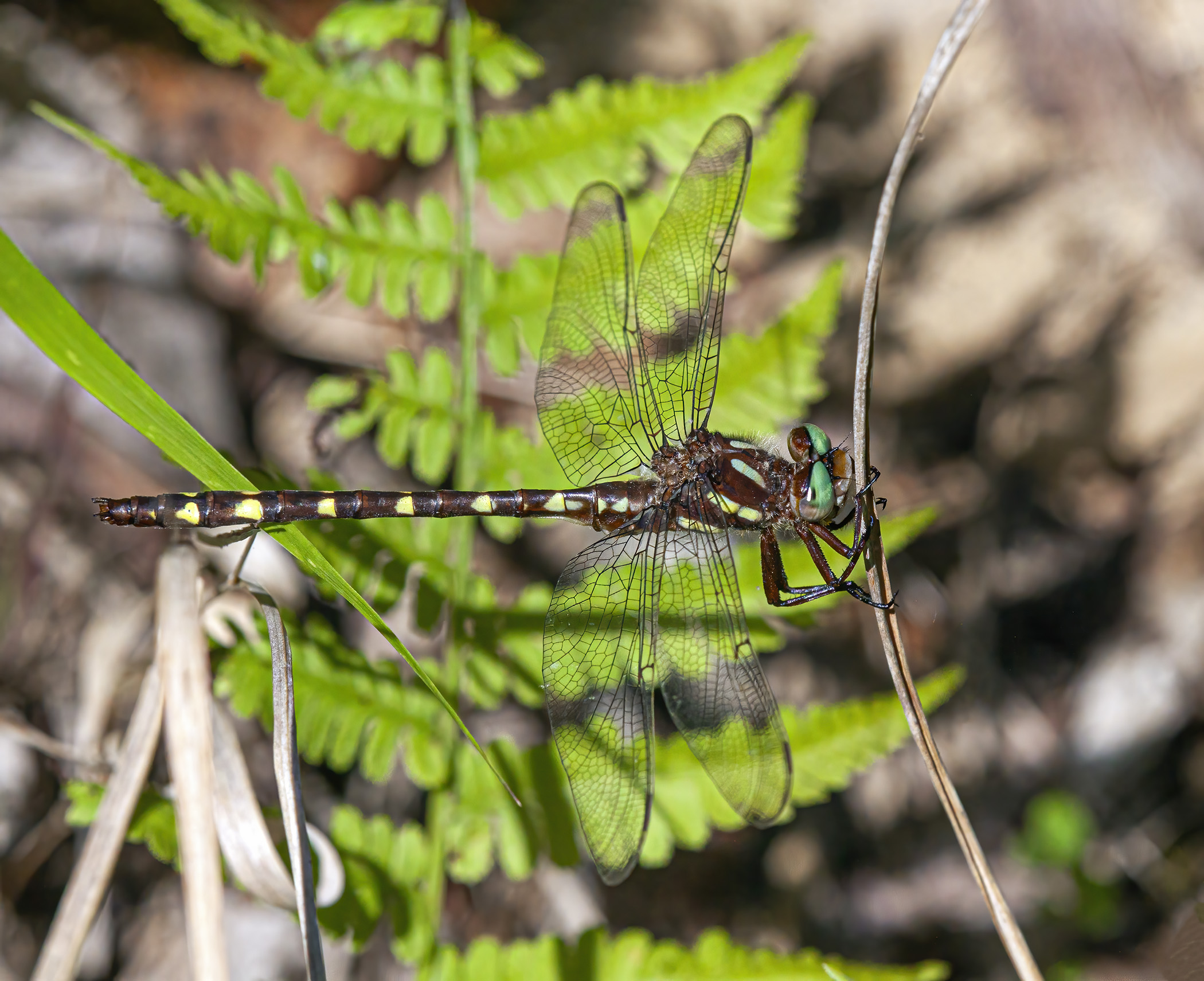
On Tuesday I was thrilled to spot this male Brown Spiketail dragonfly (Cordulegaster bilineata) while I was exploring a marshy area in Prince William County, Virginia. Spiketail dragonflies are quite rare in our area and this was the first one that I have spotted this year.

Brown Spiketails are found only in a specific type of habitat. According to the Dragonflies of Northern Virginia website, Brown Spiketails prefer “clean, small, sunlit, forest streams and seepages” and “perch often and low on grasses and shrubs in clearings, meadow edges and sunny forest edges.” As you can see from the background in these two images, the location where I found this dragonfly was full of ferns.

In case you are curious, spiketail dragonflies are so named because the long ovipositor of the female extends beyond the tip of the abdomen. The females lay their eggs by hovering over shallow water and driving the long ovipositor vertically into the shoreline mud or stream bottom in a fashion reminiscent of a sewing machine. Since these photos show a male, there is no “spike” to see for this spiketail.

I love the striking eyes of this dragonfly and the colorful markings his entire body and was happy to be able to capture such a detailed look at his beauty.


Brown Spiketail

Brown Spiketail

© Michael Q. Powell. All rights reserved.

Read Full Post »

I have seen an Indigo Bunting (Passerina cyanea) only a few times in my life, so I was thrilled last week when I spotted one last week at Occoquan Bay National Wildlife Refuge, my second sighting of this species this year. Once again I was struck by the brilliant blue coloration of its feathers—even from a distance the bird’s amazing blue color really stood out.

As I was doing a little research, I was surprised to learn that Indigo Buntings, along with other buntings and grosbeaks, are part of the Cardinalidae family, which I tend to associate with the bright red Northern Cardinals. When I look at the first photo, though, I must admit that the raised crest on the head of the bunting does remind me a bit of a cardinal.

I did not notice it when I took the first photo, but as I was processing the first image I spotted what appears to be a band on the bird’s right leg—I encourage you to click on the image to get a closer look at that leg. There is a bird banding station at this wildlife refuge and several years ago I visited it and watched the fascinating process of bird banding (see my 2018 posting entitled Visit to a banding station). I recall being amazed at the range of sizes of the bands, which allow for the banding of birds even smaller than the Indigo Bunting, which is about 5 inches (13 cm) in length.

I believe that Indigo Buntings remain with us all summer, so I will be keeping my eyes open for them during future visits. However, I couldn’t help but notice how the trees are now covered with leaves and the vegetation is lush, which makes it really hard for me to see small birds, even when I am able to hear them.

Indigo Bunting

Indigo Bunting

© Michael Q. Powell. All rights reserved.


Read Full Post »

On Saturday I spotted my first Spangled Skimmer dragonflies (Libellula cyanea) of the year at Occoquan Bay National Wildlife Refuge. It is remarkable easy to identify this species, because it is the only dragonfly in our area that has both black and white stigmata.

The stigmata, or pterostigmata, which is the more technical name, are the pigmented hollow structures on the leading edge of dragonfly wings. They are slightly heavier than the adjoining cells and have a significant effect on the aerodynamics of the wing, particularly while gliding, according to an article entitled “Dragonfly wings: tried and tested over millennia!” I confess that I don’t understand aerodynamics at all and look at dragonfly flight as nothing short of miraculous.

You may have noted that all the dragonflies in all three photos look pretty much the same, but the first two are male and the third is a female. Mature males are blue in color, but when they are young, the immature males share the brown and yellow coloration of the females. The easiest way to tell them apart is to look at the tip of the abdomen (the “tail”)—the terminal appendages of the two genders are quite different in appearance.

Spangled Skimmer

Spangled Skimmer

Spangled Skimmer

© Michael Q. Powell. All rights reserved.

Read Full Post »

When the Horned Grebe (Podiceps auritus) emerged from the water on Monday at Occoquan Bay National Wildlife Refuge, I initially thought that he had snagged some underwater vegetation. However, it quickly became apparent that the prey was wriggling and squirming and was in fact alive. It looked a bit like a small snake or maybe some kind of marine worm, but several Facebook viewers later informed me that it was probably an American Eel (Anguilla rostrata).

The eel put up quite a struggle, but I believe that the grebe eventually subdued it and swallowed it. Unfortunately the grebe turned his back to me during the process, so I was not able to document the final phases of his efforts with my camera.

Horned Grebe

Horned Grebe

© Michael Q. Powell. All rights reserved.

Read Full Post »

I was a bit surprised and absolutely delighted to see my first Monarch butterfly (Danaus plexippus) of the year yesterday at Occoquan Bay National Wildlife Refuge. I love to see these colorful butterflies, but each year it is a bit of a hit-or-miss proposition, as habitats for Monarchs continue to be threatened and their numbers seem to be declining.

Monarch butterfly

© Michael Q. Powell. All rights reserved.

Read Full Post »

I spotted this Spotted Sandpiper (Actitis macularius) on Monday at Occoquan Bay National Wildlife Refuge. There are a lot of sandpipers that are similar in appearance, so I was not sure what kind it was when I took these shots. As I looked through my bird identification guide, however, I realized that the spots on the bird’s chest and the orange bill made it quite easy to identify, because these traits are distinctive for breeding Spotted Sandpipers.

I was intrigued to learn on the Cornell Lab of Ornithology website that the female Spotted Sandpiper is the one who establishes and defends the territory—she arrives at the breeding grounds earlier than the male, unlike in other species of migratory birds, where the male establishes the territory and arrives earlier. More amazingly, the male of this species takes the primary role in parental care, incubating the eggs and taking care of the young. Wow!

Spotted Sandpiper

Spotted Sandpiper

© Michael Q. Powell. All rights reserved.


Read Full Post »

I am finally starting to see many of the common species of dragonflies and damselflies that will keep me company through the long hot days of the summer. On Monday at Occoquan Bay National Wildlife Refuge I spotted my first Big Bluet damselflies (Enallagma durum) of the season, including the mating pair shown in the first photo below. This sidewards heart position, sometimes referred to as the “wheel position,” is quite distinctive and reminds me of something you might see in a Cirque du Soleil production.

American bluets are the largest genus of damselflies in North America and are often the most familiar and numerous damselflies that people see. As the genus name Bluet suggests, most members of this genus have bright blue coloration in various patterns, although I have also photographed Orange Bluets, which sounds like a contradiction in terms.

During the summer, I often see Big Bluets along the trails adjacent to the water at this wildlife refuge. As damselflies go, Big Bluets are comparatively large at 1.3- 1.7 inches (34 – 44 mm) in length. Big Bluets have elongated, arrow-shaped black markings on their abdomens, as  you can see in the second photo below, and this helps in distinguishing them from other bluets.

Damselfly identification is challenging under the best of all circumstances and even in this case, when I was fairly confident about my identification, I sought confirmation in a Facebook dragonfly group.


Big Bluet

Big Bluet

© Michael Q. Powell. All rights reserved.


Read Full Post »

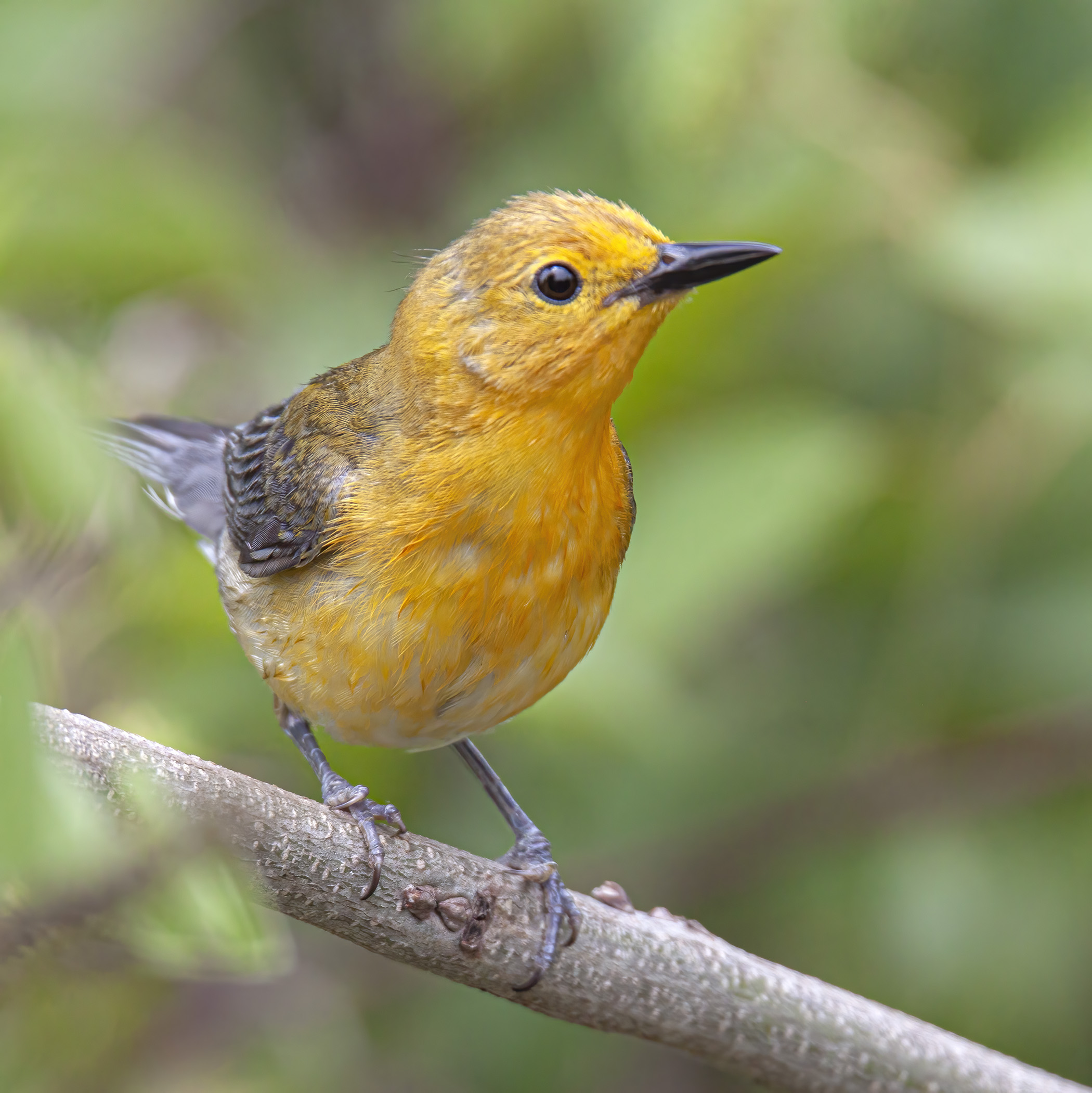
I was tracking the movement of this colorful Prothonotary Warbler on Monday (Protonotaria citrea) at Occoquan Bay National Wildlife Refuge as it hopped about in the dense green foliage, when suddenly it popped into the open and I was able to capture these images.

I absolutely love the bright yellow coloration of this warbler that never fails to put a smile on my face—years ago I used to drive a Toyota Matrix that was Solar Yellow and was visible from a long distance away. It was cool during this encounter that the bird was close enough to me that I managed to capture the reflection of the sky and the landscape in its eye.

Prothonotary Warbler

Prothonotary Warbler

© Michael Q. Powell. All rights reserved.


Read Full Post »

I was excited to spot this juvenile Bald Eagle (Haliaeetus leucocephalus) sitting up in the big nest at Occoquan Bay National Wildlife Refuge on Monday. I assume that this eaglet was born this spring, based on its coloration and markings.

Earlier this spring I had noted eagle activity around this nest and thought that the nesting process had already begun long ago. However, this nest is very large and so high up that it is impossible to tell when the eagles began to sit on the egg or eggs. I checked my blog postings from the past and saw that I posted a shot of eaglets at this same nest on 19 May last year (see the posting Eagle nest update in May), so things seem to be following the same approximate schedule.

I saw only a single eaglet this time, but will continue to monitor the nest for more eaglet activity, including indications that there is more than one eaglet. Earlier on the same day I spotted an adult eagle perched in a tulip tree—you can actually see some of the “tulips”— adjacent to the nest and suspect that this is one of the parents keeping an eye on the eaglet(s). I included a shot below of the presumed proud parent as a final photo.

Bald Eagle

Bald Eagle

© Michael Q. Powell. All rights reserved.


Read Full Post »

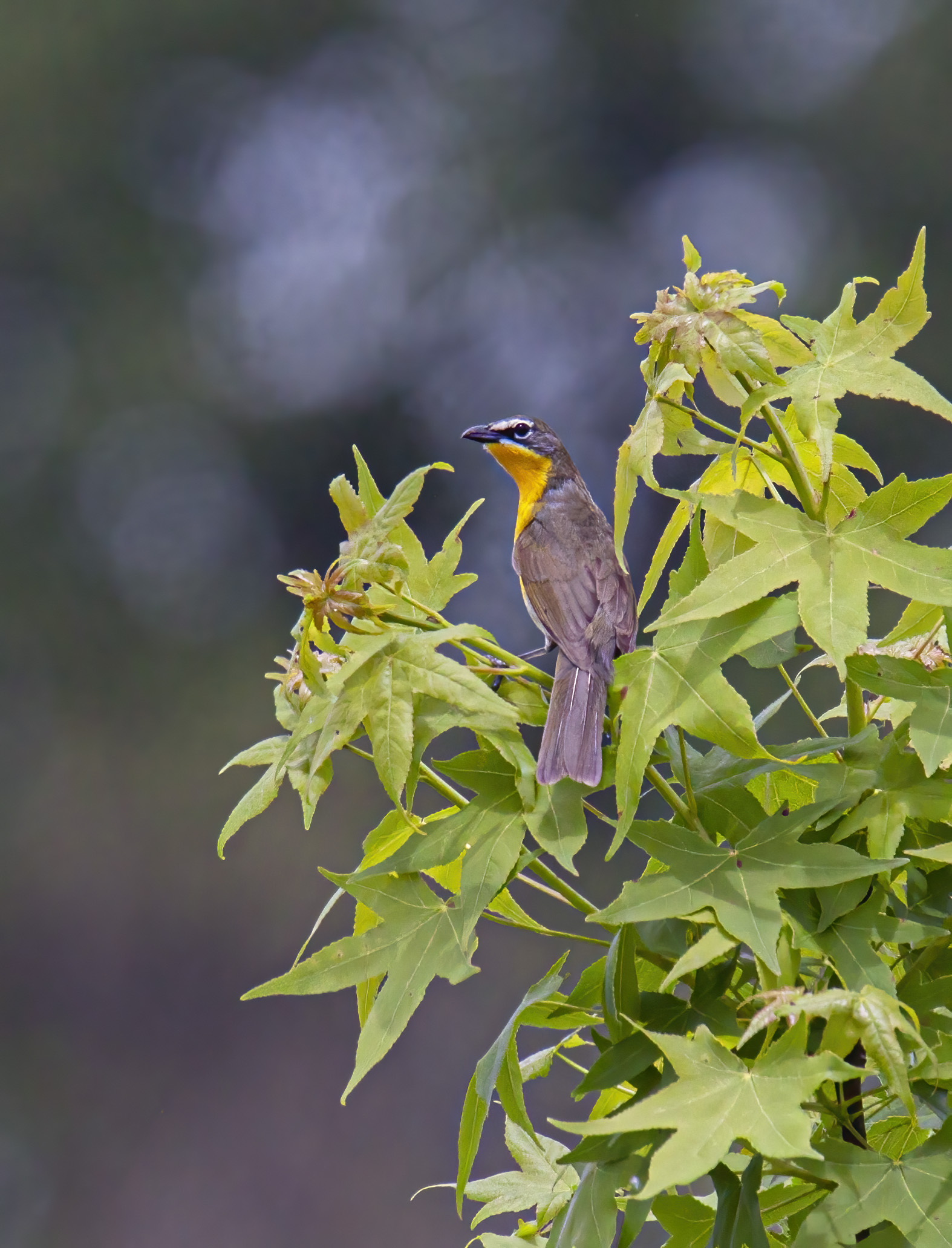
This bird was in the middle of a field on Tuesday at Occoquan Bay National Wildlife Refuge when its movement caught my eye. When it hopped to the top of the vegetation, its brilliant yellow chest made it really hard to miss, even though it was far away. I am pretty sure that it is a Yellow-breasted Chat (Icteria virens), my first sighting ever of this cool bird species.

Many of the migrating warblers that are passing through my area have various yellow markings, so I assumed that this was simply another warbler that I had never seen before. The reality, however, is hardly simple. According to Wikipedia, “The Yellow-breasted Chat (Icteria virens) is a large songbird found in North America, and is the only member of the family Icteriidae. It was once a member of the New World warbler family, but in 2017, the American Ornithological Society moved it to its own family. Its placement is not definitely resolved.”

Compared with most other warblers, the Yellow-breasted Chat seems much larger and bulkier and it has a relatively long tail and a rather robust beak. I love the bright yellow color on its breast and the distinctive eye-markings that make it look like the bird is wearing spectacles.

I think that we are nearing the end of the period of bird migration, but I will definitely keep my eyes open for possible new finds like this gorgeous Yellow-breasted Chat.

Yellow-breasted Chat

yellow-breasted chat

© Michael Q. Powell. All rights reserved.

Read Full Post »

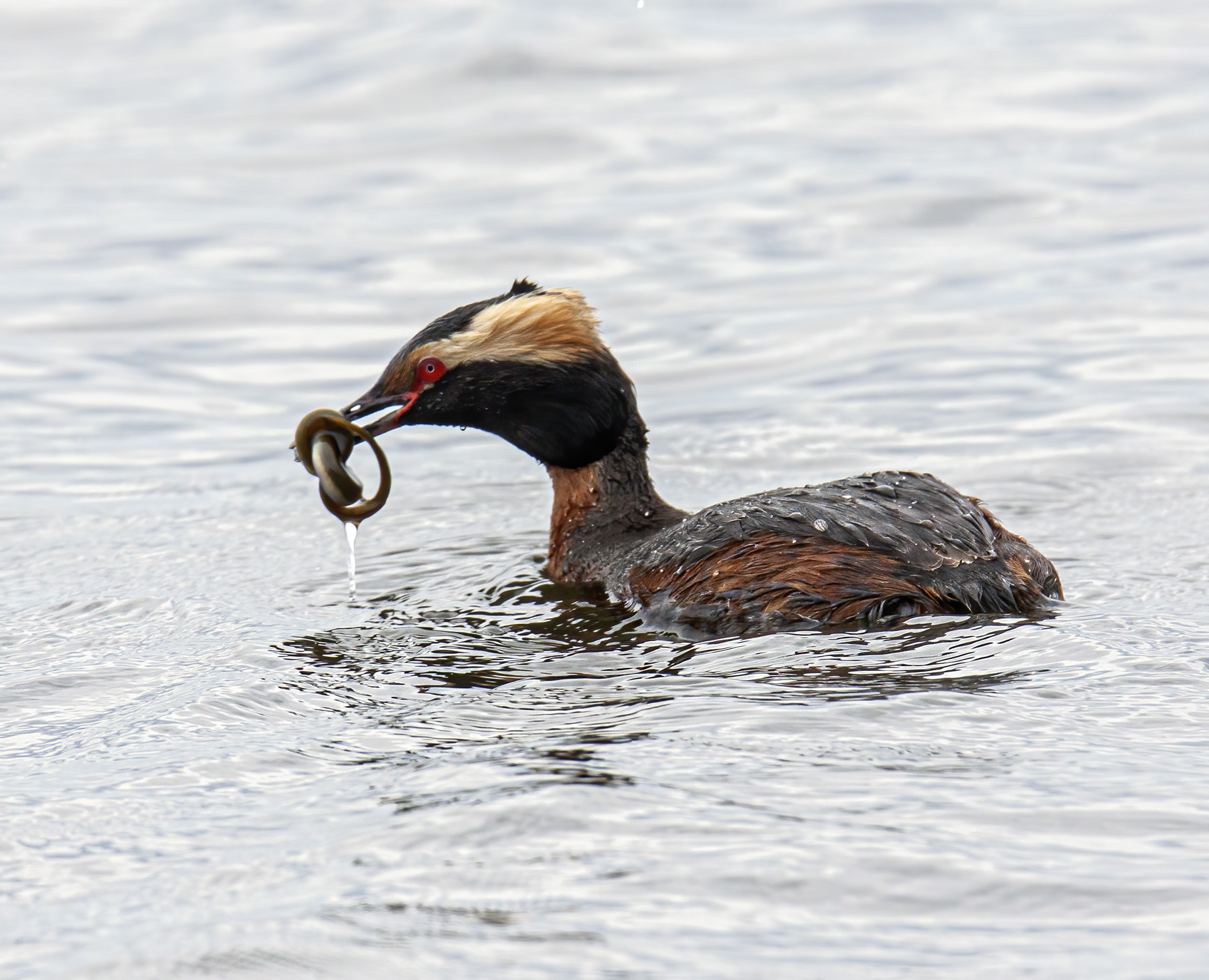
Although I have photographed a Horned Grebe (Podiceps auritus) several times in the past, I had never seen one in colorful breeding plumage until yesterday. According to the range maps on the Cornell Lab of Ornithology website, Horned Grebes do not breed in my area, so this one, who was swimming by himself, may just be passing through as he migrates northward.

The colors and patterns on this bird are amazing. The gold circles in the grebe’s red eyes really grab a viewer’s attention, though I must admit that I find them to be a little bit creepy—it is definitely worthwhile to click on the photos to get a closer look at those eyes. The bird’s distinctive “horns” appear to be tufts of long golden feathers behind each eye in a pattern that is reminiscent of the haircut of a medieval monk, particularly in the middle photo. My favorite photo may well be the final one that captures some of the grebe’s spunky personality.

Like most other grebes, Horned Grebes have compact bodies, relatively short necks, blocky heads and straight, narrow bill that is very different from a duck’s bill. I observed the grebe as it repeatedly made short dives in search of food yesterday in the waters off of Occoquan Bay National Wildlife Refuge. According to the Cornell Lab of Ornithology, during the breeding period Horned Grebes also feed heavily on insects and larvae, some caught in the air, others in or on the water.

Horned Grebe

Horned Grebe

Horned Grebe

© Michael Q. Powell. All rights reserved.

Read Full Post »

When the weather turns warm and sunny, it is not uncommon for me to spot Common Five-lined Skinks (Plestiodon fasciatus), one of the few lizards that are present in my area. Most of the time I see them on the trunks of trees or on fallen logs, but occasionally I will see one on a man-made structure that has crevices and overhangs where they can hide.

Skinks are skittish and will scamper away if they detect my presence, so I have to be super stealthy in approaching them to get a shot. In the case of these photos, I was at the edge of a small pond at Jackson Miles Abbott Wetland Refuge last week looking for dragonflies when some movement on a nearby concrete fishing platform caught my eye. The skink had just crawled out of the shadows and was surveying the area when I captured these images.

Juvenile skinks have blue tails and there appears to be some blue on the tail that is especially visible in the second photo, so I am guessing that it is almost a full-grown adult. Some scientists believe that the blue color functions as a decoy, diverting the attention of predators to this “expendable part” of the body—the tail is detachable and regrows if it is lost. Other scientists propose that the blue coloration serves to inhibit attacks by aggressive adult males, who might otherwise view the juveniles as rivals.

If you are curious and would like to see a photo of the blue tail of a juvenile skink, check out this 2021 blog posting entitled Juvenile Skink in April.


Five-lined Skink

Five-lined Skink

© Michael Q. Powell. All rights reserved.

Read Full Post »

I was busy this week, so I was not able to spend as much time out in nature as normally. The last two days, temperatures have soared well above normal to over 90 degrees (32 degrees C), so it has been really uncomfortable to spend much time outdoors. Later in the summer, my body will grow accustomed to the heat, but right now the high temperatures are unbearable.

I was able to make a short trip on Wednesday to Jackson Miles Abbott Wetland Refuge, a small nature preserve not far from where I live, and was delighted to spot this female Ashy Clubtail dragonfly (Phanogomphus lividus). Ashy Clubtails are an early spring species—they appear in April and are gone by June—and I have seen them several times already this year. Most of the ones I have spotted have been males, so it was a treat to be able to photograph a female.

Ashy Clubtails like low perches and often perch on the ground, where they often are camouflaged by the vegetation. In this case, the dragonfly perched a bit above ground level, so I was able to get a pretty good shot of her profile. It is probably my imagination, but it seems to me that she was glancing up at me and smiling a little as she posed for this portrait.

Ashy Clubtail

© Michael Q. Powell. All rights reserved.li

Read Full Post »

Although I enjoy photographing large, colorful butterflies, like the Zebra Swallowtail that I featured in a recent posting, I also love to photograph smaller, more nondescript butterflies. I spotted this pretty little Silver-spotted Skipper (Epargyreus clarus) during a visit to Occoquan Bay National Wildlife Refuge and chased it about as it gathered nectar from several early spring wildflowers.

There are over 3500 species of skipper butterflies worldwide, according to Wikipedia, and the Silver-spotted Skipper is one of the few that I can reliably identify. Many of the others that I see are so similar in appearance that I have to pore over identification guides to try to figure out what kind they are. Often I end up guessing and am wrong just about as often as I am right in identifying a skipper.

Silver-spotted Skipper

Silver-spotted Skipper

© Michael Q. Powell. All rights reserved.

Read Full Post »

I was thrilled to capture this image of an Eastern Comma butterfly (Polygonia comma) during a recent visit to Occoquan Bay National Wildlife Refuge. When its wings are closed, this butterfly blends right in with the bark of the trees on which it frequently perches, so it was nice that it chose to perch on some green leaves.

Eastern Comma

Eastern Comma

© Michael Q. Powell. All rights reserved.

Read Full Post »

Zebra Swallowtail butterflies (Eurytides marcellus) are amazingly skittish. They fly all about, approaching plants as though they were planning to land and then change course at the last moment. I was thrilled during a recent trip to Occoquan Bay National Wildlife Refuge when this beautiful Zebra Swallowtail landed on a small wildflower and stayed still long enough for me to lower my monopod and focus on it.

I was shooting at the extreme end of my long telephoto zoom lens and was not sure if I could capture the fine details of the butterfly—the lens is supposedly soft at 600 mm. I was delighted when I saw my shots on my computer to see that I had managed to capture the beautiful red markings that really pop amid the zebra stripes pop on this swallowtail. Even the long antennae and the “tails” of the butterfly are pretty sharp.

Zebra Swallowtail

© Michael Q. Powell. All rights reserved.

Read Full Post »

It is getting late in the season for Uhler’s Sundragon dragonflies (Helocordulia uhleri), so I was particularly happy when I spotted several of them last week while I was exploring a creek in Prince William County. Uhler’s Sundragons appear in early April and their flight period lasts for only a month or so, so it is always a challenge to find them and photograph them for the season.

Both of the dragonflies in the photos are males, judging by the appendages at the tips of their abdomens and their indented hind wings. I think that they are two separate individuals, but cannot be sure, since I spotted them in the same general area.

Some of you may have noticed that I did not do postings on Saturday and Sunday. I try to do a posting every day and during the past year “missed” only four days. I spent this past weekend in the mountains of Virginia at a church retreat and disconnected myself from the internet during that time. I had a wonderful time and feel uplifted emotionally and spiritually. After all of the covid-related travel limitations of the past two years, it felt good to get away and break out of my normal routine.

Uhler's Sundragon

Uhler's Sundragon

© Michael Q. Powell. All rights reserved.


Read Full Post »

Last Monday I was really excited to spot several male Stream Cruiser dragonflies (Didymops transversa), one of the early spring dragonflies that heretofore had eluded me this season. Stream Cruisers are habitat specialist, according to the Dragonflies of Northern Virginia website, and prefer “stable, small to medium, forest streams, with good flow and rocks. The best place to find them is hunting in sunlit meadows near their woodland waterways.”  That is am accurate description of the spot where I photographed these Stream Cruisers alongside a stream in Prince William County, Virginia.

I love the overall look of a Stream Cruiser, with its distinctive green eyes, its colorful markings, and its long, gangly legs. If you look closely at the first image, you can see that the dragonfly is holding onto both sides of the forked branch with its long legs. I marvel too at the way that the Stream Cruiser is hanging in the second and third images—the pose looks awkward and precarious, but somehow the acrobatic position worked for the dragonfly.

Stream Cruiser

Stream Cruiser

Stream Cruiser

© Michael Q. Powell. All rights reserved.


Read Full Post »

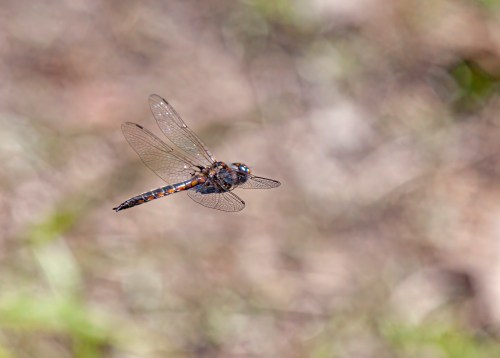
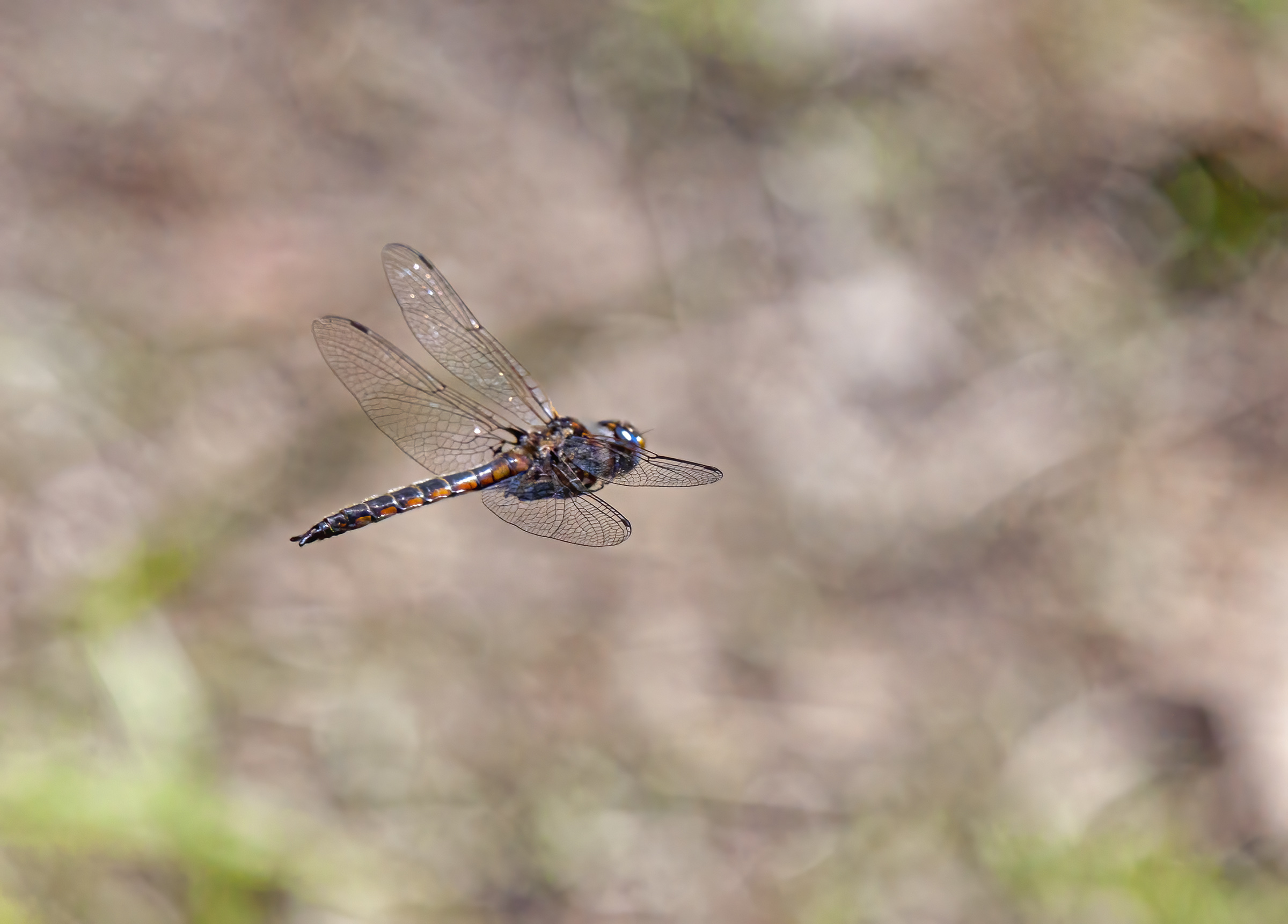
Every year I challenge myself by attempting to capture images of dragonflies in flight. Some dragonfly species help out by flying in somewhat predictable patterns or by hovering a bit, but it is still pretty tough to capture a tiny moving subject like a dragonfly.

This week I managed to photograph Common Baskettail dragonflies (Epitheca cynosura) in flight on two consecutive days at different locations using different lenses and techniques. Male Common Baskettails often patrol around the edges of small ponds in fairly limited areas. If you observe them long enough, you can get a general sense of the track that they are following.

For the first photo, I extended my Tamron 150-600mm lens to its maximum length and pre-focused on an open area that appeared to be part of the patrol route at a small pond at Occoquan Bay National Wildlife Refuge. My camera was on a monopod and when the dragonfly entered the target area, I would attempt to track it and focus the lens manually. It sounds pretty straightforward, but the hand-to-eye coordination required makes this approach quite daunting. However, as you can see in the first photo, it is possible to get a decent shot. If you click on the image, you can see lots of cool details, including the way that the dragonfly has folded up its legs under its thorax.

The next day I was exploring a small pond in Prince William County when I spotted a patrolling dragonfly—it was another male Common Baskettail. I had my Tamron 180mm macro lens on my camera and was not using a monopod. I was able to track the dragonfly a bit more freely with this lighter lens, which proved to be beneficial when the dragonfly deviated from its flight path. Once again I focused manually and was thrilled with the results I got in the second and third images below. I particularly like the way that I was able to capture some of the pond environment in the second shot, while managing to get the dragonfly in sharp focus.

Why do I use manual focus? My Canon 50D is a long in the tooth and has a relatively primitive focusing system with only nine focus points, which means that my camera can’t focus fast enough or accurately enough to shoot a dragonfly in mid-air. More modern camera have much faster and more sophisticated focusing systems and theoretically can produce better results. I saw a video recently, for example, in which a photographer was able to use animal eye focus on a moving dragonfly. Yikes! You pay a real premium, though, for that advanced technology, with camera bodies costing up to $5,000 and lenses up to $12,000.

I am not all that impressed by fancy camera gear and would rather focus on mastering the more modest gear that I have and spending as much time as I can out in the wild. In my mind, that recipe sets me up best to take advantage of the opportunities that arise as I wander about in nature.

Common Baskettail

Common Baskettail

Common Baskettail

© Michael Q. Powell. All rights reserved.


Read Full Post »

I kept hearing loud singing coming from the top of the trees on Monday at Occoquan Bay National Wildlife Refuge, but had trouble locating the source of the singing. Leaves are now covering the trees, complicating my efforts to spot small songbirds. Eventually I managed to locate the birds and they turned out to be Indigo Buntings (Passerina cyanea).

Once again I was amazed by the deep blue coloration of the male Indigo Buntings—its intensity never fails to startle me. The bold color of the Indigo Buntings, sometimes nicknamed “blue canaries,” was matched by the cheerfulness of their songs. According to the Cornell Lab of Ornithology, “Male Indigo Buntings whistle a bright, lively song of sharp, clear, high-pitched notes that lasts about 2 seconds. They are voluble, singing as many as 200 songs per hour at dawn and keeping up a pace of about one per minute for the rest of the day.” Check out this link to hear samples of some of the songs of Indigo Buntings.

I was amazed to discover about how Indigo Buntings learn to sing. According the Cornell Lab of Ornithology, “Indigo Buntings learn their songs as youngsters, from nearby males but not from their fathers. Buntings a few hundred yards apart generally sing different songs, while those in the same “song neighborhood” share nearly identical songs. A local song may persist up to 20 years, gradually changing as new singers add novel variations.” Wow!

I believe that Indigo Buntings will be with us all summer and I hope to get some shots at closer range. I have fond memories of the first time I photographed a male Indigo Bunting in August 2017 as he perched on the drooping head of a sunflower—check out the posting entitled Indigo Bunting and Monarch.

Indigo Bunting

Indigo Bunting

Indigo Bunting

© Michael Q. Powell. All rights reserved.

Read Full Post »

On Monday I spotted my first Green Heron (Butorides virescens) of the season at Occoquan Bay National Wildlife Refuge. Unlike Great Blue Herons that remain with us all winter, Green Herons migrate to warmer places in the fall and return to our area in the spring and spend the summers with us.

When I first spotted the heron, it was perched in a tree, as shown in the final photo. I passed by the heron, stopped a short distance away, and waited. Eventually the heron grew comfortable with my presence (or chose to ignore me) and hopped down out of the tree. Recent heavy rains had caused a pond to overflow onto a road and I was happy to be able to get some shots as the heron poked about in the shallow waters at the edge of the road.

I crouched as low as I could and waited for the heron to move into one of the patches of light. The little moved slowly and deliberately, gradually Green moving into the dense undergrowth where I had trouble tracking it. It was a cool encounter with one of my favorite birds—in my experience Green Herons show a lot of personality than other herons.

Green Herons are also one of the world’s few tool-using bird species. According to the Cornell Lab of Ornithology, Green Herons “often create fishing lures with bread crusts, insects, and feathers, dropping them on the surface of the water to entice small fish.” I have not yet seen this kind of behavior, but try to be particularly alert whenever I spot a Green Heron. It would be easier for me to recognize the behavior if the Green Heron used something more distinctive, like a little fishing pole.

Green Heron

Green Heron

Green Heron

© Michael Q. Powell. All rights reserved.

Read Full Post »

I was absolutely delighted yesterday to spot several colorful Calico Pennant dragonflies (Celithemis elisa) while I was exploring a pond at Occoquan Bay National Wildlife Refuge. There is something really special about dragonflies with patterns on their wings, and Calico Pennants have wonderfully intricate patterns on their wings, particularly on their hind wings.

Yesterday was our first sunny day in a week or so and the weekend had been unseasonably cold, so it felt especially good to be outdoors again. It is still early in the season for many dragonflies species, but I try to be diligent in searching areas where they might be present. Some days, like last Friday when I spotted the Lady’s Slipper orchids that I featured yesterday, I am not able to find any dragonflies at all, while other days my persistence pays off—that is the fate of a wildlife photographer.

Calico Pennant

Calico Pennant

Calico Pennant

© Michael Q. Powell. All rights reserved.

Read Full Post »

I spotted this Common Green Darner dragonfly (Anax junius) during a recent trip to Occoquan Bay National Wildlife Refuge. It was patrolling overhead within a fairly confined area and I was able to track it visually until it finally landed. The photo makes it look like the dragonfly was climbing its way out of a deep pit. In reality, however, it was hanging from some roots sticking out from a big pile of dirt.

I was a little surprised that I was able to capture as much detail as I did, given that I was shooting with my Tamron 150-600mm lens fully extended to 600mm. Supposedly the lens is soft at 600mm, but good stabilization techniques (including using a monopod) and a little tweaking with software produce images that are acceptably sharp to my eyes.

I love the multi-colored bodies of Common Green Darners, one of the largest dragonflies in our area with a body length of about 3 inches (76 mm). I think that this is a male. Mature males normally have bright blue abdomens, but they may turn purple when temperatures are low, which seemed to be the case when I took this photo. Females, by contrast, have abdomens that tend to be a mixture of tan and gray-green. For both genders, the thorax (the “chest” area) is bright green.

If you click on the image, you can get a better look at the dragonfly’s “bullseye” marking, the black and blue dot that is found on the “nose” of both male and female Common Green Darners. I am always thrilled when I manage to get a shot that captures the bullseye so well.

We are in the midst of a spell of cool, rainy weather so I have not seen any dragonflies in over a week. The weather is forecasted to warm up a bit, so I am hoping that I will have better success in the upcoming week.

Common Green Darner

© Michael Q. Powell. All rights reserved.


Read Full Post »
It did not seem like there was much pollen inside of each little phlox flower, but bees were busily collecting it when I spotted several of them last Saturday at Meadowlark Botanical Gardens in Vienna, Virginia. I love the way that some bees, including honeybees, collect pollen in little pouches on their back legs. When the pickings are really good, I have seen those pouches, which technically are called corbiculae, so full and bulging that they seem ready to burst—that was not the case this early in the spring, when not very many flowers were in bloom.

I was pleasantly surprised when I managed to capture a bee in flight in the second photo below as it surveyed the phlox flowers and planned its next assault. My 180mm macro lens is notoriously slow to acquire focus, so I rarely try to use it to try to capture moving subjects. The lens also is so noisy when focusing that one of my friends calls it “The Grinder.” Nonetheless, my trusty Tamron lens is my constant companion during the warm months and it is the one I use most often for my insects and other macro shots.

bee and phlox

Bee and Phlox

© Michael Q. Powell. All rights reserved.


Read Full Post »
A speedy little Barn Swallow (Hirundo rustica) was perched on a paved path at Meadowlark Botanical Gardens last Saturday and I captured this first image as it was taking off. The shot is a little blurry, but I love the the really cool shadow that the swallow was casting onto the ground. The second image shows the same swallow just before it took off and give you a better view of the coloration and markings of a Barn Swallow.

When I first spotted the birds in the final photo, I thought they might also be Barn Swallows, but when I took a closer look and did a little research, I determined that the bird on the outside of the nest was a male Purple Martin (Progne subis) and the one with her head poking out was a female Purple Martin. As far as I can recall, this is the first time that I have photographed this bird species, which is the largest swallow in our area.

Barn Swallow

Barn Swallow

Purple Martin

© Michael Q. Powell. All rights reserved.


Read Full Post »

As we were photographing some Spring Snowflake flowers (Leucojum vernum) on Saturday at Meadowlark Botanical Gardens, my dear friend and photography mentor Cindy Dyer noticed what looked like a spider’s leg on the side of one of the flowers and asked me to go around to the other side of the flower to investigate.

Sharp-eyed Cindy was right—I spotted this tiny spider clinging to the side of the snowflake and was delighted that I was able to capture this image of it.

Leucojum vernum

© Michael Q. Powell. All rights reserved.

Read Full Post »

Most warblers forage in the forest canopy and I have to strain my neck to search for them. Palm Warblers (Setophaga palmarum), however, mainly forage on open ground or in low vegetation.  When I saw a flash of yellow in some low bushes last week at Occoquan Bay National Wildlife Refuge, I therefore suspected that it might be a Palm Warbler.

I watched and waited and eventually the bird hopped up onto a branch and I managed to get a clear shot of it. I wasn’t one hundred percent sure that it was a Palm Warbler, but the color and markings looked about right and I could see the rust-colored cap on its head, another identification feature for a Pine Warbler. Some experts in a Facebook forum confirmed that “my” bird is indeed  a Palm Warbler.

The warblers are with us for only a limited period of time in the spring before they continue their migration northward, so I don’t know how many more times I will have a chance to photograph them. At this time of the year, though, colorful flowers are popping up and insects are reappearing, so I won’t suffer from a lack of subjects when the wablers depart.

Palm Warbler

© Michael Q. Powell. All rights reserved.

Read Full Post »

« Newer Posts - Older Posts »