Feeds:
Posts
Comments

Archive for the ‘wildlife’ Category

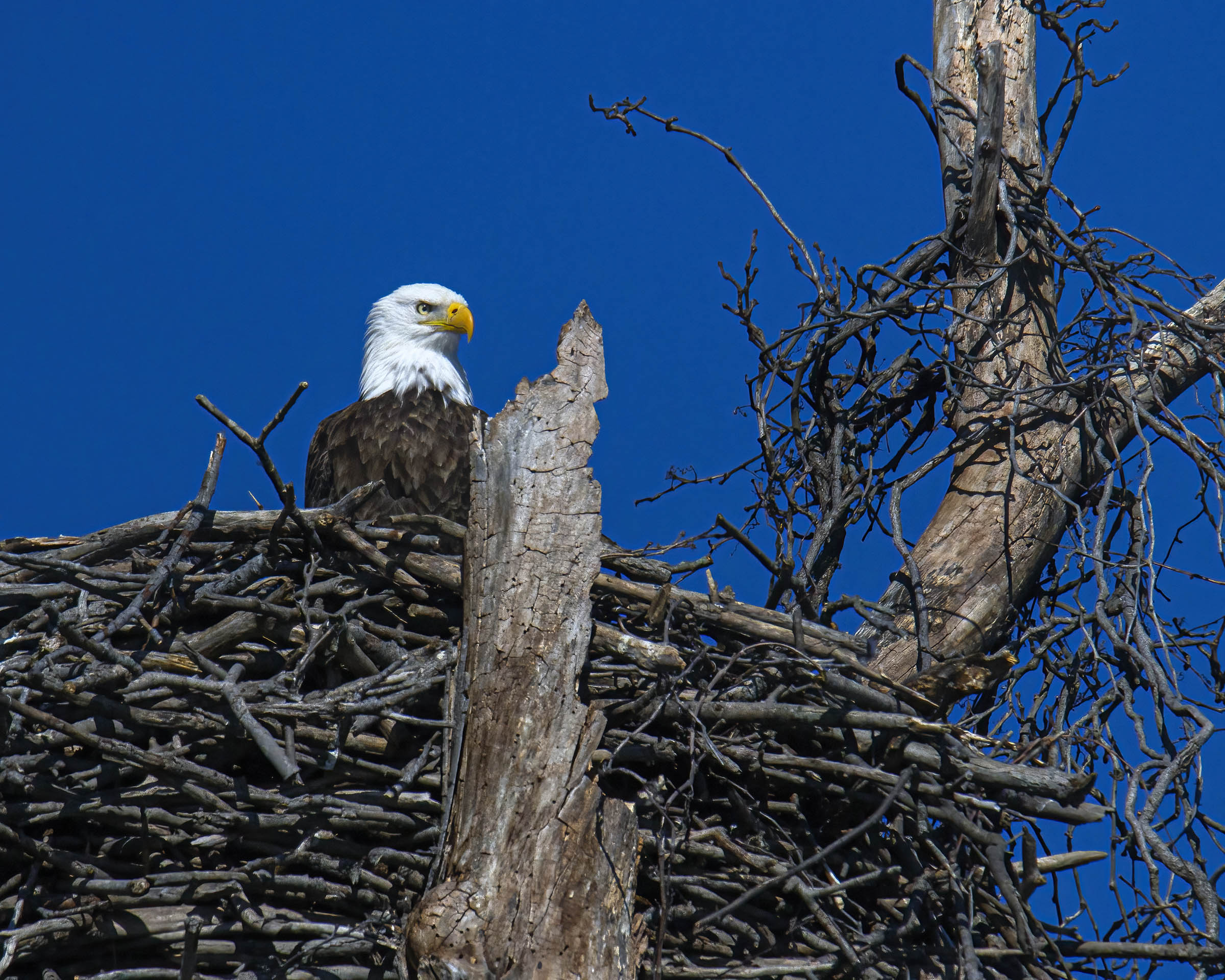
It won’t be long before the Bald Eagles (Haliaeetus leucocephalus) begin to incubate their eggs at one of several nests of which I am aware at Occoquan Bay National Wildlife Refuge. The smallest nest was used for the first time last year and I was curious to see if the eagles would return to it. I was therefore quite happy to spot an eagle on Tuesday perched in that nest in what looks to be a sycamore tree. Usually eagles sit much lower in the nest when there are eggs present, so I suspect that this eagle was checking out the nest, possible as a prelude to renovating or enlarging it.

I was a pretty good distance away from the eagle and was partially hidden by vegetation and trying to be stealthy, but the eagle detected my presence. I captured the second image right after the eagle flew out of the nest. I managed to get only a single decent shot, because the eagle descended and was immediately hidden by the abundant branches—if the eagle had flown upwards I might have had a better chance of getting several clear shots.

Last year the authorities at the refuge eventually blocked the trail on which I was traveling to keep the eagles from being disturbed during the nesting season. I would not surprised to find the trail blocked the next time I visit the refuge. During the period of time before the trees begin to leaf out, I may still be able to keep track of the nest, albeit from a slightly greater distance from it.

Bald Eagle

Bald Eagle

© Michael Q. Powell. All rights reserved.

Read Full Post »

Despite my best efforts, I could not get this White-throated Sparrow (Zonotrichia albicollis) to smile for me during a mini-portrait session on Tuesday at Occoquan Bay National Wildlife Refuge. The sparrow seemed to think that a serious look was more appropriate for his LinkedIn profile photo.

Birds were much more active on Twitter before its name was changed to X, but now are searching for new social media fora. Are postings on X still called “tweets?”

White-throated Sparrow

© Michael Q. Powell. All rights reserved.


Read Full Post »

When it comes to posting photos, where do you you draw the line? Do you carefully curate your images and post only the ones that make you look good as a photographer? Do you worry about your “image” and reputation? I remember someone telling me once that the true sign of professionals is that they present only their absolute best work to the public.

I am proud to say that I am not a professional by that definition and I post photos that I find interesting, cool, or quirky, irrespective of the supposed quality of the images. I do not really care all that much about my personal image and have never had a goal of attracting a large audience of “followers.” I post images that appeal to me in some way and hope that some viewers will have a similar reaction

My photos (and my blog) are a reflection of the way that I see the world and my simple objective is to use my images and words to share my perspectives with others, i.e. to help them to see the world through my eyes. For me, the natural world is full of endless wonder and unlimited beauty, a place to explore and channel my curiosity and creativity.

I have gone off on a bit of a tangent in this posting, but I woke up this morning in an introspective mood and wanted to share some of what is going on in my head at this moment. The three images below are ones that I have taken over the past two weeks at Occoquan Bay National Wildlife Refuge and are a bit more “artsy” than my usual images, which tend to be more detailed and close-up.

The first image shows a pair of Hooded Merganser ducks (Lophodytes cucullatus) flying away from me over the water. I really like their shadowy reflections and the parallel lines of the water. The second photo shows a Pied-billed Grebe (Podilymbus podiceps). Although I captured the details of the bird pretty well, it is the rippled reflection that really grabbed my attention.

The final photo is a minimalist environmental portrait of a Belted Kingfisher (Megaceryle alcyon). Silhouettes work best when the shape of the subject make it immediately recognizable, which I think is the case here. I like the way that the angular protrusions of the branch match those of the bird. The image is mostly black and white, but I really like the way that you can see a bit of the blue sky peeking through in the upper right corner of the frame.

So what do you think? Would you have thought to capture these images? Would you have been willing to share them with others? Where do you draw the line?

Hooded Mergansers

Pied-billed Grebe

Belted Kingfisher

© Michael Q. Powell. All rights reserved.

Read Full Post »

I observed Song Sparrows (Melospiza melodia) foraging for food on the ground at multiple locations last Thursday at Occoquan Bay National Wildlife Refuge. Most of the time they would fly away as I approached, but occasionally one of them would choose a new snow-covered perch that was still within range of my long telephoto zoom lens.

The two photos below are mostly monochromatic, composed primarily of various shades of brown and white. The warmth of the browns helps to warm up the photos a little, despite the abundance of snow. I think the photos would have felt cooler and more stark if I had converted them to black and white.

Song Sparrow

Song Sparrow

© Michael Q. Powell. All rights reserved.
 

Read Full Post »

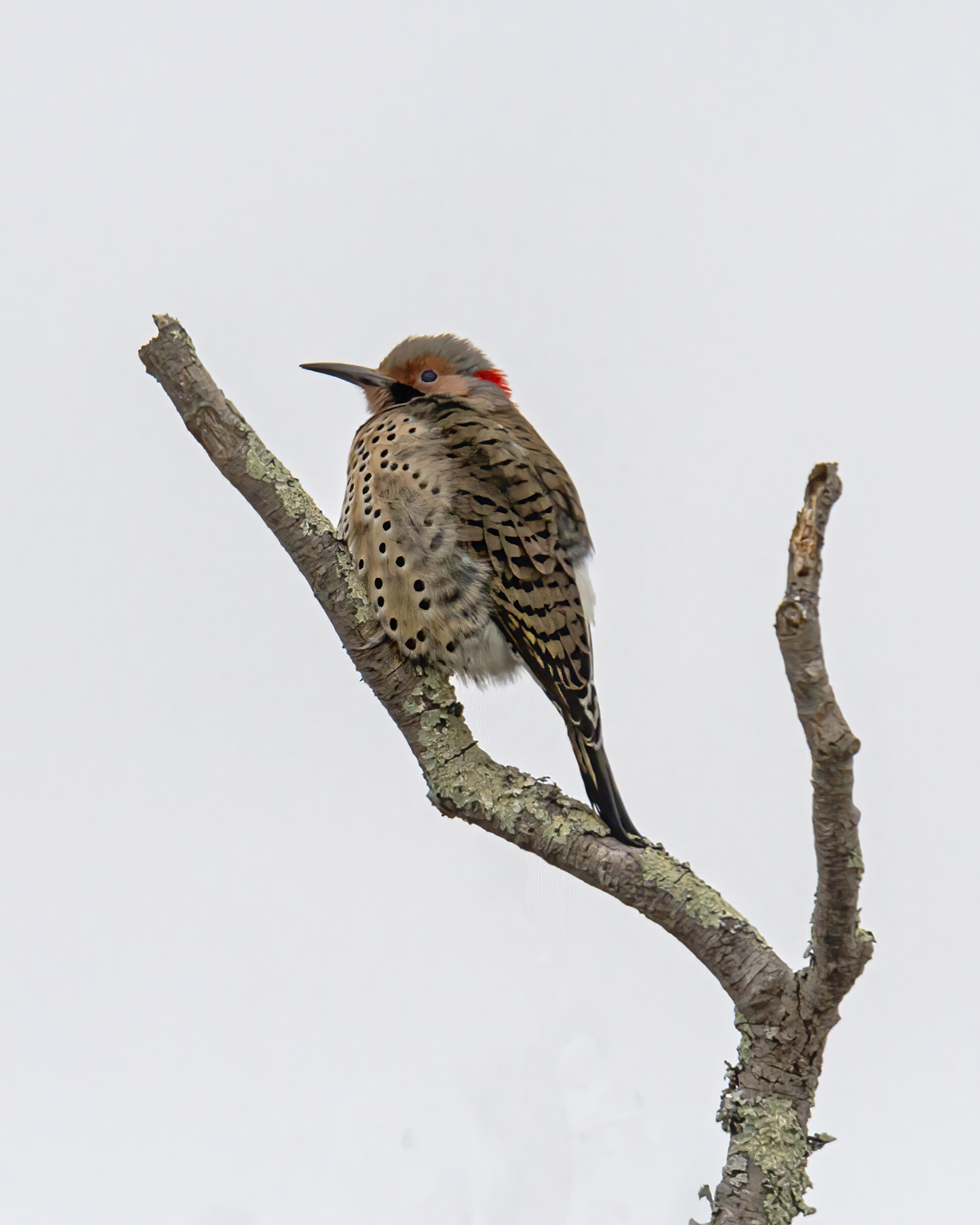
Most of the woodpeckers in my area have black and white feathers in varying patterns, but the Northern Flicker (Colaptes auratus) is a notable and colorful exception to that general rule. I spotted this male Northern Flicker—only males have the black “mustache”—last Thursday perched high in a dead tree at Occoquan Bay National Wildlife Refuge.

The sky was clouded over when I captured this image, so I chose to overexpose the shot to reveal the amazing colors and patterns of the flicker’s feathers. These camera settings caused the background to be almost totally blown out and the resulting white background makes this look like it was shot in a studio.

Like most of the birds that I photographed in our recent frigid weather, the flicker had fluffed its feathers in an effort to retain heat. If you look closely at the image, you may notice that the feathers cover most of the flicker’s feet, with only the tips of the toes visible.

Northern Flicker

© Michael Q. Powell. All rights reserved.

Read Full Post »

This Song Sparrow (Melospiza melodia) looks like it was buried in deep snow, but was merely hidden by a small snowdrift between the two of us as it foraged for food in a small open patch on Thursday at Occoquan Bay National Wildlife Refuge.

This photo reminds me of my childhood days growing up in New England. After a snowfall, we would build snow forts and have massive snowball fights. We would crouch behind the walls of our forts and periodically peer over the top of the walls (like this sparrow) before raising up to launch another volley of snowballs. These days I am more likely to build a snowman than a snow fort, although, alas, I did not take advantage of the opportunity to do so this past week.

© Michael Q. Powell. All rights reserved.

Read Full Post »

This White-throated Sparrow (Zonotrichia albicollis) seemed unhappy about something on Thursday at Occoquan Bay National Wildlife Refuge. Maybe it was complaining about my presence there or maybe it was calling out to its mate or expressing its displeasure about the cold, snowy weather. Who knows?

It is a real bonus when I can capture a bit of action in my photos of birds, even when it is hard to interpret what that action means. In many of my shots of sparrows, their heads are buried and out of view as they forage for food, so it was nice here to see the bird with its head lifted up. In this shot you actually get a glimpse of the inside of the sparrow’s mouth and a tiny tongue—you may need to click on the image and enlarge it to see these details.

We are still in the midst of a frigid spell, well below the freezing level all of today, but by Thursday we are supposed to warm up to 60 degrees (17 degrees C) and rain is in the forecast, so most of this snow will be gone in a week or so.

White-throated Sparrow

© Michael Q. Powell. All rights reserved.

Read Full Post »

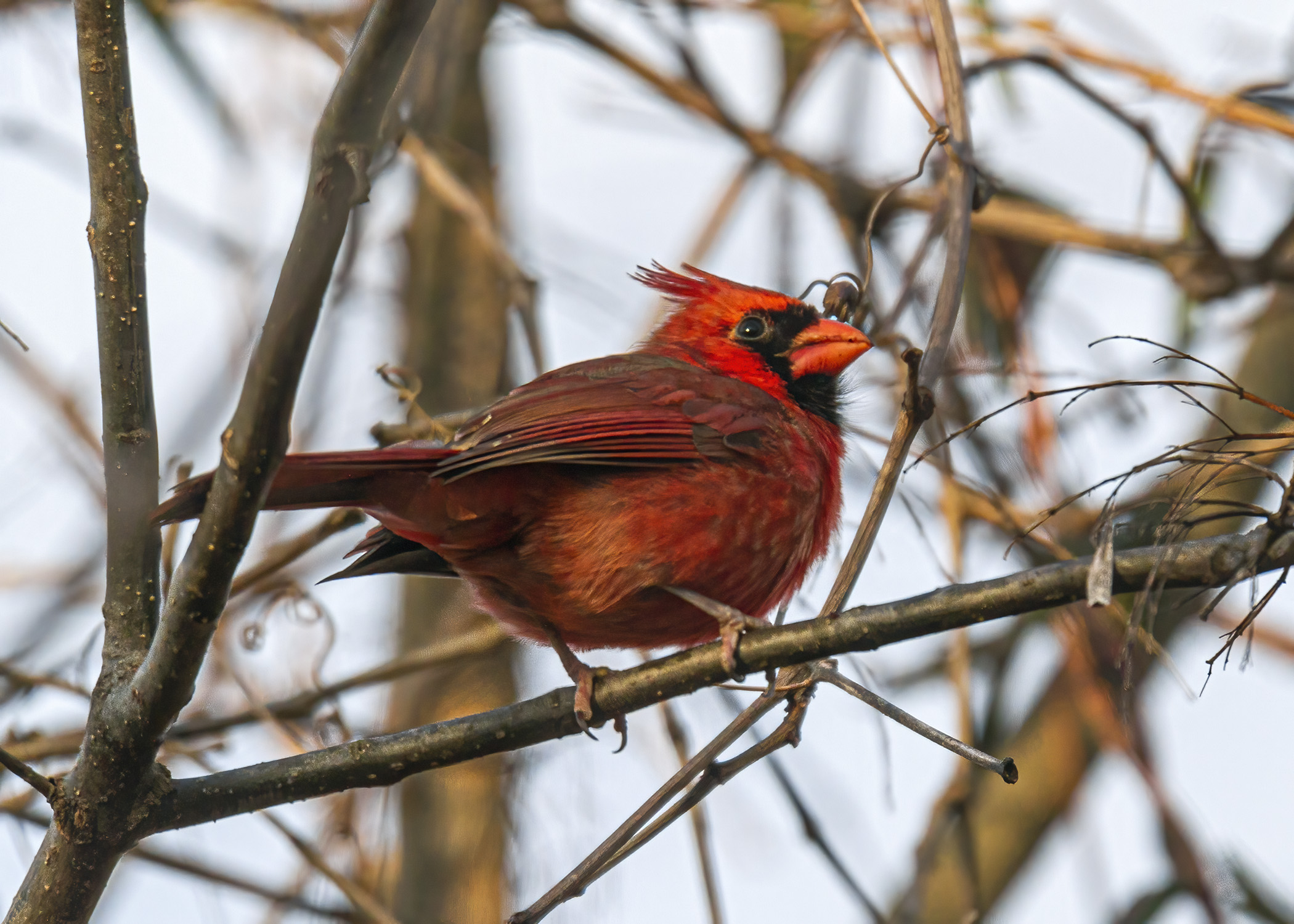
I am not sure exactly what this male Northern Cardinal (Cardinalis cardinalis) was doing on Thursday at Occoquan Bay National Wildlife Refuge when I captured this image. Perhaps he was trying to nibble on a bud on the branch on which he was perched—it was definitely too cold for there to be bugs out in the open. Whatever the case, I love the way that the cardinal extended his wings to maintain his balance.

The acrobatic moves of the cardinal and my shooting angle from below combined to distort the shape of his body, making it look almost cartoonish. All in all, this image makes me smile and I hope that it has the same effect on you.

Northern Cardinal

© Michael Q. Powell. All rights reserved.
Read Full Post »

I finally got out of my house on Thursday and visited Occoquan Bay National Wildlife Refuge. Large numbers of sparrows were busily pecking on the ground alongside the trails, many of which were still partially covered with snow. The sparrows would scatter as I approached, often disappearing deep into the surrounding vegetation, but occasionally one would stay still long enough for me to take its photo.

The first image shows what I believe is a White-throated Sparrow, surrounded by a bounty of berries. The second image shows a Song Sparrow (Melospiza melodia), foraging in the snow-covered grasses. I photographed the House Sparrow (Passer domesticus) in the third image in my neighborhood, but decided to include it here among its fellow sparrows.

The last two photos show a rotund White-throated Sparrow—like so many birds at this time of the year, this sparrow has puffed up his feathers to try to stay warm in the frigid weather. The final photo shows a blurry Northern Cardinal foraging in the background, a visible indication of the peaceful coexistence of multiple species as they searched for food.

White-throated Sparrow

Song Sparrow

House Sparrow

White-throated Sparrow

White-throated Sparrow

© Michael Q. Powell. All rights reserved.

Read Full Post »

Birds have to work really hard to find even the smallest amount food during the winter, as this Great Blue Heron (Ardea herodias) demonstrated last week at Occoquan Bay National Wildlife Refuge. Alas, the fish that the heron pulled out of the water turned out to be a tiny one, nothing more than an appetizer. After gulping the fish down, the heron patiently returned to its fishing and I moved along.

As you can probably tell from the blurred foreground of the photo, I was crouched in some vegetation adjacent to a small pond and did not have an unobstructed view of the heron. I generally try not to disturb my wildlife subjects and am even more careful during the cold months, not wanting to cause the subject to expend excess energy in escaping me that it might need to find food.

Great Blue Heron

© Michael Q. Powell. All rights reserved.


Read Full Post »

There is something iconic about a photo of a Northern Cardinal (Cardinalis cardinalis) in the snow and every time that we have a snow storm I try to capture images of these bright red birds. Fortunately I did not have to travel far to find some cardinals—I captured all three of these images in the suburban townhouse community in which I live.

Given the bright color their plumage, it is not hard to spot male cardinals, but they tend to be pretty active and don’t sit still for very long, so I had to react quickly when I managed to get an unobstructed view of one. I tried to frame my photos so there was at least a little bit of snow visible in the shot and more or less succeeded in doing so.

The weather forecasters predict that we will have some more snow tomorrow, so I will probably spend a little more time getting acquainted with my neighborhood birds this weekend.

Northern Cardinal

Northern Cardinal

Northern Cardinal

© Michael Q. Powell. All rights reserved.


Read Full Post »

We ended up getting 4-5 inches (10-13 cm) of snow in the storm that concluded yesterday. That may not sound like a lot of snow, but it was enough for the federal government and all of the school districts in the Washington D.C. area to be closed for the day. The roads were icy in my neighborhood, so I played it safe and did not venture out in my car at all.

However, I did go for a walk in my townhouse community in search of birds. It felt a little strange to be carrying a long telephoto zoom lens in such a heavily populated area and I alternately between feeling like a Peeping Tom and a member of the paparazzi.

I was happy to find a few birds in a strip of woods in our community, including this Dark-eyed Junco (Junco hyemalis). It was initially foraging on the ground when I spotted it, as you can see in the first photo, and then flew into some trees when I took a few steps closer.

It is sunny out today and the roads are mostly clear, but that is a bit deceptive, because the temperature was only 14 degrees (-10 degrees C), the last time I checked. Yikes! I have not reviewed all of my photos from yesterday, so I probably will stay inside and finish that review, rather than venture out with my camera today.

Dark-eyed Junco

Dark-eyed Junco

© Michael Q. Powell. All rights reserved.
Read Full Post »

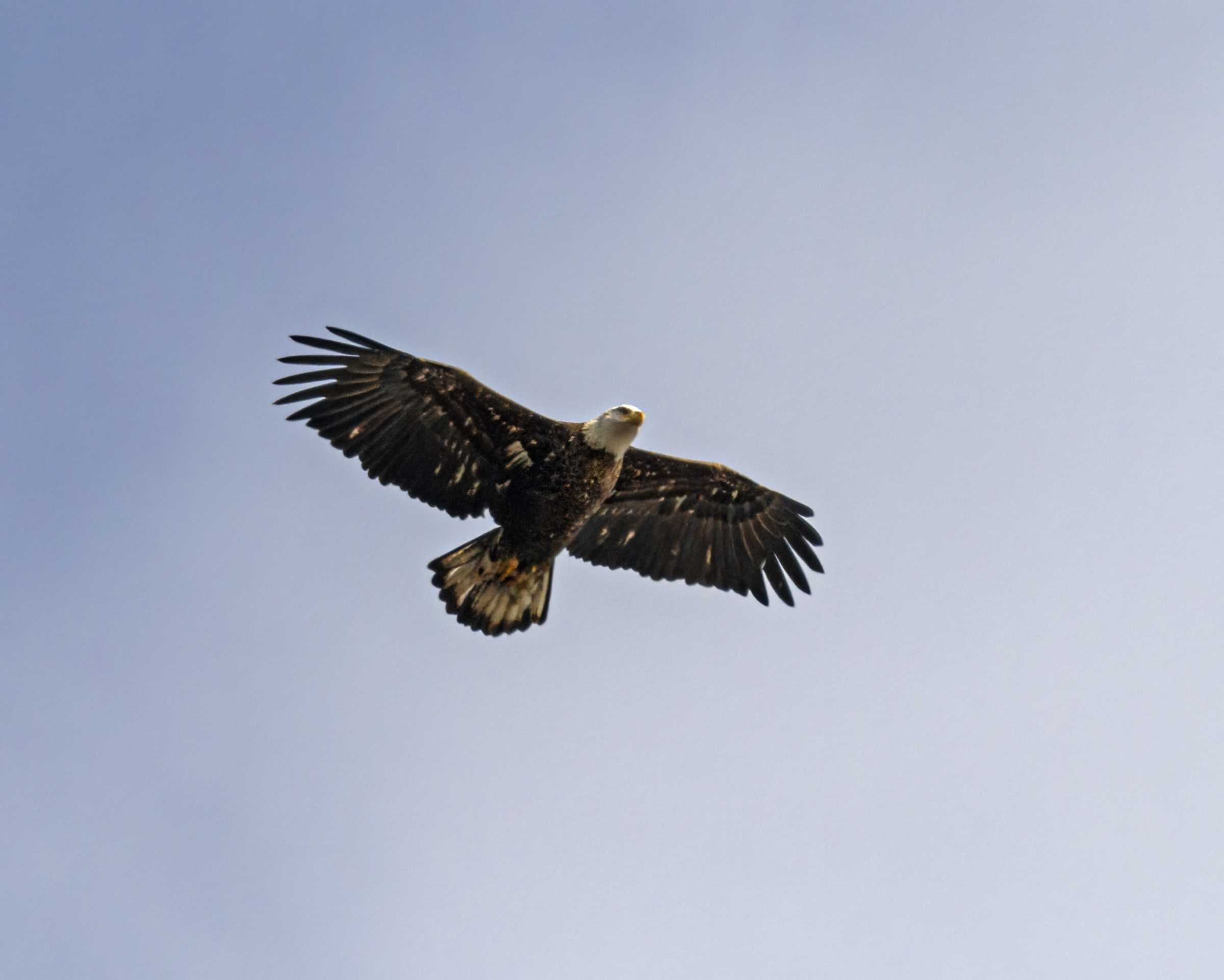
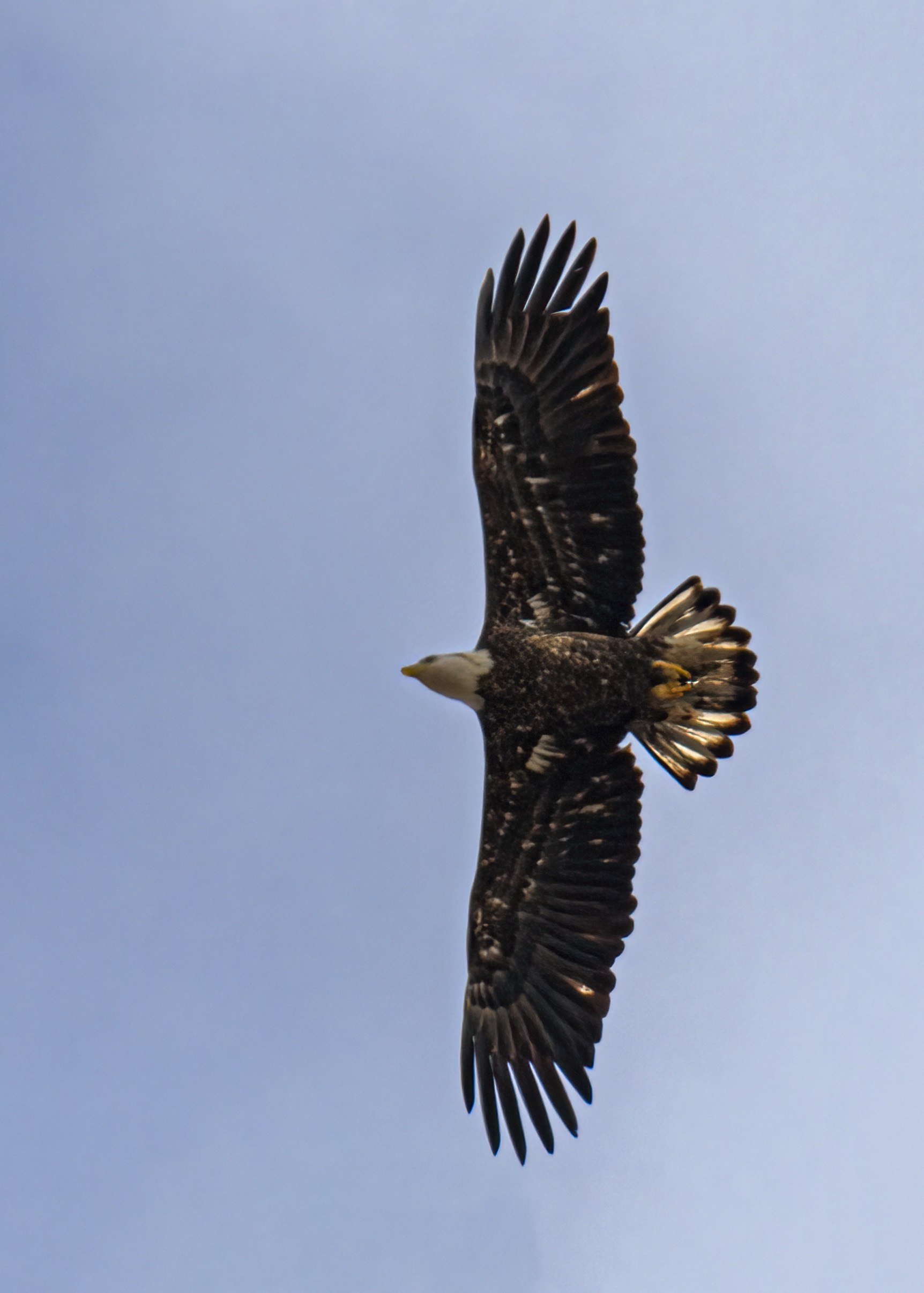
I was thrilled to be able to capture a few shots of this sub-adult Bald Eagle (Haliaeetus leucocephalus) last Monday as it soared overhead at Occoquan Bay National Wildlife Refuge. Judging from the fact that there are light feathers in the wings, which are completely dark for adults, and dark feathers in the tail, which are completely white for adults, I’d guess that this eagle is about 3-4 years old. Bald Eagles take almost five years to fully develop the “look” that we normally associate with this species.

Bald Eagle

Bald Eagle

© Michael Q. Powell. All rights reserved.

Read Full Post »

During the gray days of winter my senses are starved for color as the world turns mostly monochromatic. Where can I find bright colors? For a few blissful moments I immersed myself in a tropical world this past Thursday when I visited the “glasshouse,” the small greenhouse at Green Spring Gardens in Alexandria, Virginia.

There were some orchids and succulents, but my eyes were immediately attracted to the amazing hot pink and purple colors of an unusual-looking plant. I had no idea what kind of plant it was, but was absolutely mesmerized by this bold colors and managed to capture a few close-up shots of it with my macro lens.

When I returned home I started my research and eventually figured out that it was some sort of bromeliad. What in the world is a “bromeliad?” Bromeliads are a group of mostly tropical plants that belong to the family Bromeliaceae. I read and re-read descriptions of the characteristics and got tangled up in the scientific jargon of plant anatomy. As I understand it, many bromeliads are able to store water in a structure formed by their tightly overlapping leaf bases—the pineapple is the only bromeliad that immediately comes to mind.

With the help of my dear friend and photography mentor Cindy Dyer, I determined that this colorful plant is probably a Blue Tango Bromeliad (Aechmea ‘Blue Tango’) or possible a Dwarf Blue Tango Bromeliad (Aechmea ‘Del Mar’). Both of these are hybrid cultivars of plants that are native to tropical areas and require high humidity levels to thrive—the glasshouse was humid, but not as steamy as some that I have previously visited.

Blue Tango Bromeliad

Blue Tango Bromeliad

© Michael Q. Powell. All rights reserved.


Read Full Post »

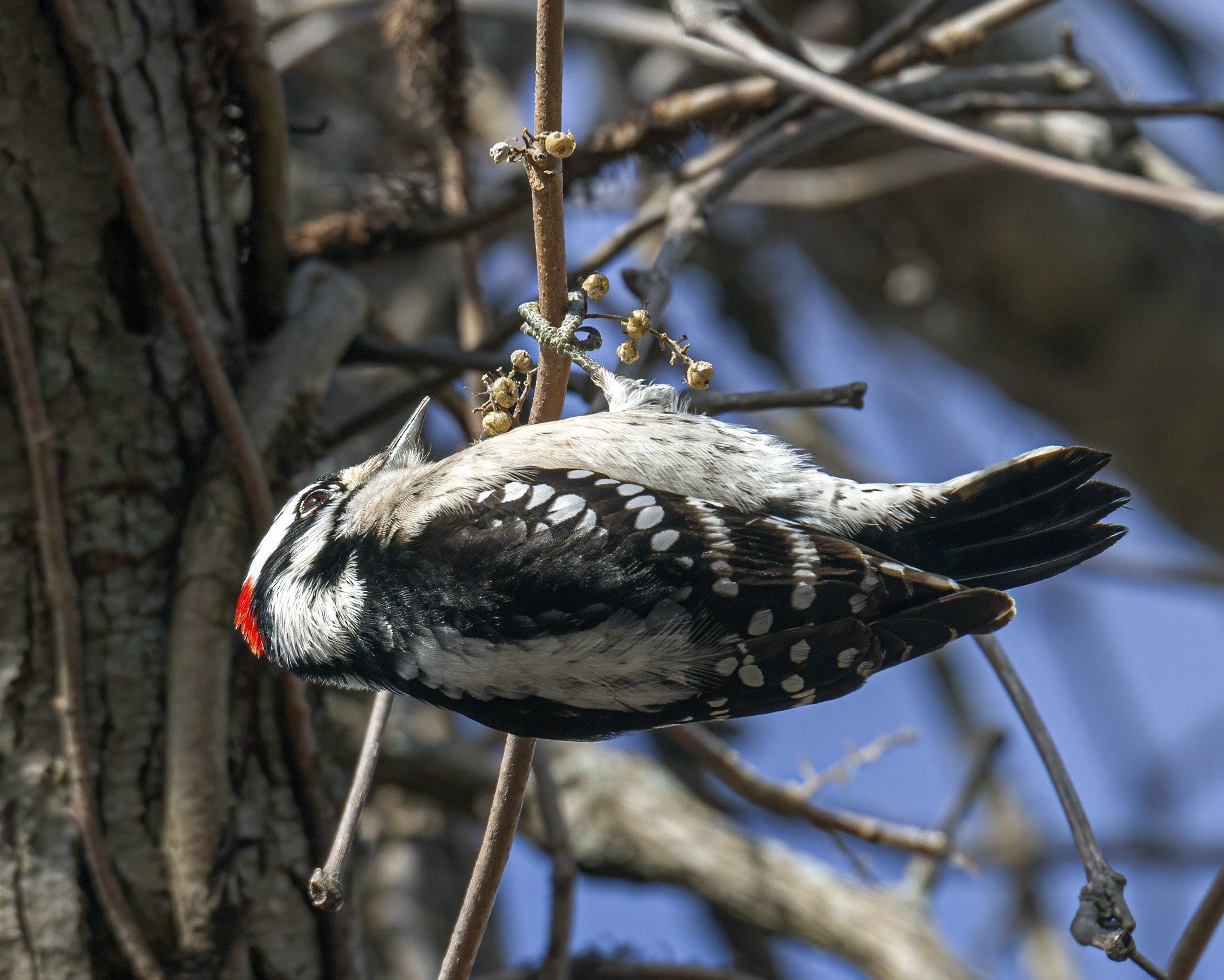
I love the beautiful markings of this male Downy Woodpecker that was acrobatically snagging some poison ivy berries when I spotted him on Monday at Occoquan Bay National Wildlife Refuge. Downy Woodpeckers, the smallest woodpeckers in North America, feed primarily on insects, although they supplement their diet with seeds and berries, especially during winter months, when insects are much harder to find.

I can’t help but admire the intense focus of these little dynamos that are in constant motion as they forage for food. I usually see them pecking away at the bark of trees, but have always seem them on bushes and cattails.

In case you are curious, it is easy to distinguish a male Downy Woodpecker from a female, because only the males have the small red patch on the back of their heads, a feature that is visible in both of these photos.

Downy Woodpecker

Downy Woodpecker

© Michael Q. Powell. All rights reserved.

Read Full Post »

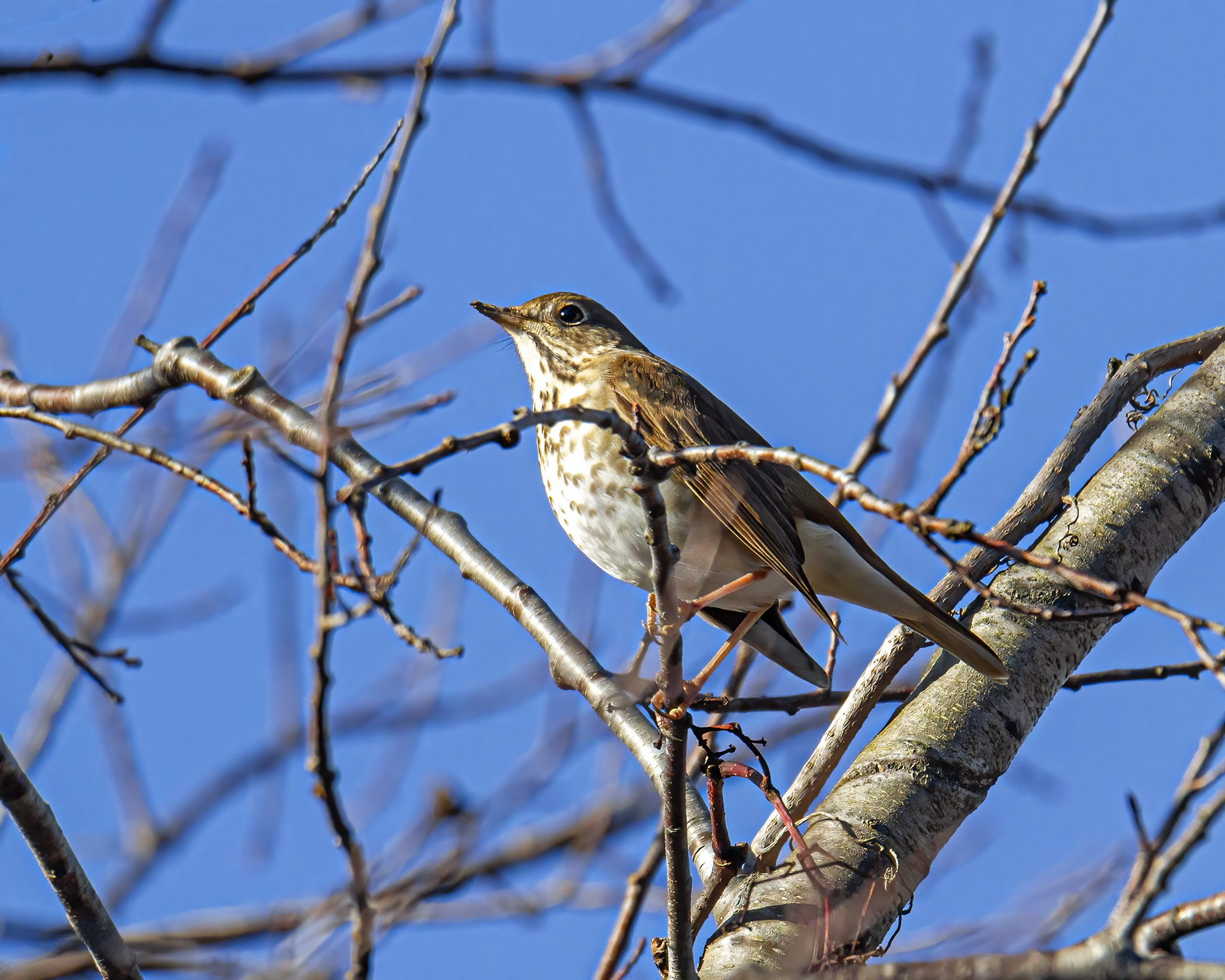
When I first spotted this little bird on Monday as it perched high in a tree at Occoquan Bay National Wildlife Refuge, its shape caused me to think that it was an American Robin. As I got a little closer, though, I could see that the bird’s breast was spotted and did not have the distinctive orange color of “our” robin.

I remembered that the American Robin is a member of the thrush family, so I assumed that this bird was another kind of thrush. (The European Robin, by contrast, belongs to the chat subfamily of the Old World Flycatcher family—check out this November 2019 blog posting to see a photo of a European Robin that I photographed in Paris.) When I returned home and checked by bird identification guide, I was able to determine that this is probably a Hermit Thrush (Catharus guttatus), a species that I have encountered only a few times.

As I was looking up information on the Hermit Thrush, I discovered that this bird played a an important role in “When Lilacs Last In The Dooryard Bloom’d,” an elegy on the death of Abraham Lincoln by noted American poet Walt Whitman. The thrush, along with lilacs and a star, is one of the recurring elements in the poem and seems to represent a kind of reconciliation with death and its song is described as “Death’s outlet song of life.” I am providing a link to the entire poem in case you are interested in reading the beautiful poem in its entirety. As a foretaste, I will leave you with one small section of the poem in which Whitman first introduced his readers to the Hermit Thrush:

“In the swamp in secluded recesses,

A shy and hidden bird is warbling a song.
Solitary the thrush,
The hermit withdrawn to himself, avoiding the settlements,
Sings by himself a song.
Song of the bleeding throat,
Death’s outlet song of life, (for well dear brother I know,
If thou wast not granted to sing thou would’st surely die.)”

Hermit Thrush

© Michael Q. Powell. All rights reserved.

Read Full Post »

Something caught the attention of this Great Blue Heron (Ardea herodias) yesterday at Occoquan Bay National Wildlife Refuge and caused it to momentarily look up towards the sky. The upward tilt of the heron’s head helped it to be better illuminated, allowing me to capture this little environmental portrait of one of the year-round inhabitants of the refuge.

Great Blue Heron

© Michael Q. Powell. All rights reserved.

Read Full Post »

Hooded Mergansers (Lophodytes cucullatus) are strange-looking ducks—no other ducks that I see regularly look like them. The shape and proportions of their heads and bills are so unusual and cartoonish that they look like they were created at Disney Studios.

Most of the time when I see Hooded Mergansers, they are in small groups, but last week I spotted only a solitary male during a short visit to a suburban pond not far from where I live. The “Hoodie” seemed to be content to swim around alone, not interacting with the other ducks on the pond and not spending any noticeable time fishing—Hooded Mergansers dive for fish, crayfish, and other food, seizing it in their thin, serrated bills.

The weather was cold, gray, and windy on the day I captured these images, conditions that are quite typical during the winter here. Weather forecasters predict that today will be mostly sunny, so I hope to have a chance to get out in nature with my camera and exercise both my body and my soul. As Vincent Van Gogh once wrote in a letter to his brother Theo, ““Always continue walking a lot and loving nature, for that’s the real way to learn to understand art better and better.”


Hooded Merganser

Hooded Merganser

© Michael Q. Powell. All rights reserved.

Read Full Post »

There is something really elegant about male Northern Pintail ducks (Anas acuta). Some other ducks are more flashy and colorful, but the beautiful combination of grays, browns, and white give the Northern Pintails a more refined beauty that is emphasized by their long white neck stripe and very long, pointed tails.

I don’t see Northern Pintails very often, because they prefer the kind of shallow wetland that is not common at my usual stomping grounds. Recently, however, I spotted a solitary male Northern Pintail amidst a group of Mallard couples a the edge of a reed-filled creek at Occoquan Bay National Wildlife Refuge. The pintail mostly stayed in the shadows, but occasionally swam into the light, allowing me to capture a couple of images.

I really like the minimal palette of earth-tone colors in these two images. The texture in the background and in the ripples in the water help to add some additional visual interest without distracting a viewer’s eyes.

Northern Pintail

Northern Pintail

© Michael Q. Powell. All rights reserved.

Read Full Post »

Quite often when I review my photos a second time I find photos that I missed during my initial look, like this photo of a Bald Eagle (Haliaeetus leucocephalus) that was just starting its liftoff from a tree last Saturday morning at Occoquan Bay National Wildlife Refuge.

When I spotted this pair of eagles in a distant tree, I watched and waited, hoping that they both would turn in my direction. However, the eagle in the back kept looking in the opposite direction and branches were also blocking my view. Suddenly the eagle in the front raised its wings to take off and I was able to react quickly enough to capture the moment when it was just starting to push off from the branch.

As you can probably tell from the lighting in the photo, this was another early morning encounter with bald eagles. I was very fortunately to have multiple encounters that morning. It will soon be nesting season for the eagles and I hope to able to capture some images as the eagles work on preparing the nests for another season—there are three nesting locations at the wildlife refuge, although one of the nests looks like it may have disappeared, possibly because one of the main supporting branches collapsed.

Bald Eagle

© Michael Q. Powell. All rights reserved.

Read Full Post »

An industrious male Northern Cardinal (Cardinalis cardinalis) was foraging for food last Saturday at Occoquan Bay National Wildlife Refuge and gave me a quick sidewards glance to determine if I was a potential threat. Deciding that I posed no danger, the cardinal resumed its search for food.

Cardinals are one of my favorite birds, especially during the winter season where the world turns mostly monochromatic. My spirits are always lifted when I see the bright red plumage of a male cardinal.

Northern Cardinal

© Michael Q. Powell. All rights reserved.

Read Full Post »

Last Saturday morning I spotted a Bald Eagle (Haliaeetus leucocephalus) perched in the middle of a tangle of small trees at Occoquan Bay National Wildlife Refuge. My view was partially obscured by a large number of branches, but I still managed to focus on the eagle.

I captured this sequence of shots when the eagle unexpectedly took off. The eagle had to maneuver its wings carefully until it was away from the branches and in the final photo the eagle was finally able to display its impressive wingspan.

Bald Eagle

Bald Eagle

Bald Eagle

© Michael Q. Powell. All rights reserved.

Read Full Post »

Two Bald Eagles (Haliaeetus leucocephalus) were perched together in a distant tree early in the morning last Saturday at Occoquan Bay National Wildlife Refuge. One of them suddenly decided to take off and I captured this fun shot. I encourage you to click on the image to get a closer views of the details, including the expression on the eagle that was in mid-air.

Somehow the eagle’s pose reminded me of the winged monkeys in the Wizard of Oz. I guess it has something to do with the dangling legs that look like they could easily snatch up Toto.

The early morning light gave this image a glow that I really like. Photographers sometimes refer to this time of the day as the “golden hour,” though it often lasts for a much shorter period of time.

Bald Eagle

© Michael Q. Powell. All rights reserved.

Read Full Post »

Most of the time when I see Wild Turkeys (Meleagris gallopavo) at Occoquan Bay National Wildlife Refuge, they are in small groups, but when I spotted this one last Friday it was alone. Initially the turkey was slowly strolling down the trail ahead of me on which I was walking. Somehow, though, it sensed my presence and picked up its pace until it seemed to be trotting.

I captured this image mid-stride, as the turkey seemed to be looking over its shoulder to see if I was still there. The photo is relatively sharp, though if you look at the turkey’s right foot, you can see a bit of motion blur, which enhances the sense of movement.

Wild Turkey

© Michael Q. Powell. All rights reserved.

Read Full Post »

A new year begins, full of promise and possibilities. Perhaps for you it starts with fireworks and loud noise, but for me, it is more quiet and introspective, like this tender little Song Sparrow (Melospiza melodia) that I spotted on Saturday at Occoquan Bay National Wildlife Refuge. Normally Song Sparrows are quite frenetic, but this one paused for an extended period of time with its feathers puffed up to stay warm, seemingly lost in its thoughts.

Happy New Year! Best wishes for a happy and healthy 2024.

Song Sparrow

© Michael Q. Powell. All rights reserved.

Read Full Post »

I could sense that this Bald Eagle (Haliaeetus leucocephalus) was preparing to take off and captured this image last Friday at Occoquan Bay National Wildlife Refuge right after it had taken a leap from the tree. I was hoping that the eagle would fly upwards and give me a chance at getting some more in-flight shots, but the eagle flew downwards and away from me.

Bald Eagle

© Michael Q. Powell. All rights reserved.

Read Full Post »

I think this Bald Eagle (Haliaeetus leucocephalus) may have been trying to snag a duck last Friday at Occoquan Bay National Wildlife Refuge. It repeatedly would swoop down over the water without success–the approach seemed quite different from the one that I would normally see when an eagle was fishing. In the bottom right of the first image, you can see some droplets of water that may have been caused by a duck diving under the water.

In the second photo, the eagle is not is as sharp focus as in the first shot, but you have a better look at the splash of the duck (?) diving to avoid the oncoming eagle. Perhaps it was just a fish, but I just don’t know enough about eagle behavior and the behavior of their potential prey to know for sure.

As you can probably tell, the lighting was less than optimal when I was taking these photos. The limited lighting made my camera’s focusing system struggle a bit and maintaining focus on the eagle in flight was a bit of a challenge. Still, I am pretty happy that I was able to capture some of the action, even if I am not 100 percent sure what was going on.

Bald Eagle

Bald Eagle

© Michael Q. Powell. All rights reserved.


Read Full Post »

It is almost nesting time for the Bald Eagles (Haliaeetus leucocephalus) at Occoquan Bay National Wildlife Refuge. Last Friday I spotted two eagles perched in the trees adjacent to the very large nest that has hosted numerous eagle couples over the years.

Later that same day I passed by the nest again and an eagle was sitting in the nest. I captured the second image when the eagle unexpectedly took off from the nest. I like the way that I captured the action,although I would have preferred not to have clipped the eagle’s wing as it extended it upwards to generate lift for its takeoff.

Bald Eagle

bald eagle

© Michael Q. Powell. All rights reserved.
Read Full Post »

The late afternoon sun was shining low in the sky and softly illuminated the side of a Bald Eagle (Haliaeetus leucocephalus) perched in a tulip tree last Friday at Occoquan Bay National Wildlife Refuge. A short time later, I spotted a Bald Eagle in a sweetgum tree with the sun shining a bit more intensely—it kept going in and out of the clouds as it dropped lower on the horizon—which made the second image feel “warmer” than the first one.

The final image shows a Bald Eagle as it was flying over the water. The sunlight was coming from almost directly behind the eagle and provided some beautiful backlighting of the eagle’s white tail feathers as well as a bit of rim lighting around the edges of its body

Bald Eagle

Bald Eagle

Bald Eagle

© Michael Q. Powell. All rights reserved.


Read Full Post »

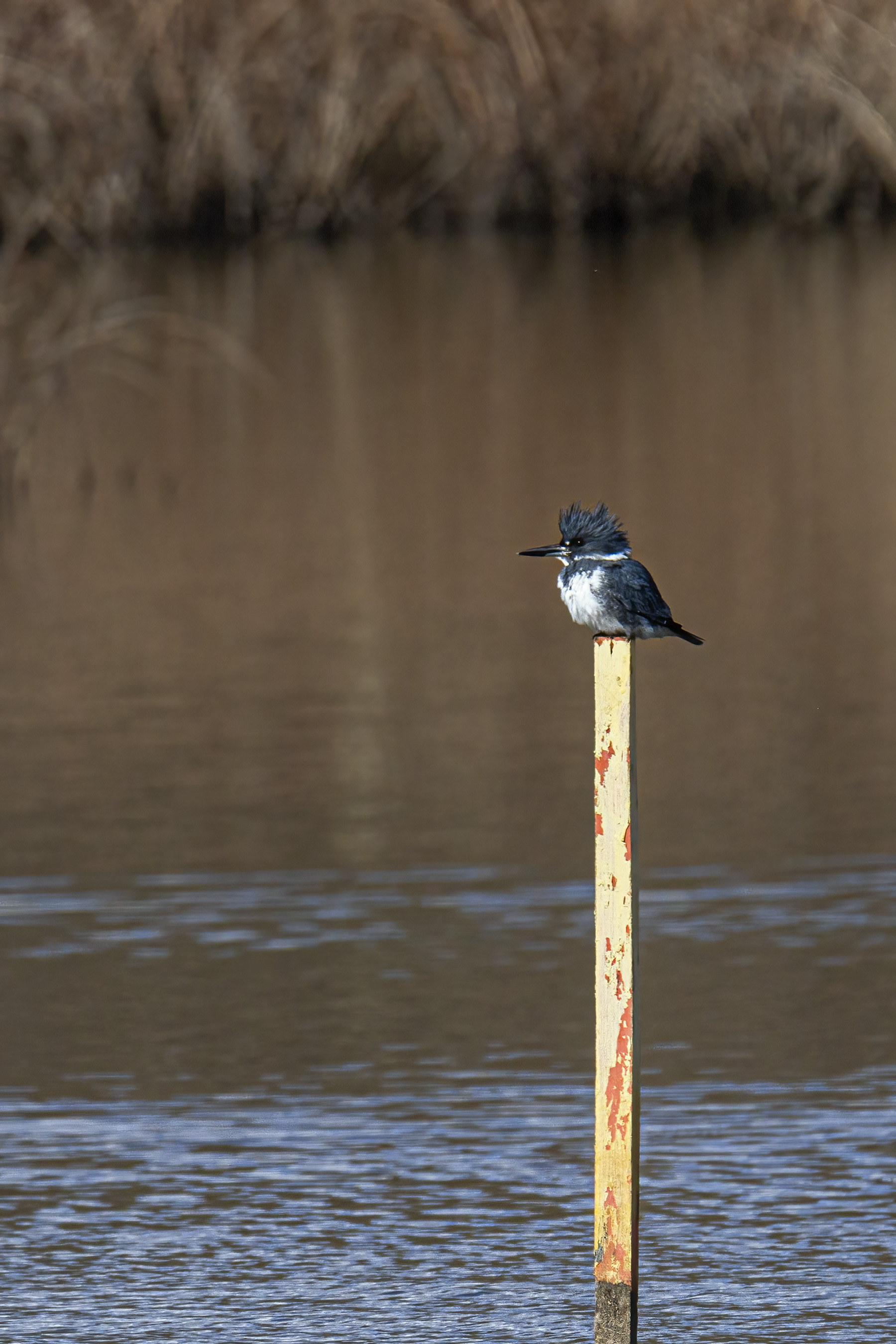
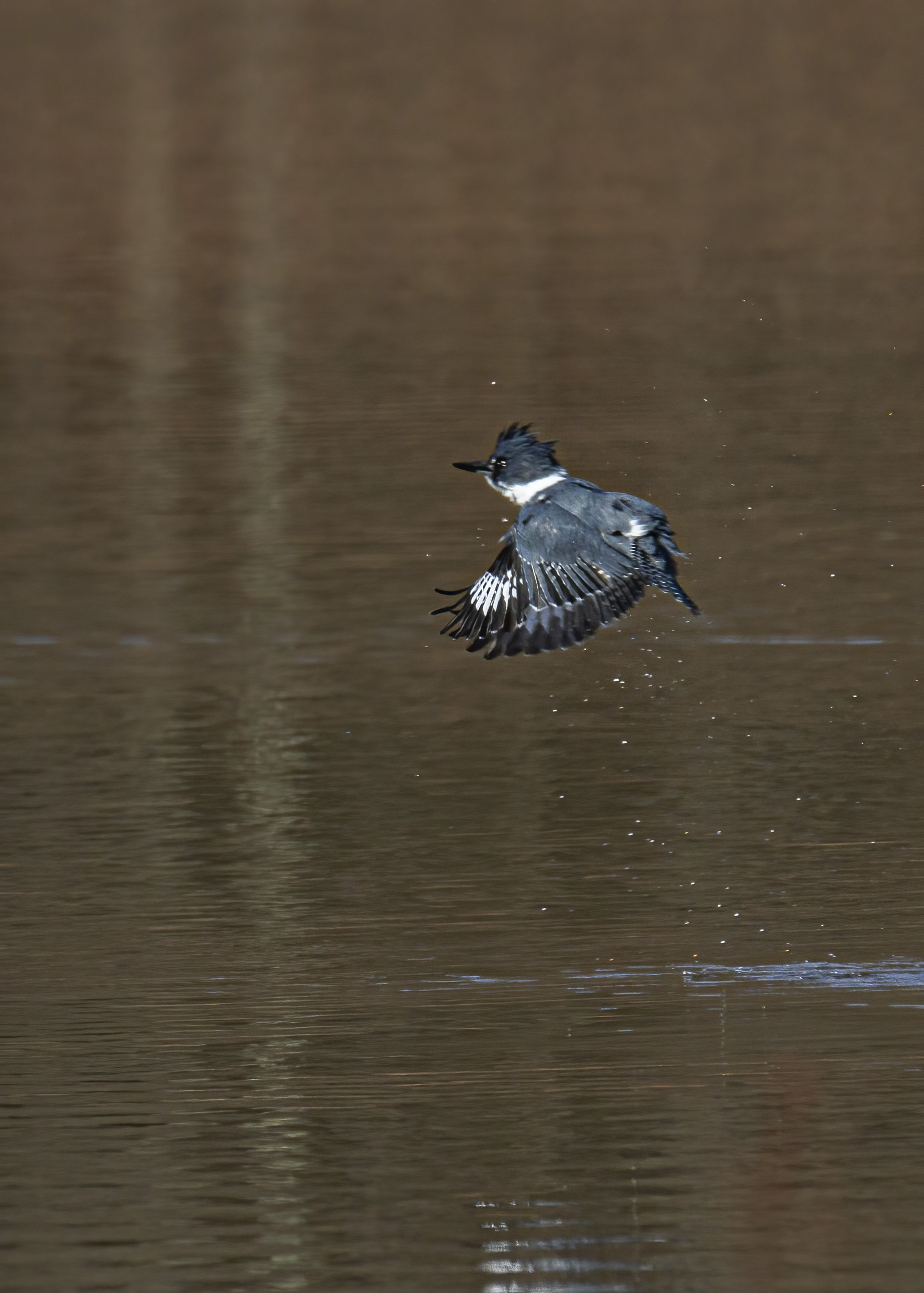
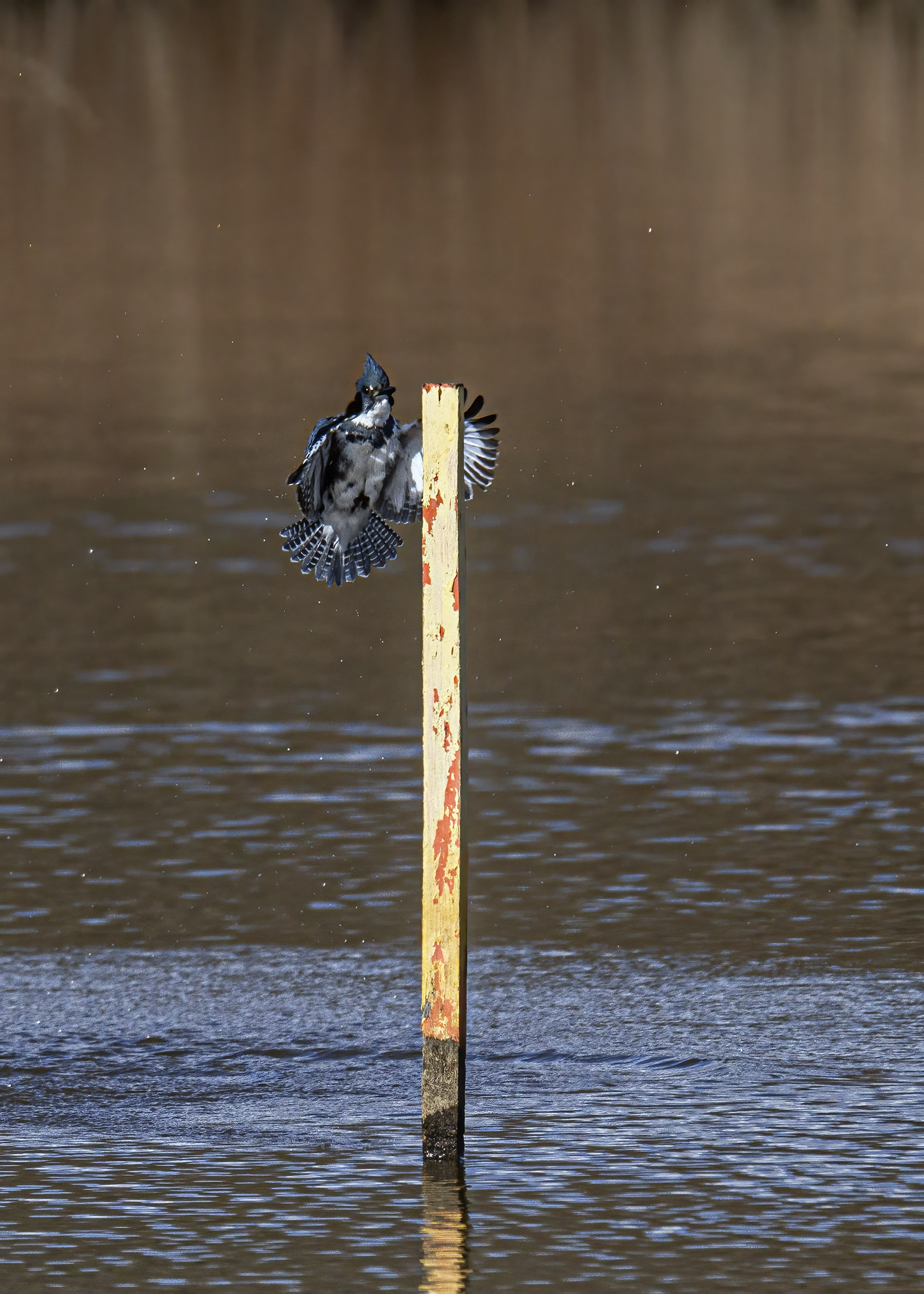
What could possibly be better than getting a photo of a Belted Kingfisher (Megaceryle alcyon)? Capturing a shot of two of them together.

Last Friday I watched and listened as two kingfishers loudly chased each other across the sky and through the trees at Occoquan Bay National Wildlife Refuge. I thought they might be a couple, but when they landed briefly in a tree, I discovered that there were two females (females have a chestnut chest stripe that the males do not have).

The two kingfishers looked at each other and continued chattering—kingfishers have a loud, rattling call that is unique and distinctive. If you have never heard the call of a Belted Kingfisher, I encourage you to click on this link to a selection of sounds of this bird on the Cornell Lab of Ornithology website, one of my favorite resources for information about birds.

Belted Kingfishers

© Michael Q. Powell. All rights reserved.


Read Full Post »

When a Great Blue Heron (Ardea herodias) looked skyward on Friday at Occoquan Bay National Wildlife Refuge, it helped me create an unusual portrait of one of my most frequently photographed subjects.

This past Saturday I helped to decorate my church in preparation for the Christmas Eve candlelight service. One of the items that was set up was a manger scene that included the three wise men. They did not arrive at the stable at the moment of the birth of Jesus, but a bit later—we celebrate the visit of the Magi on 6 January.

According to the second chapter of Matthew, the wise men travelled from the East with their eyes turned skyward, like those of this heron, following a star in order to find and worship Jesus. It has become a bit of a cliché, but I firmly support the idea that “wise men still seek Him.”

Merry Christmas to all who are celebrating today and I pray that we all can join in the message of the angels in Luke 2:14, “Glory to God in the highest heaven, and on earth peace to those on whom his favor rests,” a peace that has seemed so elusive during 2023.

Great Blue Heron

© Michael Q. Powell. All rights reserved.

Read Full Post »

« Newer Posts - Older Posts »