Feeds:
Posts
Comments

Archive for the ‘Travel’ Category

I was a little jetlagged, but managed to take a short walk through part of the city this afternoon, the day of my arrival, and got these photos of some of the notable buildings in Vienna, Austria.

There are so many beautiful and interesting buildings in Vienna that you could easily spend weeks photographing them. I have been in this wonderful city quite a number of times, so many of these buildings are familiar to me. I realize, however, that is not the case for most of my readers, so I thought I would share some of that beauty in a few photos from the point-and-shoot Canon that I have with me during this business trip.

Burgtheater, Vienna

Burgtheater, Vienna

Detail of Austrian Parliament Building, Vienna

Detail of Austrian Parliament Building, Vienna

Rathaus2_blog

Detail of Rathaus (City Hall), Vienna

© Michael Q. Powell. All rights reserved.

Read Full Post »

If you germinated 600 seeds from a single ginkgo tree, how many would grow up to be male trees and how many female? Some of you may have come up with an answer already, but I am still struggling with the question. Can trees really have a gender? Apparently ginkgo trees, like holly, persimmon, and some others have a gender. Who knew?

In 1929, Dr. Orlando White at the Blandy Experimental Grove of the State Arboretum of Virginia in Boyce, Virginia decided to do an experiment and hypothesized that the sex ratio would be 1:1. Dr. White’s intellectual curiosity resulted in the Blandy Ginkgo Grove that I visited last weekend, one of the largest collections of gingkos outside of the tree’s native China. You can learn more fascinating information about ginkgos and about this grove by downloading this brochure, my source for the historical information about the grove.

I was struck by the beauty of the ginkgo leaves. Fossils of these leaves date back to 270 million years ago, meaning this plant was around with the dinosaurs. A ginkgo, which means “silver apricot” in Chinese, doesn’t form fruits, but has fleshy seeds about the size and appearance of a small apricot, seeds that you can see in some of my photos. I should warn you, though, that ginkgo seeds do not smell as nice as apricots—they smell like a cross between vomit and dog excrement.

I am including a variety of shots to give you an idea of the beauty of the ginkgo, ranging from a view of part of the entire grove down to an image of a single leaf.  I have never used the gallery feature with WordPress, but decided to put the photos I selected for this posting into a gallery and see how it works out. Let me know if you have any thoughts about whether you like this approach, vice using single photos.

© Michael Q. Powell. All rights reserved.

Read Full Post »

Like most people who live in the the Washington, D.C. area, I don’t visit monuments much unless there are visitors. One of my fellow photographers invited me to photograph the Capitol on Friday evening to satisfy the wishes of a visiting photographer.

We were quite a sight as we set up umbrellas and tripods in the rain which fell progressively harder and harder. My favorite shot is the first one, which shows the reflection of the Capitol in one of the wet, slippery stairs leading up to it.  I tried a number of long exposures, varying from about 15 to 30 seconds to get this look.

The second one is a more traditional view, but I think that the lighting was pretty cool at that time of the evening.

capitol2_blogcapitol1_blog

© Michael Q. Powell. All rights reserved

Read Full Post »

It’s been gray and rainy almost all this week in Brussels, so many of these shots feature raindrops. When I am away on a trip for business, I generally carry only my point-and-shoot camera, an old Canon A620.

This trip I decided to experiment with the macro mode and see what kind of shots I could get. I was pleasantly surprised with the results and even managed to get some insect shots, despite the fact that I had to get really close to them, compared with the macro lens that I normally use. I never had to worry about harsh sunlight—I never saw any the entire trip—and mostly had to shoot a a high ISO and an almost wide-open aperture.

I did get some shots of the buildings in Brussels, which looked almost monochromatic in the gray light, but will post some of those images when I return home from the trip.

beepink1dropsflyleaf_dropspink2

© Michael Q. Powell. All rights reserved.

Read Full Post »

Here are a few more shots from my last night in Vienna. The first three are of a portion of the Hofburg Palace. The last one is of St. Stephen’s Cathedral (Stephansdom). I can’t recall the name of the church in the penultimate photo.

Hoffburg1_blogHoffburg2_blogHoffburg3_blogchurch1_blogStephen1_blog

Michael Q. Powell. All rights reserved

Read Full Post »

On my last full day in Vienna (at least for this trip), I decided to take some photos of the city as the sun started to set.

This is a shot of the Rathaus (Vienna City Hall), just after they turned on the lights to illuminate the building. I did not have a tripod with me, so I braced on or against various objects in an effort to steady myself. I may post a few more night shots of Vienna later (if I am not too sleepy or wake up really early), but thought I’d share this one right now.

My trip to Vienna was brief, but enjoyable. I got a lot accomplished work-wise, but had enough free time to really enjoy some amazing spring weather.

Rathaus1a

Michael Q. Powell. All rights reserved

Read Full Post »

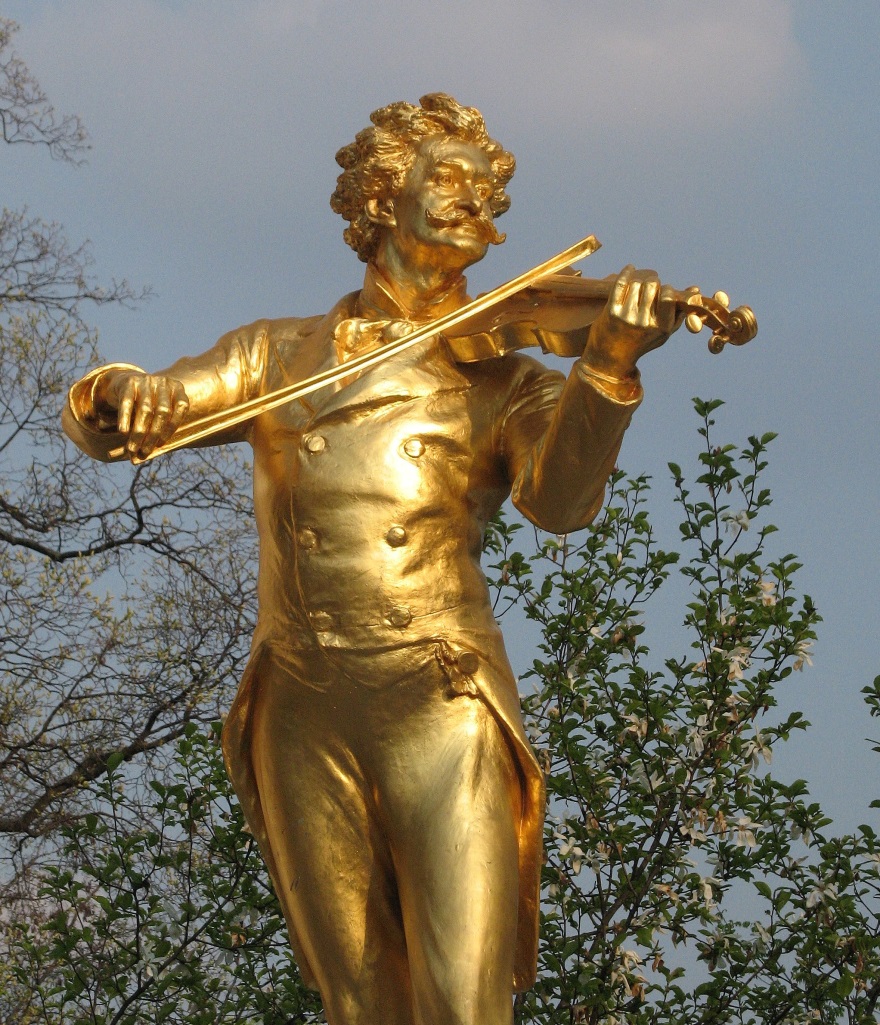
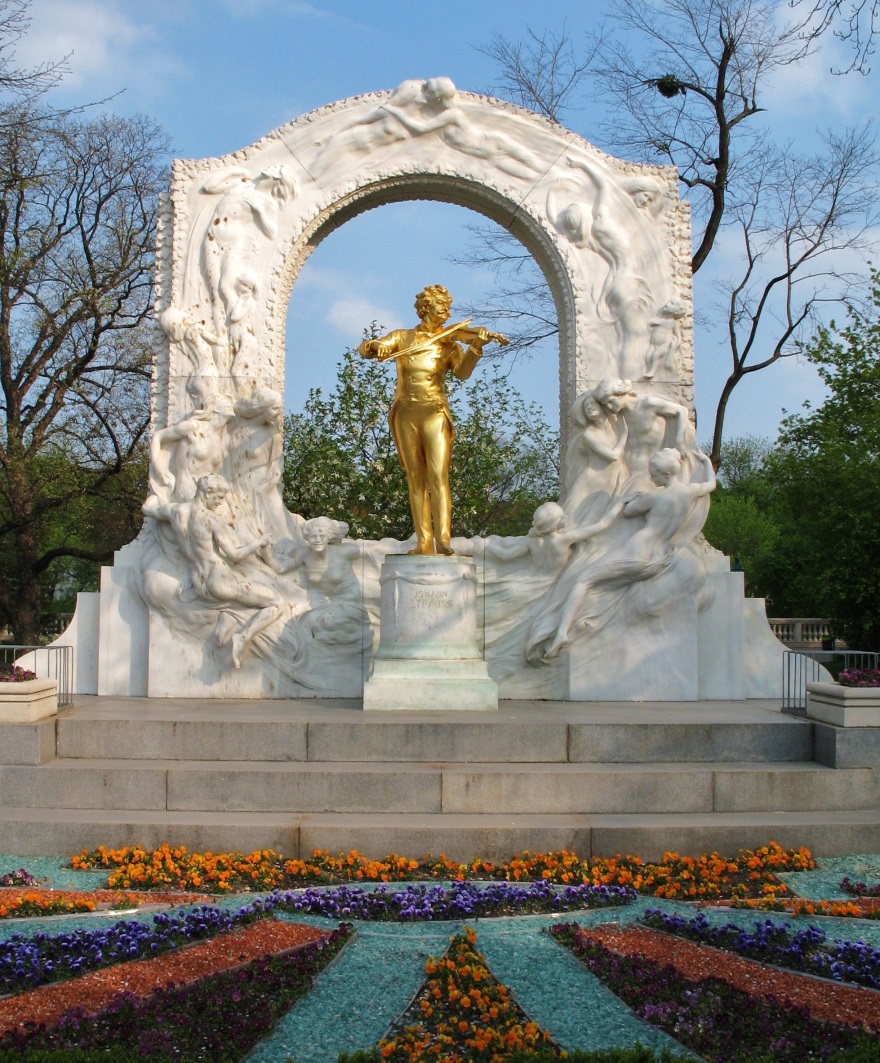
When you travel to a well-known location, do you feel compelled to take some touristy photos of the famous landmarks? I confess that I almost always feel a need to take at least a few shots of the iconic sights.

In Vienna, one of the most photographed monuments is the gold-plated bronze statue of Johann Strauss II in the City Park (Stadt Park). Strauss was an Austrian composer in the 19th century and is probably best known for popularizing waltzes. The statue itself was unveiled to the public in 1921 and was covered in gold in 1991, replacing the gold that had been removed in 1935.

One of the more interesting things about the statue is that people are permitted to climb right up next to the statue to have their picture taken. It was a lot of fun to watch the various poses that people would assume, including one lady who posed while trying to hold upright a large pitbull-type dog.

strauss1aStrauss2a

Michael Q. Powell. All rights reserved

Read Full Post »

At this time of the year the sun rises pretty early in Vienna, Austria, but I was able to capture a few shots this morning from my hotel window. In the distance you can see one of the spires of St. Stephen’s Cathedral (Stephansdom), one of the major landmarks of the city.

My little Canon A620 seems to have a maximum shutter duration of one second, so I had to play around a little with aperture and f-stop to try to get a decent exposure. I used a little tripod on the window sill to steady the camera for these shots.

Sunrise1aSunrise2a

Michael Q. Powell. All rights reserved

Read Full Post »

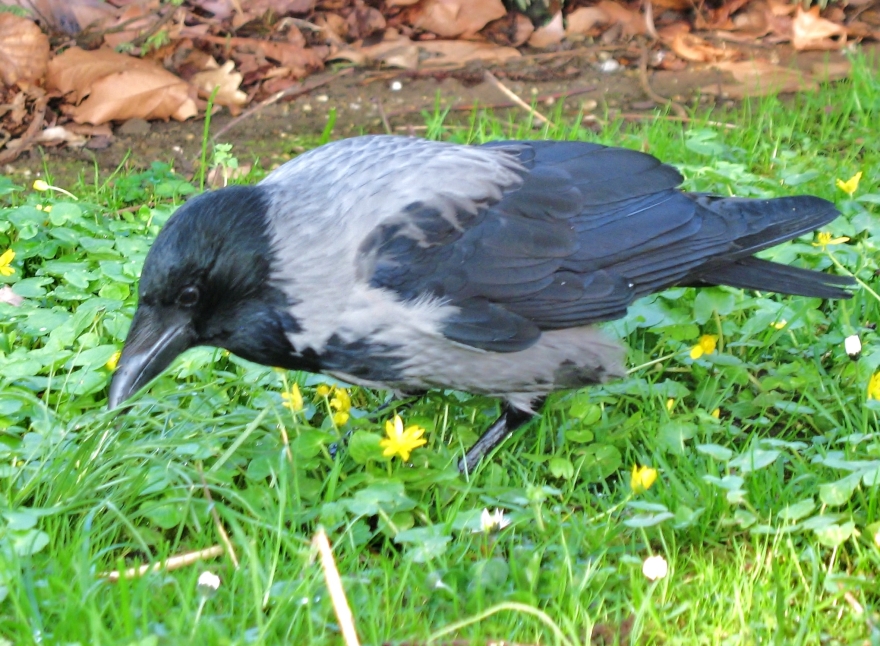
Walking through some of the parks here in Vienna, Austria, I couldn’t help but notice that the crows here are not at all the same as the crows in my part of the United States.

I am here in Vienna for work for a few days and have spent my free time walking through the parks, checking out the birds and plants.  Most of the birds that I see are pigeons, but I was really struck by the large black-and-white crows that periodically fly onto the scene.

A little research on the internet reveals that these are Hooded Crows (Corvus cornix), and not the  all-black American Crow (Corvus brachyrhynchos) that I am used to seeing.

The only camera that I have with me is my trusty Canon A620 point-and-shoot. It is compact, but its 4x zoom makes it less than ideal for capturing birds. However, several crows were relatively cooperative yesterday and let me get close enough to get these shots.

I’ll probably post a few photos of buildings in the next day or two, but wanted to let folks know that I am still drawn to seek out nature, even in the midst of a big city.

crow1b_blogcrow_frontb

Michael Q. Powell. All rights reserved

Read Full Post »

I am finally posting some more photos of the Nine-banded Armadillo (Dasypus novemcinctus) that I spotted a couple of weeks ago when visiting the Phinizy Swamp Nature Park in Augusta, GA.

Previously, I posted a photo of the armadillo standing on his hind legs, but I thought it would be interesting to post some additional shots of the armadillo in action.

I grew up in New England, so the armadillo qualifies as an exotic animal for me, although there are probably folks in Texas and elsewhere that view armadillos as pests. I am completely fascinated by the texture of his shell, particularly the tail, and tried to highlight it in the photos.

The armadillo spent most of its time rooting about in the grass and most often his head was not visible, which was a challenge for photos. Even when I moved relatively close, the armadillo seemed so focused on what he was doing (or so near-sighted), that he paid no attention to me.

I actually had two mini-encounters with him. The first time, he scurried pretty back to the swampy field from which he had emerged when he sensed my presence. I retreated from the immediate area and returned to find him in the same location. This time, after getting his fill of insects (or whatever else he was eating), he lumbered back to the swampy field.

So far, there are no armadillos in my neighborhood in Northern Virginia, but Wikipedia notes the armadillo’s rapid expansion northward, primarily because of the lack of natural predators within the United States, little desire on the part of Americans to hunt or eat the armadillo, and the animals’ high reproductive rate. Eventually, armadillos are predicted to reach as far north as Ohio, Pennsylvania, and New Jersey.

As I studied up a bit on armadillos, I learned that armadillos can contract (and pass on) leprosy (yikes!), so you won’t see me handling any armadillos. Additionally, Nine-banded Armadillos have an unusual reproductive system, in which four genetically identical offspring are born, the only mammals in which polyembryony is reliably manifested, according to Wikipedia. This trait makes them particularly suited for certain types of scientific and medical tests that need consistent biological and genetic makeup in the test subjects.

armadillo5_blog

armadillo1_blogarmadillo4_blogarmadillo2_blog

armadillo3_blog

Michael Q. Powell. All rights reserved

Read Full Post »

Walking along the Augusta Canal for a final time yesterday morning before returning home, I encountered this spider, hanging in the air from a concrete supports of an overpass, and took shots of him without a flash and with one. After being starved for insects over the winter (photographically speaking), I was thrilled to have a chance to photograph one.

I probably should have taken out my macro lens, which I had with me in my bag, but opted instead to shoot with the 55-250mm zoom lens that was on my camera. It was still relatively early in the morning and the the spider was mostly in the shade, so lights was an issue. I upped the ISO to 800, but still needed an exposure of 1/8 of a second at f/9. Fortunately I had my tripod with me, so I used that to get a relatively sharp shot. I shot with the zoom at 250mm and used manual focus.

The first image was with natural light and the second one was taken using the camera’s built-in flash. The light coming from behind the spider in the first shot helps to illuminate the spider’s legs, which look almost translucent. The flash in the second photo reveals some additional details of the spider, although it did add some reflections, because I did not have a diffuser for the flash.

Which one do you prefer?

spider1_blogspider2_blog

© Michael Q. Powell. All rights reserved

Read Full Post »

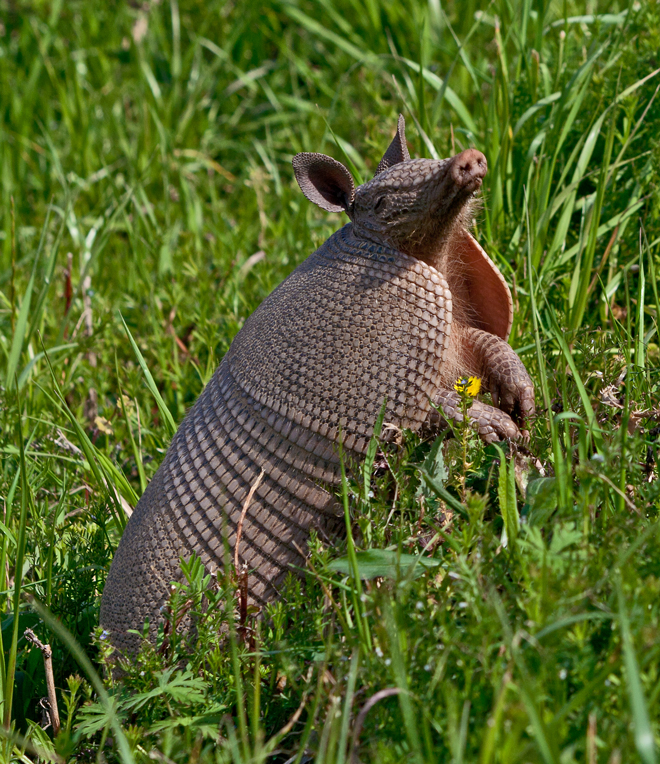
Today I visited the Phinizy Swamp Nature Park in Augusta, GA, hoping that I might see an alligator. Although I did not spot an alligator, I did encounter this Nine-banded Armadillo (Dasypus novemcinctus) in the Park. (You can actually count the nine bands).

Initially the armadillo was rooting about in the grass and he startled me a bit when he stood up. I was close to ground level and was looking through my telephoto lens, which made the movement seem a little threatening.

I was surprised to see an armadillo in Georgia—I tend to associate them with places like Texas and Oklahoma—but apparently their range is expanding. Information on the internet suggests that armadillos are mostly nocturnal and come out around dusk. I have no idea why this one chose to be out in the middle of the day.

I may post some other photos of the armadillo, but I thought that this pose was unusual enough to justify posting an image immediately.

armadillo_standing1_blog

© Michael Q. Powell. All rights reserved

Read Full Post »

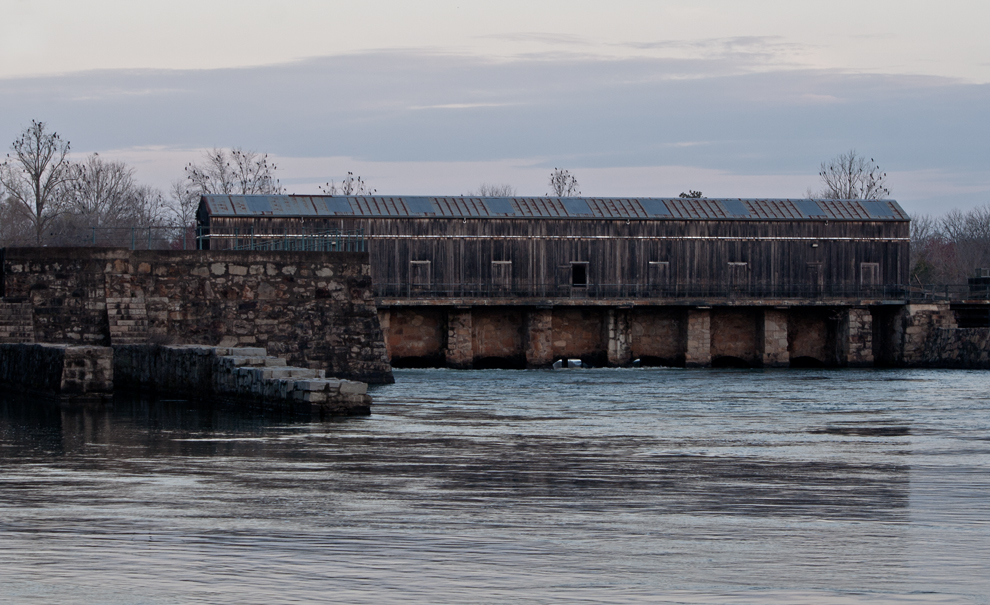
Savannah Rapids is the starting point of the Augusta Canal, which was built in 1845 as a source of power, water and transportation for Augusta, Georgia. The Canal was designated a National Heritage Area by Congress in 1996 and now serves primarily as a recreational area. (Click on this link for more details on the history of the canal, which served an important role for the Confederacy during the Civil War.)

On a beautiful morning, I walked along the raised tow path for several miles, with the canal on one side and the Savannah River on the other. The trees were starting to bud and even to flower and even to flower on a day that got up to 75 degrees (24 degrees C). Spanish moss was growing on many of the trees, giving them a look that seemed exotic to me.

Here are a few photos I took of the structures associated with managing the flow of the water in the canal. I love the weathered wood and stone and the interplay of light and shadows and reflections.

Savannah_rapids1_bloglock_blogpillars_blog

© Michael Q. Powell. All rights reserved

Read Full Post »

In the orange glow of the sky, the trees cast their reflections on the black granite surface of the Vietnam Veterans Memorial wall.

It was a moment to reflect on the names of more than 58,000 men and women whose names are inscribed on the wall. I am old enough to remember the conflicted mood of the country at the time of that war.  In the late 1970’s I enlisted in the U.S. Army and served on active duty for twenty years. With that experience, I can’t help but be humbled by the memorial to the sacrifice of so many Americans for the common good.

Monuments_blog

From certain angles, I could see reflections of the Washington Monument in the wall. It proved to be very difficult, however, to capture that reflection in a photograph. I used my tripod and a long exposure, but never quite captured the feeling of the moment. I am posting one of those efforts as a kind of aspirational shot, one that I hope to shoot better in the future.

WashMonuWords

© Michael Q. Powell. All rights reserved

Read Full Post »

When most people think of the Vietnam Veterans Memorial, they think only of the black granite wall with all of the names, but the Three Servicemen Statue is also part of the memorial.

Frederick Hart, the sculptor of these statues, described his work in these words (according to the Vietnam Veterans Memorial Fund):

“The portrayal of the figures is consistent with history. They wear the uniform and carry the equipment of war; they are young. The contrast between the innocence of their youth and the weapons of war underscores the poignancy of their sacrifice. There is about them the physical contact and sense of unity that bespeaks the bonds of love and sacrifice that is the nature of men at war. And yet they are each alone. Their strength and their vulnerability are both evident. Their true heroism lies in these bonds of loyalty in the face of their aloneness and their vulnerability.”

I visited the memorial one evening this past weekend and took these photos of the statue. The first photo shows the torsos of the grouping (the statues themselves are full body, but I wanted to show the details of the upper bodies) and the others show the faces of each of the three soldiers.

Vietnam_trio_blogmachinegun_blogStatue 2Black_soldier_blog

© Michael Q. Powell. All rights reserved

Read Full Post »

Fog, low-hanging clouds, and reflected light gave the skies of Washington D.C. an orange-colored glow last night, which made for dramatic shots of the Washington Monument.

I don’t really understand the scientific basis for the phenomenon (perhaps air pollution contributed to it), but tried to capture it with my camera. I took these shots at about nine o’clock in the evening using my tripod and a long exposure, even thought they look like they might have been shot at sunset.

A friend convinced me to go with him to Washington D.C. with the goal of getting some photographs of the Washington Monument shrouded in heavy fog, which turned out not to be the case. Instead, we got something totally unexpected that turned out to be even better than that for which we had hoped.

Monument & TreesWashMonumentOrangeSky

© Michael Q. Powell. All rights reserved

Read Full Post »

The familiar often looks new when perceived from a different angle, as I found out last weekend when I hiked along the Potomac River and looked across the river toward Georgetown University.

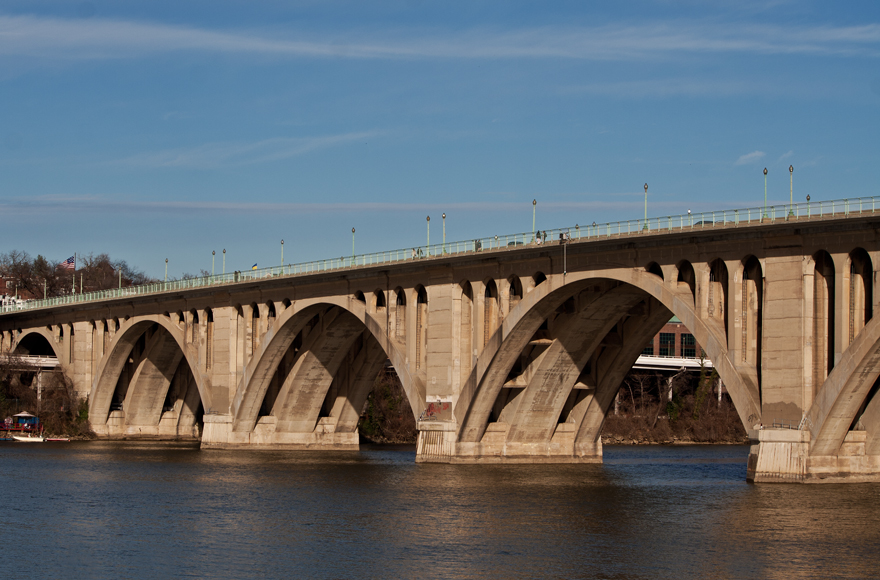
Although I have lived in this are for almost 20 years, I had never heard of the Potomac Heritage Trail, a narrow trail that begins in Washington D.C. and continues upstream, mostly at at river-level. I have driven past this scene many times and the buildings of Georgetown really stand out, but I never really saw the green boathouse tucked in at the base of Francis Scott Key Bridge, which crosses from Virginia into the District of Columbia.

The first shot shows a view from the Virginia side of the Potomac River, looking directly toward Georgetown University, and the second one shows the Key Bridge. I love the arches of the bridge, which I have crossed many times.

My little hike was a good way to force me to look at the familiar in a different way—I hope to be able to do the same with some of my other subjects too.

Georgetown1_blogGeorgetown2_blog© Michael Q. Powell. All rights reserved

Read Full Post »

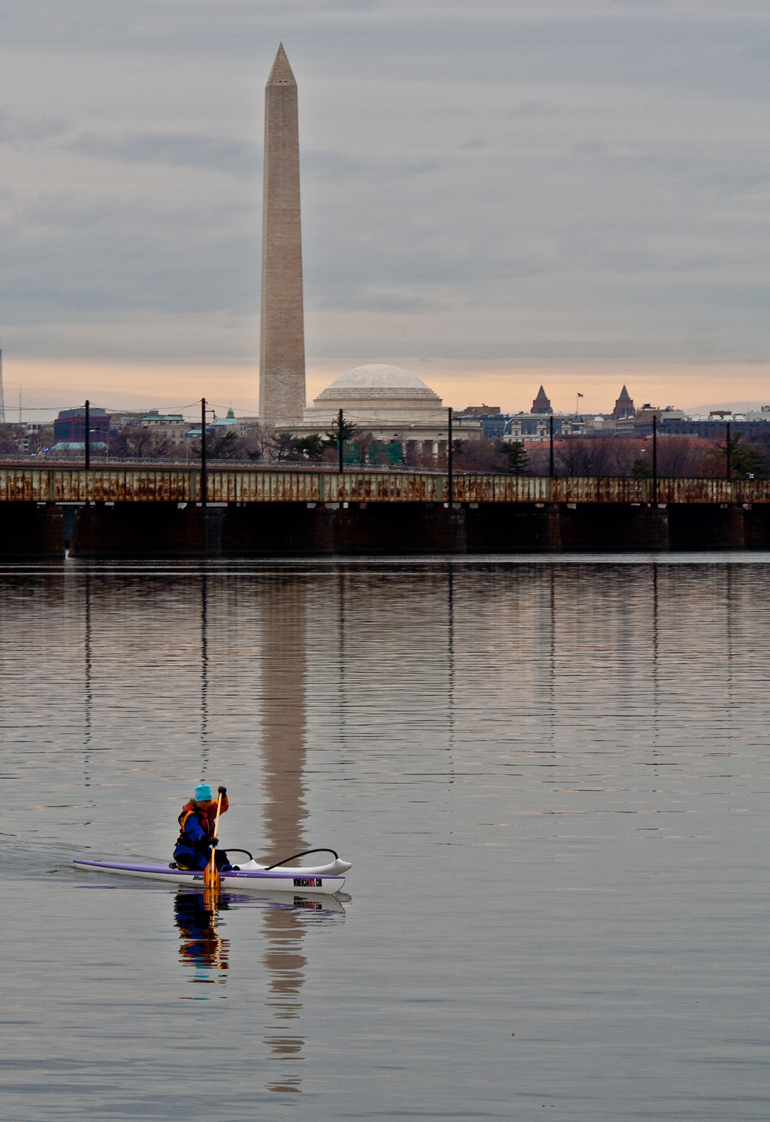
I have returned from Brussels and thought I’d share a photo that I took earlier this month of a kayaker paddling on the Potomac River. In the background you can see the beauty of the obelisk of the Washington Monument and the dome of the Jefferson Memorial. If you look closely at the Washington Monument, you can see the color change part way up the monument that was the result of a 23 year hiatus in construction and difficulty getting matching marble when construction resumed.

Unfortunately, you can also see the rusty railroad bridge that serves as the only rail link between the Commonwealth of Virginia and the District of Columbia. It serves a necessary function, but it does little to enhance the beauty of the scenery.

kayak_blog

© Michael Q. Powell. All rights reserved

Read Full Post »

On my final night in Brussels for this trip, I made one last walk through the city. Despite the frigid cold, there were still a lot of pedestrians stopping in the Grand-Place to take photos or to visit one of the numerous bars and restaurants in the area. Some of the previous times that I was in Brussels, the buildings in the square were illuminated, but the were pretty dark this time.

I balanced my camera on my stocking hat to stabilize it for this first photo, which you can probably guess was a pretty long exposure. I like the way the different lights in the scene turned out differently, with varying strengths and colors.

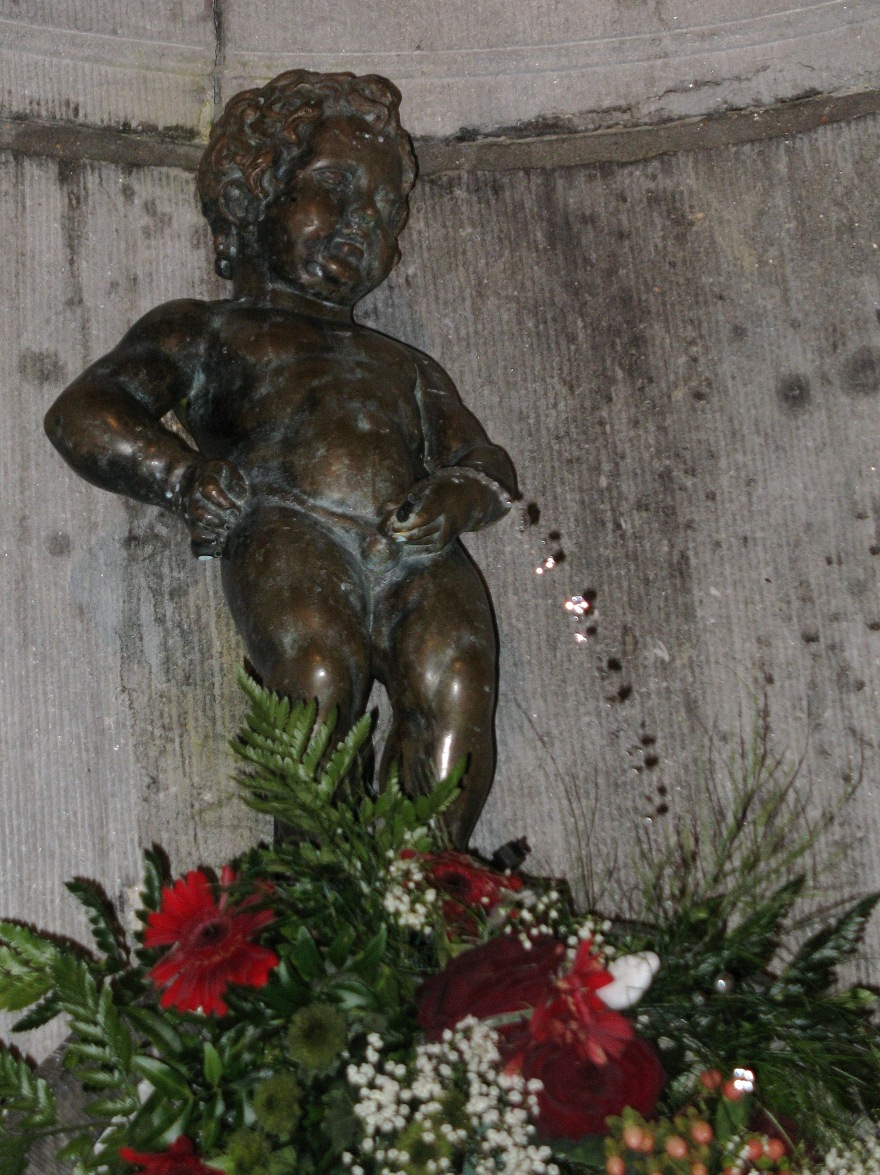
The second photo is one of Mannekin Pis, a statue of a little boy that is one of the symbols of Brussels. Sure, it’s a touristy thing place to visit and the statue certainly doesn’t rate high in terms of art. However, I usually try to stop by and see him, because sometimes he is wearing one different outfits for different occasions.

Tomorrow I’ll be home and will probably return to posting mostly nature shots in my blog.  It’s been an interesting experience the last few days trying to orient myself to photographing different things in a completely different environment.

night_blogmannekin

© Michael Q. Powell. All rights reserved

Read Full Post »

Walking around in Brussels, I came upon this stone statue with a smile that simply drew me in. There is a kind of mischievous glint in the eye that matches the smile.

I hope that you’ll smile too when you see him.

statue

© Michael Q. Powell. All rights reserved

Read Full Post »

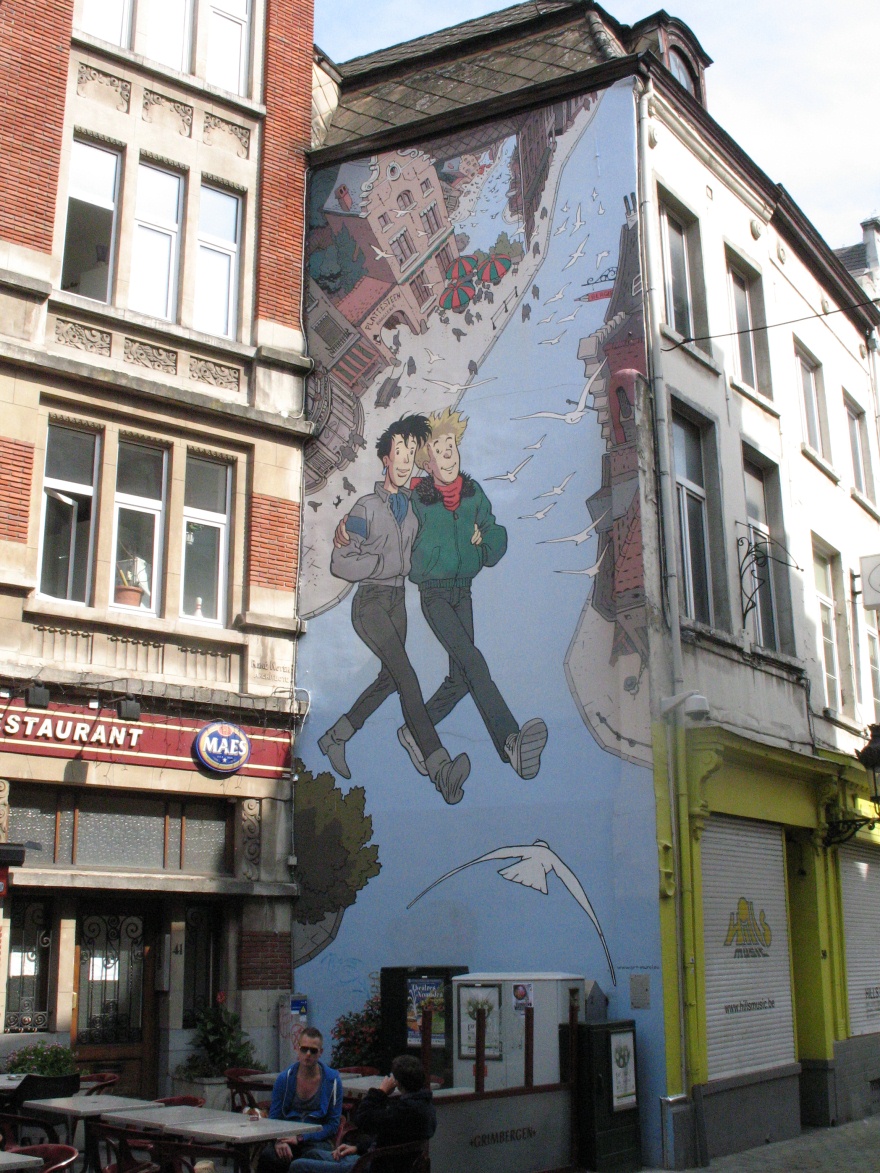
One of the cool things about walking around in the old area of Brussels near the Grand-Place is that you can unexpectedly come across giant murals on the sides of buildings illustrating scenes from the Adventures of Tintin.  This series of comic books was created by Belgian artist Georges Remi (who wrote under the pen name of Hergé) and was one of the most popular European comic series in the 20th century.

Here are photos of a few of those murals that I took in September, during a previous trip to Brussels. I really like the colors and the style of the illustrations and the way that they were integrated into the buildings on which they were painted.

TinTin1TinTin2TinTin3TinTin4

© Michael Q. Powell. All rights reserved

Read Full Post »

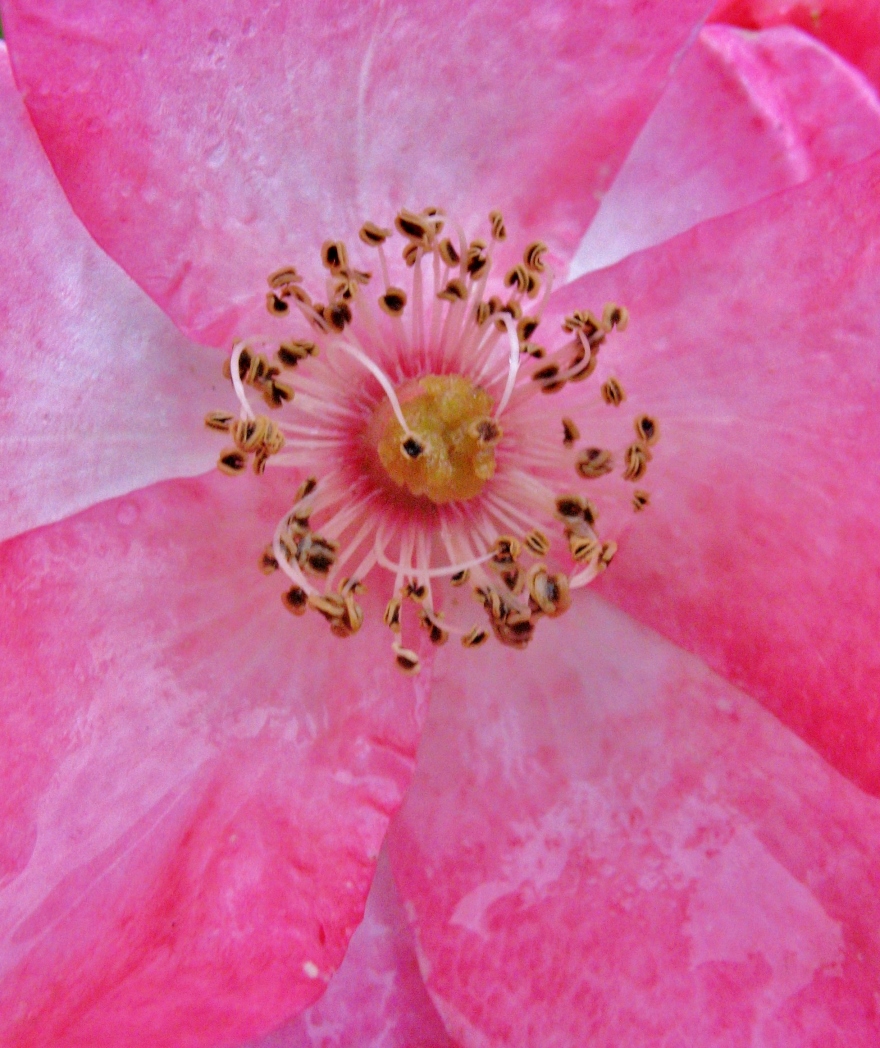
Brussels is still blanketed with a light coating of snow. The outdoor areas of the restaurants on the Grand-Place, the old city square, are deserted, but they continue to be surrounded by flowerboxes full of hardy flowers, like this little pansy. My eyes were drawn to this splash of color in a sea of grayness.

The little point-and-shoot Canon that I have with me has a limited zoom range, but it does have a macro mode that lets me get pretty close to my subject. I have tried to capture simultaneously the colors of the flower and the sense of winter. I did find the ice to be particularly difficult to render in a realistic way, probably because of its reflectiveness.

pansy1pansy2

© Michael Q. Powell. All rights reserved

Read Full Post »
What do you do when you wake up early in the morning in a hotel in a foreign country and have the desire to take some photos? If the weather were a bit nicer, I might have gone for a walk in the city, but it was bitter cold last night and snow has fallen, so instead I took a few shots looking out my window.

My room overlooks one of the entrances to the Central Train Station in Brussels and there are interesting lights and colors. The fresh snow is already covered in footprints, although not many pedestrians were yet visible when I took my photos. I particularly liked one sidewalk area that goes off to the side of the station and the two shots I’m posting show pedestrians walking in this area. The photos have kind of an urban vibe that is new to me. I’m starting to understand a bit what attracts some photographers to taking photos in the city.

Who are these people? Why are they up and about at a time when most others are still sleeping? I’ll never know their stories, but I have captured their images on this frigid Brussels morning.

Early morning pedestrian in Brussels

Early morning pedestrian in Brussels

Brussels pedestrians

Brussels pedestrians

© Michael Q. Powell. All rights reserved

Read Full Post »

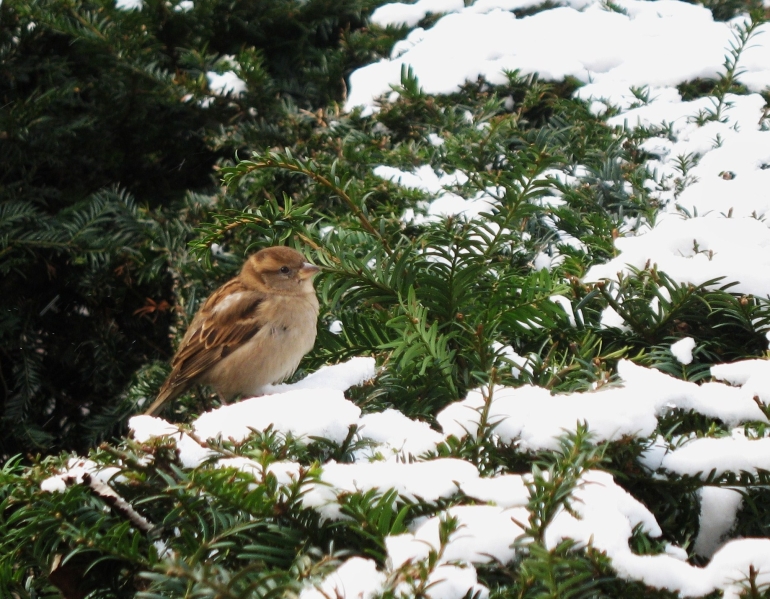
I have been photographing so many birds recently that one of my first thoughts upon arrival in Brussels yesterday was to look for birds. I did manage to get a few shots of some sparrows in a small park near the Central Train Station, the neighborhood in which my hotel is located. However, I quickly realized that the 4X zoom of my little Canon A620 is a limiting factor in getting close enough for a decent shot. I also know that at 7.1 megapixxels, I can’t afford to dramatically crop the photos.

I’m happy with these two images. I captured the first sparrow on a snowy evergreen bush. Snow may not be special to many, but my part of the USA has seen only a very small amount of snow this year. The second sparrow is perched on the railing surrounding the plants and is looking into them. I think he was singing so much that the bottom part of his beak is blurred.

I haven’t yet been able to identify these sparrows, but I wonder if they are different from the ones that I typically see in suburban Virginia.

Sparrow in Brussels

Sparrow in Brussels

Sparrow on a fence

Sparrow on a fence

© Michael Q. Powell. All rights reserved

Read Full Post »

It was almost 60 degrees (15 degrees C) when I left home, but it was well below freezing when I arrived in Brussels this morning. Although I usually try to stay awake when I first arrive, it was so dark and gray that I decided to take a nap first. Eventually the sun came out and I went for a little walk in the city center, though the cold and wind drained the power quickly from the batteries of my point-and-shoot camera and made it a little uncomfortable.

Last fall when I was here, I posted some photos of the main square of the city, the Grand-Place. The light was so beautiful today that I decided to post another shot of one of the buildings on that square, the city hall building. The perspective lines are distorted, but I think you can see how beautiful the building is. I am also including a photo of the bell tower of one of the churches here. It is considerably less ornate than the buildings on the Grand-Place, but I find it equally captivating.

City Hall in Brussels

City Hall in Brussels

IMG_1828

© Michael Q. Powell. All rights reserved

Read Full Post »

On a long walk along the Potomac River a couple of weeks ago, I stopped to take some photos of National Airport. Its full name is Ronald Reagan Washington National Airport, but that name is so long that most of just refer to it as National Airport. One of its nicest features is that it is just across the river from Washington DC. and is incredibly convenient to access. In addition, I find it really cool-looking and really like the control tower and the “Jeffersonian” domes that make up the terminal.

Control Tower and terminal at National Airport

Control Tower and terminal at National Airport

Jut past the north end of the runway there is a park, called Gravelly Point, where you have an incredible view of planes taking off and landing. When I was there, it seemed like it was mostly fathers and their young sons who were observing the aircraft. Here’s a shot I took from that location of a plane taking off. In the background you can see Woodrow Wilson Bridge, one of the major bridges that crosses the Potomac River.

Taking off from National AIrport

Taking off from National Airport

© Michael Q. Powell. All rights reserved

Read Full Post »

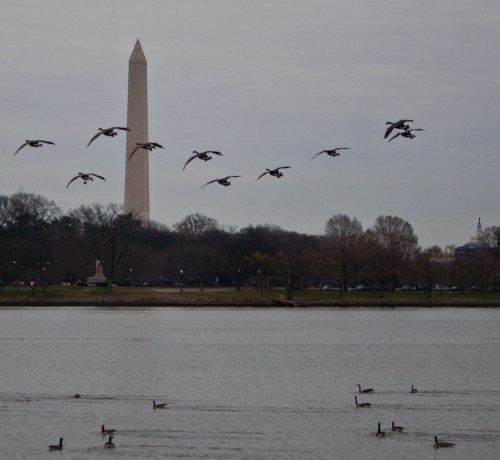
They came from the skies, invaders from the north in a tight military formation, seeking for openings to breach the defenses of their southern neighbor’s capital city.

Invaders

They sent out reconnaissance forces, in the air and on the waters of the Potomac River, collecting information and looking for a spot for a larger landing force.

Reconnaissance

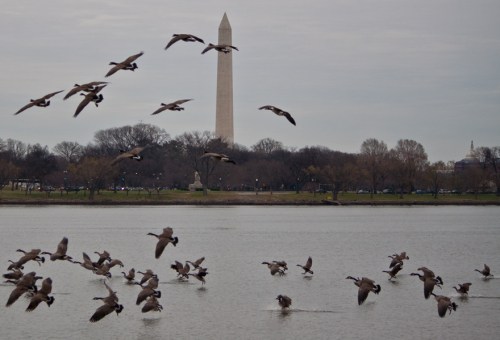
The landing zone secure, a larger force arrived and thus began the naval blockade of Washington D.C. A declaration of war has not yet been made by either side.

Landing Force

© Michael Q. Powell. All rights reserved

Read Full Post »

Sitting in the airport in Newark, I decided to take advantage of the time before my flight back to Washington, D.C. and play with some of my images. I have always loved black-and-white photography and have tried a couple of times to convert some of my images. I never know for sure what will work, but one of my photos of Christmas decorations in Vienna, Austria seemed to be appropriate for experimentation. I know that there is some good software available if I decide to pursue that direction, but this time I opted to desaturate the image almost entirely. I like the effect, in part because of the graphic lines of the original.

Which version do you like more, black-and-white or color?

Almost black and white

Almost black and white

Color

Color

© Michael Q. Powell. All rights reserved.

Read Full Post »

On my last night in Vienna, Austria, I decided to go for a walk through the city center to see how it was decorated for Christmas. There were lots of lights everywhere. Using available light, I took some photos of those lights and of some of Vienna’s famous landmarks. With a tripod, I would have done better, but I took advantage of various objects to brace myself and my camera for some fairly lengthy exposures. Here is an eclectic set of shots from my walk on a very cold Vienna evening.

city3_blog

city4_blog

city5_blog

city6_blog

city_blog1

© Michael Q. Powell. All rights reserved.

Read Full Post »
My time in Vienna is drawing to a close and I thought I’d post a few more of my favorite photos from the Christmas market.

Stands selling hot spiced wine are often areas where people congregate. One of them was set up on a path flanked with statues and I like how the first photo shows a statue peering down over the stand. What would he think of the scene in front of him?

statue_blog

The second image shows one element of the Christmas decorations. I like the colors, shapes, and the lines in that photo.

geometry_blog

The third shot was taken looking up at some of the towers of the Rathaus (City Hall). I braced myself against the wall of one of the booths to steady myself for the shot and you can see part of the booth in the foreground. I like the effect of this extreme angle (and I always love shots of buildings lit up in the evening).

up_blog

© Michael Q. Powell. All rights reserved.

Read Full Post »
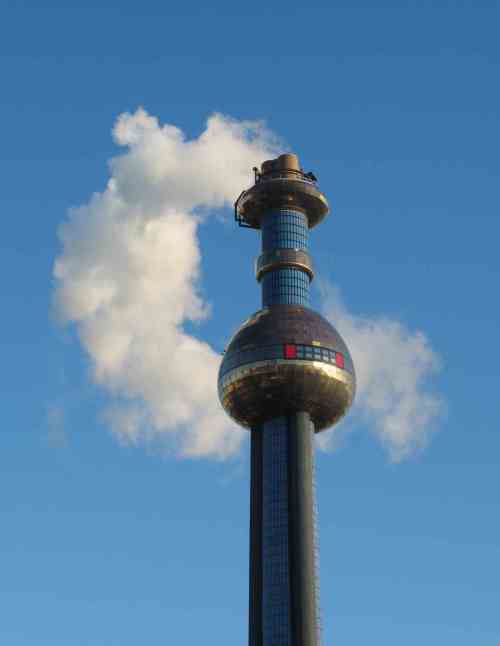
A couple of days I posted a photo of a building and asked readers to guess what its function was. There were a number of creative ideas including an observatory and a television tower, but Sue was correct in surmising that it is part of a heating plant?

plant1_blog

Yes, it actually is a district heating plant in Vienna, Austria. It was designed by Austrian artist Friedensrich Hundertwasser (1928-2000) in 1988-1992. I don’t know too much about the artist, but he was a bit eccentric, judging from the biographical information in Wikipedia, and the name he adopted as a artist means Peace-kingdom Hundred-water.

plant2_blog

According to information on a Hundertwasser webpage, originally he opposed the idea of this project, as he had fundamental objections to a garbage-incinerating plant as long as all possibilities for avoiding garbage were not exhausted. But when it was promised that the plant would be equipped with the most modern emission-purification technology, that 60,000 apartments would be heated, and in view of the fact that Vienna needed a garbage-incinerating plant, Hundertwasser finally agreed to do the design.

plant3_blog

I’ve included a number of different photos to give you a sense of what the heating plant looks like from different angles and distances. No matter what your views are on modern art, you have to acknowledge that this is a unique and unusual way to decorate the exterior of an urban heating plant.

plant4_blog

© Michael Q. Powell. All rights reserved.

Read Full Post »

« Newer Posts - Older Posts »