Feeds:
Posts
Comments

Archive for the ‘Summer’ Category

I had no idea that Eastern Gray Squirrels (Sciurus carolinensis) liked mushrooms, but this squirrel certainly seemed to be nibbling on one when I spotted him on Wednesday at Green Spring Gardens. I love the way that he was holding the mushroom in his “hands” as he gently chewed on the stem—I think he may have already consumed the mushroom cap.

Squirrel and mushroom

© Michael Q. Powell. All rights reserved.

Read Full Post »

I love the distinctive coloration of Orange Bluet damselflies (Enallagma signatum), whose name always causes me to smile at the apparent oxymoron. How can a bluet be orange? As the name “bluet” suggests, most of the 35 members of the genus American Bluet (Enallagma), the largest damselfly genus in North America, are blue. However, certain species come in other colors including red, orange, and green and the Rainbow Bluet combines red, yellow, and green.

I spotted this handsome male Orange Bluet last Wednesday as he was perching on a lily pad in a small pond at Green Spring Gardens. He posed beautifully for me and I was able to capture quite a few details of this little damselfly. I recommend that you click on the image to get a closer look at this Orange Blue, including his wonderful orange markings.

Orange Bluet

© Michael Q. Powell. All rights reserved.

Read Full Post »

Eastern Amberwings (Perithemis tenera) are very small dragonflies, with an overall length of no more than one inch (25 mm). Males of this species are easy to identify because of their amber-colored wings. Males are quite common and I ofter see them buzzing around the edges of the ponds that I visit. Females have brown patches on their clearer wings and often hunt far from the water, so I do not see them very often.

Despite their small size, Eastern Amberwings are one of the easiest dragonflies to photograph in flight. They often hover low, close to the water surface near the shore, which gives me a fighting chance to focus on them. It requires a steady hand and quick reactions, but the first two images show the kind of results you can get. The second shot is a little quirky, but I like the way that it shows two male Amberwings passing each other, flying in opposite directions.

The final shot is an “artsy” shot of a perched Amberwing. The dragonfly was flying among the lotus flowers last Wednesday at Green Spring Gardens and perched for a moment on a lotus leaf that had not yet unfurled. I tried to compose the image so that the viewer gets a sense of the habitat, which gives the shot a completely different feel from the first two photos in which the subjects are completely separated from their environment.

Eastern Amberwing

Eastern Amberwing

Eastern Amberwing

© Michael Q. Powell. All rights reserved.

Read Full Post »

I was absolutely thrilled on Wednesday when I streaks of bright yellow flashed in front of my eyes while walking among the flowers at Green Spring Gardens—goldfinches were present. Few other birds in my area can match the brilliant yellow color of the male American Goldfinch (Spinus tristis) in breeding plumage. It is easy to spot these birds, but it is a challenge to photograph them, because they are small, fast, and skittish.

My camera was equipped with my 180mm macro, which can also serve as a short telephoto lens, so I had to use all of my stalking skills to get as close as possible. Fortunately, the goldfinches were preoccupied with feeding and I was able to capture these images. I had to be quite patient, though, because the goldfinches spent most of their time with their heads buried in the flowers and only rarely gave me a good view of their faces

Together with the goldfinches, the abundance of blooming flowers helped me to create images that have a happy feel to them, a welcome antidote to the gloom of these troubled times.

American Goldfinch

American Goldfinch

American Goldfinch

© Michael Q. Powell. All rights reserved.


Read Full Post »

Ten years ago today I started this blog. After reviewing some of my photos from earlier that fateful day, my dear friend and photography mentor Cindy Dyer told me I needed a blog. I was a little skeptical, but we sat down at a computer and she helped me to set up this blog. I could not come up with a cute or creative name, so I simply called it “Mike Powell—My journey through photography.”

My first posting was a modest one that showcased a single photo of a Blue Dasher dragonfly (Pachydiplax longipennis). In case you are curious, here is a link to that first posting that was entitled “Blue Dasher dragonfly.”

I figured that my blog would be primarily a place to display my photos. I rapidly realized, however, that I enjoyed expressing myself with my words as much as with my images. My postings are often a direct reflection of my thoughts or feelings at the very moments when I am composing the post. I do not compose them in advance, so my postings sometimes ramble around a bit, but I have found that many of my readers enjoy this conversational, stream-of-consciousness style.

According to WordPress statistics, I have done 4462 postings, with almost three hundred sixty thousand total views. I have written most of these postings myself, though occasionally I have reblogged the postings of others. My favorite subjects over the years have been insects and birds, but I have also done postings on a wide range of other topics including animals, travel, poetry, and painting.

Today it seemed appropriate to post a photo of a male Blue Dasher—the dragonfly that started it all—that I photographed yesterday at Green Spring Gardens, a local, county-run historical garden. When I was starting to get more serious about photography ten years ago, Cindy and I would often photograph flowers and insects at this garden.

I owe a special debt of gratitude to Cindy for the initial push to start this blog and for her continued encouragement and inspiration. However, I am equally indebted to so many readers who have provided thoughtful comments, support, and motivation as we have made this journey together. Thanks to all of you—I could not have done it without you.

Blue Dasher

© Michael Q. Powell. All rights reserved.

Read Full Post »

It is fairly uncommon for me to see a Cyrano Darner dragonfly (Nasiaeschna pentacantha), so when I do, I try my best to get a shot of it. The problem, though, is that they always seem to be patrolling over the water far from the shore and rarely seem to perch.

Last Wednesday I spotted this Cyrano Darner flying around a heavily vegetated area, which made it even tougher to focus on the dragonfly. I was thrilled to be able to get a recognizable shot of the dragonfly, though the background is so cluttered that you may have to look hard to see it in the first image. The second image is a little less sharp, but gives you a clearer view of the dragonfly.

In case you are curious, the species is named for its long, protruding, greenish forehead that is somewhat reminiscent of the long nose of literary character Cyrano de Bergerac. This is the only species that I have encountered where the “nose” helps me to identify it—most of the time I focus on other parts of a dragonfly’s anatomy.

Cyrano Darner

Cyrano Darner

© Michael Q. Powell. All rights reserved.


Read Full Post »

I sometimes feel like male Slaty Skimmer dragonflies are checking me out—they often seem to hover and look right at me when I encounter them. Perhaps it is is a sign of curiosity or maybe one of territoriality. Whatever the case, I love their dark, good looks, like those of these Slaty Skimmers (Libellula incesta) that I encountered last Wednesday at Jackson Miles Abbott Wetland Refuge.

The first image is a traditional shot of a perching Slaty Skimmer. In the second shot, I attempt to capture an image of a Slaty Skimmer as he zoomed on past me. I like the feel of the shot, even though I was a little slow in pressing the shutter and caught him as he was flying away. As many of you know, I love to try to photograph dragonflies while they are flying. It is possible to do so, but the degree of difficulty is pretty high.

Slaty Skimmer


Slaty Skimmer

© Michael Q. Powell. All rights reserved.

Read Full Post »

I generally prefer to photograph dragonflies on natural perches, not on manmade ones. However, whenever I visit Jackson Miles Abbott Wetland Refuge I always check a piece of rebar that sticks out of the water of Mulligan Pond near one of the fishing platforms, because I have found that dragonflies love this photogenic perch.

Last Wednesday, I spotted a male Eastern Amberwing dragonfly (Perithemis tenera) perched on the rebar. It flew away as I approached, but I waited patiently and it eventually returned. I tried a number of different approaches in framing my shots, taking advantage of the changing background caused by the movement of the brownish waters of the pond.

I love the contrast between the colors, patterns, and textures of the natural object, the dragonfly, and those of the man-made subject, the rebar. The muddy waters of the pond provide a mostly uniform background color that really complements the amber and rust tones of the primary subjects.

Eastern Amberwing

Eastern Amberwing

Eastern Amberwing

© Michael Q. Powell. All rights reserved.


Read Full Post »

Each summer season I look forward to photographing Swift Setwing dragonflies (Dythemis velox) at Jackson Miles Abbott Wetland Refuge. These little dragonflies perch in a distinctive pose with their wings pulled forward, which looked to some scientist like the “ready-set-go” position of a sprinter and is reportedly the reason for the name of the species. One of my fellow photographers recently posted some photos of the species in Facebook, prompting me to set out last Wednesday to see if I could find some of them myself.

Six years ago I spotted my first Swift Setwing dragonfly at this same location. This primarily southern species had never before have been documented in Fairfax County, Virginia, the county where I live, so it is kind of special for me to see them each year. (You can see details of that first sighting in my 25 June 2016 posting Swift Setwing dragonfly.)

Members of this species like to perch at the very tip of vegetation overhanging the water and almost always face the water. It can therefore be quite a challenge to get profile shots and almost impossible to get the kind of head-on shots that I love to take.

I had a number of encounters with Swift Setwings and tried a variety of compositions to capture images of these cool little dragonflies. My favorite shot is probably the first one—I really like the way that the colors of the dragonfly’s head are mirrored in the colors of the berries in the background.

Swift Setwing

Swift Setwing

Swift Setwing

© Michael Q. Powell. All rights reserved.


Read Full Post »

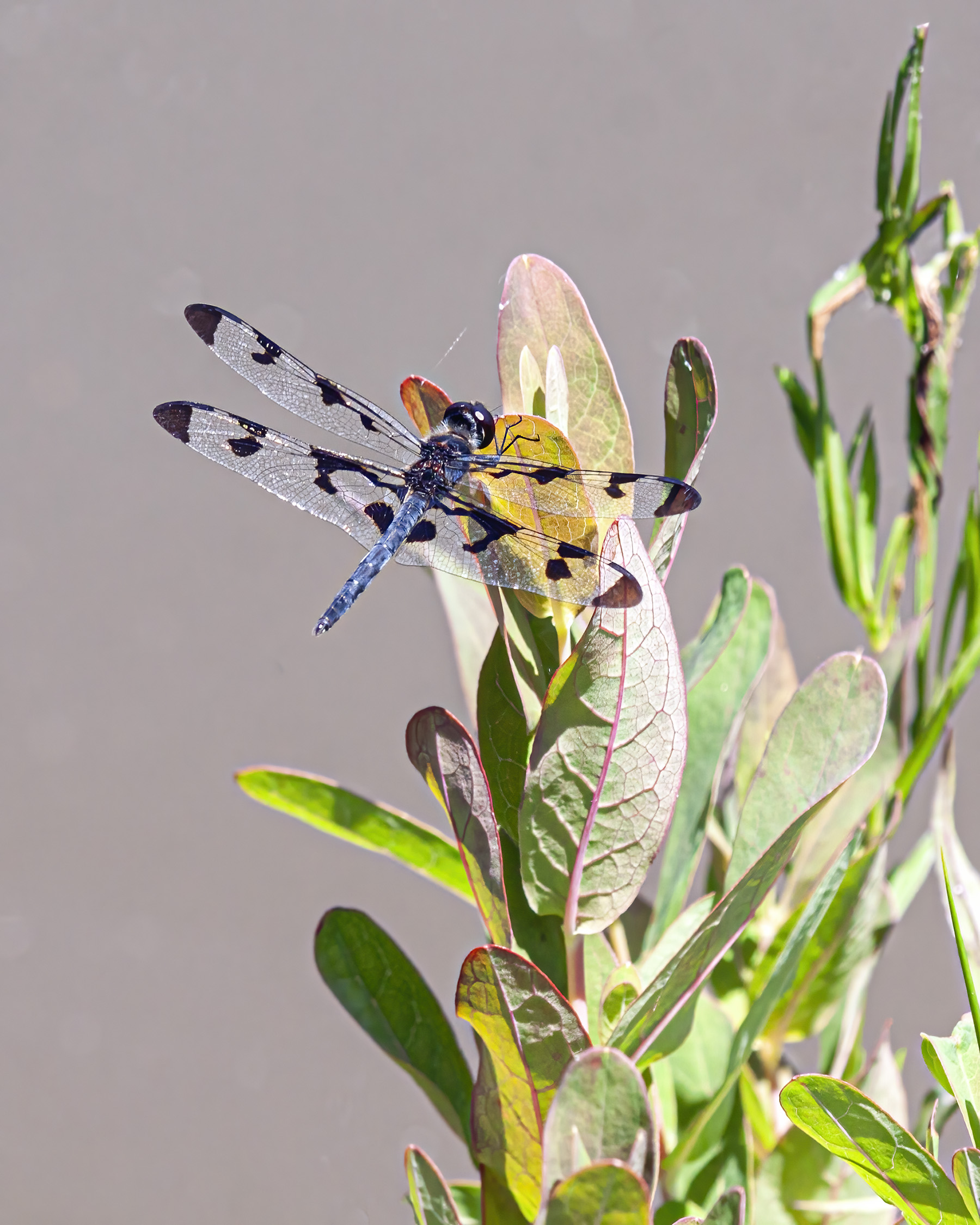
I was thrilled on Wednesday to spot some Banded Pennant dragonflies (Celithemis fasciata) at Jackson Miles Abbott Wetland Refuge. Earlier this season I photographed Calico Pennants and a Halloween Pennant and it is nice to capture images of another “pennant” species with patterned wings. This is the only local spot where I have reliably seen them in the past, and in some years I have not see a single one.

Adult male Banded Pennants are blue, like so many other dragonflies, but the distinctive pattern on their wings make them easy to distinguish from the others. They may be easy to identify, but they are small in size—about 1.3 inches (34 mm) in length—and perch in vegetation right at the edge of the water, so you have to look carefully to spot them.

I was fortunate to have multiple opportunities to photograph Banded Pennants that day. The colorful little dragonflies would make short forays over the deeper waters of the pond, but would sometimes would return to the same clumps of vegetation. The banks of the pond are pretty steep in many spots, so I had to really pay attention as I leaned over the edge to capture some of these images, but I managed to stay dry.

Have a wonderful weekend.

Banded Pennant

Banded Pennant

Banded Pennant

© Michael Q. Powell. All rights reserved.

Read Full Post »

On Wednesday I spotted this aptly-named Blue-tipped Dancer damselfly (Argia tibialis) while I was exploring a small stream at Jackson Miles Wetland Refuge. This was my first sighting of this species this season, so I was really happy to see it.

Unlike most damselflies, this one was content to perch on the rocks in the stream bed rather than on the nearby vegetation. That meant that I too had to descend to water level for me to get a shot.

When I took the image, I remember that I liked the way that the damselfly was perching at the edge of a large rock and I carefully composed the shot to include the entirety of the rock. As I was adjusting the image this morning, however, it suddenly struck me that the damselfly looked like it was trying to push the rock aside, which would clearly be an impossible task.

I immediately thought of the story of Sisyphus. According to Greek mythology, Zeus punished Sisyphus for cheating death twice by forcing him to roll an immense boulder up a hill only for it to roll down every time it neared the top, repeating this action for eternity.

I obviously have an overly active imagination when I start making these kinds of strange connections early in the morning. but it is fun sometimes to just let my creative mind run freely. I never know where these flights of fancy will take me, but the final destinations are often quirky. So, can you too imagine my little damselfly as an insect Sisyphus?

Blue-tipped Dancer

© Michael Q. Powell. All rights reserved.

Read Full Post »

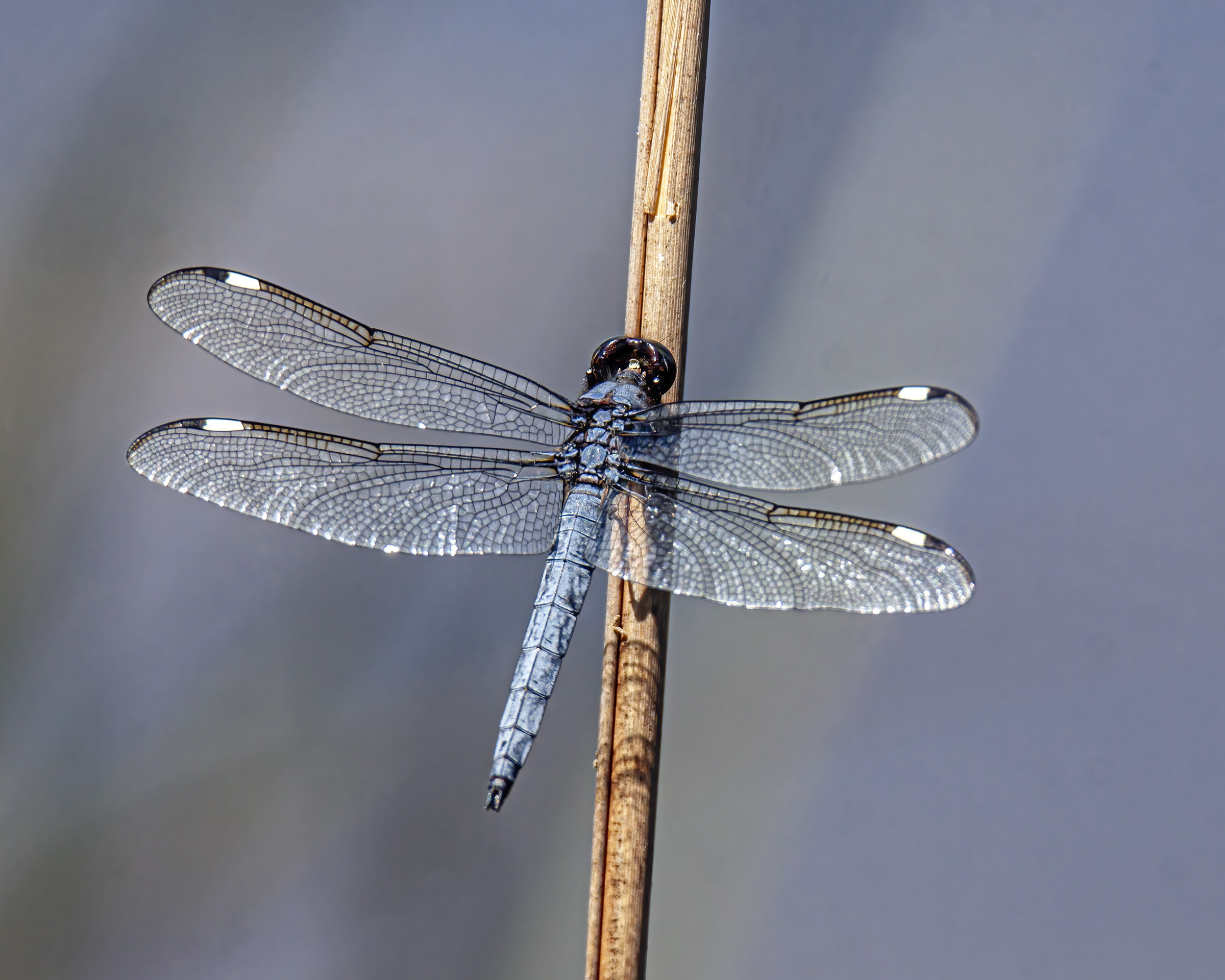
There are quite a few blue dragonflies where I live, so I can’t simply rely on color to tell them apart. Fortunately, it is very easy to identify a male Spangled Skimmer (Libellula cyanea), because it has a white spot beside a black spot on the outer leading edge of each wing—as far as I know, no other dragonfly in our area has multi-colored stigmata, the technical name for those spots.

The stigmata are not there for decoration, but serve an important role in the flight of dragonflies. I do not really understand the physics of flight, but have read that the stigmata are heavier than the adjoining cells and help to stabilize the vibrations of the wings.

I spotted these two mature male Spangled Skimmers during recent trips to Occoquan Regional Park. Earlier this year I saw some immature male Spangled Skimmers at the same location that were brown and yellow in coloration, just like the females of the species. (See my posting from 30 May 2022 entitled Spangled Skimmer dragonflies to see photos of an immature male and a female of this species.) Although the color of the males changes completely as they mature, the distinctive stigmata are present even when they are young.

Spangled Skimmer


Spangled Skimmer

© Michael Q. Powell. All rights reserved.

Read Full Post »

Earlier this season I saw a lot of Osprey (Pandion haliaetus) activity at Occoquan Bay National Wildlife Refuge. Many of the Ospreys seemed to be attempting to build nests, but it was never clear to me which ones were viable. These potential nesting sites were scattered around the entire refuge, so I count not simply monitor them as I do with the two eagle nests.

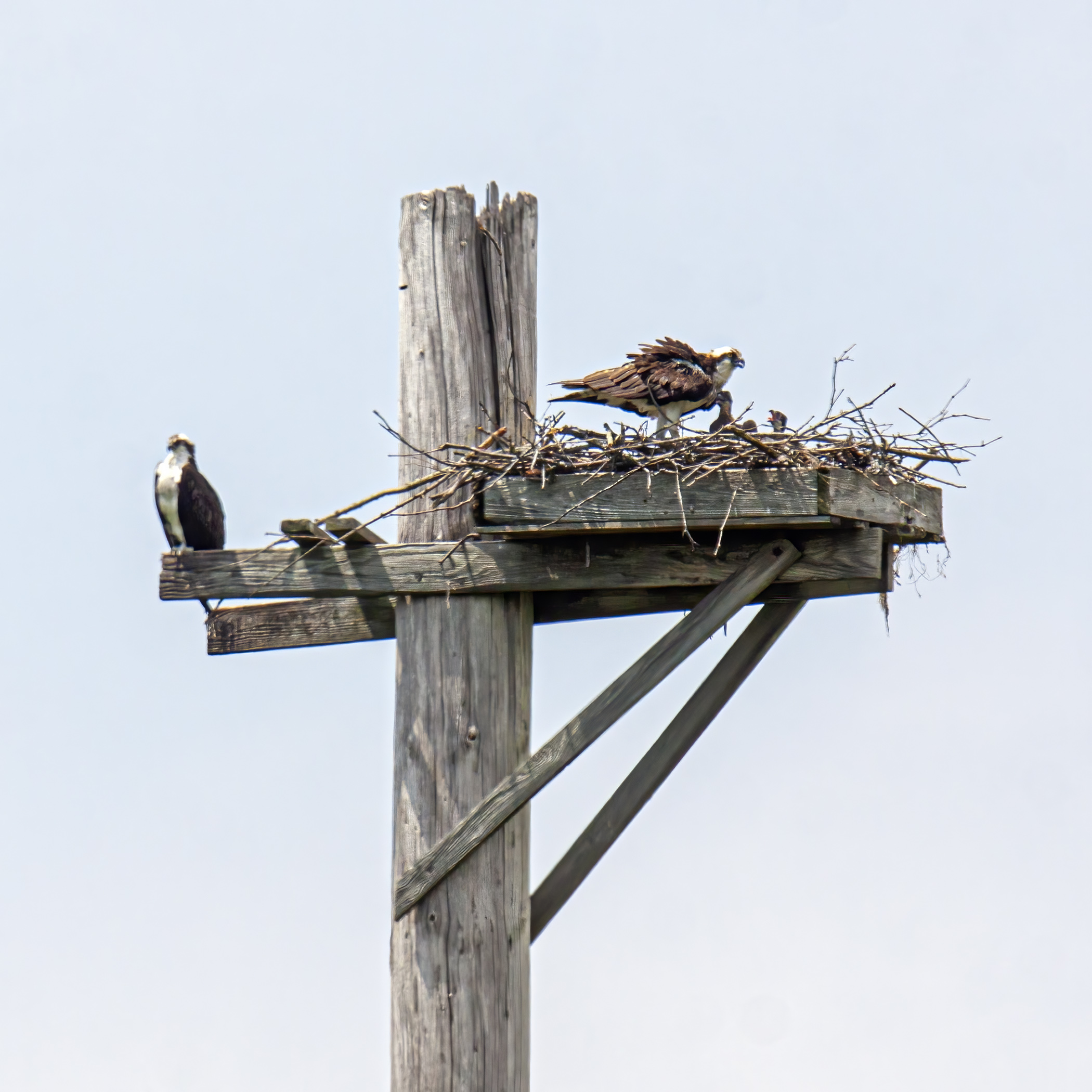
One of these sites is a man-made nesting platform that is located in the middle of a field. It is a simple wooden platform atop a vertical post that looks like a telephone pole. During the off-season, when the ospreys have departed from our area, bald eagles often perch on this platform, but it is not suitable for a bald eagle nest.

Apparently, though, the nesting platform is suitable for ospreys. Last Friday, I noted a lot of activity at the platform and managed to capture this image of an osprey family. I was shooting a telephoto lens, but was a good distance away, so the shot is not quite as sharp and detailed as I would have liked. However, it is easy to pick out both parents and at least two baby ospreys.

That same day, I checked the eagle nest to see if I could see the eaglet that I had previously photographed, but did not see it. Previously it looked like the eaglet was almost ready to fly and it is possible that the eaglet is no longer spending its time in the nest, but I will be sure to check for activity the next time that I visit the refuge—it is one of my regular stops when I make the rounds at the wildlife refuge.

Ospreys

© Michael Q. Powell. All rights reserved.


Read Full Post »

The calendar and the temperatures both tell me that we have entered into the long, hot, lazy days of summer. Here in the Washington D.C. area, where I live, that often means a lot of humidity too. Some days it can be a bit of a challenge to motivate myself to go out into the wild with my camera.

However, many dragonflies seem to love this kind of weather and the fields and ponds are abuzz with dragonfly activity. One of our common species is the Great Blue Skimmer dragonfly (Libellula vibrans). This past week I noticed a sharp increase in their numbers as I wandered the trails at Occoquan Bay National Wildlife Refuge.

Great Blue Skimmers have stunning blue eyes and white faces, which help to distinguish them from similar species. The Great Blue Skimmer in the first photo, which looks to be a young male, was cooperative and let me get quite close to him to get this close-up view of his head. Dragonflies of this species seem to have a pronounced overbite, which gives them a goofy grin that I find endearing.

I think that the dragonfly in the second shot is a female Great Blue Skimmer. Several dragonfly species share the same black and yellow coloration and pattern for juveniles and for females, so it can often be a real challenge to make a definitive identification. Fortunately, the differences among the species become more pronounced as the dragonflies mature.


Great Blue Skimmer

Great Blue Skimmer

© Michael Q. Powell. All rights reserved.


Read Full Post »

I was excited last Monday to spot this Halloween Pennant (Celithemis eponina), one of my favorite dragonflies, as I was exploring a small pond in Fairfax County. I especially love the beautiful patterns on its wings and the way that it perches on the very tip of flimsy vegetation, causing it to flutter in the slightest breeze, like a pennant.

Halloween Pennant

© Michael Q. Powell. All rights reserved.

Read Full Post »

I noticed on Friday that quite a few milkweed plants are now in bloom at Occoquan Bay National Wildlife Refuge. Hopefully they will attract some Monarch butterflies. In the meantime, I was happy to see this Red Milkweed Beetle (Tetraopes tetrophthalmus) with its cool “longhorn” antennae.

Over ten years ago, I encountered these strange-looking insects for the first time and was utterly fascinated by their appearance. That fascination has not diminished over time. Milkweed plants are amazing hosts to a wonderful variety of insects and it is always fun to examine them closely.

I was a pretty good distance away from this beetle, so I was not able to get a close-up shot of it, so settled for a shot that included a bit of the milkweed. I really like the resulting image, a reminder to myself that the primary subject does not necessarily have to fill the frame for a photo to be effective.

If you want a better view of a Red Milkweed Beetle, check out my June 2013 posting entitled “Red Milkweed Beetle—he’s back.”

Red Milkweek Beetle

© Michael Q. Powell. All rights reserved.

Read Full Post »

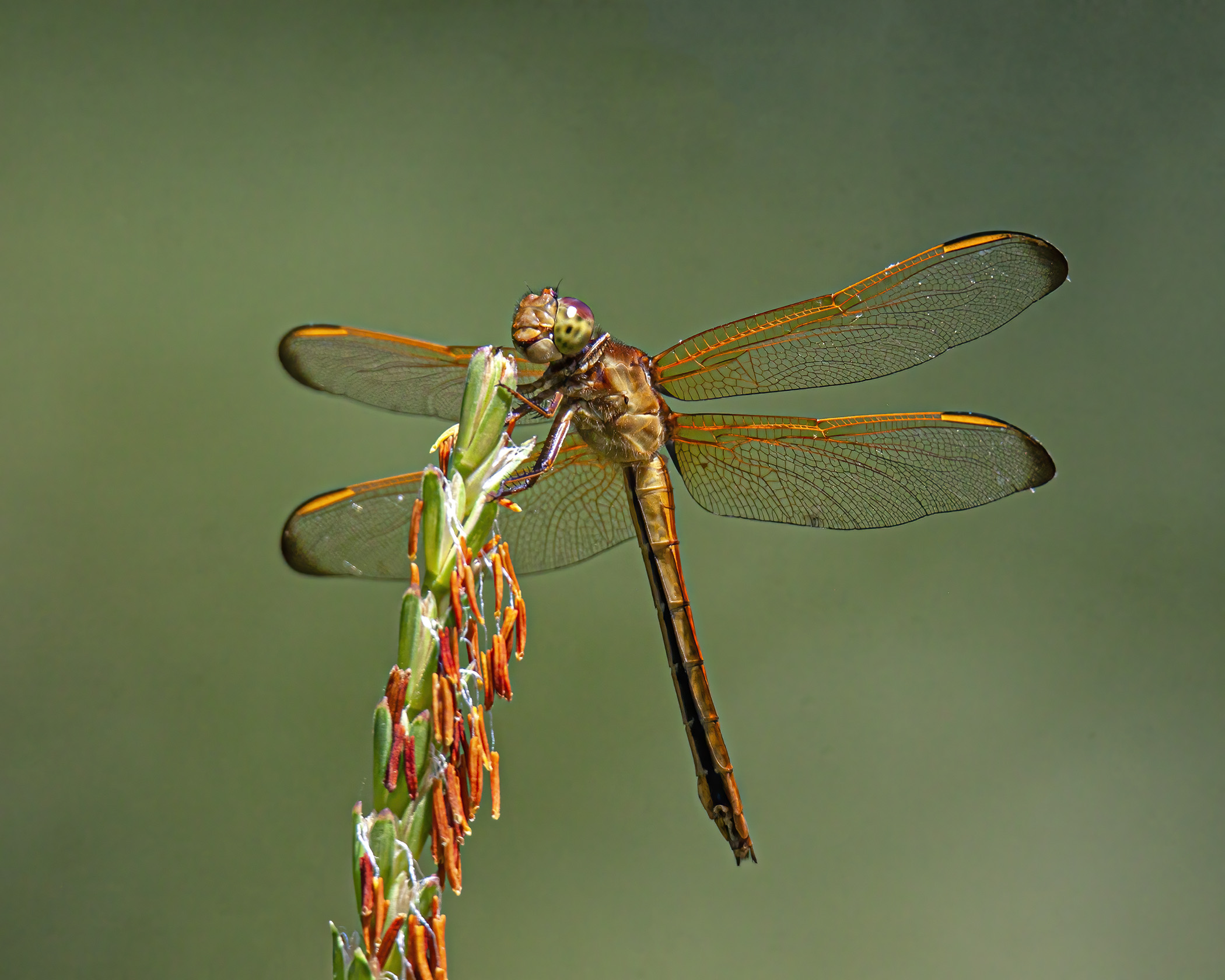
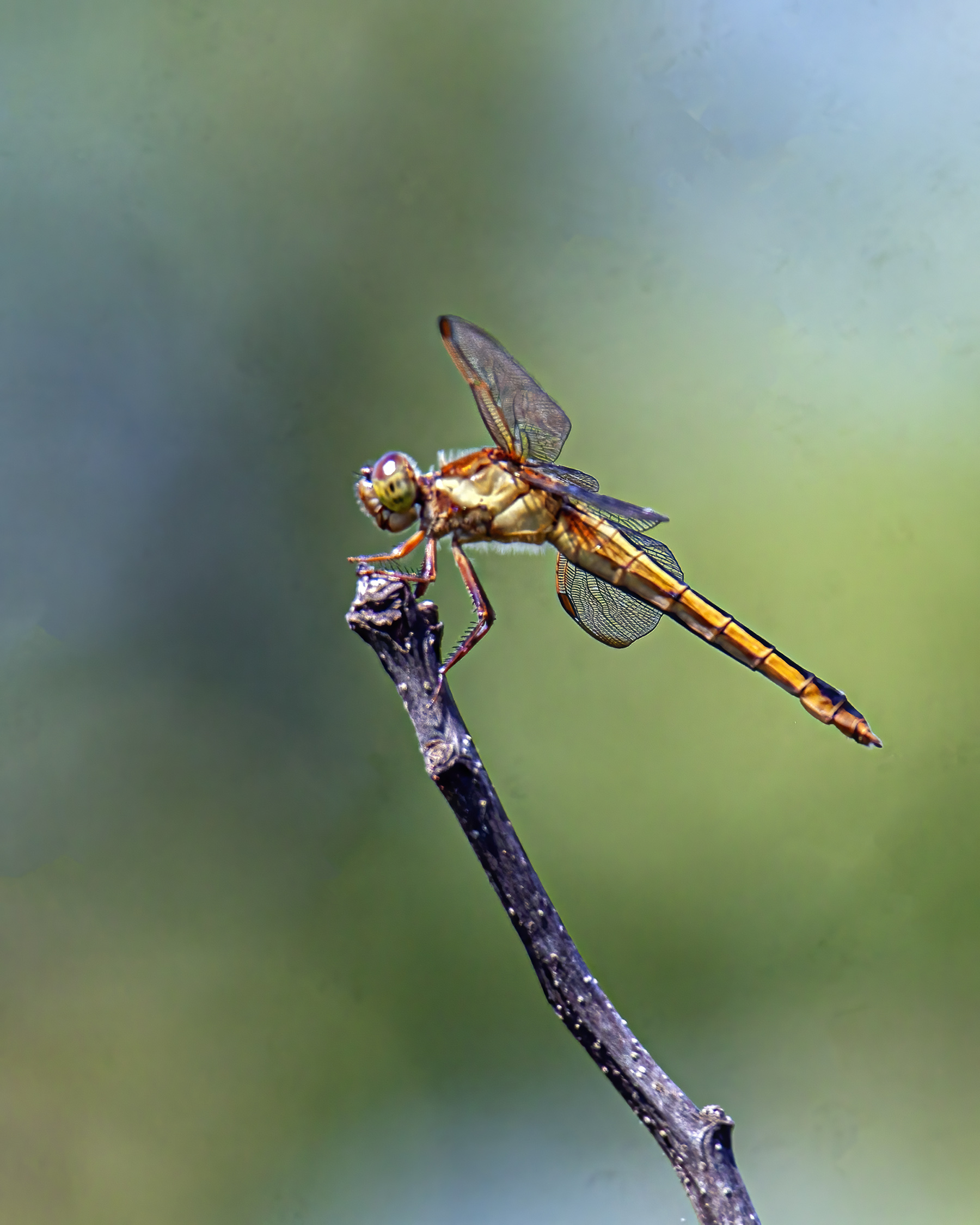
Numerous Needham’s Skimmer dragonflies (Libellula needhami)) have recently emerged at Occoquan Bay National Wildlife Refuge. Yay! I just love the golden leading edges on the wings of this species. Male Needham’s Skimmers eventually turn reddish-orange in color, but initially have the same yellow and black coloration as the females.

In the first shot, I was thrilled to photograph a beautiful female as she perched on some colorful Eastern Gamagrass (Tripsacum dactyloides).  I cannot identify very many plants, but this one is distinctive enough that it has stuck in my memory. I love the expression on the dragonfly’s face–she seems to be either smiling at me or sticking out her tongue at me.

The Needham’s Skimmer in the second image also seems to be smiling. I think that it is a male, but cannot be certain from this angle of view.

Have a wonderful weekend. Needham's Skimmer

Needham's Skimmer

© Michael Q. Powell. All rights reserved.


Read Full Post »

We have had rain and clouds the last few days and I feel the need for a pop of color today. This blanket flower (g. Gaillardia) provided a wonderfully colorful backdrop for a little bee that I spotted during a recent trip to Green Spring Gardens. I think that it may be some kind of sweat bee, but I did not get a close enough look at it to be able identify it.

bee

© Michael Q. Powell. All rights reserved.


Read Full Post »

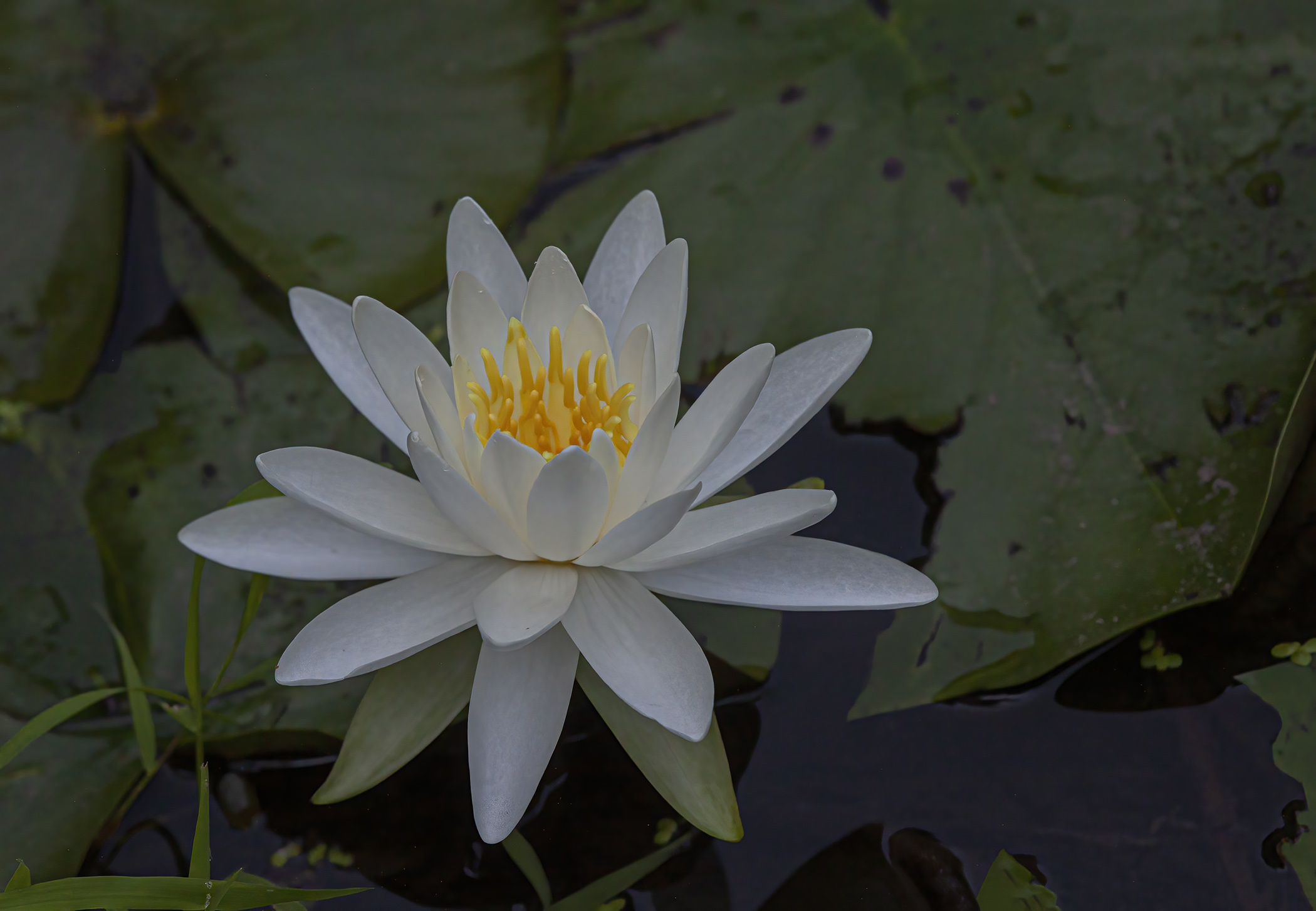
There was only one water lily in bloom last week at Green Spring Gardens—it did not have to share the spotlight with any other floating flowers. In some ways, its uniqueness made it even even more special. I love water lilies, but it may be a bit early for them to be blooming, at least at this pond.

As I was looking through my camera’s viewfinder, trying to think of an interesting way to photograph the single water lily, I spotted a tiny hover fly making a beeline for the center of the water lily. I reacted quickly and frantically clicked away. In most of my shots, the hover fly was out of focus, but my luck and timing allowed me to capture the first image below, in which the little insect is in relatively sharp focus—click on the image to get a closer look at the patterns on the hover fly’s body.

I realize that some viewers may prefer to enjoy the beauty of a flower without having to see insects, so I have added a second shot of the water lily that I took from a slightly different angle. No matter which image you prefer, I am confident that you will agree that the water lily is stunning—I love the way that the center of the flower seems to glow.

Water lily

water lily

© Michael Q. Powell. All rights reserved.


Read Full Post »

Here is a look at what might be one or more of the parents of the young eaglet at Occoquan Bay National Wildlife Refuge that I featured in a recent post. Last Friday, the larger Bald Eagle (Haliaeetus leucocephalus) at the top was perched for an extended period of time in a tree overlooking the large nest when the second eagle flew in. They remained in place for several minutes before flying away.

Are these two eagles a couple? The one on the left is probably three to four years old and may not be mature enough to be a parent—it can take about five years for the head feathers to turn completely white and for an eagle to fully mature. On the other hand, if only the older one is a parent, it seems a little strange that it was so comfortable with an interloper zooming in and perching that close if they are not a couple.

Several Facebook readers commented that the eagles that were hanging around the nest earlier in the year both had completely white heads. What happened? We may need a paternity test to determine if this precocious young eagle is indeed the father.

So what do we have here? Is this a much older sibling of the eaglet in the nest? If so, where is the other parent? Female eagles tend to be larger than males, so it is quite possible that the eagle perched higher is a female. Maybe she is disappointed that there is only a single eaglet and is trying out a possible new mate. It is a bit of a mystery.

bald eagles

© Michael Q. Powell. All rights reserved.

Read Full Post »

I never know what will catch my eye when my camera is in my hand. On Monday, for example, I spotted these tiny, colorful flowers while hunting for dragonflies at Occoquan Regional Park. The blue one is a type of blue-eyed grass (g. Sisyrinchium), but I can’t identify the pretty pink one.

I am not a gardener, so I never learned to differentiate between flowers and weeds—they are all flowers to me. I find the names of plant species to be confusing at times. Blue-eyed grass, for example, is not actually a grass, but a perennial related to the iris, and it comes in multiple colors. Yikes!

The good news is that my lack of knowledge about plants does not keep me from enjoying fully the beauty of these tiny flowers. To borrow a line from Shakespeare, “What’s in a name? That which we call a rose, by any other name would smell as sweet.”

If you recognize the pink flower and can identify it, please let me know what it is. Ten years ago I could not identify a single dragonfly, but over time I have learned a lot about them. There is hope, therefore, that I will similarly expand my knowledge of flowers as I encounter and photograph them.

UPDATE: Thanks to Steve Gingold, I now know that the pink flower is a Deptford Pink (Dianthus armeria), a plant species native to Europe that is naturalized in much of North America. Be sure to check out Steve’s blog for lots of wonderful nature images and a wealth of information about plants, insects, and other aspects of nature, especially in Western New England, where he lives.


pink flower

blue-eyed grass

pink flower

© Michael Q. Powell. All rights reserved.


Read Full Post »

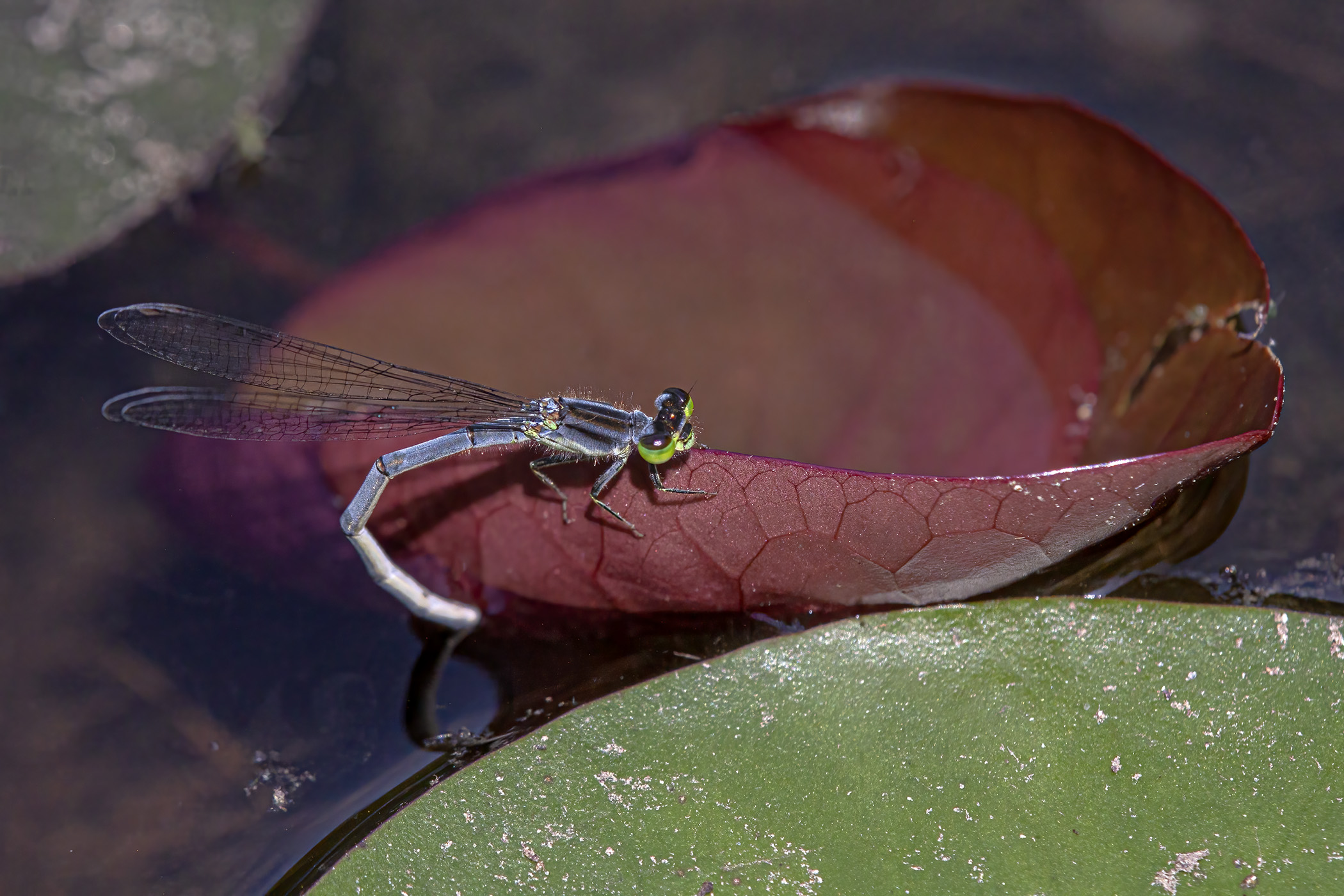
As I was visiting a small pond at Green Spring Gardens last week, checking to see if the lotus flowers and water lilies were in bloom, I detected some movement at the edge of the water. It took me a moment to spot some tiny Eastern Forktail damselflies (Ischnura verticalis) that were buzzing around the vegetation sticking out of the water. Eastern Forktails are quite small, about 0.8-1.3 inches (20-33 mm) in length.

I got down as low as I could and captured several images of a beautiful female Eastern Forktail. In the first shot, she perched and posed for me, so I had the luxury of carefully composing my shot. Click on the photo to see the wonderful details of this damselfly, including her stunning two-toned eyes. Eastern Forktails are quite small, about 0.8-1.3 inches (20-33 mm) in length.)

In the second shot, she was perching on the edge of a lily pad with the tip of her abdomen in the water. She was in the process of depositing eggs into the bottom of the lily pad or possibly into the stem of the plant.

As it turned out, it is still too early for the lotus flowers to bloom, though the plants were producing lots of leaves. There was one white water lily that was blooming, so the scene at the pond does not yet remind me of a Monet painting.

Eastern Forktail

Eastern Forktail

© Michael Q. Powell. All rights reserved.


Read Full Post »

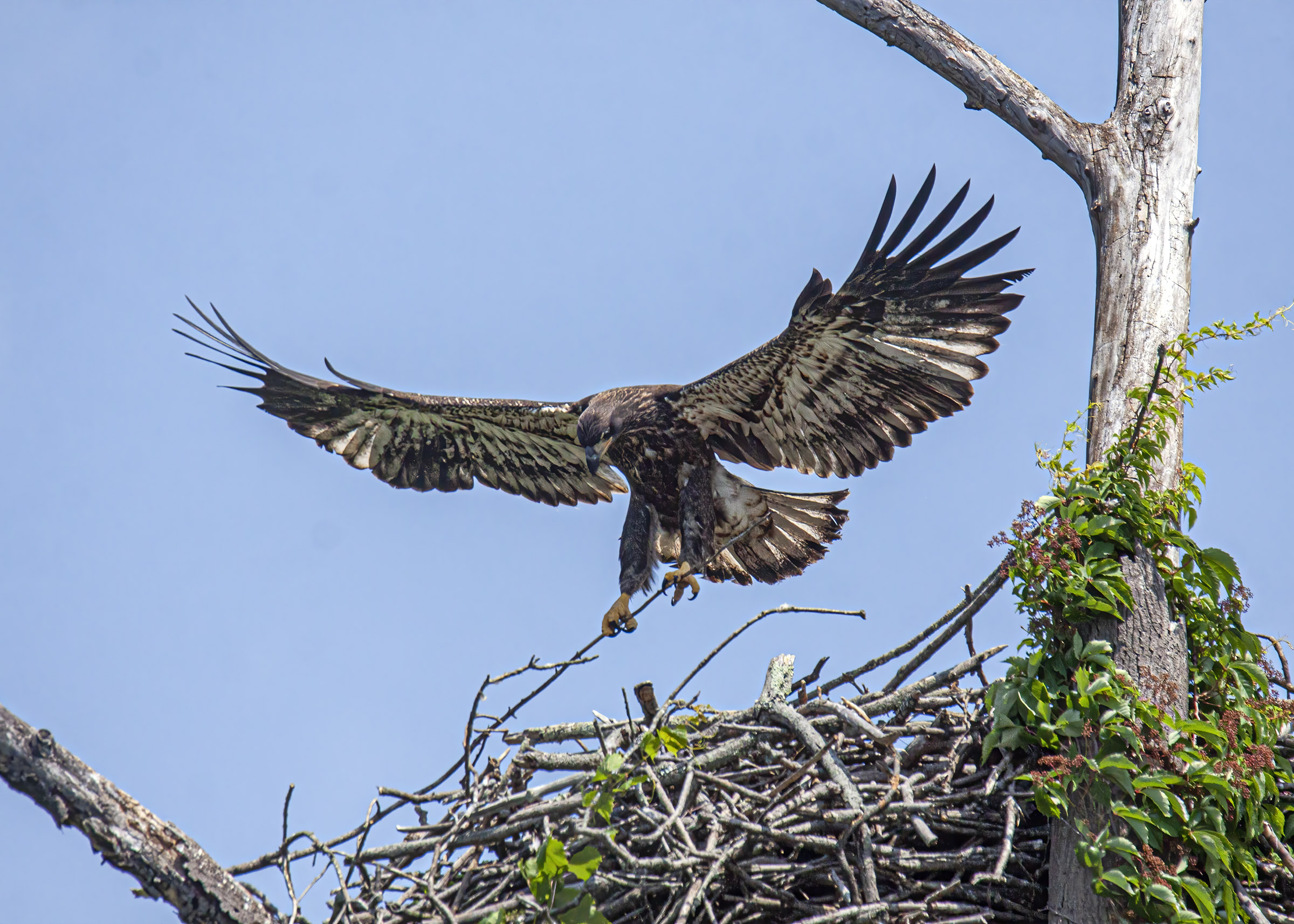
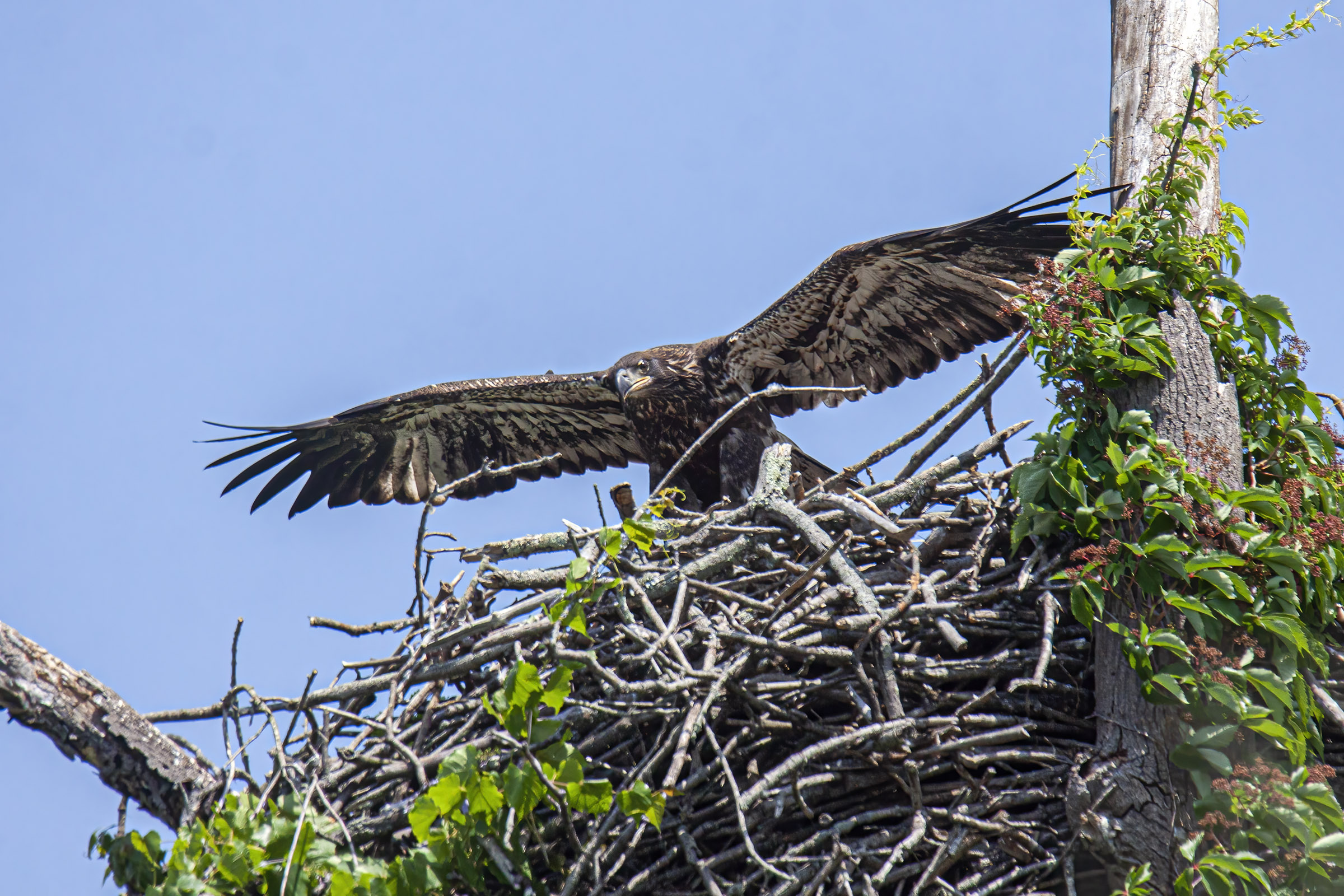
Earlier this month I did a posting called  Looking out of the nest that featured a young Bald Eagle (Haliaeetus leucocephalus) sitting up in a large nest at Occoquan Bay National Wildlife Refuge and wondered when it would be able to fly. Last Friday I returned to the refuge and was delighted to see the eaglet flapping its wings and testing them out—I think it is almost ready to fly..

The eaglet repeatedly extended its wings, but seemed a bit uncoordinated, like a gawky teenager who has experienced a growth spurt. Several times it was able to rise up into the air, but looked uncertain about what to do next. The photos below show some of the action, which lasted only for a few minutes. The eaglet then disappeared into the deep nest, possibly to rest after its exertion.

I watched for a while longer and eventually the eaglet reappeared, but it simply sat up, looking out of the nest. A fellow photographer told me that he spotted the eaglet the following day perched in the tree that you can see in the right side of the image. I suspect, though, that the eaglet will need some quite a bit more practice before it will be capable of venturing out on its own and, of course, it will have to learn how to fish.

I will probably make a trip to the refuge this week to check on the eaglet. So many of the nearby trees are covered with leaves that I may have trouble spotting the eagle, particularly because its dark, and mottled plumage help it to blend in well with the foliage. Adult Bald Eagles tend to stick out a bit more because of the bright white feathers on their heads.

Bald Eagle

Bald Eagle

Bald Eagle

© Michael Q. Powell. All rights reserved.

Read Full Post »

Recently I did a posting featuring a beautiful Violet Dancer (Argia fumipennis violacea), the uniquely purple damselfly that is featured in the banner of my blog. Today I thought that I would give equal time to several of the other dancers in my life. Damselflies in the genus Argia are known by the whimsical name of dancers, because of the distinctive jerky form of flight they use which contrasts with the straightforward direct flight of bluets, forktails, and other pond damselflies.

The damselfly in the first photo is a male Powdered Dancer (Argia moesta) that I spotted perched on a rock in the water while I was exploring a stream in Prince William County. I can tell that this is a rather young male, because he still has a lot of color on his thorax. Mature males turn whitish in color—you can see the powdery coating beginning at the tip of its abdomen.

The next two photos show a male Blue-fronted Dancer (Argia tibialis) that I found in the vegetation next to a small pond at Jackson Miles Abbot Wetland Refuge. This species is quite distinctive because the thorax is almost completely blue, with only hairline black stripes on its shoulders and the middle of its back.

One of the things that I particularly enjoy about photographing nature is the incredible diversity that I encounter. Even within a single species, I can spot unique beauty in each individual that I encounter, especially when I slow down and look closely. The same thing is true about people—we should celebrate and respect our diversity and engage with people who may look or act or think differently. As the Lee Ann Womack country music song says, if you get the choice to sit it out or dance, I hope you dance.


Powdered Dancer

Blue-fronted Dancer

Blue-fronted Dancer

© Michael Q. Powell. All rights reserved.

Read Full Post »

There has been a recent explosion of dragonflies in my area. Yesterday was a hot, humid day and I encountered hundreds of dragonflies as I walked along the trails of one of my favorite wildlife park. They were almost all relatively common species, including Common Whitetails, Needham’s Skimmers, Eastern Pondhawks, and Great Blue Skimmers. These dragonflies thrive in a variety of habitats, are numerous, and are easy to see.

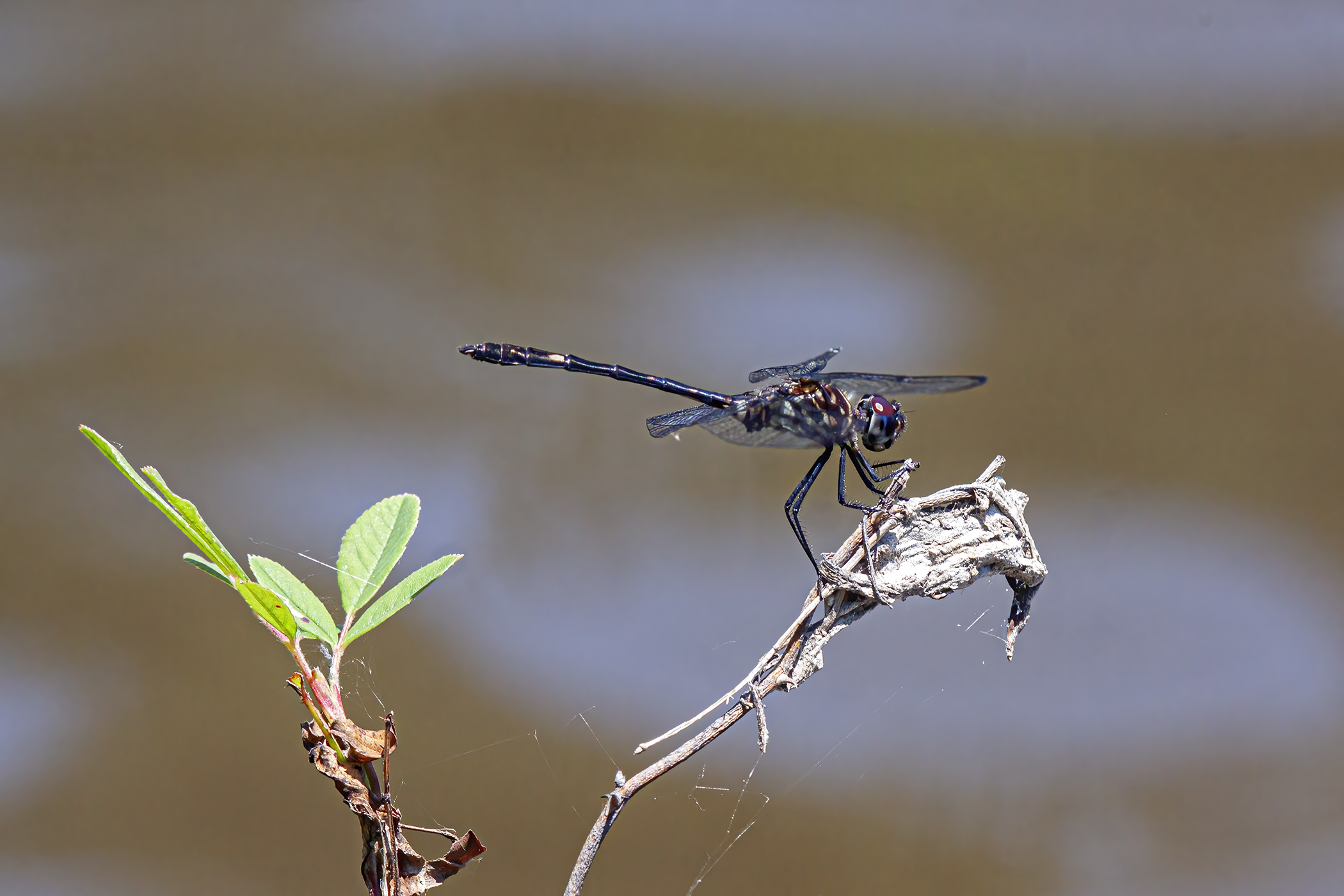
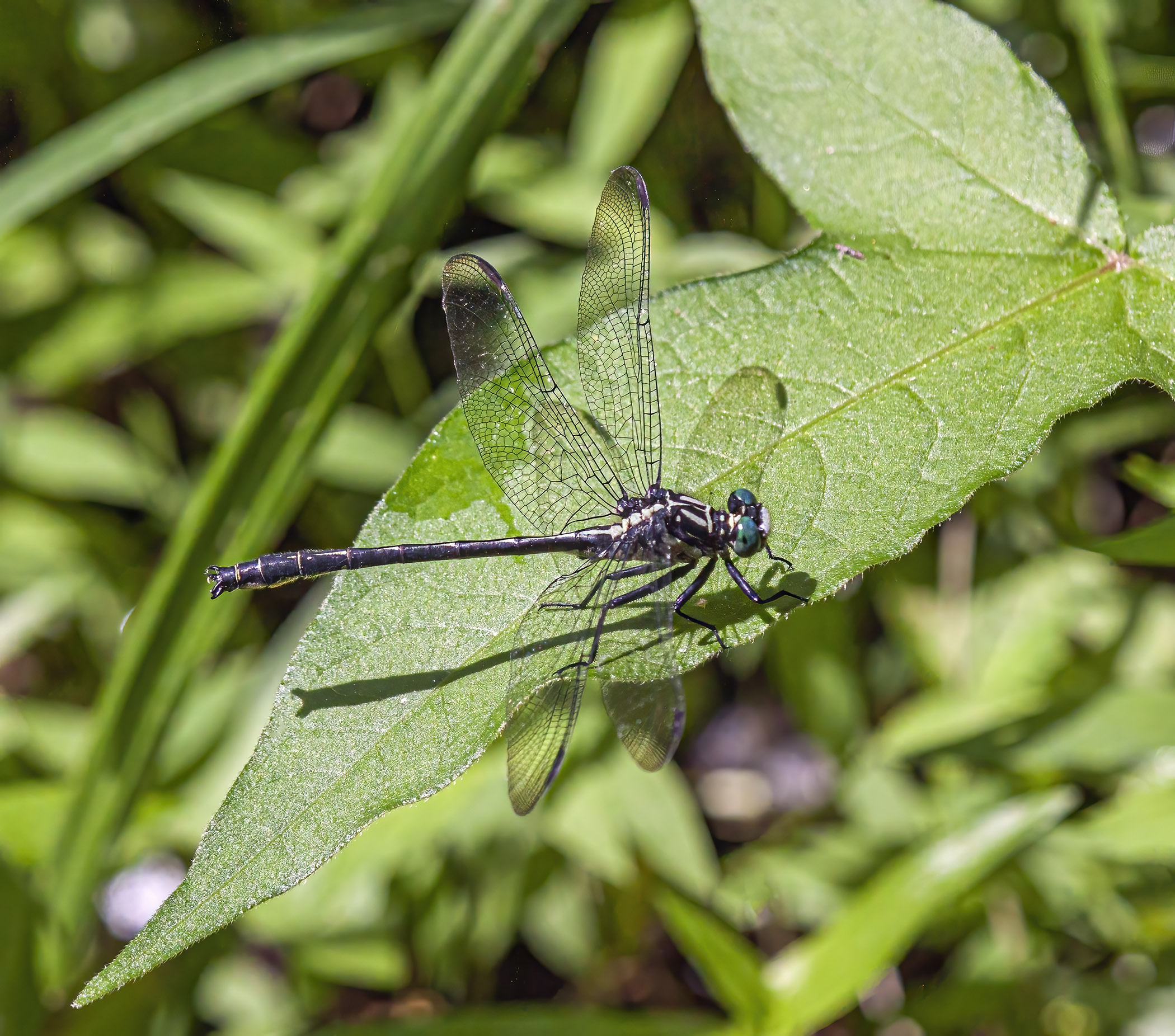
Some of the rarest dragonflies in our area, however, are quite muted in their appearance, like these male Sable Clubtail dragonflies (Stenogomphurus rogersi). Sable Clubtails are generally found only in very small numbers, have a short flight period, and require very specific habitats,—this species prefers small, clean forest streams. This past two weeks I have spent hours exploring a stream in Fairfax County in Virginia, the county in which I live, and spotted a grand total of two Sable Clubtails.

As you can see from the first photo, my most recent sighting, Sable Clubtails like to perch flat on leafy vegetation, just above the level of the stream. They are often in shadowy areas and are incredibly skittish, so it is tough to get a good shot of a Sable Clubtail.

The dragonfly in the second and third photo was initially spotted by a fellow dragonfly enthusiast a little over a week ago. I was upstream from him (and had not noticed that he was there) when he called out to me and informed me that he had spotted a Sable Clubtail. I hurried over in the direction of his voice and photographed the dragonfly in the middle photo. I was able to capture the markings of the Sable Clubtail by shooting almost directly downwards, but the sunlight produced harsh specular highlights.

As I crouched to get a better angle, I spooked the dragonfly.  Fortunately it flew only a few feet away and perched higher on a leaf in a slightly shaded area, which let me capture the third shot before it flew away.

I don’t know if I will see another Sable Clubtail this season, but it was gratifying to be able to have two encounters with this uncommon species. Habitats are fragile and changeable, so I never know from year to year if one of these low-density species will reappear or not. At this location, I have been blessed to photograph a Sable Clubtail for three of the last four years. I’ll probably check it out at least another couple of times before I call it quits for this species for the season.
Sable Clubtail

Sable Clubtail

Sable Clubtail

© Michael Q. Powell. All rights reserved.


Read Full Post »

I was thrilled to spot this cool-looking Six-spotted Fishing Spider (Dolomedes triton) yesterday at Green Spring Gardens, a county-run historic garden in Alexandria, Virginia, not far from where I live. These spiders usually keep several of their legs on the surface of the water and detect the vibrations of potential prey and them scamper across the water to capture their targets.

Initially the spider had its legs anchored on the edge of a colorful lily pad a short distance from the edge of a small pond, as shown in the first photo. When I got a little too close, the spider moved a short distance away, as shown in the second photo, but eventually it returned to its original spot.

Fishing spiders like this one are quite large—a female can grow to be about 2.4 inches (60 mm) in length, including her legs, while the male is somewhat smaller. According to Wikipedia, Six-spotted Fishing Spiders hunt during the day and can wait can wait patiently for hours until stimulated by prey. Potential prey include both aquatic insects and terrestrial insects that have fallen into the water, tadpoles, frogs, and small fish. Amazingly, these spiders are capable of capturing fish up to five times their body size, using venom to immobilize and kill the prey.

Six-spotted Fishing Spider

Six-spotted Fishing Spider

© Michael Q. Powell. All rights reserved.

Read Full Post »

It has been a while since I last saw a Monarch butterfly, but I continue to see lots of similar-looking Viceroy butterflies (Limenitis archippus), like these two little beauties that I photographed in the past few days at Occoquan Bay National Wildlife Refuge.

Monarch butterflies migrate to Mexico and parts of southern California each year and may already left our area, while Viceroys do not migrate. I suspect that we will continue to see Viceroys for another month or so before they die off. Viceroy butterflies overwinter here as caterpillars and in spring we will start to see them again.

I just glanced over at a calendar and noted that today is the first day of autumn for those of us in the Northern Hemisphere. I have noted already some changes in the weather, though we are still having more heat and humidity that I would prefer.


viceroy butterfly

Viceroy butterfly

© Michael Q. Powell. All rights reserved.

Read Full Post »

I love the way that this trio of turtles had arrayed themselves on the trunk of a fallen tree last Friday at Jackson Miles Abbott Wetland Refuge. The beautiful reflections they cast on the surface of the pond were a nice bonus. I could not help but note that they all are looking in the same direction—perhaps they all were facing into the sun or simply decided that I would prefer a profile shot to one of the back of their heads.

turtles

© Michael Q. Powell. All rights reserved.

Read Full Post »

When the urge to take photos strikes me, I am undeterred by drizzle or intermittent light rain, though heavier rain and gusty winds tend to keep me at home. Of course, weather is unpredictable and I have gotten drenched in downpours a number of times. I carry an array of plastic bags and coverings to protect my gear, which is usually my number one priority.

Last Friday, it was raining off and on and I decided to visit Jackson Miles Abbott Wetland Refuge to see if any creatures were stirring. Not surprisingly, dragonflies were at the top of my list, though I doubted that any of them would be flying in the rain. I was therefore pleasantly surprised when I spotted this male Eastern Pondhawk dragonfly (Erythemis simplicicollis). I watched him land on a droplet-laden plant and managed to capture the first image below.

As I continued to walk around the small pond, I noticed a Black and Yellow Garden Orbweaver (Argiope aurantia) in its web, patiently waiting for a passing prey to be snagged. I thought the long brown object just below the spider might be a caterpillar or some other insect, but it turned out to be only a small twig.

There were a lot of flowers in bloom and my eyes were attracted to a cluster of small purple asters. The colors seemed really saturated and I liked the way that the droplets of water stood out on the petals.

So, I was able to capture a few photos to share, despite the rain. About the only thing that the images have in common is that they all include raindrops, which I believe add an additional element of interest to what otherwise might have been rather ordinary shots.

Eastern Pondhawk

Argiope aurantia spider

asters

© Michael Q. Powell. All rights reserved.

Read Full Post »

I spotted this really cool-looking turtle on Friday while exploring at Jackson Miles Abbott Wetland Refuge during a light rainstorm. The turtle does not look like any turtle that I have seen before—its speckled face really grabbed my eye. The turtle was nestled into the thick grass and I did not want to disturb it, so I moved on after grabbing a few quick shots.

When I returned home, I rushed to the Virginia Herpetological Society website to see if I could identify “my” turtle. The Commonwealth of Virginia, in which I live, has 25 species and subspecies of turtle, of which five are sea turtles, so I figured that it would not be very difficult to find a match. I could easily eliminate many species from consideration and finally decided that the turtle looks a bit like some of the photos for a Northern Diamond-backed Terrapin (Malaclemys terrapin terrapin).

However, the map and information about the geographic distribution of the turtle within the state does not appear to include my county or any of the surrounding counties. According to the aforementioned website, the Northern Diamond-backed Terrapin is the only truly estuarine reptile in Virginia and it inhabits coastal, brackish marshes and their tributaries, bays, inlets, and tidal portions of coastal rivers—I was at a small pond adjacent to a larger marshland area. I am still seeking confirmation of my identification from more knowledgeable expert.

Where I live, Terrapins—the species seems to be variously referred to as “diamondback” and “diamond-backed”—is most often associated with the nearby state of Maryland, where the terrapin is the official state reptile and mascot for the University of Maryland College Park.


Northern Diamond-backed Terrapin

© Michael Q. Powell. All rights reserved.


Read Full Post »

Life can be a risky proposition when you are relatively low on the food chain, like a damselfly. Some larger insects may hunt you down while you are flying—see my recent post called Predator that shows an Eastern Pondhawk dragonfly consuming a damselfly. Other creatures may try to trap you and then immobilize you.

Several times this past week during visits to Occoquan Bay National Wildlife Refuge I have encountered Black and Yellow Garden Orbweaver spiders (Argiope aurantia) that had captured a damselfly. I did not see the actual capture, but the spider in the first photo was in the process of wrapping up the damselfly when I spotted.

Spiders can produce variety of types of silk. In cases like this, the silk (known as aciniform silk) comes out in sheets that look like a gauze bandage and the spider spins around the prey as it wraps it up. If you want to get a better look at how the spider emits these sheets of silk, check out a 2014 posting called Wrapping up a meal. If you have every wrapped presents at Christmas time, you know how difficult it is to wrap an irregularly shaped object. The spider has done an amazing job in making a compact package of the long skinny body and wings of the hapless damselfly—I encourage you to click on the image to see the details of the trapped damselfly.

In the case of the second photo, the spider was content to do a looser wrap, which lets us see the damselfly a little better. I think this damselfly and the one in the first photo are Big Bluets (Enallagma durum), though it is difficult to be certain of the identification.

spider

Big Bluet damselfly

© Michael Q. Powell. All rights reserved.


Read Full Post »

« Newer Posts - Older Posts »