Feeds:
Posts
Comments

Archive for the ‘spring’ Category

One of the earliest dragonflies to appear in the spring in my area is the Blue Corporal (Ladona deplanata). Blue Corporals are relatively easy to identify because they have two stripes of their shoulders—two stripes is the traditional marking for the rank of corporal in the armed forces. When they first emerge, males and females have similar colorations, but the males turn blue as they mature.

The dragonfly in the first photo is an immature male Blue Corporal and was the first member of this species that I photographed on 10 April at Occoquan Bay National Wildlife Refuge. The shiny wings and pale markings suggest that this dragonfly was newly emerged. I believe that the dragonfly in the second photo is a female Blue Corporal, judging from her terminal appendages.

I usually try to get close-up shots of dragonflies, but when I can’t get near them, I am content to capture more “artsy” shots, like the final image below that shows a male Blue Corporal perched on some vegetation poking out of the shallow water of a pond.

Blue Corporal

Blue Corporal

Blue Corporal

© Michael Q. Powell. All rights reserved.


Read Full Post »

As many of you know, I keep an eye on several eagle nests at Occoquan Bay National Wildlife Refuge at this time of the year, waiting with hopeful expectation for the birth of new eaglets. In one nest that is relatively small, the adult Bald Eagle (Haliaeetus leucocephalus) is now sitting upright, rather than hunkering down over the eggs to keep them warm. I suspect that there is at least one eagle baby, but I have not yet seen any tiny eagle heads pop up over the edge of the nest.

I am not sure what’s happening with the much larger eagle nest. I had assumed that the eagles were sitting on eggs. However, on Tuesday I watched as an osprey perched on one of the trees supporting the nest and buzzed a nearby perched eagle. Several other photographers have reported seeing osprey actually sitting in the eagle nest.

As I observed the nesting area on Tuesday afternoon, two eagles in a tree overlooking the nest briefly engaged in what looked like mating behavior. Was an earlier nesting attempt unsuccessful? Are the eagles going to make another attempt to have babies this season?

It is a bit late in the year for the eagles to begin nesting, but I think there is still time for them to do so. Normally this process begins earlier in the year before the ospreys have returned, so there is no competition for the nest. Although there appears to be competition now, I would put my money on the eagles, which I believe are larger and stronger than the osprey.

I will continue to monitor the nesting situation. There may be more drama there this spring than in previous years.

Bald Eagle

© Michael Q. Powell. All rights reserved.


Read Full Post »

When this little butterfly flew by me last week at Prince William Forest Park, it looked a bit like a nondescript brown moth. However, when it landed on the ground and I was able to zoom in on it, I was amazed by its variety of colors, textures, and markings. I was pretty sure that I had never seen one like this. When I returned home, I did some searching on the internet and concluded that this is a Henry’s Elfin butterfly (Callophrys henrici).

Every time I use the butterfly’s name, I smile, because there is just something whimsical about the word “elfin.” I love the idea of magical woodland creatures that blend in so well with their surroundings that you have to look carefully to spot them.

I encourage you to click on the image to see all of this creature’s wonderful markings, including the little white stripes on its antennae and legs and the beautiful scalloped edges of its wings.

Keep your eyes open today and you too may spot some magically whimsical creatures.

Henry's Elfin

© Michael Q. Powell. All rights reserved.


Read Full Post »

A small group of Common Green Darner dragonflies (Anax junius) was active on Monday at Occoquan Regional Park, including a couple that, after mating, was depositing eggs in the floating vegetation. The male (the one with the blue abdomen) holds onto the female while she does the actual work and then they fly off together still attached in the “tandem” position to another patch of vegetation.

Common Green Darners are a migratory species and I suspect that these particular dragonflies were part of that migration. Most people are aware of the migratory pattern of Monarch butterflies, but are unaware of the fact that Common Green Darners follow a similar pattern. The Science News website provides a good overview of that migration.

“At least three generations make up the annual migration of common green darner dragonflies. The first generation emerges in the southern United States, Mexico and the Caribbean starting around February and flies north. There, those insects lay eggs and die, giving rise to a second generation that migrates south until late October. (Some in that second generation don’t fly south until the next year, after overwintering as nymphs.) A third generation, hatched in the south, overwinters there before laying eggs that will start the entire process over again.”

I was quite fortunate that the patches of vegetation where the dragonflies were depositing the eggs were relatively close to the edge of the pond, so I was able to capture the shots of the dragonflies in action. The second shot was one that I snapped as the couple zoomed by—long-time readers of my blog know that I love to try to capture images of dragonflies while they are flying.

The final image shows one a male Common Green Darner that was flying all around the small pond, searching for food or a mate (or maybe both). It is a fun challenge to try to track and photograph a dragonfly in flight and I felt a little rusty after spending the winter photographing birds. I was therefore quite thrilled when this shot turned out so well. Some newer mirrorless cameras have tracking systems that lock focus on moving subjects, but my trusty Canon 7D DSLR has 2009 technology, so it is a little trickier for me to get shots in—it is definitely a “hands-on” process.

Common Green Darner

Common Green Darner

Common Green Darner

Common Green Darner

© Michael Q. Powell. All rights reserved.

Read Full Post »

Each spring a lot of colorful warblers pass through our area on their northward migration. Most of them stay for only a short time, so it is a hit-or-miss proposition for me to find them. This is also the time of the year when the trees are budding, flowering and pushing out new leaves. All of this new growth is beautiful, but it makes it even harder for me to spot the little birds as they flit about, often at the tops of the trees.

Yesterday I was thrilled to spot this Yellow-throated Warbler (Setophaga dominica) high in a distant tree at Occoquan Bay National Wildlife Refuge. Initially my view of the colorful little bird was blocked by the vegetation, but I bent, twisted, stretched, and leaned in all directions and was eventually was able to get a clear view of the warbler.

My eyes are really active during the spring as I look up to try to find birds and look down to search for dragonflies. I manage to observe lots of cool things, but suspect that there is so much more going on that I do not see or notice.

Yellow-throated Warbler

© Michael Q. Powell. All rights reserved.


Read Full Post »

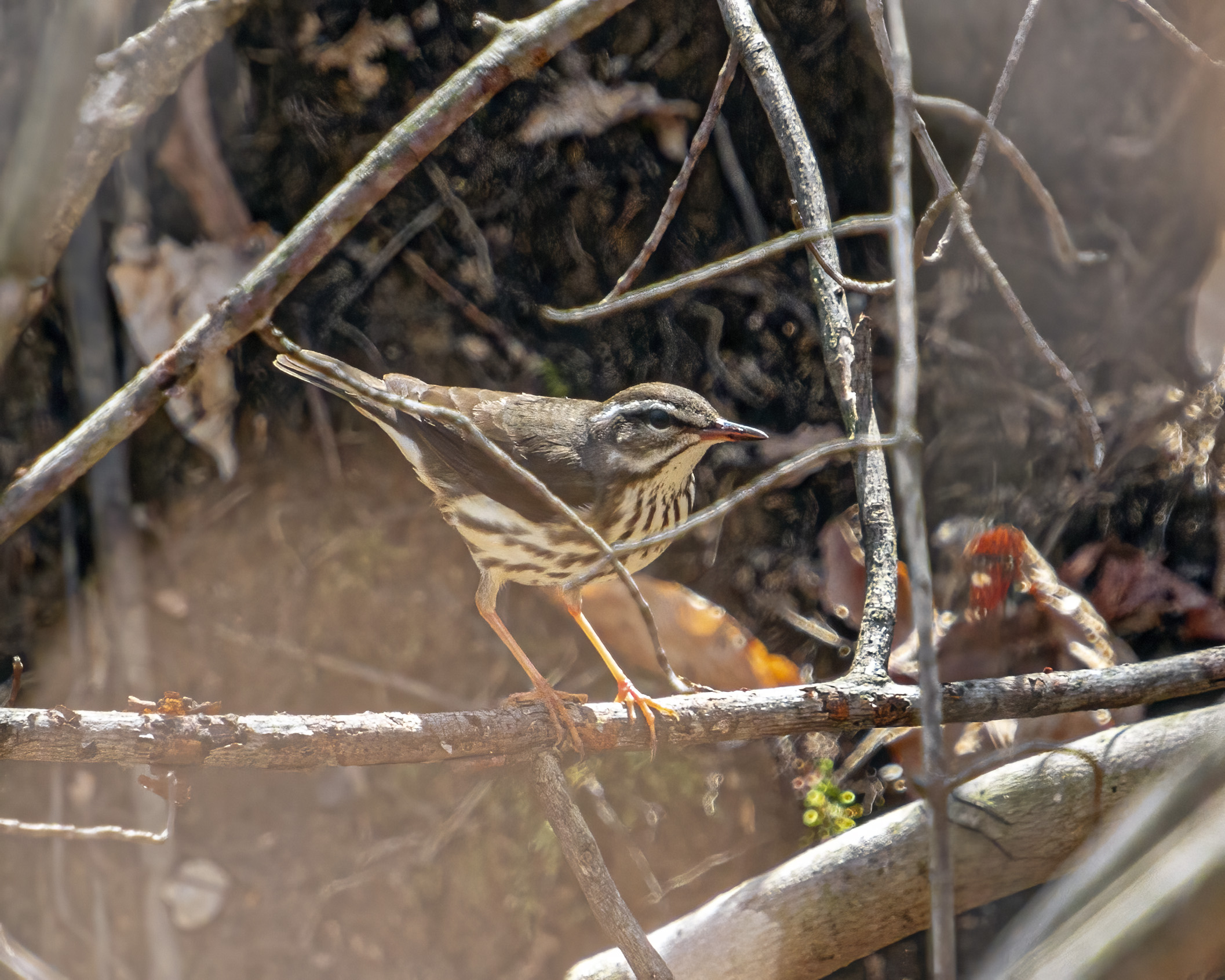
Last week I spotted this bird hopping about in a small creek in Prince William Forest Park. The bird was in constant motion and I could not get close to it, so I was was not able to get a really good shot of it. I vaguely remembered seeing a similar bird a few years ago in the same location, so I checked my old blog entries and determined that it might be a Louisiana Waterthrush (Parkesia motacilla). Several more experienced birders confirmed my tentative identification in a Facebook group for birding forum.

Despite its name, a Louisiana Waterthrush is actually a warbler, not a thrush. The Cornell Lab of Ornithology website provides the following overall description of the species:

“The ringing song of the Louisiana Waterthrush, in cadence so like the rushing streams that are its home, is one of the first signs of spring in eastern North America. Its brown plumage and bold streaking help explain why this member of the warbler family has the word “thrush” in its name. At all seasons, this species stays close to moving water—especially forested streams and creeks—and bobs its rear end almost constantly. In both spring and fall, Louisiana Waterthrushes are among the earliest migrant warblers.”

Several local photographers have started posting photos of more colorful warblers, so I will be keeping my eyes open for them. Leaves are starting to cover the trees, so I will probably have my usual problem of not being able to spot the little birds even when I can hear them singing.

Louisiana Waterthrush

Louisiana Waterthrush

© Michael Q. Powell. All rights reserved.

Read Full Post »

Most of the insects that I have observed feeding on Virginia Spring Beauty wildflowers (Claytonia virginica) have been equally small in size. I was a bit shocked, therefore, earlier this week to spot a large Eastern Carpenter Bee (Xylocopa virginica) gathering nectar and/or pollen from a small patch of Spring Beauties at Prince William Forest Park. The bee looked to be at least twice as large as each tiny flower. Wow!

The lighting was quite good and the bee was a bit distracted, so I was able to zoom in close and capture a lot of the details of the bee. I particularly like the speckled green eyes that look like they were carved out of a semiprecious stone. You can also see the bee’s tiny feet as it grasped the edges of the flower. I encourage you to click on the photos, especially the first one, to get a better look at the bee.

carpenter bee and spring beauty

carpenter bee and spring beauty

© Michael Q. Powell. All rights reserved.

Read Full Post »

I was excited yesterday to spot this cool-looking Horned Grebe (Podiceps auritus) in breeding plumage in the waters off of Occoquan Bay National Wildlife Refuge. In addition to the golden tufts that sometimes look like horns, this grebe has striking red eyes.

There were not very many birds on the water yesterday, only a few geese, cormorants, and scaups, so I was quite shocked when I saw the head of this Horned Grebe emerge from the water after a short dive. I hoped that the grebe would come a bit closer with each dive, but instead it seemed to get farther and farther away from me.

I suspect that the Horned Grebe was stopping over on a migration flight northward. Although I read that migrating grebes usually form small flocks when migrating, this one appeared to be by itself. I too like to travel alone.

Horned Grebe

© Michael Q. Powell. All rights reserved.

Read Full Post »

Many people in the United States were excited to view yesterday’s solar eclipse. I too paused for a few moments in the afternoon to view the eclipse through solar glasses that I had obtained last week during a visit to the Air and Space Museum in the Washington D.C. area.

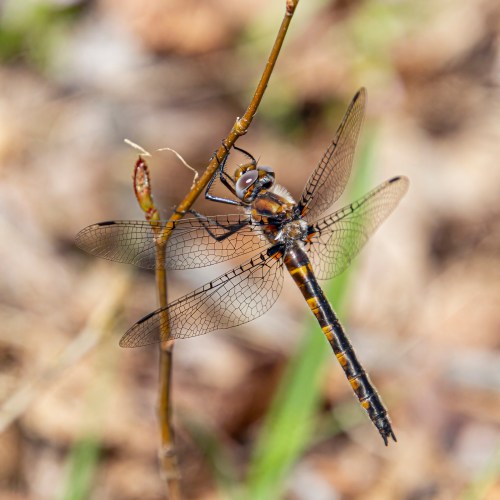
However, I must confess that I was more excited earlier in the day when I had multiple encounters with Uhler’s Sundragons (Helocordulia uhleri), the first dragonflies that I have been able to photograph in 2024. (Some of you may recall that I searched for dragonflies last week and think that I saw one flying over a stream. However, I did not get a photo of the dragonfly, so for me that first sighting does not really “count.)

I spent several hours yesterday looking carefully at the vegetation along a creek in Prince William County, Virginia where I had spotted Uhler’s Sundragons in previous years. This species appears in limited locations in the early spring and is usually gone by early May. Unlike many of the dragonflies that I will see during the summer that are habitat generalists, Uhler’s Sundragons require a specific kind of habitat, usually a mountain stream. According to the Dragonflies of Northern Virginia website, “Uhler’s need clean, small to medium, rocky forest streams with gravelly and/or sandy substrate, and a decent flow.”

I was fortunate to be able to photograph both female and male Uhler’s Sundragons. I have alternated genders in the photos below, with the females in the odd-numbered images and the males in the even ones. One of the ways to tell the genders apart is to look at the tips of the abdomens (the “tails”) and you can see that the terminal appendages are different. The lower portion of the abdomens of the males is also somewhat enlarged, as you can see in some of the photos.

Dragonflies perch in many different ways. Some species perch horizontally and some hang vertically. Uhler’s Sundragons most often perch at an angle, as shown in the first and last photos, though sometimes they may hang vertically from the vegetation.

The dragonfly season has now opened and I look forward to many more encounters with these amazingly beautiful aerial acrobatic insects that have a magical appeal for me.
Uhler's Sundragon

Uhler's Sundragon


Uhler's Sundragon

Uhler's Sundragon

Uhler's Sundragon

Uhler's Sundragon

© Michael Q. Powell. All rights reserved.

Read Full Post »

Now that we have moved into April, I have begun to really search for dragonflies. On Thursday, I explored a creek in Prince William County, Virginia where I have found early-season dragonflies in past years, but, alas, I was not able to photograph any. However, I am pretty sure that I spotted a dragonfly flying low over the waters of the creek, so I am somewhat optimistic that the dragonfly season for me will soon start. The lighting was not good and the dragonfly was pretty far away, so I am not sure what kind it was, but there are so few insects flying this early in the year that the few that are in the air readily catch my eye.

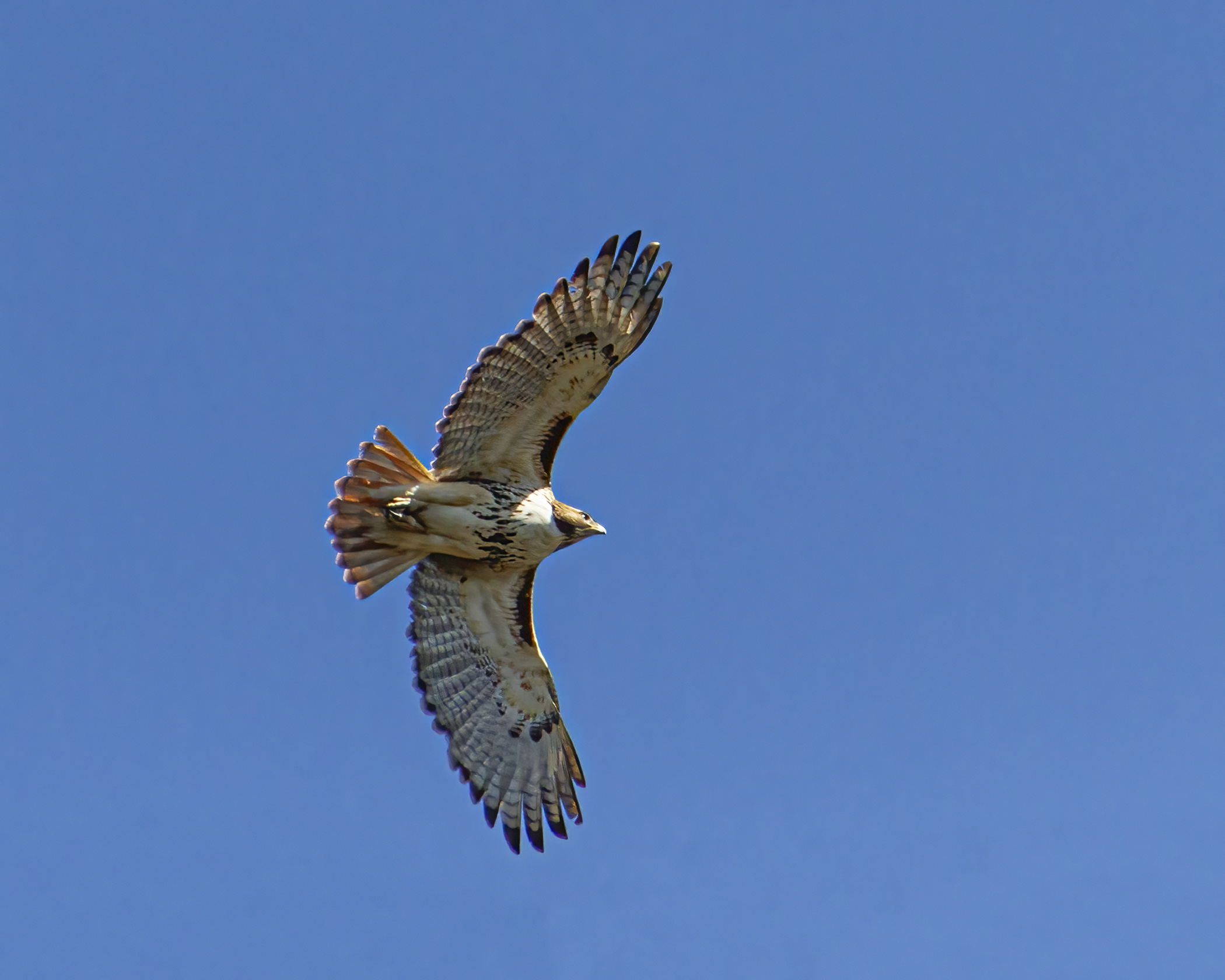
While I was searching along the edges of the creek, I spotted a hawk soaring overhead and was able to get a few shots of it. I am pretty confident that this is a Red-tailed Hawk (Buteo jamaicensis), judging from the coloration of the tail and the prominent “belly band” of darker feathers.

I was using my versatile Tamron 18-400mm lens, so I did not have the reach of the “normal” lens that I use for birds, i.e. the Tamron 150-600mm telephoto zoom lens. I have to say, though, that I am quite happy with the images that I was able to capture of this beautiful soaring hawk.

Red-tailed Hawk

Red-tailed Hawk

© Michael Q. Powell. All rights reserved.

Read Full Post »

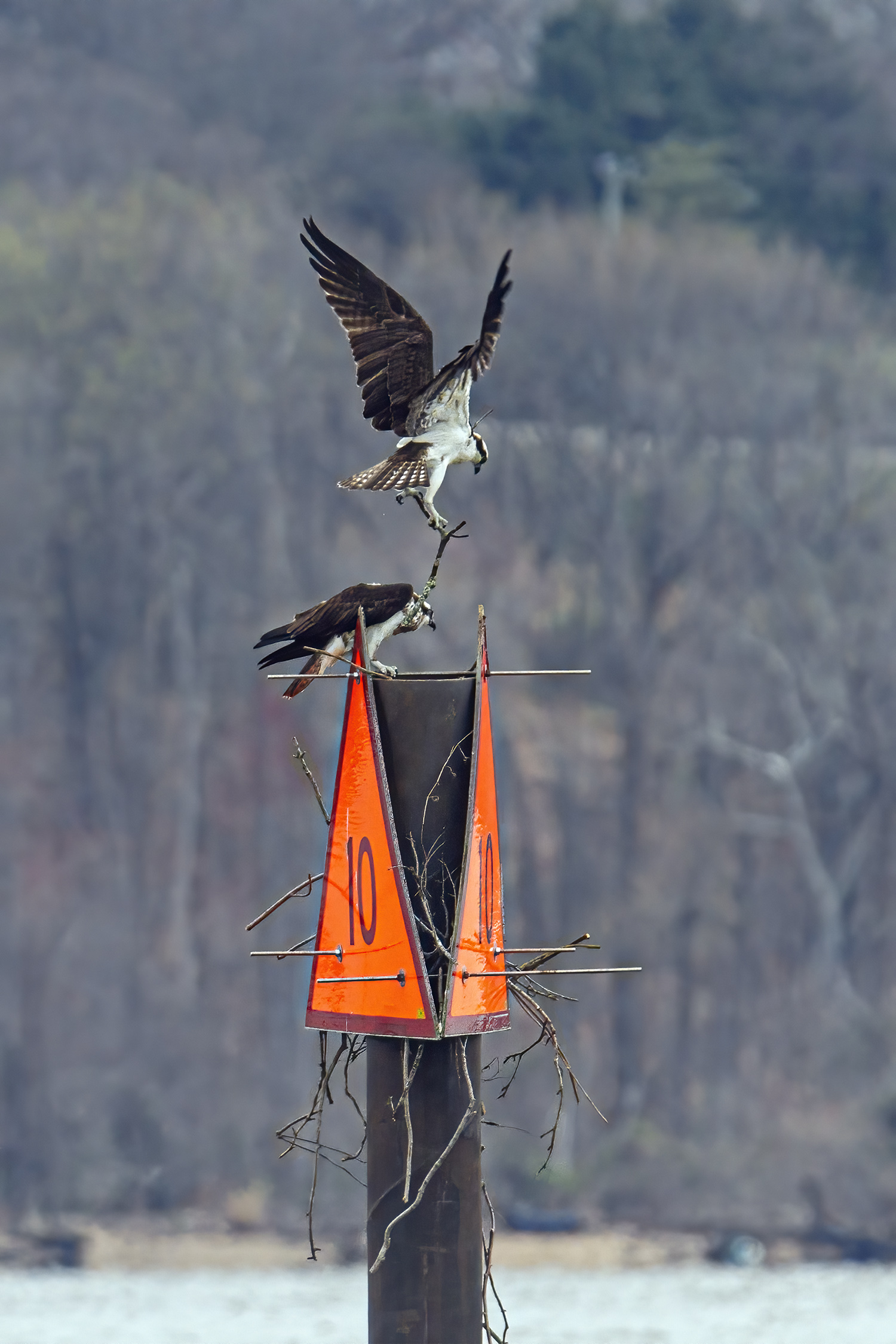
Real estate is at a premium in Northern Virginia, and new houses are jammed into the tiniest of spaces. Unfortunately, this channel marker did not appear to be quite big enough to support the nest of an osprey couple. During a recent visit to Occoquan Bay National Wildlife Refuge I watched the ospreys (Pandion haliaetus) carry a number of sticks to the marker as they unsuccessfully attempted to construct a nest—most of the sticks simply fell off the sides of the marker.

Osprey

Osprey

Osprey

Osprey

© Michael Q. Powell. All rights reserved.

Read Full Post »

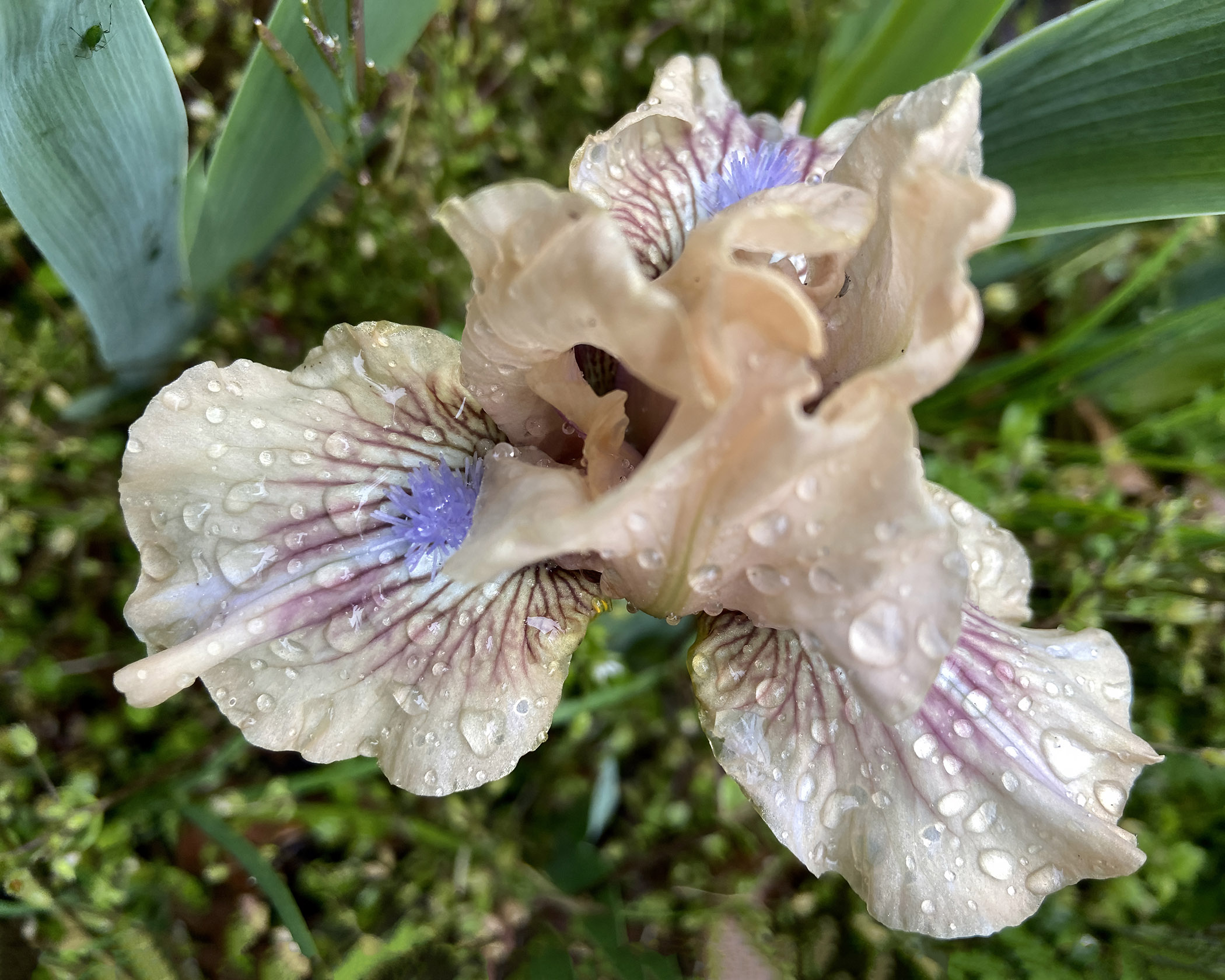
As I was preparing to go out to lunch yesterday with my dear friend and photography mentor Cindy Dyer, she glanced down at her garden and noticed that an iris was already in bloom, the first one of the spring. I suspect that this is some kind of dwarf iris, because it was nestled low in the vegetation and was only about six inches (15 cm) tall.

I thought about cropping the photo a little tighter, but wanted to retain the bug that is in the upper left corner of the image. As you might guess, I did not notice the little insect when I captured the photo with my iPhone. Cindy likes to call these “bonus bugs”—it is amazing how often I discover these “bonus bugs” in my photos when reviewing them on my computer.

Cindy has planted a wide variety of irises in her garden, so this is a sneak preview of the amazing beauty that is yet to come. I don’t know the name of this iris variety, but love the lavender color of its “beard.”

iris

© Michael Q. Powell. All rights reserved.

Read Full Post »
This Bald Eagle (Haliaeetus leucocephalus) was partially hidden by tree branches when I first spotted during a recent visit to Occoquan Bay National Wildlife Refuge. I tried to move as stealthily as I could to try to get a clearer view of the eagle, but the eagle detected my presence. I captured this image as the eagle was preparing to take off. The eagle flew downwards from its perch and my view was completely obstructed, so I was not able to capture any in-flight shots of the eagle.

As you can see, many of the trees in my area have buds now. I think this tree might be a Sweet Gum tree, because I can see some of its distinctive spiky seed balls still hanging from the tree.

Bald Eagle

© Michael Q. Powell. All rights reserved.

Read Full Post »

I’ve been really busy preparing for multiple church services this Holy Week—I help to lead singing during the worship services—so I have not been able to go out as often this week as I would have liked. So today, I am featuring another tiny forest wildflower that I spotted on Monday at Prince William Forest Park.

I think that this one is a Wood Anemone (Anemone quinquefolia), though there is a similar-looking wildflower called a Rue Anemone (Thalictrum thalictroides) and I am not sure how to tell the two of them apart. According to the Lady Bird Johnson Wildflower Center website, “Since Anemones are usually slender-stalked and tremble in the breeze, they have been called “Wind Flowers.””

I used to think that all of the white spring wildflowers looked the same but gradually I am beginning to see the differences in the number and shape of the petals and in the different types of stamens. However, I am far from being an expert in plant identification, so you should take all of them with a grain of salt.

Wood Anenome

© Michael Q. Powell. All rights reserved.


Read Full Post »
Each time I venture out into the forested trails of Prince William Forest Park at this time of the year I encounter different wildflowers, most of which are present for only a short period of time. This past Monday, for example, I spotted some Bloodroot plants (Sanguinaria canadensis) in bloom, my first of the season. These white flowers are a bit bigger than many of the other wildflowers that I see.

According to the Missouri Botanical Garden website, “Each [bloodroot] flower stalk produces a solitary, 2″ (50 mm) wide, 8-10 petaled, 1.5″ (38 mm) diameter, white flower with numerous yellow center stamens. Flowers open up in sun but close at night, and are very short-lived (1-2 days). Leaves continue to grow in size after bloom (sometimes to as much as 9″ (228 mm) across) and remain attractive until mid to late summer when the plant goes dormant.”

The forest floor was quite cluttered, so I decided to take this photo from directly above the bloodroot flower. I like the way that the shot emphasizes the geometric shape of the petals in an almost abstract way.

bloodroot

© Michael Q. Powell. All rights reserved.

Read Full Post »

Early spring wildflowers, like the Virginia Spring Beauty (Claytonia virginica), are an important source of food for a host of small bees and other insects. Many insects gather pollen from these flowers and in doing so help to pollinate the plants. One species, the Spring Beauty Miner Bee (Andrena erigeniae), is so specialized that it reportedly feeds only on this ephemeral flower.

According to the Bug of the Week website that featured this species in an article, “Using jaws and legs the female bees excavates a gallery in the soil, leaving a small pile of dirt near the entrance hole. This gallery can be as long as 15 centimeters and contain numerous lateral brood chambers. During the daytime she forages for pollen on flowers of spring beauties, which apparently are the sole source of food for her brood. Pollen from these blossoms is formed into balls and placed into brood chambers…As brood chambers are built and provisioned with pollen, the bee deposits a single egg on a pollen cake. During spring and early summer developing larvae consume the pollen, and later in summer they will form pupa. By late autumn development of the adult is complete and winter is spent in the adult stage within the brood chambers. Newly minted adults emerge each spring coincident with the appearance of spring beauty’s’ blossoms.” Wow!

On Monday I was fortunate to capture a shot of a Spring Beauty Miner Bee in action gathering pollen. If you look closely at the image, you will see how the tiny bee has collected pollen on its back legs.

Last year I posted an image of a Cuckoo Bee on the same kind of flower. That bee does not collect pollen. Instead it enters the nests of a host and lay eggs there, stealing resources that the host has already collected. From what I understand the cuckoo bee waits for the miner bee to leave its burrow and then lays its egg there. The offspring of the cuckoo bee eats the pollen in the burrow and then eats the larva of the miner bee. Yikes!

Spring Beauty Miner Bee

© Michael Q. Powell. All rights reserved.


Read Full Post »

As I was walking along a creek on Monday at Prince William Forest Park, several tiny frogs unexpectedly jumped out of my way. I was able to visually track one of those frogs and saw where it landed. After a single leap, the frog froze in place and I was able to slowly maneuver myself into position to capture this image.

I am pretty sure that this is a Northern Cricket Frog (Acris crepitans). A bit later in the season, I will be able to hear the cricket frog’s distinctive call, which sounds to me like two marbles being clicked together, but the frogs that I encountered that day were silent.

According to the Virginia Department of Wildlife Resources, the Northern Cricket Frog is one of the smallest frogs in Virginia, ranging from .87 inches to 1.14 inches (22-29 mm) in length. Their typical life span is four to twelve months, though sometimes they can live as long as three years. Cricket frogs hatch from their eggs in 29-90 days between July and August and metamorphosize into adults in late summer. In early autumn, the frogs burrow into the soil to hibernate until spring comes.

I was quite pleased with the amount of detail that I was able to capture in this image, from the bumpy warts of the frog’s back to the stripes on its tiny toes. My Tamron 18-400mm lens is quite versatile and is capable of providing macro-like capability in certain circumstances. I encourage you to click on this image to get a better look at the tiny cricket frog.

Northern Cricket Frog

© Michael Q. Powell. All rights reserved.

Read Full Post »

I went on a pretty long hike yesterday in Prince William Forest Park—just over 18,000 steps (7.1 miles or 11 km) according to my iPhone—and was delighted to spot this beautiful Eastern Tiger Swallowtail butterfly (Papilio glaucus), my first of the season.

When I first spotted the butterfly, it appeared to be sucking moisture and minerals from the wet soil, as you can see in the first photo. The butterfly flew to a nearby location and resumed its efforts and I was able to maneuver around to get the second image that shows the markings of the butterfly a bit better.

Personally I prefer the first photo that is more dynamic and gives a better sense of the activity of the butterfly. From a purely scientific perspective, the second one might be preferable because it shows more of the butterfly’s identification features. I am more of an artist than a scientist, though, so capturing all of the details with clinical precision is not as important to me.


Eastern Tiger Swallowtail

Eastern Tiger Swallowtail

© Michael Q. Powell. All rights reserved.

Read Full Post »

It was cool, cloudy, and windy when I visited Occoquan Bay National Wildlife Refuge last Friday. I did not see any activity at the two eagle nests that I checked, but suspect that there was an eagle in each of them, hunkered down keeping the eggs warm.

I did encounter solitary adult eagles several times as I walked along the trails. Perhaps these Bald Eagles (Haliaeetus leucocephalus) were the mates of the eagles sitting in the nests. Whatever the case, these eagles looked to be hypervigilant and serious, keeping a close watch over the entire area. This eagle kept its head moving a lot, so I was happy when I managed to capture this profile shot as it perched in what I believe is a Tulip tree.

Bald Eagle

© Michael Q. Powell. All rights reserved.


Read Full Post »

I was delighted on Friday to see that Ospreys (Pandion haliaetus) have returned to Occoquan Bay National Wildlife Refuge. Each autumn we bid farewell to the ospreys, which are also known as fish hawks or sea hawks, and each spring we greet their return.

Unlike eagles, which use large, well-constructed nests year after year, ospreys seem content to throw a bundle of sticks together and call it a nest. Many of these makeshift homes are blown down or fall apart during the winter, so a first priority for the returning ospreys is to construct nests.

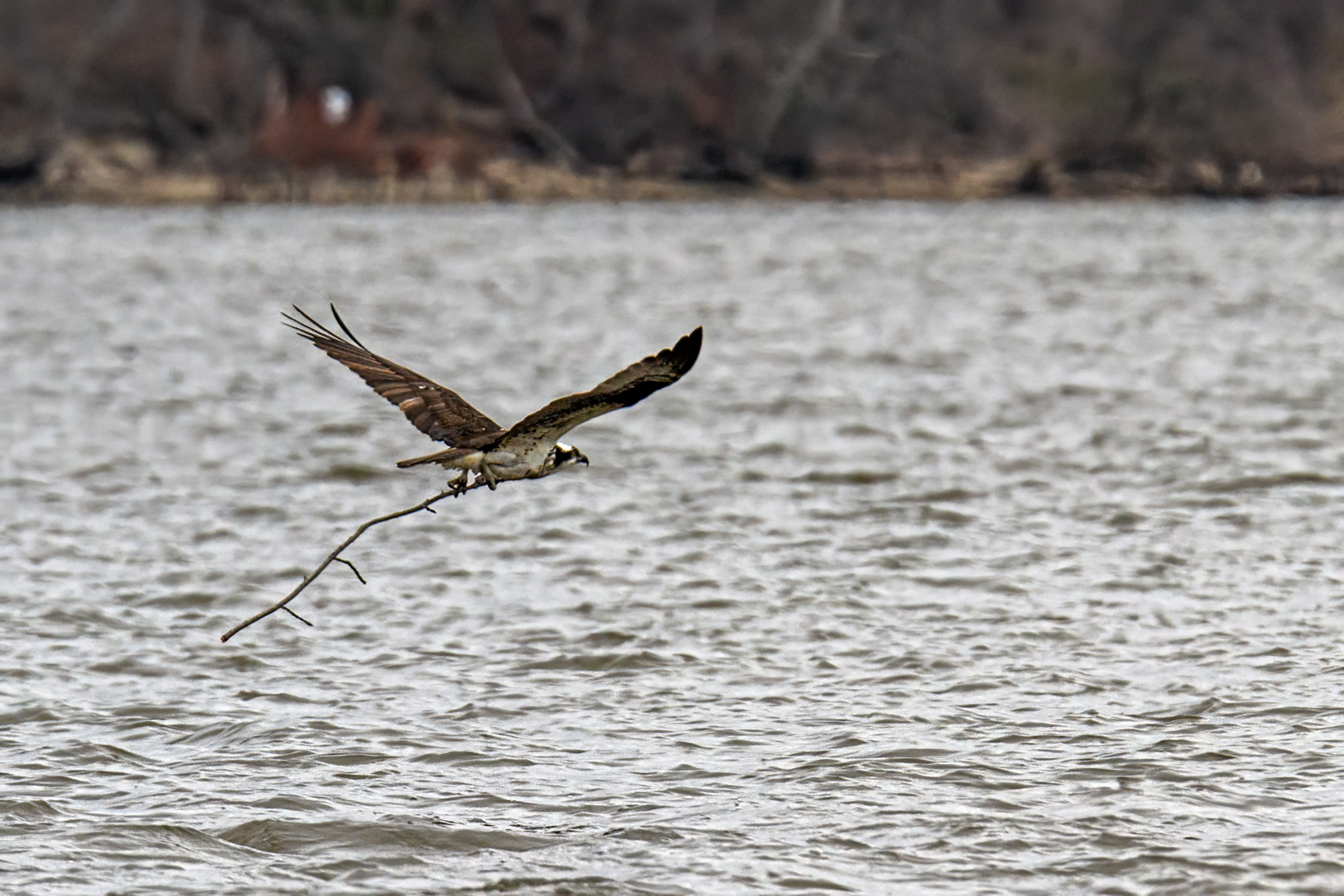
During this visit I managed to capture several photos of ospreys overhead in flight with branch in their talons. As both photos show, ospreys often grab branches at one end, rather than in the middle where the weight would be better balanced. I am amazed by the ability of the ospreys to fly so well with those long trailing branches, though I suspect that the branches weigh a whole lot less that the fish that I hope to see them catch later in the season.

Osprey

osprey

© Michael Q. Powell. All rights reserved.


Read Full Post »

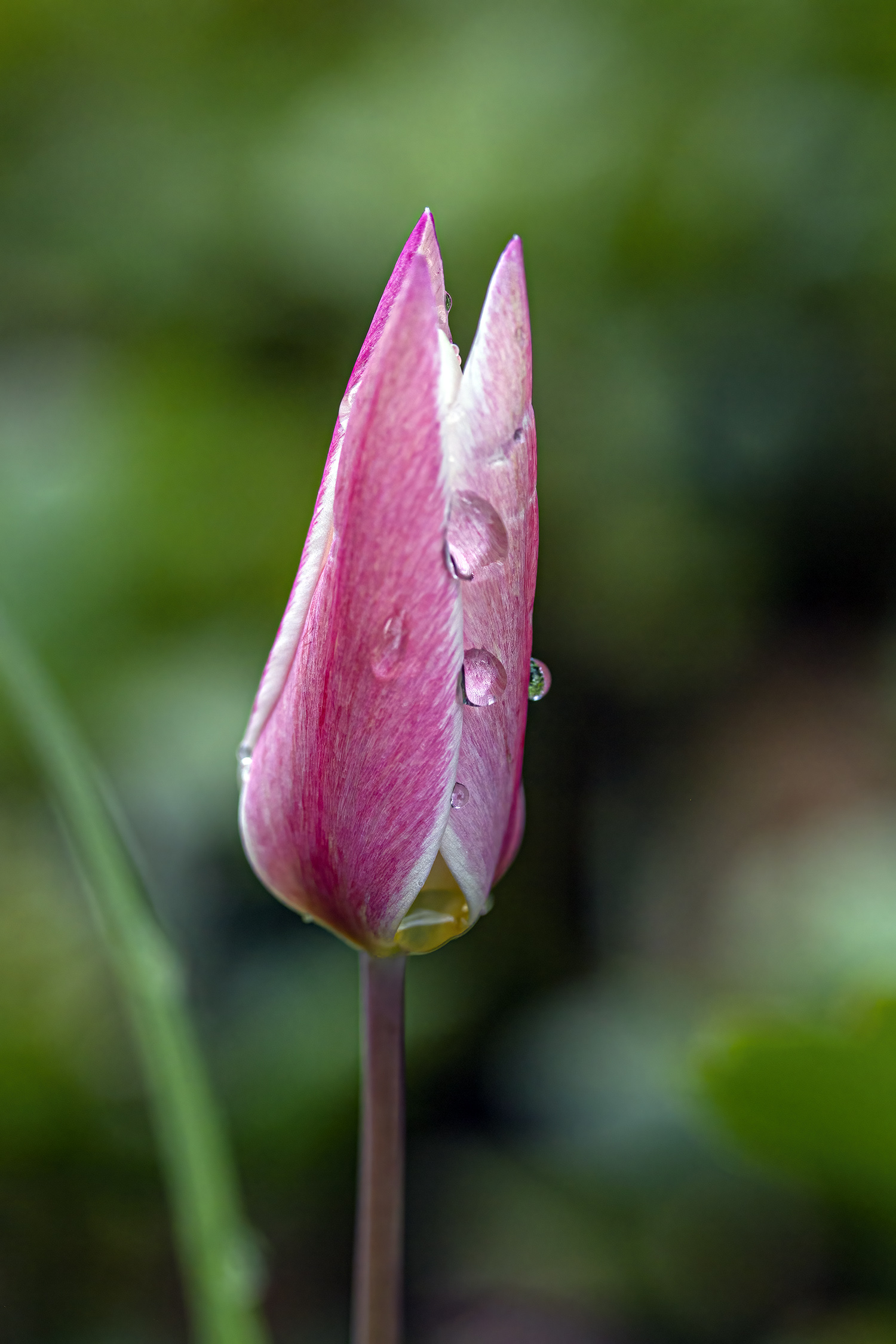
Raindrops on tulips are one of my favorite things. I photographed these different varieties of colorful tulips today in the garden of my dear friend and fellow photographer Cindy Dyer during a break in the rain.

I love spring flowers.

tulip

Lady Jane tulip

tulip

© Michael Q. Powell. All rights reserved.


Read Full Post »

I love the shape of Grape Hyacinths (g. Muscari), one of the early-appearing flowers that I look forward to each spring. The names of species sometimes do not match their appearances, but in this case the name fits perfectly—the little flowers do indeed look like a bunch of grapes.

Our recent weather has been windy, which makes it challenging to go out hunting for wildlife to photograph, because most of my potential subjects use common sense and seek shelter from the wind. As a result, I have resorted to visiting the garden of my dear friend Cindy Dyer and photographing her flowers, like this Grape Hyacinth that I spotted earlier this week.

I used a macro lens to get really close to the tiny flower to capture details, but the wind made it tough to get a sharp shot—as you get closer to a subject, the effect of any movement of the camera or the subject is magnified. On the whole, though, I like this modest portrait of one of my favorite spring flower.

Grape Hyacinth

© Michael Q. Powell. All rights reserved.

Read Full Post »

As many of you know, I do not have a garden of my own. My dear friend and photography mentor Cindy Dyer, however, lives close to me and loves to plant photogenic flowers. At this time of the year I really enjoy passing by her garden to see what has popped up.

I was delighted yesterday to see a beautiful red tulip in bloom in the middle of the garden in front of her townhouse. There was only a single tulip blooming in the midst of some hellebore plants, but it was not hard to spot. I don’t know much about tulip varieties, but think that this might be a Lady Jane tulip (Tulipa clusiana var. ‘Lady Jane‘)—I recall Cindy mentioning this variety in previous years.

I thought I would be photographing flowers close up, so I had a 60mm macro lens on my camera. This tulip, alas, was farther away than I would have liked and I did not want to step on any vegetation to get closer or to get a better angle.

I contented myself with a few shots to record this beautiful flower, my first tulip of this spring (with many more to come).

UPDATE: My memory failed me. Cindy let me know that the Lady Jane tulip is pink and white and not red like this one. I should probably have checked with her before I posted the images.

tulip

tulip

© Michael Q. Powell. All rights reserved.


Read Full Post »

Most of the time when I go out with my camera, I am focused on taking pictures. I have a general idea of which subjects I want to photograph and choose locations where I am likely to encounter them.

Sometimes, though, I am much less goal-oriented and I will visit a place primarily to experience nature. Oh, I will have my camera with me, but I am likely to take significantly fewer photos and to log a lot more steps in between photos. Usually I will have my Tamron 18-400mm lens on my camera that provides me with the greatest flexibility in capturing both wide-angle and telephoto shots.

That was certainly the case last week when I visited Prince William Forest Park, a wildlife area administered by the National Park Service. I did not see a lot of wildlife and the images that I capture tended to focus on the landscape. The first photo shows you one of the larger trails in the park that is wide enough for a vehicle and is used as an emergency route. Most of the other trails in the park are narrow and winding and accessible only on foot.

The second photos shows one of the dams along Quantico Creek. I really like the step-like shape of this dam. As you can see, some logs have accumulated along the top of the dam. They do not interfere much with the flow of the water, however, so I am not sure if the park authorities will eventually remove them.

My iPhone records my steps and I noticed recently that I tend to log the most steps each year in April, when spring is in full bloom. Last year, for example, I averaged over 6500 steps a day over the entire month of April versus an average step count of about 4000 steps for the whole year. I feel a kind of resurgence in energy in the spring, a sense of new life after the long gray days of winter.

Prince William Forest Park

Prince William Forest Park

© Michael Q. Powell. All rights reserved.

Read Full Post »

Our recent warm weather has brought out a whole lot of little creatures. As I was hiking about in Prince William Forest Park last week, I notice a spot of bright red moving about on a rock at the edge of a small creek. When I looked at it more closely, it had a shape that made it look like a tiny red spider.

I did some initial searches when I returned home to see if I could identify the spider. I could not find an exact match, but I think this might be a spider mite (or some kind of mite) rather than an actual spider. If I understand it right, mites and spiders belong to the same family of arachnids, though I might have this wrong.

spider mite

© Michael Q. Powell. All rights reserved.

Read Full Post »

When the weather is sunny, turtles at local ponds often bask in the sun in large groups. Sometimes the turtles are packed in so tightly that it looks like a mall parking lot at Christmas time. The turtles seem to have no concept of “personal space and often are leaning against each other.

I spotted a few turtles on Wednesday at Prince William Forest Park and was struck by the fact that all seemed to have chosen solitude over solidarity—they were perched by themselves.

The first one, a small Painted Turtle (Chrysemys picta) was perched on a small log in the shallow part of a marshy area. I really like the limited color palette of this image, made up of mostly earth tone. If you look carefully, though, you can spot a few red markings on the turtle’s neck.

The second turtle, a much larger Painted Turtle, had crawled entirely out of the water and appeared to be napping on dry land. The greenery in this image gives it a much more lively feel than the first image and the bright red markings on the turtle’s neck are much easier to see.

Like these two turtles, I tend to avoid crowds and like to be myself when I am pursuing my photography. Go with the crowd? No, I will leave that to others.

Painted Turtle

Painted Turtle

© Michael Q. Powell. All rights reserved.

Read Full Post »

For a brief period in the spring, the forest floor is carpeted with wildflowers. It is still a little early for most of the wildflowers to appear but on Wednesday I spotted a few early blooming ones during a hike in Prince William Forest Park in Northern Virginia.

The little wild flower in the first photo is the appropriately named Virginia Spring Beauty (Claytonia virginica). I love the pops of pink in this flower, especially the stamens. According to Wikipedia, “The individual flowers bloom for three days, although the five stamens on each flower are only active for a single day.” Yikes! I guess the Spring Beauties qualify as being “ephemeral.”

The flower in the second photo is often referred to as a Quaker Lady Bluet (Houstonia caerulea)—it is also known as the Azure Bluet. Later in the spring I am certain to encounter large clusters of this cool little flower, but on this occasion there were only a few of them. I love the simple geometric pattern of the petals that someone decided resembled the traditional hats worn by Quaker ladies.

Virginia Spring Beauty

Quaker Lady Bluet

© Michael Q. Powell. All rights reserved.

Read Full Post »

Yesterday I was thrilled to spot several Spring Azure butterflies (Celastrina ladon) at Occoquan Bay National Wildlife Refuge. This early-appearing butterfly is one of the tiniest butterflies in our area, with a wing span of about an inch (25 mm). Unlike Mourning Cloak butterflies—like the I featured last week in a blog posting—that overwinter as adults, Spring Azures overwinter in the pupal form, safe inside their chrysalis.

All of the Spring Azures that I saw yesterday were extremely skittish, spending most of their time in flight. Occasionally one would fly near the ground and come close to landing and then abruptly resume its flight. When they did land, the little butterflies almost disappeared into the abundant leaf litter and were tough to photograph.

Nature is coming alive as flowering trees begin to pop and new wildlife species reappear on the scene as we move deeper into March. It won’t be long before osprey, green herons, and great egrets return to our area and I hope to be seeing dragonflies within the next month. It is an exciting time of the year.

Spring Azure

© Michael Q. Powell. All rights reserved.


Read Full Post »

It won’t be long before basking turtles become a common sight, but they are still relatively rare in early March, when temperatures here dip down below the freezing level some nights. I spotted this Painted Turtle (Chrysemys picta) last Thursday at Occoquan Bay National Wildlife Refuge as it basked in the sun.

I was struck by the way the red markings on its neck stood out, even in the beautiful reflection on the surface of the small pond. Most turtles will try to find a horizontal perch to maximize exposure to the sunlight, but this turtle had to make do with with a steeply sloped spot. I could not see its claws, but I suspect that they were dug in to keep the turtle from sliding back into the water.

Painted Turtle

© Michael Q. Powell. All rights reserved.

Read Full Post »
Although it was sunny, the wind was kicking up quite a bit during my visit on Thursday to Occoquan Bay National Wildlife Refuge. Bird activity seemed lighter than usual. Perhaps the birds were all taking shelter from the wind,

At the far edge of a small pond, I spotted a Great Blue Heron (Ardea herodias) hunched over in a one-legged pose. The wind was whipping around the wispy feathers on the heron’s chest, head, and back. I encourage you to click on the photo to get a closer look at the heron’s “flyaway” feathers.

Have a wonderful weekend.

Great Blue Heron

© Michael Q. Powell. All rights reserved.

Read Full Post »

I was delighted yesterday (7 March) to spot this beautiful Mourning Cloak butterfly (Nymphalis antiopa) at Occoquan Bay National Wildlife Refuge, my first butterfly sighting of 2024. Mourning Cloaks, known as Camberwell Beauties in the Great Britain, overwinter as adults and are usually among the first butterflies to appear each spring.

Mourning Cloak butterflies, according to Wikipedia, have a lifespan of 11 to 12 months, one of the longest lifespans for any butterfly. As I noted, these butterflies spend spend the winters in us as adults, by “hiding away in cracks in rocks or holes in trees, and are able to shut down their bodies all winter long, effectively hibernating, in a manner known in insects as torpor,” according to the One Earth website.

Mourning Cloak butterflies have a distinctive look that some scientist thought looked like the traditional cloak worn in mourning. I was happy that I was able to capture the row of blue spots on the wings—another one of its identification features—in the photo of “my” butterfly.

The butterfly spent most of its time flying up and down, in and out of some trees. Eventually it perched for a moment on the ground and I was able to capture this image. It will be at least a few more weeks before I see my first dragonfly of the season, but I will soon begin to keep my eyes open for them. As many of you know, dragonflies are one of my favorite subjects to photograph and I look forward to the start of “dragonfly season” each year.

Mourning Cloak

© Michael Q. Powell. All rights reserved.


Read Full Post »

« Newer Posts - Older Posts »