Feeds:
Posts
Comments

Archive for the ‘spring’ Category

Tree Swallows (Tachycineta bicolor) were back at Occoquan Bay National Wildlife Refuge this past Thursday and they seemed a bit cranky. They carried on their heated disputes in the air and on the ground as they checked out nesting boxes.

I don’t know if you have ever observed Tree Swallows, but they are small and fast. Worst of all from the perspective of a photographer, they fly erratically and turn quickly and often. For those reason, I am especially happy with the first image. I should note that it is a cropped image—the original image had a lot more sky showing.

Tree Swallow

Tree Swallow

© Michael Q. Powell. All rights reserved.

Read Full Post »

I love the early morning hours and enjoy watching the darkness give way to the light. This morning I was pleased to be able to capture the predawn colors and then the actual sunrise at Occoquan Bay National Wildlife Refuge.

It was a wonderful way to start the new day.

dawn's early light

sunrise at Occoquan Bay

© Michael Q. Powell. All rights reserved.


Read Full Post »

This Bald Eagle (Haliaeetus leucocephalus) was initially facing away from me on Monday at Occoquan Bay National Wildlife Refuge.  Somehow, though, the eagle sensed me approaching and turned its head slightly to glare at me. The eagle seemed to take a little time to check me out before deciding to take off.

I am presenting the images below in reverse chronological order, starting with the “glare” and working backwards in time to the moment when I first spotted the eagle. I had just rounded the bend of a trail and lookeding upwards was shocked to see that I was almost directly this eagle. It is definitely rare for me to get this close to an eagle and to get such detailed shots of its feathers.

bald eagle

bald eagle

bald eagle

© Michael Q. Powell. All rights reserved.


Read Full Post »

How do you mark the beginning of spring? For some, it is the time when crocuses and daffodils begin to bloom. Here in the Washington D.C. area, one of the signs of spring is the blossoming of the cherry trees.

For me, I consider spring to have sprung when Ospreys (Pandion haliaetus) reappear. These impressive raptors, sometimes referred to as fish hawks, depart in the autumn and throughout the winter I eagerly await their return. Why? I gladly spend countless hour in fascination and enchantment as I watch osprey soaring through the skies, hovering in the air, and occasionally plunging feet-first into the water to catch a fish. It is also fun to watch them gathering materials to build or repair nests.

Yesterday I spotted my first ospreys this season while exploring Occoquan Bay National Wildlife Refuge on an unusually warm and sunny March day. Here are a couple of my favorite shots from those encounters, which mark the return of the ospreys for 2019.

Osprey

osprey

© Michael Q. Powell. All rights reserved.

Read Full Post »

Most of the Eastern Bluebirds (Sialia sialis) that I have seen in 2019 have been females, which have more subdued colors than their male counterparts. I was happy recently when I finally captured an image of one of the flashy male bluebirds at Occoquan Bay National Wildlife Refuge.

In my experience, bluebirds have a universal appeal—virtually everyone finds them to be beautiful.

Eastern Bluebird

© Michael Q. Powell. All rights reserved.

Read Full Post »

As I look out my window today, piles of snow from the snowstorm earlier this week remind me that winter is not yet over. I discovered, however, that some plants are already in bloom (or almost in bloom) yesterday during a visit to Dumbarton Oaks, a historic museum, research center, and garden in Washington DC.

I am definitely not an expert when it comes to flowers, but if I had to guess, I’d say that the flower in the first image is a crocus, those in the second image are snowdrops, and those in the final image are forsythias. Even in I am incorrect in my identification, it was a real joy to see some colors and signs of life after so many long gray days this winter.

I can’t wait for spring to arrive.

crocus

snowdrops

forsythia

© Michael Q. Powell. All rights reserved.


Read Full Post »

Perhaps you are conservative in your style and find most dragonflies to be too flashy and colorful for you. If that’s the case, I have a dragonfly for you, the Gray Petaltail (Tachopteryx thoreyi). This large dragonfly is almost monochromatic—its eyes and body are colored in shades of gray and black. When it is perched vertically against the bark of a tree, this dragonfly almost disappears.

This species seems to like to perch on people, especially those wearing gray clothes. It happened to me a few times, but, alas, I was not able to get a shot to document it. I am pretty flexible, but I couldn’t figure out a way to take a photo when Gray Petaltails landed on my shoulder and on my chest.

The Gray Petaltail is so unusual and distinctive that it has its own genus. The Dragonflies of Northern Virginia website described the species in these words: “Our oldest and most primitive dragonfly, species almost identical to petaltails flew alongside dinosaurs during the Jurassic period.” Wow!

Gray Petaltails are uncommon, in part because they are found only in very specific habitats. In order to locate them, you need to find a small, shallow, sun-lit forest seep that is clean and flowing. It’s not likely that you will just stumble upon one of these cool dragonflies. It helps to have a friend who knows where they can be found. In my case, that was fellow blogger and dragonfly fanatic Walter Sanford. Check out his blog for wonderful images and information on Gray Petaltails and lots of other dragonflies.

Gray Petaltail

Gray Petaltail

Gray Petaltail

© Michael Q. Powell. All rights reserved.


Read Full Post »

So many dragonflies…so little time. Although I have returned from my recent trip to Brussels, Belgium, I still have photos to share of dragonflies that I saw while I was there. I guess that I consider the species that I observed to be “exotic” and special because they were new to me, though many of them are probably quite common in Brussels.

The dragonfly species that I am featuring today is the Black-tailed Skimmer (Orthetrum cancellatum). When I first spotted these dragonflies at the  étang Tenreuken (Tenreuken Pond). I was struck by their resemblance to the Blue Dasher (Pachydiplax longipennis), a very common dragonfly where I live. The Blue Dasher is particularly special to me because it was the subject of my very first blog posting in July 2012. (For reference purposes, this will be posting number 2740.)

As I watched the Black-tailed Skimmers, I noticed some differences compared to the Blue Dashers. The bodies of the Black-tailed Skimmers appeared to be larger and broader; their eyes seemed greener; and they seemed to spend more time perching flat on the ground rather than on the tips of vegetation.

I thought about posting only the first image, my favorite, because it has a kind of artistic appeal to me. I like the low angle that I chose and the vegetation growing in the foreground out of what appears to be a rock, but is actually the deteriorated wood of a piling at the edge of the water. Ultimately I decided to share some additional shots that give you a more complete view of this beautiful “new” dragonfly species.

UPDATE: A sharp-eyed viewer from the United Kingdom noted that the dragonfly in the second photo appears to be a different species than the ones in the other photos. I did some additional checking and agree with him that it is probably a male Scarce Chaser (Libellula fulva), not a Black-tailed Skimmer. Thanks for the help, blhphotoblog, and others should check out his wonderful blog Butterflies to Dragsters for some wonderful photos.

Black-tailed Skimmer

Black-tailed Skimmer

Black-tailed Skimmer

© Michael Q. Powell. All rights reserved.


Read Full Post »

Emerging is a dangerous experience for dragonflies and doubly so when they do it in the rain. As the water-dwelling nymph is transformed into a beautiful aerial acrobat, it is very vulnerable to predators and weather. Initially the wings are extremely fragile and it takes some time for them to harden enough to permit flying.

On Monday, it was drizzling when I spotted this female Banded Pennant dragonfly (Celithemis fasciata) at a small pond in Northern Virginia. Its metamorphosis is almost complete and I am optimistic that it managed to weather the storm and survive its transformation. If you double click on the image, you can see it in higher resolution and see some of the wonderful details and patterns of its body and wings, as well as some drops of rain.

In case you are curious about a dragonfly’s magical metamorphosis, I was able to observe entire process two years ago with a Common Sanddragon dragonfly and documented it in a series of 15 photos in a blog posting entitled Metamorphosis of a dragonfly. The images are pretty intense and utterly amazing—I encourage you to check them out.

Banded Pennant

© Michael Q. Powell. All rights reserved.

Read Full Post »

Although I saw Eurasian Coots (Fulica atra) a few times when I was in Brussels, Belgium this week, I was especially thrilled to spot this juvenile coot interacting with one of its parents. The color pattern on the juvenile is quite different from the adult’s, but the shape of their bills definitely shows that they are both coots.

Eurasian Coots are similar in appearance to the American Coots (Fulica americana) that I am used to seeing, though it appears to me that the white frontal shield on the “forehead” of the coot seems more prominent on the Eurasian species.

As I was thinking about the word “coot,” I realized that most people use the word only in the expression “old coot.” It made me wonder why coots are associated with a somewhat disparaging term for older men. According to an article in the Hartford Courant newspaper, “If you’ve ever seen a coot — an ungainly marsh bird that bobs its head like a hen as it swims or walks — you can see why “coot” came to denote, by the 1700’s, “a harmless, simple person,” as in “an old coot.””

I love when I have the chance to photograph the interaction between two species or two members of the same species. In this case, the eye contact and body positions tell a story that scarcely requires words.

Eurasian Coot

© Michael Q. Powell. All rights reserved.


Read Full Post »

One of the most exciting things that I have observed during this brief trip to Brussels has been a family of Mute Swans (Cygnus olor) swimming in a small pond at the Rouge-Cloître park. I have seen swans a few times before in the wild, but I had never seen baby swans. As you might expect, they are really cute. Both of the parents seemed to be very attentive to the little ones and stayed close to them at all times. The baby swans, technically known as cygnets, seemed to be very curious and energetic and interacted a lot with each other as they explored the world.

Swan babies

Swan babies

Swan babies

© Michael Q. Powell. All rights reserved.

Read Full Post »

Most dragonflies have clear wings and different colors and patterns on their bodies. Some dragonflies, however, have patterns on their wings too that I think really accentuates their beauty and makes them particularly striking.

The first shot below shows a female Calico Pennant dragonfly (Celithemis elisa) that I spotted in mid-May at Occoquan Bay National Wildlife Refuge. The second shot shows a male Painted Skimmer dragonfly (Libellula semifasciata) that I spotted in late May at a small pond in Prince William County in Northern Virginia.

Calico Pennant

Painted Skimmer

© Michael Q. Powell. All rights reserved.


Read Full Post »

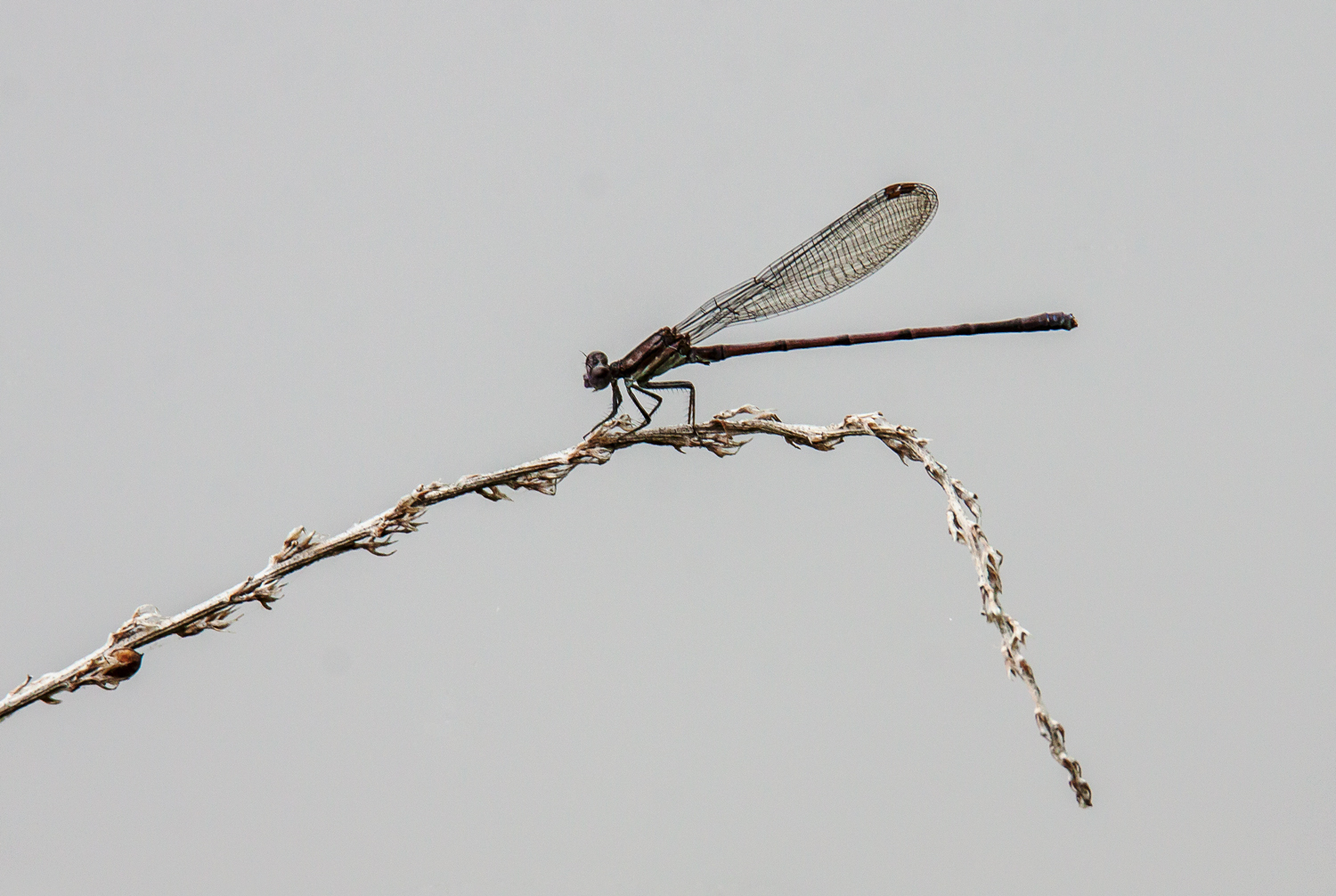
I love close-up photography, but sometimes it is good when necessity (or choice) compels me to shoot from a distance. This image has the simplest of compositions—a damselfly and a stalk on which to perch—but I like the way that the elements combined to create a sense of tranquility when I captured this moment this past Monday at Jackson Miles Abbott Wetland Refuge.

As I recall, the light was coming from in front of me, which caused the damselfly to appear as a partial silhouette. Without the normal color information, it’s hard for me to identify the species of damselfly with any degree of certainty. One of the experts on a Facebook forum, however, suggest that it might be a Variable Dancer damselfly (Argia fumipennis), the sames species that appears at the top of my blog’s home page.  As for the dried-out stalk that serves as a perch for the damselfly, I have no idea what kind of plant it is.

tranquil damselfly

© Michael Q. Powell. All rights reserved.


Read Full Post »

I don’t know for sure if there were babies in this nest on Monday, but this adult Blue-gray Gnatcatcher (Polioptila caerulea) kept bending forward into the nest, including the moment in the first image when it had what looked to be an insect in its mouth. Was it feeding some young ones? I have seen numerous photos this spring of baby birds with wide open mouths and I have been longing to capture some images like that.

Several weeks ago I watched as two gnatcatchers worked on this nest at Jackson Miles Abbott Wetland Refuge here in Northern Virginia. I marveled at their patience and at their amazing craftsmanship. They would bring small bits of material into the nest (spider webs and lichen from what I have read) and place them carefully. Then they would rotate their bodies while sitting in the nest to compact the material.

It was a bit of a challenge to capture these shots. I was shooting upwards and there was a leafy canopy that filtered out a lot of the light. I also tried really hard not to disturb the birds, so I kept my distance, avoided using flash, and limited the time that I was shooting.

Are there babies in the nest? If they are not there now, they should be coming soon. I will be sure to check out the nest when I return to this little wetland refuge some time in the near future and maybe then I will be able to capture shots of the little ones being fed.


Blue-gray Gnatcatcher

Blue-gray Gnatcatcher


© Michael Q. Powell. All rights reserved.

Read Full Post »
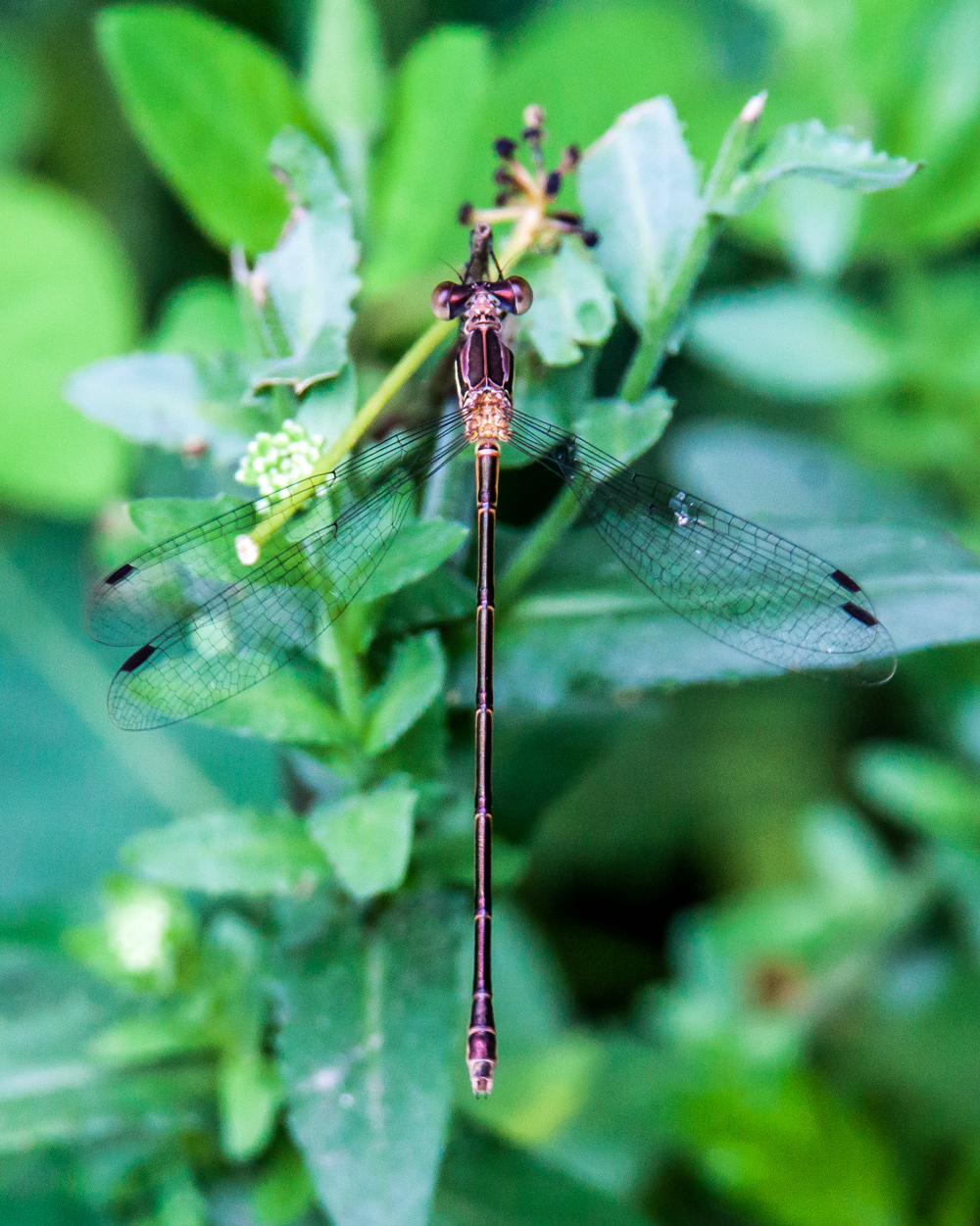
Although many damselflies are tiny in size and difficult to spot from a distance, spreadwing damselflies are a notable exception. Spreadwing damselflies tend to be quite a bit larger than other damselflies and they rest with their wings partly open in the “spreadwing” posture that gives the family its common name. (Most other damselflies rest with their wings held closed, usually above their abdomen, which makes them harder to see and to photograph.)

When I flushed this damselfly yesterday at Jackson Miles Abbott Wetland Refuge, I was immediately struck by the length of its body—it seemed to be really long and skinny.  The spreadwing family is not all that big, but I still had trouble identifying the species of the damselfly. As is usually the case in this kind ofsituation, I turned to my local expert, fellow dragonfly enthusiast and blogger Walter Sanford, who identified it as a female Slender Spreadwing damselfly (Lestes rectangularis).  I sometimes complain about the inappropriateness of the names of species, but in this case “slender spreadwing” is a perfect match for the subject that I observed.

In case you are curious about the photo, I shot it with my Tamron 150-600mm telephoto zoom lens on my Canon 50D DSLR. Over the winter I have become accustomed to using a monopod for stability and for this shot, I lowered the monopod and shot while kneeling. One of the limitations of the lens is that the minimum focusing distance is almost 9 feet (274 cm). At that distance, the camera’s autofocus system had trouble locking on the slender body of the damselfly—it kept focusing on the vegetation—so I resorted to manual focusing.

Most people are more familiar with dragonflies than with damselflies, but I encourage you to slow down and search for beautiful damselflies, the smaller members (in most cases) of the order of Odonata to which dragonflies also belong.


Slender Spreadwing

© Michael Q. Powell. All rights reserved.

Read Full Post »

This must be egg-laying season for Eastern Snapping Turtles (Chelydra serpentina serpentina) for I have seen them on multiple occasions this past week far away from the water that is their normal habitat. I spotted this venerable one in a grassy field at Occoquan Bay National Wildlife Refuge.

I am happy that I was able to capture some of the turtle’s wonderful skin texture  and serious expression in this head-and-shoulders portrait. I do realize, of course, that turtles do not really have shoulders—I used a bit of artistic license in characterizing the portrait with those words (and in calling myself an “artist”).

Many people say that snapping turtles look prehistoric to them, but I tend to think of Yoda every time that I see one. In my mind, I imagine a snapping turtle speaking with Yoda’s wisdom and unusual grammar structure with expressions like, “Named must your fear be before banish it you can.” (Lots of wonderful Yoda quotes like this one can be found at yodaquotes.net.)

Snapping Turtle

© Michael Q. Powell. All rights reserved.

Read Full Post »

This Bald Eagle (Haliaeetus leucocephalus) couldn’t seem to decide if it wanted to yawn or scream this past Monday at Occoquan Bay National Wildlife Refuge. Either reaction could have been a response to my presence.

Bald Eagle

© Michael Q. Powell. All rights reserved.

Read Full Post »

The two Bald Eagle eaglets whose development I have been following are getting really big—it looks like they are about ready to attempt to fly. In the upper left corner of the first image, you can see that one of the parents was perched just above the nest. It seems like there is no longer room for either of the parents in the nest, but at least one of them always seems to be nearby, watching over the eaglets

There is a barrier at the Occoquan Bay National Wildlife Refuge near the eagle nest that keeps people from getting close and protects the Bald Eagles (Haliaeetus leucocephalus) from human interference., From that barrier, however, I am able to see into the nest with my 150-600mm telephoto zoom lens, though the leaves on the trees are now making it quite a bit tougher to get an unobstructed shot than a  month ago. For comparison purposes, I am including a shot of the eaglets that I took three weeks earlier than the more recent image that I captured this past Monday.

Bald Eagle eaglets

Bald Eagle eaglets

© Michael Q. Powell. All rights reserved.

Read Full Post »

When I am capturing wildlife images, I am usually driven by multiple motivations that sometimes come in conflict with each other. On the one hand, I am trying to capture reality, to record the presence of a given subject in a way that makes it recognizable and identifiable. On the other hand, I am trying to create art, by choosing compositional elements and camera settings that make an image that is visually pleasing to me.

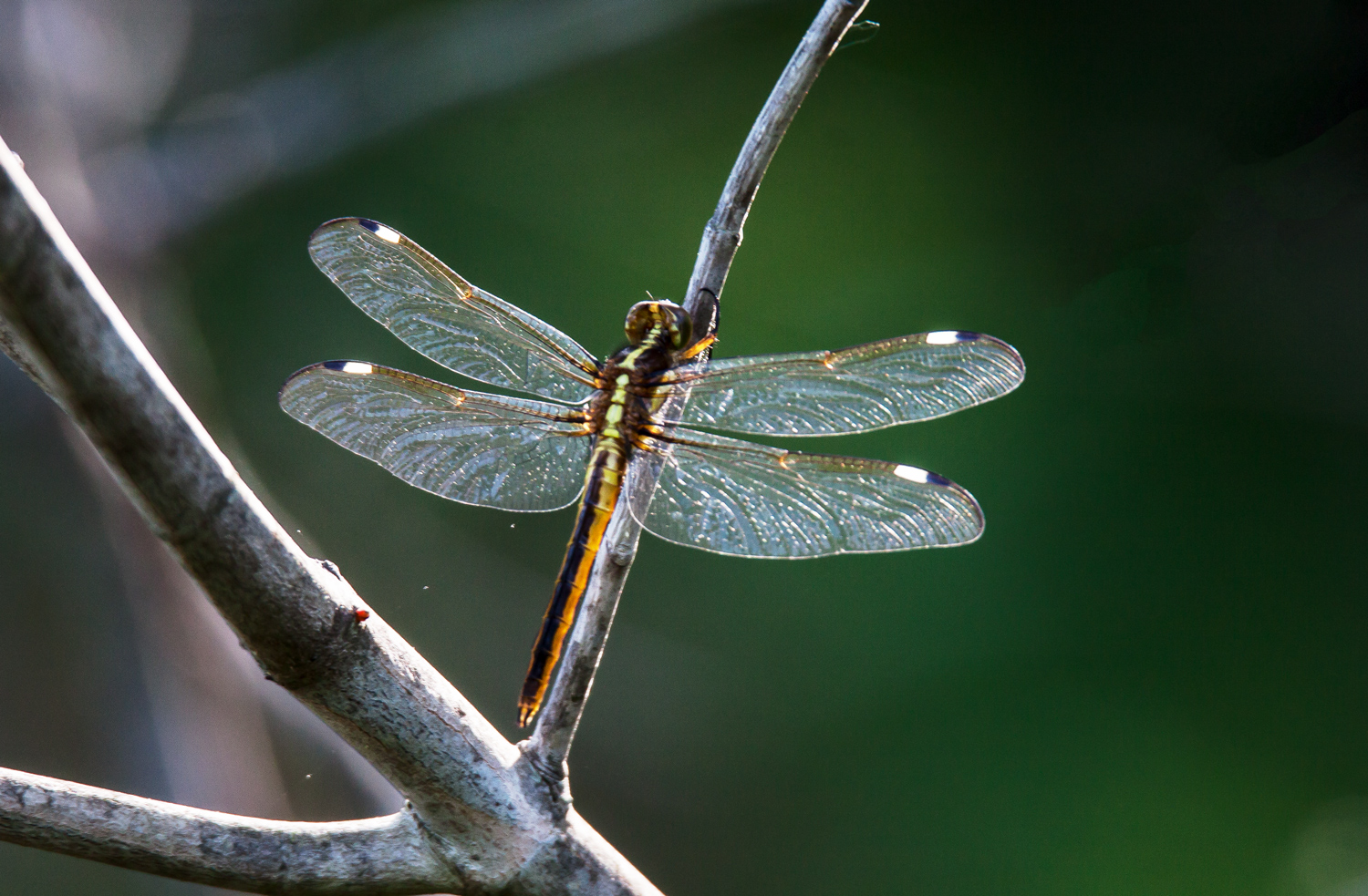
At this time of the year, dragonflies become one of my favorite subjects and I eagerly await the emergence of new species as we move deeper into spring and eventually into summer. This past Monday at Occoquan Bay National Wildlife Refuge, I noted that Spangled Skimmer  dragonflies (Libellula cyanea) are now with us. This species is pretty easy to identify because it is the only local species that has black and white stigmas—stigmas are the narrow rectangular patches of color that can be found on the front edges of the wings.

In the first image, a male Spangled Skimmer was pretty cooperative and let me capture one of my favorite type of dragonfly images—a head-on shot. In this kind of shot, the dragonfly’s body is almost always out of focus, but I am ok with that, because it forces the viewer to focus on the dragonfly’s amazing eyes.

The dragonfly in the second shot, which is an immature male Spangled Skimmer, had flown into a tree after I inadvertently spooked it. I loved the way that it was clinging to a branch. Shooting at an upward angle, I tried to simplify the background to draw attention to the branches as well as to the dragonfly. (As is often the case with dragonflies, immature male Spangled Skimmers initially have the coloration of adult females—eventually the dragonfly in the second photo will look like the one in the first image.)

Spangled Skimmer

Spangled Skimmer

© Michael Q. Powell. All rights reserved.

Read Full Post »

Cormorants are usually really skittish. Even when they are fishing far away from the shore, they will usually take off as soon as they sense my presence. When I spotted the unmistakable silhouette of a cormorant perched on the remnants of a duck blind in the waters off of Occoquan Bay National Wildlife Refuge this past Monday, I fully expected that it would fly away before I got within range to take a decent shot.

As I was approaching, I could see that it was a juvenile Double-crested Cormorant (Phalacrocorax auritus)—juveniles are paler around the neck and breast than adults and have more exposed orange skin around the bill. Perhaps this young cormorant had not yet developed a fear of humans, but whatever the reasons was, the beautiful blue-eyed bird remained in place as I took some shots from different angles and was still there when I silently moved away.


Double-crested Cormorant

© Michael Q. Powell. All rights reserved.

Read Full Post »

When I was growing up, my parents had a carved wood cuckoo clock from Germany. The bird that popped out of the clock, however, looked nothing like the Yellow-billed Cuckoos (Coccyzus americanus) that I spotted this past weekend at Occoquan Bay National Wildlife Refuge. More significantly, the cuckoos that I saw did not make the familiar cuckoo sound that was part of my childhood.

When I did a little research, I learned that the cuckoo family is quite large and spread out all over the world and that the Yellow-billed Cuckoo belongs to a different subfamily from the Common Cuckoo (Cuculus canorus) from Europe. That cuckoo is the one that makes the cuckoo sound used in all of those clocks.

Yellow-billed Cuckoo

Yellow-billed Cuckoo

Yellow-billed Cuckoo


© Michael Q. Powell. All rights reserved.


Read Full Post »

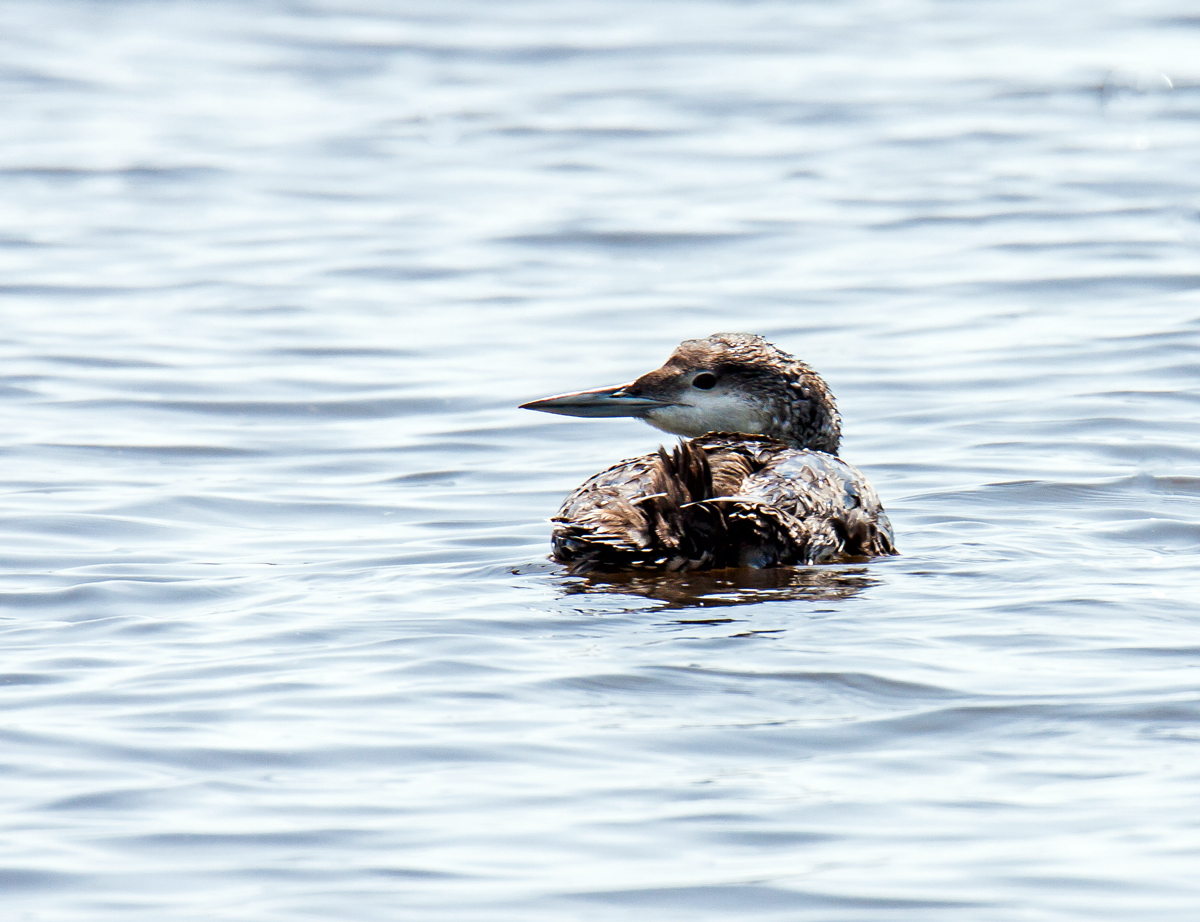
When I first saw this bird yesterday in the waters off of Occoquan Bay National Wildlife Refuge, I thought it might be some kind of grebe. The more I watched it though, the more skeptical I became of my initial identification. It seemed bigger than the grebes that I had previously seen and its bill seemed considerably longer. Additionally, it acted differently. Rather than diving, it poked its head under the water and then would swim for a bit with its head submerged.

So I did what I usually do in this kinds of situation and posted some photos in the What’s This Bird? forum on Facebook. Within a few minutes I received a chorus of responses, all indicating that this was a Common Loon (Gavia immer). I have absolutely no experience with loons, but tend to associate them with northern lakes. Mentally, I think of them as dark colored with distinctive patterns, which is true when they are in breeding plumage. It turns out that they are much more subdued in coloration when they are in non-breeding or immature plumage.

In other parts of North America, loons are a more common and popular sight than in Northern Virginia where I live. According to Wikipedia, the Common Loon is the provincial bird of Ontario, and it appears on Canadian currency, including the one-dollar “loonie” coin and the previous series of $20 bills. In 1961, it was designated the state bird of Minnesota, and appears on the Minnesota State Quarter.

Common Loon

Common Loon

Common Loon

© Michael Q. Powell. All rights reserved.


Read Full Post »

I have spotted Common Yellowthroats (Geothlypis trichas) repeatedly this spring, but, despite my best efforts, have not been able to get a close-up shot of one. They seem to like to perch in the middle of a particular field at Occoquan Bay National Wildlife Refuge and seem to taunt me from a distance with their sweet songs.

I love the distinctive black Lone Ranger-style mask of the male Common Yellowthroat that contrasts wonderfully with sunny hues of its eponymous throat. Even though I recently couldn’t get close to this yellowthroat, I managed to capture this image that has a painterly feel to it.

I’ll still be trying for a close-up of this species, but for now I am quite content with this environmental portrait of this beautiful bird.

Common Yellowthroat

© Michael Q. Powell. All rights reserved.

Read Full Post »

When I spotted this Eastern Snapping Turtle (Chelydra serpentina serpentina) from a distance yesterday at Occoquan Bay National Wildlife Refuge, I thought it might be a fox, because of its reddish-brown color. It was only when I got closer that I realized that it was a snapping turtle covered with mud—I suspect that she had recently been digging a nest to bury eggs. I got low trying to do an eye-level shot and am pleased with the expression that I was able to capture.

snapping turtle

© Michael Q. Powell. All rights reserved.

Read Full Post »

There are often a few moments in the early morning when the world seems completely at peace. The waters are calm and reflections are almost perfectly mirror-like. Sometimes there is enough light to take photographs, but even when there is not, I enjoy getting up early simply to savor those moments.

This past Monday morning, when I arrived at a small pond at Occoquan Bay National Wildlife Refuge, I noticed the beautiful reflections and my attention was drawn to a stick protruding out of the water. As I zoomed in on the stick, I noticed a damselfly perched on it. Damselflies belong to the same order of Odonata as dragonflies, but usually are smaller in size, often 1 to 1.5 inches in length (25–38 mm).

I decided to take some shots of the stick and the perching damselfly and as I was doing so, the damselfly flew away. I managed to capture the image below as the dragonfly was returning to its perch.

An expert on a Facebook forum identified the damselfly for me as an Orange Bluet (Enallagma signatum). Most members of the bluet family of damselflies are colored with various combinations of blue (as the name suggests) and black, but some family members are also orange or red. I shake my head and smile every time that I use the curious word combination “orange bluet.”

This image is somewhat atypical for me in the sense that it is not a close-up portrait. Most of the time I try to use my telephoto zoom or macro lens to capture as many details of my subject as I can. In cases like this, though, I am content to capture an image that evokes the mood of the moment. There is a kind of minimalist simplicity in this photo that really appeals to me.

Orange Bluet

© Michael Q. Powell. All rights reserved.

Read Full Post »

When I first spotted a small flock of dark-colored birds this past Monday at Occoquan Bay National Wildlife Refuge, I thought that they were blackbirds of maybe grackles. When the light illuminated them better, however, I could see that they were two-toned—their heads were brown and their bodies were black. I wasn’t sure what they were, but their distinctive color pattern made it easy to find them in my bird identification guide as Brown-headed Cowbirds (Molothrus ater).

I found the name “cowbird” to be a bit strange and wondered if perhaps they mooed like cows. After all, catbirds are reported to make sounds like those of a cat. As far as I can determine, though, they were called “cowbirds” simply because this species was often seen near cattle.

As I was poking about on the internet trying to learn more about this species, I was shocked to learn that cowbirds do not make their own nests. Where then do they lay their eggs? The Cornell Lab of Ornithology website explained this phenomenon as follows:

“The Brown-headed Cowbird is North America’s most common “brood parasite.” A female cowbird makes no nest of her own, but instead lays her eggs in the nests of other bird species, who then raise the young cowbirds. Brown-headed Cowbird lay eggs in the nests of more than 220 species of birds.”

I have not yet seen it, but apparently it is not unusual to see parents of one species busily trying to feed a baby cowbird that hatched in its nest.

The first two shots below show adult male cowbirds and the third image looks to be a juvenile cowbird or possibly a female

Brown-headed Cowbird

Brown-headed Cowbird

Brown-headed Cowbird

© Michael Q. Powell. All rights reserved.


Read Full Post »

After a series of dreary days this week, I feel the need for some brighter, more cheerful colors. Here are a couple of shots of a Yellow Warbler (Setophaga petechia) that I spotted on Monday at Occoquan Bay National Wildlife Refuge. A lot of warblers have yellow on their bodies and have long, complicated names, but this one is known simply as a “Yellow Warbler”—a straightforward name for a beautiful little bird.

Yellow Warbler

Yellow Warbler

© Michael Q. Powell. All rights reserved.

Read Full Post »

I had no idea what kind of turtle this was when I first encountered it sitting in the middle of a trail at Occoquan Bay National Wildlife Refuge this past Monday. Most of the time that I see turtles they are in the water or are sunning themselves at the water’s edge. This turtle was small and dark and lacked distinctive markings that would have aided me in identifying it.

I noticed that the turtle had a really large head and what looked to be sharp claws, so I initially thought it might be a baby snapping turtle. Uncertain of the identification, I posted a photo to a Facebook group for Nature Lovers of Virginia. The consensus of the group is that this is Eastern Mud Turtle (Kinosternon subrubrum), a new species for me.

I did a little checking on this species in Wikipedia and learned that mating occurs in the early spring followed by egg laying in May to early June. As was this case with a snapping turtle that I recently saw on dry land, I wonder if this turtle was looking for a place to lay its eggs.

Eastern Mud Turtle

© Michael Q. Powell. All rights reserved.

Read Full Post »

It is almost impossible to take a good portrait of a group of youngsters, irrespective of species—they are invariably energetic and inquisitive, almost incapable of simultaneously looking at the camera.

Yesterday I encountered a family of Canada Geese (Branta canadensis) as I walked down a path at Occoquan Bay National Wildlife Refuge. They too were strolling down the path, stopping to peck at the vegetation along the way. When they became aware of my presence, they slowly made their way to the water’s edge and slipped into the water.

The cute little goslings had already learned their lessons well and stayed in a tight little group right behind one of their parents. Once they had paddled a little way from shore, the babies, however, seemed to lose their focus and started to wander a bit. The adult in the rear of the little group, though, helped to bring them back into line as they silently swam away.

Canada Geese

Canada Geese

© Michael Q. Powell. All rights reserved.

Read Full Post »

I couldn’t help but notice Friday at Occoquan Bay National Wildlife Refuge how closely the green on the body of this Eastern Pondhawk dragonfly (Erythemis simplicicollis) matched the color of the vegetation on which it chose to perch. It won’t be long before pondhawks are all around us, but it was still nice to spot my first one of the season.

Eastern Pondhawk

© Michael Q. Powell. All rights reserved.

Read Full Post »

I was excited early on Friday morning to see my first Calico Pennant dragonflies (Celithemis elisa) of the season while exploring Occoquan Bay National Wildlife Refuge.  These small, brightly-colored dragonflies have become one of my favorites over the past year.

It is pretty early in their season and all of the ones that I spotted appeared to be immature—the patterns on the wings will soon get darker and more pronounced and bodies of the males, which start out yellow like those of the females, will turn red.

I have long wanted to capture shots of a dragonfly covered in morning dew or raindrops and the quest for these images helps motivate me to venture out early in the morning. If you click on the final photo and examine it at higher resolution, you will see tiny drops of water on the vegetation and a drop or two on the dragonfly’s wings. It’s not quite as I have imagined, but it is a good start.

Calico Pennant dragonfly

Calico Pennant dragonfly

Calico Pennant

© Michael Q. Powell. All rights reserved.

Read Full Post »

« Newer Posts - Older Posts »