Feeds:
Posts
Comments

Archive for the ‘spiders’ Category

As I was hunting for dragonflies last week, I was surprised to come across this wonderfully patterned spider at Occoquan Bay National Wildlife Refuge. I had figured that spiders were gone for the season, so I was not expecting to see on crawling across a fallen log.

I realize that spiders are a divisive subject for photography—some people love and admire then, while others fear and hate them. As you might suspect, I am in the former camp. Although I had a 18-400mm zoom lens on my camera, I was able to capture quite a few details of this spider and encourage you to click on the image.

I am not really sure of the species of this spider, but suspect that it might be a wolf spider.

Somehow this spider gives off a Halloween vibe to me. Happy Halloween in advance to those of you who celebrate thing creepy and spooky on that day.

autumn spider

© Michael Q. Powell. All rights reserved.

Read Full Post »

At this time of the year, a lot of Black and Yellow Garden Spiders (Argiope aurantia) show up, like this one that I spotted recently at Occoquan Bay National Wildlife Refuge. One of the features of this species is the distinctive zigzag pattern in the center of their webs.

When a prey lands on the web, the spider moves forward quickly to wrap up its victim in webbing material, as you can see in the second photo. Spiders will often wrap up several victims and leave them on the web for a later snack.

Black and yellow garden spider

spider

© Michael Q. Powell. All rights reserved.


Read Full Post »

Our recent warm weather has brought out a whole lot of little creatures. As I was hiking about in Prince William Forest Park last week, I notice a spot of bright red moving about on a rock at the edge of a small creek. When I looked at it more closely, it had a shape that made it look like a tiny red spider.

I did some initial searches when I returned home to see if I could identify the spider. I could not find an exact match, but I think this might be a spider mite (or some kind of mite) rather than an actual spider. If I understand it right, mites and spiders belong to the same family of arachnids, though I might have this wrong.

spider mite

© Michael Q. Powell. All rights reserved.

Read Full Post »

I have always admired the beauty and artistry of spider webs. It is so amazing to me that they can create such intricate patterns out of bodily secretions. I stumbled upon this beautiful little web on Thursday at Huntley Meadows Park and was thrilled that I was able to capture an image of it. I encourage you to click on the image for a closer view of the web design.

In order to make sure that the web did not disappear into the background completely, I deliberately underexposed the image, and focused manually on the web—there was no way that my camera’s autofocus would focus on the web.

spider web

© Michael Q. Powell. All rights reserved.

Read Full Post »

On Thursday I spotted this cool-looking Arrowhead Spider (Verrucosa arenata) , also known as a Triangle Orbweaver, at Occoquan Bay National Wildlife Refuge. This spider is one of the few known orbweavers that sits facing upwards in its web—all other species face downward.

Its distinctive triangle-shaped abdomen makes this species pretty easy to identify. If you look closely at the image, I think that you can see a couple of the spider’s large round eyes shining brightly in between several of the legs in the upper left portion of the spider’s body.

Arrowhead Spider

© Michael Q. Powell. All rights reserved.

Read Full Post »

As we move deeper into September I have been seeing more and more Black and Yellow Garden Orbweaver spiders (Argiope aurantia). These spiders are impressively large and have prominent webs with a distinctive zigzag pattern near the center.

During recent visits to Occoquan Bay National Wildlife Refuge, I have seen multiple Big Bluet damselflies (Enallagma durum) that have gotten caught up in the webs of the Argiope spiders. In the first photo the spider is moving in on two damselflies. After immobilizing the prey, the spider will often wrap it in web material, as you can see in the second image.

The final shot shows a hapless damselfly entangled at the edge of a web. I observed the damselfly for a few moments to see if I could detect any signs of movement, with thoughts that I might be able to free it. However, I did not see any movement and suspect that I had arrived too late to rescue this damsel in distress.

Some viewers may object to these kind of graphic images, but for me it is part of the “circle of life” in nature—all creatures have to eat to survive. As I have observed numerous times, today’s predator may well become tomorrow’s prey.

damselfly

damselfly

damselfly

© Michael Q. Powell. All rights reserved.


Read Full Post »

On Monday I captured this shot of a small white spider—I think it may be a White-banded Crab Spider (Misumenoides formosipes)—at Occoquan Bay National Wildlife Refuge. I really like the way that the coloration of the tips of the spider’s leg are an almost perfect match for the spiky thorns of the vegetation. In the second photo, the spider looks a lot like a crab in the way that it is shaped and was moving—it’s easy to see why it is called a “crab” spider.

White-banded Crab Spider

White-banded Crab Spider

© Michael Q. Powell. All rights reserved.

Read Full Post »

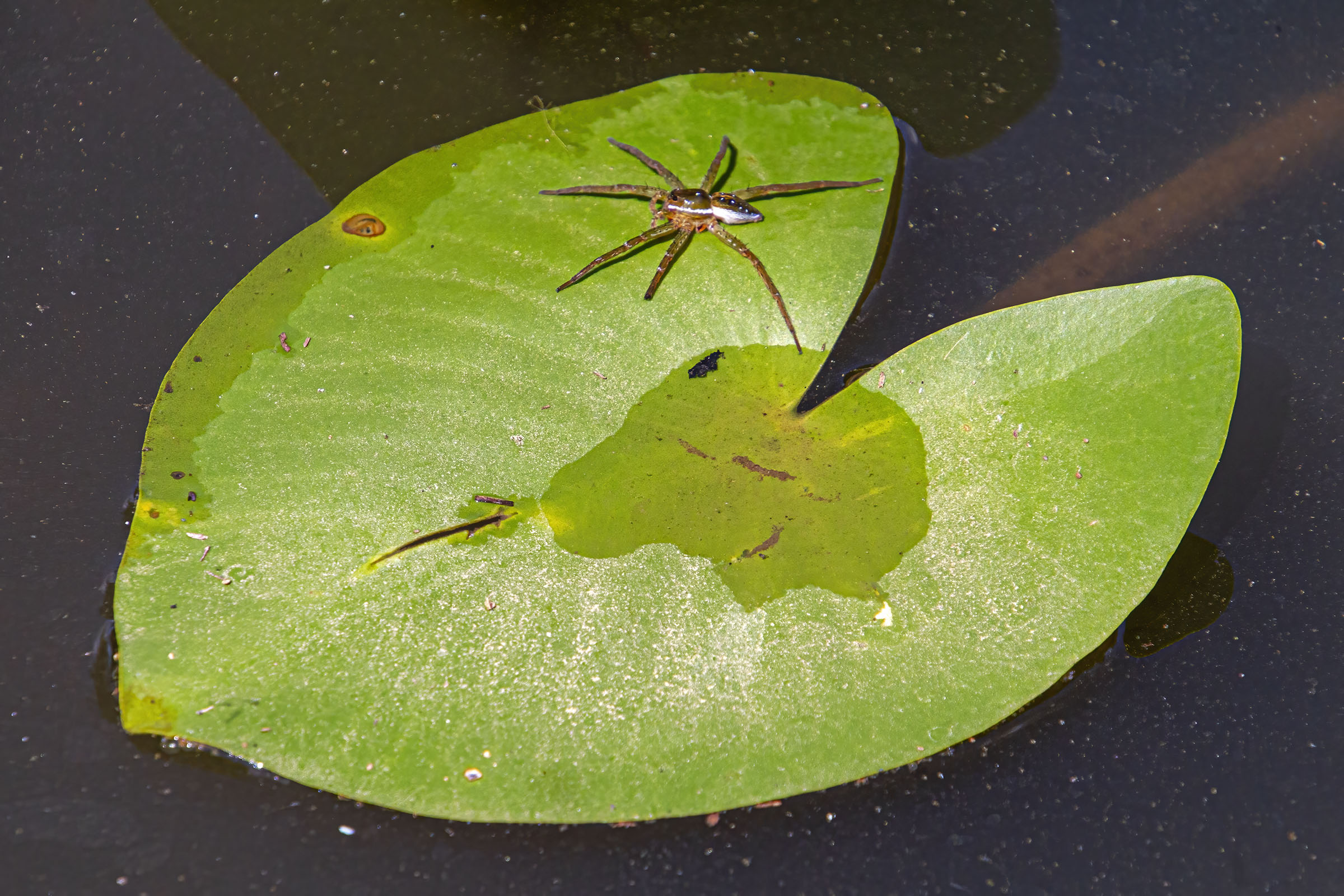
I usually scan the surfaces of lily pads whenever I see them, hoping to spot frogs perched on them. I did not see any frogs last week during a visit to Jackson Miles Abbott Wetland Refuge, but I did spot a cool-looking Six-spotted Fishing Spider (Dolomedes triton).

Normally I see these fishing spiders in shallow water at the edge of ponds with some of their legs on the surface of the water to sense the vibrations of potential prey. When they do, they capture the prey by walking across the water, prompting some people to refer to them as “Jesus spiders.”

Six-spotted Fishing Spider

© Michael Q. Powell. All rights reserved.

Read Full Post »

Some people get creeped out by spiders, but many of them are quite beautiful, like this tiny Orchard Orbweaver spider (Leucauge venusta) that I spotted on Wednesday in Prince William County. The sun was shining brightly on the shiny body of the spider, so I underexposed the image intentionally, which is why it looks so dark in the photo—the background was green in real life. I was also leaning my lens against a branch for stability, since even the slightest movement at such close range can blur an image.

Orchard Orbweavers are really common where I live, but I suspect that most people do not look closely enough at them to see their beautiful colors. According to the LSU AgCenter, “Orchard spiders are .13 to .3 inches (3.5 to 7.5 mm) in length, with females typically larger than males.” I believe that the aforementioned measurements are for the body alone and do not include the legs.

In addition to capturing some of the beautiful colors of the Orchard Orbweaver, I was thrilled to capture a look at the web of the spider. These webs are much smaller and compact than the webs of some of the larger orbweaver spiders in our area, which is a good thing, because many of these webs seem to be built across paths and I often run into them face-first.

Orchard Orbweaver

© Michael Q. Powell. All rights reserved.


Read Full Post »

Most of the time fishing spiders have some of their legs in the water to sense the vibrations of potential prey, but the large Six-spotted Fishing Spider (Dolomedes triton) that I spotted last Friday in Prince William County was perched on a log at the edge of a small creek. When I posted the photo on Facebook, one of my friends noted that he often finds fishing spiders far from the water, including in his wood pile.

I do not know how large this spider was, but it looked huge to me. Perhaps that is because the spider had all of its legs fully extended, unlike some spiders whose legs are partially bent when they are in a web.

Six-spotted Fishing Spider

© Michael Q. Powell. All rights reserved.


Read Full Post »

As I was walking along on one of the trails at Occoquan Bay National Wildlife Refuge last Friday, I noticed a large spider coming in my direction at a pretty good clip. I gave the spider plenty of space, but managed to capture this image of what I believe is a Wolf Spider with my long telephoto lens.

Wolf spiders belong to the family Lycosidae and are among the most common spider species found around the world. According to an article entitled “Wolf Spider: Friend or Foe?” wolf spiders “are keen hunters that chase or pounce on prey like wolves rather than spin a web and wait for a meal. Unlike wolves hunting as packs, wolf spiders generally live and hunt alone. Hunting occurs both day and night.”

wolf spider

© Michael Q. Powell. All rights reserved.

Read Full Post »

I think that the small spider in the foreground may be a male Black and Yellow garden spider (Argiope aurantia) and the larger one in the background a female of the same species. The body length of male Argiope aurantia spiders ranges from 0.20–0.35 inches (5–9 mm) and for females ranges from 0.75–1.10 inches (19–28 mm), according to Wikipedia.

A male Argiope spider communicates with a potential mate by plucking and vibrating the female’s web, according to the same Wikipedia article, which may explain what was happening when I captured this image on 13 September at Occoquan Bay National Wildlife Refuge.

I saw more than a dozen of the large female spiders at the wildlife refuge during my most recent visit there. Many of them had prey wrapped up in web material, stashed for future consumption. One of them, however, was busily consuming a ladybug, as shown in the second image below.


Argiope aurantia

spider and ladybug

© Michael Q. Powell. All rights reserved.


Read Full Post »

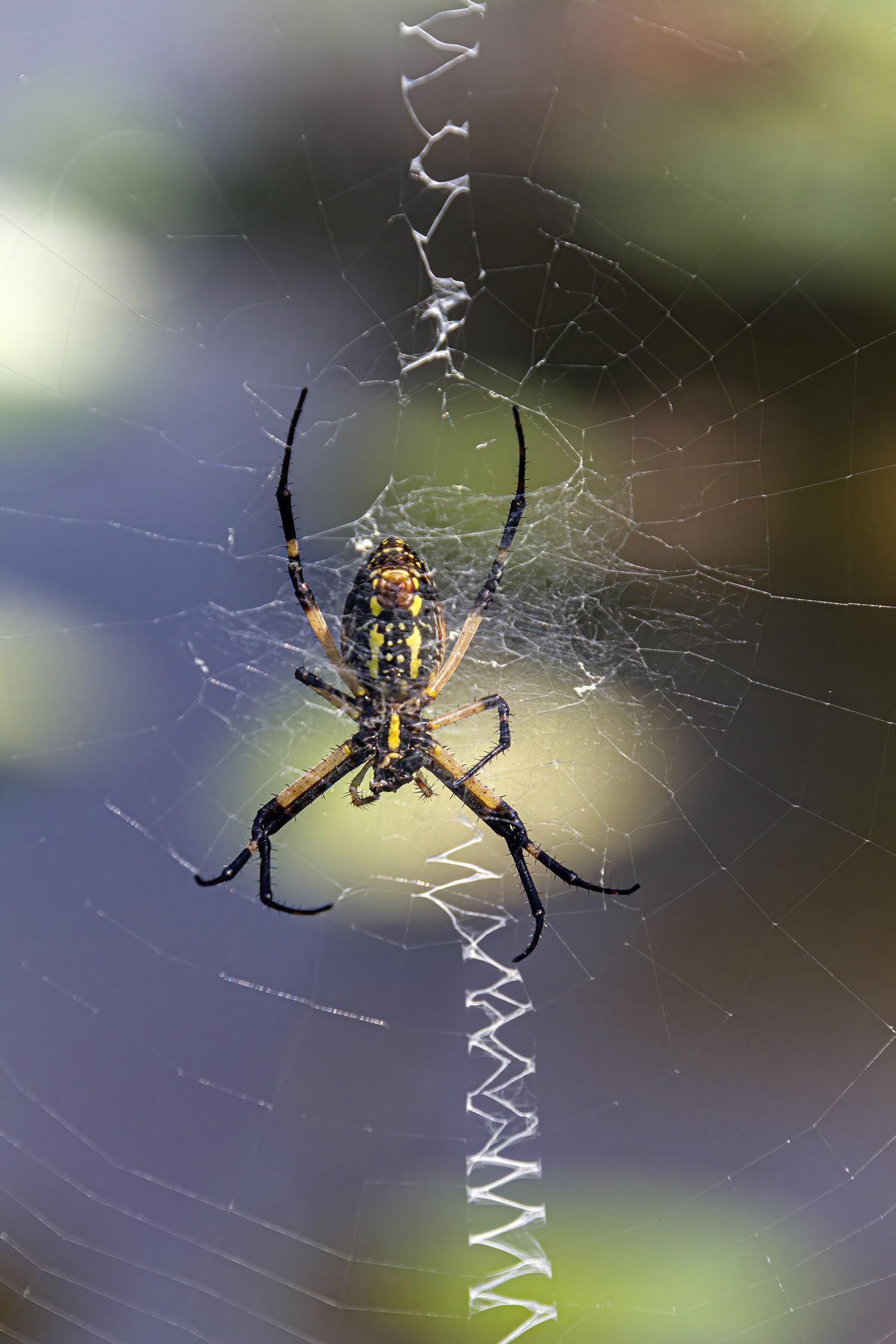
During my recent visits to Jackson Miles Abbott Wetland Refuge, I have noticed the reappearance of Black and Yellow Garden Orbweaver Spiders (Argiope aurantia). During the late summer and early fall, these relatively large spiders can be seen in the vegetation surrounding the pond and in the adjacent fields.

One of the coolest things about this spider is the distinctive zig-zag pattern, known technically as a stabilimentum that the spider uses for the central part of its web. According to Wikipedia, the purpose of the zig-zags is disputed. “It is possible that it acts as camouflage for the spider lurking in the web’s center, but it may also attract insect prey, or even warn birds of the presence of the otherwise difficult-to-see web.”

Argiope aurantia

© Michael Q. Powell. All rights reserved.

Read Full Post »

As we were photographing some Spring Snowflake flowers (Leucojum vernum) on Saturday at Meadowlark Botanical Gardens, my dear friend and photography mentor Cindy Dyer noticed what looked like a spider’s leg on the side of one of the flowers and asked me to go around to the other side of the flower to investigate.

Sharp-eyed Cindy was right—I spotted this tiny spider clinging to the side of the snowflake and was delighted that I was able to capture this image of it.

Leucojum vernum

© Michael Q. Powell. All rights reserved.

Read Full Post »

Now that it is spring, it is time for the crawling critters to reappear, like this little spider that I spotted last week while exploring in Prince William County. Some spiders overwinter as adults, so this spider may have just awoken from a long winter’s sleep. If so, the spider may have decided to go back to bed, because temperatures have dropped the last couple of days and it is currently about 25 degrees outside (minus 4 C)—it was 70 degrees (21 degrees C) when I photographed the spider last week.

UPDATE:  Initial indications from an expert at bugguide.net suggest that this is a wolf spider.

spider

© Michael Q. Powell. All rights reserved.

Read Full Post »

When the urge to take photos strikes me, I am undeterred by drizzle or intermittent light rain, though heavier rain and gusty winds tend to keep me at home. Of course, weather is unpredictable and I have gotten drenched in downpours a number of times. I carry an array of plastic bags and coverings to protect my gear, which is usually my number one priority.

Last Friday, it was raining off and on and I decided to visit Jackson Miles Abbott Wetland Refuge to see if any creatures were stirring. Not surprisingly, dragonflies were at the top of my list, though I doubted that any of them would be flying in the rain. I was therefore pleasantly surprised when I spotted this male Eastern Pondhawk dragonfly (Erythemis simplicicollis). I watched him land on a droplet-laden plant and managed to capture the first image below.

As I continued to walk around the small pond, I noticed a Black and Yellow Garden Orbweaver (Argiope aurantia) in its web, patiently waiting for a passing prey to be snagged. I thought the long brown object just below the spider might be a caterpillar or some other insect, but it turned out to be only a small twig.

There were a lot of flowers in bloom and my eyes were attracted to a cluster of small purple asters. The colors seemed really saturated and I liked the way that the droplets of water stood out on the petals.

So, I was able to capture a few photos to share, despite the rain. About the only thing that the images have in common is that they all include raindrops, which I believe add an additional element of interest to what otherwise might have been rather ordinary shots.

Eastern Pondhawk

Argiope aurantia spider

asters

© Michael Q. Powell. All rights reserved.

Read Full Post »

Life can be a risky proposition when you are relatively low on the food chain, like a damselfly. Some larger insects may hunt you down while you are flying—see my recent post called Predator that shows an Eastern Pondhawk dragonfly consuming a damselfly. Other creatures may try to trap you and then immobilize you.

Several times this past week during visits to Occoquan Bay National Wildlife Refuge I have encountered Black and Yellow Garden Orbweaver spiders (Argiope aurantia) that had captured a damselfly. I did not see the actual capture, but the spider in the first photo was in the process of wrapping up the damselfly when I spotted.

Spiders can produce variety of types of silk. In cases like this, the silk (known as aciniform silk) comes out in sheets that look like a gauze bandage and the spider spins around the prey as it wraps it up. If you want to get a better look at how the spider emits these sheets of silk, check out a 2014 posting called Wrapping up a meal. If you have every wrapped presents at Christmas time, you know how difficult it is to wrap an irregularly shaped object. The spider has done an amazing job in making a compact package of the long skinny body and wings of the hapless damselfly—I encourage you to click on the image to see the details of the trapped damselfly.

In the case of the second photo, the spider was content to do a looser wrap, which lets us see the damselfly a little better. I think this damselfly and the one in the first photo are Big Bluets (Enallagma durum), though it is difficult to be certain of the identification.

spider

Big Bluet damselfly

© Michael Q. Powell. All rights reserved.


Read Full Post »

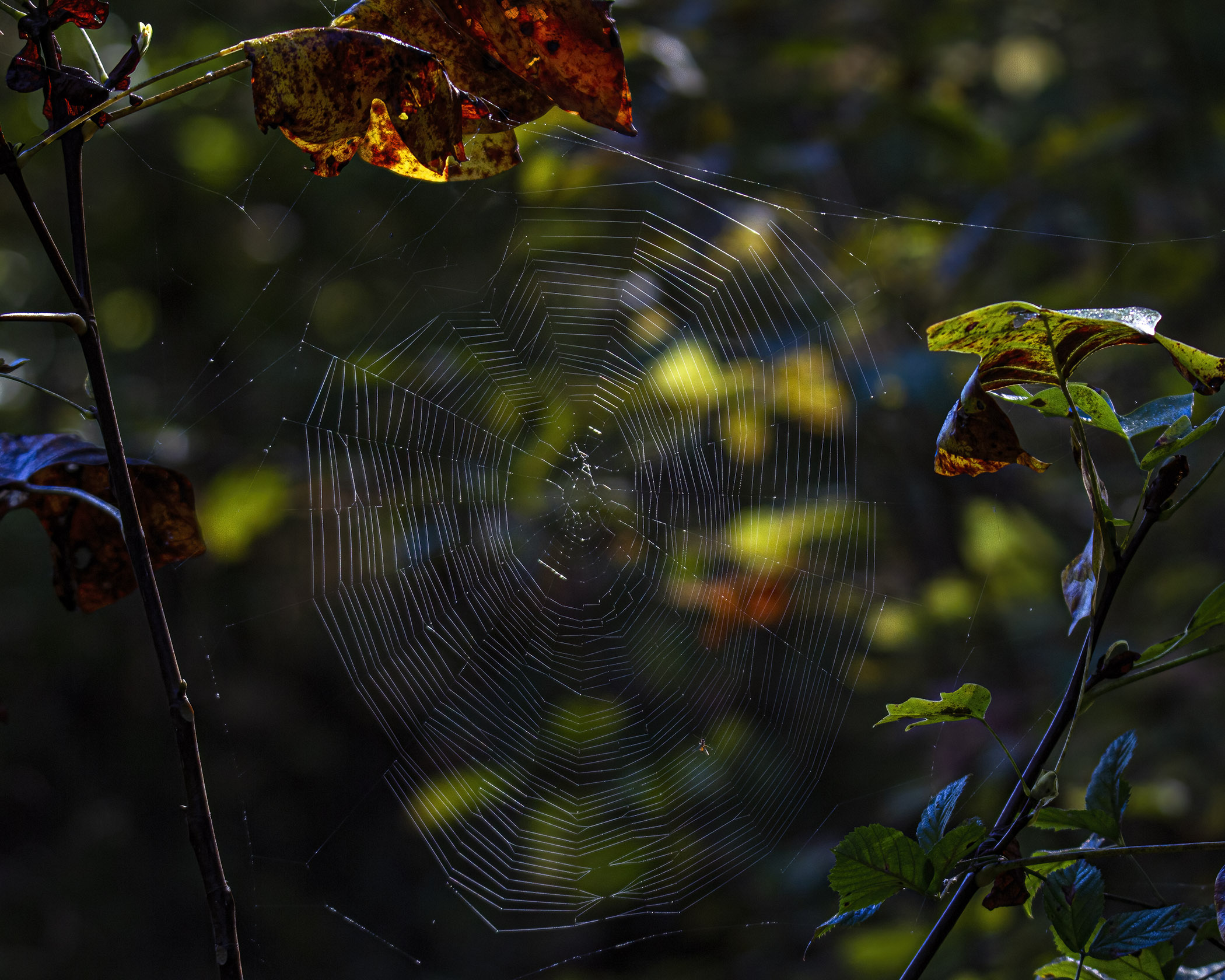
I am always in awe of the skill and artistry of spiders that are capable of constructing elaborate webs using secretions of their own bodies. I spotted this beautiful little web on Friday as I was wandering about at Occoquan Bay National Wildlife Refuge.

This photo is what I like to consider a natural abstract image. It is so easy for me to immerse myself in the intricate patterns of the web in an almost hypnotic way.

I am not sure what kind of spider made this web, though I am pretty sure the little spider in the center was responsible for it. Kudos to the artist!

spider art

© Michael Q. Powell. All rights reserved.

Read Full Post »

I was focused so intently on getting a shot of this male Swift Setwing dragonfly (Dythemis velox) on Monday at Jackson Miles Abbott Wetland Refuge that I did notice that he was not alone on the small branch overhanging the waters of the small pond.

When I first pulled up the image on my computer,  I immediately noticed the strands of spider silk that looked like the guy line of a tent pole. It was only when I started to examine the branch closely, however, that I spotted the elongated shape of a Long-jawed Orb Weaver spider (family Tetragnathidae) perched below the dragonfly on the same branch.

The dragonfly was skittish and flew away when I got too close. I suspect that he was unaware of the fact that I was not the most immediate threat that he faced—danger was lurking from below on that branch that my experience had shown was a favorite perch for Swift Setwings.

Swift Setwing

© Michael Q. Powell. All rights reserved.

Read Full Post »

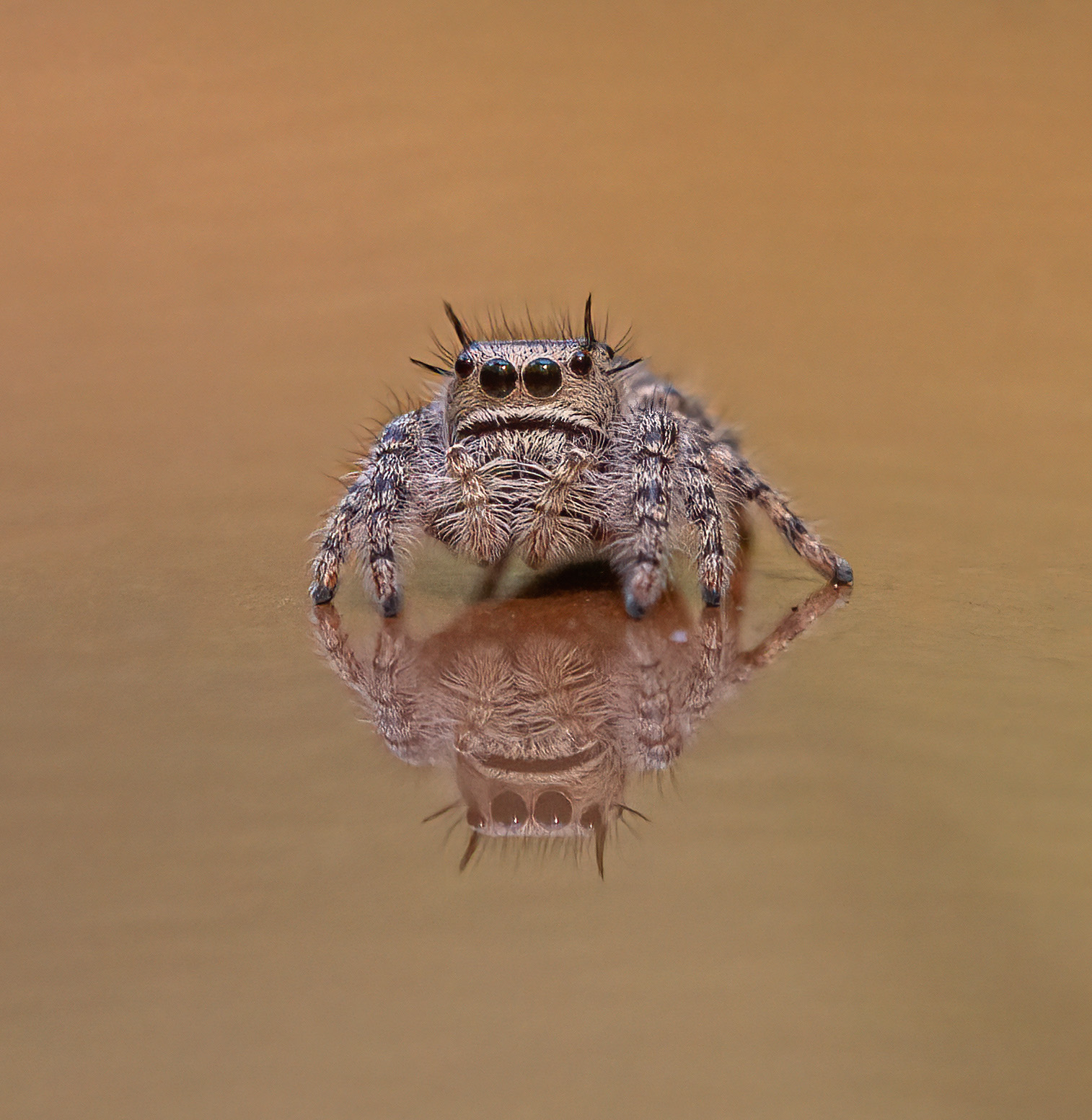
Sometimes I manage to take capture shots of wild creatures in really unusual locations. I spotted this jumping spider yesterday on the roof of my car when I was reaching inside the car to grab my camera and begin a search for dragonflies. This was a case when I happened to have the right tool in my hand at the right moment—my macro lens helped me to capture some wonderful close-up shots.

The spider was tiny—I’d estimate that it was less than half in inch (12 mm) as I faced it. My body position was awkward as I stood in the door opening and tried to balance my elbows on the roof of the car and look through the viewfinder. Fortunately I was able to place the lens on the roof, which helped me to keep it stable.

The spider did not appear to be at all frightened by my presence and in fact seemed quite curious. These three shots show some of the spider’s poses as we conducted an impromptu portrait session that highlighted the spider’s engaging personality. If you click on the images, you can see reflections of the sky in many of the spider’s eyes and the reflection of the entire spider on the car was a nice bonus.

The spiky tufts on the spider’s head helped me in trying to identify the spider and I am relatively sure that it is a Putnam’s Jumping Spider (Phidippus putnami). However, there are a huge number of species of jumping spiders, so I defer to others who have more expertise with spiders.

Jumping spiders are amazing. They do not use webs but instead rely on their speed and agility—they can reportedly jump over 50 times their own body length. A number of years ago I shot a series of photos of a Bold Jumping Spider that had captured a much larger dragonfly. I encourage you to check out that 2014 posting called Spider captures dragonfly—the story to see some images that are both startling and fascinating and to learn more details of that encounter.

In case you are curious, I drive a coppery-colored KIA Soul that is technically “Ignition Orange.” This distinctive color made a wonderful background for this beautiful spider. Apparently, spiders like my car. As I researched my own blog, I came across a posting from March 2014 entitled Spider on my car that also featured a jumping spider and one from September 2017 entitled Tiny Hitchhiker that featured a small crab spider.

Putnam's Jumping Spider

Putnam's Jumping Spider

Putnam's Jumping Spider

© Michael Q. Powell. All rights reserved.

Read Full Post »

I spotted this large spider last Thursday at Occoquan Regional Park perched atop some leafy vegetation and watched as it captured a small moth that made the mistake of landing on the same leaf. The spider assumed a defiant pose when I started to photograph it—obviously it did not want to share its lunch with me—and I captured the first photo as I stared straight into its multiple eyes.

I initially thought that this was a fishing spider because of its large size and overall shape, but I am beginning to wonder if it might actually be a wolf spider. Most of the fishing spiders that I have seen have been in the water and this one was a foot (30 cm) in the air, although it was overhanging the edge of a small stream. I included a shot of its body that shows its markings, in case any of you are expert enough to identify its species.

I know that people have mixed reactions to spiders, but I encourage those of you who do not find them to be totally creepy to click on the first photo. Doing so will allow you so see some wonderful details of the spider, especially its eyes, and the remains of the hapless moth.

spider

spider

© Michael Q. Powell. All rights reserved.


Read Full Post »

Six-spotted Fishing Spiders (Dolomedes triton) sense their prey through vibrations in the water, so generally when I see them they have several legs lighting touching the surface of the water. When I spotted this one yesterday at a small pond in Fairfax County, however, it was perched on top of some vegetation several inches above the water.

I have no idea why it was there, though there were plenty of dragonflies buzzing around that would occasionally perch on the same type of vegetation. Could it possibly be hoping to catch a dragonfly? I have included a photo of a male Blue Dasher dragonfly (Pachydiplax longipennis) from a previous day that was perched in the same area to give you an idea of the spider’s potential prey. I would think that a dragonfly’s excellent vision would allow it to spot the spider and avoid it—I can’t imagine that a dragonfly would deliberately choose to land on top of the spider, but who knows?

If you look closely at the first photo, you may also notice what appear to be several spider legs poking out from underneath the edge of the vegetation. Was there another spider there and if so, why? Nature is full of mysteries and intrigue, with lots of unanswered questions.

Six-spotted Fishing Spider

Blue Dasher

© Michael Q. Powell. All rights reserved.


Read Full Post »

I have always been fascinated by the intricate patterns of spider webs and I love to attempt to photograph them. Of course, the first challenge is to spot them. In the past I have had some success in early morning hours when the webs were covered in dew—see, for example, my posting from September 2012 called More spider art. In more recent years, though, I have most frequently encountered spider webs when I have run into them stretched head-high across trails.

I was pretty excited therefore when I spotted this backlit spider in its web last Thursday as I was exploring a forested area in Prince William County. I loved the way that the light was shining through the body of what I recognized to be an Orchard Orbweaver spider (Leucauge venusta). I toyed around with ideas on how to compose the image and decided to include only the upper half of the web—I wanted to make sure that the viewer’s eyes would be drawn to the spider.

Orchard Orbweaver spiders are quite common in my area and I encountered another one later that same day and captured the close-up image below that shows some of the spider’s beautiful coloration. I know that some people find spiders to be creepy and threatening, but hopefully these spider shots can help to convince at least a few of those viewers that spiders can also be quite beautiful.

Orchard Orbweaver

Orchard Orbweaver

© Michael Q. Powell. All rights reserved.


Read Full Post »

Do spiders overwinter as adults? Most of the crawling creatures that I tend to spot this early in the spring are quite small, so it was a little surprising to spot several large Wolf Spiders ( probably Tigrosa georgicola) on Monday at Prince William Forest Park. I was pretty sure these spiders had not hatched recently, so I did a little research and learned that “a surprisingly large number of spider species overwinter as adults or immatures, forsaking the cozy shelter of an egg sac in which to endure the harsh, cold extremes,” according to a blog posting by Bug Eric entitled Spider Sunday: Spring Spiders.

The spider in the first photo was actively crawling about in the leaf litter when I first spotted it, probably searching for prey, given that wolf spiders do not spin webs and instead are opportunistic hunters. The second spider was scurrying down a trail at a surprisingly fast pace when it paused for a moment to let me capture an image.

I encourage you to click on the photos to get a closer look at the fascinating details of these spiders, including their multiple eyes and the spiky hairs on their legs.

Wolf Spider

Wolf Spider

© Michael Q. Powell. All rights reserved.

Read Full Post »

Large black spiders are often associated with Halloween—many people find them to be merely spooky, but some are totally creeped out by them. Maybe the spiders need better marketing and a new poster child for the autumn holidays. I would nominate this colorful Marbled Orbweaver spider (Araneus marmoreus) that I spotted on Thursday at Huntley Meadows Park.

When I spotted this spider, I was immediately attracted to the way that the light was illuminating its legs from behind and causing them to glow. As I made adjustments to my camera settings, I was a little shocked to see the beautiful orange coloration and intricate patterns on the spider’s body. The oval body brought to mind a kind of stylized jack-o’-lantern and I later learned that one of the informal names for this spider is “pumpkin spider.”

For many of us this is the season for voting. Would you vote for this spider as a new autumn mascot?

Marbled Orbweaver


© Michael Q. Powell. All rights reserved.

Read Full Post »

Spiders are really cool and I always marvel at the elaborate webs they weave out of material from their own bodies. Almost all my shots of Black and Yellow Garden Spiders (Argiope aurantia) have been taken from the front, primarily because the webs are generally in inaccessible locations. However, the placement of this spider’s web that I spotted recently at Occoquan Bay National Wildlife Refuge allowed me to view and photograph it from this unusual side angle.

It is always fun to play around and attempt to capture images of a subject from multiple perspectives. In this case, the spider was cooperative and I was able to capture this cool little portrait.

Argiope aurantia

© Michael Q. Powell. All rights reserved.

Read Full Post »

I always feel like I am being hypnotized when I stare into the giant center eyes of a jumping spider. Resistance is futile when I try to look away—I am irresistibly drawn back to those mesmerizing eyes.

I spotted this really cool-looking Bronze Jumping Spider (Eris militaris) on Tuesday when I was photowalking at Occoquan Bay National Wildlife Refuge with my friend Walter Sanford. I was thrilled to spot this little spider perched atop of some waist-high vegetation. I had to move in close, though, to be sure that this was in fact a jumping spider, because the bodies of Bronze Jumping Spiders are only a bit over a quarter of inch (6-8 mm) in length.

The little spider was not jumping, but it was moving around a lot, which made it quite a challenge to photograph at such close range. However, that meant that I was able to get shots from multiple angles without having to change my shooting position, as you can see in the photos below.

I often encourage readers to double-click on the images to see the details of the subject and think that it is especially beneficial to do so with these images. You will be able to see the fascinating arrangement of the spider’s eyes—I think there are eight eyes—and the reflection of the sky and the landscape in the large front eyes.

My favorite photo is undoubtedly the first one. I love the direct view into the eyes of the jumping spider and its combative pose that reminds me of a sumo wrestler at the start of a match. Was the spider challenging me?


Bronze Jumping Spider

Bronze Jumping Spider

Bronze Jumping Spider

© Michael Q. Powell. All rights reserved.

Read Full Post »

Have you ever tried to wrap a present that is large and awkwardly shaped? I have childhood memories of helping my parents wrap tricycles and wagons for my younger siblings on Christmas Eve. No matter how much wrapping paper I used, it was pretty obvious what was underneath the wrapping.

I have watched Black and Yellow Garden Spiders (Argiope aurantia) capture prey multiple times. After the initial capture, the spider wraps up its prey in a special kind of silk that looks like a long gauze bandage. (Check out my 2014 posting called “Wrapping up a meal” for a more detailed explanation and some close-up shots of the wrapping process.)

When I spotted this Black and Yellow Garden Spider on Monday at Occoquan Bay National Wildlife Refuge, I could see from a distance that the spider had captured something that was as large as it was, but I could not determine what it was. Once I got closer, I could see that the spider had awkwardly wrapped up what appeared to be a large cicada—it was impossible to hide the shape of the cicada’s large wings.

At some point in this process the spider injects venom into the prey, killing it and liquefying its internal organs for consumption. I cannot tell for sure if that is what the spider was doing at the moment I captured this image, but the position of the spider’s body suggests that possibility.

Spider and cicada

© Michael Q. Powell. All rights reserved.

Read Full Post »

As I have observed animals, birds, and animals, I have noticed that sometimes the male is larger than the female and sometimes the opposite is the case. Quite often the size difference is so slight that you have to rely on other characteristics to try to determine the gender of a subject.

When it comes to spiders, though, the size difference is shockingly large—the male is often one quarter the size of the female or even smaller. On Monday I spotted my first black and yellow garden spider (Argiope aurantia) of the season. I have long been fascinated with these large spiders and the distinctive zigzag pattern that they weave into their webs.

When I looked at my images on my computer, I was surprised to see that there was a second, smaller spider just to the left and behind the main subject. Could this possibly be a male garden spider? According to Wikipedia, males range in size from .2-.35 inches (5-9 mm) and females range in size from .75 to 1.1 inches (18 to 28 mm), so the size differential seems about right. Additional the smaller spider looks like photos I was able to find of male garden spiders.

Spider mating can hazardous for male spiders. In some species, if the male is rejected by the female, she eats him. I thought that might be the case for these garden spiders, but came across a fascinating article at newscientist.com with the sensationalist title “Spider sex causes spontaneous death” that suggests something stranger than cannibalism.

According to a study conducted at Concordia University and the University of California, “Researchers found that for male orb-weaving spiders of the species Argiope aurantia completing copulation leads to certain death. The deceased suitor’s corpse is then trapped in the female genitalia. This may be a strategy to prevent other males from subsequently mating with the female, say the scientists.” The scientists determined that the female did nothing to kill the males who died spontaneously and concluded, “The females do sometimes remove and devour their dead mates. But the researchers do not think the death program evolved to give her a post-sex snack, as the males are too tiny to provide much nutrition.”

Nature can be wild, weird, and wonderful and endlessly fascinating. I guess that is what prompted the scientists to carefully study 100 pairs of spiders mating. 🙂


Argiope aurantia

© Michael Q. Powell. All rights reserved.

Read Full Post »

I am catching up on some photos and thought I’d post this image that I captured in mid-July of a cool-looking fishing spider that Walter Sanford spotted while we were hunting for dragonflies at a creek in Fairfax County. I am not sure of the specific species of the spider, but I am pretty confident that it is of the genus Dolomedes. Most of the times in the past when I have spotted similar spiders, they have actually been in the water, but this one seemed to be hunting from a crevice in the rocks at the edge of the water.

I love the texture of the rocks and especially the lichen that add a lot of visual interest to this image. If you would like to see Walter’s take on our encounter with this spider, check out his post ‘Fishing spider Friday.’ Walter noted that he sees “a mean monkey face on the front half of the spider and a baboon face on the back half.” Be sure to click on the image to see the spider more closely, if you dare and let me know what you think.


fishing spider

© Michael Q. Powell. All rights reserved.


Read Full Post »
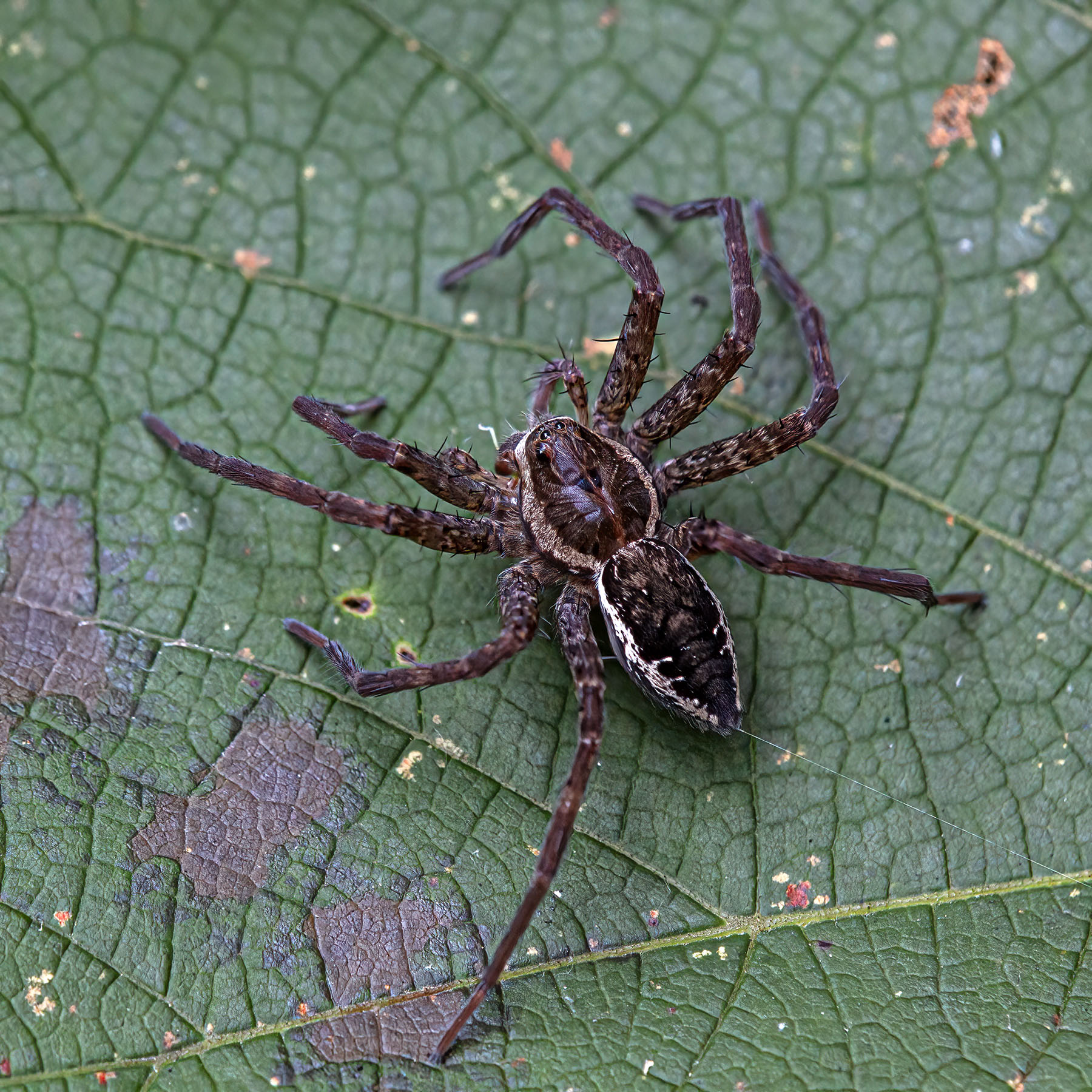
It was probably my imagination, but the Wolf Spiders (Tigrosa georgicola) that I spotted last weekend while exploring in Fairfax County seemed huge. In the first image, the shadow makes the spider look even larger and gives it a somewhat menacing appearance. I am not sure why the spider in the second shot was out in the open, but its exposed condition allowed me to examine it closely—even relatively large spiders spark my curiosity.

wolf spider

wolf spider

© Michael Q. Powell. All rights reserved.

Read Full Post »

Older Posts »