Feeds:
Posts
Comments

Archive for the ‘Portraits’ Category

As I was observing some birds on Monday at Occoquan Bay National Wildlife Refuge, a burst of bright yellow flashed across my camera’s viewfinder. I was not sure what kind of bird it was, but I definitely wanted to find out. I panned my long telephoto lens and eventually tracked the bird when it landed high in a distant tree.

I was delighted to see that it was a beautiful little American Goldfinch (Spinus tristis). Goldfinches are with us all year, but I am most used to seeing them during the summer months as they feed on sunflowers and other flowers. There is still a bit of warmth in the sun and some color in the trees, but we are moving inexorably towards the cold gray days of winter when bright colors will be in short supply.

Celebrate the color!

American Goldfinch

© Michael Q. Powell. All rights reserved.

Read Full Post »

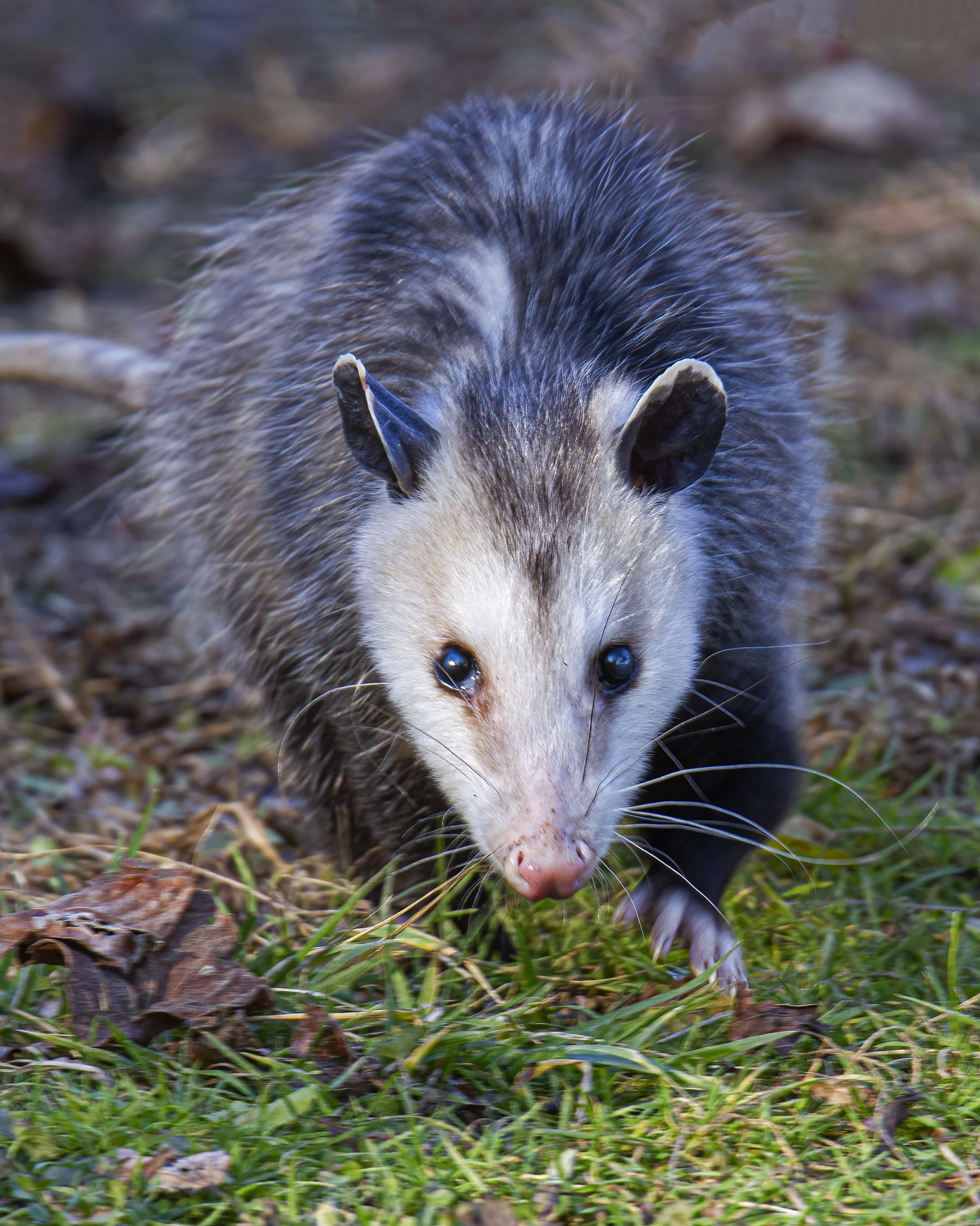
Yesterday I encountered a cool-looking Virginia Opossum (Didelphis virginiana) at Occoquan Bay National Wildlife Refuge. It was walking down the middle of a trail straight towards me and did not seem aware of my presence. Opossums are mostly nocturnal, so I do not see them very often—apparently they do not seem me very often either. An opossum’s eyesight is much better in the dark than it is in daylight, so the opossum may not have initially seen me, even though it was looking right at me in a number of these photos.

Virginia Opossums, also known as North American Opossums, are the northernmost marsupial in the world, and the only one living north of Mexico, according to Wikipedia. Like other marsupials such as a kangaroos, kolas, and wombats, opossums give birth to incompletely developed babies that develop further in a pouch—he word “marsupial” comes from the Latin word “marsupium”, which means pouch.

The gestational period lasts only 11-13 days, according to Wikipedia, and the average litter size is 8–9 infants, although over 20 infants may be born. “Newborns are the size of a honeybee. Once delivered through the central birth canal, newborn opossums climb up into the female opossum’s pouch and latch onto one of her 13 teats. The young remain latched for two months and in the pouch for 2+12 months. The young then climb onto the mother’s back, where she carries them for the remainder of their time together. It is during this time that the young learn survival skills. They leave their mother after about four or five months.”

If you want to learn more about opossums, check out an article called “50 Opossum Facts That Are Too Awesome to Miss” at the website facts.net. For example, I was shocked to learn that the word “opossum” originated in Virginia, where I live. Between 1607 and 1611, colonists John Smith and William Strachey first recorded the usage of opassom and aposoum at the early British colony in Jamestown, Virginia.

The opossum seemed curious, cute, and almost cuddly, but I kept my distance and tried not to disturb. From certain angles, such as in the second image, though, the opossum seemed focused and a little menacing.

I encourage you to click on the photos to get a closer look at some of the details of the opossum, like its prehensile tail and the little claws on its feet. You can’t see it very well, but opossums have opposable clawless thumbs on their hind feet that lets them grip onto tree branches.

Virginia Opossum

Virginia Opossum

Virginia Opossum

Virginia Opossum

© Michael Q. Powell. All rights reserved.

Read Full Post »

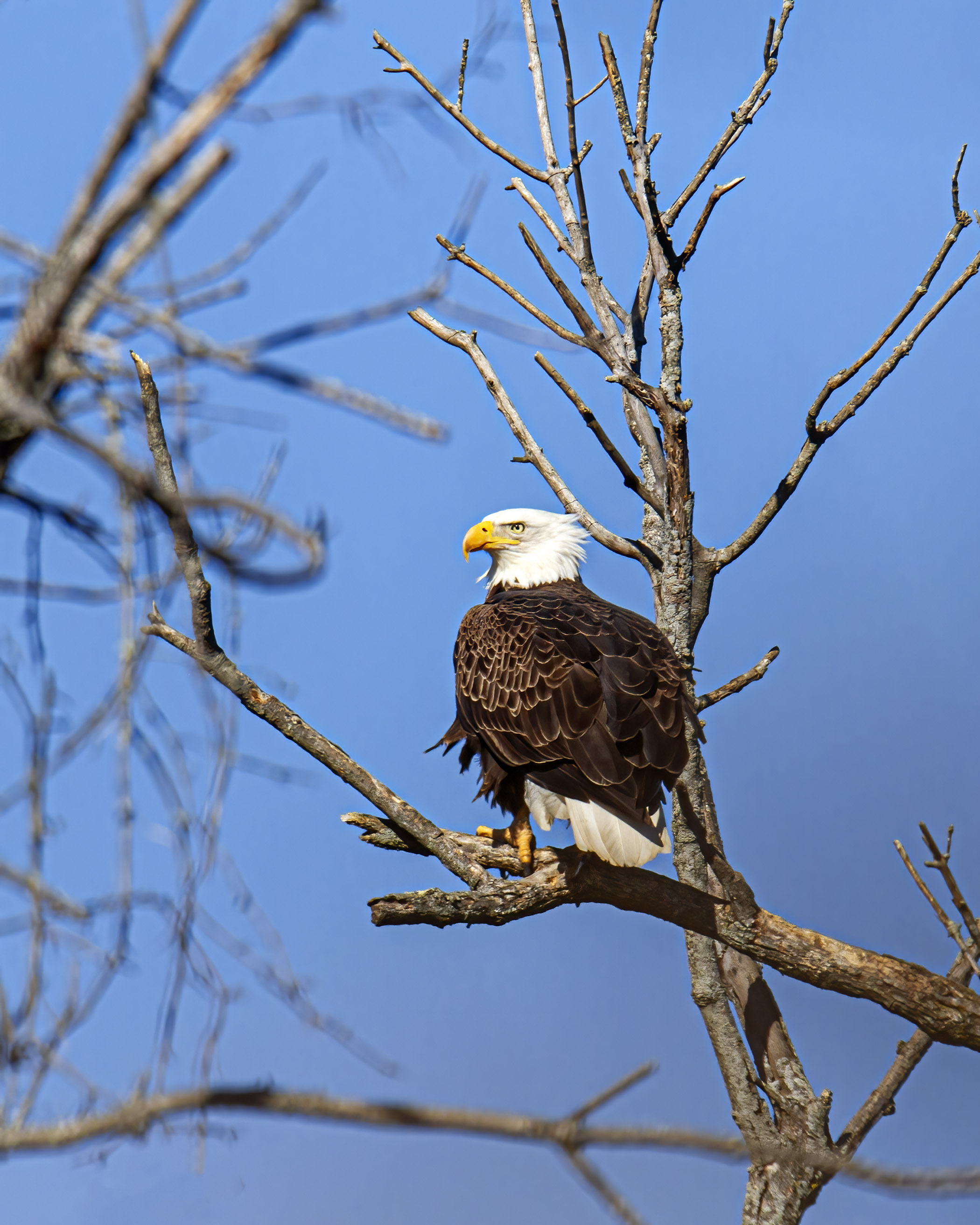
Although it was sunny last Wednesday at Occoquan Bay National Wildlife Refuge, the wind was kicking up quite a bit, repeatedly ruffling the feathers of this perched Bald Eagle (Haliaeetus leucocephalus). It has been a long time since I had hair that was long enough to sport that kind of windblown look.

When I was a child, I had a cowlick in the back of my head that refused to stay in place, despite my lineral use of Brylcreem or a similar product called Groom and Clean. My father, like many men of his generation had a comb over hair style that he somehow fixed in place. When I started going bald, I rejected that style and opted to keep  my hair cut short. Of course, during the 20 years that I spent in the US Army, it was a mandated “choice,” much like the mandatory “fun” that surrounded official social functions.

Bald Eagle

© Michael Q. Powell. All rights reserved.


Read Full Post »

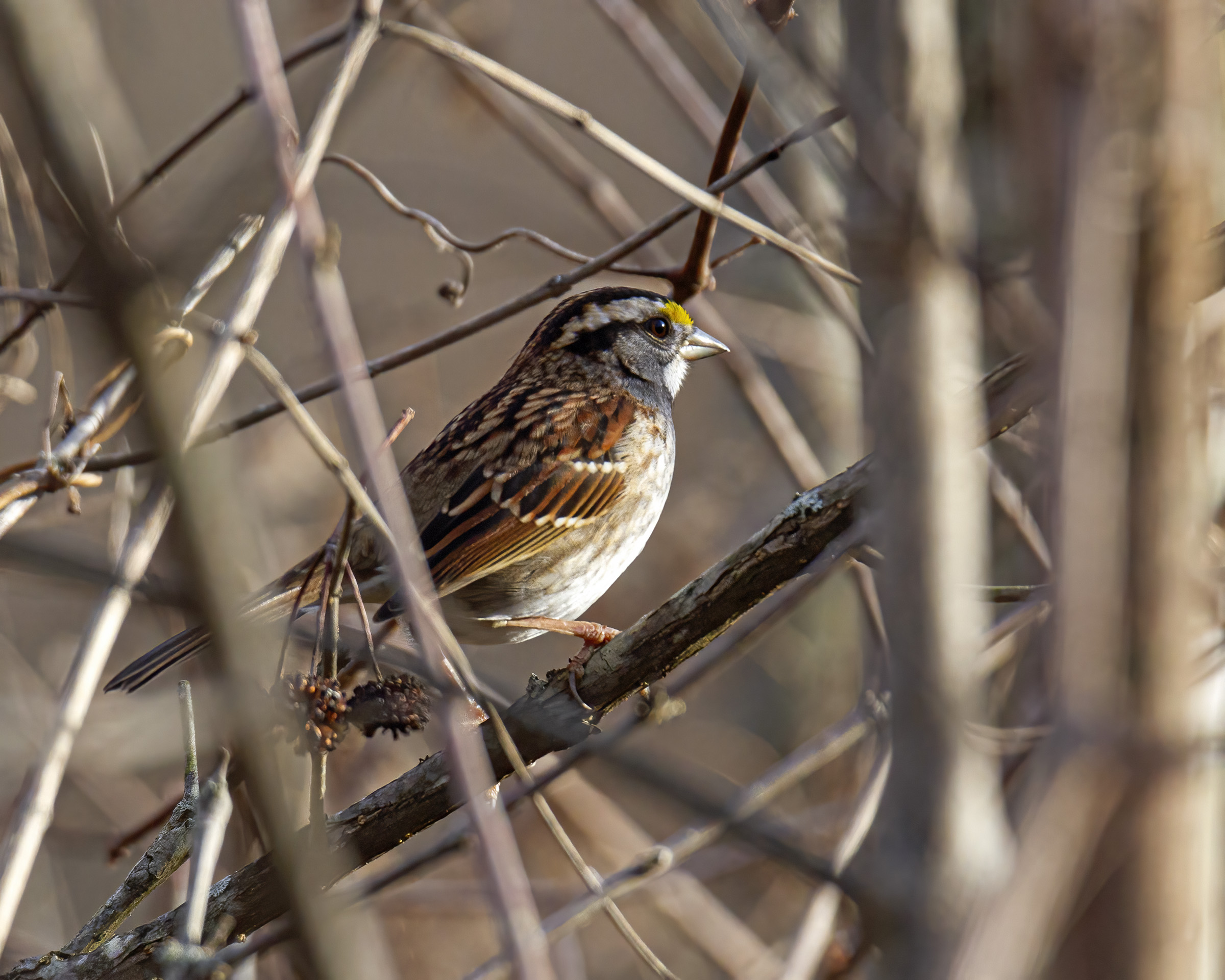
White-throated Sparrows (Zonotrichia albicollis) are one of my favorite winter birds. During autumn they migrate into my area in great numbers and spend the winter with us.

Sometimes I complain that I have trouble identifying sparrows, but this is a species that I can reliably identify, thanks to the bright yellow lores (i.e. the area between the eyes and bills) and the white throat patch that always makes me think of Santa Claus.

Like many other sparrows, White-throated Sparrows like to forage deep in the bushes and the underbrush, so it is tough to get an unobstructed shot of one. As you can see in both of these photos, my view of the sparrow was partially blocked, but I was able to find a visual tunnel that let me get a good shot the head and most of the body of this beautiful little bird.

White-throated Sparrow

White-throated Sparrow

© Michael Q. Powell. All rights reserved.

Read Full Post »
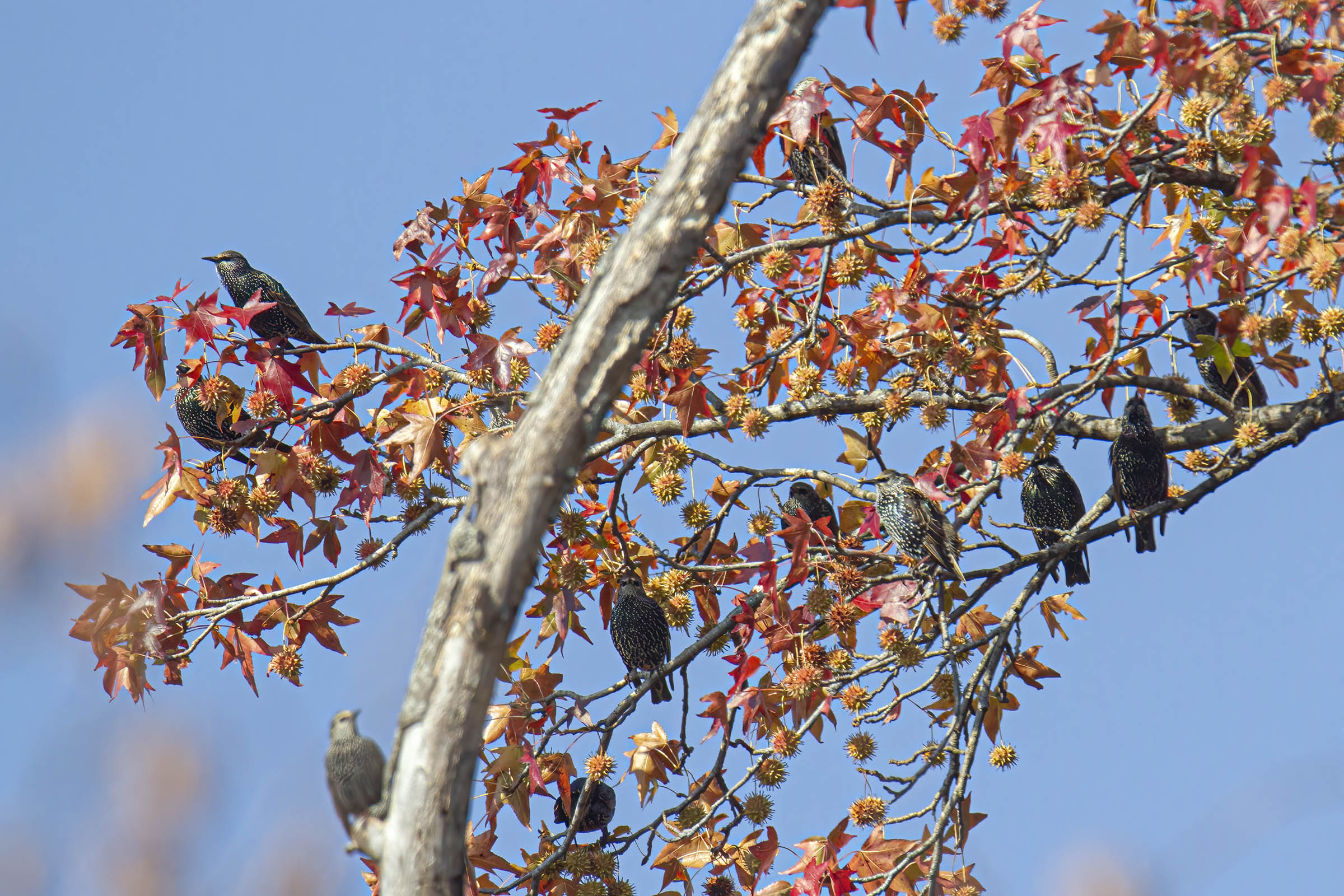
How do you photograph a flock of birds? This past Thursday I visited Occoquan Bay National Wildlife Refuge and observed (and heard) that a sizable flock of European Starlings (Sturnus vulgaris) was moving about in a large expanse of trees. I attempted to photograph clusters of starlings, but as you can see in the final photograph, many of the birds were hidden or shaded by the foliage or were looking away from me.

I decided that a better approach was to concentrate my efforts on getting shots of individual starlings. The first image is one of my favorites from my session with the starlings. The texture of the photogenic snag adds to the visual interest of the image and the starling cooperated by giving me a nice view of its profile. The colorful foliage gives you a sense of the season and of the environment and the two blurry starlings in the background help to balance the image.

The composition of the second image is much simpler—it’s just the bird and its perch. What makes this image interesting for me is the intensity of the starling as it calls out with its mouth wide open, which adds a touch of dynamism to what would otherwise be a static portrait.

European Starling

European Starling

European Starling

© Michael Q. Powell. All rights reserved.


Read Full Post »

Most warblers pass briefly through my area when they are migrating in the spring and in the fall, but Yellow-rumped Warblers (Setophaga coronata) stay with us for a good part of the colder season. This past Thursday I spotted quite a large number of Yellow-rumped Warblers as I wandered the trails at Occoquan Bay National Wildlife Refuge.

In the first photo, you can see a portion of the yellow patch that is responsible for the name of this species. Most of the time I see only the smaller yellow patches on their sides, because they tend to perch high above me and I am often shooting at an upwards angle.

I am amazed by the light weight of Yellow-rumped Warblers and their ability to perch on incredibly slender branches, as you can see in the second image. According to the Cornell Lab of Ornithology, these little birds weigh only 0.4-0.5 ounces (12-13 g).

In the final photo, the warbler is poised to move on to its next perch. Yellow-rumped Warblers are not quite as hyperactive as some other species that I see at this time of the year, like Ruby-crowned and Golden-crowned Kinglets, but they move around a lot as they forage for food.

Yellow-rumped Warbler

Yellow-rumped Warbler

Yellow-rumped Warbler

© Michael Q. Powell. All rights reserved.

Read Full Post »

Usually I see Gray Petaltail dragonflies (Tachopteryx thoreyi) perched vertically on tree trunks, but this one perched horizontally on a fallen branch and stared at me after landing momentarily on my shoulder on Tuesday at Occoquan Regional Park in Lorton, Virginia.

I really like to get eye-to-eye contact with dragonflies—somehow it makes the encounter more personal and intimate. One of the consequences of shooting from this angle, though, is that much of the body of the dragonfly will be out of focus. I am ok with that and in fact it tends to pull the viewer’s eyes towards those bits that are in focus, particularly the dragonfly’s wonderful compound eyes.  Gray Petaltail

© Michael Q. Powell. All rights reserved.


Read Full Post »

I was delighted on Wednesday to spot my first Eastern Pondhawk (Erythemis simplicicollis) dragonflies of the season while I was exploring the trails at Occoquan Regional Park. As we progress into summer, this species will become quite abundant, but it is always a joy to spot these little beauties.

Females, like the ones in these photos, are bright green in color and have a banded abdomen. I did not see any males that day, but they start out with coloration similar to that of the females and then gradually transition to having a blue abdomen and a blue and green thorax. Both genders have green faces, which, along with their coloration, make them easy to identify.

I love the way that the green spring foliage matches the colors of an Eastern Pondhawk and provides a beautiful backdrop for them, as you can see in these photos.

I will be away in the mountains this weekend on a church retreat, so will probably not be posting for the next few days. I will have my camera with me, though, so you may see a few photos from my adventures there in upcoming blog postings.

Eastern Pondhawk

Eastern Pondhawk

© Michael Q. Powell. All rights reserved.


Read Full Post »
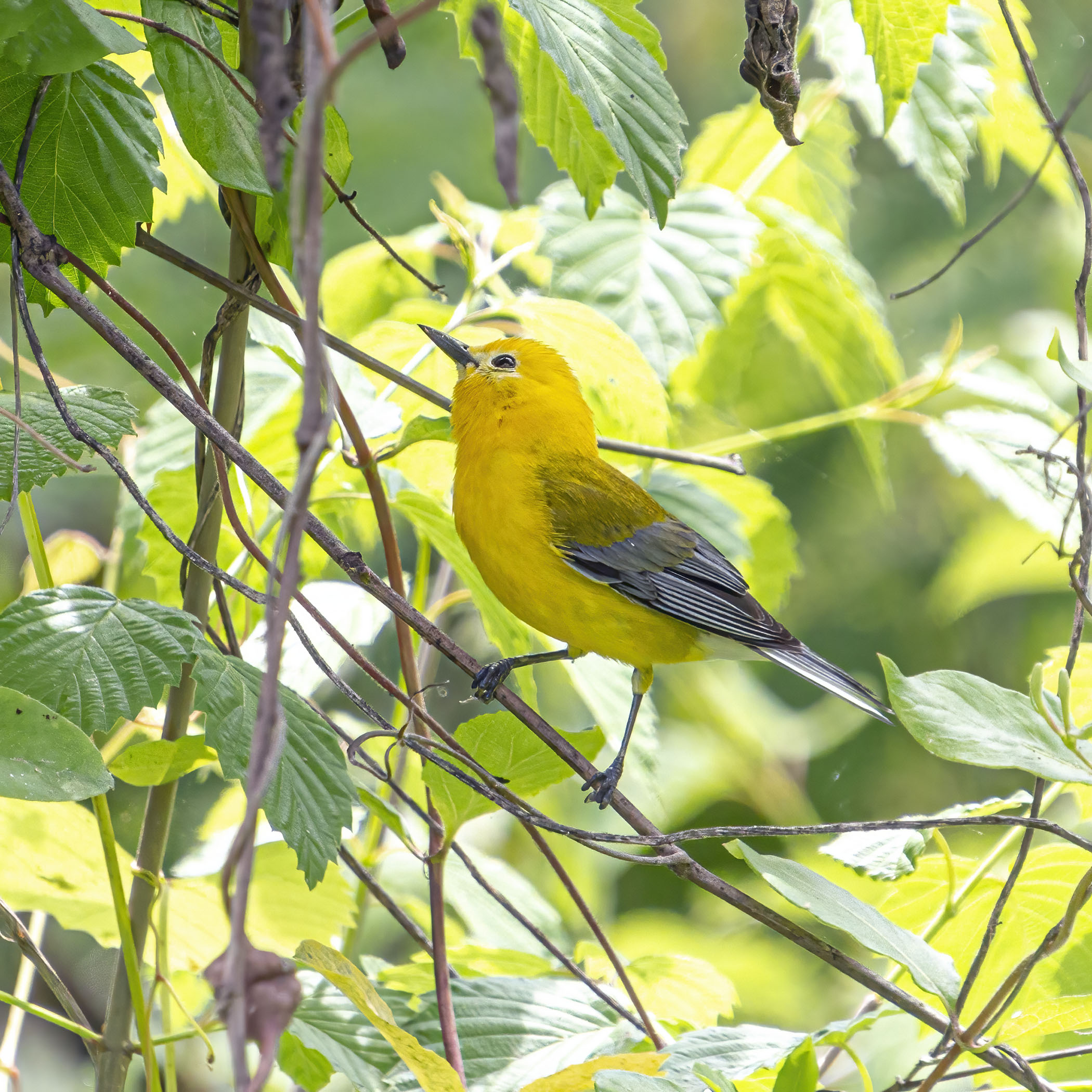
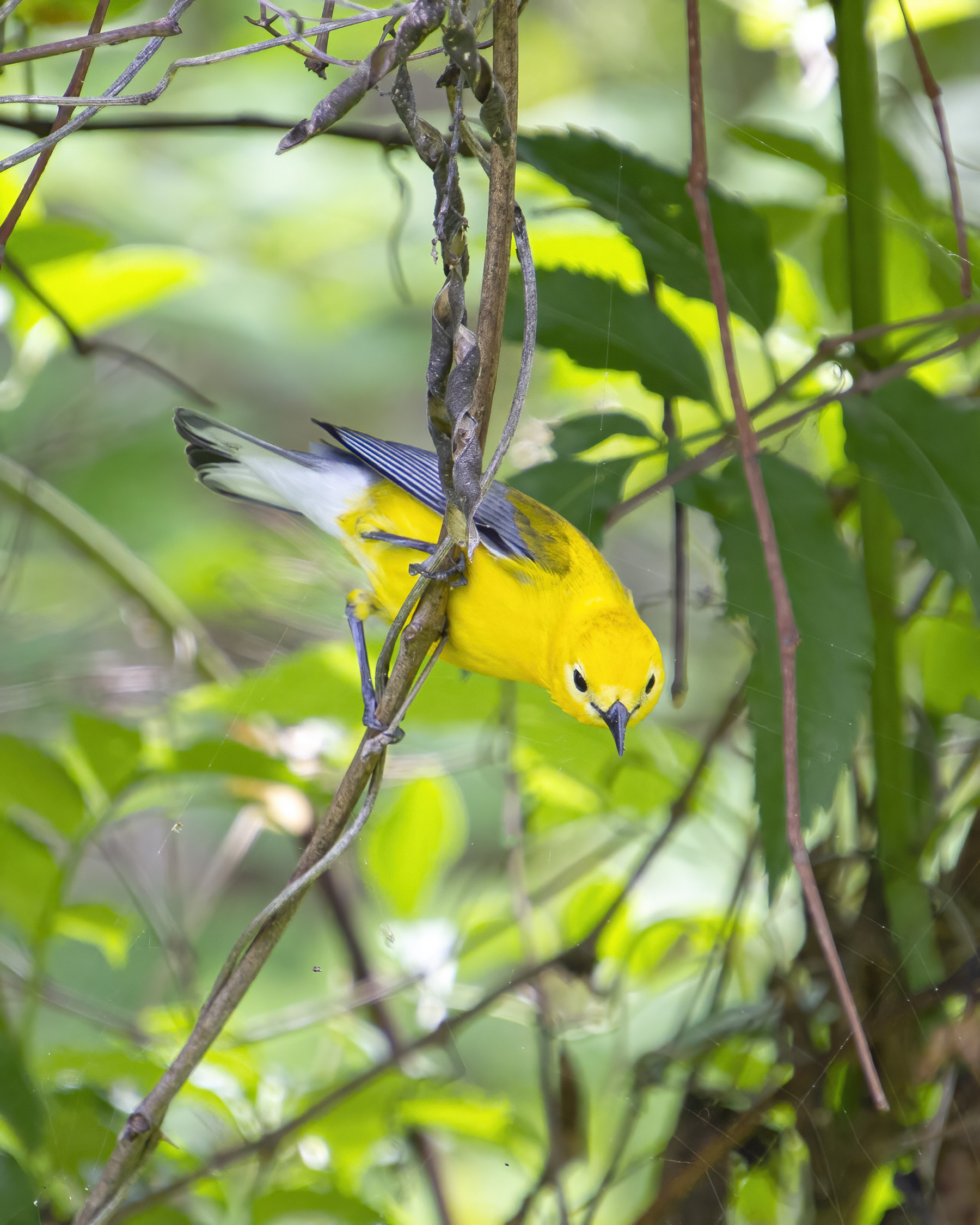
I love the poses of this bright yellow Prothonotary Warbler (Protonotaria citrea) that I spotted last Thursday at Occoquan Bay National Wildlife Refuge. The warbler was actively twisting, turning, and stretching as it foraged for food and amazingly was perched quite low in the vegetation—most of the times in the past I have seen Prothonotary Warblers high in the trees and was forced to shoot them from an unflattering sharp upward angle.

Quite often when I am focusing on a wildlife subject, it moves. Most of the time the result is a blurry image, but sometimes I end up with a really cool shot. The Prothonotary Warbler took off just as I pressed the shutter release and I was lucky to capture it in action, as you can see in the final photo.

The yellow plumage of a Prothonotary Warbler is startlingly bright and cheerful. Invariably the sight of a Prothonotary Warbler makes me think of Tweety Bird, a character from Warner Brothers Looney Tunes cartoons that I remember from my childhood. I think that Tweety was supposed to be a canary, but he didn’t really look like a canary. Often Tweety had adventures with Sylvester the cat, the subject of Tweety’s signature line, ” “I tawt I taw a puddy tat!””


Prothonotary Warbler

Prothonotary Warbler

Prothonotary Warbler

Prothonotary Warbler

© Michael Q. Powell. All rights reserved.

Read Full Post »

When it comes to photographs, do you prefer “pretty pictures” or “action shots?” If I were to judge from “likes” on social media platforms, “pretty pictures” are more popular, although I am often most proud of my “actions shots.” One of the coolest things about photography, of course, is that there is a wide latitude for individual styles and preferences and neither the viewer nor the photographer has to be forced into making false choices.

On Monday I took a couple of photos of small birds during a visit to Occoquan Bay National Wildlife Refuge. At this time of the year I am thrilled when I am able to spot the small birds that are often hidden by the increasingly dense foliage.

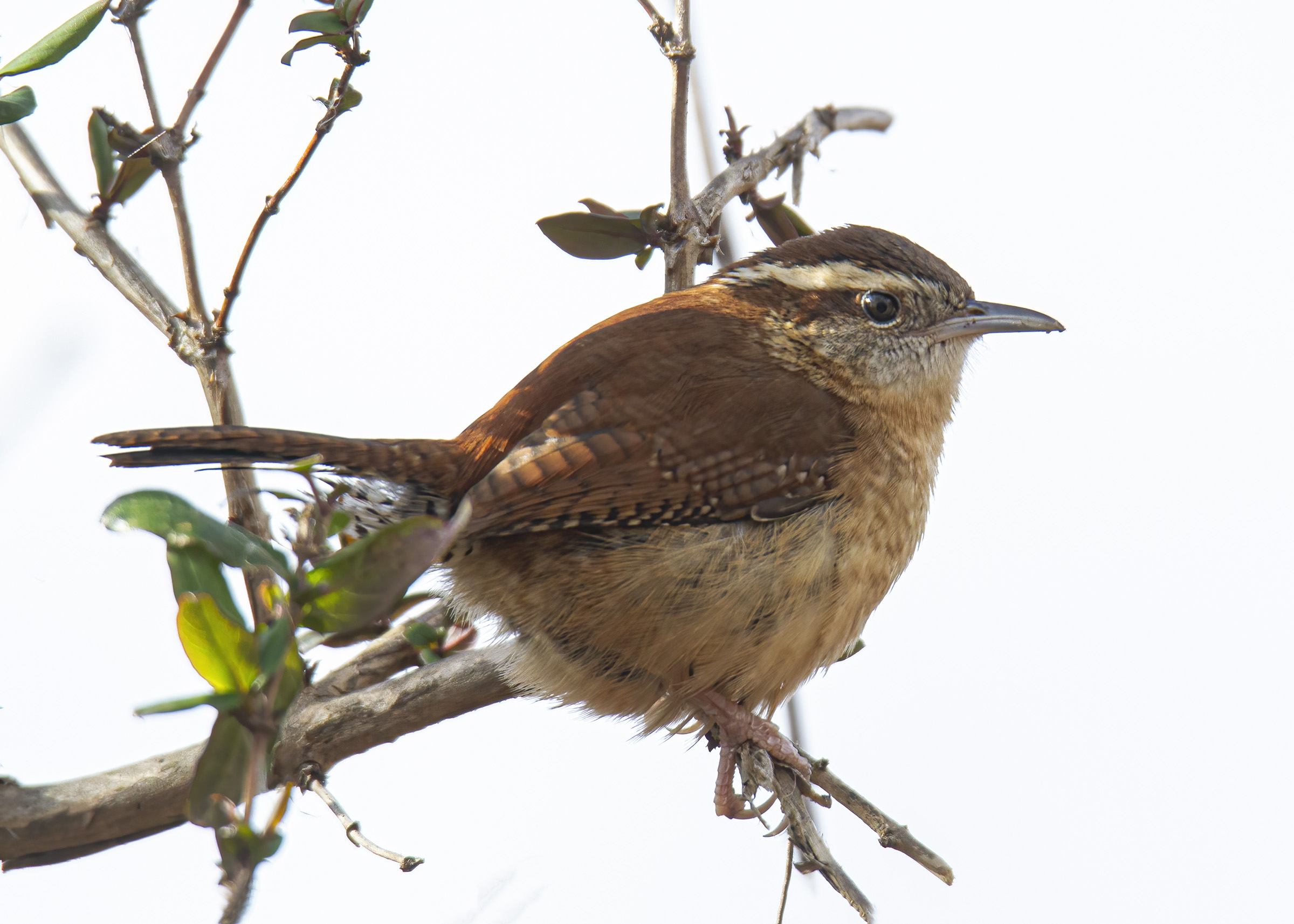
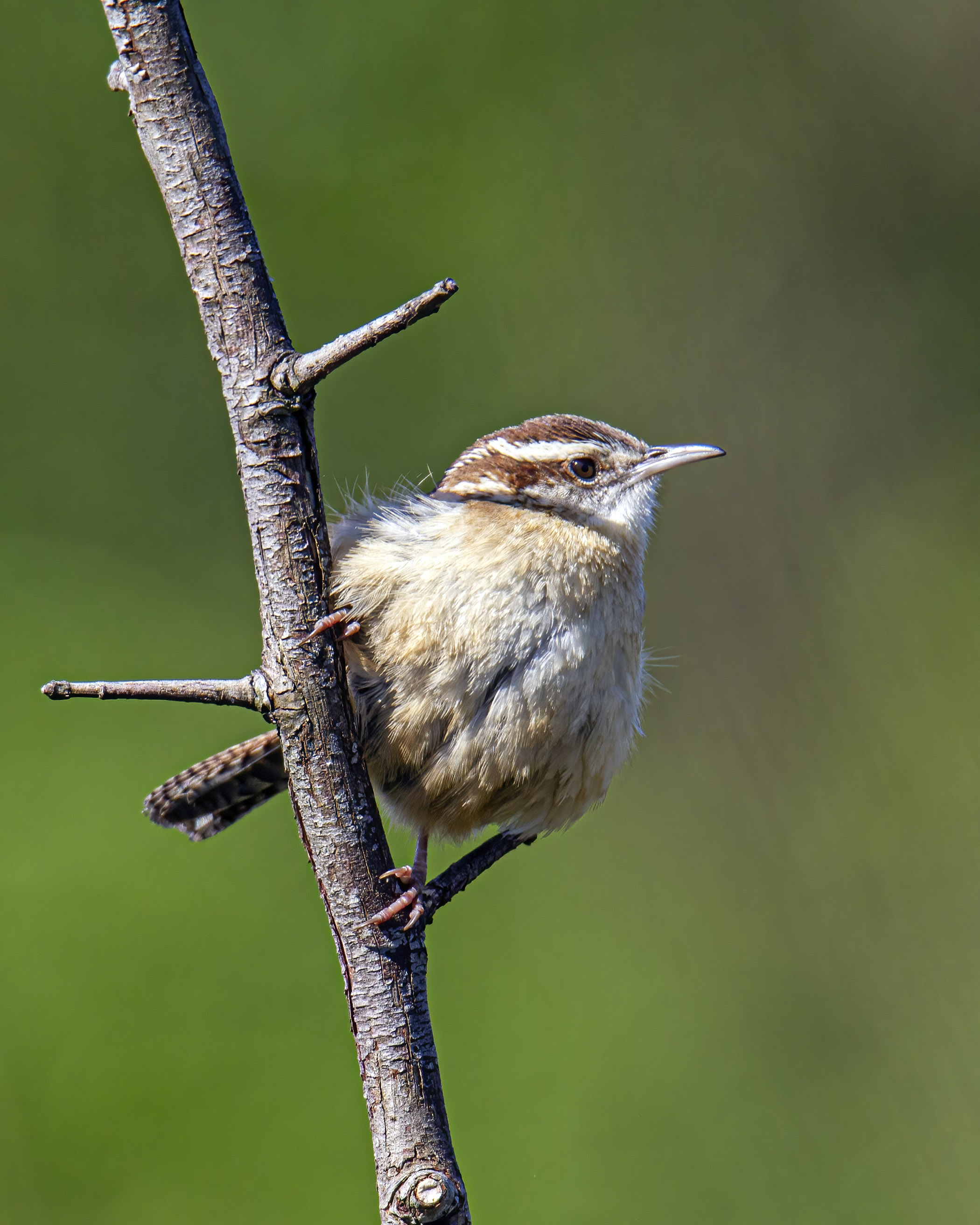
The bird in the first photo is an incredibly cute Carolina Wren (Thryothorus ludovicianus). Carolina Wrens frequently poke about in the undergrowth and I was delighted when this one chose instead to perch on a photogenic branch in the open.  The result was this pretty portrait of the little wren that looks almost like it was taken in a studio environment.

The bird in the second photo is a White-throated Sparrow (Zonotrichia albicollis). It was not perched in the open and it was not stationary. The little sparrow was bobbing and moving as it attempted to grab some of the tender shoots growing on the tree. I was happy when I managed to get a shot in which the bird has one of the shoots in its mouth. The background in this image is cluttered and part of the bird’s body is hidden by a branch. However, I like the moment that I captured and the way that the image provides a sense of the bird’s environment.

When I am photographing wildlife, I am unconsciously making a series of creative choices in the way that I frame an image and the camera settings that I use, all of which affect the look and feel of the resulting images. Sometimes of those images will be “artsy” and others will be “documentary”—I love both styles of photography.

Carolina Wren

White-throated Sparrow

© Michael Q. Powell. All rights reserved.

Read Full Post »

Bright colors are starting to emerge in the landscape as we move deeper into spring, a welcome sight after the long gray days of winter. I was delighted to see some equally bright colors in the feathers of several small birds that I photographed last Saturday in the vegetation surrounding a small suburban pond in Northern Virginia.

The first bird appears to be a female Yellow-rumped Warbler (Setophaga coronata). Normally I am not a big fan of a head-on shot of a bird, but in this case I really like the way that the photo shows both of the bird’s yellow patches on its breast (there is also a yellow patch on the warbler’s rump).

The bird in the second photo is a male House Finch (Haemorhous mexicanus). I was struck by the intensity of the red on the finch’s upper body, which reminded me of the color of a male cardinal.

In the coming months, warblers will be migrating northward through my area. Each year it is a real challenge for me to get shots of these colorful little birds, because they appear just as the trees begin to cover themselves with leaves—I often can hear warblers behind the leafy foliage without being able to see them.

yellow-rumped warbler

house finch

© Michael Q. Powell. All rights reserved.

Read Full Post »

When the light is coming from the right direction and a Double-crested Cormorant (Phalacrocorax auritus) is fairly close, you can catch a glimpse of the bird’s stunning turquoise eyes. Yesterday I was fortunate to spot a cormorant perched on a concrete bar that sticks out of a retention pond in a nearby neighborhood. The cormorant was fairly close to the shore, which meant that I was able to capture some detailed images of the striking bird.

The first image is a simply a crop of the second image that really highlights the cormorant’s eyes. The orange skin on its face really makes those eyes “pop.” The cormorant twisted its body from side to side, stretching its long neck, before finally slipping into the water, as you can see in the final photo. This is the view that I am most accustomed to during my wildlife adventures, though normally the cormorant is a lot farther away from me.

These photos are proof that it is not always necessary to travel to a wildlife refuge to see wildlife—this pond is only about a mile (1.6 km) or so from my suburban townhouse.

Double-crested Cormorant

Double-crested Cormorant

Double-crested Cormorant

Double-crested Cormorant

© Michael Q. Powell. All rights reserved.

Read Full Post »
When a Bald Eagle (Haliaeetus leucocephalus) looks directly at me, it feels really intense—there is a sense of ferocity and power in its glaring eyes. Normally I do not like eye-t0-eye photos of birds, because that direct angle causes their bills to look really strange. In this photo, though, I really like the way that the eagle’s beak looks and the way that the color of its beak matches the color of its feet.  The sharpness of the beak also mirrors the sharpness of the eagle’s prominent talons.

I try to get as many different kinds of photos of eagle as I can, and this image has a different “feel” than most of my other images. There is a minimalism and starkness that really appeal to me and a very, but effective composition.

I really feel blessed that I get to see bald eagles so often when I visit Occoquan Bay National Wildlife Refuge, where I take most of the eagle shots that are featured in my blog postings.


Bald Eagle

© Michael Q. Powell. All rights reserved.

Read Full Post »

A Turkey Vulture (Cathartes aura) turned its head to check me out as I walked by it during a recent visit to Occoquan Bay National Wildlife Refuge. However, the vulture did not move from its perch, suggesting to me that there was something dead nearby that had attracted the vulture’s attention.

I couldn’t help but think of a joke about a vulture that a friend told me last year—A vulture boards an airplane carrying two dead raccoons. The flight attendant looks at him and says, “I’m sorry, sir, only one carrion allowed per passenger.” Sorry—I have a somewhat warped sense of humor and love puns and wordplay.

Turkey Vulture

Turkey Vulture

© Michael Q. Powell. All rights reserved.

Read Full Post »

Some birds blend in so well with their surroundings that it is hard to spot them. That is definitely not the case with the male Northern Cardinal (Cardinalis cardinalis), whose bright red feathers announce his presence in even the most cluttered environment.

Last week at Occoquan Bay National Wildlife Refuge, I spotted this cardinal as he flew across the trail on which I was walking. Normally cardinals bury themselves in dense vegetation at ground level and it is tough to get a clear view of them. On this occasion, the cardinal perched on a fallen branch and briefly posed for me.

The first two images show off the cardinal’s beautiful red feathers really well, but the final photo is probably my favorite of the three. I love the way that the cardinal cocked his head to the side as he looked right at me—my dog used to look at me sometimes in the same pose with a similar mixture of puzzlement, curiosity, and amusement.

Northern Cardinal

Northern Cardinal

Northern Cardinal

© Michael Q. Powell. All rights reserved.


Read Full Post »

It was only three o’clock in the afternoon, so I was a bit shocked on Thursday when I spotted this North American Beaver (Castor canadensis) at Occoquan Bay National Wildlife Refuge. I have only seen beavers at this wildlife refuge a couple of times in the past and it was always near dawn or dusk.

I managed to snap a few photos before the beaver dove into the shallow water, swam through a culvert under the trail, and disappeared into the deeper waters of the bay.

beaver

© Michael Q. Powell. All rights reserved.

Read Full Post »

Yesterday at Occoquan Bay National Wildlife Refuge I had a short portrait session with a handsome male Canvasback duck (Aythya valisineria). When I asked him to smile, he gave me a wide, openmouthed grin, as you can see in the first photo. I like the way that the informal portrait shows his black and white breeding plumage, his chestnut-colored head, and his striking red eyes.

The Canvasback needed a more serious shot for work, so we captured the profile image that you see below. Most of the time I have trouble convincing birds to pose for me, so it was nice to come upon this cooperative Canvasback.

Canvasback

Canvasback

© Michael Q. Powell. All rights reserved.

Read Full Post »

Sometimes I am able to carefully compose my photos and ensure that I have the proper settings on my camera.  Frequently, though, I am forced to react instantaneously and merely point and shoot, with a primary goal of keeping my subject within the frame and hopefully in focus. Landscape and studio photographers may have the luxury of using  a slower, more deliberate process, but wildlife photographers rarely do.

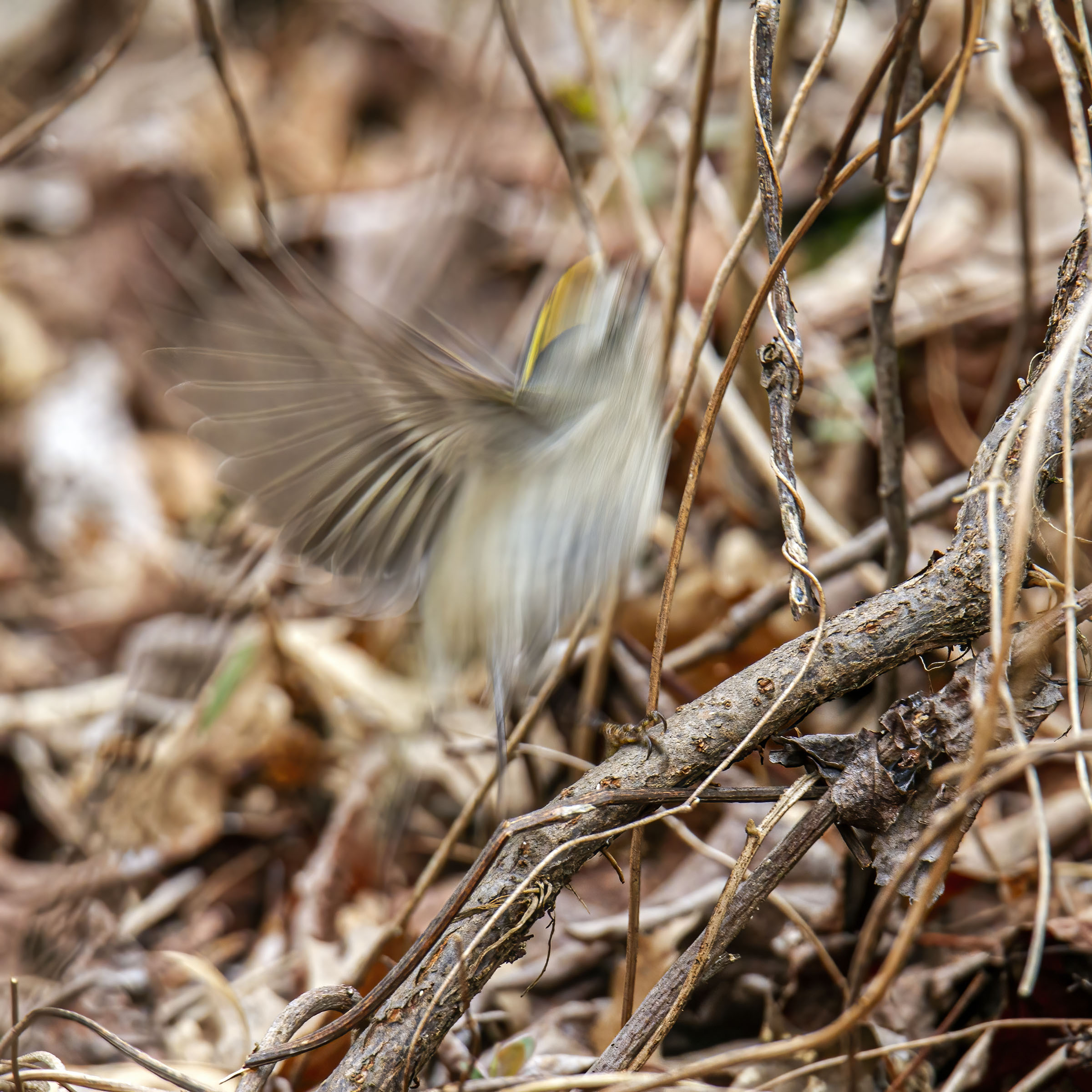
On Thursday I spotted a tiny Golden-crowned Kinglet (Regulus satrapa) in a tree at Occoquan Bay National Wildlife Refuge. The kinglet, which is only about four inches (10 cm) in length, was frenetically moving from branch to branch and I had trouble tracking it in my viewfinder. Suddenly it dropped down to ground-level and was briefing in the open.

I reacted quickly and fired off a short burst of shots. Amazingly, one of them came out pretty well, the first image that you see below. Why do I say “amazingly?’ My Tamron 150-600mm lens was fully extended  to 600mm and the lens is supposed to be “soft” at that focal length. More importantly, the shutter speed was only 1/125th of a second. However, I was able to get away with such a slow shutter speed because I was using a monopod, which helped to steady my camera.

A slow shutter speed may have been ok for a stationary subject, but it was no match for a moving one. A split-second after the first image, I captured the second image below in which the kinglet is almost completely blurry, though the branch on which it is perched is still pretty sharp. Note, however, that one of the kinglet’s feet is still on the branch and is in focus. Apparently I capture the moment when the kinglet was starting to flap its wings, but had not yet pushed off from the branch.

Although I have referred to “my” technique as “point and shoot,” there actually is some pre-planning involved. I am familiar enough with my favorite wildlife refuge that I know which subjects are likely to be found in specific locations. I also try to pay attention to my camera settings and adjust them to the amount of light available to increase the chances of getting a proper exposure for my reactive shots.

Golden-crowned Kinglet

Golden-crowned Kinglet

© Michael Q. Powell. All rights reserved.

Read Full Post »

This Great Blue Heron (Ardea herodias) was slowly striding through the shallow water at Occoquan Bay National Wildlife Refuge when I spotted him yesterday afternoon. He seemed to have a swagger in his step, showing off like he was walking on a catwalk and knew how handsome he looked. I really liked his pose and posture and the cool reflection in the water was a nice bonus.

Great Blue Heron

© Michael Q. Powell. All rights reserved.

Read Full Post »
I love the way that the coloration of this Great Blue Heron (Ardea herodias) is an almost perfect match for the environment where I spotted it last week at Occoquan Bay National Wildlife Refuge.

Great Blue Herons are one of my most frequently photographed  subjects, especially during the winter months, and I am always looking for unique ways to capture images of them. From a technical perspective, this image is far from perfect, but its aesthetic appeal really pleases my eye—in addition to the colors, I really like the variety of textures in the photo..

Have a wonderful weekend.

Great Blue Heron

© Michael Q. Powell. All rights reserved.


Read Full Post »

Male Ring-necked Ducks (Aythya collaris) are rather odd ducks. They have an unusual pointed head and striking yellow eyes. However, they have a striped pattern on their bills that make them pretty easy to identify. Although they paddle about a lot like dabbling ducks, they will periodically dive to the bottom to eat submerged plants and aquatic invertebrates.

Despite their name, it is unusual to be able to see the chestnut collar on a Ring-necked Duck’s black neck. According to the Cornell Lab of Ornithology, the ring is “not a good field mark to use for identifying the bird, but it jumped out to the nineteenth century biologists that described the species using dead specimens.”

Like several other species that I have featured recently, this Ring-necked Duck was part of a small flock that I spotted swimming about in a small suburban pond not far from where I live. Sometimes in the winter I will make a quick visit to this pond when I to experience nature, but don’t have the time to devote to a trip to the larger wildlife refuges in my area.

Ring-necked Duck

Ring-necked Duck

© Michael Q. Powell. All rights reserved.

Read Full Post »
I love the spiky reddish “hairstyle” of a female female Hooded Merganser duck (Lophodytes cucullatus). I spotted this little beauty on Monday at a small suburban pond not far from where I live. Technically this is a “stormwater management facility,” but the pond is big enough and deep enough that a number of different duck species (and a lot of Canada Geese) are resident there during the winter months.

Hooded Merganser

© Michael Q. Powell. All rights reserved.

Read Full Post »

It is wonderful to capture images of Bald Eagles (Haliaeetus leucocephalus) in action, but most of the time when I spot one, the eagle is merely perching in a tree. Although the eagle is immobile, it is clearly keeping an eye on what is going on and is ready to spring into the air without warning.

Here are a couple of shots of perched eagle from a couple of recent visits to Occoquan Bay National Wildlife Refuge in Northern Virginia, about 15 miles (24 km) from where I live. The images are not spectacular or prize-worthy, but I nonetheless feel a special thrill whenever I see a Bald Eagle and doubly so when I manage to take a photo of it.

Have a wonderful weekend.

Bald Eagle

Bald Eagle

© Michael Q. Powell. All rights reserved.

Read Full Post »
When I first spotted a Great Blue Heron (Ardea herodias) perched high in a tree on Thursday at Occoquan Bay National Wildlife Refuge, I noticed that its head was bowed. I figured that it was either praying or napping, probably the latter.

The heron raised its head a little and opened its eyes when I got closer, but apparently it decided that I was not a threat. Gradually the heron’s head started to drop and it drifted off to sleep again. As you can see in the final photo, herons sleep with their eyes closed (or at least that is what it looks like they do).

Sweet dreams, handsome heron.

Great Blue Heron

Great Blue Heron

Great Blue Heron

© Michael Q. Powell. All rights reserved.


Read Full Post »

Carolina Wrens (Thryothorus ludovicianus) are one of the birds that I hear a lot more often than I see. Most of the time these little birds are flitting about in the vegetation and leaf litter near the ground and and I am lucky to get a glimpse of one of them.

On Thursday at Occoquan Bay National Wildlife Refuge, a handsome Carolina Wren hopped up on a branch right in front of me and perched for a moment. I was thrilled to capture this little portrait of the wren that shows the beautiful markings on its wings and its distinctive white eye stripe.

Carolina Wren

© Michael Q. Powell. All rights reserved.

Read Full Post »

I was thrilled last week at Occoquan Bay National Wildlife Refuge to spot two Bald Eagles (Haliaeetus leucocephalus) in the large nest at the refuge. They have been hanging around the area for a while, appearing to be keeping an eye on the nest, but this was the first time that I have spotted them inside of it. The eagle on the left was visible for an extended period of time, while the one on the right popped up only occasionally and appeared to working on renovating the interior of the nest.

The nest is quite large and deep, so it is often hard to tell when the eagles are in it, especially when they begin to sit on their eggs. I was not able to get many clear shots, but was happy with the two images below that show slightly different poses of the eagle couple.

UPDATE: I decided to add a third photo to give you an idea of the massive size of the eagle nest. Every year it seems like they add a new layer of sticks that increases its size.

Bald Eagles

Bald Eagles

eagle nest

© Michael Q. Powell. All rights reserved.

Read Full Post »

Late on Monday afternoon I spotted this large male Wild Turkey (Meleagris gallopavo) at Occoquan Bay National Wildlife Refuge as he was foraging in the leaf litter. The turkey was very focused on scratching about in the fallen leaves and let me get so close to him that I was able to take this shot at 250mm on my zoom lens that extends to 600mm.

The light was already starting to fade—the sun set at 4:53 pm that day—and I know that my relatively old DSLR does not handle low light very well, so I did not want to raise the ISO beyond ISO 800, for fear of introducing an unacceptable amount of graininess. Instead, I captured this image with an exposure of 1/40 second, a really slow shutter speed. Even though I was using a monopod for stability, many of my shots were blurry, but this particular image ended up pretty sharp.

I love the way that I was able to capture so many details of the turkey’s feathers. From a distance, the main feathers look to be a solid dark color, but up-close, they show a lot of color variation and patterns. I was happy too that I was able to get a good view of the turkey’s “beard.” I’ve read that you can estimate the age of a turkey on the basis of the length of its beard, but I am not confident that I could figure that out—all I can say is that the turkey appeared to be a mature male to me.

Wild Turkey

© Michael Q. Powell. All rights reserved.


Read Full Post »

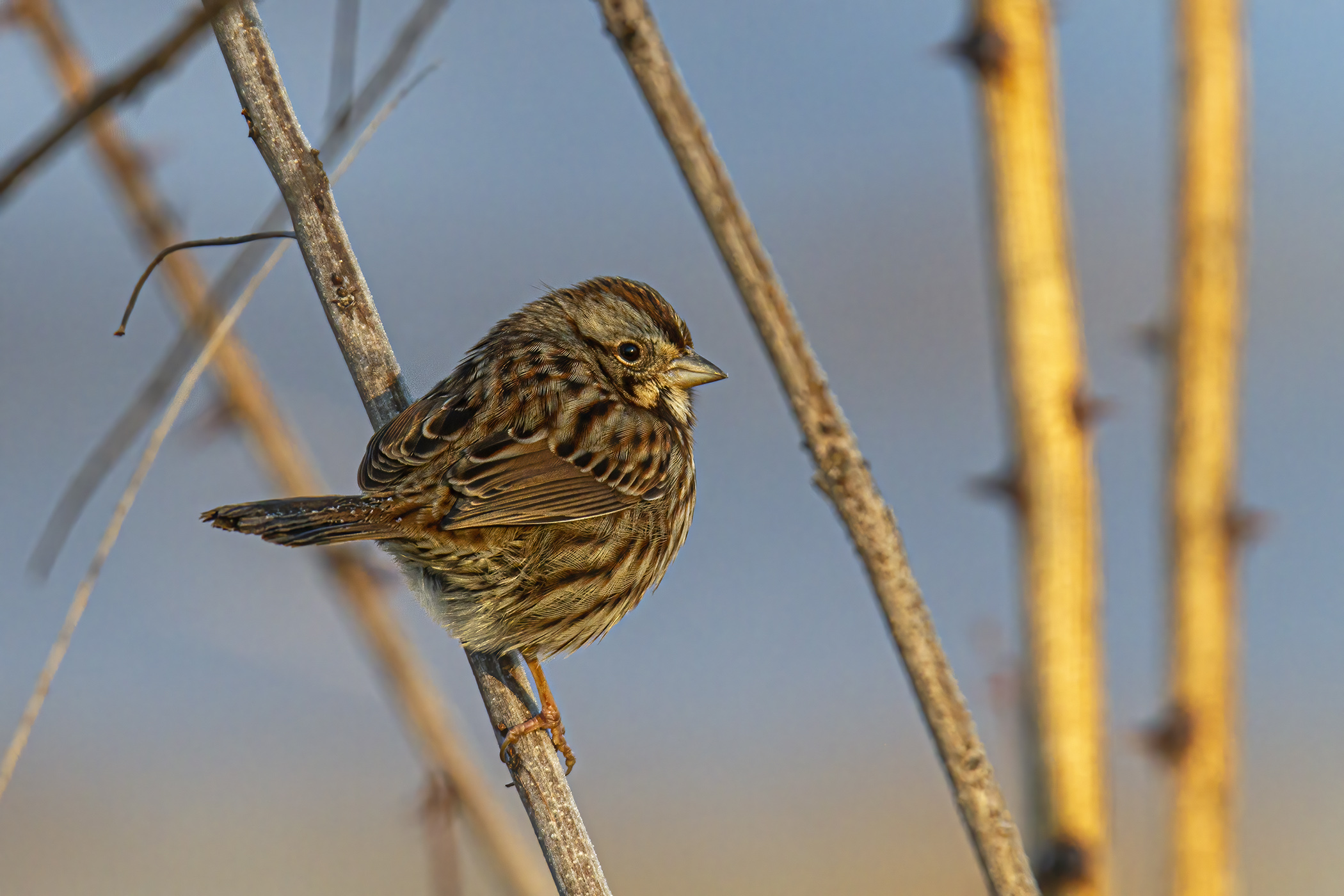
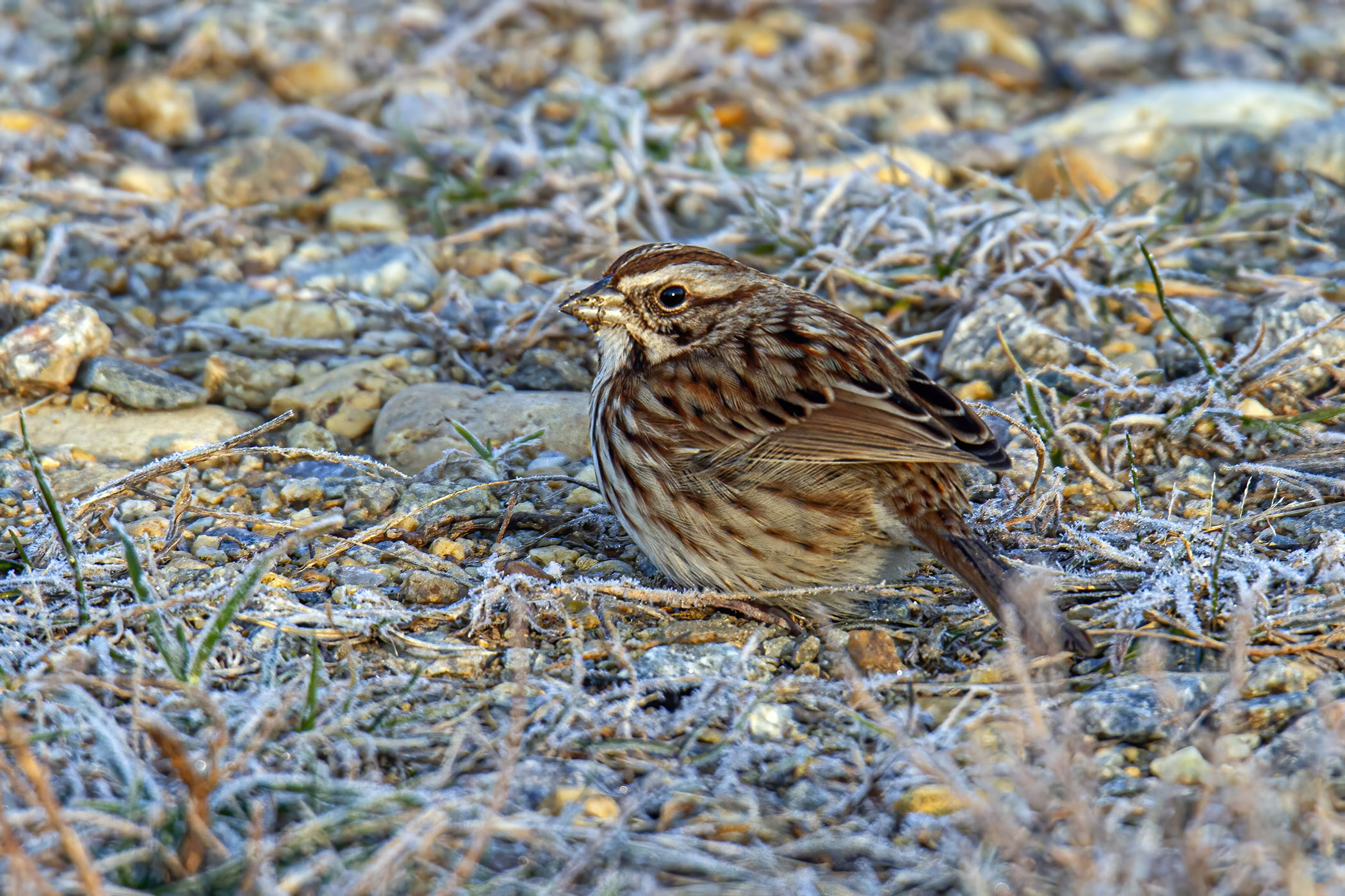
On many cold winter days, sparrows are the most common birds that I see. No matter how inclement the weather may be, sparrows are busily foraging in the trees and on the ground. Last Tuesday at Occoquan Bay National Wildlife Refuge, on a day when it was sunny, but frigid, I was able to capture little environmental portraits of these three sparrows, all of which I believe are Song Sparrows (Melospiza melodia).

My favorite of these three images is definitely the first one, with its smooth background colors and the linear shapes of the vines. However, I also really like the way that the second and third images show the little birds in their environments, with one with a cool palette of colors and the other with a touch of sunshine and warmer tones.

Many of you know that I love to photograph large birds like hawks and eagles, but I equally enjoy capturing the beauty of smaller birds, like these sparrows. Beauty is everywhere.

A belated Merry Christmas to those of you who celebrate Christmas. I decided to turn off my computer yesterday and am starting to catch up today. On Christmas Eve, I played handbells in one church service and then sang in a choir for a second service. On Christmas Day, I ran the audio video portion of our service that we also broadcast on Zoom, so I have been pretty busy

In the Episcopal Church that I now attend, we have only just begun our celebration of Christmas and will continue to do so until Epiphany on 6 January, when we celebrate the arrival of the Three Wise Men. I grew up singing the song The Twelve Days of Christmas and thought that it referred to the twelve days leading up to Christmas. It was only later in my adult life that I learned that Christmas Day itself is the first day of Christmas. The radio stations may already have moved on from playing Christmas songs, but I will continue to do so for at least another 10 days or so (and I actually like singing Christmas carols throughout the year).

Merry Christmas and best wishes for a happy and healthy 2023.

Song Sparrow

Song Sparrow

Song Sparrow

© Michael Q. Powell. All rights reserved.

Read Full Post »

A patch of sumac berries at Occoquan Bay National Wildlife Refuge has providing nourishment for a lot of different birds as we begin the winter winter season. On Tuesday of this week, I photographed a Northern Mockingbird (Mimus polyglottos) as it partook of the bounty of berries.

The day was cold, but sunny and the blue sky provided a beautiful backdrop for this little portrait of the mockingbird. The bird’s up-turned tail provided a nice visual counterbalance to the angled branch of the sumac plant and the visible berry in the bird’s open mouth was an extra bonus.

This morning as I was doing a little research on the sumac, I finally discovered the name of this type of sumac. I am pretty sure that this is a species know as Smooth Sumac (Rhus glabra). According to the plant database at wildfire.org, Smooth Sumac is the only shrub or tree species native to all 48 contiguous states. I have never been tempted to taste the little berries, but they are reported to be very sour and can be used to make a drink similar to lemonade.

Northern Mockingbird

© Michael Q. Powell. All rights reserved.


Read Full Post »

Bluebirds always make me happy and I will rarely pass up an opportunity to photograph one—I simply love that complementary color combination of blue and orange. I was doubly delighted on Tuesday to capture this image of an Eastern Bluebird (Sialia sialis) perched on branches that formed a natural frame that highlighted his beauty.

Eastern Bluebird

© Michael Q. Powell. All rights reserved.

Read Full Post »

During the winter months it is not uncommon for me to see large flocks of European Starlings (Sturnus vulgaris). When the lighting is poor, they appear to be entirely black in color. When the sun is shining brightly, however, I am sometimes able to see the speckles in their feathers and a shiny iridescence that often looks greenish or pinkish in color.

This starling was part of a flock that I spotted on Friday at Occoquan Bay National Wildlife Refuge. The birds were foraging high in the trees and most of them flew away as I approached. This one hung around for a bit longer than the others, allowing me to capture these shots that highlight markings pretty well.

According to the Cornell Lab of Ornithology, “All the European Starlings in North America descended from 100 birds set loose in New York’s Central Park in the early 1890s. The birds were intentionally released by a group who wanted America to have all the birds that Shakespeare ever mentioned. It took several tries, but eventually the population took off. Today, more than 200 million European Starlings range from Alaska to Mexico, and many people consider them pests.”

Another fun fact that I learned on the Cornell Lab of Ornithology website relates to the feathers of this cool-looking bird. “Starlings turn from spotted and white to glossy and dark each year without shedding their feathers. The new feathers they grow in fall have bold white tips – that’s what gives them their spots. By spring, these tips have worn away, and the rest of the feather is dark and iridescent brown. It’s an unusual changing act that scientists term “wear molt.””

European Starling

European Starling

© Michael Q. Powell. All rights reserved.

Read Full Post »

« Newer Posts - Older Posts »