Feeds:
Posts
Comments

Archive for the ‘Portraits’ Category

It was early in the morning and I was walking almost directly east along a stream. The sun had already risen and was in my eyes, but I spotted a Great Blue Heron in the water. I was able to get a shot that I knew would turn out as a silhouette, but the heron was standing in such a way that I was pretty confident that his silhouette would be immediately recognizable. The glare caused the color to wash out almost entirely and there are all kinds of artifacts from the light, but I like the overall effect.

Great Blue Heron Silhouette

© Michael Q. Powell. All rights reserved.

Read Full Post »

This is another shot of the Great Blue Heron (Ardea herodias) who was so cooperative today in permitting me to get close to him. In this shot, his eyes are fixed intently on the water, which unfortunately was covered with some combination of algae and duckweed. There was virtually no way for him to spot any potential prey below the surface of the water. His body seems coiled, ready to strike at a moment’s notice. He remained in this position for quite some time, but eventually he relaxed and gave up the hunt. Later, he moved to the other small pond and was equally unsuccessful there.

Focused blue heron (click for a higher resolution view)

© Michael Q. Powell. All rights reserved.

Read Full Post »

I was lucky today. Normally when I have tried to photograph Great Blue Herons (Ardea herodias), I have had to do so at the maximum range of my telephoto zoom lens and even then would have to crop the image significantly. The result has been that my photos have not been as sharp or detailed as I would have liked.

Today was different. I was walking around the little ponds at Green Spring Gardens, a county-run historical park where I had previously taken photos of a green heron, when I startled a Great Blue Heron who had been perched in a tree. He flew off high into a tree across the pond and remained there as I followed him and tried to take some photos. I have not yet looked at those photos, but suspect that they are a little distorted, given that I was shooting almost straight up.

It started to drizzle a bit. When all of the other visitors left, the heron flew down from the tree and landed no more than 30 feet from me. He wandered along the water’s edge, periodically entering the water and staring intently at its surface, probably searching for something to eat. I cautiously approached him and he let me get with fifteen feet or so of him and I even circled around him trying to get a decent angle and background for a shot. How close was I? At times I could not use the full range of my 55-250mm lens if I wanted to capture his whole body.

Here is one of my initial favorite shots. I shot it with the lens extended to 194mm with settings of f9.0, 1/200 sec, ISO 400, and an exposure compensation of -.67. Other than a little sharpening and a little cropping, this is the way the image came out of the camera.

Indeed, I was lucky today to encounter an unusually cooperative Great Blue Heron.

Cooperative Great Blue Heron

© Michael Q. Powell. All rights reserved.

Read Full Post »

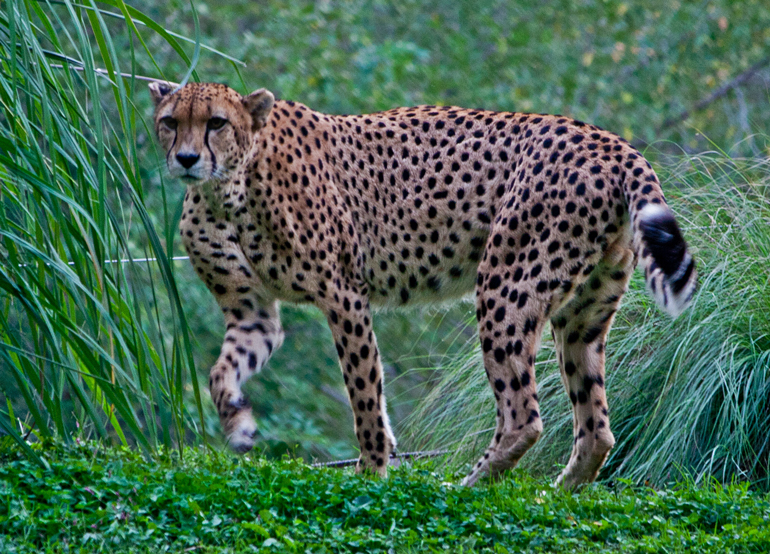
Photographed yesterday at the National Zoo in Washington, D.C. where I spent hours observing the cheetahs. There is so much to love about cheetahs—their elegance, speed, coloration, and strength. This image shows that they also have beautiful eyes.

Portrait of a cheetah at the National Zoo

© Michael Q. Powell. All rights reserved.

Read Full Post »

I visited the National Zoo in Washington, D.C. this afternoon and spent the lion’s share of the time with the cheetahs. National Zoo has a very active cheetah conservation program that you can lean more about on its website. At the moment there are six cheetahs (three brothers, one female, and two cubs) that live at the zoo, according to the website.

Most of my time was spent with what I believe was the three brothers (named Draco, Granger, and Zabini), who were  together in a single outdoor enclosure. If they were brothers, one of them seemed to be considerably larger than the other two. The zoo website indicates that the brothers were born in 2005.

I haven’t had a chance to go through all my photos, but thought I’d post a couple as a kind of sneak preview. I know that some folks object to photographing animals in captivity and apologize if I have offended anyone.  However, especially in the case of the cheetahs, I encourage you to check out the work that is being done to preserve this magnificent species as well as others.

Cheetah in the grass

Cheetah walking

© Michael Q. Powell. All rights reserved.

Read Full Post »

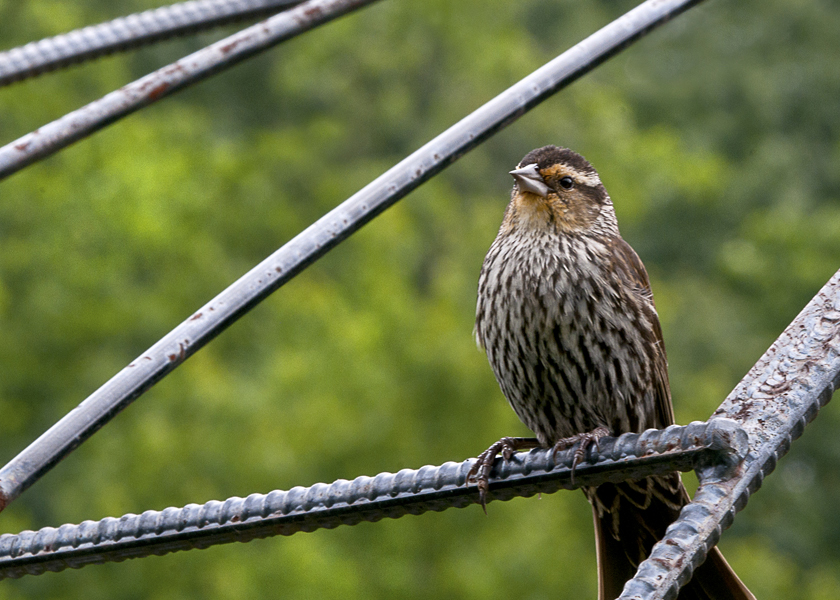
I have recently been making a lot of attempts to photograph birds, but none of the photos comes close to matching the visual impact of this female red-winged blackbird that I photographed in early June at Brookside Gardens in Wheaton, MD.

Normally you are not supposed to photograph a bird from the front, but in this case it seems to heighten the intensity of the bird’s stare. The sky was almost white that day and it disappeared when tweaks were made, but that seemed to fit with the industrial look provided by the rebar that was used to form a trellis.

Intense female red-winged blackbird

Here is another shot of the blackbird on the trellis, with some greenery in the background. You can see some of the details of the trellis, and it looks like the rusted metal is almost a perfect color match for some parts of the bird.

Bird on a wire

My blog is still less than three months old, so I have a number of my pre-blog favorites that you have not yet seen. I will occasionally share some of them when I don’t have any new material or don’t have time to prepare the new photos.

© Michael Q. Powell. All rights reserved.

Read Full Post »

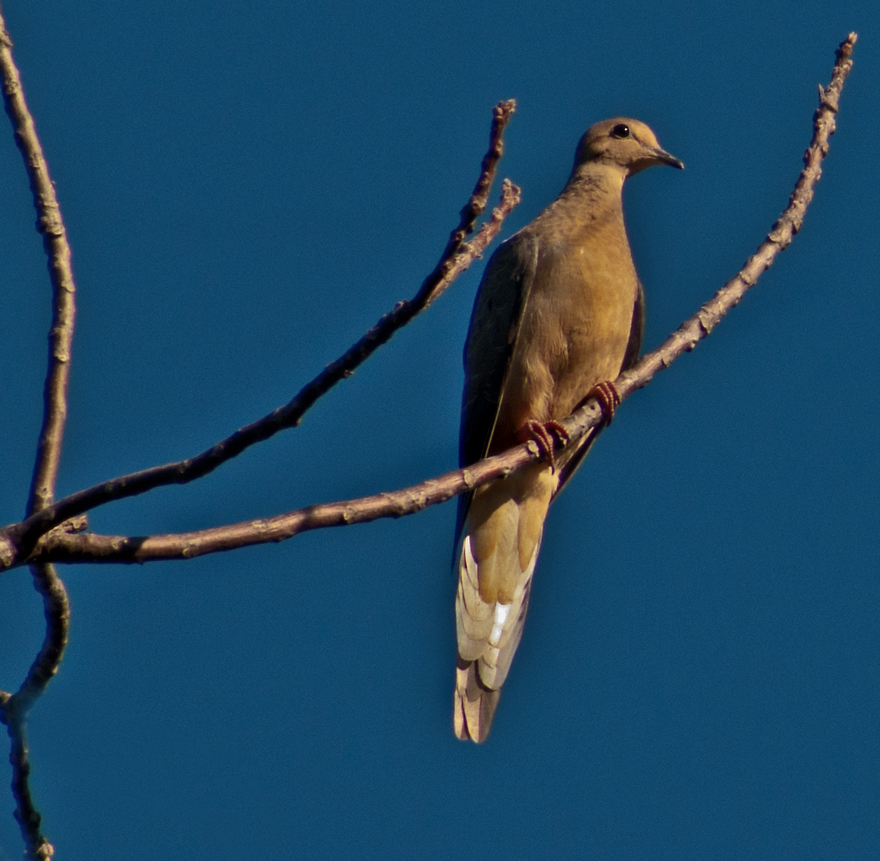
Yesterday I went out to a local garden with the monster Mamiya 500mm telephoto lens mated to a Nikon D300 to see if I could get some reasonably focused shots. A few days ago I did a posting outlining my initial difficulties in mastering the requirements of shooting in a totally manual mode and I wanted to see if things would be a little easier for me.

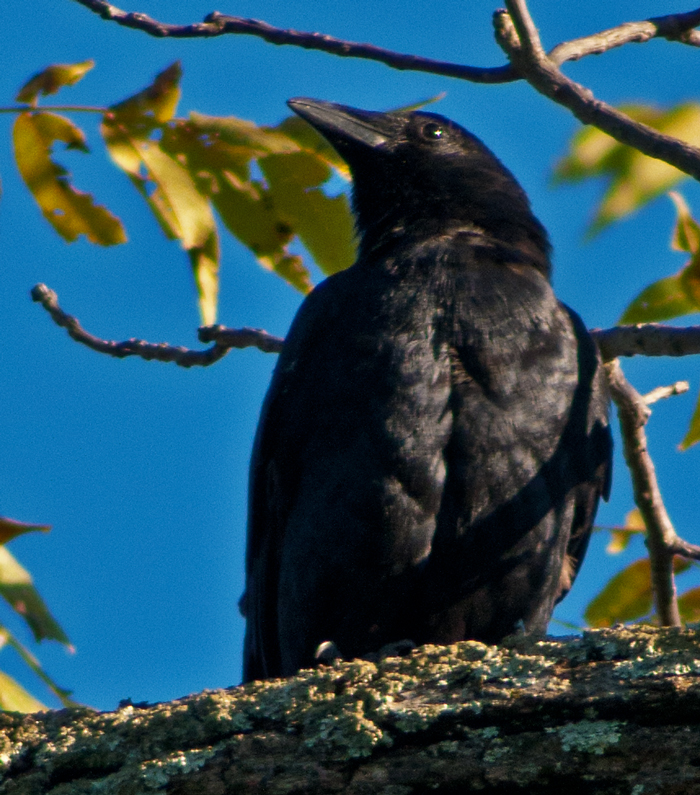
It was once again a lot of fun experimenting and I tried taking shots of a wide variety of subjects, including soccer-playing kids, flowers (yes, flowers with a 500mm lens), and a rabbit. Other than the rabbit, I had only limited success. The real test for me, though, was whether I could capture some shots of birds. I noticed a couple of birds perched high up in a tree in a relatively open area and I was able to set up my tripod on the grass and began to make a few exposures. The birds were far enough away that they were not distracted by the sound of the shutter and they stayed in place as I made adjustments. Here are some of my best shots of a crow (I cropped him so you can see the details, including the catch light in his eye) and a mourning dove. I am also including a shot of a bird that almost got away. He flew away just as I tripped the shutter and ended up in the lower left hand corner of the image in an unusual position. I decided also to post a shot of a rabbit that seems to have some personality. In this garden setting, it was the wildest animal to be found.

I have satisfied myself that it is possible to get some good images with this setup, although it requires both patiience and persistence. Is it worth the additional aggravation? My friend, Cindy Dyer, for whom I am testing this configuration will have to make that call for herself.

Close-up of a crow

Mourning dove

The one that almost got away

Rabbit on the grass

© Michael Q. Powell. All rights reserved.

Read Full Post »
Basking in the warmth and light of the fall sun, turtles of all sizes were perched on the logs and other chunks of wood in the muddy waters of a local marsh pond. I was struck by the attitude of this red-eared slider turtle (Trachemys scripta elegans), whose stiff-necked and imperious pose seemed almost aristocratic. He had gained this prime piece of real estate by crawling over one of his fellow turtles and was now standing on that turtle’s back to provide himself better access to the sun.

I have to admit that he is beautiful and I suspect that he would be the first to tell me so if he could speak.

Red-eared slider turtle basking in the sun

© Michael Q. Powell. All rights reserved.

Read Full Post »

Blue Dasher dragonflies seem to have disappeared from my local marshland, but I was happy today to see that the Common Whitetail dragonflies (Plathemis lydia) are still around. They are not as elegant and colorful as some other dragonflies and are somewhat stubby and drab (and, in fact, are called “common”). My portrait below shows, however, that they possess their own special beauty.

Common Whitetail dragonfly in mid-September

© Michael Q. Powell. All rights reserved.

Read Full Post »

It’s only a grasshopper, not an exotic insect, but I really like the way that his portrait turned out.

The grasshopper’s pose suggests that he is ready for action and his slightly cocked head helps to give him personality. I was able to get sufficient depth of field and sharpness by using an F8 aperture, ISO 200,  and 1/200 sec and by moving in a bit from the far end of my telephoto zoom (I was at 229mm of a 55-250mm lens). Both the foreground and the background are simple and are made up of a minimum of colors, mostly green and brown. The day was mostly cloudy, so the shadows are soft.

All these elements seemed to work in harmony and I was able to produce this nice, open-air portrait of a grasshopper.

Grasshopper portrait (click for a higher-resolution view)

© Michael Q. Powell. All rights reserved.

Read Full Post »
This past weekend seems to have been my heron weekend. I posted some photos of a great blue heron that I saw on Saturday. However, I realize that hadn’t yet gone through all of my photos from Friday, which included this shot of a green heron perched on the dead limb of a tree.

The tree was overlooking a muddy pond and I couldn’t tell if the green heron was just resting or whether he was preparing to hunt for prey. The situation afforded me an unobstructed view of the green heron and I quickly started taking some shots, suspecting (as turned out to be the case) that my luck would not hold for long. The green heron soon jumped from his perch and moved farther away into some undergrowth when he focused his attention on the water.

I was totally fascinated and watched him from a distance for quite a while. Several times he “alerted” by extending his neck and leaning toward the water, but I didn’t managed to see him catch anything.

This image captures some of  of the green heron’s gorgeous colors. I especially like the chestnut color around his neck and the intensity of the yellow of his eyes.

© Michael Q. Powell. All rights reserved.

Read Full Post »
Some bees are hairy and some bees are really hairy.

Seriously, this bee looks like he could use a beauty makeover. At a minimum he needs a trip to a barber or hair stylist to trim away some of that excess hair. Look at his legs, his forehead, and his neckline. Yikes! The worst area may be the swirly hair on his back. I haven’t seen anything that bad since the days when the comb-over was a popular hair style.

Maybe he is wearing his hair long to conceal the fact that he is going thin on his back. If that’s the case, I have news for you, Mr. Bee. “You’re not fooling anyone.”  It’s time to get with modern styles, perhaps, and shave it all off.

What would a bald bee look like?

Fuzzy Wuzzy was a bee…

© Michael Q. Powell. All rights reserved.

Read Full Post »
Four weeks ago today my friend and mentor Cindy Dyer helped me to start this blog. She has been teaching me and encouraging me as I seek to express myself through my photography. I owe her my thanks.

Over the past month I’ve tried a lot of different things: short posts and long ones; serious posts and funny ones; scientific posts and artistic ones; and scarey posts and beautiful ones. Some have been successful and others less so. The best thing about this blog, however, is that I have encountered a wide array of fellow bloggers. You have taught me so much and supported me with words of encouragement and inspiration. Thanks to all of you.

My first blog posting featured a Blue Dasher dragonfly, one of my favorite subjects. It somehow seems appropriate to feature another one as I celebrate my four-week anniversary. I photographed this Blue Dasher dragonfly (Pachydiplax longipennis) in late June at Green Spring Garden, a county-run facility that has a pond as well as a garden. It is only a few miles from my house and has been a kind of laboratory for me as I have worked on my photography.

Today is a hot, humid day here in the Washington DC area and I have stayed indoors poring over some of my images from the past month or so. I came across this one and after I adjusted the exposure a bit I realized that it was a pretty good shot. The lighting and background help to make it stand out from some of my other dragonfly photos (and I have lots). I uploaded a higher resolution image to allow viewers to see some more of the details, including the “eyelashes” of the dragonfly. Be sure to click on the image.

Click on the photo for a more detailed view of the dragonfly

© Michael Q. Powell. All rights reserved.

Read Full Post »

A few minutes ago I was vacuuming when I suddenly noticed that there was an insect on the screen of my sliding glass patio door.  Of course, I immediately stopped working and grabbed my camera (with macro lens) and tripod.

I decided to try some face-to-face shots, which was a little tricky for the insect (which I think is a katydid) was less that two feet above ground level. I am glad that nobody could see me as I contorted my body with considerably less grace than the Olympic gymnasts I watched earlier this week.

When I looked at my closeup shots of the eyes, I realized they were a little creepy. No, they were more than a little creepy. So, of course, I am sharing them with you. Hopefully this image does not cause anyone to lose sleep or have nightmares and I certainly would not advise blowing this up and hanging it on your wall. (And yes, I know my macro technique still needs work, but I am still just learning.)

Now I can return to my chores, unless some other photo opportunity literally falls at my door step.

© Michael Q. Powell. All rights reserved.

Read Full Post »

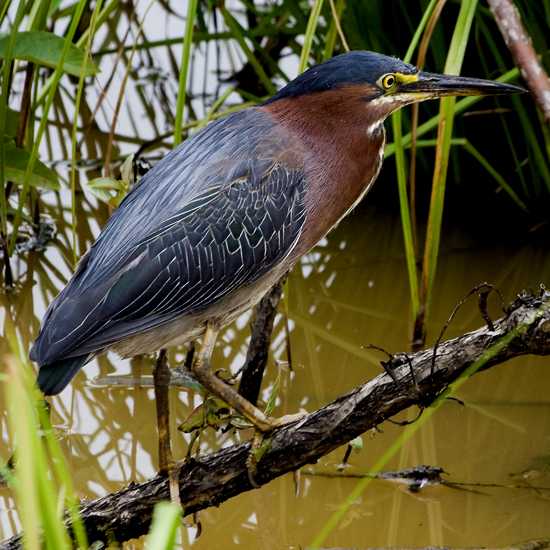
Yesterday’s blog entry featured the adventures of a young green heron catching and swallowing a frog. After the snack was consumed, though, the heron moved from the boardwalk into the marshy area. There he perched on a branch and seemed to pose for me, maybe figuring that his exploits were worthy of a magazine feature.

The resulting photograph is one of my favorite shots of the whole day, because I think it captures well the rugged beauty of this young bird. The background is a little distracting but I like the reflections in the water and the angle of the ranch.

I decided to include two additional action shots from yesterday. The photos seem to show that I probably was incorrect when I stated that the heron had speared the frog when he initially caught it. It looks like the heron was merely holding the frog with his beak as he adjusted its position. Now that I think about it, the process of swallowing the frog would have been complicated if the frog had been speared.

© Michael Q. Powell. All rights reserved.

Read Full Post »

« Newer Posts