Feeds:
Posts
Comments

Archive for the ‘Portraits’ Category

The last month or so I have been keeping an eye on a couple of female Hooded Merganser ducks that are using a nesting box at my local marshland park. One of my fellow photographers has already posted a photo of one of them, surrounded by a dozen or so cute little ducklings, so I may have missed one of the moments that I was hoping to catch.

A little earlier this month, though, I had a special moment with one of them, when I arrived at the park early in the morning, just after the sun had risen. The small female duck was more out in the open than usual, though she was still pretty far away. Initially she seemed to be taking a bath, as she stuck her head under water and would shake a little. Eventually she climbed out of the water onto a log and began to groom herself.

The light at that moment from the back and the side made the spiky reddish-blond hair on her head glow and also created a nice reflection in the water. She seemed unhurried and unafraid as she basked in the beautiful early morning light.

For at least a moment, the two of us were freed from the cares of our everyday lives.

merganser_morning_blogmerganser2_blog

Michael Q. Powell. All rights reserved
Read Full Post »

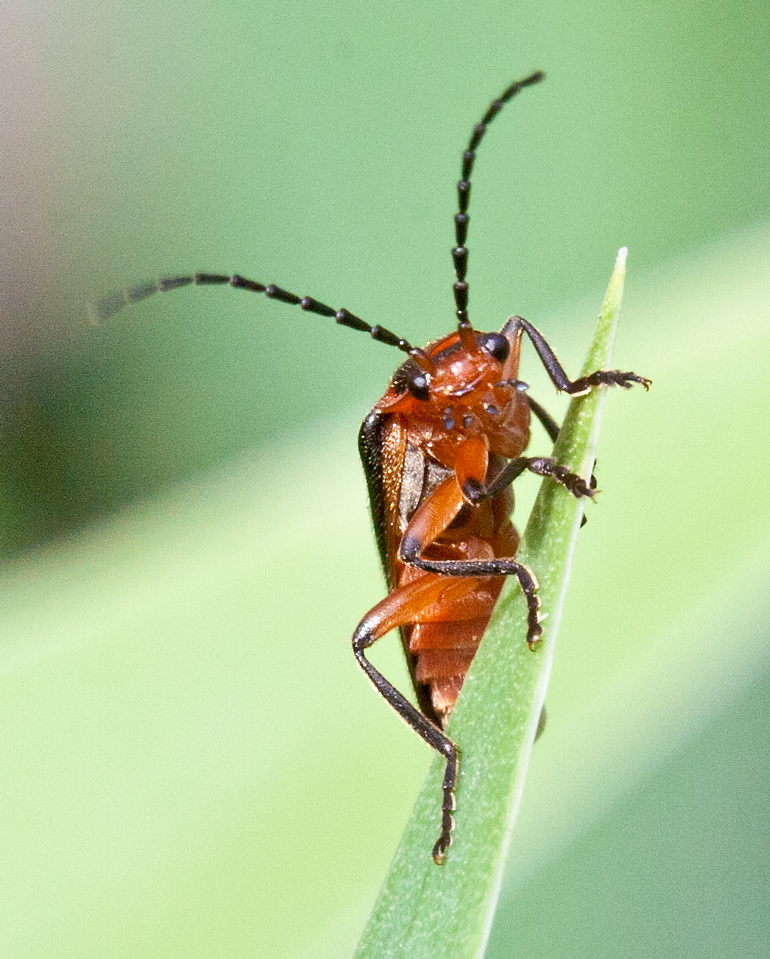
An insect on the edge of a leaf is a perfect candidate for a macro shot and when I saw this one from a distance in my neighbor’s garden, I got to work without a clue about its identity.

When I looked at the photos initially, I thought I had captured images of a Red Milkweed Beetle (Tetraopes tetrophthalmus), because of its bright red body and curved, segmented antennae. (I have a self-identified obsession with this insect that I discussed in a blog posting last year.) However, there were a few problems with that identification. This beetle seemed smaller; it was on a plant that was definitely not a milkweed plant; and it seemed too early to be seeing a milkweed beetle. My identification was further complicated by the fact that I never did see the back of the beetle.

So what insect did I photograph? I have been going over photos at bugguide.net, one of my favorite sources and wonder if this might be a Lily Leaf Beetle (Lilioceris lilii). Tentatively, though I like the name that I invented for this post, Red Spring Beetle.

I may not be sure about the identification of this insect, but I know that I like the photos that I managed to get, especially the first one. I captured a pretty good amount of detail and I like the way that he posed, looking directly at me.

red_bug3_blogred_bug2_edited-1

Michael Q. Powell. All rights reserved

Read Full Post »

Although it is exciting to be able to capture a photo of a Great Blue Heron (Ardea herodias) flying or catching a fish, I find them to be beautiful even when they are standing still.

I came upon this heron early one morning a week ago or so and was struck by the serenity of the moment. The heron seemed pensive and the beautiful morning light helped to provide some wonderful reflections in the still water of the beaver pond.

The second shot was taken a little later that same morning, after the heron had groomed himself. In this photo, I am amazed at how tall the heron looks with his neck fully extended.

It was rare for me to be able to get unobstructed shots of a heron from relatively close range, and I was pretty happy to be able to get shots like this.

standing_heron1_blogstanding_heron4_blog

Michael Q. Powell. All rights reserved

Read Full Post »

I am not sure if she was searching for food or was gathering nesting materials, but this female Red-winged Blackbird (Agelaius phoeniceus) was relentlessly attacking a cattail stalk. She paused for a minute and looked up, providing me with this photo op.

I like the way that her bill and her feet are covered with the cottony inner fibers of the cattail. The shadowy image of the male Red-winged Blackbird, with his distinctive shoulder patches, adds a interesting element to the background.

blackbirds_blog

Michael Q. Powell. All rights reserved

Read Full Post »

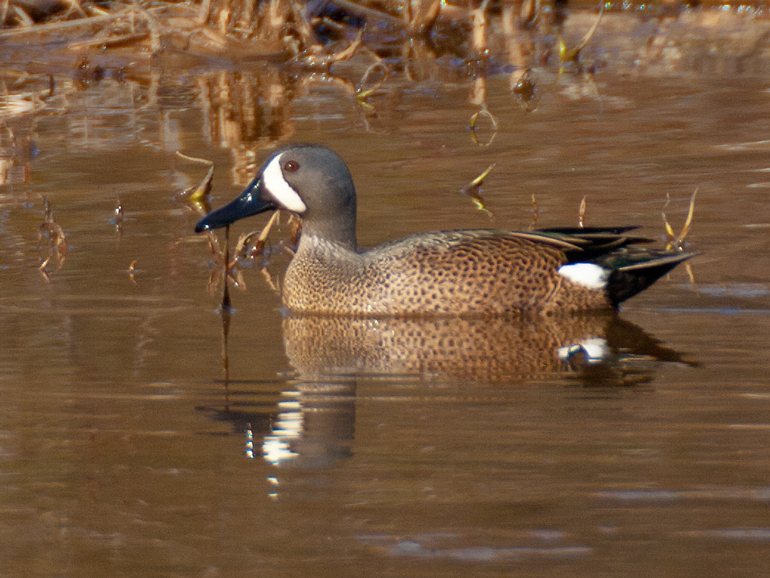
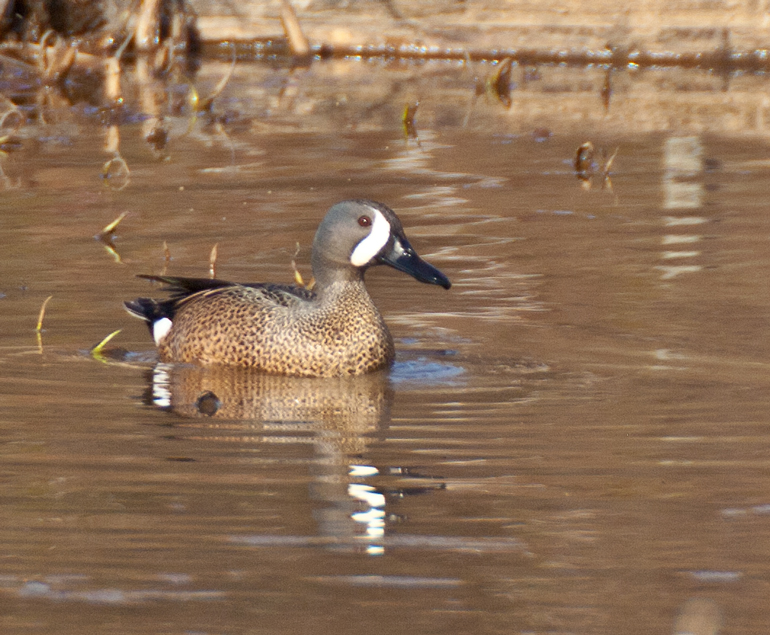
Yesterday was the first time that I managed to get a photograph of a male Blue-winged Teal (Anas discors), a small, very striking dabbling duck. I was quite fortunate that the lighting and location was quite favorable, since these small ducks usually hang out at the far reached of the pond.

Although the Cornell Lab of Ornithology states that the Blue-winged Teal is the second most abundant duck in North America, after the Mallard, I am not sure that I have seen one before, and certainly not closely enough to photograph one. The range maps suggest that I am in the migration region for these birds, so I doubt that these birds will hang around for too long.

I really like the look of the speckled body, blue bill, and bold white stripe across the face of this Blue-winged Teal. He was traveling with a small group of Blue-winged Teals and they were even more beautiful when they took to the air and displayed a beautiful patch of blue on their wings.

blue-winged_blogblue-winged2_blog

Michael Q. Powell. All rights reserved

Read Full Post »

Early yesterday morning when I arrived at my local marsh, two Great Egrets (Ardea alba), were already up and trying to find some breakfast. At this time of year, I suspect that they may be eating a lot of frogs at this location, though I didn’t actually see them catch anything. Eventually they wandered into the reeds and cattails, so I gradually lost sight of them.

In the past, I had a lot of trouble taking photos of these beautiful white birds and usually I ended up blowing out the highlights. Two things seemed to have helped me deal with these issues. I am paying a lot more attention to exposure compensation and I am underexposing by as much as two f-stops. Additionally, I am using a longer telephoto lens and filling more of the frame with the subject somehow helps me to get a better exposure.

egret1_blogegret2_blog

Michael Q. Powell. All rights reserved
Read Full Post »

I am not sure what the other Canada Goose said or did, but this goose was clearly an angry bird yesterday. He seemed to put his whole body into the expression of his strong feelings, from the tip of this tongue to the tip of his tail.

Do they have a goose in the game Angry Birds?  If not, perhaps they should.

goose_tongue_blog

Michael Q. Powell. All rights reserved
Read Full Post »

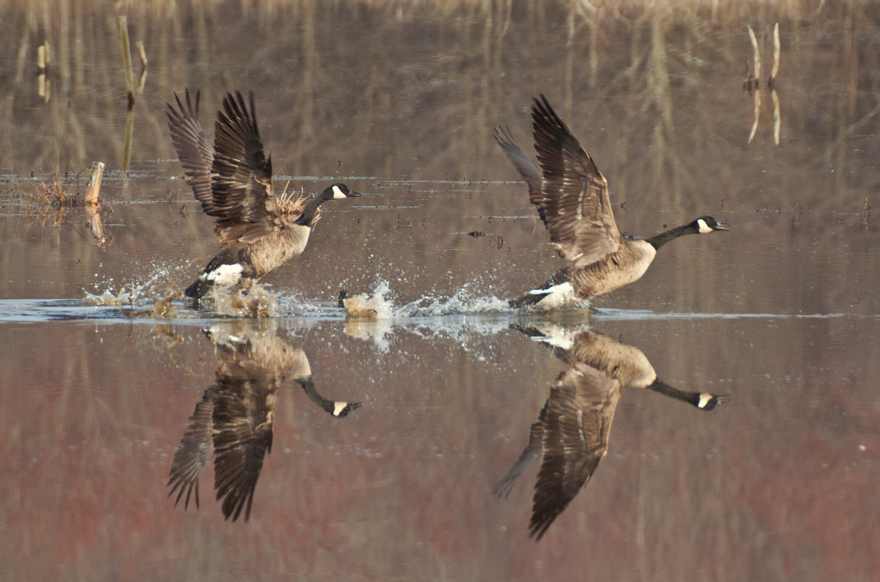
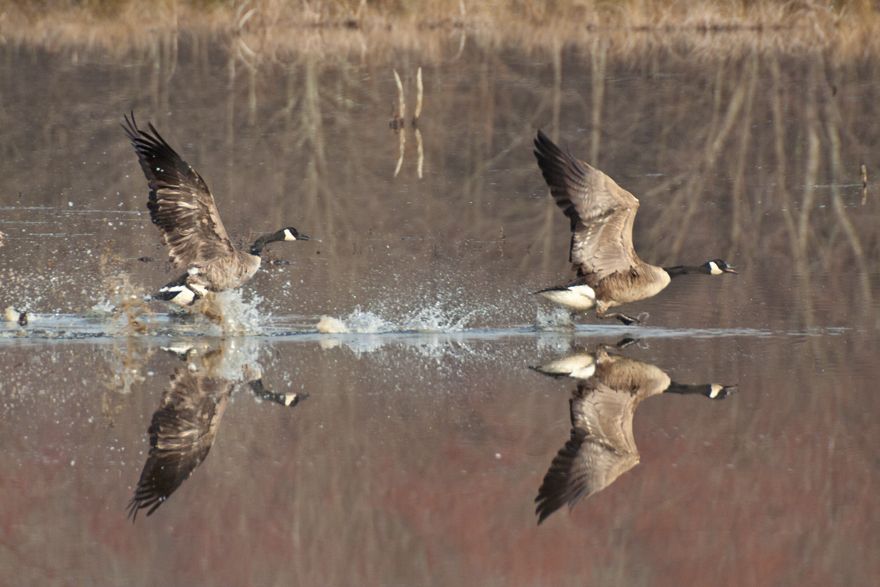
At a moment when the lighting was particularly beautiful yesterday morning, I sensed that the pair of geese was getting ready to take off from the pond. I readied myself and somehow my timing, composition, and focus clicked together with my shutter.

I ended up with some images that required almost no adjustments or cropping. I was particularly happy, because I have been experiencing difficulties capturing motion with my newest lens, a Sigma 135-400mm telephoto zoom.

Luck played a big role too, since I had no control over the way that the geese would move their wings (though I guessed correctly the direction in which they would take off).

geese_takeoff_bloggeese_takeoff2_blog

Michael Q. Powell. All rights reserved

Read Full Post »

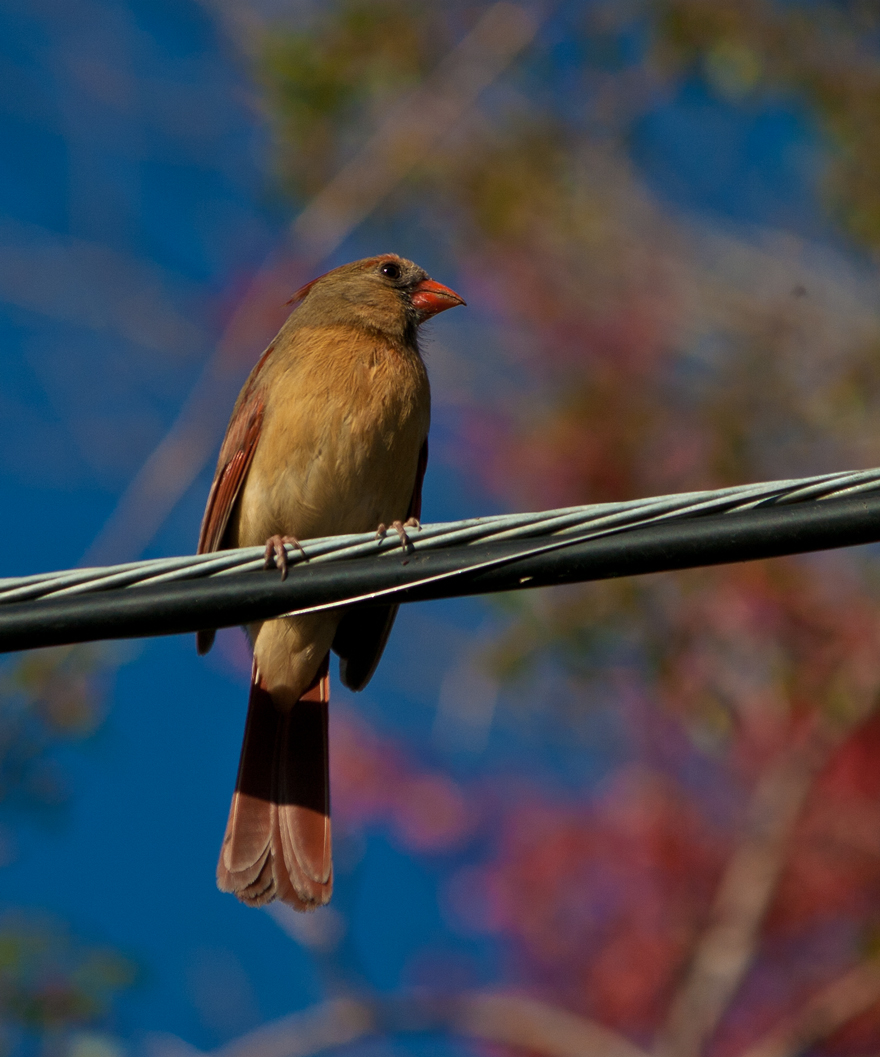
The setting and the perspective were not completely natural, but somehow I ended up with an image of a female Northern Cardinal (Cardinalis cardinalis) that I really like.

I ran across this cardinal almost two weeks ago when I was just starting my exploration of the Phinizy Swamp Nature Park in Augusta, Georgia. She was perched almost directly overhead on a wire and seemed to be warming herself in the rays of the morning sun. It was the start of a beautiful sunny day and already the skies were blue.

Georgia was already well into spring and you can see some of beautiful colors of the flowering trees in the blurred background. I managed to get the facial area of the cardinal in pretty sharp focus, which contrasts nicely with the background.

It won’t be long before we have flowering trees in Northern Virginia, where I live, but at least we have daffodils in bloom to remind us that spring is finally here.

cardinal_wire_blog

Michael Q. Powell. All rights reserved

Read Full Post »

This male Hooded Merganser duck (Lophodytes cucullatus) flew away when his mate entered the nesting box (as shown in my posting yesterday), but I was able to get these shots when he was swimming around beforehand.

I am also including a shot from earlier this month when a male was displaying for a female. He would periodically throw back his head back and make the strangest sound, almost like a frog. The sound is so unusual that you may enjoy checking it out at the Cornell Lab of Ornithology site, where you should click on the button that says “Male display.”

male1_blogmale2_blog

Merganser_singing1_blog

Michael Q. Powell. All rights reserved

Read Full Post »

There is just something about this Red-winged Blackbird that makes me laugh. Perhaps it is his whimsical little half-smile or the way that he has cocked his head. Maybe it is the way that his feathers stick out like a little boy’s cowlick or the glint in his eyes or the way he is perched on the cattail. All of these features give him an almost comical look that I really enjoy.

blackbird1_blog

Michael Q. Powell. All rights reserved
Read Full Post »

Yesterday I decided to take some close-up shots of some of the turtles sunning themselves at my local marsh.

I am pretty sure that the first one is a painted turtle, but I am not sure if the turtle in the second photo is a different species. I was intrigued by the contrast between the clean, bright colors of the first turtle and the muddy, muted colors of the second one. The turtles were pretty cooperative and let me get close enough to fill the frame of my camera.

It’s not quite warm enough for humans to be sunbathing, but now that spring is officially here, it won’t be long.

turtle1_blogturtle2_blog

Michael Q. Powell. All rights reserved
Read Full Post »

Most of the turtles that I have seen on recent sunny days have climbed out of the water entirely to bask in the sun, but this Eastern Painted Turtle (Chrysemys picta picta) seems to have taken a more tentative approach.

Although he seems poised for a quick reentry into the water, he seemed undisturbed when I approached him to take this photo. The angle of the photo provides a view of the turtle’s torso that I rarely see, and as you can probably tell, I got down pretty low to get the shot.

 I was surprised by the amount of red on his body and the length of his claws. When I saw the claws, I decided not to go for an extreme close-up shot. I can only imagine the newspaper headline, “Wildlife photographer mauled by killer turtle.”

turtle1_blog

© Michael Q. Powell. All rights reserved
Read Full Post »

I remember my parents telling me when I was young that robins are a sign of the imminent arrival of spring and that association remains strong in my mind to this day.

I am now seeing increasingly large numbers of robins and other birds. Flowers are starting to pop up all over, crocuses, daffodils, and others. The air is alive with a sense of joyous expectation, of new growth.

Whenever I see a robin, I instinctively pause and look around for more signs of spring. Life gets so busy that it is useful for me to have reminders that push me outside of the cares of my daily life and cause me to take a closer look at the beauty of nature.

robin_blog

© Michael Q. Powell. All rights reserved

Read Full Post »

It’s a little ironic that I took these photos of a Ring-necked Duck (Aythya collaris), some of my best duck photos, in a man-made pond in my neighborhood, rather than in a more natural setting. I have never seen any Ring-necked Ducks at my marshland park—perhaps the water is not deep enough for these diving ducks—but found them in a very suburban setting.

The light was bright on the day when I watched some of these ducks diving and resurfacing every couple of minutes. The glare was pretty intense on some of my initial photos and I didn’t like the way they turned out.

However, there is a walking trail all of the way around the pond, so I went off in search of a better lighting situation.  When I reached an area of open shade, I encountered this duck near the shore. Unlike his fellow ducks, he seemed to be relaxing and was remarkably cooperative in letting me take his portrait.

If you are like most people, you may wonder why this duck is not called a ring-billed duck, because there doesn’t seem to be any ring around his neck. According to the Cornell Lab of Ornithology, the bird’s name refers to the hard-to-see chestnut collar on its black neck, which apparently jumped out to the nineteenth century biologists that described the species using dead specimens.

ring_neck2_blogring_neck1_blog

© Michael Q. Powell. All rights reserved

Read Full Post »

A flock of robins was really active in my neighborhood this morning, busily pecking the ground as the freezing rain gradually turned into snow. This American Robin (Turdus migratorius) didn’t even have time to clean up before I took his portrait.

robin_blog

Click on the photo to see a higher-resolution view

© Michael Q. Powell. All rights reserved

Read Full Post »

I don’t know where the male lions were this weekend when I visited the National Zoo, but there were three or four female lions and it was fun to watch them play together.

I tried to get a group photo, but they were about as cooperative as kids, with one of them turning her back and another sticking out her tongue.

lioness3_blog

After a while they seemed to get bored with me and I caught one of them in a big yawn.

lioness2_blogI wanted very much to get an action photo, but the lions seemed content to lounge around together. This is the closest thing I got to an action photo. I like it a lot, even though it is not super sharp, primarily because of the body position and the angle of the shot.

lioness1_blog

© Michael Q. Powell. All rights reserved

Read Full Post »

To supplement their diets, the beavers at the National Zoo in Washington D.C. get crunchy vegetables like carrots and corn.

I had the chance to watch them eat this past weekend and took some fun photos of one of the beavers munching away on part of an ear of corn. This beaver, a female named Willow, was able to manipulate the corn really easily with her front paws and seemed to enjoy each bite as she slowly consumed the entire piece of corn.

I watched some videos on photographing animals at a zoo before this shoot and followed some of the tips, like shooting close-ups and paying attention to backgrounds. I did not, however, switch to shutter-priority mode, as suggested, but kept the camera in aperture-priority mode. I may have lost a few shots, because the shutter speed was too slow, but I was able to get decent results by using a more familiar approach.

beaver_corn_blogbeaver_corn2_blog© Michael Q. Powell. All rights reserved

Read Full Post »

The clicking sound of my shutter caused the napping cheetah to raise his head yesterday afternoon and look directly at me. He didn’t move the rest of his body at all, but stared intently at me for a minute or so. Reassured, he laid his head down again in his den and resumed his nap.

I visited the National Zoo yesterday and took photos of a number of different animals that I will share later, but I wanted to share this one immediately.  I like the cheetah’s expression and the positioning of the head and body. The darkness of the den really helps to showcase the beauty of the cheetah (and fortunately for me the cheetah was at the front of the den where natural light illuminated his face).

National Zoo does a good job in taking care of the animals there and, as is the case with the cheetahs, in working to ensure the survival of animals with a limited gene pool. For me, it is enjoyable to visit the different animals and to practice my photography skills to show the animals in the best possible light.

cheetah2_blog

© Michael Q. Powell. All rights reserved
Read Full Post »

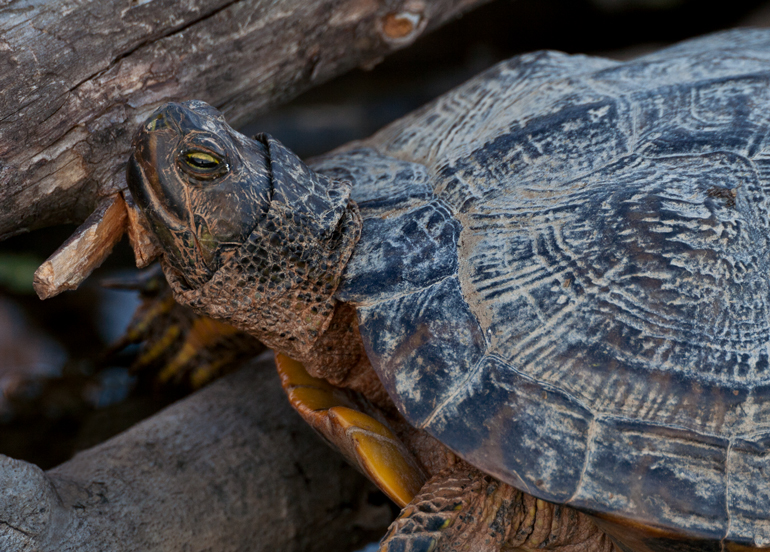
The weather yesterday was so nice that turtles emerged from the mud for the first time in months to bask on logs and enjoy the warmth of the sun.

My understanding is that the turtles have been spending the cold winter months buried in the mud with their metabolism slowed way down. I would call this state “hibernation,” although there apparently is some argument in the scientific community about whether that term should be reserved for mammals and the term “brumation” used for reptiles, because the physiological processes are different. Whatever you call it, reptiles can move in and out of this state and seem to have moved out of it to soak up some sum.

The turtle in this photo looks like he has not had a lot of time to clean off the mud that fills all of the creases and crevices in his body and shell. He almost looks like he is smiling and he is definitely alert.

Most of the turtles that I have photographed previously at my marshland park have been Red-eared Sliders, but I can’t tell if this one is a member of that species or is a different type. I did note that there is a semi-circular pies missing from both the left and right front areas of the shell. Has something been gnawing on the shell? What would have caused the damage?

I looked around to see if I could see any frogs yesterday, but they are still in their wintering mode. I suspect that it won’t be long before the frogs and snakes are back and I’ll soon be keeping a look-out for my first dragonfly of the season.

turtle1_blog

© Michael Q. Powell. All rights reserved

Read Full Post »

I love the way this Mourning Dove (Zenaida macroura) turned its head to look back at me yesterday and how the soft background complements and enhances its beauty.

dove1_blog

© Michael Q. Powell. All rights reserved

Read Full Post »

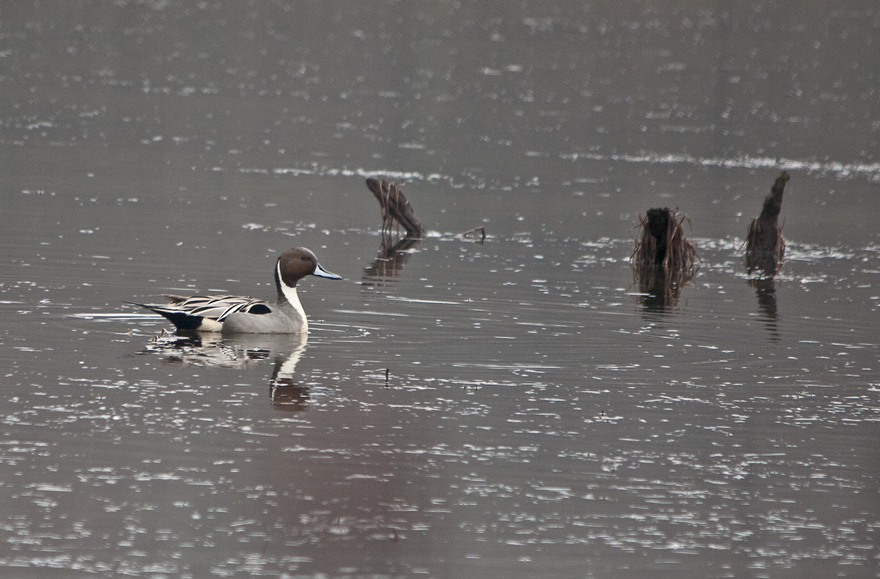
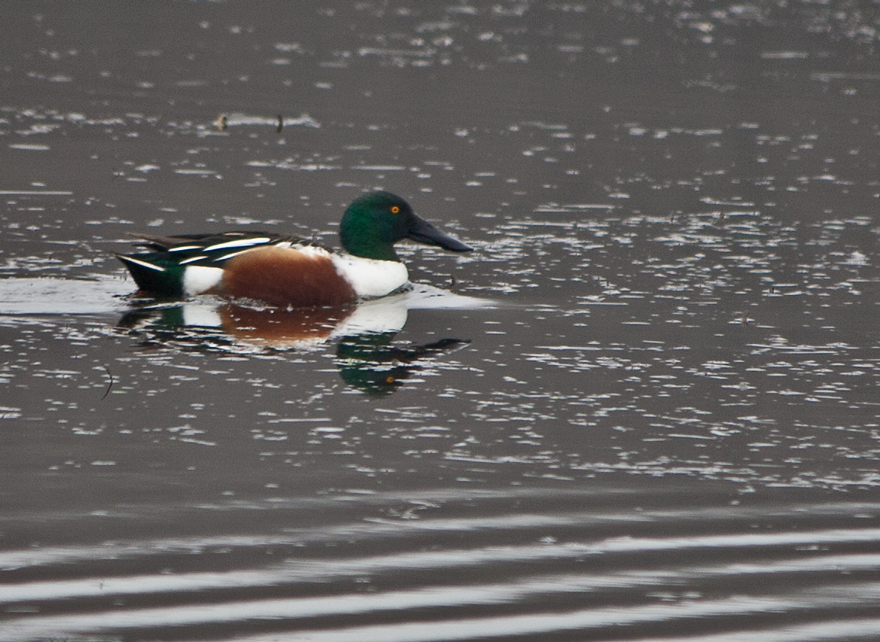
Born in Boston, Massachusetts, I have an affinity for things from the north and was amused to find that two of my favorite birds from this past weekend are called “Northern”—the Northern Pintail (Anas acuta) and the Northern Shoveler (Anas clypeata).

Sometimes it seems that I shoot subjects in cycles. At one point this past summer, I felt like I was shooting a lot of new and interesting subjects that turned out to have “Common” in their names. In addition to the two Northerners that I am featuring today, this winter I have also photographed Northern Cardinals, Northern Flickers, and Northern Mockingbirds.

The day that I took these photos was gray, misty, and overcast, which gave the water an interesting gray tinge. Fortunately there was  enough light to cast interesting reflections onto the water’s surface.

I like the contrast between the body shapes and colors of these two ducks.  The elegance of the long neck and understated, conservative colors of the pintail are quite different from the bold colors and the counter-culture look of the shoveler’s bill. In some ways, they seem to represent the establishment, on the one hand, and the rebel, on the other.

pintail_blog

Male Northern Pintail at Huntley Meadows Park

Male Northern Shoveler at Huntley Meadows Park

Male Northern Shoveler at Huntley Meadows Park

© Michael Q. Powell. All rights reserved

Read Full Post »

If you think that you are having a bad hair day today, check out the windblown hair of this Great Blue Heron.

It was cold and really windy today and it seemed like the small birds had sought shelter somewhere, because there were relatively few around. The bigger birds could handle the wind better and I saw lots of crows and geese and a number of vultures.

I also saw one Great Blue Heron, who was pretty far away from me. I watched him for quite some time as he stared down at the waters at the far edge of the beaver pond and I wondered if it would be possible for him to find anything to eat.

When I looked at some of my photos of the heron, I was struck by his hair. It looks like he is suffering from male pattern baldness and has grown his hair long in a vain attempt to hide that reality. Perhaps he has an artistically arranged comb over most of the time, but the wind caused his hair to go in all directions.

Do you think that they have a Hair Club for herons?

badhair_blog

© Michael Q. Powell. All rights reserved

Read Full Post »

Walking alongside a stream yesterday, I heard the unmistakable call of a Belted Kingfisher, a call that is usually described as a “piercing rattle.” Here is a link to the Cornell Lab of Ornithology, which has sound clips that you might find interesting if you have never heard a Kingfisher’s call in person.

A previous post chronicled my quest for an elusive female Belted Kingfisher (Megaceryle alcyon) at a little suburban lake that is stocked with trout. I made multiple attempts on different days to photograph that Kingfisher as she perched on tree branches overlooking the water.

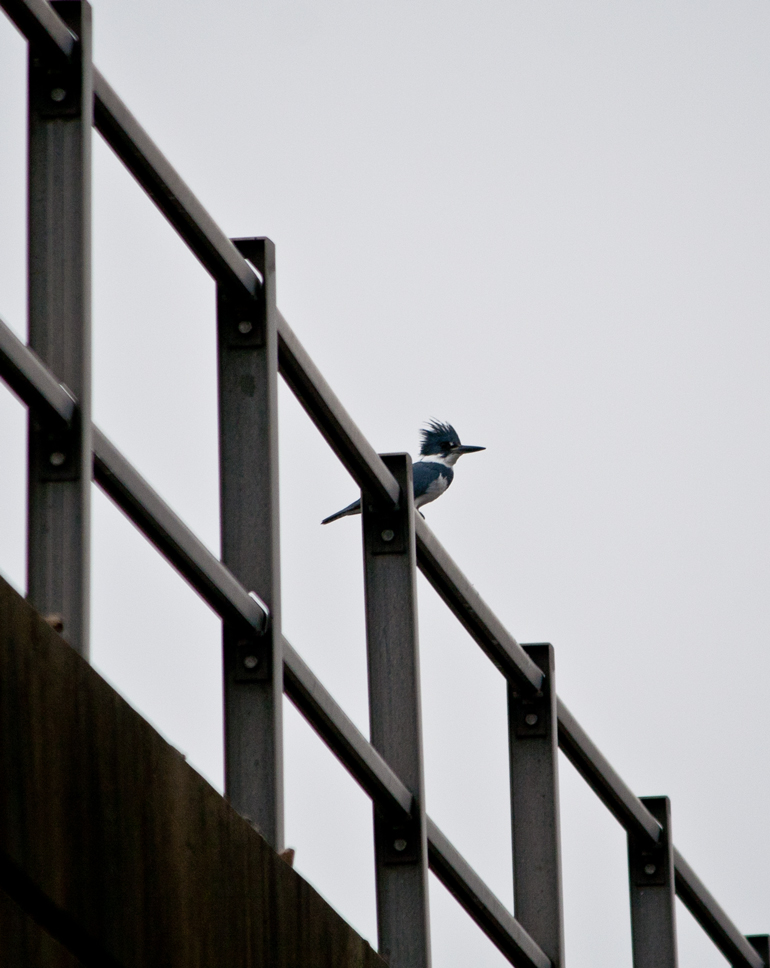
Although the stream along which I was walking yesterday is only a half mile or so from the female Kingfisher’s fishing spot, I was surprised to hear a Kingfisher’s call, because there are no trees on the banks of the stream at that location. When I heard its call again, I turned my head in the direction of the sound and was surprised to see a male Kingfisher perched on a power line above the stream. (It’s really easy to distinguish a male Belted Kingfisher from a female, because the male has only a blue stripe on is chest and a female has blue and chestnut stripes.)

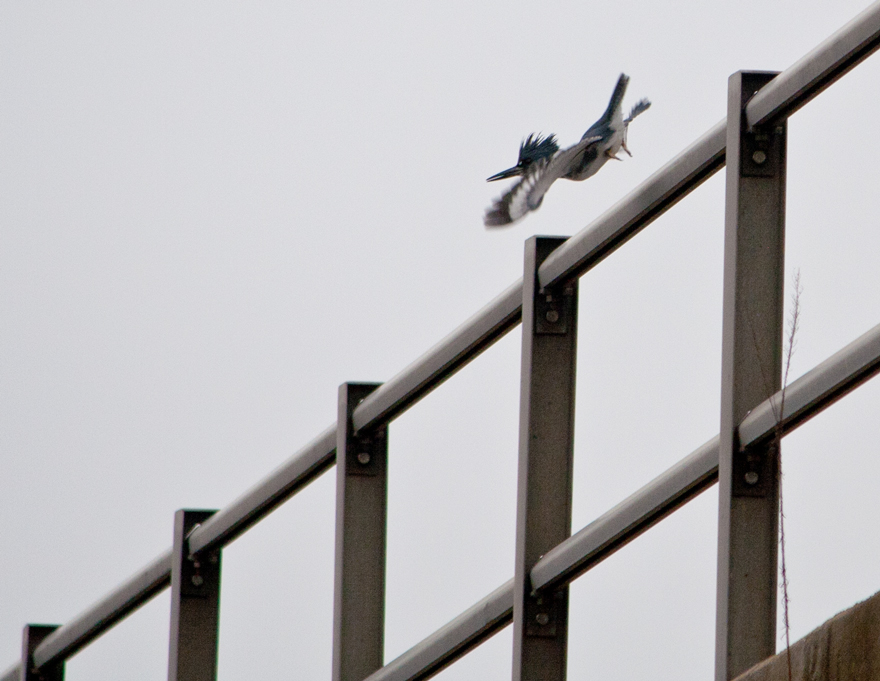
When I moved a little closer to him, he flew a short distance downstream and I located him again, this time perched on the railing of a railroad bridge over the stream. Over the course of an hour or so, he and I played  a little game in which he would pose for a few minutes on the railing and then fly downstream. A short while later he would be back on the suspended power line. I would walk slowly in the direction of the power line and once I arrived there, the Kingfisher would return to the railroad bridge.

Although I was not able to get really close to the Kingfisher, I managed to get some pretty cool pictures, including several in-flight shots. I really like the industrial-looking setting of the railroad bridge, with its simple geometric structure and beautiful angular lines. In many ways, the bridge is a much a subject in the photos as the bird.

I confessed in a previous post that I was a stalker of Kingfishers, but maybe it’s time to elevate my status—perhaps from now on I will refer to myself as a member of the Kingfisher paparazzi.

kingfisher_M3_blogkingfisher_M1_blogkingfisher_M2_blogkingfisher_M5_blogkingfisher_M6_blogkingfisher_M4_blog

© Michael Q. Powell. All rights reserved

Read Full Post »

It was cold and windy on Friday, but the sun was shining, permitting me to take this portrait of a resting male mallard. The subject is ordinary, but the lighting was wonderful and the bright colors of his head and bill really pop, including in his reflection in the brown waters of the beaver pond. I even managed to capture a little catch light in his eye.

It’s exciting to take photos of extraordinary subjects, but most often I am content to try to reveal some of the beauty in the ordinary things that I encounter every day.

mallard_blog

© Michael Q. Powell. All rights reserved

Read Full Post »

As the insistent honking got louder, I scanned the horizon for approaching geese and saw none.

Suddenly a pair of Canada Geese swooped over a nearby treeline and headed right at me as I stood on the boardwalk at my local marshland park. They were closing so quickly that it was hard to get my focus to lock on. At the same time I also had to adjust my zoom lens. Normally I photograph birds at the far end of my 55-250mm zoom lens, but the geese were filling up so much of the frame that I had to zoom out.

This is my best shot from the encounter. The goose and I were able to look each other straight in the eye at that moment.  The background has a nice blur, because I was shooting at f5.6, and a fair amount of the goose is in focus. I like the goose’s position too as he strains forward in preparation for the water landing. (Click on the photo to see more details)

Incoming_blog

© Michael Q. Powell. All rights reserved

Read Full Post »

I got down pretty low to take this shot of a beaver at my local marshland park as he swam in my direction. I especially like the the reflection of his face in the water and the fact that his tail is visible. The ice in the foreground helps to give some interesting context to the photo.

During other seasons, the beavers would immediately dive whenever they sensed my presence, but the last week or so the beavers have been much more wiling to tolerate me (and others). Maybe the ice on the pond forces them to stay closer to home and to venture out more during the daylight hours rather than at night.

swimming_blog

© Michael Q. Powell. All rights reserved

Read Full Post »

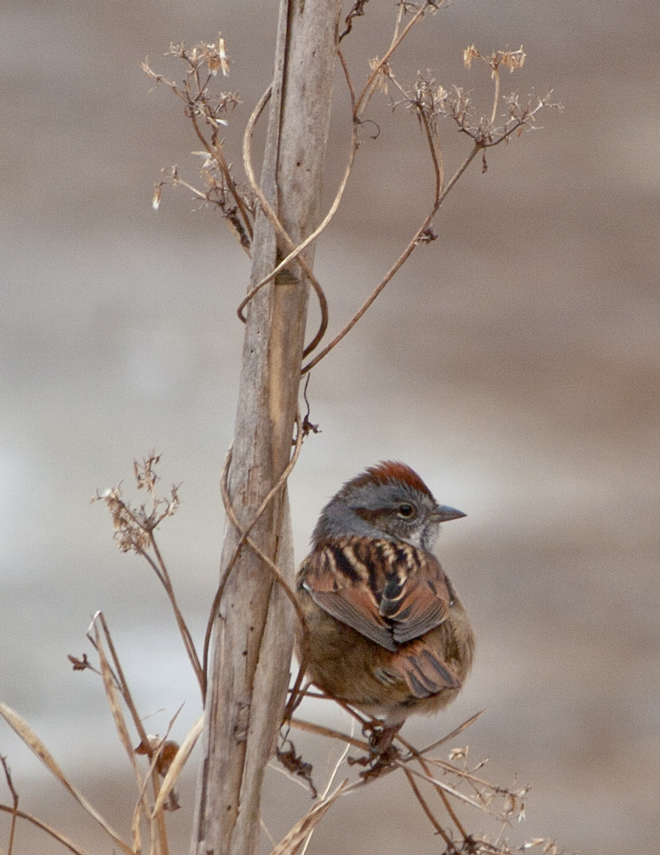
The crisscrossing pattern of the vine and the cooperative pose of the Song Sparrow combine to make this photo one of my recent favorites.

It is always exciting for me when the elements of an image work together in interesting and unexpected ways. I was attempting to photograph this Song Sparrow (Melospiza melodia) when he flew onto this stalk. He was facing away from me, but I kept shooting and them he turned his head. I am not sure that I could have intentionally come up with a more interesting pose—I love the way we are looking down his back and get to see his wings and also get a clear view of his face.

When I first looked at this photo, though, what caught my eyes the most were the crisscrossing vines, an unanticipated bonus. The X-shape of the vine is both linear and curved at the same time and I chose to crop the photo to highlight this feature.

One of the things that keeps me thrilled about photographing nature is the balance between preparation and spontaneity, between technical excellence and creativity. I try to put myself into situations outside in which I know there is a chance that I will see something interesting and then prepare myself (and my camera) to take advantage when something does happen (and it’s usually not what I anticipated).

sparrow_blog

© Michael Q. Powell. All rights reserved

Read Full Post »

When I saw a Wilson’s Snipe (Gallinago delicata) on Friday, I expected that it was a once-in-a-lifetime sighting and was really happy to have gotten some photos. I never imagined that I would see the bird (possibly the same one) the very next day in even better lighting conditions. I may eventually post some other photos, but I wanted to share this one in which he is visible against a snowy background that is mostly blown out. I think it helps to highlight some of the wonderful colors and textures of this long-billed shorebird.

Somehow the word “snipe,” which is used in all kinds of other contexts, doesn’t seem dignified enough for this beautiful bird, so I have taken to calling him the “Pinnochio bird”—for obvious reasons.

wilson_snow_blog

© Michael Q. Powell. All rights reserved

Read Full Post »

Simple in composition and simple in color palette, I find something really appealing about this photo of a male Northern Cardinal (Cardinalis cardinalis).

The backdrop is made up of the gray composite elements of the boardwalk that wends its way through the marshland area of Huntley Meadows Park in Alexandria, VA. The gray “wood,” with its horizontal and diagonal lines helps to give a little structure to the image.

The cardinal cooperated by cocking his head in an interesting way and giving me a sidewards glance. I believe that the red berry-like fruits are rose hips. The cardinals seem to enjoy eating the inside part of the fruit, but seem to discard most of its flesh. Several areas of the board walk are littered with these red remains.

cardinal_blog

© Michael Q. Powell. All rights reserved

Read Full Post »

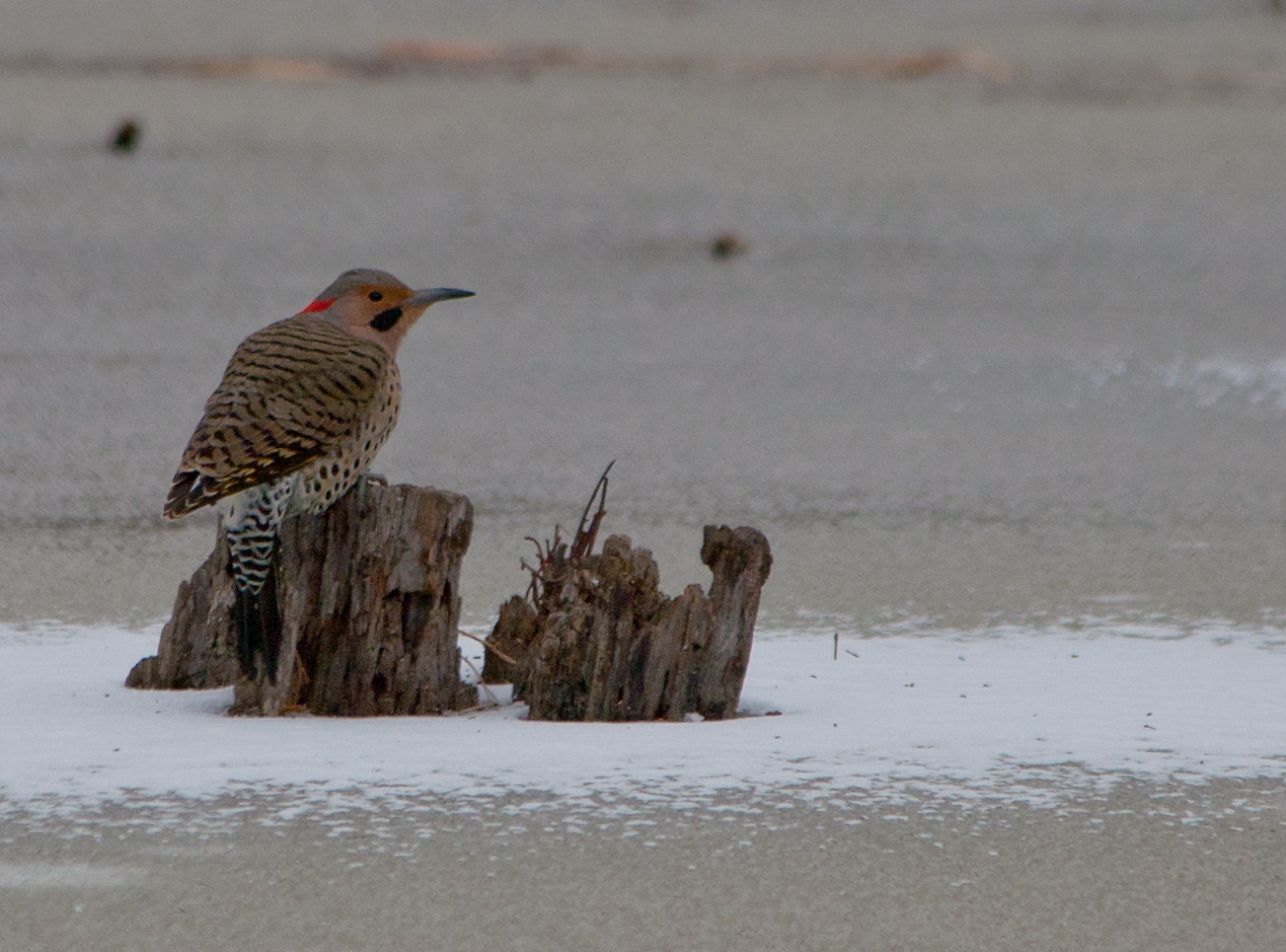
Against the backdrop of a frozen pond with a dusting of snow, the colors of this male Northern Flicker (Colaptes auratus) stood out even more brightly than usual yesterday morning. The flicker is perched on a rotted stump that is poking out of the beaver pond at my local marshland park.

I love the colors and the markings on this beautiful bird, who seems to be making a fashion statement by mixing stripes and polka dots and accenting the ensemble with touches of bright colors.

flicker1_blog

© Michael Q. Powell. All rights reserved

Read Full Post »
« Newer Posts - Older Posts »