Feeds:
Posts
Comments

Archive for the ‘Portraits’ Category

When it comes to images of birds in flight, do you prefer the sky as the background or some element of the earth? Here are two photographs of Canada Geese (Branta canadensis) that I took this past Monday that illustrate my question.

Canada Geese are some of my favorite subjects as I try to improve my skills in photographing flying birds—they are relatively big, flight slowly (especially when taking off and landing), and, perhaps most importantly, there are a lot of them.

In some ways, it’s a little easier to track a bird in the sky, since there is nothing else to grab the camera’s focus (if you can lock in the focus quickly enough). However, the light is a lot more variable, particularly when a bird is circling, so proper exposure is a challenge and shadows are a sad reality. I was happy that I was able to time the second shot so that the light illuminated most of the underside of the goose. Some photographers, though, seem to look down at photos of birds in the sky and prefer more environmental shots.

I had to act quickly to get the shot of the goose with the trees in the background, when some geese took off and flew by me at almost eye level. The trees were far enough away that they blurred out and the head of the goose is mostly in focus. Depth of field is always an issue for me in shots like this—you can actually see the depth of field in the amount of the extended wings that is in focus.

So there you have it, two different shots of a goose in flight. Does the background play a role in your assessment of which one you prefer?

goose_flying_11Nov_blog

goose_flying2_11Nov_blog

© Michael Q. Powell. All rights reserved.

Read Full Post »

As I was going through some of my bird photos, I realized that a majority of them feature the male of the species. The males tend to be more loud and flashy, so I guess it’s not surprising that they draw my attention much of the time. The female often has a more delicate beauty and coloration, as is the case with this female Ring-necked duck (Aythya collaris) that I photographed recently.

I added an image of a male Ring-necked duck that I photographed the same day to allow you to make your own comparison and judgments. It may be a cliché, but it is nonetheless true that beauty is in the eye of the beholder.

ring-necked_female_blogring-necked_male_blog

© Michael Q. Powell. All rights reserved.

Read Full Post »

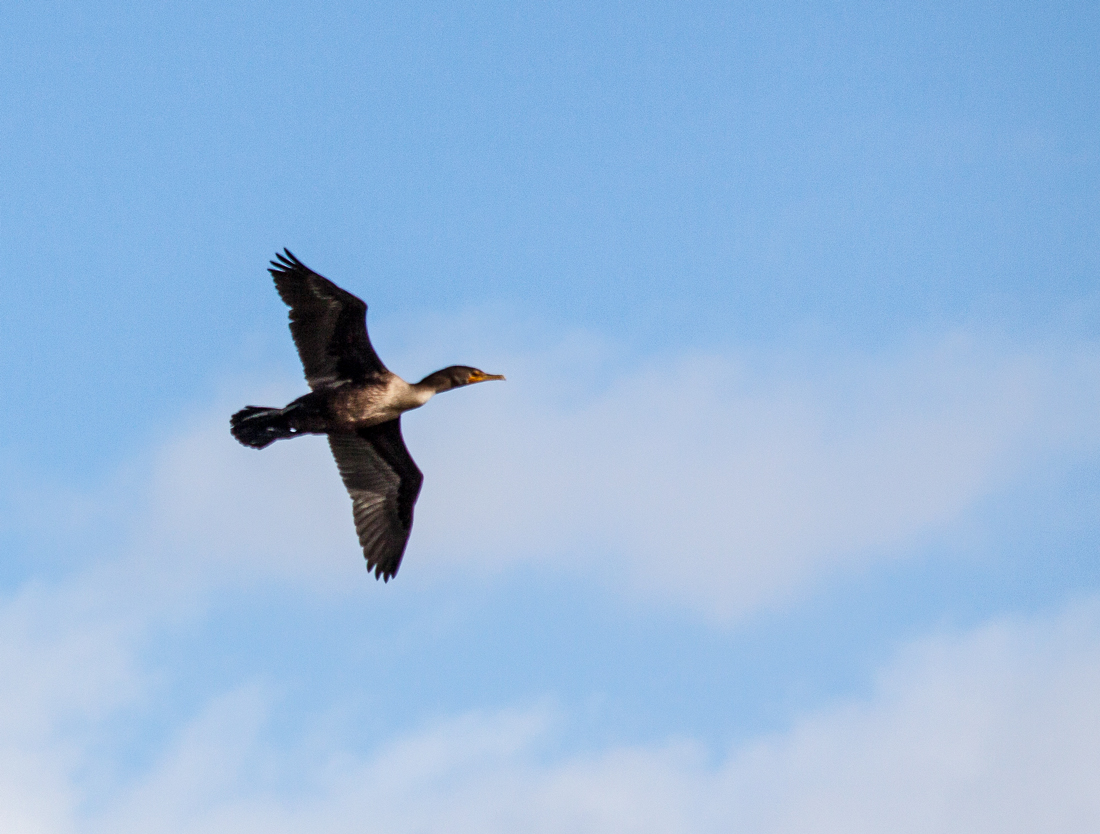
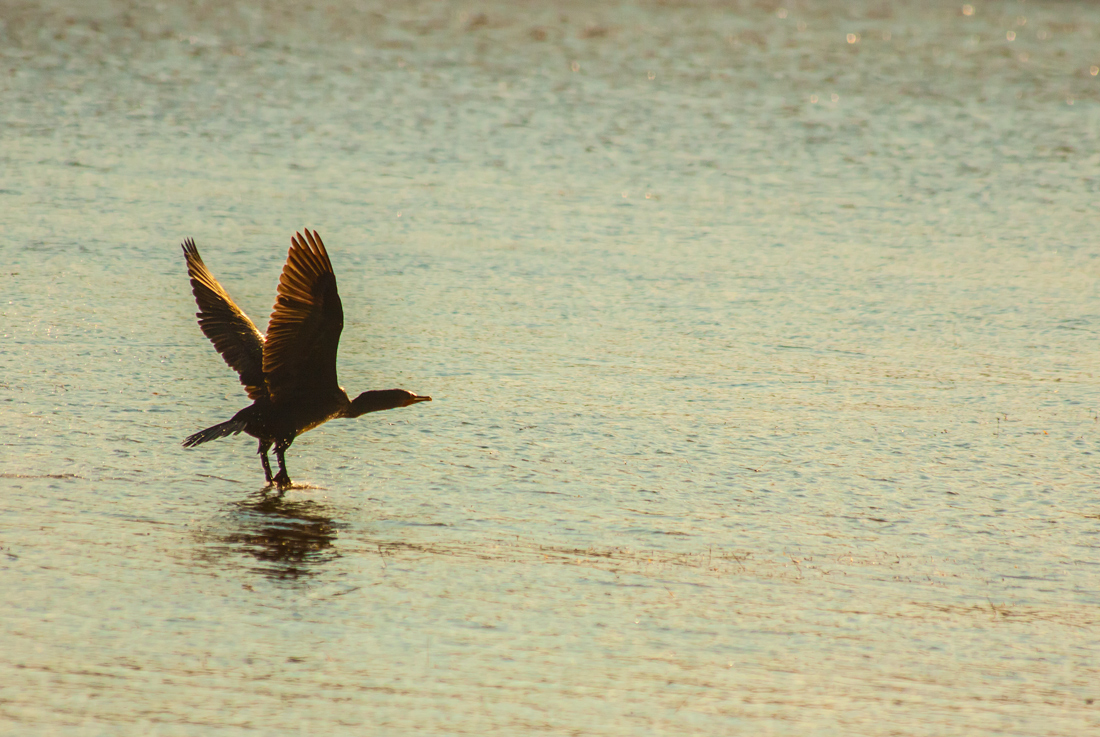
Two weeks ago I didn’t even realize that we had Double-crested Cormorants (Phalacrocorax auritus) in this area and now I can find quite a number of them on the Potomac River. It’s a little difficult to tell from the range maps in my bird guide if the cormorants are migrating through this area of if they may choose to winter here.

The more I observe these birds, the stranger they appear. The Cornell Lab of Ornithology described them this way—”The gangly Double-crested Cormorant is a prehistoric-looking, matte-black fishing bird with yellow-orange facial skin. Though they look like a combination of a goose and a loon, they are relatives of frigatebirds and boobies and are a common sight around fresh and salt water across North America.”

I am still working on getting some shots of the cormorants in the water, but as a start, here are a couple of images of a cormorant in the air. I took the first one before I knew that it was a cormorant—I have a habit of trying to capture anything in flight that is remotely in range. The second one shows a cormorant as he is taking off from the water after some bounding steps across the surface as he gained speed. The location of the light caused much of the cormorant’s body to be in the shadows, but did illuminate the details of some of its feathers.

cormorant_flying1_blogcormorant_liftoff_blog

© Michael Q. Powell. All rights reserved.
Read Full Post »

The wind was kicking up yesterday on the Potomac River, making it difficult for the ducks there, like this Ruddy Duck (Oxyura jamaicensis). I watched as the small ducks got drenched repeatedly as they sought to ride the waves.

At least it wasn’t raining and the temperatures have not yet dropped below the freezing levels, even at night.

ruddy_waves_blog

© Michael Q. Powell. All rights reserved.
Read Full Post »

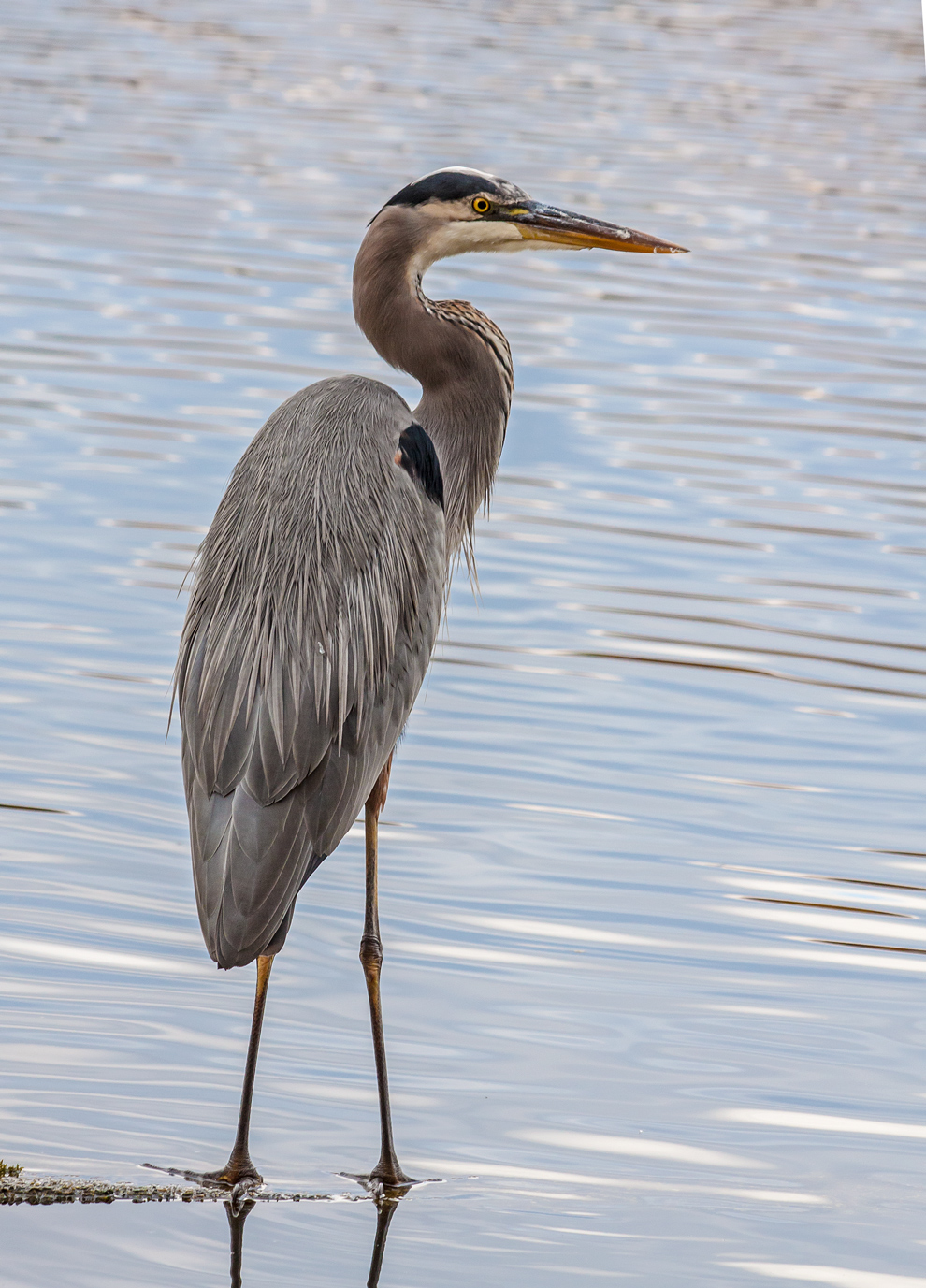
I felt like this Great Blue Heron (Ardea herodias) was modeling for me when it climbed out of the water onto a narrow slab of concrete and struck a pose. It was unusual for me to see a stationary heron out of the water—usually when I see them out of the water, they are flying. The blue waters make it look like I shot this in some exotic, tropical location, but I took this photo only a mile or so from where I live, at a small suburban pond surrounded by townhouses on one side and a well-travelled road on the other side.

heron_out_of_waterblog

© Michael Q. Powell. All rights reserved.

Read Full Post »

It was cold and overcast yesterday and there were not many birds visible, with the notable exception of sparrows. Sparrows were as active as ever, though most of the time I could only hear them and not see them. They seem to like to rot about in the underbrush most of the time.

I was really happy when this White-throated sparrow (Zonotrichia albicollis) popped up for a moment and I was able to get this image. I love the facial pattern and colors of this bird, which seems to have a goatee much like my own. (My goatee started out with salt-and-pepper color, but increasingly has become mostly salt).

When researching this bird, I learned that there is another version (morph) of this bird that has brown and tan head stripes, instead of black and white. I will have to look even more closely at my photos of the White-throated sparrow, which has become more common the past few weeks, and see if I have managed to capture any images of the tan-striped variant.

sparrow_white_throat_crop_blog

© Michael Q. Powell. All rights reserved.
Read Full Post »

Last year it seemed like I saw Downy Woodpeckers everywhere, but this year I have sighted only a few of them. I took this shot of a female Downy Woodpecker (Picoides pubescens) in mid-October during a visit to Theodore Roosevelt Island, a nature preserve in the Potomac River opposite the District of Columbia.

woodpecker_downy_blog

© Michael Q. Powell. All rights reserved.

Read Full Post »

Some spiders can be creepy, but others are quite beautiful, like this one that I photographed earlier this month at my local marshland park. I am catching up a bit on posting photos from this month that I really liked and thought it might be good to post a spider image on Halloween night. I have not yet been able to identify this spider, but noted that it did not have a web and seemed to be lying in wait for prey on the long leaf of this plant. I’d welcome assistance in identifying the species of spider,

spider_halloween_blog

© Michael Q. Powell. All rights reserved.

Read Full Post »

The first time I saw a bird that looked like this, I thought it was a sparrow of some sort. When I saw this one, last week, I knew immediately that it was a female Red-winged Blackbird (Agelaius phoeniceus).

I have learned a lot about birds and photography this past year.  Along the way I also have learned more about myself as I seek to express myself in my words and in my images.

red-winged_female_blog

© Michael Q. Powell. All rights reserved.

Read Full Post »

I haven’t seen many migrating ducks yet at my local marsh, so I traveled to the Potomac River this weekend, because I had heard from a birder that there were numerous ducks there. There were lots of Mallards, some Northern Shovelers (I think), and this cool-looking duck with a distinctive white patch on its cheek that I could not identify initially. After I returned home, it didn’t take long to figure out that this as a Ruddy Duck (Oxyura jamaicensis), a species that I had never seen before.

ruddy_duck1_blog

© Michael Q. Powell. All rights reserved.

Read Full Post »

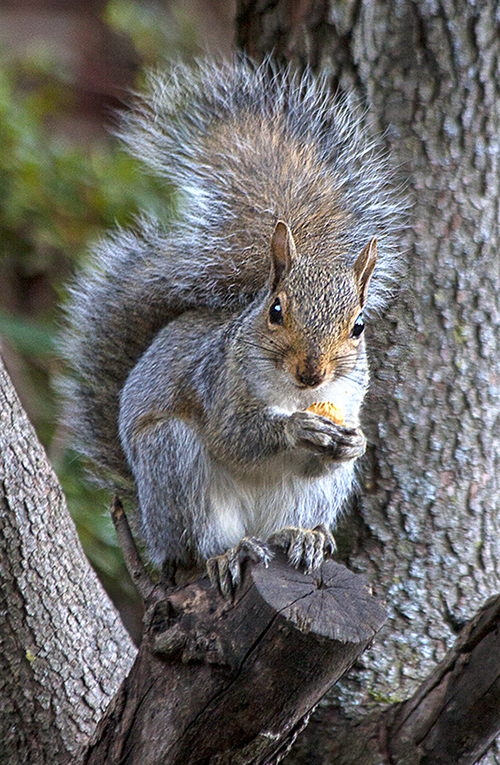
The squirrels in my neighborhood are very busy now as they scurry about getting ready for winter. This particular Eastern Gray Squirrel (Sciurus carolinensis) paused several times to enjoy a leisurely snack. Rather than devour the treat on the ground, he would leap up onto this posing stand and delicately nibble away. He almost seemed to be aware that I was photographing him and periodically would change his pose to give me a different look.

I guess that I lucked into photographing a squirrel with modeling experience (and great hair).

Squirrel Nut blogSquirrel Nut 2 blog

© Michael Q. Powell. All rights reserved.

Read Full Post »

Migrating birds are starting to arrive in my area, including a few Ring-necked ducks (Aythya collaris) that I observed last week in a man-made pond in a nearby suburban housing area. The water in my local marsh tends to be too shallow for these diving ducks, but this pond seems to suit them pretty well.

The ducks tend to stay near the center of the pond, which makes them a little challenging to photograph. These shots were taken from a distance, but they let you see some of the beautiful details of the male Ring-necked duck, including the pattern on his bill and his beautiful golden eyes.

If I have the good luck that I had last year, I look forward to seeing and photographing another half-dozen species of ducks in the coming months.

ring-necked_duck2_blog

ring-necked_duck1_blog

© Michael Q. Powell. All rights reserved.
Read Full Post »

As the outside temperatures continue to drop, I am seeing fewer and fewer spiders. This is one of my favorite recent shots of what I think is a barn spider. I really like the way that the spots in the background mirror the spots on the spider’s abdomen.

I think that this may be a Neoscona crucifera spider, though it may be an Araneus cavaticus spider. Strangely enough, both of them are sometimes known as barn spiders.

orange_spider2_blog

© Michael Q. Powell. All rights reserved.

Read Full Post »

Freckles is a year-old female Cocker Spaniel who is staying with me overnight while her owner is out of town. Freckles is usually very active, but she managed to sit still for a minute while I took some photos of her.

I used my 50mm lens for this shot (a lens that I should use more often) and I tried to get as close to eye-level as I could. I shot it at f/2.2, which blurred out the beige carpet of my dining room, though I did have to clone out a couple of objects in the background.

I am happy that I was able to capture some of Freckles’ beautiful coloration and I am sure that most viewers will agree that she is a very photogenic model.

Freckles_portrait© Michael Q. Powell. All rights reserved.

Read Full Post »

Have you ever watched a coot swim? When I first spotted this American Coot (Fulica americana) earlier this week at my local marsh, I thought it might be a duck. Once it started swimming, I could tell immediately that it was a coot.

Coots have a really clumsy way of swimming. They thrust their necks forward and then back, as if to generate momentum to propel themselves forward. The two photos show two different positions that the coot assumes while swimming. The Cornell Lab of Ornithology that coots, unlike ducks, don’t have webbed feet, but instead each one of the coot’s long toes has broad lobes of skin that help it kick through the water. In fact, they are closer relatives to Sandhill Cranes than to Mallards.

This coot was by itself and may be migrating through this area or may become a resident here for the winter. I was happy that I saw the coot in a relatively open area of the marsh. A short time later, the coot swam into the cattails and disappeared from sight.

Given the popular use of the term “coot,” I wonder if I am old enough to qualify as an American coot too.

coot_swimming2_blogcoot_swimming1_blog

© Michael Q. Powell. All rights reserved.

Read Full Post »

When I first saw this bird, I knew that it was a sparrow, but couldn’t identify it. I was baffled when I went to my Peterson Field Guide to Birds of North America, because I couldn’t find the sparrow. I went back and forth through the 14 pages covering sparrows, examining carefully the text and illustrations, but none of the species looked like this bird.

I was beginning to doubt my identification skills, so I kept looking through the field guide, desperately hoping to find the bird. On the very last page of the section of the guide with information on bird species, just before all of the range maps, I stumbled across a small section called Old World Sparrows and found the bird—it’s a House Sparrow (Passer domesticus).

Apparently Old World sparrows are non-native (as their name suggests) and are of a different family from all of the other sparrows that I have observed. The Cornell Lab of Ornithology website indicates that House Sparrows were introduced from Europe in 1851 and that they are common in places with houses, because the birds seem to prefer to nest in manmade structures, like the eaves of buildings, more than natural nesting sites. I took these photos at a little manmade lake that is partially surrounded by houses, rather than at the marsh where I do a lot of my shooting, which may explain why I have never noticed this type of sparrow before.

little_bird1_blog

© Michael Q. Powell. All rights reserved.

Read Full Post »

Deep in the cattails, this Northern Water snake (Nerodia sipedon) seemed to have taken refuge from the rising waters of the marsh after several days of heavy rainfall. The snake’s body looked a little thicker around the middle, causing me to wonder if it had eaten recently and was in the kind of food coma that I experience after a really big meal.

snake_bush_blog

© Michael Q. Powell. All rights reserved.

Read Full Post »

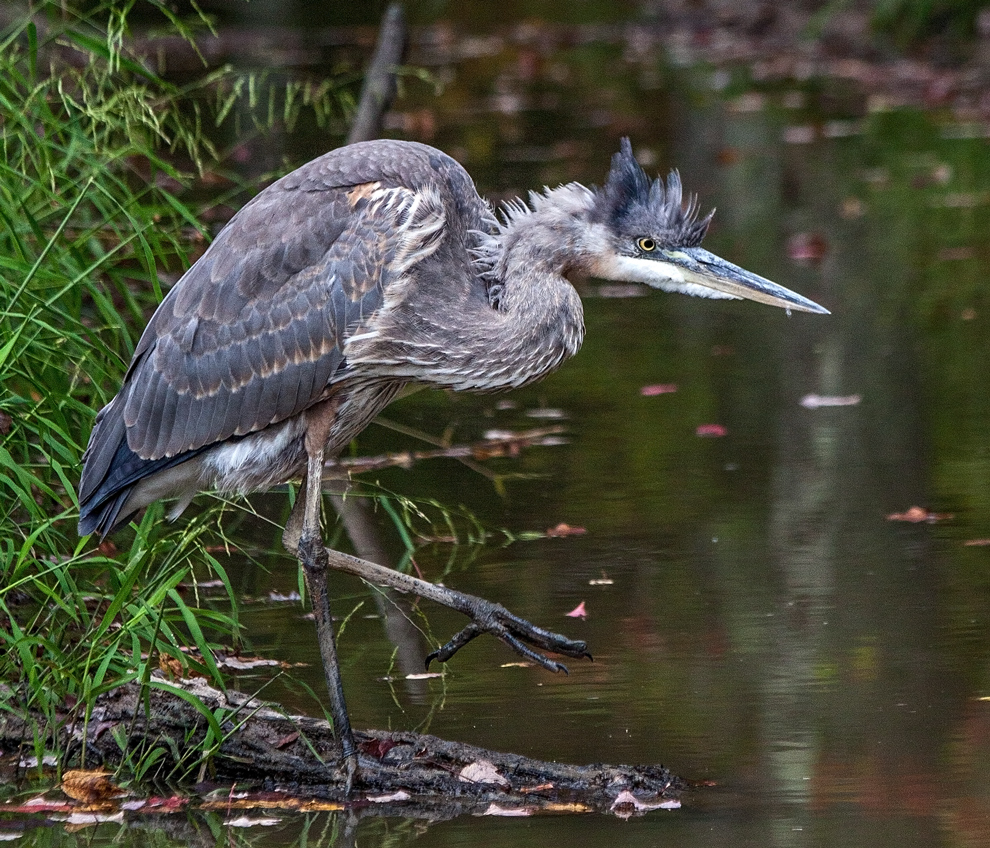
A blue heron with attitude? The pose, facial expression, and hair style of this Great Blue Heron (Ardea herodias) at Huntley Meadows Park, my local marsh, remind me of a punk rocker. Do you think he has tattoos and body piercings too?

heron_punkrocker_blog

© Michael Q. Powell. All rights reserved

Read Full Post »

Sometimes I don’t want to freeze motion entirely in the way that I did in a photo of a Canada Goose landing in the water that I posted earlier today.

Here is another shot of a Canada Goose in which I panned the camera, helping to blur the background, and the slower shutter speed left a certain amount of motion blur in the wings, helping to enhance the impression of speed. My camera was in aperture-priority mode and the shutter speed dropped when the goose that I was tracking flew against the darker background of the trees.
I really like the overall feel of the image, the sense that the goose is straining to slow down as it prepares for landing, but is still moving forward at a fast speed. Is the image “tack sharp?” No, it’s not, but I am happy that it is not—it’s a creative choice. Check out a recent posting entitled “Chasing the tack sharp mirage” by Lyle Krahn, one of my favorite photographers, for a provocative  discussion about this topic.
goose_flying_blog

© Michael Q. Powell. All rights reserved

Read Full Post »

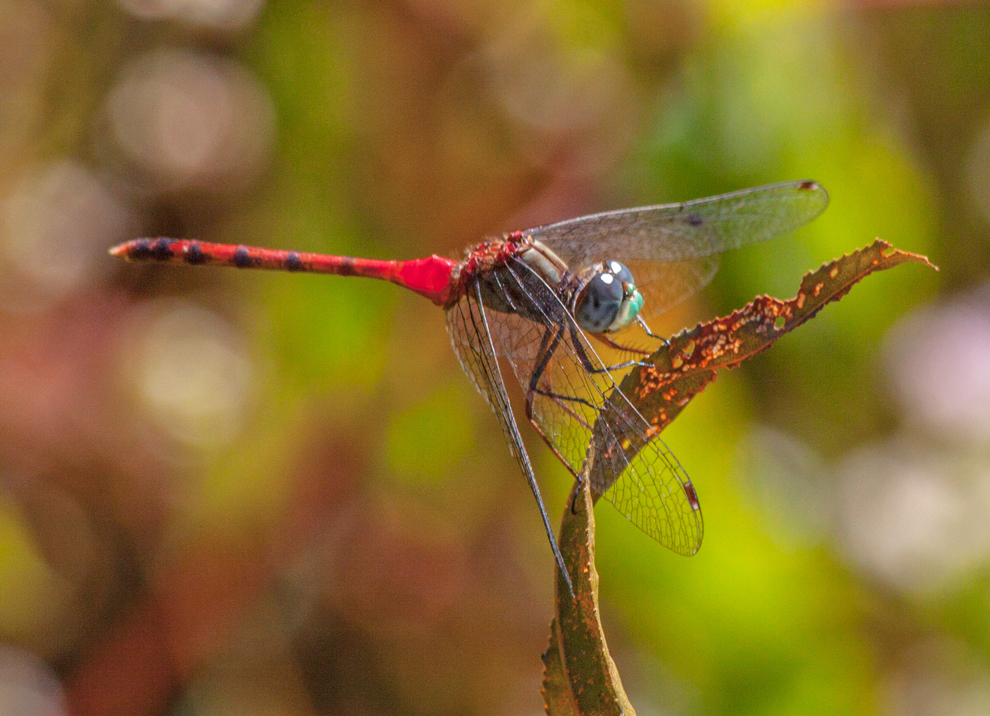
I don’t expect to see new species of dragonflies at this time of the year, but one of my fellow photographers, Walter Sanford, has been stalking the Blue-faced Meadowhawk (Sympetrum ambiguum) almost daily and I joined him for a few hours one late September day and got this shot.

I learned quickly that these dragonflies are hard to spot, despite their conspicuous coloration. They seem to like to remain perched down low in the vegetation and wait for their prey, rather than fly around when they are hunting.

I love the combination of colors on the Blue-faced Meadowhawk and I was happy to get a decent shot that shows its blue face. If you want to see more shots of this beautiful dragonfly, check out Walter’s blog posting from yesterday.

I am now in search of the Autumn Meadowhawk, the last dragonfly that I observed last fall. Normally they should be here already, but none of my fellow dragonfly followers has observed any of them yeat.

blue-faced1_blog

© Michael Q. Powell. All rights reserved

Read Full Post »

In the shallow water of the marsh, this Northern Water snake (Nerodia sipedon) patiently waits for its unwary prey, probably a frog. At one point its body began to vibrate violently and I thought it was getting ready to strike, but it turned out to be a false alarm. In the end, the snake turned out to be more patient than I was and I left without observing the snake capture its next meal.

snake_water_blog

Click on the photo to see a higher resolution view of the snake.

© Michael Q. Powell. All rights reserved


Read Full Post »

Most of the tree frogs that I have seen until now have been lime green, but the one that I saw on Friday was a much darker shade of green. I am pretty sure, though, that he is a Green Treefrog (Hyla cinerea) and he was in a very familiar pose, comfortably napping during the heat of the day.

He was a pretty good distance away, perched on a small tree (or maybe a bush) in the partial shade, but luck was with me, because the sunlight was shining on him. I had a telephoto lens on my camera and managed to get a pretty good shot without scaring him away.

I left the frog thinking that he probably had the right approach—a nap sounded like a good idea.

dark_green_treefrog_blog

© Michael Q. Powell. All rights reserved

Read Full Post »

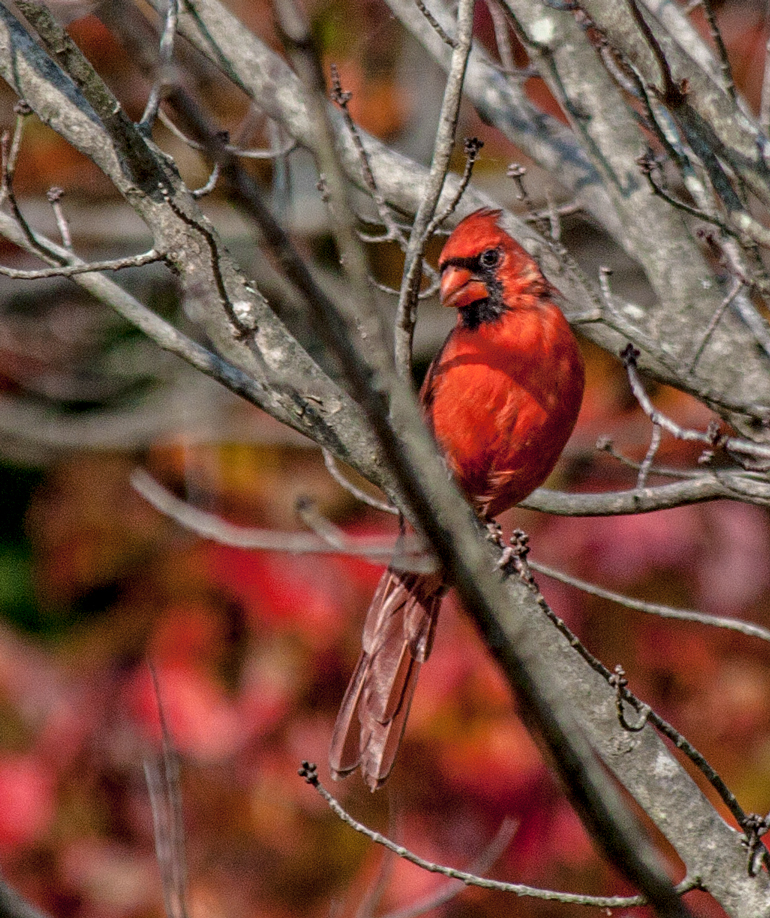
I love to photograph cardinals throughout the year, but I was really excited when I saw this male Northern Cardinal (Cardinalis cardinalis) land on a tree with colorful fall foliage in the background. There were a lot of branches, but I somehow managed to get a facial shot with an interesting expression.

The cardinal seemed to be staring at me, silently criticizing my behavior. It reminded me of the expression that parents sometimes adopt when they want to publicly communicate their displeasure to their offspring without uttering a single word.

cardinal_autumn_blog

© Michael Q. Powell. All rights reserved

Read Full Post »

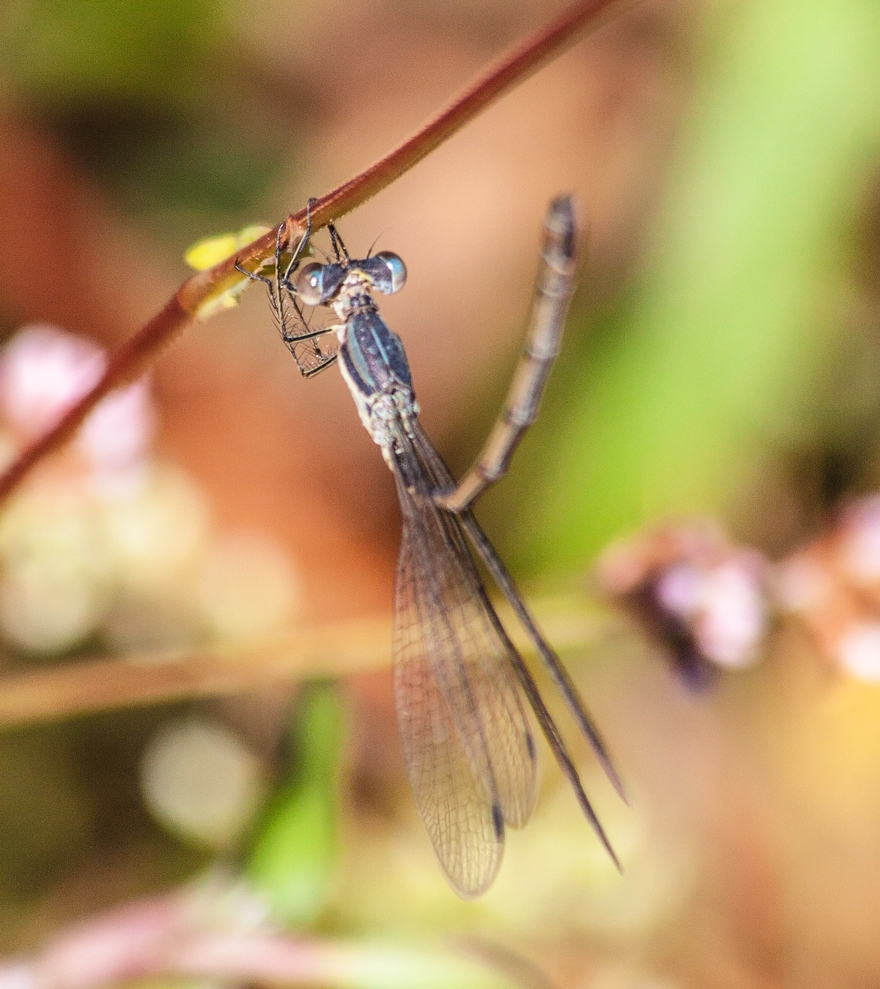
As I was observing this Slender Spreadwing damselfly (Lestes rectangularis) earlier this week, it suddenly launched into a series of acrobatic maneuvers worthy of an Olympic gymnast on the high bar. I captured several action shots of the routine, possibly related to laying eggs, although I managed my clearest shot when the damselfly returned to its starting position and waited for the scores from the judges.

Pointing the toes for maximum extension

Pointing the toes for maximum extension

damsel_spread2_blog

Swinging back to generate greater velocity for the next trick

Finishing up the routine

Finishing up the routine

Waiting for the scores from the judges

Waiting for the scores from the judges

© Michael Q. Powell. All rights reserved

Read Full Post »

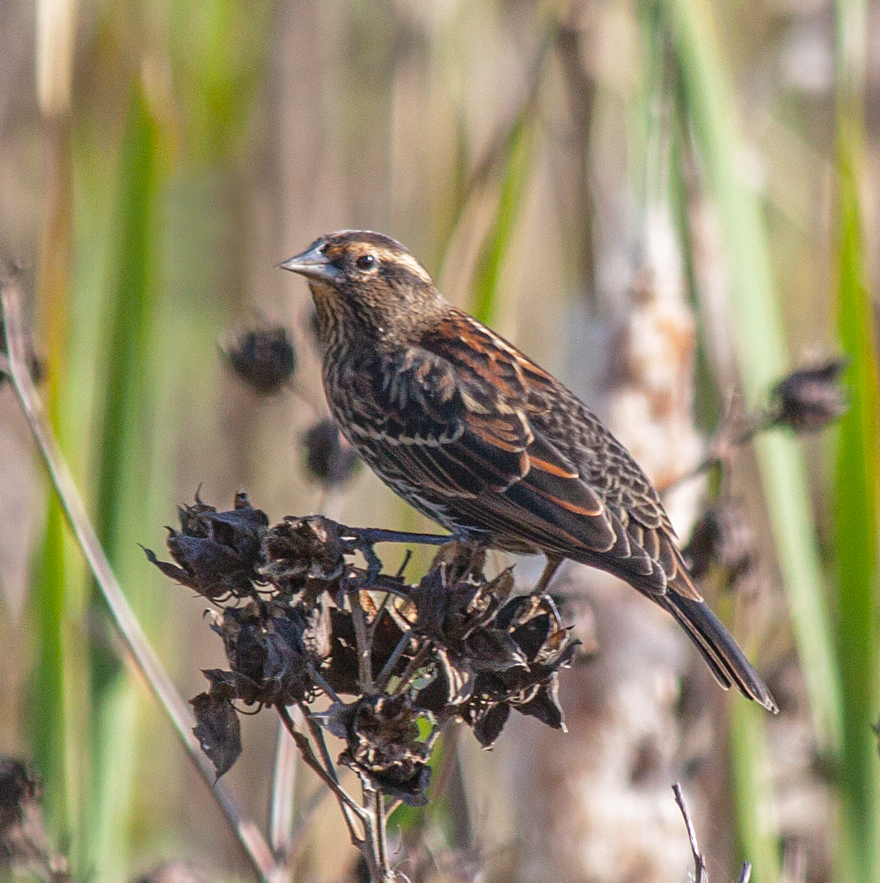
I remember well my confusion the first time that someone identified a bird like this one as a female Red-winged Blackbird (Agelaius phoeniceus). “How can it be a Red-winged Blackbird, when it’s not black and doesn’t have red wings?” I naively asked.

I have learned a lot since that moment and have resigned myself to the reality that the names of birds and insects are often not descriptive (or apply only to one gender of the species).

Female Red-winged Blackbirds seem to forage for food in the underbrush most of the time and I have found it to be harder to get a good shot of females than the males, which seem to like to perch and pose prominently on the cattails. This female lifted her head for a brief moment, permitting me to get this shot, and then quickly returned to work.

blackbird_female_blog

© Michael Q. Powell. All rights reserved

Read Full Post »

There seemed to be a lot of small birds in the trees this past weekend, mostly hidden in the foliage. I did manage to get a shot of this pretty little bird, which I think is a Red-eyed Vireo (Vireo olivaceus). The eye does not look as bright red as in some of the images that I see on-line of this bird, but most of the other characteristics seem to match pretty well.

We seem to be moving into the prime season for birds and my bird identification guide (I was given a Peterson Field Guide to Birds of North America by a dear friend) now has a prominent spot on my desk. Unlike some of the birders that I encounter, I don’t carry around a field guide when I am shooting—I don’t like to have my head buried in a book and potentially miss some action shots.

vireo_blog

© Michael Q. Powell. All rights reserved

Read Full Post »

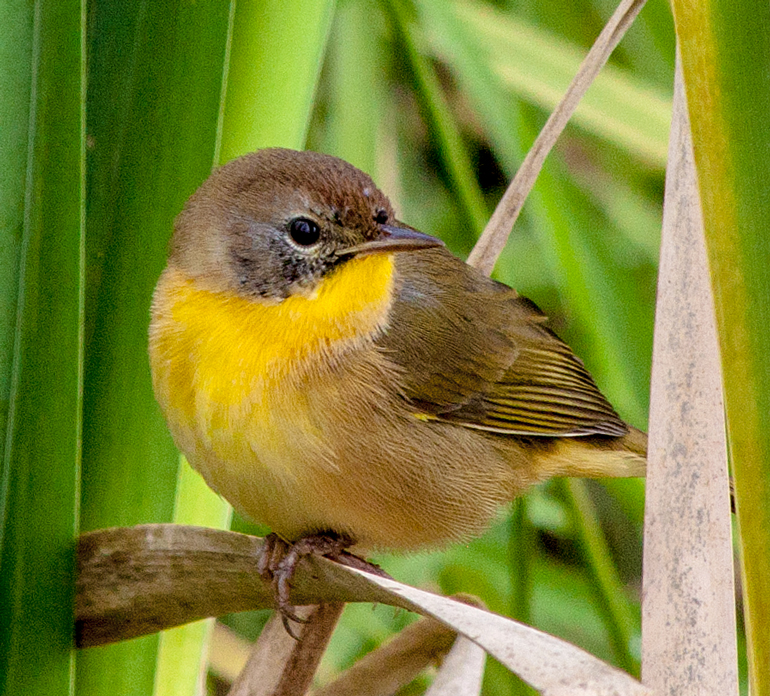
Glancing into the cattails, I caught sight of a flash of color and then gradually a bright yellow bird came into view. The tail was partially concealed by the cattails, accentuating the bird’s circular body shape (and everyone knows that the camera adds pounds to subjects).

I have done some internet searches and concluded that this is probably an immature male Common Yellowthroat (Geothlypis trichas). Adult male Yellowthroats are really easy to identify, because they have a prominent black mask. Like many bird species, however, young male Yellowthroats look a lot like the females, but gradually develop the mask. It looks to me that this bird may have the first traces of such a mask.

The lighting and camera settings combined to produce images that I really like, with colors that are beautifully saturated. I need to figure out how to replicate this look.

yellowbird_blogyellowbird2_blog

© Michael Q. Powell. All rights reserved

Read Full Post »

Yesterday I noticed several small flocks of blackbirds swooping in and out of the cattails at my local marsh and suspect that they are migrating birds. The marshland park seems to be favorite stopping-off spot for all kinds of birds as they move south.

I managed to get his shot of one of a male Red-winged Blackbird (Agelaius phoeniceus) in a rather typical pose on a cattail stalk. Unlike in the spring, when males seem to spend a lot of time calling out to potential, the blackbirds yesterday seemed to be much more focused on foraging for food.

blackbird_fall_blog

© Michael Q. Powell. All rights reserved

Read Full Post »

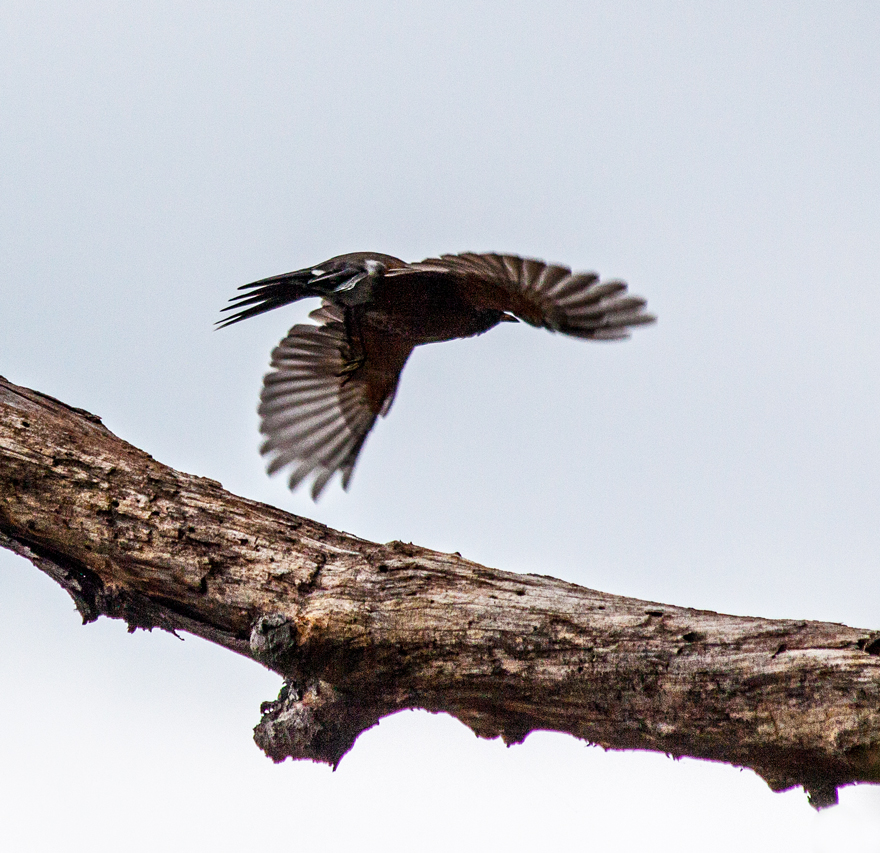
No matter how quickly I try to focus on a bird, they often are quicker than I am. Often I am left with merely an image of an empty branch, but every now and then I’ll get a cool image of the bird taking off.

That was the case yesterday, when I tried to get a shot of this small, dark-colored bird. I really like the position of the tail and the detail of the wings, which help to form an almost abstract portrait of the unidentified bird.

unknown_takeoff_blog

© Michael Q. Powell. All rights reserved

Read Full Post »

Far away from any adult supervision, this baby snapping turtle seemed to be having trouble figuring out how to forage for food on his own.  He stretched out his neck as far as it would go, but was still not within reach of the plants that he was eying. The realization had not yet struck him that was going to have to move his body closer. Just above him you can see a little fish that was monitoring his progress, but staying beyond the reach of those jaws, in case the turtle decides he needs a little protein in his diet.

baby_snapper_blog

© Michael Q. Powell. All rights reserved

Read Full Post »

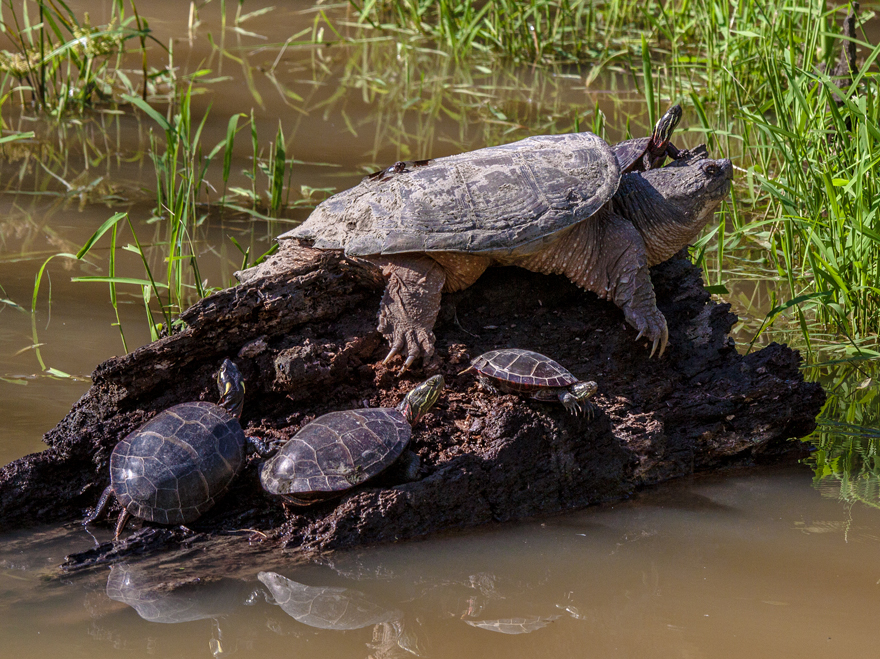
When the family of Red-eared Slider turtles (Trachemys scripta elegans) adopted an orphaned turtle, they had no idea that the baby would grow so big. Despite his disproportionate size, the larger turtle, an Eastern Snapping turtle (Chelydra serpentina serpentina), likes to participate in all family activities and doesn’t seem to realize that he is different from the other members of his adopted family.

I chose a natural setting for this family portrait and managed to catch almost everyone in a good pose—unfortunately, one of them had an attitude and refused to look directly at the camera and smile. Most of us have similar informal family portraits with the same problem. I don’t know how professional portrait photographers get everyone to cooperate.

co-existence_blog

© Michael Q. Powell. All rights reserved

Read Full Post »

« Newer Posts - Older Posts »