Feeds:
Posts
Comments

Archive for the ‘Photography’ Category

Yesterday I was thrilled to get a glimpse of this impressive-looking Wild Turkey (Meleagris gallopavo) at Occoquan Bay National Wildlife Refuge. I have seen Wild Turkeys at this refuge on numerous occasions, but this is one of the first images that I have been able to capture this spring.

I am always amazed when I come upon a male turkey displaying his feathers. I grew up in the suburbs of Boston and the only turkeys that I ever saw were those in the freezer at the supermarket, which did not look anything like this bird, and the cutout figures that we would pin to the wall to celebrate Thanksgiving. Somehow I always thought those cutouts were cartoonish caricatures—little did I know that wild turkeys actually look like those colorful figures.

wild turkey

© Michael Q. Powell. All rights reserved.

Read Full Post »

This Green Heron (Butorides virescens) was practicing its yoga on Saturday while perched on the railing of a small bridge at Meadowlark Botanical Gardens. In the first image you see the rarely observed giraffe pose—don’t try this at home or you many end up in traction. The second shot shows the green heron with its neck in a more relaxed position.

I am amazed by the amount of neck extension the green heron was able to achieve—I am willing to stick my neck out for others at times, but not to that extent.

Green Heron

Green Heron

© Michael Q. Powell. All rights reserved.


Read Full Post »

During a visit yesterday to Meadowlark Botanical Gardens in Vienna, Virginia, I was reminded of my favorite artist—Claude Monet. During the last thirty years of his life, water lilies (Nymphéas in French) were the main focus of his artistic production. One of the museums that I most love visiting is the Musée de l’Orangerie in Paris, because it houses eight massive water lily murals by Monet in two specially-built oval rooms. It is incredibly peaceful to just sit in one of those rooms, surrounded by those amazing paintings.

I was delighted and a little surprised yesterday to see that some water lilies were already in bloom. There was a lot of vegetation surrounding the pond in which the beautiful flowers were floating, so there were some limits to my ability to compose my shots. Still, I am pretty happy with the images that I was able to capture.

Perhaps you will find yourself as captivated by the water lilies as I was.

Water lily

Water lily

water lily

© Michael Q. Powell. All rights reserved.


Read Full Post »

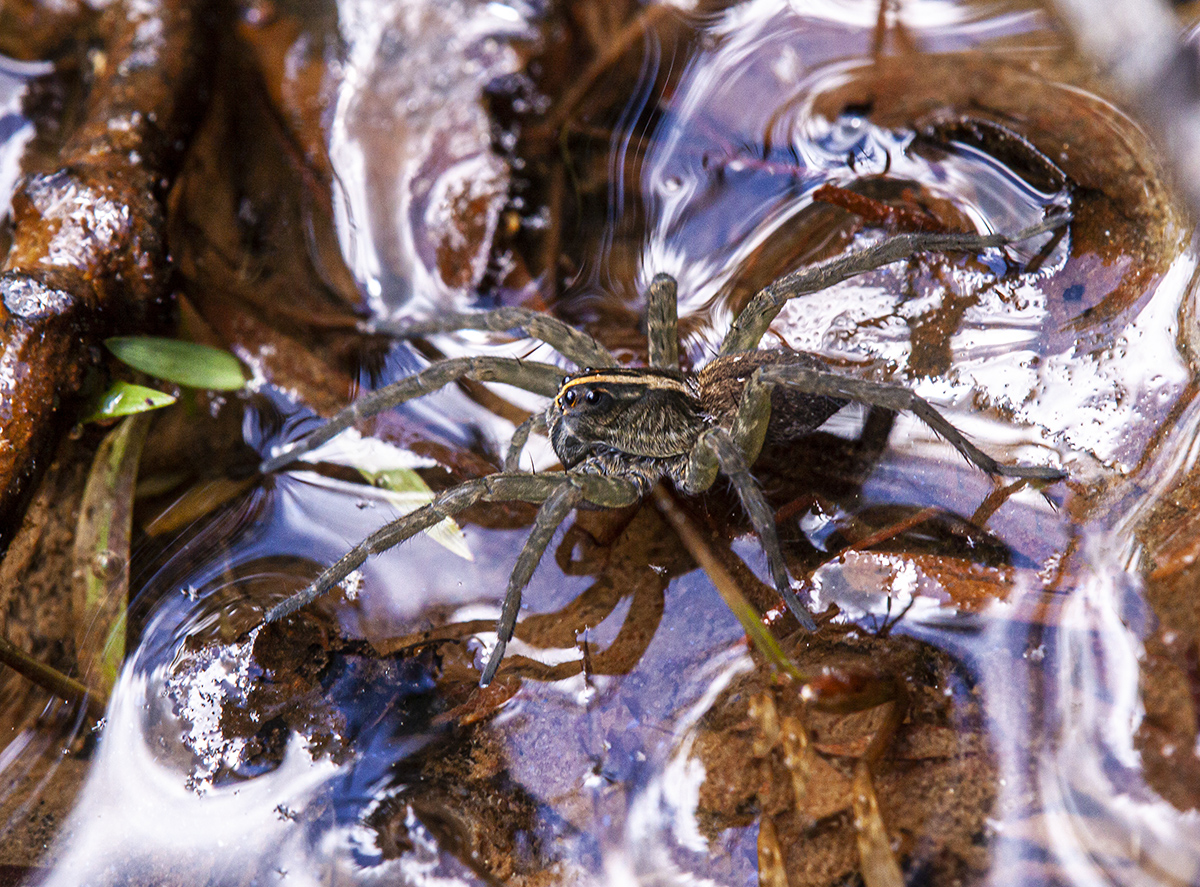
Did you know that not all spiders build webs? Some, like jumping spiders, rely on stealth and speed to capture unsuspecting prey. One of my favorite spiders, the Six-spotted Fishing Spider (Dolomedes triton), sits at the edge of the water with some of its long legs fully extended. When it senses vibrations of a potential prey on the surface of the water, a fishing spider can walk on the water to seize insects, vertebrates, tadpoles and occasionally small fish or even dive underwater up to 7.1 inches (18 cm), according to Wikipedia.

Here are a couple of images of a Six-spotted Fishing Spider that I spotted earlier this week at Prince William Forest Park. I really like the way that you can see most of the spiders eight eyes in these images and the way that the environment looks almost alien and other-worldly.

Past experience has shown me that viewers will be split in their reactions to these images—some will find them to be really cool and fascinating, while others will find them to be completely creepy. As you might suspect, I am in the former group.

Six-spotted Fishing spider

Six-spotted Fishing spider

© Michael Q. Powell. All rights reserved.

Read Full Post »

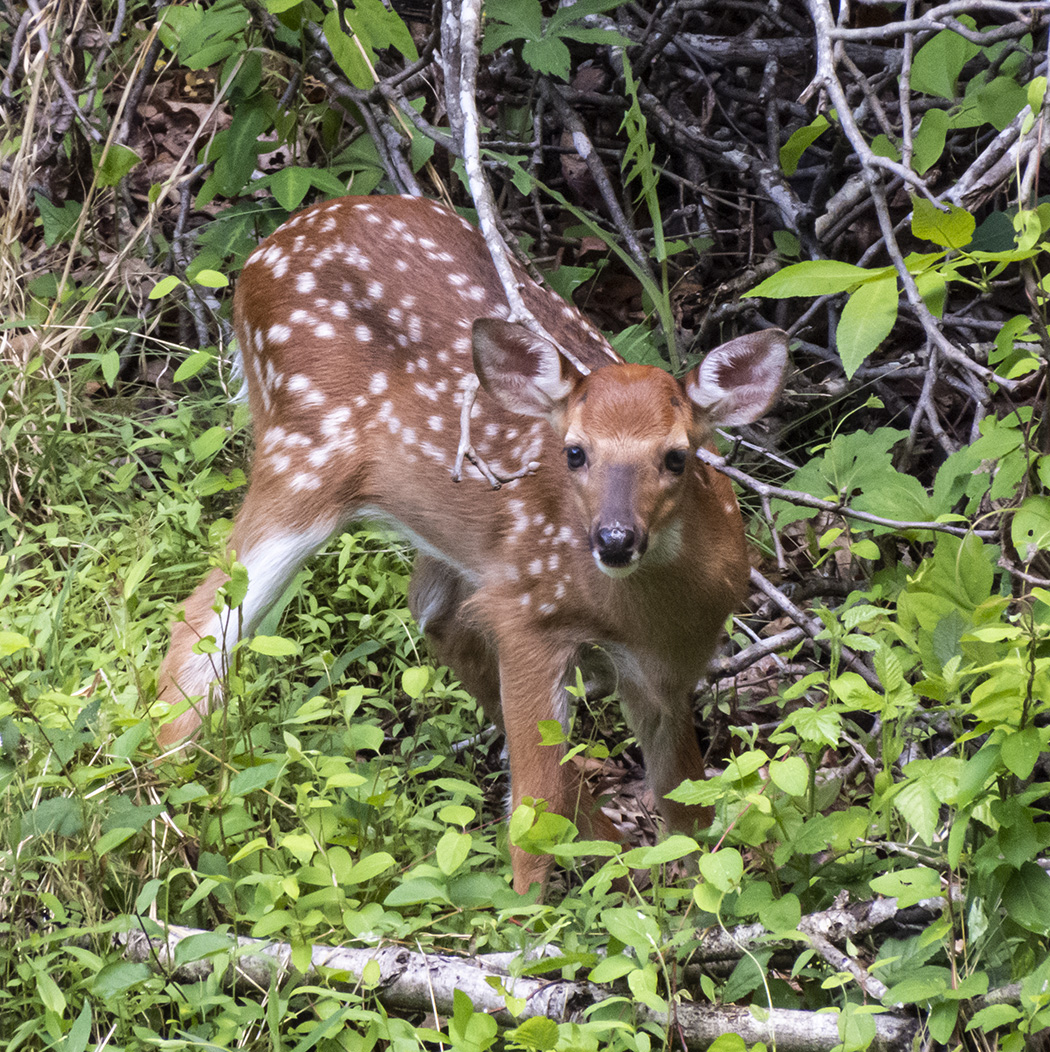
Whenever folks of my generation catch sight of a spotted fawn, we invariably think of the animated Disney movie Bambi, a movie that is an integral part of  our collective memory of childhood. Perhaps we remember the friendship of Bambi, Thumper,  and Flower or the love of Bambi and Faline  or the shocking death of Bambi’s mother. Our memories of the movie may vary, but I think we all feel a soft spot in our hearts if we are lucky enough to catch sight of a fawn.

I spotted this little deer on Tuesday at Prince William Forest Park in Triangle, Virginia. It was down in a small valley at the edge of some heavy vegetation. I watched from a distance from my higher vantage point as the fawn poked about in the vegetation. At some point, the fawn became aware of my presence and looked straight at me through its soft brown eyes. The deer held its gaze for what seemed like a long time and it faded into the underbrush and the spell was broken.

Thanks, Bambi, for sharing those magical moments with me.

Bambi

© Michael Q. Powell. All rights reserved.

Read Full Post »

It was quite startling to see the bright orange color on the head of this Broad-headed Skink (Plestiodon laticeps) yesterday at Prince William Forest Park in Triangle, Virginia. We do not have many lizards in our area and they all tend to blend in much better with their surroundings than this one did.

According to information from the Virginia Herpetological Society, adult males of this species are uniformly brown most of the year. However, during mating season in the spring the head of the males becomes enlarged and turns bright orange. The color of their heads gradually fade and the head is reduced in size the rest of the year.

Broad-headed Skink

© Michael Q. Powell. All rights reserved.

Read Full Post »

Do you like to hang out in the swamp? Swamps may not be the most hospitable place for humans, but they provide a wonderful environment for all kinds of photogenic creatures. For example, the bright yellow Prothontary Warbler that I featured yesterday likes to hang out in a wooded swamp, unlike most warblers that prefer trees in a drier environment.

As I was photographing that bird two weeks ago at Occoquan Bay National Wildlife Refuge, I noticed some very large dragonflies flying around in the same area.  I recognized them as Swamp Darner dragonflies (Epiaeschna heros) and I was thrilled when one of the females decided to deposit some eggs in a fallen log not far from where I was standing observing the warbler. I had to bend down a bit, but essentially my feet stayed in the same spot.

It is definitely cool to be able to photograph two such colorful species from the same spot. The experience is a good reminder not to get so focused on your primary subject that you lose sight of what is happening around you. You never know when an equally good or even better subject may be at your feet, above your head, or to your right or left.

Swamp Darner

© Michael Q. Powell. All rights reserved.

Read Full Post »

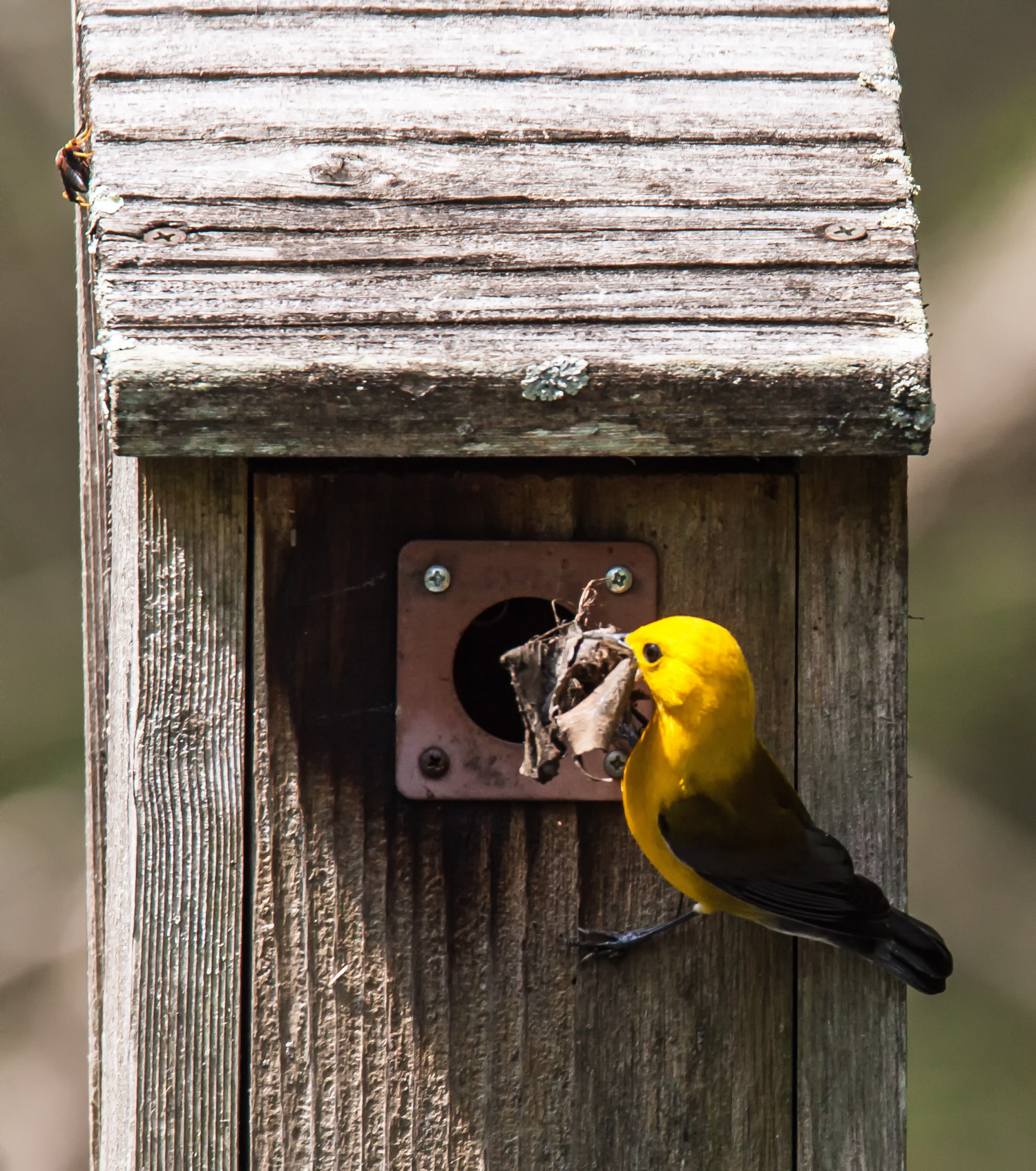
A couple of weeks ago I spotted a colorful Prothonotary Warbler (Protonotaria citrea) building a nest in a nesting box at Occoquan Bay National Wildlife Refuge. The warbler made multiple trips to the nest carrying a variety of materials in its bill. Each time that it got ready to leave the box, the warbler would stick its head out and look around. Although I tried repeatedly to capture the bird in flight as it left the box, the last image was the only one that was partially successful.

I am finally catching up on a backlog of photos—normally I post my photos within a few days of shooting them.

Prothonotary Warbler

Prothonotary Warbler

Prothonotary Warbler

© Michael Q. Powell. All rights reserved.

Read Full Post »

It’s always wonderful to see large colorful butterflies, like this Red-spotted Purple butterfly (Limenitis arthemis astyanax) that I spotted last week at Jackson Miles Abbott Wetland Refuge. I don’t know about you, but I find the spots to be a bit more orange than red and the body looks more grayish-blue than purple. Maybe the people responsible for naming the species say it in a different light. 🙂

Red-spotted Purple

Red-spotted Purple

© Michael Q. Powell. All rights reserved.

Read Full Post »

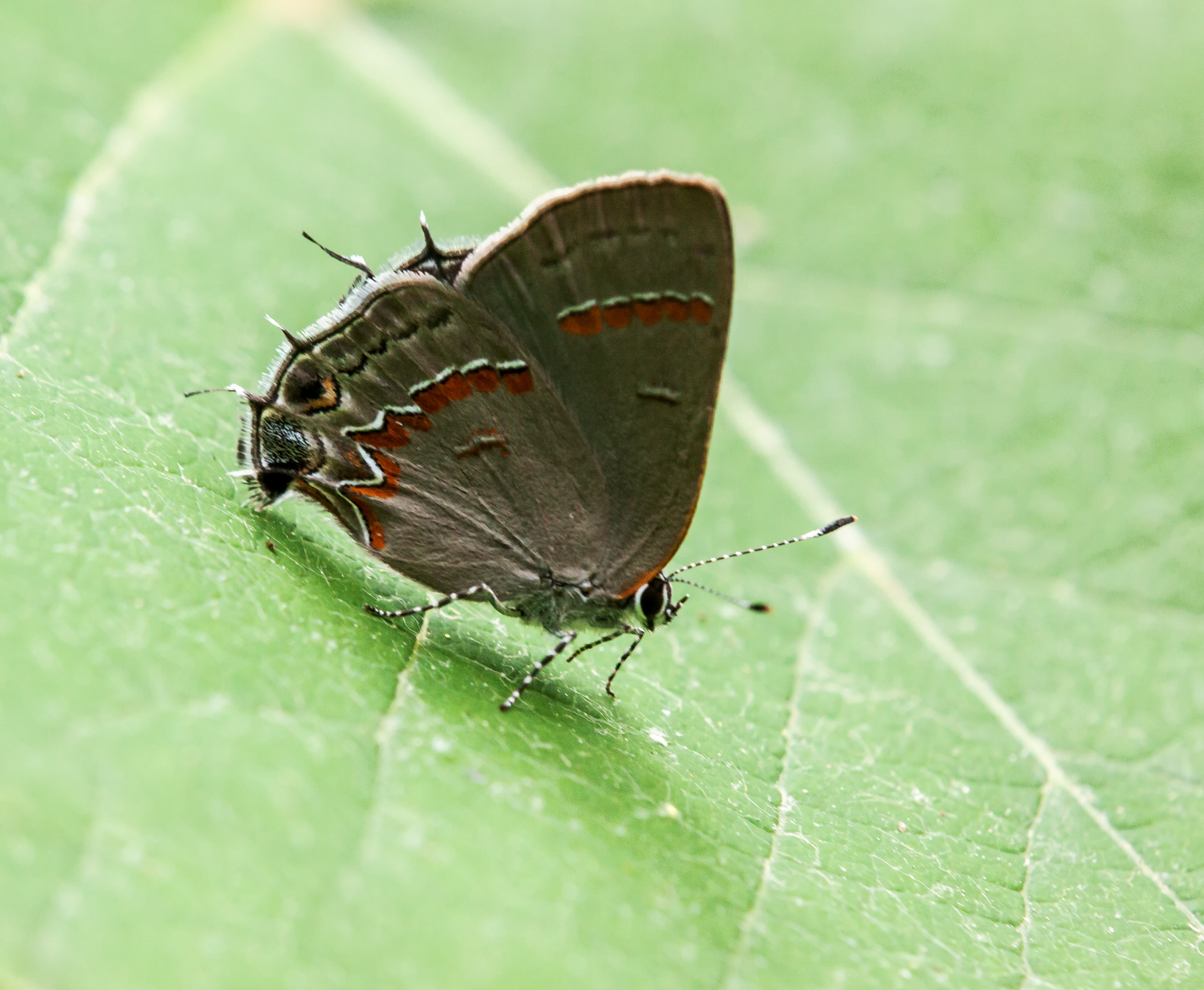
Yesterday I was thrilled to get a shot of this pretty Red-banded Hairstreak butterfly (Calycopis cecrops) at Occoquan Regional Park. These tiny butterflies are only about an inch (25mm) in length, so you really need a macro lens to get a close-enough shot that reveals all of the butterfly’s wonderful colors and patterns. It is also nice to be able to see the little “tails” protruding from the hind wings that I believe are responsible for the name “hairstreak.”


Red-banded Hairstreak

© Michael Q. Powell. All rights reserved.

Read Full Post »

Do you remember the first blog post that you ever wrote? In my first blog posting on July 7, 2012, I featured a photo of a Blue Dasher dragonfly (Pachydiplax longipennis). Every year since then whenever I see my first Blue Dashers of the season, I recall my excitement I experienced in being able to photograph that first dragonfly. I did not realize at that time how “addicted” I would get to photographing these beautiful little creatures.

I spotted this handsome male Blue Dasher this past Tuesday at the edge of a small pond at Jackson Miles Abbott Wetland Refuge.

Blue Dasher

© Michael Q. Powell. All rights reserved.


Read Full Post »

Earlier this week I spotted this male Zabulon Skipper butterfly (Poanes zabulon) while I was exploring Occoquan Regional Park. I am not one hundred percent sure of my identification, given that there are hundreds of different species of skipper butterflies, but I am hoping that I am correct for the simple reason that I find the name “Zabulon” to be exceptionally cool. As some of you may know from the URL for my site, my middle initial is Q, which stands for Quentin, and I am irresistibly drawn to names that begin with infrequently used letters like Q, X, and Z.

In terms of the image itself, I really like the way that the warm orange tones of the butterfly stand out amidst the cooler shades of green in the foreground and in the background.

Zabulon Skipper

© Michael Q. Powell. All rights reserved.

Read Full Post »

Are you so used to the common beauty that surrounds you every day that you no longer see it? What does it take for you to stop and take notice and maybe even pull out a camera to photograph a subject?

Almost six years ago I read a blog posting by fellow photographer Lyle Krahn that talked of a concept called “stopping power” and that posting has stuck with me to this day. Here’s a portion of that posting that describes the concept, “I think every beautiful scene has stopping power. That’s my term for the ability of a scene to make a person stop hiking or driving in order to pull out a camera and make images. Did you ever wonder what makes you stop? Do you ever hear the music?”

I try to pay attention to even the most common subjects and when it comes to dragonflies, that means the aptly named Common Whitetail (Plathemis lydia). Common Whitetails are among the first dragonflies to appear in the spring and among the last to disappear in the autumn. You can find lots of Common Whitetails almost everywhere it seems.

On Tuesday at Occoquan Bay Regional Park I stopped and photographed some Common Whitetail dragonflies as I was searching for some more exotic dragonfly species. This early in the season the Common Whitetails seem to be hanging out at a distance from the water—later in the summer I tend to find them buzzing around ponds and swamps.

The first two shots below are of male Common Whitetails. Although mature males are white, when they are young they have brown bodies similar to those of females. However, males have different patterns on their wings and the second and third images show those differences and may help you to distinguish immature males from females.

So, what has “stopping power” for you? I encourage you to think about that question, to make an effort to lower your threshold, and to look for the uncommon beauty in common subjects.

Common Whitetail

Common Whitetail

Common Whitetail

© Michael Q. Powell. All rights reserved.

Read Full Post »

Yesterday I spotted this male Lancet Clubtail dragonfly (Gomphus exilis) while exploring Jackson Miles Abbott Wetland Refuge, a relatively small park not far from where I live. The dragonfly was perched on some leafy vegetation overhanging the water and I almost fell into the pond while trying to frame the shot. Fortunately I achieved my desired result by hanging over the edge of the steep bank.

If you look at the end of the “tail,” which technically is called the “abdomen,” you can see the enlarged section that gives rise to the term “clubtail.” Compared to the family of skimmers, which include most of the dragonflies that you probably see, like Blue Dashers and Common Whitetails, clubtails are relatively uncommon and it is always exciting for me to spot one.

I was particularly struck by this dragonfly’s brilliant blue eyes. For some reason I find blue eyes to be especially beautiful, irrespective of the species.

Lancet Clubtail

© Michael Q. Powell. All rights reserved.


Read Full Post »

During my church retreat in Orkney Springs, Virginia this past weekend, I played hide-and-seek with a Common Green Darner dragonfly (Anax junius). It repeatedly flew teasingly close to me, trying to entice me to chase it.  I took the bait and pursued the big dragonfly for quite some time as it flew in and out of the reeds.

It tried to hide by hanging from some vegetation by the tips of its tiny toes—the second photo shows my initial view of the hidden dragonfly. By moving to the side and crouching low, I was able to peer through the vegetation and eventually spot the dragonfly. Realizing that it was found, the dragonfly tilted its head toward me and smiled, as you can see in the first image shown below.

Common Green Darner

Common Green Darner

© Michael Q. Powell. All rights reserved.


Read Full Post »

What does the world look like when viewed through the eyes of a young child? I imagine that it is just as magical as the colorful soap bubbles that six year old Isaac had me chasing this past weekend at a church retreat at Shrine Mont in Orkney Springs, VA. For a few carefree moments, I felt like a child again and was able to experience a sense of joy and freedom.

Sometimes I think we make our lives too complicated and buy into the notion that happiness comes through the acquisition of more “stuff.” This experience reminded me of the value of simple, childlike pleasures.

magical bubble

© Michael Q. Powell. All rights reserved.

Read Full Post »

I try to do a blog posting almost every day, but I spent this weekend unplugged from the internet at a church retreat in the mountains of Virginia, so I missed a couple of days. When I first started blogging, I was a bit compulsive about it and worried that I would lose all of my followers if I did not post every single day. Now I have a more balanced approach and realize that it is not the end of the world if the clock strikes midnight and I have not posted something new.

Today I am featuring some Brown Spiketail dragonflies (Cordulegaster bilineata) that I spotted last week while exploring Occoquan Regional Park with my fellow dragonfly enthusiast and blogger Walter Sanford. He and I returned to a location where we had spotted this species last year and were delighted to see that members of this species had emerged on schedule. Like many other species that emerge in the early spring, Brown Spiketails have a limited flight period and are found in small numbers at a limited number of locations.

Walter and I discovered that it is helpful to search for these dragonflies together. Often one of us will flush the dragonfly and the other person can observe the direction and the spot to which the dragonfly has relocated. This is really important because, as you can see from the photos, Brown Spiketails perch at an angle or hang vertically from vegetation that is often low to the ground, which makes it difficult to spot them when they are stationary.

Be sure to check out Walter’s posting today of our encounter with the Brown Spiketails. Although he and I were shooting together, we use different camera gear and approaches and our respective images give you different perspective on the same subjects. We also craft our blog postings independently and the style and content of our individual postings tends to reflect our personalities and backgrounds—I have a liberal arts background and Walter has a background in science.

Brown Spiketail

Brown Spiketail

Brown Spiketail

© Michael Q. Powell. All rights reserved.

Read Full Post »

Shorebirds are always tough for me to identify—so many of them are similar in appearance. When I spotted this little bird on Wednesday at Occoquan Regional Park, I noticed that it was all alone. Half-jokingly, I thought to myself that maybe it is a Solitary Sandpiper (Tringa solitaria). When I later checked my bird identification guide I was shocked to discover that it actually is a Solitary Sandpiper.

According to the Cornell Lab of Ornithology, however, the name of the Solitary Sandpiper is not completely accurate—”While not truly solitary, it does not migrate in large flocks the way other shorebirds do.” On the same website I also learned the interesting fact of the world’s 85 sandpiper species, only the Solitary Sandpiper and the Green Sandpiper of Eurasia routinely lay eggs in tree nests instead of on the ground.

Solitary Sandpiper

Solitary Sandpiper

© Michael Q. Powell. All rights reserved.

Read Full Post »

I hope that the title did not lead to an expectation that you would find photos of tiny deer in this posting. It may have been a stretch to use that title, but I wanted to give a hint of the fact that I captured all of these images with my macro lens. In fact, the first two images are uncropped, which gives you an idea of how close I was to the deer.

Yesterday I set off for Occoquan Regional Park to search primarily for dragonflies and butterflies. I put my Tamron 180 mm macro lens on my camera, a lens which is my go-to lens for much of the spring and summer. Now I must confess that the reach of this macro lens is a bit longer than the average macro lens, which generally has a focal length of 100 mm or so, but it certainly would not be my first choice for wildlife photography.

I was sitting on a log taking a break when I heard some nearby noise in the underbrush. I stood up, expecting to see a scurrying squirrel, and suddenly was face-to face with a White-tailed Deer (Odocoileus virginianus). For a considerable amount of time the deer eyed me with curiosity before slowly moving away. As I watched the deer depart, I noticed another deer, one with amazingly long ears. As I prepared to photograph the second deer, the first one photobombed us, resulting in the third image.

This situation reinforced to me the importance of shooting with whatever camera or lens that I happen to have at hand. It may not be the optimal option, but it can often yield surprisingly good results.

Whiite-tailed Deer

White-tailed Deer

White-tailed Deer

© Michael Q. Powell. All rights reserved.


Read Full Post »

The sky was mostly covered in clouds yesterday morning at Occoquan Bay National Wildlife Refuge when an Osprey (Pandion haliaetus) decided to fly right at me after it had caught a fish.

I love the look of a head-on shot of a flying bird, but capturing such a shot is not easy. First, the bird has to cooperate and most of the time, it seems, birds like to fly away from me and not toward me. Secondly, I have to be able to capture and maintain focus on the bird as it is approaching, which can be a challenge with a heavy telephoto zoom lens. Finally, I have to calibrate my shooting speed so that I don’t fill up the buffer of my camera before the bird gets close.

Things worked out pretty well for this shot. If you click on the image and zoom in on it, you will see that I managed to keep those yellow eyes in reasonably sharp focus and even the beak is in focus. You don’t get a very good view of the fish—you will have to wait until I capture of profile shot of an osprey with its catch.

osprey

© Michael Q. Powell. All rights reserved.

Read Full Post »

Natural camouflage in the coloration of birds and insects enhances their survivability, but it really makes them hard to find and photograph. Last week I made trips on two consecutive days to Patuxent Research Refuge in Laurel, Maryland to search for dragonflies. I have already posted photos of a Common Green Darner and a Swamp Darner that I saw during those trips—both of those dragonflies are large and colorful and relatively easy to spot.

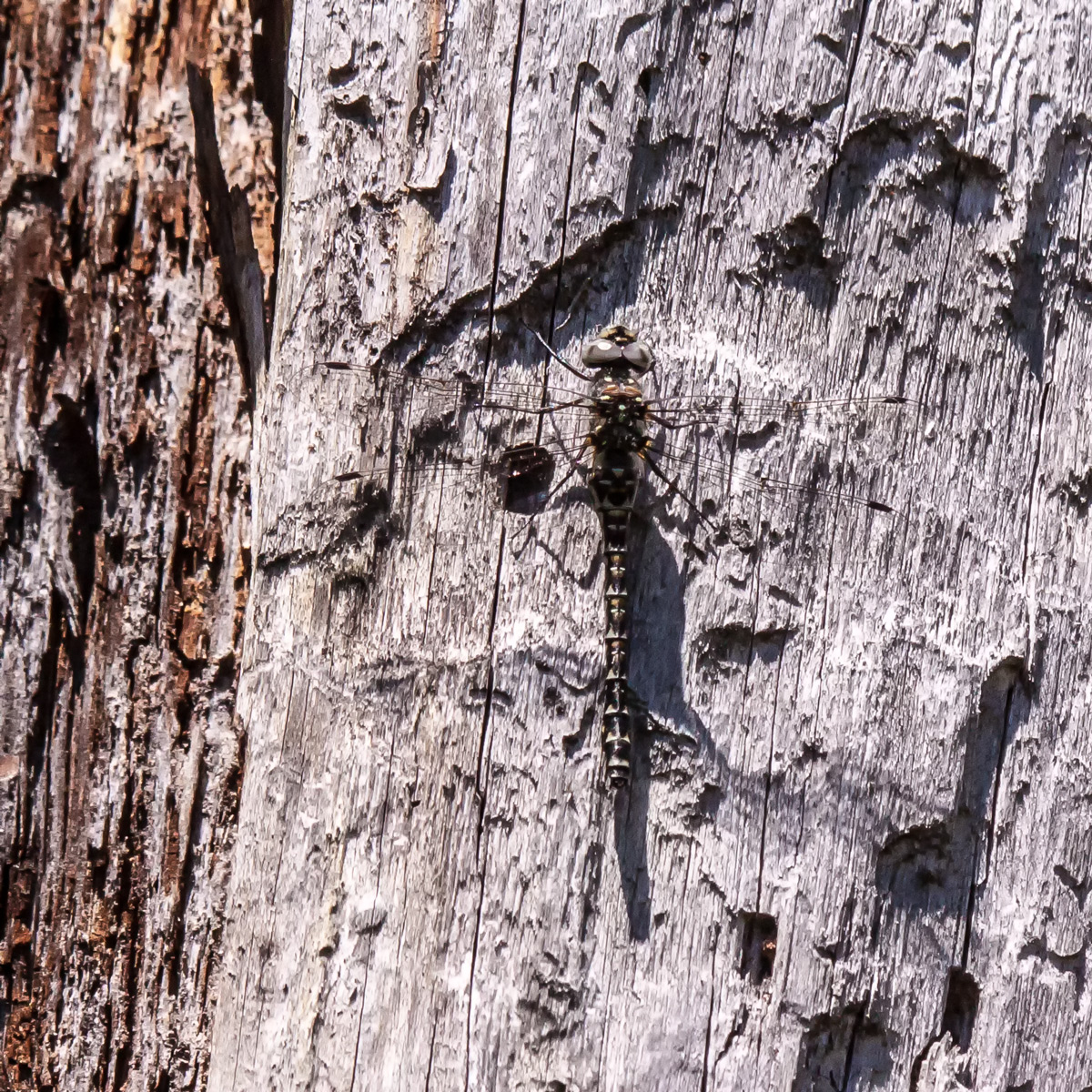
One of the main purposes of the trip, though, was to look for a Harlequin Darner (Gomphaeschna furcillata), a species that is rare in our area and hard to spot in the field. Why? The Harlequin Darner is small for a darner, about 2.2 inches (56 mm) in length, and is in a sub-group know as pygmy darners. Its subdued coloration of gray and brown provide excellent camouflage, particularly because it often perches on tree trunks. The Harlequin Darner requires a specific type of habitat and has a flight season of only a few weeks in early spring.

On my first trip, I traveled with fellow dragonfly enthusiast and blogger Walter Sanford. We searched in vain for several hours, sometimes side-by-side and sometimes separated. As luck would have it, Walter located a Harlequin Darner at a moment when I was pretty far away. Alas, the dragonfly flew away shortly after I arrived at his location. Fortunately, Walter captured some excellent shots which you can see (along with some additional information) on his blog posting from last week. As it turned out, that was the only Harlequin Darner that either of us saw all day.

The following day I decided to return alone, hoping that I too might spot a Harlequin Darner. I saw a good number of dragonflies, including the Common Baskettail that I captured in flight, but as the day progressed, I began to wonder if I would ever find a Harlequin Darner. I kept searching and finally I saw a dragonfly perch vertically on the trunk of a tree. The lighting was harsh and the shadows distorted the proportions of the dragonfly, so I wasn’t sure what kind it was. At this point, though, I was focused on getting a shot and would worry later about identifying the dragonfly. The dragonfly remained in place for about 30 seconds and then flew away.

Well, it turns out this is a female Harlequin Darner. Every time that I see a new species for the first time, I am thrilled to get any kind of recognizable images. In the future I will try to get better shots, but for now I am content that once again my persistence paid off.

It’s great to celebrate small victories.

Harlequin Darner

Harlequin Darner

© Michael Q. Powell. All rights reserved.


Read Full Post »

Many of you are aware that I have been keeping track of a Bald Eagle (Haliaeetus leucocephalus) nest at Occoquan Bay National Wildlife Refuge. When the eagle couple occupied the nest earlier this spring, the authorities set up barriers to keep the eagles from being disturbed, because the tree with the nest is close to the intersection of several trails.

I have checked the nest several times in the past month and there has always been an eagle sitting in the middle of the nest. As I looked through my telephoto zoom lens this past Friday from one of the barriers, I could see that an adult eagle was sitting at one side of the nest, leading me to believe there might be babies. I waited and eventually was rewarded with a view of one eaglet.

Last year there were two eaglets born at this nest. Perhaps there is a second eaglet this year too, but at a minimum I am thrilled to know that there is at least one new eaglet birth to celebrate.

Bald Eagle

© Michael Q. Powell. All rights reserved.

Read Full Post »

Last Friday I spotted this Common Loon (Gavia immer) in the waters off of Occoquan Bay National Willdife Refuge.  I don’t think that I have ever actually seen a loon before, but this bird pretty much matches the image of a Common Loon in breeding plumage in my bird identification guide. The range maps indicate that Northern Virginia, where I live, is in a migratory area for this species. I am guessing that this loon stopped for a while on his journey northward.

Common Loon

© Michael Q. Powell. All rights reserved.

Read Full Post »

Most of the warblers that I am fortunate enough to see are partially hidden by branches. Although hope is usually not an effective technique for taking photos, essentially that is what I do when I spot a hidden warbler—I start shooting and hope that the little bird will reveal itself enough for me to capture a clear shot of at least its head.

That was the case on Friday when I shot numerous photos in an attempt to capture an image of this Prothonotary Warbler (Protonotaria citrea) at Occoquan Bay Naational Wildlife Refuge. Unlike many warblers that are found bushes and in trees in more open area, Prothonotary Warblers are creatures of the swamp. I initially spotted one of these beautiful birds in a marshy area and was thrilled when one of them eventually made its way into some vegetation overlooking the water.

According to the Cornell Lab of Ornithology, the Prothonotary Warbler got its name from the bright yellow robes worn by papal clerks, known as prothonotaries, in the Roman Catholic church. This background information is fascinating, though I must confess that it is hard to find an opportunity to inject the word “prothonotary” into an everyday conversation unless I am talking about this bright yellow bird.

Prothonotary Warbler

© Michael Q. Powell. All rights reserved.

Read Full Post »

Yesterday at Occoquan Bay National Wildlife Refuge I was excited to spot a colorful little bird that was new to me. A search through my bird identification guide and some help from my Faceboook friends helped me to determine that it is a Prairie Warbler (Setophaga discolor).

I am hoping to be able to spot some more warblers this spring while their plumage is particularly colorful. I observed a few warblers last fall and noted that their coloration was a lot more subdued than it is now.

Prairie Warbler

Prairie Warbler

Prairie Warbler

© Michael Q. Powell. All rights reserved.

Read Full Post »

It is a little unusual for me to post photos of the same species twice within a few days, but I could not help myself when I captured this image of a female Swamp Darner (Epiaeschna heros) that provides such a wonderful view of her remarkable eyes.

Dragonfly eyes are always amazing, with their multiple lens that give the dragonfly almost 360 degree vision and the ability to see parts of the color spectrum that are invisible to the human eye. What is particularly striking about this Swamp Darner’s eyes are its varied colors and patterns. Wow!

The second image shows the same female Swamp Darner as she rested in a tree prior to beginning the task of depositing her eggs, which is what you see her doing in the first shot. I captured these images this past Tuesday during a visit to Patuxent Research Refuge in Laurel, Maryland.


Swamp Darner

Swamp Darner

© Michael Q. Powell. All rights reserved.


Read Full Post »

Odonata is an order of insects that includes dragonflies and damselflies. In general, dragonflies tend to be larger and perch with their wings held out to the sides, while damselflies are smaller, have more slender bodies, and most  hold their wings over the body at rest. I try to pay attention to members of both damselflies and dragonflies, but often spend more time with the latter group, because they are easier to find and photograph.

In the interest of equality, I decided to devote today’s post to some of the female Fragile Forktail damselflies (Ischnura posita) that I have observed this past week. The three images show female Fragile Forktails in three of their main activities—perching, eating, and ovipositing (laying eggs). I have no recent shots of the mating that precedes the ovipositing, so I will leave that to your imagination for now.

As you probably noted, the coloration of these lady damselflies varies. The damselfly in the first image with the distinctive markings is an immature female. As the females age, they acquire a bluish coating that is sometimes referred to as pruinescence, which you can especially see in the second image. The third image shows a damselfly arching her long abdomen as she deposits eggs in the debris floating on the surface of a small pond.

Fragile Forktail

Fragile Forktail

Fragile Forktail

© Michael Q. Powell. All rights reserved.

Read Full Post »
Sometimes I can identify a dragonfly by the way that it perches. Some dragonflies like to perch high on the tip of vegetation and some perch low to the ground or even on the ground itself. Some will hang vertically or perch horizontally or at an angle somewhere in between.

On the rare occasions in the past when I have seen a Common Green Darner (Anax junius) perch (usually I see them in the air), it has usually been in vegetation relatively low to the ground. I was therefore surprised to see one spreadeagled on the side of a tree on Monday at Patuxent Research Refuge in Laurel, Maryland. Of course, the bright green color and the bull’s-eye pattern on the face made it easy to identify this dragonfly, despite her unconventional perching pattern.

I have learned from experience that the wildlife subjects that I love to photograph often do not look or act the way in the ways described in books. They are may also be found in different habitats or at different times than the range maps indicate. That is what makes this type of photography so challenging and so rewarding and it means I have to be constantly alert and vigilant when out in the field.

Common Green Darner

Common Green Darner

© Michael Q. Powell. All rights reserved.

Read Full Post »

On Monday I traveled to Patuxent Research Refuge in Laurel, Maryland with fellow dragonfly enthusiast and blogger Walter Sanford to search for dragonflies. One of the highlights of the visit for me was spotting this female Swamp Darner dragonfly (Epiaeschna heros) as she was laying her eggs. As you can see from these two photos Swamp Darners lay their eggs directly into wet wood with their blade-like ovipositor, unlike many other dragonflies that lay their eggs onto the water.

Swamp Darners are among the largest dragonflies in our area, about 3.4 inches in length (86 mm) and it was impressive to watch this one flying about over a swampy area of the refuge.

Swamp Darner

Swamp Darner

© Michael Q. Powell. All rights reserved.

Read Full Post »
What is your first thought when you see these three turtles together? Are they just friends or more than friends? The turtles seem to be pretty comfortable sharing a confined space and there is plenty of space in our minds for varied interpretations on the nature of their relationship. According to the old saying, “two’s a couple and three’s a crowd”—is that always true?

Whatever the case, the turtles at Occoquan Bay National Wildlife Refuge have been definitely been enjoying our recent sunny days. My turtle identification skills are not very good, but I think these all may be Eastern Painted Turtles (Chrysemys picta picta), though there is a chance that they might be Red-eared Sliders (Trachemys scripta elegans).

I love images like this one that allow viewers to use their creativity to interpret what they see and to generate in their minds their own mini-narrative of what is going on. Ménage à trois or just friends—you make the call.

red-eared sliders

© Michael Q. Powell. All rights reserved.

Read Full Post »

Yesterday was a wonderful day for searching for dragonflies at Occoquan Regional Park and among my finds was this beautiful female Painted Skimmer (Libellula semifasciata). This is the first one of the season for this species, which is relatively common compared to most of the early spring species. The patterns on the wing make this species stand out and definitely help in identifying.

I love the way that the different colors on this dragonfly work so well together and give this dragonfly a refined and rather sophisticated look. It is an additional bonus that those colors are mirrored by the background colors in this image.

Painted Skimmer

© Michael Q. Powell. All rights reserved.

Read Full Post »

« Newer Posts - Older Posts »