Wings are tattered. Flowers have faded. Summer is ending. (Blue Dasher dragonfly (Pachydiplax longipennis) photographed on 6 September at Jackson Miles Abbott Wetland Refuge.)

© Michael Q. Powell. All rights reserved.
Posted in Autumn, Dragonflies, dragonfly, Flowers, Insects, Nature, Photography, Summer, wildlife, tagged black-eyed susan, Blue Dasher, Blue Dasher dragonfly, Canon 7D, changing seasons, end of summer, Fort Belvoir VA, Jackson Miles Abbott Wetland Refuge, Pachydiplax longipennis, Tamron 18-400mm on September 12, 2023| 4 Comments »
Wings are tattered. Flowers have faded. Summer is ending. (Blue Dasher dragonfly (Pachydiplax longipennis) photographed on 6 September at Jackson Miles Abbott Wetland Refuge.)
© Michael Q. Powell. All rights reserved.
Posted in Autumn, Dragonflies, dragonfly, Flowers, Insects, Nature, Photography, Summer, wildlife, tagged Blue Dasher, Blue Dasher dragonfly, Canon 7D, female Blue Dasher, Fort Belvoir VA, Jackson Miles Abbott Wetland Refuge, Pachydiplax longipennis, Tamron 18-400mm on September 12, 2023| 11 Comments »
I don’t often see dragonflies perch on flowers, so I was delighted when this female Blue Dasher (Pachydiplax longipennis) decided to rest for a moment on an aster plant in bloom last week at Jackson Miles Abbott Wetland Refuge.
I decided not to crop this photo to show the dragonfly better, because I really like the sweep of bright color on the left side of the image and the more muted out-of-focus colors on the right side. I am growing to love this type of environmental portrait, which goes against my normal approach of trying to fill as much of the frame as possible with my primary subject.

© Michael Q. Powell. All rights reserved.
Posted in Autumn, Birds, Nature, Photography, Summer, wildlife, tagged Canon 7D, Meleagris gallopavo, Occoquan Bay National Wildlife Refuge, Tamron 18-400mm, turkey, turkey wingspan, Wild Turkey, Woodbridge VA on September 11, 2023| Leave a Comment »
As I was observing some Wild Turkeys (Meleagris gallopavo) last Thursday at Occoquan Bay National Wildlife Refuge, one of them suddenly decided to stretch a bit and flapped his wings. In the past I have seen a turkey extend its wings like this only when running away from me. In this case, though, the turkey went back to pecking on the ground and either was not aware of my presence or was simply not bothered by it.
Perhaps he was just trying to cool off on what was a really hot, humid day.

© Michael Q. Powell. All rights reserved.
Posted in Butterflies, Insects, Nature, Photography, Summer, wildlife, tagged Bald Eagle, Canon 7D, Danaus plexippus, Haliaeetus leucocephalus, Monarch, monarch butterfly, Occoquan Bay National Wildlife Refuge, Tamron 18-400mm, Woodbridge VA on September 10, 2023| 4 Comments »
Certain creatures, like Bald Eagles (Haliaeetus leucocephalus) and Monarch butterflies (Danaus plexippus), never fail to thrill my heart when I encounter them. I remember dire warnings from my youth of their threatened extension and I consider it a real blessing that they are still around. The Bald Eagle population has really rebounded, but it is my understanding that the survival of Monarchs is still at risk as a result of the loss of Monarch breeding habitats.
I did not see any Bald Eagles during my visit to Occoquan Bay National Wildlife Refuge this past Thursday, but I was excited to spot this stunning Monarch butterfly. Its colors were bright and vibrant and it seemed to be in perfect condition. I suspect that this butterfly was preparing itself for its upcoming migration flight. According to an article by the National Wildlife Federation, “Beginning in late summer and continuing into early fall, monarchs that emerge from their chrysalides will be behaviorally and biologically different from generations that emerged earlier this year. Unlike their parents and grandparents, these late-season monarchs do not mate or lay eggs. Instead, the insects focus on feeding to fatten up for long migrations to their winter habitats: coastal California for monarchs west of the Rocky Mountains and central Mexico for those to the east.”
The Monarch butterfly was so focused on feeding that it did not fly away as I maneuvered into position to capture this image. I even had the luxury of attempting shots from several angles as the butterfly moved about from flower to flower.

© Michael Q. Powell. All rights reserved.
Posted in Autumn, Dragonflies, dragonfly, Insects, Nature, Photography, Summer, wildlife, tagged Canon 7D, Dythemis velox, Fort Belvoir VA, Jackson Miles Abbott Wetland Refuge, Swift Setwing, Swift Setwing dragonfly, Tamron 180mm on September 9, 2023| 5 Comments »
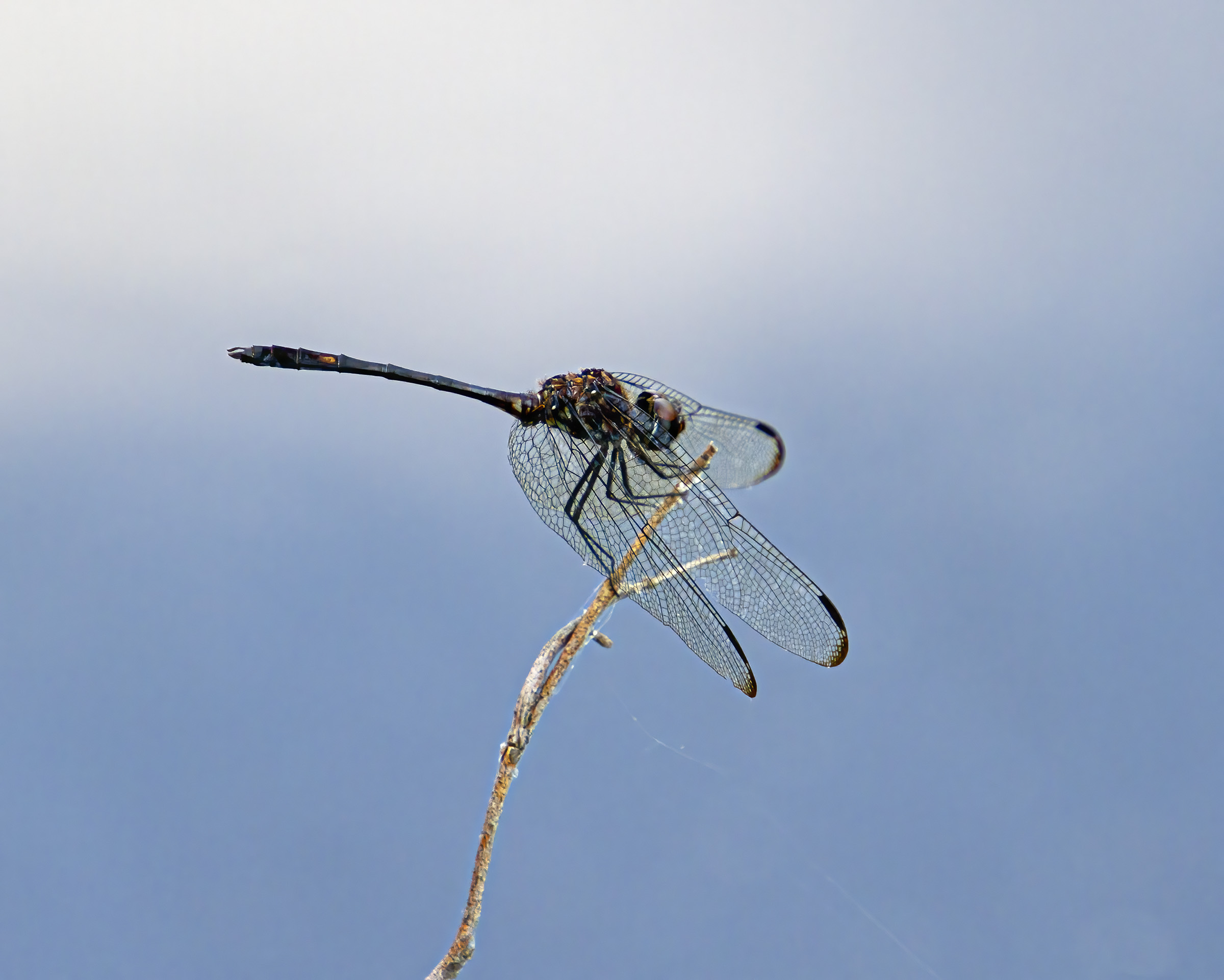
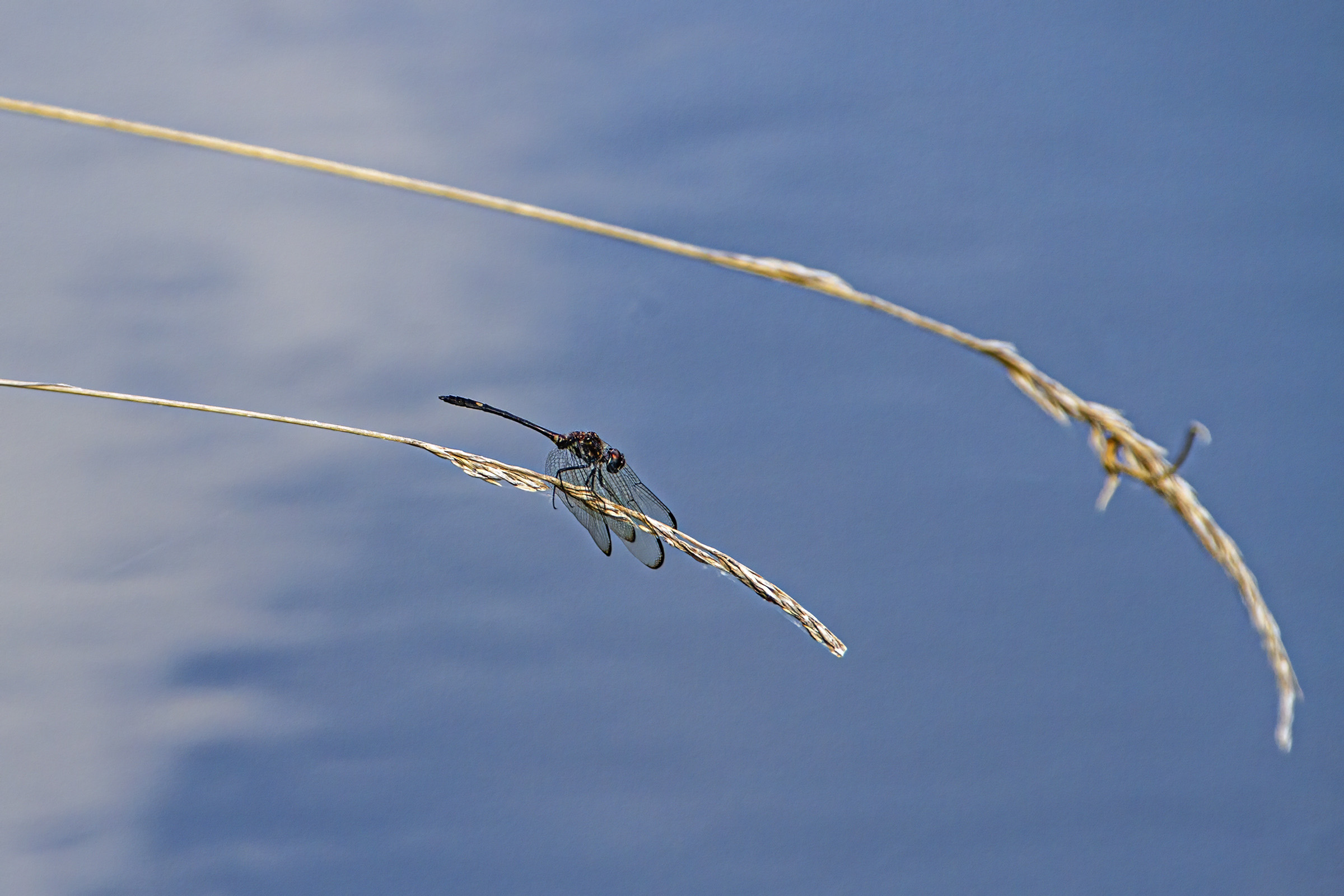
Do you prefer to live your life widely or deeply? That is a curious question, but it is one that affects the way that many of us approach our photography and our lives in general. Let me reframe the question. Are you always seeking to visit new places to see new things, i.e. living “widely”, or would you rather spend your time in familiar locations with familiar subjects, going back to the same places repeatedly, i.e. living “deeply?”
As you may have guessed, I tend to put myself in the second category. I like to observe the seasonal changes at a few local areas, watching for new species to arrive and to depart (or disappear), observing the changes in the flora and the fauna, and discovering favorite spots for my photography. I am not really consumed by a need or desire to add to my “life list” of birds or insects that I have seen, though I do enjoy visiting other locations.
All of these thoughts were percolating in my brain on Wednesday when I visited Jackson Miles Abbott Wetland Refuge to see which dragonflies were still present. I was particularly delighted to spot several Swift Setwing dragonflies (Dythemis velox). In June 2016 at this same refuge, I first photographed a Swift Setwing—a primarily southern species that had never before have been spotted in Fairfax County, the county where I live—and each year since I have eagerly returned to learn more about the species. For more details on my initial sighting, check out my 2016 blog posting Swift Setwing dragonfly.
It is always tough to frame shots of Swift Setwings, because they like to perch on vegetation that overhangs the water and they face the water. The sun was shining brightly and I was happy to capture a couple of images in which the dragonfly appears to be perching among the clouds. I did try to get down low, but I think the background is a reflection of the sky in the water of the pond and not the sky itself.
For the second image, I was far away from the dragonfly. I couldn’t get a clear shot of the Swift Setwing, so I chose to use some vegetation blocking my view as a framing element in the foreground. I like the way that the image turned out.
© Michael Q. Powell. All rights reserved.
Posted in Autumn, Butterflies, Insects, Nature, Photography, Summer, wildlife, tagged Canon 7D, Fort Belvoir VA, ironweed, Jackson Miles Abbott Wetland Refuge, Limenitis archippus, Tamron 18-400mm, Viceroy, Viceroy butterfly on September 8, 2023| 4 Comments »
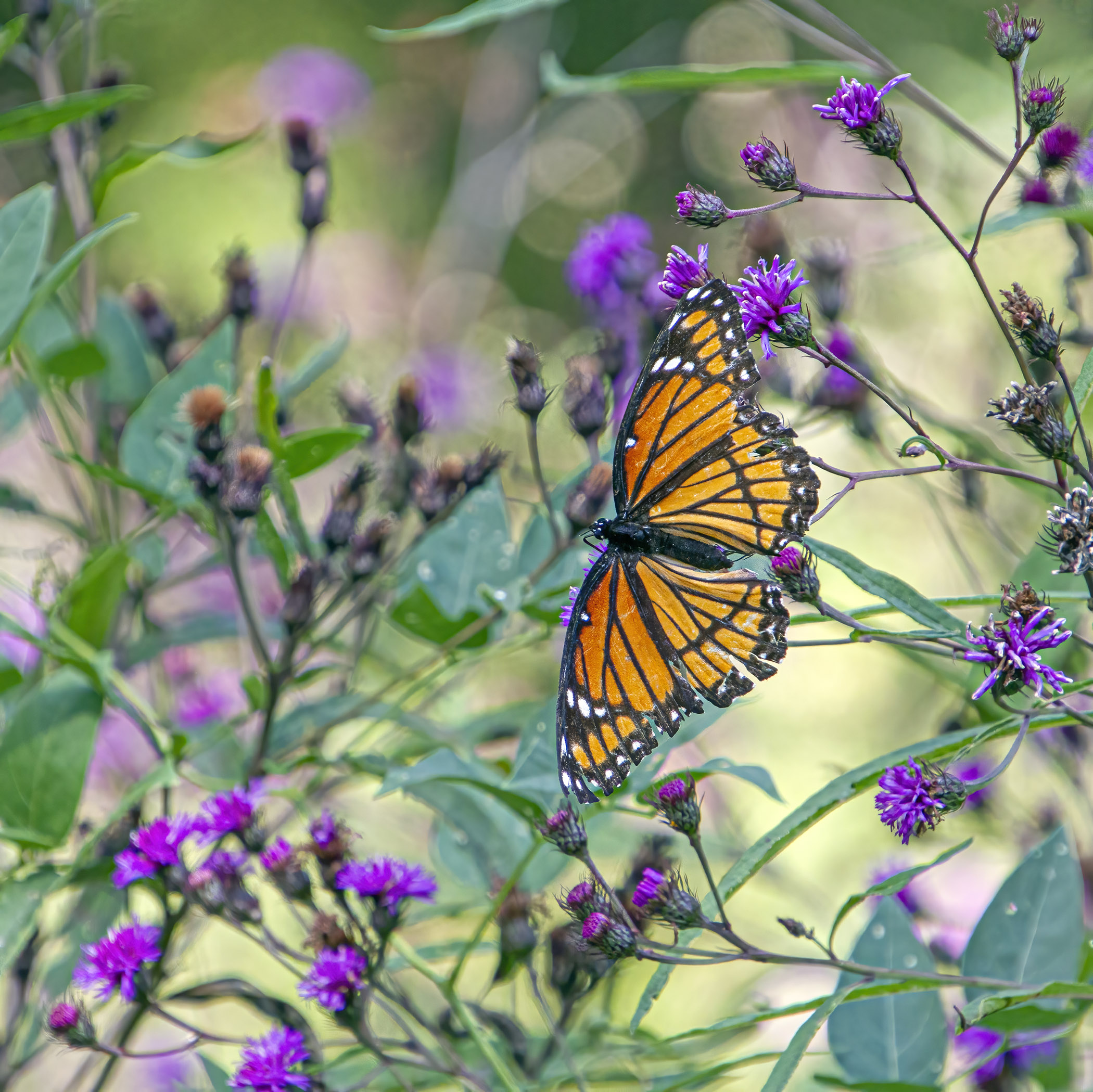
On Wednesday I spotted this beautiful Viceroy butterfly (Limenitis archippus) during a short visit to Jackson Miles Abbott Wetland Refuge. At one end of the refuge, there is a patch of wildflowers and I always make sure to check it out for birds, butterflies, and other insects. I am no expert on wildflowers, but I think the purple plant in the photo may be a variety of ironweed.
As you can probably tell, the Viceroy is considered to be a mimic of the somewhat larger Monarch butterfly. They are pretty easy to tell apart, however, because the Viceroy has a black line across the hind wings that is not found on the wings of Monarchs.

© Michael Q. Powell. All rights reserved.
Posted in Autumn, Dragonflies, dragonfly, Insects, Nature, Photography, Summer, wildlife, tagged Canon 7D, Fort Belvoir VA, Jackson Miles Abbott Wetland Refuge, Libellula pulchella, Tamron 18-400mm, Twelve-spotted Skimmer, Twelve-spotted Skimmer dragonfly on September 7, 2023| 2 Comments »
From a distance, many dragonflies are hard to identify. However, the wing markings on a male Twelve-spotted Skimmer dragonfly (Libellula pulchella) are so distinctive that I could identify this dragonfly immediately when I spotted it yesterday in the marshland at Jackson Miles Abbott Wetland Refuge.
If you take the time to count all of the spots on the wings of the dragonfly, you come up with a number much higher than 12. Why then is it called a Twelve-spotted Skimmer? Someone decided that it was best to count only the dark spots, because only the males generally have the white spots. It is a rare case when gender equality seems to have factored into the name of a species—normally species’ names are based on the characteristics of the male.

© Michael Q. Powell. All rights reserved.
Posted in Butterflies, Insects, Nature, Photography, Summer, wildlife, tagged black swallowtail, black swallowtail butterfly, Canon 7D, Occoquan Bay National Wildlife Refuge, Papilio polyxenes, Tamron 18-400mm, Woodbridge VA on September 6, 2023| 4 Comments »
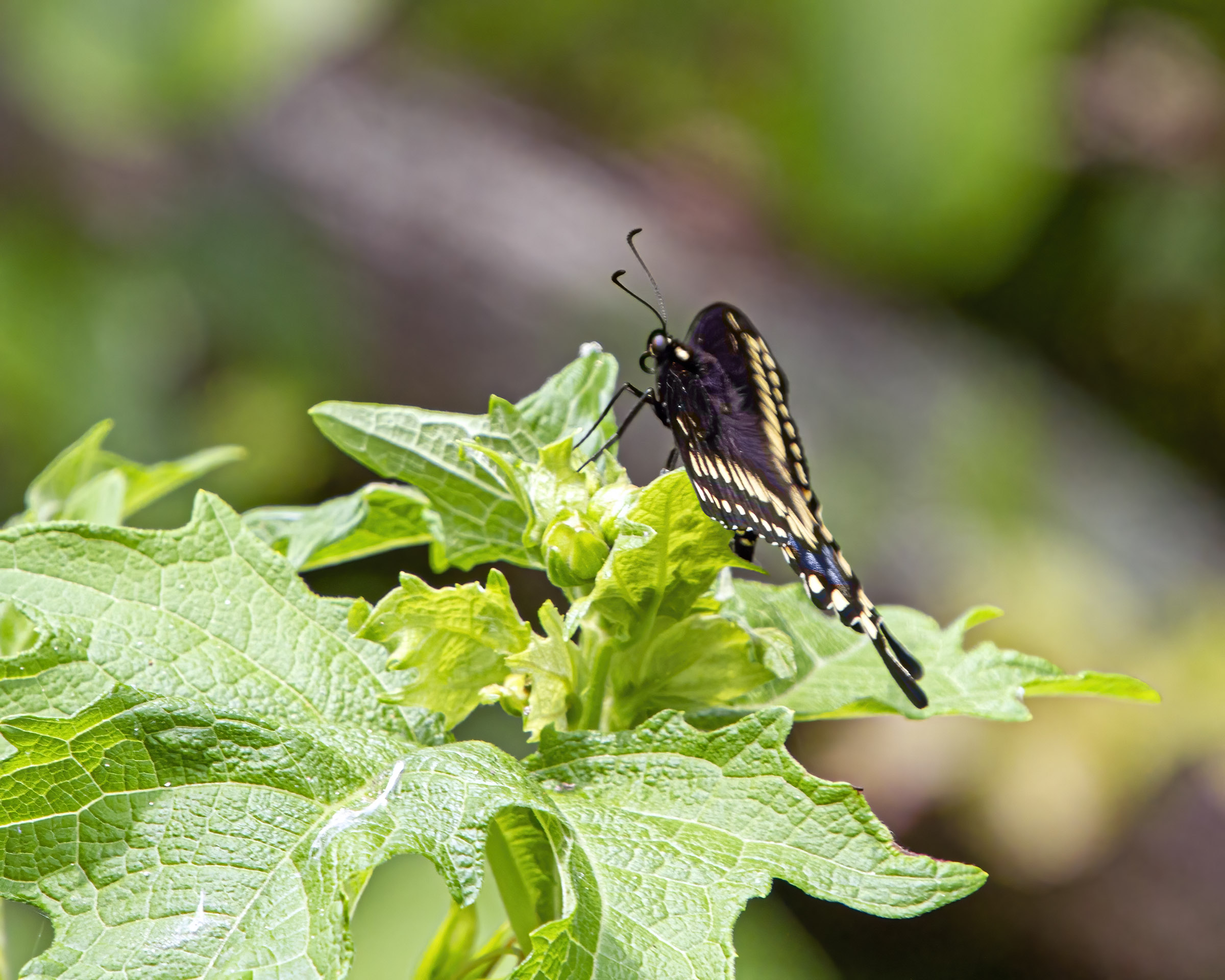
I am happy that I continue to see quite a few butterflies during my visits to Occoquan Bay National Wildlife Refuge. Summer is definitely not over yet—today’s high temperature is forecast to be 97 degrees (36 degrees C) with a heat index well above 1oo degrees (38 degrees C)—but increasingly I am seeing signs that the seasons are starting to change.
I spotted this Black Swallowtail butterfly (Papilio polyxenes) recently as it fed upon some kind of leafy plant. The butterfly’s “tails” were fully intact, but there seemed to be a little damage to its wings and the wings seemed to be strangely separated from its body in the first photo. I am not sure if this is normal or not.
I am trying to decide if I will venture out into the heat today, seeking some of the late season dragonflies, like the Blue-faced Meadowhawk and the Fine-lined Emerald, that emerge onto the scene in early September. If I do go out, I will be sure to bring lots of water and will stay in the shade as much as I can.

© Michael Q. Powell. All rights reserved.
Posted in Autumn, Dragonflies, dragonfly, Insects, Nature, Photography, Summer, wildlife, tagged biological imperative, Blue Dasher, Blue Dasher dragonfly, Canon 7D, dragonflies mating, Lorton VA, mating, Occoquan Regional Park, Pachydiplax longipennis, Tamron 18-400mm on September 5, 2023| 2 Comments »
The clock is ticking as we move towards the end of the dragonfly season and I see a lot of mating dragonflies that appear to be driven by the biological imperative of ensuring the perpetuation of their species. Late in August I observed this pair of Blue Dasher dragonflies (Pachydiplax longipennis) at Occoquan Regional Park in the mating position that is sometimes referred to as “the wheel.”
When mating is completed, the female, the lower dragonfly in the photo, will may lay 500 or more eggs by flying low over the water usually near a heavily vegetated pond edge and repeatedly tapping her abdomen to the surface. Once the eggs hatch, the life cycle of a dragonfly larva begins as a nymph that live underwater and eat smaller aquatic insects. The nymphs, also referred to as naiads, live underwater for up to two years and shed their exoskeletons six or more times.
According to an article in Cambridge Day, “When a naiad is ready to metamorphose into an adult dragonfly, it swims to the surface at night. There, it lifts its head out of the water as its body adapts to breathing air, then climbs a plant stem out of the water, where its skin splits behind its head and the adult dragonfly emerges. The adult swallows air to plump up its body and pumps hemolymph, the bloodlike substance of insects, into its wings.”
For more information about the life cycle of Blue Dasher dragonflies, check out these postings at Life on CSG Pond and at Cambridge Day.

© Michael Q. Powell. All rights reserved.
Posted in Birds, Nature, Photography, Summer, wildlife, tagged Ardea alba, Canon 7D, egret, egret fishing, fishing, Fort Belvoir VA, Great Egret, Jackson Miles Abbott Wetland Refuge, Tamron 18-400mm on September 4, 2023| 4 Comments »
The vegetation seemed so thick in the marshland at Jackson Miles Abbott Wetland Refuge that I was surprised that a Great Egret (Ardea alba) was able to spot and catch a fish there last Monday. I have not seen many egrets this year, so I was shocked to see five of them that day.
Great Egrets leave our area and head to warmer locations when the weather begins to turn cooler, while their “cousins,” the Great Blue Herons, stay with us throughout the entire year.


© Michael Q. Powell. All rights reserved.
Posted in Dragonflies, dragonfly, Insects, Nature, Photography, Summer, wildlife, tagged Canon 7D, Fort Belvoir VA, Great Blue Skimmer, Great Blue Skimmer dragonfly, Jackson Miles Abbott Wetland Refuge, Libellula vibrans, Tamron 18-400mm on September 3, 2023| 4 Comments »
As we flip the pages of our monthly calendars from August to September, it is not unusual for me to encounter dragonflies with tattered wings. For many of these dragonflies, it has been a long, tough summer and they will only be with us for a few more weeks or perhaps a month or two. Despite the damage to their wings, the dragonflies appear to be fully capable of flight—somehow they are able to compensate for their infirmities.
I spotted this Great Blue Skimmer dragonfly (Libellula vibrans) this past Monday at Jackson Miles Abbott Wetland Refuge. It is a little tough to tell in this image, but several of the wings showed wear-and-tear. The shredded appearance of the vegetation is a perfect complement to this late season dragonfly—they both speak to me of the inexorable passage of time and the inevitable changes in our appearance and capabilities brought on the aging process.

© Michael Q. Powell. All rights reserved.
Posted in Dragonflies, dragonfly, Insects, Nature, Photography, Summer, wildlife, tagged Canon 7D, Carolina Saddlebags, Carolina Saddlebags dragonfly, Occoquan Bay National Wildlife Refuge, Tamron 18-400mm, Tramea carolina, Woodbridge VA on September 2, 2023| 1 Comment »
I do not see Carolina Saddlebags dragonflies (Tramea carolina) very often and when I am lucky enough to spot one, it is usually in flight. According to the Dragonflies of Northern Virginia website, “Carolina Saddlebags appear to stick to shallow, thickly vegetated ponds and marshlands,” which is a pretty good description of the place where I spotted this one last Saturday at Occoquan Bay National Wildlife Refuge. The same website described the Carolina Saddlebag’s flight tendencies as “Strong flier, often high, rarely perches.”
I had been watching several Calico Pennant dragonflies, another species that is red and has patterned wings, as they flew around over the pond when suddenly a somewhat larger red dragonfly flew into view—Calico Pennants are approximately 1.3 inches (33 mm) in length, while Carolina Saddlebags are 2.0 inches (51 mm). I visually tracked the Carolina Saddlebags and was able to follow it as it perched high on a stalk of vegetation in an adjacent field.
I moved slowly and stealthily, but did not have room for maneuver to compose a few shots. The lighting was best when from the angle at which I captured the first shot and you can see some of the details and markings on the dragonfly’s body. In the second image, you get a better look at the “saddlebags,” the reddish-brown patches on the rear wings, but most of the body is silhouetted.
For the third shot, I changed the height of my shooting angle to make the background a bit more interesting than the sky. The blurry greenish background in the image was some distant trees. As you may have noticed, the dragonfly’s position in the second and third images is almost the same


© Michael Q. Powell. All rights reserved.
Posted in Dragonflies, dragonfly, Insects, Nature, Photography, Summer, wildlife, tagged Calico Pennant, Calico Pennant dragonfly, Canon 7D, Celithemis elisa, male Calico Pennant, Occoquan Bay National Wildlife Refuge, pole vault, pole vaulter, Tamron 18-400mm, Woodbridge VA on August 29, 2023| 7 Comments »
Calico Pennant dragonflies (Celithemis elisa) often remind me of pole vaulters. They hold on to a long, narrow “pole” at the very end and flex it, as though they were trying to propel themselves over a bar. I spotted this handsome male Calico Pennant last Saturday at Occoquan Bay National Wildlife Refuge, one of the few local spots where I encounter this spectacular species.
This will probably be my last blog posting this week. I will be driving from Virginia to Massachusetts later today to deal with some family issues and will return home this coming weekend, when I hope to resume my habit of posting nature and wildlife photos almost daily.

© Michael Q. Powell. All rights reserved.
Posted in Dragonflies, dragonfly, Insects, Nature, Photography, Summer, wildlife, tagged Canon 7D, Libellula luctuosa, male Widow Skimmer, Occoquan Bay National Wildlife Refuge, Tamron 18-400mm, Widow Skimmer, Widow Skimmer dragonfly, Woodbridge VA on August 28, 2023| 6 Comments »
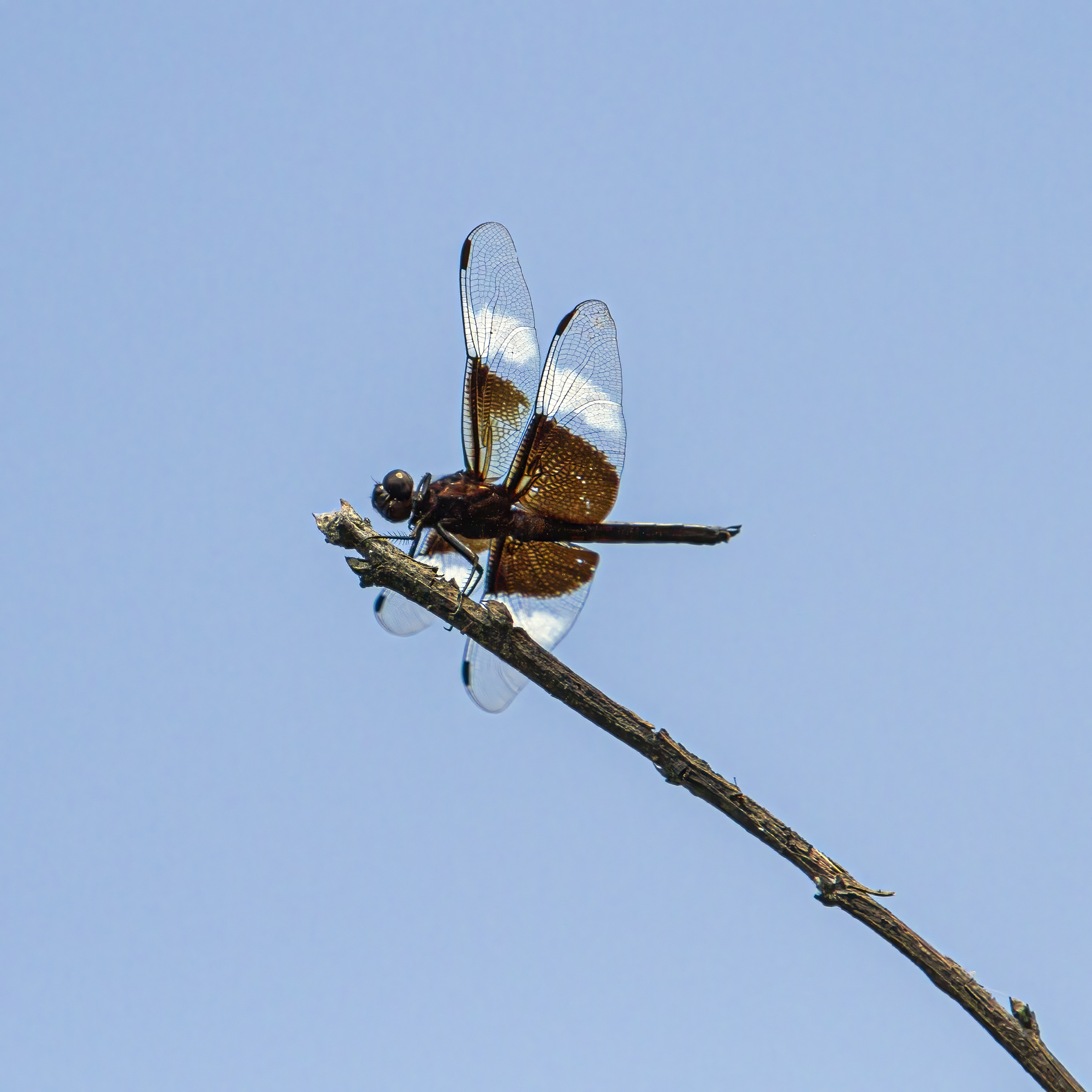
I spotted this handsome male Widow Skimmer dragonfly (Libellula luctuosa) this past Saturday at Occoquan Bay National Wildlife Refuge. Only the males of this species have white patches on their wings—the females have only the dark patches.
The Latin name for this species includes the word “luctuosa,” which means “sorrowful” or “mournful.” Apparently someone thought that the dark patches on the wings of dragonflies of this species looked like the kind of mourning crepe veils that traditionally widows were supposed to wear up to four years to show their grief.
I think that I have been reading too many warnings about people taking advantage of older people, because the name “Widow Skimmer” initially conjured up visions of young gigolos chasing after rich old ladies in Florida who have lost their husbands.
© Michael Q. Powell. All rights reserved.
Posted in Birds, Nature, Photography, Summer, wildlife, tagged Ardea herodias, Canon 7D, Great Blue Heron, Great Blue Heron in a tree, Lorton VA, Occoquan Regional Park, Tamron 18-400mm on August 27, 2023| 7 Comments »
I inadvertently spooked a Great Blue Heron (Aredea herodias) on Wednesday at Occoquan Regional Park and captured this first image as it flew up to a perch high in a nearby tree. It was really cool to see the heron’s impressive wingspan as it came in for a landing in the tree. The second image shows the Great Blue Heron as it surveyed its surroundings from its new perch.
When I was just starting out in wildlife photography, I remember being shocked the first time that I saw a Great Blue Heron in a tree. I somehow had assumed that they spent all of their time in the shallow water or at the edge of ponds. Little did I know at that time that Great Blue Herons build their nests in the trees and often spend their nights roosting in trees to protect themselves from potential predators.


© Michael Q. Powell. All rights reserved.
Posted in Dragonflies, dragonfly, Insects, Nature, Photography, Summer, wildlife, tagged Canon 7D, Celithemis eponina, Eastern gamagrass, gamagrass, halloween pennant, Halloween Pennant dragonfly, Occoquan Bay National Wildlife Refuge, Tamron 18-400mm, Tripsacum dactyloides, Woodbridge VA on August 26, 2023| 2 Comments »
Last Monday I spotted this striking female Halloween Pennant dragonfly (Celithemis eponina) perched high in the eastern gamagrass (Tripsacum dactyloides) at Occoquan Bay National Wildlife Refuge. It was somewhat unusual for me to have a chance to photograph a dragonfly above eye level and I did my best to isolate the subject against the pale blue sky.
I really like the minimalism of this composition. The color and texture of the gamagrass add some visual interest to the image without distracting the viewer from the primary subject.

© Michael Q. Powell. All rights reserved.
Posted in Butterflies, Insects, Nature, Photography, Summer, wildlife, tagged Canon 7D, Eastern Tiger Swallowtail, Eastern Tiger Swallowtail butterfly, Occoquan Bay National Wildlife Refuge, Papilio glaucus, Tamron 18-400mm, Woodbridge VA on August 25, 2023| 4 Comments »
I was excited to spot this beautiful Eastern Tiger Swallowtail butterfly (Papilio glaucus) on Monday at Occoquan Bay National Wildlife Refuge. Most years I spot lots of these butterflies, but for some reason I have not seen one in quite some time this summer.
I love the beautiful coloration of this Eastern Tiger Swallowtail and believe that it is a female. Males of this species are almost exclusively yellow and black, while females are more vividly colored, with strongly pronounced cells of orange and a greater degree of iridescent blue on the lower wings.

© Michael Q. Powell. All rights reserved.
Posted in Art, Dragonflies, dragonfly, Insects, Nature, Photography, wildlife, tagged Calico Pennant, Calico Pennant dragonfly, Canon 7D, Celithemis elisa, dragonfly in flight, male Calico Pennant, Occoquan Bay National Wildlife Refuge, Tamron 18-400mm, Woodbridge VA on August 24, 2023| 9 Comments »
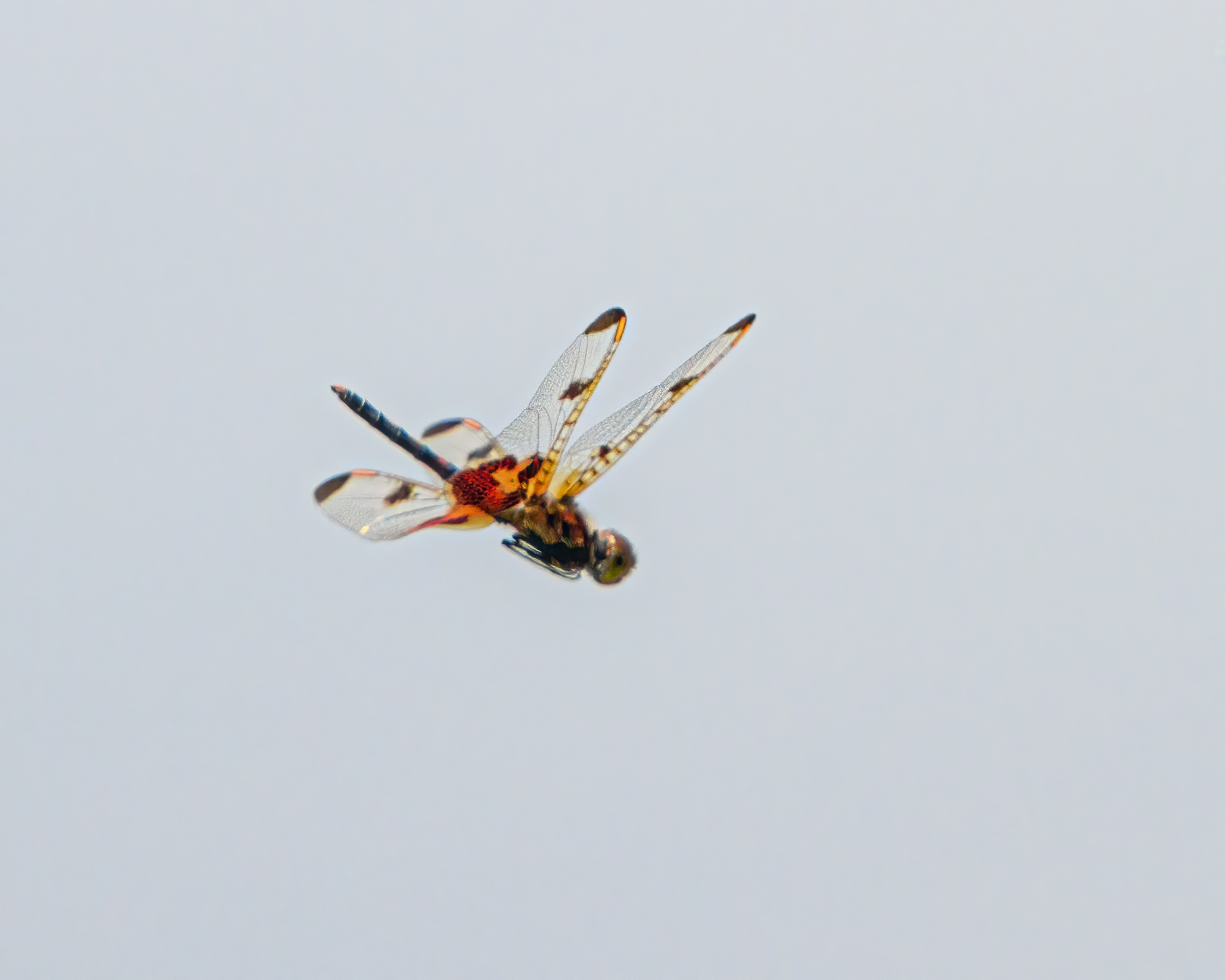
When I am writing a blog posting with multiple photos, I will usually lead with the “best” photo. Most of the time I have a clear favorite image, but today I struggled a bit in trying to decide which image of a Calico Pennant (Celithemis elisa) was the “best” one. I was delighted on Monday at Occoquan Bay National Wildlife Refuge to have multiple opportunities to photograph male Calico Pennants, which are among the most striking dragonflies that I encounter, thanks to their bold coloration and wonderfully patterned wings.
From a technical perspective, the first image could be considered the “best.” The background is pleasantly blurred and virtually all of the dragonfly’s features are in sharp focus. Graphically this image stands out, even when viewed as a thumbnail on a cell phone.
The background in the second image is considerably more cluttered than in the first image. However, I think the color contrast between the bright red of the dragonfly and the pinkish-purple colors in the background makes it easy to see the primary subject. The vegetation helps to provide the viewer with a sense of the environment in which I photographed the dragonfly.
The third image was the most challenging to capture. Several Calico Pennants were flying around over the waters of a pond and I was thrilled to capture this in-flight shot, my first such photo of this species. Most of the other dragonflies that I have photographed as they were flying were considerably larger—a Calico Pennant is only about 1.3 inches (33 mm) in length—and it took a lot of persistence and concentration to get this shot.
The final shot was a lucky one. I was focused on the perched dragonfly and reacted quickly when it took off. From an artistic perspective, I really like this image. The mottled colors of the pond works well as a backdrop for the action and the contrast between the muddy brown and the bright red of the dragonfly makes the subject “pop.” I love the texture of the branch and the branch helps to lead the viewer’s eyes to the dragonfly. Finally, the dragonfly’s wing patterns are displayed beautifully as I managed to capture a moment when they were fully extended.
I don’t know if it is possible for me to state definitively which one of these images is the “best”—I like each of them for different reasons. Is there one that stands out to you more than the others? I’d welcome your views on this question.



© Michael Q. Powell. All rights reserved.
Posted in Birds, Nature, Photography, Summer, wildlife, tagged Black Vulture, Canon 7D, Coragyps atratus, Occoquan Bay National Wildlife Refuge, Tamron 18-400mm, vulture, Woodbridge VA on August 23, 2023| 7 Comments »
The gloomy feel of this photo seems perfect for these two Black Vultures (Coragyps atratus) that I spotted in a dead tree on Monday at Occoquan Bay National Wildlife Refuge. Many people find vultures to be creepy, probably because they feed on the carcasses of dead animals. I remember too watching cowboy movies when I was growing up in which vultures would be circling overhead, waiting for people to die in the desert wastelands.
There were lots of vultures circling overhead on Monday and in situations like that, I jokingly tell people that I try to move about a lot, lest the vultures mistake me for a potential meal. In my area, we have both turkey vultures and black vultures. They are pretty easy to tell apart, because turkey vultures have very distinctive red heads and black vultures have black heads. According to the Cornell Lab of Ornithology, “Whereas Turkey Vultures are lanky birds with teetering flight, Black Vultures are compact birds with broad wings, short tails, and powerful wingbeats. The two species often associate: the Black Vulture makes up for its poor sense of smell by following Turkey Vultures to carcasses.”
The light was coming mostly from behind the two birds, which created the silhouette-like effect that you see in the image below. I lightened the shadows a little, but I like the starkness of the almost monochromatic view of these birds in which most of their details are suggested, but hidden. I think it works well with the simple structure of the branches of the dead tree. Unlike most of my images that concentrate on detailed views of my subjects, this image is more about mood and shapes.

© Michael Q. Powell. All rights reserved.
Posted in damselfly, Insects, Macro Photography, Nature, Photography, Summer, wildlife, tagged Big Bluet, Big Bluet damselfly, Canon 7D, Enallagma durum, Occoquan Bay National Wildlife Refuge, Tamron 18-400mm, Woodbridge VA on August 22, 2023| 8 Comments »
Yesterday it was hot and humid and there was an air quality alert because of smoke from the Canadian wildfires. I was therefore not too surprised when I pulled into the parking lot at Occoquan Bay National Wildlife Refuge to see that I was the only car there. As I have mentioned previously, I prefer to enjoy nature alone whenever possible, so I was quite pleased that I had the refuge to myself.
It was about midday, so I knew that the birds would not be very active—they tend to be more active in the early morning and later afternoon—but I knew that many insects prefer the warmest periods of the day. I saw quite a few Big Bluet damselflies (Enallagma durum) in the vegetation near the water. As its name suggests, this damselfly is quite large—up to 1.7 inches (43 mm)—and is primarily a coastal species.
This was my favorite shot of the day of a Big Bluet. I like the overall cool tones of the image and the way that the vegetation fades into background, allowing the viewer to focus on the wonderful details of this beautiful Big Bluet.

© Michael Q. Powell. All rights reserved.
Posted in Flowers, Insects, Nature, Photography, Summer, wildlife, tagged black-eyed susan, Canon 7D, Fort Belvoir VA, hover fly, hoverfly, Jackson Miles Abbott Wetland Refuge, rudbeckia, Rudbeckia hirta, Tamron 18-400mm on August 21, 2023| 2 Comments »
When I first started taking nature photos more than ten years ago, I probably would have assumed that this yellow and black insect was a bee. With the benefit of accumulate experience, I can identify it as some kind of Hover Fly. Hover flies, also called flower flies or syrphid flies, are quite common—according to Wikipedia there are about 6000 species of hover flies worldwide, so I don’t feel bad that I cannot identify the species of this one.
I spotted the hover fly during a recent visit to Jackson Miles Abbott Wetland Refuge as it was feeding on a Black-eyed Susan flower (Rudbeckia hirta). Both the insect and the flower are made up of varying shades of yellow and brown and they seem to complement each other pretty well. I also like the way that the lines on the petals of the flower mirror the marking on the insect’s body.

© Michael Q. Powell. All rights reserved.
Posted in Dragonflies, dragonfly, Insects, Nature, Photography, Summer, wildlife, tagged Canon 7D, Eastern Pondhawk, Eastern Pondhawk dragonfly, Erythemis simplicicollis, Fort Belvoir VA, Jackson Miles Abbott Wetland Refuge, Tamron 18-400mm on August 20, 2023| 1 Comment »
Female Eastern Pondhawk dragonflies (Erythemis simplicicollis) are quite easy to spot when they are out in the open—they are bright emerald green in color and have distinctive black stripes on their abdomens. When they land in a grassy area, however, they virtually disappear from sight, thanks to their almost perfect camouflage.
During a recent visit to Jackson Miles Abbott Wetland Refuge, I spotted this Eastern Pondhawk while it was flying and watch it land on this fallen branch. If I had not seen the dragonfly land and it had remained still on its perch, I doubt that I would have detected its presence.

© Michael Q. Powell. All rights reserved.
Posted in Dragonflies, dragonfly, Insects, Nature, Photography, Summer, wildlife, tagged Canon 7D, Libellula incesta, Occoquan Bay National Wildlife Refuge, Prince William County VA, Slaty Skimmer, Slaty Skimmer dragonfly, Tamron 150-600mm telephoto, Tamron 18-400mm, Woodbridge VA on August 16, 2023| 2 Comments »
One of the most common dragonflies that I see at this time of the year is the Slaty Skimmer (Libellula incesta). Male Slaty Skimmers have dark bodies and dark eyes and are pretty easy to identify. Slaty Skimmers tend to perch on bare stalks and one of my challenges in photographing them is to try to frame my shots so that the background is interesting.
Here are three images in which I tried to use a bit of my creativity in the way that I composed the shots by including some of the vegetation, as in the first and second shots, or by focusing on lines and angles, as in the final photo.
I am making another trip this week to Massachusetts and Maine to deal with some family issues, so this may be my last blog post of the week. I am planning to return on Saturday, so perhaps there will be a new posting on Sunday morning.


© Michael Q. Powell. All rights reserved.
Posted in Dragonflies, dragonfly, Insects, Nature, Photography, Summer, wildlife, tagged balancing act, Banded Pennant, Banded Pennant dragonfly, Canon 7D, Celithemis fasciata, Fort Belvoir VA, Jackson Miles Abbott Wetland Refuge, Tamron 18-400mm on August 15, 2023| 2 Comments »
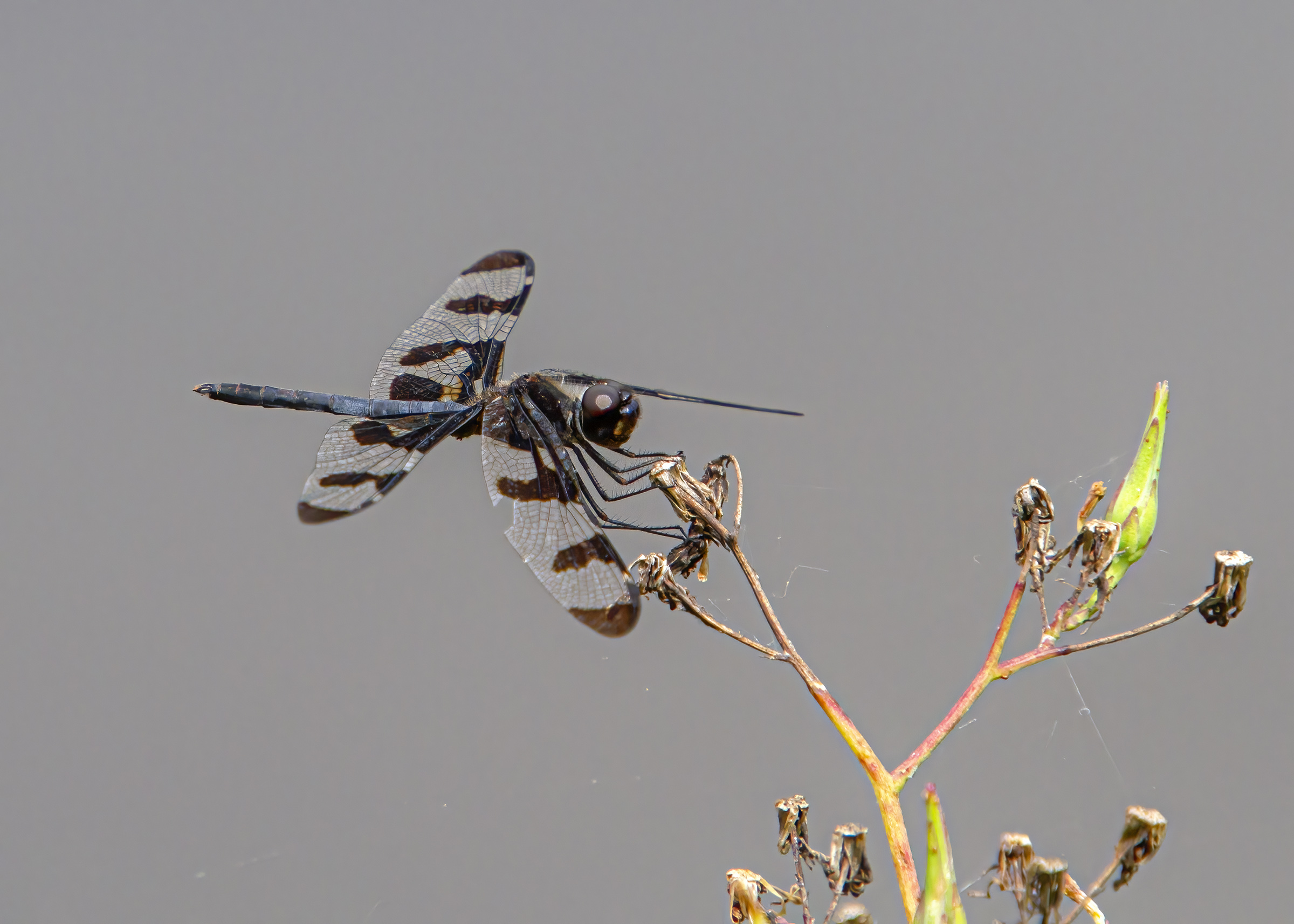
I was intrigued by the varying wing positions of this Banded Pennant dragonfly (Celithemis fasciata) that I spotted last week at Jackson Miles Abbott Wetland Refuge. There was a bit of a breeze and this little dragonfly was doing its best to hold on to the vegetation by adjusting its wings.
Although each wing can function independently from the others, it appeared that the dragonfly mostly moved them in pairs. I was particularly struck in the first photo by the way that the front wings of the Banded Pennant were tilted forward, while its back wings were held flat horizontally.


© Michael Q. Powell. All rights reserved.
Posted in Dragonflies, dragonfly, Insects, Nature, Photography, Summer, wildlife, tagged Canon 7D, Dythemis velox, Fort Belvoir, Jackson Miles Abbott Wetland Refuge, Swift Setwing, Swift Setwing dragonfly, Tamron 18-400mm on August 14, 2023| 3 Comments »
I was happy to see that at least a few Swift Setwing dragonflies (Dythemis velox) were still around this past Friday at Jackson Miles Abbott Wetland Refuge. We are gradually moving to a time of the summer when some dragonfly species decrease in numbers or disappear. Fortunately, a few fall species will appear soon to take their places.

© Michael Q. Powell. All rights reserved.
Posted in damselfly, Insects, Nature, Photography, Summer, wildlife, tagged Argia moesta, Argia translata, Canon 7D, Dusky Dancer, dusky dancer damselfly, Powdered Dancer, Powdered Dancer damselfly, Prince William County VA, Tamron 18-400mm on August 13, 2023| Leave a Comment »
Most of the damselflies that I photograph are found at ponds. However, there are other damselflies that are found primarily at streams and creeks. I spotted two such species this past Tuesday when I was exploring a creek in Prince William County, Virginia.
The damselfly in the first photo is a Powdered Dancer (Argia moesta) that I spotted on a rocky ledge of the creek. Male Powdered Dancers are the only mostly white damselflies that I have seen and they get increasingly white as they mature. I love the way the angle of the shot makes it look like the damselfly was perched on the side of a massive mountain that it was attempting to climb.
The damselfly in the second photo is a Dusky Dancer (Argia translata). This damselfly may have the most intense blue eyes that I have ever seen on an insect. It was perched on a rocky ledge at the edge of a creek. I would have liked to get a closer shot, but the bank of the creek was high and steep and the ledge was inaccessible to me (unless I was willing to get really wet, which I did not want to do).
According to Wikipedia, the damselflies in the genus Argia, are commonly known as “dancers” because of the distinctive jerky form of flight they use which contrasts with the straightforward direct flight of bluets, forktails, and other pond damselflies.


© Michael Q. Powell. All rights reserved.
Posted in Dragonflies, dragonfly, Insects, Nature, Photography, Summer, wildlife, tagged Canon 7D, Epitheca cynosura, Fort Belvoir VA, Jackson Miles Abbott Wetland Refuge, Macromia taeniolata, Prince Baskettail, Royal River Cruiser, Russet-tipped Clubtail, Tamron 18-400mm on August 12, 2023| Leave a Comment »
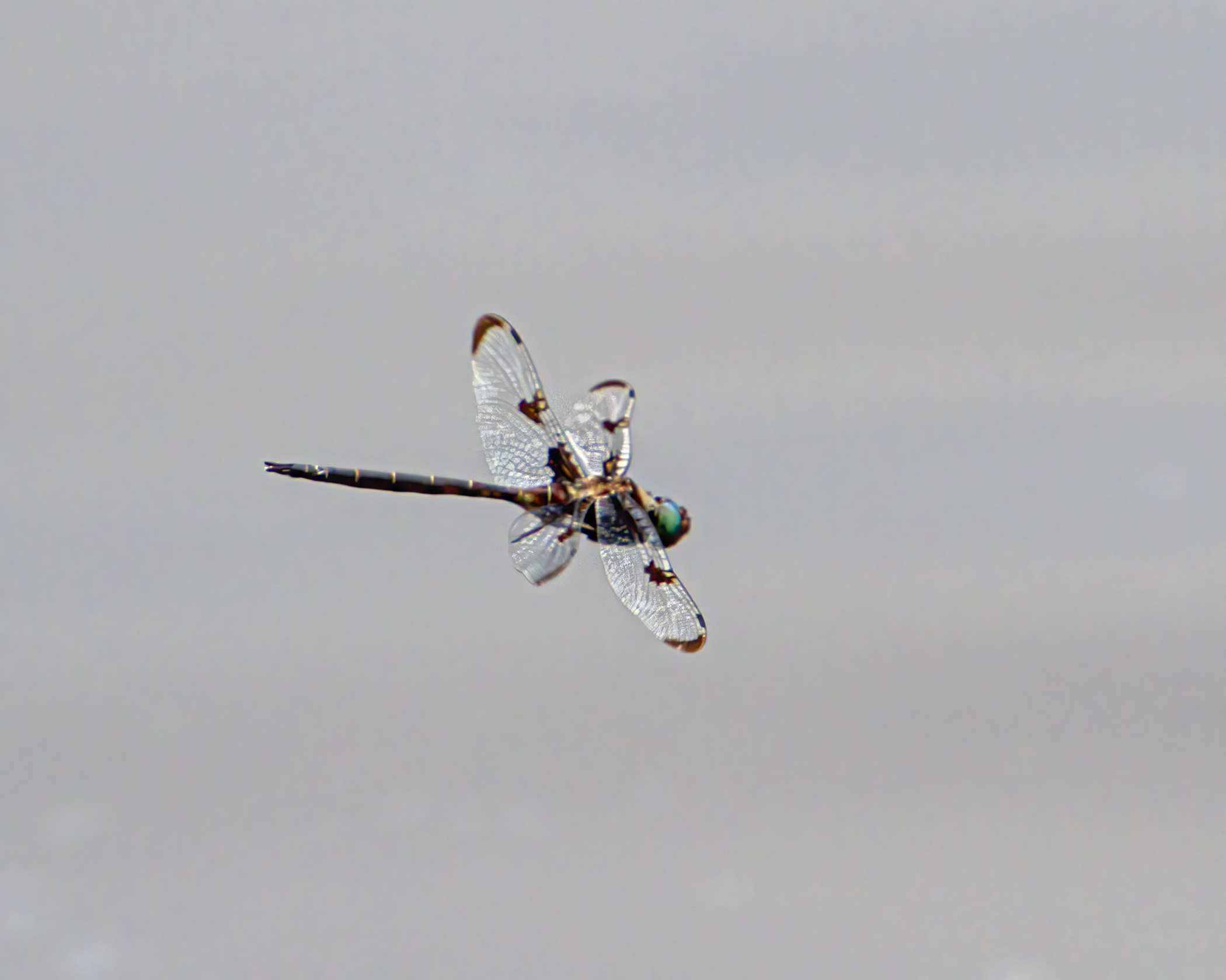
Yesterday I had the chance to test my skill and my patience as I tried to capture images of dragonflies in flight at Jackson Miles Abbott Wetland Refuge. I believe they are a Royal River Cruiser (Macromia taeniolata), a Prince Baskettail (Epitheca cynosura), and a Russet-tipped Clubtail (Stylurus plagiatus), members of three different families of dragonflies.
The Royal River Cruiser is the most uncommon of these three species—I have only seen one a few times and this is the first time that I have gotten a decent shot of one. Cruisers are large dragonflies with large eyes and long legs that generally fly up and down streams or rivers or along lake shores. I did not expect to see one at the small pond at this refuge, but there is an adjacent wetland and a small stream, so maybe the dragonfly made a detour in its patrol over those areas. This dragonfly followed the shore of the pond and flew fast in a single direction.
The Prince Baskettail is the most common of the three dragonflies and I have featured in-flight shots of this species multiple times. The Prince Baskettail appears to have a portion of the shoreline as its territory and it flies back and forth, giving me multiple opportunities to get a shot. This dragonfly has amazing stamina and rarely seems to rest—in ten years of observing dragonflies, I have seen a perched Prince Baskettail only a couple of times.
The Russet-tipped Clubtail is a dragonfly that appears in the late summer and I usually spot one when it is hanging from the vegetation. This one was the first sighting for me of the species this season. Although the dragonfly never came close to the shore, the distinctive color of its “tail” made it easy for me to identify it, even when it was flying.
In case any of you are curious, I captured all of these images with my Canon 7D DSLR and my Tamron 18-400mm zoom lens. Sometimes I focus manually when trying to photographing dragonflies in flight, but I believe I used my camera’s autofocus for these shots with a group of nine focus points in the center selected.


© Michael Q. Powell. All rights reserved.
Posted in Dragonflies, dragonfly, Insects, Nature, Photography, Summer, wildlife, tagged Canon 7D, Celithemis eponina, halloween pennant, Halloween Pennant dragonfly, Prince William County VA, Tamron 18-400mm on August 11, 2023| 3 Comments »
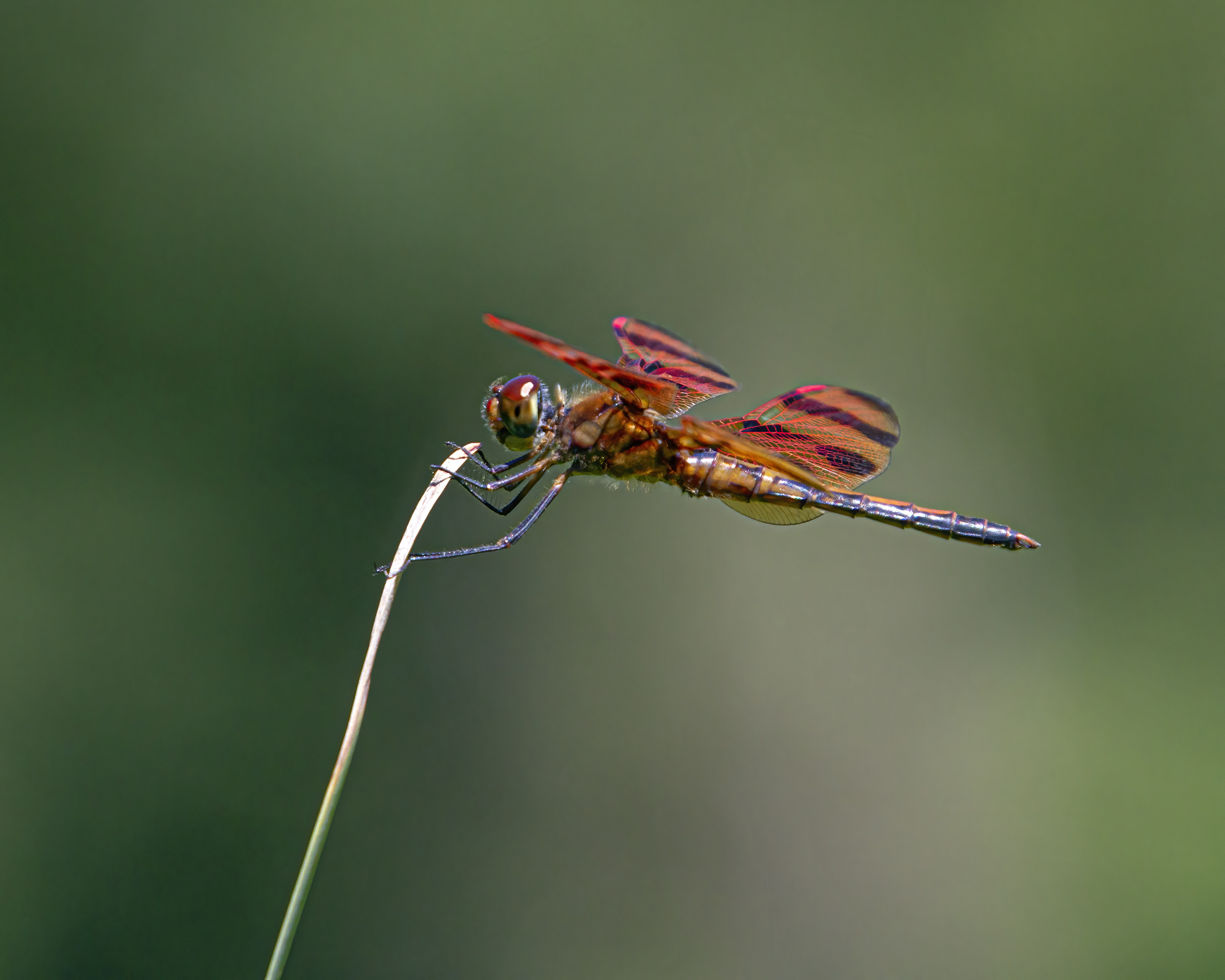
On Tuesday I was thrilled to spot the distinctive color and patterns of a Halloween Pennant (Celithemis eponina) dragonfly as I was exploring a field adjacent to a creek in Prince William County, Virginia. The Halloween Pennant’s wings are orange in color with dark brown bands, the Halloween inspiration for its common name.
Like other “pennant” dragonflies, Halloween Pennants like to perch at the tips of plants, as you can see in these images, which causes them to wave like pennants in even the slightest breezes. I love the way the photos how the dragonfly uses its three sets of legs to grasp the vegetation, ensuring that it can hold on even when the wind is blowing hard.


© Michael Q. Powell. All rights reserved.
Posted in Birds, Nature, Photography, Summer, wildlife, tagged Canon 7D, juvenile osprey, Occoquan Bay National Wildlife Refuge, Osprey, osprey nest, Pandion haliaetus, Tamron 150-600mm, Woodbridge VA on August 10, 2023| 1 Comment »
Two juvenile Ospreys (Pandion haliaetus) appear to almost grown up, but I believe they are still dependent on their parents to feed them. They made protracted cries of what appeared to be “Feed me” when they spotted an adult osprey flying in the distance last Saturday at Occoquan Bay National Wildlife Refuge.
Sometimes their movements seemed synchronized, as in the first photo, but at other times they expressed themselves in individual ways. In the second photo, you may notice that the two ospreys have speckled feathers and orange eyes, two signs that they are not yet adults, which have dark feathers and yellow eyes.


© Michael Q. Powell. All rights reserved.
Posted in Dragonflies, dragonfly, Insects, Nature, Photography, Summer, wildlife, tagged Boyeria vinosa, Canon 7D, Fawn Darner, Fawn Darner dragonfly, Prince William County VA, Tamron 18-400mm on August 9, 2023| 4 Comments »
I spotted this cool-looking dragonfly yesterday when it flew to a hanging perch in some shaded vegetation along a creek in Prince William County. I was walking along a trail parallel to the creek and was primarily looking towards the water. Out of the corner of my eye, I detected some movement and spotted where the dragonfly had landed.
A couple of things immediately stood out to me. The dragonfly was hanging vertically, which meant that it was probably not one of the more common skimmers that I am used to seeing at this time of the year. I noted too that the dragonfly was long and skinny and, realizing that my camera was going to have trouble focusing on the dragonfly, I switched to manual focusing. I was able to snap off only a couple of shots before the dragonfly flew away and despite my efforts to relocate it, I was not able to find the dragonfly again.
When I looked on the back of my camera at the images that I had captured, I was not able to identify the dragonfly. When I returned home, I looked through my dragonfly guides and determined that it was a Fawn Darner dragonfly (Boyeria vinosa), a new species for me. Some experts in a Facebook dragonfly group confirmed my identification.
According to the Dragonflies of Northern Virginia website, “Unlike most other darners, and in fact most dragonflies, Fawns shun open, sunny areas. They spend the day hiding in dense, shady underbrush, hanging from the branches of shrubs and young trees. Around 4PM they start venturing out to patrol their shady, forest streams, peaking from about 6PM-8PM.” I encountered the Fawn Darner around midday, so I may have been disturbing its resting period.
Wildlife and nature photographers use many different approaches. Some of them go out to researched locations with a goal of seeing specific species—they are very targeted in their tactics. Others, like me, are opportunistic photographers who wander about, ready to react to whatever they encounter. Although I do love to spot species that are new to me, as was the case with this Fawn Darner, such encounters tend to be almost serendipitous—I tend to stumble upon new species.

© Michael Q. Powell. All rights reserved.
Posted in Dragonflies, dragonfly, Insects, Nature, Photography, Summer, wildlife, tagged Canon 7D, Libellula needhami, male Needham's Skimmer, Needham's Skimmer, Needham's Skimmer dragonfly, Occoquan Bay National Wildlife Refuge, Tamron 150-600mm, Woodbridge VA on August 8, 2023| Leave a Comment »
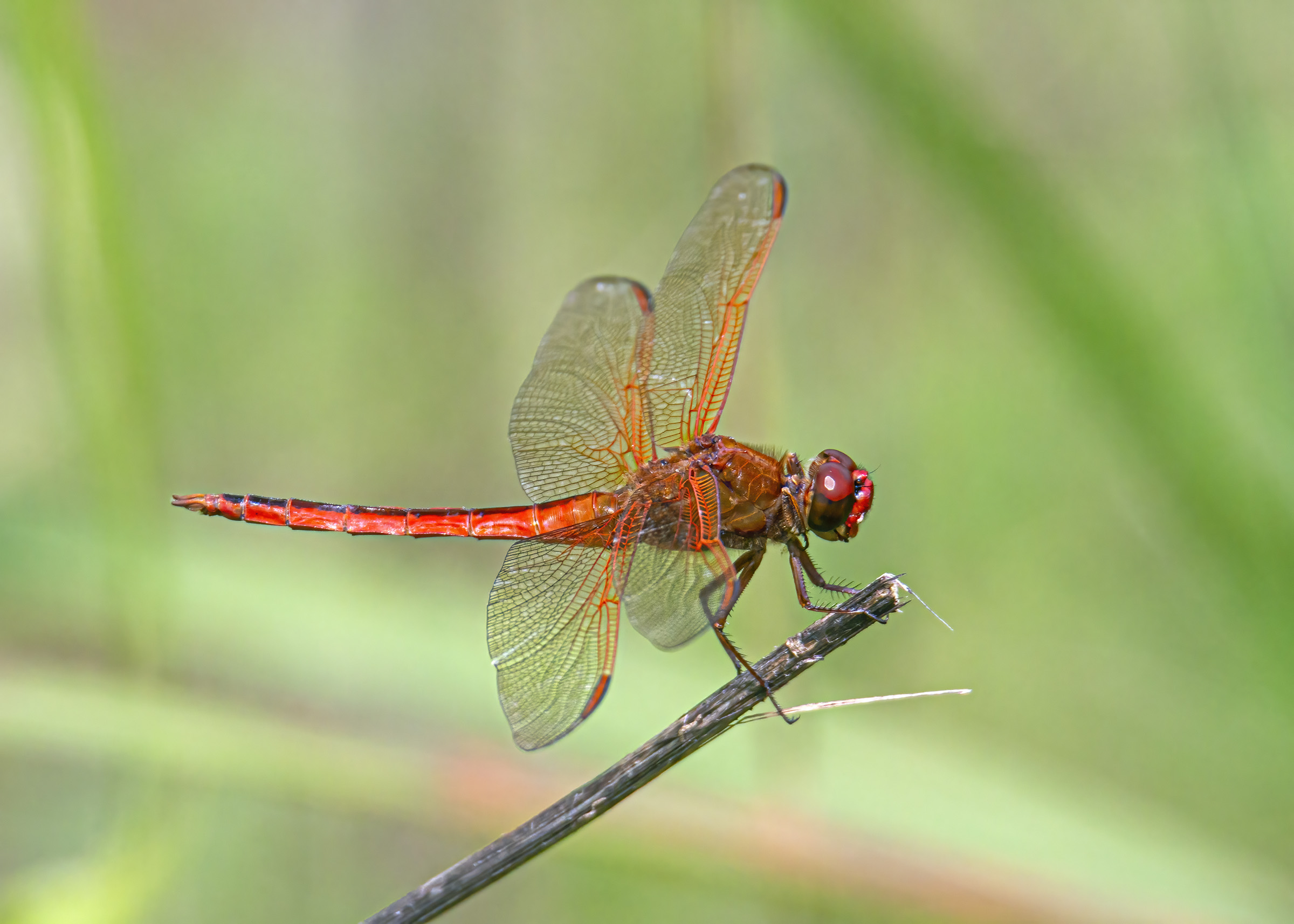
Last Saturday morning at Occoquan Bay National Wildlife Refuge I was delighted to spot this male Needham’s Skimmer (Libellula needhami), one of the most brightly colored dragonflies in our area. In addition to its beautiful reddish-orange color, this dragonfly has stunning gold accents on the front edges of each of its wings.
© Michael Q. Powell. All rights reserved.
 Mike Powell