Feeds:
Posts
Comments

Archive for the ‘Macro Photography’ Category

It is nearly impossible to miss the ostentatious displays of brilliant color as a succession of flowers and trees burst onto the springtime scene. Sometimes, though, they overwhelm my senses and I find myself more drawn to the delicate beauty of the tiny wildflowers that pop up in fields and forests.

Yesterday I was happy to photograph a skittish Eastern Tailed-Blue butterfly (Cupido comyntas) as it moved about in a small patch of Spring Beauty wildflowers (Claytonia virginica) in a forested area of Prince William County. With my macro lens, I was able to capture the distinctive “tail” and orange chevrons that help in identifying this tiny butterfly that has a wingspan of only ¾ – 1¾ inches (22 – 29 mm). I also managed to capture the beautiful pink markings of the spring beauties, including the anthers at the tips of the stamens.

It is easy to lose myself in this magical tiny world or perhaps it might be more correct to say that I find myself there.

Eastern-tailed Blue

© Michael Q. Powell. All rights reserved.
Read Full Post »

On Thursday I finally photographed my first dragonflies of the season. I had previously spotted Common Green Darners several time, but they don’t really “count” because I was not able to capture images of them. I initially checked out several locations at a stream in Prince William County, Virginia, where I had seen Uhler’s Sundragon dragonflies (Helocordulia uhleri) in recent years and came up empty-handed.

However, I was thrilled when later in the day I spotted Uhler’s Sundragons at several locations further upstream from my previous locations. Uhler’s Sundragons have a brief and very early flight period and are considered rare in our area. They also are habitat specialists and “they need clean, small to medium, rocky forest streams with gravelly and/or sandy substrate, and a decent flow,” according to the wonderful Dragonflies of Northern Virginia website.

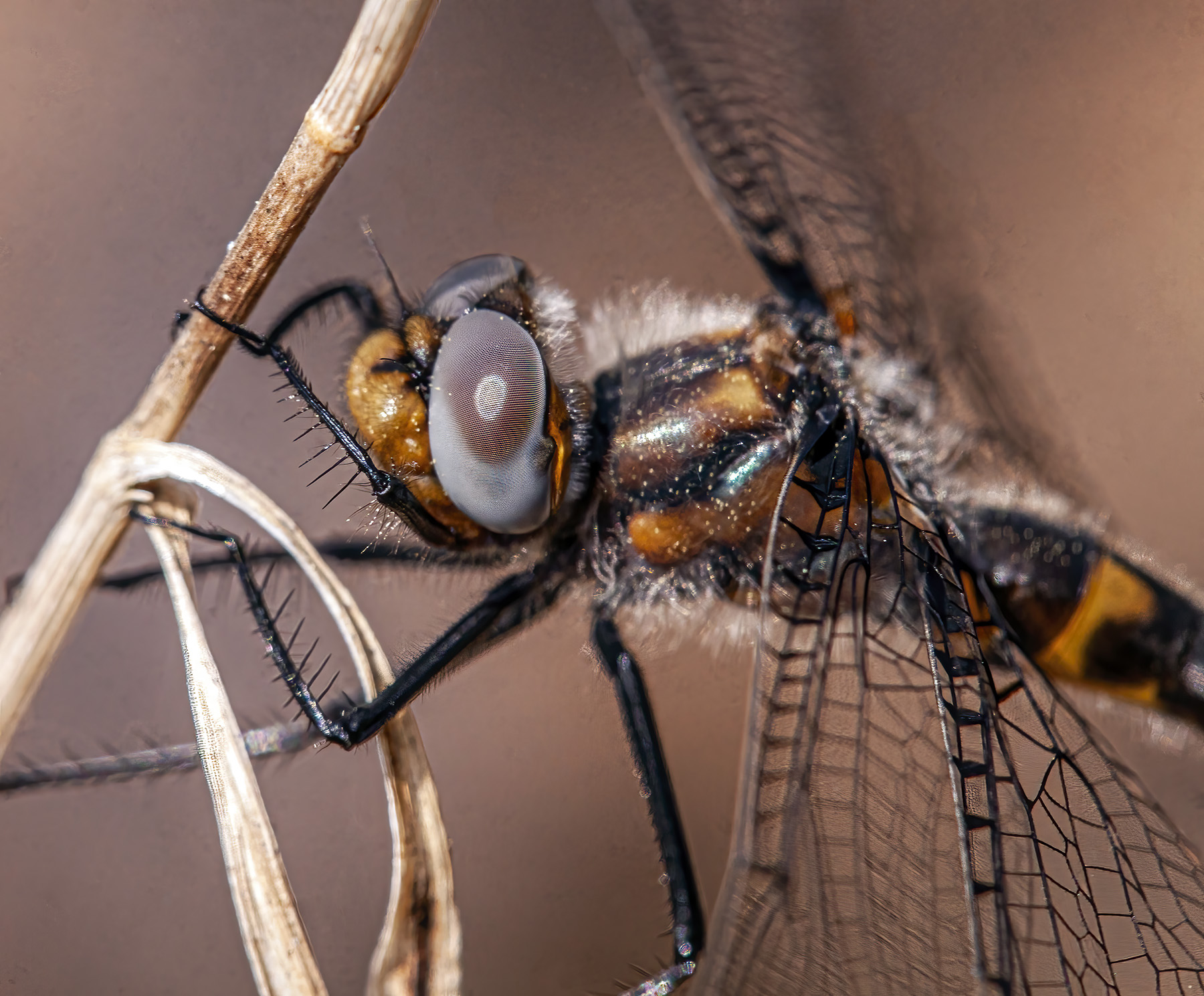
These three photos are indicative of the types of photos that I often try to capture of dragonflies. I love to try to get as close as I can and take extreme close-up shots, like the first one. You can easily see the spines on the legs of the dragonfly and even some of the ommatidia, the optical units that make up the amazing compound eyes of the dragonfly.

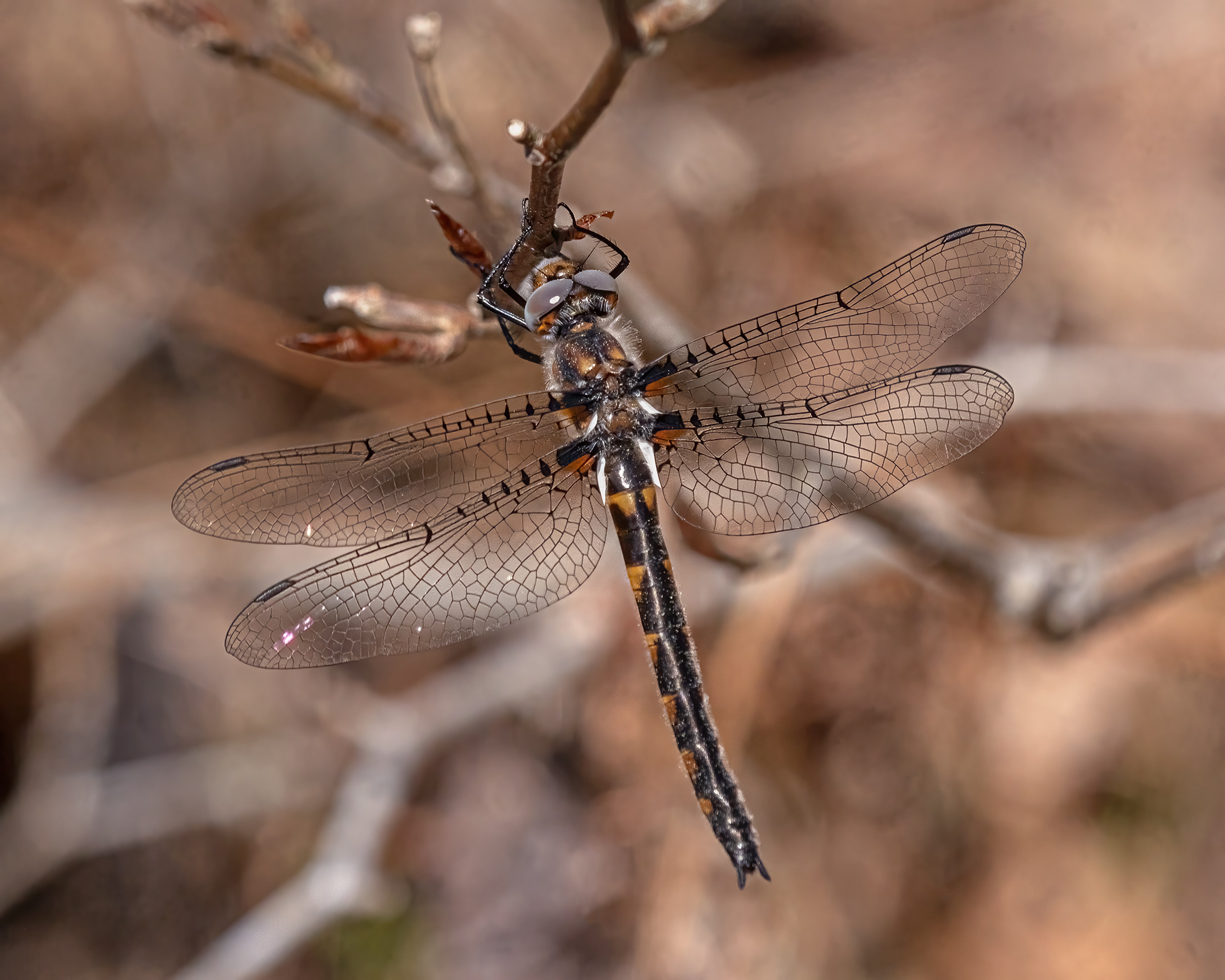
The second shot of a female Uhler’s Sundragon is a good illustration of the way that I try to separate my subjects from the background. The final shot of a male Uhler’s Sundragon shows more of the habitat in which I found the dragonfly. The background is a little busy, but I like the way that the image shows the transparency of the dragonfly’s wings.

In case you are curious about how I can tell the gender of these dragonflies, one of the primary keys is to look at the tips of the abdomens (the “tail”)—you will probably note the different anatomical shapes if you compare the second and third images.

Uhler's Sundragon

Uhler's Sundragon

Uhler's Sundragon

© Michael Q. Powell. All rights reserved.


Read Full Post »

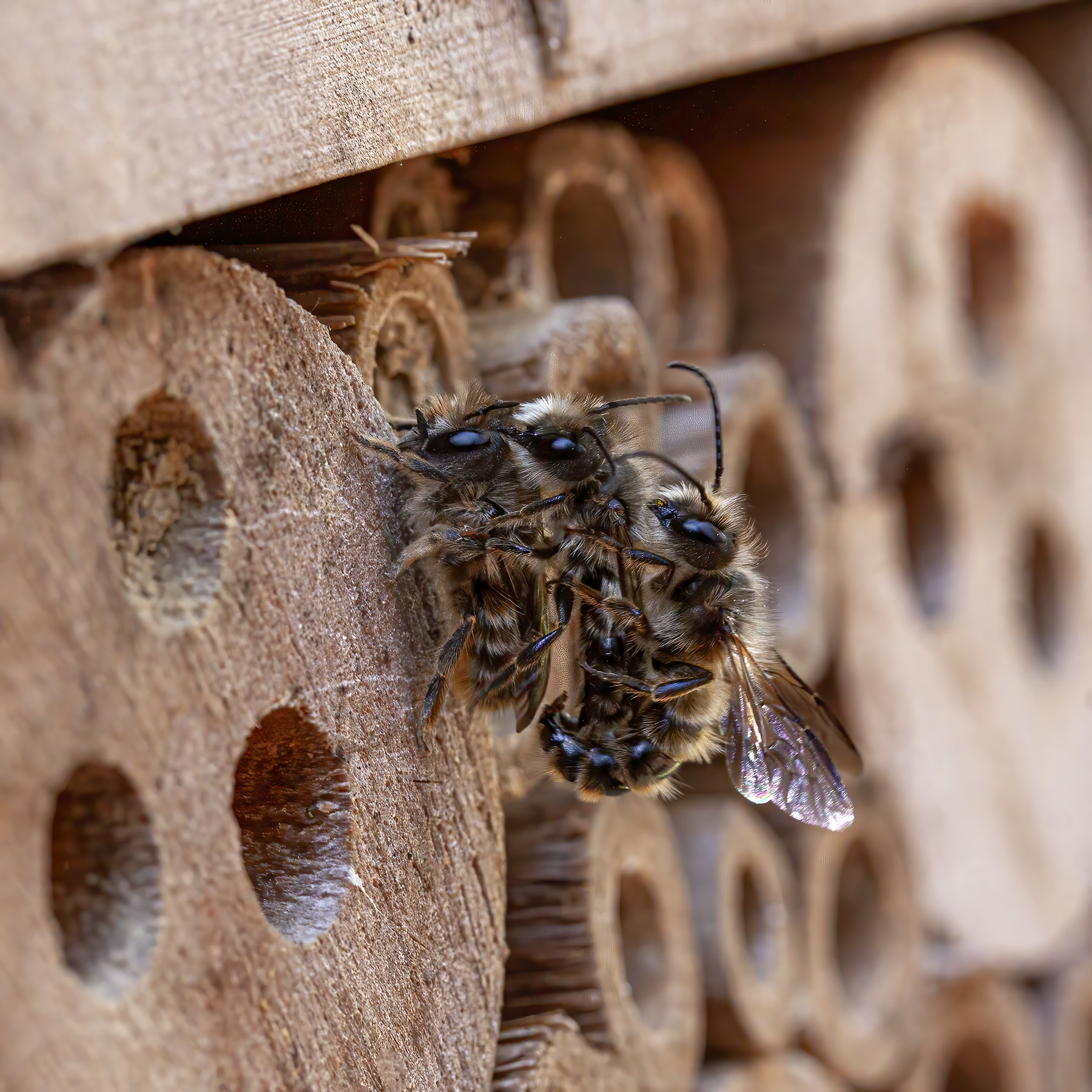
When it comes to mating, many male insects are really aggressive—they will do everything they can to prevent their rivals from hooking us with a desirable female. I think that is what was going on in this image I captured on Sunday of three bees outside of a bee house in the garden of my friend and neighbor Cindy Dyer. It looks to me that the top bee in this ménage à trois was trying to dislodge a rival and somehow gain access to the female. Yes, as the old song simply states, “birds do it, bees do it.”

Perhaps you have a better explanation of what was transpiring, like they were simply playing piggyback and wanted to see how strong the bottom bee was. What do you think? I encourage you to click on the image to see the details better.

I often tell you that I was not as close as it seems, because I generally shoot with a telephoto lens or a long macro lens. In this case, though, I was shooting with a 60mm macro lens and was only a few inches away from the “action” and had to dodge bees that were entering and exiting the tubes of the bee house.

bees

© Michael Q. Powell. All rights reserved.

Read Full Post »

Many of you know that dragonflies and damselflies are my favorite subjects to photograph in the warm months of the year. There is something magical about these colorful aerial acrobats that spend most of their lives underwater before undergoing a remarkable metamorphosis. If you are not familiar with a dragonfly’s total transformation, you may want to check out a posting I did a few years ago called Metamorphosis of a dragonfly that documents in photos and in words the step-by-step metamorphosis of a Common Sanddragon dragonfly (Progomphus obscurus).

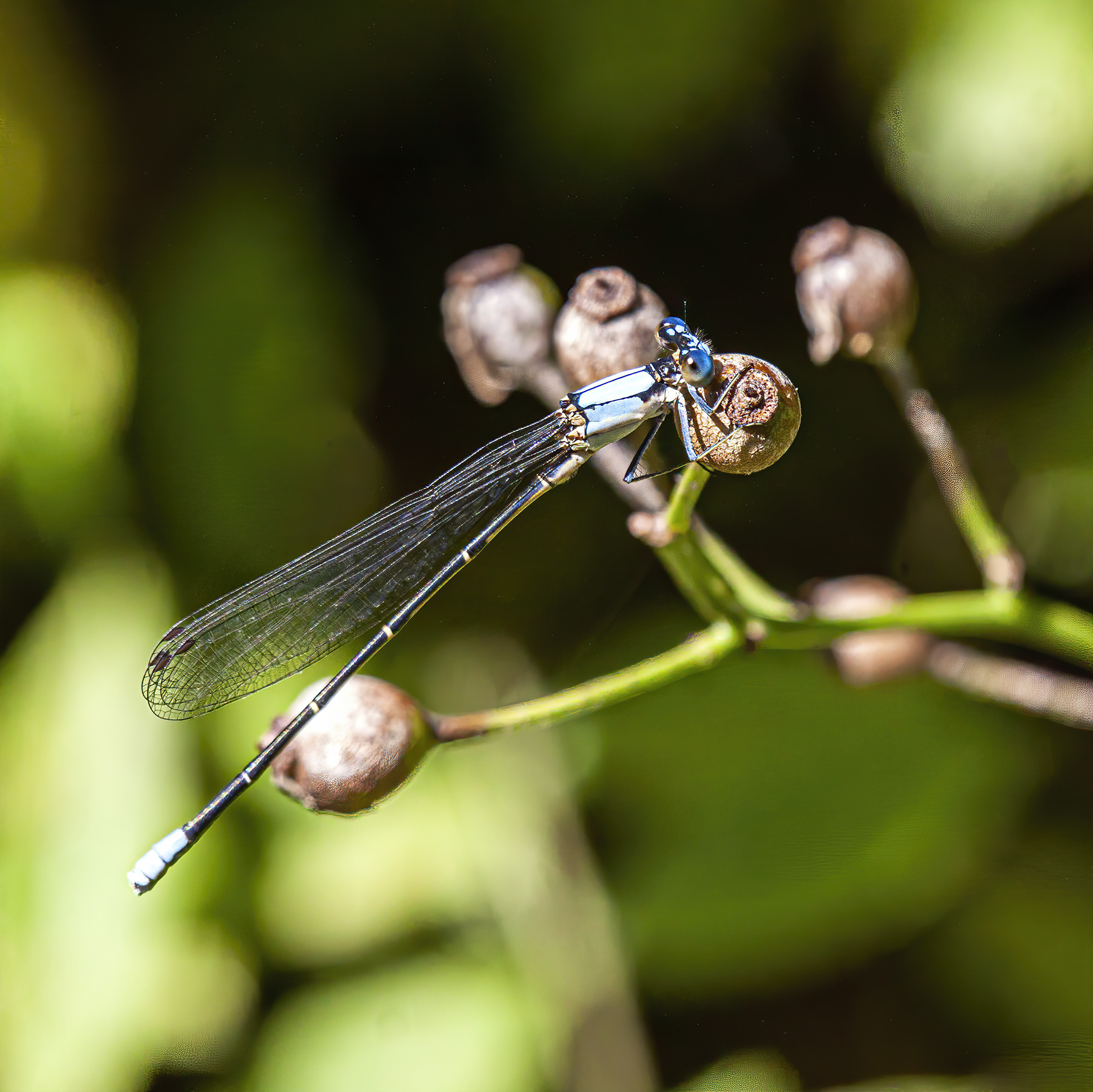
It is still a bit early in the season, but I have already been searching for dragonflies and damselflies for a couple of weeks now. Yesterday I finally found my first damselfly, the female Fragile Forktail (Ischnura posita) in the first photo that I spotted as she perched on some skunk cabbage in a muddy seep at Occoquan Regional Park. I scoured the area and eventually spotted a few more Fragile Forktails, including the male in the second photo that was also perched on the leaves of a skunk cabbage.

As their name suggests, Fragile Forktail damselflies are quite small and delicate and are only .8 to 1.1 inches (21-29 mm) in length. This species is fairly easy to identify, once you manage to spot one, because both genders have interrupted pale shoulder stripes that look like exclamation marks. I encourage you to click on the images, especially the first one, in which you can see the incredible details of this little lady, including her amazing wings, spiny legs, and tiny feet.

The dragonfly/damselfly season has now officially started for me and I will now begin to intensify my search for spring species, many of which can be found only in specific habitats for a limited period of time. Can you feel my excitement? Yeah, I an unapologetically a bit geeky about these little creatures.


Fragile Forktail

Fragile Forktail

© Michael Q. Powell. All rights reserved.
Read Full Post »

Do spiders overwinter as adults? Most of the crawling creatures that I tend to spot this early in the spring are quite small, so it was a little surprising to spot several large Wolf Spiders ( probably Tigrosa georgicola) on Monday at Prince William Forest Park. I was pretty sure these spiders had not hatched recently, so I did a little research and learned that “a surprisingly large number of spider species overwinter as adults or immatures, forsaking the cozy shelter of an egg sac in which to endure the harsh, cold extremes,” according to a blog posting by Bug Eric entitled Spider Sunday: Spring Spiders.

The spider in the first photo was actively crawling about in the leaf litter when I first spotted it, probably searching for prey, given that wolf spiders do not spin webs and instead are opportunistic hunters. The second spider was scurrying down a trail at a surprisingly fast pace when it paused for a moment to let me capture an image.

I encourage you to click on the photos to get a closer look at the fascinating details of these spiders, including their multiple eyes and the spiky hairs on their legs.

Wolf Spider

Wolf Spider

© Michael Q. Powell. All rights reserved.

Read Full Post »

As temperatures rise, the springtime air is frequently filled with the sounds of frogs, ranging all the way from the high-pitched choruses of spring peepers to the solitary bass notes of croaking bullfrogs. When I walk along the edge of marshes and ponds at this time of the year, the ground in front of me often seems to explode as well-camouflaged frogs arc through the air seeking to escape me.

On Monday as I wandered about in Prince William Forest Park, I spotted quite a number of tiny frogs at the edge of the water, but did not hear them calling, so I had to rely on their physical appearance to identify them. On the basis of the dark triangle between their eyes and their other markings, I believe the frogs in the photos below are both Eastern Cricket frogs (Acris crepitans crepitans).

Eastern Cricket frogs are small frogs,  reaching lengths of 5/8 to 1-3/8 inches (16-35 mm), which make them a challenge to photograph. According to the Virginia Herpetological Society, part of the scientific name for the species is derived from the Latin word crepit which means “rattle” and the call of these frogs sounds like pebbles being clicked together. Perhaps they will be calling, the next time that I visit the park.

The evidence is mounting that spring is really here. What are your favorite signs of the arrival of spring?

Eastern Cricket Frog

Eastern Cricket Frog

© Michael Q. Powell. All rights reserved.


Read Full Post »

Is it a bee? Is it a fly? It is a Greater Bee Fly (Bombylius major), a parasitic bee mimic that is one of the earliest spring pollinators of wildflowers. I photographed this bee fly as it was feeding on the nectar of a Spring Beauty (Claytonia virginica) on Monday at Prince William Forest Park.

I was quite happy to be able to capture so many of the details of this curious creature, including its long proboscis, spindly legs, patterned wings, and fuzzy body. In case you are curious, the body of one of these bee flies is about six-tenths of an inch (15mm) in length and its wing span is about one inch (25mm). I recommend that you double-click on the image to get a better looks at the little details of this bee fly.

If you would like to learn more about these fascinating little bee flies, including their parasitic behavior, check out the article on the US Forest Service website by Beatriz Moisset entitled “A Pollinator with a Bad Reputation.”

Greater Bee Fly

© Michael Q. Powell. All rights reserved.

Read Full Post »

One of the signs of spring where I live is the emergence of small wildflowers in the wooded areas, including Spring Beauties (Claytonia virginica), like this one that I photographed yesterday at Prince William Forest Park in nearby Triangle, Virginia. According to the description of the Spring Beauty in Wikipedia, “the individual flowers bloom for three days, although the five stamens on each flower are only active for a single day.”

I do not know if this was “the day” for the stamens of this particular flower, but a large hairy fly was definitely attracted to its nectar. I cannot identify the species of the fly, but think that it is a kind of Tachinid fly. The large family of Tachinid flies differ in color, size, and shape but many somewhat resemble house flies and tend to feed on liquids such as nectar.

When I showed this image to fellow blogger and dragonfly enthusiast Walter Sanford, he noted the low angle at which I had taken this shot and characterized it as a “belly flopper photo.” Walter has seen me in action multiple times and knows that I will often try to get as low as I can to get a shot, which was pretty low in this case, given the fact that Spring Beauties are often only a few inches tall.

How low do I go? Check out a posting that Walter did in 2016 called Opposing viewpoints to see a shot of me sprawled on the ground trying to get at eye level with a snake and my posting that same day called Close to a garter snake to see the kind of images that you get when shooting at such close range.

spring beauty

© Michael Q. Powell. All rights reserved.

Read Full Post »

I was totally fascinated by the shapes and colors of this tiny flower that has started to bloom in the garden of my friend and neighbor Cindy Dyer. Cindy told me it was a type of Grape Hyacinth, which confused me a little, because all of the grape hyacinths that I had previously seen were shaped more like grapes than little bells.

I searched on-line and eventually discovered that this flower is Muscari azureum, a species also referred to as Pseudomuscari azureum or Hyacinthella azurea. According to gardenia.net, “Muscari azureum is a lovely, compact china-blue grape hyacinth, with bell-shaped flowers that are not constricted at the mouth. Therefore it looks more plump and fuller than others.”

It was a challenge for me to photograph these flowers because they are so small and grow so close to the ground. Additionally the rather naked early spring garden soil in which the flowers were growing does not make a very photogenic backdrop. I used a macro lens to get close to the flowers for the first two shots in order to isolate them somewhat from the background and focus the viewer’s attention on the intricate details of the flowers.

For the final image, I backed up a little to give you a view of the overall scene and the challenges I described above. As you can probably tell, the two flowers at the far left of the frame were the ones that were featured in the first two photos.


Muscari azureum

Muscari azureum

Muscari azureum

© Michael Q. Powell. All rights reserved.

Read Full Post »

My neighbor and photography mentor Cindy Dyer has a new raised flower bed in her back yard and the first flowers to appear in it are some tiny Snowdrops (g. Galanthus), including this one that I photographed on Friday. For me there is something really beautiful about the simple shape and restrained colors of this little flower. I have seen snowdrops appear much earlier at other locations, including in 2012 when I photographed some in bloom in late December—see my blog posting entitled Winter Snowdrops.

snowdrop

© Michael Q. Powell. All rights reserved.


Read Full Post »

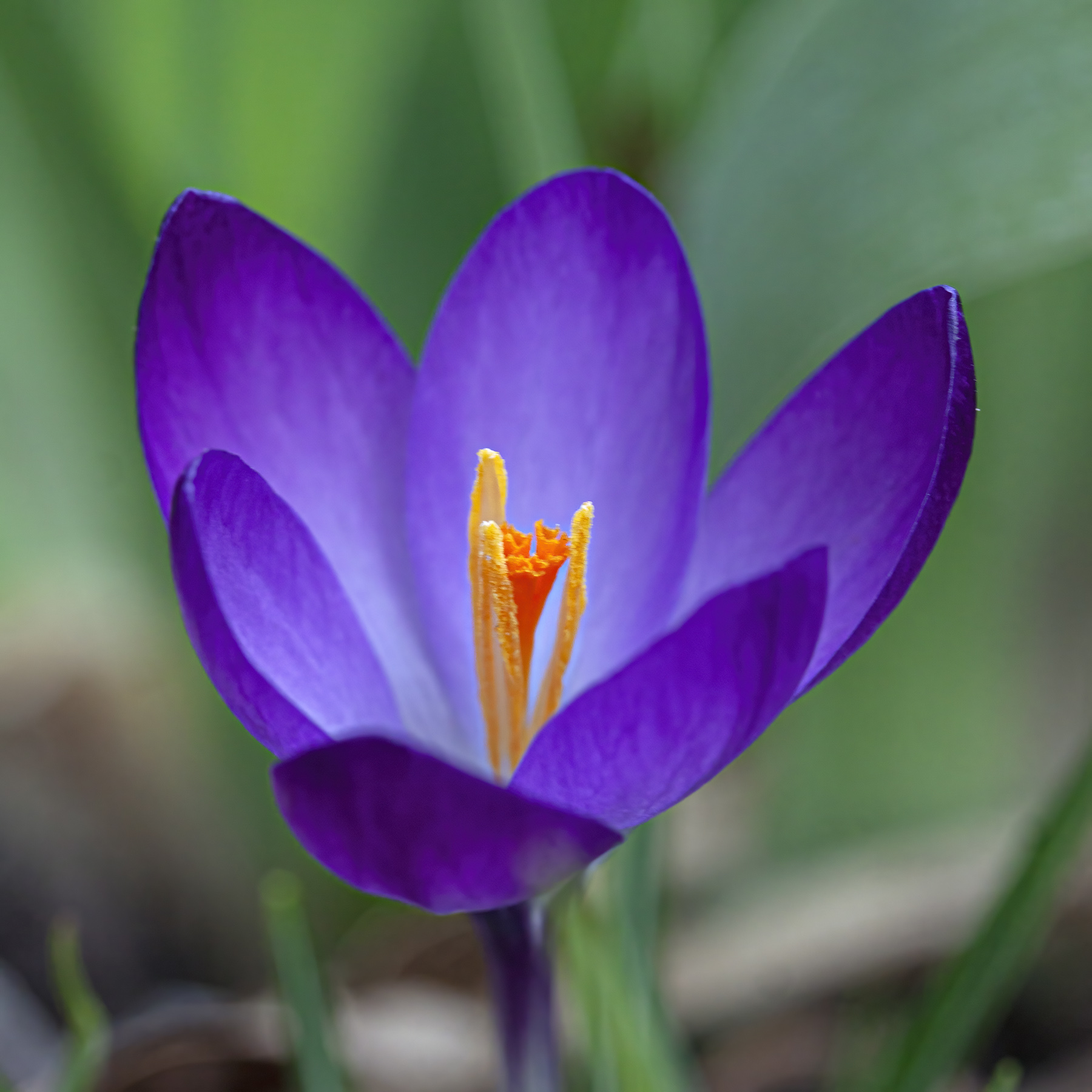
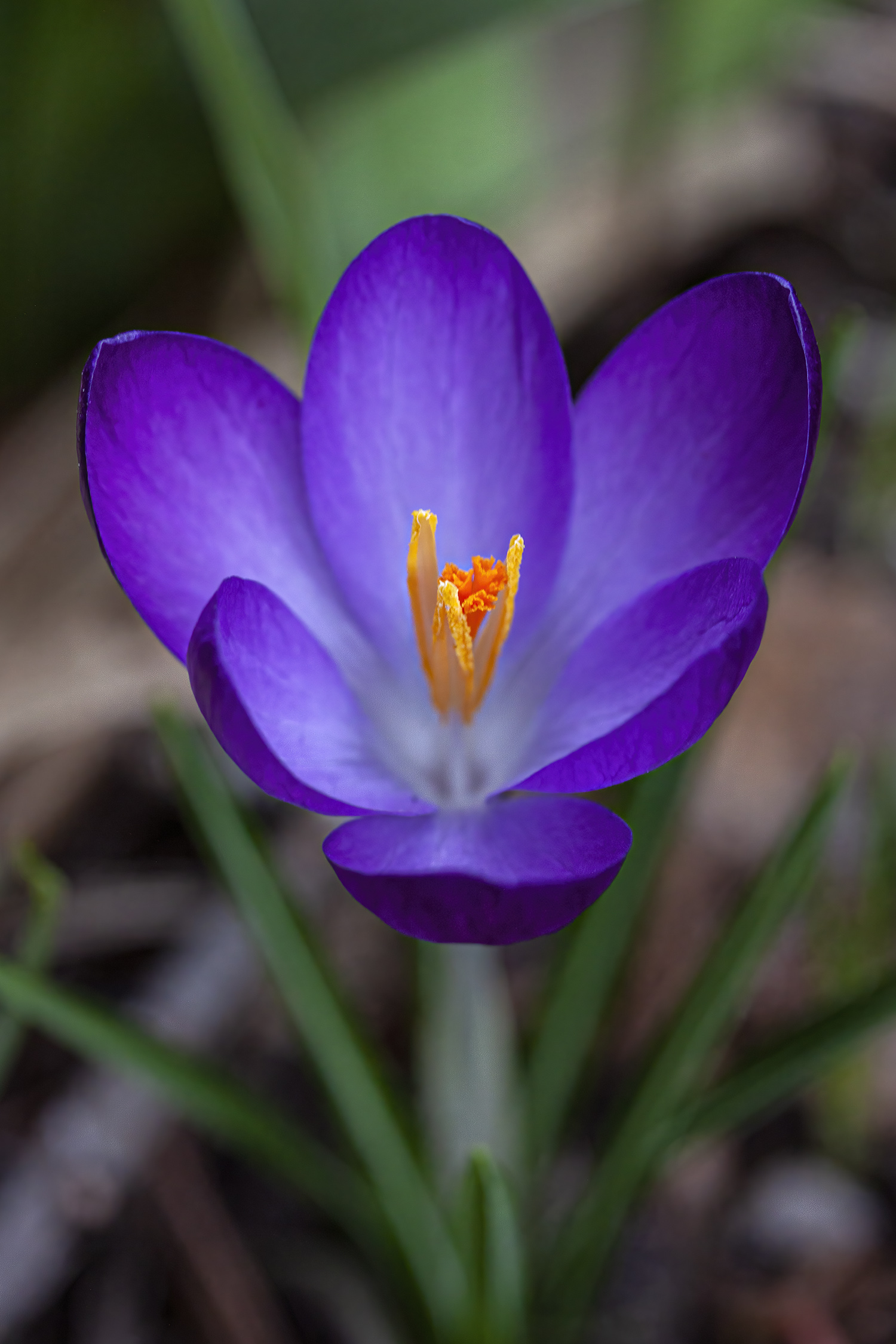
I do not have my own garden, but my friend and neighbor Cindy Dyer has a wonderful one that I visit often during the growing season. I was thrilled on Friday to see that one of her crocuses is blooming, the first one that I have seen this year. A second crocus had not yet opened, but I was so excited to see these colorful signs of spring that I photographed it too.

During the colder months of the year I shoot almost exclusively with a long telephoto zoom lens. For these images, however, I switched to a 60mm macro lens, a sign of the changing seasons—during the summer months my favorite lens is my 180mm macro lens. As the leaves start to reappear to on the trees, I will be photographing fewer birds and will be focusing on smaller, close-in subjects like butterflies and dragonflies, hopefully within a month or so.

crocus

crocus

crocus

© Michael Q. Powell. All rights reserved.

Read Full Post »

It was unseasonably warm yesterday, so I was out in the wild looking for late season dragonfly survivors. I came up empty-handed for dragonflies, but did spot this cool-looking wolf spider (g. Gladicosa) at Occoquan Regional Park.

Several years ago fellow dragonfly enthusiast Walter Sanford spotted an Autumn Meadowhawk dragonfly in early January, so I knew that it was at least a theoretical possibility that I might see one. According to Walter’s blog posting about his sighting in 2016, the temperature was 51 degrees (10 degrees C) when he spotted the dragonfly and it was even warmer yesterday—58 degrees (14 degrees C). I scoured all kinds of locations where the sunlight was shining, anticipating that a dragonfly likely would be basking in the sun.

I spotted this spider in a sunlit area strewn with fallen leaves. I suspected that it was some kind of wolf spider, but relied on experts in several Facebook groups for confirmation. One of the experts was even able to identify the genus of the spider, but not the specific species. According to Wikipedia, wolf spiders “are robust and agile hunters with excellent eyesight. They live mostly in solitude and hunt alone, and do not spin webs. Some are opportunistic hunters pouncing upon prey as they find it or even chasing it over short distances. Some wait for passing prey in or near the mouth of a burrow.”

I doubt that I will see any dragonflies this month or even any more spiders, but I will keep looking for a little while longer, especially on days when the temperatures rise this high above the freezing level.

wolf spider

© Michael Q. Powell. All rights reserved.

Read Full Post »

The weather has gotten decidedly colder, with daily high temperatures struggling to get past 60 degrees (16 degrees C). I am beginning to wonder if this female bluet that I saw last week at Huntley Meadows Park will be my final damselfly sighting of the season.

I was fairly confident that this was a female Familiar Bluet damselfly (Enallagma civile), but once again I learned how difficult identification can be when I posted the image to a Facebook forum for dragonflies and damselflies in Virginia. Several experts weighed in with suggestions that the eyespots made then think it was a female    Atlantic Bluet (Enallagma doubledayi), a species that I have never before encountered.

How hard can it be to identify a damselfly? One of the aforementioned experts noted that  “you cannot be completely sure about many female Enallagma without microscopic examination.” Microscopic examination? Yikes!

Familiar Bluet

© Michael Q. Powell. All rights reserved.

Read Full Post »

Large black spiders are often associated with Halloween—many people find them to be merely spooky, but some are totally creeped out by them. Maybe the spiders need better marketing and a new poster child for the autumn holidays. I would nominate this colorful Marbled Orbweaver spider (Araneus marmoreus) that I spotted on Thursday at Huntley Meadows Park.

When I spotted this spider, I was immediately attracted to the way that the light was illuminating its legs from behind and causing them to glow. As I made adjustments to my camera settings, I was a little shocked to see the beautiful orange coloration and intricate patterns on the spider’s body. The oval body brought to mind a kind of stylized jack-o’-lantern and I later learned that one of the informal names for this spider is “pumpkin spider.”

For many of us this is the season for voting. Would you vote for this spider as a new autumn mascot?

Marbled Orbweaver


© Michael Q. Powell. All rights reserved.

Read Full Post »

As I was walking along one of the trails recently at Occoquan Bay National Wildlife Refuge, my eyes were drawn to the bright orange of a patch of fungus. Orange is one of the colors that I tend to associate with autumn and with holidays like Halloween and Thanksgiving, so I was feeling very seasonal. I do not know my fungi very well, but I think that this might be Chicken of the Woods (Laetiporus sulphureus).

From what I have read, this mushroom can be used as a substitute for chicken and can be sautéed, deep fried, baked, and used in soups. I prefer to enjoy its beauty with my eyes only—the consequences of eating the wrong mushroom can be pretty dire.

The third image gives you an overall view of the mushroom “patch.” However, I had a macro lens on my camera, so I had fun exploring the different elements of the scene. The first image reminds me of Halloween candy corn, a traditional candy that most people either love or hate. In the second image, I was attracted to the circular rows of water droplets that paralleled the rings of colors of the mushroom.

Chicken of the Woods

Chicken of the Woods

Chicken of the Woods

© Michael Q. Powell. All rights reserved.

Read Full Post »

Humans shed skin cells all of the time—according to one source, in one year, each of us sheds more than 8 pounds (3.6 kg) of dead skin. Snakes have an entirely different shedding process. Several times a year they grow a complete new layer of skin underneath the old layer. During shedding, snakes secrete a fluid to help separate the old skin from the new, and this fluid runs under their specialized eye caps, resulting in the opaque or blue quality of the eye.

Last Friday I encountered one of these blue-eyed snakes while exploring Occoquan Bay National Wildlife Refuge. Snakes are vulnerable during this stage when their vision is impaired and I was a little surprised to see this snake was in a fairly open area. I think this may be an Eastern Ratsnake (Pantherophis alleghaniensis), but did not examine the snake at length for fear of disturbing it.

Moving as stealthily as I could, I leaned in with my macro lens to capture this image. If you look carefully into the eye (or double-click on the image to enlarge it) you will see that I managed to capture a “selfie” reflection.

As an interesting coincidence, my most viewed posting of 2020 has been a May 2016 posting that also featured a snake with a blue eye. That posting, entitled Blue-eyed garter snake, has had 597 views so far this year. If you are not totally creeped out by today’s photo, you might want to check out the 2016 posting, which has some full body shots as well as a close-up shot of the snake’s head.

Eastern Ratsnake

© Michael Q. Powell. All rights reserved.

Read Full Post »

How flexible are you? I used to run marathons and, like most runners, I am not very flexible. I marvel at ordinary people who can bend down and touch the floor while keeping their knees straight and am utterly fascinated when I watch gymnasts and acrobats. Several years ago I attended a Cirque de Soleil performance and was mesmerized the entire time.

I don’t think of grasshoppers and katydids as being particularly flexible—their outer shell seems rigid and armor-like. Imagine my surprise and delight when I stumbled upon this flexible female Handsome Meadow Katydid (Orchelimum pulchellum) last week at Occoquan Bay National Wildlife Refuge. Normally her ovipositor, the yellow scimitar shaped appendage at the end of her abdomen, faces to the back. In this case, though, she has arched her back so much that the tip of the ovipositor extends further forward than her head.

What is she doing? I think that she is somewhere in the process of depositing eggs. I do not know exactly how that works, but a University of Arkansas website described the ovipositing for a similar katydid with these words, “An ovipositing female embraces a plant stem with her prothoracic and mesothoracic legs and brings the curved and sword-like ovipositor far forward so its tip can scrape the substrate.” There are a lot of unfamiliar scientific words there, but I think I get the gist of what is going on.

I do not recall photographing this process before, but a search of my blog revealed that, in fact, I captured a series of images in a September 2013 posting entitled “Rainbow katydid depositing eggs?“. Be sure to check out that earlier posing for more fascinating photos of a flexible katydid.

Handsome Meadow Katydid

© Michael Q. Powell. All rights reserved.
Read Full Post »

The weather has turned cooler, but traces of summer still remain, like this tiny Summer Azure butterfly (Celastrina neglecta) that I spotted last Wednesday at Occoquan Bay National Wildlife Refuge. The Azure butterflies are among the smallest butterflies in our area, with a wing span of just over one inch (25 mm). My current approach is to shoot any insect that I can find—it won’t be long before they are all gone and I will change to a longer lens and focus primarily on birds.

Summer Azure

© Michael Q. Powell. All rights reserved.
Read Full Post »

Nature sometimes saves the best for last. Many dragonflies that have kept me company through the long, hot days of summer have started to disappear. The appearance in autumn of the spectacularly colored male Blue-faced Meadowhawk dragonfly (Sympetrum ambiguum) compensates in part for this sense of loss.

I spotted this handsome dragonfly on Wednesday as I was exploring Occoquan Bay National Wildlife Refuge. I hope to be seeing this species for another month or so and also its “cousin,” the Autumn Meadowhawk, which has a similarly colored body but has brown eyes. 

Blue-faced Meadowhawk

© Michael Q. Powell. All rights reserved.

Read Full Post »

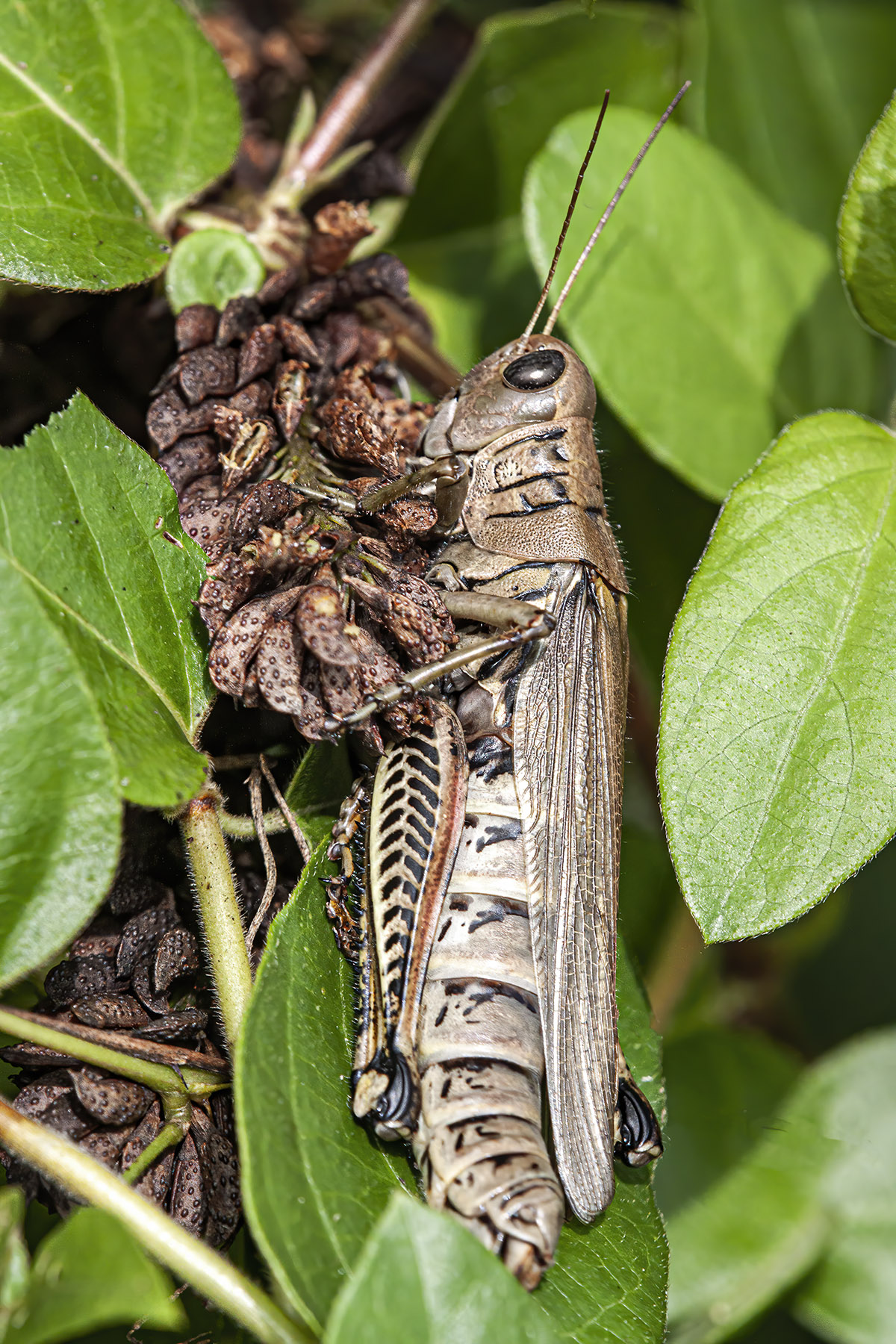
When I first spotted this large grasshopper last week at Occoquan Bay National Wildlife Refuge it was so still that I was not sure that it was alive. I gently rustled the vegetation and the grasshopper moved a little, so I knew that it was not dead. As I watched, I could see its mouth moving and I think that it might have been eating, which might explain why it was distracted and did not immediately fly away. The first photo was an unsuccessful attempt to determine what the grasshopper was eating.

I am not very good at grasshopper identification, but my friend Walter Sanford, with whom I was hunting for dragonflies, knew that it was a Differential Grasshopper (Melanoplus differentialis). The prominent chevrons on the hind femur are apparently one of the identification features for this species.

differential grasshopper

differential grasshopper

© Michael Q. Powell. All rights reserved.

Read Full Post »

Roses are red and bluets are blue, except when the bluets are damselflies, when they might be a different color. Last week while photowalking at Occoquan Bay National Wildlife Refuge, fellow dragonfly enthusiast Walter Sanford pointed out this Orange Bluet damselfly (Enallagma signatum) that was perched in a tree just above eye level. As he pulled back a branch that was blocking my view, I was able to get this unobstructed shot of the beautiful little damselfly.

You might think that the bright coloration of this damselfly would make it easy to spot, but Orange Bluers are small, less than an inch and a half (38 mm) in length, and elusive. I am lucky if I manage to spot a couple of them during an entire season, so I was thankful for Walter’s sharp eyes.

This Orange Bluet, I think, would make a good mascot for the autumn season, when oranges and browns begin to dominate the natural and manmade landscape and the stores are filled with decorations for Halloween and Thanksgiving. I suspect that some stores are already starting to decorate for Christmas, but I am not ready to give up on the waning moments of summer—for some of us, tomorrow is the autumnal equinox, the first day of fall.

Orange Bluet

© Michael Q. Powell. All rights reserved.


Read Full Post »

What’s my favorite insect? If I were to do a survey of readers of this blog, I am confident that most would say that my favorite insect would have to be one of the many dragonflies that I regularly feature here. I do love dragonflies and spend endless amounts of time during the warm months photographing them, but if I had to choose one favorite insect, it would not be one of them—it would be the Handsome Meadow Katydid (Orchelimum pulchellum).

I remember my sense of amazement the first time that I spotted one of these multi-colored beauties. I literally could not believe my eyes and it was love at first sight. To this day, I never fail to be mesmerized by the neon colors and the blue eyes of the Handsome Meadow Katydid. Love is love—when we are smitten, words somehow are inadequate to explain our feelings.

I spotted this beautiful female Handsome Meadow Katydid on Tuesday while photowalking at Occoquan Bay National Wildlife Refuge with fellow dragonfly enthusiast Walter Sanford. You can tell that this one is a female because of the yellow scimitar-shaped appendage at the tip of the abdomen that is an ovipositor used to deposit eggs on plants.

I really like the the ways that the colors of the katydid are repeated in the background and the repeated pattern of the vegetation leads the eye and somehow manages to be unobtrusive. All in all, it seems to be the perfect backdrop for the appropriately-named Handsome Meadow Katydid, my favorite insect.

Handsome Meadow Katydid

© Michael Q. Powell. All rights reserved.

Read Full Post »

Over the years I have developed the habit of checking milkweed plants carefully whenever I spot them. Milkweed plants host an extensive cast of colorful characters including ladybugs, milkweed beetles, and Monarch butterfly caterpillars (Danaus plexippus). Though I have been keeping an eye out for them for the last couple of months, I was unsuccessful in spotting a Monarch caterpillar until this past Sunday when I finally spotted one at Occoquan Bay National Wildlife Refuge.

This Monarch appears to be in one of its final phases of development as a caterpillar, when fattening up seems to be a priority before forming a chrysalis. It is not surprising, therefore, that most of the edges of the leaves in this photo have been gnawed on by the caterpillar. This caterpillar seems to be a little late calendar-wise in its path to becoming a butterfly, but I did spot several Monarchs yesterday, so it seems that the Monarch migration has not yet taken place, or at least not in its entirety.


Monarch caterpillar

© Michael Q. Powell. All rights reserved.


Read Full Post »

My eyes were attracted to the pinkish-colored asters when I spotted them last Friday at Jackson Miles Abbott Wetland Refuge and I moved closer to investigate them more closely. I was delighted to see several green metallic sweat bees (g. Agapostemon) busily gathering pollen. I have always loved the coloration of these sweat bees that are so much smaller than the bumblebees and carpenter bees that I am more used to seeing.

The sweat bees were in almost constant motion and I got a little dizzy as I tried to track their circular movement around the center of the little flowers. I was happy that I was able to get a few shots in which the speckled eyes of the bees are visible—you may want to double-click on the images to enlarge them and see this cool little detail.

Asters generally appear in my area in late summer and early fall, another sign that the seasons are starting to change. I am not ready to let go of summer, though I must confess that I enjoy the somewhat cooler weather that we have been experiencing, especially during the nighttime hours.

sweat bee

sweat bee

© Michael Q. Powell. All rights reserved.


Read Full Post »

Do you have a favorite dragonfly? Almost everyone who reads my blog knows that I love dragonflies. Like parents with children, I am probably supposed to love them all equally, but I actually do have a favorite dragonfly, the Blue-faced Meadowhawk (Sympetrum ambiguum). On Thursday, I was thrilled to spot my first Blue-faced Meadowhawk  of the season at Occoquan Bay National Wildlife Refuge which turned out to be a female.

Why are these my favorites? The males of this species are spectacular, with bright red bodies and stunning turquoise eye and I also find the females to be quite attractive. At a time when the dragonfly season feels like it is starting to wind down, these little dragonflies appear on the scene and keep me company for several more months—that is at least as important to me as their physical appearance.

If you want to know a bit more about why I like dragonflies so much and especially Blue-faced Meadowhawks, check out my posting entitled “My favorite dragonfly?” Almost every year I am flooded with similar feelings when I see my first Blue-faced Meadowhawk and the linked post shows a handsome male that was the first one that I spotted in 2018—it is also an easy way for you to compare today’s female with that male to see some of the differences between the two genders.

Blue-faced Meadowhawks are also special to me for a personal reason—I was awarded second place in a local photo contest several years ago for a macro shot of a Blue-faced Meadowhawk. Here is a link to the 2015 posting Second place in a local photo competition that shows that prize-winning entry and tells some of the back story of the image.

I captured the two images below from more or less the same spot—it is interesting to see how much difference a slight change in the angle of view can make. I like the overall pose and the background of the first image, which I believe was shot from a crouched position. The second image, which looks like it was shot from a higher angle, is a little sharper and you can see some of the details much better, like the spines on the legs. Overall, I think I prefer the first one. What do you think?

Blue-faced Meadowhawk


Blue-faced Meadowhawk

© Michael Q. Powell. All rights reserved.

Read Full Post »

Have you ever tried to wrap a present that is large and awkwardly shaped? I have childhood memories of helping my parents wrap tricycles and wagons for my younger siblings on Christmas Eve. No matter how much wrapping paper I used, it was pretty obvious what was underneath the wrapping.

I have watched Black and Yellow Garden Spiders (Argiope aurantia) capture prey multiple times. After the initial capture, the spider wraps up its prey in a special kind of silk that looks like a long gauze bandage. (Check out my 2014 posting called “Wrapping up a meal” for a more detailed explanation and some close-up shots of the wrapping process.)

When I spotted this Black and Yellow Garden Spider on Monday at Occoquan Bay National Wildlife Refuge, I could see from a distance that the spider had captured something that was as large as it was, but I could not determine what it was. Once I got closer, I could see that the spider had awkwardly wrapped up what appeared to be a large cicada—it was impossible to hide the shape of the cicada’s large wings.

At some point in this process the spider injects venom into the prey, killing it and liquefying its internal organs for consumption. I cannot tell for sure if that is what the spider was doing at the moment I captured this image, but the position of the spider’s body suggests that possibility.

Spider and cicada

© Michael Q. Powell. All rights reserved.

Read Full Post »

Over the years I have gradually learned which plants tend to attract butterflies and Buttonbushes (Cephalanthus occidentalis) are one of my favorites.  The plant’s spiky spherical flowers are quite distinctive and make a nice compositional element in a photo. I used to mentally associate these flowers with medieval weapons, but nowadays when people see one, they can’t help but think of the well-publicized structure of the Covid-19 virus.

Last week I spotted this Silver-spotted Skipper (Epargyreus clarus) nectaring on a buttonbush flower at Jackson Miles Abbott Wetland Refuge. I was hoping that one of the Monarchs that were fluttering by would also stop to sip at one of these photogenic flowers, but the Monarchs seemed to prefer the taste of the swamp milkweed flowers.

Silver-spotted Skipper

© Michael Q. Powell. All rights reserved.

Read Full Post »

I love the distinctive coloration of Orange Bluet damselflies (Enallagma signatum), whose name always causes me to smile at the apparent oxymoron. I spotted this couple in tandem earlier in August at Jackson Miles Abbott Wetland Refuge. Many damselflies remain in this position after they have completed mating, with the male at the top attached to the female as she deposits her eggs.

As the name “bluet” suggests, most of the 35 members of the genus American Bluet (Enallagma), the largest damselfly genus in North America, are blue. However, certain species come in other colors including red, orange, and green and the Rainbow Bluet combines red, yellow, and green.


Orange Bluet

© Michael Q. Powell. All rights reserved.

Read Full Post »

I love the stunning eyes of this handsome male Blue-fronted Dancer damselfly (Argia apicalis) that I spotted yesterday during a visit to Jackson Miles Abbott Wetland Refuge with fellow odonata enthusiast Walter Sanford. Normally these little guys perch on or near the ground, but I was fortunate when this damselfly chose to perch on some vegetation at almost eye level, which made it a lot easier to get a clear shot of its amazing eyes.

Blue-fronted Dancer

© Michael Q. Powell. All rights reserved.


Read Full Post »

I was happy last Monday to finally get a shot of a female Swift Setwing dragonfly (Dythemis velox) at Jackson Miles Abbott Wetland Refuge—all of my previous photos this year have been of males. With some dragonfly species, like Common Whitetails, I generally see an equal number of males and females, but with other species, like the Swift Setwing, the females tend to hang out in different places than the males and are rarely seen. The female visits the location where they males are found—in this case, the pond—only when she decides that she is ready for mating.

The first image shows the typical wings-forward pose of Swift Setwings, which allows us to see the beautiful markings on the upper part of the abdomen of this female. In the second image, she has raised her wings into a position much like that of other dragonflies, which lets us get a better view of her face. As I recall, a breeze was blowing in the face of the dragonfly when I took the second shot and she may have raised her wings to reduce her profile and wind resistance.


Swift Setwing

Swift Setwing

© Michael Q. Powell. All rights reserved.

Read Full Post »

Do you photograph the same subjects over and over again? I know that I do, hoping that each new opportunity might provide something different—perhaps a new pose, an unusual angle of view, or different lighting conditions.

That is why I was chasing after this male Eastern Amberwing dragonfly (Perithemis tenera) last week at Jackson Miles Abbott Wetland Refuge. Usually I find the males of this common species buzzing around at water’s edge or perched on vegetation overhanging or growing out of the water. This individual, however, was flying over a grassy patch adjacent to the pond, periodically pausing to perch only a few inches above the ground.

I took this shot from almost directly above the little dragonfly—Eastern Amberwings are less than an inch (25 mm) in length—and that angle helped me to capture the entire body in relatively sharp focus. Sharpness, though is only one of the factors that I use in evaluating my photos and often it is not the most important one. In this case, I really like the angled pose of the dragonfly and I the dominant colors in the image. I absolutely love the way that the beautiful warm brown colors of the dragonfly contrast with the cool greens in the background.

Sometimes we grow so comfortable with our familiar surroundings that we take them for granted. I strive to look at the world with optimism and fresh eyes each day, confident that I will discover beauty almost anywhere that I find myself.

Eastern Amberwing

© Michael Q. Powell. All rights reserved.
Read Full Post »

« Newer Posts - Older Posts »