Feeds:
Posts
Comments

Archive for the ‘Macro Photography’ Category

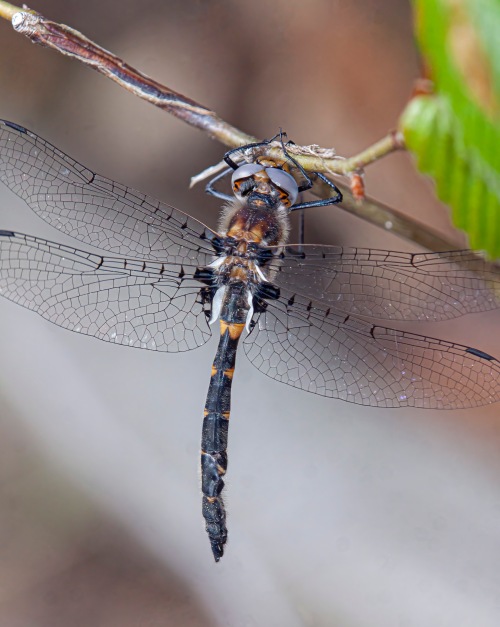
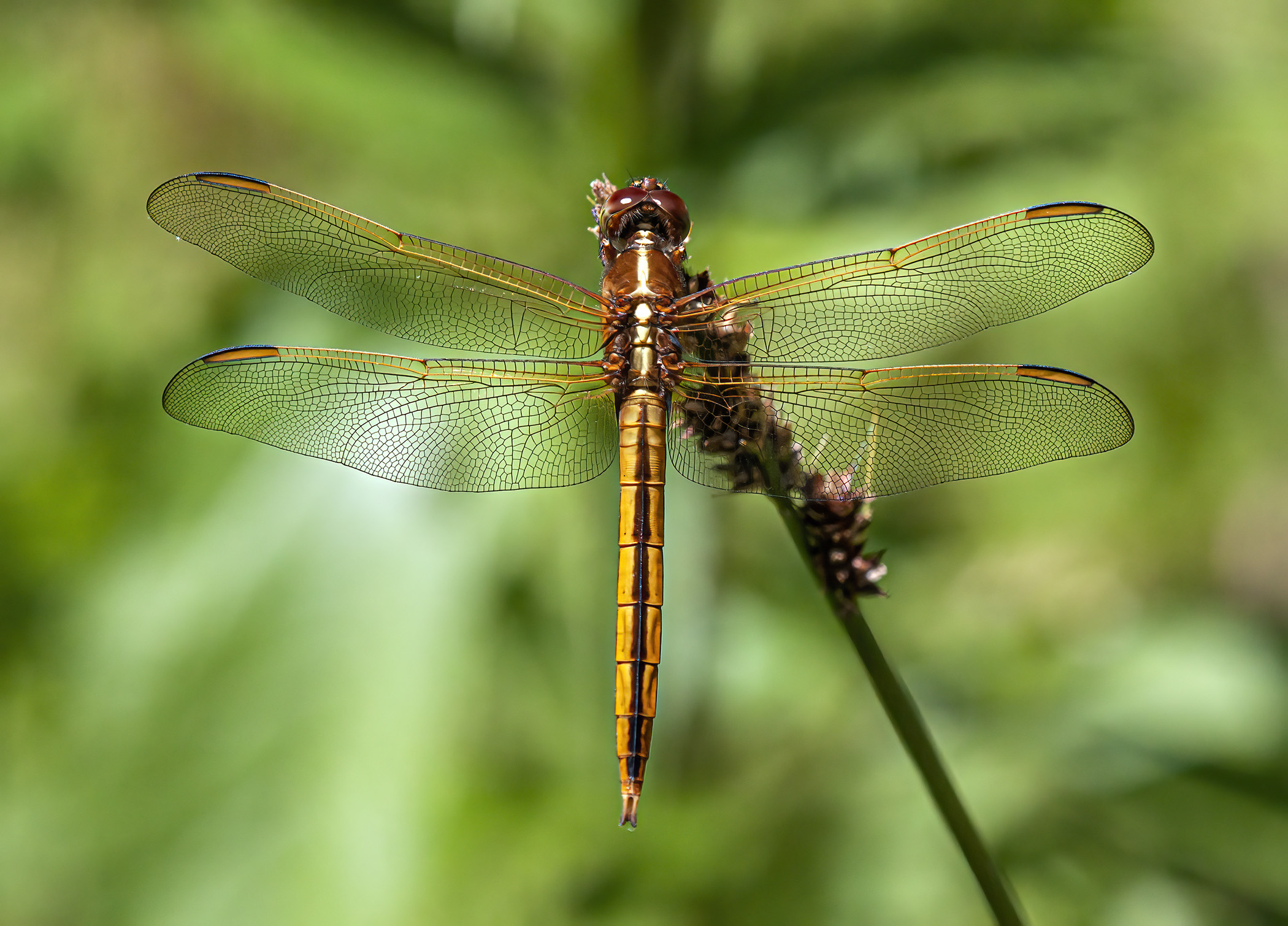
Have you even examined dragonfly wings really closely? I tend to think of dragonfly wings as being made up lots of individual “cells” that are uniform in size and shape, like the squares on piece of graph paper. The reality, however, is that the wings are incredibly complex and are full of intricate designs and shapes that presumably help the dragonfly to maneuver its way so masterfully through the air.

Last week I captured this image of an immature male Needham’s Skimmer (Libellula needhami) while I was exploring in Occoquan Regional Park. I managed to position my camera so that I was almost perfectly parallel to the plane of the wings that are consequently in sharp focus. I highly encourage you to click on the image to see the breathtaking wing details that form such complex mosaic-like patterns. Wow!

It is no wonder that it is so hard for me to draw or paint dragonfly wings that look realistic.

Needham's Skimmer

© Michael Q. Powell. All rights reserved.

Read Full Post »

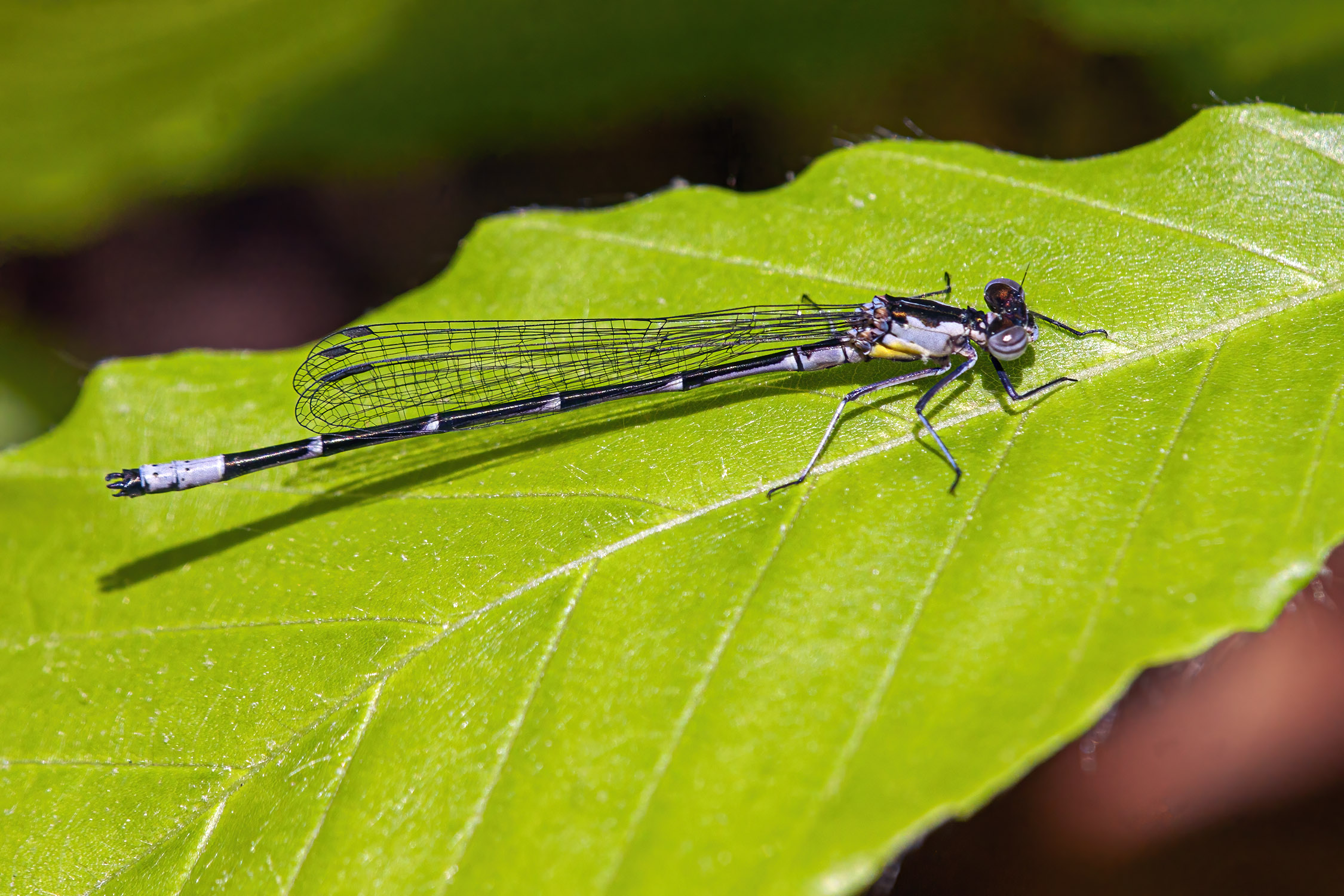
I was happy to spot these handsome Powdered Dancer damselflies (Argia moesta) in mid-June as I was exploring a rocky stream in Prince William County. Most of time when I see a damselfly it is at a pond or marshy area, but this large, distinctive damselfly seems to prefer rivers and streams. Although I occasionally spot them perched in vegetation, as in the second photo, Powdered Dancers quite often perch on bare ground or on flat stones.


Powdered Dancer

Powdered Dancer

© Michael Q. Powell. All rights reserved.


Read Full Post »

Six-spotted Fishing Spiders (Dolomedes triton) sense their prey through vibrations in the water, so generally when I see them they have several legs lighting touching the surface of the water. When I spotted this one yesterday at a small pond in Fairfax County, however, it was perched on top of some vegetation several inches above the water.

I have no idea why it was there, though there were plenty of dragonflies buzzing around that would occasionally perch on the same type of vegetation. Could it possibly be hoping to catch a dragonfly? I have included a photo of a male Blue Dasher dragonfly (Pachydiplax longipennis) from a previous day that was perched in the same area to give you an idea of the spider’s potential prey. I would think that a dragonfly’s excellent vision would allow it to spot the spider and avoid it—I can’t imagine that a dragonfly would deliberately choose to land on top of the spider, but who knows?

If you look closely at the first photo, you may also notice what appear to be several spider legs poking out from underneath the edge of the vegetation. Was there another spider there and if so, why? Nature is full of mysteries and intrigue, with lots of unanswered questions.

Six-spotted Fishing Spider

Blue Dasher

© Michael Q. Powell. All rights reserved.


Read Full Post »

When it comes to insects, I devote the majority of my attention to dragonflies and butterflies. However, there are other insects that periodically capture my attention, like this mating pair of bee-like robber flies (Laphria index/Laphria ithypyga) that I spotted last week at Occoquan Regional Park. I had no idea what species they might be, but was able to get some help when I posted the photo in a robber fly Facebook group. Yes, there actually is such a group in Facebook.

My favorite robber fly, though, is the Red-footed Cannibalfly—there is something about its creepy name that has always fascinated me. Apparently I am not alone, because a posting I did in 2013 that was simply titled Red-footed Cannibalfly has had 2,798 views to date, including 228 views last year, making it my second most viewed posting ever. Most people appear to find the posting by doing a search in Google for “Red-footed Cannibalfly.” My posting used to show up on the first page of results for that Google search, but has now slipped lower, though it was still the third entry when I did the same search in Bing this morning.

I definitely do not understand insect mating practices, so I will leave it to your imagination to figure out what is going on in this photo. As for me, I can’t help but think of one of Dr. Dolittle’s fantastic animals, the pushmi-pullyu.

Have a wonderful Monday.


robber flies

© Michael Q. Powell. All rights reserved.


Read Full Post »

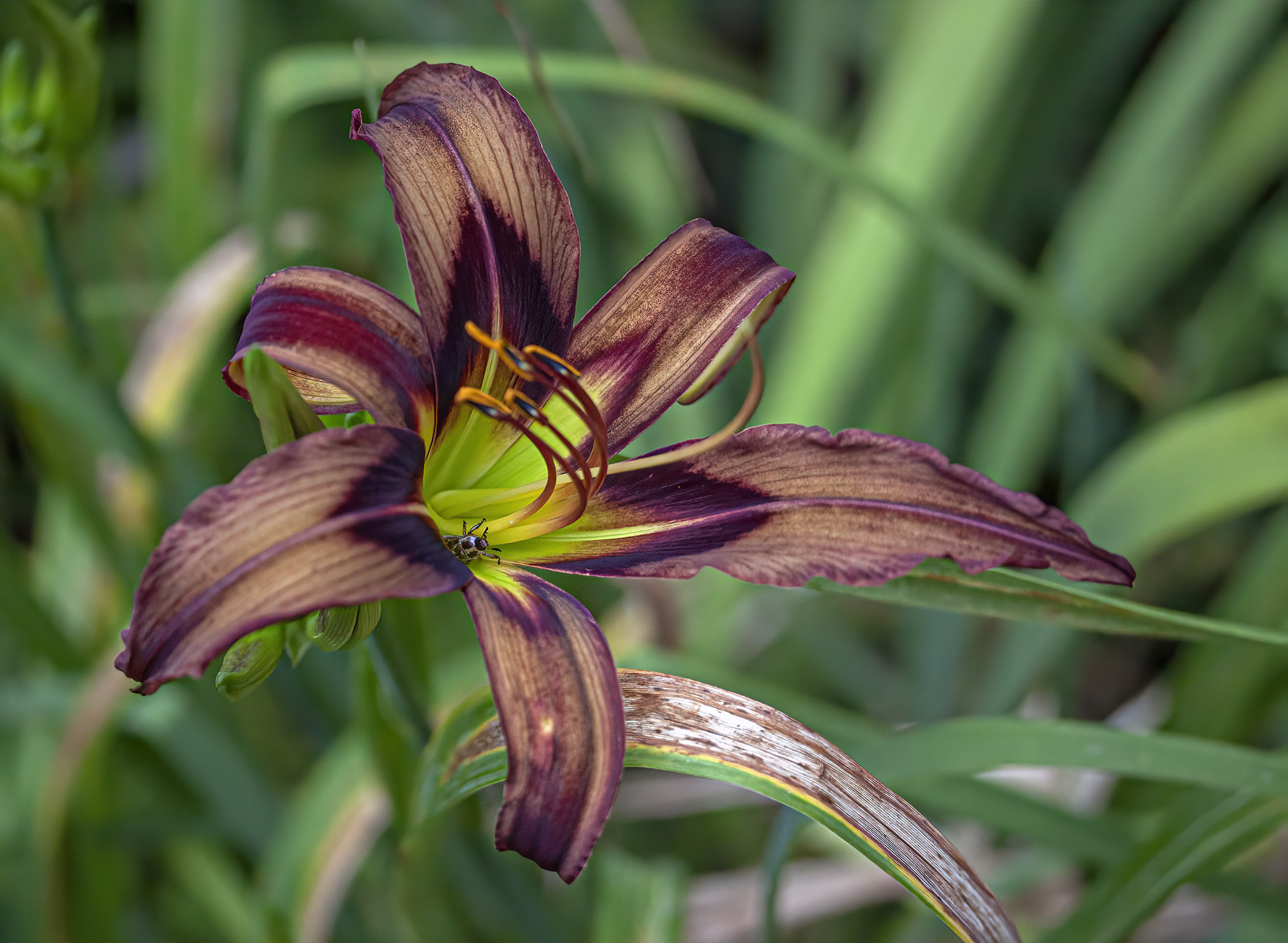
It’s amazing the things that show up in my photos that I did not notice when taking the shot, like this little beetle in the center of a striking lily that I photographed recently in the garden of my dear friend and neighbor Cindy Dyer. Cindy likes to call them “bonus bugs.” According to our rules, any bugs that you see when capturing a shot don’t “count” towards a bonus.

I do not have enough information to identify the insect. At first I thought it might be a cucumber beetle, but the pattern does not quite match the ones I have seen before. Cindy suggested that it might possibly be a carpet beetle. I also checked out a lot of different types of scarab beetles, but eventually decided that I was ok with not knowing the identity of the bonus bug.

I have included the second photo as a bonus. My original purpose in photographing the lily was to capture its beauty and unusual coloration and the second shot accomplished that goal. I carefully focused on the stamens (and particularly the anthers) and allowed the rest of the flower to fall out of focus. If I had not looked at the first photos, I might not have noticed the fuzzy shape of the bonus bug in the second image, but it is definitely there.

lily

lily

© Michael Q. Powell. All rights reserved.

Read Full Post »

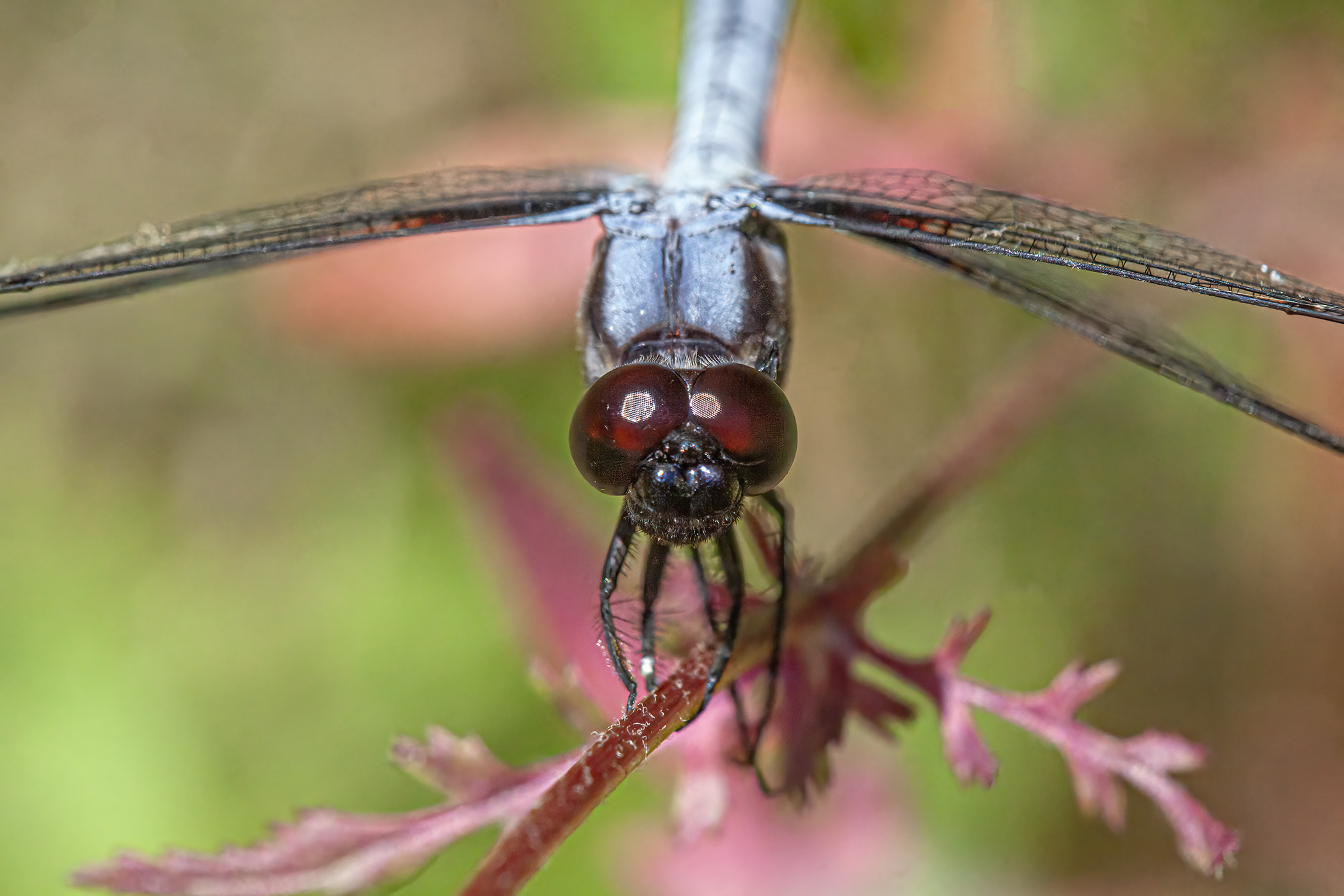
I had a really close encounter with this male Bar-winged Skimmer dragonfly (Libellula axilena) last Thursday while exploring a small pond in Prince William County, Virginia with fellow dragonfly enthusiast and blogger Walter Sanford. It is a challenge to handhold a macro shot when I am that close to a live subject, but the dragonfly was pretty cooperative and stayed put while I composed the shot. The colorful vegetation on which he was perched added some additional visual interest to the image without drawing attention away from the primary subject.

Bar-winged Skimmer

© Michael Q. Powell. All rights reserved.


Read Full Post »

How do you draw attention to the main subject in your photograph? One effective way is to choose a camera setting that will give you a shallow depth of field, so that only the subject is in sharp focus and the rest of the image is blurred. Another way is to ensure that the colors and texture of the background contrast with those of the subject.

I used both of these techniques yesterday morning when I spotted this metallic green sweat bee (g. Agapostemon) on one of the Shasta daisies growing in the garden of my neighbor and photography mentor Cindy Dyer. I love these little bees with their large speckled eyes and shiny green bodies and got as close to this one as I dared with my Canon 60mm macro lens.

I opened the aperture of the lens all the way to f/2.8 to let in lots of light and to achieve the narrowest possible depth of field. That is why the center of the daisy falls so quickly out of focus. As I was composing the shot, the flower reminded me of an egg that had been fried “sunny-side up” and I chose an angle that emphasized that look. (In case you are curious about the other camera settings, the ISO was 800 and the shutter speed was 1/800 sec.)

There is nothing super special about this image, but it is a fun little photo taken close to home that reminds me that beauty is everywhere. A series of creative choices in camera settings and composition by the photographer can often help to draw a viewer’s attention to that beauty. (I encourage you to click on the image to get a better view of the beautiful details of the little green bee.)

green sweat bee

© Michael Q. Powell. All rights reserved.

Read Full Post »

I was happy yesterday to spot several Common Sanddragon dragonflies (Progomphus obscurus) while exploring a creek that runs through a small suburban park in Fairfax County, only a few miles from where I live. Unlike many other dragonflies that like areas with vegetation, this species prefers sunny, shallow creeks with sandy or gravelly banks.

Quite often Common Sanddragons will perch flat on the sand or with their abdomens raised a little or even a lot, as shown in the third image. The third image is quite unusual, because it shows a Common Sanddragon perched off of the ground and away from the water. When I first spotted the dragonfly perched on that dead branch, I had to look really closely to convince myself that it was in fact a Common Sanddragon. Fortunately, male Common Sanddragons have bright terminal appendages, known as cerci, at the tip of their abdomens that make them easy to identify.

Common Sanddragon

Common Sanddragon

Common Sanddragon

© Michael Q. Powell. All rights reserved.

Read Full Post »

When it comes to damselflies, I love the sidewards heart that their bodies create when they are in this mating position. I have been told that the process is somewhat brutal, but I like to think of it as romantic, two hearts joined as one.

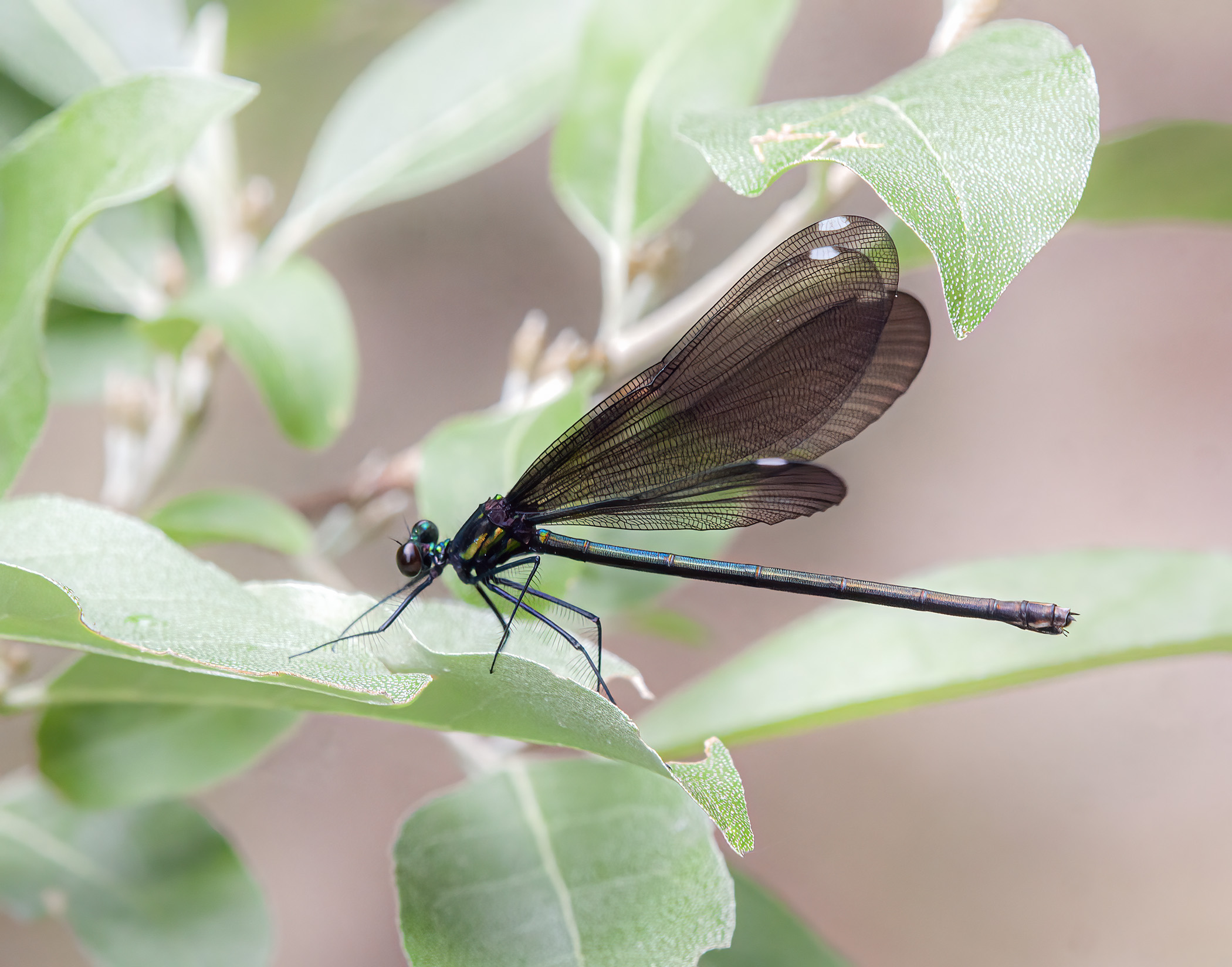
I spotted these Ebony Jewelwing damselflies (Calopteryx maculata) last Sunday in Fairfax County. At this time of the year Ebony Jewelwings are quite common, especially in the shaded forest streams that I like to explore.

In addition to the sidewards heart, I really like the interplay of the light and the shadows in the background that adds a lot of visual interest without detracting from the primary subjects. You can get a really feel for the dappled sunlight that kept the scene from being in complete shade.

Ebony Jewelwing

© Michael Q. Powell. All rights reserved.

Read Full Post »

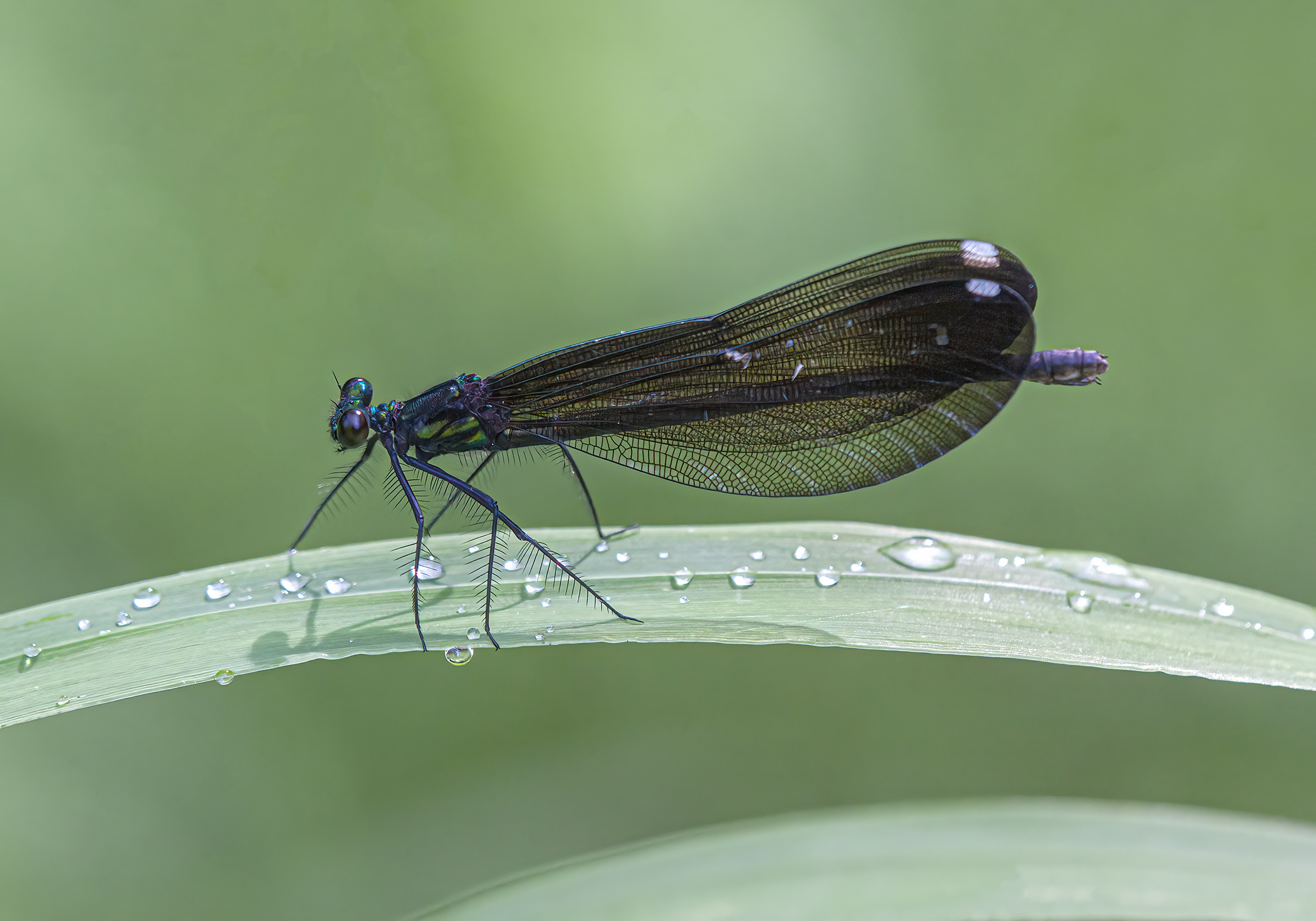
Some say that the secret to capturing an effective image is to eliminate all of the non-essential elements. This image is about as minimalistic as I can get. The raindrops on the vegetation provide a sense of what has been and the shadows a hint that the sun was shining again when I spotted this stunning female Ebony Jewelwing damselfly (Calopteryx maculata) at Occoquan Regional Park on Friday.

The image itself is simple, but I am amazed at the details that I was able to capture of this tiny creature and encourage you to click on the image. If you do, you may be as shocked as I was, for example, at the length of the “hairs” on the damselfly’s legs—clearly leg shaving is not practiced among the ladies of this species.

Ebony Jewelwing

© Michael Q. Powell. All rights reserved.


Read Full Post »

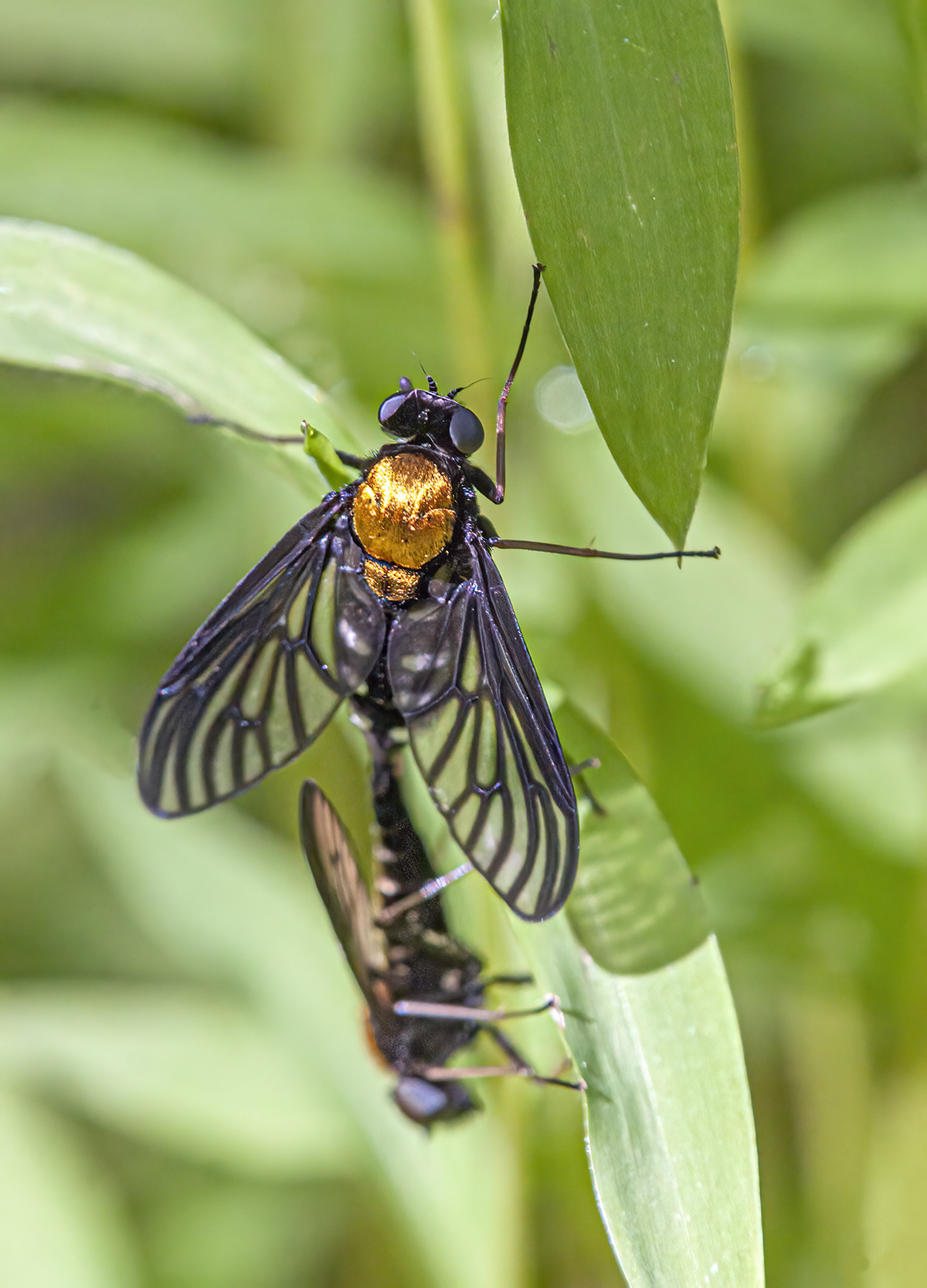
I see all kinds of flies when I am out in the wild with my camera, but I don’t think that I have ever seen one like this brightly-colored one that I spotted on Tuesday at Occoquan Regional Park. Some internet research suggests that it is a Golden-backed Snipe Fly (Chrysopilus thoracicus). It was hard to find detailed information about the life cycle of this species, but I did come across an amusing and informative article by Joe Boggs at The Ohio State University entitled Snipe Hunting, if you are interested in learning a little more about this unusual-looking fly.

Golden-backed Snipe Fly

© Michael Q. Powell. All rights reserved.

Read Full Post »

I spotted this beautiful female Turquoise Bluet damselfly (Enallagma divagans) on 27 May as I was exploring the edge of the woods adjacent to a small pond in Prince William County, Virginia. While I was out in the field, I recognized that it was a bluet, but could not determine its species. Even when I returned home and consulted resources in print and on-line, I quick became confused as I assesed the relative size of the eyespots on the the top of the damselfly’s head, the width of the occipital bars (the band that joins the eyespots), and the placement and size of the blue areas on the abdomen (the “tail”).

Fortunately I am a member of several Facebook groups focused on dragonflies and damselflies and the experts in those groups came to my rescue and identified this as a female Turquoise Bluet, a species that I had never before encountered. I was happy that I was able to capture a lot of detail in my photo and encourage you to click on it to see those details. For reference, Turquoise Bluets are 1-1.4 inches (25-36 mm) in length.

Turquoise Bluet

© Michael Q. Powell. All rights reserved.


Read Full Post »

Whenever I go out searching for dragonflies in the early morning or after a rainstorm, I am hoping to photograph a dragonfly covered with drops of water. It has not happened yet, but it remains as one of my aspirational goals.

There were plenty of raindrops on the vegetation on Thursday morning when I began my adventures in Prince William County. I was happy to spot this tiny male Fragile Forktail damselfly (Ischnura posita) peering over the edge of the water-spattered leaf on which he was perched. I really like the simplicity of the image that I captured, with its limited number of shapes, colors, and patterns.

Photography does not have to be complicated to be effective—minimalistic images are often the most powerful.

Fragile Forktail

© Michael Q. Powell. All rights reserved.


Read Full Post »

I have always been fascinated by the intricate patterns of spider webs and I love to attempt to photograph them. Of course, the first challenge is to spot them. In the past I have had some success in early morning hours when the webs were covered in dew—see, for example, my posting from September 2012 called More spider art. In more recent years, though, I have most frequently encountered spider webs when I have run into them stretched head-high across trails.

I was pretty excited therefore when I spotted this backlit spider in its web last Thursday as I was exploring a forested area in Prince William County. I loved the way that the light was shining through the body of what I recognized to be an Orchard Orbweaver spider (Leucauge venusta). I toyed around with ideas on how to compose the image and decided to include only the upper half of the web—I wanted to make sure that the viewer’s eyes would be drawn to the spider.

Orchard Orbweaver spiders are quite common in my area and I encountered another one later that same day and captured the close-up image below that shows some of the spider’s beautiful coloration. I know that some people find spiders to be creepy and threatening, but hopefully these spider shots can help to convince at least a few of those viewers that spiders can also be quite beautiful.

Orchard Orbweaver

Orchard Orbweaver

© Michael Q. Powell. All rights reserved.


Read Full Post »

Many of the early spring dragonflies are now gone, but the summer species are starting to show up in force. On Tuesday, for example, I spotted a large number of Eastern Amberwing dragonflies (Perithemis tenera), including the handsome male in the photo below, buzzing about the pond at Jackson Miles Abbott Wetland Refuge. Eastern Amberwings are quite common during the summer and are the smallest dragonflies in our area at about one inch (25 mm) in length—it is easy to confuse them with wasps when you see them flying.

According to the Dragonflies of Northern Virginia website, “Amberwings are reported to have the most intricate courtship of any dragonfly. After the male selects several possible egg-laying sites for a mate, he flies off to find a female and leads her back to his potential nursery. To attract her, he sways back and forth, and hovers with his abdomen raised. Mating only occurs if the females approves—making this one of the few dragonflies where females choose the males.”

I love the warm tones of this dragonfly and the way the background colors of this image complement them.

Eastern Amberwing

© Michael Q. Powell. All rights reserved.


Read Full Post »

Even though I have learned to identify many dragonflies pretty well, I often feel clueless when it comes to damselflies. The differences between damselfly species are often subtle and difficult to see. I often get lost in trying to look at the relative size of eye spots or the length of various markings.

Fortunately for my self-esteem, there are some damselflies that I can confidently identify, like this female Ebony Jewelwing damselfly (Calopteryx maculata) that I spotted on Tuesday at Occoquan Regional Park. Ebony Jewelwings are the only damselfly species in our area with distinctively dark wings. It is even easy to distinguish the genders too, because only the females have white stigmas on each of their wings.

I was a little surprised this morning to learn that the male Ebony Jewelwings also have stigmas on their wings, but the stigma are black and do not show up very well on their black wings. According to a posting on the Nature Watch blog, “All damselflies (and dragonflies) have stigmas on their wings. A stigma (pterostigma) is a large, thick cell on the leading edge of the wing near the tip which helps stabilize the wing while the dragonfly or damselfly is in flight. It holds down vibration allowing increased speed during gliding flight. In many species the stigma is pigmented, in others, it is clear. Each wing has a stigma.”

I previously knew about stigmas, of course, but somehow thought of them as primarily decorative rather than functional elements. It is really cool to learn more about the physics of how that my magical little friends are able to fly. What really blows my mind, though, is thinking about how the world looks to them when viewed through their large, multi-faceted compound eyes. Wow!

Ebony Jewelwing

© Michael Q. Powell. All rights reserved.

Read Full Post »

This past Saturday I spotted this unusual insect—an Eastern Eyed Click Beetle (Alaus oculatus)—while I was exploring in Prince William County. The large eye spots on its thorax are a kind of defensive adaption designed to confuse or frighten potential predators into thinking the beetle is much larger than it really. In addition to the distinctive eye spots, the beetle has some really cool looking antennae that you can see more clearly if you click on the image to enlarge it.

Eastern Eyed Click Beetle

© Michael Q. Powell. All rights reserved.

Read Full Post »

The newspapers in our area are full of apocalyptic stories about Brood X periodical cicadas (Magicicada septendecim) that are starting to emerge in my neighborhood and in other parts of the United States after a seventeen-year stint underground. I have not seen many live cicadas, but there are dozens of discarded exoskeletons on my backyard fence and in my front yard tree, a few of which you can see in the second and third photos. I am not paranoid, but it does feel like they are surrounding me.

On Tuesday I photographed one cicada that was in the process of emerging. If you look closely at the first photo you will note that the cicada’s wings are not yet fully formed. They will eventually lengthen and become transparent. So far the cicadas have remained silent, but before long I expect to hear their deafening chorus, as the males compete to attract females by belting out their mating calls.

Yesterday the Washington Post had a story with the sensationalist title A fungus could turn some cicadas into sex-crazed ‘salt shakers of death.’  According to the authors of this article, “Yellow-white fungus grows inside the cicadas, filling their insides and pushing out against their abdomens. One by one, the rings that compose the back halves of their bodies slough off and fall to the ground. Driven by a chemical compound in the fungus — and now lacking butts and genitals — the bugs try to mate like crazy. Some researchers call these infected cicadas “flying salt shakers of death.” And they’re lurking among Brood X.” There is even a warning in the article, “Despite the amphetamine’s ability to control cicadas, no one should expect to feel a high from eating a fungus-infected insect.”

Yes, things are a little crazy here as we await the full-scale onslaught of the cicadas. I will try do an update posting in the upcoming weeks with more photos of these brooding, red-eyed insect invaders.


cicada

cicada

cicada

© Michael Q. Powell. All rights reserved.


Read Full Post »

I was delighted to spot these beautiful Calico Pennant dragonflies (Celithemis elisa) on Tuesday at Occoquan Bay National Wildlife Refuge. The one with the yellow markings is a female and the one with the red markings is a male.

The combination of bright colors and intricate wing patterns makes Calico Pennants one of the most stunning dragonflies species that I am blessed to see and photograph. They sure do pack a lot of beauty into their tiny bodies that are only 1.3 inches (33 mm) in length.

Calico Pennant


calico pennant

calico pennant

© Michael Q. Powell. All rights reserved.

Read Full Post »

Yesterday I spotted this beautiful little Silver-spotted Skipper butterfly (Epargyreus clarus) while I was wandering about at Occoquan Regional Park. There are more than 3500 species of skippers worldwide, but fortunately this one is pretty easy to identify. Many of the other skippers in our area are similar in appearance, with only slight differences in the patterns on their wings.

When I was doing a little research on this species, I came across this curious comment on the Butterflies and Moths of North America website, “The Silver-spotted Skipper almost never visits yellow flowers but favors blue, red, pink, purple, and sometimes white and cream-colored ones.” I am not sure whether the fact that this butterfly species has a color preference surprises me more or the fact that some scientist obviously studied and catalogued its behavior.

Silver-spotted Skipper

© Michael Q. Powell. All rights reserved.

Read Full Post »

Beauty can often be found in small things in ordinary situations. On Thursday I captured this image of a beautiful Pearl Crescent butterfly (Phyciodes tharos) feeding on a dandelion while I was exploring in Prince William County with fellow dragonfly enthusiast Walter Sanford. Although we were focused on searching for dragonflies, most of you know that I am an opportunistic photographer and will take a photo of almost anything that catches my eye.

I am not completely certain about the identification of this butterfly—I have trouble distinguishing between a Silvery Checkerspot butterfly (Chlosyne nycteis) and a Pearl Crescent butterfly. In fact, I am not really sure if this is a dandelion or one of a number of small flowers that are similar in appearance.

The funny thing is, though, that I am totally unconcerned about the accuracy of my identification in this case. This image is more about art than it is about science. It is about light and color and patterns and details. I encourage you to click on the image and immerse yourself in the enlarged image. You will be amazed to see the speckles in the butterfly’s eyes and the flecks of pollen on its extended proboscis.

Beauty can often be found in small things in ordinary situations.

Pearl Crescent

© Michael Q. Powell. All rights reserved.

Read Full Post »

On Tuesday I was excited to spot this pretty Red-banded Hairstreak butterfly (Calycopis cecrops) while visiting Occoquan Regional Park. These tiny butterflies are only about an inch (25mm) in length, so I had to get pretty close to photograph one. Fortunately this butterfly seemed preoccupied with feeding, so it tolerated my presence pretty well.

My macro lens allowed me to capture an image that reveals many of the butterfly’s wonderful colors and patterns. It is also nice to be able to see the little “tails” protruding from the hind wings that are responsible for the name “hairstreak” and the pattern of colors on the antennae.

Red-banded Hairstreak

© Michael Q. Powell. All rights reserved.

Read Full Post »

When I am intently searching for dragonflies, my eyes are drawn to anything that is moving through the air. Once I detect movement, I will try to track the subject until I am able to identify it. Early in the season, things were a bit easier, because there were not many insects around, but as the weather has warmed out, it has gotten tougher and the air now seems filled with grasshoppers, bees, and other flying creatures as I move about in the fields and forests.

As I was wandering about last Thursday in Prince William County, I detected a black and yellow insect and tracked it until it landed on some vegetation. Ten years ago, I might have simply called it a “bee”—my knowledge of insects was so limited that I would have divided insects into broad categories like bees and butterflies. If pushed for more specificity, I might have called this a “small bee.”

My identification skills and my knowledge of insects has grown exponentially over the years. As soon as I saw the way that the insect was flying, I could tell that it was a hover fly, a member of a group of flies that you may know as flower flies, because of where they can be found most often. I was immediately attracted to the beautiful, elaborate patterns on the insect’s body and recalled that I had seen a similar one last year in the garden of my friend Cindy Dyer.

I believe that this cool-looking hover fly belongs to a species known as the Eastern Calligrapher Fly (Toxomerus geminatus), though there are over six thousand hover fly species worldwide, so it could also be a related species. Nevertheless, I love the thought of someone hand drawing the delicately etched pattern with pen and ink, creating a miniature work of art.

As I was composing a shot, I grew fascinated with the details of the leaf on which the hover fly was perched—it is easy for me to lose myself when looking at the world through a macro lens. It appears that some other insect had been chewing on the leaf before the Calligrapher Fly arrived and I like the way that I was able to capture the holes in the gnawed-on leaf.

Eastern Calligrapher Fly

© Michael Q. Powell. All rights reserved.

Read Full Post »

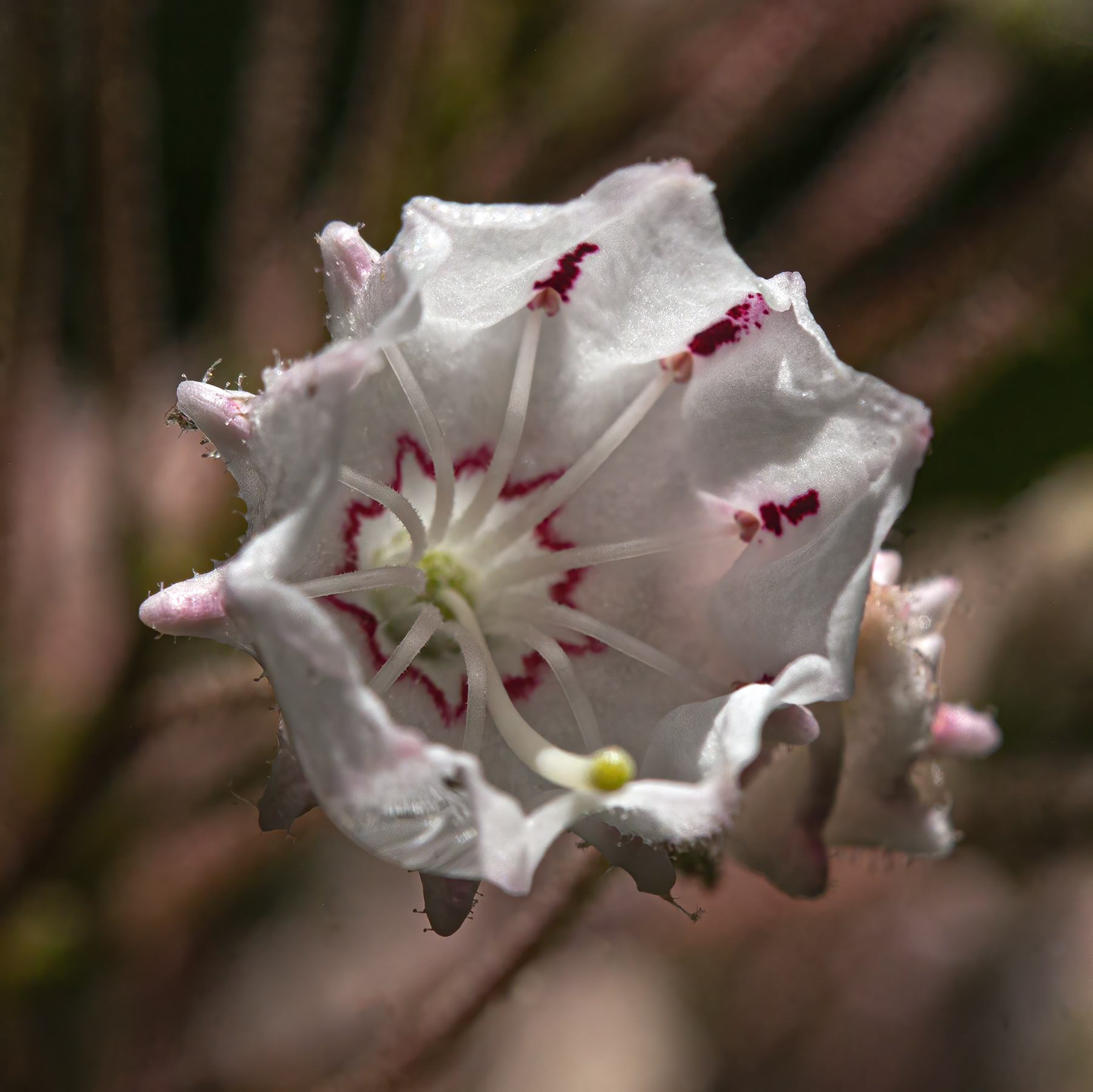
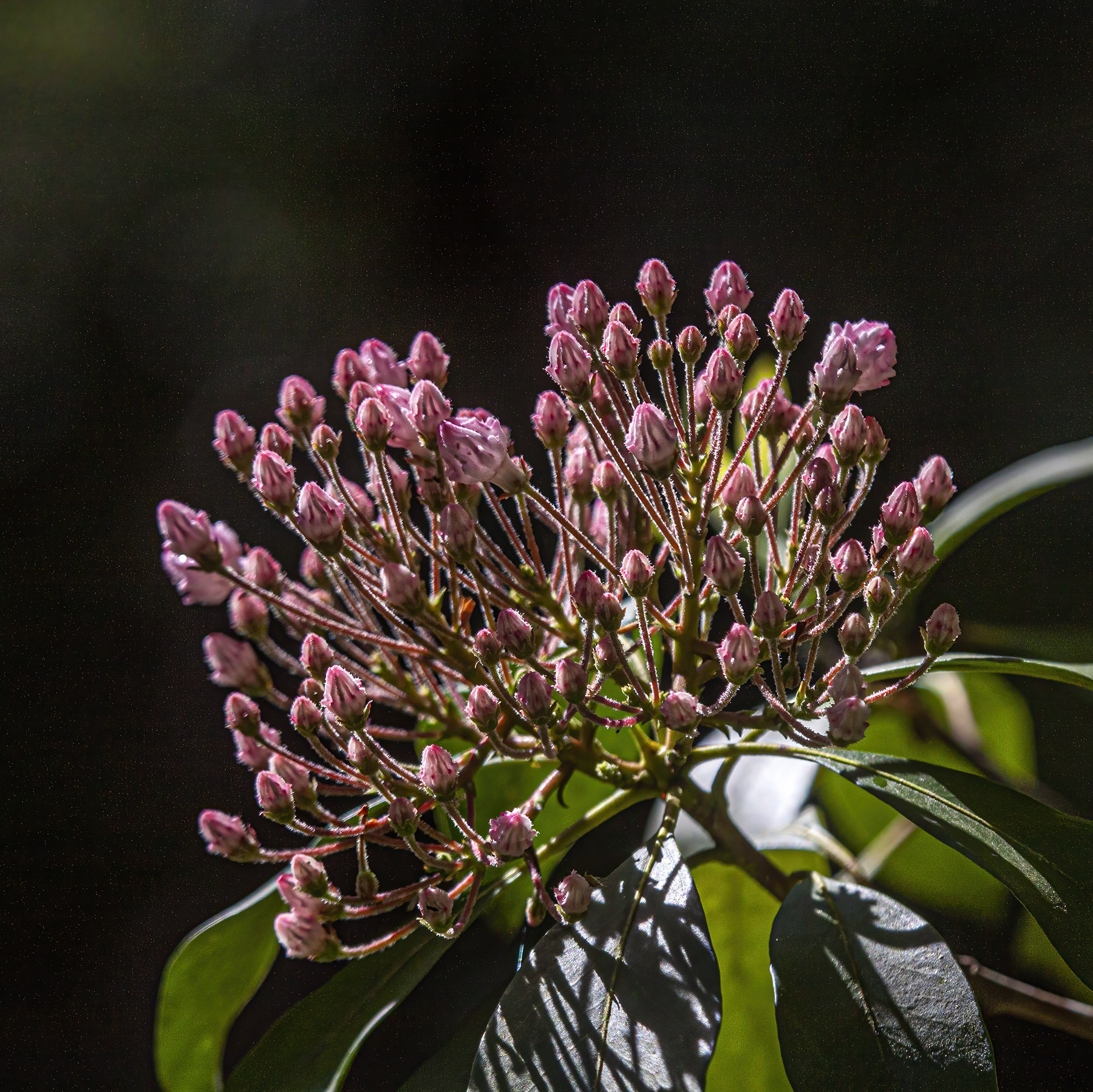
As I was wandering about last Saturday in Prince William County, I was thrilled to spot my first flower on a Mountain Laurel shrub (Kalmia latifolia). I had been noticing lots of buds during recent trips, but this was the first one that I spotted that was open. I think there may be cultivated versions of mountain laurel, but it is naturally found on rocky slopes and in mountain forest areas, which was exactly the environment that I was exploring.

I simply love the shape, colors, and pattern of the gorgeous flowers of this plant. After I published this post, I decided to add a second photo, one that shows the unopened buds of a mountain laurel, their additional beauty waiting to be revealed.

mountain laurel

mountain laurel

© Michael Q. Powell. All rights reserved.


Read Full Post »

On a recent visit to Occoquan Bay National Wildlife Refuge I stumbled upon a Common Baskettail dragonfly (Epitheca cynosura) at the edge of a pond that was in the final stages of the process of emergence. The first photo shows the dragonfly only seconds after it popped open its wings for the first time—note how shiny and clear the fragile wings are at this stage. The second photo shows the dragonfly a few minutes earlier, when its wings were still closed and its markings were just beginning to appear.

The dragonfly remained in place for a few minutes as its wings began to harden. It then made a short fluttering flight to some nearby vegetation, a safer and less exposed location to rest and complete its amazing metamorphosis.


Common Baskettail


Common Baskettail

© Michael Q. Powell. All rights reserved.

Read Full Post »

It was pretty cool to spot this male Aurora Damsel damselfly (Chromagrion conditum) on Friday while I was exploring in Prince William County. I love the accents of brilliant yellow on the sides of its upper body that make this damselfly stand out from many others that are also black and blue.

I also managed to get a shot of an Aurora Damsel couple in what is known as the “tandem” position. The female of this species, the lower damselfly in the second photo, also has the yellow accents, although her body coloration is more subdued, as is often the case with damselflies and dragonflies.

When they are mating, damselflies join together in a heart-shaped position, known as the “wheel position,” and afterwards the male will often remain attached to the female, including while flying, as she lays her eggs. He does this by retaining his grip on the front part of the female’s thorax, as you can see in the second photo, using claspers located at the tip of his abdomen.

If you have never seen the distinctive sidewards-heart that damselflies make when mating, check out a posting that I did last year entitled Sidewards heart that shows a pair of Ebony Jewelwing damselflies forming the aforementioned heart.

aurora damselfly

aurora damselfly

© Michael Q. Powell. All rights reserved.

Read Full Post »

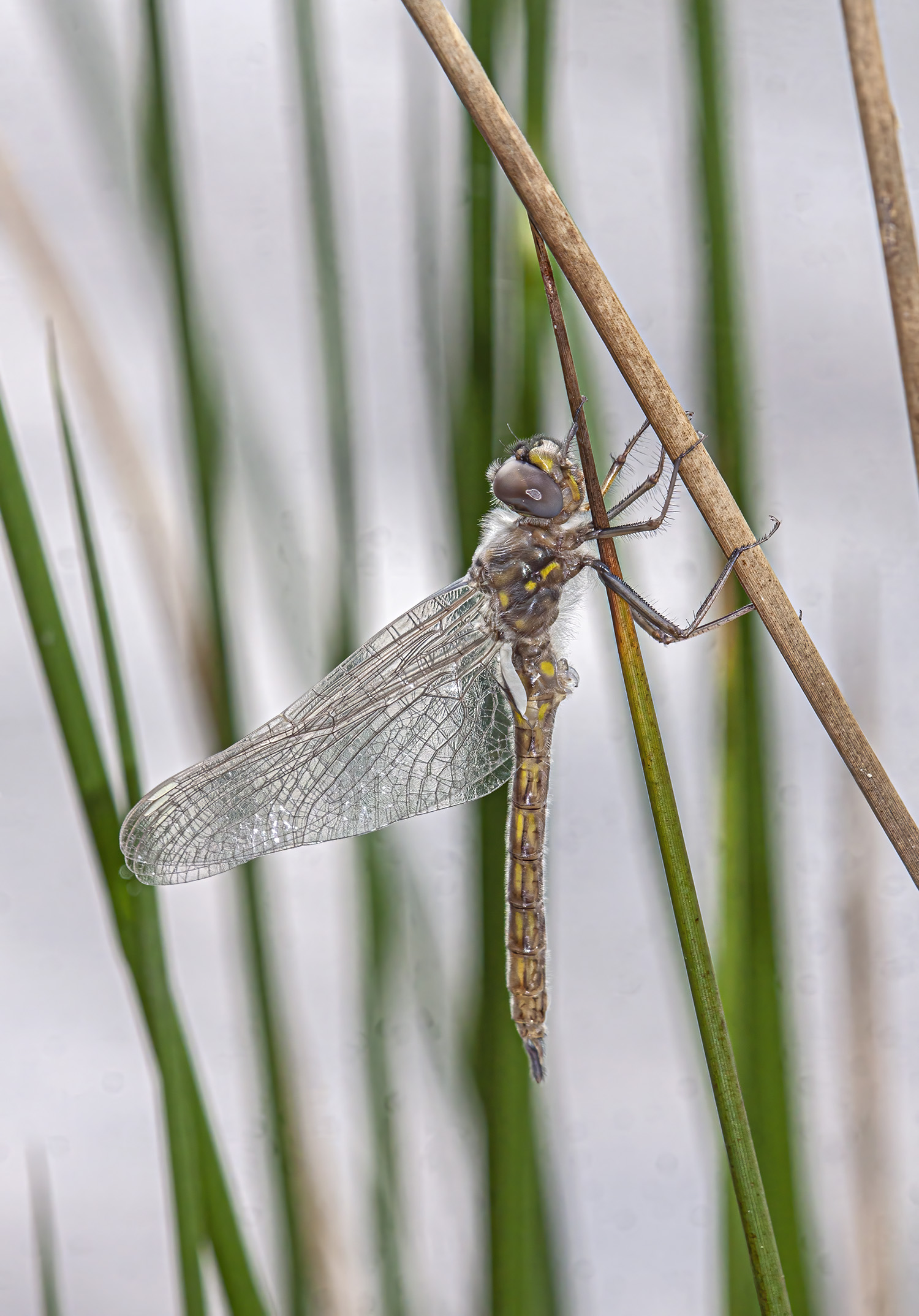
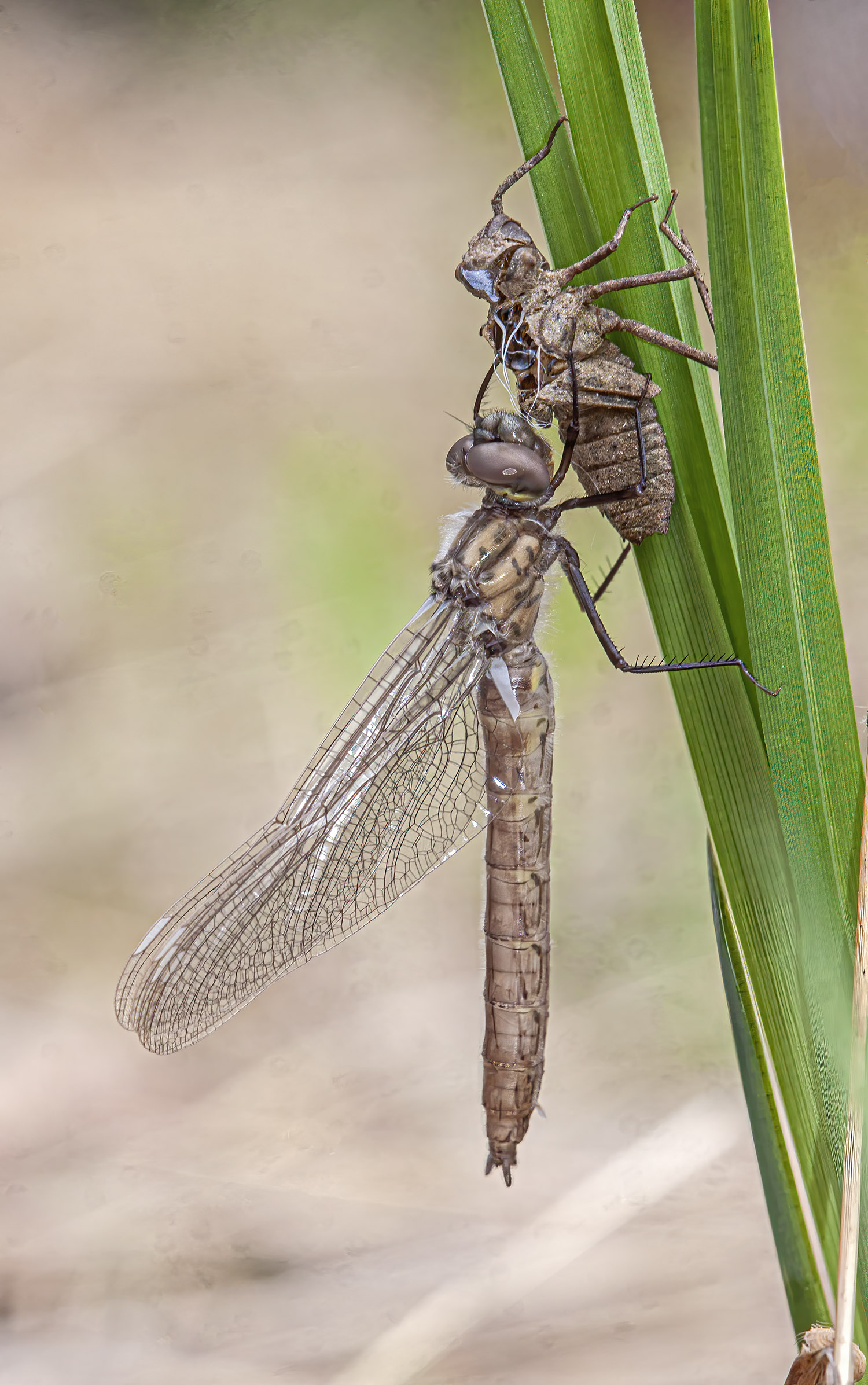
Have you ever watched a dragonfly-to-be break out of its exoskeleton and undergo a remarkable metamorphosis from a water-breathing nymph to an amazing aerial acrobat? It is an amazing and fascinating process that rivals (or maybe even surpasses) the more familiar transformation of a butterfly that many of us studied in school.

On a recent excursion to look for dragonflies in Prince William County, my good friend and fellow dragonfly enthusiast Walter Sanford excitedly called out to me that he had spotted a dragonfly that was midway through the process of emergence. We had not had much success up to that point in the day, so Walter’s news was especially welcome.

When dragonflies are in the process of emergence, they are very vulnerable. Their bodies are undergoing some incredible changes and they do not yet have the ability to fly. If you look at the first photo and compare the size of the exoskeleton (often referred to as an exuvia) to that of the dragonfly, you can get a sense of the magnitude of the changes that were occurring.

I moved a little closer for the second shot, being careful not to disturb the dragonfly, in order to capture some additional details. The exoskeleton shows, for example, little wing pads that are tiny when you compare them to the wings that are still closed over the dragonfly’s body. A little later in the process, the dragonfly will unfold the wings and will be be able to fly, albeit weakly at first.

At this stage, we could tell that the dragonfly was a female, because of the shape of the terminal appendages, but we could not determine its species, because its colors and markings were still really pale. Depending on the species, this transformation process can take as long as several hours and it can sometimes take a few days for the colors and markings to darken. (If you are interested in this whole process, I witnessed the it from start to finish several years ago and took a series of photos that documented the process in a blog posting called Metamorphosis of a dragonfly.)

Walter was eventually able to determine that this was a female Uhler’s Sundragon (Helocordulia uhleri). My final photo shows an adult female Uhler’s Sundragon that I photographed later that same day, so you can easily see that the dragonfly was not yet done with her transformation when we photographed her. 

How did Walter do it? For the answer to that mystery, check out Walter’s blog posting today called Uhler’s Sundragon dragonfly (emergent female) for the fascinating story of his detective work and additional photos and details of our encounter with this emerging dragonfly.

Uhler's Sundragon

Uhler's Sundragon

Uhler's Sundragonfly

© Michael Q. Powell. All rights reserved.


Read Full Post »

I was excited on Friday to capture this image of a colorful male Eastern Forktail damselfly (Ischnura verticalis) as I was wandering about at Occoquan Regional Park in Lorton, Virginia. I love the color combination of the light green thorax and the turquoise accents near the tip of the abdomen.

Generally when I see these little damselflies they are perched flat on the ground or on vegetation close to the ground—this slightly elevated perch made it a bit easier for me to get a good shot of its entire body. In case you are curious about the size of this damselfly, Eastern Forktails are only 0.8-1.3 inches (20-33 mm) in length, so you have to look really carefully to spot one.

Eastern Forktail

© Michael Q. Powell. All rights reserved.


Read Full Post »

There always seems to be something fun and whimsical about ladybugs, like this one that I spotted last Saturday at Occoquan Regional Park. This is probably an invasive Harlequin Lady Beetle (Harmonia axyridis), rather than a native ladybug, but I still find it to be beautiful.

The Harlequin Lady Beetles, also known as Multicolored Asian Lady Beetles, may assist with control of some aphid pests, but may also harm native and beneficial insects and are considered by many to be pests.

My interests tend to be primarily photographic, so I tend not to make distinctions between weeds and flowers or between native and invasive species in the way that others, such as gardeners and farmers, may need to do. I am trying to capture my subjects as well as I can and I am pretty happy with the way this particular image turned out, given the small size of the ladybug and the fact that it was moving about as I was trying to get a shot.

ladybug

© Michael Q. Powell. All rights reserved.


Read Full Post »

Here are a few shots of one of the cool early spring dragonflies in our area, the distinctive Twin-spotted Spiketail dragonfly (Cordulegaster maculata). I photographed what I believe are two different males on 16 April at Occoquan Regional Park. I was fortunate to spot these dragonflies as they were flying about low to the ground and was able to track them visually to their perches less than a foot (30 cm) above the ground. As you can see from the photos, Twin-spotted Spiketails hang from vegetation at an angle rather than perch horizontally as some dragonflies do.

This species is considered to be uncommon in our area, so I was quite happy to spot them again this year in a location where I had seen them last year. According to Kevin Munroe’s wonderful website Dragonflies of Northern Virginia, Twin-spotted Spiketails “are uncommon to rare, and need small, perennial, forest streams with stable, relatively un-eroded banks and a noticeable, steady current. They don’t need the cold, highly-oxygenated, rocky waters of a trout stream, but do need streams with halfway decent water quality and relatively low stormwater surges.”

Over the past few years I have learned, thanks to the helpful instruction of fellow dragonfly enthusiast Walter Sanford, that the habitat really matters for many of the uncommon dragonfly species in our area. There are no guarantees that I will find the my target species when I go searching for them, but there is a much greater chance if I know where to look and when, given that some of these species are present for only a few weeks each year.

In case you are curious, these dragonflies are much larger than the Uhler’s Sundragons and Selsys’s Sundragons that I featured in recent postings. The sundragons are about 1.5 inches (40 mm) in length, while the Twin-spotted Spiketail can be almost 3 inches (76 mm) in length.

Twin-spotted Spiketail

Twin-spotted Spiketail

Twin-spotted Spiketail

© Michael Q. Powell. All rights reserved.

Read Full Post »

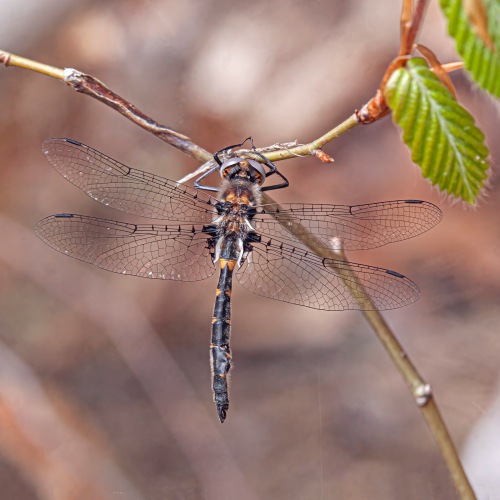
Normally when I photograph a new species of dragonfly I am immediately ecstatic, but that was not the case on Tuesday. After a long day of searching for Uhler’s Sundragons (Helocordulia uhleri) in Prince William County with fellow dragonfly enthusiast Walter Sanford, we were excited when we finally spotted a few of them. It had been an overcast day and it was only when the sun came out after noon that the dragonflies began to appear. Walter was thrilled, but my excitement was a little more muted, because I had photographed this species the previous week—check out my posting First dragonflies of the season for details and photos of my adventures that day.

After a while, Walter noted to me that all of the Uhler’s Sundragons that he had seen so far were female and that he hoped he would see a male. This may sound a little strange, but with some species of dragonflies, the females hang out in a separate area from the males until they are ready to mate, so you do not always see the genders intermixed.

I was wandering around the area a bit, as I am prone to do, when Walter called out to me that he had found a male. I rushed over and managed to get some shots of the specimen, including the first two images below. As it turns out, that was the only male that we saw all day.

The following day, Walter sent me an excited Facebook message informing me that the male dragonfly that we had both photographed was not a Uhler’s Sundragon, but was a Selys’s Sundragon (Helocordulia selysii), a similar species that neither of us had ever seen before. Walter did a records search and it looks the species had never before been documented in Prince William County. Finally I was ecstatic.

How did we not notice immediately that this was a different species? One of the primary differences between the species is that Uhler’s Sundragons have amber-colored markings mixed with dark ones at the base of their wings, while Selys’s Sundragons have only the dark markings. Given the small size of these dragonflies, these differences are hard to spot in the field, but are much easier to see when reviewing images afterwards.

For comparison purposes, I have included a photo of a male Uhler’s Sundragon that I photographed last week. If you look carefully, you can see the amber-colored markings in the final photo that are absent in the first two photos.

You may also notice that there is a spider on the branch in the final photo that appears to be reaching down and tapping the dragonfly on the “shoulder.” In this scenario, I am not sure which species would be the predator and which would be the prey. I have documented several cases in which dragonflies have been caught in spiderwebs and also a case when a jumping spider took down a much larger dragonfly (see my 2014 posting Spider captures dragonfly—the story for a fascinating series of images).

If you would like to see Walter’s account of our encounter with the Selys’s Sundragon, check out his blog posting today entitled Selys’s Sundragon dragonfly (male).
Sely's Sundragon

Selys’s Sundragon, 13 April 2021

Sely's Sundragon

Selys’s Sundragon, 13 April 2021

Uhler's Sundragon

Uhler’s Sundragon, 8 April 2021

© Michael Q. Powell. All rights reserved.

Read Full Post »
« Newer Posts - Older Posts »