Feeds:
Posts
Comments

Archive for the ‘Insects’ Category

I am always excited to see brightly-colored Blue-faced Meadowhawk dragonflies (Sympetrum ambiguum) at this time of the year when the overall number of dragonflies is dropping. This couple that I spotted last Thursday at Occoquan Bay National Wildlife Refuge was doing its best to ensure that I see this species for years to come. The acrobatic pose in the photo, sometimes referred to as the “wheel position,” is used by dragonflies and damselflies when mating, with the male clasping the female by the back of her head.

Blue-faced Meadowhawk

© Michael Q. Powell. All rights reserved.

Read Full Post »

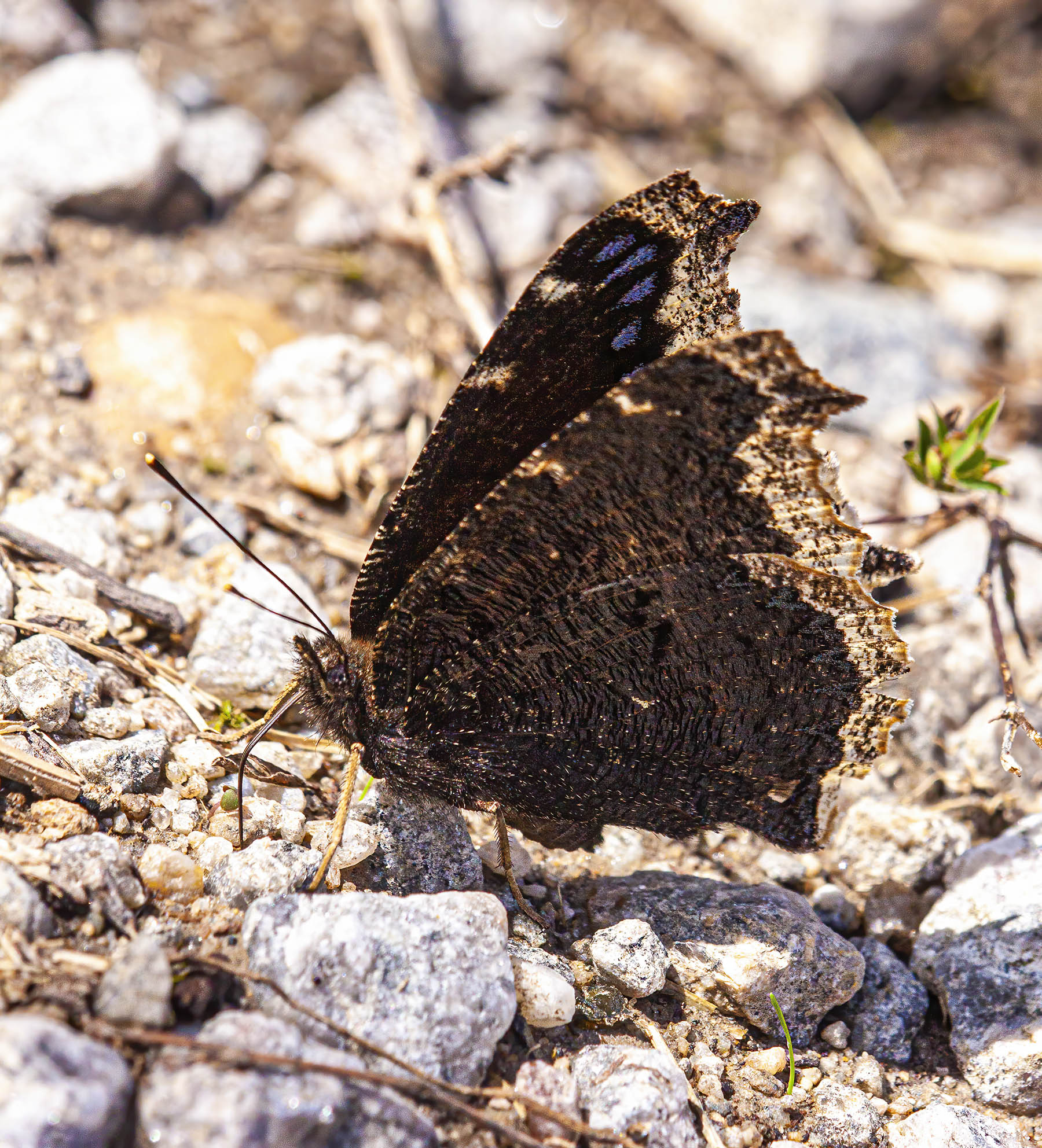
How long do butterflies live? According to most sources, Mourning Cloak butterflies (Nymphalis antiopa), which can live for 10-11 months, are thought to be the longest living butterflies in their range. I am always thrilled to see these darkly colored butterflies, which are known as “Camberwell beauties” in Great Britain, in the early spring and in the autumn.

Where are they the rest of the time? Mourning Cloaks spend part of the summer in aestivation, a hibernation-like state of inactivity to avoid the heat and lack of water. They are active in the fall, eating voraciously to fatten up and then overwinter as adults in another state of dormancy, often on the underside of fallen trees. In the spring, they reawaken to eat, mate, and die. In the north, there is often only a single brood annually, but in the south there may be two or more.

I spotted this butterfly on the first of October at Occoquan Bay National Wildlife Refuge. It looked to me like the butterfly was getting nutrients from the soil or possibly from animal droppings—unlike some butterflies, Mourning Cloaks do not rely on nectar from flowers as a primary source of nutrition.

Mourning Cloak

Mourning Cloak

© Michael Q. Powell. All rights reserved.


Read Full Post »

A bee and a flower—it’s such a simple, yet beautiful composition. I photographed this Eastern Carpenter Bee (Xylocopa virginica) on a globe thistle flower this past Tuesday in the garden of my neighbor and dear friend Cindy Dyer.

Some folks might suffer a little cognitive dissonance when they look at the flower in the photo and hear the name “globe” thistle. I thought about renaming it “hemisphere thistle” for the purposes of the picture.  🙂

Beauty is everywhere.globe thistle

© Michael Q. Powell. All rights reserved.

Read Full Post »

How flexible are you? I used to run marathons and, like most runners, I am not very flexible. I marvel at ordinary people who can bend down and touch the floor while keeping their knees straight and am utterly fascinated when I watch gymnasts and acrobats. Several years ago I attended a Cirque de Soleil performance and was mesmerized the entire time.

I don’t think of grasshoppers and katydids as being particularly flexible—their outer shell seems rigid and armor-like. Imagine my surprise and delight when I stumbled upon this flexible female Handsome Meadow Katydid (Orchelimum pulchellum) last week at Occoquan Bay National Wildlife Refuge. Normally her ovipositor, the yellow scimitar shaped appendage at the end of her abdomen, faces to the back. In this case, though, she has arched her back so much that the tip of the ovipositor extends further forward than her head.

What is she doing? I think that she is somewhere in the process of depositing eggs. I do not know exactly how that works, but a University of Arkansas website described the ovipositing for a similar katydid with these words, “An ovipositing female embraces a plant stem with her prothoracic and mesothoracic legs and brings the curved and sword-like ovipositor far forward so its tip can scrape the substrate.” There are a lot of unfamiliar scientific words there, but I think I get the gist of what is going on.

I do not recall photographing this process before, but a search of my blog revealed that, in fact, I captured a series of images in a September 2013 posting entitled “Rainbow katydid depositing eggs?“. Be sure to check out that earlier posing for more fascinating photos of a flexible katydid.

Handsome Meadow Katydid

© Michael Q. Powell. All rights reserved.

Read Full Post »

The weather has turned cooler, but traces of summer still remain, like this tiny Summer Azure butterfly (Celastrina neglecta) that I spotted last Wednesday at Occoquan Bay National Wildlife Refuge. The Azure butterflies are among the smallest butterflies in our area, with a wing span of just over one inch (25 mm). My current approach is to shoot any insect that I can find—it won’t be long before they are all gone and I will change to a longer lens and focus primarily on birds.

Summer Azure

© Michael Q. Powell. All rights reserved.

Read Full Post »

This year has been full of question marks as our lives have been turned upside down by the pandemic and so many of those questions have gone unanswered. Somehow, then, it seemed appropriate that I spotted this Question Mark butterfly (Polygonia interrogationis) on Tuesday when I was exploring Occoquan Bay National Wildlife Refuge.

At this time of the year, when the leaves are turning brown and falling to the ground, this butterfly blends in well with its surroundings. This butterfly, however, did not seem interested in blending in and chose instead a rocky surface to help highlight the irregular shape of its wings. Normally Question Marks are more opaque in their brown coloration, but the sun was illuminating the wings from behind and gave us a hint of the beautiful orange interior and distinctive markings of this butterfly—I love it when internal beauty shines through.

Question Mark butterfly

© Michael Q. Powell. All rights reserved.

Read Full Post »

Nature sometimes saves the best for last. Many dragonflies that have kept me company through the long, hot days of summer have started to disappear. The appearance in autumn of the spectacularly colored male Blue-faced Meadowhawk dragonfly (Sympetrum ambiguum) compensates in part for this sense of loss.

I spotted this handsome dragonfly on Wednesday as I was exploring Occoquan Bay National Wildlife Refuge. I hope to be seeing this species for another month or so and also its “cousin,” the Autumn Meadowhawk, which has a similarly colored body but has brown eyes. 

Blue-faced Meadowhawk

© Michael Q. Powell. All rights reserved.

Read Full Post »

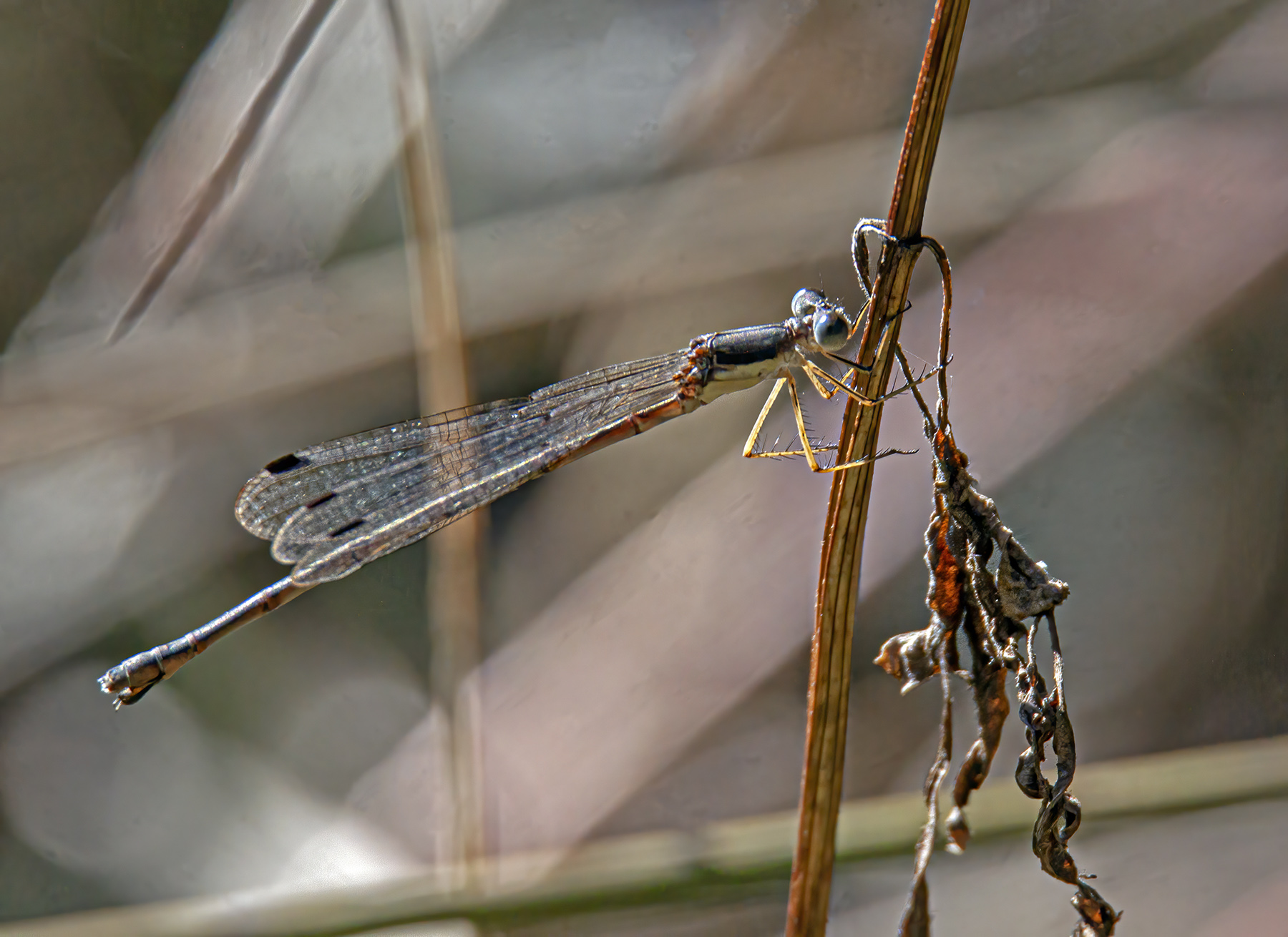
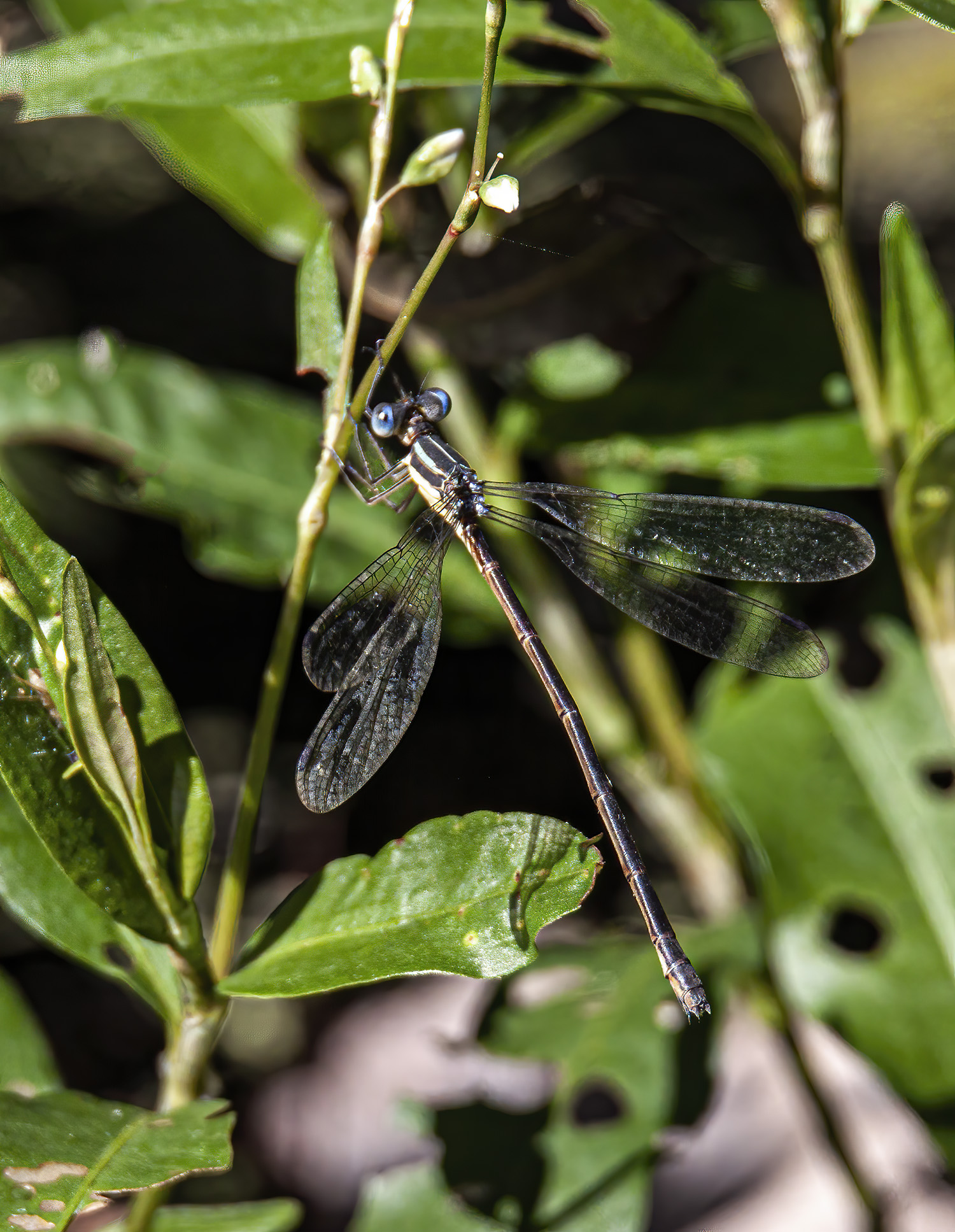
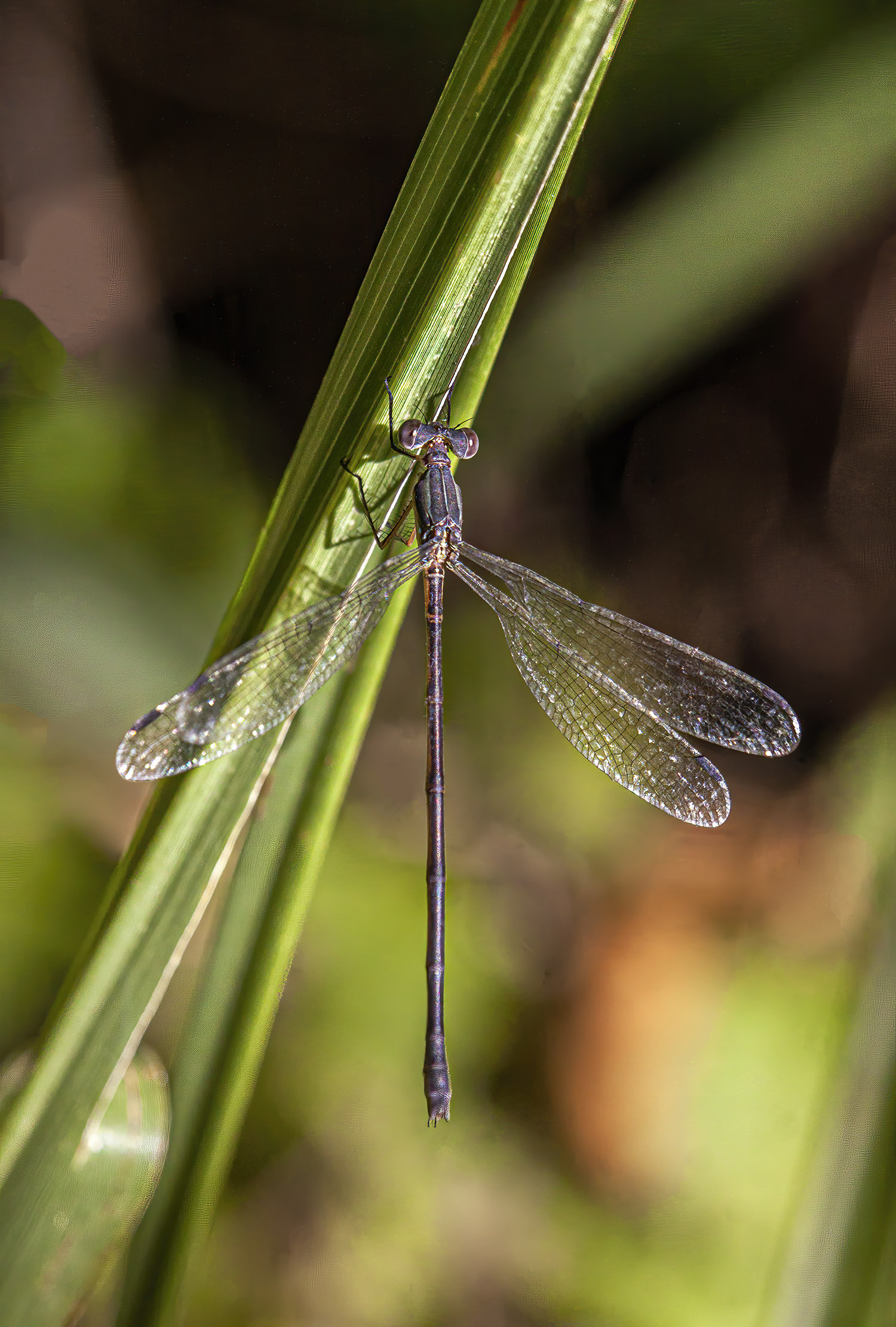
Most damselflies fold their wings above their bodies when they are perched. There is, however, a small group of fairly large damselflies, known as spreadwings, that hold their wings partially open when perching.

I do not see spreadwing damselflies very often, so I was excited to spot this one on Monday at Occoquan Bay National Wildlife Refuge. I managed to capture shots from a couple of angles before it flew away, but did not get a shot that showed the thorax markings, which can help a lot with identification. I can tell for sure that the damselfly is female, but it is difficult to determine with certainty its species.

I posted the photos in a Facebook dragonfly forum and even the experts were not certain—females tend to lack the distinctive markings of the males and generally are harder to identify. They narrowed it down to a few possibilities and if I had to guess, I’d say this is a female Slender Spreadwing damselfly (Lestes rectangularis).

Slender Spreadwing

Slender Spreadwing

© Michael Q. Powell. All rights reserved.


Read Full Post »

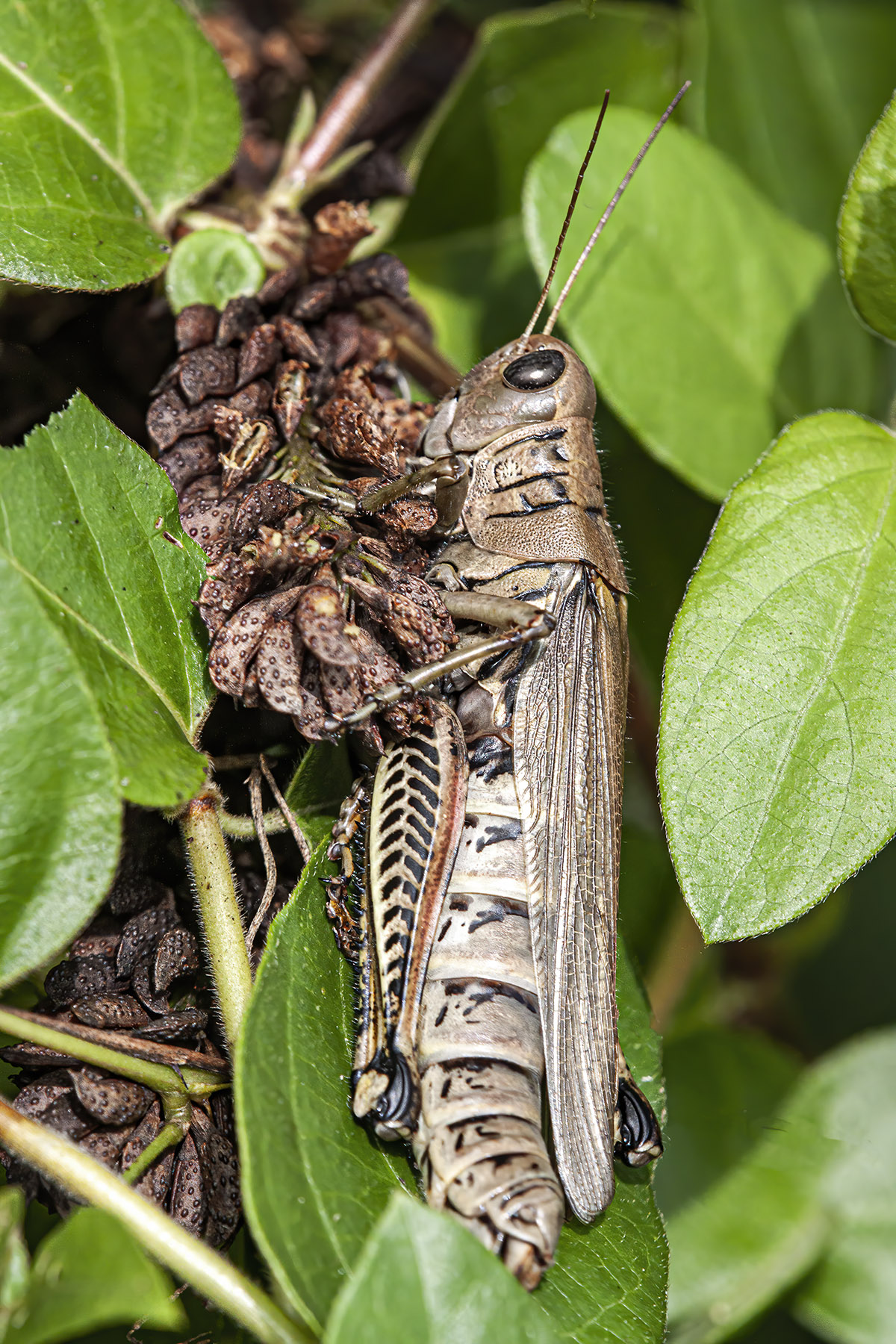
When I first spotted this large grasshopper last week at Occoquan Bay National Wildlife Refuge it was so still that I was not sure that it was alive. I gently rustled the vegetation and the grasshopper moved a little, so I knew that it was not dead. As I watched, I could see its mouth moving and I think that it might have been eating, which might explain why it was distracted and did not immediately fly away. The first photo was an unsuccessful attempt to determine what the grasshopper was eating.

I am not very good at grasshopper identification, but my friend Walter Sanford, with whom I was hunting for dragonflies, knew that it was a Differential Grasshopper (Melanoplus differentialis). The prominent chevrons on the hind femur are apparently one of the identification features for this species.

differential grasshopper

differential grasshopper

© Michael Q. Powell. All rights reserved.

Read Full Post »

Roses are red and bluets are blue, except when the bluets are damselflies, when they might be a different color. Last week while photowalking at Occoquan Bay National Wildlife Refuge, fellow dragonfly enthusiast Walter Sanford pointed out this Orange Bluet damselfly (Enallagma signatum) that was perched in a tree just above eye level. As he pulled back a branch that was blocking my view, I was able to get this unobstructed shot of the beautiful little damselfly.

You might think that the bright coloration of this damselfly would make it easy to spot, but Orange Bluers are small, less than an inch and a half (38 mm) in length, and elusive. I am lucky if I manage to spot a couple of them during an entire season, so I was thankful for Walter’s sharp eyes.

This Orange Bluet, I think, would make a good mascot for the autumn season, when oranges and browns begin to dominate the natural and manmade landscape and the stores are filled with decorations for Halloween and Thanksgiving. I suspect that some stores are already starting to decorate for Christmas, but I am not ready to give up on the waning moments of summer—for some of us, tomorrow is the autumnal equinox, the first day of fall.

Orange Bluet

© Michael Q. Powell. All rights reserved.


Read Full Post »

Sometimes I can get an indication of the species of a dragonfly by the way that it perches. Most skimmer dragonflies, the family of dragonflies that you are most likely to see, perch horizontally, sometimes on the ground or on vegetation. Other species perch vertically, hanging from vegetation. Finally, there are some dragonflies that never seem to perch and spend most of their time patrolling in the air—when they do take a break from flying, they often perch high in the tree canopy, where they are extremely hard to spot.

Stylurus is a genus of dragonflies whose members are commonly known as “Hanging Clubtails,” because of their habit of hanging nearly vertically when they perch. This past Tuesday I was thrilled to spot a male Russet-tipped Clubtail dragonfly (Stylurus plagiatus), one of the “Hanging Clubtails,” during a visit to Occoquan National Wildlife Refuge with fellow dragonfly enthusiast Walter Sanford.

During this summer I have been blessed to spot Russet-tipped Clubtails several times at two separate wildlife refuges. As the dragonfly season starts to draw down, it is special to find some of my favorites again, never knowing if it will be the final sighting of that species for the year.

The image below was my second sighting of a Russet-tipped Clubtail in the same general area. A short time earlier I had spotted another male Russet-tipped Clubtail in the trees, but it flew away before I could get any good shots of it. This may well be the same dragonfly, albeit in a different perch.

If you look closely at the image below you can see how the dragonfly is clinging to the leaf and hanging almost vertically. You can also note the prominent “club” that makes it easy to identify as a clubtail dragonfly and the terminal appendages (the shape at the end of the abdomen) show that this is a male. As you can imagine, dragonflies that perch this way are hard to spot—if they don’t move, it is easy to miss them.

Our weather has turned cooler now as we move deeper into autumn (or will begin it soon, depending on which calendar you use for the seasons). It is premature to start a countdown for the dragonfly season, but already I am noting diminishing numbers of certain species. Will I see another Russet-tipped Clubtail this season? If I am lucky, perhaps there will be another. For now I will simply say au revoir—one of the French ways of saying good-bye , with a literal meaning  of “until we meet again.”

Russet-tipped Clubtail

© Michael Q. Powell. All rights reserved.

Read Full Post »
What’s my favorite insect? If I were to do a survey of readers of this blog, I am confident that most would say that my favorite insect would have to be one of the many dragonflies that I regularly feature here. I do love dragonflies and spend endless amounts of time during the warm months photographing them, but if I had to choose one favorite insect, it would not be one of them—it would be the Handsome Meadow Katydid (Orchelimum pulchellum).

I remember my sense of amazement the first time that I spotted one of these multi-colored beauties. I literally could not believe my eyes and it was love at first sight. To this day, I never fail to be mesmerized by the neon colors and the blue eyes of the Handsome Meadow Katydid. Love is love—when we are smitten, words somehow are inadequate to explain our feelings.

I spotted this beautiful female Handsome Meadow Katydid on Tuesday while photowalking at Occoquan Bay National Wildlife Refuge with fellow dragonfly enthusiast Walter Sanford. You can tell that this one is a female because of the yellow scimitar-shaped appendage at the tip of the abdomen that is an ovipositor used to deposit eggs on plants.

I really like the the ways that the colors of the katydid are repeated in the background and the repeated pattern of the vegetation leads the eye and somehow manages to be unobtrusive. All in all, it seems to be the perfect backdrop for the appropriately-named Handsome Meadow Katydid, my favorite insect.

Handsome Meadow Katydid

© Michael Q. Powell. All rights reserved.

Read Full Post »
Over the years I have developed the habit of checking milkweed plants carefully whenever I spot them. Milkweed plants host an extensive cast of colorful characters including ladybugs, milkweed beetles, and Monarch butterfly caterpillars (Danaus plexippus). Though I have been keeping an eye out for them for the last couple of months, I was unsuccessful in spotting a Monarch caterpillar until this past Sunday when I finally spotted one at Occoquan Bay National Wildlife Refuge.

This Monarch appears to be in one of its final phases of development as a caterpillar, when fattening up seems to be a priority before forming a chrysalis. It is not surprising, therefore, that most of the edges of the leaves in this photo have been gnawed on by the caterpillar. This caterpillar seems to be a little late calendar-wise in its path to becoming a butterfly, but I did spot several Monarchs yesterday, so it seems that the Monarch migration has not yet taken place, or at least not in its entirety.


Monarch caterpillar

© Michael Q. Powell. All rights reserved.


Read Full Post »
I spotted this pretty little sulphur butterfly last week at Occoquan Bay National Wildlife Refuge. Several sulphur species in our area are similar, but I think this one is a Cloudless Sulphur (Phoebis sennae). I was hoping that the butterfly would perch in a more photogenic spot, but it kept landing on a gravel road and appeared to be taking in salts or other minerals from the soil.

Cloudless Sulphur

© Michael Q. Powell. All rights reserved.

Read Full Post »

Dragonflies are fierce predators that eat a wide variety of insects. However, predators can easily become prey, as was the case with this male Common Whitetail dragonfly (Plathemis lydia) that encountered a Black and Yellow Garden Orbweaver Spider (Argiope aurantia). When I spotted this pair last Friday at Jackson Miles Abbott Wetland Refuge, the spider had already immobilized the dragonfly and may have been injecting it with venom at that moment.

dragonfly and spider

© Michael Q. Powell. All rights reserved.

Read Full Post »

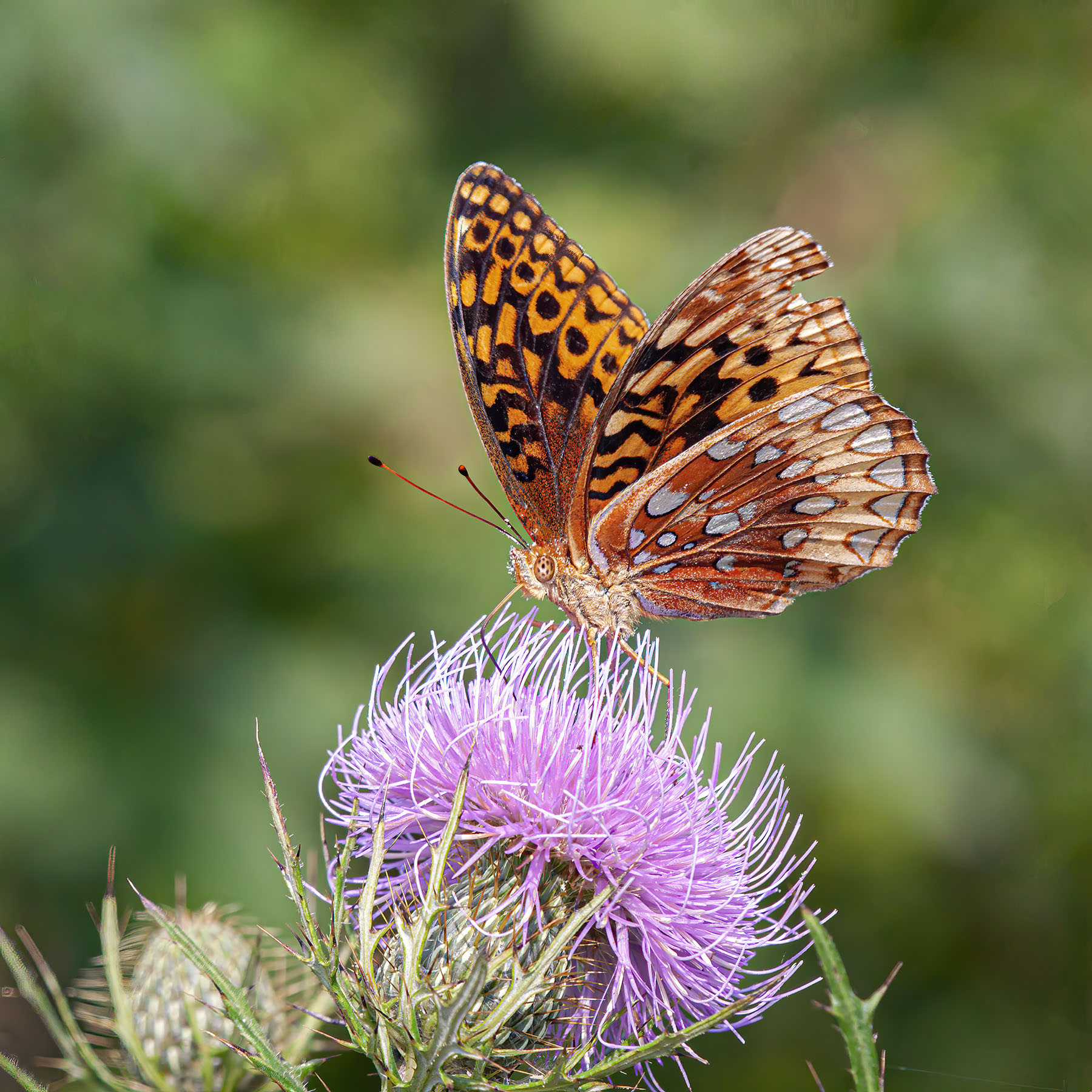
I was absolutely thrilled when I spotted this Great Spangled Fritillary butterfly (Speyeria cybele) on Tuesday at Occoquan Bay National Wildlife Refuge, because it was the first one that I managed to photograph this year. Great Spangled Fritillaries are generally quite common where I live, but somehow I missed them, probably because my photography forays have been sharply limited by the corona virus restrictions.

The butterfly was gathering nectar from a flowering thistle, whose specific species I cannot identify. I initially thought that the orange of the butterfly and the pink of the flower would not work together, but the more that I look at the image, the more I like the color combination. What do you think?

Great Spangled Fritillary

© Michael Q. Powell. All rights reserved.


Read Full Post »

I am pretty old, but I was not born in 1669. However, a Dutch painter, Maria van Oosterwijck, was fascinated by dragonflies and butterflies, as I am, and included them in a floral painting called Flower Still Life that she completed in 1669. Molly Lin Dutina, one of my faithful subscribers, thought of me when she saw the painting in a museum recently and wrote this delightful blog posting. Be sure to check out her blog Treasures in Plain Sight for more of her postings that are thoughtful, inspirational, and always a joy to read.

Molly Lin Dutina's avatarTreasures in Plain Sight, A Christian Blog

He seems to follow me everywhere! His interest in dragonflies, butterflies, flowers and nature in general keep me intrigued with his blog. Until he gets to the snakes. Then I tune him out. Yuck. https://michaelqpowell.com/2020/09/04/dragonfly-and-duckweed/

Because of him I am exponentially aware of dragonflies, though I cannot identify hardly any of them. As my oldest friends are aware I love butterflies, but Mike researches his and posts details about them. I merely admire. Well, except for the monarchs and especially their caterpillars. My husband and I garden milkweed especially for those!

Recently Bob and I made a trip to the Cincinnati Art Museum, wearing our masks and social distancing in the almost deserted museum. One exhibit was called “Women Breaking Boundaries” and this painting was done by Maria van Oosterwijck in 1669 entitled Flower Still Life. I was admiring the flowers: nasturtium, peony, tulip, lily of the valley, carnation or…

View original post 246 more words

Read Full Post »

My eyes were attracted to the pinkish-colored asters when I spotted them last Friday at Jackson Miles Abbott Wetland Refuge and I moved closer to investigate them more closely. I was delighted to see several green metallic sweat bees (g. Agapostemon) busily gathering pollen. I have always loved the coloration of these sweat bees that are so much smaller than the bumblebees and carpenter bees that I am more used to seeing.

The sweat bees were in almost constant motion and I got a little dizzy as I tried to track their circular movement around the center of the little flowers. I was happy that I was able to get a few shots in which the speckled eyes of the bees are visible—you may want to double-click on the images to enlarge them and see this cool little detail.

Asters generally appear in my area in late summer and early fall, another sign that the seasons are starting to change. I am not ready to let go of summer, though I must confess that I enjoy the somewhat cooler weather that we have been experiencing, especially during the nighttime hours.

sweat bee

sweat bee

© Michael Q. Powell. All rights reserved.


Read Full Post »

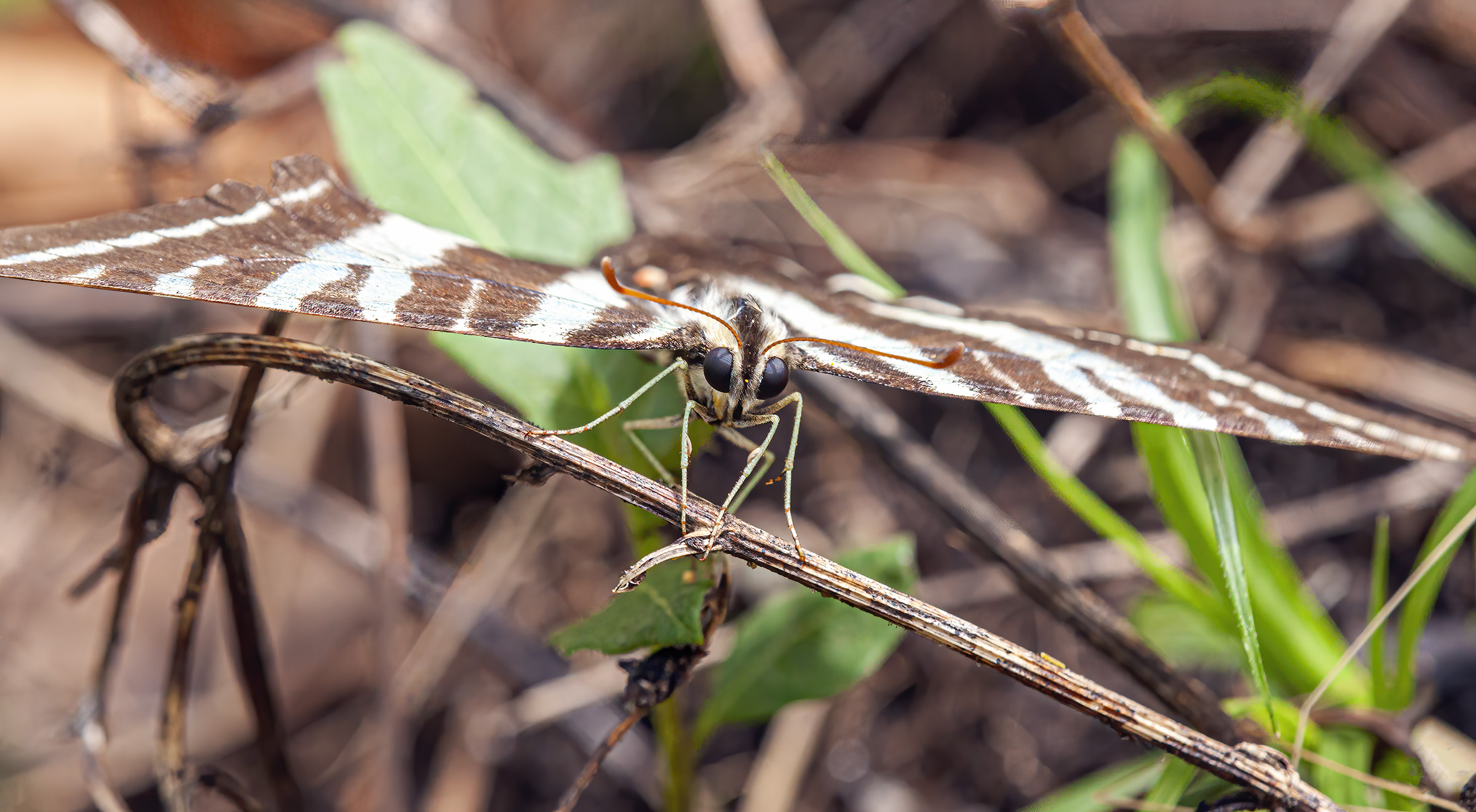
Zebra Swallowtail butterflies (Protographium marcellus) are usually in constant motion, so I was excited on Wednesday at Occoquan Bay National Wildlife Refuge when the one that I was chasing landed. My initial shot was the second one below that shows the pattern on this butterfly that is responsible for its name. I was then able to circle around and capture an eye-to-eye shot, one of my favorite shooting angles for insects, and it was a bonus that the butterfly had its wings fully extended.

If you look closely at the second shot, you will see that this butterfly is a survivor. Both of the “swallowtails” and the lower portion of one of the wings appear to be missing. As I have noted in recent postings, butterflies somehow manage to fly and do most of their normal activities despite significant wing damage. If you are interested in viewing an image of an intact Zebra Swallowtail, check out this 2017 posting that was entitled “Zebra Swallowtail.”

Zebra Swallowtail

Zebra Swallowtail

© Michael Q. Powell. All rights reserved.


Read Full Post »
This has been a crazy year in so many different ways, including for dragonfly hunting. I post images almost every day, so I may provide the mistaken impression that I am out shooting every day. In fact, I have been staying at home a lot more and have been generally limiting my photography forays to a couple of times a week, supplemented by periodic trips to my neighbor’s garden to photograph flowers.

As a result, I have not seen some of “the usual suspects,” i.e. the dragonflies that I am used to seeing every year. I was quite excited when I spotted this female Painted Skimmer dragonfly (Libellula semifasciata) during a visit to Occoquan Bay National Wildlife Refuge, because I had not seen this species this season. You may have noticed that I really like dragonflies with patterned wings—I think that those patterns at an extra dimension to their beauty.

Dragonflies tend to be distracted when they are eating, which sometimes lets me get a little closer for a photograph. You can’t help but notice that this Painted Skimmer is feeding on some kind of insect with a bright red body. It looks a little like some kind of wasp or similar insect, though I really am not sure what it is.

I had no idea that “The Usual Suspects” was the name of a 1995 movie starring Stephen Baldwin and Kevin Spacey, so folks of a younger generation may associate those words with that movie. For me, however, “the usual suspects” will forever be a reference to a line in Casablanca, my absolutely favorite movie. If you are unfamiliar with the movie and would like to see the full line “round up the usual suspects” in its original context or simply want to relive that movie moment, check out this short clip from YouTube.

Painted Skimmer

© Michael Q. Powell. All rights reserved.


Read Full Post »

Is today the first day of a new season? It depends. If you use the meteorological calendar, today is the first day of autumn (or spring if you live in the Southern Hemisphere). If you use the astronomical calendar, however, you have to wait until the equinox on 22 September for summer (or winter) to end.

No matter how you calculate the seasons, we are already starting to see signs of transition. The weather is marginally cooler and some vegetation is dying off. It won’t be long before the leaves on the trees begin to change colors or, as is often the case, simply fall from the trees.

Many of the dragonflies and butterflies that I see are showing signs of wear and tear, with scratches on their bodies and tattered wings. While exploring Occoquan Bay National Wildlife Refuge last week, I spotted several butterflies with somewhat unusual damage to their wings. The wings of the Eastern Tiger Swallowtail (Papilio glaucus) in the first photo seem to be in almost pristine condition, except for the fact that one of the tails and a portion of the wing is gone. What could have caused that kind of damage?

The Common Wood Nymph (Cercyonis pegala) in the second image had similar damage, but it appears that the damage affected both of its wings. I can’t help but notice the straight lines and almost right angles of the edges of the missing wing sections of both of these butterflies. Could a bird have caused that damage? It is a bit of a mystery to me and I would welcome any insights that you might have about the cause of the injuries to these butterflies, which nonetheless seemed flying capable of flying.

Happy change of seasons—fall or spring, as applicable—if you live a place that uses the meteorological calendar.

Eastern Tiger Swallowtail

Common Wood-Nymph

© Michael Q. Powell. All rights reserved.


Read Full Post »

I do not recall seeing a single Russet-tipped Clubtail dragonfly (Stylurus plagiatus) last year, but I am more than making up for it this year. I have already done postings this month of female and male Russet-tipped Clubtails that I spotted during trips to Jackson Miles Abbott Wetland Refuge and was pleased to spot some more last week at a different location.

The first time that I see a species each year, I am extremely happy to capture any shot at all. If I am fortunate enough to have additional sightings, I will work to get a better shot, even though I know that I risk scaring the subject away. I traveled to Occoquan Bay National Wildlife Refuge twice last week and was delighted to spot a male Russet-tipped Clubtail each time.

My subjects last week chose very different perches—one flew up into a tree and one was in some vegetation lower to the ground—so I used different approaches for each one. When the dragonfly in the first photo initially landed in the tree, I was facing into the light and the details of the dragonfly were lost in the shadows. I was able to circle around so that the sun was to my back and managed to find a shooting angle that allowed me to avoid other branches and have the blue sky as the background.

My second subject was hanging vertically and was facing away from me. My initial shots captured the beautiful details of the wings, but the background was so close that I could not blur it out and it was somewhat cluttered in the images. I moved to the side and was able to compose the second shot below that eliminated the problem with the background. Yes, I sacrificed some wing detail, but in return I got a pose that is much more pleasing. We now have a better view of the eyes and the dragonfly has some personality—he almost looks like he is talking to me.

In photography, as in many other areas, it is the results that count. I could have simply shown you the photos and left it at that. However, I thought some of you might enjoy a brief peek inside of my head, a sense of my mental process as I was shooting. Quite often I opportunistically shoot whatever presents itself to me, but in situations like this I made some conscious decisions to improve my situation. In both cases I was able to get some better shots, which is why you see some more Russet-tipped Clubtails today.

Russet-tipped Clubtail

Russet-tipped Clubtail

© Michael Q. Powell. All rights reserved.

Read Full Post »

I spotted this Black Swallowtail butterfly (Papilio polyxenes) last Thursday at Occoquan Bay National Wildlife Refuge. In our area black-colored swallowtails also include dark morph Eastern Tiger Swallowtails, Spicebush Swallowtails, and Pipevine Swallowtails, so identification can be a bit tricky.

I can tell, however, that this butterfly is a Black Swallowtail because it is the only one of the dark swallowtails with a black dot inside of an orange dot on the edge of the wings near the body, a characteristic that you can see in the photo below. Unlike most of the butterflies that I have photographed, this one is not actively feeding, so its proboscis is curled up, rather being extended. If you double-click on the image, you can get a closer look at the curled-up proboscis and other wonderful details of this beautiful Black Swallowtail butterfly.

Black Swallowtail

© Michael Q. Powell. All rights reserved.

Read Full Post »

Do you have a favorite dragonfly? Almost everyone who reads my blog knows that I love dragonflies. Like parents with children, I am probably supposed to love them all equally, but I actually do have a favorite dragonfly, the Blue-faced Meadowhawk (Sympetrum ambiguum). On Thursday, I was thrilled to spot my first Blue-faced Meadowhawk  of the season at Occoquan Bay National Wildlife Refuge which turned out to be a female.

Why are these my favorites? The males of this species are spectacular, with bright red bodies and stunning turquoise eye and I also find the females to be quite attractive. At a time when the dragonfly season feels like it is starting to wind down, these little dragonflies appear on the scene and keep me company for several more months—that is at least as important to me as their physical appearance.

If you want to know a bit more about why I like dragonflies so much and especially Blue-faced Meadowhawks, check out my posting entitled “My favorite dragonfly?” Almost every year I am flooded with similar feelings when I see my first Blue-faced Meadowhawk and the linked post shows a handsome male that was the first one that I spotted in 2018—it is also an easy way for you to compare today’s female with that male to see some of the differences between the two genders.

Blue-faced Meadowhawks are also special to me for a personal reason—I was awarded second place in a local photo contest several years ago for a macro shot of a Blue-faced Meadowhawk. Here is a link to the 2015 posting Second place in a local photo competition that shows that prize-winning entry and tells some of the back story of the image.

I captured the two images below from more or less the same spot—it is interesting to see how much difference a slight change in the angle of view can make. I like the overall pose and the background of the first image, which I believe was shot from a crouched position. The second image, which looks like it was shot from a higher angle, is a little sharper and you can see some of the details much better, like the spines on the legs. Overall, I think I prefer the first one. What do you think?

Blue-faced Meadowhawk


Blue-faced Meadowhawk

© Michael Q. Powell. All rights reserved.

Read Full Post »

Almost all of the male Calico Pennant dragonflies (Celithemis elisa) that I have seen this season have been immature. How can I tell? When male Calico Pennants are young their abdomens are bright yellow, like those of the females. As they mature their abdomens turn a beautiful shade of red, like the male Calico Pennant in the image below that I captured on Monday at Occoquan Bay National Wildlife Refuge.

You might think that it would be easy to spot a dragonfly with such gaudy colors, but Calico Pennants are small and elusive. I usually manage to find them in the waist high vegetation in a field at the edge of a small pond at the refuge.

If you would like to compare the coloration of this male Calico Pennant with that of an immature male, check out the my posting from a couple of weeks ago entitled “Immature Calico Pennant dragonfly.”

Calico Pennant

© Michael Q. Powell. All rights reserved.


Read Full Post »
I will always try to get a photograph whenever I see a Monarch Butterfly, as I noted in a recent post, so I immediately set out after this orange and black butterfly when I spotted it on Monday at Occoquan Bay National Wildlife Refuge. When the butterfly landed and I got a closer look, I discovered that it was a Viceroy butterfly (Limenitis archippus), a species considered to be a mimic of the Monarch. The two species share similar color schemes, but the Viceroy is smaller and has a black line across its hind wings that in not present on Monarch wings.

I had learned long ago that Viceroys used a type of defensive behavior, known as Batesian mimicry, in which a palatable species, the Viceroy, closely resembles unpalatable or toxic species, like the Monarch, to avoid predation. However, some research suggests that the Viceroy is also unpalatable, which would make the Viceroys and Monarchs co-mimics of each other, a phenomenon known as Müllerian mimicry, in which two or more noxious species develop similar appearances as a shared protective device.

In the abstract of his article entitled “Comparative unpalatability of mimetic viceroy butterflies (Limenitis archippus) from four south-eastern United States populations” David Ritland stated, “Viceroy butterflies (Limenitis archippus), long considered palatable mimics of distasteful danaine butterflies, have been shown in studies involving laboratory-reared specimens to be moderately unpalatable to avian predators. This implies that some viceroys are Müllerian co-mimics, rather than defenseless Batesian mimics, of danaines.” (Monarch butterflies (Danaus plexippus) are part of the Daniadae sub-family (“danaine”) that Ritland mentioned.) Ritland tested his hypothesis with wild-caught butterflies and red-winged blackbirds and the results supported his hypothesis that Viceroys are unpalatable.

I have no idea what scientists have concluded about the mimicry question regarding the Viceroy butterfly, but it is fascinating to see the interrelatedness of different species that share this planet. We are all in this together.


Viceroy

© Michael Q. Powell. All rights reserved.

Read Full Post »

Have you ever tried to wrap a present that is large and awkwardly shaped? I have childhood memories of helping my parents wrap tricycles and wagons for my younger siblings on Christmas Eve. No matter how much wrapping paper I used, it was pretty obvious what was underneath the wrapping.

I have watched Black and Yellow Garden Spiders (Argiope aurantia) capture prey multiple times. After the initial capture, the spider wraps up its prey in a special kind of silk that looks like a long gauze bandage. (Check out my 2014 posting called “Wrapping up a meal” for a more detailed explanation and some close-up shots of the wrapping process.)

When I spotted this Black and Yellow Garden Spider on Monday at Occoquan Bay National Wildlife Refuge, I could see from a distance that the spider had captured something that was as large as it was, but I could not determine what it was. Once I got closer, I could see that the spider had awkwardly wrapped up what appeared to be a large cicada—it was impossible to hide the shape of the cicada’s large wings.

At some point in this process the spider injects venom into the prey, killing it and liquefying its internal organs for consumption. I cannot tell for sure if that is what the spider was doing at the moment I captured this image, but the position of the spider’s body suggests that possibility.

Spider and cicada

© Michael Q. Powell. All rights reserved.

Read Full Post »

Over the years I have gradually learned which plants tend to attract butterflies and Buttonbushes (Cephalanthus occidentalis) are one of my favorites.  The plant’s spiky spherical flowers are quite distinctive and make a nice compositional element in a photo. I used to mentally associate these flowers with medieval weapons, but nowadays when people see one, they can’t help but think of the well-publicized structure of the Covid-19 virus.

Last week I spotted this Silver-spotted Skipper (Epargyreus clarus) nectaring on a buttonbush flower at Jackson Miles Abbott Wetland Refuge. I was hoping that one of the Monarchs that were fluttering by would also stop to sip at one of these photogenic flowers, but the Monarchs seemed to prefer the taste of the swamp milkweed flowers.

Silver-spotted Skipper

© Michael Q. Powell. All rights reserved.

Read Full Post »
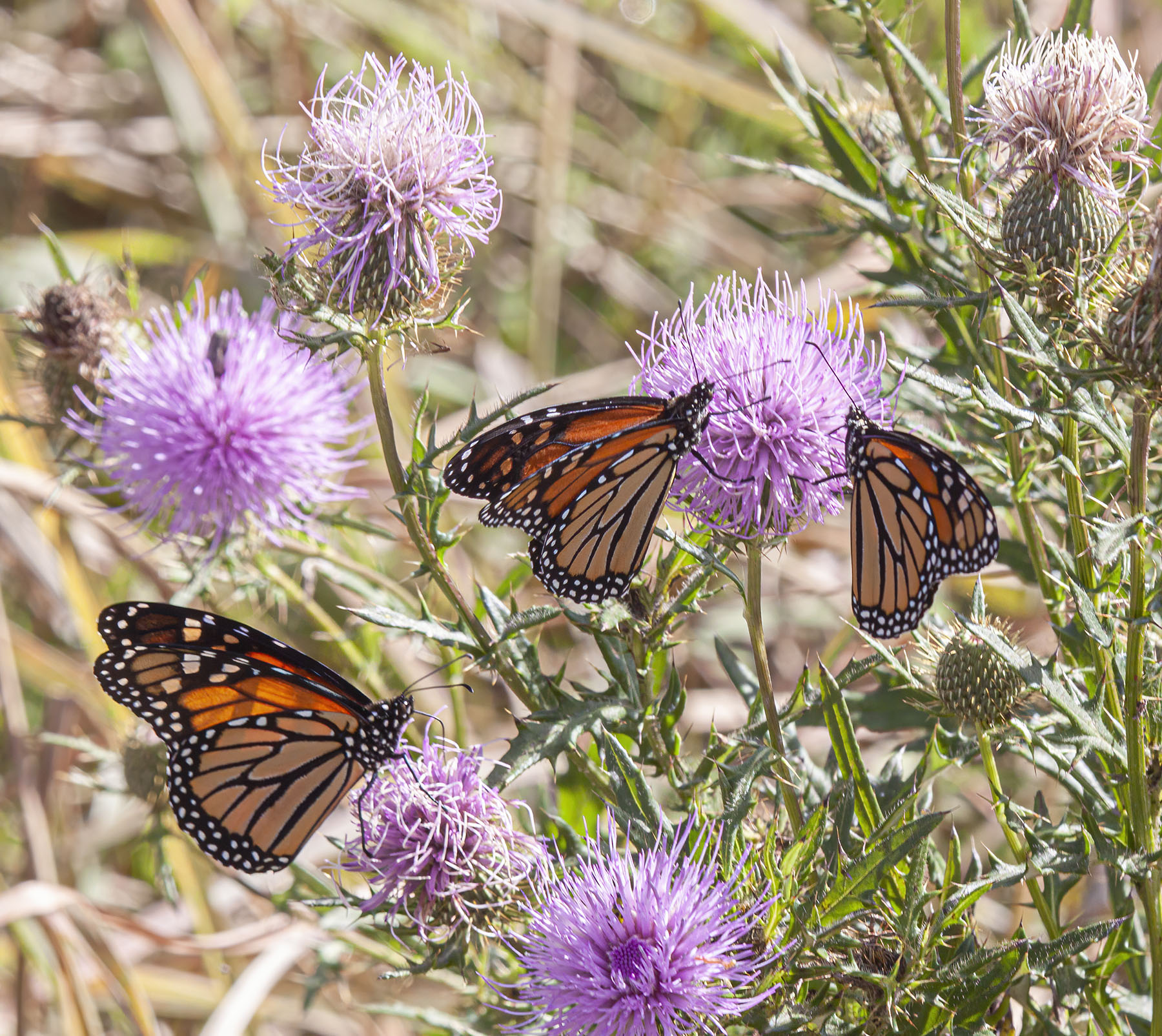
There are some subjects that I will try to photograph every single time that I see them. Bald Eagles are high on that list, as are Monarch Butterflies (Danaus plexippus), like this beauty that I spotted last Monday at Jackson Miles Abbott Wetland Refuge. Both of these subjects have “stopping power” for me.

Seven years ago I read a blog posting entitled “Stopping power” by fellow wildlife photographer Lyle Krahn that introduced me to this concept. In Lyle’s own words, “I think every beautiful scene has stopping power. That’s my term for the ability of a scene to make a person stop hiking or driving in order to pull out a camera and make images. Did you ever wonder what makes you stop? Do you ever hear the music?” That idea really took root in me and I still think about it quite often and vividly recall that initial posting.

What is your threshold for putting your camera to you eye and taking photos? Would you stop to photograph a squirrel or a Canada Goose or a mallard duck? Does a subject have to be new or exotic for you to stop? Are you so focused on a single subject that the rest of the world is invisible to you or simply doesn’t matter? Lyle described an encounter with a bear watcher in Grand Tetons National who said that he would not stop to photograph a moose. Yikes! It is hard to imagine not stopping to photograph a moose.

Most of you know that my personal threshold is really low—I will stop to take photos of almost anything that catches my eye. Every now and then I will end a posting with the words “beauty is everywhere” and I truly believe that. Of course, there is an opportunity cost for spending time on one subject and you might miss out on another potential subject. I am ok with that and rarely fall prey to the sense of anxiety that is popularly called FOMO (fear of missing out).

Even if you are not someone who takes pleasure in taking photos, I encourage you to stop more often during the day, to pause to feel the wind or listen to a bird or smell the flowers. I believe that in doing so you can lower the threshold for “stopping power” and experience our wonderful world more deeply.

Monarch Butterfly

© Michael Q. Powell. All rights reserved.


Read Full Post »

Blue Dashers are one of our most common dragonflies where I live and it is easy to pass them by and take them for granted. When I stop and look closely at them, however, I am reminded of their beauty. I spotted this striking male Blue Dasher dragonfly (Pachydiplax longipennis) on Tuesday at Jackson Miles Abbott Wetland Refuge.

There is a lot of detail in this image—like the little amber patch on the wings and a tiny orange simple eye (ocellus) in the middle of the “face” adjacent to the larger compound eyes—and I recommend that you double-click on the image to get a closer view. (If you want to learn more about dragonfly eyes, check out this fascinating article entitled “Dragonflies: eyes and a face” at benkolstad.net.)

Beauty is everywhere.

Blue Dasher

© Michael Q. Powell. All rights reserved.


Read Full Post »

I love the distinctive coloration of Orange Bluet damselflies (Enallagma signatum), whose name always causes me to smile at the apparent oxymoron. I spotted this couple in tandem earlier in August at Jackson Miles Abbott Wetland Refuge. Many damselflies remain in this position after they have completed mating, with the male at the top attached to the female as she deposits her eggs.

As the name “bluet” suggests, most of the 35 members of the genus American Bluet (Enallagma), the largest damselfly genus in North America, are blue. However, certain species come in other colors including red, orange, and green and the Rainbow Bluet combines red, yellow, and green.


Orange Bluet

© Michael Q. Powell. All rights reserved.

Read Full Post »

« Newer Posts - Older Posts »