Feeds:
Posts
Comments

Archive for the ‘Humor’ Category

This duck tale has a happy ending, as two Hooded Merganser duck couples paddle gently down the stream, but a potential crisis had been averted only moments before.

It began like this. Five Mallard ducks (Anas platyrhynchos), three males and two females, were swimming upstream. Two of the males were in the lead, while the other male seemed to be carrying on a conversation with one of the females. Their course had them in the partial shade, not far from one of the banks.

At the same time, four Hooded Merganser ducks (Lophodytes cucullatus), two males and two females, were headed downstream in perfect formation on a collision course with the Mallard ducks.

What would happen when the groups met? Would there be a confrontation? Would they exchange information about the attractions of the places they had just passed through? Who has the right-of-way in situations like this?

The signals were a bit ambiguous at the first encounter, as one of the male Mallards tried to have a conversation with one of the male Hooded Mergansers, who had turned away. All eyes were turned on the two representatives. Would they be able to negotiate an agreement? If a fight broke out, it was clear that the Mallards had an advantage in both size and numbers.

Who know what was said, but it appears that an agreement was reached and a possible confrontation was avoided. The ducks peacefully passed each other and continued on their separate ways.

The first photo showed the Hooded Merganser ducks after the encounter with the Mallards, so sequentially it should go here. Did you notice that the duck formation had changed and that the males were now in the lead? Was this a protective, chivalrous gesture on their part?

Of course, I may have completely misread this situation. Perhaps the male duck ego is less fragile than the human one and the two male ducks were simply asking each other for directions when they met in the middle of the stream.

© Michael Q. Powell. All rights reserved.

Read Full Post »

I was attempting to get a photo of a bird in the cattails, when suddenly I noticed that a deer had entered into the frame. Deer are pretty common and I have even seen them in my suburban neighborhood, but I have rarely seen them at a moment when I had my camera in my hand, so I was excited.

The lighting was a little uneven and harsh and it was difficult to get a completely unobstructed shot, but the deer cooperated and paused a few times, allowing me take a few relatively clear shots. I grew up in the suburbs of Massachusetts and even though my deer identification skills are not strong, I am pretty confident that this is a buck, probably a white-tailed deer (Odocoileus virginianus).

I am not a politician, but I am glad to affirm with great conviction,  “The buck stops here.”

© Michael Q. Powell. All rights reserved.

Read Full Post »

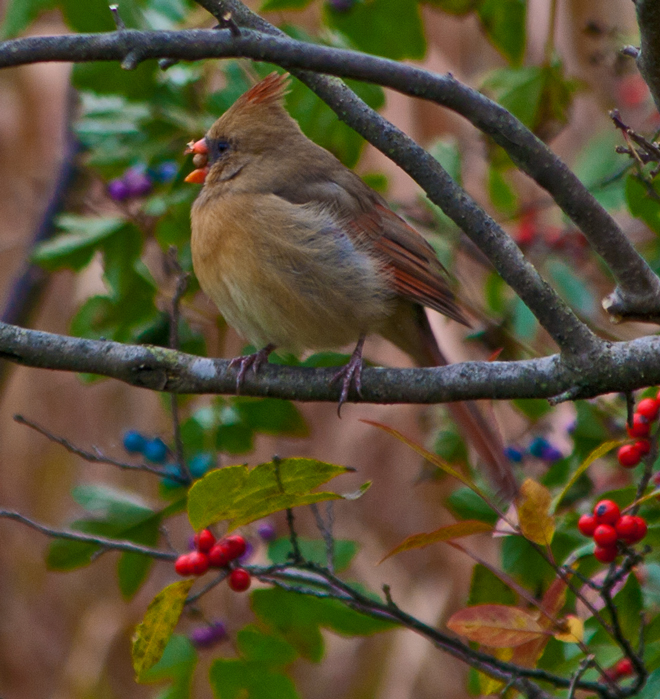
Some people claim that the camera adds ten pounds, and that seems to be the case with this female Northern Cardinal. Maybe it’s just the angle or she had fluffed up her feathers for better insulation, but it sure looks to me like she has been fattening herself up for the winter. In fact, you probably noticed that I caught her in mid-bite. I’m not sure what she is eating, but there are lots of colorful berries in the background from which to choose.

Some people claim that they eat like a bird—I hope they don’t mean they eat like this particular bird.

Cardinal in mid-bite

© Michael Q. Powell. All rights reserved.

Read Full Post »

Did you ever wonder what happens if an aircraft’s radar and radio go bad? Yesterday I saw what happens when the emergency network is activated and escorts are sent out to accompany the aircraft to its final destination. In a cost-cutting measure, fighter jets are no longer dispatched, but these geese do have significant experience in long-distance flying and especially flying in formation.

Emergency escorts

© Michael Q. Powell. All rights reserved.
Read Full Post »

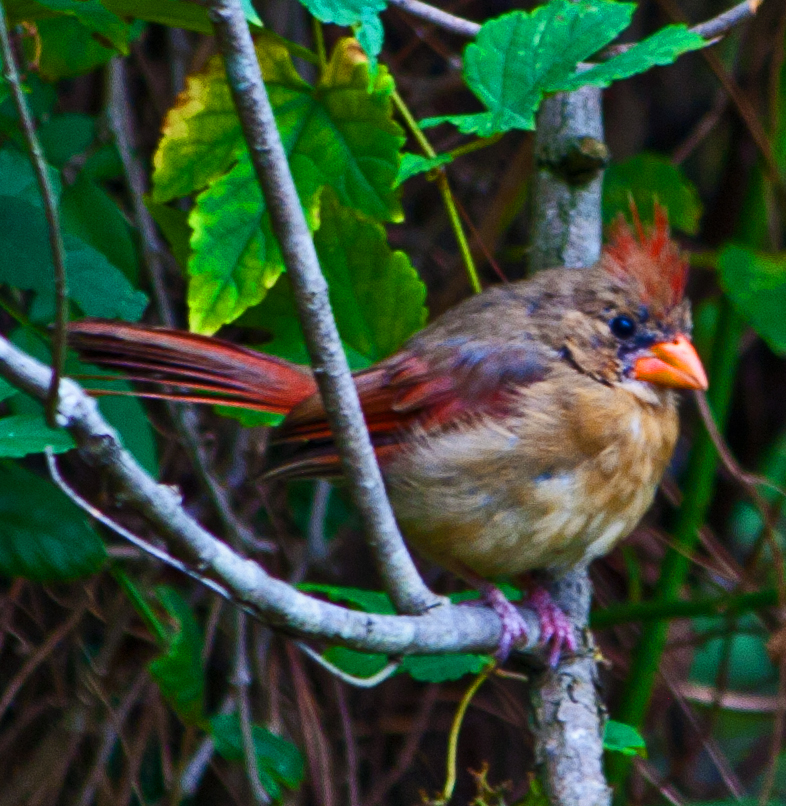
It looks like this female Northern Cardinal decided to get dressed up as a punk rocker for Halloween. She has put some gel in her bright red Mohawk and adopted an attitude. Her really bright eyes and vacant stare suggest that she might be under the influence of some natural or artificial stimulant. I was not able to get close enough to see if she has any tattoos or piercings, but it wouldn’t surprise me.

Happy Halloween!

Punk rocker Cardinal

© Michael Q. Powell. All rights reserved.

Read Full Post »

It seems appropriate to post a photo of a spider on the evening before Halloween. I was not able to get a look at the spider’s front side when I photographed it this past weekend at Huntley Meadows Park, so I can’t identify it. I know for sure, though, that I never want to wake up in the morning and have this view of a spider. With my near-sighted vision, that would mean that it was way too close to me for my comfort. Happy Halloween!

UPDATE: Thanks to the assistance of my mentor and fellow blogger, Cindy Dyer, I am now pretty sure that the spider is the orb-weaver spider Neoscona Crucifera, sometimes known as Hentz’s orb-weaver or a barn spider (though there are other spiders known as barn spiders too).

Pre-Halloween spider enjoys a snack

© Michael Q. Powell. All rights reserved.
Read Full Post »

This morning, we continue to assess the damage from Hurricane Sandy here in the Washington, D.C. area, mainly downed trees and flooded roads. Perhaps we can draw inspiration from these geese, who are engaging in a rarely seen version of t’ai chi, seeking to achieve balance. This ancient martial art can be practiced on land or in the water—the water variant is especially appropriate for a time of reflection.

T’ai chi goose

Water t’ai chi—a reflective pose

© Michael Q. Powell. All rights reserved.

Read Full Post »

This past weekend I came across a caterpillar that I had never seen before.  Its black, yellow, and white markings somehow made me think of the Pittsburgh Steelers NFL team that wears those same colors. For now, I am referring to it as the Steelers caterpillar, though, of course, it has a “real” name.

I’m having trouble identifying it—it may be a Smartweed caterpillar, also known as a Smeared Dagger caterpillar (who makes up these names?), although it seems to be lacking the red coloration in the hairs that I see in most photos. If anyone can make a positive identification, please let me know. Who knows, maybe the Steelers need a fuzzy new mascot?

Pittsburgh Steelers caterpillar

© Michael Q. Powell. All rights reserved.

Read Full Post »

It looked like it was bath time for the Canada Geese (Branta canadensis) in a local pond and they seemed to be having fun playing in the water (and occasionally stopping to groom themselves). The geese were exuberantly beating the water with their wings, creating giant clouds of water droplets. It reminded me of trying to give a bath to a two year old child, who splashes almost as much—the only thing missing was the yellow rubber duck. Some of the geese would then rise up in the water a bit and flap their wings, presumably to dry them, and then get soaked all over again. Perhaps they were following the instructions on the shampoo bottle, “Lather, rinse, and repeat.”

I managed to get a couple of fun shots in which the goose’s head is in focus, but the wings are a blur—I think the effect is kind of cool.

Splish, splash, I was taking a bath

Ruffling some feathers

© Michael Q. Powell. All rights reserved.

Read Full Post »

While I was watching migrating geese at a local marsh yesterday, one of them suddenly stretched out its wings. There was another goose right behind the one with outstretched wings and I wanted to warn him by crying out, “Duck, goose!” Instead I instinctively pressed the shutter release and got this photo. The image makes me laugh when I look at the face of the crouching goose, who does not appear to be too happy with his fellow traveler.

© Michael Q. Powell. All rights reserved.

Read Full Post »

I often see turtles lined up on branches in the water, basking in the sun. Usually they are arranged as neatly as cars in a parking lot, though occasionally I see them in haphazard patterns or so close to each other that they are touching (I see that in parking lots too, actually). Nonetheless, I really like the configuration of the turtles in this photo, who all appear to be red-eared slider turtles (Trachemys scripta elegans). I find the different positions of the heads and bodies to be interesting and the facial expressions particularly fascinating.

My favorite element, though, is the little turtle near the bottom of the photo, who is mostly in the shade, but has managed to extend his neck to catch a bit of the sun. Do you prefer a different turtle?

Turtles in the sun

© Michael Q. Powell. All rights reserved.

Read Full Post »

Does Halloween have an official insect mascot? Maybe we need an election, since it seems to be season for campaigning.

When I first saw this photo of a Cattail caterpillar (Simyra insularis) that I took a week ago, I was struck by the fact that its black and orange colors seemed perfectly appropriate for Halloween. (In a previous posting about this species, it was the pattern of the caterpillar that was its most notable feature.)

Does anyone else have a viable candidate? If so, post your photos and let’s make this a race!

Vote for me to be the official insect mascot for Halloween

© Michael Q. Powell. All rights reserved.

Read Full Post »

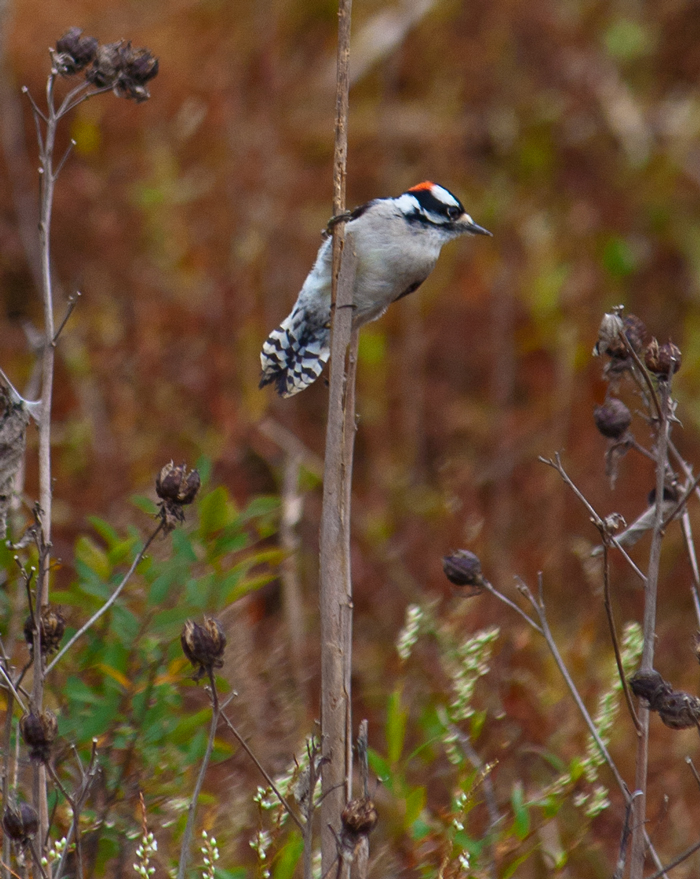
This weekend I learned some new things about woodpeckers. I always thought that woodpeckers were found exclusively in the trees. Isn’t it logical that woodpeckers need wood to peck? (It reminds me of the response attributed to Willie Sutton on why he robbed banks—”Because that’s where the money is.”) Well, I saw a woodpecker pecking at the stalks of cattails and other similar vegetation that clearly were not made of solid wood.

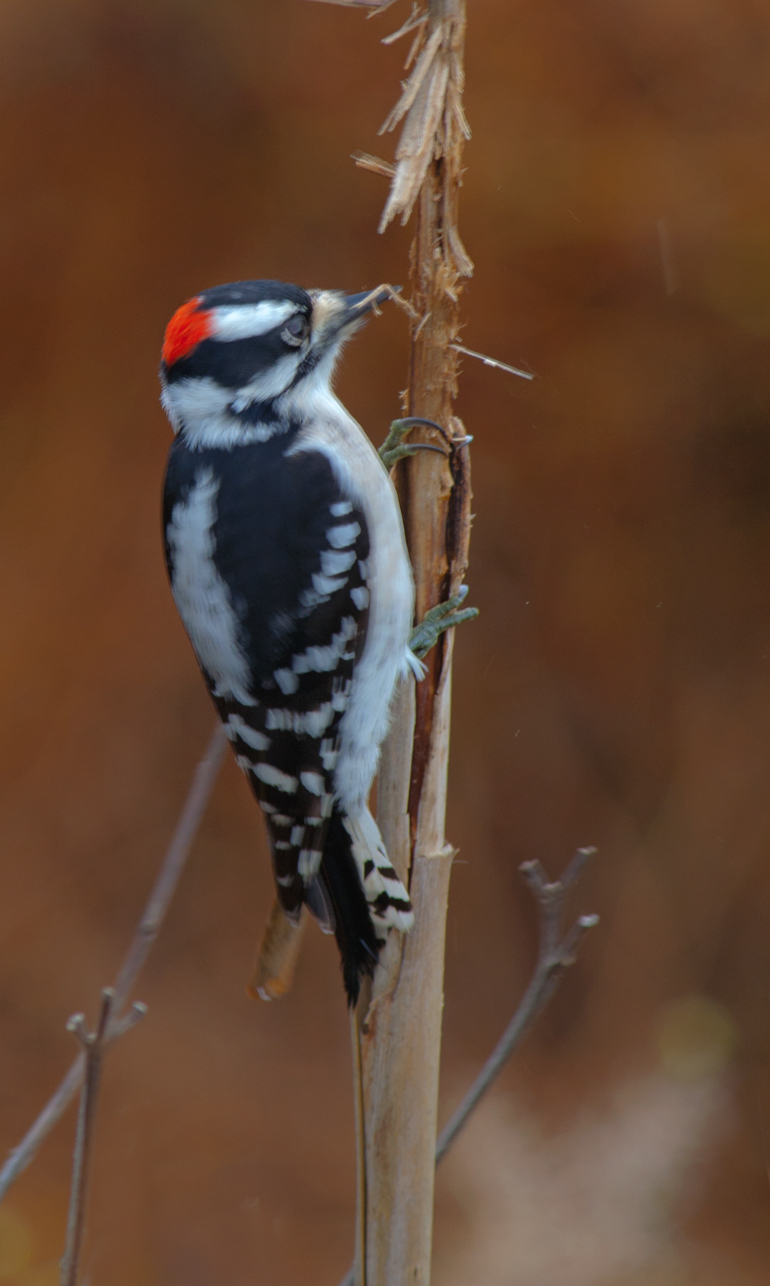
Secondly I learned that the woodpecker that had a big red spot on the back of his head was not a Red-Headed Woodpecker. Fortunately, it was not too hard to determine that the little woodpecker that I saw and photographed was a male Downy Woodpecker (Picoides pubescens). He was very active climbing up and down the stalks of a whole series of plants in the middle of a marsh and was a lot of fun to watch.

Here are a couple of photos of that beautiful bird. I am not sure that I did full justice to the blazing red color on his head that initially attracted my attention or to the wonderful black and white pattern of his feathers. I hope that I have another chance soon to see more woodpeckers and learn even more new things about them.

Male Downy Woodpecker in the field

Downy Woodpecker looks to the side

© Michael Q. Powell. All rights reserved.

Read Full Post »

I have a confession to make—I really like to photograph little green frogs. Maybe it’s the influence of Kermit the Frog on my perceptions, but, whatever the reason, there seems to be something whimsical about frogs. Like this little frog that I photographed yesterday, they appear to have a perpetual half-smile, as though they find this world to be unceasingly amusing.

It brings to mind one of my favorite movies scenes, the opening sequence of The Muppet Movie, in which the camera gradually zooms in on Kermit, sitting on a log in the swamp and playing the banjo. The words of the song he is singing express the kind of eternal optimism to which I aspire, “Someday we’ll find it, the Rainbow Connection, the lovers, the dreamers and me.” (Here’s a link to the video of that scene on YouTube—I highly recommend that you take a couple of moments to relax with it, especially if you’ve never seen it before.) With all of the cares of everyday life, it’s hard to be a dreamer, it’s tough to see hope in rainbows, it’s not easy to see whimsey in frogs. It’s my hope, though, that we all can maintain (or rediscover) that child-like optimism about our world.

Fall frog

© Michael Q. Powell. All rights reserved.

Read Full Post »

As I was walking through the marsh land early this morning, a flock of very loud black birds flew overhead. I was surprised at how many there were and how noisy they were. I think they may be some kind of blackbird and that they are in the process of migrating. I managed to snap a few photos of some of the birds as they were flying. It is fun to look at all of the different body positions of the individual birds when I took the shots.

I especially like this first photo. It looks to me like the bird who is lagging behind is calling out to the other birds, requesting that they slow the pace a bit so that he does not fall behind. The birds look almost cartoonish and the photo just makes me smile.

“Please slow down.”

The second photo shows an even greater number of different positions. You may want to click on the photo for a higher resolution view so that you can appreciate the uniqueness of the individual birds.

Unsynchronized flying

© Michael Q. Powell. All rights reserved.

Read Full Post »

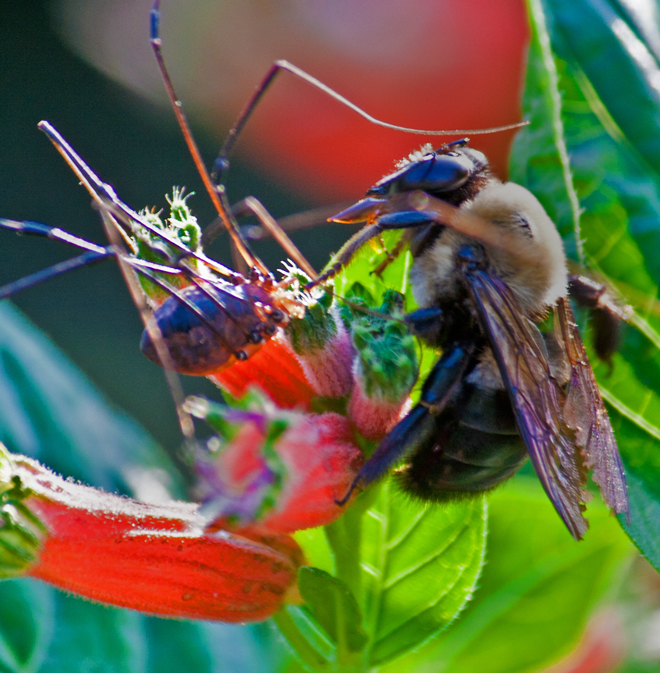
I am always fascinated whenever I happen to capture two different insects in a single image, especially when they appear to be interacting. A bee flew onto a flowering plant and appears to be having a conversation with a daddy longlegs (aka harvestman) that was already there. Does one of them look at the other as a potential prey? Are they sharing information? Is one asking the other out on a date?

Can you hear me now?

Insect interaction

© Michael Q. Powell. All rights reserved.
Read Full Post »

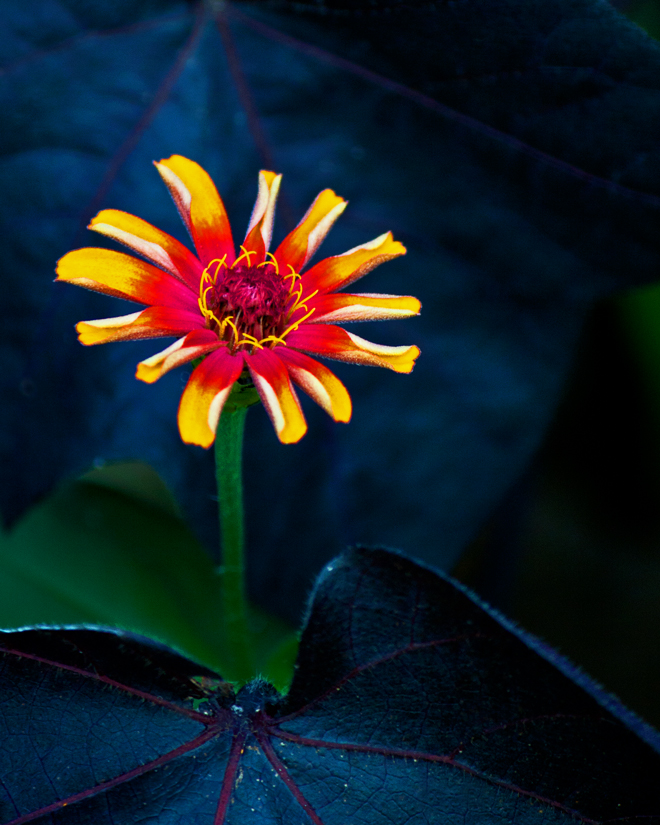
Some words are just fun to say out loud. How can you not smile when you repeat the words “Zowie Zinnia?”

I think that is the correct name for this colorful little flower, which helps to brighten up the gloomy weather that has descended on us the last few days. Zowies usually have much more showy displays, but I like the way that the colors and shape of this young plant are set off against the backdrop of the dark green leaves.

“Zowie!”—it sounds like something Robin would say to Batman (and of course it would need to be punctuated with an exclamation point).

Zowie Zinnia

© Michael Q. Powell. All rights reserved.
Read Full Post »

I was observing three cheetahs at the National Zoo for quite some time when one of them decided to enter the dug out area of their habitat where two cheetahs were already lying down. Just before he entered it, he turned in my direction and stuck out his tongue. I have no idea what he might have been trying to communicate to me. Perhaps he was no longer interested in my antics and was trying to tell me so or maybe it was his way of saying goodnight. Whatever his intention, it makes for an interesting photo.

Cheetah sticking out his tongue

© Michael Q. Powell. All rights reserved.
Read Full Post »

This shot has some great elements—a Great White Egret and a Great Blue Heron,  practicing together in the trees for their audition for “Dancing With the Stars.” They look to be almost perfectly synchronized, though the heron may need to work on his neck position. From a technical perspective, alas, the shot is far from great, but it was interesting enough that I decided to share it.

I frequently see egrets roosting in the trees along Cameron Run, a stream in Alexandria, Virginia that feeds into the Potomac River, but this is the first time that I had seen a blue heron fly into the trees. I was shooting from a running path that parallels one side of the stream.  Shooting across a considerable amount of growth as well as the stream itself, I find it difficult to get a close-up shot. In this photo, I had startled the heron and he took off into the trees, startling the egret, who was already perched there.

Dancing in the trees

I continue to have difficulties getting good shost of the egret, because there is often glare and it is hard to keep the highlights from blowing out. Here is a shot of an egret in partial shade that has some detail, but I can’t seem to keep the detail without imparting a grayish tinge to what is a really white bird. I will definitely keep trying, though, because I find the egrets and herons to be fascinating to watch in their almost geeky gawkiness.

Egret in a tree along Cameron Run

© Michael Q. Powell. All rights reserved.

Read Full Post »

If you ever get invited to dinner by a Monarch caterpillar, you know what will be on the menu—milkweed. Monarch caterpillars consume amazing quantities of milkweed (and nothing else), growing over 2,000 times their original mass during this 14-day phase of their lives, according to Rick Steinau.

Almost everything you read emphasizes that milkweed is toxic to humans (and to animals), but scienceviews.com notes that native peoples all over the United States and southern Canada used milkweed for fiber, food, and medicine. The article warns that milkweed may be toxic “when taken internally without sufficient preparation.” It is especially fascinating to read of the medicinal uses of the plant. It was used to treat backaches and bee stings, to induce postpartum milk flow, and to deal with a variety of stomach problems. The Meskwaki tribe, according to the article cited above, even used milkweed as a contraceptive, that worked by producing temporary sterility.

Milkweed, however, contains cardiac glycosides that are poisonous to humans and livestock, but also may account for its medicinal effect.  Symptoms of poisoning by the cardiac glycosides include dullness, weakness, bloating, inability to stand or walk, high body temperature, rapid and weak pulse, difficulty breathing, dilated pupils, spasms, and coma. (It sounds a lot like being in love!)

I don’t care how well Monarch caterpillars can prepare milkweed, if they invite me over for dinner, I think I’ll probably refrain from eating and just watch them eat (as I did this past weekend). I love Monarch butterflies in all their forms. Nevertheless, I would take my cue from the artist Meat Loaf, who sang, “I would do anything for love, but I won’t do that.”

Monarch caterpillar feeding on milkweed

© Michael Q. Powell. All rights reserved.

Read Full Post »

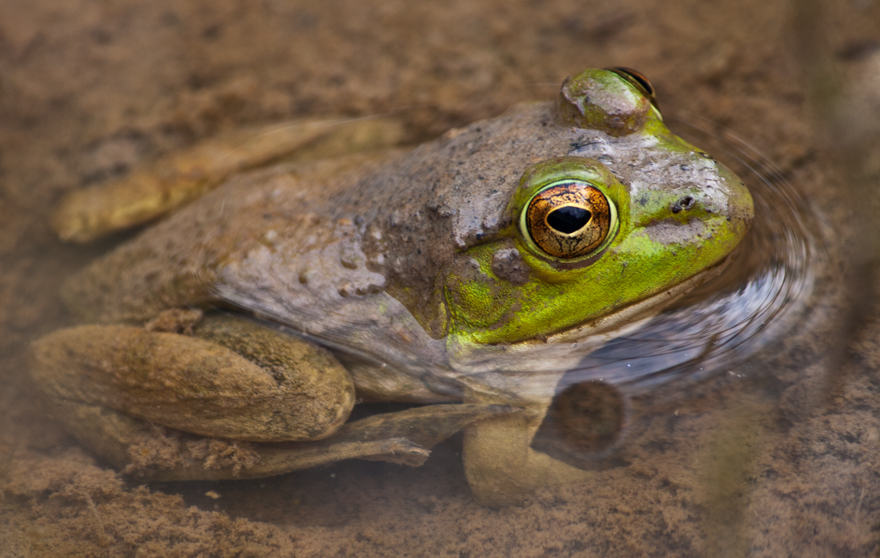
This morning I captured this photo of a bullfrog. I was able—with gyrations that would have been hilarious to a spectator—to get almost low enough to look him eye-to-eye. I was happy also to get a reflection of the frog with a considerable amount of detail. As I was reviewing the images on my computer, I noticed the bubbles under his chin (do frogs have chins?), a delightful detail that adds a sense of whimsy to the frog. Blowing bubbles is something that I always associate with being a child, and I remember how much fun it was to blow bubbles in my drink with a straw or to blow soap bubbles with one of those little wands.

Perhaps this bullfrog was blowing bubbles in the water, remembering too when he was little, presumably in a post-tadpole phase.

Bullfrog with bubble (click for higher resolution)

© Michael Q. Powell. All rights reserved.
Read Full Post »

I know that periodically the statue of mannekin pis in Brussels is dressed in a variety of different outfits throughout the year. However, yesterday he seemed to be wearing an unauthorized additional item—a mustache. 

Mannekin Pis with Mustache
When I took the photos, I didn’t even notice the mustache, but it was very obvious when I reviewed my shots. The is some writing on the mustache that suggests it is a prank done by a design studio. It is a little hard to figure how they pulled it off, though, given that there is a very obvious video camera pointed right at the statue. Over the years the statue has been stolen a number of times, according to Wikipedia, and the one that is on display is a replica. The original is in the Maison du Roi on the Grand-Place.

Close-up of Mannekin Pis with Mustache

© Michael Q. Powell. All rights reserved.
Read Full Post »

Just a few days after posting a photo of a neon-colored grasshopper (who turned out to a Handsome Meadow Katydid), I saw another one. Well, actually I encountered a giant sign for a toy store featuring a cool grasshopper that looked a lot like “my” grasshopper.

How many passers-by realize that there is an actual grasshopper with colors as bright (or even brighter) than the one on the sign?

© Michael Q. Powell. All rights reserved.

Read Full Post »

I was going through my recent dragonfly photos and this one really caught my eye. Somehow the combination of the dragonfly’s position and the long branch with the slight curve together made me think of a pole vaulter just before he clears the bar. It’s a little unusual that I photograph a dragonfly from below with the sky as a backdrop, but that’s what happened that day.

Maybe he’s preparing for the Dragonfly Olympics! What other events do you think they would have? I’m pretty sure they’d have gymnastics, given the frequency with which I see dragonflies do handstands.

Pole-vaulting dragonfly

© Michael Q. Powell. All rights reserved.

Read Full Post »

Who knew that the spots on a ladybug’s shell were water-soluble? That seems to be the case with this ladybug, who has only one remaining spot and a few drops of water, perhaps where other spots used to be.

Spotless ladybug–well almost spotless

© Michael Q. Powell. All rights reserved.

Read Full Post »

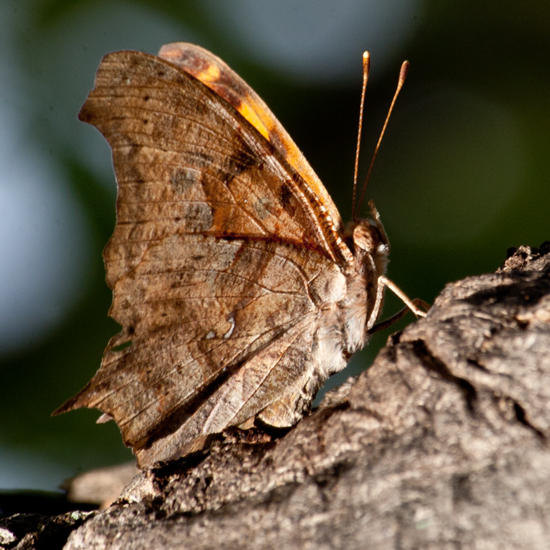
Back and forth I went as I tried to answer a simple question, “Comma or question mark?” You’re probably imagining that I was caught in some kind of punctuation dilemma, but that was not the case. No, I was not stuck in some special hell reserved for grammarians and editors, nor was I sweating out a standardized English test. Instead, I was trying to make a decision on the identity of this unusual looking butterfly that I encountered this past weekend.

Comma or Question Mark?

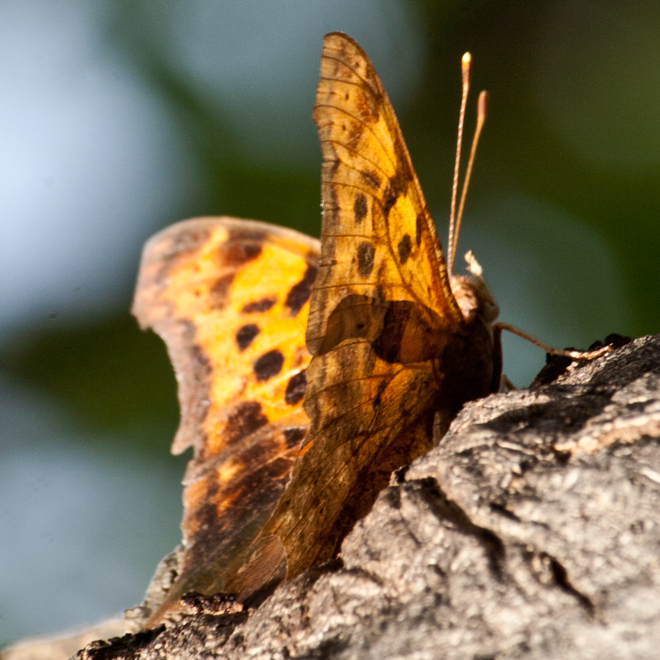
The colors of this butterfly almost perfectly matched the tree on which he was perched, facing downward in a way that almost perfectly camouflaged him. I rotated the image for the ease of viewers, hoping they will avoid the sore neck that I got as I turned my head trying to make out the details of the butterfly. In addition to the unusual color, the shape of this butterfly was pretty distinctive. What kind was he? As I was pondering that question, the butterfly—who had flown away and returned—opened his wings a little and I got a glimpse of the brilliant orange concealed inside his drab exterior.

A glimpse of orange

As he slowly opened his wings, more of more of the inside of his wings was revealed. The light shining through his wings made the colors glow like those of a back-lit stained glass window.

Back-lit wings

The butterfly flew away again, but amazingly returned once more and treated me to a full view of his open wings—his breathtaking beauty was revealed in full.

Beauty revealed

He sure was beautiful, but I wanted to know his name. Previously I had read about a butterfly called the Eastern Comma butterfly (Polygonia comma) and I had a vague recollection that he looked like this one. Wikipedia’s article on the Eastern Comma also helped explain why he was on a tree rather than some beautiful flower, like most of the butterflies that I have encountered. “This butterfly seldom visits flowers, but rather feeds on sap, rotting fruit, salts and minerals from puddling, and dung.”

I was still not sure of his identity, so I continued to search for clues. It turns out that there are two butterflies with similar shapes and colors. One is the Eastern Comma and the other is the Question Mark (Polygonia interrogationis), really. I feel like I am in some kind of Abbott and Costello style routine akin to their famous “Who’s on first?” routine. (Here’s a You Tube link to the classic routine if you are not familiar with it. It is definitely worth watching.)

The key to distinguishing the two is the shape of the little white markings on the wings and whether the markings are in two parts or one. If you think back to punctuation, you can probably guess that the one in two parts is the question mark and the unitary one is the comma. The website Gardens With Wings has an article with side by side photos of the two butterflies in case I have confused you.

So, which one did I photograph? I think I saw at least two different butterflies, but the one in the initial two photos and the one below all seem to have the white marking in two parts, which make them Question Mark butterflies (Polygonia interrogationis).

Question Mark butterfly

To be honest, though, the marking looks more like a semicolon than a question mark. Why isn’t there a Semicolon Butterfly?

© Michael Q. Powell. All rights reserved.

Read Full Post »

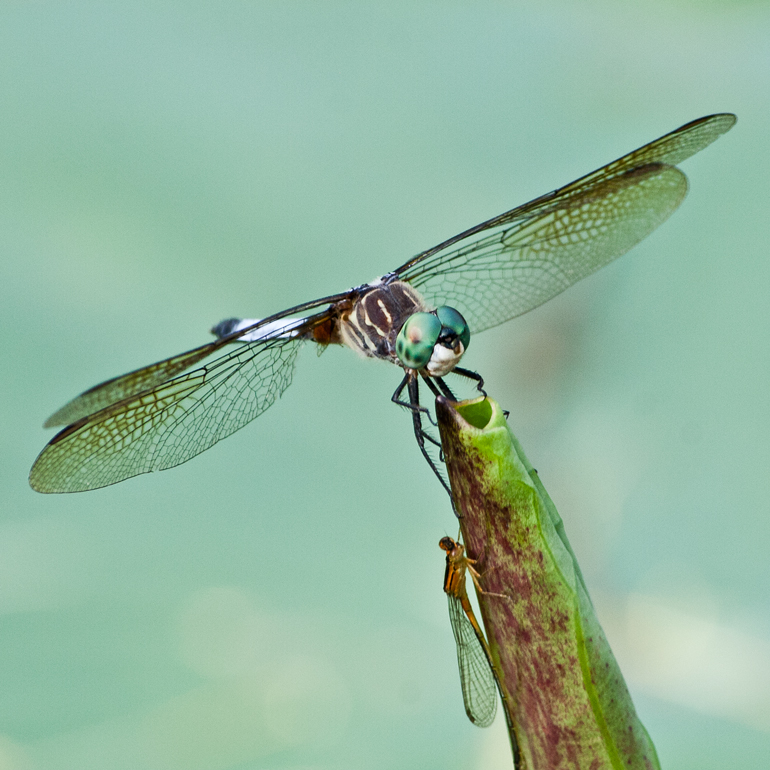
Sometimes when I open my images on my computer I am pleasantly surprised. I was going through my images from yesterday afternoon and came upon this one.

Click on the image for greater resolution and details

I had been focusing on shooting dragonflies that had stopped to pose on various objects. In this case I am certain that I was looking at the Blue Dasher dragonfly (Pachydiplax longipennis) perched on the rolled-up leaf of a lotus plant and never noticed the damselfly in the photo. The damselfly appears to be scaling the leaf, ready to do battle with the dragonfly. The dragonfly seems to be looking down with a little concern, wondering who is trying to challenge his position. When I compare the relative sizes of the two insects, I can’t help but think of the Biblical story of the boy David taking on the giant Goliath. In this case it would essentially be a family feud, since both dragonflies and damselflies are part of the Odonata family.

It’s a lesson to me to check my images carefully when I process them—there may be all kinds of hidden treasures waiting to be discovered.

© Michael Q. Powell. All rights reserved.

Read Full Post »

Every now and then when I am focusing intently on an insect and trying to set up a shot, other insects creep into the frame. Only later, when I am looking at the photos on my computer screen, do I realize that they are there. My friend, Cindy Dyer, likes to call them “bonus bugs.”

This morning as I was looking at some recent wasp photos, I realized that there was a black shield bug in one of them. The shot is not that great technically, but I think that the combination of the two very different insects makes for an interesting photo, particularly because the wasp seems to have noticed the shield bug.

To me the moment is reminiscent of the bar scene in the Star Wars movie in which all kinds of different alien creatures are interacting. Click on the link to a You Tube video if you’ve never seen this classic piece of film history.

This photo really is begging for a clever caption and I’d welcome any suggestions.

© Michael Q. Powell. All rights reserved.

Read Full Post »

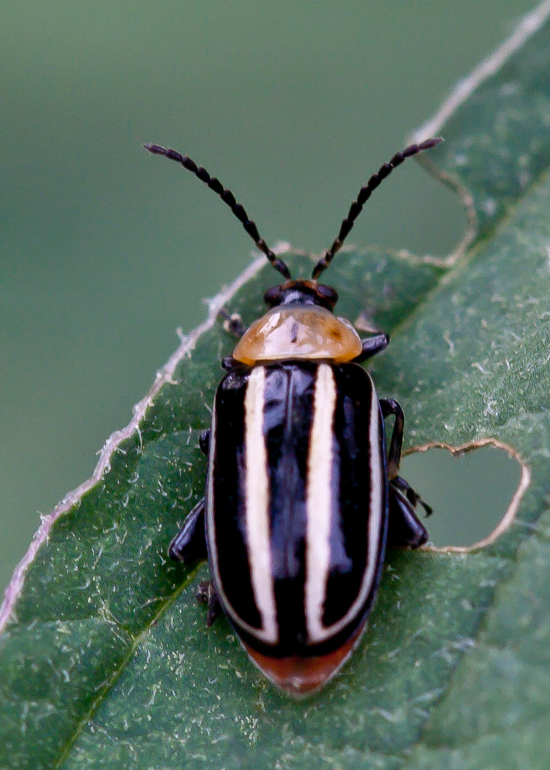
Last month I first encountered the Striped Cucumber Beetle (Acalymma vittata) in a neighbor’s garden. I was immediately taken by his cool, sophisticated, man-about-town look. The black and light yellow stripes down his back make him look like he is dressed formally. The translucent orange high collar, though, adds a splash of color to his ensemble and causes him to really stand out in a crowd. This well-dressed dandy, however, has a deep dark secret. Beneath the surface of this Dr. Jekyll lurks a Mr. Hyde.

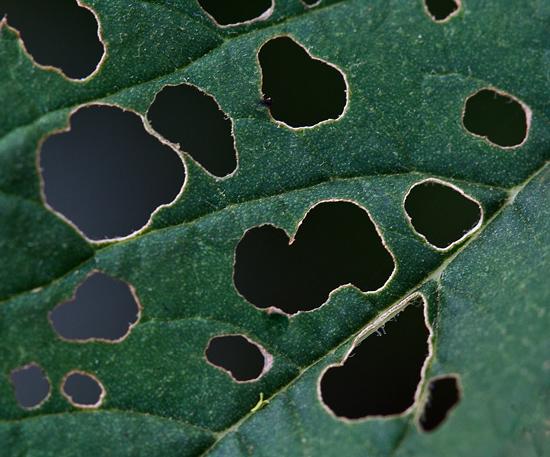
I ran into him today in my friend’s garden. Previously, the garden had been green and flowering. Now the garden looked like a war zone, with signs of devastation everywhere. The leaves of the plants had all been ravaged and looked like the image below.

So I confronted the striped cucumber beetle about what had happened to the leaves. I asked him to swear an oath to tell the hole truth, and nothing but the truth. Initially he resisted and then he admitted to a hole in one. Finally he confessed and named the other beetles who had participated. The judge, however,  may be lenient with him because he took personal responsibility for his actions and acknowledged that the hole thing had been his idea.

© Michael Q. Powell. All rights reserved.

Read Full Post »

Some bees are hairy and some bees are really hairy.

Seriously, this bee looks like he could use a beauty makeover. At a minimum he needs a trip to a barber or hair stylist to trim away some of that excess hair. Look at his legs, his forehead, and his neckline. Yikes! The worst area may be the swirly hair on his back. I haven’t seen anything that bad since the days when the comb-over was a popular hair style.

Maybe he is wearing his hair long to conceal the fact that he is going thin on his back. If that’s the case, I have news for you, Mr. Bee. “You’re not fooling anyone.”  It’s time to get with modern styles, perhaps, and shave it all off.

What would a bald bee look like?

Fuzzy Wuzzy was a bee…

© Michael Q. Powell. All rights reserved.

Read Full Post »

A few minutes ago I was vacuuming when I suddenly noticed that there was an insect on the screen of my sliding glass patio door.  Of course, I immediately stopped working and grabbed my camera (with macro lens) and tripod.

I decided to try some face-to-face shots, which was a little tricky for the insect (which I think is a katydid) was less that two feet above ground level. I am glad that nobody could see me as I contorted my body with considerably less grace than the Olympic gymnasts I watched earlier this week.

When I looked at my closeup shots of the eyes, I realized they were a little creepy. No, they were more than a little creepy. So, of course, I am sharing them with you. Hopefully this image does not cause anyone to lose sleep or have nightmares and I certainly would not advise blowing this up and hanging it on your wall. (And yes, I know my macro technique still needs work, but I am still just learning.)

Now I can return to my chores, unless some other photo opportunity literally falls at my door step.

© Michael Q. Powell. All rights reserved.

Read Full Post »

« Newer Posts - Older Posts »