Feeds:
Posts
Comments

Archive for the ‘Humor’ Category

I usually think of bees as being yellow and black, but I encountered this cool-looking metallic green bee (of the Agapostemon family) yesterday at Lewis Ginter Botanical Garden in Richmond, Virginia.

I remember The Green Hornet on television when I was a child, but I had never seen a green bee before. At first I was not even sure that it was a bee, but as I watched it gather pollen, I concluded that it had to be a bee.

It seems appropriate that I would be suffering from color confusion at that moment, because the bee was perched on a Purple Cone Flower (Echinacea purpurea), a flower that in my experience is rarely purple—they normally appear to be more pink than purple.

Now that I have freed my mind and broken the bonds of my conventional thinking about the color of bees, perhaps I will be able to bee all that I can bee.

green_bee1_blog green_bee2_blog green_bee3_blog

© Michael Q. Powell. All rights reserved

Read Full Post »

It had been years (and maybe even decades) since I had last seen a toad and somehow I had forgotten that they have lots of warts and bumps, unlike the smooth-skinned frogs that I am used to seeing.

I encountered this brown toad, which I think is an Eastern American Toad (Anaxyrus americanus americanus), at a garden in Maryland. According to Maryland’s Department of Natural Resources, there are only two types of true toads in the state, so my changes of being correct are pretty good. The other toad is a Fowler’s Toad.

Apparently, you can distinguish between the two types by the number of warts per dark spot on their backs. Maybe you can tell them apart—I wouldn’t even know where to start counting.

toad_blog

© Michael Q. Powell. All rights reserved

Read Full Post »

This bee might argue that it’s just the camera angle, but my initial impression of this bee was that he looked chubby—I don’t think that I have ever encountered a bee with such a round face. He reminds me of a sumo wrestler at the start of a match.

The bee pretty much ignored me, though, and seemed to really get into his work, literally, gathering pollen from some kind of milkweed plant, perhaps swamp milkweed (Asclepias incarnata).

chubby_blog

© Michael Q. Powell. All rights reserved

Read Full Post »

Praying mantises blend in so well with their surroundings that it is extremely rare for me to see one. This past weekend I spotted one as I was scanning the undergrowth while I was walking along the boardwalk in my local marsh.

The challenge for me was to figure out how to get a good shot of the praying mantis, which was sitting among some green leaves just about level with the boardwalk itself. I first tried shooting from directly above the insect, but I didn’t like the results very much, because I could not seem to make the praying mantis stand out from the background.

The second basic approach that I tried was to shoot at eye level with the insect. This produced some good results, like the second photo below, because I was able to capture a lot of details of the mantis and the shadows add interest to the shot.

I got my favorite image, the first one, when I shot from below the level of the insect, by hanging over the edge of the boardwalk. Framing the shot was a bit tricky because I had to place myself in the middle of the vegetation without disturbing the praying mantis (you should never disturb an insect when it is praying). I also had to shoot from an awkward angle in which it was difficult to steady the camera, so many of my shots were blurry.

Why is the first image my favorite? I like the simplicity of the color palette in the image−mostly green and black—and the pose of the praying mantis staring into the shadows from the edge of the leaf, which has wonderful details. (If you click on the image you can see a higher resolution view, which includes some details of insect’s head.)

praying2_blogpraying1_blog

© Michael Q. Powell. All rights reserved

Read Full Post »

Every since I got my new 180mm macro lens, it seems like the spider population has increased. That’s an exaggeration, of course, but somehow my new lens has caused me to be hypersensitive to spiders and insects within range of the new lens and I find myself filled with an almost irresistible urge to photograph them when I encounter them.

I saw this spider alongside a path at my local marshland park and gave in to the urge. As you can probably tell, I used flash to add a little light to the spider. I probably need to diffuse the flash more, so there is not quite as much glare, but I am happy with the way the background turned  out—I think the combination of black and green works well with the colors of the spider.

spider_with_web1_blog

© Michael Q. Powell. All rights reserved

Read Full Post »

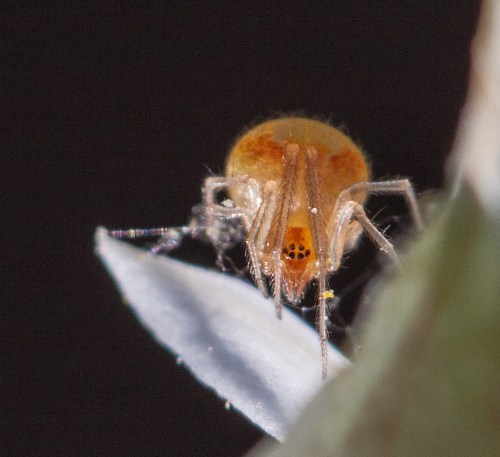
Is it just my imagination or do the eyes of this spider look like a smiley face to you too?

Eager to use my new macro lens, I went searching yesterday in my neighbors’ garden for subjects and came upon a tiny orange spider, which I have not yet been able to identify.

The spider was initially suspended in midair, but climbed up an invisible silken thread as I approached and took refuge in the shadow of white flower.

I boldly (or foolishly) tried photographing the spider handheld, but the images were blurry. Eventually I put the camera on my tripod and did my best to focus manually. For some shots, I used my pop-up flash to add a bit more light. Of course, it turned the background black, but I think that works for this shot.

In the original shot, the spider was upside down, but I decided it looked better when I rotated the image 180 degrees. I am fascinated with the multiple eyes of spiders.  There seem to a lot of different eye patterns in the different species of spider—a macro lens tends to make me look more closely at these kinds of details.

orange_spider_blog

© Michael Q. Powell. All rights reserved

Read Full Post »

Every time that I look at a dragonfly head-on, I can’t help but think of the biplanes of World War I, like the Sopwith Camel that Snoopy famously imagined piloting in his battles with the Red Baron.

Considering the colors of this Needham’s Skimmer dragonfly (Libellula needhami), I guess that he would have to represent the Red Baron, not Snoopy. Aerial dogfights are not without danger, and it looks like this dragonfly has survived several encounters with the enemy, with all of his wings showing some damage.

red_dragonfly_headon_blog© Michael Q. Powell. All rights reserved

Read Full Post »

Have you ever watched an animal sleep? I used to watch my dog sleep. He slept soundly, but sometimes a sound or a smell or a dream would wake him up. He would look around a little to reassure himself that all was well and then would put down his head and go back to sleep.

Yesterday, I did a posting on a trio of North American beavers (Castor canadensis) that had been temporarily flooded out of their lodge and were sleeping on dry land a short distance from their home. The general response to the photo in that posting was that the beaver seemed peaceful and content (and cute!) when sleeping.

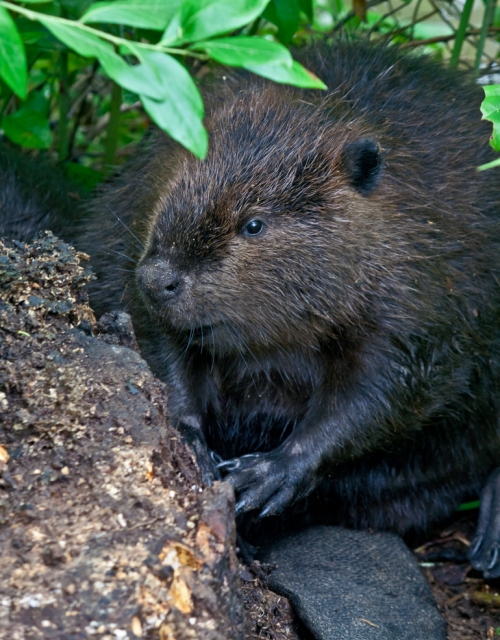
Today, I am posting a few photos of the occasions when one of the beavers woke up and looked around, much like my dog used to do.  This is actually not the same beaver that was featured yesterday, although part of this beaver was visible in the photo yesterday. This beaver was the one on which the other beaver was leaning as it snuggled.

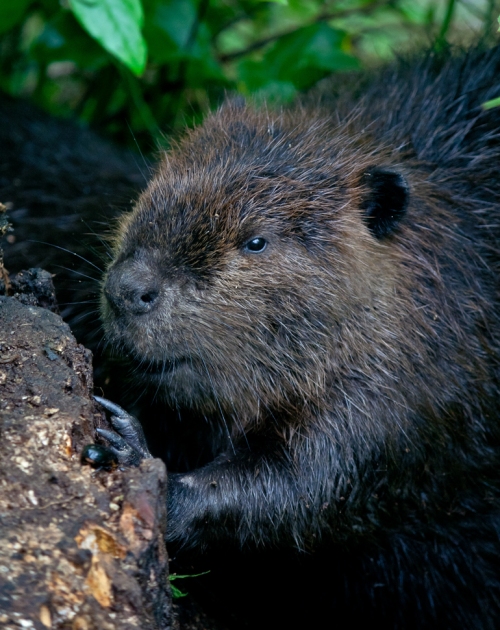
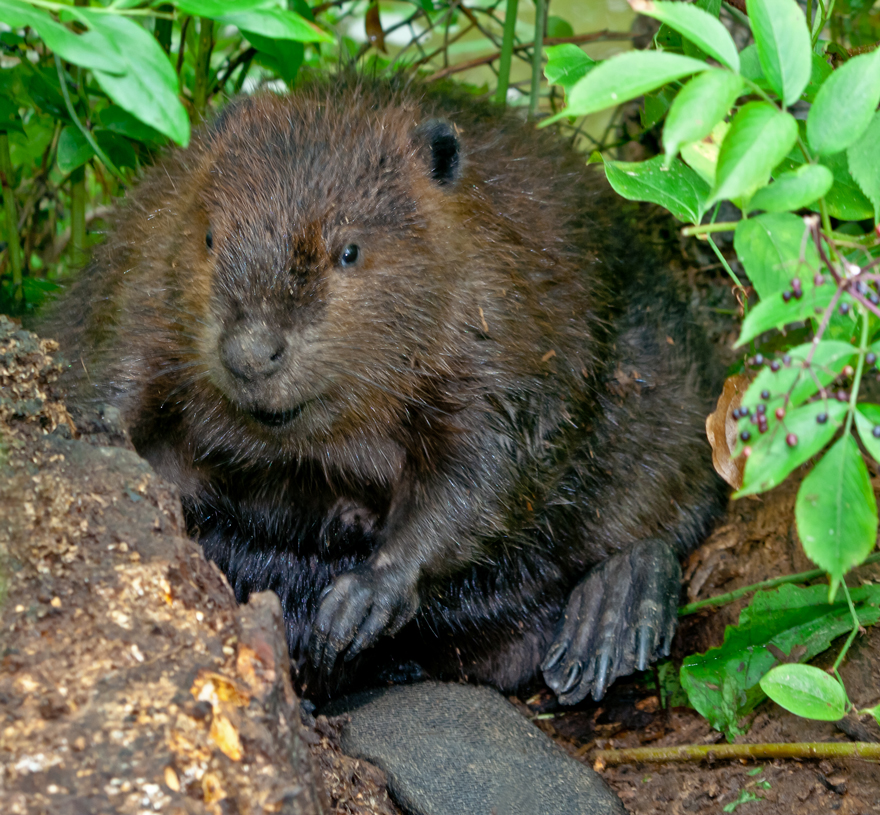
The first photo shows a pretty alert beaver, leaning on a stump around which the beavers were sleeping. I like the details that you can see of the fur and of the front paw. I was on a boardwalk at my local marshland park when I took these photos and was looking slightly down at the beavers. I was so close that I did not even have to use the full length of my zoom lens and, for example, shot the first photo with my lens at a focal length of 135mm.
beaver1_blog

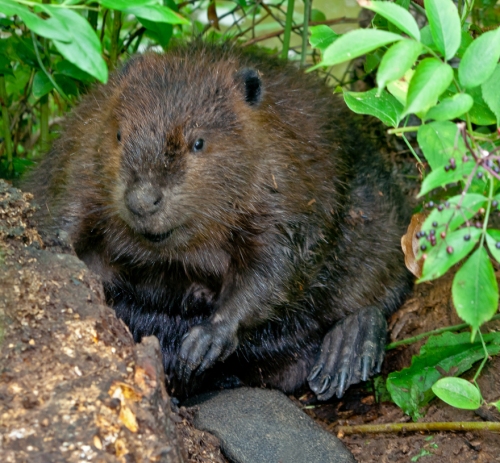
The second shot is somewhat similar to the first, but it shows part of the beaver’s tail. It was interesting to see how the beaver’s tail was tucked under the beaver when it was sleeping. I somehow had always assumed the tail was rigid—it seems to be reasonably flexible.
beaver2_blog

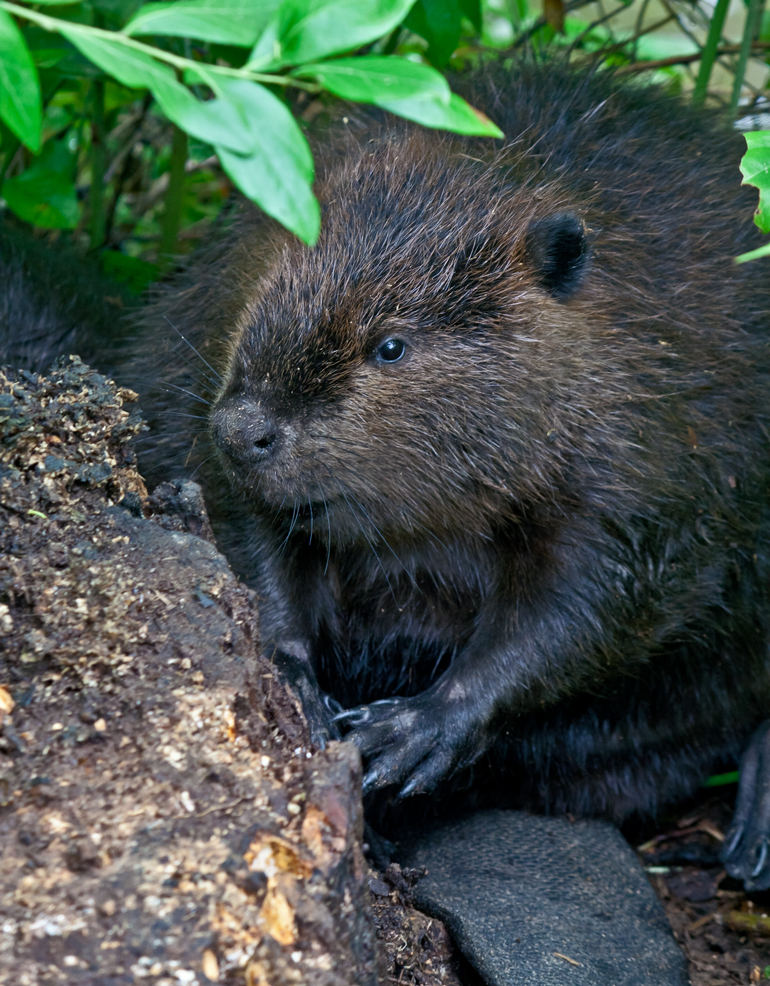
The final image today is not quite as sharp as the first two, but I like it because of the way that it shows both a front and back paw, as well as the tail. The beaver also has a tousled look and somehow unfocused eyes, looking a lot like most of us do when we first wake up.
beaver4_blog

I am still going over my photos and may post a few more, so stay tuned. I feel really lucky that I was able to see these beavers in this kind of situation in the wild and managed to capture it well enough in photos to be able to share part of the experience with all of you.

© Michael Q. Powell. All rights reserved

Read Full Post »

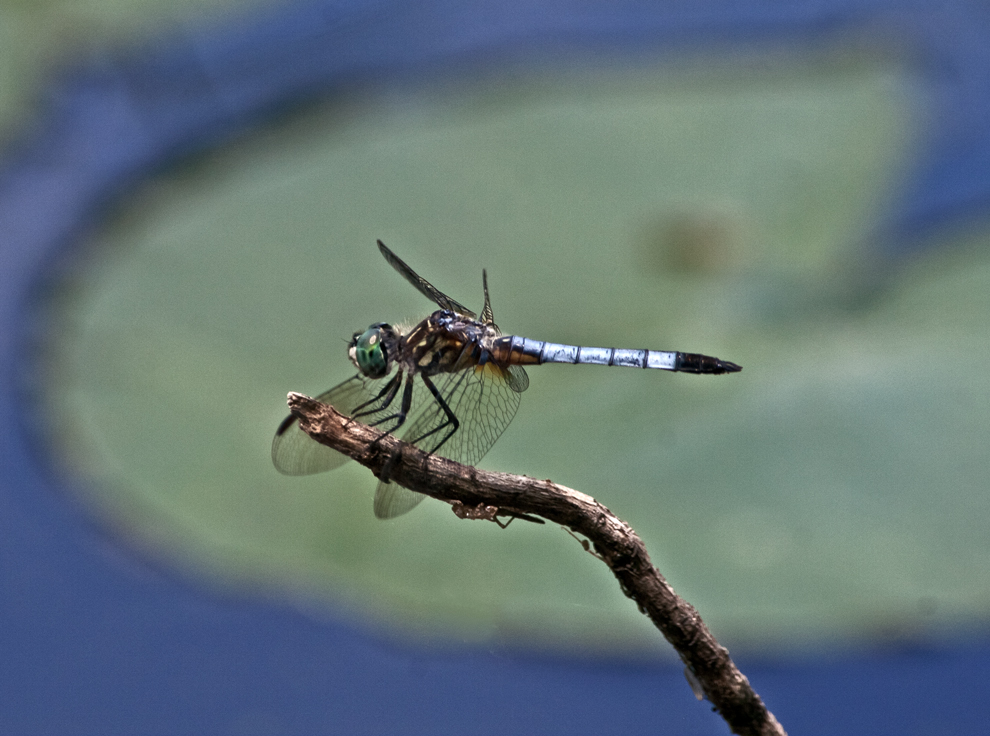
It’s not often that I have the luxury of consciously composing the background when I am photographing a dragonfly, but this Blue Dasher (Pachydiplax longipennis) was cooperative enough that I was able to frame the shot with a lily pad in the background. As a bonus, the colors of the background are a pretty good match for the colors of the dragonfly.

Who knew that dragonflies were so stylish? Maybe the coordinated colors helps the males to attract prospective mates. The less stylish dragonflies probably have to rely on the insect equivalent of eHarmony.com.

dasher_pad_blog

© Michael Q. Powell. All rights reserved

Read Full Post »

As I was walking along the boardwalk at my local marsh in the early afternoon of a very hot and humid day this weekend, I spotted a deer in the brush, my closest encounter with a deer in a long time.

Immediately I stopped, fearful that I would spook the deer. The deer was close enough that I figured that I could get a good shot. I was wrong. The strong, harsh midday light was coming directly from the side, and despite my efforts to adjust my settings, virtually all of my shots had one side of the deer’s face with blown out highlights and the other side in deep shadows. It might sound artistic, but it wasn’t.

I slowly began to move toward the deer, hoping to get a more favorable lighting situation, when, sure enough, the deer turned around and ran away from me. I thought that all was lost, but then the deer stopped and turned to look back at me. Somehow, the deer had moved to a spot where there was a little shade and I managed to get this shot.

Frankly, my deer, I don’t give a damn that you chose to move away from me—I love you more from a distance.

deer1_blog

© Michael Q. Powell. All rights reserved

Read Full Post »

Have you ever tried to take photos of a bee in flight? In the past, I have managed to get a few such shots accidentally, when a bee took off as I was shooting.

However, a few days ago when the light was fading in the early evening, I decided to try to photograph a bee in flight using my pop-up flash. I knew that timing would be critical, because the time required for the flash to recycle meant that I would get only one shot each attempt, and not a burst. It was a fun little challenge, even though most of my shots were out of focus.

I especially like the first image, in which the bee appears to be attempting to hover in mid-air. The second shot makes it look like the bee was free-falling, waiting for the optimal moment to deploy his tiny parachute.

It’s easy to get ultra-serious about photography and get bogged down thinking of settings and exposures and composition—it’s nice sometimes to just have fun and then share the results of the fun time.

hover_bee_blogjump_blog

© Michael Q. Powell. All rights reserved

Read Full Post »

Last summer I confessed to being obsessed with Red Milkweed Beetles (Tetraopes tetrophthalmus) in one of my postings and initial signs this summer suggest that the fascination remains strong.

This past weekend, I spotted several of my little red friends when visiting Green Spring Gardens, a local county-run historical garden, and I stalked them like a paparazzo, trying to get a good shot. I particularly like this image, in which the beetle is staring down at me from a partially eaten leaf. (I don’t know if it was the one that chewed up the leaf.)

The colors of the photo may suggest Christmas, but I am not sure that there would be much of a market for this as a Christmas card image.

redbug1_blog

© Michael Q. Powell. All rights reserved

Read Full Post »

Do you ever have days when you crave solitude, but others just won’t stop bothering you? That may be how this male Blue Dasher dragonfly (Pachydiplax longipennis) felt today, when other dragonflies harassed him from the back and from the front.

behind_blogsuspended_blog© Michael Q. Powell. All rights reserved

Read Full Post »

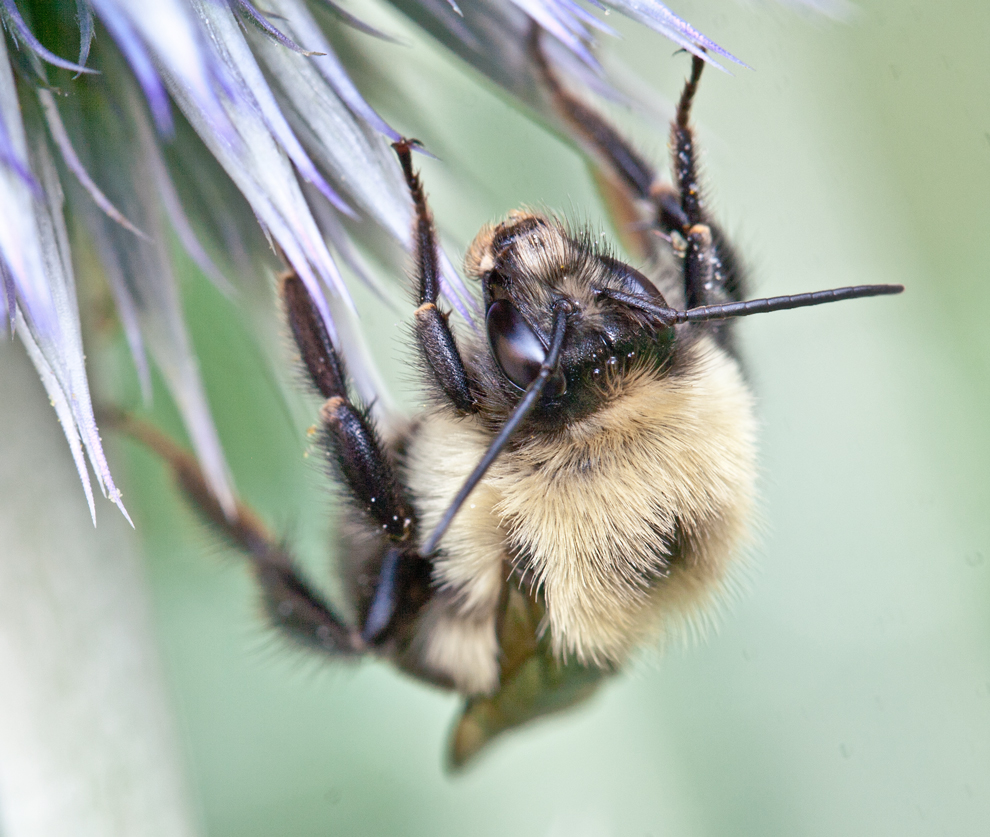
Before going out to the marsh park to shoot this morning, I decided to check out my neighbor’s garden and came across this bumblebee, hanging from the side of a a beautiful Small Globe Thistle (Echinops ritro).

I took some initial shots and then began to wonder if the bee was still alive, because it was not moving at all. When I blew gently on its face, however, it moved a little, so I figure that it was probably just sleeping. I carefully set up my tripod and got as close as my lens would let me get, which caused the bee to fill a substantial part of the frame.

I managed to capture some details that normally I do not see, like the little lines on the antennae and the hairs on the bee’s face. The bee was still sleeping when I departed—I didn’t want to risk the possibility that bees get angry if you wake them up prematurely.

close-up_bee1_blog

Michael Q. Powell. All rights reserved

Read Full Post »

Who hasn’t wished for an extra set of hands to get more done in this multi-tasking world?

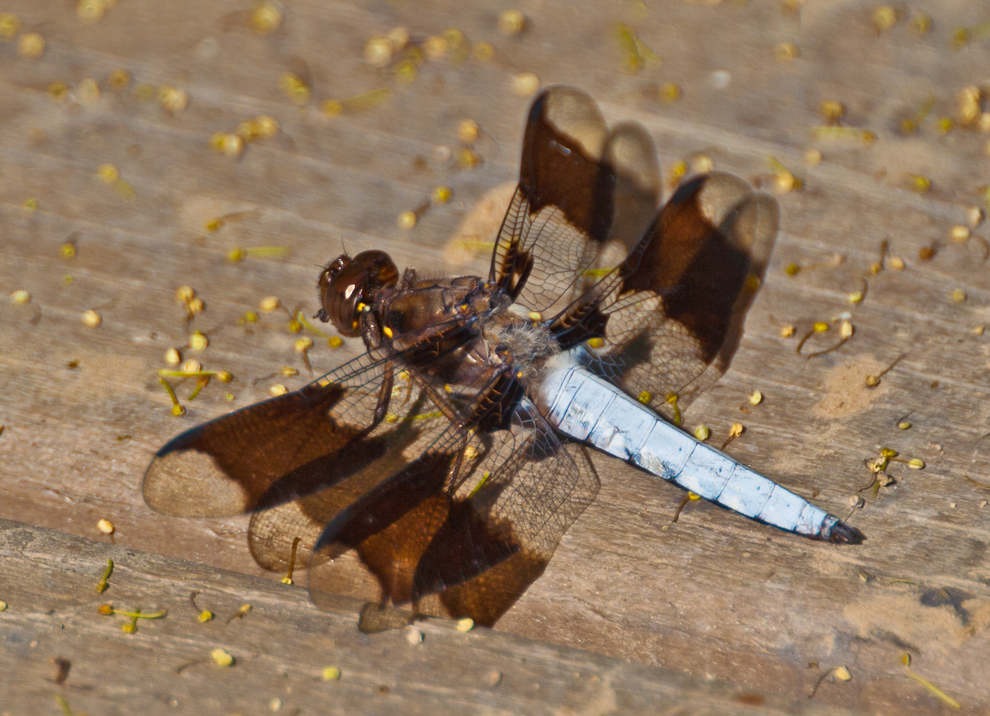
When I first looked at this photo that I took of a male Common Whitetail dragonfly (Plathemis lydia), it looked like he had grown two extra sets of wings. Had a genie granted one of his wishes? Could he now fly faster than his friends (he is a male, after all)? Will this impress the ladies?

A close look at the image, however, reveals that the extra wings are merely illusions, shadowy reflections of a more ordinary reality.

That doesn’t mean, though, that he has ceased to dream and to wish from time to time for those extra wings.

wings_blog

Michael Q. Powell. All rights reserved

Read Full Post »

It may be hard for this snapping turtle to climb the ladder of success, when he had such difficulties merely getting himself onto a floating log. It would be understatement to note that Eastern Snapping Turtles (Chelydra serpentina serpentina) are not exactly graceful when they pull themselves out of the water (and even in the water, they seem a bit clumsy).

I read somewhere on-line that snapping turtles—unlike most other turtles—generally do not bask in the sun out of the water. Therefore, I was a little surprised when this turtle swam up to the log and began his attempt to climb onto it. It was like watching a movie in slow motion as he struggled and strained to pull his body up out of the water.

The first image shows him taking a break after making it halfway to his goal. I love the details of his visible front leg and all of his wrinkles. In the second shot, he has achieved his objective and seems to be settling in for an afternoon nap in the sun.

I noted that the log is no longer floating out of the water as it was at the start.—apparently success weighs heavy on the victor.

snapper2_blogsnapper3_blog

Michael Q. Powell. All rights reserved

Read Full Post »
Yesterday, when an Eastern Snapping Turtle (Chelydra serpentina serpentina) crawled onto a floating log, where a much smaller Red-eared Slider (Trachemys scripta elegans) was already basking in the sun, it looked like there might be a showdown.

The two faced off, staring at each other. Despite the size difference, the small turtle did not appear to be intimidated and refused to back off at all. Eventually they both relaxed and decided that peaceful co-existence was the best option.

It turned out that both the log and the sun were big enough to share.

turtles_blog

Click on the photo to see a higher resolution view.

Michael Q. Powell. All rights reserved

Read Full Post »

When I was a boy, I had hair that would stand up in a cowlick and refuse to lie flat, and that’s what I immediately thought of when I saw this Tree Swallow (Tachycineta bicolor) with frizzy feathers.

My Mom’s solution to my hair problem was a little saliva on her fingers that she would apply to my hair and smooth it down.

I thought of doing the same to this little bird, but I am not sure that it would appreciate my efforts.

frizzy_blog

Michael Q. Powell. All rights reserved

Read Full Post »

Spotting the camera around my neck, an attractive young lady excitedly pointed out this frog to me, calling it a “Hollywood Frog,” because it reminded her of the ones in the movies.

I couldn’t resist asking her if she was going to kiss the frog to see if it would turn out to be a prince. She smiled a little, shook her head, and responded, “No, I’ve already kissed my fair share of frogs.”

greenfrog_blog

Michael Q. Powell. All rights reserved

Read Full Post »
Swans have Swan Lake, so why shouldn’t shorebirds have Shorebird Ballet?

It looked like these Lesser Yellowlegs (Tringa flavipes) were practicing their dance moves in the water one day recently. As you can see, it requires great balance and, as the second photo shows, attention to the foot position—you have to keep the toes pointed. (One or more of these might be Greater Yellowlegs (Tringa melanoleuca), but my identification skills are not honed enough to be able to distinguish between the two with any great certainty.)

You can’t turn on the television these days without seeing commercials for dance competition programs like Dancing With the Stars or So You Think You Can Dance.  These birds could be at the leading edge of a new dance craze, Dancing With the Birds.

They already have a leg up on their competition.

ballet2_blogballet1_blog

Michael Q. Powell. All rights reserved

Read Full Post »
Ladybugs are often considered symbols of good luck and many people look at them as cute. Consequently, you have probably never considered them as menacing (assuming that you are not an aphid), but that is the descriptor that came to mind when I first looked at this head-on image of a ladybug that I photographed yesterday.

Perhaps I am just not used to looking eye to eye with a ladybug, but this one seems to have a deadly serious look on its face, like it was not happy that I was disturbing it.

I took the shot in my neighbor’s garden, using a macro lens and a hand-held diffuser to cut down on the intensity of the sunlight. Although I stopped down the lens to get some additional depth of field, the back portion of the ladybug, including its rear legs, are out of focus, which helps to draw attention to the face.

The change in seasons means that I will probably be featuring fewer birds in my blog than during the winter, and a whole lot more insects and flowers.

ladybug1a_blog

Michael Q. Powell. All rights reserved

Read Full Post »
Are Barn  Swallows normally hostile toward each other?

As I was looking over once more the shots that I took on Monday, I came across this little series of images of two Barn Swallows (Hirundo rustica) interacting. I had passed over these photos when I did my first sorting, because they were seriously underexposed. Unlike the photo that I posted earlier this week of a confrontation between two swallows, I was not using a flash for these photos, which meant, however,  that I was able to take a burst of photos. (When I used my pop-up flash, I had to wait for the flash to re-cycle in order to shoot again.)

I tweaked these photos in Photoshop Elements (and cleaned up the background a little) and was amazed to discover that this confrontation seems to have escalated a bit beyond the previous one. The flying swallow seems much more aggressive and threatening, going beyond the squawking I had seen before, and looking more like he was ready to attack the sitting swallow, who seems to be paying attention to the incoming bird.

These photos would have been better with a higher shutter speed and better light, but I am amazed that I was able to capture this moment. I love interactions between members of the same species (and between different species) and I enjoy trying to catch those moments.

scream2c_blogScream2a_blogscream2b_blog

Michael Q. Powell. All rights reserved

Read Full Post »

Is it just me, or does this image look like it came from a low budget science fiction movie, with a strange-looking alien creature hovering over a Martian landscape?

I was chasing dragonflies again this past weekend, trying to capture images of them in flight, and ended up with this image of a female Common Whitetail dragonfly (Plathemis lydia). It’s pretty tough to try to track these flying insects with a hand-held telephoto zoom lens extended to almost 400mm. My autofocus seemed too slow and I adapted a technique of trying to focus manually, while trying to keep the lens steady. I can’t tell for sure if this image was auto-focused or was manually focused.

Female Common Whitetail dragonflies do not have a white tail and in many ways that makes them a little easier to expose correctly. The wings are blurred, but you can still see the brown markings that identify this as a female, and not an immature male.

Last summer I was content to get a shot of a dragonfly when it was stationary, but this summer I am going to work hard to capture some more images of dragonflies in flight.

whitetail2_blog

Michael Q. Powell. All rights reserved

Read Full Post »

I was focusing my camera on a Barn Swallow (Hirundo rustica) perched on a branch, when out of nowhere another Barn Swallow appeared and started screeching as it hovered in midair. Fortunately I had enough presence of mind to press the shutter release.

It was raining most of the day and I was shooting one-handed under an umbrella much of the time. For this shot, I decided to use the built-in flash on my camera to add a little additional light. The reflections in the screeching bird’s eyes add to its almost maniacal look.

The bird on the branch was totally impassive. It turned its head toward the hovering bird, but did not appear to react in any other way.

The overall feel of the image is almost like a cartoon.  I really like the way it came out (and recognize that it was mostly luck and fortunate timing).

confrontation_blog

Michael Q. Powell. All rights reserved

Read Full Post »

Although most people probably associate the descriptor “whitetail” with deer, it’s also part of the name of this dragonfly that I photographed yesterday, an immature male Common Whitetail dragonfly (Plathemis lydia).

I remember seeing the adult male Whitetail a lot last summer, and its body is a chalky white in color, as its name suggests. Males start out looking a lot like the female, which has a brown body with some white or yellow markings, according to Bugguide. However, it’s relatively easy to tell the immature males from the females, because their wing patterns are different. Males have wider bands of brown and clear wingtips (no, they are not wearing dress shoes—I am talking about the literal tips of the wings).

I am sure that I’ll get lots more photos of Common Whitetail dragonflies this summer, including some in much better light, but it was nice to see them appearing already in April.

dragonfly1_blog

Michael Q. Powell. All rights reserved

Read Full Post »

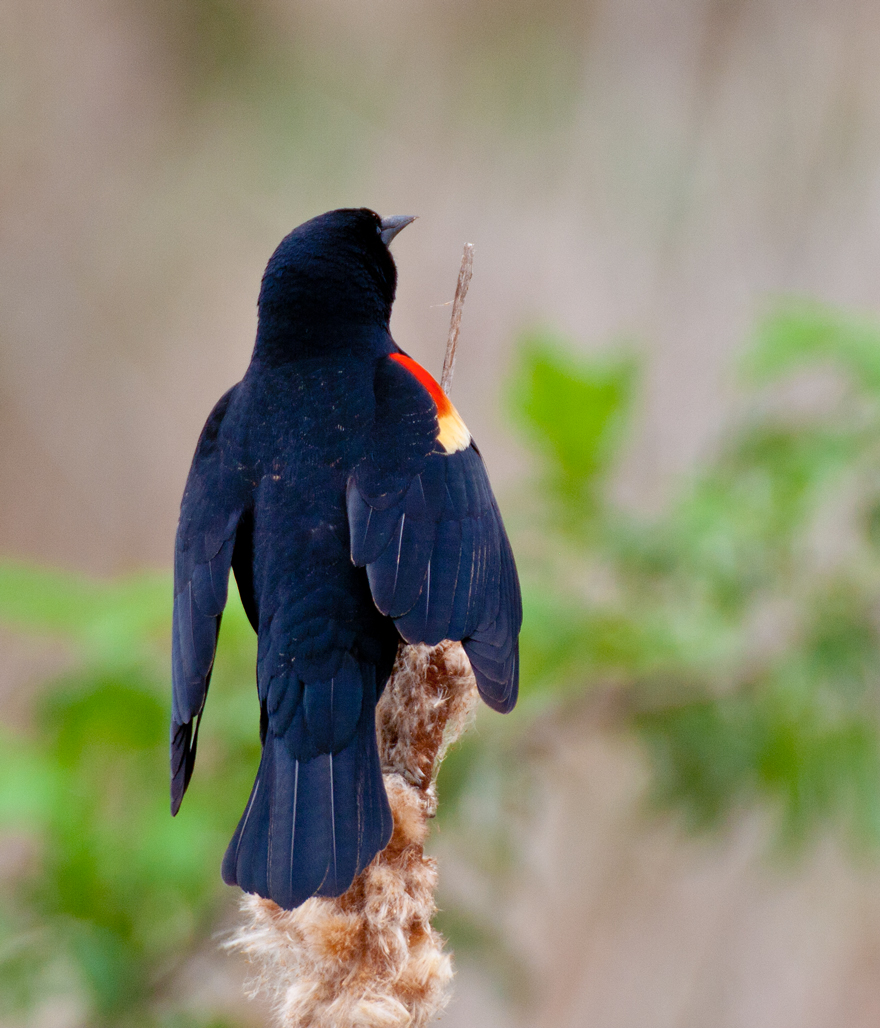
Male Red-winged Blackbirds (Agelaius phoeniceus) are loud and visible almost all of the time, but this one blackbird seemed even more determined than usual to pose for me. It was almost as though he was an experienced model, changing poses and holding them for a few seconds to allow me to get the shot before striking a new pose.

I wonder if he could have his own fashion show. Of course, we might have to alter the terminology a bit—I am not sure he would be keen to strut his stuff on something called a “catwalk.”

pose_blogAttention_blogstretch_blog

Michael Q. Powell. All rights reserved

Read Full Post »

A blog about a frog on a log in a bog—is this how Doctor Seuss got started?

The subject is ordinary and the composition is simple, but I really like the result. The frog seems to be lost in a moment of contemplation as he stares out across the pond and I made sure not to wake him from his reverie as I quietly snapped his photo and moved on.

frog1_blog

Michael Q. Powell. All rights reserved

Read Full Post »

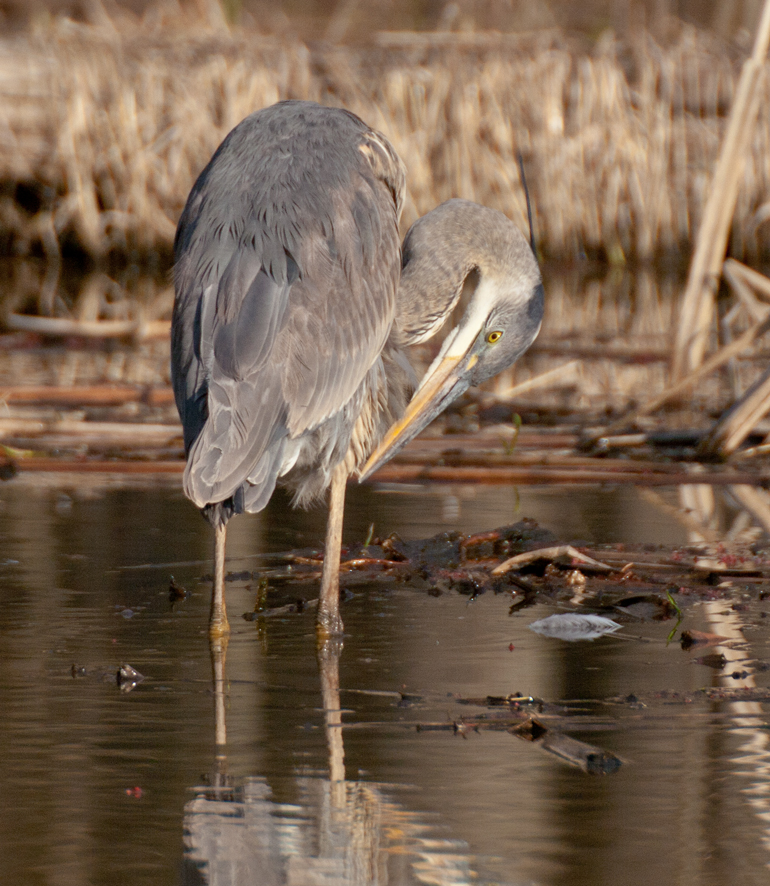
I arrived at the marsh early in the morning, just as this Great Blue Heron (Ardea herodias) was getting up. He seemed to be going through his pre-breakfast routine, grooming and preening and getting ready for the day ahead. It was fascinating to watch him contort his long neck as he sought to arrange his feathers just so. The water was calm enough that he could have used it as a mirror, if he had wanted to do so.

I am not sure if he was trying to make himself look bigger and fluffier, was airing himself out,  or just wanted some additional air for insulation, but at one point he shook himself vigorously. I was fortunate enough to get the first photo as he was in the process of ruffling the feathers.

Eventually, my feathered friend decided that he was presentable and stood motionless, as though posing for me. I’ll post some of those images later.

standing_heron3_blog

standing_heron2_blog

Michael Q. Powell. All rights reserved

Read Full Post »
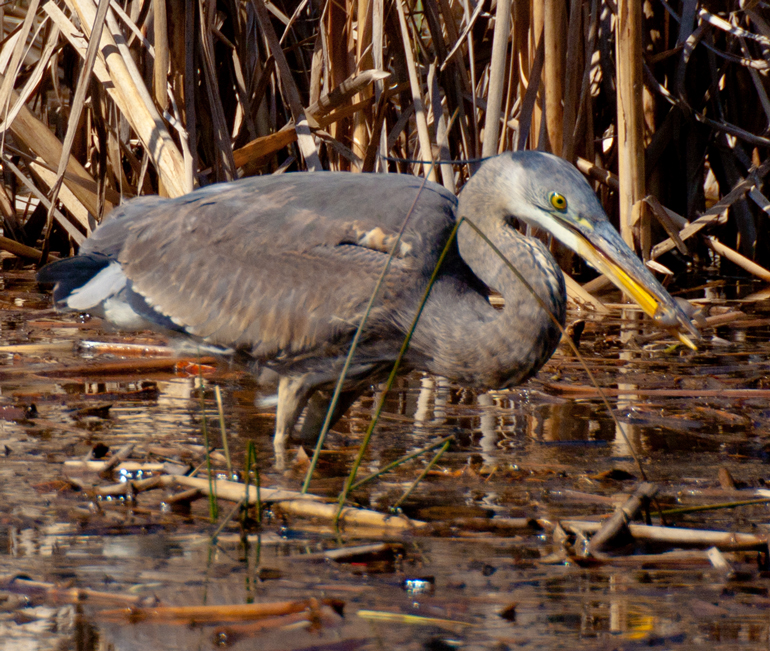
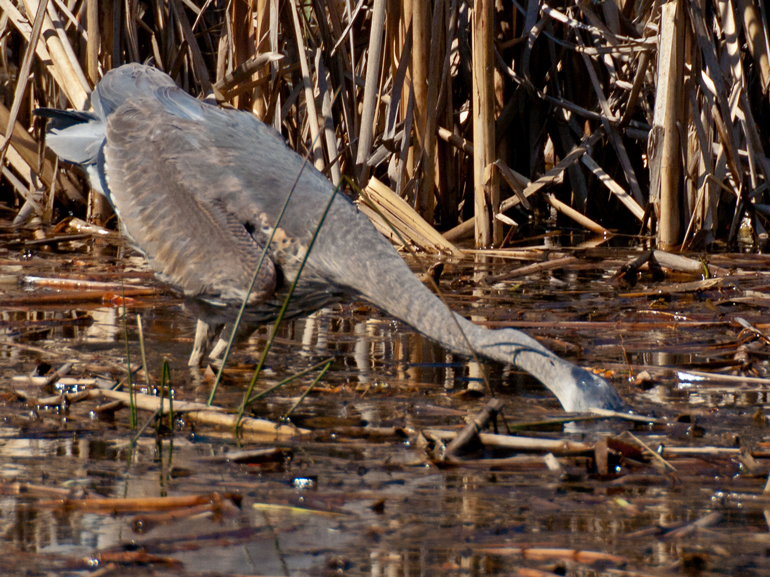
A Great Blue Heron this weekend was poised, waiting to strike, and I waited with my camera and my tripod, hoping to capture the moment of triumphal success.

I had visions of the heron pulling some big fish out of the water, like I see in Phil Lanoue‘s incredible photos, and watching as he struggled to swallow it whole.

The reality, as you can see, was much more modest. After all, the Great Blue Heron (Ardea herodias) was fishing in the beaver pond at my local marsh and the pickings were pretty slim. Initially, I though he had caught a frog, but the photo suggests it was a small fish, though it is hard to tell for sure because of the catch’s small size.

The second photo shows his pre-strike position. The heron stood motionless in this position for what seemed like an eternity. I am amazed that he could see anything in the shallow, reed-covered water.

When he struck, he didn’t even have to put his head very deeply into the water or use a lot of force to catch the fish. The final shot shows the heron swallowing his catch. It did not take any special maneuvering to get the little fish down his throat.

I saw a heron hanging around the same beaver pond the following day. I hope he is not spending all of his time in this one location or I may end up photographing a really skinny heron in the future.

heron1_blogheron2_blogheron3_blogheron4_blog

Michael Q. Powell. All rights reserved

Read Full Post »
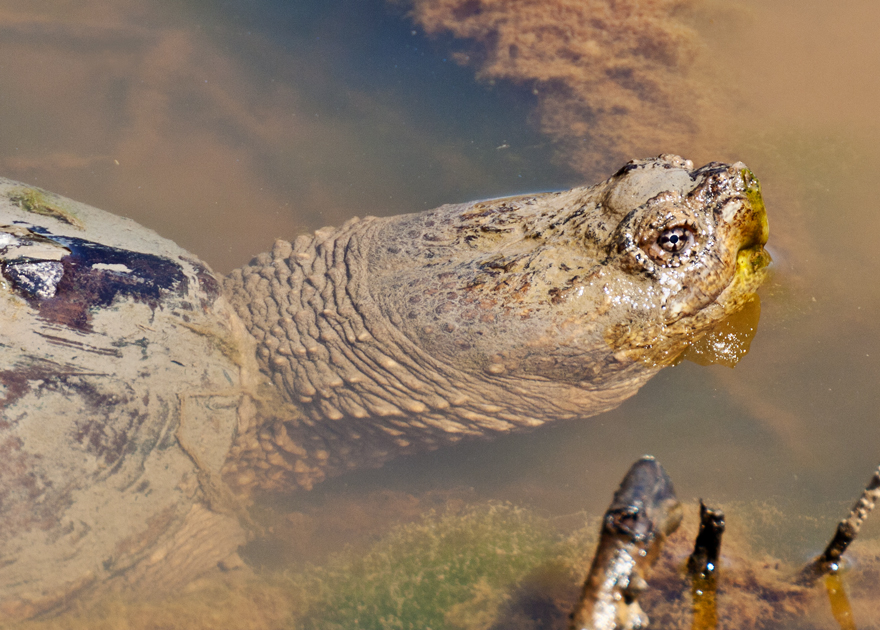
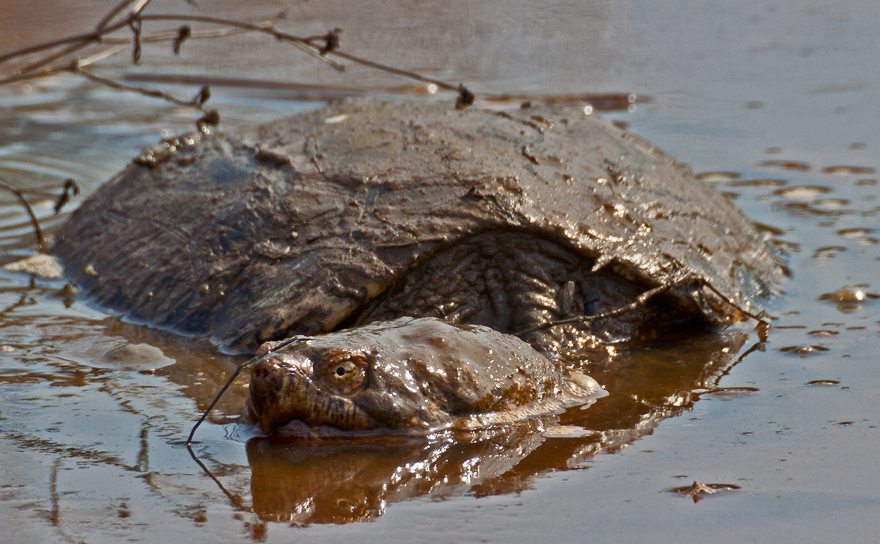
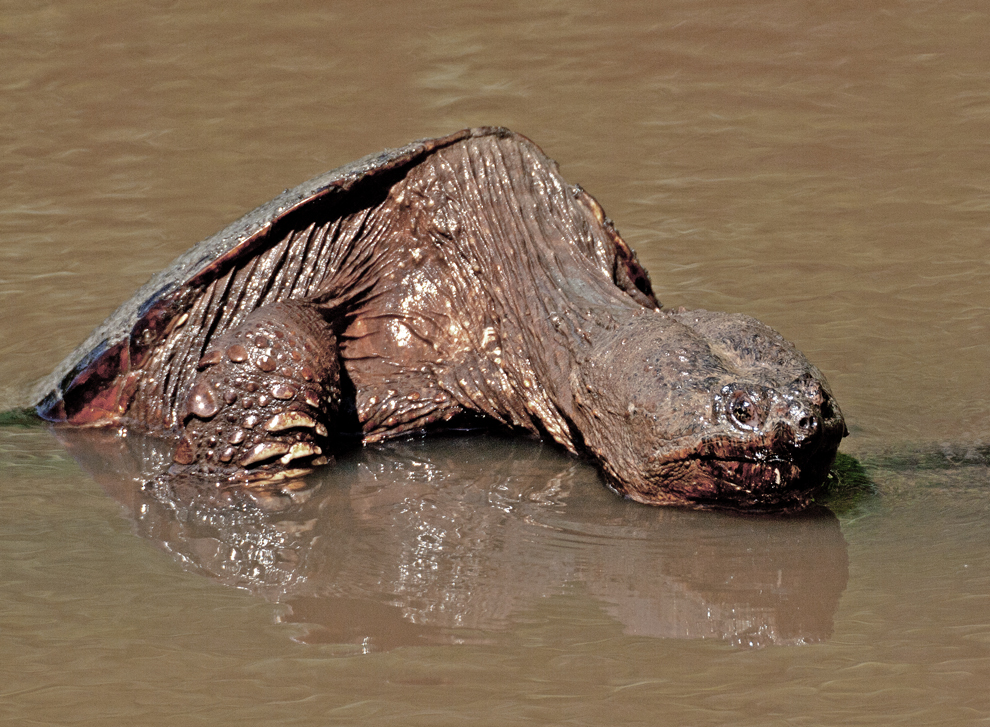
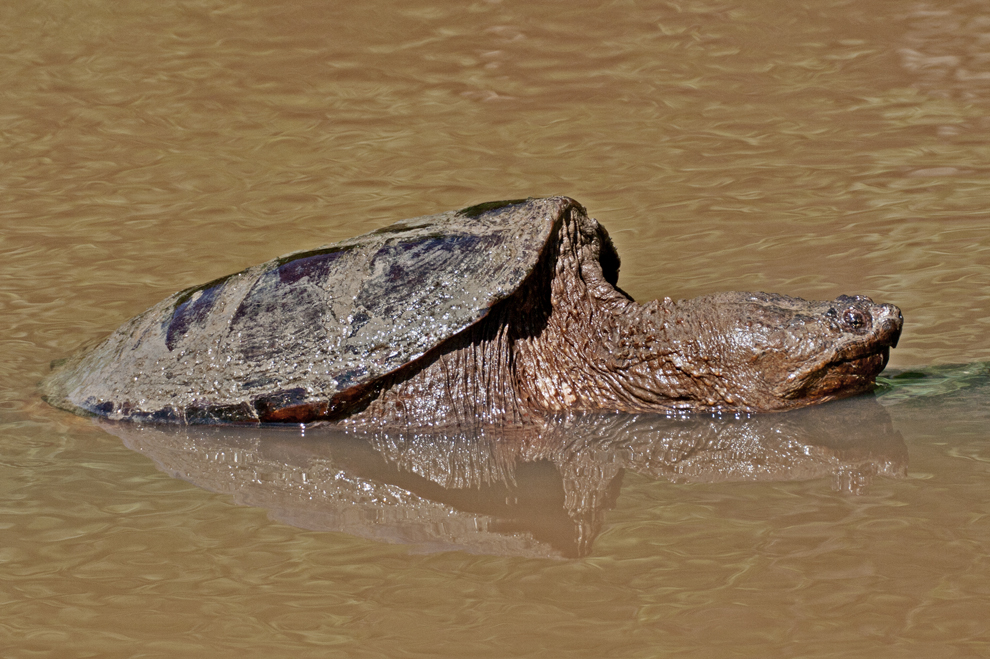
Like prehistoric beasts from another era, the snapping turtles have finally emerged from the mud and the slime of my local marsh.

Painted turtles and Red-eared Sliders have been basking in the sun for weeks now, but it seems like the Eastern Snapping Turtles (Chelydra serpentina serpentina) like for it to be a bit warmer before they start moving. This past weekend I saw quite a few snapping turtles in the marsh, most of them with a lot of mud still piled on the top of their shells, including some pretty big ones. Some of them were floating on the surface of the water, but they don’t appear to bask on land like their smaller counterparts.

I would hesitate to call any of them beautiful or even ruggedly handsome—scarey seems a more appropriate adjective. After reading that snapping turtles are omnivores, I have reconfirmed my desire to keep my distance from these creatures. Thankfully, I have a long telephoto lens.

snapping_blogsnapping2_blog

Michael Q. Powell. All rights reserved

Read Full Post »
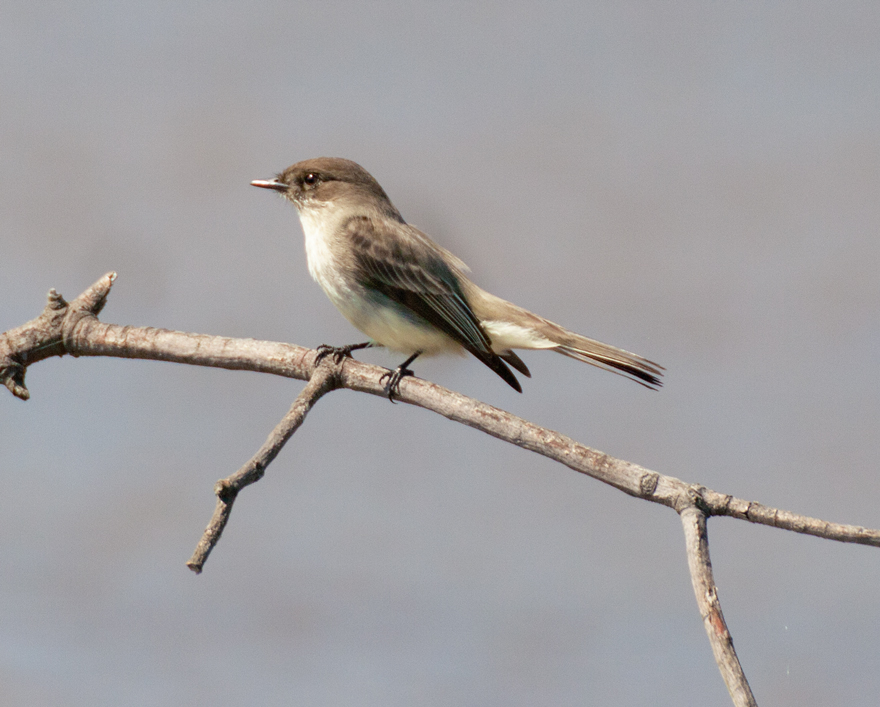
Spring has complicated my life when it comes to bird identification. I started photographing (and trying to identify) birds last fall, when many of the birds had already left the area. Over the winter, there was a limited set of birds that I gradually became accustomed to seeing and I learned to identify them. Even when we had lots of different kinds of ducks, I could look in the section of my identification guide and figure out what they were.

Spring has brought all kinds of new species that have left me baffled and confused. Some of the birders are all excited by the return of warblers, including the Yellow-rumped Warbler. I can’t even see the birds when they point them out to me, much less figure out what color the color of the bird’s rump.

Here’s a recent photo I took of a pretty little bird that I have not yet been able to identify. I’d welcome any hints about what kind of a bird it is.

little_bird_blog

To add insult to injury, leaves are starting to appear on the trees, which will future challenge my ability to identify birds. I may have to go back to photographing insects.

Michael Q. Powell. All rights reserved

Read Full Post »
« Newer Posts - Older Posts »