Feeds:
Posts
Comments

Archive for the ‘Flowers’ Category

Skipper butterflies received their name because of their quick, darting flight habits. Many species look very much alike and I invariably have trouble identifying them.

Last week I spotted this little skipper butterfly as it was feeding on some wildflowers at Occoquan Bay National Wildlife Refuge. I was really happy to capture this image of the butterfly with its proboscis extended, sucking up the nectar from a flower. What species is it? If I had to guess, I’d say it might be a Fiery Skipper butterfly (Hylephila phyleus), but my eye is not as attuned to the subtle differences in skippers as it is to dragonflies, so this is really just a guess.

Even it I can’t identify the butterfly, I can enjoy and celebrate its beauty. I encourage you all to slow down and take in the beauties of nature whenever you can.

skipper butterfly

© Michael Q. Powell. All rights reserved.


Read Full Post »

On Monday I spotted this little Silver-spotted Skipper butterfly (Epargyreus clarus) feeding on a buttonbush (Cephalanthus occidentalis) at Jackson Miles Abbott Wetland Refuge. I love the distinctive spiky flower balls of this plant that have always reminded me of medieval maces.

A few years ago, however, I came to associate the shape of the balls with depictions of the COVID virus. Recently the number of COVID cases has reportedly been on the rise and I fear that they will increase even more when summer ends and people begin to spend more time indoors. Since I am over 65 years old and therefore considered to be “vulnerable,” I hope that I will be able to get an updated COVID shot (and a flu shot too) in the upcoming months. Neither offers 100% protection, but the shots will hopefully lessen the severity of symptoms if I do get sick.

Silver-spotted Skipper

Silver-spotted Skipper

© Michael Q. Powell. All rights reserved.


Read Full Post »

Shortly after waking up this morning, I walked over to my neighbor Cindy’s garden to see what was in bloom. The last time I checked, about a week ago,  there were lots of flowering day lilies, but I suspected that the recent heat had caused many of them to wilt and die. I am not sure if lilies close up at night, but I did not see any lilies in bloom in the early morning light—I was there about 6:15 today.

However, there were plenty of purple coneflowers and Shasta daisies open and I did my best to capture some their beauty with the short macro lens that I was using. I was delighted to spot a tiny insect creature crawling around on one of the daisies, as you can sort of see in the second photo. The limited light available forced me to open the aperture of the lens and created such a narrow depth of field that I could not get both the insect and the flower in focus.

Most of you know that I enjoy photographing wildlife and nature in more remote locations, but it is reassuring to know that I do not always have to travel far to find subjects—beauty is everywhere.

shasta daisy

Shasta daisy

coneflower

© Michael Q. Powell. All rights reserved.

Read Full Post »

Most flowers have blooms at the end of their stems or at least in places above their leaves. Each spring, however, I encounter Mayapples (Podophyllum peltatum), a strange plant that seems to work in a totally different way. Mayapple plants grow in colonies from a single root and stems put out large umbrella-shaped leaves, with usually only a single large leaf per stem. These stems do not produce any flower or fruit.

A few stems, though, produce a pair or more leaves and a single white blossom appears at the juncture point where the stem branches off. If you don’t know that the blooms are there, it is easy to miss them, because the large leaves hide them from view.

Last week during a trip to Accotink Bay Wildlife Refuge I checked out several large patches of Mayapples that I had seen in previous years. I think I might have been a little late in the season, but eventually I found a Mayapple plant with a flower that was clearly past its prime. As you can see in the first photo, a harvestman, known colloquially as a daddy longlegs, was camped out on the flower, waiting perhaps for potential prey. For the second photo, I zoomed out a bit to show the unusual location of the flower on the Mayapple plant and the habitat in which these plants grow.

As many of you know, I focus mostly on wildlife creatures in my photography, but my almost insatiable sense of curiosity draws me to anything weird and wonderful that catches my eyes, like Mayapples in bloom.

Mayapple

Mayapple

© Michael Q. Powell. All rights reserved.


Read Full Post »

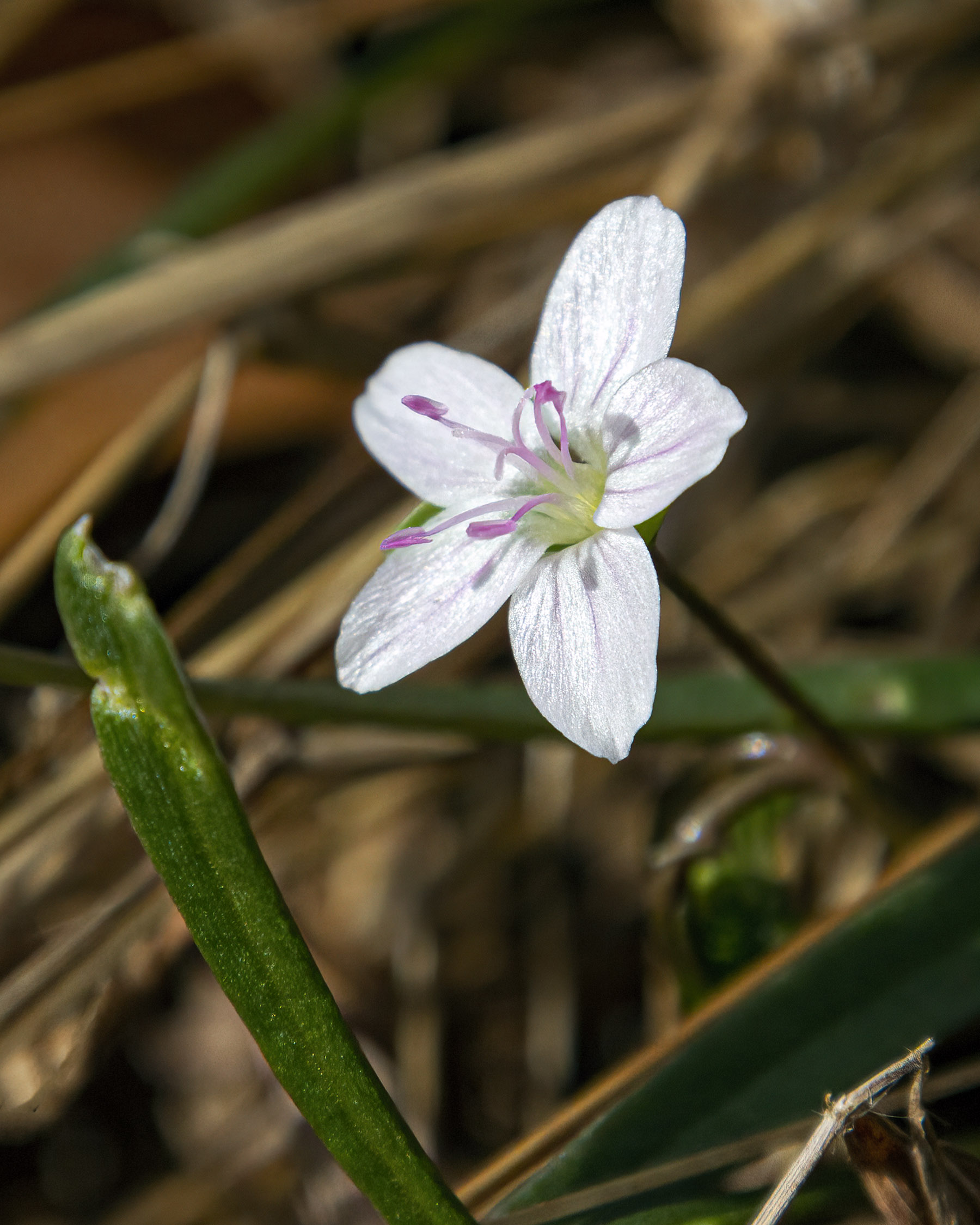
Spring is definitely here. I spotted my first Spring Beauty wildflower (Claytonia virginica) on 26 March during a hike at Prince William Forest Park in Triangle, Virginia. Before long I am sure that I will see large numbers of them in the forest, though they tend to be ephemeral and don’t bloom for very long.

The Spring Beauty plants have tiny underground tubers that Native Americans reportedly prepared and ate like potatoes, though I suspect that you would have to collect a lot of them to make a meal.

Spring Beauty

© Michael Q. Powell. All rights reserved.


Read Full Post »

I was delighted to spot this Great Spangled Fritillary butterfly (Speyeria cybele) feeding on a thistle flower during a recent visit to Huntley Meadows Park, a county-run wetland not far from where I live in Northern Virginia. I have not seen many of this species of butterfly this season, so I was happy to capture this artsy artsy shot of the Great Spangled Fritillary on the one open bloom of the thistle plant.

I love the way that they spiky unopened buds add visual interest to the image without drawing attention from the primary subject.

Great Spangled Fritillary

© Michael Q. Powell. All rights reserved.

Read Full Post »

The entrance to a partially-open flower on a trumpet vine was so narrow that a bumblebee really struggled to gain access to the sweet goodness inside last Thursday at Occoquan Bay National Wildlife Refuge. Eventually the bee was able to wiggle its way inside and add to the pollen baskets on its hind legs.

I could not help but recall how much easier it is for Ruby-throated Hummingbirds (Archilochus colubris) to access the nectar in trumpet vine flowers using their long, slender bills. I have not yet been able to photograph any hummingbirds this season, but thought that I would reprise a photo from an August 2015 blog posting entitled “Hummingbird and trumpet vine.” Click on the link to see some additional photos of hummingbirds feeding on trumpet vines and learn more about my encounter that day.

bumblebee

Ruby-throated Hummingbird

© Michael Q. Powell. All rights reserved.


Read Full Post »

I spotted quite a few beautiful Zebra Swallowtail butterflies this past Tuesday at Occoquan Bay National Wildlife Refuge. The all seemed to be in constant motion, rarely perching for more than a split second and flying in unpredictable patterns.

Eventually I was able to capture a shot of a distant Zebra Swallowtail when it stopped to sip from a milkweed plant. I really like the composition of the photo, despite the fact that the main subject occupies only a small portion of the frame.

I could not help but notice that the butterfly is looking a bit tattered, with its long swallowtails already gone. Later in the season, I am sure that I will see many more butterflies and dragonflies with damage to their wings from the wear-and-tear of daily life. I am always amazed by the way that they are able to compensate and continue to survive. As I get older and slow down a bit, I try to remind myself to focus on those things that I can do and not on the ones that may be becoming increasingly challenging for me.

Zebra Swallowtail

© Michael Q. Powell. All rights reserved.

Read Full Post »

How does the Google search engine work? What causes information that you post to show in the first page of Google results? There are plenty of people on-line who claim to understand the Google algorithm and are willing to sell you there services for something called Search Engine Optimization, but for most of us, Google is a bit of a mystery.

When I do a daily blog posting, I expect that most of my views for that day will be from that posting, primarily from subscribers to my blog, or maybe for postings from the previous few days. Over the past ten years, I have learned that other viewers may be drawn to my site as a result of searches using Google or other search engines. In 2023, for example, 34 percent (14,473) of my 43,661 total views came from Google searches.

In the last couple of months, however, I have noticed a rise in daily views that seems to be driven largely by an increase in Google searches. I have a modest goal for my blog of about 120 daily views and in May and June the daily views have averaged over 200. I’d like to think that my blog postings have been better than average recently, but the numbers don’t bear that out.

So far this month, 59 percent of my 4,074 views came from Google searches, including 562 views of a 2013 posting called Fuzzy White Caterpillar and 217 views of a 2019 posting called Groundhog in a tree. In the case of the latter posting, when I do a Google search of “Groundhog in a tree,” my posting shows up as the first result. Yikes!

I really don’t care that much about the number of views that my blog gets, but my analytic mind is fascinated by the data. As I have noted repeatedly in the past, I use the words and images in my blog postings to share a bit of the world as I experience it, showcasing with a sense of wonder and curiosity the amazing world in which we live, as filtered through my eyes and through my brain.

In case you are curious, this white water lily was one of several that I encountered during a recent visit to Green Spring Gardens. Somehow this simple image conveys a sense of the peace and serenity that I felt as I captured the image. My hope is that we can all experience a bit more of that peace in our daily lives.

As for Google, I am somewhat perplexed and a little amused that Google seems to like me a bit more recently and is sending additional viewers my way and suspect that it is only a passing fancy. As Andy Warhol is reported to have said, “In the future, everyone will be famous for 15 minutes.”

water lily

© Michael Q. Powell. All rights reserved.


Read Full Post »

I love the way that water lilies seem to glow, as though there were a light emanating from their centers. I photographed this pretty pink water lily during a recent visit to Green Spring Gardens, a county-run historical garden not far from where I live. Several white water lilies were also in bloom, but somehow I was drawn to the solitary pink one that was surrounded by lily pads.

Whenever I see Water Lilies in bloom, I immediately think of one of my favorite artists—Claude Monet. During the last thirty years of his life, water lilies (Nymphéas in French) were the main focus of his artistic production.

water lily

© Michael Q. Powell. All rights reserved.


Read Full Post »

The poppies at Green Spring Gardens were well past their prime when I spotted them during a visit last week. Nonetheless I was drawn in by the shapes and colors of these cool flowers and captured some fun photos. The images have a kind of abstract feel to them that I really enjoy, a departure from my normal realistic style.

If you look closely at the final photo, you will notice that a bee really liked the flower too and was busily collecting pollen.

poppy

poppy

poppy

© Michael Q. Powell. All rights reserved


Read Full Post »

I love photographing dragonflies as they perch on lotus flowers and lotus buds. Alas, the lotuses were not yet in bloom last week when I visited Green Spring Gardens, a nearby county-run garden that has a small pond with a few lotuses and water lilies.

Fortunately quite a few dragonflies were buzzing around the pond and I managed to capture this image of a male Blue Dasher dragonfly (Pachydiplax longipennis) as he perched on the tip of a rolled-up lotus leaf. I like the way that the texture of the leaf adds visual interest to the image, something that would be absent if the dragonfly had perched on a bare branch.

I will probably return to the gardens in a few weeks to see if I can get some shots of the lotuses when they are blooming. As I recall, lotuses seem to enjoy the hazy, hot, and humid days that are far too common during the summer in the Washington D.C. area.

Blue Dasher

© Michael Q. Powell. All rights reserved.

Read Full Post »

Mayapples (Podophyllum peltatum) are woodland plants with large umbrella-shaped leaves. Instead of having flowers above the leaves, like most plants, mayapple plants have flowers that grow on the stems below the leaves, like this one that I photographed last week at Accotink Bay Wildlife Refuge.

Mayapples typically grow in colonies that originate from a single root. Most of the mayapple plants that I see have only a single stem and are infertile. The fertile ones, which are fairly uncommon, have a pair of leaves on a branched stem and a single flower grows at the junction spot where the branching occurs.

mayapple

© Michael Q. Powell. All rights reserved.

Read Full Post »

Most of the insects that I have observed feeding on Virginia Spring Beauty wildflowers (Claytonia virginica) have been equally small in size. I was a bit shocked, therefore, earlier this week to spot a large Eastern Carpenter Bee (Xylocopa virginica) gathering nectar and/or pollen from a small patch of Spring Beauties at Prince William Forest Park. The bee looked to be at least twice as large as each tiny flower. Wow!

The lighting was quite good and the bee was a bit distracted, so I was able to zoom in close and capture a lot of the details of the bee. I particularly like the speckled green eyes that look like they were carved out of a semiprecious stone. You can also see the bee’s tiny feet as it grasped the edges of the flower. I encourage you to click on the photos, especially the first one, to get a better look at the bee.

carpenter bee and spring beauty

carpenter bee and spring beauty

© Michael Q. Powell. All rights reserved.

Read Full Post »

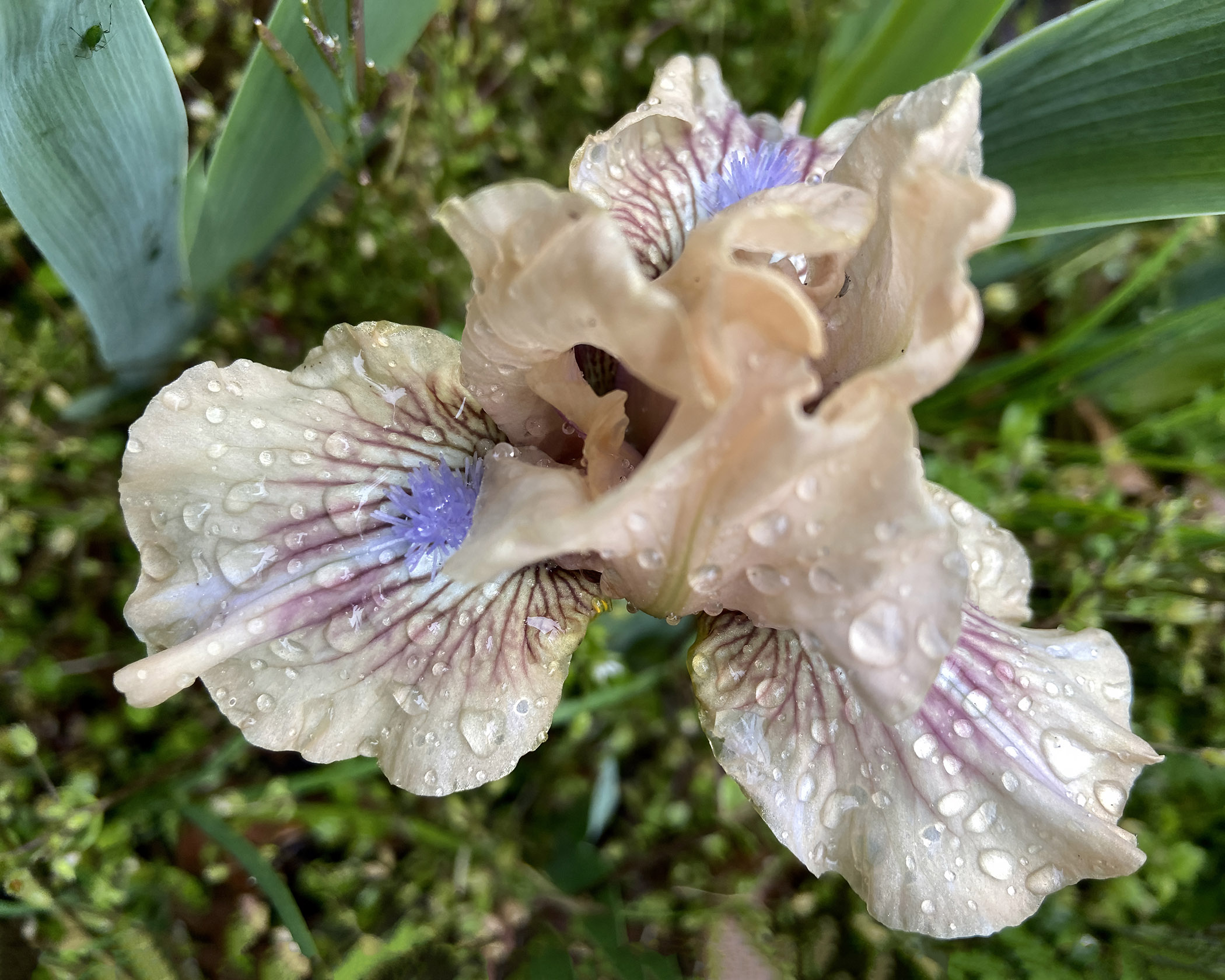
As I was preparing to go out to lunch yesterday with my dear friend and photography mentor Cindy Dyer, she glanced down at her garden and noticed that an iris was already in bloom, the first one of the spring. I suspect that this is some kind of dwarf iris, because it was nestled low in the vegetation and was only about six inches (15 cm) tall.

I thought about cropping the photo a little tighter, but wanted to retain the bug that is in the upper left corner of the image. As you might guess, I did not notice the little insect when I captured the photo with my iPhone. Cindy likes to call these “bonus bugs”—it is amazing how often I discover these “bonus bugs” in my photos when reviewing them on my computer.

Cindy has planted a wide variety of irises in her garden, so this is a sneak preview of the amazing beauty that is yet to come. I don’t know the name of this iris variety, but love the lavender color of its “beard.”

iris

© Michael Q. Powell. All rights reserved.

Read Full Post »

I’ve been really busy preparing for multiple church services this Holy Week—I help to lead singing during the worship services—so I have not been able to go out as often this week as I would have liked. So today, I am featuring another tiny forest wildflower that I spotted on Monday at Prince William Forest Park.

I think that this one is a Wood Anemone (Anemone quinquefolia), though there is a similar-looking wildflower called a Rue Anemone (Thalictrum thalictroides) and I am not sure how to tell the two of them apart. According to the Lady Bird Johnson Wildflower Center website, “Since Anemones are usually slender-stalked and tremble in the breeze, they have been called “Wind Flowers.””

I used to think that all of the white spring wildflowers looked the same but gradually I am beginning to see the differences in the number and shape of the petals and in the different types of stamens. However, I am far from being an expert in plant identification, so you should take all of them with a grain of salt.

Wood Anenome

© Michael Q. Powell. All rights reserved.


Read Full Post »

Each time I venture out into the forested trails of Prince William Forest Park at this time of the year I encounter different wildflowers, most of which are present for only a short period of time. This past Monday, for example, I spotted some Bloodroot plants (Sanguinaria canadensis) in bloom, my first of the season. These white flowers are a bit bigger than many of the other wildflowers that I see.

According to the Missouri Botanical Garden website, “Each [bloodroot] flower stalk produces a solitary, 2″ (50 mm) wide, 8-10 petaled, 1.5″ (38 mm) diameter, white flower with numerous yellow center stamens. Flowers open up in sun but close at night, and are very short-lived (1-2 days). Leaves continue to grow in size after bloom (sometimes to as much as 9″ (228 mm) across) and remain attractive until mid to late summer when the plant goes dormant.”

The forest floor was quite cluttered, so I decided to take this photo from directly above the bloodroot flower. I like the way that the shot emphasizes the geometric shape of the petals in an almost abstract way.

bloodroot

© Michael Q. Powell. All rights reserved.

Read Full Post »

Early spring wildflowers, like the Virginia Spring Beauty (Claytonia virginica), are an important source of food for a host of small bees and other insects. Many insects gather pollen from these flowers and in doing so help to pollinate the plants. One species, the Spring Beauty Miner Bee (Andrena erigeniae), is so specialized that it reportedly feeds only on this ephemeral flower.

According to the Bug of the Week website that featured this species in an article, “Using jaws and legs the female bees excavates a gallery in the soil, leaving a small pile of dirt near the entrance hole. This gallery can be as long as 15 centimeters and contain numerous lateral brood chambers. During the daytime she forages for pollen on flowers of spring beauties, which apparently are the sole source of food for her brood. Pollen from these blossoms is formed into balls and placed into brood chambers…As brood chambers are built and provisioned with pollen, the bee deposits a single egg on a pollen cake. During spring and early summer developing larvae consume the pollen, and later in summer they will form pupa. By late autumn development of the adult is complete and winter is spent in the adult stage within the brood chambers. Newly minted adults emerge each spring coincident with the appearance of spring beauty’s’ blossoms.” Wow!

On Monday I was fortunate to capture a shot of a Spring Beauty Miner Bee in action gathering pollen. If you look closely at the image, you will see how the tiny bee has collected pollen on its back legs.

Last year I posted an image of a Cuckoo Bee on the same kind of flower. That bee does not collect pollen. Instead it enters the nests of a host and lay eggs there, stealing resources that the host has already collected. From what I understand the cuckoo bee waits for the miner bee to leave its burrow and then lays its egg there. The offspring of the cuckoo bee eats the pollen in the burrow and then eats the larva of the miner bee. Yikes!

Spring Beauty Miner Bee

© Michael Q. Powell. All rights reserved.


Read Full Post »
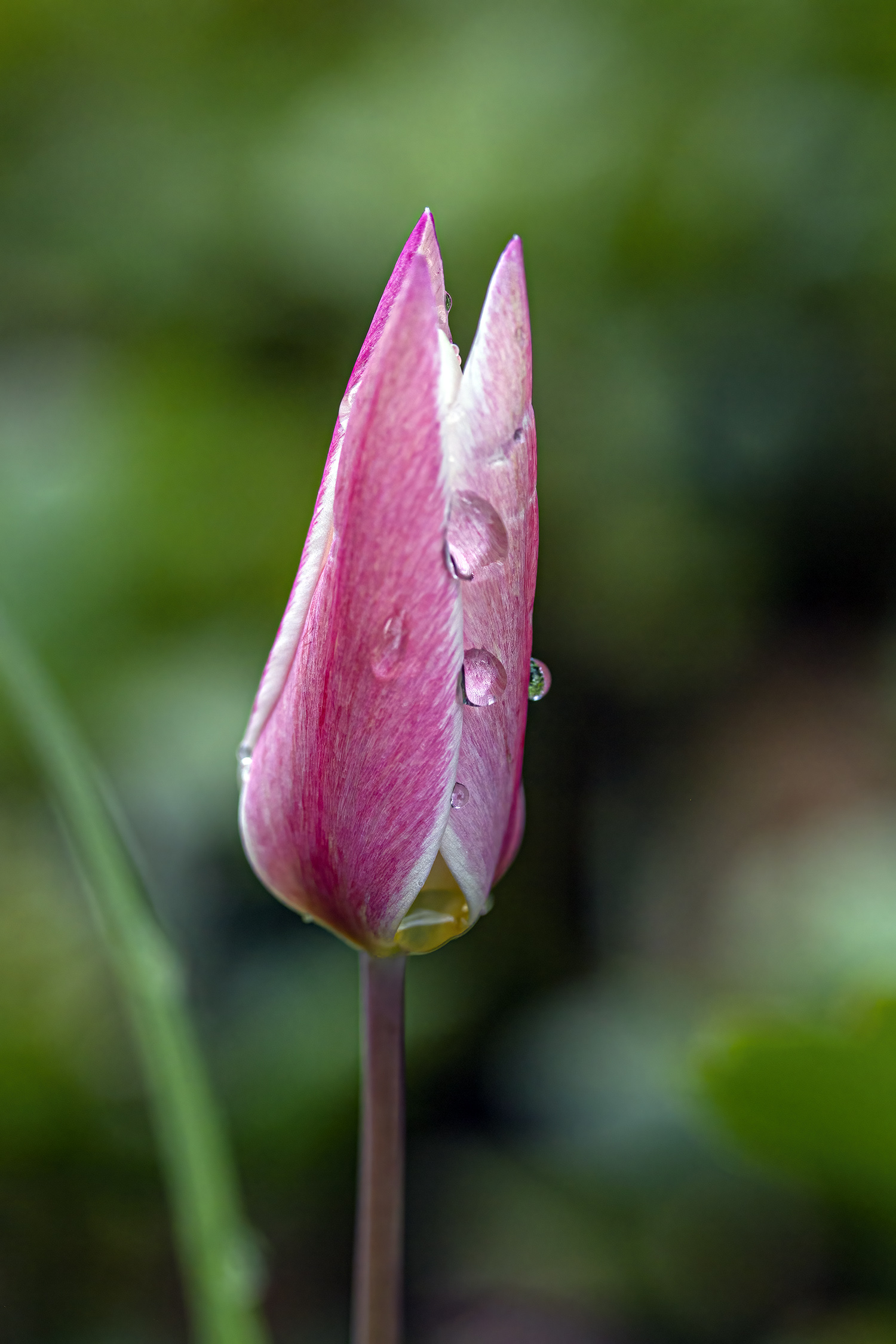
Raindrops on tulips are one of my favorite things. I photographed these different varieties of colorful tulips today in the garden of my dear friend and fellow photographer Cindy Dyer during a break in the rain.

I love spring flowers.

tulip

Lady Jane tulip

tulip

© Michael Q. Powell. All rights reserved.


Read Full Post »

I love the shape of Grape Hyacinths (g. Muscari), one of the early-appearing flowers that I look forward to each spring. The names of species sometimes do not match their appearances, but in this case the name fits perfectly—the little flowers do indeed look like a bunch of grapes.

Our recent weather has been windy, which makes it challenging to go out hunting for wildlife to photograph, because most of my potential subjects use common sense and seek shelter from the wind. As a result, I have resorted to visiting the garden of my dear friend Cindy Dyer and photographing her flowers, like this Grape Hyacinth that I spotted earlier this week.

I used a macro lens to get really close to the tiny flower to capture details, but the wind made it tough to get a sharp shot—as you get closer to a subject, the effect of any movement of the camera or the subject is magnified. On the whole, though, I like this modest portrait of one of my favorite spring flower.

Grape Hyacinth

© Michael Q. Powell. All rights reserved.

Read Full Post »

As many of you know, I do not have a garden of my own. My dear friend and photography mentor Cindy Dyer, however, lives close to me and loves to plant photogenic flowers. At this time of the year I really enjoy passing by her garden to see what has popped up.

I was delighted yesterday to see a beautiful red tulip in bloom in the middle of the garden in front of her townhouse. There was only a single tulip blooming in the midst of some hellebore plants, but it was not hard to spot. I don’t know much about tulip varieties, but think that this might be a Lady Jane tulip (Tulipa clusiana var. ‘Lady Jane‘)—I recall Cindy mentioning this variety in previous years.

I thought I would be photographing flowers close up, so I had a 60mm macro lens on my camera. This tulip, alas, was farther away than I would have liked and I did not want to step on any vegetation to get closer or to get a better angle.

I contented myself with a few shots to record this beautiful flower, my first tulip of this spring (with many more to come).

UPDATE: My memory failed me. Cindy let me know that the Lady Jane tulip is pink and white and not red like this one. I should probably have checked with her before I posted the images.

tulip

tulip

© Michael Q. Powell. All rights reserved.


Read Full Post »

For a brief period in the spring, the forest floor is carpeted with wildflowers. It is still a little early for most of the wildflowers to appear but on Wednesday I spotted a few early blooming ones during a hike in Prince William Forest Park in Northern Virginia.

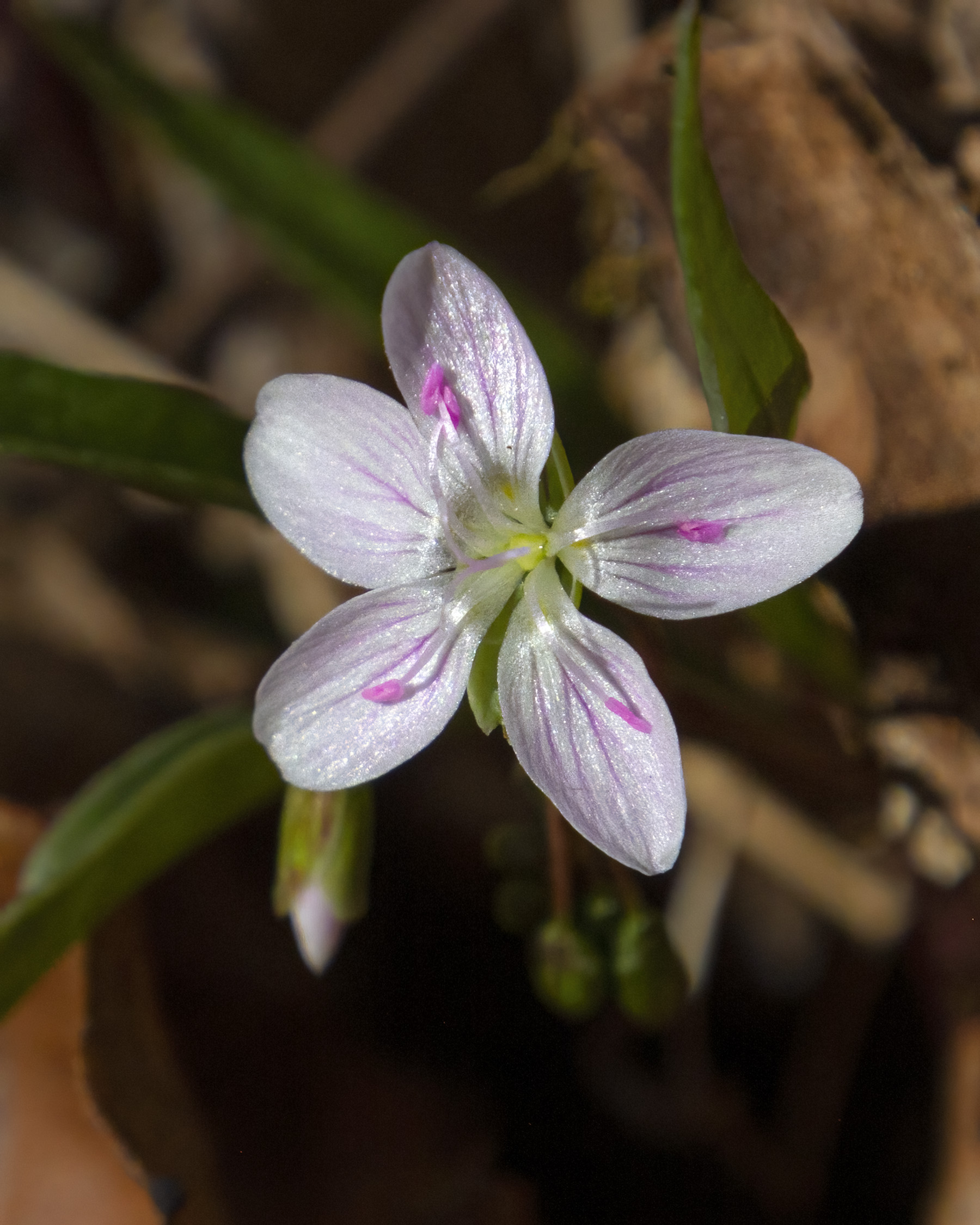
The little wild flower in the first photo is the appropriately named Virginia Spring Beauty (Claytonia virginica). I love the pops of pink in this flower, especially the stamens. According to Wikipedia, “The individual flowers bloom for three days, although the five stamens on each flower are only active for a single day.” Yikes! I guess the Spring Beauties qualify as being “ephemeral.”

The flower in the second photo is often referred to as a Quaker Lady Bluet (Houstonia caerulea)—it is also known as the Azure Bluet. Later in the spring I am certain to encounter large clusters of this cool little flower, but on this occasion there were only a few of them. I love the simple geometric pattern of the petals that someone decided resembled the traditional hats worn by Quaker ladies.

Virginia Spring Beauty

Quaker Lady Bluet

© Michael Q. Powell. All rights reserved.

Read Full Post »

When does spring begin? Many of us in the Northern Hemisphere measure the seasons using the astronomical calendar and this year spring begins on the 19th of March, i.e. the vernal equinox. For those who use the meteorological calendar, however, spring began on the 1st of March.

I generally use something other than a calendar when I measure the change of seasons. I feel the beginning of spring when the weather starts to warm up and the daylight begins to linger a bit longer. I can feel nature stirring, preparing for new life in the animal and plant kingdoms.

One of the signs of spring that I look for is the emergence of early spring flowers. This weekend I am cat sitting for my friend Cindy and her husband Michael, who are out of town on a trip to Texas. Cindy, my photography mentor and fellow photographer, has a wonderful garden that I have featured in this blog numerous times. The last couple of weeks I have checked out her garden, waiting patiently for the first flowers to appear.

I was delighted on Thursday to see that a tiny purple crocus was blooming amid all of the leaf clutter. It was only a single bloom, but it somehow filled my heart with joy and excitement. For me, spring has begun.

crocus

crocus

© Michael Q. Powell. All rights reserved.


Read Full Post »

Nature moves in seasonal cycles, constantly changing as plants and creatures appear and disappear. At this time of the year I begin to look for signs of spring. The calendar tells me that I have another month to wait, but nature does not always follow the manmade calendar.

As I was walking to a craft store on Saturday I was delighted to spot this solitary daffodil poking out of the ground, already in bloom. I snapped this quick photo with my iPhone to record the moment, my first daffodil of 2024.

Whenever I record the “first” photo of any subject, whether it is a completely new one or the reappearance of a familiar one, I am happy to capture whatever photo I can. Later, when I have a second chance, I will worry more about artistry and technique. At that first moment, I am content to immerse myself in joy and wonder—the photo is of secondary concern.

daffodil

© Michael Q. Powell. All rights reserved.

Read Full Post »

Flowers are beautiful when you look at them from the front, of course, but they can be equally beautiful when you look at them from behind, especially when they are backlit. That was certainly true for these colorful violas that I photographed last week at Green Spring Gardens, a county-run historical garden not far from where I live.

I especially like the first shot, which has an abstract quality to it, caused in part by photographing the flower at close range with my macro lens. The flower is reduced to a mass of shapes and color and of light and shadows to the point where the brain at first glance does not seem to be able to figure out what the subject is.

viola

violas

© Michael Q. Powell. All rights reserved.

Read Full Post »

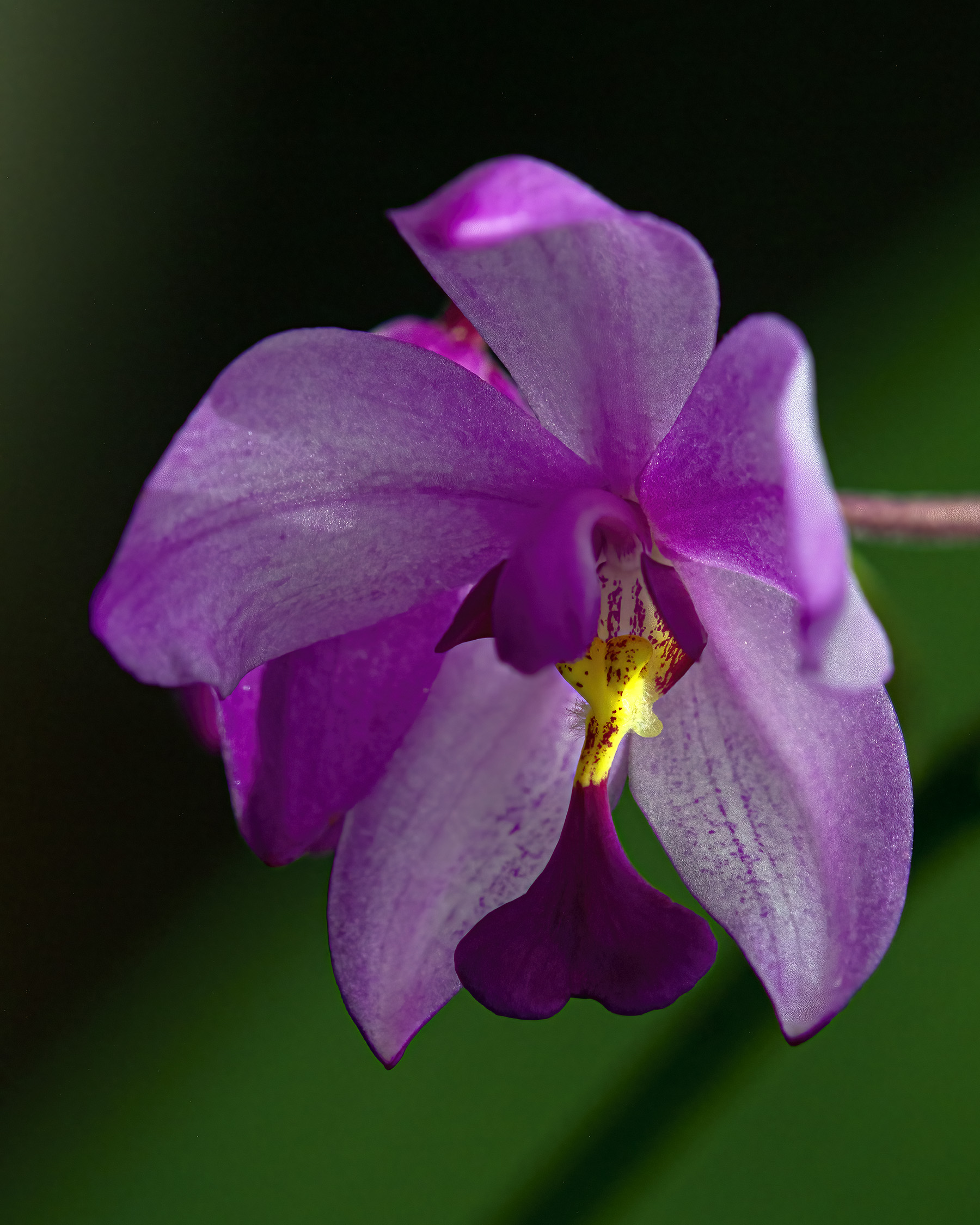
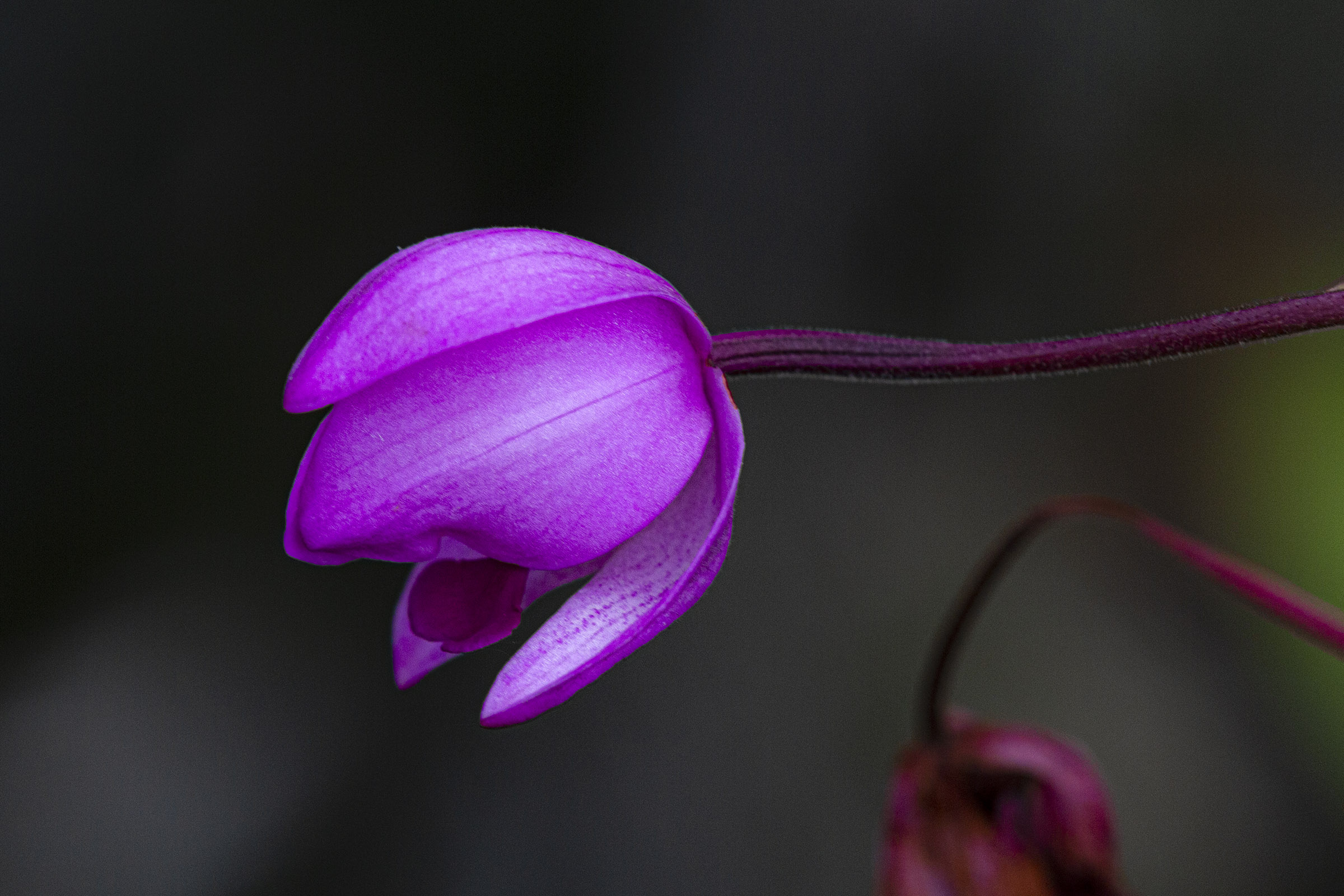
In addition to the stunning pink and purple bromeliad that I featured in an earlier posting, here are some shots of tropical plants that I observed in the “glasshouse” at Green Spring Gardens last week. The first two shots are of what I believe is a ground orchid—it may be a Phillippine Ground Orchid (Spathoglottis plicata), but there are a number of similar species, so I cannot be sure of the identification.

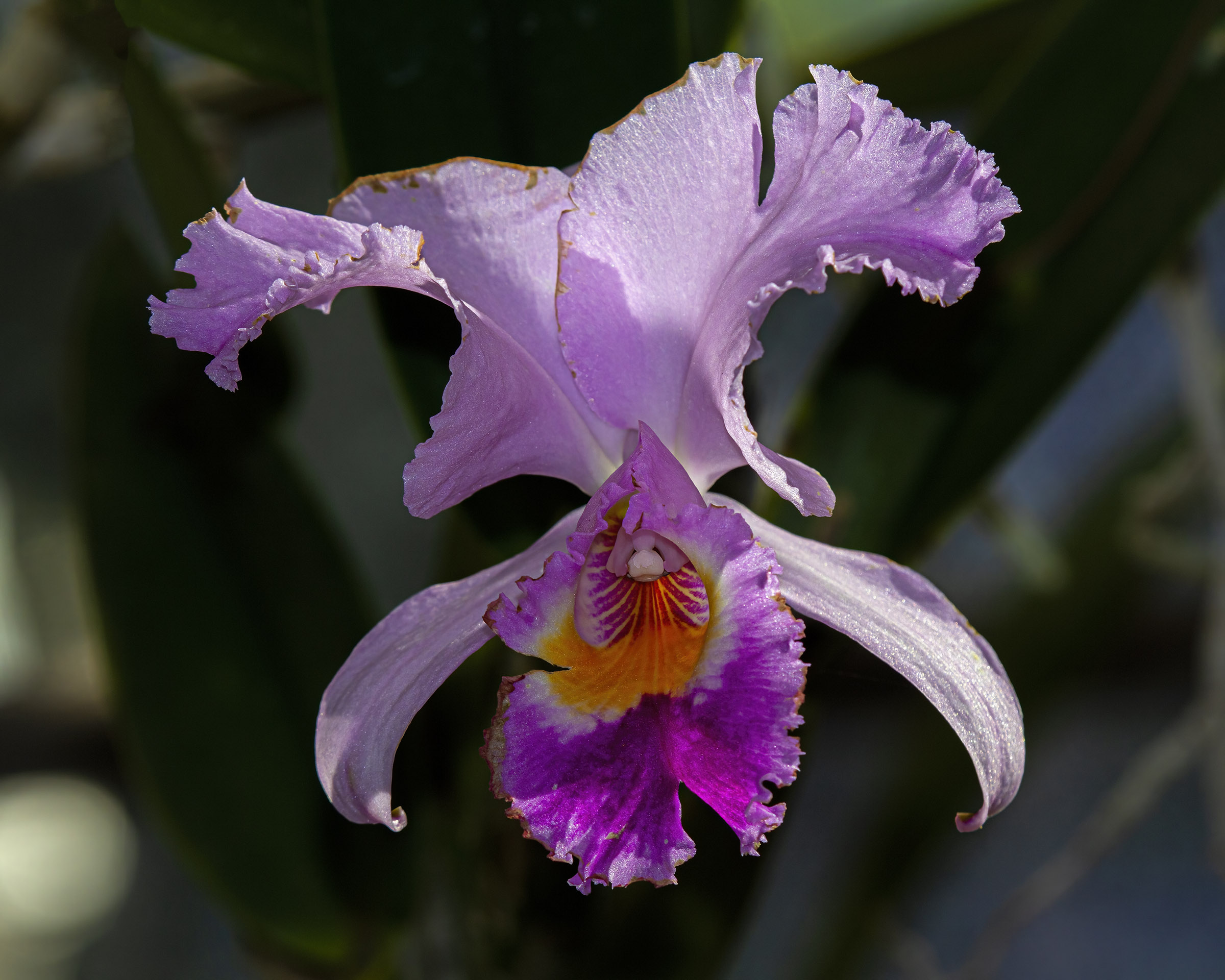
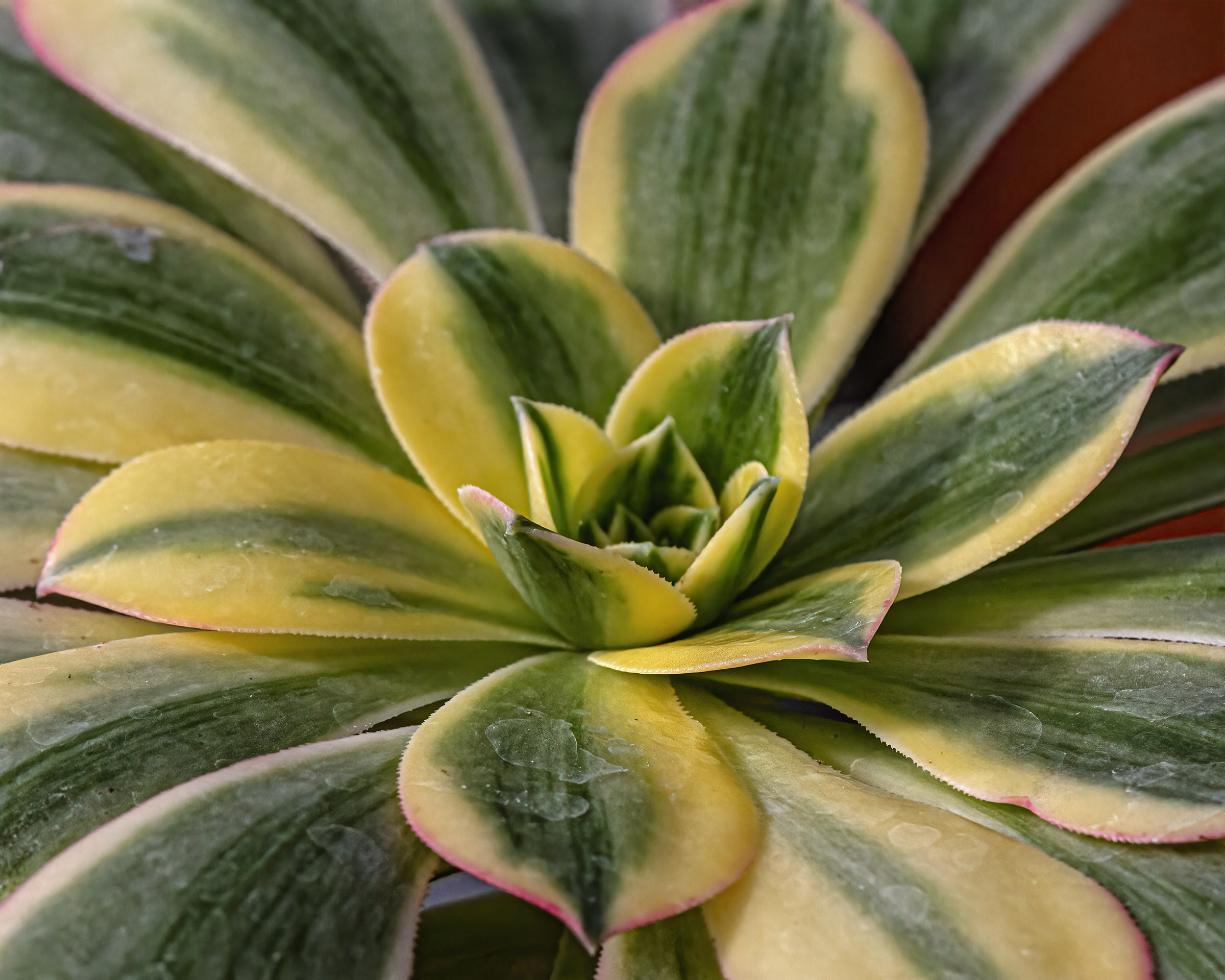
The third photo shows an orchid that is more typical of what I imagine when I think of an orchid. It is a little past its prime, but is still incredibly beautiful. The final photo is a close-up view of one of the many succulents that I observed. I love the geometric patterns of the multi-colored leaves in the image.

One of the nice things about taking photos indoors was that I did not have to worry about the wind creating movement. However, there was not a lot of space for maneuvering and the background was often cluttered, so I had to work hard to find pleasing angles for my photos.

This is a totally different style of photography that the bird photography I have been doing the past few months, but I think that it is good to mix things up a bit to keep from getting stuck in a rut photography-wise.

ground orchid

ground orchid

orchid

succulent

© Michael Q. Powell. All rights reserved.

Read Full Post »

During the gray days of winter my senses are starved for color as the world turns mostly monochromatic. Where can I find bright colors? For a few blissful moments I immersed myself in a tropical world this past Thursday when I visited the “glasshouse,” the small greenhouse at Green Spring Gardens in Alexandria, Virginia.

There were some orchids and succulents, but my eyes were immediately attracted to the amazing hot pink and purple colors of an unusual-looking plant. I had no idea what kind of plant it was, but was absolutely mesmerized by this bold colors and managed to capture a few close-up shots of it with my macro lens.

When I returned home I started my research and eventually figured out that it was some sort of bromeliad. What in the world is a “bromeliad?” Bromeliads are a group of mostly tropical plants that belong to the family Bromeliaceae. I read and re-read descriptions of the characteristics and got tangled up in the scientific jargon of plant anatomy. As I understand it, many bromeliads are able to store water in a structure formed by their tightly overlapping leaf bases—the pineapple is the only bromeliad that immediately comes to mind.

With the help of my dear friend and photography mentor Cindy Dyer, I determined that this colorful plant is probably a Blue Tango Bromeliad (Aechmea ‘Blue Tango’) or possible a Dwarf Blue Tango Bromeliad (Aechmea ‘Del Mar’). Both of these are hybrid cultivars of plants that are native to tropical areas and require high humidity levels to thrive—the glasshouse was humid, but not as steamy as some that I have previously visited.

Blue Tango Bromeliad

Blue Tango Bromeliad

© Michael Q. Powell. All rights reserved.


Read Full Post »

Yesterday I had the desire to photograph something different. For the past few months, my long 150-600mm telephoto zoom lens has remained on my camera and I have focused mostly on birds. I decided to switch back to my 180mm macro lens, the lens that I use most of the time during warmer months, and set off for Green Spring Gardens, a historic county-run park only a few miles from where I live.

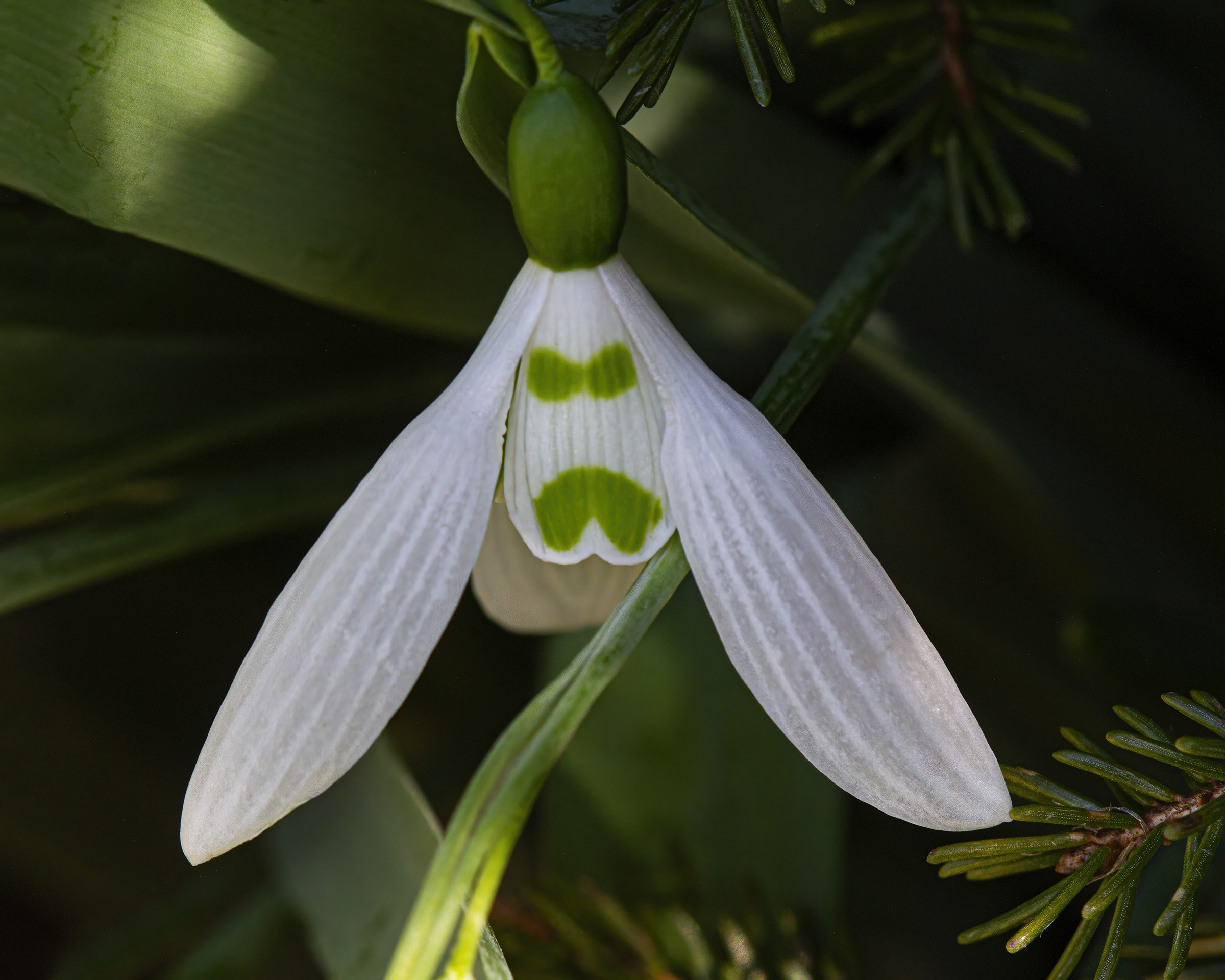
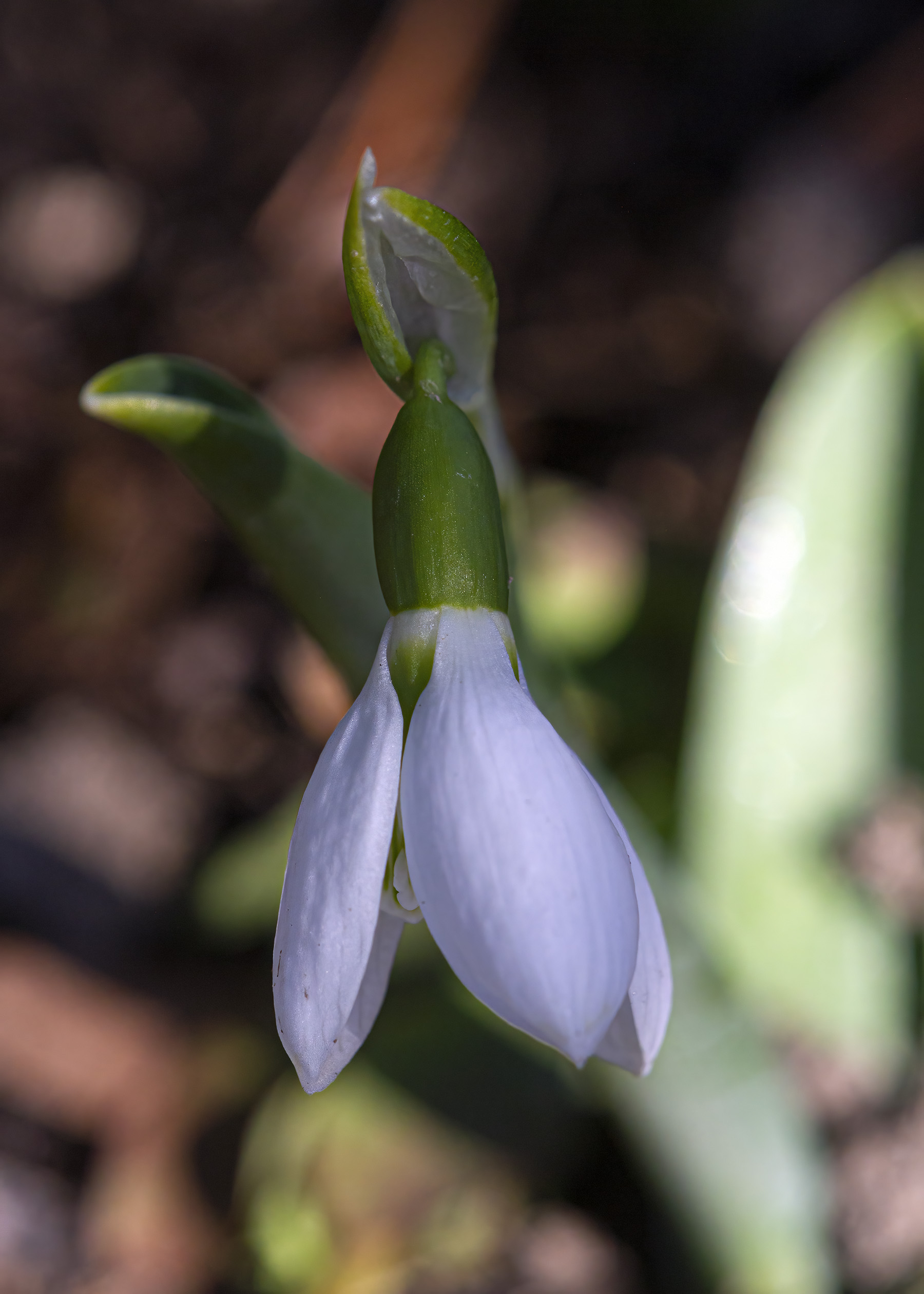
Not surprisingly, I did not spot any insects, but I was thrilled to find several patches of Snowdrop flowers (g. Galanthus) in bloom. I had a fun time trying to compose some  shots of these beautiful little flowers, though I did end up a bit muddy, because it had rained a lot the previous day.

At this time of the year the flower beds are mostly dirt and/or mulch, so it is impossible to get the smooth green backgrounds that I often strive for during the spring and summer months. However, I was able to blur the background some by carefully choosing my shooting angle and adjusting my camera settings.

During my time at the park, I also visited the “glasshouse,” a small greenhouse that houses tropical flowers, succulents, and bromeliads. It felt great to soak up the warmth of the sun in this enclosed environment and I managed to take a few photos there that I will share in a future blog posting.

Snowdrop

Snowdrop

Snowdrop

© Michael Q. Powell. All rights reserved.

Read Full Post »

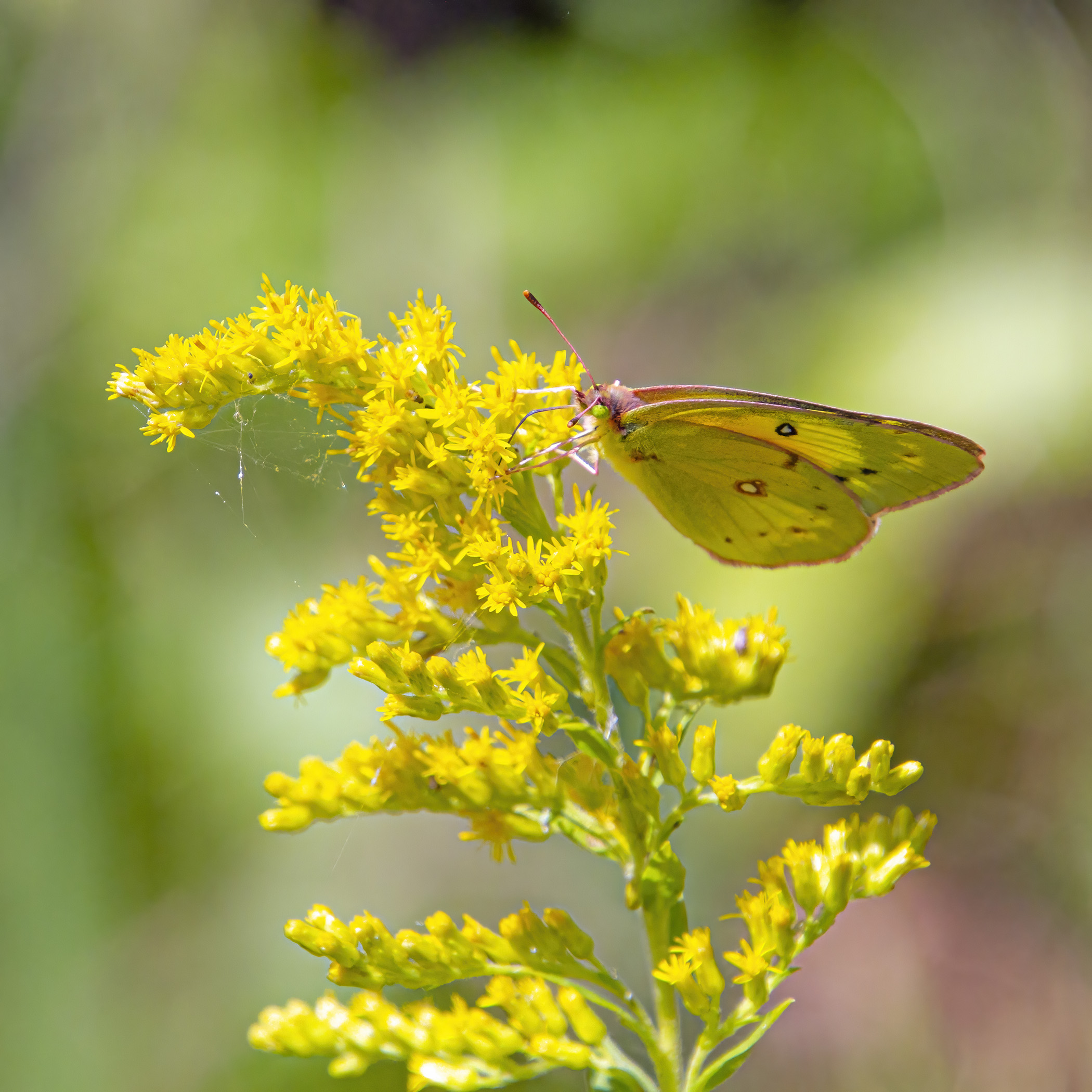
Lots of wildflowers still in bloom as we move deeper into autumn here in Northern Virginia. Last night we had our first frost warning of the season, but I don’t think there was any frost this morning in my neighborhood—a hard frost may speed the demise of many of the remaining butterflies and dragonflies. I was therefore delighted last Thursday to spot this Clouded Sulphur butterfly (Colias philodice) feeding on the flowers of what I believe is a White Heath Aster (Symphyotrichum ericoides) plant at Huntley Meadows Park.

Although part of the butterfly is obscured by the stem and the leaves in the foreground of this image, I like the way that I was able to capture the details of the butterfly’s green eyes and its extended proboscis.

Clouded Sulphur

© Michael Q. Powell. All rights reserved.

Read Full Post »

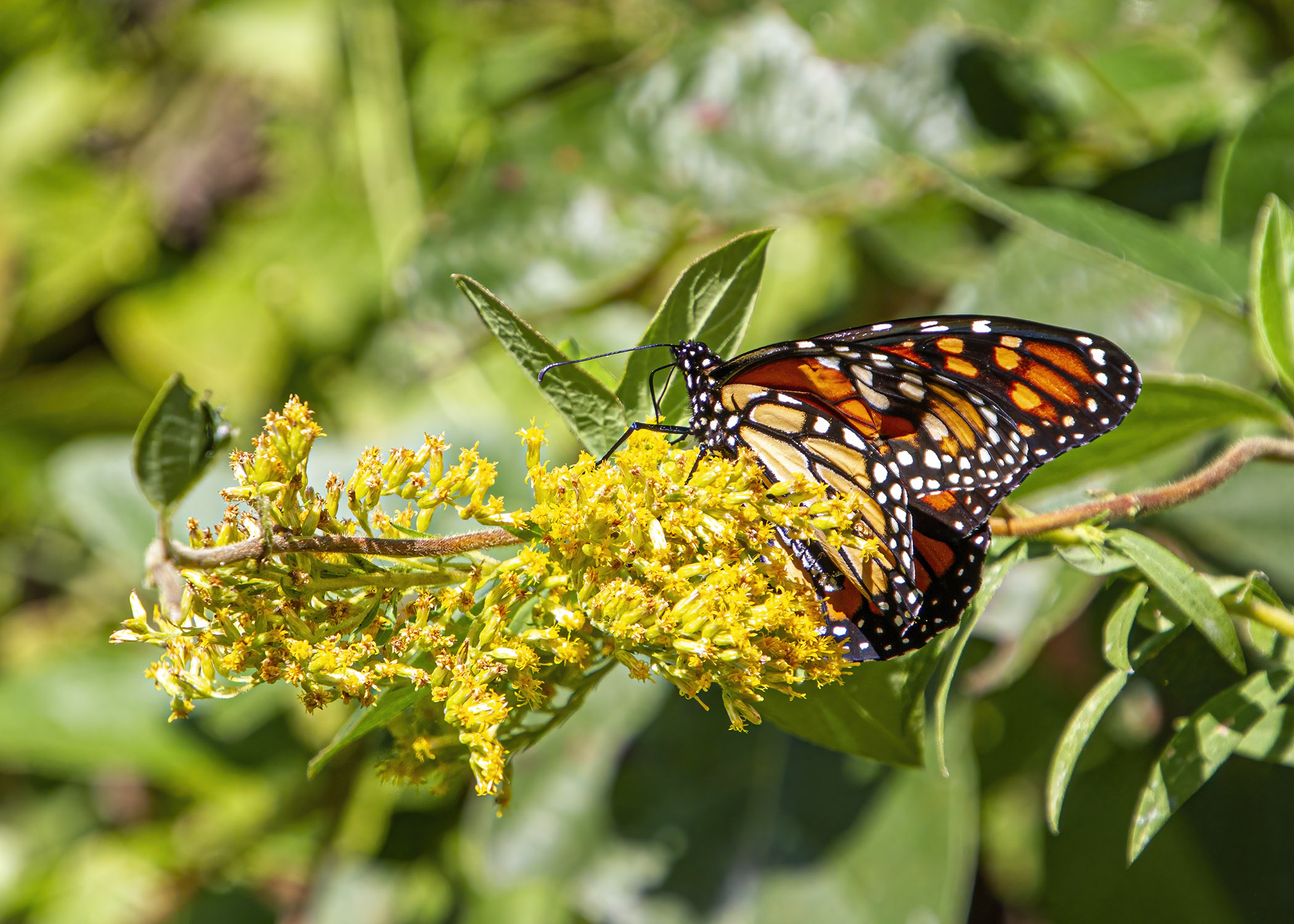
I love bright colors and instinctively smile when I see the large patches of goldenrod that are still in bloom at Occoquan Bay National Wildlife Refuge. The insects seem to love these flowers too and last Tuesday I spotted a large Monarch Butterfly (Danaus plexippus) and smaller Clouded Sulphur butterfly (Colias philodice) feeding on goldenrod.

Monarch

Clouded Sulphur

© Michael Q. Powell. All rights reserved.


Read Full Post »

On Monday I captured this shot of a small white spider—I think it may be a White-banded Crab Spider (Misumenoides formosipes)—at Occoquan Bay National Wildlife Refuge. I really like the way that the coloration of the tips of the spider’s leg are an almost perfect match for the spiky thorns of the vegetation. In the second photo, the spider looks a lot like a crab in the way that it is shaped and was moving—it’s easy to see why it is called a “crab” spider.

White-banded Crab Spider

White-banded Crab Spider

© Michael Q. Powell. All rights reserved.

Read Full Post »
Older Posts »