Feeds:
Posts
Comments

Archive for the ‘dragonfly’ Category

I have been seeing Common Green Darner dragonflies (Anax junius) in the air for several weeks now, but only this past Monday did I finally catch one taking a break from patrolling while I was tracking it at Occoquan Regional Park. It is quite common to see Common Green Darners patrolling high overhead in a wide variety of habitats, darting to and fro, feeding on the fly.

These large colorful dragonflies—about three inches (75 mm) in length—are among the first to be spotted in the early spring and among the last to disappear late in the autumn. How is such a long flight season possible? The simple answer is that Common Green Darners are a migratory dragonfly species. Kevin Munroe described the migratory cycle on his wonderful Dragonflies of Northern Virginia website in these words:

“Common Greens seen in our area in early spring are in fact migrants from points south. They emerge in the Southeast and fly north, arriving here late March thru May. After their long flight, they mate, lay eggs and die. Their young emerge in July and August. Congregating in large swarms, this second generation begins flying south in September. They lay eggs that fall, after arriving in their southern destinations, and die. When their young hatch in March, they fly back to Northern Virginia and it starts again— a two generation migration.”

I love the bright and cheery colors of the Common Green Darner, colors that reminded one of my Facebook viewers of a tropical parrot. I also really like the bullseye pattern on the dragonfly’s “nose,” just below its large compound eyes. Be sure to click on the image if you want to see these details better.

Common Green Darner

© Michael Q. Powell. All rights reserved.


Read Full Post »

Have you ever watched a dragonfly-to-be break out of its exoskeleton and undergo a remarkable metamorphosis from a water-breathing nymph to an amazing aerial acrobat? It is an amazing and fascinating process that rivals (or maybe even surpasses) the more familiar transformation of a butterfly that many of us studied in school.

On a recent excursion to look for dragonflies in Prince William County, my good friend and fellow dragonfly enthusiast Walter Sanford excitedly called out to me that he had spotted a dragonfly that was midway through the process of emergence. We had not had much success up to that point in the day, so Walter’s news was especially welcome.

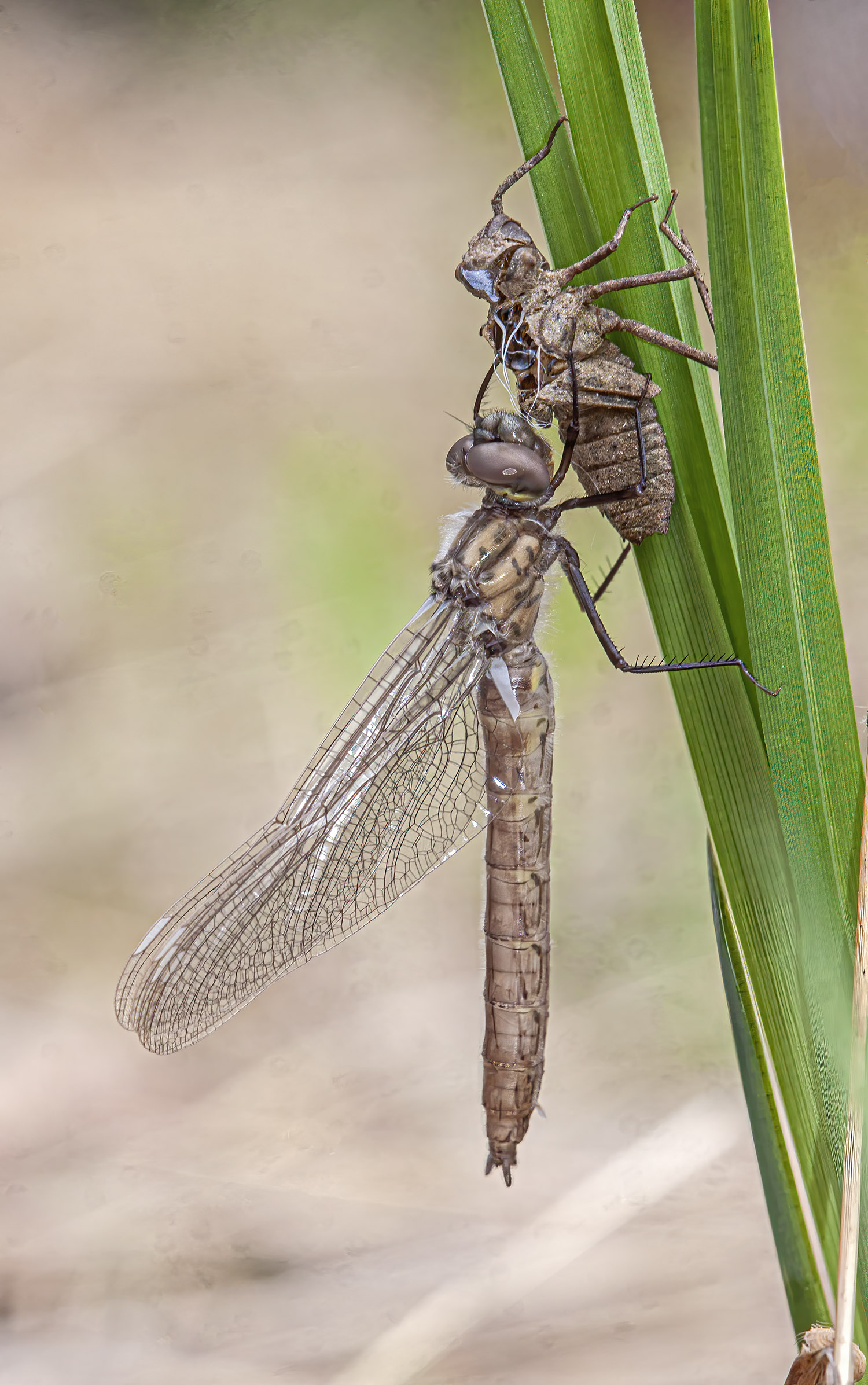
When dragonflies are in the process of emergence, they are very vulnerable. Their bodies are undergoing some incredible changes and they do not yet have the ability to fly. If you look at the first photo and compare the size of the exoskeleton (often referred to as an exuvia) to that of the dragonfly, you can get a sense of the magnitude of the changes that were occurring.

I moved a little closer for the second shot, being careful not to disturb the dragonfly, in order to capture some additional details. The exoskeleton shows, for example, little wing pads that are tiny when you compare them to the wings that are still closed over the dragonfly’s body. A little later in the process, the dragonfly will unfold the wings and will be be able to fly, albeit weakly at first.

At this stage, we could tell that the dragonfly was a female, because of the shape of the terminal appendages, but we could not determine its species, because its colors and markings were still really pale. Depending on the species, this transformation process can take as long as several hours and it can sometimes take a few days for the colors and markings to darken. (If you are interested in this whole process, I witnessed the it from start to finish several years ago and took a series of photos that documented the process in a blog posting called Metamorphosis of a dragonfly.)

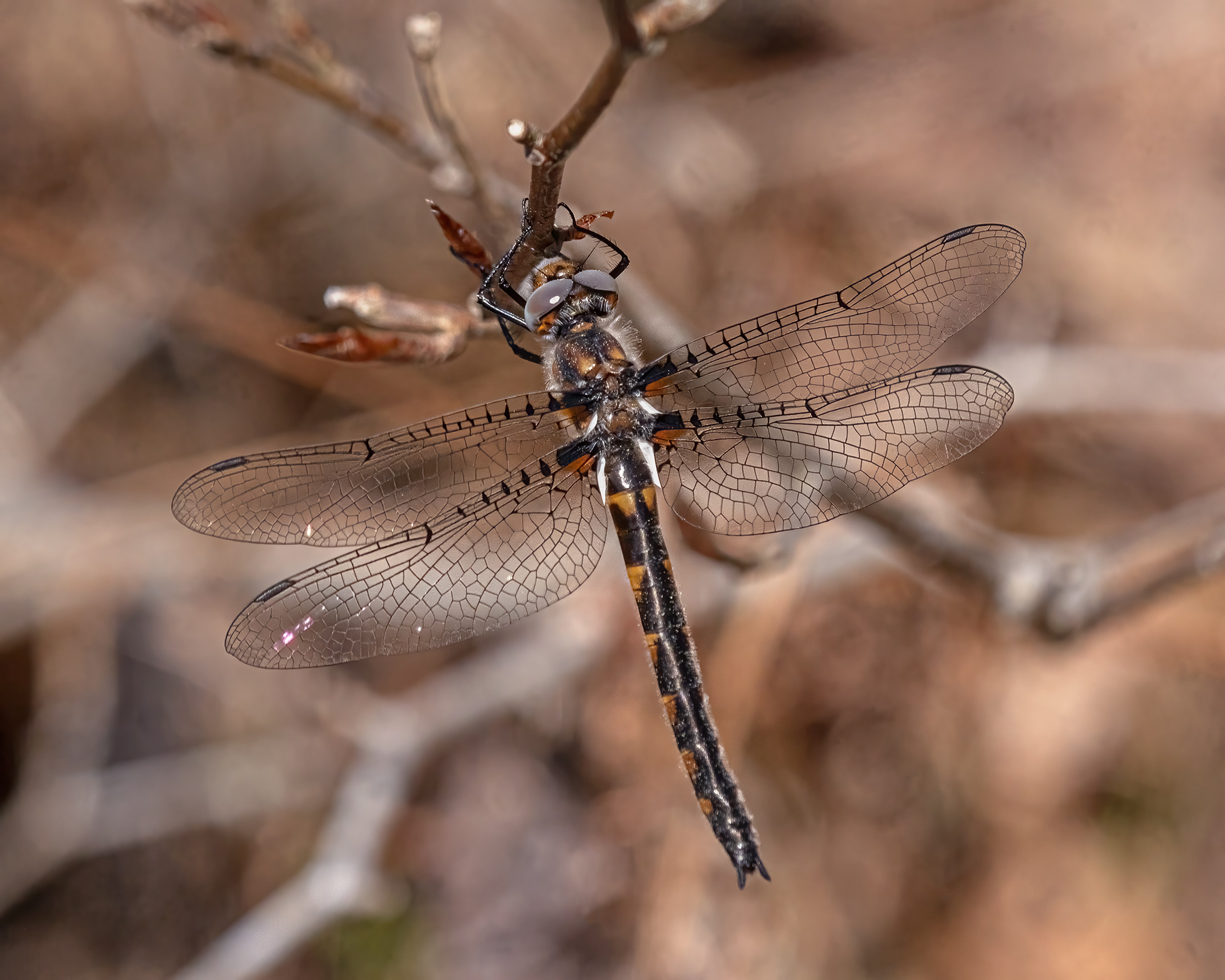
Walter was eventually able to determine that this was a female Uhler’s Sundragon (Helocordulia uhleri). My final photo shows an adult female Uhler’s Sundragon that I photographed later that same day, so you can easily see that the dragonfly was not yet done with her transformation when we photographed her. 

How did Walter do it? For the answer to that mystery, check out Walter’s blog posting today called Uhler’s Sundragon dragonfly (emergent female) for the fascinating story of his detective work and additional photos and details of our encounter with this emerging dragonfly.

Uhler's Sundragon

Uhler's Sundragon

Uhler's Sundragonfly

© Michael Q. Powell. All rights reserved.


Read Full Post »

When I photographed this dragonfly on Friday at Occoquan Bay National Wildlife Refuge, I had no doubt in my mind that it was a Common Baskettail dragonfly (Epitheca cynosura).  I had seen dragonflies of this species several times near that area of the refuge, including once earlier this year. Besides, what else could it be?

I got a quick response to that question when I posted a photo to the Virginia Odonata group, a Facebook forum devoted to dragonflies and damselflies. One viewer suggested that it looked more to him like a Slender Baskettail dragonfly (Epitheca costalis) than a Common Baskettail. Eventually several experts weighed in and also opined that it looked like a male Slender Baskettail, though one acknowledged that it was difficult to make a definitive call based on my photos that he judged to be “suboptimal.”

So how do you tell the species apart? Slender Baskettails tend to have a narrower waist and are relatively slimmer, but the only way to know for sure is by the length of the cerci, the dark black terminal appendages at the tip of the abdomen (the “tail”). The cerci are longer on male Slender Baskettails than on Common Baskettails. (If you want to know more about dragonfly terminal appendages, check out a posting by fellow dragonfly enthusiast Walter Sanford entitled Dragonfly terminal appendages (male, female).)

The folks who suggested that this dragonfly is a Slender Baskettail did so on the basis of my photos, but that is not really a reliable method, because the angle and lighting can distort perceptions. How do you know for sure? One expert stated that “you can really only ID them by measuring the cerci which I do of a specimen under a microscope.” I may be a little geeky when it comes to dragonflies, but I am not about to measure a specimen’s anatomical parts with a microscope.

I am left therefore with a bit of a scientific mystery. Is it a Slender Baskettail or a Common Baskettail dragonfly? It might be a bit of heresy to some, but it does not really matter to me. I was simply happy to capture these cool photos of a beautiful creature.

Shakespeare’s words about a rose in “Romeo and Juliet” could easily be applied here, “A rose (or a dragonfly) by any other name would smell (or look) as sweet.”


Slender Baskettail

Slender Baskettail

© Michael Q. Powell. All rights reserved.


Read Full Post »

I was thrilled yesterday at Occoquan Bay National Wildlife Refuge to spot my first Blue Corporal dragonfly (Ladona deplanata) of the season. This little dragonfly—about 1.4 inches (36 mm) in length—is one of the earliest dragonflies to reappear each spring in my area and was one of my target species for the day.

If you look carefully at the upper part of the thorax (the “shoulders”) you can see the two light-colored stripes, the traditional military insignia for a corporal, that are responsible for the name of this species. Blue Corporals most often perch flat on the ground, which can make them really hard to spot when they land. In this case, the ground was so cluttered with dried reeds that I could barely detect the dragonfly’s wings. (You can see the wings more easily if you click on the image to enlarge it.)

Blue Corporal

© Michael Q. Powell. All rights reserved.

Read Full Post »

I spent most of my time looking for birds during a trip last week to Occoquan Bay National Wildlife Refuge and I managed to capture the images of the bald eagles that I featured yesterday. The day had started off cool and overcast, more suitable for birds than for dragonflies, but when the sun finally broke through in the late afternoon, I decided to swing by a small pond on my walk back to the parking lot on the off chance that I might find a dragonfly.

My hunch paid off when I spotted this female Ashy Clubtail dragonfly (Phanogomphus lividus) perched low to the ground. At that moment I had my Tamron 150-600mm lens attached to my camera and that presented a challenge, because its minimum focusing distance is 8.9 feet (2.70 meters), so I had to back up. At that distance it is hard to locate and focus on a subject that is only 2 inches (50 mm) in length. Fortunately I have been in this situation before and I steadied myself, focused manually, and captured the first image before the dragonfly flew away.

Having established that there there was at least one dragonfly in the area, I switched to my Tamron 180mm macro lens, my preferred lens for dragonflies, and continued my search. A few minutes later I spotted another female Ashy Clubtail when it flew up into some low hanging vegetation and I captured the second image. There is a good chance that this was the same individual that I photographed earlier—both of them are pale in color, suggesting that they had only recently emerged from their larval state.

As I moved a little closer for the final shot, the dragonfly closed its wings overhead, reverting briefly to an earlier stage when it was in the process of emerging. I have seen this happen before when a newly emerged dragonfly, sometimes referred to as a teneral, flew for the first time and its wings were still in a very fragile state. At this point, I decided to stop shooting, fearful that I might spook this newly emerged dragonfly into flying at a time when she clearly needed to rest.

If you are unfamiliar with the amazing process that a dragonfly goes through in transforming itself from a water-dwelling nymph to an aerial acrobat, check out my blog posting called Metamorphosis of a dragonfly that documents the entire process in a series of photos.

Ashy Clubtail

Ashy Clubtail

Ashy Clubtail

© Michael Q. Powell. All rights reserved.

Read Full Post »

Here are a few shots of one of the cool early spring dragonflies in our area, the distinctive Twin-spotted Spiketail dragonfly (Cordulegaster maculata). I photographed what I believe are two different males on 16 April at Occoquan Regional Park. I was fortunate to spot these dragonflies as they were flying about low to the ground and was able to track them visually to their perches less than a foot (30 cm) above the ground. As you can see from the photos, Twin-spotted Spiketails hang from vegetation at an angle rather than perch horizontally as some dragonflies do.

This species is considered to be uncommon in our area, so I was quite happy to spot them again this year in a location where I had seen them last year. According to Kevin Munroe’s wonderful website Dragonflies of Northern Virginia, Twin-spotted Spiketails “are uncommon to rare, and need small, perennial, forest streams with stable, relatively un-eroded banks and a noticeable, steady current. They don’t need the cold, highly-oxygenated, rocky waters of a trout stream, but do need streams with halfway decent water quality and relatively low stormwater surges.”

Over the past few years I have learned, thanks to the helpful instruction of fellow dragonfly enthusiast Walter Sanford, that the habitat really matters for many of the uncommon dragonfly species in our area. There are no guarantees that I will find the my target species when I go searching for them, but there is a much greater chance if I know where to look and when, given that some of these species are present for only a few weeks each year.

In case you are curious, these dragonflies are much larger than the Uhler’s Sundragons and Selsys’s Sundragons that I featured in recent postings. The sundragons are about 1.5 inches (40 mm) in length, while the Twin-spotted Spiketail can be almost 3 inches (76 mm) in length.

Twin-spotted Spiketail

Twin-spotted Spiketail

Twin-spotted Spiketail

© Michael Q. Powell. All rights reserved.

Read Full Post »

Normally when I photograph a new species of dragonfly I am immediately ecstatic, but that was not the case on Tuesday. After a long day of searching for Uhler’s Sundragons (Helocordulia uhleri) in Prince William County with fellow dragonfly enthusiast Walter Sanford, we were excited when we finally spotted a few of them. It had been an overcast day and it was only when the sun came out after noon that the dragonflies began to appear. Walter was thrilled, but my excitement was a little more muted, because I had photographed this species the previous week—check out my posting First dragonflies of the season for details and photos of my adventures that day.

After a while, Walter noted to me that all of the Uhler’s Sundragons that he had seen so far were female and that he hoped he would see a male. This may sound a little strange, but with some species of dragonflies, the females hang out in a separate area from the males until they are ready to mate, so you do not always see the genders intermixed.

I was wandering around the area a bit, as I am prone to do, when Walter called out to me that he had found a male. I rushed over and managed to get some shots of the specimen, including the first two images below. As it turns out, that was the only male that we saw all day.

The following day, Walter sent me an excited Facebook message informing me that the male dragonfly that we had both photographed was not a Uhler’s Sundragon, but was a Selys’s Sundragon (Helocordulia selysii), a similar species that neither of us had ever seen before. Walter did a records search and it looks the species had never before been documented in Prince William County. Finally I was ecstatic.

How did we not notice immediately that this was a different species? One of the primary differences between the species is that Uhler’s Sundragons have amber-colored markings mixed with dark ones at the base of their wings, while Selys’s Sundragons have only the dark markings. Given the small size of these dragonflies, these differences are hard to spot in the field, but are much easier to see when reviewing images afterwards.

For comparison purposes, I have included a photo of a male Uhler’s Sundragon that I photographed last week. If you look carefully, you can see the amber-colored markings in the final photo that are absent in the first two photos.

You may also notice that there is a spider on the branch in the final photo that appears to be reaching down and tapping the dragonfly on the “shoulder.” In this scenario, I am not sure which species would be the predator and which would be the prey. I have documented several cases in which dragonflies have been caught in spiderwebs and also a case when a jumping spider took down a much larger dragonfly (see my 2014 posting Spider captures dragonfly—the story for a fascinating series of images).

If you would like to see Walter’s account of our encounter with the Selys’s Sundragon, check out his blog posting today entitled Selys’s Sundragon dragonfly (male).
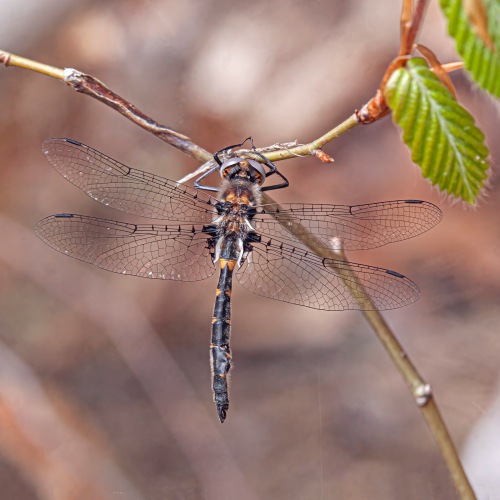
Sely's Sundragon

Selys’s Sundragon, 13 April 2021

Sely's Sundragon

Selys’s Sundragon, 13 April 2021

Uhler's Sundragon

Uhler’s Sundragon, 8 April 2021

© Michael Q. Powell. All rights reserved.

Read Full Post »

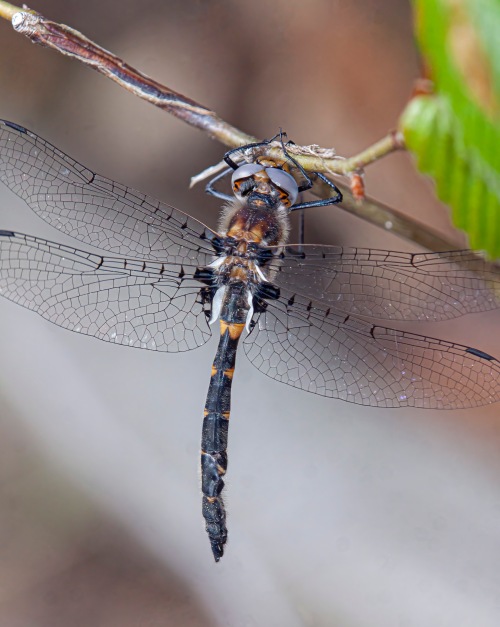
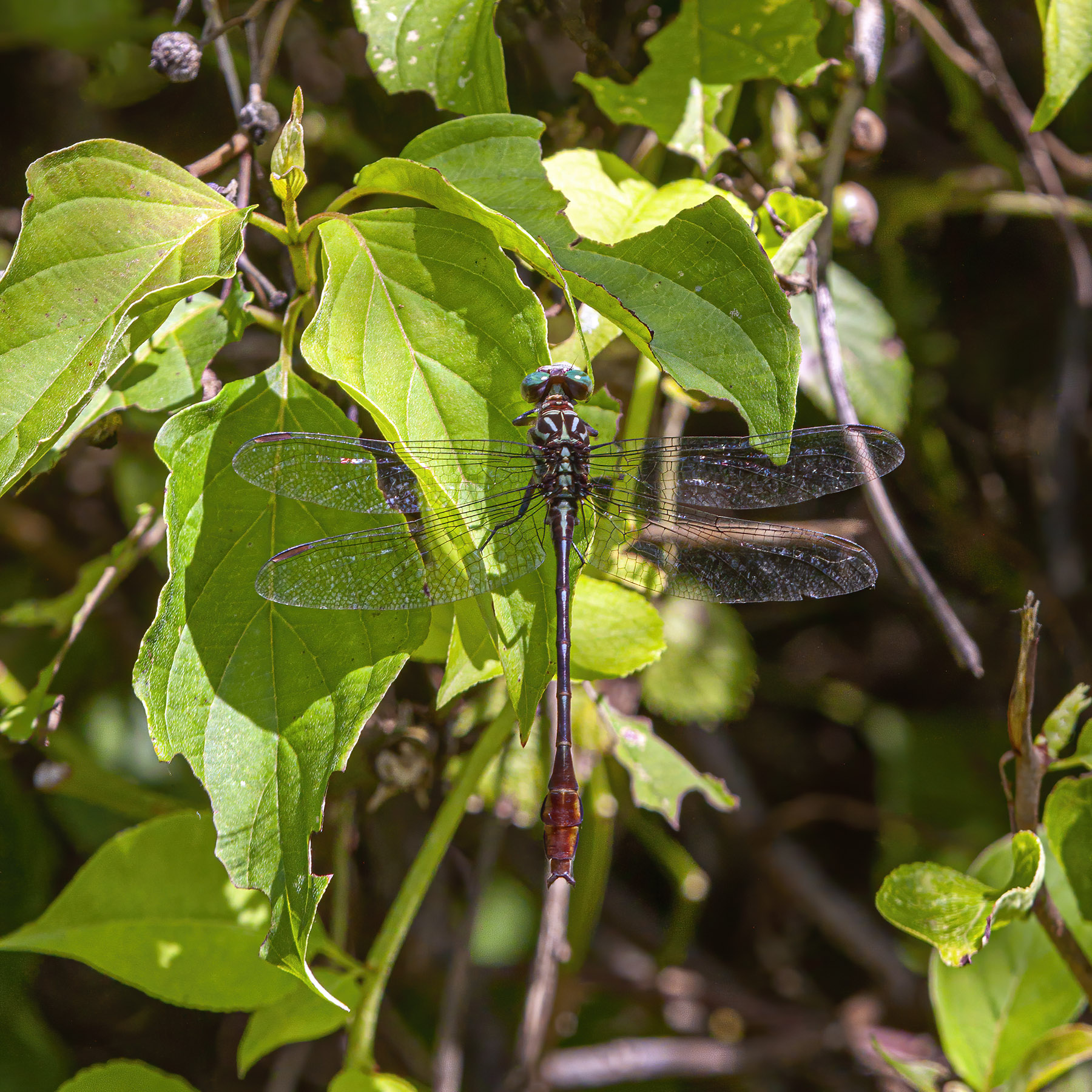
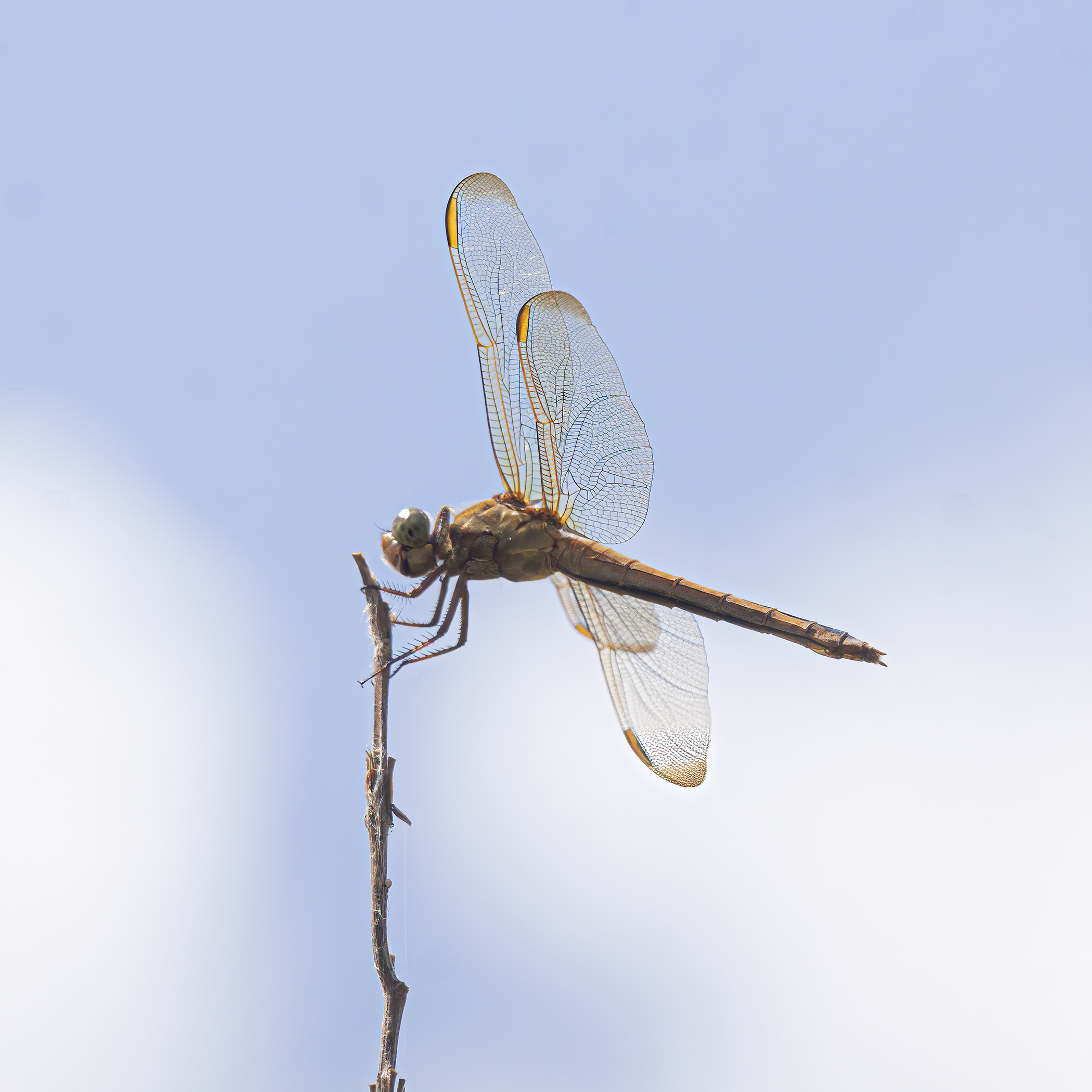
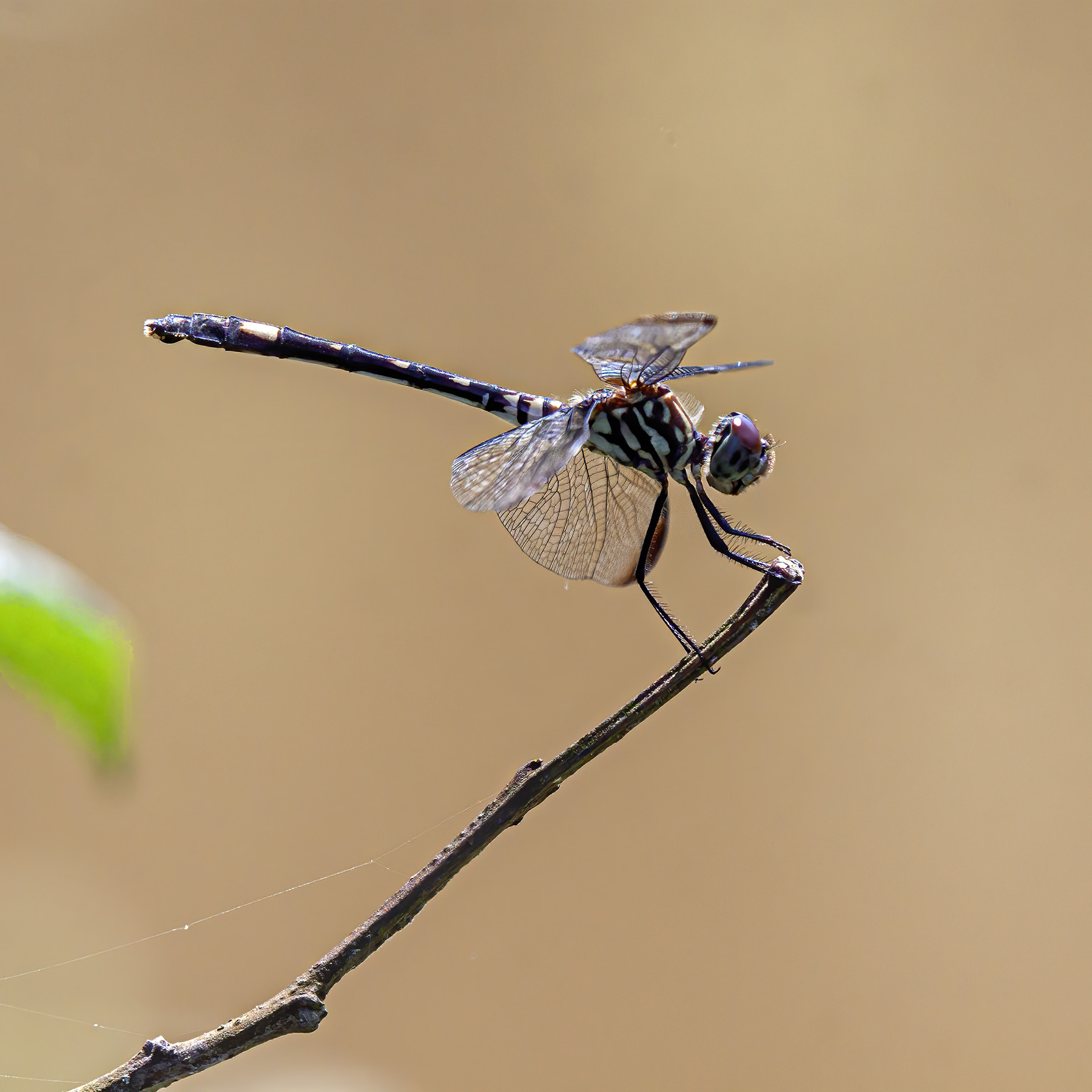
On Thursday I finally photographed my first dragonflies of the season. I had previously spotted Common Green Darners several time, but they don’t really “count” because I was not able to capture images of them. I initially checked out several locations at a stream in Prince William County, Virginia, where I had seen Uhler’s Sundragon dragonflies (Helocordulia uhleri) in recent years and came up empty-handed.

However, I was thrilled when later in the day I spotted Uhler’s Sundragons at several locations further upstream from my previous locations. Uhler’s Sundragons have a brief and very early flight period and are considered rare in our area. They also are habitat specialists and “they need clean, small to medium, rocky forest streams with gravelly and/or sandy substrate, and a decent flow,” according to the wonderful Dragonflies of Northern Virginia website.

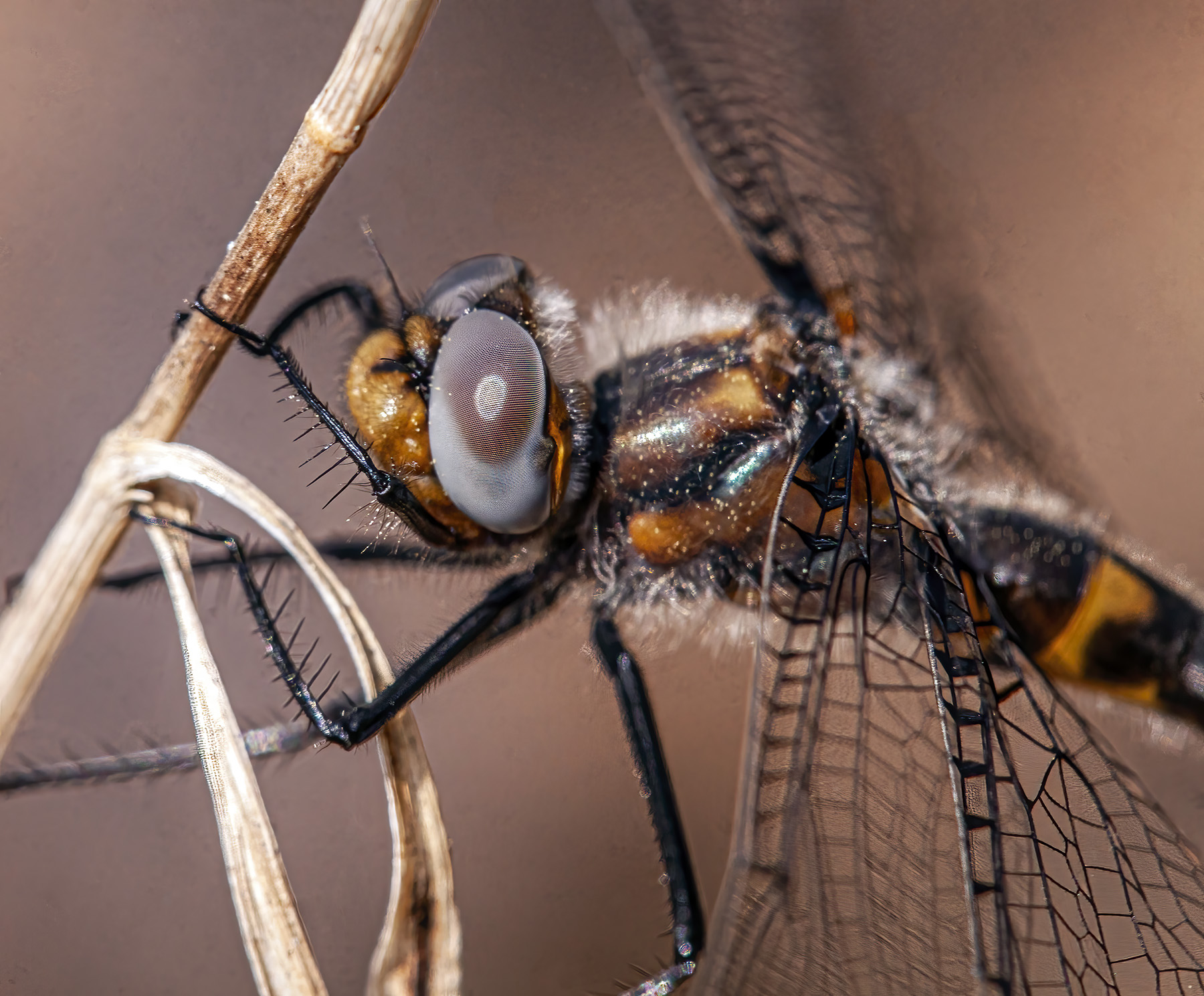
These three photos are indicative of the types of photos that I often try to capture of dragonflies. I love to try to get as close as I can and take extreme close-up shots, like the first one. You can easily see the spines on the legs of the dragonfly and even some of the ommatidia, the optical units that make up the amazing compound eyes of the dragonfly.

The second shot of a female Uhler’s Sundragon is a good illustration of the way that I try to separate my subjects from the background. The final shot of a male Uhler’s Sundragon shows more of the habitat in which I found the dragonfly. The background is a little busy, but I like the way that the image shows the transparency of the dragonfly’s wings.

In case you are curious about how I can tell the gender of these dragonflies, one of the primary keys is to look at the tips of the abdomens (the “tail”)—you will probably note the different anatomical shapes if you compare the second and third images.

Uhler's Sundragon

Uhler's Sundragon

Uhler's Sundragon

© Michael Q. Powell. All rights reserved.


Read Full Post »

Many of you know that dragonflies and damselflies are my favorite subjects to photograph in the warm months of the year. There is something magical about these colorful aerial acrobats that spend most of their lives underwater before undergoing a remarkable metamorphosis. If you are not familiar with a dragonfly’s total transformation, you may want to check out a posting I did a few years ago called Metamorphosis of a dragonfly that documents in photos and in words the step-by-step metamorphosis of a Common Sanddragon dragonfly (Progomphus obscurus).

It is still a bit early in the season, but I have already been searching for dragonflies and damselflies for a couple of weeks now. Yesterday I finally found my first damselfly, the female Fragile Forktail (Ischnura posita) in the first photo that I spotted as she perched on some skunk cabbage in a muddy seep at Occoquan Regional Park. I scoured the area and eventually spotted a few more Fragile Forktails, including the male in the second photo that was also perched on the leaves of a skunk cabbage.

As their name suggests, Fragile Forktail damselflies are quite small and delicate and are only .8 to 1.1 inches (21-29 mm) in length. This species is fairly easy to identify, once you manage to spot one, because both genders have interrupted pale shoulder stripes that look like exclamation marks. I encourage you to click on the images, especially the first one, in which you can see the incredible details of this little lady, including her amazing wings, spiny legs, and tiny feet.

The dragonfly/damselfly season has now officially started for me and I will now begin to intensify my search for spring species, many of which can be found only in specific habitats for a limited period of time. Can you feel my excitement? Yeah, I an unapologetically a bit geeky about these little creatures.


Fragile Forktail

Fragile Forktail

© Michael Q. Powell. All rights reserved.

Read Full Post »
It was cold and windy yesterday when I set out for Occoquan Bay National Wildlife Refuge, about 44 degrees (7 degrees C), but I thought that there might be a chance that I could find a dragonfly, because the sun was shining brightly. This late in the season, there is only one dragonfly species still present in my area, the Autumn Meadowhawk dragonfly (Sympetrum vicinum), and its days are almost certainly numbered. I was heartened by the fact that a fellow photographer had spotted an Autumn Meadowhawk this past weekend and the knowledge that fellow dragonfly enthusiast spotted one on 3 January 2016—a new late-date for a dragonfly in Virginia. (Check out his posting for more details.)

I spent most of my time looking for birds, but I would slow down and look closely at the ground whenever I came to a sun-lit patch of ground. Autumn Meadowhawks often perch flat on the ground and love to bask in the sun. I was nearing the end of my normal loop when I finally spotted an Autumn Meadowhawk, the only one that I would see all day.

I had my 150-600mm zoom lens on my camera and it has a minimum focusing distance of almost nine feet (2.7 meters), so I had to back us a bit to get the dragonfly in focus. Autumn Meadowhawks, are pretty small, about 1.3 inches in length (33 mm), so it was a challenge finding the dragonfly in my camera’s viewfinder—fortunately the bright red color of its body helped me to locate the dragonfly. I managed to snap off two shots before the dragonfly flew away.

I am amazed and delighted by the hardiness of these little dragonflies and will search for them again whenever I am out with my camera this month. I decided to include a photo of an Autumn Meadowhawk that I photographed on 16 November, because it really shows off really well the autumn habitat of this species. For the last three weeks, I have put off posting that image, hoping that it would not be my last dragonfly sighting of 2020.

The season for dragonflies is not yet over!

Autumn Meadowhawk

Autumn Meadowhawk

© Michael Q. Powell. All rights reserved.

Read Full Post »

The end of the season has come for most species of dragonflies, with only a few hardy survivors still flying. However, I am delighted that to note that I am still seeing plenty of Autumn Meadowhawk dragonflies (Sympetrum vicinum) and expect to continue see them for at least a number of months. For me, the appearance of these bright red dragonflies is one of the signs of the change of the seasons.

I love trying to capture images of Autumn Meadowhawks perching on colorful fall foliage, but they are rarely as cooperative as the dragonfly featured in the first two photos. I’ll be trying to capture similar shots as the season progresses. The final photo provides a somewhat more isolated view of the stunning brown eyes of this male Autumn Meadowhawk and the beautiful red tones of its body.

The dragonfly season may be winding down, but from my perspective it is far from being over.

Autumn Meadowhawk

Autumn Meadowhawk

Autumn Meadowhawk

© Michael Q. Powell. All rights reserved.


Read Full Post »

The beautiful colors on this dragonfly that I spotted yesterday at Huntley Meadows Park are so amazing that it it hard for me to call it “common,” even though I know that it is a Common Green Darner dragonfly (Anax junius). I initially spotted this dragonfly when it was patrolling over a field and was thrilled when I saw it land nearby.

Although my telephoto lens zooms out to 600mm, I needed to extend it to only 450mm, because Common Green Darners are so large, about 3 inches (75 mm) in length. As a result, the images were sharper and I was able to capture a lot of detail. I encourage you to double-click on the images to see those details, like the bullseye pattern on the top of the “nose” and the spectacular rainbow colors of this dragonfly.

Common Green Darners are a migratory species that flies in swarms so big that they can be picked up on weather radar. This dragonfly seemed to be alone, so it could be a migratory straggler or simply a part of the local population.

Common Green Darner

Common Green Darner


© Michael Q. Powell. All rights reserved.

Read Full Post »

I was fortunate when the Black Saddlebags dragonfly (Tramea lacerata) that I was tracking finally landed on Monday at Occoquan Bay National Wildlife Refuge and I was able to capture this image. Black Saddlebags spend most of their time gliding and circling overhead and it is rare for me to see one perching. This species is one of only a handful of dragonfly species in North America that migrate and this dragonfly may have been merely visiting the refuge on a southward journey.

As I noted in my posting yesterday, I have now switched to my 150-600mm telephoto zoom lens as my walkaround lens and I captured this image with that lens. The lens was fully extended to 600mm for this shot and I was using a monopod for some additional stability. It is a little unusual for me to try to photograph such a small subject with my long lens, but this shot shows that it is possible to get a reasonably sharp image if I pay a lot of attention to my technique.


Black Saddlebags

© Michael Q. Powell. All rights reserved.

Read Full Post »

I am always excited to see brightly-colored Blue-faced Meadowhawk dragonflies (Sympetrum ambiguum) at this time of the year when the overall number of dragonflies is dropping. This couple that I spotted last Thursday at Occoquan Bay National Wildlife Refuge was doing its best to ensure that I see this species for years to come. The acrobatic pose in the photo, sometimes referred to as the “wheel position,” is used by dragonflies and damselflies when mating, with the male clasping the female by the back of her head.

Blue-faced Meadowhawk

© Michael Q. Powell. All rights reserved.

Read Full Post »

Common Whitetail dragonflies (Plathemis lydia) are among the first dragonflies to appear in our area in the spring and among the last to disappear in the fall. They thrive in a wide variety of habitats and are probably our most frequently seen and easily identified dragonfly—the name “common” seems to fit quite well.

Despite their ubiquitousness, I enjoy trying to photograph these little dragonflies whenever I can. Many of my photos are almost carbon copies of previous photos (you have to pretty old to remember carbon copies), but sometimes I manage to capture an image that is different and distinctive. At times I can envision such a moment when I am out in the field, but often I discover that things “clicked” only when I am examining the images on my computer.

I captured this image of a female Common Whitetail last Tuesday at Occoquan Bay National Wildlife Refuge. The dragonfly had been perching on the ground, as dragonflies of this species are wont to do, and flew up to a precarious perch on a bent stalk of vegetation. She was not there long, but it was enough time for me to snag this shot. For me, it is the wonderful twisting curve of the vegetation that makes the shot work so well as an “artsy” environmental portrait of a Common Whitetail dragonfly.

Common Whitetail

© Michael Q. Powell. All rights reserved.

Read Full Post »

Nature sometimes saves the best for last. Many dragonflies that have kept me company through the long, hot days of summer have started to disappear. The appearance in autumn of the spectacularly colored male Blue-faced Meadowhawk dragonfly (Sympetrum ambiguum) compensates in part for this sense of loss.

I spotted this handsome dragonfly on Wednesday as I was exploring Occoquan Bay National Wildlife Refuge. I hope to be seeing this species for another month or so and also its “cousin,” the Autumn Meadowhawk, which has a similarly colored body but has brown eyes. 

Blue-faced Meadowhawk

© Michael Q. Powell. All rights reserved.

Read Full Post »

Sometimes I can get an indication of the species of a dragonfly by the way that it perches. Most skimmer dragonflies, the family of dragonflies that you are most likely to see, perch horizontally, sometimes on the ground or on vegetation. Other species perch vertically, hanging from vegetation. Finally, there are some dragonflies that never seem to perch and spend most of their time patrolling in the air—when they do take a break from flying, they often perch high in the tree canopy, where they are extremely hard to spot.

Stylurus is a genus of dragonflies whose members are commonly known as “Hanging Clubtails,” because of their habit of hanging nearly vertically when they perch. This past Tuesday I was thrilled to spot a male Russet-tipped Clubtail dragonfly (Stylurus plagiatus), one of the “Hanging Clubtails,” during a visit to Occoquan National Wildlife Refuge with fellow dragonfly enthusiast Walter Sanford.

During this summer I have been blessed to spot Russet-tipped Clubtails several times at two separate wildlife refuges. As the dragonfly season starts to draw down, it is special to find some of my favorites again, never knowing if it will be the final sighting of that species for the year.

The image below was my second sighting of a Russet-tipped Clubtail in the same general area. A short time earlier I had spotted another male Russet-tipped Clubtail in the trees, but it flew away before I could get any good shots of it. This may well be the same dragonfly, albeit in a different perch.

If you look closely at the image below you can see how the dragonfly is clinging to the leaf and hanging almost vertically. You can also note the prominent “club” that makes it easy to identify as a clubtail dragonfly and the terminal appendages (the shape at the end of the abdomen) show that this is a male. As you can imagine, dragonflies that perch this way are hard to spot—if they don’t move, it is easy to miss them.

Our weather has turned cooler now as we move deeper into autumn (or will begin it soon, depending on which calendar you use for the seasons). It is premature to start a countdown for the dragonfly season, but already I am noting diminishing numbers of certain species. Will I see another Russet-tipped Clubtail this season? If I am lucky, perhaps there will be another. For now I will simply say au revoir—one of the French ways of saying good-bye , with a literal meaning  of “until we meet again.”

Russet-tipped Clubtail

© Michael Q. Powell. All rights reserved.

Read Full Post »

Dragonflies are fierce predators that eat a wide variety of insects. However, predators can easily become prey, as was the case with this male Common Whitetail dragonfly (Plathemis lydia) that encountered a Black and Yellow Garden Orbweaver Spider (Argiope aurantia). When I spotted this pair last Friday at Jackson Miles Abbott Wetland Refuge, the spider had already immobilized the dragonfly and may have been injecting it with venom at that moment.

dragonfly and spider

© Michael Q. Powell. All rights reserved.

Read Full Post »

I am pretty old, but I was not born in 1669. However, a Dutch painter, Maria van Oosterwijck, was fascinated by dragonflies and butterflies, as I am, and included them in a floral painting called Flower Still Life that she completed in 1669. Molly Lin Dutina, one of my faithful subscribers, thought of me when she saw the painting in a museum recently and wrote this delightful blog posting. Be sure to check out her blog Treasures in Plain Sight for more of her postings that are thoughtful, inspirational, and always a joy to read.

Molly Lin Dutina's avatarTreasures in Plain Sight, A Christian Blog

He seems to follow me everywhere! His interest in dragonflies, butterflies, flowers and nature in general keep me intrigued with his blog. Until he gets to the snakes. Then I tune him out. Yuck. https://michaelqpowell.com/2020/09/04/dragonfly-and-duckweed/

Because of him I am exponentially aware of dragonflies, though I cannot identify hardly any of them. As my oldest friends are aware I love butterflies, but Mike researches his and posts details about them. I merely admire. Well, except for the monarchs and especially their caterpillars. My husband and I garden milkweed especially for those!

Recently Bob and I made a trip to the Cincinnati Art Museum, wearing our masks and social distancing in the almost deserted museum. One exhibit was called “Women Breaking Boundaries” and this painting was done by Maria van Oosterwijck in 1669 entitled Flower Still Life. I was admiring the flowers: nasturtium, peony, tulip, lily of the valley, carnation or…

View original post 246 more words

Read Full Post »

One corner of the pond at Ben Brenman Park was covered with so much duckweed on Sunday that it look almost solid, like a floating carpet of green lentils. As I was scanning the surface of the water for frogs, which sometimes hang out in duckweed, I spotted a  dragonfly buzzing low over the water. When it finally landed, I captured this image of what turned out to be a male Eastern Pondhawk dragonfly (Erythemis simplicicollis).

This image really appeals to me for artistic reasons. I like the different colored branches that cut across the frame; I like the texture provided by the duckweed in the background; and I like the color and the angled pose of the dragonfly, and its wonderful shadow as an added bonus.

I am drawn in by the image’s simple composition, as is frequently the case with my favorite photographs. Photography, I’ve found, is often most effective when it is reduced to its most basic elements, as I tried to do in this image of a dragonfly and duckweed.

Eastern Pondhawk

© Michael Q. Powell. All rights reserved.

Read Full Post »

This has been a crazy year in so many different ways, including for dragonfly hunting. I post images almost every day, so I may provide the mistaken impression that I am out shooting every day. In fact, I have been staying at home a lot more and have been generally limiting my photography forays to a couple of times a week, supplemented by periodic trips to my neighbor’s garden to photograph flowers.

As a result, I have not seen some of “the usual suspects,” i.e. the dragonflies that I am used to seeing every year. I was quite excited when I spotted this female Painted Skimmer dragonfly (Libellula semifasciata) during a visit to Occoquan Bay National Wildlife Refuge, because I had not seen this species this season. You may have noticed that I really like dragonflies with patterned wings—I think that those patterns at an extra dimension to their beauty.

Dragonflies tend to be distracted when they are eating, which sometimes lets me get a little closer for a photograph. You can’t help but notice that this Painted Skimmer is feeding on some kind of insect with a bright red body. It looks a little like some kind of wasp or similar insect, though I really am not sure what it is.

I had no idea that “The Usual Suspects” was the name of a 1995 movie starring Stephen Baldwin and Kevin Spacey, so folks of a younger generation may associate those words with that movie. For me, however, “the usual suspects” will forever be a reference to a line in Casablanca, my absolutely favorite movie. If you are unfamiliar with the movie and would like to see the full line “round up the usual suspects” in its original context or simply want to relive that movie moment, check out this short clip from YouTube.

Painted Skimmer

© Michael Q. Powell. All rights reserved.


Read Full Post »

I do not recall seeing a single Russet-tipped Clubtail dragonfly (Stylurus plagiatus) last year, but I am more than making up for it this year. I have already done postings this month of female and male Russet-tipped Clubtails that I spotted during trips to Jackson Miles Abbott Wetland Refuge and was pleased to spot some more last week at a different location.

The first time that I see a species each year, I am extremely happy to capture any shot at all. If I am fortunate enough to have additional sightings, I will work to get a better shot, even though I know that I risk scaring the subject away. I traveled to Occoquan Bay National Wildlife Refuge twice last week and was delighted to spot a male Russet-tipped Clubtail each time.

My subjects last week chose very different perches—one flew up into a tree and one was in some vegetation lower to the ground—so I used different approaches for each one. When the dragonfly in the first photo initially landed in the tree, I was facing into the light and the details of the dragonfly were lost in the shadows. I was able to circle around so that the sun was to my back and managed to find a shooting angle that allowed me to avoid other branches and have the blue sky as the background.

My second subject was hanging vertically and was facing away from me. My initial shots captured the beautiful details of the wings, but the background was so close that I could not blur it out and it was somewhat cluttered in the images. I moved to the side and was able to compose the second shot below that eliminated the problem with the background. Yes, I sacrificed some wing detail, but in return I got a pose that is much more pleasing. We now have a better view of the eyes and the dragonfly has some personality—he almost looks like he is talking to me.

In photography, as in many other areas, it is the results that count. I could have simply shown you the photos and left it at that. However, I thought some of you might enjoy a brief peek inside of my head, a sense of my mental process as I was shooting. Quite often I opportunistically shoot whatever presents itself to me, but in situations like this I made some conscious decisions to improve my situation. In both cases I was able to get some better shots, which is why you see some more Russet-tipped Clubtails today.

Russet-tipped Clubtail

Russet-tipped Clubtail

© Michael Q. Powell. All rights reserved.

Read Full Post »

Do you have a favorite dragonfly? Almost everyone who reads my blog knows that I love dragonflies. Like parents with children, I am probably supposed to love them all equally, but I actually do have a favorite dragonfly, the Blue-faced Meadowhawk (Sympetrum ambiguum). On Thursday, I was thrilled to spot my first Blue-faced Meadowhawk  of the season at Occoquan Bay National Wildlife Refuge which turned out to be a female.

Why are these my favorites? The males of this species are spectacular, with bright red bodies and stunning turquoise eye and I also find the females to be quite attractive. At a time when the dragonfly season feels like it is starting to wind down, these little dragonflies appear on the scene and keep me company for several more months—that is at least as important to me as their physical appearance.

If you want to know a bit more about why I like dragonflies so much and especially Blue-faced Meadowhawks, check out my posting entitled “My favorite dragonfly?” Almost every year I am flooded with similar feelings when I see my first Blue-faced Meadowhawk and the linked post shows a handsome male that was the first one that I spotted in 2018—it is also an easy way for you to compare today’s female with that male to see some of the differences between the two genders.

Blue-faced Meadowhawks are also special to me for a personal reason—I was awarded second place in a local photo contest several years ago for a macro shot of a Blue-faced Meadowhawk. Here is a link to the 2015 posting Second place in a local photo competition that shows that prize-winning entry and tells some of the back story of the image.

I captured the two images below from more or less the same spot—it is interesting to see how much difference a slight change in the angle of view can make. I like the overall pose and the background of the first image, which I believe was shot from a crouched position. The second image, which looks like it was shot from a higher angle, is a little sharper and you can see some of the details much better, like the spines on the legs. Overall, I think I prefer the first one. What do you think?

Blue-faced Meadowhawk


Blue-faced Meadowhawk

© Michael Q. Powell. All rights reserved.

Read Full Post »

Almost all of the male Calico Pennant dragonflies (Celithemis elisa) that I have seen this season have been immature. How can I tell? When male Calico Pennants are young their abdomens are bright yellow, like those of the females. As they mature their abdomens turn a beautiful shade of red, like the male Calico Pennant in the image below that I captured on Monday at Occoquan Bay National Wildlife Refuge.

You might think that it would be easy to spot a dragonfly with such gaudy colors, but Calico Pennants are small and elusive. I usually manage to find them in the waist high vegetation in a field at the edge of a small pond at the refuge.

If you would like to compare the coloration of this male Calico Pennant with that of an immature male, check out the my posting from a couple of weeks ago entitled “Immature Calico Pennant dragonfly.”

Calico Pennant

© Michael Q. Powell. All rights reserved.


Read Full Post »

Blue Dashers are one of our most common dragonflies where I live and it is easy to pass them by and take them for granted. When I stop and look closely at them, however, I am reminded of their beauty. I spotted this striking male Blue Dasher dragonfly (Pachydiplax longipennis) on Tuesday at Jackson Miles Abbott Wetland Refuge.

There is a lot of detail in this image—like the little amber patch on the wings and a tiny orange simple eye (ocellus) in the middle of the “face” adjacent to the larger compound eyes—and I recommend that you double-click on the image to get a closer view. (If you want to learn more about dragonfly eyes, check out this fascinating article entitled “Dragonflies: eyes and a face” at benkolstad.net.)

Beauty is everywhere.

Blue Dasher

© Michael Q. Powell. All rights reserved.


Read Full Post »
This week I made three visits to Jackson Miles Abbott Wetland Refuge and I was excited to spot a male Russet-tipped Clubtail dragonfly (Stylurus plagiatus) during two of those trips. Some of you may recall that I spotted a female Russet-tipped Clubtail earlier this month, which I documented in a posting entitled “Russet-tipped Clubtail in August,” but my sightings this week were the first males that I have seen this season.

Some species of dragonflies are so widespread that I will see dozens or even hundreds of members of that species in a single day. Other species, like the Russet-tipped Clubtail, have such a low population density that I can walk about for several hours and consider myself lucky to spot a single one, even when I know that I am in an area where they can be found.

Russet-tipped Clubtails belong to the genus Stylurus, a group often referred to as “hanging clubtails” from their tendency to hang nearly vertically when they perch, as in the second photo below that I captured on Tuesday during a photowalk with fellow dragonfly enthusiast Walter Sanford. On rare occasions you can find one perched horizontally atop a leaf, as in the first image below that I captured yesterday.

If you compare these photos of the male Russet-tipped clubtails with those of the female in the previous posting, you will see many physical similarities, including the long, thin abdomen and the stunning green eyes. The most notable differences between the two genders are the much larger “clubtail” on the male and the different-shaped terminal appendages at the tip of the abdomen.

Many summer dragonfly species are still hanging on and several more late-summer/early autumn species should be emerging soon, so I hope to continue to include a healthy dose of dragonflies in my postings, along with more of the beautiful butterflies that seem to have had a summer resurgence.


Russet-tipped Clubtail

Russet-tipped Clubtail

© Michael Q. Powell. All rights reserved.


Read Full Post »
Some dragonflies seems to seek the highest possible perch and I love photographing them with the sky and the clouds as the simple backdrop.  I spotted this female Needham’s Skimmer dragonfly (Libellula needhami) last week at Occoquan Bay National Wildlife Refuge.

I was thrilled that I was able to maneuver myself into a shooting position almost directly below the dragonfly and shoot upwards at a sharp angle. I was also happy to capture the beautiful golden markings near the leading edges of the wings, one of the most distinctive characteristics of this species that is quite common where I live.


Needham's Skimmer

© Michael Q. Powell. All rights reserved.

Read Full Post »

Male dragonflies are often territorial and spend a lot of their time chasing off intruders, like these rival male Eastern Amberwing dragonflies (Perithemis tenera) that I spotted earlier this month at Jackson Miles Abbott Wetland Refuge. Although Eastern Amberwing dragonflies are quite small (one inch (25 mm) or less in length), they tend to hover a bit when they are flying, which makes them a little easier to photograph in flight than most other dragonfly species.

Eastern Amberwing

© Michael Q. Powell. All rights reserved.

Read Full Post »

I was happy last Monday to finally get a shot of a female Swift Setwing dragonfly (Dythemis velox) at Jackson Miles Abbott Wetland Refuge—all of my previous photos this year have been of males. With some dragonfly species, like Common Whitetails, I generally see an equal number of males and females, but with other species, like the Swift Setwing, the females tend to hang out in different places than the males and are rarely seen. The female visits the location where they males are found—in this case, the pond—only when she decides that she is ready for mating.

The first image shows the typical wings-forward pose of Swift Setwings, which allows us to see the beautiful markings on the upper part of the abdomen of this female. In the second image, she has raised her wings into a position much like that of other dragonflies, which lets us get a better view of her face. As I recall, a breeze was blowing in the face of the dragonfly when I took the second shot and she may have raised her wings to reduce her profile and wind resistance.


Swift Setwing

Swift Setwing

© Michael Q. Powell. All rights reserved.

Read Full Post »

Some of the dragonfly species that I search for are around for only a few weeks, while other species have a flight season of multiple months. Calico Pennants (Celithemis elisa) are in the latter category. I photographed some Calico Pennants in the middle of June and spotted this colorful immature male this past Tuesday—I am happy to see that they are still around.

Calico Pennants are so small—about 1.3 inches (33 mm) in length—that many viewers have probably never seen one. I love their bright colors and multi-colored wing markings. Adult males are red while females and immature males, like this one, are yellow. I can tell that this one is a male because of the distinctive appendages at the tip of the abdomen.

If you want to see photos of a female Calico Pennant and an adult male, be sure to check out the earlier posting entitled “Calico Pennant dragonflies in June.”


Calico Pennant

© Michael Q. Powell. All rights reserved.

Read Full Post »

It has obviously been a rough summer for this female Halloween Pennant dragonfly (Celithemis eponina). Her tattered wings are testaments to her struggle to survive. We can only speculate about what caused all of that damage, for only she truly knows what experiences led to those ragged edges. Somehow it seems appropriate that the perch that she chose is equally full of rough and jagged edges.

This summer has been difficult for many of us too and I suspect that a lot of us feel as frazzled and beat-up as this beautiful little dragonfly, even though we may not show it on the outside. Be gentle with yourself and with others that you encounter. You never know how fragile they may be or what struggles they are going though—we all have ragged edges.

Halloween Pennant


© Michael Q. Powell. All rights reserved.

Read Full Post »

« Newer Posts - Older Posts »