Feeds:
Posts
Comments

Archive for the ‘damselfly’ Category

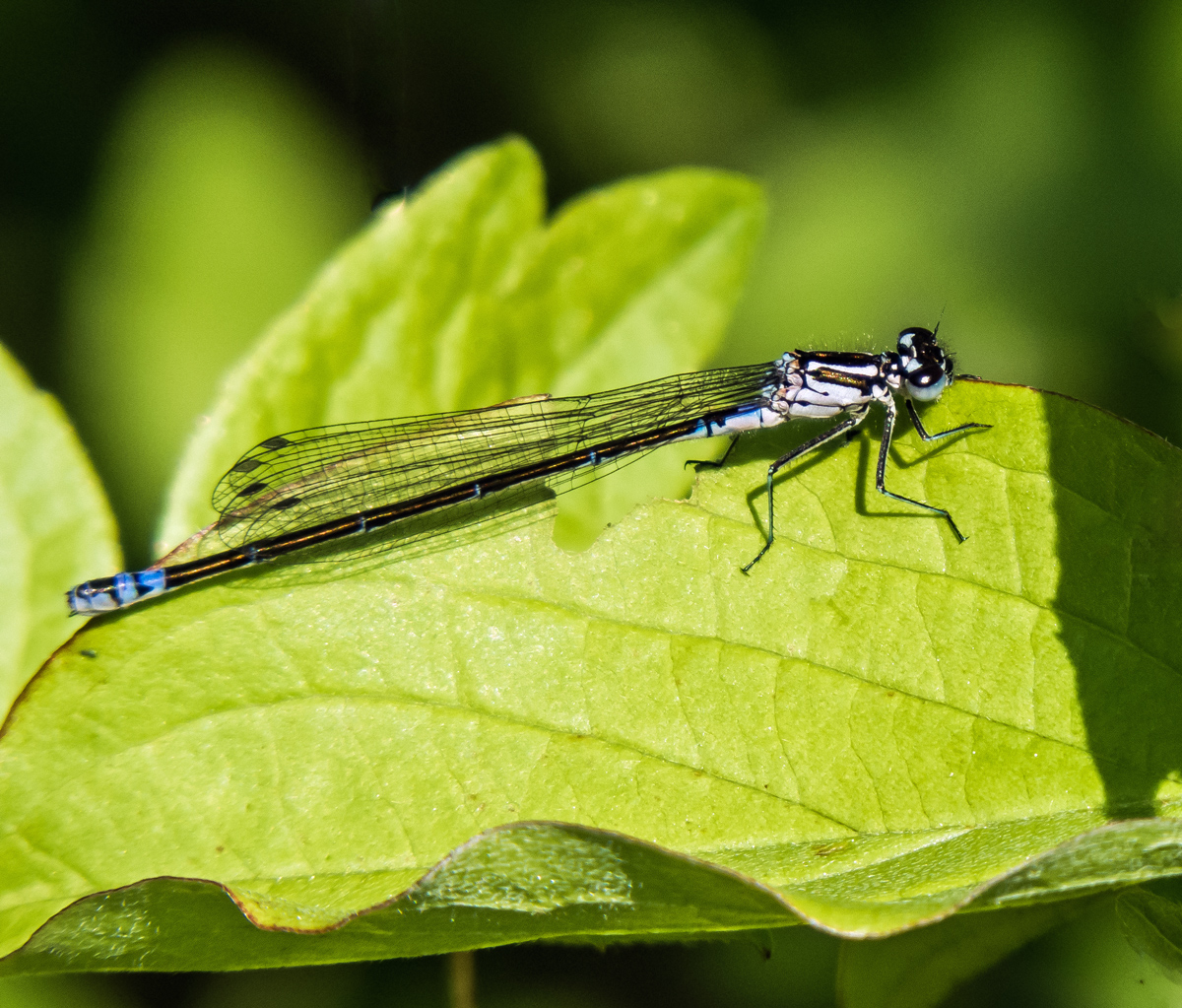
I’m still looking for my first dragonfly of the season, but was thrilled yesterday afternoon when I spotted my first damselfly, a Fragile Forktail (Ischnura posita), at Jackson Miles Abbott Wetland Refuge. In anticipation of seeing one of these small insects, I mounted my Tamron 180mm macro lens on my camera, a lens that has gone largely unused during the long winter months in favor of my telephoto zoom lens.

Yesterday was a nice reminded of how much I enjoy using a macro lens. (To give you a sense of scale, a Fragile Forktail damselfly is about 0.8-1.1 inches in length (21-29mm).)


Fragile Forktail

Fragile Forktail

Fragile Forktail

© Michael Q. Powell. All rights reserved.

Read Full Post »

Orange is one of the colors that I tend to associate with autumn. Some leaves are already turning orange and pumpkin decorations and displays have started to appear on my neighbors’ doorsteps.

As I was exploring Occoquan Bay National Wildlife Refuge yesterday morning, my eyes detected some motion in the nearby grass. I leaned forward and was delighted to see this tiny damselfly decked out in the colors of Halloween—orange and black. I had no idea what species it was, but fortunately I have a really good guide for damselflies and was able to identify it as an immature female Eastern Forktail damselfly (Ischnura verticalis).

Although there are already lots of symbols for autumn, I think this tiny damselfly could be added to the list.

Eastern Forktail

© Michael Q. Powell. All rights reserved.

Read Full Post »

On Friday I was delighted to capture this image of one of my favorite damselflies, the beautifully colored Variable Dancer (Argia fumipennis), while exploring Jackson Miles Abbott Wetland Refuge. The red and yellow colors of the vegetation are vaguely autumn-like, a reminder that the clock is ticking for the end of the dragonfly/damselfly season this year. If only I could slow down the passage of time.

Variable Dancer

© Michael Q. Powell. All rights reserved


Read Full Post »

It was cool and wet on Monday and clouds covered the entire sky, but I felt an irresistible need to return to the wild after a week in the urban confines of Brussels, Belgium. Many of the trails at Occoquan Bay National Wildlife Refuge, my recent favorite shooting location, were blocked by standing water and there was not a great abundance of wildlife to be seen.

Most dragonflies prefer warm, sunny weather, so I was not surprised when I did not see many of them. I was happy, though, to see that damselflies were active and I spent quite a bit of time trying to capture images of them. They seemed more skittish than normal and the poor lighting made it tough to keep my shutter speed high enough to keep my images from being blurry.

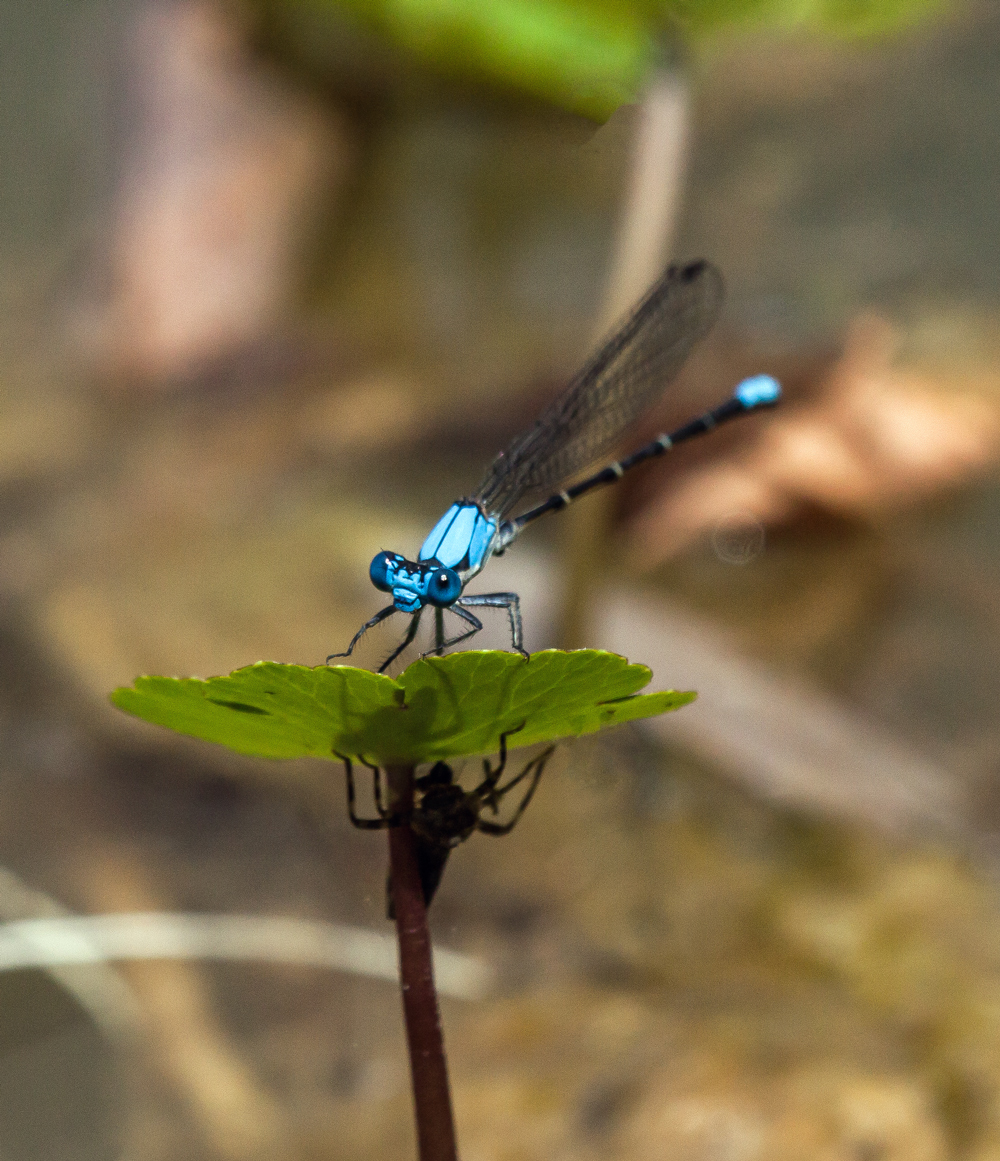
This is one of my favorite damselfly shots of the day. I was able to isolate the subject, which I believe is a male Big Bluet (Enallagma durum) damselfly, while still including enough of the vegetation to give you a sense of the environment in which I found him.

Big Bluet

© Michael Q. Powell. All rights reserved

Read Full Post »

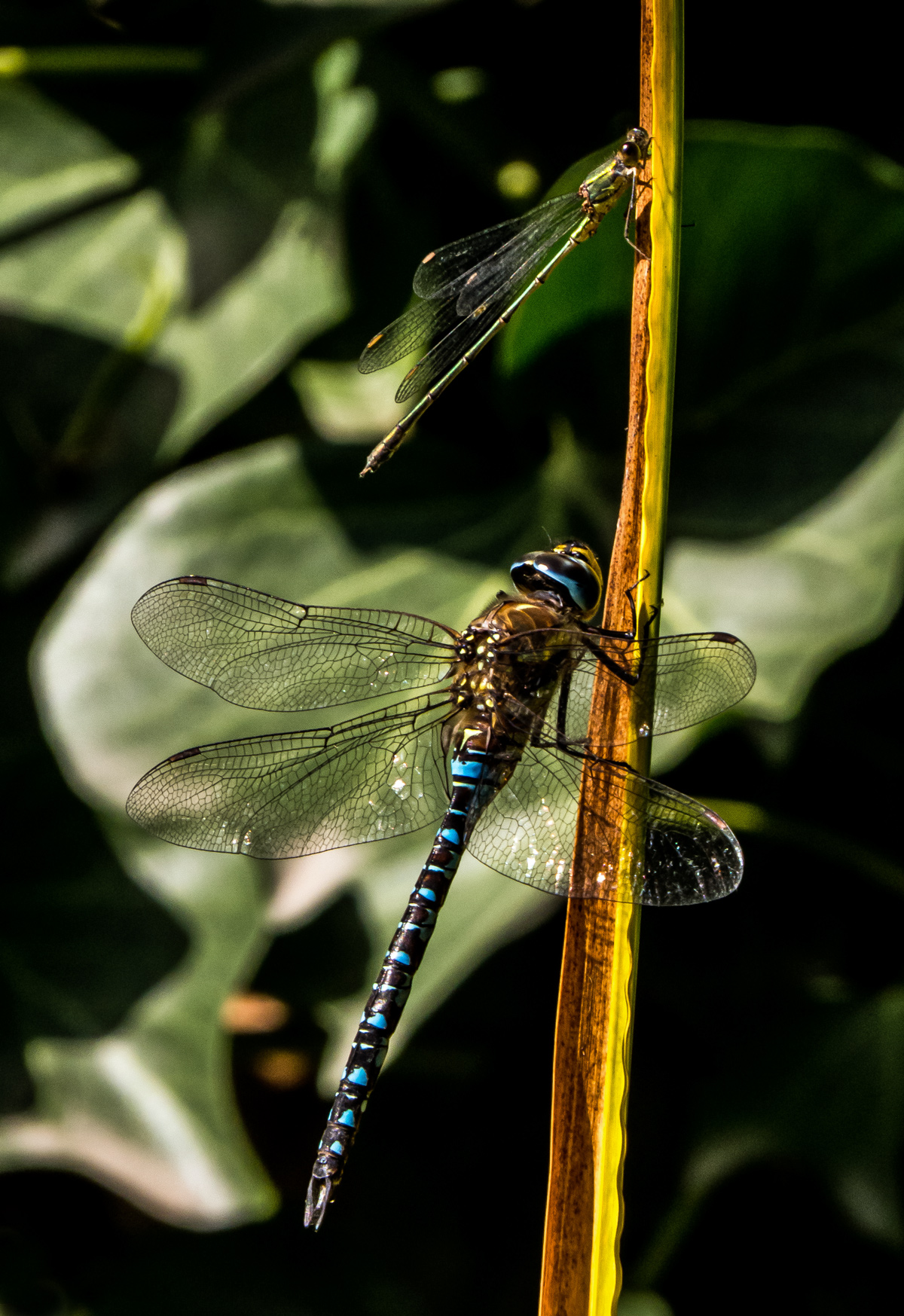
I can’t help but wonder what was going through the minds of these two insects as they perched on the same stalk of vegetation this past weekend at the botanical garden in Brussels, Belgium. Their postures suggest to me a heightened sense of alertness and a kind of wariness. The much smaller damselfly at the top seems to be cautiously looking down over its shoulder at the Migrant Hawker (Aeshna mixta), who appears to be focusing his attention upward. Was it a sign of curiosity or one of hunger? There was never any sign of direct aggression, but I note that the damselfly was the first one to take off and the dragonfly did not pursue it.

For those of you who are not as hooked on dragonflies as I am, this image shows pretty clearly some of the differences in the body shape and eye positions of a damselfly versus a dragonfly. It is important, though, to keep in mind the amazing diversity within the community of dragonflies and damselflies in terms of color, size, and behavior—these are some of the reasons why I am drawn to them as subjects for my photography.

friend or foe

© Michael Q. Powell. All rights reserved

Read Full Post »

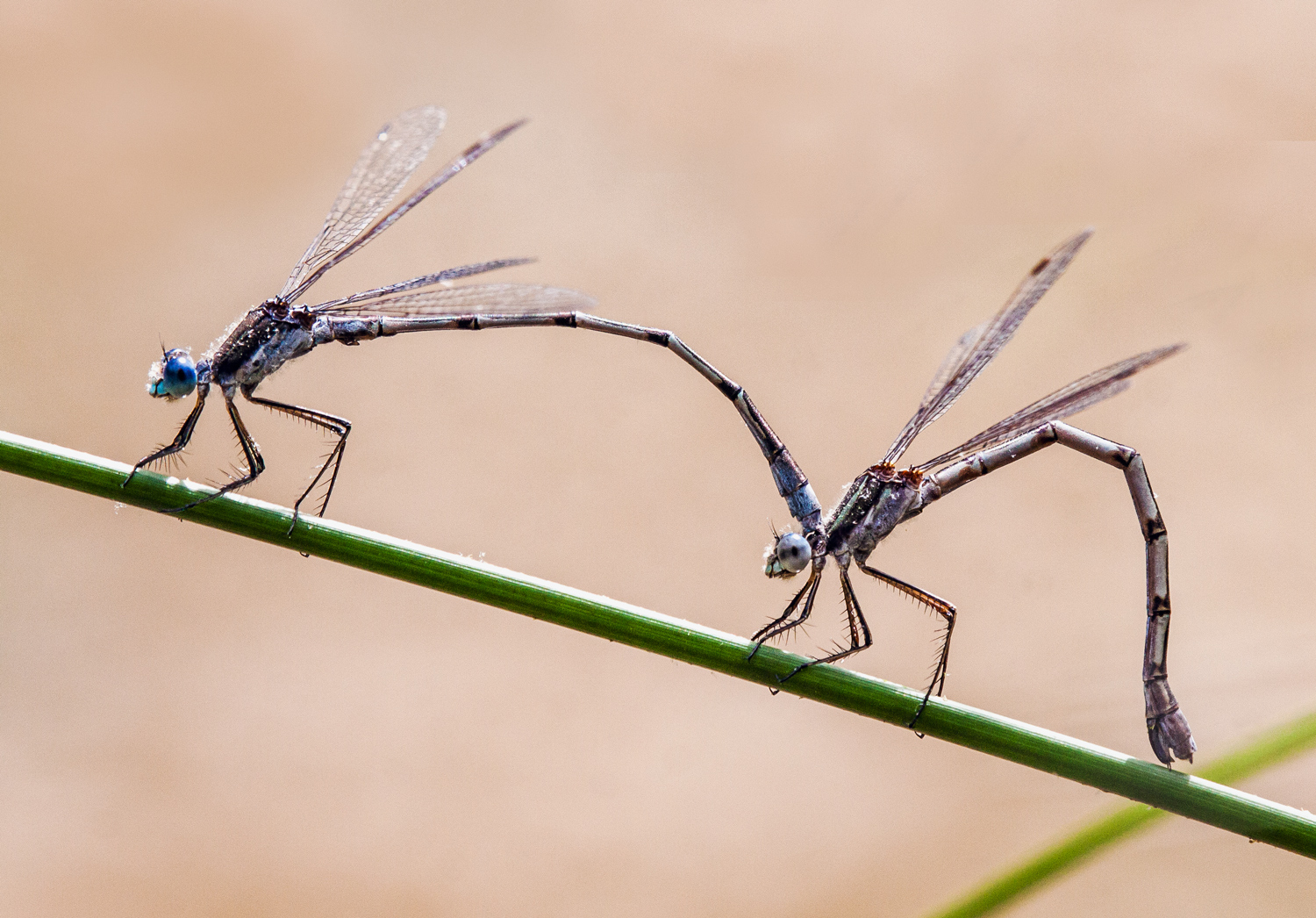
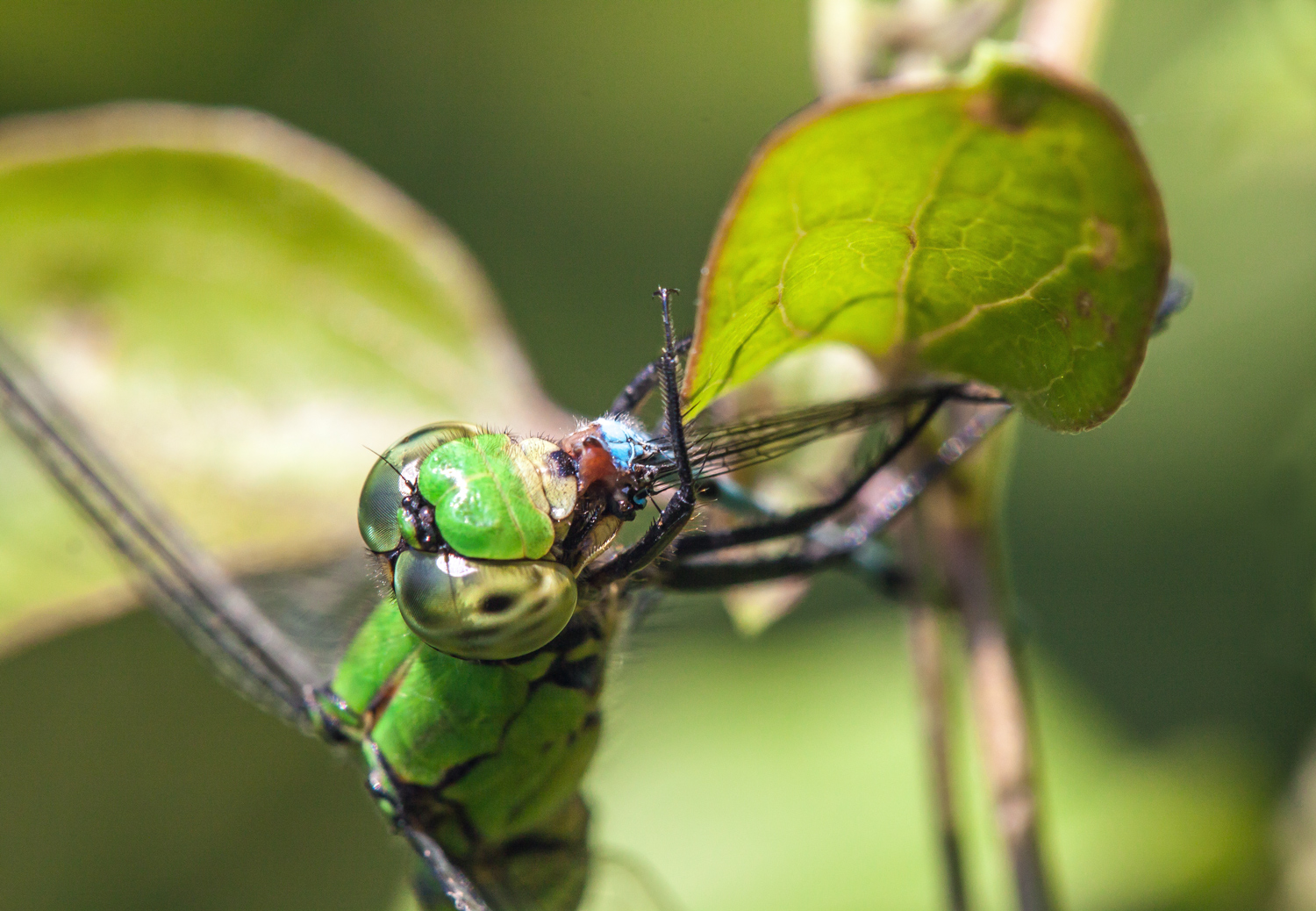
When recently at Occoquan Bay National Wildlife Refuge I spotted these two damselflies, which an expert identified as probable Big Bluets (Enallagma durum), I initially thought they were mating. Then I realized that the positions were all wrong and the nibbling on the neck was probably indicative of a literal hunger. Yikes.

As Tina Turner once sang, “What’s love got to do with it?”

damselflies

daamselflies

© Michael Q. Powell. All rights reserved

Read Full Post »

This image is a little gruesome, but here is a close-up look at an Eastern Pondhawk dragonfly (Erythemis simplicicollis) as it consumed a damselfly that it had captured this past Monday at Occoquan Bay National Wildlife Refuge in Northern Virginia. The second image shows a different Eastern Pondhawk with a different damselfly—the pondhawks seemed to have a particularly voracious appetite that day.

Eastern Pondhawk

Eastern Pondhawk

© Michael Q. Powell. All rights reserved.


Read Full Post »

Yesterday as I was exploring Riverbend Park in Great Falls, Virginia, I encountered several damselflies that were new to me. When you spend as much time as I do  searching for insects to photograph, you develop a sense of what is “normal” and I am able to decide almost immediately whether a subject is a familiar one or not. Those of you who know my work are aware that familiarity with a subject is not a criterion for photographing it—I am just as likely to take a shot of a common subject as a rare one.

As I looked though my reference books and material on line, I was able to determine that I had captured images of both the male and the female American Rubyspot damselfly (Hetaerina americana). One of the experts in a Facebook dragonfly forum pointed out the dragonfly in the first photo below is an immature male, which helps to explain why the red spot for which the species is named is not yet prominent.

I won’t go into the details of damselfly anatomy, but if you compare the dragonflies in the two photos, you can see some of the gender differences that often help in identification. The very tip of the abdomen, the part of the body that many folks refer to as the “tail,” is quite different for the male and the female. There is also some color differentiation. Alas, these are general rules that don’t apply in all cases, so I am often confounded when trying to identify the species of a given subject.

It is really cool that I continue to encounter new species. Part of the reason for that, I suspect, is that I am exploring some new locations. More importantly, though, my observational skills have improved dramatically over time and I am seeing things that I might not have noticed several years ago.

American Rubyspot

American Rubyspot

© Michael Q. Powell. All rights reserved.

Read Full Post »
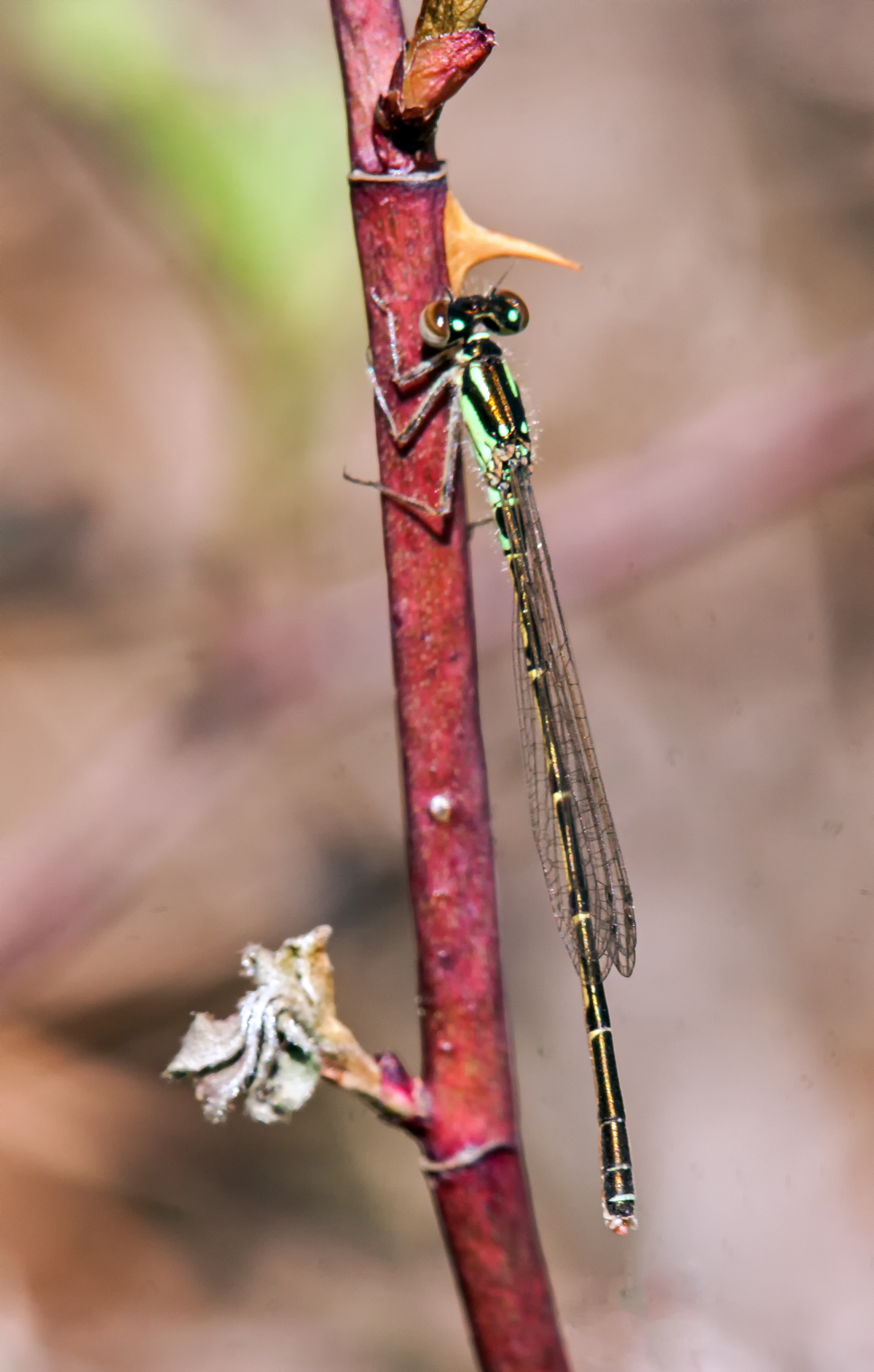
What a difference the background makes when photographing a damselfly. This past Friday I saw lots of damselflies as I was exploring Riverbend Park in Great Falls, Virginia. My eyes were repeatedly drawn to one species that a dark abdomen (the “tail” part) and speckled green eyes and I was able to photograph these damselflies in a number of different settings. I usually have problems in identifying damselflies, so I posted the third image below to a Facebook forum and one of the experts there identified it as an immature male Powdered Dancer damselfly (Argia moesta).

Normally I prefer to photograph dragonflies and damselflies in a natural environment, but the first photo is definitely an exception. I love the juxtaposition of the rust and corrosion of the curved man-made metal with the lines and color of the damselfly (and the cool shadow was a real bonus). In the second shot, the damselfly is perched on the ground and the unevenness of the surface makes for an intriguing shadow. The setting in the final shot is the most “natural” and the image gives viewers the best overall view of this damselfly species, but it doesn’t grab me as much as the first image.

Powdered DancerPowdered Dancer

Powdered Dancer

© Michael Q. Powell. All rights reserved.

Read Full Post »
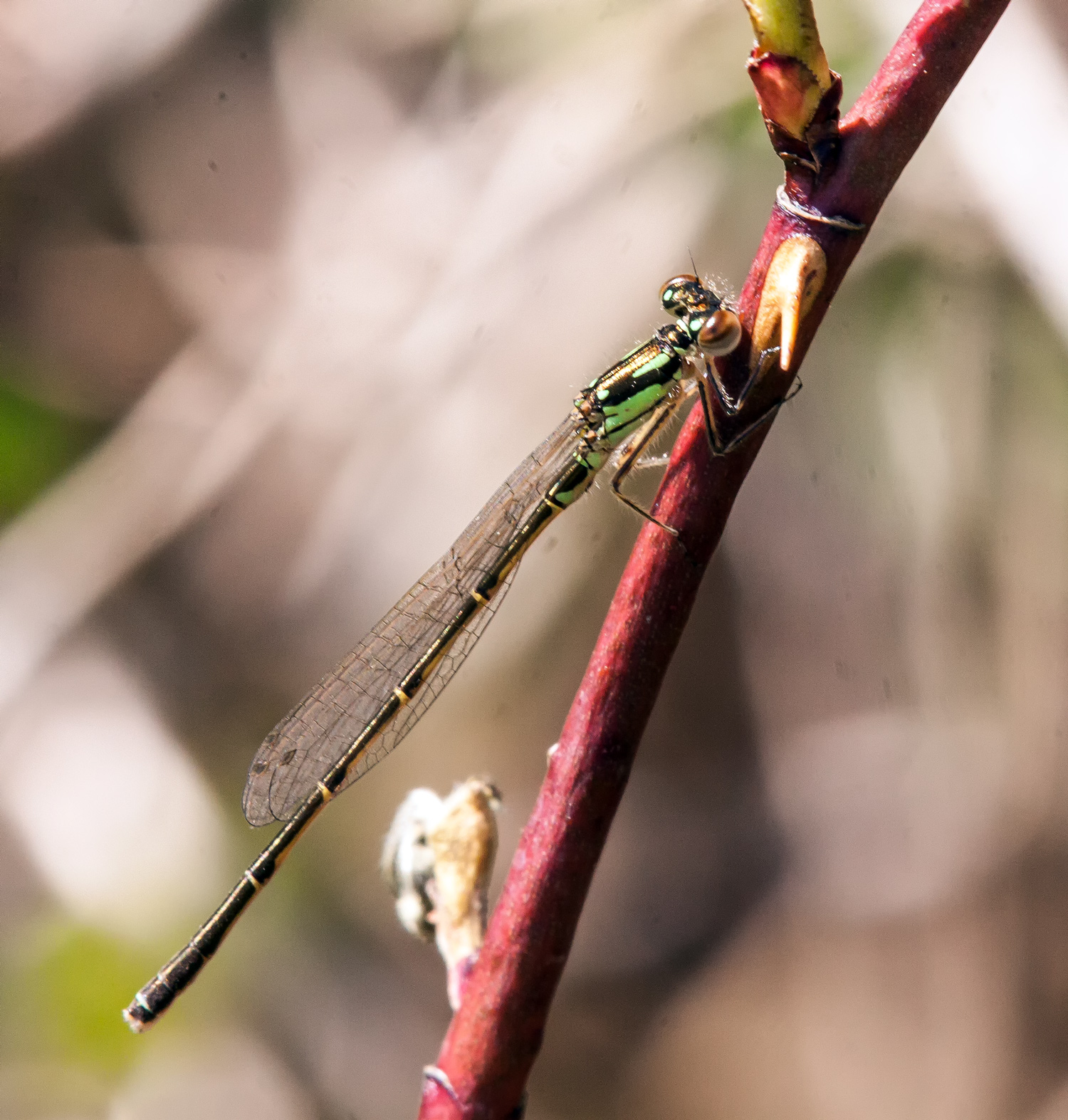
As I was exploring the edge of the Potomac River yesterday at Riverbend Park, I flushed a fairly large dragonfly. Rather than fly away, it perched in a nearby tree, just above eye level. I suspected that I had interrupted a meal and that it wanted to enjoy its prey in peace.

The dragonfly was in the shade and the light was filtering in from in front of me, so the shadows made it hard to tell exactly what was going on. I fired away anyways, hoping that I would be able to salvage the images afterwards.

It turns out that the dragonfly is a Black-shouldered Spinyleg (Dromogomphus spinosus). You definitely can see the large spines on the dragonfly’s back legs, which help in capturing and holding prey, and you can sort of see the black shoulders. As I suspected, there was a prey–the dragonfly had captured some kind of damselfly.

I decided to try a couple of different techniques to try to capture a usable image. In the first shot, I used software to adjust the exposure levels and remove some of the shadows, which had the side effect of brightening the entire image and blowing out some of the detail in the background. As a result, the leaves also look a little washed out. In the second shot, I used my camera’s pop-up flash to help eliminate some of the shadows. The resulting image retains a bit more of the full range of tonal values, but may still be a little too dark. Neither image is perfect, but wildlife photography is so often about making compromises.

Black-shouldered Spinyleg

Black-shouldered Spinyleg

© Michael Q. Powell. All rights reserved.

Read Full Post »

Although many damselflies are black and blue in coloration, I was particularly struck by the powdery blue coloration on the upper body of this damselfly when I first spotted it, a beautiful shade of blue interrupted only by a very thin line of black. I did some searching about on the internet and have concluded that this is probably a Blue-fronted Dancer damselfly (Argia apicalis).

I really like the way that the blue colors of this damselfly help it stand out in an otherwise mostly monochromatic image. I also enjoy the fact that this damselfly comes from a family of dancers, a term that seems appropriate for these aerial acrobats.

Dance on, tiny damselflies, dance on through the summer.


Blue-fronted Dancer

© Michael Q. Powell. All rights reserved.


Read Full Post »

On Monday I was thrilled to get a shot of one of my favorite damselflies at Occoquan Regional Park, the beautifully colored Violet Dancer (Argia fumipennis violacea), a subspecies of the Variable Dancer damselfly (Argia fumipennis). I love the color combination of this tiny beauty, a spectacular shade of violet on its body and the wonderful blue accents. Sharp-eyed viewers may have noted that a photo of this same type of damselfly has been my banner image for quite some time.

Violet Dancer

© Michael Q. Powell. All rights reserved.

Read Full Post »
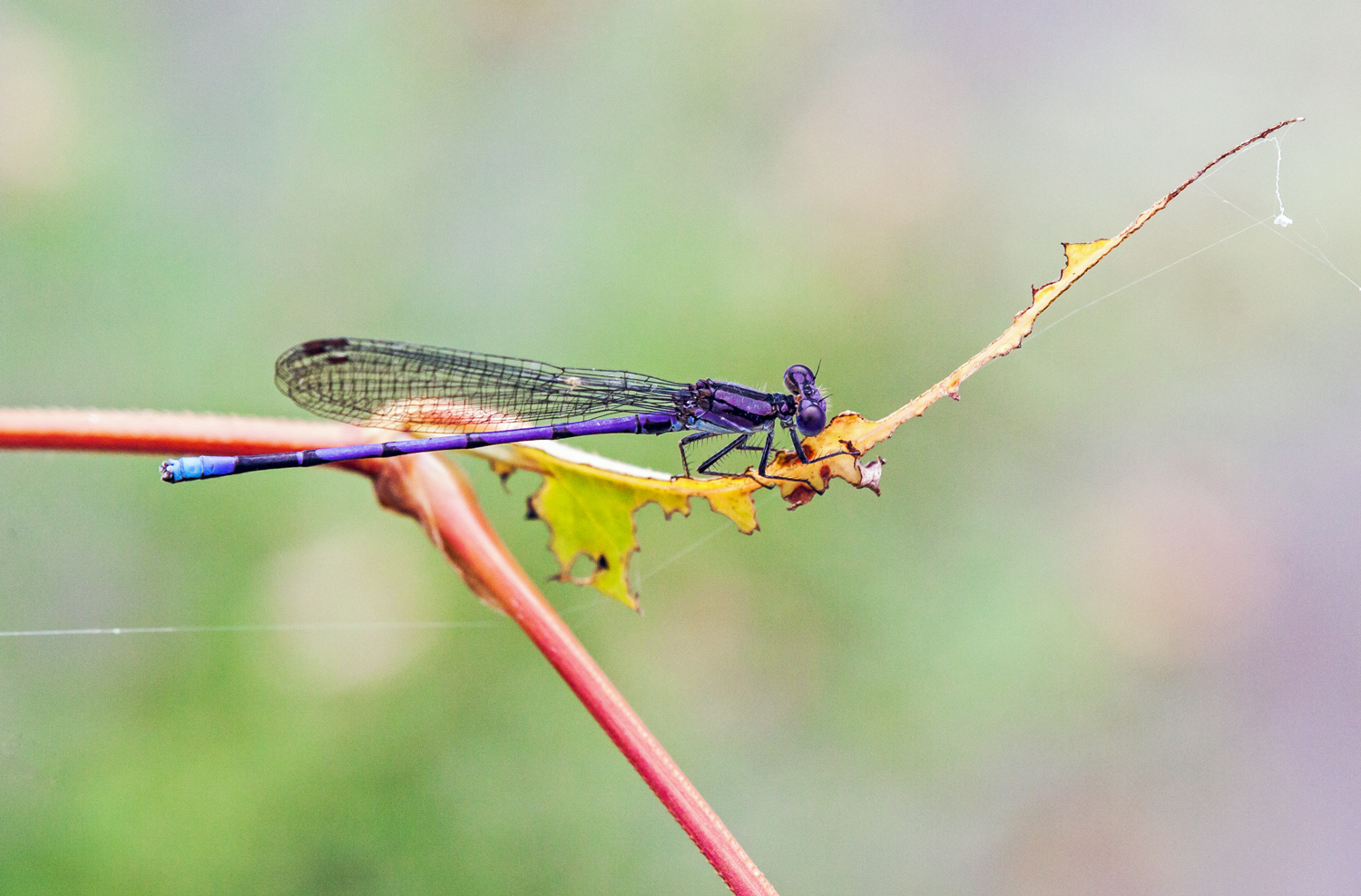
As I was working on a post earlier today about an unusually colored damselfly, the Citrine Forktail damselfly, I realized that I had not posted any photos of the beautifully colored ones that I saw during my trip to Brussels earlier this month. They were not yellow in color, but instead were a bright red. The first ones that I saw were a couple in the tandem position that is used for mating and also, for some species, when depositing eggs. A few days later I spotted a singleton damselfly perched on some vegetation.

I don’t think that I have seen any red damselflies in Northern Virginia, so I had to do some research. What I discovered is that these damselflies have the very unexciting name of Large Red Damselflies (Pyrrhosoma nymphula). The name seems to fit, but it strikes me that the scientist must have been tired or was otherwise feeling uncreative when he came named the species. This particular species is mainly a European one with some populations in Northern Africa and Western Asia, according to Wikipedia, so I am not at all likely to spot one on my frequent photowalks here.

Large Red Damselfly

Large Red Damselfly

© Michael Q. Powell. All rights reserved.

Read Full Post »

Do you ever go out to shoot photos when it is raining? It was already raining when I set out on a photo walk yesterday morning at Occoquan Bay National Wildlife Refuge and it kept raining for several hours as I sought subjects to photograph. My camera is somewhat waterproof, but my lenses are not, so I carried an umbrella. It must have been quite a sight to see me balancing my umbrella and my camera, which was attached to an extended monopod.

Dragonflies generally do not fly in the rain, but I decided to search the edge of a small pond to see if I could spot any particularly hardy specimens. As I was doing so, I caught sight of a small flicker of yellow. As I drew closer to it, I could see that it was a tiny damselfly. Now damselflies are always pretty small, but this one was even smaller than normal. Since many damselflies are a combination of black and blue, the brighter coloration of this one really made this one stand out.

It was not hard to find this damselfly in my guidebook because of its coloring. It is a Citrine Forktail damselfly (Ischnura hastata), a diminutive damselfly that is only .8-1.1 inches (20 to 27 mm) in length. I am really happy that I was able to capture so many of the details of this cool damselfly: the tiny blue eyespots; the narrow green shoulder stripes; and the mostly yellow abdomen.

Citrine Forktail

© Michael Q. Powell. All rights reserved.

Read Full Post »
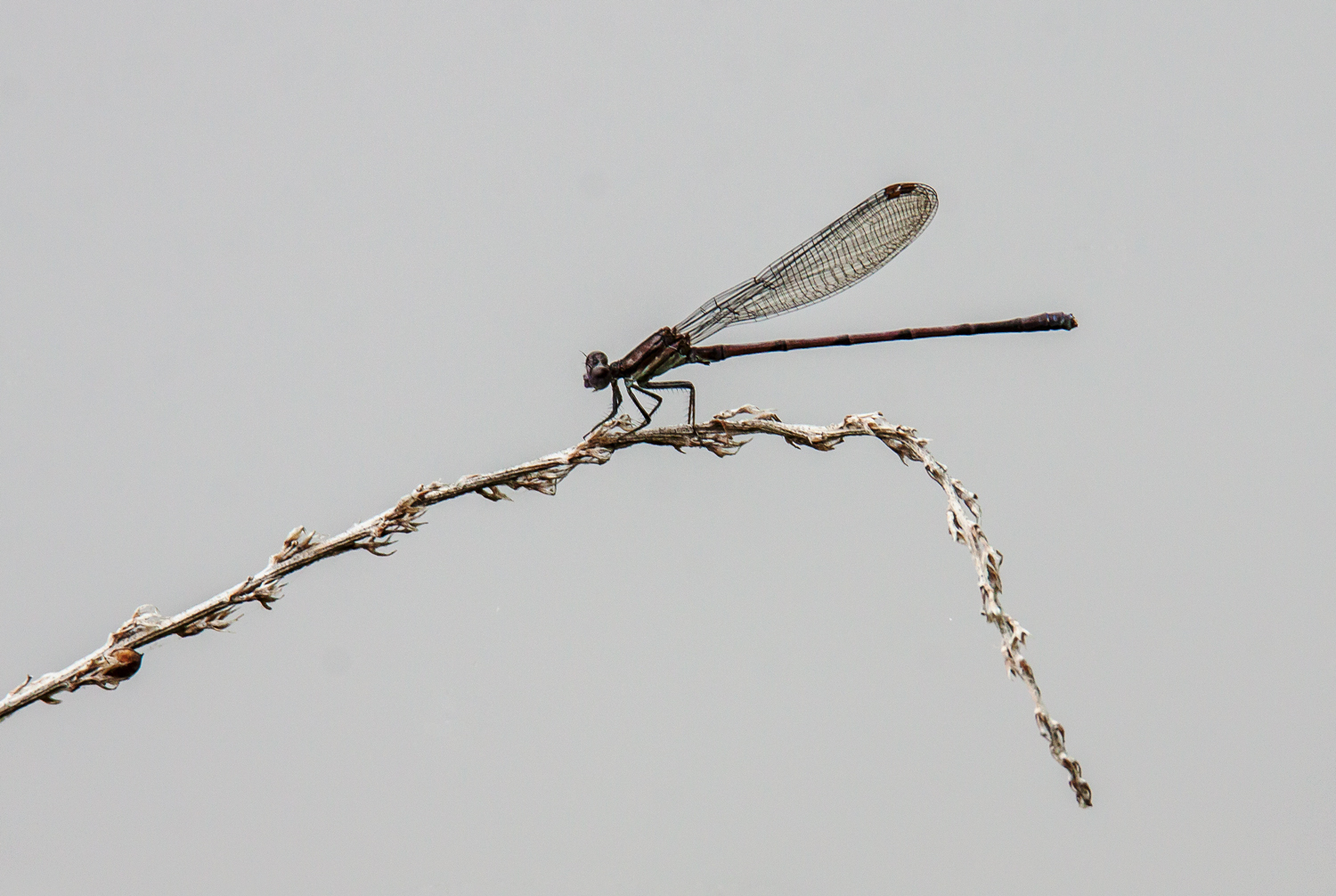
I love close-up photography, but sometimes it is good when necessity (or choice) compels me to shoot from a distance. This image has the simplest of compositions—a damselfly and a stalk on which to perch—but I like the way that the elements combined to create a sense of tranquility when I captured this moment this past Monday at Jackson Miles Abbott Wetland Refuge.

As I recall, the light was coming from in front of me, which caused the damselfly to appear as a partial silhouette. Without the normal color information, it’s hard for me to identify the species of damselfly with any degree of certainty. One of the experts on a Facebook forum, however, suggest that it might be a Variable Dancer damselfly (Argia fumipennis), the sames species that appears at the top of my blog’s home page.  As for the dried-out stalk that serves as a perch for the damselfly, I have no idea what kind of plant it is.

tranquil damselfly

© Michael Q. Powell. All rights reserved.


Read Full Post »

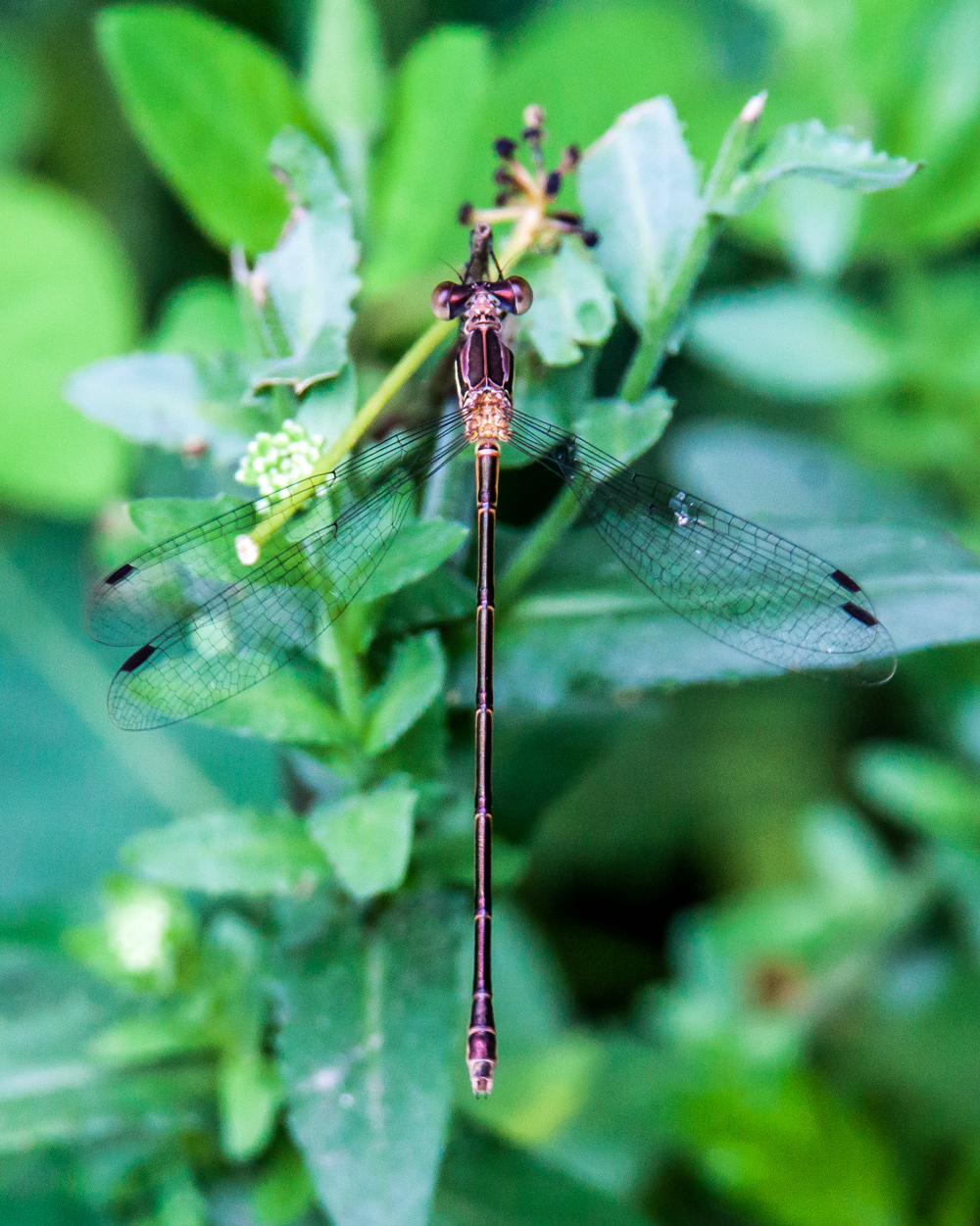
Although many damselflies are tiny in size and difficult to spot from a distance, spreadwing damselflies are a notable exception. Spreadwing damselflies tend to be quite a bit larger than other damselflies and they rest with their wings partly open in the “spreadwing” posture that gives the family its common name. (Most other damselflies rest with their wings held closed, usually above their abdomen, which makes them harder to see and to photograph.)

When I flushed this damselfly yesterday at Jackson Miles Abbott Wetland Refuge, I was immediately struck by the length of its body—it seemed to be really long and skinny.  The spreadwing family is not all that big, but I still had trouble identifying the species of the damselfly. As is usually the case in this kind ofsituation, I turned to my local expert, fellow dragonfly enthusiast and blogger Walter Sanford, who identified it as a female Slender Spreadwing damselfly (Lestes rectangularis).  I sometimes complain about the inappropriateness of the names of species, but in this case “slender spreadwing” is a perfect match for the subject that I observed.

In case you are curious about the photo, I shot it with my Tamron 150-600mm telephoto zoom lens on my Canon 50D DSLR. Over the winter I have become accustomed to using a monopod for stability and for this shot, I lowered the monopod and shot while kneeling. One of the limitations of the lens is that the minimum focusing distance is almost 9 feet (274 cm). At that distance, the camera’s autofocus system had trouble locking on the slender body of the damselfly—it kept focusing on the vegetation—so I resorted to manual focusing.

Most people are more familiar with dragonflies than with damselflies, but I encourage you to slow down and search for beautiful damselflies, the smaller members (in most cases) of the order of Odonata to which dragonflies also belong.


Slender Spreadwing

© Michael Q. Powell. All rights reserved.

Read Full Post »

There are often a few moments in the early morning when the world seems completely at peace. The waters are calm and reflections are almost perfectly mirror-like. Sometimes there is enough light to take photographs, but even when there is not, I enjoy getting up early simply to savor those moments.

This past Monday morning, when I arrived at a small pond at Occoquan Bay National Wildlife Refuge, I noticed the beautiful reflections and my attention was drawn to a stick protruding out of the water. As I zoomed in on the stick, I noticed a damselfly perched on it. Damselflies belong to the same order of Odonata as dragonflies, but usually are smaller in size, often 1 to 1.5 inches in length (25–38 mm).

I decided to take some shots of the stick and the perching damselfly and as I was doing so, the damselfly flew away. I managed to capture the image below as the dragonfly was returning to its perch.

An expert on a Facebook forum identified the damselfly for me as an Orange Bluet (Enallagma signatum). Most members of the bluet family of damselflies are colored with various combinations of blue (as the name suggests) and black, but some family members are also orange or red. I shake my head and smile every time that I use the curious word combination “orange bluet.”

This image is somewhat atypical for me in the sense that it is not a close-up portrait. Most of the time I try to use my telephoto zoom or macro lens to capture as many details of my subject as I can. In cases like this, though, I am content to capture an image that evokes the mood of the moment. There is a kind of minimalist simplicity in this photo that really appeals to me.

Orange Bluet

© Michael Q. Powell. All rights reserved.

Read Full Post »
Damsels in Vienna? Here are a few shots of some beautiful little damselflies that I encountered this past weekend during a visit to the Donau-Auen National Park in Vienna, Austria.

While traveling for work I normally leave at home my Canon DSLR and big lenses and use instead a Canon SX50 point-and-shoot camera with a super zoom lens. There are some compromises and limitations with this type of camera, but I am quite pleased with the results I can achieve using it, including these almost-macro images.

damselfly in Vienna

damselfly in Vienna

damselfly in Vienna

© Michael Q. Powell. All rights reserved.


Read Full Post »

At first I thought it was love, but looking closer I realized that Tina Turner was right—what’s love got to do with it. Both the predator and the prey in what appears to be an act of cannibalism look to be Big Bluet damselflies (Enallagma durum), which I spotted this past Sunday at Occoquan Bay National Wildlife Refuge.

The pale coloration of the victim suggests to me that it is newly-emerged, a phase referred to as “teneral.” At this stage of development, dragonflies and damselflies are relatively immobile as their bodies and wings are transforming and are particularly vulnerable.

damselfly cannibalism

© Michael Q. Powell. All rights reserved.

Read Full Post »

When a Black and Yellow Garden Spider (Argiope aurantia) traps a prey in its web, it often moves so quickly to wrap it up completely that it is difficult to identify the prey. That was not the case with the damselfly that I spotted yesterday at Occoquan Bay National Wildlife Refuge as it was being encased in a silken shroud.

The damselfly looks to be a bluet damselfly and if pressed, I’d guess that it might be a Familiar Bluet (Enallagma civile) or possibly a Big Bluet (Enallagma durum). The spider seems to be experiencing the same kind of problem that I encounter when I am trying to wrap an awkwardly-shaped present at Christmas time—it is hard to be neat and tidy, the process uses up lots of wrapping material, and the package always end up irregularly shaped and easy to identify.

spider and damselfly

© Michael Q. Powell. All rights reserved


Read Full Post »

Over the last few years it has become traditional for me to be in Brussels over Labor Day weekend in early September for meetings. After I arrived today, I had some free time and captured these images of damselflies in the Botanical Gardens. Some of them are quite similar to those that I see at home, while others appear to be a bit different. As is often the case when I am traveling for work, I left my big camera at home and took these shots with my Canon SX50 HS superzoom camera.

damselfly in Brussels

damselfly in Brussels

mating damselflies in Brussels

© Michael Q. Powell. All rights reserved

Read Full Post »

Damselfly mating is, to say the least, unusual and acrobatic. Yes, I felt a little like a voyeur as I observed this pair of Ebony Jewelwing damselflies (Calopteryx maculata) on Monday at Huntley Meadows Park.

Did you notice the sideways heart that their bodies form during this process? Yeah, I am a bit of a romantic, even when it comes to mating insects in the wild. I would recommend, though, that you not try this position at home, but leave it to the professionally trained damselflies. You might otherwise require an unplanned visit to a chiropractor.

Ebony Jewelwing mating

© Michael Q. Powell. All rights reserved

Read Full Post »

Whenever I walk along the edge of a pond, I always like to look for damselflies, which love to perch on the vegetation growing out of the water. Footing can be a bit problematic and more than once I have slid down a slippery bank into the water. Normally, though, I just lean out as far as I dare to get some shots.

Last weekend as I was exploring Jackson Miles Abbott Wetland Refuge, I spotted this beautiful little damselfly that was looking in my direction. I knew that depth of field would be a problem from that position, but did my best to focus on the damselfly’s beautiful eyes. When I returned home and began to review my shots, I was a little shocked to see what looked to be the discarded exoskeleton (exuvia) of another damselfly (or possibly a dragonfly) on the underside of the leaf on which “my” damselfly had perched. How did I not notice that when I was shooting?

I really like the way that the head of the exoskeleton is facing that of the damselfly and the shadow in between the two of them. Is it the shadow of the one looking down or the one looking up? Common sense says that it is the former, but the slight degree of ambiguity adds interest to the photo for me.


damselfly

© Michael Q. Powell. All rights reserved.

Read Full Post »

In addition to dragonflies, damselflies are now appearing in greater numbers, like this beautiful little Ebony Jewelwing (Calopteryx maculata) that I spotted on Friday at Huntley Meadows Park. Identification is pretty easy, because it is the only dark-winged species in our area. The red eyes suggest that it is newly emerged—the eyes will change to a less demonic color later—and the lack of white markings on the wings indicate it is a male. Click on the image if you want to see some of the details of the damselfly at higher resolution, like the tiny hairs on its legs.

Ebony Jewelwing

© Michael Q. Powell. All rights reserved

Read Full Post »

Nature photographers are a peculiar breed of people. How else could I explain why I headed off to the Donau-Auen National Park within hours of my arrival in Vienna, Austria. I am staying in the center of the city, virtually surrounded by historic buildings and monuments, yet I feel more drawn to explore nature than history.

Saturday was a warm, sunny day and I was hoping to encounter dragonflies as I explored some of the areas of the park that I have visited before. It may be a little early in the season or that I was simply not lucky, but in any case I did not encounter a single dragonfly. I was, however, quite fortunate and saw quite a few damselflies. These beautiful little creatures are tiny and elusive and like to hide perch on vegetation, so it is often challenging to get clear shots of them.

I was shooting with my Canon SX50, a superzoom point-and-shoot, which helped me sometimes to get shots without scaring off the damselflies. In some cases, though, it was really tough to get the camera’s focus to lock onto the target.

The shapes and colors of the damselflies are somewhat familiar and may be related to the species that I see at home, but I am not even going to try to identify them. I hope that you can enjoy the delicate beauty of these damselflies that I encountered during my most recent adventures in the national park here in Vienna.

damselfly in Vienna


damselfly in Vienna


damselfly in Vienna

damselfly in Vienna

© Michael Q. Powell. All rights reserved

Read Full Post »

You have to be awfully lucky to capture in-flight images of damselflies, but it helps a little when they are in tandem. I spotted these Southern Spreadwing damselflies (Lestes australis) last week at Huntley Meadows Park. The pair in the foreground were still hooked up after mating and appeared to be heading for the branch that you can see in order to lay eggs there.

It’s cool how you can see another damselfly in the background flying in from another direction. I noticed that some single damselflies, probably rival males, seemed to be trying to interfere with the couples when they were involved in ovipositing, which is why the male stays with the female until he is sure the job is done.

Southern Spreadwing

© Michael Q. Powell. All rights reserved

Read Full Post »

These Southern Spreadwing damselflies (Lestes australis) were engaging in a little May Day mayhem this past Monday at Huntley Meadows Park. If I have this figured out right, the female, the one on the right in this image, is depositing her eggs in the vegetation after successfully mating with the male, who is still holding on to her.

Southern Spreadwing

 © Michael Q. Powell. All rights reserved

Read Full Post »

As I drove back yesterday from Georgia to Northern Virginia, an almost 800 mile drive (1287 km),  I stopped at a rest area on I-95 in North Carolina. Noting that there was a small man-made pond, I decided to investigate for odes and spotted this damselfly. One of the experts in the Southeaster Odes Facebook Group helped to identify this beauty as a female Fragile Forktail damselfly (Ischnura posita).

It’s a whole lot cooler in Northern Virginia than it was in Georgia and North Carolina, so I suspect that I will have to wait a month or two for damselflies and dragonflies to emerge here. With this sneak preview, I can hardly wait.

fragile forktail

© Michael Q. Powell. All rights reserved.

Read Full Post »

It’s still a bit early for dragonflies in Northern Virginia, but when temperatures soared to almost 80 degrees (27 degrees C) yesterday in Columbus, Georgia, I decided to see if I could find some here. I had a wonderful time exploring some of the area of the Oxbow Meadows Environmental Learning Center that is not far from Fort Benning, where I was staying.

I came up empty-handed for dragonflies, but did spot some beautiful little damselflies. Later in the spring, these will be fairly common, but after a long period with no odonates, they seem rare and exotic.

The first one looks like a Fragile Forktail damselfly (Ischnura posita), but I am not sure about the others. Several of them flew so weakly that I wondered if they had only recently emerged.

Fragile Forktail

damselfly

damselfly

damselfly

damselfly

© Michael Q. Powell. All rights reserved.

Read Full Post »

« Newer Posts