Feeds:
Posts
Comments

Archive for the ‘Butterflies’ Category

Skipper butterflies normally do not get much attention because they are small and are not brightly colored.  When you look closely at members of this large family of butterflies, however, you discover an amazing variety of colors and patterns.

Give some love to the skippers. (Click on any one of the images to see all of them full size in slide show mode, unless you are viewing the post in the WordPress Reader, in which, I believe, the images will be shown individually.)

© Michael Q. Powell. All rights reserved.

Read Full Post »

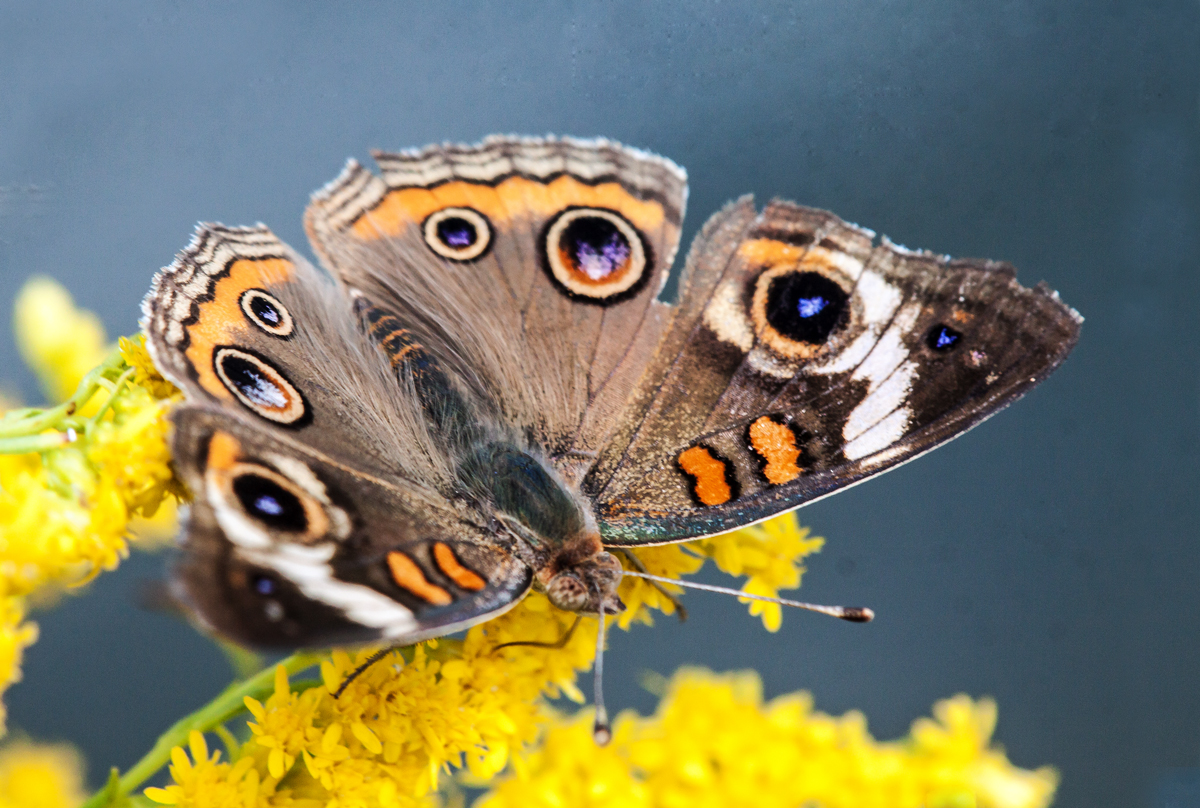
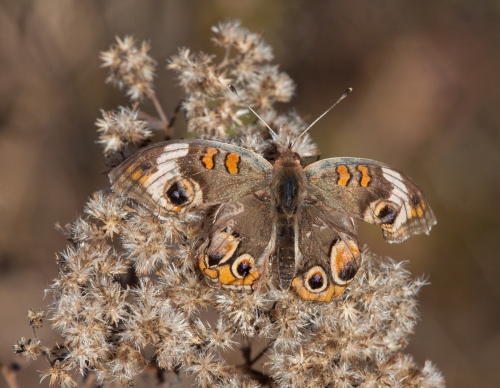
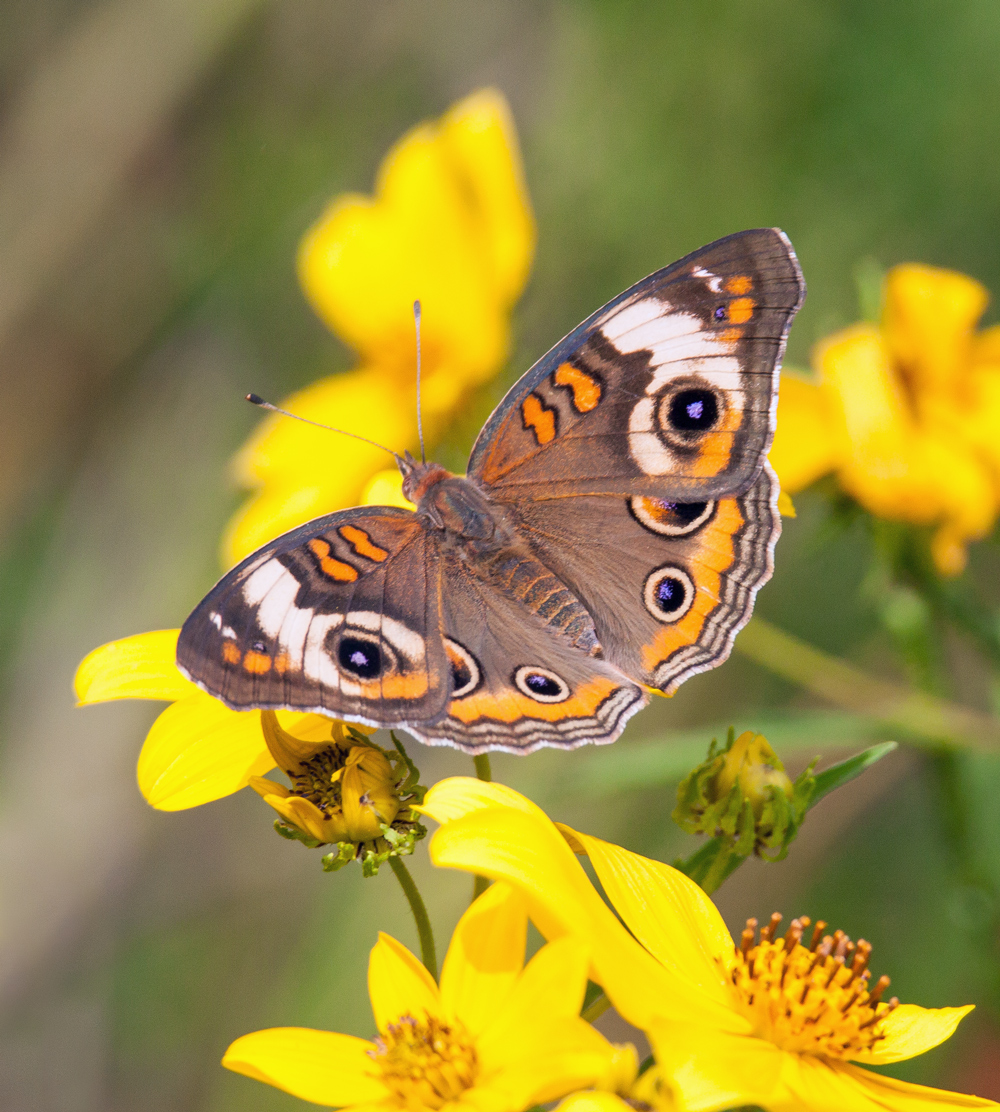
This Common Buckeye butterfly (Junonia coenia) was so focused on the goldenrod flowers that it was either unaware of my presence or simply didn’t care on Monday at Jackson Miles Abbott Wetlands Refuge. I was therefore able to capture the beauty of the butterfly from a somewhat unusual angle that lets us see some of the wonderful markings on the body as well as on the wings.

Common Buckeye

© Michael Q. Powell. All rights reserved.

Read Full Post »

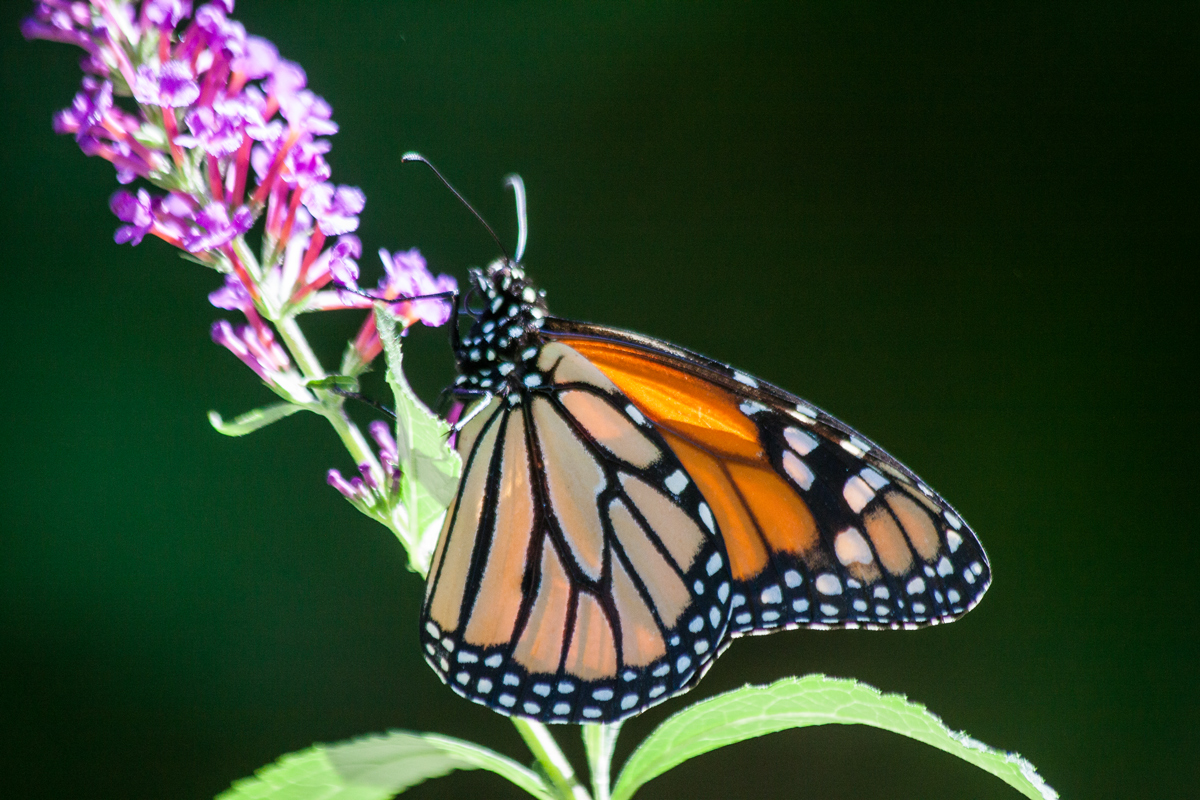
The last few years I haven’t seen many Monarch butterflies (Danaus plexippus) and I have read reports of their declining numbers. I was therefore pretty excited when I spotted one yesterday at Huntley Meadows Park. As I approached, the Monarch got spooked and flew up into a tree. Fortunately I was shooting with my long telephoto zoom lens and I managed to get this somewhat unusual shot of the beautiful butterfly.

Monarch butterfly


© Michael Q. Powell. All rights reserved.

Read Full Post »

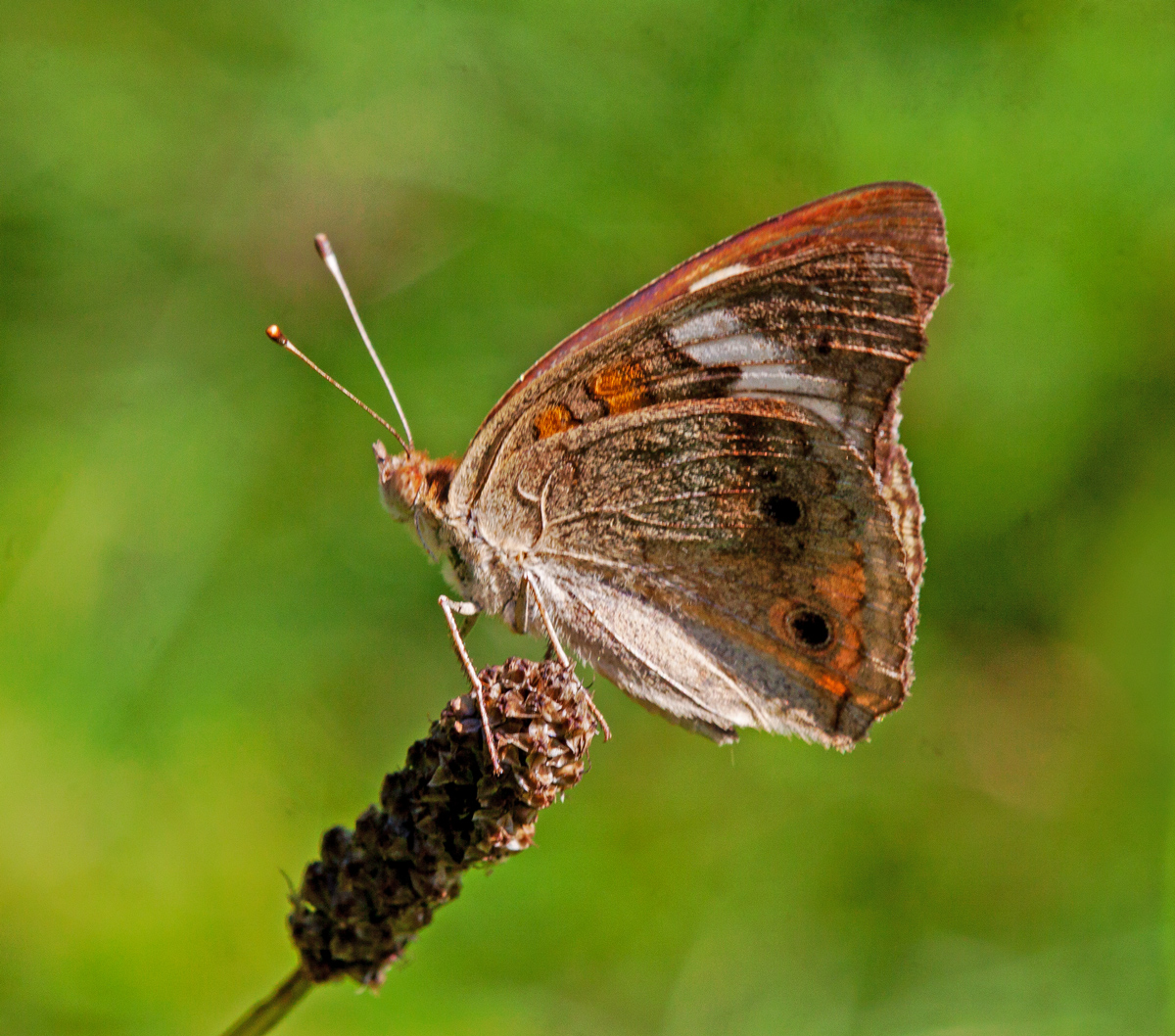
I spotted this beautiful little butterfly while wandering through the woods at Huntley Meadows Park this morning. I think it might be an Appalachian Brown (Satyrodes appalachia), although there are a surprisingly large number of brown butterflies with eyespots, which complicates identification.

The woods were pretty dark in the area in which I first spotted the butterfly. However, luck was with me and the butterfly landed on a log that was in the sunlight. I tried to get as low as I could to get this shot, which is why you see the green moss in the foreground.

Update: One of my Facebook readers pointed out that this is probably a Northern Pearly-eye (Enodia anthedon), not an Appalachian Brown. My butterfly identification definitely need some more work.

Appalachian Brown


© Michael Q. Powell. All rights reserved.

Read Full Post »

Hot, humid summer days may be a little tough on us, but butterflies seem to love them. I captured this shot of a spectacular Eastern Tiger Swallowtail (Papilio glaucus) this past weekend at Huntley Meadows Park as it sipped nectar from what I think is Joe-Pye weed (g. Eutrochium). (I am a bit uncertain about the plant identification and wonder if it might instead be a kind of milkweed, but “Joe Pye” rhymes with butterfly and sounds cooler, so I’ll go with that as a possible identification.)

Unlike many butterflies that I see at this time of the year whose wings are tattered and torn, this butterfly seemed to be in perfect condition. The sun was shining brightly when I took these shots and I was really afraid of blowing out the highlights of this lightly-c0lored butterfly. I switched the metering on my camera to spot metering and was able to get a good exposure of the butterfly and the background went really dark, adding a bit of drama to the images.

Eastern Tiger Swallowtail

Eastern Tiger Swallowtail

Eastern Tiger Swallowtail

© Michael Q. Powell. All rights reserved.

Read Full Post »

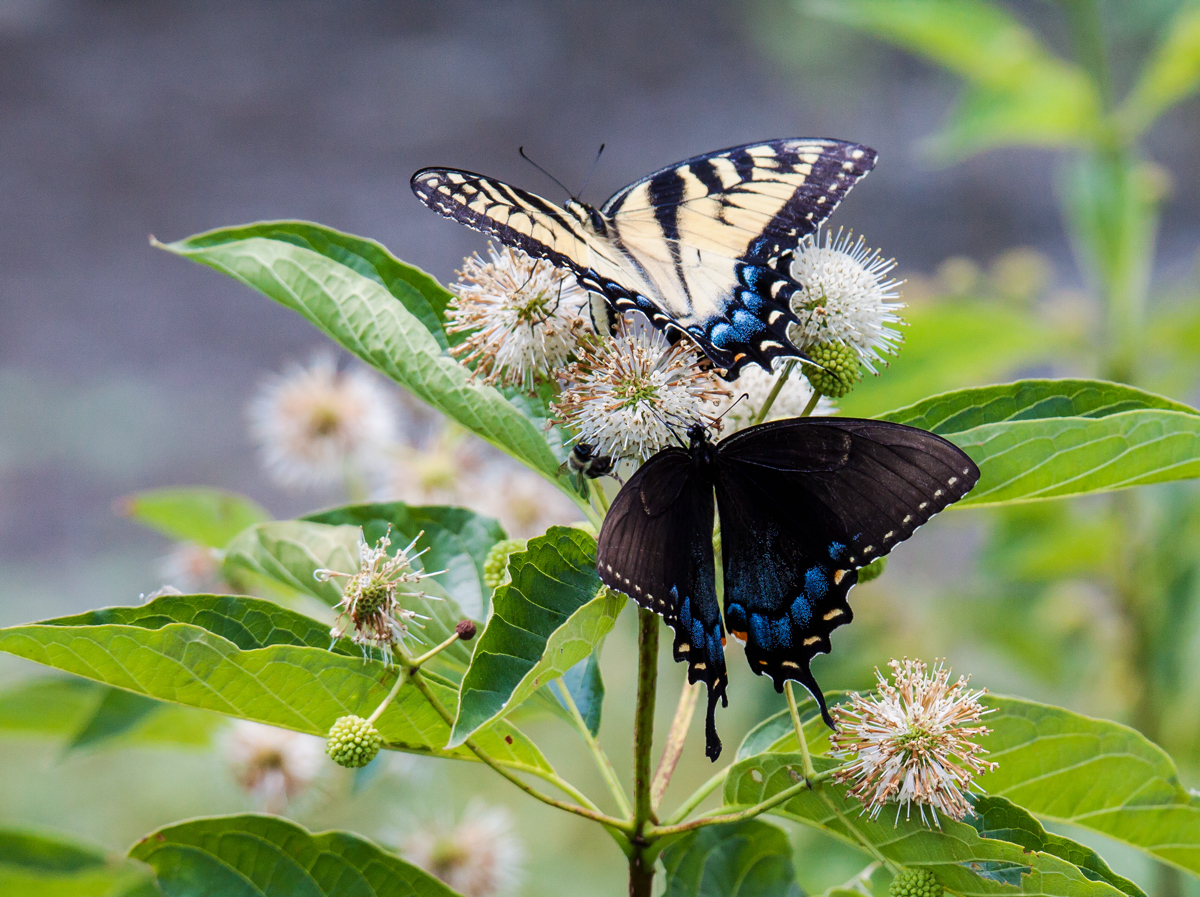
Eastern Tiger Swallowtail butterflies (Papilio glaucus) were really busy on the buttonbushes (Cephalanthus occidentalis) at Huntley Meadows Park recently, including what looks to be a dark morph female. Females of this species are dimorphic—there are both yellow morphs and dark morphs—but males are only yellow.

If you look closely at the second image you’ll see that I managed to capture a “bonus bug.” a bee that is also feeding on the buttonbush. My photography mentor likes to use the term “bonus bug” to refer to insects  in our photos whose presence was unknown at the time the photos were taken.

Eastern Tiger Swallowtail

Eastern Tiger Swallowtail

© Michael Q. Powell. All rights reserved.

Read Full Post »

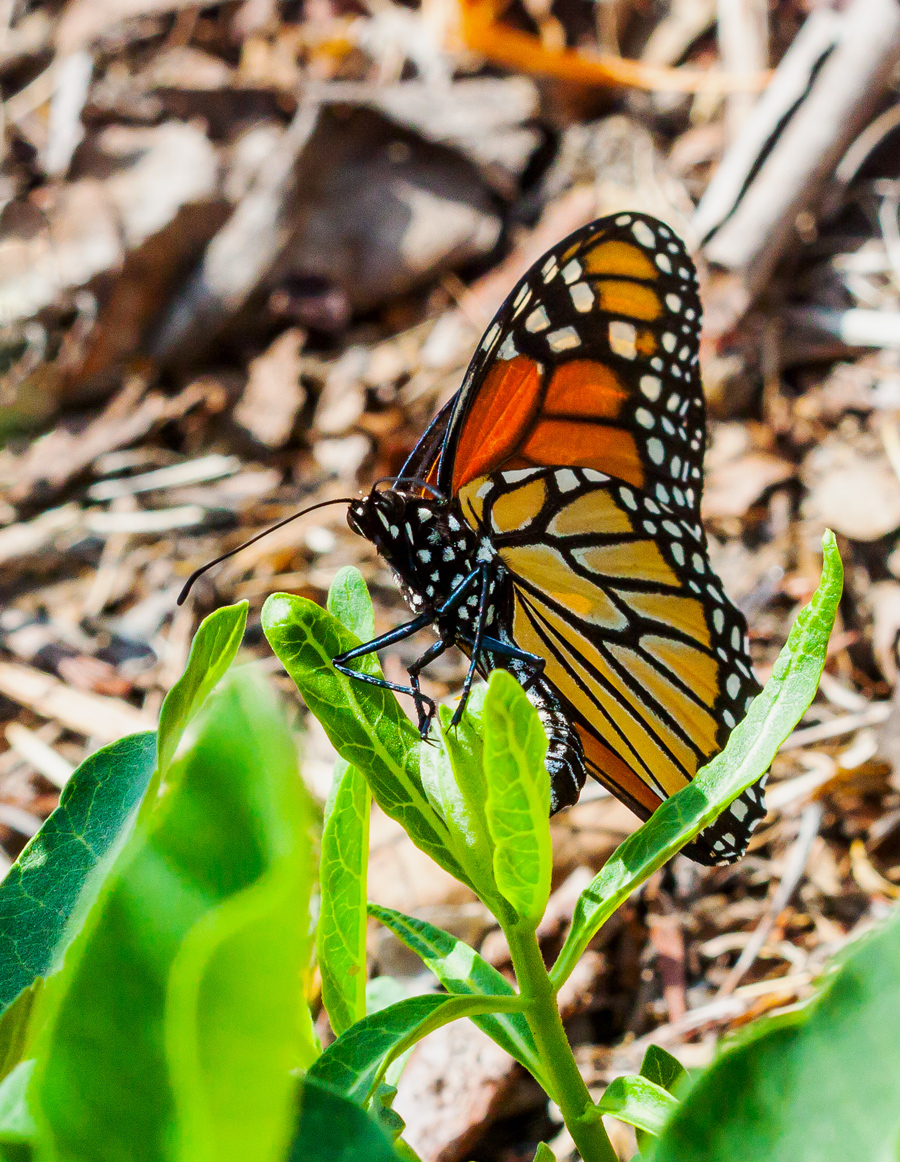
I was beginning to think that another year would go by without seeing a Monarch butterfly (Danaus plexippus) when yesterday I spotted one of them in the most unlikely of places—in the mulched plants at the back of the hotel where I am staying in Woburn, Massachusetts.

After a grueling eleven-hour ride from Northern Virginia, I arrived at the hotel yesterday afternoon ready to relax. Unfortunately, I was told that my room would not be ready for at least an hour. I grabbed my camera and decided to walk around the grounds of the hotel, which is adjacent to a small canal, to see what there might be to photograph.

As I was walking, I caught sight of an orange-and-black butterfly that kept landing momentarily on the low plants, never staying still long enough for me to get a good shot (I was shooting with a 100mm macro lens). I kept chasing and eventually got some shots. It has been such a  long time since I last saw a Monarch that any photo at all is a bonus, so it doesn’t bother me that these are far from being great shots.

My excitement at seeing a Monarch is tempered a bit by the fact that I did not get the right angle to conclusively exclude the possibility that this is a Viceroy butterfly. If that were to turn out to be the case, I’ll be out again chasing butterflies in search of the first Monarch of the season.

Monarch butterfly

Monarch butterfly


© Michael Q. Powell. All rights reserved.

Read Full Post »

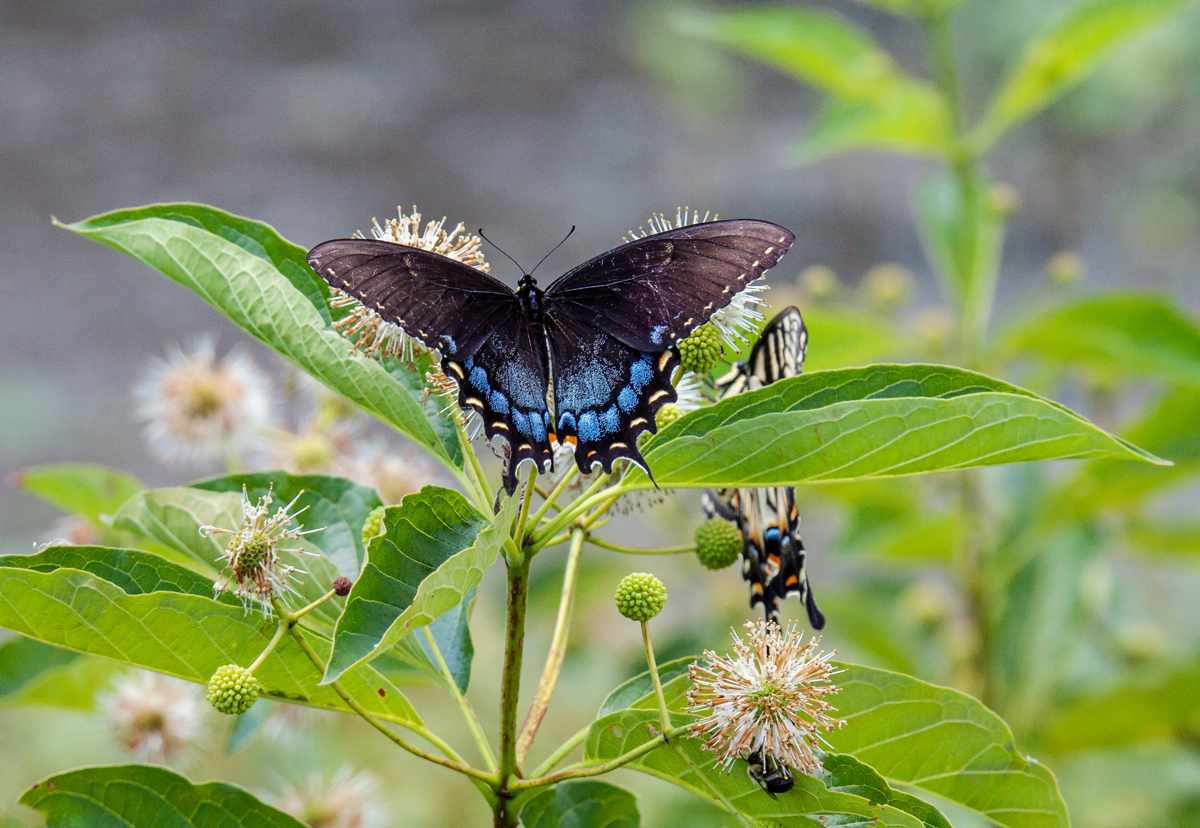
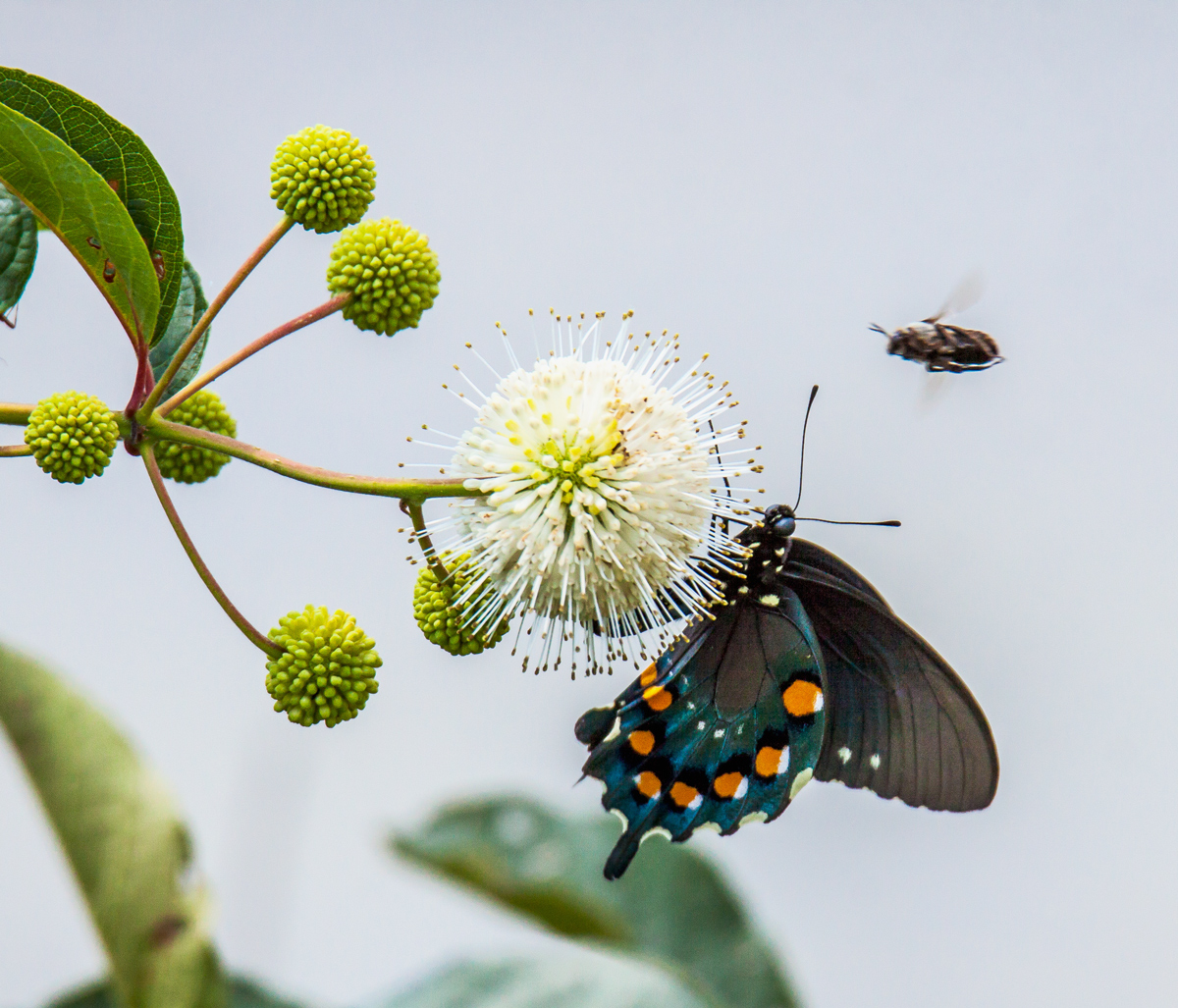
Butterflies were really active this past Monday at Huntley Meadows Park, especially around the buttonbushes (Cephalanthus occidentalis). A dark swallowtail butterfly caught my eye and my mind raced to remember how to distinguish among the various dark swallowtails. Fortunately I had enough presence of mind to capture some images, knowing I could search different resources when I got home.

I’m pretty confident that the butterfly in question is a Pipevine Swallowtail (Battus philenor). One of its distinguishing characteristics is a single row of orange spots in the shape of a C. As I was searching the internet, I came across a wonderful posting by Louisana Naturalist that has side-by-side photos of four different dark swallowtails —the Black Swallowtail, the dark morph of the female Eastern Tiger Swallowtail, the Spicebush Swallowtail, and the Pipevine Swallowtail.

As I was trying to get a shot of this butterfly, which was in constant motion, another insect decided to photobomb us. I think it is a bee and I am including a photo of the photobombing insect just for fun.

Pipevine Swallowtail

Pipevine Swallowtail

© Michael Q. Powell. All rights reserved.

Read Full Post »

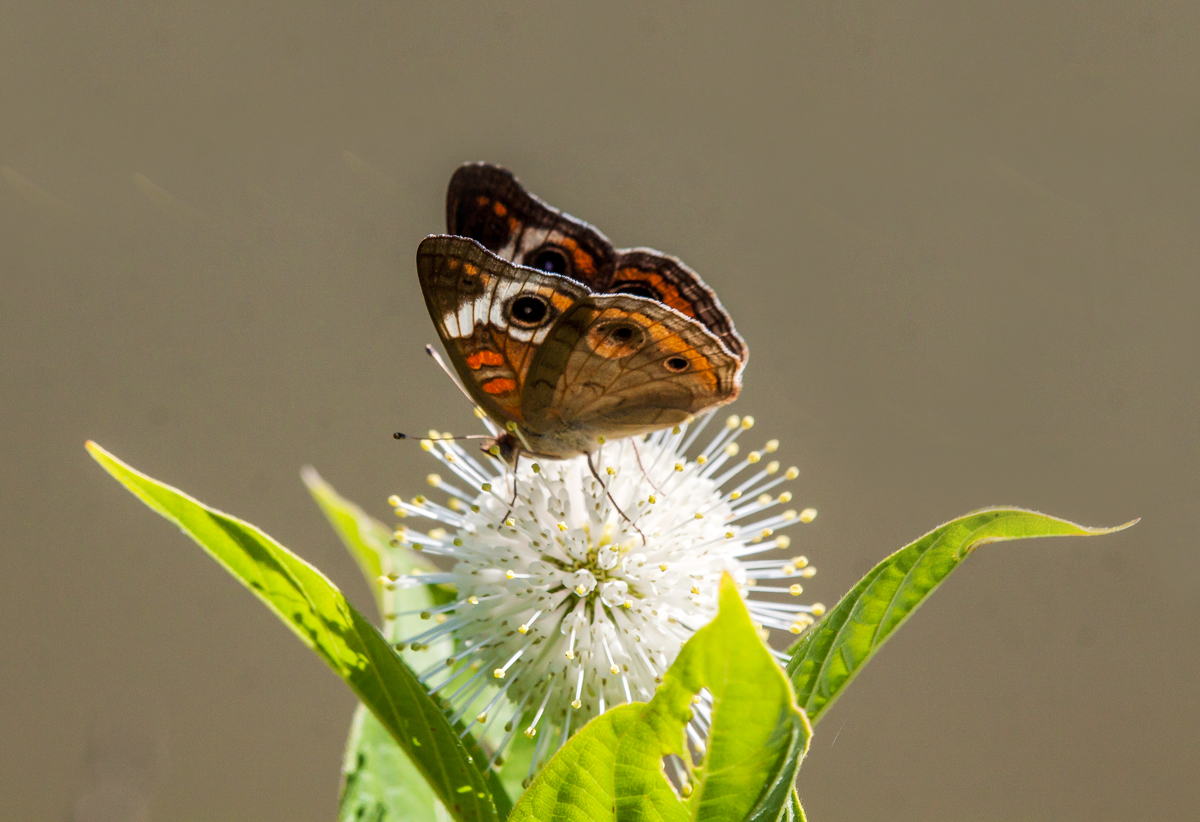
I first spotted this small Common Buckeye Butterfly (Junonia coenia) as it was flying low above a grassy patch at Jackson Miles Abbott Wetlands Refuge. Periodically it would stop and I would attempt to get a shot of it. It was probably hilarious to watch our little pas de deux—the butterfly would fly and perch and I would bend my knees and crouch, which served as a signal for the butterfly to take off again.

I’m pretty patient, so we danced this way for quite a while before the butterfly decided to perch on some low vegetation rather than on the bare ground. I was finally able to capture a shot, though the butterfly didn’t pose long before taking off again.

Common Buckeye

As I continued the chase, my knees started getting a bit sore. I was thinking of giving up the chase when suddenly the butterfly flew higher into the air and landed on a buttonbush (Cephalanthus occidentalis). These bushes are a virtual magnet for butterflies and I love the spiky spheres of the plant. I wasn’t able to get very close to the buttonbush, but captured this image that I really like.

Common Buckeye

The chase ended here and we went our separate ways. I hope that I never get too old or too self-conscious to chase butterflies, a pursuit that makes me feel like a carefree child again.

© Michael Q. Powell. All rights reserved.


Read Full Post »

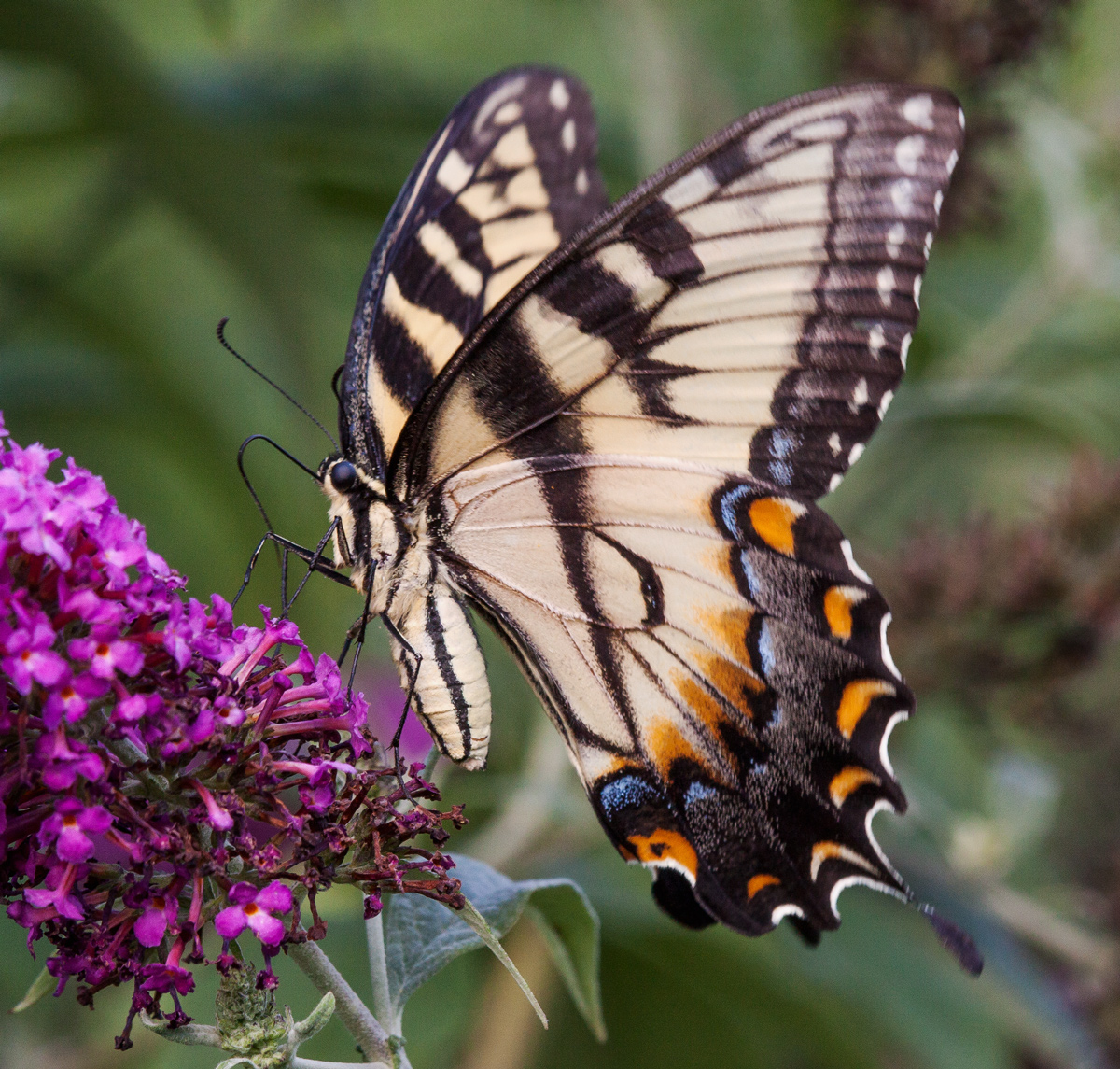
Some folks are really into chasing imaginary creatures with their cellphones. I prefer to chase living creatures with my camera and captured this image of a beautiful Eastern Tiger Swallowtail butterfly (Papilio glaucus) yesterday as it was feeding at Green Spring Gardens, a county-run historic garden in Northern Virginia.

The butterfly gave me multiple opportunities to get shots as it flew around a small area of the gardens, but it rarely gave me an obstructed view. Often it was partially buried in the flowers or turned away from me at an angle. When I took this shot, the butterfly had opened its wings and offered me a rare look at its body as well as its amazingly long proboscis.

Eastern Tiger Swallowtail

© Michael Q. Powell. All rights reserved.


Read Full Post »

How far do you usually travel when you want to take some photos? I capture a lot of my wildlife/nature images in my local area, but generally I get into my car and travel at least a few miles before I begin shooting.

Sometimes, though, I feel the urge to shoot, but don’t really want to travel far. In those moments I will usually walk over to the townhouse of my neighbor, fellow photographer Cindy Dyer, who always seems to have an assortment of photogenic flowers in bloom.

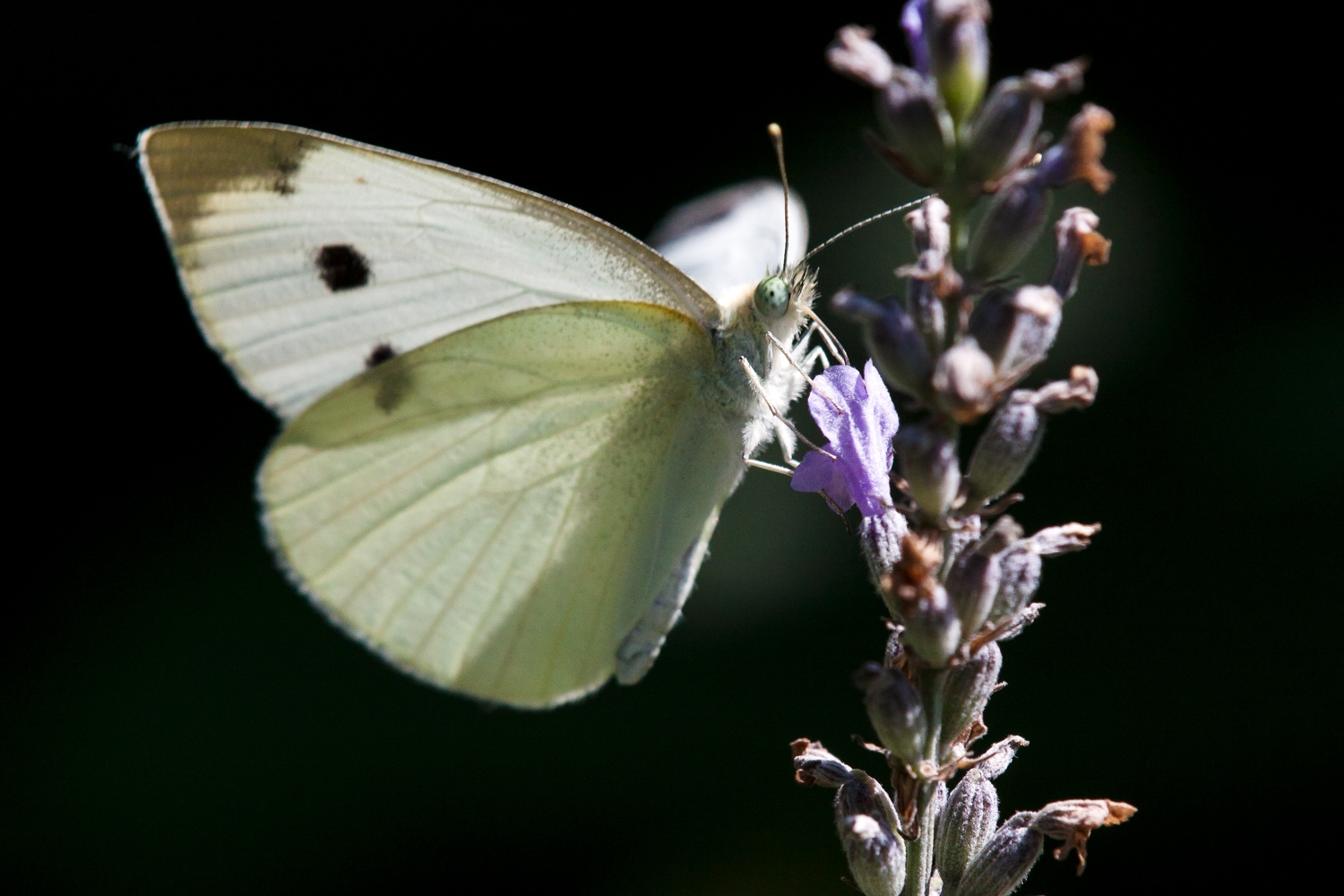
Last week I chased a Cabbage White butterfly (Pieris rapae) that I spotted fluttering about the flowers in garden. It passed by the globe thistles and the cone flowers and finally perched for a moment on a lavender plant. The sun was shining brightly, which I knew would create problems in getting a proper exposure of the dazzling white wings of the butterfly. I switched my metering to spot metering and the wings retained their details, but the background became really dark, creating a dramatic lighting effect that I really like. As always, I was thrilled to be able to see the beautiful green eye of this common butterfly that is often ignored or simply taken for granted.

Cabbage White

© Michael Q. Powell. All rights reserved.

Read Full Post »

Cabbage White butterflies (Pieris rapae) are very active and their blindingly white wings often cause images to be overexposed. When the light is right, though, you can see their enchanting speckled green eyes, like those of this butterfly that I spotted during a recent trip to Brookside Gardens in Wheaton, Maryland.

Cabbage White

© Michael Q. Powell. All rights reserved.

Read Full Post »

The light falling on this Silver-spotted Skipper butterfly (Epargyreus clarus) yesterday was beautiful and dramatic at Brookside Gardens in Wheaton, Maryland. I was focusing on the butterfly with my camera set for spot metering and I think that setting was largely responsible for creating the dark, underexposed background.

I was going to crop the image, but decided that I like the composition as it came out of the camera. My normal impulse is to zoom in or crop the shot so that my subject fills a larger part of the frame, but in this case I really like the large amount of negative space.

This shot reminds me a bit of a studio shot, the kind that would have required a number of carefully placed lights to create the same dramatic effect, not to mention a cooperative butterfly. Taking advantage of the natural lighting required a whole lot less effort. “More drama and less effort”—I like the sound of that as an approach to photography, which often seems so complicated.

Silver-spotted Skipper

© Michael Q. Powell. All rights reserved.

Read Full Post »

Purple Milkweed (Asclepias purpurascens) is in bloom in multiple locations at Huntley Meadows Park and the butterflies are loving it, including this Silver-spotted Skipper (Epargyreus clarus) that I spotted this past Monday.
Generally I have trouble identifying little skipper butterflies and Wikipedia notes that there are more than 3500 species of skippers worldwide.  The Silver-spotted Skipper, though, is pretty easy to identify, given its distinctive colors and markings.
There are several species of milkweed in my favorite marshland park and I have noticed more Purple Milkweed this year than in the past. This is really good news, because Purple Milkweed is considered to S2 (“imperiled”) in the Commonwealth of Virginia, according to the 2016 plant list of the Virginia Department of Conservation and Recreation.
Silver-spotted Skipper

© Michael Q. Powell. All rights reserved.

Read Full Post »

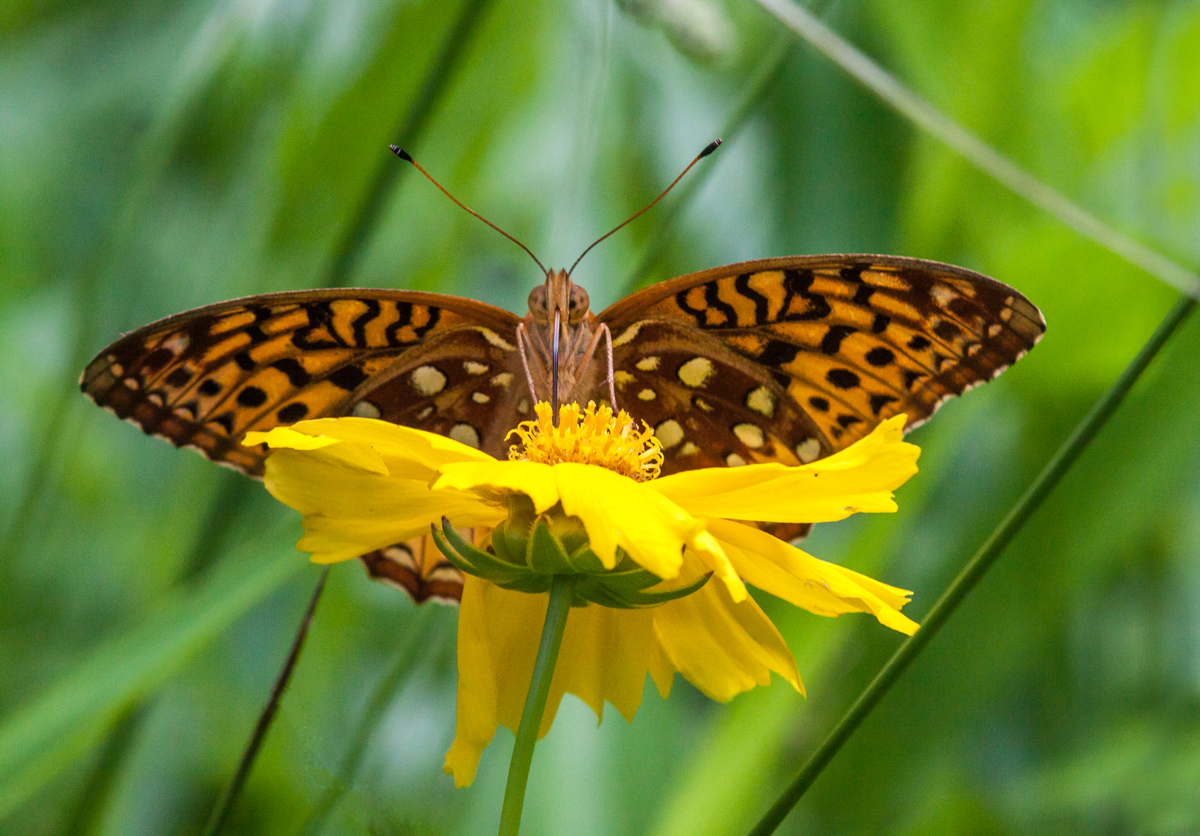
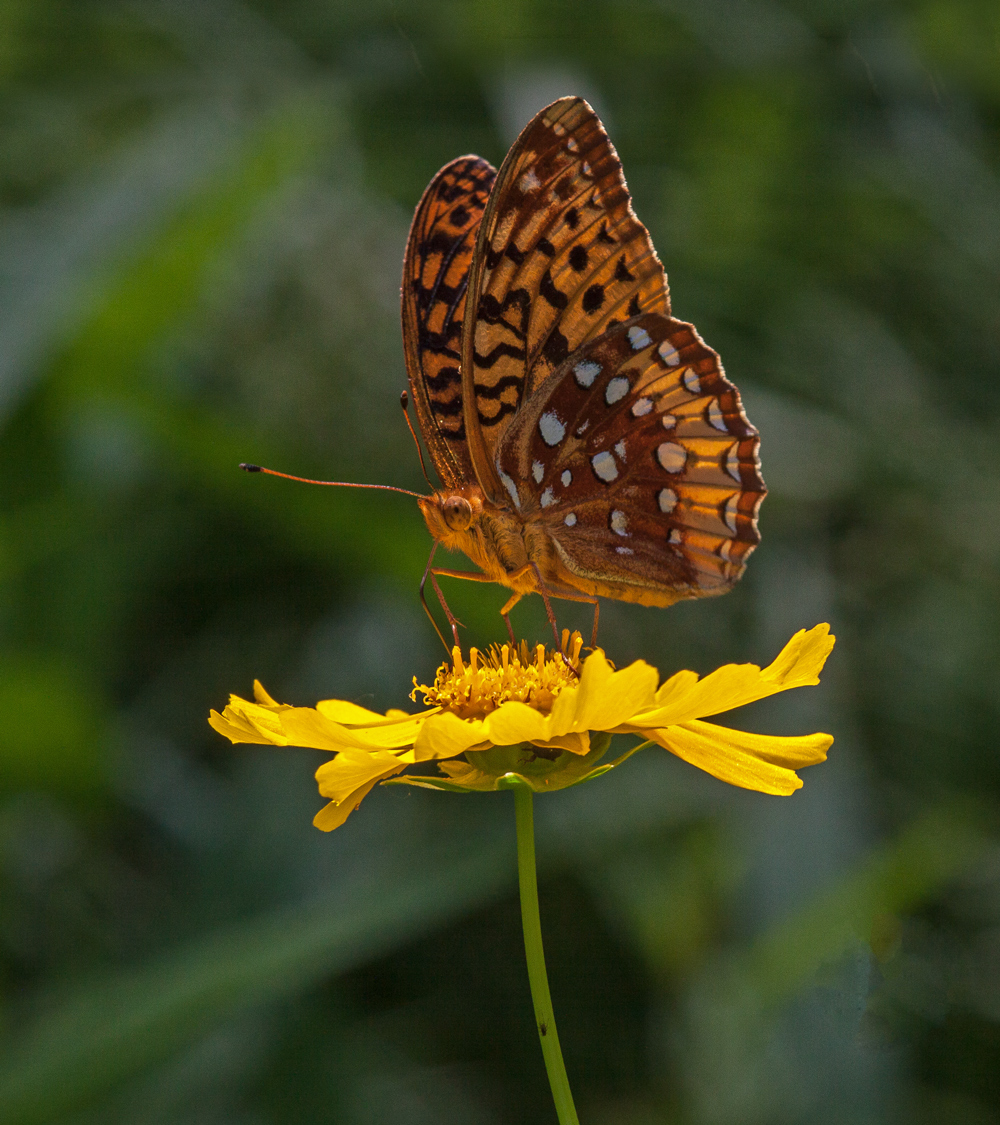
Spring is a time for chasing butterflies. This past week there seems to have been an explosion of Great Spangled Fritillary (Speyeria cybele) butterflies and I saw them at multiple locations yesterday as I trekked about in Huntley Meadows Park. The butterflies were very active, stopping for only short periods of time at flowers before moving on to the next one. My chasing behavior was impeded somewhat by the tall vegetation that has grown up in the fields, thanks to the large amount of rain that we had in May.

One of my favorite approaches with butterflies is to try to get at eye level with then and a few times yesterday I was able to get the kind of shot that I really like.

Great Spangled Fritillary

Great Spangled Fritillary

© Michael Q. Powell. All rights reserved.

Read Full Post »

As I was wandering through the woods of Huntley Meadows Park last Friday, I came upon a giant Luna Moth (Actias luna) that seemed to be almost as big as my hand. I was trying to get a close-up of its really cool antennae when an ant crawled onto one of the moth’s legs. I thought the ant might become lunch until I learned that Luna Moths don’t eat—they have no mouths and they only live for about a week as adults, with a sole purpose of mating, according to a Fairfax County Public Schools webpage.

Luna Moth

Luna Moth

Luna Moth

© Michael Q. Powell. All rights reserved.

Read Full Post »

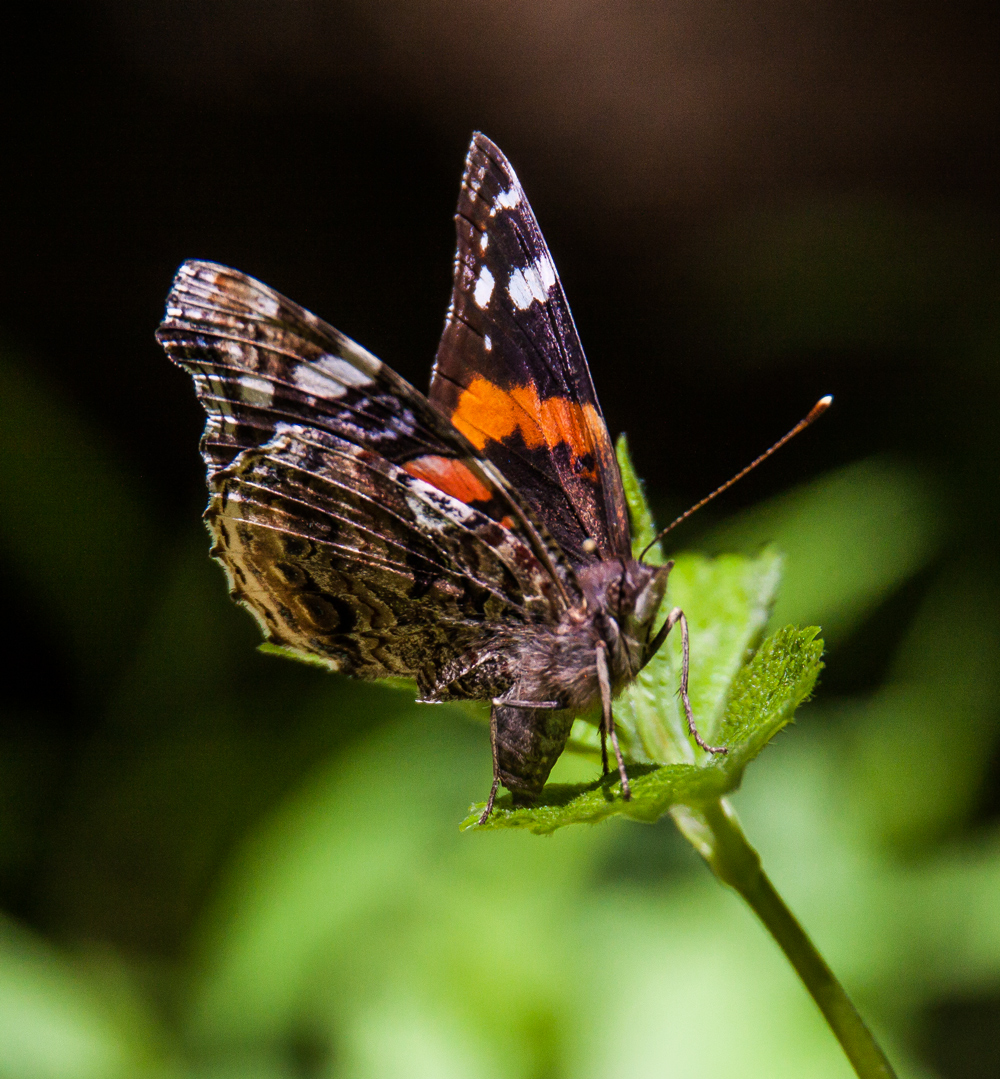
With the return of the sun, butterflies have started to reappear, like this handsome Red Admiral (Vanessa atalanta) that I spotted yesterday afternoon at Huntley Meadows Park.

It’s been gloomy and rainy for most of the past few weeks, so it was a particular joy when the sun was shining brightly yesterday. As I wandered through the woods and fields of my favorite park, butterflies flitted by a number of times, including several Red Admirals. Most of them kept moving and I was unable to capture them with my camera, but one of them perched a few times and gave me a chance to get some shots.

I’ve posted two of my favorite shots. The first is a little unconventional—the butterfly is upside down on a fallen log and I love the way it looks a bit like a heart. The second shot is a little more conventional, but it has a dynamic quality in the half-open wings and overall pose and I love the background blur.

Red Admiral

Red Admiral

© Michael Q. Powell. All rights reserved.

Read Full Post »

At this time of the year I love to try to photograph insects, but during my brief visit to Vienna, Austria the weather has been cool, windy, and sometimes rainy. The only insect that I was able to capture was this green-eyed moth that I spotted at the Donau-Auen National Park. I did a quick internet search,so far but have not been able to identify this insect.

When I am on business trips, I generally don’t travel with my Canon 50D DSLR and multiple lenses. I had been using a Canon PowerShot A620, a 2005 vintage 7.1 megapixel point-and-shoot camera. However, a while back I purchased a Canon SX50, a super zoom camera, to use as my new travel camera and I have used this trip to Vienna to test it out. I knew that it would be pretty good for long range shots, and have featured some images of birds this week that I photographed with the SX50.

What would it do, though, with smaller subjects? Would it be able to capture details? When I examined this image of the small green-eyed moth, I was pleased to see that the camera did a pretty good job in rendering details, such as the antennae and the eye.

I am still playing around with the different settings of the camera in an attempt to maximize the quality of the images it delivers, but my initial impressions are quite favorable.

Green-eyed moth

© Michael Q. Powell. All rights reserved.

Read Full Post »

Spring has definitely arrived in our area, but I was still quite surprised this past Saturday to see an Eastern Tiger Swallowtail butterfly (Papilio glaucus) at Huntley Meadows Park—it seems so early for butterflies like this.

I chased after the butterfly several times, to the extent that you can chase something while on a boardwalk, but each time the butterfly flew away. I had more or less reconciled myself to the likelihood that I was unlikely probably not going to get a shot of this early spring butterfly when I caught sight of it again.

The butterfly landed in a muddy open area where a flock of Canada Geese had previously been feeding.  There were no flowers around from which to get nectar, so the butterfly resorted to an organic source of nutrients.

This is definitely not the prettiest shot of a butterfly that I have ever taken, but it’s the first butterfly that I have photographed this season. Like the butterfly in the photo, I am content to settle for what I can find, hopeful that better things are to come as we move deeper into spring.

Eastern Tiger Swallowtail

© Michael Q. Powell. All rights reserved.

Read Full Post »

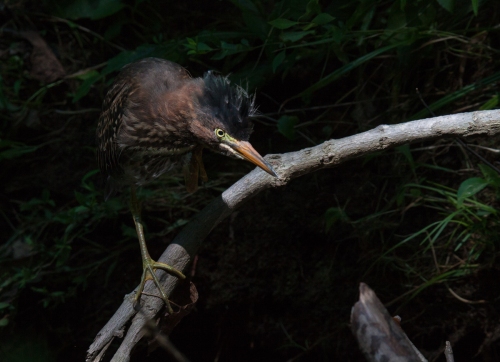
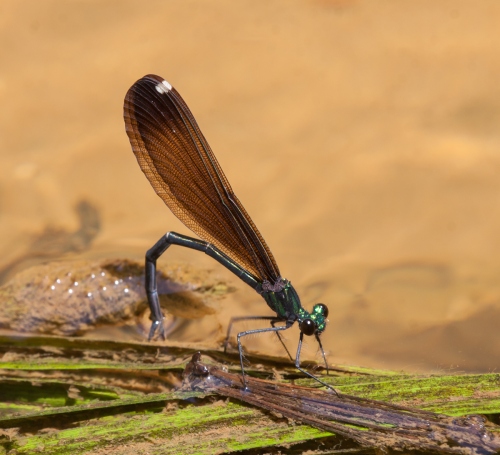
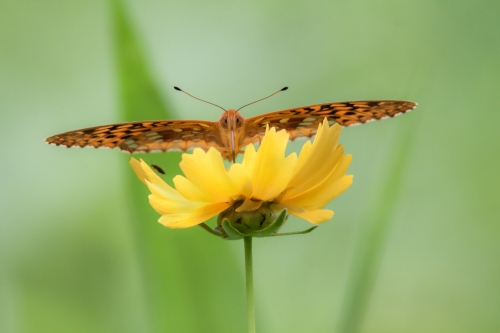
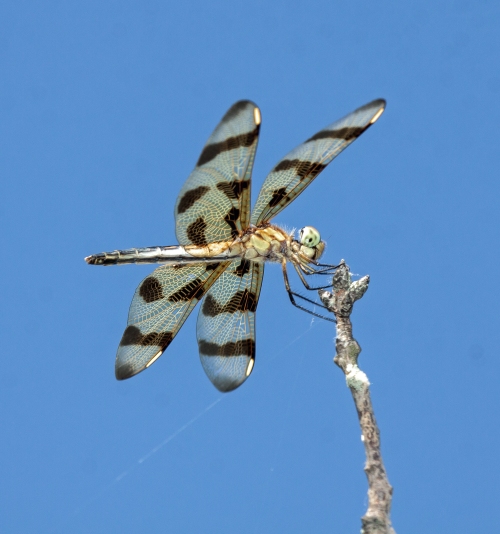
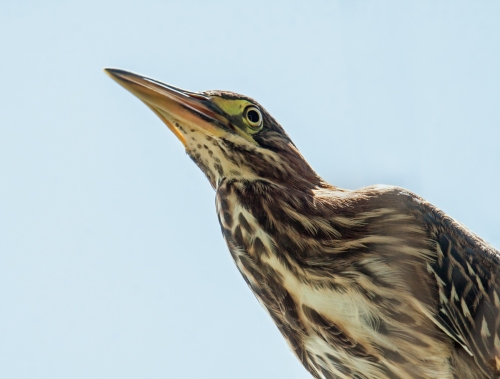
WordPress tells me I posted 851 photos during 2015 in 395 blog posts. I’ve forgotten many of those photos, but I want to share ten of my favorites with you today as we start the new year.

I used a very unscientific approach in selecting them—I simply chose ones that I really liked without looking at numbers of likes or views or comments. So often I am focused on getting new shots that I sometimes forget how wide a spectrum of subjects I like to shoot. These images remind me of my varied approaches and techniques.

I didn’t include any of the fox photos or contest entries that I featured recently, figuring that you were already familiar with them. I should note that this selection of favorites is representative and not exhaustive—there are probably some awesome shots that I have neglected to include. I haven’t tried to put the images in any kind of rank order, but if forced to choose, my favorite image of the year is probably the first one, the Green Heron with a kind of Rembrandt lighting.

Thanks to all of you who have supported and encouraged me so much in 2015. Best wishes for a wonderful 2016.

Green Heron

Ebony Jewelwing

Great Spangled Fritillary

Banded Pennant

Green Heron

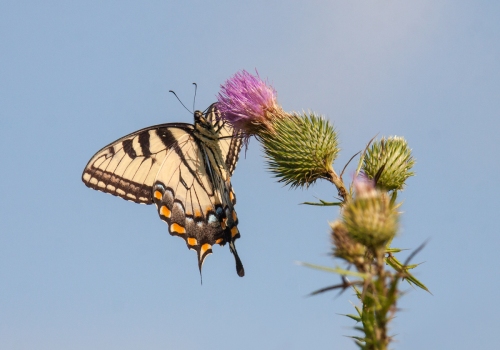
Eastern Tiger Swallowtail

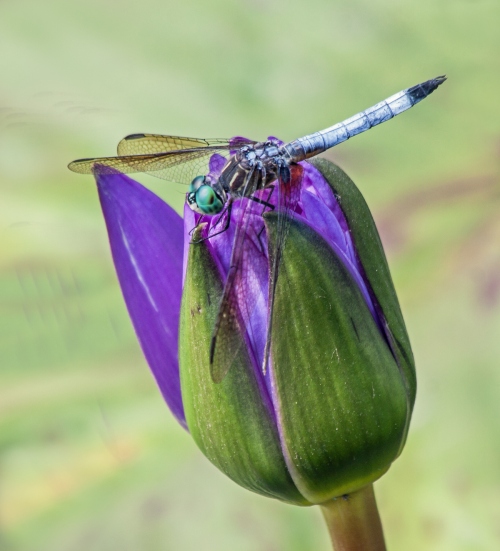
Blue Dasher

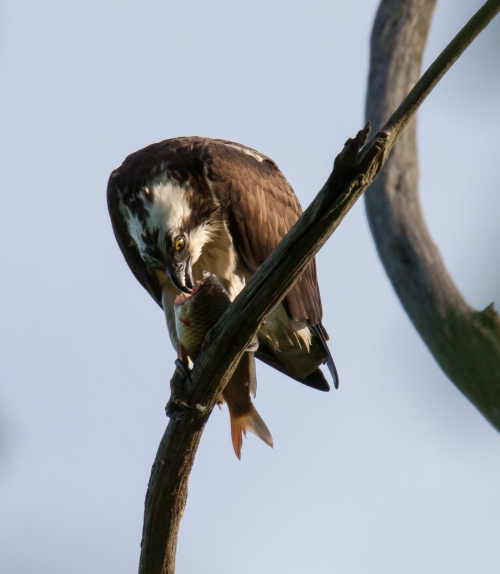
Osprey

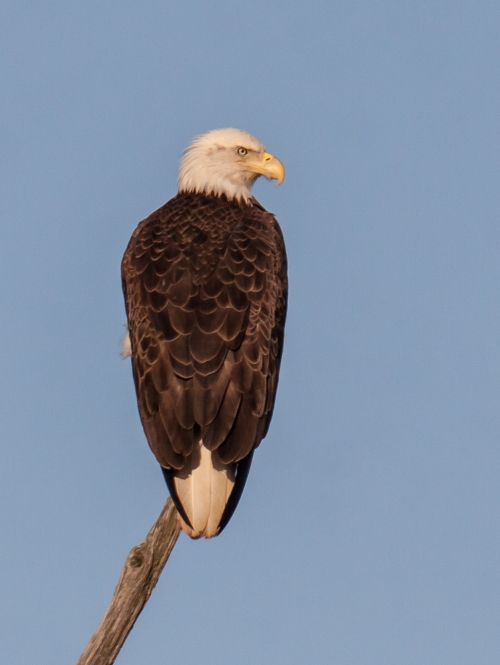
Bald Eagle

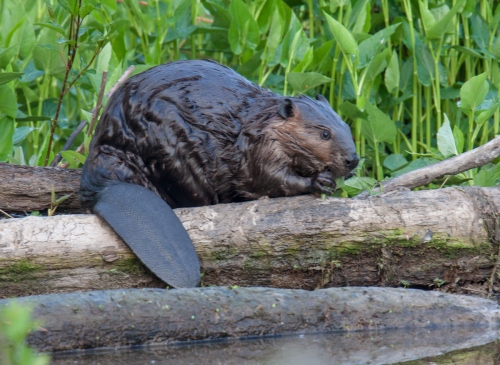
North American Beaver

© Michael Q. Powell. All rights reserved.

Read Full Post »

At first I thought it was only a leaf blowing in the breeze and then I slowly came to realize that it was a Common Buckeye butterfly (Junonia coenia), an unexpected sight in mid-November.

Although faded and tattered, this survivor butterfly is still spectacular, despite its “common” name.

Common Buckeye

© Michael Q. Powell. All rights reserved.

Read Full Post »

Earlier this month I spotted a butterfly with perfect colors for Halloween and it was perched upside down in a way that reminded me of a bat. (Take a close look at its shadow.)

It’s not really called a Halloween Butterfly—I sometimes like to make up my own names for the creatures that I see and photograph. It was a cool, but sunny day when I came upon the butterfly, which was completely stretched out, basking in the warmth of the sun’s rays. I wasn’t sure it was alive, until it flew away when I moved in a little closer after some initial shots.

The unusual wing shape made me think it was either an Eastern Comma or a Question Mark butterfly—yes, there are butterflies named after punctuation marks—but I wasn’t sure which one. After a little research on line, I’m convinced that it is probably an Eastern Comma butterfly (Polygonia comma). According to a posting on Trekohio.com, Eastern Comma butterflies have three dark spots in a row on their front wings, while Question Mark butterflies have four spots.

Why am I seeing a butterfly this late in the season? Eastern Comma butterflies overwinter as adults. A University of Wisconsin-Milwaukee Field Station posting described the process in this way, “They overwinter in cracks and crevices in rocks and trees. There, they certainly freeze, becoming butterfly-sicles, but their blood contains glycogens – antifreeze – that allow their tissues to withstand the winter’s cycles of freezing and thawing.”

In spring, the un-dead arise again.

Happy Halloween.

Eastern Comma

© Michael Q. Powell. All rights reserved.

Read Full Post »

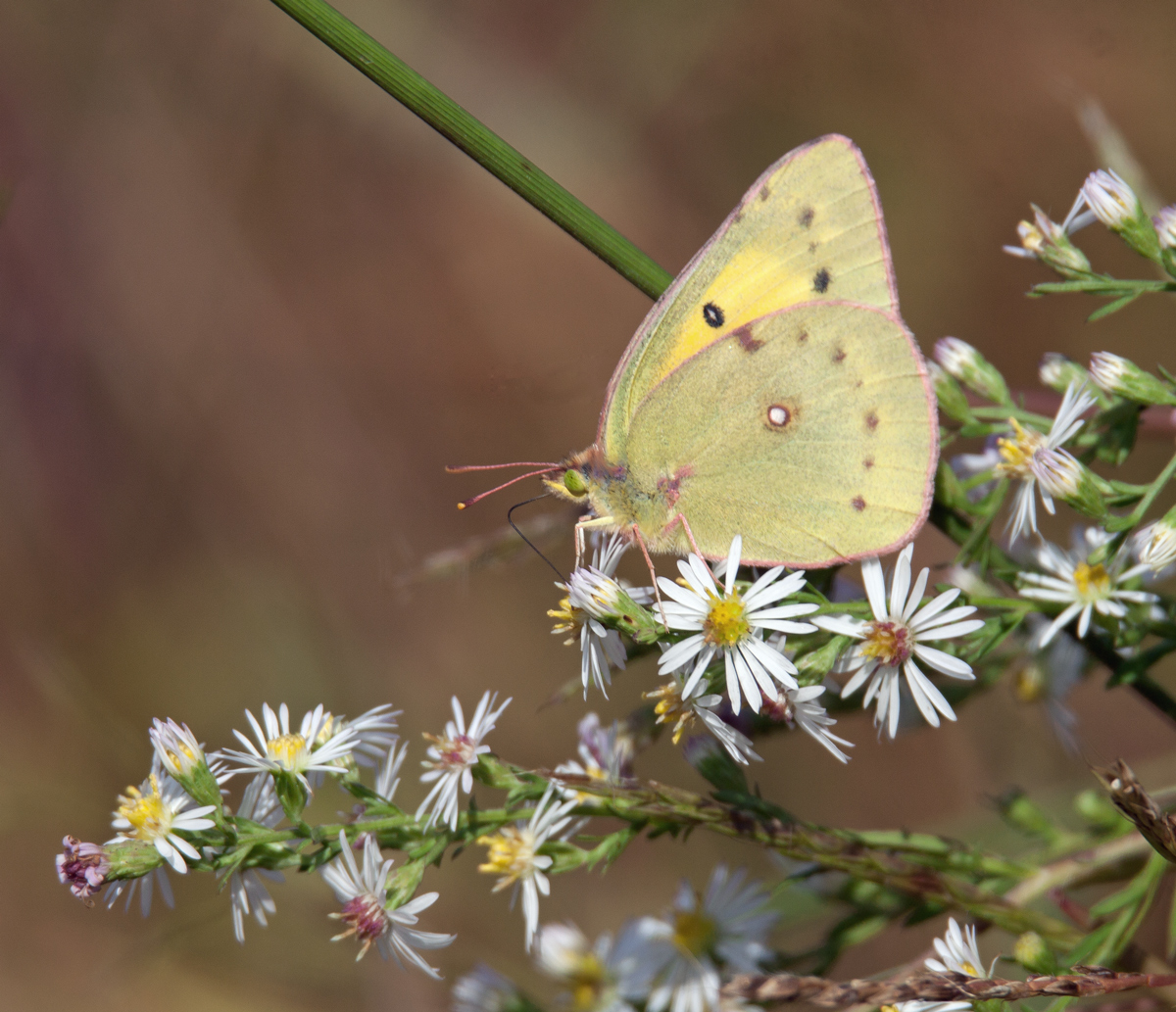
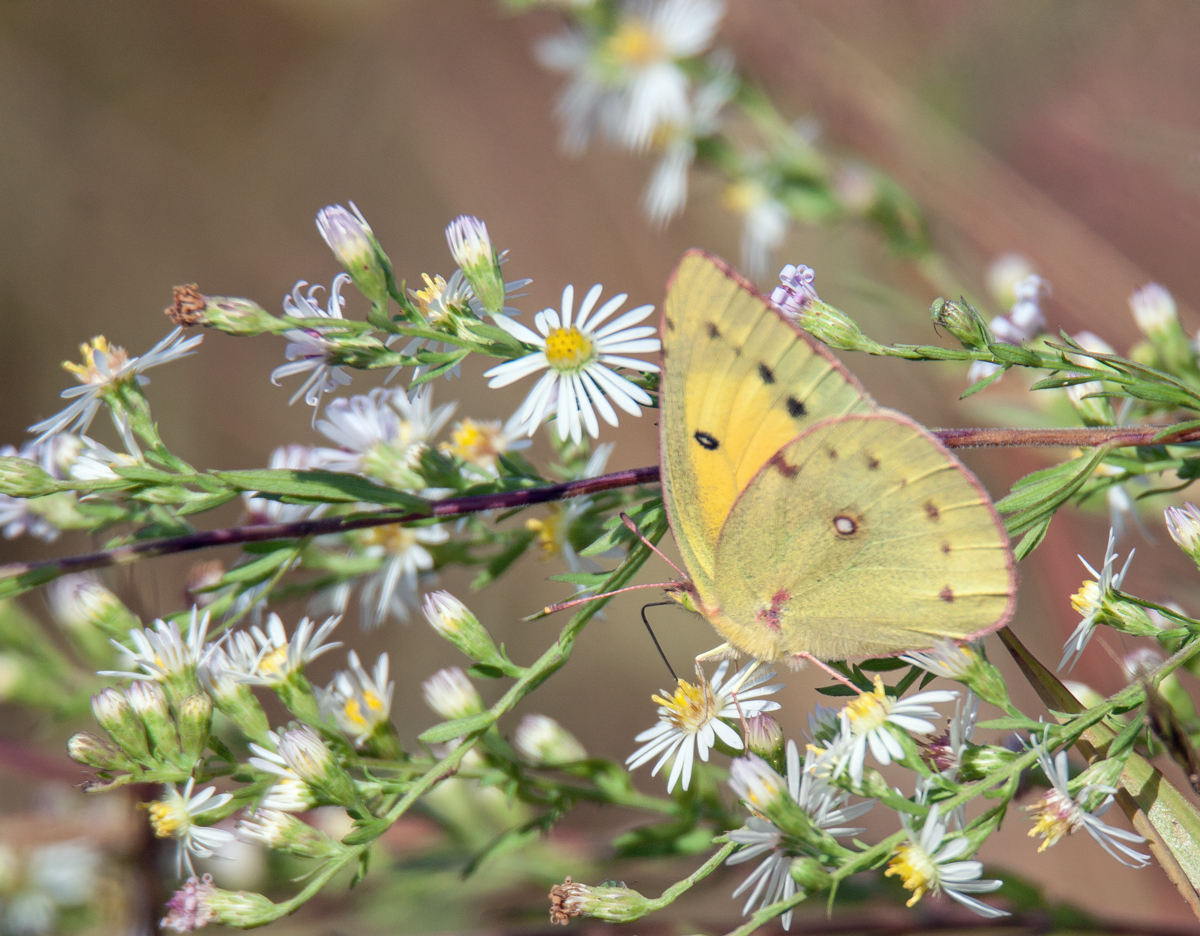
The large butterflies seem to be gone, but I continue to occasionally see smaller sulphur butterflies nectaring on late blooming flowers.

There are several different varieties of sulphur butterflies that look a bit alike, so I am not certain in identifying this butterfly. At first I thought that this might be a Pink-edged Sulphur (Colias interior), but the range maps suggest that we may not be in the correct geographic region for that species.

I think it is more likely that this is a Clouded Sulphur butterfly (Colias philodice). As for the flower, it looks to me to be some variety of aster.

The weather is definitely getting colder—I had to scrape frost off my car’s windshield earlier this week—so I don’t know how much longer I’ll be seeing these little beauties. Beauty so often is transitory; all we can do is enjoy it and appreciate it until it is gone.

Clouded Sulphur

Clouded Sulphur

Clouded Sulphur

© Michael Q. Powell. All rights reserved.

Read Full Post »

Though it is officially called “common,” the bright colors and patterns of this Common Buckeye butterfly (Junonia coenia) make it uncommonly beautiful in my eyes. (I should also note that it is not common for me to spot one—I’ve seen them only a few times this summer.)

Common Buckeye

© Michael Q. Powell. All rights reserved.

Read Full Post »

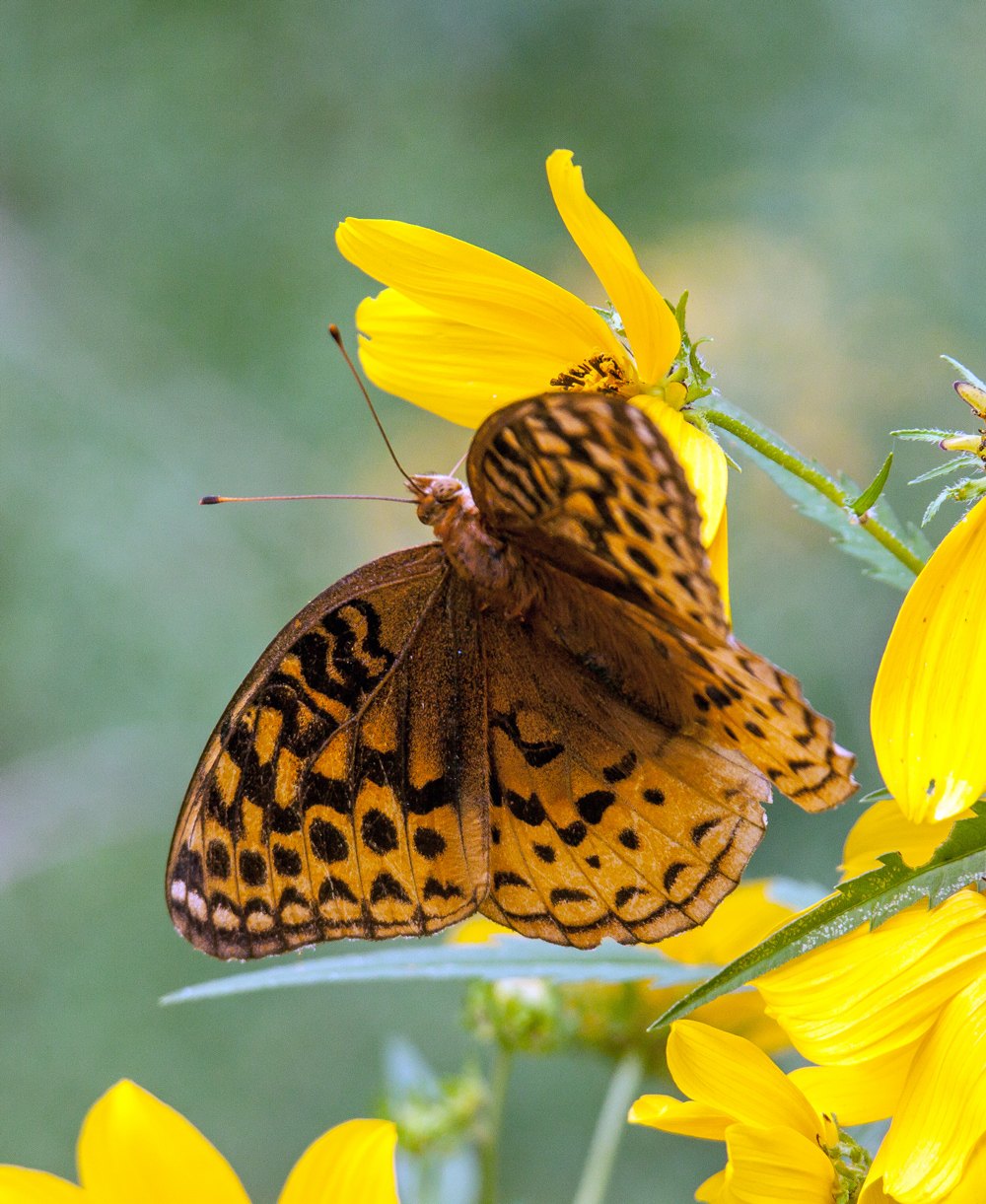
It’s amazing how a brightly colored butterfly can almost disappear from view merely by turning sidewards. Last week, I was observing a Great Spangled Fritillary butterfly (Speyeria cybele) feeding on a yellow flower when suddenly it seemed to disappear. I blinked my eyes and looked again and the butterfly looked almost like a grasshopper, because I could not see its wings.

Great Spangled Fritillary

A few seconds later, the butterfly shifted its position and its colorful wings once more came into view, providing the more conventional view of the butterfly that you see in the photo below.

Great Spangled Fritillary

I love trying to find unconventional views of familiar subjects, though it’s important not to forget that there is a lot of beauty in the familiar conventional views as well.

© Michael Q. Powell. All rights reserved.

Read Full Post »

My favorite marshland park is abloom with yellow flowers. This past Friday, I spotted a Monarch butterfly (Danaus plexippus) at the edge of a meadow feeding on one of those flowers. I thought the Monarchs had flown south for the season already, but was delighted to see they are still around.

I tried to frame the image so that there would be yellow flowers in the background and the results were even better than I had anticipated.

Yellow seems to be a happy color and somehow I can’t help but smile when I look at this image. I hope that it has the same effect on all of you.

Monarch butterfly

© Michael Q. Powell. All rights reserved.


Read Full Post »

I’m back from a brief overseas trip and it’s time to switch back from shooting in urban surroundings to my more typical nature images. In the meantime, here’s a shot of a beautiful Eastern Tiger Swallowtail (Papilio glaucus) from a pre-trip visit to Huntley Meadows Park in Alexandria, Virginia.

Eastern Tiger Swallowtail

© Michael Q. Powell. All rights reserved.

Read Full Post »

As we move closer and closer to the end of the summer, many of the butterflies are starting to show the effects of time, with faded colors and missing pieces of their wings. Yet somehow, at least in my eyes, their beauty is undiminished, like this Viceroy butterfly (Limenitis archippus) that I spotted this past week at my favorite local marshland park.

viceroy butterfly

© Michael Q. Powell. All rights reserved.

Read Full Post »

What kind of subjects lend themselves to black and white film? Can you decide beforehand and try to see the world in black and white, as I started out trying to do, or do you decide afterwards, as most people do when converting digital images to black and white?

This is the continuing story of my experimentation with a totally mechanical Nikon F SLR loaded with Ilford HP 5 Plus black and white film. I wandered through the streets of Washington D.C. looking for subjects and came upon this bust of noted Soviet human rights activist Andrei Sakharov outside of the Russia House restaurant on Connecticut Avenue.

I worked hard on this one to try to compose it and shoot it in an interesting way and I like the way that it turned out. It turned out that focusing manually is tougher than I thought, even with the visual assists in the viewfinder of a film camera, like the micro prism. I was definitely out of practice and I worried that all of my images would be soft and out of focus. This image reassured me that if I am careful, I can get relatively sharp images and capture details like the texture that you can see on the hands and the head of the statue.

Andrei Sakharov

Eventually I made my way to the National Zoo and last week I posted some digital shots of some of the animals that I encountered there. The zoo posed a big problem for me in getting a proper exposure, because there was a mixture of harsh midday sunshine and shadows. As I looked over my negatives, I realized that I need to meter more often—I took a series of shots of lions that were sometimes in the sunshine and sometimes in the shade and overexposed many of the shots.

However, one of my favorite images of the roll of film was this one of a female lion that was properly exposed and captured a good amount of detail. At this point in the day, I had switched to a Tokina 80-200mm lens to give myself a bit of additional reach.

lion

So could I take the kind of wildlife/nature shots that I normally feature with a film camera? It would be tough to do so, but this shot of a Monarch butterfly suggests that it would not be impossible. The pattern of the Monarch is so well-known, that most of us can imagine its orange and black coloration without actually seeing the colors. This is the only one of my black and white images on which I did a significant crop, and you can see how the background has become a bit grainy.
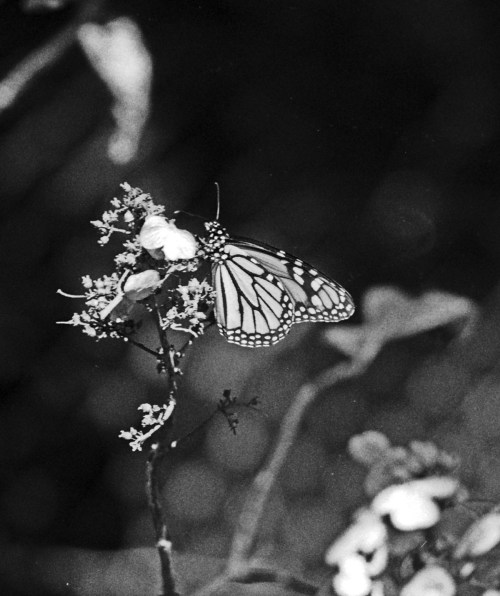
Monarch butterfly

For folks who are interested in the process, I developed the film with Ilfosol 3 developer, a general purpose developer. I exposed the film as though it were ISO 200, instead of the box speed of ISO 400, and learned that pulling the film like this is likely to lead to lower contrast (while shooting it at higher speeds will tend to give more contrast). I scanned the negatives with a Canoscan 8400f scanner as TIFF files and did a few adjustments in Photoshop Elements 11.

So what did I learn? I learned to slow down and be more deliberate as I contemplate my shots; I learned to look past some of the colors of the world and search for shapes and lines and contrast; and I leaned the value in producing my images in a manual, hands-on way, leading to a greater sense of ownership of those images.

I learned a lot, though clearly I have a lot more to learn as I continue to explore this new/old area of photography.

© Michael Q. Powell. All rights reserved.

Read Full Post »

I haven’t seen very many Monarch Butterflies (Danaus plexippus) the last few years, so I was thrilled when I spotted this one yesterday at the outdoor butterfly garden at the National Zoo.

I chased after it as it flew from plant to plant, hoping that it would come to rest withing range of my camera. Once the Monarch had landed I circled around until I was on the same plane as the butterfly and got this shot. Fortunately I was close enough that I was able to fill the frame with the beautiful Monarch and a small amount of the flower on which it was feeding—this is an uncropped image.

It was midday and the lighting was a little harsh, but it did help illuminate the wing from an angle and showcase the butterfly’s spectacular colors.

I did take some photos of some of the animals at the National Zoo, which I will present in another posting, but thought I’d start with the Monarch Butterfly, an unexpected bonus of my brief visit to the zoo.

Monarch butterfly

© Michael Q. Powell. All rights reserved.

Read Full Post »

There were lots of other available thistle plants yesterday at Huntley Meadows Park, but an Eastern Tiger Swallowtail (Papilio glaucus) and a Great Spangled Fritillary (Speyeria cybele) kept jockeying for position on this single flower, each seemingly determined to gain the upper hand.

Who knew that butterflies were so competitive?

Competitive butterflies

© Michael Q. Powell. All rights reserved.

Read Full Post »

« Newer Posts - Older Posts »