Feeds:
Posts
Comments

Archive for the ‘Birds’ Category

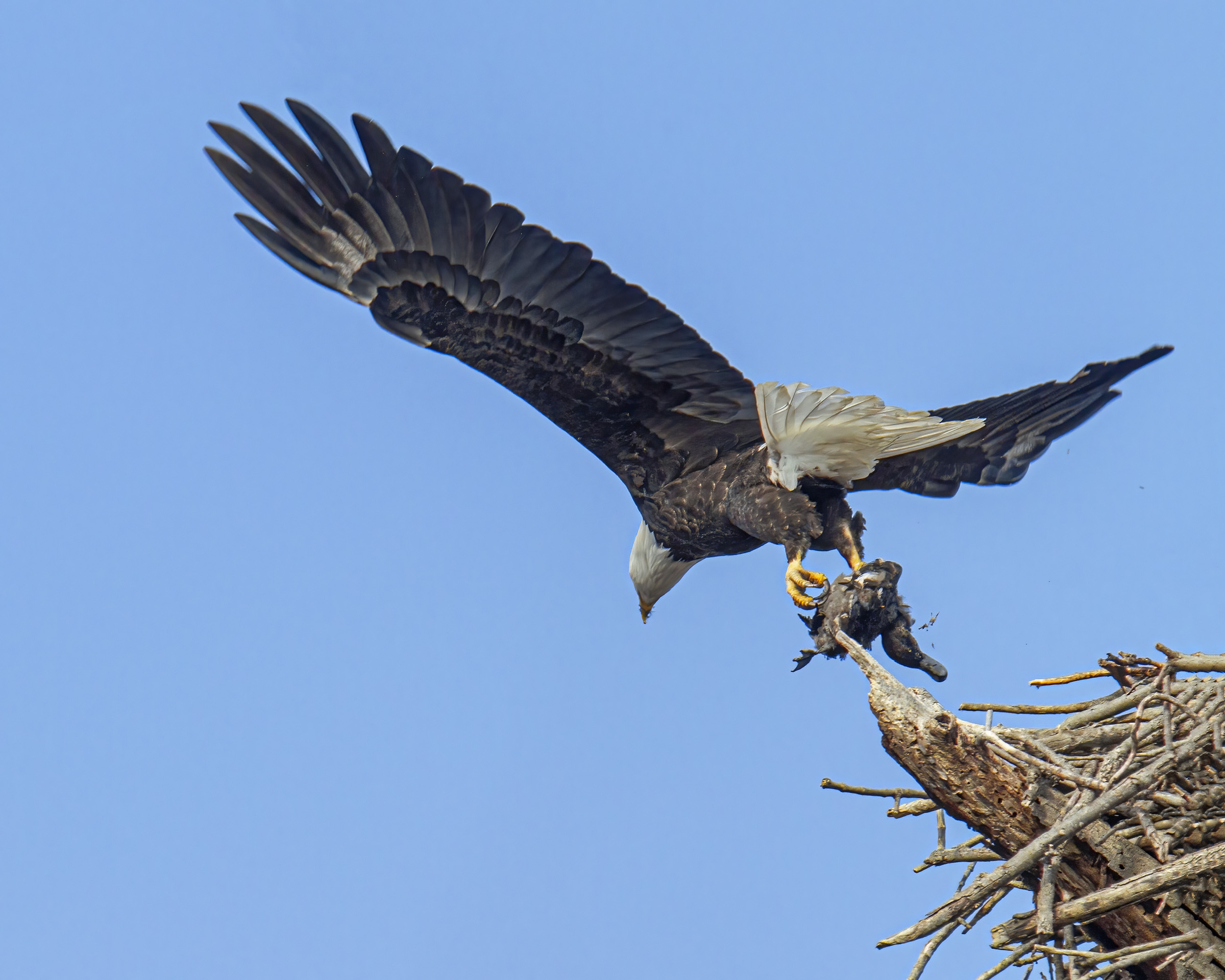
This Bald Eagle (Haliaeetus leucocephalus) must have decided that it wanted to celebrate Thanksgiving with poultry rather than fish. A Wild Turkey would have been too big, so it looks like the eagle settled for a duck.

As I approached the large eagle nest at Occoquan Bay National Wildlife Refuge, I was shocked to see that there was an eagle in the nest. As I watched, the eagle moved about a bit, bobbing its head up and down. I assumed that it was making minor repairs to the nest, but I was wrong.

It was only when the eagle flew out of the nest that I realized that the movement I had observed had been feeding behavior. I did not get a good look at the prey that was dangling from one of the eagle’s feet as it flew away, but assumed that it was a fish. Once again, I made a wrong assumption. When I looked at the images on my compute screen, I could see that the prey was some kind of duck, though I did not get a good enough shot of the duck to identify its species.

I don’t know how often eagles prey on water birds, but this is not the first time that I have seen it happen. Check out my March 2023 blog posting called “Eagle grabs coot” in which I featured some photos of an eagle encounter with an American Coot.

When I looked out on the waters of Occoquan Bay, I noticed that several rafts of ducks were present. They were pretty far away, but I did managed to identify numerous Ruddy Ducks and Buffleheads in addition to a few Pied-billed Grebes. The size of these groupings of birds varies throughout the colder months, but I can usually count on seeing them during late fall and winter months. If the eagles feel lazy or want a change in diet, I suspect that it is much easier for them to grab a duck that a fish.

Bald Eagle

Bald Eagle

Bald Eagle

Bald Eagle

© Michael Q. Powell. All rights reserved.

Read Full Post »

Most of the time my photos have a well-defined subject. Some of the time, though, I am so interested in trying to capture the mood of the moment that the “subject” occupies only a small part of the frame.

Last Friday, I spotted a large bird perched on a skeletal tree at Occoquan Bay National Wildlife Refuge. I thought at first that it might be a Bald Eagle, but when I zoomed in a bit I could see that it was a Turkey Vulture. I really like the starkness of the bare trees and the way that they give an abstract feel to the landscape. As I was preparing to take a shot, a small flock of Canada Geese flew into the frame and I captured several of them in the photo below.

The resulting image is mostly monochromatic, though you can see occasional glimpses of a warmish brown on some of the broken edges of the trees. If you look really closely at the vulture’s head, you can see a touch of red.

I do not know if this image “works” in conveying the mood of that monochromatic moment, but I thought it might be interesting to share with you my thought process as I experimented in capturing an image that is quite different from my normal wildlife shots.

monochromatic

© Michael Q. Powell. All rights reserved.

Read Full Post »

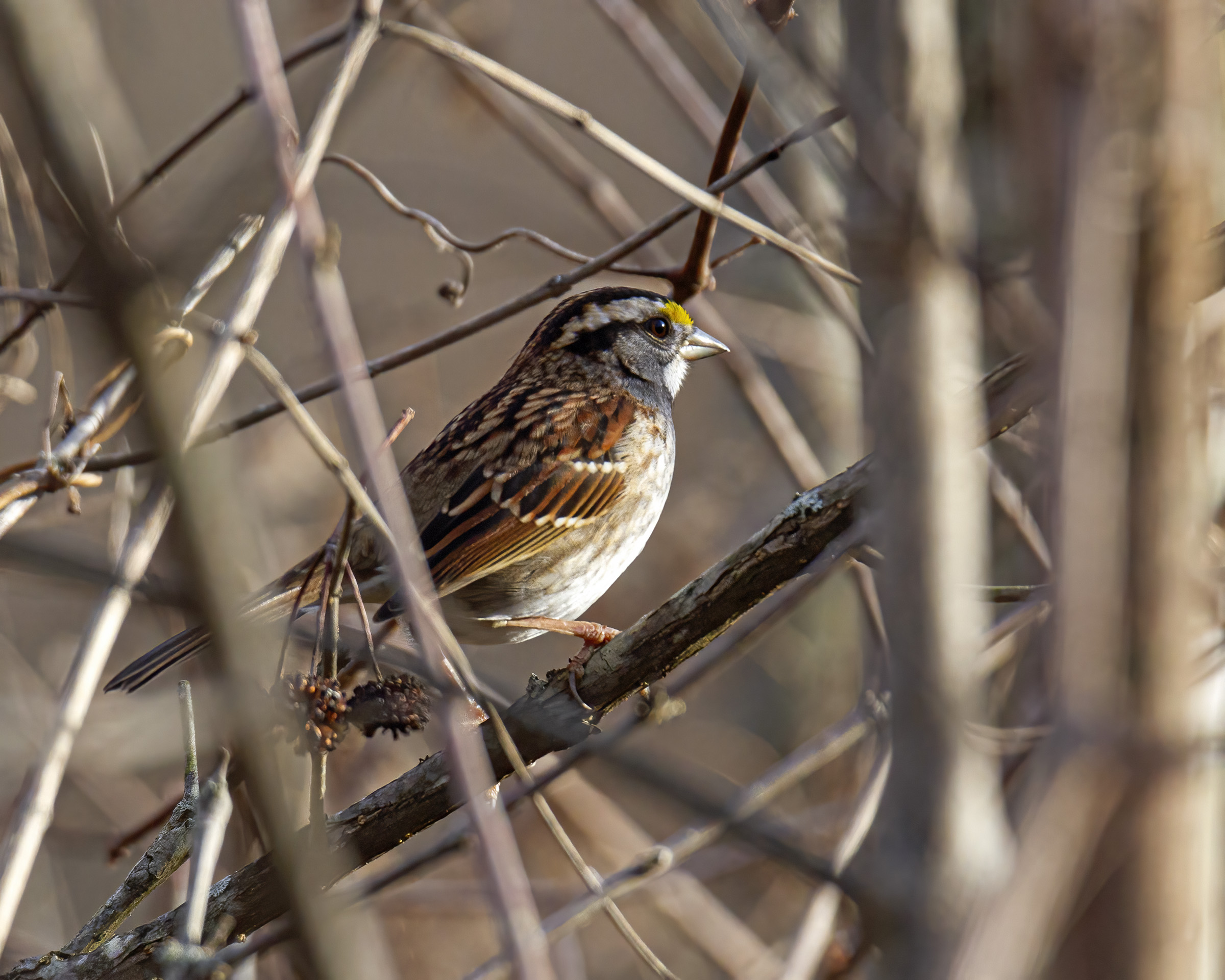
White-throated Sparrows (Zonotrichia albicollis) are one of my favorite winter birds. During autumn they migrate into my area in great numbers and spend the winter with us.

Sometimes I complain that I have trouble identifying sparrows, but this is a species that I can reliably identify, thanks to the bright yellow lores (i.e. the area between the eyes and bills) and the white throat patch that always makes me think of Santa Claus.

Like many other sparrows, White-throated Sparrows like to forage deep in the bushes and the underbrush, so it is tough to get an unobstructed shot of one. As you can see in both of these photos, my view of the sparrow was partially blocked, but I was able to find a visual tunnel that let me get a good shot the head and most of the body of this beautiful little bird.

White-throated Sparrow

White-throated Sparrow

© Michael Q. Powell. All rights reserved.

Read Full Post »

When I was growing up in New England, American Robins (Turdus migratorius) were always viewed as a harbinger of spring. I don’t know if American Robins migrated out of our area and returned in the spring, but I do recall that seeing one of them foraging on a lawn meant that spring was on the way.

Here in Northern Virginia where I have lived for thirty years now, I have grown accustomed to seeing American Robins throughout almost the entire year. It gets cold enough here that the ground freezes most years, so I suspect that the robins have to adapt their diets to other food sources—I have a mental picture of robins pulling worms out of the ground and that would not be possible during the winter.

I spotted this American Robin last Thursday almost hidden in the vegetation at Huntley Meadows Park. I suspect that it is either a female or an immature male, given the rather pale coloration and the white patches of feathers on the belly.

American Robin

© Michael Q. Powell. All rights reserved.

Read Full Post »

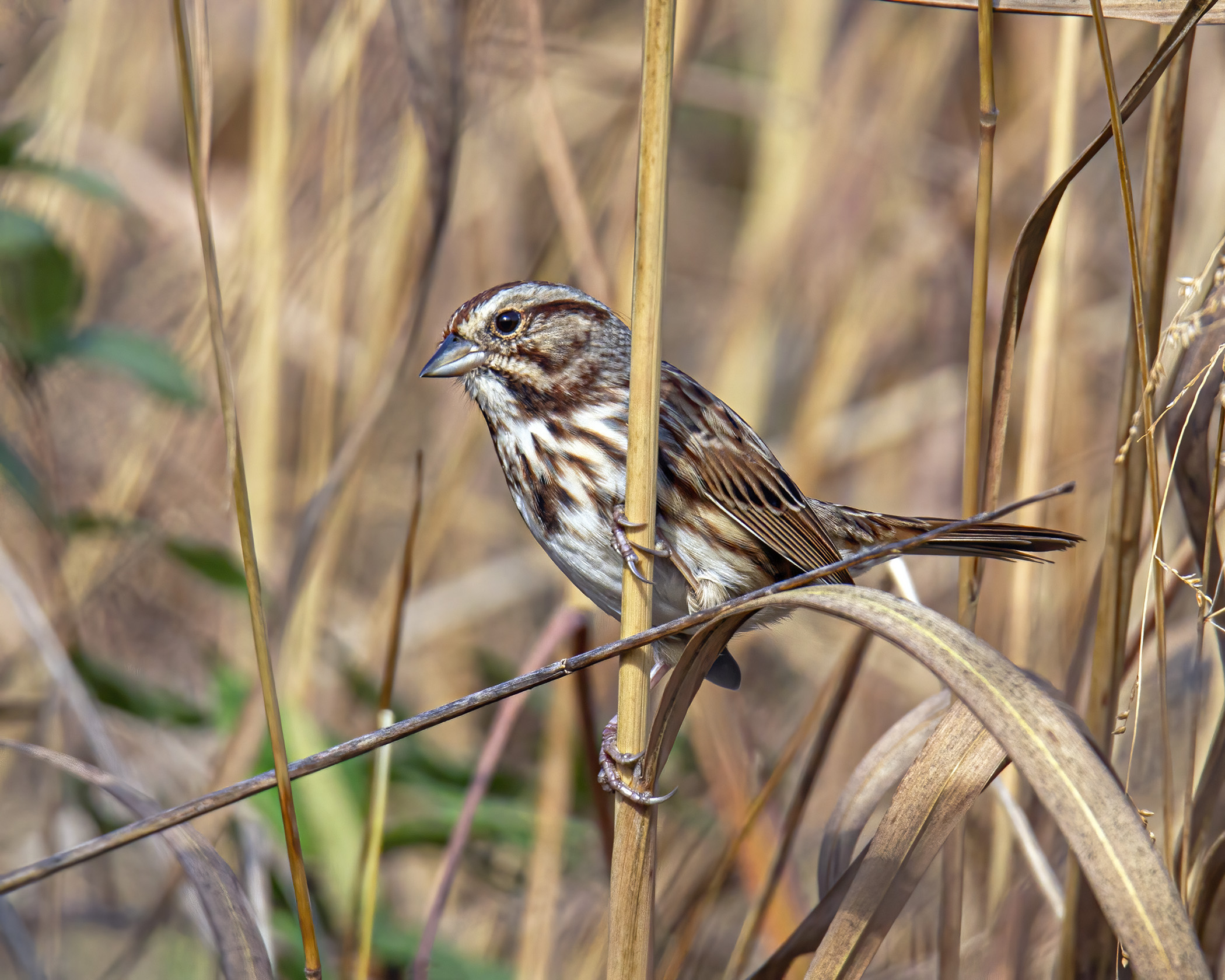
Some days it seems like most of the birds are hiding from me, but I can usually count on seeing at least a few sparrows. Last Thursday I spotted this little sparrow, which I am pretty sure is a Song Sparrow (Melospiza melodia), perched in the reeds at Occoquan Bay National Wildlife Refuge.

I still have a bit of trouble with identifying some sparrow species, but I am getting better at looking closely at the facial markings and other identifying features that help me to distinguish one species from another. Some experienced birders can identify birds by their calls, but with a few notable exceptions I am not at that level.

Song Sparrow

© Michael Q. Powell. All rights reserved.
 

Read Full Post »

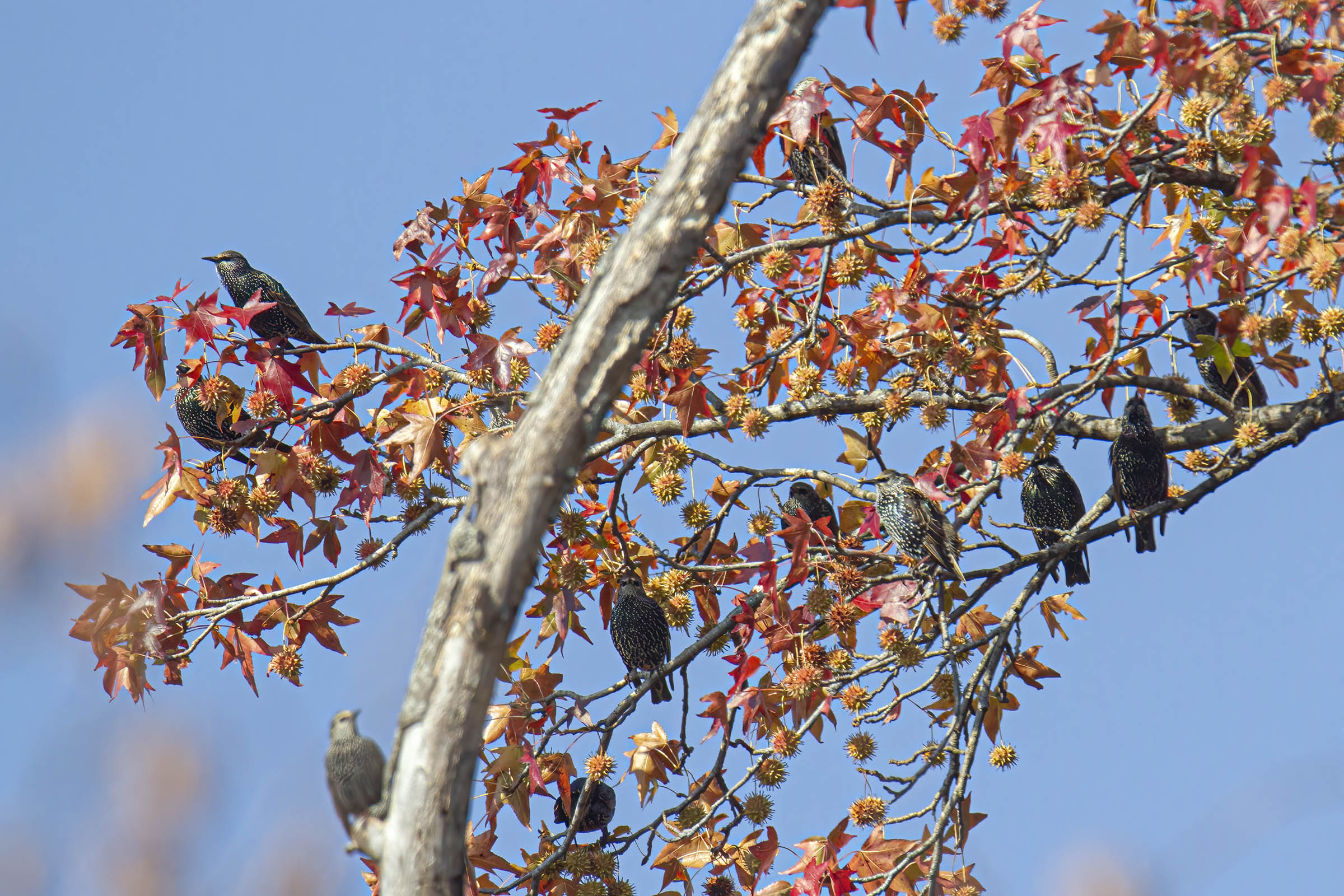
How do you photograph a flock of birds? This past Thursday I visited Occoquan Bay National Wildlife Refuge and observed (and heard) that a sizable flock of European Starlings (Sturnus vulgaris) was moving about in a large expanse of trees. I attempted to photograph clusters of starlings, but as you can see in the final photograph, many of the birds were hidden or shaded by the foliage or were looking away from me.

I decided that a better approach was to concentrate my efforts on getting shots of individual starlings. The first image is one of my favorites from my session with the starlings. The texture of the photogenic snag adds to the visual interest of the image and the starling cooperated by giving me a nice view of its profile. The colorful foliage gives you a sense of the season and of the environment and the two blurry starlings in the background help to balance the image.

The composition of the second image is much simpler—it’s just the bird and its perch. What makes this image interesting for me is the intensity of the starling as it calls out with its mouth wide open, which adds a touch of dynamism to what would otherwise be a static portrait.

European Starling

European Starling

European Starling

© Michael Q. Powell. All rights reserved.


Read Full Post »

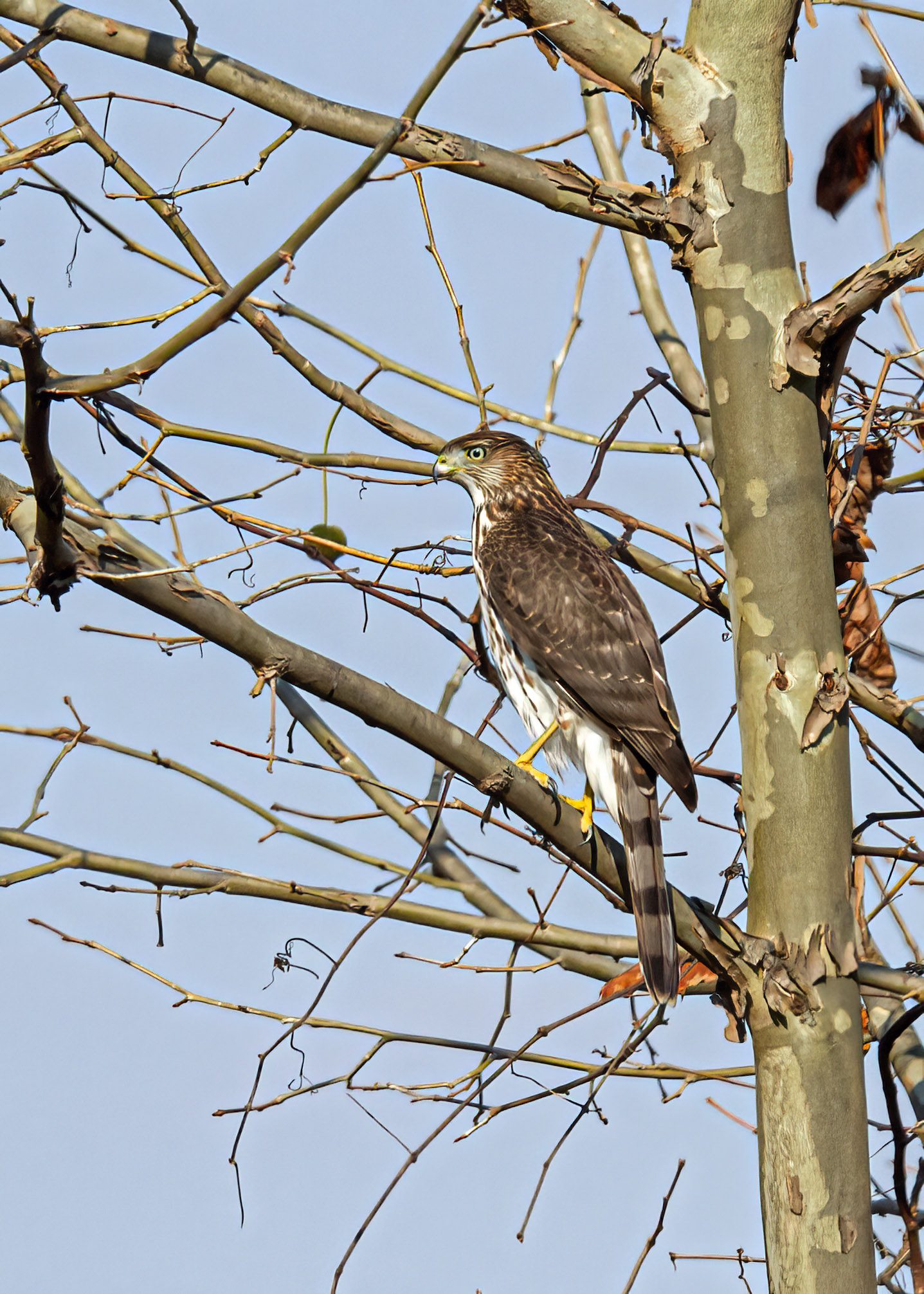
As I looked up a trail on Thursday at Occoquan Bay National Wildlife Refuge, I noted the shape of a bird perched on a shaded gate. When I zoomed in, I realized it was a hawk, which flew to a distant tree as I was capturing the first shot. I shared the images with a Facebook birding group, and the general consensus is that the bird is a juvenile Cooper’s Hawk (Accipiter cooperii).

Most of the hawks that I regularly see are Red-shouldered Hawks and occasionally I spot Red-tailed Hawks. At first I thought that this one might be a Red-shouldered Hawk, but when I looked at my photos on my computer, I was really struck by the length of the hawk’s tail and by the elongated shape of the hawk’s body that are not characteristic of a Red-shouldered Hawk.

One of the folks on Facebook who responded to my posting noted, “Juvenile Cooper’s hawk. Beautiful youngster. You caught the neat teardrop shaped breast streaking, and the short wings against the long and widely banded tail.”

As many of you know, I am an opportunistic wildlife photographer—I enjoy walking around a lot and try to capture photos of my wonderful encounters with nature, like this one.


Cooper's Hawk

Cooper's Hawk

Cooper's Hawk

© Michael Q. Powell. All rights reserved.
Read Full Post »

Woodpeckers are amazingly industrious. They repeatedly hammer their heads against trees, with seemingly a low success rate. Yesterday, though, this male Downy Woodpecker (Picoides pubescens) was successful in capturing an insect at Occoquan Bay National Wildlife Refuge and paused for a moment to show it to me.

Downy Woodpeckers are the smallest woodpeckers in my area and are the species that I see most often. In addition to pecking away at trees, I have also seen them search for insects in cattails and in other vegetation. It is easy to distinguish a male Downy Woodpecker from a female, because males have a bright red patch on the back of their heads, a feature that you can just see in this photo.

Downy Woodpeckers are usually very energetic. I spotted this woodpecker as he was spiraling his way up the tree. I prepared myself when he disappeared behind the trunk and was able to anticipate where he would reappear. I really like the angle of view of this shot that allows us to see the bird’s sharp claws and intense eyes. Downy Woodpeckers always seem to be intensely focused on what they are doing and it was wonderful to see this one’s efforts rewarded with a nice little treat.

Downy Woodpecker

© Michael Q. Powell. All rights reserved.
Read Full Post »

It is fun to watch the acrobatics of tiny Ruby-crowned Kinglets (Corthylio calendula) as they forage for food, like this one that I photographed last Thursday at Occoquan Bay National Wildlife Refuge. I love the twisting, spiral shape of the little branchlet on which the kinglet is perched so much that I might well have photographed it even if the kinglet were not there. The yellow colors in the background are a huge plus in creating an autumnal feeling in this image.

© Michael Q. Powell. All rights reserved.
Read Full Post »

I wouldn’t recommend adding poison ivy berries to your diet, but this Yellow-rumped Warbler (Setophaga coronata) seemed to be really enjoying them last Thursday at Occoquan Bay National Wildlife Refuge. Amazingly, poison ivy is a great source of nutrition to a variety of wildlife species. According to the Georgia Department of Natural Resources, a wide variety of “birds are especially fond of poison ivy berries. The plant’s waxy, white berries are loaded with vitamins and other nutrients. If that isn’t enough, they are available to south-bound migrants in mid-summer as well in winter when food is at a premium.”

It is incredible to me that such tiny birds can survive during the winter and finding nutrition like these little white poison ivy berries is one of the keys to their survival. Yellow-rumped Warblers eat mainly insects in the summer, according to the Cornell Lab of Ornithology, but during the winter they switch to a diet of mostly seeds and berries. Can you imagine being a carnivore for six months of the year and a vegan for the other six months?

Yellow-rumped Warbler


Yellow-rumped Warbler

Yellow-rumped Warbler

© Michael Q. Powell. All rights reserved.

Read Full Post »

As I was preparing to lock the front door of my townhouse in Northern Virginia one day last week, I glanced over at a bush about 10 feet (3 meters) away where a bird was perched. I pivoted my body, turned on the camera, and focused on the little bird, which I noted was a Carolina Wren (Thryothorus ludovicianus)—I going out out on a photo adventure, so my camera was slung over my shoulder.

Fearing that I might scare off the wren, I snapped off a few shots without paying too much attention to my camera settings. It felt a little strange to photograph a bird at such close range. In most cases I photograph birds with my 150-600mm lens zoomed out to 600mm, but in this instance I took the shot at 309mm and probably should have zoomed back a bit more.

When I was reviewing the images on my computer,  I checked the camera settings I had used and found out my camera was set at ISO 800, f/6.3, and 1/100. I am a little shocked that I was able to get a relatively sharp shot at such a low shutter setting, but the lens does have some built-in image stabilization and I am used to holding the lens pretty steady.

Some photographers travel great distances to capture wildlife images. This shot is definitely award worthy, but it does show that you may not have to travel far from home to see and photograph nature and wildlife. Beauty is everywhere.

Carolina Wren

© Michael Q. Powell. All rights reserved.

Read Full Post »

Most warblers pass briefly through my area when they are migrating in the spring and in the fall, but Yellow-rumped Warblers (Setophaga coronata) stay with us for a good part of the colder season. This past Thursday I spotted quite a large number of Yellow-rumped Warblers as I wandered the trails at Occoquan Bay National Wildlife Refuge.

In the first photo, you can see a portion of the yellow patch that is responsible for the name of this species. Most of the time I see only the smaller yellow patches on their sides, because they tend to perch high above me and I am often shooting at an upwards angle.

I am amazed by the light weight of Yellow-rumped Warblers and their ability to perch on incredibly slender branches, as you can see in the second image. According to the Cornell Lab of Ornithology, these little birds weigh only 0.4-0.5 ounces (12-13 g).

In the final photo, the warbler is poised to move on to its next perch. Yellow-rumped Warblers are not quite as hyperactive as some other species that I see at this time of the year, like Ruby-crowned and Golden-crowned Kinglets, but they move around a lot as they forage for food.

Yellow-rumped Warbler

Yellow-rumped Warbler

Yellow-rumped Warbler

© Michael Q. Powell. All rights reserved.

Read Full Post »

Sometimes when you have an itch, you just have to stop what you are doing and scratch it. I have certainly had that experience and that seemed to be the case with this Great Blue Heron (Ardea herodias) that I spotted last week at the edge of the water at Occoquan Bay National Wildlife Refuge.

If you zoom in on the photo, you can see that the heron has quite long claws on its toes that it was using along the length of its neck. I love the way that the feathers were all awry as the heron focused on scratching its itch.

Great Blue Heron

© Michael Q. Powell. All rights reserved


Read Full Post »

They are not as creepy as spiders or a black cats, but there is something eerie and unsettling about the pale yellow eyes of Rusty Blackbirds (Euphagus carolinus), like this one that I spotted last Friday at Occoquan Bay National Wildlife Refuge. The bird was in a really distant tree, so the image is not super sharp, but I really like the way I was able to create a mood in the shot and the subdued colors throughout the shot really help that eye to pop.

Happy Halloween!

Rusty Blackbird

© Michael Q. Powell. All rights reserved

Read Full Post »

A large flock of European Starlings (Sturnus vulgaris) was foraging in the trees at Occoquan Bay National Wildlife Refuge last Friday. Initially I thought that this might be a flock of crows or red-winged blackbirds, but when I zoomed in on the birds and saw their mottled iridescent feathers, I immediately identified them as starlings.

I captured these images as the birds feasted on some unidentified berries, plucking and ingesting them one at a time. I was hoping to get more shots of these birds, but without any visible warning, they all took off at the same time and flew away.

European Starling

European Starling

European Starling

© Michael Q. Powell. All rights reserved

Read Full Post »

Do you imagine a photo in your mind and then try to create it? Most of the time I am an opportunistic wildlife photographer—I react to the situations in which I find myself and try to make the best possible photo to capture the subject, the action, or the mood. Sometimes, though, I look at a spot and think, “Wouldn’t it be great if my subject moved into that light or onto that photogenic perch?”

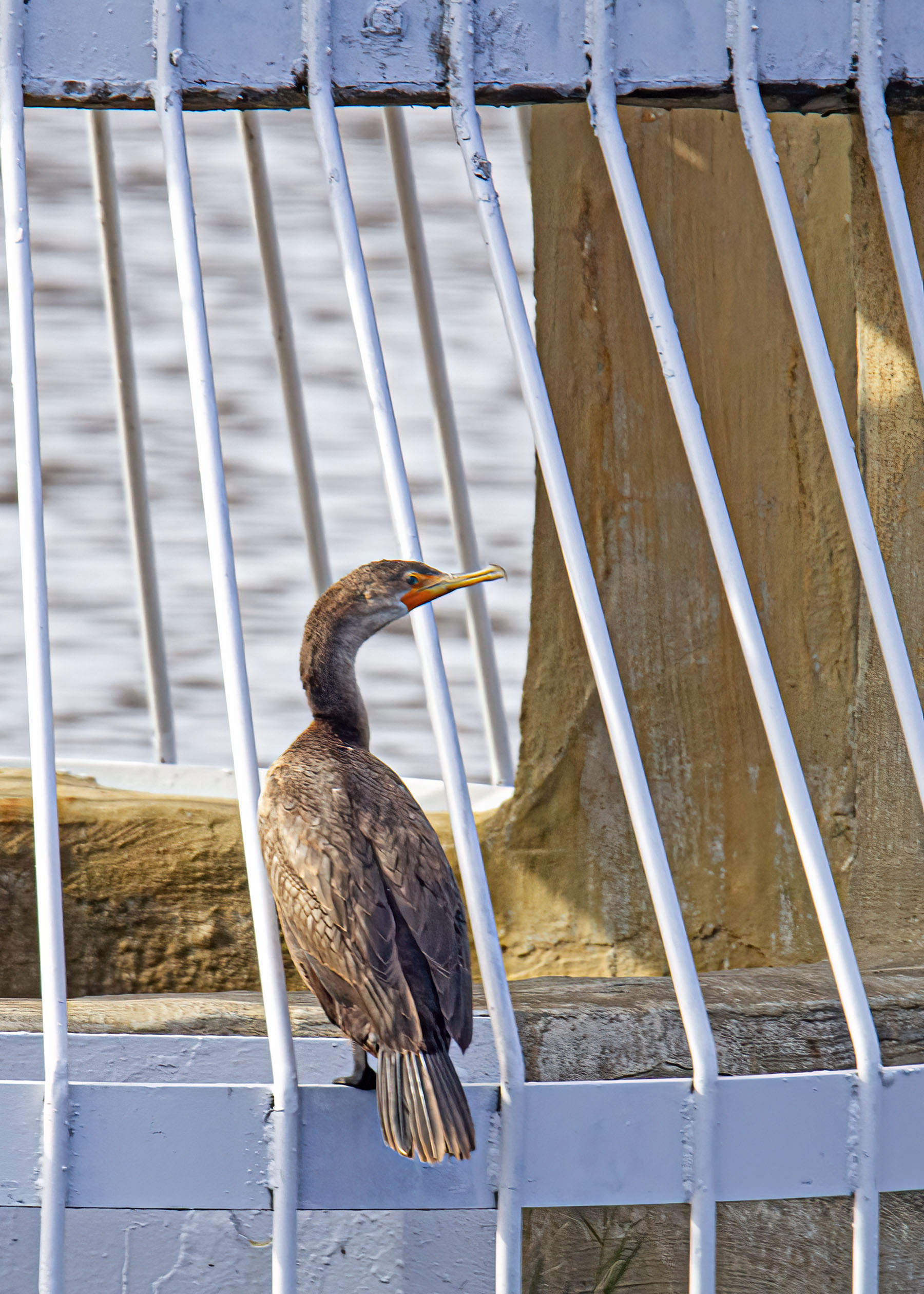
On Wednesday I watched a lone Double-crested Cormorant (Phalacrocorax auritus) as it repeatedly dove into the water in a small suburban pond not far from my townhouse. Generally I encounter cormorants at larger bodies of water, but I know that this manmade pond is deep and is suited to birds that dive for food—some species of migratory diving ducks, for example, overwinter there.

The cormorant would spend quite a while underwater and I never knew where it would pop up next. I kept hoping it would surface in an area where the reflections of the fall foliage were especially colorful and eventually it did. The cormorant was quite far away, but I captured the kind of imagine that I had imagined, with colorful rippled patterns on the surface of the water as the cormorant swam into the frame. I encourage you to click on the imagine to see the details of the first image.

The second image was one of my earlier attempts. The cormorant surfaced closer to me than in the first shot, but the surface of the water was not as colorful as I wanted. However, the shot provides a really good look at the striking aquamarine eyes of this beautiful bird. Wow! Those eyes never fail to startle and delight me.

It is a fun challenge to try to incorporate the fall foliage into my photos and I have had an unusual amount of good luck in doing so this past week with a variety of subjects. I am starting to see more and more leaves on the ground, so I know that this period is transitory. Carpe diem!

Double-crested Cormorant

Double-crested Cormorant

© Michael Q. Powell. All rights reserved


Read Full Post »

This tiny Ruby-crowned Kinglet (Corthylio calendula) glared down at me as I photographed it on Wednesday in a tree overhanging a stormwater retention pond in Kingstowne, a suburban community only a mile or so from where I live. The autumn foliage surrounding the pond had several patches of  impressively colorful leaves and I was delighted to be able capture some of the beautiful autumn color in the background of these two images.

In the first photo, you can see a portion of the kinglet’s “ruby crown,” a feature of the males that is often hidden from sight. The second image gives you a better overall view of the little kinglet, which only about four inches (10 cm) in length and weighs about .3 ounces (9 grams).

Ruby-crowned Kinglets are generally hyperactive, so it was unusual when this one paused for a moment in its foraging efforts and “posed” for me in the open.

Ruby-crowned Kinglet

Ruby-crowned Kinglet

© Michael Q. Powell. All rights reserved


Read Full Post »

I will often strive to photograph my wildlife subjects from as many different angles as I can in order to take advantage of the lighting or to highlight the details of their bodies. When I spot a subject, though, I initially try to capture whatever shot I can before I work to get a better shot—any of my subjects are skittish and there is always the chance that my initial shot will be my only one.

I spotted this perched male Belted Kingfisher (Megaceryle alcyon) last Thursday at Huntley Meadows Park in Alexandria, Virginia and one of my initial shots was the third one below. The perch was sticking out of a pond that was surrounded by a marshy wetland, so there was really no chance for me to get closer to the kingfisher—there was no way to work the angles in my usual way.

So what did I do? In the background I noticed there were some patches of colorful fall foliage, so I decided to see if I could include some of those colors in my images to give them an autumn vibe. By bending, twisting, crouching, and kneeling I was able to vary my shooting angle, while remaining more or less in the same spot, and eventually managed to get some photos that included portions of that autumn foliage. The kingfisher remained in place, but cooperated by changing his head position from time to time.

Belted Kingfisher

Belted Kingfisher

Belted Kingfisher

© Michael Q. Powell. All rights reserved.

Read Full Post »

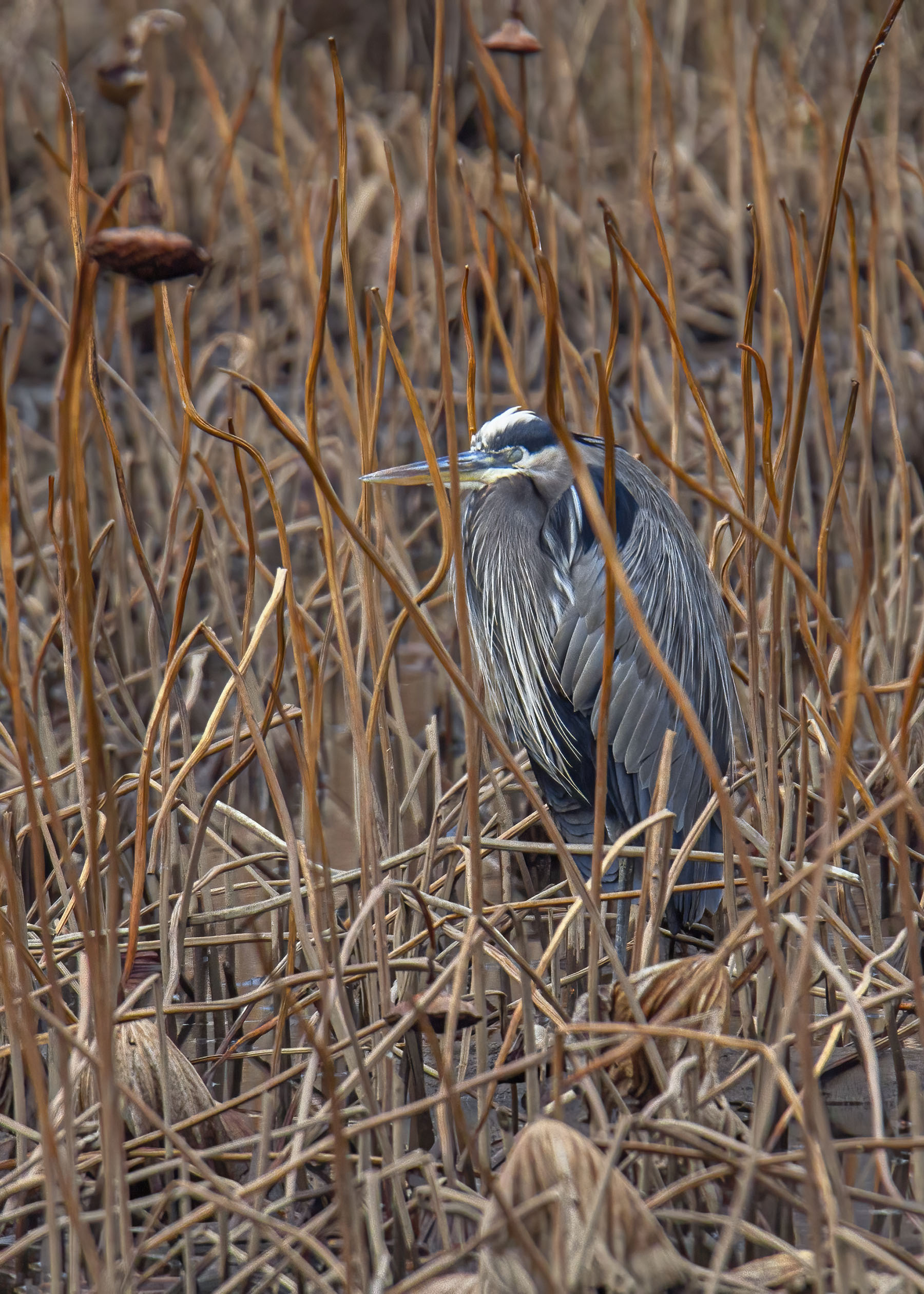
This Great Blue Heron (Ardea herodias) was so well hidden that I could not tell if it was perched on a small raised portion of the ground or in a tree when I caught a glimpse of it during a recent visit to Occoquan Bay National Wildlife Refuge. My view of the heron initially was mostly obscured by the thick vegetation, but I managed to get a somewhat clear shot of it by climbing on top of a conveniently placed park bench.

Great Blue Heron

© Michael Q. Powell. All rights reserved.


Read Full Post »

This Bald Eagle was almost hidden in the foliage of a sweet gum tree when I spotted it on Thursday at Occoquan Bay National Wildlife Refuge. Normally I depend on the brightness of a bald eagle’s head to give away the presence of an eagle, but in this case the eagle’s head was in partial shade, making it stand out quite a bit less than it usually does.

The second shot shows a view of the eagle from a different angle. Even though this shot does not show as much detail as the first shot, which was actually taken after the second one, I like the way that it shows how the eagle was nestled on its perch amidst all of the branches.

In the upcoming months, many of the leaves will fall from the trees and it will become marginally easier for me to spot an eagle from a longer distance away. Of course, that will also make it easier for the eagles to spot me and my vision and reflexes are rarely a match for those of the eagles. Often my first indication of an eagle’s presence is when it takes to the air and flies away from me.

Bald Eagle

Bald Eagle

© Michael Q. Powell. All rights reserved.


Read Full Post »

I spotted this Bald Eagle (Haliaeetus leucocephalus) in a distant tree on Tuesday at Occoquan Bay National Wildlife Refuge at about the same time that it spotted me. I reacted quickly and managed to capture this first image as it prepared to take off. As you can see, there is already a bit of color in our autumn foliage, but the colors are relatively muted here in Northern Virginia, compared to what I would see when I was growing up in New England.

The second photo shows the eagle a few seconds after its takeoff as it rose above the trees. At that moment its feet were still dangling, but it raised its “landing gear” shortly after I captured the image.

It has been a while since I last posted eagle photos and it was wonderful to have a couple of sightings of these majestic birds on a beautiful fall day.

Bald Eagle

Bald Eagle

© Michael Q. Powell. All rights reserved.

Read Full Post »

I spotted this pretty little sparrow on Wednesday at Occoquan Bay National Wildlife Refuge. When I looked through my bird identification guide, I thought that it looked a little bit like a Chipping Sparrow. When I posted the photo below in a birding group on Facebook, however, some experienced birders identified this bird for me as a young White-crowned Sparrow (Zonotrichia leucophrys), a new species for me.

Sparrows can often be hard for me to identify, but the distinctive bill on this one helped me to narrow down the pool of potential species. A mature male White-crowned Sparrow has a black and white head and is easy to identify, but immature males and females of different species are often similar in appearance.

White-crowned Sparrow

© Michael Q. Powell. All rights reserved.


Read Full Post »

Each fall I face the same dilemma—I see the photos of other photographers indicating that migrating warblers are present in our area, but I have trouble spotting these elusive little birds. Part of the problem is that leaves are still mostly on the trees and I can often hear birds that remain invisible in the foliage. The other main problem is that many birds are now sporting their duller fall plumage, so they do not stand out as much as during the spring migration, when their  breeding plumage is much brighter.

Given my normal experience, I was thrilled to spot several Palm Warblers (Setophaga palmarum) and Yellow-rumped Warblers (Setophaga coronata) during visits to Occoquan Bay National Wildlife Refuge earlier this week. The birds in the first two photos, I believe, are Palm Warblers, a relatively common warbler species that likes to poke around a lot on the ground.

The final two photos show Yellow-rumped Warblers, which are the most common warbler species in my area. In both of the photos you can see the yellow patch of feathers on the “rump” of the bird.

In a month or so I may switch over to my longest lens, a Tamron 150-600mm zoom lens, which will allow me to zoom in a little more on these tiny birds, but for now I am sticking with my Tamron 18-400mm lens, a more versatile lens that lets me get photos of butterflies and dragonflies as well as of birds. (The problem with the longer lens is that it has a minimum focusing distance of almost 9 feet (2.7 meters) and it is sometimes hard to focus on small subjects from that far away.)


Palm Warbler

Palm Warbler

Yellow-rumped Warbler

Yellow-rumped Warbler

© Michael Q. Powell. All rights reserved.

Read Full Post »

As I was leaving Occoquan Bay National Wildlife Refuge on Friday, I spotted this small band of Wild Turkeys (Meleagris gallopavo) foraging on the side of a small hill. I captured this image while I was seated in the driver’s seat of my car. I was stopped with my blinkers on and fortunately there was no other traffic. I like the way that the turkeys had spaced themselves out in a military-style patrolling formation.

Wild Turkeys

© Michael Q. Powell. All rights reserved.


Read Full Post »

I almost always have trouble identifying shore birds, especially the different kinds of sandpipers. On Thursday, I spotted a single sandpiper-like bird in the shallow water of a pond at Occoquan Bay National Wildlife Refuge. Initially I thought it might be a Solitary Sandpiper, but when I got a good look at its legs, I leaned towards calling it a Lesser Yellowlegs (Tringa flavipes)—Solitary Sandpipers have greenish legs.

It was fascinating to watch the little bird move through the water, carefully raising its feet. On land, it seemed to prance a bit. In the final photo, the bird was flexing its wings as part of its grooming routine and seemed to be keeping an eye on me.

Lesser Yellowlegs

Lesser Yellowlegs

Lesser Yellowlegs

© Michael Q. Powell. All rights reserved.

Read Full Post »

When I stepped out of my car on Thursday at Occoquan Bay National Wildlife Refuge, I notice a bird pecking about in the grass at the edge of the parking lot.The lenght of its tail made me think of a Northern Mockingbird, but the coloration was more sparrow-like. As I tracked the bird in my camera’s viewfinder, the bird lifted its head and I caught a glimpse of its bright yellow eye and realized that it was a Brown Thrasher (Toxostoma rufum), a species that I have seen only a few times before.

I really like the basic description of the species on the Cornell Lab of Ornithology website—”It can be tricky to glimpse a Brown Thrasher in a tangled mass of shrubbery, and once you do you may wonder how such a boldly patterned, gangly bird could stay so hidden. Brown Thrashers wear a somewhat severe expression thanks to their heavy, slightly downcurved bill and staring yellow eyes, and they are the only thrasher species east of Texas. Brown Thrashers are exuberant singers, with one of the largest repertoires of any North American songbird.”

Brown Thrasher

© Michael Q. Powell. All rights reserved.


Read Full Post »

I was not able to get close to this Blue Grosbeak (Passerina caerulea) on Monday at Occoquan Bay National Wildlife Refuge, but was thrilled to get a shot that was good enough for me to identify the bird. As far as I know, this is the first time that I have photographed a Blue Grosbeak.

When I first spotted this bird, I thought that it was probably an Indigo Bunting.  When I got home and looked more closely at the images, however, I noticed the reddish wing bars that are not found on an Indigo Bunting, so I scoured my bird identification book until I came across the Blue Grosbeak.

These two shots illustrate well the dilemma I have in photographing small birds at this time of the year. Many of them like to perch high in the trees and the leaves often hide them from view. When I hear a bird singing, I try to locate it, but am usually unsuccessful in doing so unless the bird moves. In a month or so, many of the leaves will be gone, but so will many of the birds that are now passing through our area.

Blue Grosbeak

Blue Grosbeak

© Michael Q. Powell. All rights reserved.


Read Full Post »

On Monday I spotted these two Wild Turkeys (Meleagris gallopavo) at Occoquan Bay National Wildlife Refuge as they climbed a small hill through some tall grass. They kept disappearing from view, but occasionally their heads would pop up and I was able to capture a few shots of them.

The bodies of the turkeys are partially hidden by the vegetation, but I really like the way that I was able to capture a sense of the habitat in which I saw the turkeys. Normally I spot turkeys in the open on the trails at this wildlife refuge, so it was cool to see them traveling “off-road.”

Wild Turkeys

Wild Turkeys

© Michael Q. Powell. All rights reserved.

Read Full Post »

On Thursday at Occoquan Bay National Wildlife Refuge I captured this image of a Great Blue Heron (Ardea herodias) at water’s edge. Heron’s are quite large and normally are easy to spot.

However, as I was approaching this area, this Great Blue Heron was initially hidden from view by the metal posts sticking out of the water, as you can see in the second photo. Fortunately the heron’s head was turned to the side and it was the bird’s large bill that gave away its presence. I had to walk farther down the trail and look back to get the viewing angle for the first photo in which the heron is somewhat separated from the posts and is more visible.

Great Blue Heron

Great Blue Heron

© Michael Q. Powell. All rights reserved.


Read Full Post »

At this time of the year we experience the change in seasons in many different ways. We feel the gradual cooling of the weather. We see the changing colors of the leaves on the trees. We hear (and see) the unmistakable sound of flocks of migrating Canada Geese (Branta canadensis).

Although we seem to have a resident population of Canada Geese in our area year-round, during the spring and summer large flocks of geese fly through our area and it is quite common to hear the loud honking of the geese as they fly overhead. Sometimes they fly in military precision in a v-formation, but more often than not they are in a looser formation, as was the case with these Canada Geese that I photographed last week while I was looking for dragonflies at Jackson Miles Abbott Wetland Refuge in Northern Virginia.

Canada Geese

© Michael Q. Powell. All rights reserved.

Read Full Post »

As I was observing some Wild Turkeys (Meleagris gallopavo) last Thursday at Occoquan Bay National Wildlife Refuge, one of them suddenly decided to stretch a bit and flapped his wings. In the past I have seen a turkey extend its wings like this only when running away from me. In this case, though, the turkey went back to pecking on the ground and either was not aware of my presence or was simply not bothered by it.

Perhaps he was just trying to cool off on what was a really hot, humid day.

Wild Turkey


© Michael Q. Powell. All rights reserved.

Read Full Post »

« Newer Posts - Older Posts »