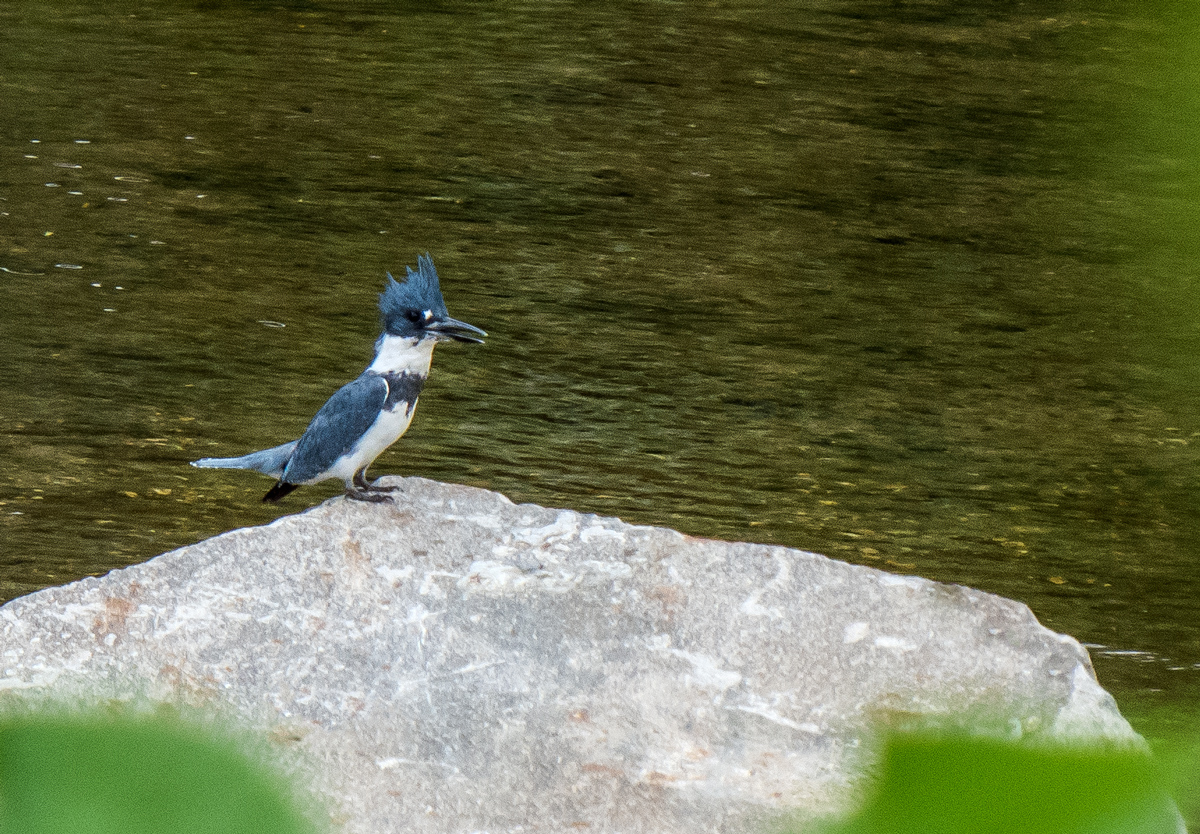
Yesterday I was on a biking/walking trail that follows Cameron Run, a tributary stream of the Potomac River, when I heard the unmistakable rattling call of a Belted Kingfisher (Megaceryle alcyon). As I moved through the vegetation to investigate, I spotted a kingfisher perched on a rock jutting out of the water. I had my Canon SX50 zoomed out to its maximum length, but it wasn’t enough—I needed to get closer.
As I made my way slowly down a steep slope, my footing gave way and I unceremoniously slid for a short distance on my back side. No surprisingly I spooked the kingfisher. What was surprising was that the kingfisher did not fly up into the trees, but instead he flew to a more distant smaller rock that was barely bigger than he was. (You can tell that it is a male because, unlike the female, he does not have chestnut stripe across his chest.)
The kingfisher soon took to the air and was joined by another one. They proceeded to fly back and forth over a portion of the stream, calling out loudly the entire time. They didn’t actually buzz me, but they did fly in my general direction a couple of times before veering off. What was going on?
I got a somewhat blurry shot of the second kingfisher, a female, that confirmed my suspicion that this was a couple. According to the Cornell Lab of Ornithology website, “During breeding season the Belted Kingfisher pair defends a territory against other kingfishers. A territory along a stream includes just the streambed and the vegetation along it, and averages 0.6 mile long. The nest burrow is usually in a dirt bank near water. The tunnel slopes upward from the entrance, perhaps to keep water from entering the nest. Tunnel length ranges from 1 to 8 feet.”
This behavior suggests to me that there could be baby kingfishers in the area. I certainly didn’t see any babies and suspect that a nest would probably be on the opposite side of the stream from where I took these photos, an area that is more remote and inacessible.


© Michael Q. Powell. All rights reserved
Read Full Post »

















 Mike Powell
Expressing our differences
Posted in Birds, commentary, Nature, Photography, wildlife, tagged Alexandria VA, Ardea herodias, Canon 50D, Great Blue Heron, herons, Huntley Meadows Park, Tamron 150-600mm on November 8, 2016| 5 Comments »
Why were the Great Blue Herons (Ardea herodias) prancing about on Saturday with their heads tilted upward and their wings displayed? Surely this was some kind of elaborate courting ritual.
As Tina Turner famously sang, “What’s love got to do with it?” Apparently this is how these herons defend their feeding territories. Really? According to the Cornell Lab of Ornithology, one of my favorite sources of information on birds, “Great Blue Herons defend feeding territories from other herons with dramatic displays in which the birds approach intruders with their head thrown back, wings outstretched, and bill pointing skyward.”
If only we could be so dignified in expressing our differences instead of squawking loudly and aggressively at each other.
© Michael Q. Powell. All rights reserved.
Share this:
Read Full Post »