Feeds:
Posts
Comments

Archive for the ‘Birds’ Category

Early yesterday morning at Huntley Meadows Park, the Great Egrets (Ardea alba) were relaxing in the trees, awaiting the start of another beautiful day. When birds are as brilliantly white as egrets, it’s a challenge to get an exposure that retains the details in the feathers. I set the metering on my camera to spot metering and it seems to have worked pretty well. I even like the way that it darkened the background and made the egret stand out even more.

Great Egret

© Michael Q. Powell. All rights reserved

Read Full Post »

Last weekend I spotted a shorebird in the distance while exploring Huntley Meadows Park. It was sharing a log with several turtles. Initially the little bird stayed on the opposite end of the log from the turtles. Gradually the curious and energetic bird moved closer and closer to the turtles. I couldn’t tell for sure, but it looked like the bird came close to pecking one of the legs of a turtle. Perhaps the bird was surprised when the turtle reacted or the turtle made a threatening move, but in any case the bird flew off after the brief encounter.

I was pretty conftdent that the bird was some kind of sandpiper, but I have never seen one with these markings. I posted to a Facebook group and got a quick response. What was the sandpiper I had spotted? It turned out to be a Spotted Sandpiper (Actitis macularius).

Spotted Sandpiper


Spotted Sandpiper

© Michael Q. Powell. All rights reserved

Read Full Post »

I was looking high and in the distance and the Bald Eagle (Haliaeetus leucocephalus) came in low and was almost on top of me before I saw it yesterday morning at Huntley Meadows Park. I had to scramble and pull back on my zoom lens to capture this image, which barely fit into the frame of the viewfinder. (The EXIF data for the shot indicate that it was shot at 309mm of my 150-600mm Tamron telephoto zoom lens.)

I feel like I should have been able to take better advantage of the situation that presented itself, but I am not disappointed. As I have noted repeatedly, any day with a bald eagle is a great day.

Bald Eagle

© Michael Q. Powell. All rights reserved

Read Full Post »

This female Ruby-throated Hummingbird (Archilochus colubris) must have been feeling tired or lazy yesterday afternoon at Huntley Meadows Park. Rather than going in through the opening in the trumpet vine flower and helping to pollinate it, she opted to drill in through the side of the flower to get to the nectar.

Ruby-throated Hummingbird

© Michael Q. Powell. All rights reserved

Read Full Post »

I have known for a while that hummingbirds are attracted to trumpet vines, so I keep my eyes open whenever I pass a stand of them near the observation tower at Huntley Meadows Park. Yesterday morning I finally lucked out and spotted a female Ruby-throated Hummingbird (Archilochus colubris) in the midst of the trumpet vines (Campsis radicansand managed to capture these images, including one in which the hummingbird was resting for a few seconds on a branch before resuming her energetic activity.

Ruby-throated Hummingbird

Ruby-throated Hummingbird

© Michael Q. Powell. All rights reserved

Read Full Post »

Green Herons (Butorides virescens) have so much personality packed into their small bodies. This one almost seemed to be smiling as it flew by me last weekend  at Huntley Meadows Park. Perhaps it was just my imagination running away with me.

Green Heron

© Michael Q. Powell. All rights reserved


Read Full Post »

For wildlife photographers, I would argue, a successful image is most often the result of some combination of luck, skill, and equipment. We inhabit a world of tremendous uncertainty and have to be hypervigilant, never knowing when “the moment” will arrive when we will be forced to make a series of split-second decisions.

One of those moments arrived for me yesterday as I was exploring Occoquan Bay National Wildlife Refuge in Woodbridge, Virginia. Although I was quite aware that there were bald eagles in the area, because some of the trails in the refuge near eagle nesting sites were closed, I was primarily chasing dragonflies and butterflies, so I had my 180mm macro lens mounted on my camera. I knew that I would be doing a lot of walking, so in order to minimize weight, I was not carrying my trusty (and heavy) 150-600mm zoom lens.

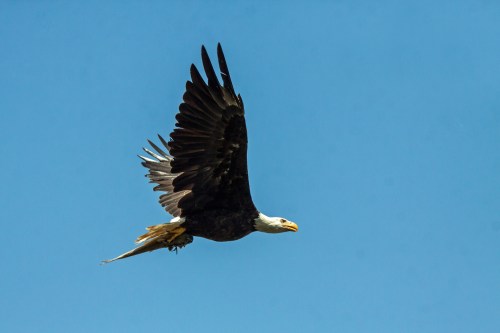
I was following a trail that ran parallel to the waters of Occoquan Bay and was a little frustrated that the view was frequently obstructed by heavy vegetation. When I reached an opening in the vegetation I looked out at the water and suddenly a Bald Eagle (Haliaeetus leucocephalus) burst into view out of nowhere. The eagle was almost at eye level and seemed to be struggling a little to gain altitude. As I later was able to ascertain, it had just caught a fish.

The logical part of my brain might have told me that a 180mm lens is not long enough to capture an image of an eagle in flight, but think I was acting on an instinctive level at that moment and I was able to snap off some shots before the eagle disappeared out of sight. It took a while for the adrenaline to wear off and I didn’t know for sure if I had been able to capture the moment. It was only when I reviewed the images on my computer that I realized that I had gotten my best eagle shots ever.

As is the case with most of my bird images, I cropped the first image to bring the subject in a bit closer. However, I am also including an uncropped version of the same image. It boggles my mind to think that I filled up that much of the frame with an eagle in flight with a 180mm lens.

Luck was hugely important; skill played a role, though it was my quick reaction time that was critical; and equipment turned out to be less important that I would have anticipated.
Bald Eagle

Bald Eagle

© Michael Q. Powell. All rights reserved


Read Full Post »

I spotted several young Wood Ducks (Aix sponsa) this morning at Huntley Meadows Park, including these two who playfully posed for me. Actually, there were three young Wood Ducks grooming themselves on a long and one decided to jump into the water. After swimming around for a while, the duck in the water decided to dry its wings and I was able to capture the extended wings in this shot. In case you are curious, the third duck was just out of the frame to the right. Although it was well past the “golden hour,” the light was beautiful and I was happy to be able to capture a partial reflection of the duck with outstretched wings.

wood duck

© Michael Q. Powell. All rights reserved


Read Full Post »

Why do we like certain photos more than others? What makes a good image? These questions churn away in my brain every time that I have my camera in my hand and often even when my hands are empty. Sure, there are rules and guidelines and generally accepted norms, but often it comes down to personal, unexplainable preferences—I like what I like.

Last weekend I spent a lot of time observing Green Herons (Butorides virescens) at Huntley Meadows Park. I kept trying to capture action shots of the herons catching fish or flying through the air, but I pretty much came up empty-handed. Oh, I took a lot of shots and once I wade through them all there may be some decent images of the herons that I will choose to post, but none of those images really spoke to me during my initial review of the photos from that day.

I was drawn instead to some images from early in the day when a fellow photographer and I spotted a Green Heron in the trees in the distance. We were standing on a boardwalk, so there was only a limited freedom of movement to frame our shots. There was a lot of vegetation that partially obstructed our view of the heron. I searched in vain for a visual tunnel that afforded a clear view of the entire body of the heron. Still, the light was beautiful, so I kept shooting—when it comes to birds, expressions are so fleeting that it is best to shoot a lot of images.

I decided to post this shot and attempt to explain why. There are so many things that I like about this image that I am not really bothered by the leaves that blocked my view. What do I like? I love the tilted head as the heron looks to the sky and basks in the sun; I like the little head feathers that look like a cowlick; I really like the shapes and colors in the background; and I am happy that I was able to capture some details in the wing feathers.

Is it one of my best shots? No, it is not, but I choose to post images that I like and especially the ones that make me happy, like his image of a pensive, relaxed Green Heron in a tree.

green heron

© Michael Q. Powell. All rights reserved


Read Full Post »

As we move deeper into summer, I have been seeing fewer and fewer duck families at Huntley Meadows Park—maybe the ducklings have grown up or have succumbed to predators. Whatever the case, I was thrilled early yesterday morning to spot a Mama  Wood Duck (Aix sponsa) with five ducklings, relaxing and grooming themselves on a log in the water in one of the more remote areas of the park.

When they are first born, all of the ducklings seem to look the same to me, but gradually they seem to take on some of their adult markings. The duckling alone in the center, for example, seems to be acquiring some of the head markings of the adult Wood Duck, though he still lacks the spectacular colors of the adult male Wood Duck. (In case you don’t know what a male Wood Duck looks like, I am reprising below a photo from earlier this year of one sitting on a nesting box.)

wood duck

Wood Duck

© Michael Q. Powell. All rights reserved


Read Full Post »

Several folks have recently posted photos in Facebook of a juvenile Yellow-crowned Night-Heron (Nyctanassa violacea) that they spotted at Huntley Meadows Park, my favorite marshland for photography, so I kept my eyes open today as I explored the park. I came up empty-handed for this particular bird, a species that I had never seen before, but as I was getting ready to leave, a helpful photographer led me to a spot where he had seen the bird earlier in the day.

Amazingly the bird was in the same general location and I was able to get several long-distance shots of the gangly little bird, which seems to be bigger than the Green Herons in the park, but smaller than the Great Blue Herons. As far as I know, nobody has seen an adult Yellow-crowned Night-Heron in the park, so we don’t really know how this juvenile happens to be in this location.

Yellow-crowned Nigh-Heron

Yellow-crowned Night-Heron

© Michael Q. Powell. All rights reserved

Read Full Post »

Great Egrets (Ardea alba) are so graceful in flight—it’s like watching an aerial ballet performance. I spotted this egret early this morning at Huntley Meadows Park and captured this image as it was taking off from atop a tree on which it was perched.

Great Egret

© Michael Q. Powell. All rights reserved.

Read Full Post »

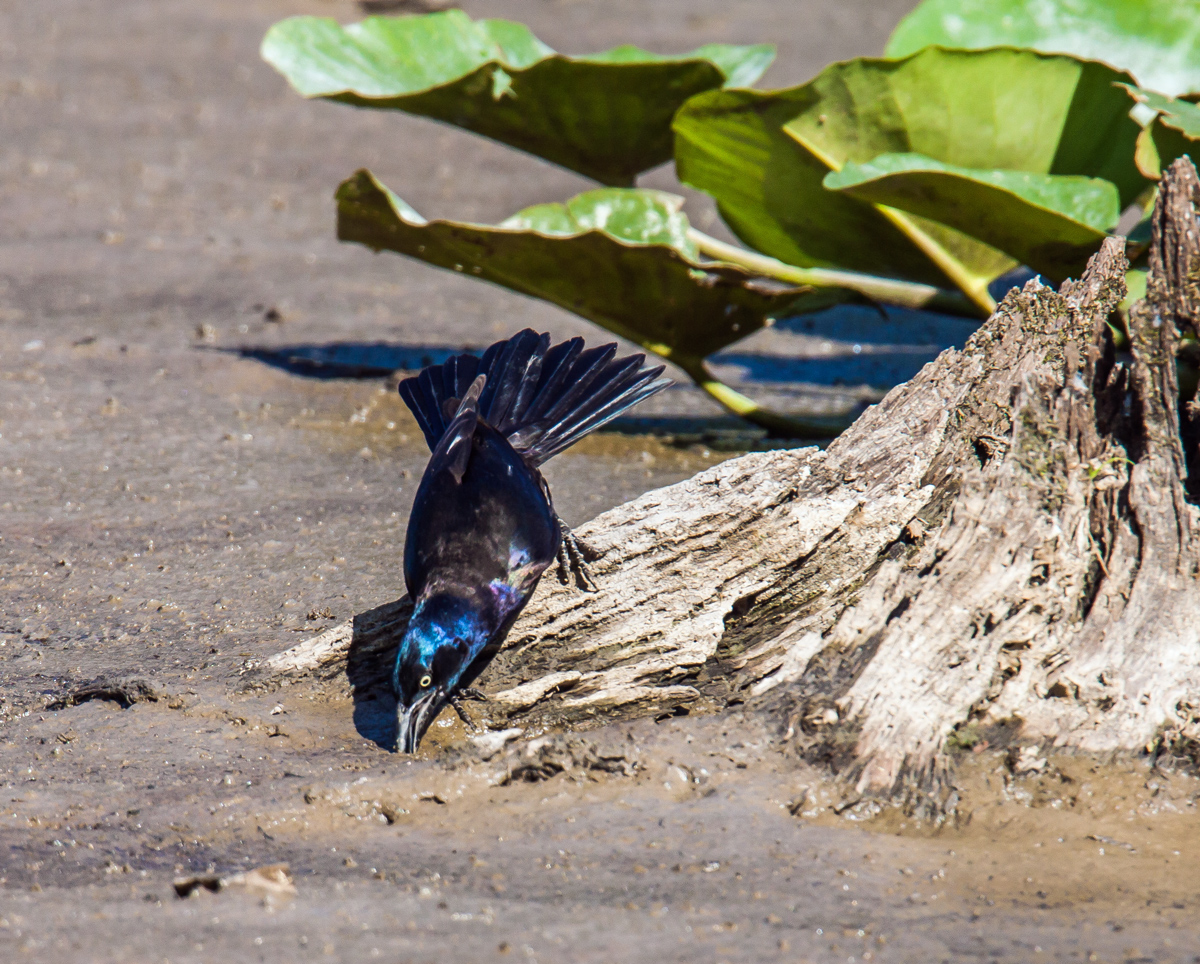
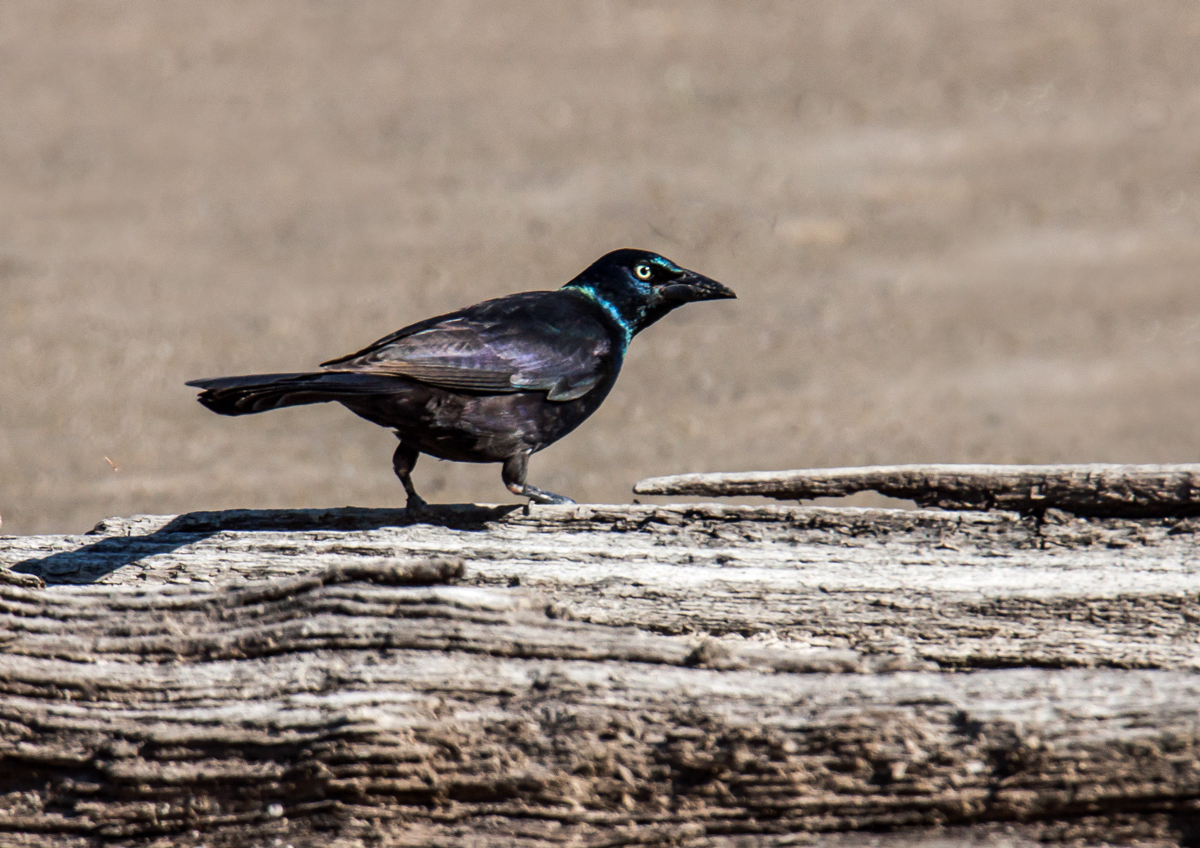
A small flock of large black-colored birds was noisily moving about the marsh at Huntley Meadows Park one morning last weekend and if I were better at identifying bird calls, I probably would have know what kind of birds they were—I considered the possibility that they might be crows or Red-winged Blackbirds or starlings or grackles. When I got closer and the sunlight illuminated their bodies, I realized that they were probably Common Grackles (Quiscalus quiscula), because of the way that their black color became iridescent, with colorful highlights.

I spent quite a while watching the grackles as they energetically pecked about, presumably looking for morsels of food. Their heads were pointed downwards most of the time, so it was a little tough to get good shots of them.

Here are a couple of my favorite shots that help show both the beauty and the personality of a grackle.


Common Grackle

Common Grackle

© Michael Q. Powell. All rights reserved

Read Full Post »

Great Egrets (Ardea alba) always seem to me to be a little vain and self-centered—maybe if comes from being so beautiful and graceful. This one did not like being ignored, so it decided to photobomb my shot of a deer this past weekend at Huntley Meadows Park .

Great Egret

© Michael Q. Powell. All rights reserved

Read Full Post »

A White-tailed Deer (Odocoileus virginianus) seemed curious about the Great Blue Heron (Ardea herodias) perched on a log, but the heron remained impassive and did not react as the deer passed behind it early Saturday morning at Huntley Meadows Park.

Peaceful co-existence—we could all use some more of that in our daily lives.

peaceful co-existence

© Michael Q. Powell. All rights reserved

Read Full Post »

This little Green Heron (Butorides virescens) somehow managed to find a perch in the midst of the thick vegetation growing out of the water yesterday morning at Huntley Meadows Park. From this higher vantage point, the heron was able to scan the area better for potential prey, though I never saw it catch anything.

Was the Green Heron imagining how much easier it would be if it were as tall as a Great Blue Heron?

green heron

© Michael Q. Powell. All rights reserved

Read Full Post »

Female Wood Ducks (Aix sponsa) at Huntley Meadows Park have been caring for their ducklings alone, so I figured the males had all departed. This morning, however, I spotted this male Wood Duck when he climbed out of the water to groom himself.

I captured this image when he gently shook himself to dry off. The moisture flew easily into the air, like water off of a duck’s back.

wood duck

© Michael Q. Powell. All rights reserved

Read Full Post »

Every spring, Barn Swallows (Hirundo rustica) build a nest on the underside of a raised observation platform at Huntley Meadows Park. It is always  a lot of fun to watch these energetic little dynamos flying about, catching insects in mid-air. Fortunately this one came to rest for a moment on the metal railing of the platform and I was able to capture this image of a colorful Barn Swallow.


Barn Swallow

© Michael Q. Powell. All rights reserved

Read Full Post »

In the early morning light at Huntley Meadows Park last week, I was thrilled to catch a glimpse of an Eastern Kingbird (Tyrannus tyrannus). The colors and lighting were subdued, which helped to draw my attention to the details of the bird’s feathers when I captured these images.

Several other photographers had posted photos of a kingbird on the park’s Facebook page and I was hoping that I would see one when I set out that day. When I first saw this bird from a distance, I thought it might be some kind of swallow. Once I got a little closer, I changed my mind and considered the possibility that it might be an Eastern Phoebe. It was only when I got home and was able to look at my birding book that I realized the white-tipped tail of this bird meant that it was almost certainly an Eastern Kingbird.

I studied Latin for a couple of years in high school (a long time ago) and I am always curious about the origin of the Latin name for different species. This one—Tyrannus tyrannus—really caught my eye.  The Cornell Lab of Ornithology website explained the name in these words. “The scientific name Tyrannus means “tyrant, despot, or king,” referring to the aggression kingbirds exhibit with each other and with other species. When defending their nests they will attack much larger predators like hawks, crows, and squirrels. They have been known to knock unsuspecting Blue Jays out of trees.”

Eastern Kingbird


Eastern Kingbird


Eastern Kingbird

© Michael Q. Powell. All rights reserved

Read Full Post »

This Green Heron (Butorides virescens) picked a particularly precarious perch from which to focus on a potential prey this past Monday at Huntley Meadows Park in Alexandria, Virginia.

Green Heron

© Michael Q. Powell. All rights reserved


Read Full Post »

Wildlife photography forces us to make a lot of choices in a short period of time, because we often encounter our subjects unexpectedly and don’t have the luxury of carefully planning all of our shots. When I stumbled upon this Hooded Merganser family (Lophodytes cucullatus) on Monday at Huntley Meadows Park, for example, I had to make a quick choice. Should I focus on the hyper-vigilant Mom or on her ducklings?

It’s hard to resist cuteness, so I initially focused on the babies. As you can see in the first shot below, the ducklings were relaxed and appeared to be preening and playing, while the Mom in the foreground kept watch. After I had taken a few shots, I switched my attention and my focus to the mother. Her more rigid posture is in sharp contrast to that of her ducklings, who have faded a little into the background in the second shot.

I think that my focusing choices cause each of the images to tell a slightly different story and causes a viewer to react differently. That’s one of the cool things I like about photography—our creative choices can help others to see the world in different ways as we gently guide their attention to what we think is important.

Hooded Merganser family

Hooded Merganser family

© Michael Q. Powell. All rights reserved

Read Full Post »

As I was getting ready to leave Huntley Meadows Park yesterday afternoon, a Wood Duck family (Aix sponsa)  suddenly swam right in front of me from under the boardwalk. Even though I zoomed out, I was unable to capture the entire family with my long telephoto lens.

Here are a couple of shots of the mother and some of her ducklings. They were moving pretty quickly as a group and I didn’t have much time to get some shots before they disappeared into the vegetation.

Wood Duck

Wood Duck

© Michael Q. Powell. All rights reserved


Read Full Post »

It was wonderful early this morning to catch a glimpse of one of the Hooded Merganser families (Lophodytes cucullatus) at Huntley Meadows Park. The ducklings appear to be almost grown up now and the survival rate seems to be higher than normal. In the past I have often seen the size of similar families dwindle down to just a couple of ducklings because of the large number of potential predators, most notably snapping turtles. I am amazed that the mother is able to watch over so many babies—the father doesn’t stick around to help raise the offspring.

mama merganser and babies

© Michael Q. Powell. All rights reserved

Read Full Post »

I was hoping that I would be in Vienna at the right time of the year to see baby swans, but I guess my trip brought me here a bit too early. At the lake at Donau-Auen National Park, I could see one Mute Swan (Cygnus olor) swimming around and wondered if it was alone. When I walked further around the lake, I spotted what appears to be its mate, partially hidden by the vegetation, sitting on a nest.

Mute Swan

Mute Swan

Mute Swan

Mute Swan

© Michael Q. Powell. All rights reserved

Read Full Post »

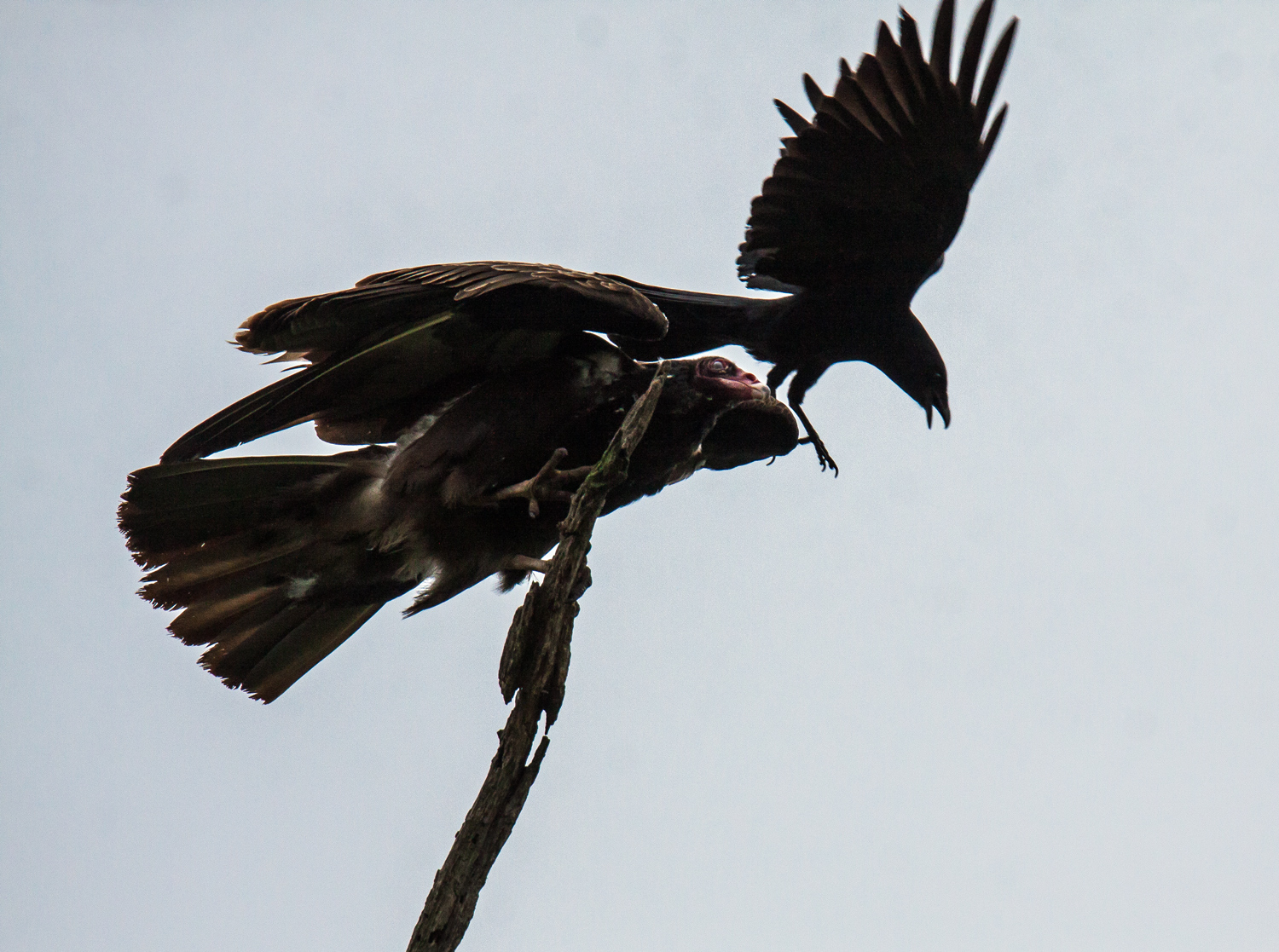
I was watching a Turkey Vulture high in a tree at Huntley Meadows Park this past weekend, when all at once it seemed to get tense and agitated. Suddenly a flash of black crossed my field of view as I gazed through my camera’s viewfinder.

I had no idea what had happened until I saw this photo–an aggressive crow appeared to be attempting to get the vulture to move. What was unusual was that the attack was not preceded by the loud calls of a crow, nor did there appear to be a group of crows, as is often the case when crows harass larger birds.

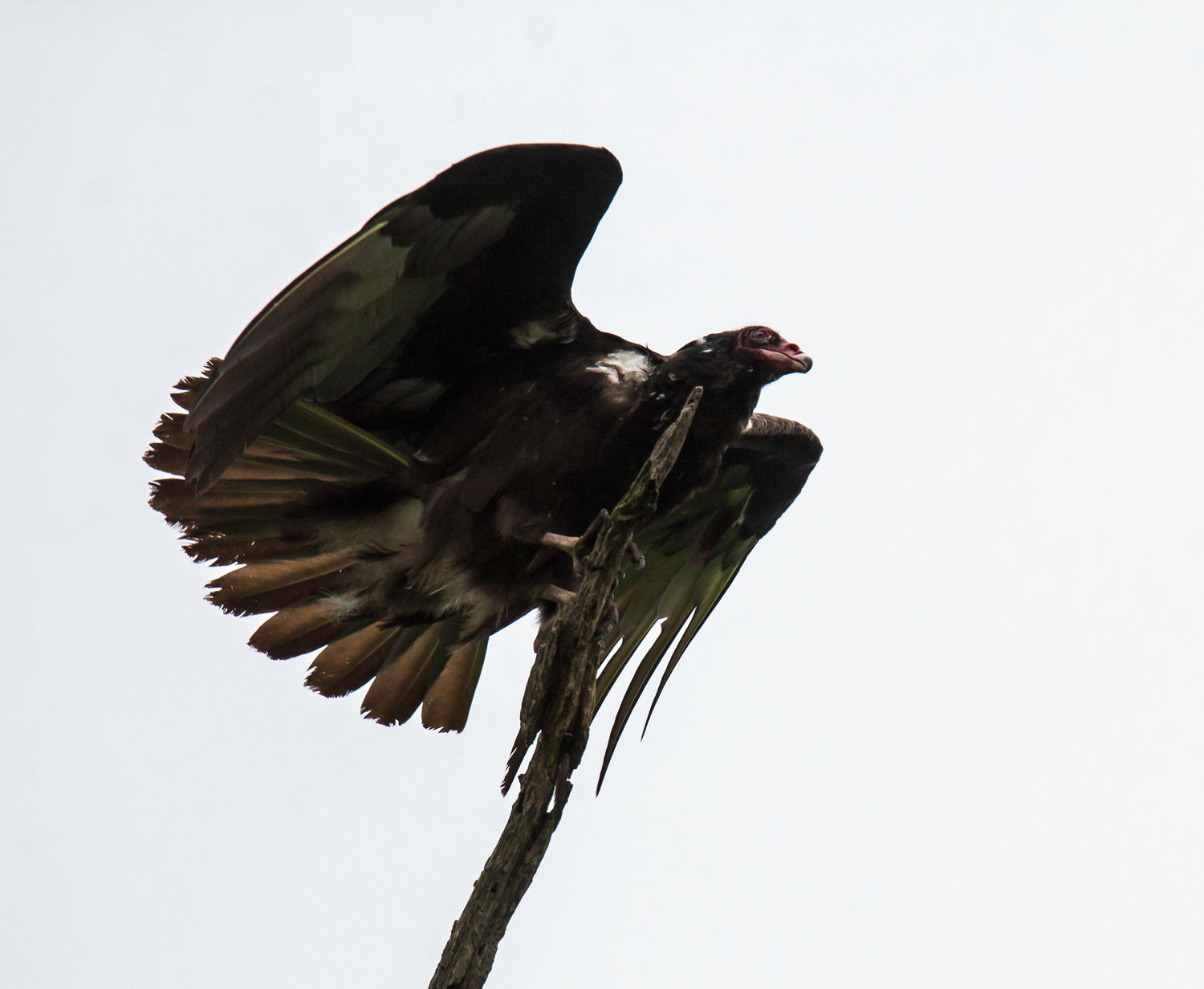
The vulture stayed put and eventually lowered its wings. (The second shot shows the vulture seconds before the attack, when it had raised its wings and appeared to be ready to take action if required.)

Turkey Vulture

Turkey Vulture

© Michael Q. Powell. All rights reserved

Read Full Post »
As this Turkey Vulture circled overhead, I couldn’t help but notice the large gap in its wing feathers. Some birds seem to fight with each other, which cold account for the missing feathers, but I don’t recall ever seeing a Turkey Vulture squabbling with another bird. What would they fight about? Territory? Food?

Despite the gap, the vulture seemed to have no trouble flying and its wingspan was still pretty impressive.

Turkey Vulture

© Michael Q. Powell. All rights reserved

Read Full Post »
Last weekend at Huntley Meadows Park, a Tree Swallow (Tachycineta bicolor) seemed determined to scare off potential competitors by screaming loudly and vigorously flapping its wings as it sat atop a pole to which a nesting box was attached. The swallow spent a lot of time looking upwards, scanning the skies for rivals. I couldn’t tell if the swallow’s mate was inside of the nesting box or if it was simply staking a claim to the box for future use.

Tree Swallow

Tree Swallow

© Michael Q. Powell. All rights reserved

Read Full Post »

Hooded Merganser ducks (Lophodytes cucullatus) are usually pretty skittish, but the females are a little less so at this time of the year as they hang around and wait for their eggs to hatch.  I spotted this little lady earlier this month on a morning when the light was particularly beautiful. She was unusually cooperative and looked in my direction as if to say, “I’m ready for my close-up.”

Hooded Merganser

© Michael Q. Powell. All rights reserved

Read Full Post »

With so much water currently in the central wetlands area of Huntley Meadows Park, I don’t see many shorebirds at this time of the year. The shorebirds seem to prefer to wade in shallow water. This past weekend, however, I spotted this one as it surveyed the marshland from atop a log. I think it is a Greater Yellowlegs (Tringa melanoleuca), although I admit that I have troubles identifying the different shorebirds, many of which look almost identical to me.

As you can see, the yellowlegs was a long way away. Usually I try to get close-up shots with either a telephoto or a macro lens and am a little disappointed if I can not fill a substantial part of the frame with my primary subject. In this case, however, I was never tempted to crop the image more severely, because  the surrounding landscape is an important element of making this image appealing to me.

Greater Yellowlegs

© Michael Q. Powell. All rights reserved

Read Full Post »
When some birds zoomed by me this past weekend, I could tell they were swallows by the way that they flew.  Their coloration, however, didn’t seem to match the Barn and Tree Swallows that I have previously seen at Huntley Meadows Park.

One of them finally perched and I got this shot of what appears to be a Northern Rough-winged Swallow (Stelgidopteryx serripennis), a bird that I had never seen before. According to the Cornell Lab of Ornithology, “The species derives its name from the outer wing feathers, which have small hooks or points on their leading edges.”

The bright sun made for a pleasant day, but made it tough to properly expose for the brilliant white feathers on the swallow’s chest. I was happy that I managed to capture a few details of the feathers despite the rather harsh midday sunlight.

Northern Rough-winged Swallow

© Michael Q. Powell. All rights reserved.

Read Full Post »

As the seasons change, new birds appear and disappear at my favorite marshland park—Huntley Meadows Park—in Northern Virginia. We are fortunate to be along the migratory route for birds flying north and south and are far enough south to be a destination of some overwintering birds.

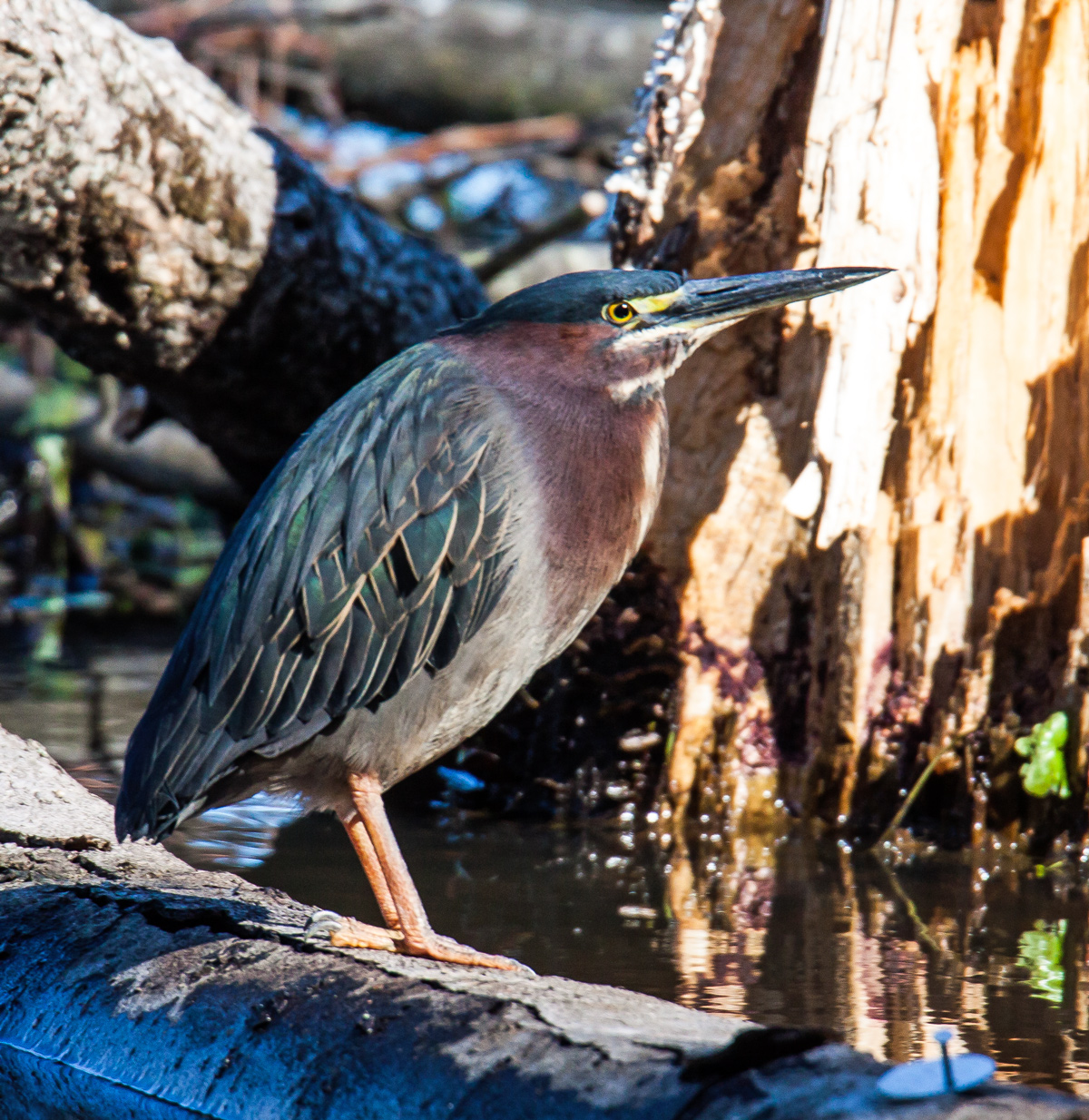
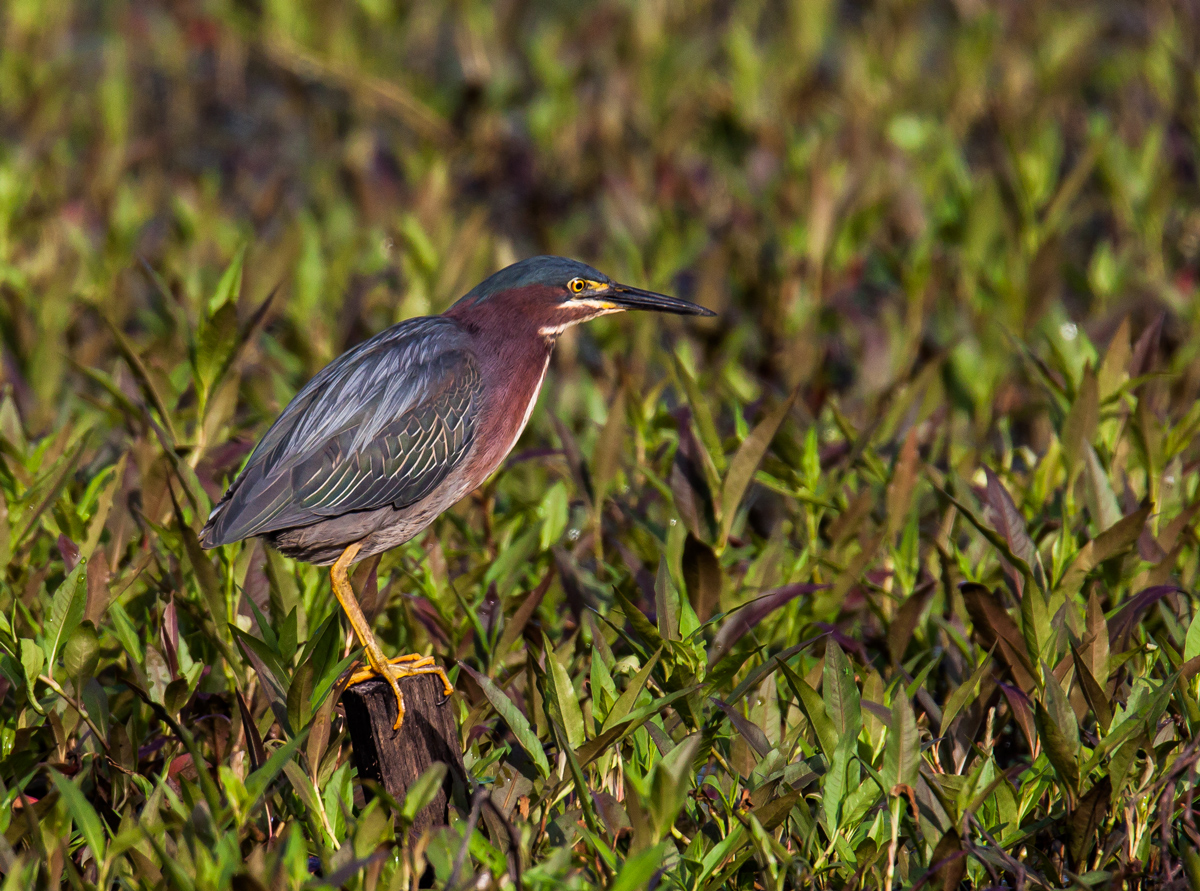
Unlike the Great Blue Herons, which remain with us all year, Green Herons (Butorides virescens) leave in the autumn and I eagerly await their arrival in the spring? Why? I am utterly fascinated by these squat little birds, despite the fact they have none of the elegance of the Great Blue Herons and Great Egrets. They always strike me as industrious and diligent and go about their work, generally avoiding the spotlight. Green Herons also seem to have an abundance of personality and almost seem capable of expressing emotions. Finally, Green Herons have a subdued, but refined beauty, a beauty that I was able to capture in this image from yesterday morning.

Welcome back, Green Herons. I missed you. Perhaps it is true that absence makes the heart grow fonder.

Green Heron

© Michael Q. Powell. All rights reserved.

Read Full Post »

« Newer Posts - Older Posts »