Feeds:
Posts
Comments

Archive for the ‘Birds’ Category

I was thrilled on Tuesday to get a glimpse of several juvenile Bald Eagles (Haliaeetus leucocephalus) at Occoquan Bay National Wildlife Refuge. I think that they are the eaglets that were born earlier this year and now it looks like they are almost fully grown. It will take a few more years, however, before they acquire the white feathers on their heads that make them look like they are bald.

The first eaglet was hanging out in the nest when I first spotted it, as you can see in the first shot. There is so much vegetation now that it is hard to see the nest, but I know that it is there. I wasn’t quite ready when the eagle took off so my second shot is a little blurry. I decided to included it, because it provides a pretty cool look at the feathers of this already majestic bird.

The final shot is of what I assume is one of the siblings of the eaglet in the first two shots. Based on a conversation that I had with one of the volunteers at the wildlife refuge, there may have been three eaglets at this nest this year (and two in a nest in another part of the refuge).

Bald Eagle

Bald Eagle

Bald Eagle

© Michael Q. Powell. All rights reserved.


Read Full Post »

During the hot, humid days of mid-summer, I often hear the sounds of birds, but rarely see them. Although I may be out in the blazing sun, most of the birds seem to use common sense and take shelter in the shade of the trees.

Last week as I was exploring Jackson Miles Abbott Wetland Refuge, I heard the unmistakable call of a kingfisher and caught a glimpse of it skimming across the water of a small pond. I was a bit surprised when it chose briefly to perch in a small tree overhanging the water. I was a long way away, but had a clear line of sight and captured this image of the female Belted Kingfisher (Megaceryle alcyon). I can tell that it is a female because I can see a reddish-colored band across its chest that the male lacks.

Many of you know that I photograph birds more frequently during the winter months, when insects disappear and the lack of foliage makes it easier to spot the birds. Throughout the year, however, I try to be ready in case a bird decides to be cooperative and poses for me.

Belted Kingfisher

© Michael Q. Powell. All rights reserved.

Read Full Post »

Thanks to a reminder from WordPress, I realized this morning that I am starting my 8th year with this blog. On July 7, 2012 I made my first posting “Blue Dasher dragonfly” and, as they say, the rest is history. According to WordPress stats, I have had 205,209 views of 3,177 posts. Some of those were re-reposts of blogs written by others, but I figure that I have written over 3,100 individual posts with well over 5,000 photos.

This morning I decided to share three of my all-time favorite photos—a singing Red-winged Blackbird (Agelaius phoeniceus); a Red Fox (Vulpes vulpes) on a frozen pond; and a close-up shot of a Blue-faced Meadowhawk dragonfly (Sympetrum ambiguum). I think that these three images taken together give you a good idea of my approach to photography.

I could not have made it this far on my journey in photography without the support and encouragements of so many of you. You have helped to make blogging part of my daily life. Thanks so much to you for enriching my life in a whole range of different ways.

I owe a special debt of gratitude to Cindy Dyer, my dear friend and photography mentor. She was the one who sat me down seven years ago and helped me with the mechanics of starting this blog. She continues to inspire me and to support me in both my personal life and in my photography. Thanks, Cindy.

What’s ahead? For the foreseeable future I plan to continue my adventures in photography. Having recently retired, I may start to venture to somewhat more distant locations, but mostly I anticipate more and more hours of walking around with my camera in hand, trying to capture all of the beauty of the natural world.

Red-winged Blackbird

Red Fox

Blue-faced Meadowhawk

© Michael Q. Powell. All rights reserved.

Read Full Post »

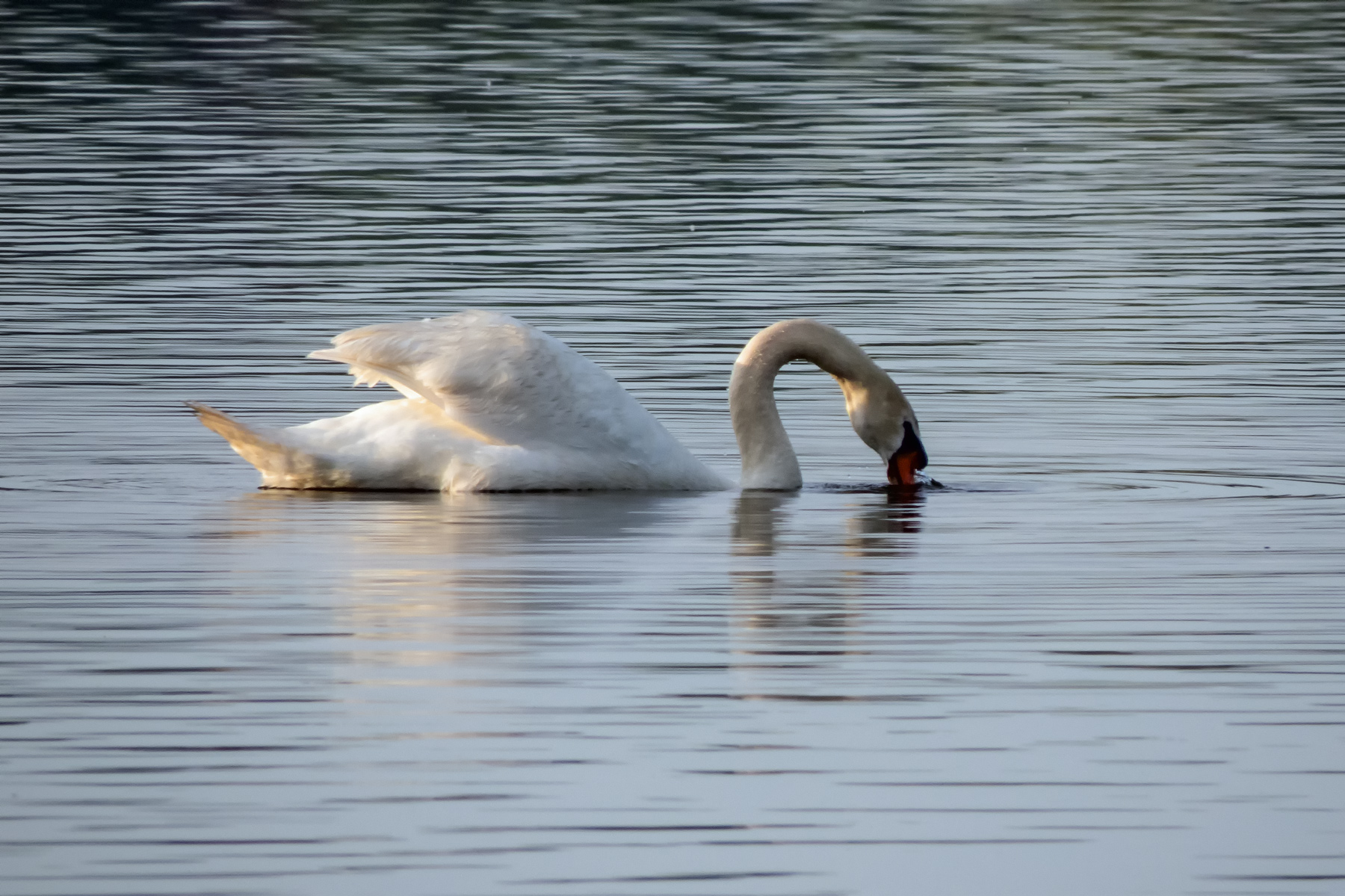
I was thrilled last Friday to spot this Mute Swan (Cygnus olor) at Horn Pond in Woburn, Massachusetts. Growing up in a suburb of Boston, I remember visiting the Boston Public Garden and riding in the famous pedal-powered Swan Boats there. As a result, the mere sighting of a swan is enough to trigger fond memories of my childhood.

Readers of my generation (and maybe even younger folks) may recall that the Swan Boats were featured prominently in the beloved book “Make Way for Ducklings.” I was a little surprised to learn from Wikipedia that the Swan Boats have been in operation since 1877.

“Robert Paget first created the Swan Boats in the Public Garden in 1877, after seeing the opera Lohengrin with his wife Julia Paget. Inspired by the knight’s gallant rescue of the damsel by riding a swan across the lake, Paget decided to capitalize on the recent popularity of the bicycle and combine the two, designing a two-pontooned boat with two wooden benches and a brass seat on top of a paddlebox concealed by a swan. The driver would sit inside the swan and pedal passengers around the pond.”

One of the amazing things is that the Swan Boats have remained virtually unchanged since that time.

Mute Swan

Mute Swan

Mute Swan

© Michael Q. Powell. All rights reserved.

Read Full Post »

Early Friday morning I spotted this Double-crested Cormorant (Phalacrocorax auritus) at Horn Pond in Woburn, Massachusetts. Although the bird’s facial features were in the shadows, I was happy to be able to capture its distinctive hooked beak in this silhouetted view.

As many of you know, I try to find opportunities to capture nature images even when I am traveling. On Thursday I drove from Virginia to Massachusetts to attend a surprise 60th birthday party on Friday evening for one of my brothers. Although I was somewhat worn out from the drive, which took almost 12 hours thanks to numerous road construction projects and rush hour traffic in Boston, I was out on the trails of Horn Pond by 6:30 in the morning. In many ways immersing myself in nature helps to recharge my batteries as much as sleep does.

A few seconds after I spotted the cormorant, it sensed my presence and flew away. I was anticipating that it might do so and was able to capture this shot just as the bird was starting to take off.

Double-crested Cormorant

© Michael Q. Powell. All rights reserved.


Read Full Post »

Now that the foliage on the trees  is full, it is hard for me to monitor the status of the baby eagles in several Bald Eagle (Haliaeetus leucocephalus) nests at Occoquan Bay National Wildlife Refuge. On Wednesday, however, I detected some motion as I was peering at one of the nests and realized that it was the flapping of an eaglet’s wings. I managed to find a visual tunnel through which my view was mostly unobstructed and was able to capture this view of two eaglets. I was shocked to see how big they have grown and suspect that they soon will be flying.

The nest is probably too small to hold the adults along with the youngsters—what I would call “full nest” syndrome, i.e. the opposite of the more commonly known “empty-nest” syndrome. The second image shows one of the presumed parents perching on a higher branch of the tree in which the nest is located.

Bald Eagle eaglets

Bald Eagle

© Michael Q. Powell. All rights reserved.

Read Full Post »

Yesterday I was thrilled to get a glimpse of this impressive-looking Wild Turkey (Meleagris gallopavo) at Occoquan Bay National Wildlife Refuge. I have seen Wild Turkeys at this refuge on numerous occasions, but this is one of the first images that I have been able to capture this spring.

I am always amazed when I come upon a male turkey displaying his feathers. I grew up in the suburbs of Boston and the only turkeys that I ever saw were those in the freezer at the supermarket, which did not look anything like this bird, and the cutout figures that we would pin to the wall to celebrate Thanksgiving. Somehow I always thought those cutouts were cartoonish caricatures—little did I know that wild turkeys actually look like those colorful figures.

wild turkey

© Michael Q. Powell. All rights reserved.

Read Full Post »

This Green Heron (Butorides virescens) was practicing its yoga on Saturday while perched on the railing of a small bridge at Meadowlark Botanical Gardens. In the first image you see the rarely observed giraffe pose—don’t try this at home or you many end up in traction. The second shot shows the green heron with its neck in a more relaxed position.

I am amazed by the amount of neck extension the green heron was able to achieve—I am willing to stick my neck out for others at times, but not to that extent.

Green Heron

Green Heron

© Michael Q. Powell. All rights reserved.


Read Full Post »

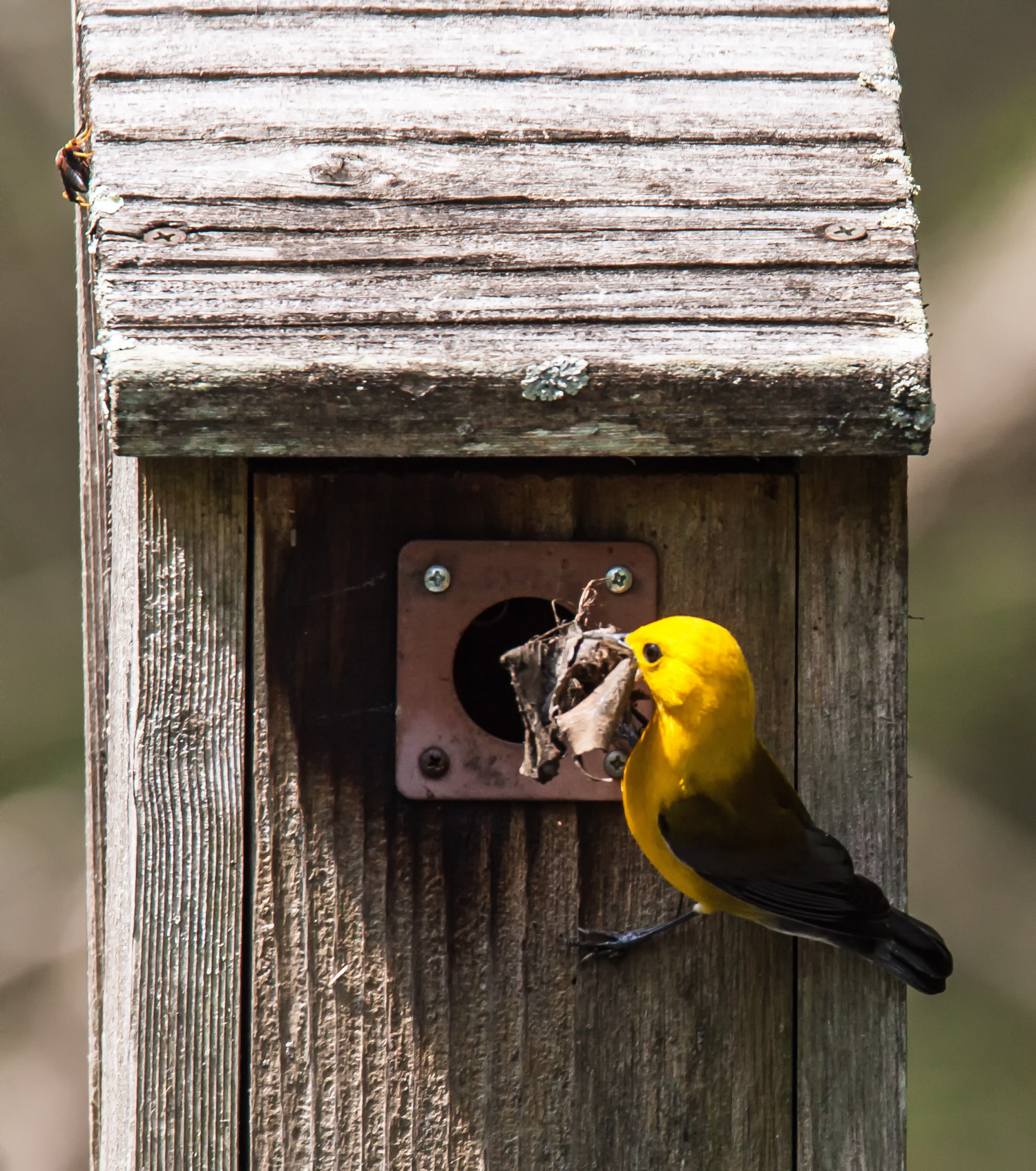
A couple of weeks ago I spotted a colorful Prothonotary Warbler (Protonotaria citrea) building a nest in a nesting box at Occoquan Bay National Wildlife Refuge. The warbler made multiple trips to the nest carrying a variety of materials in its bill. Each time that it got ready to leave the box, the warbler would stick its head out and look around. Although I tried repeatedly to capture the bird in flight as it left the box, the last image was the only one that was partially successful.

I am finally catching up on a backlog of photos—normally I post my photos within a few days of shooting them.

Prothonotary Warbler

Prothonotary Warbler

Prothonotary Warbler

© Michael Q. Powell. All rights reserved.

Read Full Post »

Shorebirds are always tough for me to identify—so many of them are similar in appearance. When I spotted this little bird on Wednesday at Occoquan Regional Park, I noticed that it was all alone. Half-jokingly, I thought to myself that maybe it is a Solitary Sandpiper (Tringa solitaria). When I later checked my bird identification guide I was shocked to discover that it actually is a Solitary Sandpiper.

According to the Cornell Lab of Ornithology, however, the name of the Solitary Sandpiper is not completely accurate—”While not truly solitary, it does not migrate in large flocks the way other shorebirds do.” On the same website I also learned the interesting fact of the world’s 85 sandpiper species, only the Solitary Sandpiper and the Green Sandpiper of Eurasia routinely lay eggs in tree nests instead of on the ground.

Solitary Sandpiper

Solitary Sandpiper

© Michael Q. Powell. All rights reserved.

Read Full Post »

The sky was mostly covered in clouds yesterday morning at Occoquan Bay National Wildlife Refuge when an Osprey (Pandion haliaetus) decided to fly right at me after it had caught a fish.

I love the look of a head-on shot of a flying bird, but capturing such a shot is not easy. First, the bird has to cooperate and most of the time, it seems, birds like to fly away from me and not toward me. Secondly, I have to be able to capture and maintain focus on the bird as it is approaching, which can be a challenge with a heavy telephoto zoom lens. Finally, I have to calibrate my shooting speed so that I don’t fill up the buffer of my camera before the bird gets close.

Things worked out pretty well for this shot. If you click on the image and zoom in on it, you will see that I managed to keep those yellow eyes in reasonably sharp focus and even the beak is in focus. You don’t get a very good view of the fish—you will have to wait until I capture of profile shot of an osprey with its catch.

osprey

© Michael Q. Powell. All rights reserved.

Read Full Post »

Many of you are aware that I have been keeping track of a Bald Eagle (Haliaeetus leucocephalus) nest at Occoquan Bay National Wildlife Refuge. When the eagle couple occupied the nest earlier this spring, the authorities set up barriers to keep the eagles from being disturbed, because the tree with the nest is close to the intersection of several trails.

I have checked the nest several times in the past month and there has always been an eagle sitting in the middle of the nest. As I looked through my telephoto zoom lens this past Friday from one of the barriers, I could see that an adult eagle was sitting at one side of the nest, leading me to believe there might be babies. I waited and eventually was rewarded with a view of one eaglet.

Last year there were two eaglets born at this nest. Perhaps there is a second eaglet this year too, but at a minimum I am thrilled to know that there is at least one new eaglet birth to celebrate.

Bald Eagle

© Michael Q. Powell. All rights reserved.

Read Full Post »

Last Friday I spotted this Common Loon (Gavia immer) in the waters off of Occoquan Bay National Willdife Refuge.  I don’t think that I have ever actually seen a loon before, but this bird pretty much matches the image of a Common Loon in breeding plumage in my bird identification guide. The range maps indicate that Northern Virginia, where I live, is in a migratory area for this species. I am guessing that this loon stopped for a while on his journey northward.

Common Loon

© Michael Q. Powell. All rights reserved.

Read Full Post »

Most of the warblers that I am fortunate enough to see are partially hidden by branches. Although hope is usually not an effective technique for taking photos, essentially that is what I do when I spot a hidden warbler—I start shooting and hope that the little bird will reveal itself enough for me to capture a clear shot of at least its head.

That was the case on Friday when I shot numerous photos in an attempt to capture an image of this Prothonotary Warbler (Protonotaria citrea) at Occoquan Bay Naational Wildlife Refuge. Unlike many warblers that are found bushes and in trees in more open area, Prothonotary Warblers are creatures of the swamp. I initially spotted one of these beautiful birds in a marshy area and was thrilled when one of them eventually made its way into some vegetation overlooking the water.

According to the Cornell Lab of Ornithology, the Prothonotary Warbler got its name from the bright yellow robes worn by papal clerks, known as prothonotaries, in the Roman Catholic church. This background information is fascinating, though I must confess that it is hard to find an opportunity to inject the word “prothonotary” into an everyday conversation unless I am talking about this bright yellow bird.

Prothonotary Warbler

© Michael Q. Powell. All rights reserved.

Read Full Post »

Yesterday at Occoquan Bay National Wildlife Refuge I was excited to spot a colorful little bird that was new to me. A search through my bird identification guide and some help from my Faceboook friends helped me to determine that it is a Prairie Warbler (Setophaga discolor).

I am hoping to be able to spot some more warblers this spring while their plumage is particularly colorful. I observed a few warblers last fall and noted that their coloration was a lot more subdued than it is now.

Prairie Warbler

Prairie Warbler

Prairie Warbler

© Michael Q. Powell. All rights reserved.

Read Full Post »

When it comes to choosing a nesting site, Ospreys (Pandion haliaetus) at Occoquan Bay National Wildlife Refuge seem to be opportunistic. Some lucky couples are able to snag pre-existing nesting sites that require only minor improvements, while others are forced to build entirely new nests.

This past Thursday I photographed a nest that is annually built on top of one of the duck hunting blinds in the waters off of the wildlife refuge. Earlier in the season, the ospreys would fly away as I walked by on a trail, but now that the trees are leafing out, the ospreys have a bit more privacy.

The nest in the second image is a new nest, built in the last couple of weeks and probably still under construction. It is adjacent to the location where the nest in the third shot used to be. For reasons that are not clear to me, that nesting platform has disappeared and only a part of the post remains. I believe that the new nest may have been built by  the couple that occupied that nesting platform earlier in the season.

Osprey

Osprey

Osprey

© Michael Q. Powell. All rights reserved.

Read Full Post »

Yesterday while I was exploring a stream in Northern Virginia looking for dragonflies, I came across an interesting little bird perched in a tree at the edge of the stream. I could not identify it on the spot and when I returned home and looked at my identification guide, I was still uncertain. Some experienced birders in a Facebook forum identified it as a Louisiana Waterthrush (Parkesia motacilla).

I think I bypassed that entry in my guide, assuming incorrectly that I was in the wrong geographic area. Strangely enough, the Louisiana Waterthrush is not even in the thrush section of the guide, where you find birds like American Robins—it is a warbler.

Louisiana Waterthrush

Louisiana Waterthrush

© Michael Q. Powell. All rights reserved.


Read Full Post »

Do you associate certain colors with certain seasons? For me, yellow is definitely a springtime color. After months of winter weather dominated by shades of gray and a palette of faded colors, spring explodes with bright colors, with yellow daffodils popping up all over the place. Usually I have to wait a bit longer for yellow to pop up in the birds and insects that I enjoy photographing.

As I was exploring with my camera this week, I ran across bright yellow subjects in two very different locations. One, a Pine Warbler (Setophaga pinus) was quite appropriately perched high in a pine tree. The second was an Eastern Tiger Swallowtail butterfly (Papilio glaucus) that appeared to be probing the sand on the bank of a forest creek. I suspect that the butterfly needed the minerals and salts, although I confess to initially thinking that butterflies needed only nectar from flowers for sustenance (and there were definitely no flower in the area of that creek).

Pine Warbler

Eastern Tiger Swallowtail

© Michael Q. Powell. All rights reserved.


Read Full Post »

I was a little surprised and quite happy this past weekend to spot a Pileated Woodpecker (Dryocopus pileatus) poking about on the ground at Occoquan Regional Park. Most of the time I have to settle for high-angle shots when I am lucky enough to spot one of these giant woodpeckers. I have been told that these woodpeckers regularly probe fallen trees, but this was a first for me.

After I inadvertently spooked the woodpecker, it flew to a nearby tree. The light was coming from the side and the front when I took the second shot and it made the woodpecker red crest look like it was on fire. Somehow it seemed appropriate, given that most redheads I have known have tended to be quite fiery.

Pileated Woodpecker

Pileated Woodpecker

© Michael Q. Powell. All rights reserved.
Read Full Post »

Last week I took a break from exploring Occoquan Bay National Wildlife Refuge and hiked about in Prince William Forest Park in Triangle, Virginia. According to Wikipedia, this park is the largest protected natural area in the Washington D.C. metropolitan region at over 16,000 acres.  I went lighter than usual with my camera gear, carrying only my Canon SX50 superzoom camera, because I knew that I would be doing a lot of walking on hilly forest trails, which fortunately were well-marked with signs and colored blazes on the trees.

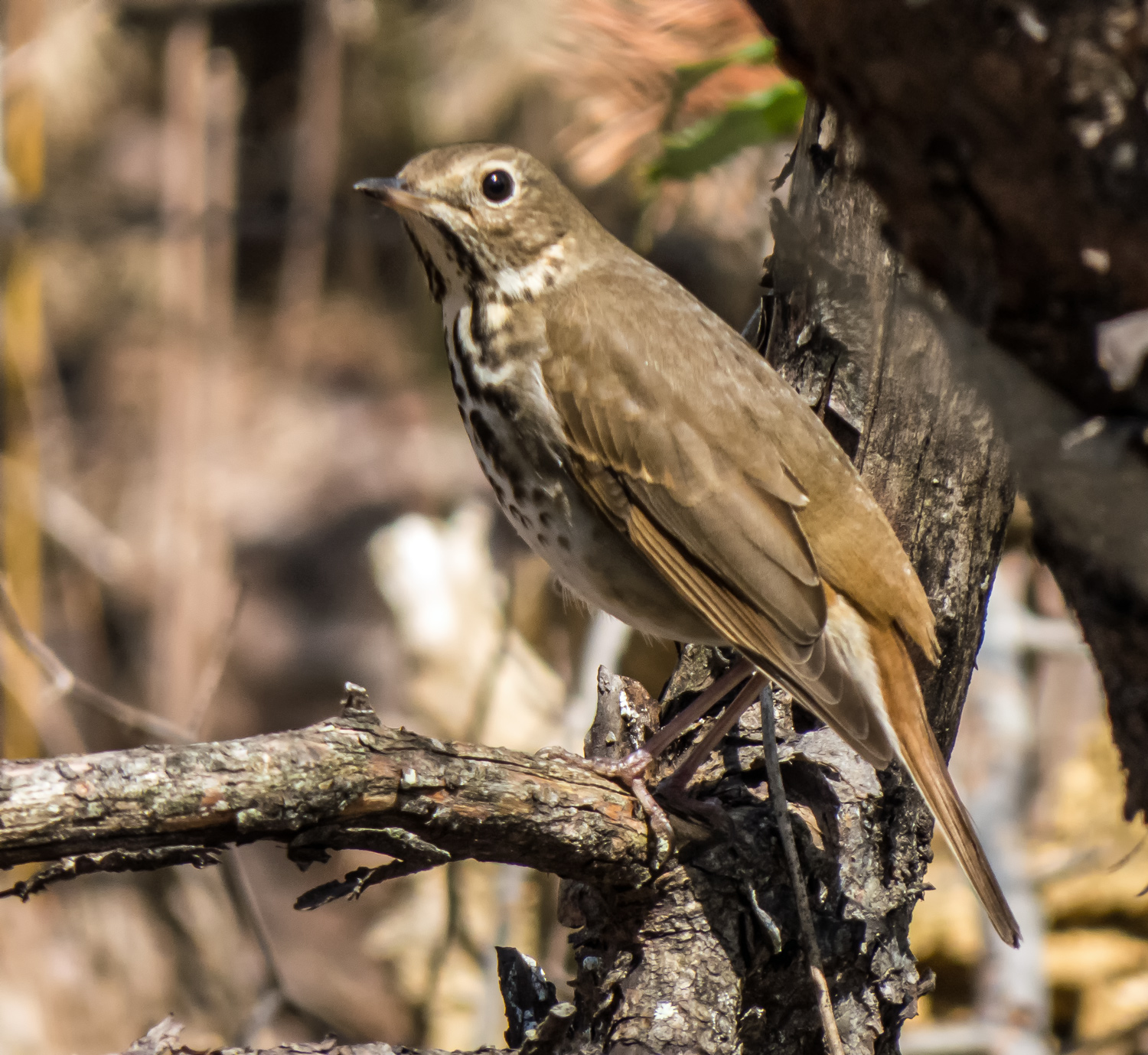
I did not see much wildlife, but was quite happy to capture these shots of a Hermit Thrush (Catharus guttatus) that was poking about in the underbrush. The shape of the Hermit Thrush reminds me of that of the American Robin, another bird in the greater thrush family, though, of course, the breast of the Hermit Thrush lacks the distinctive reddish-orange color of the robin.

Hermit Thrush

Hermit Thrush

© Michael Q. Powell. All rights reserved.

Read Full Post »

Ospreys (Pandion haliaetus) in my area have been building nests in all kinds of places, including on some channel markers in the Potomac River off of Occoquan Bay National Wildlife Refuge. I personally don’t really think that there is enough space there for a nest, but the ospreys seem to think otherwise.

I am amused by the “No wake” sign that they have chosen. During busy periods, I would think that “No sleep” would be more appropriate.

Have a wonderful weekend. 🙂

osprey

© Michael Q. Powell. All rights reserved.


Read Full Post »

There is no doubt that I love photographing majestic raptors, like the bald eagles that I regularly feature. Yet there is something equally special about capturing images of tiny songbirds, like this perky little Blue-gray Gnatcatcher (Polioptila caerulea) that I spotted earlier this week at Occoquan Bay National Wildlife Refuge.

How small are these birds? According to the Cornell Lab of Ornithology, Blue-gray Gnatcatchers are 3.9-4.3 inches in length (10-11 cm) and weigh 0.2-0.3 ounces (5-9 grams), just slightly larger than a hummingbird. The same source notes that, despite the bird’s name, gnats do not form a significant part of a Blue-gray Gnatcatcher’s diet.

Who comes up with these names?


Blue-gray Gnatcatcher

© Michael Q. Powell. All rights reserved.

Read Full Post »

A Bald Eagle (Haliaeetus leucocephalus) paused for a moment to check on its catch as it flew away on Monday at Occoquan Bay National Wildlife Refuge. Occasionally I will see an eagle flying with a fish in its talons, but it is quite rare for me to see an eagle actually catch the fish.

In this case, I was fortunate enough to spot an eagle circling low over the water and I captured a few images just after the eagle snagged the fish. In the second shot, which chronologically speaking was the first shot, you can just make out the fish. In the third shot, the eagle appears to be adjusting itself to the additional weight and is starting to increase its speed and altitude.

These are the kind of action shots that I love to capture. I never know when such situations will arise, so I always try to remain ready to react.

Bald Eagle

Bald Eagle

Bald Eagle

© Michael Q. Powell. All rights reserved.


Read Full Post »

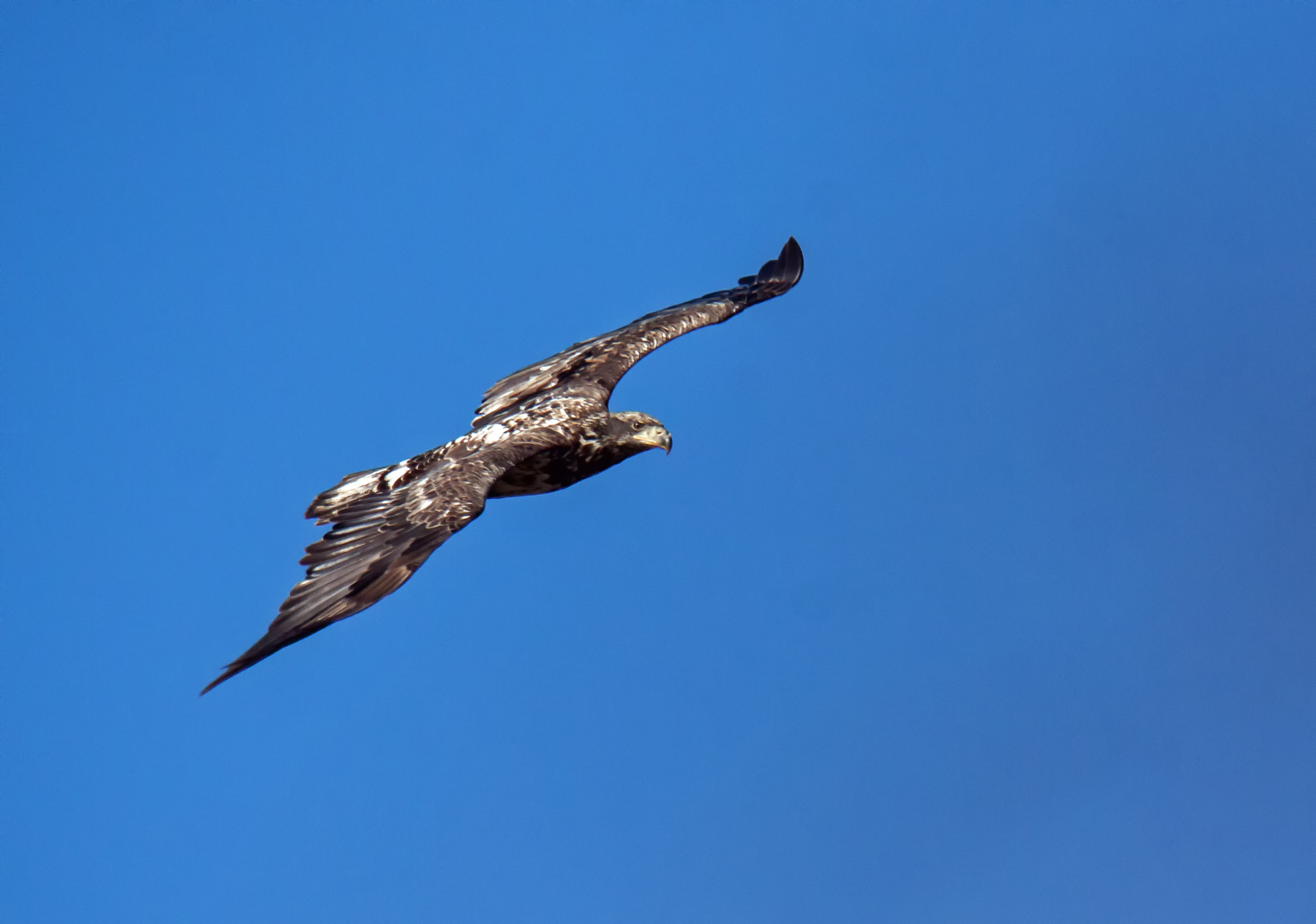
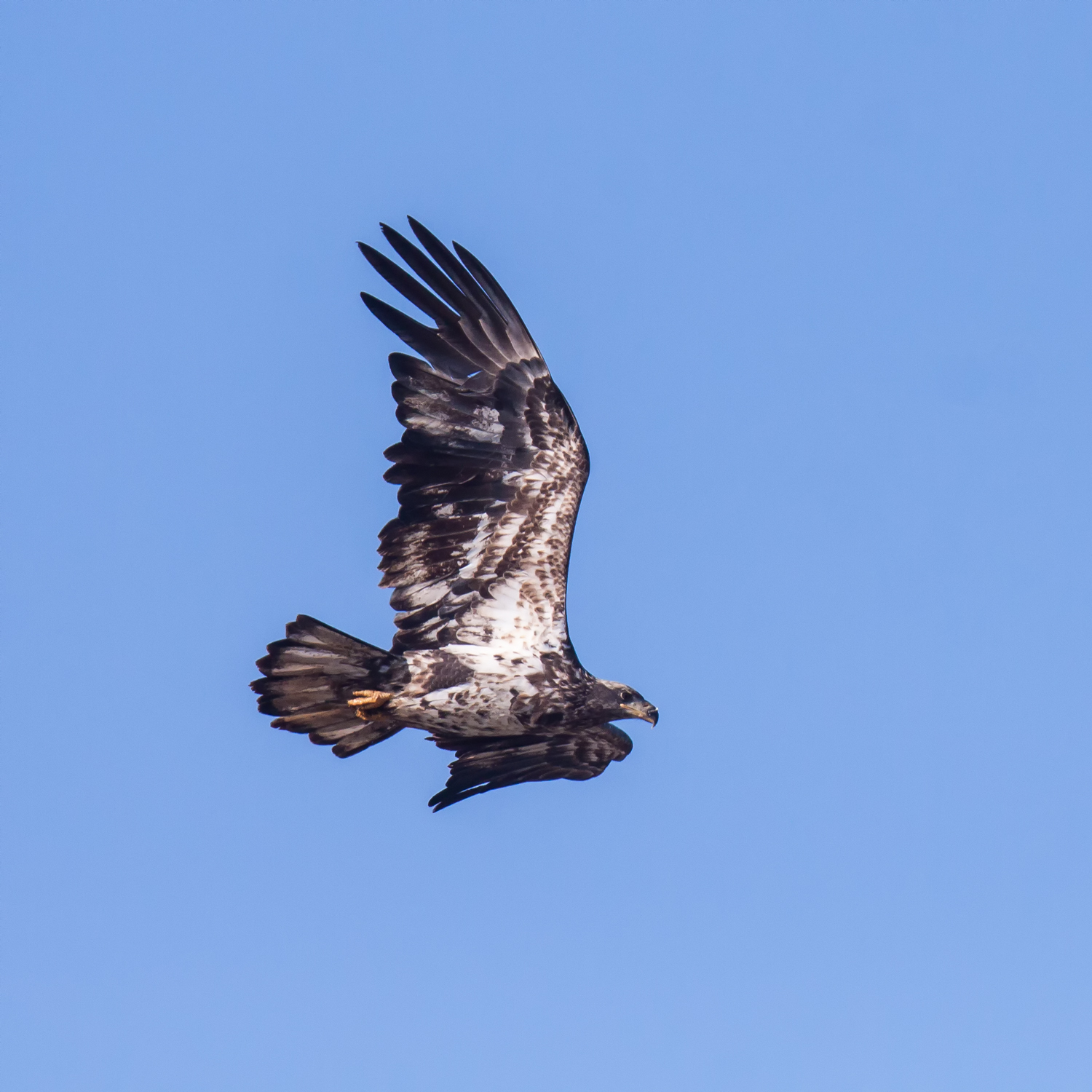
On Monday it was cool and windy and I didn’t expect to see many birds at Occoquan Bay National Wildlife Refuge. I was pleasantly surprised to spot several Bald Eagles (Haliaeetus leucocephalus) flying about. The wind seemed to slow them down a little and gave me a slightly better chance of capturing images of them in flight.

My favorite subject was this juvenile eagle. Sometimes juveniles can look somewhat bedraggled with their multi-colored feathers, but I thought that this one looked quite handsome, especially when the light hit it from a good angle and illuminated its body. One unexpected benefit was that it was easier to get a proper exposure with the juvenile because it does not have the extreme contrasts of the dark body and white head of the adults. In many of my shots of adult eagles, the body ends up underexposed and/or the head ends up overexposed.

juvenile bald eagle

juvenile bald eagle

juvenile bald eagle

© Michael Q. Powell. All rights reserved.

Read Full Post »

Yesterday at Occoquan Bay National Wildlife Refuge I spotted my first warbler of the spring, a Palm Warbler (Setophaga palmarum). For several weeks, I have been diligently searching the ground and the trees for warblers, whose appearance marks the beginning of spring for some birders. It was not surprising that the first one I saw was a Palm Warbler, because they are traditionally one of the earliest species to arrive, but I was a little surprised to find several of them at water’s edge, poking about in the rocks and the debris. In the past, I have most often spotted them on the grassy trails.

I was not able to get close to these little warblers, so my normal temptation was to crop my images, as I did in the first one, in order to highlight the bird. As I was working on the second image, I decided I liked the idea of including more of the environment, even though it is a bit cluttered. What do you think?

Palm Warbler

Palm Warbler

© Michael Q. Powell. All rights reserved.


Read Full Post »

Some birds are so round in appearance that they look more like cartoons than real birds. That was certainly the case with this tiny Ruby-crowned Kinglet (Regulus calendula) that I spotted last week at Occoquan Bay National Wildlife Refuge.

Ruby-crowned Kinglet

© Michael Q. Powell. All rights reserved.

Read Full Post »

Yesterday I spotted this pair of Eastern Bluebirds (Sialia sialis) perched on a nesting box at Occoquan Bay National Wildlife Refuge. The female appeared to have nesting materials in her bill and seemed ready to build a nest. The only problem is that this nesting box, I believe, is currently being used by some Tree Swallows.

I don’t know for sure if this is the place where the bluebirds plan to make their nest and I never did see either of the bluebirds enter the nesting box. However, a short time later I spotted the male bluebird with nesting material in his bill, so it is quite likely that they are determined to construct a nest somewhere nearby.

Eastern Bluebirds

Eastern Bluebird

© Michael Q. Powell. All rights reserved.

Read Full Post »

Normally when I see a Northern Mockingbird (Mimus polyglottos), it is perched in a tree. This past Wednesday at Occoquan Bay National WIidlife Refuge, I spotted one foraging in a field. The mockingbird was perched on the stalks of the vegetation and periodically would bend down and grab a few seeds.

I love the way that the cooler tones of the bird contrast with the warmer shades of the vegetation and the background. That contrast makes this fairly common bird really stand out and shine.

Northern Mockingbird

© Michael Q. Powell. All rights reserved.
 

Read Full Post »

I love the sweet sounds of a Carolina Wren (Thryothorus ludovicianus), like this little beauty that I spotted on Wednesday at Occoquan Bay National Wildlife Refuge.  Most of the times when I see a Carolina Wren, it is hopping about in the underbrush, but sometimes when they are going to sing, they choose a higher, more visible perch.

Carolina Wren

© Michael Q. Powell. All rights reserved.

Read Full Post »

This past Monday I spotted this juvenile Cooper’s Hawk (Accipiter cooperii) high in a tree at Occoquan Bay National Wildlife Refuge. Initially there were a lot of branches between us, but I was able to move slowly and stealthily closer to the little hawk and get a relatively clear shot of it.

Cooper's Hawk

© Michael Q. Powell. All rights reserved.

Read Full Post »

This past week at Occoquan Bay National Wildlife Refuge I observed two large birds consuming large fish using very different techniques. The first, a Great Blue Heron (Ardea herodias), carefully positioned the fish and then swallowed it in a single big gulp.

An Osprey (Pandion haliaetus), pictured below, used a much slower and methodical approach, tearing small chunks off of the fish. It takes a lot of bites to finish off a fish in this way. In between bites, the osprey would often look around to make sure no other bird was approaching and attempting to steal its catch.

When it needed to tug extra hard on the fish, the osprey would sometimes extend its wings in what I assume was an effort to stay balanced and keep from falling out of the tree. I believe that is what was going on at the moment when I captured this image.

Osprey

© Michael Q. Powell. All rights reserved.

Read Full Post »

« Newer Posts - Older Posts »