I really love to capture images of common birds in cool poses or settings, like this Song Sparrow (Melospiza melodia) that I spotted on Wednesday at Occoquan Bay National Wildlife Refuge on the bank of a small stream whose water had receded with the low tide.
The sparrow was moving about searching for tasty tidbits on the wet ground strewn with tiny pebbles and shells. I was happy when it paused for a moment at a spot where I could capture its reflection in the shallow water. Be sure to click on the image if you want to get a closer look at this handsome little bird and all of the snail and mussel shells that surround it.
I was thrilled yesterday at Occoquan Bay National Wildlife Refuge when a passing birder pointed out this Common Yellowthroat (Geothlypis trichas) to me. I thought that they were already gone until the spring, but a more experienced birder later told me that it is normal that some overwinter with us.
Like most other warblers, Common Yellowthroats generally head south for the winter. I wonder why this one stayed behind. Was he a procrastinator who got left behind or maybe a natural contrarian? Is the range of this species gradually creeping northward, perhaps because of global warming? (The range map shows that Common Yellowthroats are present year-round in the coastal areas of North Carolina, which is just to the south of Virginia, where I live.)
Whatever the case, it was really nice to spot the brilliant yellow throat of this masked warbler. I too was wearing a mask, but I don’t think it made look as cool and rakish as this Common Yellothroat.
This Bald Eagle (Haliaeetus leucocephalus) was staring down at me and appeared to be irritated when I spotted it on Monday at Occoquan Bay National Wildlife Refuge. Was it truly sad, disappointed, or angry at my presence, or was I merely mirror-imaging the range of emotions that I have experienced this past week as I observed the chaos and confusion in my own country?
If you would like to get a closer look at the eagle’s expression, double-click on the image. What do you read in that expression?
I am not sure why this wild turkey (Meleagris gallopavo) decided to flash its feathers at me yesterday at Occoquan Bay National Wildlife Refuge, but it sure made for a fun photo. A fellow photographer spotted a small flock of turkeys foraging in a faraway field and we tried to track them as they made their way up a small slope at the edge of the field.
Most of the time the turkeys kept their heads down as they moved forward, scratching about in the dirt, as you can see in the final photo. I had to wait patiently, hopeful that one of them would raise its head briefly before they got too far away. I was thrilled when the turkey in the second shot stood still for a moment and almost ecstatic when it fanned and flashed its feathers as you saw in the featured first photo.
How do you choose the images that you will include in a posting? Generally I will post photographs within a day or two of taking them. Sometimes, though, I get backlogged, either because I have gone out frequently or because my “catch” for a particular day was particularly good. If I were better organized and more objective in reviewing my photos, I might be better at making sure that I always post my best images. However, I suffer from a phenomenon known as “recency bias.”
What is recency bias? Recency bias is a type of cognitive bias in which you give greater weight during evaluation to things that are recent than to those in the past, even in the recent past. How does that work in practice for me? Yesterday I posted a photo of a bald eagle couple that I had spotted this past Monday, the most recent photo that I had taken of a bald eagle. I was excited to share it, because every single eagle sighting is special to me.
When I was trying to figure out what to post today, I realized that I had run out of cool images from my most recent photographic forays. I decided to go back a little in time and looked through my photos from late December. I stumbled across my eagle photos from 28 December, less than two weeks ago. I had taken a whole lot of shots of the eagle in an attempt to get an unobstructed view and had never gotten around to reviewing them all. I meant to do so, but got caught up in newer photos and gradually forgot about this eagle.
I really like this shot of a Bald Eagle (Haliaeetus leucocephalus) that I spotted in a sweetgum tree at Occoquan Bay National Wildlife Refuge. By almost any standard, it is a much better eagle photo than the one that I posted yesterday and I am glad that I “re-discovered” it. This little experience serves as a good reminder to me that it is important to look back sometimes and not be quite so tunnel-vision focused on getting the next image.
I am chuckling a little as I conclude this posting because I realize that, in essence, I am complaining about having so many images to post that I forget about some of them. Compared to the major challenges that we face in the world today, this definitely qualifies as a “first world problem.”
We have now reached the dark, gray days of winter. The endless series of cold cloudy days threatens to weaken my creative energy, and subjects to photograph seem harder and harder to find. What can I do? What should I do?
For me, the key is simply to press on, even when I am not “feeling it” and even when the weather is less than optimal. I have to keep reminding myself of the benefits to my body and my emotional well-being that come from walking around in solitude with my camera. So I put on extra layers and push myself out the door.
As for the photos, I try to be grateful for whatever opportunities come my way. On Monday, for example, these perched Bald Eagles (Haliaeetus leucocephalus) were among a small number of birds that I managed to photographed. They were pretty far away, but I was happy to capture some of the details of the eagles’ feathers and the bark on the trees.
I could’t help but notice that the only bright colors in the image were the eagles’ beaks and talons, so I played around and converted the image to black and white. With the color removed, I can focus better on the shapes and textures of the elements in the image, but perhaps it draws too much attention away from the eagles that are, after all, the primary subjects of the photo.
Male Bufflehead ducks (Bucephala albeola) are really easy to identify even from a distance because of the distinctive bonnet-like white patch on their heads. The rest of their heads normally appears to be a solid darkish color, but if the light is coming from the right direction, a very striking purple-green iridescence is revealed.
Yesterday I spotted a couple of male buffleheads at a small suburban pond near where I live. Most of the time the buffleheads stayed in the deep water, as most diving ducks like to do, but occasionally one of them would pop up momentarily a bit closer to the shore. I was thrilled that I managed to capture the beautiful head coloration in a couple of my images, which surprised and delighted me because the day was mostly cloudy and sunlight was mostly lacking.
I spotted this handsome Eastern Bluebird (Sialia sialis) last week at Occoquan Bay National Wildlife Refuge and surprisingly he was willing to pose for me—normally bluebirds fly off as soon as I move close to them with my camera.
We started off with a formal pose against a solid backdrop and then moved on to a more casual pose. We were both really happy with the final images—he plans to use them on his social media, especially Twitter.
In the distance I heard the unmistakeable call of a Belted Kingfisher (Megaceryle alcyon) during a recent at Occoquan Bay National Wildlife Refuge. My eyes tried to follow my ears and I was finally able to locate the elusive bird, almost hidden against a backdrop of tangled trees. Was it worth taking a shot?
All photographers are taught to avoid cluttered backgrounds, because they make it difficult for viewers to focus on the primary subject—that is the conventional wisdom and it often makes sense, except when it doesn’t. The more I take photos, the more I realize that the “rules” are merely loose guidelines that need to be challenged regularly. When in doubt, I believe it is best to take the shot even when the lighting is bad, the shutter speed is too slow, or the background is too busy.
In this case, the small branches form an almost irregular pattern that more or less fades away for me, leaving me with the skeleton structure of the darker branches and the bird itself. The colors of the bird contrast so much with those of the branches that it stands out even though it is only a small part of the photo.
Does the image “work?” It is definitely not the “normal” kind of shot that I take, but I really like the way that it turned out. Sometimes it can be good to ignore the limitations of the rules and just go for it.
I grew up thinking of American Robins (Turdus migratorius) as springtime birds, but in the area in which I live robins are with us throughout the year. I photographed this robin this past Saturday at Occoquan Regional Park when it turned towards me with a quizzical look. The little bird seemed more curious about my presence than disapproving, though the inflexible bills of birds makes facial expressions a bit hard to judge.
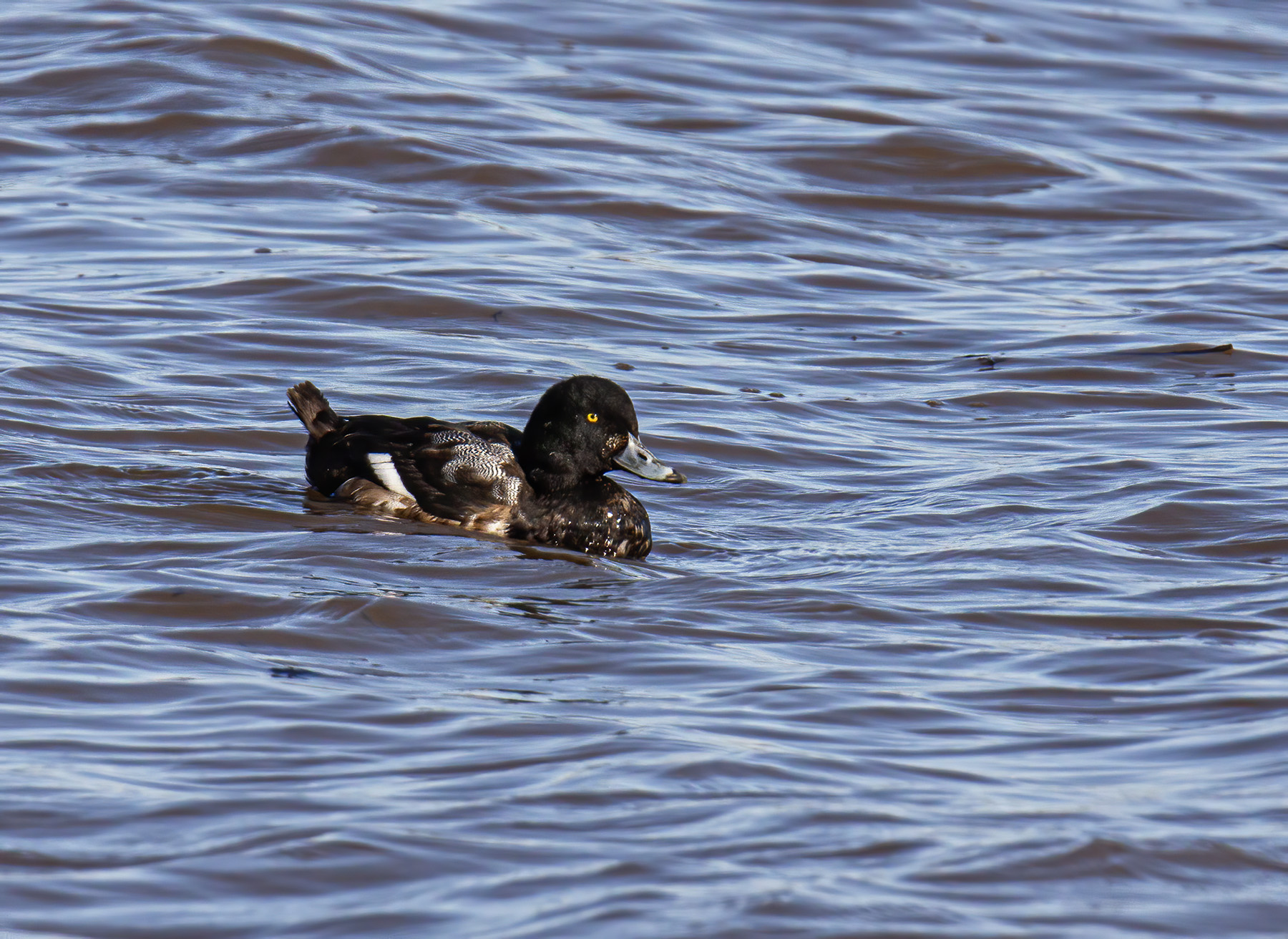
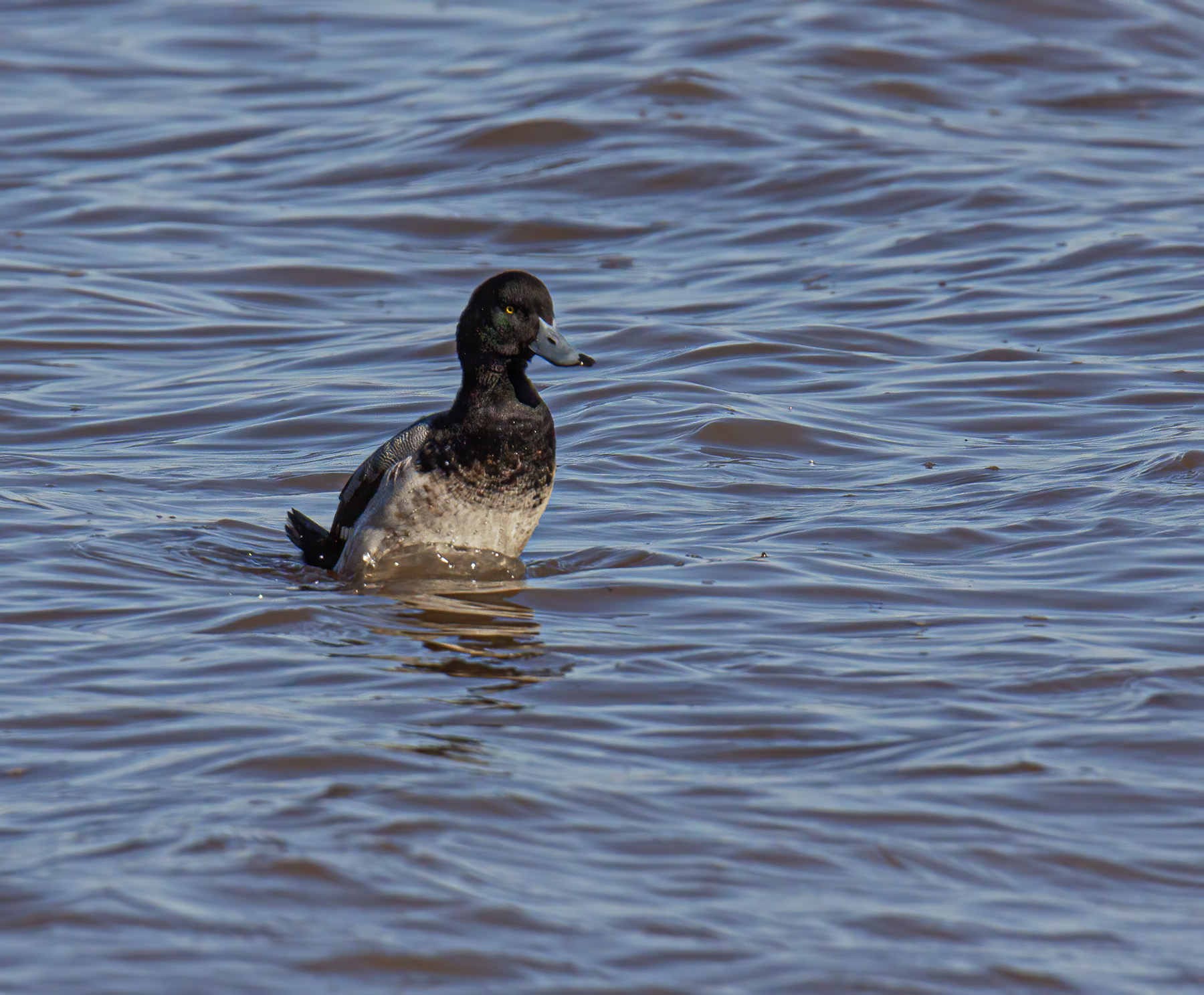
At this time of the year I am always looking for birds in the waters off of Occoquan Bay National Wildlife Refuge, like this scaup, a small diving duck, that I spotted on Monday. There is a Greater Scaup (Aythya marila) and a Lesser Scaup (Aythya affinis) and they are quite similar in appearance.
For the sake of identification, I am going to assume that this is a “Greater” one—I do not want to damage its self-esteem by calling it “Lesser.”
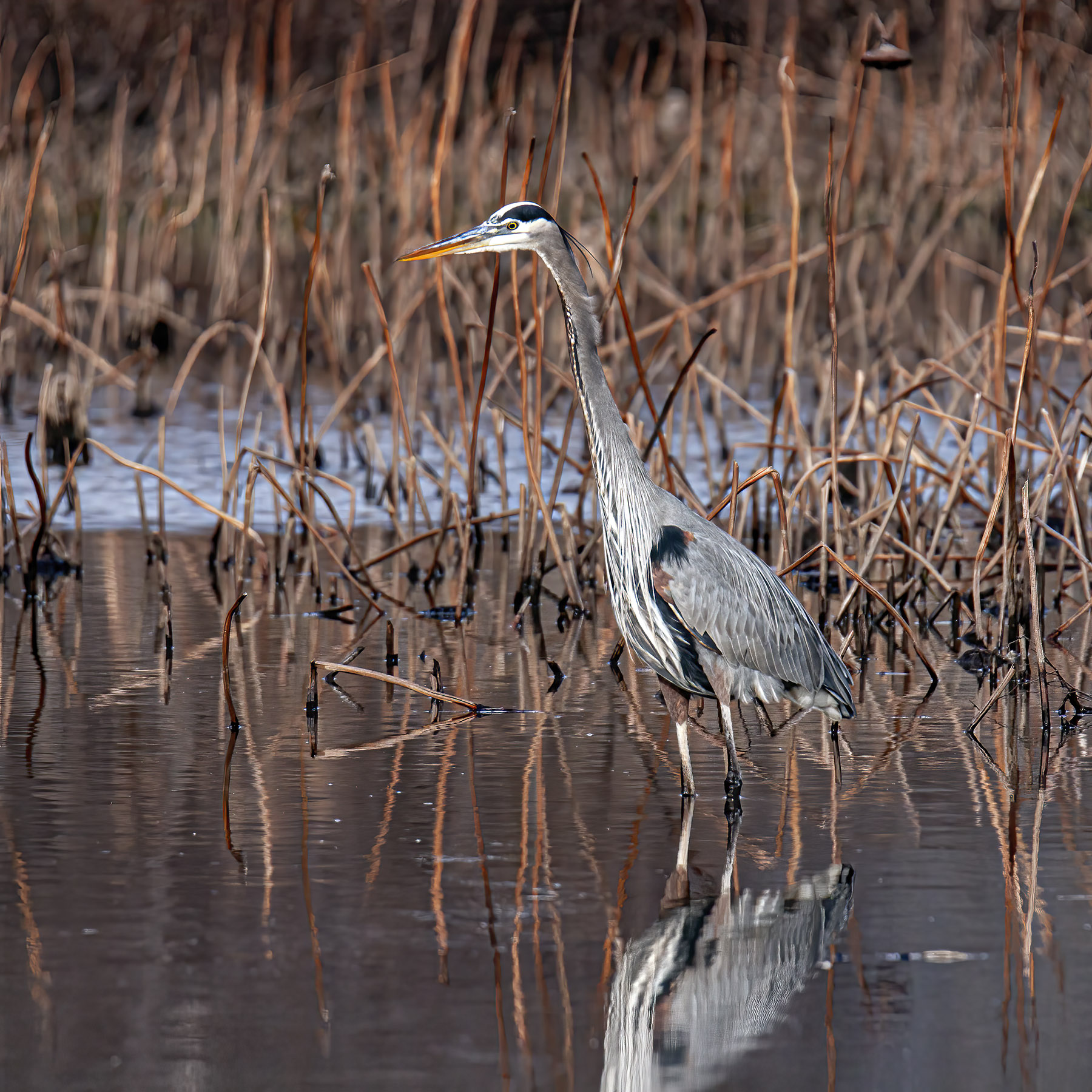
And so the new year begins. In many ways I feel like this Great Blue Heron (Ardea herodias) that I spotted on Monday at Occoquan Bay National Wildlife Refuge, alert and wide-eyed, but hunkered down alone on the sidelines, cautiously waiting until it is safe to engage more fully.
The Great Blue Heron in the second image was the final bird I photographed in 2020—I captured this image yesterday afternoon. This heron appeared to be fishing, standing motionless for a long time, watching and waiting and hoping. Perhaps there is a lesson for us here as well as we begin 2021. Patience has been in somewhat short supply this past year and we could all use more of it this year.
Happy New Year to all of you and to your loved ones.
This tiny Golden-crowned Kinglet (Regulus satrapa) seemed to have puffed himself up to look larger and more menacing as he defiantly stared at me from the underbrush last week at Occoquan Bay National Wildlife Refuge. His bright yellow Mohawk hairstyle enhanced his non-conformist vibe—it would not surprise me to learn that he has tattoos and body piercings.
Generally I try to avoid head-on shots of birds, but somehow it worked out pretty well in this case and allowed me to photograph this kinglet with an attitude. I encourage you to click on the image to get a closer look at this cool little bird.
The last time that I posted a photo of this Bald Eagle (Haliaeetus leucocephalus) couple, they were sitting apart on the platform that is sometimes used by ospreys during nesting season at Occoquan Bay National Wildlife Refuge. When I spotted them last week, they had moved much closer together and were perched on the small surface at the top of the post. Is love in the air?
The tree in which these eagles generally nest is not very far away. Part of their rather small nest there seems to have disappeared over the last year, perhaps as a result of a fallen branch, and it will be interesting to see if they will rebuild the nest at the same location.
As I was observing the eagles, I realized that I had never provided you with an overall view of this preferred platform, so I zoomed back and captured the second image below. As you can readily see, the platform is quite tall and I believe that the eagles like the commanding view from their perch, a view that includes the tree in which their nest is located.
How are you coping with the pandemic? Most of us give a politely positive response to such a query. It is hard to admit to doubts and fears, so we generally mask our emotions just as tightly as we mask our noses and mouths.
I was in a contemplative, almost poetic mood yesterday as I was walking about in nature with my camera and played around with these words. If you had seen me, you would have noticed me mumbling to myself. (I decided to illustrate my thoughts with a masked bird, an immature Cedar Waxing (Bombycilla cedrorum) that I photographed in early November.) I’m not a poet, but here is where I ended up. (NOTE: The formatting may be messed up in the WordPress Reader, but is correct if you click through to the blog itself.)
A Masked Response
“I’m fine,” you reply
wearing a mask.
But are you really?
Have you been tending
to your mental well-being
or merely pretending?
Is your pretense
in the past tense
or are you still tense
in the present?
Take care, my friend,
I care.
Throughout this year I have been entertained, intrigued, and inspired by a whole group of real poets, primarily but not exclusively from the United Kingdom and Ireland, who have helped me to maintain my emotional well-being. Two of them, Karen Mooney and Gaynor Kane, recently published a short collection of poems, entitled Penned In, in which they responded to the impact of the pandemic on society and everyday life. It is an amazing work by two wonderful ladies. If you want to know more about the collection or would like to order your own copy, click on the title above.
Here is a link to a video version of one of Karen’s poems in the collection entitled “We’re All In This Together.”
Here is a link to a video version of one of Gaynor’s poems in the collection entitled “Learning BSL During Lockdown.”
Let me conclude with a stanza from one of the poems in their collection entitled “Stilling the World.”
“But think of the cost if you don’t stay home.
You’re not alone, we’re in this together,
won’t be forever, but some will never…”
Stay safe and healthy as we all prepare to begin a new year.
Homemade cranberry sauce made a wonderful complement to the turkey at the Christmas Day feast that I shared with the other two members of my “pod.” Many birds are also feasting on berries at this time of the year, though I cannot recommend that you taste the poison ivy berries that they are consuming.
Last week I spotted this White-throated Sparrow (Zonotrichia albicollis) at Occoquan Bay National Wildlife Refuge and watched as it picked berries one by one from a cluster of poison ivy and consumed them in place. Most of us do not like to have our photos taken while we are eating, but this pretty little sparrow was so focused on its feast that it did not seem to mind.
It won’t be long before it is nesting season at Occoquan Bay National Wildlife Refuge for Bald Eagles (Haliaeetus leucocephalus). I know of two nests that have been used the past few years. One of them is close to a trail that the refuge authorities block off when nesting is taking place. The other, pictured below, is high in a tree that is visible in the distance from a trail but is inaccessible to human traffic.
You can’t help but notice how large this nest is, especially when you compare it with the size of the bald eagle that I managed to photograph early one morning last week. Every year the eagles add on to the nest and now it is so deep that I am unable to see the eagles when they are sitting in the nest.
I will be keeping an eye on the eagle nest in the upcoming months and will be sure to give a progress report if/when I see additional activity.
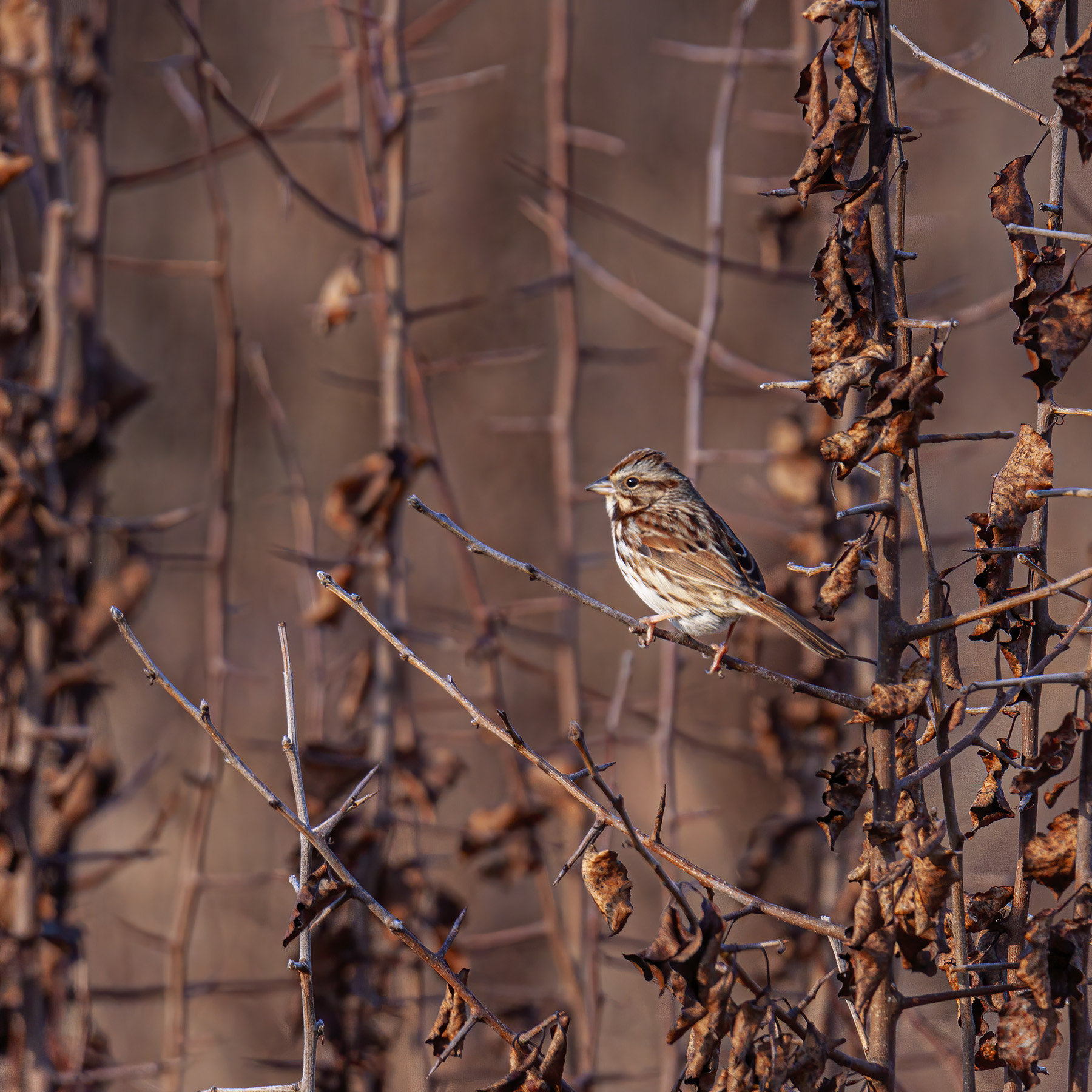
“I sing because I’m happy, I sing because I’m free. For His eye is on the sparrow, and I know He watches me.” These are some of the words of one of my parents’ favorite hymns and I think of them whenever I see one of those little birds, like this Song Sparrow (Melospiza melodia) that I spotted last Tuesday at Occoquan Bay National Wildlife Refuge.
I love the background of this photo so much that there was no way that I was going to crop in closely. The plants form an almost grid-like pattern that find really appealing and the muted browns are a good complement to the earthy tones of the sparrow. Even the light was cooperative, highlighting the subject without blowing out the lightest areas.
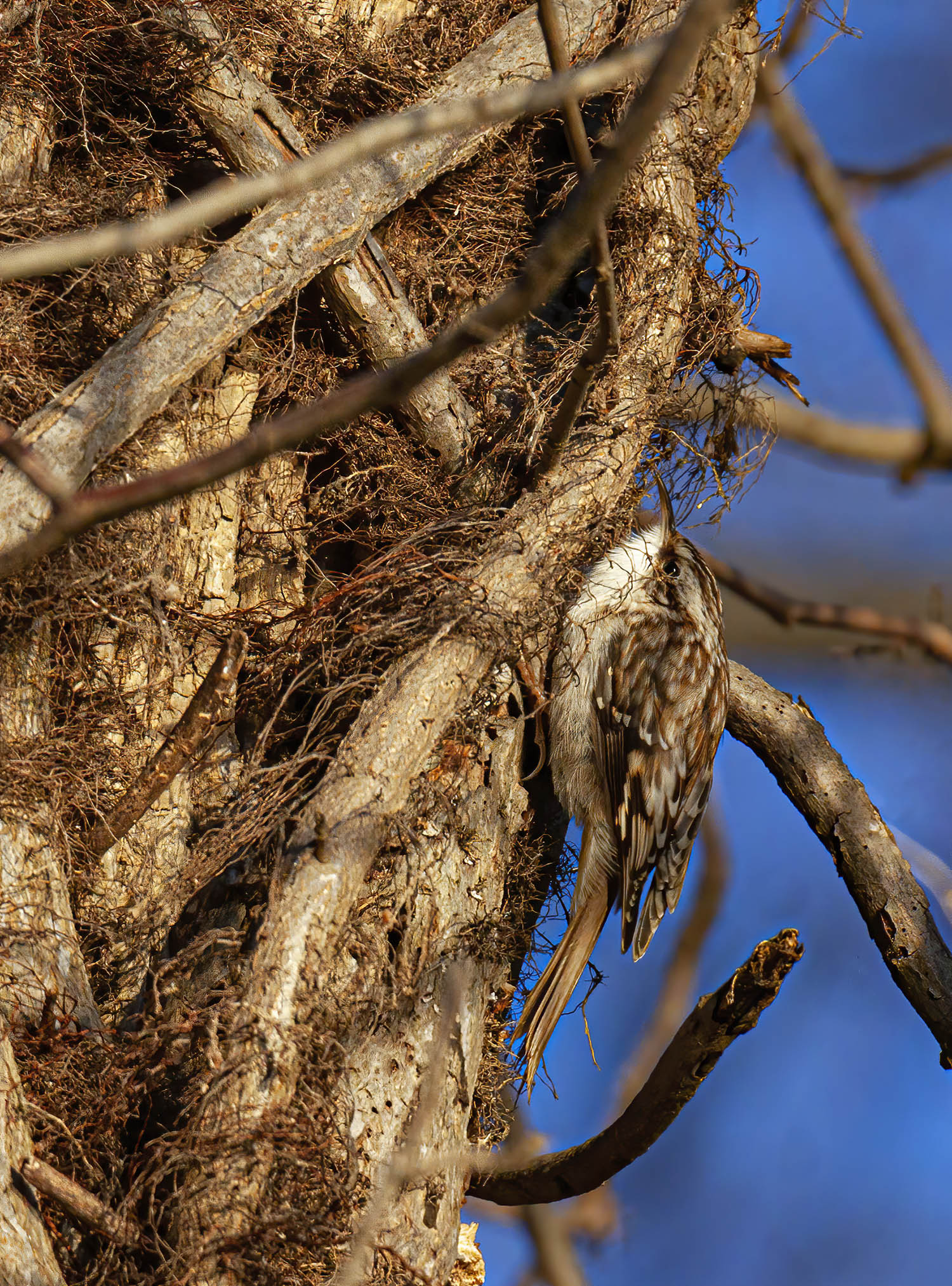
Can you spot the bird in this photo? Its white underparts help to give away its position, but otherwise the Brown Creeper (Certhia americana) is pretty well camouflaged. I rarely see these little birds (about 5 inches (13 cm) long) because they blend in so well and are constantly in motion, poking and probing as they spiral their way to the top of the trees.
I really like the way that the Cornell Lab of Ornithology describes these small birds—”Brown Creepers are tiny woodland birds with an affinity for the biggest trees they can find. Look for these little, long-tailed scraps of brown and white spiraling up stout trunks and main branches, sometimes passing downward-facing nuthatches along the way. They probe into crevices and pick at loose bark with their slender, downcurved bills, and build their hammock-shaped nests behind peeling flakes of bark. Their piercing calls can make it much easier to find this hard-to-see but common species.”
I spotted the Brown Creeper this past Tuesday at Occoquan Bay National Wildlife Refuge early in the morning when the light had a golden tinge that made everything look particularly beautiful. I tried to track the bird as it made its way up the tree and took quite a few photos. This is one of the few in which I got a relatively clear view of the entire bird, including its stiff tail that it uses for support.
I love all kinds of Christmas songs whether they be traditional carols, secular songs, or contemporary hits. One of my favorites is Winter Wonderland, though I must confess that it sometimes leaves me confused. The second verse says, “Gone away is the bluebird, here to stay is a new bird. He sings a love song as we go along, walking in a winter wonderland.” The bluebirds have not in fact gone away—I saw Eastern Bluebirds (Sialia sialis) multiple times this past Tuesday at Occoquan Bay National Wildlife Refuge.
I love these cheerful, colorful little birds and hope that they are here to stay as I walk about in my own winter wonderland.
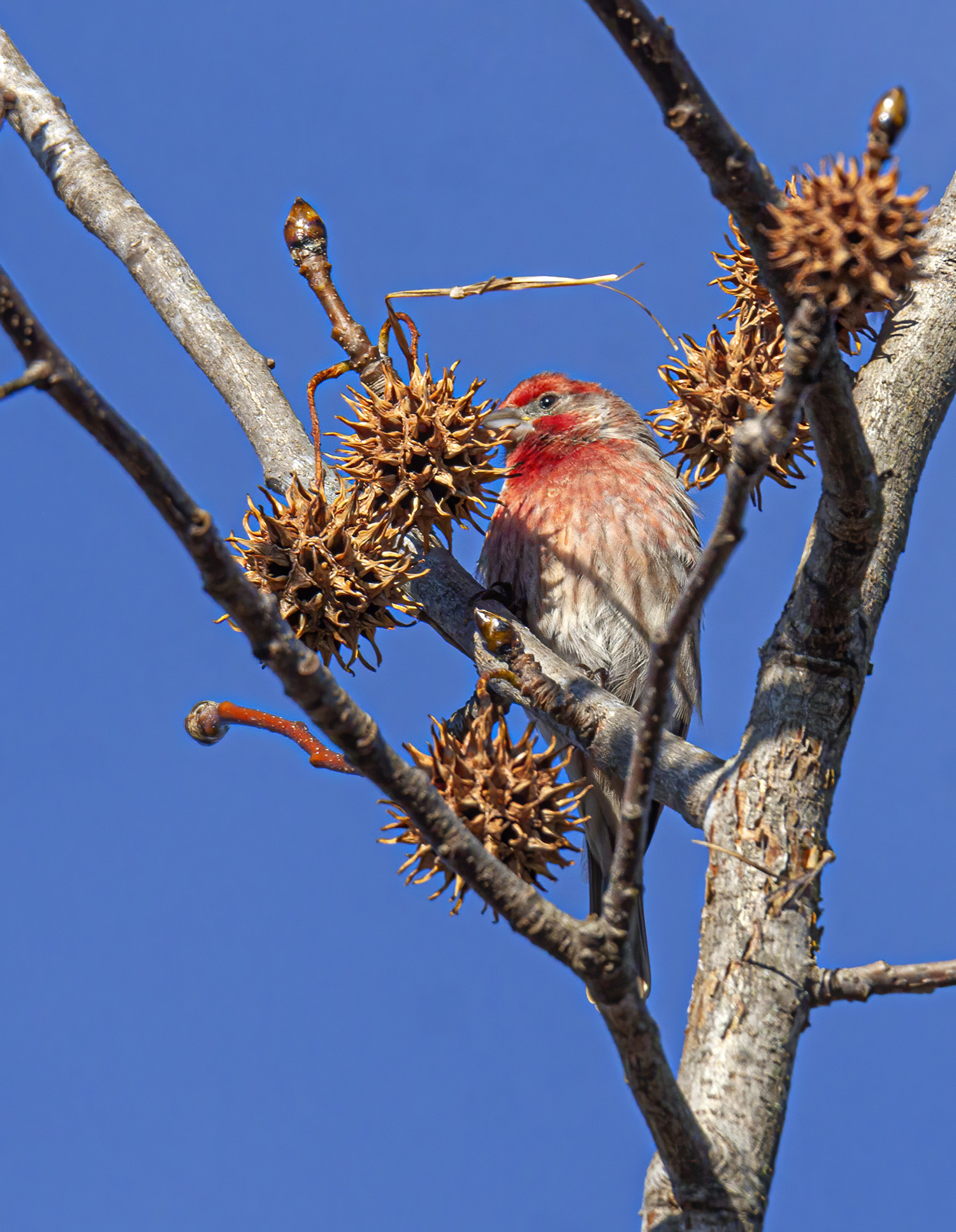
This is the first year that I have really noticed how many different birds work to extract the seeds from the spiky seedpods of the sweetgum tree. In the past month I have done postings featuring chickadees and goldfinches. Today I am spotlighting a beautiful House Finch (Haemorhous mexicanus) that I spotted on Tuesday at Occoquan Bay National Wildlife Refuge.
The brilliant red color on the finch’s head and shoulders seems so perfect for the season as many of us prepare to celebrate Christmas. I initially thought that the bird’s large conical beak was buried in the the seed ball, but was happy to see that it is visible. The finch uses that powerful beak to crack open all kinds of seeds as it engages in nature’s own nutcracker suite.
Merry Christmas to those celebrating Christmas and happy holidays and best wishes to all in this joyous season. “Glory to God in the highest heaven, and on earth peace to those on whom his favor rests.” (Luke 2:14)
I am not sure what caught the attention of this Great Blue Heron (Ardea herodias), but the heron was intensely focused on something on the shore for quite some time recently at Occoquan Bay National Wildlife Refuge. Perhaps it was thinking back to warmer days, when it might have been able to snag a frog or even a dragonfly, but, alas, the weather has turned cold and those creatures are no longer stirring.
Eventually the heron gave up on that spot on the shore and re-focused on fishing, hoping for better luck.
It is quite a challenge to get a clear shot of a Ruby-crowned Kinglet (Regulus calendula). Why? Ruby-crowned Kinglets are one of the smallest birds in my area, about 4 inches (10 cm) in length and 0.2-0.3 ounces (5 to 10 g) in weight. Additionally they are almost constantly moving. The Cornell Lab of Ornithology described them as, “restless, acrobatic birds that move quickly through foliage, typically at lower and middle levels. They flick their wings almost constantly as they go.”
I have spotted these tiny birds multiple times this season but only recently did I manage to get some reasonably clear images of them during a visit to Occoquan Bay National Wildlife Refuge. This images show pretty well their prominent white eye-rings and the beautiful pattern on their wings. Unfortunately I did not get a glimpse of the the “ruby crown” of a male kinglet, a characteristic that is only occasionally visible.
A common bird in a simple setting—that is all of the prompting that I need to capture an image. Nature photography for does not require exotic subjects or locations.
This past Saturday I spotted this Northern Mockingbird (Mimus polyglottos) perched in a young tree. The position did not look very comfortable, so I suspected the bird would not stay in it for long. I focused quickly and was really happy with the result—a nice little portrait with a very limited palette of subdued colors.
Although we had only about an inch of snow last week, it has hung around on cars and in shady areas. Despite the continuing cold and overcast weather, I decided yesterday that I needed to get outdoors with my camera. I had several places in mind, but my plans were thwarted when I ran into a traffic jam on the interstate. I took the first exit and decided to visit instead a small suburban pond not far from where I live.
Several species of ducks overwinter at this pond and I spotted Hooded Mergansers and Ring-necked Ducks in the center of the pond, out of range of my telephoto zoom lens. As I continued circling the pond on a walking trail, I was thrilled to spot several Double-crested Cormorants (Phalacrocorax auritus) standing in the shallow water not far from the shore. Some bushes separated me from the cormorants, so I had to bend and twist a bit to get a clear shot, but I managed to capture this image of one of them before they turned their backs to me and swam away.
The bright orange color of the cormorants’ bills always captures my attention, but it is the beauty of their brilliantly blue eyes that keeps me transfixed. Wow! Be sure to double-click on the photo to get a closer look at that amazing blue color.
As it turned out, I did not need to travel far to find beauty—figuratively speaking it was in my back yard. It would be cool to have an actual pond in my back yard, but it would have to be a tiny one and my townhouse homeowners’ association would certainly complain about it.
Smaller birds seem to enjoy foraging for Sweet Gum seeds while the seed pods are still hanging on the trees, like this Carolina Chickadee (Poecile carolinensis) that I spotted last week at Occoquan Bay National Wildlife Refuge. Many of you may recall a somewhat similar posting last month featuring goldfinches. If you have not yet seen it, check it out at Goldfinch and Sweetgum.
Although I enjoy photographing raptors, like the Bald Eagle that I showcased yesterday, I derive an equal amount of pleasure observing and attempting to photograph tiny birds like this chickadee. Beauty is everywhere.
When I first spotted this Bald Eagle (Haliaeetus leucocephalus) last Saturday at Occoquan Bay National Wildlife Refuge, it was mostly hidden from view, perched rather low on a broken-off tree and surrounded by a thick tangle of vegetation. When I finally maneuvered around to a position where I had a relatively clear line of sight to the eagle through the bushes, I realized that I had another problem—the light was shining brightly from the side, causing the white head of the eagle to be overexposed on one side with a resultant loss of details.
I moved a little from side to side to improve the lighting situation and waited for the eagle to move its head too. As I reviewed my shots afterwards, I was delighted to see that the side lighting had helped to reveal the beautiful layers of feathers on the eagle’s body. The eagle seemed to be giving me a disapproving look in the second shot, but amazingly it remained in place. As I was moving away I looked back at the eagle and silently thanked the majestic bird for our shared moments together.
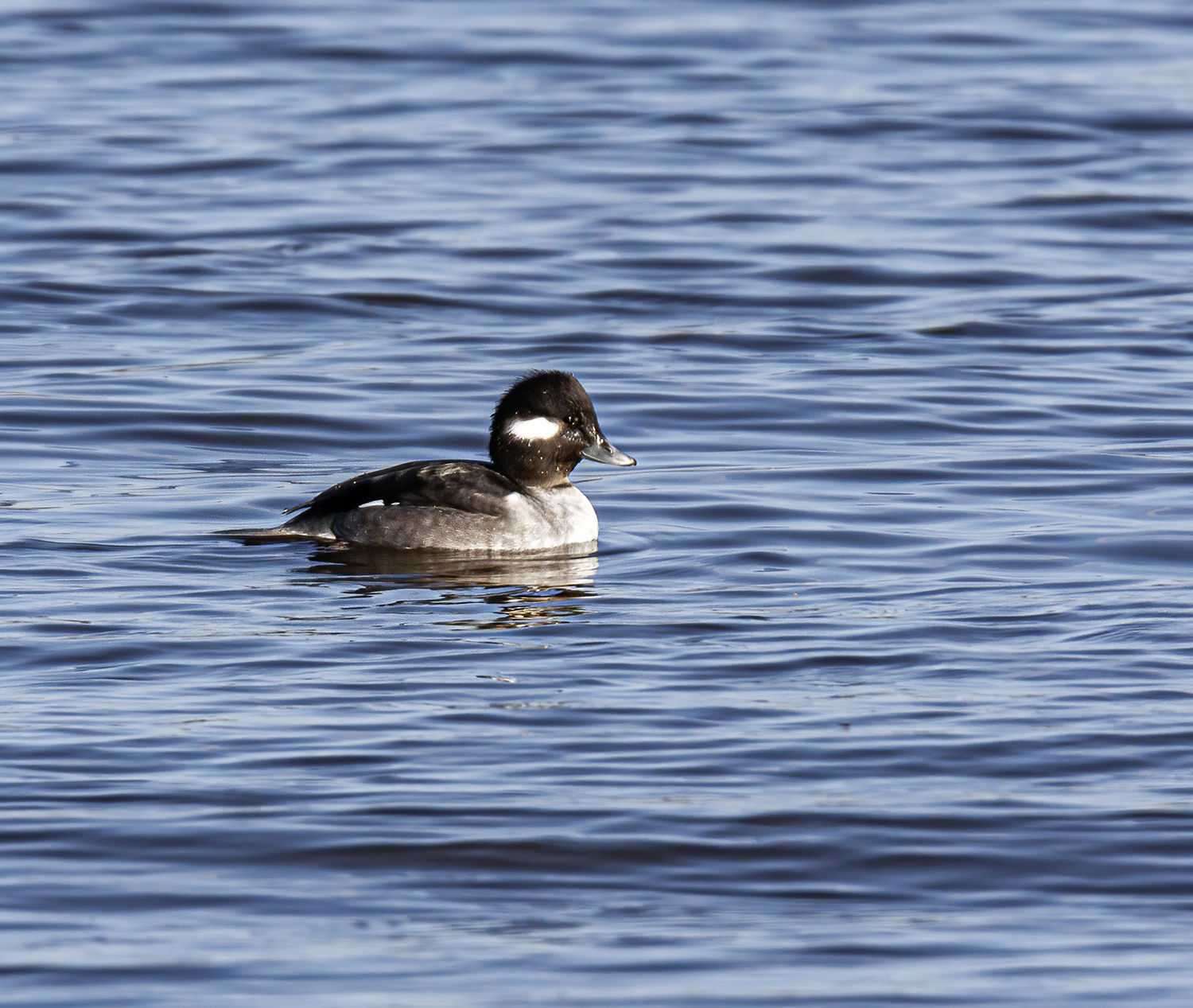
She never approached the shore for the close-up that I was craving, but I was happy to capture this image of a pretty little female Bufflehead (Bucephala albeola) last week at Occoquan Bay National Wildlife Refuge. Later in the winter I am likely to spot small flocks of Buffleheads in the deep waters, but on this day this one was all by itself.
I am often fooled by Eastern Towhees (Pipilo erythrophthalmus). Whenever I see a flash of rusty brown feathers on a dark bird, I assume that it is an American Robin. If a towhee stays still long enough, it is easy to tell that it is not a robin—the color pattern and the bill shape are completely different from those of a robin. The problem is that towhees are often in constant motion, foraging about in the undergrowth, so it is hard to get a good look at one.
I was fortunate last week when an Eastern Towhee popped out of the brush at Occoquan Bay National Wildlife Refuge and perched for a moment on the branch of a small tree, allowing me to capture a shot of this very colorful sparrow.
During nesting season ospreys build a nest atop this tall platform at Occoquan Bay National Wildlife Refuge, but at other times of the year Bald Eagles (Haliaeetus leucocephalus) like to use it as a resting spot. On a recent day when the weather was cold and windy, I spotted this eagle couple resting together. I suspect that the larger eagle on the lower level is the female and the one keeping watch is the male, although the sharp upward angle at which I was shooting makes it a little difficult to judge their relative sizes.
If I wander the trails of Occoquan Bay National Wildlife Refuge for a long enough period of time, I am quite likely to encounter some Wild Turkeys (Meleagris gallopavo). I have seen them in almost all parts of the refuge and suspect that there are several flocks that reside there.
Last Monday I encountered a small flock that appeared to include a half-dozen or so turkeys. They were scratching about at the edge of one of the trails and did not seem to notice me as I slowly made my way forward. All of the sudden, one of the turkeys flapped its wings a little as if to sound an alarm, as you can see in the second image below. All of the turkeys started to move and slowly disappeared into the underbrush. I was thrilled to capture the first image as they were striding away.












 Mike Powell