Feeds:
Posts
Comments

Archive for the ‘Autumn’ Category

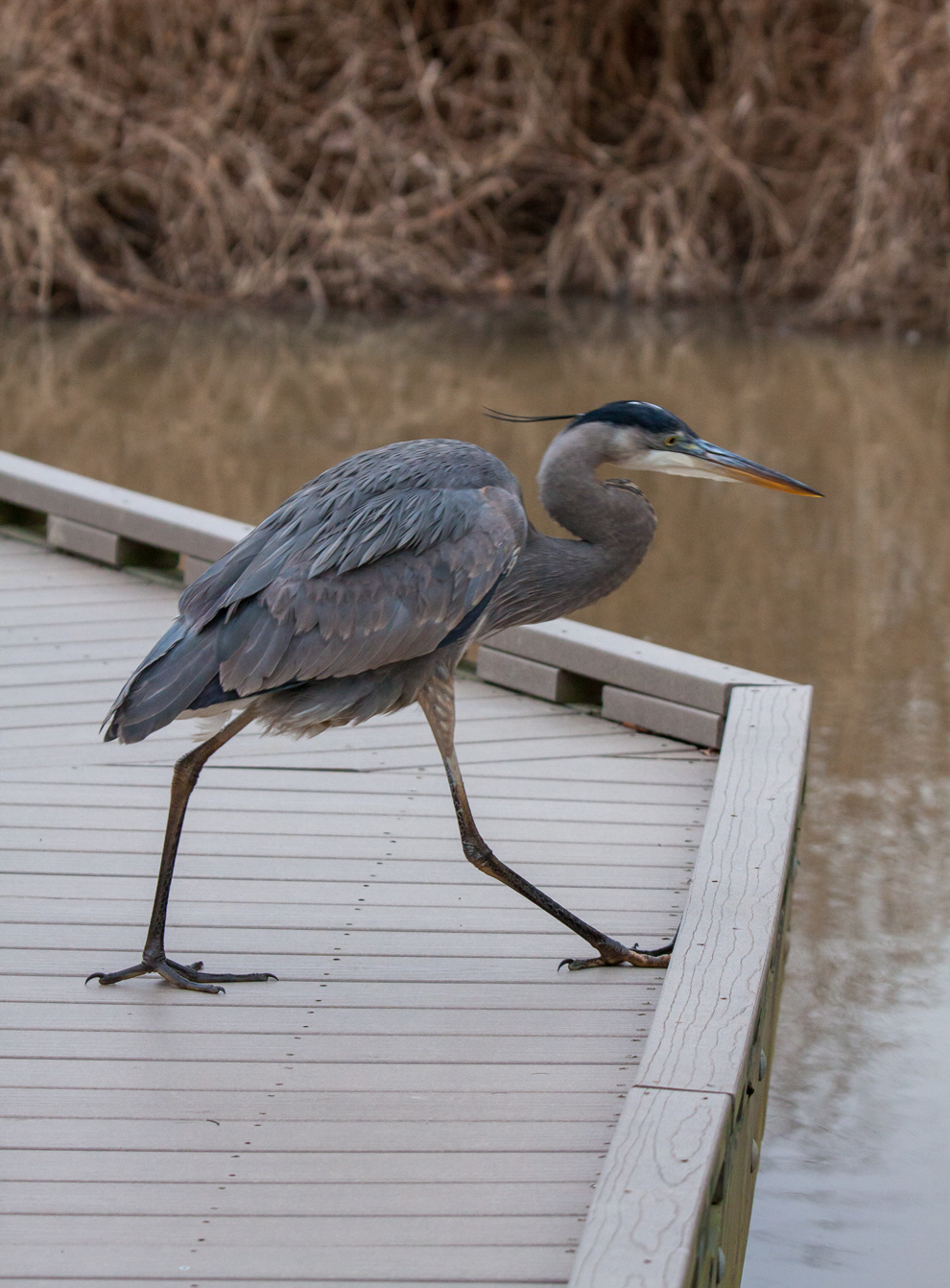
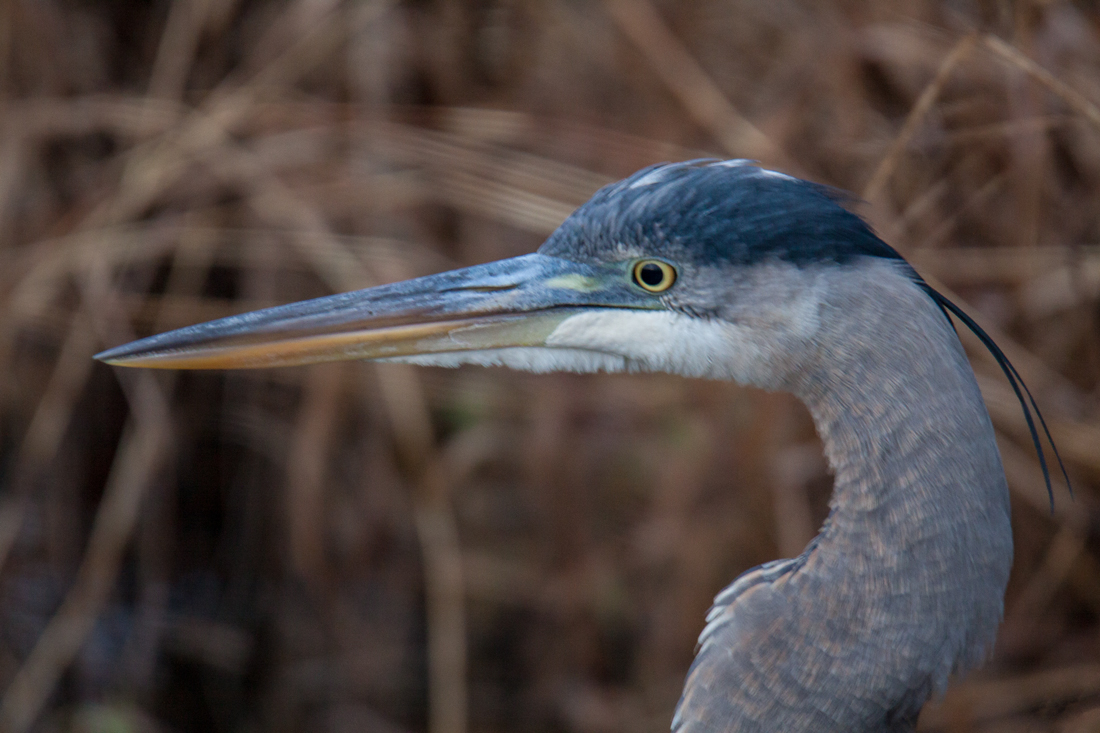
The mind can sometimes make strange associations. From the moment that I saw the pose of the Great Blue Heron (Ardea herodias) in this image, I couldn’t help but think that it looked like the kind of dragon that you see in movies and in children’s cartoons.

I took this shot in mid-December, while I was walking along the boardwalk in the familiar confines of my local marshland park. The heron had been fishing in the shallow waters of a former beaver pond to the left and decided to move to the water on the other side of the boardwalk. Rather than fly directly to the new location, the heron decided to hop up onto the surface of the boardwalk.

I posted a somewhat similar photo on 9 December, but I like this one better—the pose is more interesting, the focus is a little sharper, and the colors of the heron are more vibrant. Herons are a relatively commonplace bird in the locations I visit, but I never tire of trying to capture images of these fascinating creatures.

Does the heron remind you of a dragon? As children, we had no trouble believing in magical creatures, but, alas, most of us lost that capacity as we grew into adults.

It brings to mind a quote from one of my favorite books, Le Petit Prince by Antoine de Saint Exupéry, “Les grandes personnes ne comprennent jamais rien toutes seules, et c’est fatigant, pour les enfants, de toujours et toujours leur donner des explications.” (Grown-ups never understand anything by themselves, and it is tiring for children to be always having to explain things to them).

A dragon? Why not?

Great Blue Heron

© Michael Q. Powell. All rights reserved.

Read Full Post »

It certainly pays to look closely at a group of birds, because they may not all be from the same species. Last week I spotted this cool-looking duck in the midst of a group of mallards at my local marshland park.

I couldn’t identify the duck when I took the photos, but it was clearly not a mallard. After a bit of research on the internet, I have concluded that it is probably a Gadwall (Anas strepera), a species of ducks that I had never seen before.

Gadwall
Gadwall

© Michael Q. Powell. All rights reserved.


Read Full Post »

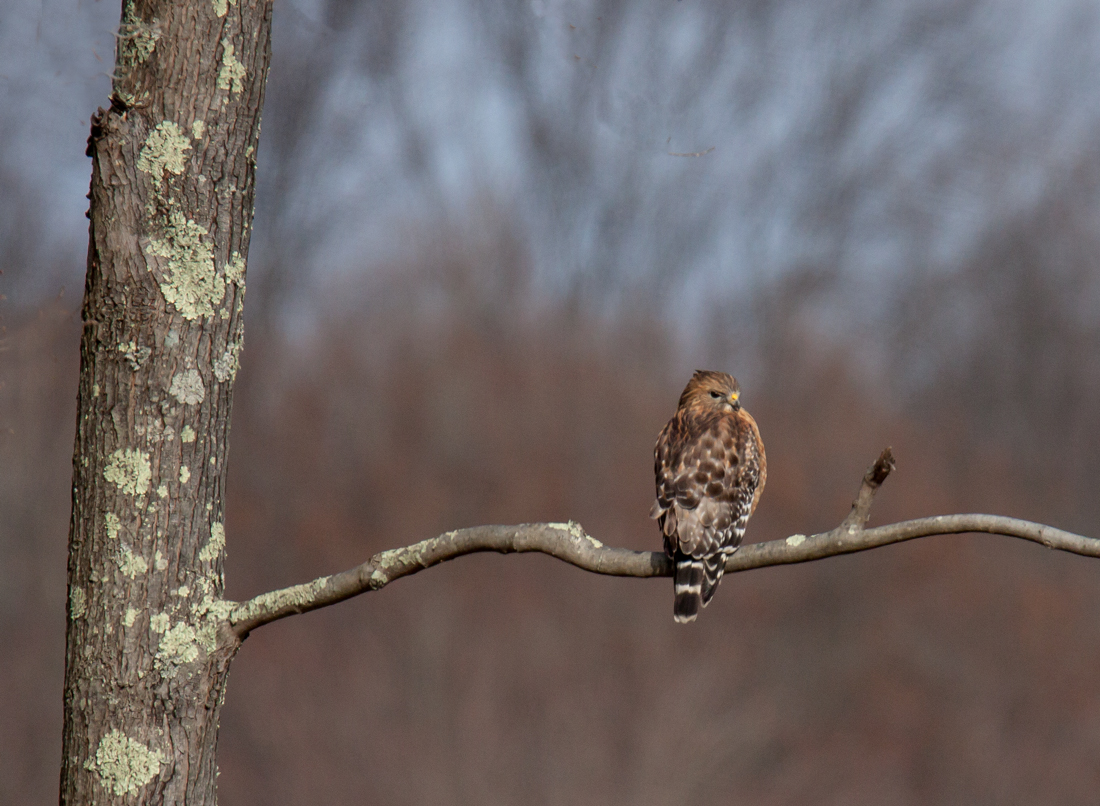
Now that the leaves have fallen from the trees, I have a much greater chance of reaching one of my goals for this winter of capturing some better shots of hawks.

One of the biggest challenges at my local marshland park is that most of the trees on which hawks seem to like to perch are inaccessible—the trees are surrounded by flooded swamps on one side and dense vegetation on the other.

This past week I took my best hawk shots in quite some time when a fellow photographer pointed out this Red-shouldered Hawk (Buteo lineatus) on the limb of a distant tree. We were able to move a little closer to the hawk, because it was facing away from us, but when the water started to get ankle-deep, I had to make do with the conditions I had.

I’ll be keeping my eyes and ears open for the sights and sounds of these magnificent birds and hope to get a bit closer to one in the coming months.

Red-shouldered HawkRed-shouldered Hawk

© Michael Q. Powell. All rights reserved.

Read Full Post »

Do you prefer the bold color of the iconic male Northern Cardinal (Cardinalis cardinalis) to the more subtle coloration of the female cardinal or are you on the fence?

“Fierce” is the word that came to mind when I first saw the image I had shot of this female cardinal with the spiky red Mohawk hairstyle and don’t-mess-with-me glare. Although I took this photo at my local marshland park, the simple wire fence gives it a kind of urban feel that seems appropriate for this subject.

I wonder if she has body piercings or a tattoo—it wouldn’t surprise me if she does.

female Northern Cardinal

© Michael Q. Powell. All rights reserved.

Read Full Post »

Normally I see woodpeckers high in the trees, but some of my fellow photographers spotted this Red-bellied Woodpecker (Melanerpes carolinus) pecking about on the ground below a tree and pointed it out to me. The woodpecker appeared to be collecting acorns and then hopped upward onto the tree carrying an acorn in its bill.

Red-bellied WoodpeckerRed-bellied Woodpecker

Initially I was perplexed, because I tend to think of woodpeckers driving their bills into trees in search of insects, not transporting acorns. Then I remembered back to last winter, when I observed some Red-headed Woodpeckers (Melanerpes erythrocephalus) at my local marshland park stockpiling acorns in the hollow of a tree. Is it possible that Red-bellied Woodpeckers do the same thing?

Red-bellied Woodpecker

I checked out the Cornell Lab of Ornithology, my favorite website for information about birds, and it confirmed that Red-bellied Woodpeckers “also use cracks in trees and fence posts to store food for later in the year, a habit it shares with other woodpeckers in its genus.”

Red-bellied Woodpecker

It might be my imagination, but if you look closely at the final shot below, you can see what the outlines of what appear to be several acorns just a bit below the woodpecker’s bill. It’s a mystery to me how the woodpecker remembers where it has stockpiled food and how it keeps other birds from stealing it, but I have to assume that the woodpecker knows what it is doing.

The recent cold weather reminds me that winter is almost here and this bird seems to be preparing for those tougher times to come.

Red-bellied5_blog

© Michael Q. Powell. All rights reserved.

Read Full Post »

It was cold and gray yesterday afternoon at Huntley Meadows Park and there weren’t a lot of people around. The Chairman of the Board(walk) decided that it was a good time to survey his marsh from a different vantage point.

I just love watching Great Blue Herons (Ardea herodias) and you never know what they will choose to do next. It was unusual, however, taking photos of one using the 150mm end of my 150-600mm Tamron lens and I actually had to back up in order to fit the heron’s entire body in the frame. Shortly after I took these shots, the heron flew off a short distance, back into the water.

Chairman of the Board(walk)Chairman of the Board(walk)

© Michael Q. Powell. All rights reserved.

Read Full Post »

Some of the Eastern Gray Squirrels (Sciurus carolinensis) at my local marshland park are not gray—they are black. Some of them are pure black, while others, like this one that I photographed yesterday, seem to be a mixture of gray and black. What’s going on here?

According to Wikipedia, black squirrels are a “melanistic subgroup” of the Eastern Gray Squirrel caused by the presence of mutant pigment genes. If there are two mutant genes present, the squirrels will be jet black, but they will be brownish-black if only one such gene is present.

In a fascinating bit of historical trivia, the black subgroup seems to have been predominant throughout North America prior to the arrival of Europeans in the 16th century, as its dark color helped them hide in old growth forests which tended to be very dense and shaded. As time passed, hunting and deforestation led to biological advantages for gray-colored individuals.

Squirrels seems to be very active right recently, preparing for the colder days to come. They always seem to be in a big hurry and I was happy to be able to photograph this one as it took a short break from its frenetic activity.


Black Squirrel web

© Michael Q. Powell. All rights reserved.

Read Full Post »

As we have moved deeper and deeper into autumn, the number of dragonflies at Huntley Meadows Park has continued to drop and the sole survivor now  appears to be the Autumn Meadowhawk (Sympetrum vicinum).

During my most recent visit to the park on the 1st of December, I observed quite a few Autumn Meadowhawks, primarily perched on the synthetic boards of the boardwalk that runs through several portions of the marshland.

Some of them, however, seemed to really like one of the signs adjacent to the boardwalk that provides tips on wildlife watching at the park. The Autumn Meadowhawk in the first image seems to be fascinated by the photo of the crayfish at which it is intently staring. (This photo is an homage to fellow photographer Walter Sanford, who did a similar posting recently with the same sign and the same species of dragonflies.)

Autumn Meadowhawk

A month ago, I probably would have photographed the dragonfly with my macro lens, but now I have a telephoto zoom lens on my camera most of the time. I decided to use the dragonfly as a test for my new Tamron 150-600mm lens and took some shots at 600mm to see if I could capture any of the details of this small dragonfly, which is at most about 1.4 inches (35mm) long. If you click on the image below, which is a slightly cropped and lightly edited version of the original, you can see that the lens did a pretty good job with the details and you can even see the dragonfly’s tiny feet.

Autumn Meadowhawk

Autumn Meadowhawks frequently seem to be quite tolerant of the presence of people and sometimes will even seek it out and land on you. I will often try to coax one to perch on my finger and one of my fellow photographers, Lova Brown Freeman, took these wonderful shots of a successful attempt. Thanks, Lova. I like the fact that her final shot gives you an idea of  context in which you this activity took place. I am usually so anxious to zoom in close on the action, with macro or with telephoto, that I frequently forget to provide viewers with a view of the overall setting.

Autumn MeadowhawkAutumn Meadowhawk

© Michael Q. Powell. All rights reserved.

Read Full Post »

American Coots (Fulica americana) have strange-looking feet. I mistakenly assumed that coots had webbed feet, like ducks, and was shocked recently when I saw one out of the water to see that is definitely not the case.

The Cornell Lab of Ornithology website had this description of their feet ”

“Although it swims like a duck, the American Coot does not have webbed feet like a duck. Instead, each one of the coot’s long toes has broad lobes of skin that help it kick through the water. The broad lobes fold back each time the bird lifts its foot, so it doesn’t impede walking on dry land, though it supports the bird’s weight on mucky ground.”

Recently at the edge of the Potomac River in Alexandria, Virginia, I came upon this coot that seemed to be grooming itself. After a short time, it assumed a pose that reminded me of the crane kick position that featured so prominently in the movie The Karate Kid. Perhaps the coots have their own martial art.

Eventually the coot became aware of my presence and stopped what it was doing and looked in my direction. There was a disapproving look in its intense stare and it almost looked like it was giving me the evil eye.

American Coot

Practicing martial arts

American Coot

Giving me the evil eye

© Michael Q. Powell. All rights reserved.


Read Full Post »

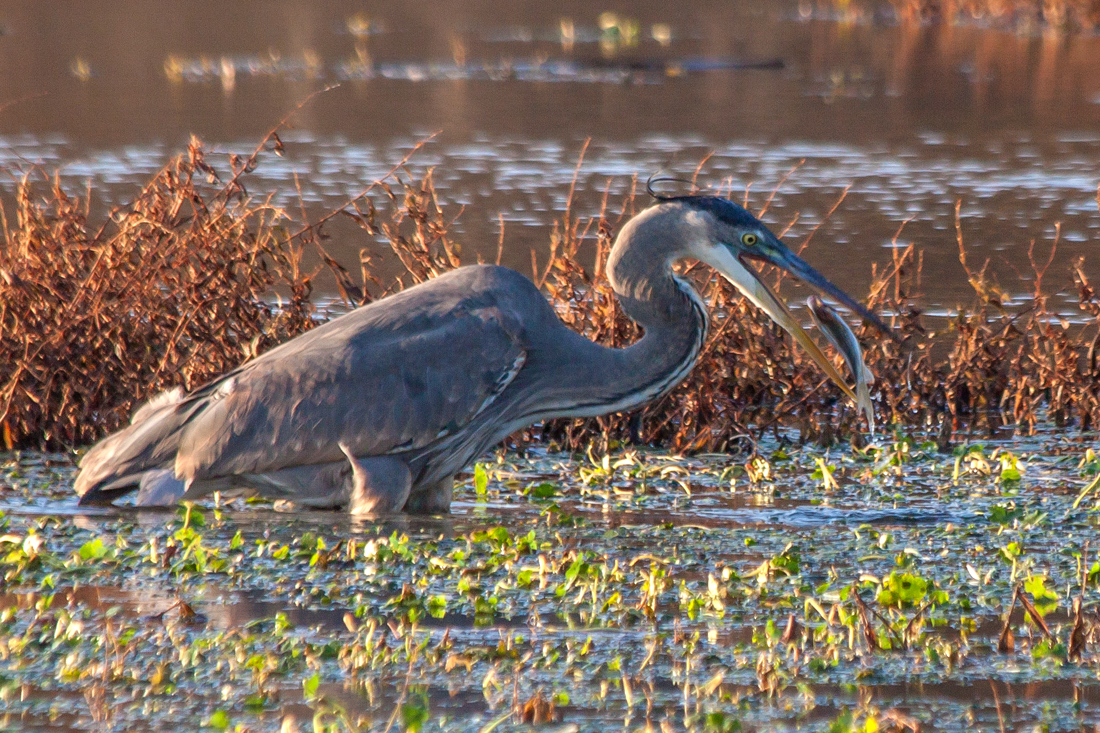
On an unusually warm date late in November I came upon a Great Blue Heron (Ardea herodias) fishing at my local marshland park. In similar situations I will often stop and wait for a little while to see if I can capture a shot of the heron catching a fish, but generally the heron is more patient that I am and I leave empty-handed.

This time, however, I felt unusually patient and I set up my tripod and waited. The sun was bright and was coming from the left, the direction in which the heron was initially facing. It is tough for me to remain continuously alert when waiting for an extended period of time and I did not react quickly enough to get a shot of the heron pulling the fish out of the water. I recovered rapidly and got some interesting shots of the heron with the fish that it had just caught.

Great Blue Heron

Not seeing eye-to-eye


Great Blue Heron

Expelling a drop of water

One of the biggest challenges for the heron is manipulating the fish so that it can be swallowed in a single gulp. Each time that the heron shakes and jiggles the fish, it runs the risk of dropping it. In this case, the heron turned away from the sun and began its maneuvers. It took some time to get the fish into position. In the last two shots, you can see the final steps of the process as the heron dips the fish in the water, presumably to make it slide down the throat more easily, and them flips the fish into the air a final time.

Great Blue Heron

Initial adjustments

Great Blue Heron

Moving into position

Great Blue Heron

Dipping the fish

Great Blue Heron

Final flip

© Michael Q. Powell. All rights reserved.

Read Full Post »

Shortly after spotting the Great Egret that I featured yesterday, I caught sight of this Great Blue Heron (Ardea herodias), almost hidden in the trees. From his perch on a fallen tree, he had a view of the grass field that opened into the marsh and seemed to be keeping watch over it.

The heron’s upright posture somehow reminded me of the sentinels at the Tomb of the Unknowns at Arlington National Cemetery, just a few miles away from Theodore Roosevelt Island, where I took this photo. At the Tomb, elite soldiers of The Old Guard, a US Army unit, are on duty twenty-four hours a day, keeping watch over the monument dedicated to American service members who have died without their remains being identified.

It is important that we never forget the military, police, and other dedicated people who are conducting the often solitary duty of keeping us safe and free, while we are awake and while we are sleeping. During this Christmas season especially, be sure to keep in your hearts and prayers the men and women who will be on duty in distant lands, separated from their family and loved one.

Great Blue Heron

© Michael Q. Powell. All rights reserved.


Read Full Post »

I thought that all of the Great Egrets (Ardea alba) had left this area for warmer locations and haven’t seen one at my local marsh in weeks. However, I encountered one this past weekend on Theodore Roosevelt Island, a small island in the Potomac River opposite part of the District of Columbia.

Great Egret

The egret was initially foraging in a field of high grass in a marshy area of the park, as shown in image below. I tried to be as stealthy as I could as I crept bit closer to the egret, but it eventually sensed my presence and took to the air.

Great Egret

The bird circled around a little, but returned to its initial location after a very short period of time in the air.

Great Egret

I had some trouble getting in-flight shots of the egret. The changing light as the bird circled, combined with the bright white color of its body, made it tough to get a proper exposure. I liked the unusual body position of the flying egret in several of the shots well enough that I included them in this post, though I think the image of the egret on the ground is probably the one in sharpest focus.

During this transitional season, it’s fascinating to see which summer birds are still with us, which birds stop by as they migrate to more distant locations, and which ones arrive to overwinter here.

© Michael Q. Powell. All rights reserved.

Read Full Post »

I don’t know if they are going to stay for the winter or are just passing through, but yesterday, the first day of December, there were a dozen or so Hooded Merganser ducks (Lophodytes cucullatus) cavorting in the water at Huntley Meadows Park, my local marshland park.

I was first alerted to their presence when I heard the unmistakable frog-like croak of one of the males. The Cornell Lab of Ornithology states that these ducks are usually silent except during courtship, when the courting male “makes a deep, rolling sound like the call of a pickerel frog, earning it the nickname of “frog-duck” in Georgia.” Check out this link to hear the call of the courting male Hooded Merganser. It seems a bit early for courting to be taking place, but the males were bouncing around as I have seen them do in the spring.

The Hooded Mergansers stayed pretty far out in the water and this is the best shot I could get of one of the males paddling by. The comic-like appearance of these ducks always makes me smile and I love their shiny golden eyes.

Hooded Merganser

© Michael Q. Powell. All rights reserved.


Read Full Post »

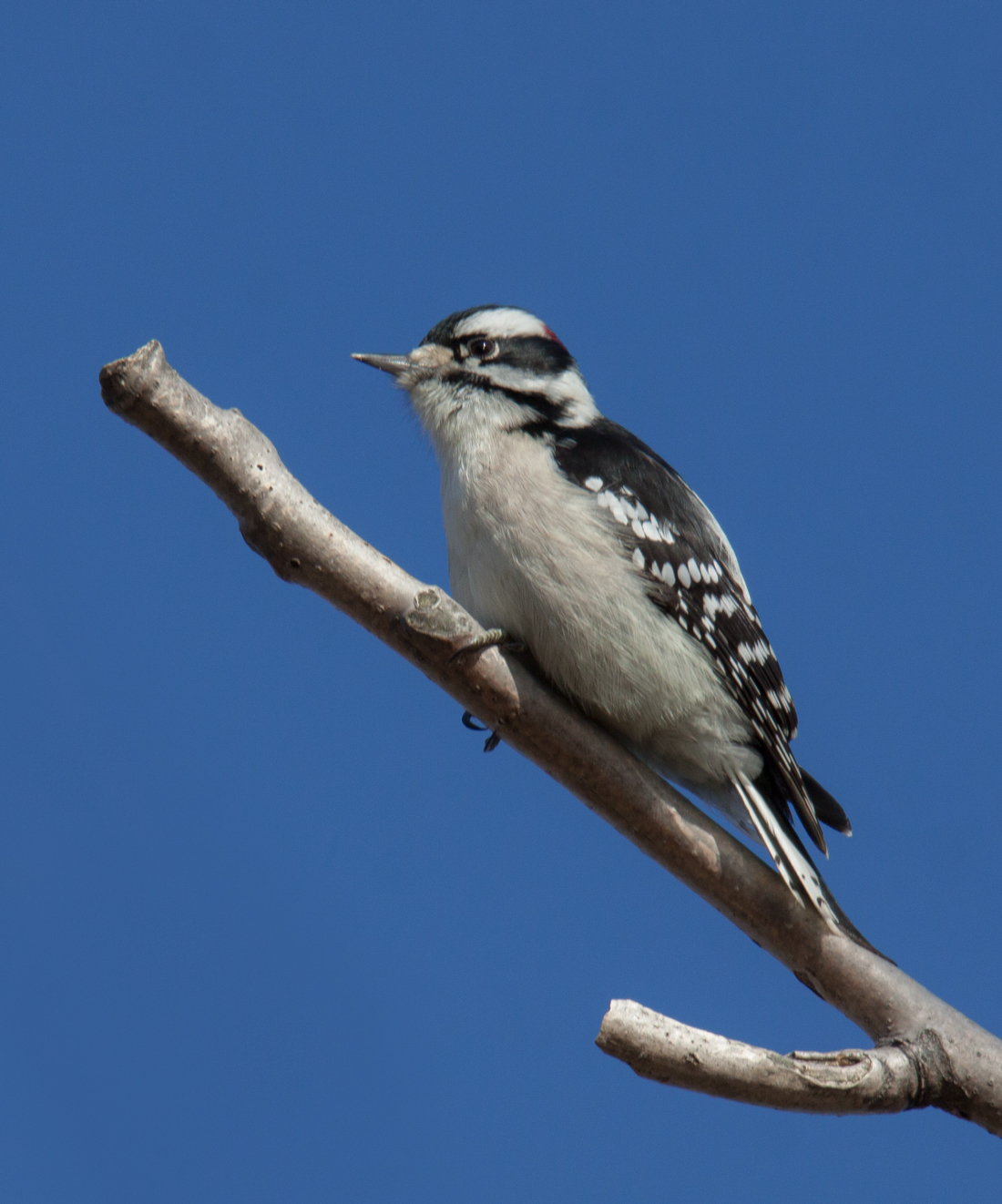
I admire the boundless energy of Downy Woodpeckers (Picoides pubescens). This weekend I watched as this male Downy Woodpecker climbed higher and higher in a tree, pecking along the way, until he ran out of branches.

He turned his body and looked up at a nearby tree and paused, which gave me a chance to get this shot of his downy white abdomen. There is a kind of tension in his position that I really like, as he clutches the branch and focuses intently on his next destination.

Downy Woodpecker

This second shot, which was taken before the first one, shows the Downy Woodpecker in a more conventional pose. He was inching his way up to the end of the branch and I was wondering what he would do next.

One thing that learned from this mini-shoot is that it is tough to hold a lens this heavy overhead for an extended period of time. I haven’t weighed the camera/lens combination, but the lens alone weights 4.3 pounds (1.95 kg).

I may have to start lifting weights to build up my arm and shoulder muscles

Downy Woodpecker

© Michael Q. Powell. All rights reserved.

Read Full Post »

Zooming a long telephoto lens while tracking a flying bird is like simultaneously patting your head and rubbing your tummy—it can be done but requires a lot of practice.

Yesterday as I was observing a Great Blue Heron (Ardea herodias) on the far side of a small pond, he unexpectedly took off. The heron flew towards me initially and then veered off to the side. My 150-600mm lens was fully extended at the start and as the bird approached, I frantically tried to zoom out a little. The EXIF data indicate that I was at 552mm when I took this shot and I just barely managed to keep the heron in the frame—I didn’t crop this image at all.

I’ve often been told to fill the frame with the main subject and this is one of the few times when I have been able to do so with a bird.

Great Blue Heron in flight

© Michael Q. Powell. All rights reserved.

Read Full Post »

Although I frequently catch a glimpse of them, it’s proven tough to get a shot of a Tufted Titmouse (Baeolophus bicolor).  These little birds are in almost constant motion and the Cornell Lab of Ornithology describes them as “acrobatic foragers.”

The coloration of the Tufted Titmice is subdued and quiet, but the spiky crest and huge eyes help them to stand out from the crowd. As I was stalking one of these birds, it flew over to a support piece for a bird feeder and perched for a moment, giving me the opportunity to snap off this photograph. Normally I try to have a more natural setting for my bird images, but the bird’s pose was so perfect that I decided to post the image.

A simple shot of a common subject can often reveal its beauty—photography doesn’t always have to be complicated.

Tufted Titmouse

© Michael Q. Powell. All rights reserved.

Read Full Post »

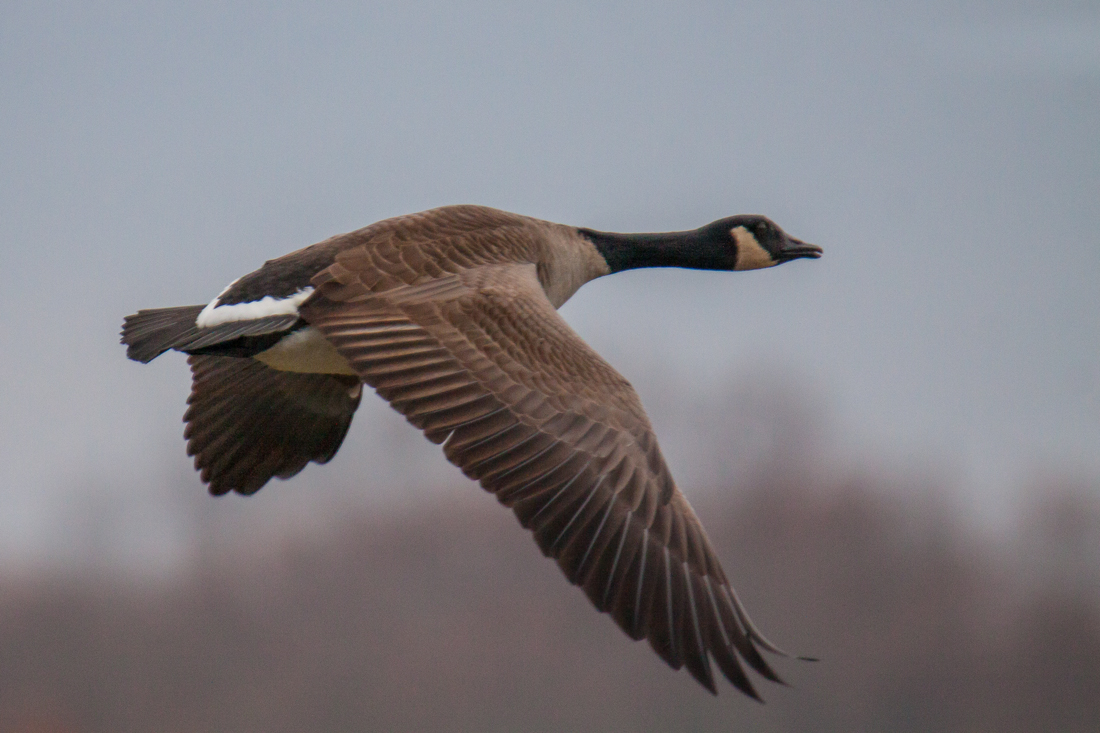
Canada Geese (Branta canadensis) have now invaded the ponds at my local marsh in full force, but the population seems mostly transient, with lots of arrivals and departures, particularly in the early morning hours.

Earlier this weekend, I continued to practice my skills in tracking birds in flight and took a couple of shots that I really like of geese flying in the early morning mist. In both cases I managed to capture a pretty good amount of detail on the goose and the background is a pleasing blur, especially in the first image, in which the hazy outlines of a distant tree line are visible. The goose in the second image was making a turn, preparing for an upcoming landing.

Canada GooseCanada Goose

© Michael Q. Powell. All rights reserved.

Read Full Post »

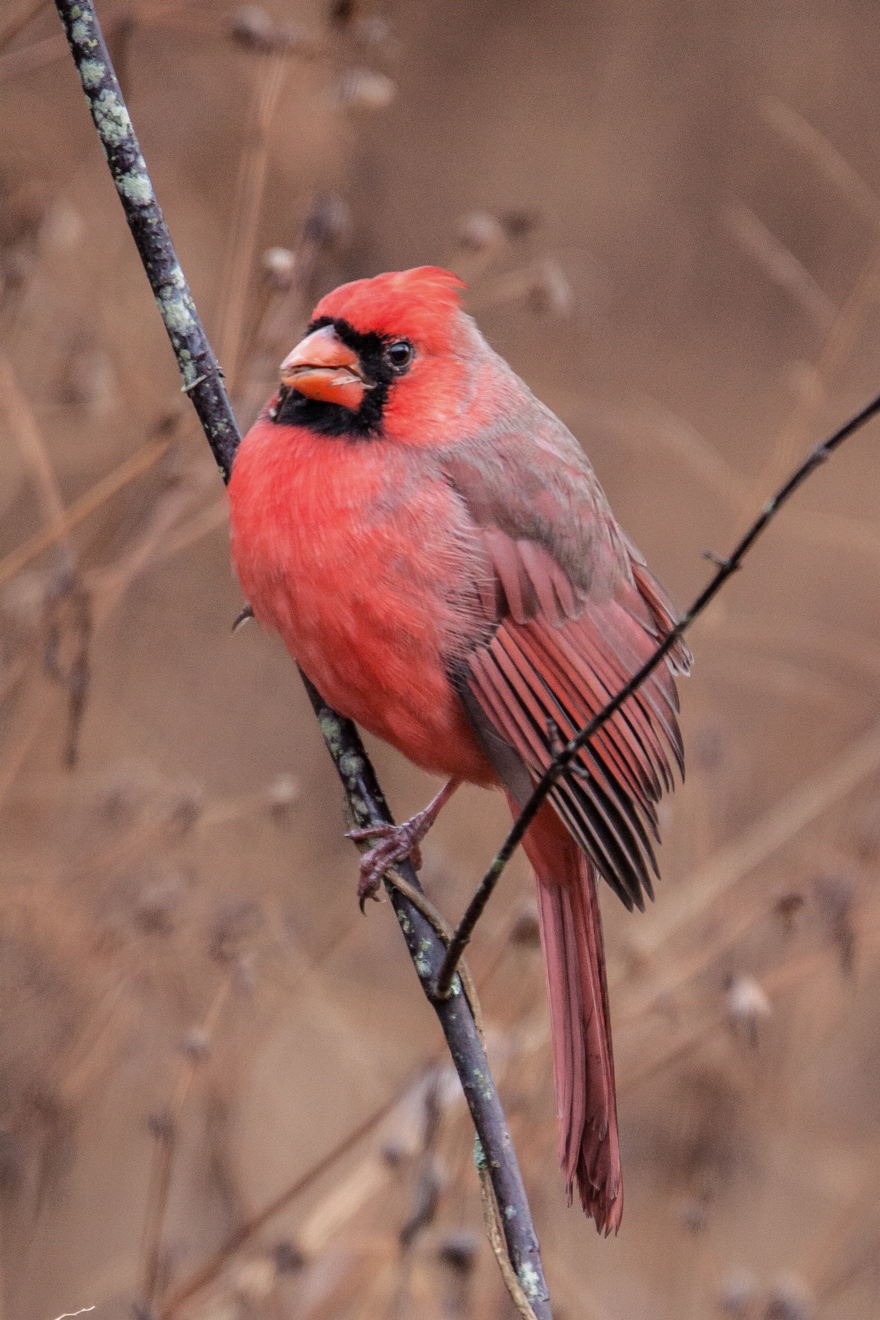
In the early morning mist yesterday at my local marshland park, the bright red color of this male Northern Cardinal (Cardinalis cardinalis) was even more distinctive than usual, shining like a beacon in the limited light.

The white-colored sky and the shadowy shapes of the trees in the distance provide a simple backdrop for this first image that gives it a lot of atmosphere. The wet, lichen-encrusted branch helps to tie the cardinal back to nature and keep this from looking too much like a studio shot, though it does look like the cardinal was posing for me.

When the cardinal moved to a different perch, the backdrop changed and the white sky was replaced by the dried-out vegetation of a field of cattails. Fortunately, the vegetation was far enough away from the subject that it softened up with the aperture wide open. In the second image, the cardinal seems to have become a little irritated with me and is scowling a bit. In both shots, the cardinal looks to have fluffed up its feathers, an indication that it was cold outside when I took these shots.

Northern CardinalNorthern Cardinal

© Michael Q. Powell. All rights reserved.

Read Full Post »

I started my Thanksgiving Day early with a big bird. No, I wasn’t preparing a turkey—I was sharing a quiet moment with this Great Blue Heron (Ardea herodias) at Huntley Meadows Park, the local marshland where I capture a lot of my images.

Happy Thanksgiving to all.

Great Blue HeronGreat Blue HeronGreat Blue Heron

© Michael Q. Powell. All rights reserved.

Read Full Post »

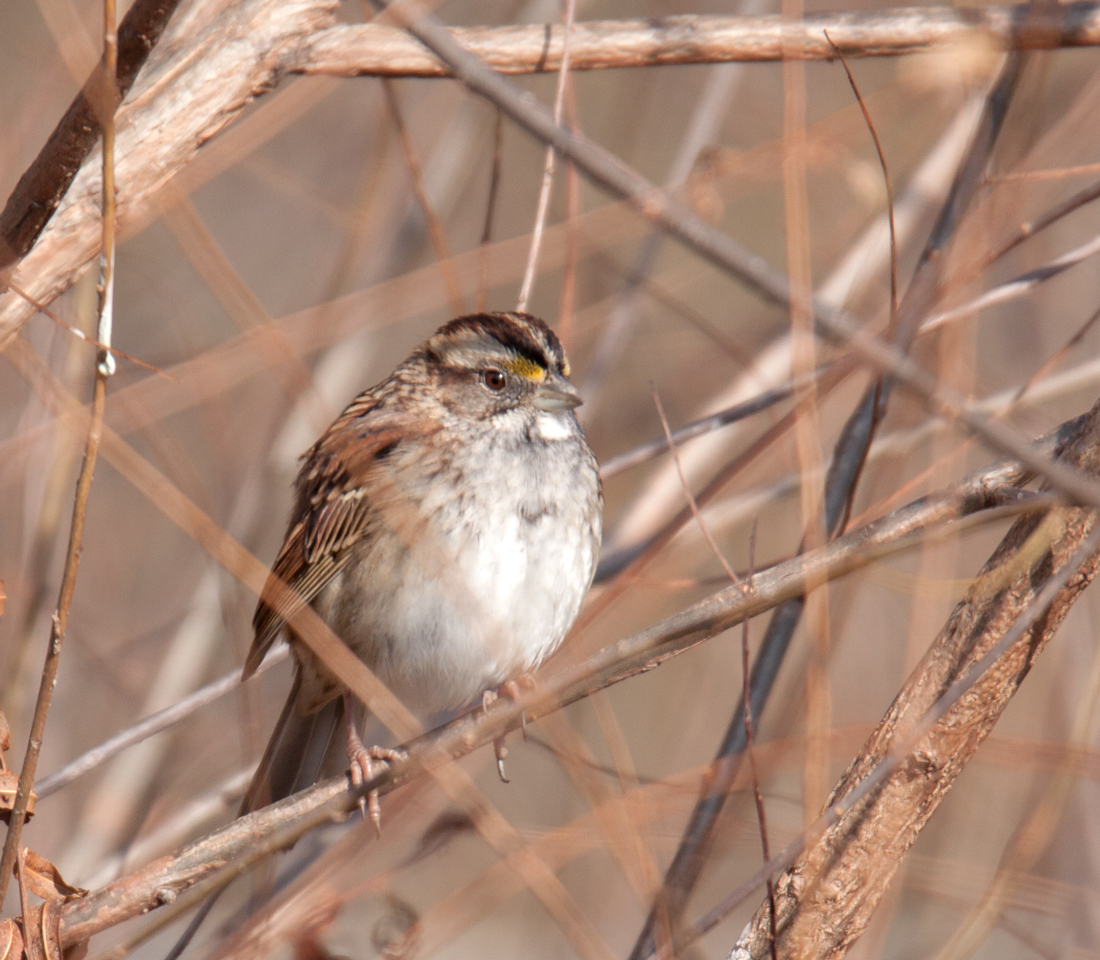
One of my goals in testing out my new Tamron 150-600mm lens was to see how well it did in capturing the little birds that hide out in the underbrush. As we move deeper into the autumn and into winter, I can always depend on hearing and sometimes spotting different kinds of sparrow poking about in the tangled plants and leaves in the marsh. These birds tend to be in constant motion, moving quickly from spot to spot after a few pecks, and this weekend I stalked a few of them to see if I could focus quickly and accurately on them.

We seem to have had a recent influx of White-throated Sparrows (Zonotrichia albicollis) and I think that all three of the images below are of members of this species. However, sparrows have often confounded me in the past, so I apologize in advance if I have misidentified them.

These sparrows seem to have individual personalities and I like the fact that they posed in different ways for me. I used to ignore sparrows and other such birds, but now go out of my way to try to photograph their beauty and individuality. I think my new lens passed the test in being able to capture portraits of these little sparrows.

White-throated SparrowWhite-throated SparrowWhite-throated Sparrow

© Michael Q. Powell. All rights reserved.

Read Full Post »

As the sun went down and a sliver of the moon appeared at Huntley Meadows Park, a Great Blue Heron (Ardea herodias) made a last attempt to catch a fish in the dwindling light.

Great Blue Heron

sunset_nov_blog

Waxing crescent moon (thanks to Walter Sanford for the identification)

Waxing crescent moon (thanks to Walter Sanford for the identification)

© Michael Q. Powell. All rights reserved.

Read Full Post »

Some of the reviews of my new Tamron 150-600mm lens suggest that it has trouble capturing birds in flight, so I was anxious to test out its capabilities and the Canada Geese (Branta canadensis) coming and going from my local marsh served as my initial test subjects.

These five geese were part of a larger group that was departing from the marsh and I started tracking them as they flew past me. Initially thought that one of the geese has flown out of the frame in the second image, but then I looked more closely and realized that all five were still there—the formation was really tight (or at least the compression caused by the long telephoto lens made it look that way.

Sometimes in the past I have had problems in grabbing focus on moving subjects, especially when the background is cluttered and is competing for focus. I was happy to see that I was able to acquire and hold focus pretty well and the geese are separated from the trees in the background.

I am learning how to manage this longer lens and, for example, still have trouble sometimes pointing the extended lens at a subject and then finding the subject in the viewfinder—the field of view is not very wide at 600mm. I plan to check out the different focus options for my camera to see if any of them will improve my changes of getting clearer shots.

Does it show that I’m pretty excited with my new lens? I’ll be sharing more images as I continue to practice and learn with it.

Canada Geese in flight

Five guys in flight

Tight Formation

Tight Formation

© Michael Q. Powell. All rights reserved.

Read Full Post »

As I wandered along the boardwalk yesterday at my local marsh, birds would periodically pop in and out of the eye-level cattails. Most of them were little sparrows that would bury themselves back down in the underbrush. At one point, though, a male Red-winged Blackbird (Agelaius phoeniceus) emerged and perched near the top of the cattails.

He was so close that I didn’t dare move from where I was standing and I tried to find a visual path through the vegetation to get a clear shot. I cropped this image slightly and made a few minor post-processing, but this is pretty much what I was seeing through the viewfinder as I tried out my new Tamron 150-600mm lens.

The photos were shot handheld at f/6.3, 1/400 sec, ISO 320, and 600mm. Recognizing that the image quality would increase a little if I closed down the aperture, backed off from the maximum focal length, and used a tripod, I am nonetheless pretty happy with the result and it’s definitely cool to more than fill the frame with a bird.

Red-winged Blackbird

Red-winged Blackbird

© Michael Q. Powell. All rights reserved.

Read Full Post »

Yesterday I spotted a male Downy Woodpecker (Picoides pubescens) on an exposed branch in a tree across a small field of cattails. In the past, I would not have even attempted to take a shot because of the distance, but I recently bought a Tamron 150-600mm zoom lens and suddenly this little bird was more or less within reach. This was my first day out with my new lens and it was fun testing out its capabilities (and I’ll do a few more postings showing what the lens was able to get in different situations).

Downy Woodpeckers seem to have an amazing amount of energy and are in almost constant motion. As I watched, the little woodpecker pecked his way to the end of the branch and then stopped. He seemed to be confused and stared straight ahead at first,  Unsatisfied, he looked down and then up. Suddenly he lifted off almost straight up and I was fortunate to capture him with his wings extended.

Who knew that Downy Woodpeckers had such an impressive wingspan?

Downy Woodpecker

Liftoff

Downy Woodpecker

Looking ahead

Downy Woodpecker

Looking down

Downy Woodpecker

Looking up

© Michael Q. Powell. All rights reserved.


Read Full Post »

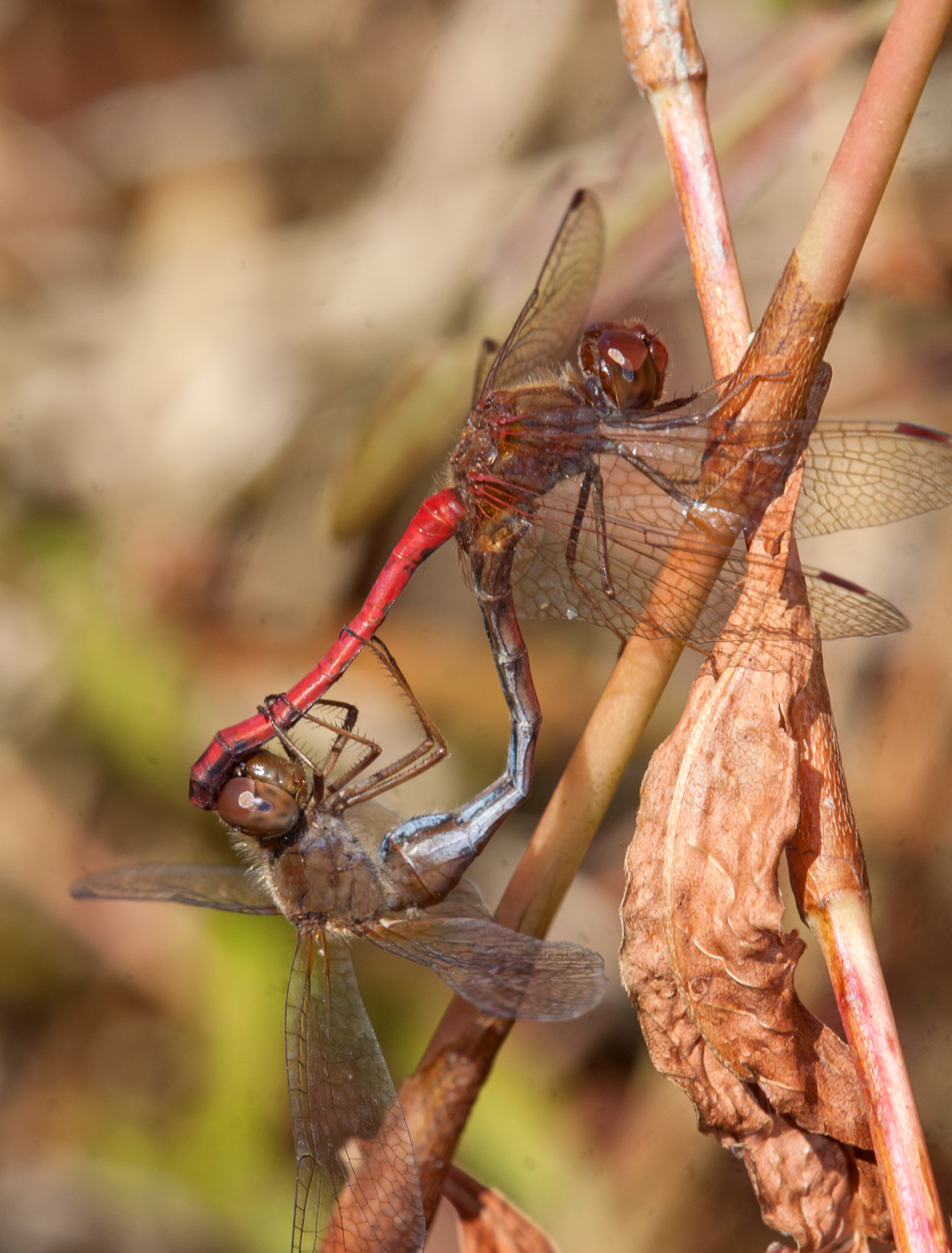
When I captured these two images of mating dragonflies on the 10th of November, I did not realize that their frantic efforts to perpetuate their species that day would mark an end to this year’s dragonfly season for me. There is a chance that some especially hardy Autumn Meadowhawks (Sympetrum vicinum) may have survived our recent spell of bitter cold, but realistically speaking, it’s time to put my macro lenses on the shelf and focus my photographic efforts and birds (and the occasional small mammal).

The Autumn Meadowhawks in the first image were a little higher off the ground that the Blue-faced Meadowhawks (Sympetrum ambiguum) in the second shot and I managed to get into a better shooting position to capture details and separate the dragonflies a bit from the background.  In case of the Blue-faced Meadowhawks, I was so thrilled to see them so late into November that I was willing to settle for a lower angle shot with a more cluttered background.

Most of the time I feature only a single species of dragonflies in a posting and it’s a little hard to compare the featured dragonflies with others. It’s a whole lot easier to see the differences between the species when you compare the two photos here.

And so this year’s dragonfly season draws to a close, as the mating couples dance their last tango of the autumn.

Autumn Meadowhawk matingBlue-faced Meadowawk mating

© Michael Q. Powell. All rights reserved.

Read Full Post »

I recently experienced a sharp increase in the number of views of my blog and went from 628 to 4723 views in a single week.  One of my posts has had an amazing 3235 views to date. What happened? Have I learned a secret to boosting my viewer statistics?

As you might have guessed from the photos that I have reprised below, the post in question is my 4 November posting Rescue of an Injured Bald Eagle. Within my WordPress world, the post was reasonably successful and sixty viewers “liked” it, but that’s not enough to account for the boost.

The most important key to getting more viewers, I think, is finding viewers from outside of WordPress. I sometimes cross-post on Facebook account and in a few Facebook groups to which I belong and will get some additional views, but generally only a few.

I’ve looked back at all that transpired and here is the “formula” that led to my “success.” First, take photos of an event that is newsworthy, has broad appeal, and preferably has police involvement. The police departments, it seems, are always looking for good news stories, and I sent copies of my photos to the officer who made the rescue. The Fairfax County Police Department posted my photos (with attribution) on their blog on 5 November and included a link to my blog posting. This got the ball rolling, it seems.

The next step is to enlist the aid of the mass media in publicizing your blog and keep them updated. I suspect that news outlets troll the police sites for stories and suddenly I started receiving requests from reporters to use the photos in the on-line versions of their television or radio stations—I don’t think the photos appeared in print. I gave approval each time that I was asked, but requested attribution by name and, if possible, a link back to my blog.

The local Fox station and the local NBC station were the most cooperative and did articles that used my photos, excerpts from the text of my blog, and included links to my blog. The Fox article brought in more than 750 viewers and the NBC article brought in over 100 viewers. WTOP, a local news radio station, was similarly cooperative. I made sure to keep these reporters in the loop when I first received information that the eagle was euthanized and all they did updates on the story.

What about the others? Several news outlets, most notably The Washington Post, used my photos with attribution, though they did not request permission or link back to my blog in any way. It was really cool to see the Post use one of my photos in articles on 5 November and 6 November, but it had no effect on my blog statistics. The local ABC station WJLA also gave attribution when they used my photo in an article. I ran across a couple of instances in which my photos were used and they were attributed to “a park visitor” or to the police department.

I came across the photos, with attribution, in several local community news sites and in a couple of other Fox site as well. The euthanization decision was carried by the Associated Press, but, alas, they did not use a photo.

I think I understand better now how I had such an increase in viewers, but I realize that the experience is not easily replicable and the results were short-lived. After the temporary spike in views, I have returned to more normal levels. I enjoyed the brief moment in the spotlight and learned a lot about how stories enter into the news cycle, but I am content to return to my smaller world of walking the trails, in search of new photographic adventure.

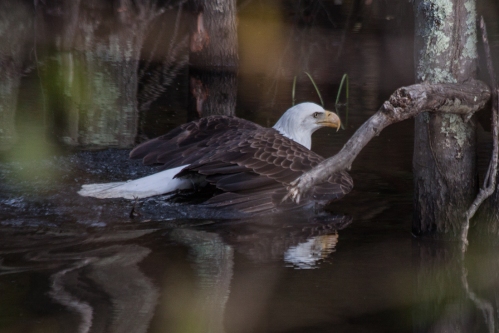
 

Bald Eagle rescue

Bald Eagle rescue

© Michael Q. Powell. All rights reserved.


Read Full Post »

I’ve been in denial about the change of seasons. Two weeks ago it was warm and I was still photographing insects.  The sub-freezing temperatures the last couple of days have been a reminder to me that it’s time to put my macro lenses on the shelf and reach for my telephoto lenses.

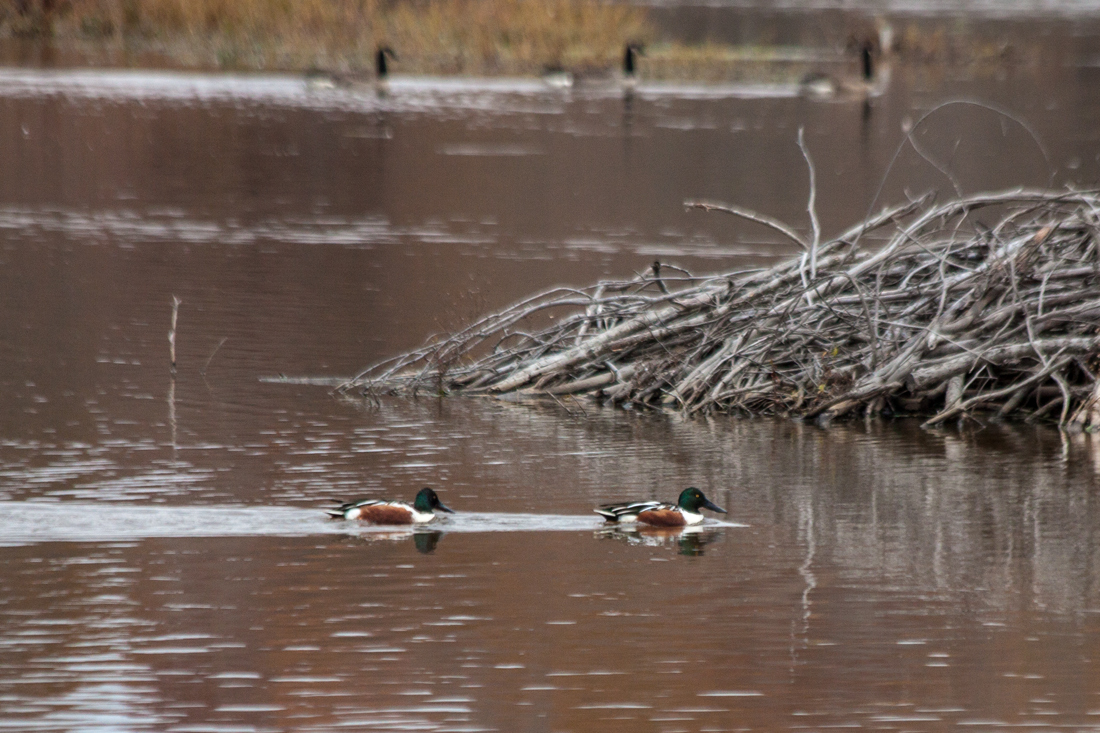
Walking through my local marshland park this past Monday, I couldn’t help but notice that the ducks are starting to arrive. During the fall and winter, the park hosts a variety of different ducks (along with quite a few Canada Geese). Some of them are there for a brief stay and then continue their journeys to more distant destinations. Others remain for an extended period of time.

Among the early birds are these Northern Shovelers (Anas clypeata), whose distinctively-shaped bills and colorful bodies make them hard to miss. They were paddling across the largest pond in the park, past a brush pile, when I captured this image. I didn’t notice it when I took the shot, but I really like the way that you can see some Canada Geese swimming in the distance.Northern Shoveler

© Michael Q. Powell. All rights reserved.

Read Full Post »

The weather recently has turned cold and heavily overcast with intermittent rain. The chill in the air reminds me that winter is coming and apparently the beavers at my local marshland park have been receiving the same signals.

One of my favorite places in the park is a small beaver pond in a remote area of the park. It is peaceful and quiet and there are some fallen logs on which I like to sit and just watch and listen.

As the summer progressed I grew increasingly uncertain about the inhabitants. Were they still there or had they moved? It looked like the dam that held in the water had been neglected and parts of it were deteriorating.

I am sill not certain that they are still in the lodge that you see in the second photo, but in the area surrounding that lodge, I’ve come across incontrovertible evidence that beavers have been busy—several dozen small and medium trees that have been removed and the toothmarks look fresh.

I’ll be keeping my eyes open for additional signs that the lodge is occupied or that another one is being built nearby as I return to this spot.

dam3_blogdam1_blogdam2_blog

© Michael Q. Powell. All rights reserved.

Read Full Post »

I have seen these signs for a couple of months at my local marshland park and haven’t given them much thought. Yesterday, however, as I was wandering through a remote area of the park, I came across an above ground metal tree stand and the muscles between my shoulder blades began to involuntarily twitch a little.

My first thought was to climb up into the stand to check out the view from the higher vantage point. I resisted that impulse and began to wonder if I was risking my safety by traveling as often as I do off of the beaten path. Technically speaking, no part of the park is closed, but I must confess that I was not on an “established trail.”

This park is in a suburban area and one of the problems we face is an overpopulation of deer. Huntley Meadows Park explains the reason for the deer management program in these words:

“Over-populated deer herds eat large amounts of native vegetation, having a seriously negative effect on forest ecosystems. Native fruits, seeds, flowers and leaves essential as food sources for other wildlife are drastically reduced, or even eliminated. A park Huntley’s size should have approximately 60 White-tailed Deer-our most recent surveys indicate a herd of over 150. These over-populated herds are caused by the removal of deer’s natural predators (wolves, mountain lions, American Indians, etc.), and also the abundance of “free” food found in suburban yards. Archery hunters help replace absent predator populations and reduce deer numbers to more natural levels-this encourages a healthier forest ecosystem, with more plant and animal diversity.”
I probably will not curtail my photographic explorations, but I plan to be a little more cautious than I have been up until now—and I might even start wearing a hat or a vest that is bright orange.

archery1_blog archery2_blog

© Michael Q. Powell. All rights reserved.

Read Full Post »

During most of the year the bright red body of Blue-faced Meadowhawk dragonfly (Sympetrum ambiguum) would really stand out, but in the late autumn, it blends in pretty well with the vegetation. However, it is almost impossible to conceal this species’ stunning blue eyes and turquoise face, which cause it to stand out from even a very cluttered background.

Blue-faced Meadowhawk

© Michael Q. Powell. All rights reserved.

Read Full Post »
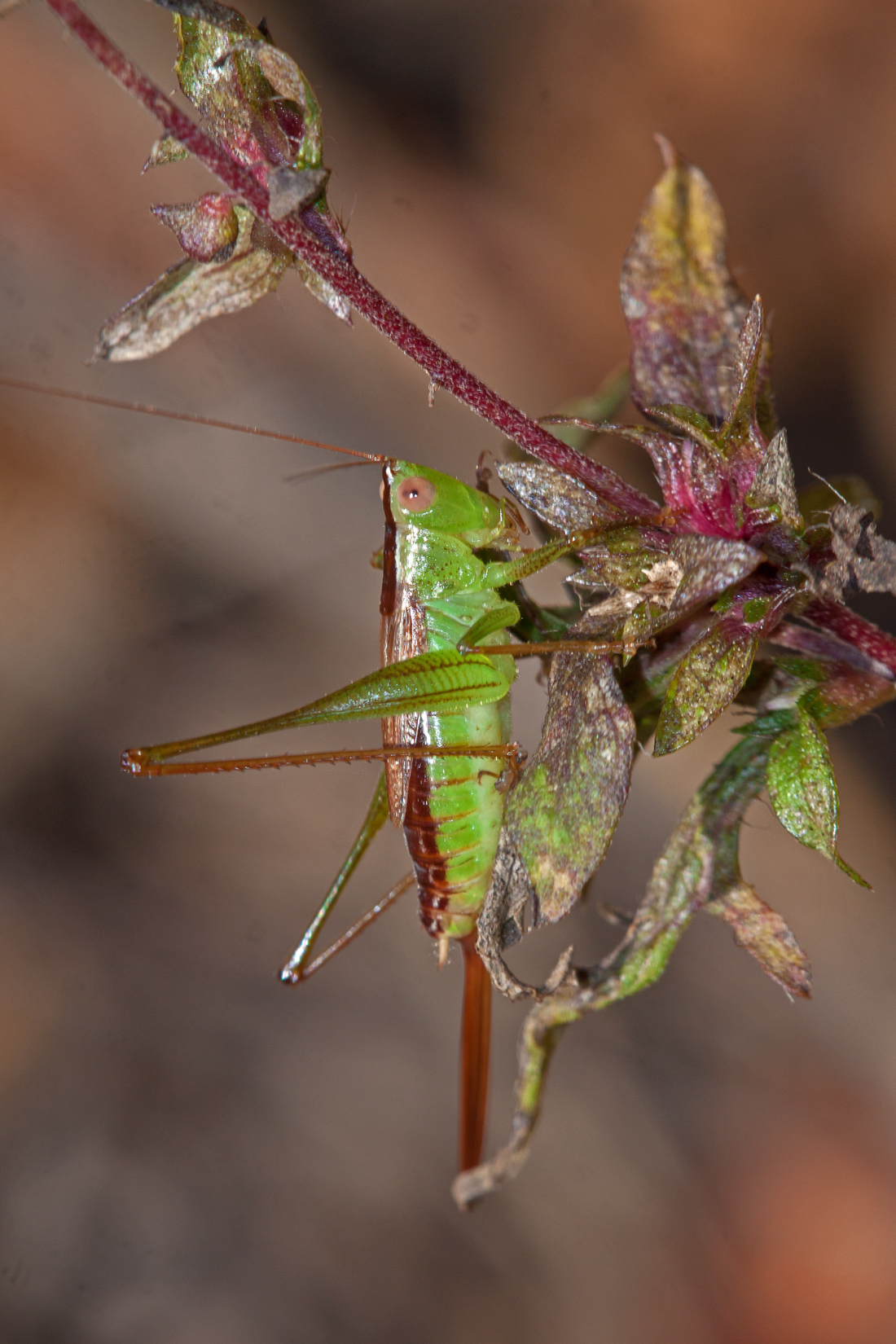
Although many summer dragonflies perch high on the vegetation, the autumn species seem to prefer the ground, so I have been spotting all kinds of cool-looking insects as I keep my eyes pointed down in my continuing search for dragonflies (and so far have not run into anything).

Earlier this week, I came across this beautiful grasshopper-like insect. It looks a bit like my all-time favorite insect, the  Handsome Meadow Katydid (Orchelimum pulchellum) and has the same long antennae, but this katydid’s colors are drab by comparison. (Check out one of my previous blog postings called Rainbow Grasshopper to see my favorite insect.)

This insect’s wings are pretty short and it looks to have a long ovipositor. As a result, I’ve tentatively concluded that it might be a female Short-winged Meadow Katydid (Conocephalus brevipennis) and have put in a request to the helpful folks at BugGuide for assistance in confirming my identification.

Short-winged Meadow Katydid

© Michael Q. Powell. All rights reserved.

Read Full Post »

« Newer Posts - Older Posts »